
Lectures on Political Economy
Appendices
1. PROFESSOR CASSEL’S SYSTEM OF ECONOMICS2
(i) Cassel’s refutation of the theory of value, his theory of exchange, and his views on the pricing mechanism.
(ii) The theory of interest, the theory of rent of land and mines, the theory of wages.
(iii) The nature of money and international payments.
(iv) The theory of trade cycles.
I
Professor Cassel, like so many others, has felt a call to present his scientific system to a wider public than that which could follow his lectures. He has for this purpose secured the collaboration of Professor L. Pohle, of Leipzig, who is eventually to publish the preliminary part, dealing with historical and sociological developments, of their joint work, Lehrbuch der Allgemeinen Volkswirtschaftslehre. Professor Cassel is the author of the second and purely theoretical part, which is now published in a large volume.
To review this book one must sit in judgment on the whole of the author’s lifework in the sphere of theory. Professor Cassel expressly desires that all his writings—even the earliest and least mature of them—should be regarded as indispensable foundations for the theoretical edifice, which now appears in its completed form. The wisdom of refraining from a fundamental revision of his earlier, and in my opinion, less completely developed views, while not letting them fall into oblivion, may perhaps be questioned. But naturally this is his own concern. For my part I also have felt the need of arriving at an understanding of his whole approach to theory. On various grounds, mostly personal, I have never undertaken a public criticism of any of his work, with the exception of his very first essay in the Tübinger Zeitschrift.3 If I delayed much longer, it might be too late for either or both of us. This may excuse the unusual length of the following essay.
The many excellent qualities distinguishing Professor Cassel’s earlier writings and also—I believe—his direct teaching activities, are to be found in abundance in this work. I envy him his ability to present generally accepted economic doctrines concisely and comprehensively, and to throw light on them with well-chosen examples from the world of affairs, with which he appears to have acquired a practical acquaintance. Last and not least there is his laudable attempt at a description of concrete economic phenomena, based on statistical material—this being especially evident in the fourth section of the book, on cyclical fluctuations, which I hold to be the best.
With these merits, however, Professor Cassel possesses the defect of desiring at all costs to be esteemed an original and even path-breaking theorist, and this in every branch of economics. It remains a riddle how with his diligent activities as a publicist and with his numerous public duties, he can have found time for these inquiries, for nothing is so consuming of time as scientific thought. I am afraid that his claim is based on an illusion. His originality does not extend in most cases beyond an exposition of the ideas of others in a new, if not always improved, version. Innovations are generally the mark of an indomitable desire to penetrate the obscurer regions of theory; but this end is not often achieved by those who have too cursory an acquaintance with the terrain. The reader finally ends in a bog of mental confusion, which a facile style can no longer conceal, and from which the only escape is to revert to precisely that literature which is here so contemptuously dismissed as “unnecessary” and “scholastic”.
The first and most striking of these tours de force is the wholesale rejection—already appearing on the first page of his introduction—of “all the old so-called theory of value”. Of course, he means the modern theory of value. He has always been more amiably disposed towards the older theories of value; this, together with his charm of exposition, was what recommended him to the aged Schäffle.
On the other hand, he wants to extirpate the modern subjective theory of value; but he substitutes for the concept of marginal utility either nothing at all or the “principle of scarcity”. He asserts that the psychological phenomena lying behind price do not belong to the economist’s domain. This idea reminds us of the English stockbroker, who earned his income, year in year out, by buying and selling railway stock without knowing where the railway was. He also repeats his old objection about the impossibility of “measuring utility”, as though exchange and economic activity in general—even in a primitive economy—would be conceivable, if we could not estimate the utility of different objects to us. Similarly, the deliberations of members of Parliament on problems of taxation would be meaningless, if it were impossible to compare the utility of the same good to different persons. (It is characteristic of Professor Cassel that when he has to talk about so-called collective wants, he dismisses the whole thing as a manifestation of force “Zwang, Zwangsivirtschaft, Zwangorganisation,” et praeterea nihil.) He himself is of the opinion that the “economist” must adhere exclusively to money prices as being a “precise magnitude”—and this was written or printed in the last year of the Great War, when money as a measure of value became completely bankrupt.
He also maintains that marginal utility as the basis of exchange value presents the disadvantage that it is neither given nor determinate, but is itself variable with and dependent on the prices which it is intended to explain. But how does this apply to “scarcity?” A commodity is not scarce because it is present in small quantities, but, as Professor Cassel himself states in the Introduction, it is scarce only in relation to wants, or to the extent that it becomes an object of demand. And the degree of scarcity is measured in exactly the same way as marginal utility, by the strength of the next unsatisfied need, which first causes the commodity to be recognized as “scarce”. In other words, scarcity and marginal utility are fundamentally one and the same thing; Walras already recognized this, for the word “rareté” (which he used as an alternative to “utilité finale”) signifies scarcity as well as rareness.
Such, however, is not Professor Cassel’s opinion. Strangely enough, he himself—apart from the above introductory passage—gives no description of the concept of scarcity, otherwise the relationship might have become clear to him. To compensate for this omission, he prints in italics the following definition of the principle of scarcity. “In the exchange economy,” he says, “the principle of scarcity signifies the necessity, by the pressure of prices, to adjust consumption to a relatively scarce supply of goods” (p. 74). What is meant by a “scarce supply” remains, as we have said, unexplained. But even so, this definition is absurd, for there is no need to be afraid of consumption exceeding supply. In the later course of the work the word “consumption” is consistently replaced by “demand” in this connection. And in this formulation one can indeed recognize the principle, for price undeniably has the “task” of equating supply and demand, so that all the supply is sold and no effective demand remains unsatisfied.
But if the Principle of Scarcity did not contain anything else, it would be absolutely identical with the ancient principle of equilibrium between supply and demand, of which Cassel does not suppose himself to be the discoverer. The doctrine of marginal utility goes beyond this by stipulating equality or proportionately between commodity prices and their “scarcity” (= marginal utility) for each exchanging individual. That this principle is by no means so easily established, ought to be proved by the fact that, even Gossen, the first expounder of the theory of marginal utility, did not reach it. That it was not “unnecessary”, seems to follow from the fact that not less than three genuinely path-breaking scientists advanced it as an important discovery at roughly the same time. Certainly it contains nothing absolutely new, but neither did the discovery of the differential calculus; the service of both consists in their having replaced diffuse or unsystematic ideas by a clear general concept and, what is no less important, by an adequate formulation of it.
Why has Professor Cassel absolved himself from this task? Why, apart from an otherwise perfectly correct résumé in a few lines, has he withheld from his readers this serviceable guide through the labyrinth of the theory of exchange? For example, the concept of elasticity of demand with falling and rising prices becomes much clearer, if it is based on the elementary principle that marginal utility always remains proportional to price. Here also Professor Cassel advances without closer examination a series of statements, of which a few are correct, but generally require an explanation, while others are doubtful or completely wrong; such as the statement (p. 80) that demand must invariably rise with a fall in price, and vice versa. This is not certain in the case of goods which are partly substitutable in consumption, and in the case of the reservation demand of the holders of the goods themselves. The effect on the latter of a rise in the price of their goods may quite conceivably be such that they retain a greater proportion for their own use. This must have been the case to a great extent, if I am not mistaken, with those who produced for their own needs during the war. Professor Cassel himself gives an extremely brief account of the fundamental concept of marginal utility, and it would not surprise me, if his readers, so far from thinking this account “unnecessary”, were, like Oliver Twist, to ask for more.
Another peculiarity of Professor Cassel’s to which we have elsewhere drawn attention, and which, remarkably enough, he regards as a step forward, is his use of money as a “scale of reckoning”.4 He boldly maintains that when the classical economists attempted, wherever possible, to abstract from the use of money in their inquiries into economic phenomena, this was due to their preconception (which according to Professor Cassel is false) that in primitive society no money was used. This statement is characterized by a naïveté which one would hardly have attributed to Professor Cassel. On the contrary, this conscious abstraction from the functions of money—the conception of trade, external as well as internal, as consisting in the last analysis in the exchange of commodities, of capital as real capital instead of as a sum of money,5 of wages as real wages—was the decisive step which first gave economics a truly scientific character, and first raised it above the hazy and incoherent ideas of Mercantilism.
For the rest, Professor Cassel does not succeed in carrying his method through consistently. In his treatment of the “pricing mechanism”, to which we shall later return, he first assumes that each consumer has a certain purchasing power (expressed in money), and he naturally arrives at the result that the prices of commodities will be completely determinate. I became vastly interested in reading this, for I thought that the next step would be an attempt to demonstrate how this monetary purchasing power arose and was maintained. But nothing comes of it. The hypothesis is merely advanced only to be dropped later, and quite unexpectedly the explanation follows that the phenomena of exchange and production only suffice to account for relative commodity prices, but not absolute money prices, a task which must be kept in reserve for the theory of money as such. Now it should be noticed that Cassel explicitly says that at this stage he will consider money exclusively as a “scale of reckoning”, and will thus provisionally abstract from its function as a medium of exchange, which perhaps may even be taken over by some other commodity—as in Homer’s times, when “oxen” were used as a measure of value, although they hardly constituted a general medium of exchange. In this case, however, money would retain its character as a commodity perfectly intact, and the use of money as a measure of value would not prejudice it in the least. In other words, the exchange value of money would be determined by the phenomena of production and exchange in exactly the same way as that of other commodities, and ex hypothesi the prices of commodities expressed in money would be uniquely determined precisely by the “pricing mechanism”, and not merely, as Professor Cassel states, prices multiplied “by any factor whatsoever”. Further, we should get the same result, if money were, strictly speaking, nothing more than a medium of exchange, i.e. the means of presenting goods on the market. For an amount of money, however small, can, as we know from experience, effect the exchange of any quantity of commodities whatsoever. Now money has also a third function, which is in practice the most important, i.e. as a “store of value” a reserve or cash balance. It is through this characteristic that with given commodity prices the need for a certain amount of money obtains, and it is here that the amount of money becomes a factor of the first order for commodity prices. Further, it is through this property that the character of money as a commodity recedes into the background, becomes secondary, or even vanishes altogether. This was perfectly clear to Walras; he first treated money as “numéraire” (unit of account) and only later as “monnaie” (medium of exchange); as far as its first property is concerned, it is for him only one commodity among many. Professor Cassel, on the other hand, argues as though the “oxen” of Homer were not generally the object of consumption and exchange, but only served as a “scale of reckoning”. Here at least the premature introduction of money has contributed not to increased lucidity but rather the reverse.
A more valuable element in Professor Cassel’s account is the emphasis laid on the reciprocal relationship between products and the factors of production in the pricing process. In those of his earlier writings which I regard as his best,6 Professor Cassel has shown with a masterly clarity that as soon as we have more than one factor of production (e.g. simple manual labour), and in fact we have hundreds of different kinds, the principle that costs of production determine the exchange value, of a product can no longer be maintained. These costs become quite simply the prices of the factors of production, which are necessarily determined in combination with the prices of commodities in a single system of simultaneous equations. This idea, however, belongs to Walras; it is his powerful synthesis which in the last analysis lies at the basis of Professor Cassel’s “pricing mechanism”. Professor Cassel’s indebtedness to him is obviously very great, but instead of showing the gratitude he ought to have expressed, he does not mention Walras’ name once in the whole book.7 He adheres, though not altogether consistently, to the principle of never quoting anybody but himself. He has not, however, accomplished any improvement in Walras’ exposition—apart from a certain simplification in the formulae. On the contrary, he breaks off in the middle, with a resulting loss in coherence. Following Walras, he describes how the total rewards of the factors of production are in the main identical with total (real) incomes, and are at the same time the source of the demand for goods and services; he adds that these incomes are not all consumed, but are partly saved. But at this point the equality (which we had previously accepted) between the sum of the factors of production now available, and that part of them which enters into the various goods demanded for consumption, ceases to obtain, and Professor Cassel’s system of equations (7) (p. 144) is no longer valid. For the whole system to function, it is not only necessary that the savers, as Professor Cassel assumes, should decide how much to save on the basis of ruling prices or in relation to the determination of prices, but also that they, or the entrepreneurs in their stead, should be clearly aware what factors of production to demand in order to invest their savings most profitably. Of this, Professor Cassel says not a word. But even if the reader in distress could fill this gap unaided, he would in any case begin to have doubts, when, in the course of the book he meets Professor Cassel’s factor of production “capital-disposal” and its “price”, interest, and tries to accommodate these magnitudes with the other factors of production and the prices in the formulae previously given. It would have been of great interest if Professor Cassel had indicated how this could be managed without double reckoning.
Walras proceeds in an entirely different manner. For him the capital-goods themselves are factors of production just as much as labour and the forces of nature; and the rate of interest “le taux du revenu net” is considered as the ratio between the expected yield of the capital-goods now being made (= the price for their factors of production minus the necessary amortization costs) and their own cost of production according to present prices. Thus it here represents a “parameter” in the “functions” which determine saving. Savers and entrepreneurs strive to maximize this ratio, and equilibrium is reached when it is the same for all alike. In this way Walras constructs an extraordinarily coherent and rigorous system, which, when it is combined with the systems of Jevons and Böhm-Bawerk, both completes and is completed by them.8 Professor Cassel simply omits the whole of this vital section of Walras’ system, and defers the theory of capital to the next book, when he moves more freely without having to trouble himself about algebraical formulæ. But more of this later.
We are now confronted with the difficult task of giving an account of another peculiarity in Professor Cassel’s presentation of fundamentals. It is well known that the classical economists were often inclined to adopt a method of approach in which they regarded free competition or a free pricing mechanism as a kind of moral factor—an economic providence, so to speak, which gave each participant in total production his allotted and just share of the product and, at the same time, gave the maximum sum of satisfactions to all. Among contemporary economists, Professor Cassel should be one of the last to find it easy to escape from this approach. It is true he does not go so far as to make the existing state of society, based in principle as it is on free competition, the ideal of social justice; his own parable “of the bread of the poor which is sometimes thrown to the dogs of the rich” bears evidence of this. But essentially he stands by the classical system. He emphasizes as often as possible its economic superiority, and if he can do nothing else he praises “the free choice of consumption goods” which it provides in contrast with, for example, a similar socialist state. He is so little afraid of provoking laughter that in another context he adduces salt and ink as proof of the fact that even the poorest can almost completely satisfy some of their needs.
Actually the lower classes in present-day society do not in the least possess free choice in consumption; as far as means of subsistence proper are concerned, they are allotted all the cheapest brands, and their remaining consumption is similarly organized. A compulsory rationing of the most important commodities, as in war time, would certainly give them greater freedom in their “choice of consumption-goods”.
When we are dealing with production apart from distribution, we can then say that, in a certain sense, economic freedom promotes “economy”, for as soon as a surplus of exchange value can be obtained at any point with the available factors of production, under free competition they are necessarily transferred to that point. Yet we must of course remember that the kind of production is determined by effective demand, and not by the socially desirable demand for products—two concepts which Professor Cassel is only too inclined unconsciously to confuse. The problem of the share of the factors of production in the resulting total product is, in the last analysis, identical with that of social distribution, and no eloquence can conceal the fact that “the Principle of Scarcity” only produces a bare mechanical levelling, which faute de mieux may perhaps be preferred to any other, but which is not based on any ethical or sociological principle. The “simultaneous equations” are no guarantee that any “variable” cannot assume the value nil, even if we are discussing so important a social factor as wages, or so questionable—not to say odious—a social factor as the rent of land, site-rent, or certain monopoly revenue, etc.9
The situation is worsened if free competition is abolished by agreements, and the contracting parties are ranged against each other like two opposing armies, for here in most cases the result is at least as uncertain as that of war in general, and mutual destruction is the only outcome of which we can be sure.
In an extremely well-written section, xiv, which is, however, too optimistic and “apologetic” in tone, Professor Cassel himself gives a vivid description of the tendency towards an ever-stronger limitation of freedom of production which characterizes modern economic development. But even here he seeks, wherever possible, to defend his suum cuique. He wishes us to believe that when large-scale enterprises agree to form trusts, it is because they would otherwise have been forced by internecine competition to produce at a loss. And he points out that when the State is compelled to grant monopolistic powers to certain corporations such as railway companies, it seeks to limit the pernicious utilization of this monopoly by maximum rates and the like. Moreover the monopolist is sooner or later threatened by latent competition, for example, from abroad.
Here it should be noted that a monopolistic system of prices is by no means the worst; if we assume that there is only one or at most a few monopolies in the whole market. If, however, many branches of production become monopolized or trustified, it would ultimately become aimless for them to raise their prices against each other; they would have to seek their profit—apart from a certain technical advantage lying in combination—in more or less common action by which the prices of those factors of production not in their own possession (and especially the wages of labour) would be forced down, or at least be prevented from rising. The State has not, at least up to the present, been in a position to react against this procedure.
This vagueness in Professor Cassel’s social views is analogous to a similar vagueness in his theory. Although in his own system there are no independent costs of production but only prices for the different factors of production (which equal their share in the total product), he considers it important to mention that the price of each good must coincide with its costs of production—which on his assumption becomes merely a platitude, a self-evident fact (in so far as the costs of production can be imputed). In other words, “each demand must carry the costs bound up with it,” or, as Professor Cassel sometimes expresses it, without further classification of the concept, it must carry “the necessary costs”. All this is hopelessly obscure; perhaps it is Walras’ principle of the tendency of entrepreneurial profits to zero, of which originally he had a glimmering. But later it seems to have escaped his attention, that it holds only under perfect competition, and that certain “costs”, which even in perfect competition are economically necessary, are not therefore socially necessary. A division of the yield of land among the consumers of food or the yield of forests among the consumers of timber on a pro rata or some other basis would not indeed lead to a fall in the price of this commodity, but it would lead to a fall in the actual expenditure on it.10
In order to “state” or “produce”—whichever word we prefer—this equality between costs and the prices of commodities, the “Principle of Scarcity”, according to Professor Cassel, is no longer sufficient. In many places there is some indeterminateness in costs of production, to overcome which no less than four extra supplementary principles are in his opinion necessary. These he calls the Differential Principle, the Principle of Decreasing Average Costs, the Principle of Substitution, and finally the Principle of Joint-products. They are four too many. The last may have some significance, but rather as an exception to the “Principle of Costs” than as a means of establishing it. If two or more products are technically combined in production in a constant technical proportion, then an imputation of their costs is out of the question, whereas naturally each has its particular market price determined by supply and demand. If, however, which is more usually the case, the technical proportion varies (sheep for mutton or wool respectively, etc.) particular costs exist at the margin of production, and these must coincide with their price in the usual way. The same holds for the Principle of Substitution. On the whole the different factors of production are not wholly substitutable, but are simultaneously applied. At the margin of production, however, a contemplated (virtual) increase or decrease in any one of them can be regarded as its economic contribution, and this is necessarily proportional to its price. But this substitution value, or, what comes to the same thing, this marginal productivity is measured in the same way as the “scarcity” of the good, with which it is thus identical if it is correctly defined. Professor Cassel’s reiterations to the contrary are, in my opinion, merely evidence of an incomplete analysis.
Neither is the Differential Principle an extraneous addition to the Principle of Scarcity; here it is essentially a question of different factors of production, each of which in spite of an external similarity has its own scarcity and price. Two pieces of land of different fertility or at different distances from the market are not the same thing, even though they may appear to be.
But most suspicious and to me most incomprehensible is the “Principle of Decreasing Costs”. Professor Cassel, in his introductory remarks on this subject extending over several pages, maintains that as he has already treated the position of different firms in relation to each other (under the “Differential Principle”), he will now assume for the sake of simplicity that each commodity is produced by only one large firm. Even so, costs of production can in his opinion be indeterminate, in so far as they vary with the size of the firm. If costs increase as the firm increases, the case is simple (he says)—it is the highest costs, i.e. the marginal costs, which determine price. He says nothing about the destination of the profit in such a case, but suddenly abandons the whole of this interesting special question. And it is just as well, for it is difficult to imagine a large firm with increasing costs of production. If production on a small scale is more remunerative than on a large, factory work gives way to domestic work, large property is parcelled out into smallholdings, etc.
On the contrary, the large firm with decreasing costs (as the firm’s scope extends) is an actual fact. Here, says Professor Cassel, the highest costs cannot be price-determining, as “they are at the bottom and not at the peak of production”. But neither can the price of the good be equal to its marginal costs, for the firm could not then maintain itself. Consequently, he concludes that we must choose the via media, where the price is determined in such a way that it just covers the average costs, so that there is no profit for the entrepreneur—in contradistinction to the previous case! Professor Cassel gives no clue to the entrepreneur’s reasons for such benevolent behaviour. He goes on to show—and it is not difficult—that in this case “at least two” prices must exist, a higher and a lower, with each of which the firm’s expenses would be covered. From these he decides that it is the lower which is chosen! He first takes the case where the relation of sales to price varies in such a way that, within limits, production just pays its way with any price—presumably in order to make this conclusion more palatable to the sceptical reader. Here we must admit the producer has no incentive to fix the price higher than is reconcilable with the consumer’s interest. But what of all the other cases? Between the maximum and minimum prices there lies a whole series of prices which would yield a surplus profit for the producer. Then why does he not choose one of them? If we assume that he alone is master of the situation, he will certainly fix on that price which will yield the maximum profit; if, on the other hand, he has competitors, even though they be smaller and weaker, he presumably chooses a somewhat lower price in order to ruin them, after which he can again raise his price. In other words, when the law of “increasing returns” holds for a firm, and holds for any expansion whatsoever, then free competition is impossible, and the profits of the entrepreneur, which finally become a monopoly gain, have no tendency to disappear.
The astonishing thing is that Professor Cassel is actually very well aware of this, and mentions it in the very next paragraph (p. 129). Nevertheless, he later appeals without further ado to this peculiar “supplementary principle” in his chapter on “the pricing-mechanism” (pp. 161 ff.). It remains a puzzle how all this can be understood.
The confusion increases when the author, with reference to these “principles” (p. Ill), applies the expression “increasing” and “diminishing returns” in an entirely different sense, i.e. as the result occurring when one factor of production is combined in increasing quantities with another which remains constant—for example, when a fertilizer or an increased amount of labour is applied to land of a given quality. Here there is no question of an increase in the scale of production! The principle remains the same, whatever the area of the land employed. It is true, as he observes, that an increase in the scale of production often occurs together with a change in the proportion of factors employed or is even conditioned by it. This naturally complicates the problem, but should not lead to a confusion of fundamentally different concepts.
The whole of this farrago—I can scarcely call it anything else—is largely to be attributed to the fact that Professor Cassel stubbornly passes over the earlier specialist literature on this subject, which he ostensibly finds “superfluous” since the appearance of his own book.
Amongst minor points in the first book we may only mention that he (p. 52) includes “trade marks and patent rights” as part of the “total capital” of a “closed exchange economy” (expressly as “real capital”); and if I understand him aright, he includes the increase in the value of land and sites occurring during the year in “total income” (p. 57). Neither can be right. An invention, i.e. a certain method of work, has nothing in common with real capital (though it may well have cost a large sum of capital), and when a patent expires, society is none the poorer, if anything it is richer—otherwise why should legislation restrict patent rights? Again, mere increase in land values may certainly be included in the national income from a fiscal point of view, but hardly from any other. Professor Cassel merely says that the national income suffices to pay for the rise in land values (which he calls an important principle), but vague terminology does not improve the matter, nor does it render it more intelligible. Why not clarify important social relationships instead of obscuring them?
II
In the second book, the chapter on interest should arouse mixed feelings in most readers acquainted with the subject, and this as much for its critical as for its constructive contributions. The wage-fund theory is categorically described as “sterile dogmatism”—it was at least of some use, and the error in the older version consisted above all in regarding the fund without further proof as a fund stored up for a single year. It was this error which led even Ricardo to certain fallacious conclusions. But this defect has been remedied in more recent times by the analysis of Jevons and still more by that of Böhm-Bawerk.
I doubt whether Professor Cassel has the support of any serious economist when he describes the work of Böhm-Bawerk (and Menger) as a “definite retrogression” (p.l91)—except in the sense that they actually “went back” to the original ground of the whole phenomenon of interest (i.e. the exchange of present against future advantages). It is in this way that their theory can embrace all kinds of interest, even the case in which no capital is accumulated in the physical sense, as in consumption-loans11; most other theories of interest are narrower in this respect. The discourtesy of Professor Cassel’s judgment12 is even more offensive than it is absurd. Böhm-Bawerk, in his Geschichte und Kritik, without altogether approving of Senior’s theory of interest (which stands in the closest agreement with Professor Cassel’s) declares it to be “incomparably superior to his predecessors’ theories in its profundity, its system, and scientific seriousness”, and defends it against unjustified attacks. One has only to compare this treatment of so distinguished an economist as Senior with Professor Cassel’s remark on Böhm-Bawerk in order to appreciate on which side “sober scholarship” is to be found. And since it is clear that Professor Cassel, like others, takes most of what he really knows about the functions of capital and interest from Bohm-Bawerk, one involuntarily recalls the words with which Dr. J. Bonar, for the most part in good will, concluded his review of the “Nature and Necessity of Interest”: “Maledicti, qui ante nos nostra dixerunt!”13
Jevons’ theory of interest, which is essentially identical with Böhm-Bawerk’s, is nevertheless called an “important advance”. Professor Cassel’s first objection against it is that capitalistic production does not require “an accumulated stock of foodstuffs” Did Jevons make any such assertion? Jevons says that capital in its “free” form, i.e. at the beginning as well as at the end of its existence as (invested) capital, assumes the form of means of subsistence; but that is not to say that this disinvestment must occur en masse and at one blow in any particular enterprise. I shall return when reviewing Professor Cassel’s own construction to another objection he makes against Jevons. A third objection is that Jevons “wishes to determine interest” exclusively “by means of the marginal productivity of the extension of the period of production”, which “completely loses sight of the Principle of Scarcity”. As we have shown, scarcity and marginal productivity, correctly understood, are one and the same thing. If we consider capitalistic production in society as a whole, it consists in the application of the annual “endowment” (to use a felicitous term of Böhm-Bawerk’s) to preparing for a consumption, which, on the average, lies at some point in the future, and at a point more remote, the more intensively capitalistic production is. Here the duration of the capital-investment is the only variable dimension, and an increase in the social capital is thus ipso facto equivalent to a lengthening of the average investment-period. It is of course assumed that the original factors of production, land and labour, remain constant, or, which amounts to the same thing, that capital increases relatively to them. Professor Cassel’s reference to “conservative agriculture”, where an increase in capital need not bring about any change in the period of production but at most an extension of the area under cultivation, is therefore only an argumentum ad ignoriantiam—how far it is ex ignoriantia it is for the reader to say.
We return once more to Böhm-Bawerk. Of his magnum opus “Kapital und Kapitalzins”, Professor Cassel says that “in spite of the solid and extraordinarily careful work put into it, it is in the main misdirected, both in its critical and historical and in its constructive parts”. Böhm-Bawerk’s critical monograph, a work without peer in economic literature, which clearly and decisively demonstrates14 the obtuseness, superficiality, and error so characteristic of most of the older attempts to explain interest—can it be “in the main misdirected”? Perhaps for a change, Professor Cassel will enlighten us as to why his own loud praises of Turgot’s theory of interest (in his “Nature and Necessity of Interest”) are now suddenly silenced.15 But he may well rejoice that his Own youthful jeu d’esprit, the idea of identifying interest and the quota of capital accumulation for the splendid reason that they are both proportional to capital as well as to time,16 escaped Böhm-Bawerk’s critical attention. As far as the “Positive Theory” is concerned, its “misdirected character” should, according to Professor Cassel, already be made evident by Böhm-Bawerk’s “statement of the problem”.”Does the value of the product depend on the value of the factors of production, or, contrariwise, does the value of the factors of production depend on the value of the product?” Professor Cassel does not advert to the fact that this well-founded question was put in exactly the same form by Walras, and that it was answered, as far as I can see, by both thinkers in exactly the same way (which is the way Professor Cassel answers it himself). The question as such makes him uncomfortable. Moreover, he repeats the same remark against Jevons, notwithstanding his previous description of Jevons’ theory as a “great advance”.17 Can then “a great advance” be “in the main misdirected?”
I shall not linger long over Professor Cassel’s own positive contribution to the theory of capital. Discussions in this sphere are only too easily lost in a maze of words. For my part I cannot feel myself bound to any particular terminology, but have often declared that as long as the time-element is given its appropriate place, the starting-point for the construction of a theory of interest can be chosen almost at random; it does not really matter whether we start from the productivity theory, or from use, or abstinence, or even from the theory of money. The only important thing is to be consistent. But it is just this consistency that I find wanting here. We can either adopt Walras’ method of taking a cross-section through social production at a moment of time, and thus consider only the co-operation of the factors of production existing at the moment. In this case, no doubt, the demand for finished products constitutes an indirect demand for raw materials and the factors of production, by means of which the finished products are produced. At the same time there is a demand for new capital-goods, and their present yield is the basis for their estimated future yield. We thus gain a clear insight into the mechanism by which loan-interest is determined at each moment of time. In this method of procedure we have no use for “waiting as a factor of production” (though it enters to some extent as the regulator of saving). Or else we can refer everything back to the original factors of production in conjunction with waiting (or preferably time). Here we make a longitudinal section instead, and this construction is also admissible. This longitudinal section, as Professor Cassel does indeed remark, actually extends indefinitely in time in both directions. This indefiniteness, however, is of no practical importance, since the major portion lies between finite limits. If we proceed thus, the indirect demand for the factors of production from the consumers’ side becomes a mere metaphor, and we also cease to take capital-goods into consideration; adopting the scheme of Jevons and Böhm-Bawerk, everything is resolved into a continuous production directed towards the future.
In the first place, this method gives us a purely theoretical insight into the very origin of interest; but practically, as I observed in my Über Wert, it has the serious drawback, which arises from the durability of certain capital investments, of presenting the process of successive readjustments, from which an equilibrium situation would ensue, as embracing an interval of time where centuries are the merest episodes. This inconvenience, however, lies in the very nature of the subject-matter and cannot be avoided. For practical purposes we might of course confine our attention to shorter periods, and put particularly durable capital-goods in a group on their own as a kind of “Rentengüter”—comparable to “land” and the supply of natural forces. This procedure I there proposed and it is this which Professor Cassel now adopts, but of course we do not obtain more than a provisional equilibrium situation in this way.
Professor Cassel oscillates between these views without giving any precision to the concepts he uses. In the section on the pricing-mechanism, he would also like to restrict himself to the given moment. But on page 207 he says that “any analysis of the exchange-economy must be limited to a fairly small and determinate period”. Here it is therefore not a moment of time but a period of time that is still being dealt with, and we are not told how its duration is to be determined. A few pages later (p. 215) he adds that “the connection appears most clearly if we regard the services (of durable capital-goods) as the ultimate products and thus include waiting for their services in the production process in its wider sense”, etc. Here, therefore, we must necessarily deal with a significantly long “period”. Yet he makes no attempt to complete his previous “equilibrium equations” by taking account of this omission, and the cardinal question of whether the “price for waiting” (interest) is determined by its own scarcity or the “scarcity of capital” remains shrouded in darkness. The problem is indeed difficult; it is only Professor Cassel’s claim that he has made it so much easier than his predecessors that gave occasion to these reflections.
Professor Cassel’s favourite expression “capital-disposal” (it used to be called Kapitalnutzung or the use of capital) is not particularly suited to the clearing up of the matter. This “capital-disposal” soon becomes synonymous with waiting (in which case it is superfluous as a term), and then a condition for waiting (and therefore not synonymous with it) in the waiter himself18; and later we take it to be the waiter who puts his capital at the disposal of another. “Waiting,” we read (p. 199), “implies that a person foregoes for a time the disposal of capital. Capital-disposal is the right of disposal over capital thus rendered possible for this period.”19 But what is the word “capital” doing here? The man who saves and waits certainly foregoes the consumption of some of his income, and eventually places this income at another’s disposal in exchange for a future (greater) income. A house costs £5,000. I have an income of £1,000 per annum plus 95 shares of £50 each, and either get the house built or want to buy it. I forego the consumption of a quarter of my income, or £250, and sell my shares in lots of £250 to nineteen other similarly situated persons, each of whom saves a quarter of his income in order to obtain possession of the shares, which thus only change hands. (Alternatively, they might have taken out mortgages on the house.) With these twenty parts of twenty different persons’ incomes the house is paid for, and no house has ever been built or purchased in any other way when payment was made in cash. The builders of the house obtain a new income, which they can dispose of as they think fit. The matter is just as simple in practice. Why make it more complex purely for the sake of jargon? Professor Cassel also has a predilection for the phrase “capital-market”, but fundamentally it is only a metaphor, for no capital in the physical sense is either demanded or supplied on this market, but simply and solely portions of income, which are supplied by savers and demanded by entrepreneurs.
Characteristic of Professor Cassel is his sharp distinction between durable goods and consumption goods. Here also he must have been primarily inspired by Walras, who as we know defined the former exclusively as capital and the latter as “revenus”; for the simple reason that the total value of the future services of a durable good is as a rule greater than its present value, the difference constituting interest. This distinction, however, cannot be justified. Even the goods which are consumed in a single act must be counted as capital when the act of consumption occurs in the future and the goods obtain a greater value through the very act of waiting. Broadly speaking, the manufacturers’ and merchants’ stocks of raw materials and finished goods belong to this category, as Professor Cassel himself admits, although he is apparently inclined to belittle their importance.20
None the less he wishes to maintain without qualification that this distinction is essential. Even in the Introduction he devotes to the subject space and attention which seem to me to be wasted. Again, when he is explaining the origin of interest, he clearly distinguishes between “the gradual wearing-out of durable goods” and “time-consuming production in the real sense”, and he accuses (p. 194) Jevons (and Böhm-Bawerk) of “artificial constructions”, when they try to “force” both processes “into a single form”. We may well admit that the technical aim of capitalistic production is, or at least can be, different in both these cases. One or more time-intervals can deliberately be inserted in production in the latter, mainly in order to utilize the free forces of nature (the storing of wine in cellars, the effects of sunlight on vegetation, etc.). With durable goods, however, it is largely a question of joint supply. A capital-good is given durability in order that it should yield more services, but these must, on the average, necessarily be postponed to a more or less remote future. From an economic point of view the difference is therefore unessential—the less so because increased durability often goes hand in hand with an all-round increase in efficiency; and it entirely disappears if, as in other cases of joint supply, we employ the method of variations (the marginal method) and thus obtain a picture of the whole process in flux. A farmer has to choose between two ploughs, one of which lasts ten years, and the other, equally useful, lasting eleven. If he chooses the more durable (and dearer) plough, he has the benefit of an extra year’s service, which, however, only comes into being after the lapse of eleven years, and must therefore replace the difference in price between the two ploughs accumulated by the total interest for the eleven years. Similarly, the price of old wine must exceed the price of newly-pressed wine by the interest for the years of storage.
Professor Cassel holds that the real practical reason justifying this distinction is that “incomparably the largest quantity of capital-disposal is required for the services yielded by durable goods” (such as houses, railways, etc.). Translated into everyday speech this means that the greater part of annual savings, together with the annually disinvested portions of capital, are invested in this way. And this is what undoubtedly happens in present-day society, but only because of its outstandingly progressive character. In a stationary state, the situation would be entirely different. The whole of this analysis furnishes but one example out of many of Professor Cassel’s irrational inclination to regard as normal what is from a quantitative point of view a violently progressive society.
We come now to an undoubtedly valuable contribution to the practical problem of interest. We are, or course, referring to his celebrated calculations on the strong impulse’ to individual capital-consumption and to a reduced total of capital accumulation which a very low rate of interest would induce. (It is on account of this tendency that such a low rate cannot exist.) This element deserves all attention, but one cannot with certainty infer any other conclusion than that saving and capital accumulation will progress at a slower tempo the more the rate of interest falls. And this seems to be clear a priori. Assuming a sufficiently clear insight into the. urgency of future wants as compared with present wants, and also a sufficiently vivid interest in the welfare of future generations, it will appear that capital accumulation cannot cease, as long as it is generally possible to gain more in the future by sacrificing less (computed in terms of subjective values) in the present, i.e. as long as there is a positive rate of interest, however small. In a socialist state, the conception of which presupposes the fulfilment of both these conditions, the rate of interest would therefore tend to fall to a minimum, until it finally became zero. Cassel’s own views on “interest in the socialist state” are rather obscure, and appear to be a survival of his bizarre ideas in “Das Recht”.
The important practical question of the structure of the rate of interest in the immediate future, that is to say, until the losses in capital incurred in the war are more or less made good, depends above all on what happens to the population. This book contains no chapter on the theory of population—only a couple of pages in the chapter on wages are devoted to it, out of sheer necessity—and the author’s own views on the subject seem to be hopelessly vague. It appears as if his whole system of economics is so inextricably bound up with the idea of a continually and rapidly increasing population that he cannot depart from it, even when it is all too patently opposed to the facts. Before the war, Bortkiewicz had already predicted that the population of Germany would have become stationary within perhaps twenty-five years. Since the war the probability has become much greater, and the prediction need not be confined to Germany alone!
Professor Cassel maintains that, even in a stationary state, every fall in the rate of interest would produce an enormous rise in the demand for fixed capital, e.g. for houses for labourers. But this is by no means certain. The price of a house is not made up of interest only, and, besides, the habitation of a large house involves other outlays. Of these fuel was quite as expensive in Sweden as the rent of the house itself—at least during the war. The situation is entirely different when there is a great rise in the standard of living of the labouring population, for then it becomes certain, as the example of America shows, that the workers’ demands for dwelling space will increase even without any fall in the rate of interest.
All in all I fear that Professor Cassel has not succeeded in throwing light on the problem of the probable future rise or fall in the rate of interest, whether in its theoretical or practical aspects.
We must add that this chapter undoubtedly contains many sound observations, e.g. on the question of the tendency towards the concentration of firms (increasing returns proper)—a subject which has hitherto been very much neglected by theorists. But queer and arbitrary statements, whose only motive apparently is a desire to controvert accepted principles, are to be found in plenty, e.g. on pp. 227 and 228 among others. For reasons of space, I must forego any closer examination of them.
No less than thirty-eight pages are devoted to the theory of rent. We may well doubt the need for so exhaustive a treatment, for nothing new is added to a subject which has been discussed almost ad nauseam and which is yet so simple in essence. The pertinent criticisms of the Ricardian theory had already been made by Walras and should by now be considered common property in economics, even though no less an economist than Marshall attempts to maintain Ricardo’s teachings in their old formulation. It is in any case an abuse of words to dismiss, as Professor Cassel does, Ricardo’s famous thesis that “the price of corn is not high because rent must be paid but that rent must be paid because the price of corn is high” as merely “false”. Rightly interpreted, it contains an extremely important and often misunderstood truth, and it should not give rise to any real misconception.
Naturally, in actual fact, as Professor Cassel (following Walras) rightly maintains, the price of land and its services is determined in more or less the same way as the prices of other factors of production, and is only a link in the whole chain of price-relationships. But if one tries to deal with the whole problem in all its ramifications at once, it becomes so much more complex and so much less susceptible to a general survey that the whole exposition peters out in vague generalization. If we are to obtain some real insight into the interrelations of the phenomena, it is therefore necessary21 to start with a first approximation or abstraction, in which the quantities of goods on the market are taken as given, and then go on to a second, in which the prices of the goods are taken as given. This procedure is equivalent to treating the problem of production (and distribution) on the assumption that only one commodity is produced—and yet even in this case it is complicated enough!
As an example of the looseness of analysis in this book, we may cite the statement (p. 286) that in comparing two pieces of land of different quality, we must not, as Ricardo does, assume them to be worked by the same amount of “labour and capital”, but by the amount of labour and capital adapted to each. What is he driving at? Ricardo himself says that the better land is cultivated more intensively, whether alternatively to or simultaneously with the cultivation of the worse, but that does not imply that there is a lacuna in his deduction of differential rent.
Professor Cassel’s peculiar and mutually inconsistent definitions of “increasing and decreasing returns” have already been discussed.22 On p. 279 he adds yet a third, when he says that if with a given price for labour, land, and capital an entrepreneur can increase the value of his product relatively to total costs by applying more labour and capital to a given piece of land, a firm is still “in conditions of increasing returns”. But on the same assumption the entrepreneur could have obtained the same addition to his relative profits by diminishing the amount of land employed and thus reducing total costs. On this excellent definition “increasing” and “decreasing” returns are therefore identical!
The whole analysis is here very nebulous and diffuse. Naturally, the entrepreneur strives to attain the maximum absolute and not relative profit; we must therefore necessarily start from something fixed and given, or else the whole edifice will vanish into thin air. We must assume that the entrepreneur disposes over either a given amount of capital (his own or borrowed), or else a given area of land, or finally a given amount of labour (as in co-operative agriculture). But in this case the Principle of Substitution only comes into operation for the factors of production demanded by him and not for those he already possesses.23 Only in a general equilibrium resulting from competition between entrepreneurs, where their profits are theoretically forced down to zero, does the Principle of Substitution or marginal principle hold universally. And yet we must always introduce a reservation for “the marginal productivity of capital” regarded as a sum of value. This I have explicitly proved in my writings, but Professor Cassel completely neglects it. His own rather vague and diffuse theory of capital is wholly unadapted to more clear-cut conceptual distinctions.
Greater store must be set on his really exhaustive treatment of the rent of mines—“the price of natural materials”. And yet in my opinion his discussion would have gained in significance if he had first dealt with what is theoretically the simplest case, that in which the mines are regarded as inexhaustible, and at the same time the annual output can be increased within certain limits without increased general costs. This is clearly the assumption from which Ricardo starts in his only too sparse reflections on the subject. If in these conditions all mines should be regarded as equally productive, there would, says Ricardo, be no rent for the mine, and the price of the minerals would include only labour and capital costs. When, on the other hand, some mines are more productive than others, the owners of the better mines enjoy a rent, which is determined in the same way as the ordinary rent of land.
But here Ricardo must be wrong. If on this assumption the better mines were released for free exploitation, labour and capital would flow from the worse to the better mines, the annual output would rise and the price of ore fall. We maintain on the contrary that there would be no such change in the price of agricultural products when the rent of land is confiscated or remitted by the State. The owners of the better mines can therefore only procure incomes by an artificial lowering of the gross product, and even in this case there would be an essential difference between “royalty” and “rent”. The former is a monopoly rent, the latter a pure scarcity rent. When we take an imminent exhaustion of the mines into account, the difference is naturally accentuated, but it tends to disappear to the extent that relatively increased costs are involved by increasing the annual product of either mines or agriculture in general. In any case, it is to Professor Cassel’s credit that he has gone into the details of a subject which has been only too cursorily dealt with in economic theory.
We now come to the special chapter on wages. Here also Professor Cassel claims to have constructed an independent theory, but I cannot discover wherein its originality lies. The division of wage-theories into “pessimistic” and “optimistic” is certainly not new. All wage-theories without exception—or with the exception of those which are merely confused—are necessarily pessimistic, if we start from an unrestricted tendency for the population to increase, otherwise no wage-theory would be pessimistic if pursued to a logical conclusion. Even the Iron Law of Wages is converted into “a standard of life” theory or a “Golden Law of Wages” [Gide]—a change which was by no means alien to Ricardo’s train of thought.
Why the Wage-Fund theory should be singled out from all others for description as pessimistic is difficult to understand. If we assume the “dividend” or fund to be sufficiently large and the divisor (the number of workers) sufficiently small, the quotient—the per capita wages—can, at least at first glance, attain any magnitude whatsoever. I willingly concede that the Wage-Fund theory, in its classical form, where the fund was mainly regarded as of a single year’s duration, was completely erroneous. As we have already remarked, it led even Ricardo to draw patently false conclusions, and in this form it unfortunately became a weapon in the struggle against the shorter working day. In the extended form it assumed at the hands of Bohm-Bawerk, it can easily be defended from a purely theoretical point of view, but it has, as we have said, a severe disadvantage from a practical point of view. Eminently durable capital-goods cannot be fitted into such a fund without involving the consideration of altogether unmanageable periods of time. For shorter periods, however, these durable capital-goods take on the same economic status as land; they are “Rentengüter”, and their share (or their owners’ share) in the product is determined, at least in the stationary state, quite simply according to the principle of marginal utility or of marginal productivity. A fusion of the Wage-Fund and the marginal productivity theories, however, would then be impossible. Or else one can24 throw overboard the whole concept of the Wage-Fund, or the subsistence-fund, and adopt instead Böhm-Bawerk’s brilliant suggestion. The idea of considering capitalistic production as primary and capital itself as secondary was put forward in the second book of the Positive Theory, but of course Böhm-Bawerk himself did not carry it to completion. By this means everything is dominated by the marginal principle applied to land, labour, and time (the period of waiting or capital-investment) as the factors of production.
Remarkably enough, in this chapter, Professor Cassel also rejects marginal productivity as a ground for the determination of wages; he asserts inter alia that it provides no “elucidation of the dependence of wages on the workers’ efforts and ability”. This we fail to understand. In the individual case wages are of course proportional to the worker’s efficiency—in all cases in the bargaining system. If the efficiency of labour increases all along the line this theory drives us to the conclusion that wages fall relatively (or possibly absolutely), but this sad result cannot be ascribed to the fault of the theory! Cassel adds that he is afraid that efficiency and marginal productivity will be confused, and in support of this view he quotes a passage from Professor Seligman which is not very remarkable in its penetration, and however prominent a thinker Professor Seligman may in many respects be, we cannot hold him to be a typical representative of modern economics in any way.
What then are Professor Cassel’s own views on the theory of wages? It is not so easy to say. He begins by going back to the principle of supply and demand, which always provides a starting-point at any rate, if nothing else. But in its elaboration he expresses himself, contrary to his wont, in quite loose phraseology, as though he were afraid of certain unavoidable conclusions. The policy of “the open shop” described by the Webbs he praises discreetly, without, however, completely binding himself to it. “The Webbs’ doctrine has the great merit that it has changed the study of the supply of labour from a pure computation in terms of arithmetical magnitudes to an examination of the underlying economic and social processes which determine the supply of labour”—which sounds very much like a verbal flourish. And as verbal flourish number two I shall cite the following (p. 333): “The most advantageous position for labour on the whole is attained if the supply of labour is as nearly as possible adapted to the demand, i.e. if the price of different kinds of labour is merely the expression of their inevitable natural scarcity.” Can this theory be applied without closer examination to those earning the lowest wages? More than once Cassel talks of the necessity of an “amelioration” of these unfortunate wage conditions or of the “market”, and still more often he warns us against any “misdirected” attempt at such an amelioration, but he never tells us how the desired amelioration should be introduced.25
When he discusses (p. 334) the question “of a limitation of the total supply of labour”, he expresses himself so vaguely that we cannot tell whether he is considering a shortening of hours or even—and this more or less follows from the context—a reduction in the number of workers, which naturally makes an immense difference. On p. 349 he says that too small a relative birth-rate in the higher classes and the upper sections of the working-classes may “perhaps lead to a relatively too great scarcity of qualified workers, especially in the key positions”. This in its turn would involve a particularly disadvantageous development of the market position for the lower classes, and would press down their wages considerably. No doubt such a chain of events is conceivable, but in any case it would be hard to point out a historical example of this kind. A general fall in the birth-rate is a phenomenon confined to comparatively modern times.
As an explanation of the high wages of North American workers we are offered (p. 339)—as far as one can gather from a phraseology which is repeatedly loose—the theory that the European demand for agricultural products prevented their internal price in America from falling as much as they would otherwise have done. If that is his real opinion, it is wrong. This demand—as he himself admits immediately afterwards—was responsible for the emergence of rent and to this extent for a fall in wages (in terms of corn) in America. Whether this disadvantage has been counterbalanced by the cheapness of European industrial goods is more than doubtful.
The chapter closes with several reflections on “wages in the socialist state”, which, like his previous remarks on the same subject, suffer from being excessively critical to the point of ineffectualness. He asserts inter alia that much, perhaps most, of the incomes of the “leisured classes” to-day would not, after redistribution, accrue to the benefit of consumption in the socialist state, because “probably” it “will have to be claimed for the requisite accumulation of capital”. Which presupposes a large continuous increase in population inconceivable in the long run, whether in the socialist state or in present-day society.
On the whole, in spite of much that is interesting in detail, Professor Cassel’s inquiries into the theory of wages are too much devoid of rigour and—so to speak—backbone, to provide the basis for fruitful social investigations, although, appealing to a well-known monograph, he very emphatically states that such has been the case.
III
The third book is devoted to the nature of money and to some extent to actual monetary systems. Even here the author’s theories are not too rigorous or consecutive. As far as one can see he is still completely dependent on the Quantity Theory, as in Section 43 on “Free Standards”. The only concession he makes to the “bullion” theory is to be found in the statement that the hope of a future conversion of paper money into bullion can to some extent affect its value. Indeed, this is not incompatible with the quantity theory; some-bank notes are hoarded for future conversion and, for the time being, take no part in circulation. Besides there are cases on record where paper money has attained a value even higher than that of the bullion it originally represented.
But in the chapter on “Bank Money” we suddenly stumble on the following passage, which might almost have been culled from one of Jacob Riesser’s pre-War works. No one should doubt, at this time of the day, that these works exercised a baleful influence on Germany’s monetary system during the War. I quote the passage in full:—
“There is moreover a possibility of a continuous multiplication of the means of payment only as long as confidence in the bank’s capacity to cash its notes and deposit is undisturbed. But as we know from experience, this confidence cannot be maintained, unless the bank keeps a reserve which is in a sufficient proportion to the obligations daily falling due and particularly to its notes. In this respect an international desire for an appropriate reserve has arisen, a desire which has not fixed upon a constant numerical proportion without seriously upsetting confidence at home and abroad in the maintenance of the foreign exchange rate. We therefore find that a minimum reserve which is never actually used is regularly kept against bank money (!). This minimum reserve will be left untouched even in cases of the direst necessity, as in wartime. What is more, it is just in such cases, as the most recent experience has shown, that an earnest attempt is made to protect the reserve and even to strengthen it by diverse means by abolishing the obligation to redeem the notes in cash.”26
Well might we ask—what is Professor Cassel’s true opinion? Is it the “scarcity of bank money”, ultimately ensuing from the interest policy of the banks, which determines the value of money? Or is it confidence in the conversion of bank-notes and deposits in gold—a confidence so touchy that it must always, so to speak, have its object, gold, visible before it, but at the same time so impregnable that it cannot be perturbed when it is patently deceived by the banks’ indefinite postponement of conversion? Of course one can only accept one of these views to the exclusion of the other. There is no doubt, at any rate for me, as to which has most to be said for it. In the nature of the case, Professor Cassel should tend to hold the former—the experience of the War, as he himself admits, must influence him in this direction.27
When he is unravelling the influence of the rate of interest on commodity prices, we meet the same regrettable half-hearted-ness and uncertainty. Judging by many of his statements, he is clearly aware that the essential factor must be the relative height of the rate of interest in relation to the return the borrower expects to get from the loan, i.e. to the real rate of interest. None the less he says28 that “a real rate of interest in any other sense than the market rate does not exist”. Very strange! The rate of interest on the so-called open market, i.e. the discount for first-class paper, which in fact constitutes a kind of intermediary between prime bills of exchange and mere cash, stands indeed in a looser relation to the average yield on capital than does the bank-rate. Again, as far as this yield, i.e. the real rate of interest, is concerned, it is actually not observed on the Stock Exchange apart, perhaps, from its indirect effect on the price of shares. Of course it cannot be strictly determined numerically, but it does not on that account cease to exist and exert its full influence on economic phenomena. Heat would still exist even if there were no thermometers, and so would electric currents even if we did not know how to measure them by means of a galvanometer.
My own statement that a persistent, abnormally high or low money rate must be cumulative in its effects on the level of commodity prices Cassel calls “a paradox which is obviously only possible if we overlook the reactions on the capital market of an unjustifiable lowering of the rate of interest”.29
But how can the fact that a cause operates in the same direction as long as it persists be called a paradox? Clearly my theory coincides with Ricardo’s theory of the effects of a continued flow of gold into the banks. On the other hand, it must be admitted that some forces come into play as a reaction. Professor Cassel’s own discussion of these forces (on the preceding page) does not appear to be particularly lucid. There is no doubt that when a sudden violent rise in prices has set in, people with fixed incomes or with incomes which have not increased sufficiently are compelled to curtail consumption. This process is equivalent to a real accumulation of capital, and to that extent should lower the real rate. In normal conditions, however, such a reaction should only be of secondary importance. Otherwise, as Ricardo says, the banks are “potent engines indeed”, they will be able to determine arbitrarily the height of the rate of interest without any risk other than that attaching to a single rise or fall in the level of commodity prices. Professor Cassel was formerly wont to be the first to maintain that the banks do not have this power.
What appears to me to be a still more serious defect is Professor Cassel’s tendency to expound the theory of money in such a way as to make it serviceable for some of the practical ends in which he is interested. He holds inter alia that the present high margin of profits of private banks is especially beneficial and must be left undisturbed. He therefore attempts to render credible the theory that the rate of interest does not normally have any effects worthy of mention on the volume of saving. Naturally, he cannot substantiate this view. Accordingly, he explains in the Introduction to his chapter on Bank Money (p. 412) that “in an inquiry into the nature of money, it is clear that we must abstract from all deposits representing investments of capital, and confine ourselves only to cash entrusted to the bank on current account”. It is no accident that this is a preliminary to his thorough-going refusal to attach any importance to the deposit-rate in the determination of the value of money. In the important Section 47 on the “Cover on Bank Money and its Reflux”, Cassel assumes for the sake of simplicity that “the capital left in the bank for longer periods or permanently remains constant”,30 and this provisional assumption is never later discussed. And yet he himself must recognize (p. 438) that a rise in the discount-rate will only have a sufficiently powerful effect on the “provision of money”, if “the sum of money lent is large in relation to the bank money” (bank-notes or current accounts), in other words that the money consisting of interest-bearing deposits (just as much as the banks’ own capital) constitutes a significantly large part of total liabilities. The importance of deposit rates for a rapid regulation of the issue of bank-notes (or bank money in general) clearly follows; at the same time it is the basis of the modern demand that the central banks should also be allowed to receive deposits in return for the payment of interest—as the Bank of England actually did during the War, at least for the private banks.
Although he elsewhere keeps only to the closed economy “on principle” (!) Professor Cassel also deals here with international payments and the foreign exchanges. Characteristically enough, he begins with “free independent standards”. This is indeed a very difficult and complicated question; in any case his theories do not seem to me to be well developed. He asserts that a high exchange rate in one country—e.g. Germany—acts as a stimulus to borrowing from abroad on short term and to the export of securities, because in both cases “there is a profit to be earned on the high exchange” (p. 512). That may well be, but is this result certain? The man who procures a deposit abroad will one day have to pay for the loan. If the exchanges continue at the same rate, he has gained nothing, and has only had to pay what was probably an exorbitant rate of interest in the interim. Similarly, the price of foreign—e.g. Swedish—securities must rise in Germany, while German securities fall in Sweden if the mark depreciates relatively to the krone; how then can it pay to export them from Germany to Sweden?
The explanation must be as follows. The man who buys securities in Germany in order to sell them in Sweden is not—as Cassel says—a speculator in the proper sense of the word, but is merely conducting an arbitrage operation, the gain from which, if any, he can calculate directly. Actual speculators are the final buyers or sellers of these securities. The German owner of Swedish securities sells in the hope that he will be able to repurchase at a profit when the mark exchange rises again. He can therefore sell them at a somewhat lower price than that corresponding to the rise in the exchange-rate, or otherwise it would not pay him to do so. On the same grounds a Swedish buyer expecting a future rise in the exchange on Germany offers a little more for German securities than would correspond to the present rate of exchange, and so on. The same holds for Swedish imports from Germany. If the payment is stipulated in Swedish money and the exchange-rate on Sweden rises, the German buyer obtains a postponement of his payment, if necessary, against the payment of a higher rate of interest, because he hopes for a future fall in the exchange-rate. If the payment is made in German currency, the Swedish creditor, for this reason and no other, allows his claim on Germany to remain outstanding instead of pocketing it at the current low rate of exchange on Germany.
One of two conditions is necessary, if a country having no interest-claims abroad is to be able to import more than it exports. Either a country offers its creditors an attractively high rate of interest by raising its discount rate, or its foreign exchange-rate has fallen sufficiently to attract speculation on its prospective rise.31
Of course the level of commodity prices and the exchange-rate always tend to move in the same direction in two countries trading with each other, at least as long as the exchange of goods can proceed freely, but this movement may just as well start from the side of the exchange-rate as from that of the price level. With a higher exchange-rate there is a rise in the price of exports as well as of imports, and if the banks do not appropriately react with a higher discount-rate, but let their bank-notes and credit flow out, the rise in prices is rapidly diffused to all commodities. Thus the credit policy of the banks—and above all of the central banks—is the dominating factor.
With some astonishment we find Professor Cassel repeating in this book without any further critical examination his celebrated speculations—more fantastic than trustworthy—on the relation between the quantity of gold and the level of commodity prices throughout the nineteenth century. No one denies that some such connection must exist, but in order that it should be demonstrable in detail, all the factors at work must naturally be considered, and this he has completely neglected to do. We have heard tell of an American humorist who once, probably in the great days of the Temperance movement, gave an evening lecture with the queer title of “Milk”, which began with a promise not to mention the word milk again. He succeeded without any difficulty. Professor Cassel has solved the much more difficult problem of giving us a numerical analysis of the connection between gold-production and the price-level from 1800 onwards without as much as mentioning silver on a single occasion. I am by no means the first to draw attention to this omission, it has been done several times before now—in Sweden more than ten years ago by Brock. But it is still entirely ignored; he continues to “conjure” with his gold-curves. Of what use are such ingenious constructions? The more they succeed, the more suspicious become the very methods which, when rightly used, should inevitably lead to a demonstration of the gap in the argument, at least for what covers the nineteenth century, when the world’s main metallic currency was silver. If he had extended his curve to cover the eighteenth century, then, as far as I can see, their disagreement with the facts—not to say their absurdity—would have immediately become apparent.
IV
My review has become exceptionally long, or otherwise I should willingly write at rather greater length on the fourth book on Trade Cycles in order to compensate for my previously largely negative criticism. As I have already said, it is in my opinion incomparably the best part of his work. Professor Cassel’s great gifts for concrete description based on facts and figures here show to advantage. Besides, the somewhat irritating Olympian omniscience of the rest of the book has entirely disappeared; he never claims to have propounded some new theory of crises, but is content to suffer the older explanations of crises calmly and objectively and to accept the most plausible of them. At the same time he illuminates all the phenomena associated with the trade cycle with interesting statistical tables and diagrams.
Considering the extraordinary difficulty of the subject (and my own far from adequate comprehension of it), I certainly cannot vouch for the correctness of all his conclusions, but on the whole they appear preponderatingly sound and just.
Some objections can certainly be advanced; the description of the period of depression, which is the weak point of most theories, hardly emerges in a clearer light in Cassel. From his older essay (Ekonomisk Tidskrift, 1904), on which this is otherwise a great advance, he has taken the idea that capital accumulation even in a depression mainly takes the form of fixed capital. He tries to show by means of the statistics of railroad construction (inter alia) that the increase in fixed capital-goods does not stagnate even in the downward phase of the trade cycle; so that society is better provided with fixed capital at the end of the depression than at the beginning. He forgets that all this must be judged relatively. The provision of fixed capital must always keep pace with the growing needs of the population. If its growth is actually accelerated in the boom and retarded in a depression, the latter from this point of view cannot serve as “a preliminary to the subsequent upward phase”—other than negatively by creating a relative vacuum which must be filled. Logically speaking, what Professor Cassel says must hold for circulating capital—stocks of goods. What in fact happens cannot, unfortunately, be ascertained owing to the lack of statistical material. Professor Cassel does not wholly deny this possibility, but he is generally tempted to keep it in the background.
The agricultural situation is particularly relevant at this point. If, as he also maintains, agriculture relinquishes some labour to industry during a boom, it must on the other hand be possible to do some preparatory work in the subsequent depression, which will serve to provide food for the population in the next industrial boom. For during the depression a number of industrial labourers return to agriculture, which can also absorb part of the increase in the labouring population. Professor Cassel thinks—in my opinion wrongly—that agriculture is independent of trade cycles proper, thus differing from Dietzel and Petander, who perhaps go to the other extreme.
Here and there we still find inconsistent and loosely reasoned judgments. On p. 609 it is left an open question how far real wages (as distinct from money wages) rise or fall in a boom. But only a few pages later, without giving any really decisive reason, he is sure that they rise, at least if the services of those recently taken into employment are considered. Brock has maintained the opposite thesis, and the statistics he adduces would have deserved some scrutiny. The scepticism with which Professor Cassel here speaks of “statistics” does not well accord with his own diligent application of statistics as a method of proof.
All these are mere details. One reads this painstaking discussion with interest and advantage. And what is more with enjoyment. The very tone is different. Curiously and characteristically enough it is just at this point, where he has really so much that is new and valuable to offer, that an unassertive, quiet and scientific approach redeems the unpleasant aggressiveness of the preceding part of his work.
With a certain feeling of constraint we ask: why could it not all have been written in this spirit? Why has not Professor Cassel throughout contented himself with the rôle of continuer instead of that of a pretended innovator, for which neither his nor other men’s powers suffice when it is a matter of so large a field as the whole of economics? Why has he not resolutely freed himself from the immature vagaries of his earlier writings—which he cannot seriously maintain—and, with the acuter view which he must have acquired, given us a simple objective survey of the present position of economic science? That the work even in its present form has many merits, I do not deny; but—and this is the highest compliment I can pay to his talent—he could have enormously improved his book if he had cared more for the subject than for his own self-esteem.
Macaulay mentions as a characteristic of James II that when a member of his court dared to contradict him and humbly warn him against the consequences of his explicit avowals, he used to repeat what he had said in identically the same way and then believed that he had sufficiently refuted all objections. Such a method may be all very well for kings in difficulties, although, as the example shows, it has its dangers even for them. For laymen who have not yet become the acknowledged monarchs of their subject it is decidedly not to be recommended. Professor Cassel must learn—unless it is indeed too late—to use his critical faculties on himself as well as on others, to give as well as to take—otherwise his life-work will not survive criticism.
2. REAL CAPITAL AND INTEREST32
(a) Dr. Gustaf Åkerman’s Realkapital und Kapitalzins
It has been a great pleasure for me to re-read in print a book in which I had already taken a keen interest in its manuscript form, especially as what remained rather obscure in the perusal of the manuscript now stands in a clearer light. This holds for the defects of the book as well as for its merits, but on the whole I believe that it is with a good conscience that I can give the author credit for having fulfilled his anything but easy task with rare energy, consistency, and deep penetration. The object of the book is to investigate the co-operation of social durable capital with free uninvested labour in production. This problem is clearly of great practical significance—no doubt much more so than the problems dealt with by Jevons and Böhm-Bawerk. They concentrated on the capitalistic process of production, in which labour resources (and probably land resources) ripened into immediate consumption goods, or what the author calls “variable capital”. But his problem is so complex that the vast majority of economists, including the reviewer, have almost entirely passed it by as being much too difficult to be susceptible to analysis. In spite of the fact that Walras did touch on certain aspects of the question, our author has not much to draw from him, for Walras essentially regards capital-goods as indestructible or as constituted in such a way that they can be kept intact with a given amount of maintenance (or insurance) costs. This procedure naturally simplifies the problem, but on the other hand it neglects many of its most important aspects. For Walras does not take into account the fact that a longer or shorter duration for the projected capital-good may be more profitable, which is the crux of the matter for Åkerman. But as the author himself admits, the real starting-point, if nothing else, of his own treatment was discovered in the long-forgotten work of the Scottish-American, John Rae.33
From the very beginning the author has therefore to go almost entirely his own way. Our esteem for his work rises still more, when we remember that his problem is not elementary from a mathematical point of view, and that in order to master it he only had access to the ordinary high-school knowledge of mathematics. Nevertheless, it is for this very reason that he has been compelled to give his analysis such a form that the book can be read by anybody without any but the most elementary knowledge. But with one intractable condition—the unremitting attention of the reader is demanded. If we miss our way only once in the finely spun web of reasoning, everything we read later is bound to be in vain, and it only remains for us to begin again de novo. Which is naturally a shortcoming. The author ought to have relieved the reader’s tension with a fuller and more pointed method of exposition, and would have been in a position to do so if he had more time at his disposal. We may mention as an example of the difficulties confronting the reader the magnitude representing the value of a unit-use of some capital-good, e.g. a machine. This magnitude b, together with l (wages) keeps on appearing in the whole of the latter part of the book, and is obtained in the following manner. We conceive of the productive services of this machine in a unit of time, e.g. a year, as being divided into as many equal parts as units of labour required to produce, not this machine, but an equally good and useful one of a single year’s duration. This concept is indeed extremely abstract in character. Certainly it is developed with unfailing consistency and does lead to correct results, but only by inflicting on the poor reader the torment of keeping this “b”, which is neither fish nor fowl, in mind. With a slight revision of the formula the book could have been made more intelligible in this respect.
But there is another more serious difficulty, which I fear is for the most part insuperable in the discussion of the economic phenomenon of durable capital. For we cannot, at least without further analysis, apply the celebrated principle that capital is or corresponds to a certain amount of “‘previously-done’ labour”, i.e. the accumulated saved-up, or invested, resources of labour (or land). A machine fresh from the factory undoubtedly represents a certain amount of labour; if this were the machine’s only cost of production, and if the usefulness of the machine is taken as known, we can theoretically calculate at what rate of interest these costs will yield interest for the lifetime of the machine at the same time as they are being repaid. But if the machine has been in use for over a year or for several years, there remains only one part of the “annual use”, which, for the sake of simplicity, is assumed by the author to be constant in size or technical value. Clearly it is then quite impossible to decide how much of the previously invested labour resources still remain “stored-up” in the capital-good. In fact the question has no meaning to which any proper sense can be attached. For the annual uses successively following one another constitute a kind of joint-supply (to adopt Marshall’s terminology) and fundamentally it is just as absurd to ask how much labour is invested in either one or the other annual use as to try to find out what part of a pasture goes into wool and what part into mutton. It is only at the margin of production that these quantities can be differentiated and have a concrete significance assigned to them.
It so happens that from the very beginning the author is convinced that the problem is capable of solution in one way or another. The whole of his intricate terminology bears witness to this conviction. In addition to the concepts of investment-capital and “real value capital”, both of which have a perfectly real meaning, Akerman employs those of amortization capital (in German, Tilgungskapital) so-called, transitory capital, maintenance capital, concrete real capital, etc. “Investment-capital,” i.e. the labour costs of manufacturing a machine is first divided into parts—into the so-called i-series. The first term of this series corresponds to the amount of labour required to make the machine last only a year, the next term is the additional cost of making it last yet another year, and so on. This idea borrowed from Rae, even if abstract, is quite scientific; but it only has practical significance at the margin of production where it pays to exchange a machine lasting ten years for one just as good in other respects but lasting an extra year. But, in addition, the author believes that the capital bound up in a machine is after a time disinvested or amortized (and in a stationary state reinvested) in the following order. In the first year we regard the machine as repaying part of the investment-capital and the interest accumulated on that part for a single year. Next year it repays another, rather smaller, part of the initial investment costs, but with a total accruing interest for two years, and so on, until the machine becomes finally worthless, but at the same time is finally amortized. These amortization-quotas, or rather the amounts of labour they are taken to represent, form the u-series, which of course is quite different from the i-series, although their sums are equal. (Similarly, if we use the rate of interest for a moment of time in our calculations, in equilibrium the last terms of both will be equal at the margin of production.) But in the first part of the book the u-series is often inextricably associated with the terms of the i-series in a most confusing manner. The author holds that this u-series, also called the “abstract amortization system” has a really scientific significance, or is at least of great interest for purposes of exposition. I shall not bother to deny the latter, but essentially it is only one of an infinite number of other conceivable amortization systems. Nor has it the advantage of leaving the capital situation of the owner of the machine intact, for if the amount amortized is reinvested on the basis of another amortization system, his supply of capital will clearly increase at the beginning only to diminish later. Consequently, it is only at the end of the machine’s existence that taken together they become equal to the amount of investment-capital. (It is assumed that the interest received is consumed.)
If the owner of the machine wishes to maintain his capital intact, he has instead to choose either the “natural” or the “theoretical” amortization system. As far as I can see these two systems really coincide. They can best be described in the following way. Each year we write off or reinvest the difference between the outstanding value of the capital-good at one point of time, and its value at the succeeding point, e.g. at the beginning and end of each year; this procedure may indeed be called perfectly “natural”, but the concept does not therefore obtain any “concrete” content—neither more nor less than that of the “theoretical” system. (A fourth system, the so-called “practical” system, in which each year we write off an equal fraction of the original value of the capital is also applied now and then, but only because of its simplicity. It has no other raison d’être.)
Now if production is “staggered” (durchgestaffelt—to use Böhm-Bawerk’s term), machines of all sorts of durations manufactured in different years are employed side by side in the same firm or group of firms, and the oldest machine (or machines) is annually exchanged for a new one. In this case it is a matter of indifference which amortization system we choose, provided that we apply it consistently.34 For in all so much is always written off from the estimated value of existing machines as is required (under stationary conditions) to repurchase the new machines and consequently to maintain all the machinery at a constant magnitude and composition. On the other hand it is not a matter of indifference for the book value of the existing capital, for if we write off more at the beginning of each machine’s “life-time” and less later, the total book value of all machines clearly becomes less than would be the case if we chose the reverse method. Here also the “natural” system is to be preferred.
The book value of all the existing machinery becomes exactly such that the yearly interest in them, computed at the same rate as that actually yielded by the amortized or newly invested capital, corresponds to their total yield per annum. In perfect equilibrium this rate ought to be identical with the prevailing rate of interest. This principle is demonstrated by the author (on p. 151), but at bottom it is a mere truism, for the outstanding capital value of the machines which have been partly used up has in fact just been computed by applying this very rate of interest.
It might appear strange that the same physical capital can just as well be taken to have a greater as a smaller amount of labour resources invested in it. But if we remember that “static” capital always has a dynamic pre-history, the paradox is resolved. The more the owner reinvests, the less the capital that has to be supplied from outside before the collection of machines of different durations becomes complete, so that a perfectly stationary state has been reached. The smaller the portion of the present value of fixed capital he can, if he wants, regard as invested wages—and in this sense as “capital”—the greater the part he may regard as interest which has been accumulated but not yet consumed. If the firm is sold, he will receive this interest probably in the form of profits over and above the book value of the stocks. (But naturally we ought not to think that this form does in fact yield a rate of interest corresponding to the relation of the net gain per annum to the book-value of the capital. When, after a time, the owner buys new machines to replace those which have been worn out, and thus reinvests some of the successively uninvested capital, in equilibrium the reinvestments will only yield the current interest.)
The author’s adherence to the idea of “concrete” capital, consisting of invested labour, leads him to hasty conclusions which I shall discuss later. In my opinion, he would have saved himself much unnecessary trouble if the w-series and the whole discussion, however interesting in itself, of the different amortization systems had been completely omitted. For they have no special function to perform in the actual solution of the main problem. Their irrelevance is due to the fact that the annual costs of maintenance of real capital are always, amortized and reinvested in their totality, whichever the amortization system adopted for particular capital-goods. This quantity is obviously proportional to the amount of labour invested per annum, and also determines the amount of free uninvested labour.
We have now reached the stage where, with only a few simplifying assumptions, we can ascertain and describe numerically the connection between all the essential constituents of the economic phenomenon of durable capital, viz. the yearly product, wages, and interest for each given amount of capital per head of the labouring population. The author considers in turn different economic situations where capital receiving its maximum remuneration only suffices for an investment lasting one year, two years, or three years, or for an investment lasting for an intermediate period. (Clearly the different amortization systems, and consequently the book-value of fixed capital, will not play any decisive rôle if this method of approach is employed.)
The author makes two basic assumptions about the forms of the productivity functions. The first is concerned with the i-series, i.e. the amount of labour which has to be invested in order to produce a capital-good of a given size and utility and make it last for one, two, or three years, and the second with the form of the productivity function, given the (most advantageous) co-operation of a certain amount of “free” labour with a certain amount of capital. Both these functions must be regarded as technically given. To the latter Åkerman gives a definite mathematical form, but the former, later called f(n) is only empirically determined by the successive differences in the i-series.
If the relation between l wages and b the value of the unit-use of a machine is taken as given, it can be shown that a particular “life-time” for each newly-manufactured machine produces the maximum interest on the capital so invested. The author solves this by no means elementary problem of maximization with elementary tools, and in a particularly ingenious and lucid manner (pp. 110-14). From a purely expository point of view this is one of the best passages in the book. He then introduces a situation in which a number of different machines co-exist, although they were all manufactured in different years. We thus obtain a static state in which there is a “staggered” and constant production of machines and consumption-goods. For its actual renewal or “maintenance” this complete equipment of machinery demands the exact cost incurred in making a single new machine. Thus to each labourer who is continuously occupied in manufacturing machines, there corresponds a definite amount of machines now being used (and of course an equal amount of “machine-uses” available per diem or per annum). Similarly we can calculate the present discounted value of the outstanding uses of all the remaining machines, and consequently their present capital-value “Realwertkapital”. This we do simply by applying the most advantageous life-time, which has already been provisionally determined, and the yield of every machine which has recently been manufactured. (Adopting a different amortization system the author also works out the results for two other concepts of capital. But I pass this section by.) Given the most profitable life-time for machines, the number of labourers employed in the production of machines and the value of the machine-capital are mutually determined. As soon as we know the former we also know the amount of free labour resources, for these two are together equal to the whole of the available supply of labour, or the annual labour resources of the society.
Now the free labour resources are combined with the unit-uses of the machines available in each year. At this point the productivity function is assumed to be technically given. In perfect competition it must be homogeneous and linear, i.e. such that a uniform increase in all factors of production produces the same percentage increase in the product, in other words, such that, after a certain optimum size has been reached for the individual firms, production on either a large or a small scale is relatively just as profitable. This function gives the hypothetical size of the national dividend per annum, and by its partial derivation we obtain—also hypothetically—l the level of wages and b the value of the unit-use of the machine.35
Now in equilibrium these quantities, l and b, must clearly coincide with their initial hypothetical values. In other words, we have to determine six or seven unknowns, i.e. the duration of the capital-good, the rate of interest, and the distribution of the existing labour force between machine-labourers and free labourers, in addition to the three quantities already mentioned. In mathematical parlance, these six or seven unknowns are determined by the same number of simultaneous equations, which are transcendental to boot. The author solves this formidable problem empirically and approximately by the construction of arithmetical tables of the same kind as those used by Böhm-Bawerk, though they are naturally more complicated and more awkward to handle.
The book’s most brilliant and most significant contribution to economics is not only to have put this problem (which I have merely outlined with the greatest brevity) in all its detail, but also to have solved it empirically. It can be argued against the author’s use of figures that it is often hazardous to decide to what extent the results gained are of general validity or are dependent on the actual selection of the arithmetical data.
An increase in capital must bring about an extension of the life-time of a capital-good, so that capital grows not only in “breadth” but also in “height”. Otherwise the marginal productivity of labour would necessarily rise in comparison with that of the use of a machine. This consideration, as I shall show later, always makes it advantageous to increase the durability of the machine, and this is further corroborated by the author’s tables, though the result is somewhat obscured by his assumption that the extension of the life-time of a machine occurs not continuously but in one-year stages.
On the other hand, how far capital, when it grows, must also grow in breadth remains less clear. The author’s Table III (p. 144) shows that the amount of labour u = i, which is needed for the maintenance (renewal) of durable capital, increases continually, though not at a particularly violent rate, when capital itself, and with it the life-time of capital-goods, is increasing. We ask ourselves whether the solitary exception here is perhaps merely apparent and whether therefore we are even here dealing with a general rule. This appears to be the author’s view on p. 28, where he says that when there is an increase in capital “a greater amount of labour than before must each year be employed in investments which partake of the nature of the replacement of durable capital-goods, and thus a smaller amount than before co-operates with the existing capital-goods”. But this passage might only be a lapse, for an increase in capital need not have the results here indicated by Åkerman. We can, as I shall show later, construct a productivity function proper and a function for extending the life-time of durable capital-goods (the author’s f(n) or i-series) such that, given no changes in population, both the labour invested in machines and free labour remain constant when capital increases. In this case capital grows exclusively in height and not at all in breadth. With the appropriate assumptions it is possible to make the former diminish—though not of course—indefinitely—with a growth of capital.
But Table IV (p. 149) shows a continual rise in the value of the annual product when capital increases and the rate of interest is still positive. Is this rule general? Clearly it is not. For as long as the process of prolonging the life-time of the machine always results in relatively smaller costs of maintenance, it might appear to be in the interest of the capitalists to undertake such a prolongation, even if the value of the gross product is thereby diminished. If the capitalists combined, it would certainly be possible for them to prolong the life-time of the capital-good to their own advantage, even if it involved a fall in the annual product, and would therefore be anti-social in its nature.36 Can this also occur even in free competition? No.
Actually it was this point which more than anything else attracted my attention when reading the manuscript, and it is of such intrinsic interest that Åkerman might well have discussed it in greater detail. In the manuscript version the author had in place of Table IV a table from which it apparently followed that the product per annum does not continually grow with a rise in the amount of capital, but ultimately begins to fall, even before the rate of interest has fallen to zero. Åkerman and I had a prolonged discussion on this point, and we finally arrived at the conclusion that this result depended on the fact that the productivity function, which after all was quite empirically chosen by him, did not satisfy the preconditions for free competition—in other words it was not homogeneous and linear. The author later reconstructed this table and thus opened the way to a consideration of the function  mentioned on p. 137, which is applicable to free competition.37 But it has the disadvantage of holding (in my opinion needlessly) only for a special case, so that the figures for the product increase without intermittence. As I shall show later, this result should also be perfectly general.
Similarly, if we postulate the existence of free competition and disregard the effects of inventions, wages should rise in all cases with an increase in the amount of durable capital. But as Table IV clearly shows, they will rise less than proportionately to the increase in capital. In other words, although the extension of the life-time of capital-goods cannot entirely frustrate a rise in wages, it is adopted in reaction to such a rise, which has already taken place.
I must adopt a more sceptical attitude to the statement on p. 152 ff., even though it is made with certain qualifications. On “variable capital” I have observed in my own writings that von Thünen’s thesis that the rate of interest is determined by the addition to the product due to the “last” portion of capital does not hold for an increase in the whole of the social capital. It is only valid for a low rate of interest, since part of the increase in capital is absorbed by increased wages (and rent) so that only the residue of the increase in capital is really effective as far as a rise in production is concerned. The author now says that von Thünen’s thesis may hold even for social capital if only we take into account the increase in “concrete” capital, i.e. the amount of labour recently invested to the value of the previous increase in capital. This should probably prove to be right, if only we could always, so to speak, catch hold of this concrete capital. For example, the principle holds perfectly for Böhm-Bawerk’s schema (vide Appendix). But in the arithmetical demonstration here given, it only depends on the fact that capital-goods invariably last for a single year and no more, so that capital grows exclusively in breadth, and thus proportionately to the amount of labour annually invested. Åkerman further assumes that it takes a year to manufacture any capital-good. To obtain a picture of the process as a whole, we can imagine a supply of free labour always co-operating with another supply of labour, which has already been invested for exactly a year and is now “maturing”. The problem now becomes extremely simple, and the result is really only an application of the principle that “interest is the difference between the marginal productivity of saved-up (accumulated) labour and that of current (free) labour”, but it is actually much too simple to permit of drawing any conclusions for fixed capital lasting for several years. For the inter-relations are much more entangled here, and as we have said concrete capital (so-called) has no proper significance in this case. Åkerman himself admits that his tables cannot provide any complete corroboration of this definition of interest. Characteristically enough, he does not seem to be certain which of the numerous capital concepts he has defined should be used as the basis of his calculations, but he believes that better results will be obtained by adopting the rate of interest at a moment of time and by applying “higher mathematics” to the problem. As I was rather interested in the subject, I undertook a minor piece of research of this kind, which I append at the end of my review. It leads to a particularly interesting result, but the above definition is not corroborated.
Böhm-Bawerk (and in fact Jevons also) describes interest as being determined by the relation of the last addition to the product to the extension of the period of investment, or to put it in another way—by “the marginal productivity of waiting” Much to his disappointment the author has not succeeded in showing that this definition, closely related as it is to the one just discussed, is compatible with the results of his tables; this is because he is dealing with a constant investment period of a single year. This discrepancy depends on an omission on the author’s part—an omission to which, I believe, attention was already drawn at Åkerman’s viva voce examination. With his formulation of the problem, he should have taken not the value of the annual product, but the (total) sum of wages paid out in the course of the year as the divisor. (If simple interest is applied, as in Åkerman’s analysis, we ought generally to calculate the interest accruing on the original capital and not on the increasing products.) Once this factor is taken into account, his tables are brought into agreement with Böhm-Bawerk’s definition, though it does not follow that anything is demonstrated for the general case. We are here confronted with the thorny question of the average investment-period. In this case it was due to the simple character of the problem that the author could—apart from the above omission—deal with this concept, the average investment period is here only another way of expressing the proportion between labour which is and labour which is not invested. But not so for “staggered” production. For instance, in the Böhm-Bawerkian scheme the average period of investment for capital in the process of maturing at each moment of time is half the period of production, and this magnitude constantly appears and reappears in the formulae. But it can easily be shown (vide Appendix) that the average period of investment for all capital is a third of the period of production; and I do not see how this magnitude and its successive modifications could possibly be put in a simple relationship with the variations in the net product. Perhaps I have misunderstood the author or else am merely mistaken—if so I earnestly hope that I shall be corrected. But it really does appear to me that Åkerman has here been involved in an attempt to solve an insoluble problem. Clutching at any straw, he says that if the two quantities are compared in a certain position, they both become zero at the same time, which of course does not prove that they are generally identical.
Actually the disagreement lies in the nature of the subject-matter, and we cannot blame Åkerman save for pronouncing a judgment he could not satisfactorily substantiate. At the end of the book he also promises to analyse the dynamic aspects of the problem,38 and he will probably succeed in illuminating these obscure and intricate points, of which I for my part am far from believing myself the master.
Our analysis is naturally valid for the construction of machines. For firstly machines, the uses of which have not changed, will be constructed to last long enough to be economically remunerative, and secondly, if we are considering a change in the life-time of machines, those machines which only last as long as before will be given as many useful qualities as possible from all points of view. This property, which Åkerman deals with in his Introduction, he sums up in the name “automatism”. It is well known that machine technologists talk of an automatic power of 100 per cent and an automatic power of 50 per cent according as machines “save” more or less labour. The author deserves all praise for seeking to give greater scientific precision to an idea which is so vague in ordinary everyday speech. Yet his treatment of the question does not seem to be as clear and definite as would have been desirable; if it is at all possible to obtain perfect clarity in this sphere. He says (pp. 27–8) that “any durable capital-good, in the production of which some labour has been invested, has thus attained a degree of automatism such that it later requires a given amount of co-operating labour, neither more nor less, if the maximum amount of efficiency per co-operating labourer is to be obtained”. Automatism, he continues, is to be regarded as high or low according as the machine in question requires “a smaller or greater amount of co-operating labour in proportion to the labour originally invested, in order to reach this maximum return per unit of co-operating labour”.
To say the least, this description is not very lucid. If the words italicized (by the author himself) mean the free labour resources co-operating with machines, as the context appears to require, then the statement is incorrect. For whom would it benefit that the product per unit of this labour and no other should be as large as possible? But even if by “co-operating labour” we understand the whole supply of co-operating labour, both free and invested, Åkerman’s thesis still remains incorrect, unless the rate of interest has fallen to practically nothing. In equilibrium, the distribution of the available supply of labour between free and invested labour must rather be such that the capitalists obtain the maximum interest compatible with the current rate of wages, and labourers, taken as a whole, the highest wages compatible with the current rate of interest. But in these circumstances “Automatism” becomes an integral part of the whole problem of production, from which it cannot be separated. Nor can it acquire an independent significance. On the other hand, there ought to be no serious difficulty in attempting a theoretical treatment of the question, in which we start with a state of economic inertia, all machines being of identically the same kind with reference to their potential uses.
The book is not without its shortcomings and weaknesses, but as far as I can see they are fewer and less important than one might have expected in the treatment of so extraordinarily difficult and exhausting a problem. The normal reader cannot imagine the practical difficulties encountered in carrying out the calculations. The unreality of the arithmetical tables is striking enough; for example, one cannot help noticing that they record a precipitous decline in the rate of interest after a comparatively modest increase in capital. Again, according to Table IV, when a society’s capital increases there is an almost uninterrupted fall in the total capital gains—a circumstance which, in this respect, is very discouraging for capitalists. This result is largely due to Åkerman’s actual choice of the terms of the i-series—the additional labour necessary for making a machine last longer. If they are to correspond to the facts of the real world, they should from the very beginning decline more rapidly than he makes them do. It was impossible for convenience of exposition to adopt this procedure, for in the author’s view the terms of the i-series should be chosen so as not to infringe the principle that in general the duration of some capital-goods cannot advantageously be extended beyond certain limits. It is, therefore, not sufficient to make the terms of this series stop falling at some point or other, but, as the author rightly maintains against Rae (pp. 22 and 118) it is also necessary that their average size (per year of life-time) should cease to decline. If he had wanted to obtain figures more closely approximating to the real world he would, in the first place, have been compelled considerably to extend the i-series. In the second place, the tables would then have become too full, and it would have necessitated the use of higher powers for the rate of interest for a moment of time, and the calculations would have become extremely tedious and difficult.39 Most of these obstacles might be overcome by the use of more powerful mathematical tools, but this must be left to the future. As they stand, most of the columns of figures in all cases fulfil their function of illuminating the most significant aspects of the phenomenon.
In my opinion, the more purely critical sections of the book testify to Åkerman’s erudition and soundness of judgment.40 I am convinced that on the whole the author has made a really significant contribution to the theory of capital, and it is with great interest that I look forward to the continuation of his work. Only I should advise him to remember in his new exposition that the contemporary reader, even of scientific works, seldom has unlimited time and patience at his disposal.
(b) A Mathematical Analysis of Dr. Åkerman’s problem
In the following pages, we shall attempt a mathematical solution of the problem we have just been discussing. We start with the assumption that production is continuous and that capitalization takes place on the basis of the rate of interest for a moment of time. Since machines are in fact discrete and are not therefore capable of being divided into infinitesimal parts, our result will of course only have an approximate validity. But no more can be obtained by any other method of approach.
Using an amount of labour a, a labourer (or group of labourers) produces a capital-good, e.g. an axe, which is instantly taken into employment. If used normally the axe can remain in use for n years after which it is devoid of any value. We assume that the axe is so small (or that the group of labourers required so great) that the length of time required for its production compared with its actual life-time need not be taken into account. Our calculations are thus simplified to a considerable extent without, however, losing in force. Naturally it does not follow that a is a negligible quantity.41 If, however, a labour-year (or else the work of a whole group of labourers for a year) is taken as the unit for the services of labour, a becomes quite small and its reciprocal  quite large.
The exchange-value of an axe to the man who buys or employs it naturally depends on its utility for his purposes. We make the additional assumption that this value is known, and that it is estimated to be b (shillings) per annum; b is therefore the sum of the undiscounted value of all its uses for one year. Let us assume that the axe is applied uniformly throughout the year (or years). If Δt is a fraction of time, then the value of the axe’s uses for this time is clearly b.Δt. If we relate the axe’s employment through t years to the present moment and let r be the rate of interest, we obtain its present value by dividing bΔt by the binomial expression (1 + r) raised to the power t. Thus—
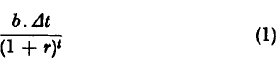
Let 1 + r = eρ where e = 2·718 . . . is the base of the natural system of logarithms and ρ is thus the “natural” logarithm of 1 + r, i.e. the ordinary logarithm divided by ·434 . . . It can also be expressed in terms of r by means of the logarithmic series,  which is convergent for r
  1. ρ is the instantaneous rate of interest for a moment of time, or what is called in German “Verzinsungsenergie”. ρ and r more or less coincide with sufficiently small values for r; otherwise ρ is always less, if only insignificantly, than r (if r is 5 per cent, ρ = 4.88 per cent, and if ρ is exactly 5 per cent r is 5.13 per cent, and so on). In each case they stand in a definite arithmetical relationship to each other, and it is not very incorrect to assume them to be wholly substitutable for each other.
Substituting in this manner, we obtain for the value of each of the axe’s uses discounted to the present—

Since t is to be taken here as continuously variable, we obtain the present value of all the axe’s uses and therefore its own present value by the summation (integration) of the above expression between 0 and n, two points in time
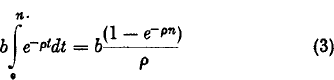
(corresponding to the normal calculations for annuity-loans). If r, and consequently ρ also, were so small that in expanding the series for the exponential function—

we need only include the first two terms, the above expression is reduced to b.n; in other words, the present value of the axe is equal to the (undiscounted) value of all its uses. If we include the first three terms, we get 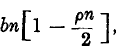 i.e. the total use-value discounted by simple interest on it for half its period of use.
In equilibrium, the value of the axe coincides with its costs of production. Let l be wages per head per annum. Then—
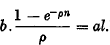 42(4)
42(4)
This equation holds for a, b, l, ρ (or r), and n, as they are determined in an equilibrium situation. If equilibrium is not yet reached, equation (4) describes the following conditions instead. Let us assume that not only is b (the value of the axe’s use for a year) given, but also ρ and r, r being taken as the usual rate of interest current at the time. Now if n and a, the life-time of the axe and the amount of labour needed for its production respectively, were also to be technically given (as we often take them to be), the R.H.S. of the equation would represent the sales-value of an axe (l the wages per annum multiplied by a the unit of labour) which is received by the axe-manufacturers. Now although the magnitude of neither n nor a is given, they are technically related to each other. By investing more labour on an axe we can increase its durability, all other properties remaining constant; n is thus a function of a and a of n, i.e. of the period for which it is sought to make the axe last while it is being manufactured. Clearly, both increase together, but n must increase more than proportionately to a, otherwise, however low the rate of interest, labour could not be employed in producing axes of longer duration, but it would be employed in producing many less durable axes instead. We assume therefore that a varies as a fractional power of n, i.e.

where k is a constant and ν a proper fraction. If, for example, ν = ½, a would grow proportionately to the numbers 1, 2, 3, 4, etc., whilst n grows as the numbers 1, 4, 9, 16, etc. In other words, n increases geometrically in relation to a. Of course the form of this function is too special to reflect the actual relation between a and n when both are undergoing large changes, but with smaller variations which, as a rule, are the only ones likely to occur in practice, it may be as good an approximation formula as any other.43 If we assume, for example, that it held for axes lasting for 16 to 36 years, and that ν = ½, then the constant k represents a quarter of the amount of labour required to give the axe in question a life-time of 16 years; or else, and it here comes to much the same thing, a fifth of the labour needed to produce an axe which is intended to last 25 years, etc.
At this stage, we could, of course, eliminate a from equations (4) and (5), and then l and b would be the only unknowns outstanding. But we prefer to retain both equations in their present form.
For the labourer, or group of labourers, if they themselves are the entrepreneurs, the most advantageous value of n is that which makes the selling price of the axe a maximum in relation to the amount of labour invested, i.e. makes l attain its maximum.44 Since a variable magnitude at its maxima (or minima) behaves like a constant, we have to differentiate equation (4) as though l were a constant, which gives
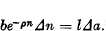 45(6)
45(6)
We have again obviously obtained on the L.H.S. an expression of the form of equation (2), n and Δn taking the place of t and Δt. The obvious implication is that at its maximum bΔn, the last addition to the value of the axe, when discounted to its present value exactly corresponds to lΔa, the last increment to the cost of its manufacture.
We get by logarithmic differentiation of (5)

Substituting in (6)

and combining with (4), we obtain finally

This result is rather peculiar. The product ρn is here the root of an equation, in which ν is the only variable. In other words once the particular function we have used for extension of life-time is taken as given, it follows that the product of the rate of interest (with continuously compound interest) and the optimal lifetime of the axe is a constant, independently of the size of b, as soon as we regard ν as a technical datum. Even with the choice of a less simple function, the connection between n and p remains independent of b, provided a is a function of n. (9) is of course a transcendental equation, but we can easily obtain an approximate result for the larger of the real roots.46 (The other = 0 for every value of ν.) If, for example, ν = ½, ρn is roughly 1.27, so that if ρ is .05 (and the ordinary rate of interest therefore a little over 5 per cent) the axe’s optimum life-time is always circa 25 years, however much the value of its uses, calculated per annum, may vary. We shall indicate this root by ϕ(ν) with the proviso that it is a constant as soon as v is taken as a technical datum. The following analysis depends to a great extent on this result.
We have hitherto regarded the rate of interest (r or ρ) as given. Now if we consider capitalists as entrepreneurs, l must be taken as given instead. Those capitalists, who at a given wage manufacture axes to be later applied, are confronted with the problem of making the axes last so long that the capital invested in their manufacture receives the maximum rate of interest. From a mathematical point of view, this problem leads us to exactly the same formula as the first, for when ρ reaches its maximum, it behaves as a constant, and we have therefore to differentiate equation (4) as though l and ρ were constants. We obtain precisely the same equation as before, and also equation (9) in a similar manner.

But it is no longer ρ but l which, is the datum. To find n we substitute in (8) the value discovered from (9) for ρn = ϕ(ν) (e.g. 1.27 if ν = ½), and eliminate a by means of (5). Thus

or what comes to the same thing, as ϕ(ν) is the root of (9).

If ν = ½ and ∴ ϕ(v) = 1.27, we get
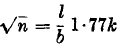
We are here restating the principle with which we were acquainted before, that an increase in wages produces a tendency to increase the durability of a capital-good, in this case in geometric proportion to the rise in wages.47 This tendency corresponds to the extension of the period of production in the case of “variable real capital” (circulating capital).
Before going any further, we should like to mention an interesting fact with reference to the average investment-period of capital tied up in a particular capital-good. Under normal circumstances, the annual yield of a fixed capital-good will afterwards repay as well as yield interest on the costs incurred in making it. As we have maintained in our review of Åkerman, the question of the order in which either the former or latter occurs is of merely formal interest. But we should be able to represent the average investment-period of this capital as a period such that if all the uses of the capital-good were finally turned out at the same time, they would yield the same interest on the capital as the owner actually obtains. Let this period be m. Since in our example the total value of all the uses is clearly b.n, with equation (4) we get

if a is here increased, and therefore according to (5) n too, m must also be increased.48 Now since n is at its optimal value and we can regard l and ρ as constants (for one is assumed to be an actual constant and the other has attained its maximum), we obtain by logarithmic differentiation of (11) the equation—
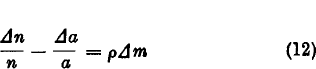
describing the relations between the simultaneous increases in n, m, and a. This result is not difficult to interpret. Since a is the amount of labour required to produce one axe,  is the number of axes produced by one unit of labour49 and
  the number of (potential) yearly uses of axes. Therefore
  is the value of all their uses. If for the moment we call this expression P, and retain our assumption that b is a constant we obtain by logarithmic differentiation—
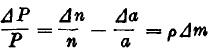
or
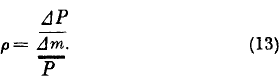
We might have derived this result directly from (11); it holds, therefore, even if b is not taken as constant, but is allowed to vary in some proportion or other to the lifetime of the axe, as soon as ρ or l attains its maximum. Thus in dealing with fixed capital we obtain a counterpart to the Jevonian principle that interest is “the rate of increase of the produce divided by the whole produce”, or is the “marginal productivity of waiting”, i.e. with reference to average waiting reckoned according to the above principle. At this point we must note that the amount of labour invested is taken as fixed (= 1 unit of labour) so that the average period of waiting becomes capital’s only variable dimension. It is also worthy of notice that the principle holds for the whole duration of the capital-good, and not merely for the period for which the stock of machines of different ages (= the existing fixed capital) still has to last. On the other hand, it is fairly clear that our principle is completely independent of the assumption we made about the form of the function for extension of lifetime.
We turn now to consider the stock of fixed capital. If the labourer (or group of labourers) continues to produce axes, he (or it) will produce axes in one year and axes in n years.50 Within this period the number of axes in use will obviously continually increase, but once we get beyond n, it ceases to do so, since the oldest axes are discarded pari passu with the manufacture of new ones. Thus we have got here a, fixed capital consisting of axes, which is “staggered” in structure and which includes axes of various ages, and as a matter of course the a number of uses available is the same at any moment. The total (undiscounted) value of all the uses available in one year is therefore  Again, the total value of all the potential uses which the fixed capital, consisting of axes and existing at each moment, represents, is clearly

For the time elapsing during the manufacture of an axe is assumed to be so short that the age of the axe grows continuously from 0 to n years. This proceeds on the assumption that only a single labourer or group of labourers is employed in producing axes. If, however, M labourers or  groups of labourers with ten men in each group are occupied in manufacturing axes, all our quantities will naturally have to be multiplied by M; from now on we take the annual services of one labourer as the unit of labour.
Now in order to find the value of the capital itself we employ in our calculations that rate of interest which is attained when the best possible line of action is adopted in the use of each individual axe for the whole of its life-time. Once equilibrium is finally reached this rate must coincide with the current rate. According to (3) the value of a new axe with n years to live is  Therefore the residual value of an axe already used for t years must be

Since Δt is an infinitesimal period of time we regard the axes between the ages t + Δt as having the same value. Now since one labourer produces axes per unit of time (one year) and M labourers therefore produce  axes; the number of axes in the moment Δt produced t years ago is
  and their total outstanding value is according to (14)
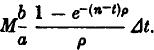
Summing all these values, we obtain the value of all the fixed capital by integrating between t = 0 and t = n. Thus

This equation corresponds to the sums of the recurrent series in Åkerman’s analysis, which he does not however summate. It can be checked, for if ρn is so small that we need only consider the first three terms in the exponential series  etc., our equation is then reduced to
  corresponding to the undiscounted value of all the potential uses of the axes, as we have already seen. Even if the fourth term is included, we obtain the same expression multiplied by the binomial
  i.e. the value of all the potential uses minus the simple interest on them for a third of the whole lifetime of each axe—a new but naturally incomplete approximation. The quantity
  is the distance of the centre of gravity from the base of a triangle, the height of which is n and the base the number of axes in existence. If the potential uses of the whole existing stock of axes are discounted back to the present, the average period of discounting should in fact be (cf. review, p. 270), if we use simple interest.51
We can easily prove that at any moment the net value of the uses of the whole of the axe-capital, i.e. the gross value minus the cost of renewal of capital, is the interest on the total value of the capital at the same moment. For it follows from what we have just said that the former is  Δt, which, using (4), becomes

(16) is of course bound up with the fact that the residual capital-value of the axes already in use is precisely estimated according to this rate of interest, and may therefore be called a truism.
We have not yet made any use of our assumption about the nature of the function of “extension of lifetime”, i.e. equation (5). Once (5) is taken into account, K, the amount of capital, becomes a much simpler expression, for in this case ρn is a constant = ϕ(ν), and so the numerator of our fraction also becomes a constant. Further, ρ and a can be simply expressed in terms of n, so that we can express K in terms of M, b, and n. Since according to (10) n is proportional to some power of the ratio  we can express K in terms of l and b only, but always with the proviso that it is also a multiple of M and includes a constant factor, which is solely dependent on the value of ν, which is technically given. The significance of this consideration will become apparent later.
In actual fact neither l nor b is given, but the value of both is ultimately determined by the co-operation of free labour with real capital in the production of commodities. For we assume that under free competition wages l are the same for all labour, whether it is free labour or “replacement labour” (Åkerman), which is annually invested in machines. To obtain this economic nexus and the data necessary for solving the whole problem, we must now make the further assumption that all the capital of the community consists exclusively of only one kind of capital-good, in this case axes, and that only one kind of product is produced. Since we have previously only been occupied with capitalistic production in its simplest form we are doubtless justified in making an assumption which is rather fantastic if taken by itself.
Let x free labourers co-operate with y units of capital (axes) in a given form. Now with the optimal employment of resources, the product, or the value of the product, will clearly be a function of both x and y. We can decide a priori that this function must be homogeneous and linear, i.e. such that a uniform increase in x and y produces exactly the same percentage increase in the product. For if two labourers, each having his own axe, could together produce more than twice as much as one labourer with one axe, or if the product of three labourers and three axes was proportionately even more, and so on, then we should obviously have to let the labourers co-operate in groups in such a way that the maximum efficiency was reached. But once this maximum has been attained, a further increase in labourers and axes, i.e. an increase in the number of such groups, would only produce a proportionate increase in the product. On the whole we can therefore assume that with a constant “stock” of axes per labourer, the product grows in proportion to the number of labourers, but with an increasing or diminishing stock of axes, labour remaining constant, the product certainly increases or diminishes in some degree, although less than proportionately to the change in the number of axes. In other words our productivity function, which we represent by F(x, y), must take the form,
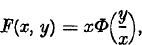
where Ф is a function of a single variable, i.e. of the ratio  It increases or diminishes simultaneously with its variable, but to a lesser extent. For if it increased in the same proportion, the whole expression could be reduced to
  where c is a constant; in other words, we should arrive at the ludicrous result that the product was solely dependent on the number of axes and not at all on the number of workers. We should get a still more ludicrous result if the function Ф increased more than proportionately to its variable.
Since we are chiefly concerned with expressing this relation in as convenient a form as possible for our calculations, we may simply let the Ф-function vary as a root of its variable, i.e. we may put
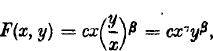
where α and β are both positive fractions and their sum = 1. P, the value of the product computed for a moment of time,52 thus becomes

If this equation is partially differentiated with respect to x and y, we obtain
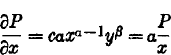
and
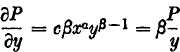
Let us postulate a stationary state in which there is perfect competition between employers and labourers. Once equilibrium has been reached, the first partial derivative must necessarily equal or l the wages per head per annum, and the second b, or the payment received for the yearly use of an axe. Thus

from which, among other things, it follows
xl + yb = (α + β)P = P, since α + β = 1.
In other words payments, so determined, made to the labourers and the owners of the axes, will together absorb the total value of the product; which is as it should be. Similarly, assuming a continuous productivity function, we obtain the simple ratio of b to l—

Let A be the total number of labourers or the supply of labour annually available. If M is the number of labourers always employed in the manufacture of axes in order to renew or maintain the fixed capital consisting of axes, then the amount of free labour is plainly A—M. It follows that the number of axes in use at the same time is  and that in equilibrium just this proportion between free labourers and axes employed must obtain in each firm, as the result of reciprocal supply and demand; otherwise some of the labourers or axes would be unemployed. We can therefore substitute A—M and for x and y in our previous formulæ, and replace P by π, the value of the whole social product. Thus we obtain

and

and

By making a simple change in equation (8) and then combining it with (9), it follows that if the most profitable lifetime is attained for every axe, then
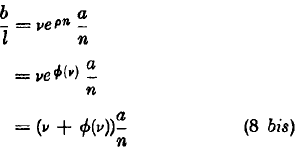
where ϕ(ν) is the root of (9).
We finally obtain—

This result is calculated to create some astonishment. All the magnitudes on the R.H.S. are constants irrespective of the amount of social capital. These constants reflect the assumptions we made (1) for the technical conditions under which our capital-goods are manufactured, and (2) for their co-operation with free labour in the production of consumption-goods. Our assumptions have thus shown that, however much the amount of capital itself changes, the distribution of the existing supply of labour between free labour co-operating with capital-goods and labour employed in the maintenance or renewal of capital itself53 remains unchanged. And yet only within limits, since the form of our function is too special to be valid beyond a certain field of variation, even if it contains one arbitrary constant.54 Within these limits, however, capital, when it does grow, grows exclusively in height and not at all in breadth. N.B.—When capital first increases and there is a consequent disturbance of equilibrium, capital will also—or rather exclusively—grow in breadth, since in the beginning the additional number of new capital-goods will be of the same type as those already in use. If, on the other hand, the amount of labour invested per moment of time is temporarily increased and the amount of free labour diminished, there will be a rise in wages and a fall in the value of the use of capital (axes), more or less in this sequence. Further, according to (10), the new capital-goods now produced will be manufactured to last longer, as this method of investment has become most profitable. But when equilibrium is reached once more the amounts of free labour and of labour engaged in replacing capital resume their former proportion (at the same time the labourers lose part of, but not all, their recent increase in wages and the capital-goods regain part of, but not all, the value they have just lost). Employing this interesting result, we might regard the productivity function and the function for “extension of lifetime”, which have been selected, i.e.
α = f(n) = Knν
and P = F(x, y) = cxαyβ (α + β = 1),
as typically normal functions from which, taking them as the simplest elements in the problem, we must start in the analysis of the more complicated phenomena of the real world.
With these constants, the values of M and A plainly become

Let v = ½ then ϕ(ν) = 1.27. Further, let α = β = ½.55 Then

Rather more than a third of the existing supply of labour should therefore be engaged in manufacturing axes, and the remainder—about two-thirds—in the application of the existing stock of axes for the delivery of saw-logs. This result we achieve without taking the amount of axe-capital into account, for, with a small supply of capital in the form of axes, as long as our assumptions hold, they must necessarily be manufactured so as to last for a correspondingly short period, and will therefore need renewal all the more often.
M being determined, the whole problem can be solved without any further difficulty. The remaining unknowns are (1) the amount of capital expressed in terms of the product or of money (for the price of the product is taken as fixed on the great staple markets), (2) the product per annum in terms of the same unit, (3) the duration or lifetime of the capital-goods (axes), (4) wages per annum, (5) the value of the yearly uses of an axe, and (6) the rate of interest prevailing in equilibrium and current throughout the economy. It does not matter which of these is taken as the independent variable, for in any case all the other quantities vary as certain powers of this parameter, each being multiplied by its own constant co-efficient. If we choose n as our independent variable, i.e. if we imagine an equilibrium situation where the total period for which the capital-good lasts is n years, and let C1, C2, etc., be the constant coefficients, we obtain
K = C1n1 + β(1-ν), π = C2nβ(1-ν),
L = C3nβ(1-ν),b = C4n-α(1-ν),
and, as before,
ρ = ϕ(ν)n-1
It follows immediately that the exponentials are solely dependent on ν and β(= 1—α). The coefficients depend on K and c, the meaning of which is well understood. In addition, C1 and C2, the first two coefficients, contain A as a factor; for by dividing by A we had obtained the capital and product per head (of labourers) of the population.
Thus with the simplifying assumptions we selected the problem is now solved. But we must of course be very careful in drawing general conclusions from the results obtained if only because of the above reservation (and quite apart from the fact that they are no longer applicable as soon as our quantities move in a negative direction, for what is not valid in a special case is still less so in the general). But a few observations may still be permissible.
As ν is < 1, the capital K clearly increases simultaneously with n, and conversely n with K. For the reason mentioned in our review, this interrelation must be general. Similarly, π grows when n (and K) increase, but much less than the latter, since the index is smaller by one whole unit.56 The conclusion that an increase in fixed capital also produces an increase in the annual product should also be perfectly general, independently of our particular assumption, as we shall immediately attempt to show.
Similarly, l increases when n and K increase, but b diminishes when n and K increase. This conclusion ought also to be general in its validity, as we shall soon show.
Since the expressions for π and l have the same index, the ratio  remains a constant, in other words, with increasing capital, wages remain an unvarying part of the increasing product, which is a necessary consequence of our assumptions. Given our particular productivity function, the sum of the wages of free labour in each firm and throughout industry constitutes an unvarying portion of the product, which follows from (18) and (18 bis.) And besides since, according to our function for the “extension of lifetime”, A—M, the total number of free workers remains constant, every free labourer (and therefore all labourers) receives a constant part of the national dividend when capital increases (though of course labour now invested is paid in consumption-goods which are ready now, and not in the consumption-goods which they themselves help to make). Naturally, this conclusion cannot be general.
If the proportionate share of the labourers in the total national dividend is constant, then the capitalists’ share is also constant. But, as we have maintained, this result holds for the interest on all the capital at the moment of time in question, if the rate of interest is ρ.
Hence  must be a constant. This result is correct, for
 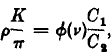 since the powers of n cancel out.
It may be added that the number of capital-goods (axes) in use at the same time, which on the above analysis is
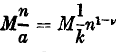
necessarily increases with n and also with K, although in a smaller proportion than either, since 1 + β(1—ν) = 1—α(l—ν) + 1—ν > 1—ν. This result is general and holds as we shall soon show, even in the exceptional case when M diminishes with an increase in K.
Let us turn to the transition from one equilibrium to another. It is now possible to discover to what extent the closely-related proposition originally advanced by von Thünen that the rate of interest corresponds to the “marginal productivity” of capital is corroborated by our formulae in the modified form put forward by Åkerman. By logarithmic differentiation we obtain directly

Therefore
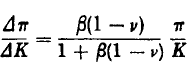
We can easily express the value of the ratio  without needing to bother about the rather complicated constants C1 and C2. Since the share of capital in the product is equal to the interest on all the capital = ρK (cancelling Δt out), it must clearly be π—Al, or, if we take (18 bis) and (20 bis) into account, it is
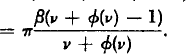
Thus we obtain
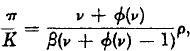
and finally

Our ratio is therefore proportionate, but not equal, to ρ. If ν = ϕ(ν) = 1.27, and β = α = ½, it becomes .92ρ approximately, i.e. rather less than ρ. This discrepancy is only to be expected, when the increase in capital is partly absorbed by the resulting increase in wages and only part of it is effective in raising production. But since this explanation does not hold here, we may infer that the principle is not general. If β is quite small, i.e. if the capital-goods have only a minor significance for production as compared with free labour, then as long as ν = ½, the first fraction approaches 1—ν = ½ as closely as possible, whilst the other is always i.e. > 2. Strangely enough, this ratio is thus greater than ρ.
In these circumstances, it is already obvious a priori that von Thünen’s thesis is no longer verified, even in the form in which Akerman proposes to recast it. In his analysis on p. 152, Åkerman starts by replacing the divisor  and thus subtracts that part of the increase in capital absorbed by the rise of wages. This method of approach is perfectly justifiable (cf. my review) for Böhm-Bawerk’s thesis, as we can see from a simple inspection of the formulæ on p. 113 of my Uber Wert, etc.57 But in this particular case, it does not hold good.
We obtain without any difficulty

and if Δ π is divided by this expression, the new ratio can be written as

The new ratio differs from the old only in this respect, that the factor in the denominator depending on β drops out. Since this is always > 1 as also in this case, the new ratio  is always greater than the old one, but it is not therefore equal to ρ. On the contrary, we should be in a position to show that it must always be greater than ρ, except in both the limiting cases, where either ν is very small and nρ = ϕ(ν) is therefore very large, or where ν approaches unity and ϕ(ν) tends to zero. In both these cases the R.H.S. of the equation is reduced to the value of ρ; this is self-evident for the first case and can easily be proved for the second by the method of limits.58 I cannot enter now on the explanation of this very puzzling formula; presumably it belongs to the sphere of “dynamic” theory, where we cannot confine ourselves to the comparison of two different equilibria, but must also study the transition from one to the other.
Finally, I shall tackle the question which really constitutes the starting point for the whole of this fragmentary essay. It is the validity of the principle that an increase in capital (measured in units of product, or the value of the product remaining unaltered) must, as a general rule, always produce an increase in the volume of production. We have already seen that it is valid on our assumptions.
But even this conclusion now appears more complex to me than I had first believed. The proof I shall advance rests on the assumption that a rise in wages relatively to the use-value of the machine, that is to say an increase in  , always brings about an extension of lifetime whenever such an extension can be profitable (in other words if all the data are taken as continuously variable). According to (10) and (10 bis) n varies quite simply as a positive power of and vice versa, but this conclusion follows from a = knν, our function for ‘extension of lifetime’. If instead we take a more general function, a =f(n), of which it is only assumed that it becomes zero when, n is zero, and increases more slowly than n, then the matter is no longer self-evident. For brevity, substitute x for . We now obtain the corresponding changes in x and n by differentiating (4) and (6), which hold simultaneously for a given value of x , when ρ has reached its maximum.
Thus—

and also

where f’(n) is the first derivative of f(n). This expression should now be differentiated with respect to n, x, and ρ, for it involves a shifting of the maximum points themselves. Let f”(n) be the second derivative of f(n) and let  = p and
  = q.
= q.
Then on eliminating Δρ, we obtain

Clearly, on our assumption (f(n) = 0 when n = 0 and f’(n) diminishing when n increases), p must be <  and q < 0. The expression – p is therefore always positive, and in the n numerator and the denominator of the next fraction q and p – are both negative. But we cannot presume without further analysis that they are simultaneously < or simultaneously > p.59 It is therefore not a priori impossible for Δx and Δx to have opposite signs. Let us return to our function a = f(x) = knv. Then clearly p =
  and
and 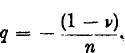 Consequently, the numerator and denominator are here identical (if multiplied by n they both become ρn + ν—1 = ν + ϕ(ν)—1) and our equation is simplified thus—
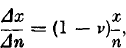
which can be directly obtained by logarithmic differentiation of (10). Now since f(n), whatever its actual form, has the same general form as our special function, we may infer even now that x and n vary approximately to the same degree. But it is not impossible that they might sometimes vary in different directions, from which it plainly follows that  and n are not uniquely determined by each other but that x may have two (or more) values for the same value of n or, conversely, n may have different values for the same value of x.
In actual fact this last possibility may often be reached, but it should not on that account give rise to any serious dilemma. The only practical significance it can have is that an increase of capital is sometimes distributed between two different investments—two types of machine of different durability (though otherwise identical), both yielding the same maximum return on capital. We have confined the number of different investments to two, because for technical reasons it often does not pay to manufacture capital-goods lasting for intermediate periods.60
It would have very much more serious effects on the following proof, if two different values of  could hold for the same value of n. But fortunately this can never happen. If it could, the conditions of our equations (4 bis) and (6 bis) could simultaneously be satisfied for the same value of n with two different x-values, x1 and x2, and with concomitantly different values for ρ, ρ1 and ρ;2 (ρ1 > ρ2). In other words we should obtain at the same time first
 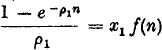 x1f(n) and e-ρ1n = x1f’(n), and secondly
 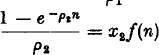 x2f(n) and e-ρ2n = x2f’(n), from which dividing we should obtain
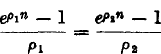
or

If the values of n and p are positive, all the terms in the series are also positive, and our assumption therefore involves something absurd.
We may, consequently, proceed on the assumption that an increase in  always produces an extension of the lifetime of capital-goods, even if this extension does not always occur continuously; at times it may take place in jumps (or more correctly in such a way that capital is distributed among capital-goods of the same profitability but of different durations).
On this hypothesis the proof of the thesis we previously advanced takes more or less the following form.
When real capital increases it must always increase in “height”, in so far as an extension of the durability of machines is technically possible. For were it only to increase in “breadth”, so that the only effect would be an increase in the number of machines of the old type, the labour permanently engaged in maintaining it would clearly have increased, once equilibrium had been reached. Hence it follows that the amount of free labour would have diminished at the same time as the number of capital-goods had increased. This must clearly result in a shifting upwards of , in which case we must infer from our conclusion, which we have just shown to possess general validity, that an extension of the lifetime of the capital-good becomes profitable. On the other hand there is no need for an inevitable increase in the “breadth” dimension of capital which follows from what we have said above. On our formula, with an increase in capital the amount of labour required for renewing capital should generally remain unaltered. We may therefore summarily assume that an increase in capital may very well occur with an accompanying fall in the breadth dimension. None the less even in this case the number of capital-goods in existence at the same time will have increased, for if it had diminished, since, the amount of free labour has now increased, would have shifted downwards and we cannot describe the position in which n has a new and higher value as an equilibrium one. It therefore emerges that there will be a larger number of machines simultaneously with a larger supply of free labour, which must obviously lead to an increase in the total product.61
Let us now take the commonest instance in which machine-capital increases in breadth as well as in height; then the amount of free labour will diminish. We can conceive of this change as occurring in two (or more) stages. Let capital grow in breadth to begin with and only later in height also—in other words, we first increase our M, n remaining constant, and afterwards n as well (with M constant).
The first part of this procedure is soon explained. For since the composition of machine-capital remains the same, the whole process can be regarded as though M units of labour invested in a certain way co-operated with A—M free labour in each case. If M is increased, and A—M diminished by one unit, then, ignoring infinitesimal quantities of higher orders, the total product is increased and there is a difference between the marginal productivies of invested and free labour. This difference must be positive, for as we have always regarded the Productivity Function as being homogeneous and linear (or that it has again become so after any change has taken place) the marginal productivity of each group necessarily coincides with its wages. These must clearly be greater for invested than for free labour, as the wages of the former also include some interest. Now let the lifetime of the same number of capital-goods increase, M remaining constant. Then it follows that the number of machines in existence must increase (for the number of machines per labourer working on machines is  and, if the amount of free labour is constant, the total product must increase still more. If the increase in machine-capital is such that as far as the first part of our analysis is concerned the rate of interest not only falls but is at the point of becoming zero, we simply stop at this point and allow n to grow until the rate of interest reaches its maximum (and becomes therefore > 0), and using this point as our starting-point we begin again with the same procedure.
Thus the net result is that a growth of capital, as long as it is such as to be profitable, is always accompanied by an increase in the total product. Consequently the paradox of a fall in the national dividend resulting from continued saving and capital accumulation does not apply to perfectly free competition, but the possibility of its holding for a situation in which capitalists combine cannot be excluded.
So far we have treated the lifetime of capital-goods as if it were altogether separated from their other property—their “Automatism”, as Åkerman calls it. Actually, these properties are scarcely ever independent, greater durability is normally combined with greater efficiency in other respects. We ought to be able to express this mathematically so that the a-function does not actually have the simple form f(n), but also contains a quantity g as a variable which objectively refers to the efficiency of the capital-good in question. Thus if, for example, g increases from g1 to g2, and g2 = 2g1, ceteris paribus we get a machine of a new type, which can replace two of the older machines in all respects. We need only substitute f(n, g) for f(n) in equation (4 bis), and partially differentiate with respect to n and g, to obtain a new equation corresponding to this variable. However, I shall not undertake it here, as I have already taken too much space.

or since N is here a large number, weeks approximately. And in the same way, still using simple interest, we get the average period of investment for a “staggered variable real capital”. (Cf. the relevant passages in my review.)
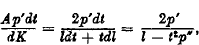
disappears from the denominator in the fraction on the extreme right, which is reduced to  (the rate of interest).
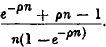
The denominator of this fraction is certainly > 0, and so is the numerator, since its value becomes = 0 for ρn = 0, but later rise continuously, as—e-ρn + 1 its derivative (with respect to ρn) is always > 0.
It is impossible to get any further without knowing something about ρ + q. Still we can easily show that the inequality ρ + q > 0 (which for f(n) = knν becomes ϕ(ν) + ν—1 > 0) constitutes the second condition necessary for the emergence of a maximum value for l or ρ in the general case. This condition, however, need not be satisfied throughout. As far as I can see, if is given and n is increasing, there is nothing to prevent a sequence in which there first emerges a maximum value for ρ, then a minimum and then a maximum again, and so on. An interesting consequence of this phenomenon will soon be mentioned.
Were capital and to increase, the maximum corresponding to the higher value of n may become the greater. Now when ρ has two equal maxima (for different values of n), there must be a case in the transition period analogous to that described in my Lectures, p. 163. For a time the increase in capital is divided between two different investments, in which l and b and their ratio do not undergo any further change; for since an ever-growing part of the capital is successively transferred to the longer investment, M is diminished and A–M increased, so that the proportion between free labour and the available uses of the machines remains unchanged. But I have not been able to complete any research into this interesting question in detail.
- 1This expression is perhaps not entirely suitable, since, as will easily be seen, the essence of the argument is in both cases the same. It is therefore also possible that I ought to have endeavoured to combine sections II, 2, C and D in a single uniform presentation. I have found myself unable, however, for various reasons, to do this. As they now stand, these two collateral presentations may materially support and explain each other.
- 2Some of the matter included in this book had been published in Conrad’s Jahrbücher in the preceding year.
- 3Some of these contributions are now available in one or other of the world languages. The article on Professor Bowley’s Mathematical Economics, with its discussion of the theory of Bilateral Monopoly, appears in the Archiv für Sozialwissenschaft, Bd. 58, pp. 252-281. Professor Hayek has included a celebrated article on Prices and the Exchanges in his Beiträge zur Geldtheorie, and two others on Dr. Gustav Åkermann’s Realkapital und Kapitalzins and Prof. Cassel’s “Theory of Social Economy” appear in English as appendices to the present volume. But an English translation of a comprehensive selection of these papers is still urgently to be desired.
- 4A short list of Wicksell’s principal contributions to foreign periodicals is given by Professor Ohlin, op. cit., p. 512.
- 5See, e.g., Schumpeter, “Knut Wicksell,” Archiv für Sozialwissenschaft, Bd. 68, pp. 238-257.
- 6In this connection a comparison between Wicksteed’s article on Jevons’ “Theory of Political Economy” (Works, vol. ii, pp. 734–754) and the sections on Capital Theory in Uber Wert, Kapital und Rente is very instructive.
- 7But not all. I should be very sorry to be thought to lend any countenance to the view, now apparently gaining ground in somewhat unexpected quarters, that in undergraduate teaching or in advanced studies we are yet in a position to dispense with the most thorough study of Marshall’s Principles. It would be a sad thing if the uncritical acceptance of this great work, which so long tended to stiffle the development of other lines of thought in this country, were to be succeeded by an equally uncritical rejection of all the wisdom and the path-breaking intuitions that it contains.
- 8He must have been aware of Über Wert, Kapital und Rente, for it was reviewed together with his own Co-ordination of the Laws of Distribution in the Economic Journal for June, 1894.
- 9Finanztheoretische Untersuchungen, p. 176 seq. Wicksell’s views in this spect have been developed with great ingenuity by his pupil, Professor E. Lindahl, in his Die Gerechtigkeit der Besteuerung,
- 10Theory of Wages, p. 233.
- 11“The Ricardian Theory of Profits,” Economica, February, 1933, pp. 51–74.
- 12Prices and Production, chapter i, passim. “A Note on the Development of the Doctrine of ‘Forced Saving,’” Quarterly Journal of Economics, vol. xlvii, pp. 123–133.
- 13See Hayek, Monetary Theory and the Trade Cycle, chapter v, and Prices and Production, chapter i; also G. Myrdal, “Der Gleichgewichtsbegriff als Instrument der Geldtheoretischen Analyse,” in Beiträge zur Geldtheorie, ed. Hayek.
- 14Etudes d’économie politique appliquée, p. 466.
- 15L’echange de deux marchandises entre elles sur un marché régi par la libro concurrence est une opération par laquelle tous les porteurs, soit de l’une des deux marchandises, soit de l’autre, soit de toutes les deux, peuvent obtenir (obtiennent) la plus grande satisfaction de leurs besoins compatible avec cette condition de donner de la marchandise qu’ils vendent et de recevoir de la marchandise qu’ils achètent dans une proportion commune et identique. (Élémente d’économie politique pure, 4me éd. l0me Leçon.)
- 16Concerning his later views on this question, cf. pp. 82–83.
- 17As it is only our intention here to illustrate a theoretical principle, we ignore the otherwise important circumstance that shorter hours of labour usually give rise to a greater or less increase in the efficiency of labour.
- 18y is the quantity of his own commodity (B) which he originally sells; y.Δp is consequently the additional quantity of the commodity (A) which he would obtain as a result of the increase in price if he could continue to sell the same quantity y of his own commodity; is the marginal utility of (A) and hence .y.Δp is the gain in utility derived from the increase in (A).
- 19As an example of how even an experienced mathematician may be led to erroneous conclusions in this field, we may mention the argument of Launhardt (Mathematische Begründung der Volkswirtschaftslehre). He assumes two parties to an exchange, one of whom from the beginning possesses a units of the commodity (A) and the other b units of the commodity (B) and, for the sake of simplicity, he supposes the total utility derived by each person from the commodity (A) to be expressed by the same function, f( ); and similarly ϕ( ) for the commodity (B). If they then exchange the quantities x and y the total utility received after exchange by both parties together is expressed by N = f(a—x) + ϕ(y) + f(x) + ϕ(b—y). In order that this expression should be a maximum we must have:—
- 20In an essay in Ekon. Tidskrift, October, 1908, and also in his work, Den ekonomiska fördelningen och Kriserna, Brock has sought to prove that the above conception of the relation between retail and wholesale prices is not correct. Retail prices, in his view, show a strong tendency to follow wholesale prices upwards, but very little tendency to follow them downwards. The statistics (from America) on which Brock bases this assertion would seem to show merely that of recent years retail prices have, on the whole, risen as compared with wholesale prices; a fact which, owing to the great relative increase of retailers, is in itself probable and is quite in accordance with what we are about to say. As a general doctrine, Brock’s view (and that of Lexio and others) is clearly absurd; it would imply that retail prices would diverge more and more from wholesale prices at each cyclical fluctuation—which would lead to absurd consequences. Obviously, we do not attribute any altruistic motives to retailers when we speak of their endeavour to keep prices as steady as possible for their customers’ convenience. It is well understood that it is in the interest of every business man to satisfy his customers.
- 21See Principles mathématiques de la théorie des richesses. This work was first published in 1838, but was not generally known until much later. Translations into English and various other languages are now available.
- 22Papers relating to Political Economy, vol. i, pp. 143–151, and Economic Journal, 1899, p. 286.
- 23Cf. also my Finanztheoretische Untersuchungen, p.12, et seq.
- 24The theory of pricing under “duopoly” or “polypoly”, as they were formerly called, was developed by Cournot (see below) and deserves attention.
- 25A. Weber’s Der Standort der Industrie may be described as such an attempt.
- 26Edgeworth, in his Mathematical Psychics (1885) and in an essay in the Giornale degli Economisti, 1897 (and also the mathematician, Bertrand, in the Journal des Savants, 1883), criticized Cournot’s reasoning, but, in my opinion, on insufficient grounds. It is certainly true that the problem, as Edgeworth says, will to some extent be indeterminate in the case of two, or generally of a limited number of monopolists, whether in the same or in different branches of production. But Cournot’s further assumption, quoted above, seems to me much more reasonable than the one selected by Bertrand and Edgeworth. The latter involves the assumption that each monopolist aims at the maximum net profit on condition that the other does not change his price—an assumption which seems to me quite unjustifiable where they both produce the same commodity. [See Wicksell’s review (Economisk Tidskrift, 1925) of Professor A. L. Bowley’s Mathematical Groundwork of Economics; a German translation of this review subsequently appeared in the Archiv für Sozialwissenschaft, 1927.]
- 27Das Kapital, i. Third edition, p. 206 et seq.
- 28[A mark against this passage in the author’s copy of the second edition indicates that he wished to recast it.]
- 29Hours of labour may be influenced by the possibility of exchange.
- 30J. S. Mill, Principles, book iii, chap, xviii.
- 31Strictly speaking, this applies only it the two commodities cannot substitute each other in consumption.
- 32In the article “Handel”, in Schōnberg’s Handbuch (cf. Ekonomiska Samhällslivet, ii, p. 478), W. Lexis has been guilty of a serious omission in relation to this point, which makes his argument deceptive.
- 33That of International Trade.
- 34See my Finanztheoretische Untersuchungen, pp. 63 ff. (Jena, 1896).
- 35This is the only point at which Åkerman makes use of higher mathematics—following my “Lectures” more or less closely. It should not, however, have given rise to some of the insuperable difficulties which crop up in the treatment of this part of the problem; even in its elementary form it would have been better had he proceeded much as I did in my perfunctory attempt to solve the problem in the passage dealt with.
- 36We have a parallel case in investment in “variable capital”. Cf. my Uber Wert, etc., p. 104.
- 37Clearly, if the factors of production c and r are both increased in the same proportion, then, since k is a constant, the product P is also increased in the same proportion. [P is the product, c is free labour, and r the machine-capital with which it co-operates. Cf. Åkerman, Realkapital, p. 41.]
- 38[The second volume of Realkapital, und Kapitalzins (Stockholm, 1924) deals with durable real capital in dynamic conditions.]
- 39The series employed are all recurrent and can therefore be reduced to a few terms—a fact with which the author does not seem to be acquainted, except in the case of geometrical series.
- 40I may mention en passant that the passages from my Uber Wert and Lectures quoted on p. 135 are hardly inconsistent. In the earlier passage I am dealing with the antithesis between short- and long-term investment. Åkerman does not make this point clear. I maintained that arithmetical averages are still of some use in handling short-term investments. I did not say that this method was exact, for if that were so they would also be applicable to long-term investments. I must express my gratitude for an acknowledgment of my own work which if anything is only too generous. He wishes to associate my treatment of the Wage-Fund with Böhm-Bawerk’s well-grounded Wage-Fund theory. Actually my more rigorously mathematical analysis of Böhm-Bawerk’s arithmetical exposition was much too derivative to have any particular merit of its own.
- 41For example, in modern house-building all the different parts and accessories of the house are manufactured at the same time as the foundations are laid, so that the whole house, even though actually requiring an amount of labour corresponding to ten labour-years, is in fact completed in the course of a few months, perhaps only a few weeks, i.e. in a negligibly small period of time as compared with the house’s own probable duration.
- 42If the yearly services of a whole group of labourers—say of ten men—is taken as the unit, the amount a in terms of this unit falls in proportion as l (in terms of shillings) increases.
- 43On the other hand, there is no expression to correspond with Åkerman’s i-series, which would describe the condition that the durability of some capital-goods cannot successfully be increased beyond a certain point.
- 44We might also assume that they do not sell their axes but hire them out. Here they must themselves borrow at the rate of interest r or (p) for maintaining them—the theoretical result is the same in both cases.
- 45That the remaining condition for the maximization of ι, as of ρ in the next case, is here always fulfilled will be shown later.
- 46This can be solved by expanding according to Lagrange’s theorem, taking out the root ρn = 0.
- 47We shall later try to show that this result is perfectly general, quite apart from the function for extension of lifetime.
- 48It can easily be shown that if m, the average investment-period, is reckoned on this principle (i.e. of the annuity-loan), it is rather less than half the “amortization period” But the lower the rate of interest, the more closely does it approximate to . Since p the rate of interest varies inversely with n in our example, m must necessarily increase at the same time as n, perhaps even in a somewhat greater proportion. (We have here another example of the fact that compound interest is superior to simple for purposes of computation; for with the ordinary annuity-loan calculated in the same way, the average amortization period sometimes falls short of half the loan-period and sometimes exceeds it, according to its length and the height of the rate of interest. If, for example, a man has to effect an outlay of £50 at the end of every year for the next twenty years, the best thing for him to do would be to pay the whole lot at once after ten years, if the rate of interest is above 5 per cent, but not otherwise.)
- 49Since a is small, is large. But to make matters more intelligible we can imagine the number of axe-makers to be so large that even this number of axes can be produced almost simultaneously, so that taken together they can be regarded as a single capital-good.
- 50The expression has thus a double significance; it is the amount of potential uses of the number of axes produced by one unit of labour in the first place, and the total number produced by a labourer in n years in the second. Because of its second implication it is described in the text as the total number of uses available at one and the same time.
- 51If a capital-good lasts altogether N weeks, and if the same number of capital-goods are all of various ages, the number of remaining weeks’ uses of a good already in existence for T weeks is clearly N—T, and its average period of discounting, using simple interest, is weeks. We obtain the average period of discounting for the whole stock from the formula:—
- 52We might also have calculated it for an infinitesimal period of time, i.e. multiplied both sides of the equation by Δt. But once production is taken as stationary, this procedure would make no difference whatsoever.
- 53In a stationary state these quantities will themselves be constant.
- 54The two coefficients k and c refer only to the value of units, and therefore leave no room for varying conditions in other respects.
- 55It follows from this second assumption that capital and labour are equally important in production, so that a percentage increase in one factor has the same effect as an equal increase in the other, which of course is only conceivable in a special situation.
- 56If ν = ½ and β = ½, K becomes proportional to but π only to
- 57If ΔK is replaced by in the equation at the bottom of the page, p. 113, op. cit.,
- 58Let ν = 1— where ; is a small positive fraction. The value of ϕ(ν) then approximates to 2, and the value of the denominator thus becomes + . The denominator cannot change signs between the limits ν = 0 and ν = 1 since it would be at a minimum between these points, which can easily be proved to be impossible. Therefore it always remains positive. We can now also prove that this quantity ν + ϕ(ν)—1 always has a sign opposite both to the second derivative of l with respect to n, ρ remaining constant, and to the second derivative of ρ, l remaining constant, when their first derivative becomes = 0; whence the values of l and ρ respectively, obtained above, always describe a real maximum. This need not hold in the general case (vide infra).
- 59But it can easily be proved that the denominator ρ + p— in always > 0. From (6 bit) and (4 bis) we find that it must here always have the value
- 60If ρ has two maxima (as distinguished from a minimum) for small values of the manufacturer of machines naturally chooses the larger, which we shall assume corresponds to the smaller value of n.
- 61Similarly, if we abstract from technical discoveries, which change f (n) and F(x, y) the basic functions themselves, wages must always rise with a relative increase in the amount of capital. The general character of the Productivity Function plainly involves the result that l and 6 always vary inversely; if I has increased n must also increase.

