
Lectures on Political Economy
II. Currency
BIBLIOGRAPHY.—The above-mentioned works of Nasse-Lexis, and especially Helfferich. The articles on Currency, Currency Unions, the Precious Metals, gold, silver, bimetallic and parallel currency, etc., in the Handwörterbuch and the works referred to there. Current accounts of the production of the precious metals in Statistisk Årsbok; cf. also, Davidson, Guldproduktion och Varuprisen (Ekonomisk Tidskrift, 1901, p. 525, and essays by the author in subsequent issues of the same periodical).
In the lively, though nowadays remote, dispute between monometallists and bimetallists we may quote as representatives of the latter the names of Wolowski, Cernuschi, O. Arendt, Laveleye, Ad. Wagner, and others, and as (gold) monometallists Soetbeer, Roscher, Knies, Bamberger, Nasse, and many others, and, more recently, K. Helfferich.
The difficult problems of ancient and early medieval currency are treated in a manner at once intelligible and interesting in Babelon’s Les Origines de la Monnaye, cf. also Ridgeway, Metallic Currency and Weight Standards. Concerning earlier Swedish currency and monetary systems, cf. the respective chapters in H. Hildebrand’s Svenska Medeltiden and C. E. Ljungberg’s essay in Agardh-Ljungberg’s Statsekonomisk Statistik över Sverige. Concerning Sweden’s adoption of the Gold Standard, cf. Kommittébetänkande of 13th August, 1870, Handlingar submitted to the Bank and Law Committee, 1873, and the Report of that Committee, as well as the Riksdag minutes for the same year.
1. The Precious Metals as Currency.—Some Historical Notes on Currency in Antiquity and the Middle Ages.
We know nothing definite concerning the beginnings of the use of money. The surmise put forward by Karl Bücher in his Wirtschaft der Naturvölken that a commodity which in a certain place, in a certain tribe, is not itself an object of production, but is only acquired by exchange with other tribes, would always acquire the characteristics of money whenever its properties proved suitable for that purpose, seems to have much in its favour. The habit of taking this commodity in exchange and the necessity for keeping stocks of it until the next caravan or shipload arrived would, of itself, have led to the use of the commodity as a more or less accepted medium of exchange in that place; a use which, it must be remembered, would be maintained and developed when once a beginning had been made on a sufficiently large scale. It is known, however, that among the civilized races of the earth the precious metals (gold and silver) have been used as a medium of exchange since the earliest times and have gradually replaced all other media. The qualities which make them especially suitable for this purpose are not difficult to discover. They are their beauty and brilliance, their durability, comparative scarcity, and consequent value (still further increased by their use as money), so that large values can be easily transported, or hoarded. Also their homogeneity, a virtue of the precious metals to which the essential quality of money as a res fungibilis applies in a high degree; their malleability, and the unlimited possibility of dividing them into smaller, or combining them into larger, pieces—a quality which, for example, platinum does not possess, and precious stones possess to a much lesser degree. Finally, they possess the quality, at first suspected rather than clearly apprehended, of being steady in value, due to the fact that, apart from currency, they are used almost exclusively as ornaments and are therefore exposed to very little wear and tear, and also that the quantity consumed as a rule constitutes only a small portion of the total stock. With the exception of sea-shells,1 this quality is entirely lacking in the other objects, which have been, and are still used, by primitive peoples as media of exchange, such as furs, salt-cake, tea, cocoa-beans, etc., and cattle. In these cases we are dealing with goods which are being constantly consumed and the stocks of which cannot easily be very great in proportion to the quantities normally produced and consumed. If production and consumption do not coincide, a surplus or deficiency of the medium of exchange must arise, with a consequent change of values and a rise or fall in the prices of other goods. Among metals the same is true of copper, and even more so of iron—both of which were formerly widely used as media of exchange (the Greek obolos originally meant a small iron bar, the drachme = 6 obolos, i.e. as many iron bars as could be held in the hand. We should remember that, in antiquity, iron was a comparatively rare metal). As regards copper, the original metal of the ancient Roman coinage, we are reminded of its importance in a number of current expressions, aerarium = treasury, estimare = value in copper (aes); this metal has also played a fateful role in the history of Sweden, even as late as the eighteenth century; and the same is true of Russia. But we also know the violent fluctuations in the value of copper plates and copper dollars, which, combined with excessive weight, made them particularly unsuitable for coinage. The fact that copper, or copper alloyed with zinc and tin (bronze), should still be in use in most countries as token money, is quite another matter, for in that case, as we shall soon see, the intrinsic value of the metal is of quite secondary importance. Indeed, in copper coins it constitutes only a fraction of its legal value.
At the height of the classical period, silver and gold both forced themselves into the foreground as media of exchange and standards of value, and in earlier times also “electron”, which is supposed to have been a natural alloy of gold and silver. Nowadays we are amazed at the quantities, especially of gold, which existed in Greece under the Macedonian rulers and in Rome under the Cæsars; quantities which, if the authorities are correct, can even be compared with modern stocks of those metals. Since the population of antiquity was much less than that of modern times, and its turnover of trade, even in proportion to the population, certainly not comparable with that of to-day, it is not easy to understand to what uses such masses of the precious metals were put. We should bear in mind, however, that modern methods of increasing the velocity of circulation of money were then unknown, and especially that hoarding, even for its own sake, as a form of wealth and ostentation, was practised to an extent of which we in modern times have no conception.
During the Middle Ages, the greater part of these hoards were lost and the known mines exhausted; scarcity of the precious metals was general and, to judge by various indications, they seem to have risen considerably in value in the later Middle Ages, until the discovery of the Bohemian, Tyrolese, and especially the South and Central American, deposits brought about a change concerning which we shall have more to say later.
The origin of coined or minted money is similarly obscure and still a matter of dispute. Efforts have been made to discover in the peculiar form of early coins the image of the objects, such as fish, cattle, domestic utensils, etc., which had previously served as media of exchange, or at least as measures or stores of value. But probably the purpose of minting money was rather to facilitate exchange by fixing the weight and fineness of the precious metals. Yet, throughout antiquity, the practice persisted, side by side with minting, of valuing the precious metals by weight, as is done in Eastern Asia. Most of the older names like “talents”, “mines”, “shekels”, etc., were originally the names of a certain weight of gold or silver. This practice, too, was universal among the Hebrews, as the biblical writings show. The well known mystic words from the Book of Daniel, “Mene, tekel, upharsin,” mean, according to one interpretation, nothing more remarkable than three kinds of weights and three names for coins; “mene” was simply the Greek word “mena” or “mina”, “tekel” was “shekel”, etc. The words could thus be freely translated by pounds, shillings, and pence.
When states developed and their governments took over the minting of money, and when taxes and dues were paid in such coinage, this method of payment probably gained ground side by side with the weighing of metal. In this way, of course, trade was considerably facilitated, though there was a strong temptation to debase the currency, a practice constantly recurring in currency history since Roman antiquity (under Septimus Severus and his successors) until the most modern times. Hence the original designations of weights for money gradually became mere empty names, without a meaning. One cause of this continuous debasement of the currency may be specially emphasized here as it is inherent in the nature of metallic money. The advantage of having as a medium of exchange a quantity of metal easily recognizable by its external form instead of having to bring forth scales and testing stone for every transaction is so great that even considerable inequality in the weight or composition of the currency is generally tolerated before the currency becomes useless as a medium of exchange on account of its diminished value. In earlier times, before the art of making the precious metals more durable by means of alloys, of protecting coins against wrongful clipping and scraping by means of an artistic design, money was much more worn and damaged than it is nowadays. If the coinage of a country comes to consist of such depreciated coins it is futile to attempt to regenerate it by minting new coins of full value. This new money, which can be obtained as cheaply as the old worn money, is collected eagerly by hoarders or is melted down and sent abroad. The bad money, as it is said, drives out the good. This principle has been called Gresham’s Law, and was well known to antiquity. A government, therefore, has only two courses open; either to call in, melt down, and remint the whole of the currency, which is very costly, or to mint the new money at a lower value, which is the first step towards currency abasement, and soon followed by others.
Finally, some very difficult problems arise as regards the relation between the values of gold and silver and the exchange value of these metals in terms of goods.
In the old Assyrian Empire, as also in Asia Minor and Persia, the relation between gold and silver is said to have been 13⅓ to 1 for many centuries. The reason appears to have been that electron, a natural alloy of gold and silver, was reckoned at ten times the value of silver, and pure gold at an additional one-third. The same names were used for the different units of weight of gold and silver (talents, mines, states, etc.). But the latter were one-third heavier than the former and were calculated at one-tenth of their value. After the discovery of the gold mines in Thrace and Macedonia, and after Alexander the Great had dispersed the gold hoards acquired in the Orient, this ratio could no longer be maintained, and the gold and silver “mine” or “talent” was given the same weight, so that the value ratio became as 10:1.
In Rome, where the coinage of gold and silver was of comparatively late date, no fixed value ratio between these two metals appears to have developed. Under the Emperors, gold, which was usually accepted by weight, gradually became the real currency metal, whilst silver, as a result of continuous debasement, fell to mere token money. Ultimately even the State refused to accept it and demanded the payment of taxes in gold. This metal, however, had become scarcer, so that the value ratio, which was 9:1 in Julius Cæsar’s day, gradually rose, and in Justinian’s Code it stands at 14·4:1. In the Middle Ages, the movement was in the opposite direction: both gold and silver, but especially the latter, became more and more scarce, so that, at the beginning of the sixteenth century, the value ratio was 10·3:1.
It is difficult to say to what extent the attempts to fix a definite legal ratio between these two currency metals were really successful in earlier times. There can scarcely be any question of bimetallism in the strict modern sense, but rather something resembling what we should call a parallel standard, which has really existed for long periods in the recent past and in modern times. The two currency metals, and even the different currency forms of the same metal, had their fields of activity and use side by side with each other, and according to circumstances payments were required to be made in one or the other of the metals or kinds of currency. But, on the other hand, one cannot assert that the legal ratio was merely formal and had no influence on the actual exchange ratios or valuations of the two metals in relation to each other. It can be readily seen that Gresham’s Law, which in the opinion of many economists would make a fixed value ratio impossible between two metals both used as standards, is chiefly important as between different countries. If there is active commercial intercourse across the frontiers of two neighbouring countries and if different ratios are established in them between full weight gold and silver coins, it is inevitable that each of the metals will sooner or later find its way to the country in which its value is relatively higher. There are examples of this kind in antiquity. But the greater or the more isolated the territory in which the statutory ratio prevails, the more probable is it that it will really determine exchange relations, even between individuals, though this may in the end become impossible if one or other of the two metals should become too abundant or vice versa.
A similar answer must be given to the extremely obscure question of the purchasing power of money in terms of other goods in earlier times and the causes of its changes. There can be little doubt that, here also, habit and custom played an important part. The determination of the prices of various goods in terms of each other or of money which, under a more advanced economic system, is so easily affected by the influence of the market, is an extremely difficult and complex matter under a primitive system, and it must often have been felt as a great relief, corresponding to a real need, when such prices were fixed, as was often the case until comparatively modern times, by official schedules. Yet the economic forces which in abstract theory alone govern price formation doubtless manifested themselves at all times as a tendency which, when the pressure became strong, enabled them to overcome habit and led to new price formations—which, in their turn, came to acquire the force of habit and custom. Perfectly clear examples of this can, in fact, be adduced from antiquity. Again if we compare antiquity with the later Middle Ages we shall find that the excessive quantities of the precious metals in the former, and the scarcity of them in the latter, period was reflected in a price level which, in the days of the Antonines, for example, is supposed to have been as high as at the present day; whereas in the Middle Ages, at any rate in Scandinavia, the prices of those necessities which it is possible to compare were only a fraction of what they are now.
2. Currency in Modern Times, especially in the Nineteenth Century.
Towards the end of the Middle Ages, new silver deposits were discovered in the Tyrol and Bohemia (Joachimsthal in Northern Bohemia, from which the words “thaler” and “dollar” are derived); and after the discovery of America, the Spaniards came into possession both of great accumulated stocks of gold and silver and of the extremely rich silver mines of Potosi in Bolivia. In addition, great progress was made in the eighteenth century in the technique of extracting silver from the ore by means of quicksilver. The consequence was that, during the latter half of the sixteenth and the whole of the seventeenth century, there took place a progressive rise in the prices of all goods and especially a fall in the price of silver in terms of gold from about 1:11 in the middle of the sixteenth century to about 1:15 at the end of the seventeenth. Silver production then predominated even in value terms and continued to do so until the middle of the nineteenth century; being about two-thirds to three-quarters of the total annual production value, as compared with about three-fifths in the middle of the eighteenth century. During the last centuries of the Middle Ages the reverse was the case. The world supply of currency thus became predominantly silver. In the eighteenth century, England alone, for a reason to which we shall shortly return, retained a certain amount of gold in circulation; and since its silver coinage had become worn out and debased, it effectively went over to the Gold Standard at the end of the eighteenth century (formally in the year 1816). The value ratio between gold and silver from the middle of the seventeenth century and throughout the eighteenth only varied between 13¾:1 and 15¼:1 and during the first half of the nineteenth century between 15½:1 and 15¾:1.
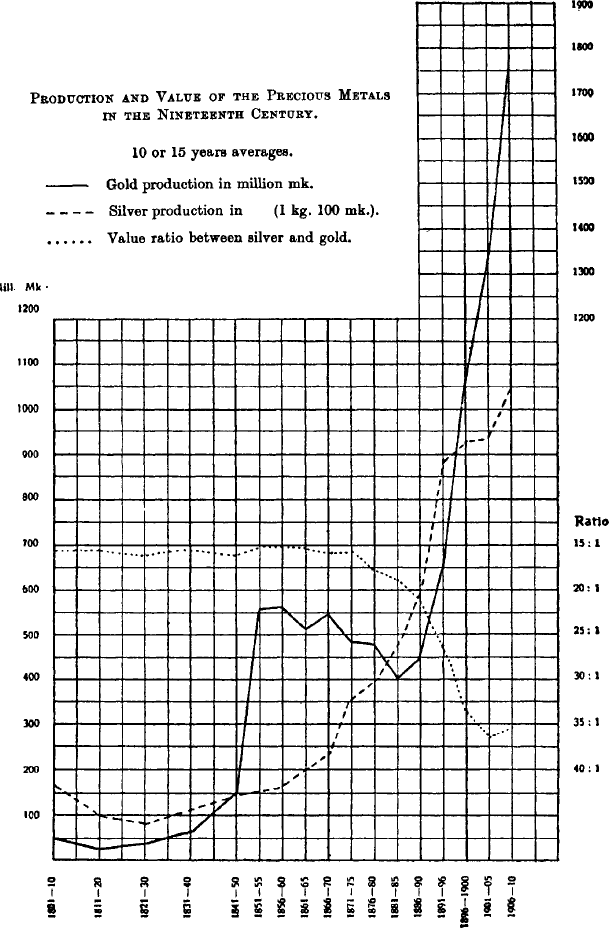
In the years 1848 and 1851 the goldfields in California and Australia were discovered, followed by similar discoveries in New Zealand, Colorado, etc. The output of gold was thus suddenly increased tenfold; in twenty-five years as much was produced as in the previous 250 years, and the annual production for a couple of decades was as much as three times the value, and one-fifth the weight, of that of silver. That this increase in the stock of precious metal was not without influence on commodity prices can be seen in the statistics, even though the crisis of 1857 caused a set-back in the rising price level. On the other hand, one would have expected the value of silver to rise considerably in relation to gold; but, curiously enough, this did not happen. Despite the complete revolution in the conditions governing the output of gold and silver, their relative values remained for a further twenty years—until the middle of the’seventies—about the same as had prevailed for 200 years, i.e. 15½:1, or slightly less. This state of affairs undoubtedly constitutes a strong argument in favour of the bimetallists who contend that a stable relation between the two metals can be effectively maintained by law (even though within certain limits) so that both might serve as standards with free coining and be full legal tender. In point of fact, two of the most important commercial countries of Europe at that time had, as early as the beginning of the eighteenth century, set up a statutory ratio between the gold and silver coinage. If this ratio had been the same in both countries it is quite probable that the market value would have related to it and that the circulating medium of both countries would have consisted of a mixture of gold and silver currency. This did not occur, however. The ratio established in England was 15.2:1, which was above the contemporary market value of gold in terms of silver. The French ratio was 14⅝:1, which was lower. It would perhaps be more correct to say that the market value fluctuated between these two limits. The consequence was that gold coins left France for England, whilst the full-weight English currency disappeared from England and only the worn coins remained, in complete accordance with Gresham’s Law. This was one of the chief reasons why England, instead of calling in and melting down the debased silver currency in order to replace it by full weight, preferred to go over to a pure gold standard and, to that end, forbade the free minting of silver for private account when, as a result of the fall in price of silver, it had again become profitable to do so. Shortly before, however, France had raised its ratio to 15½:1 (subsequently known as the bimetallic parity) and thus succeeded for a time (until about 1820) in retaining a certain amount of gold in circulation with silver. The revolutionary changes in the conditions of production which followed 1848 produced the following results: the market ratio between gold and silver fell below 15½:1—the ratio established by French currency law. Hence gold began to flow in and to monopolize the circulation, whilst the superfluous silver was melted down and sold to other countries—a large part of it going to India and the East. The weakening silver served as a parachute for gold and prevented the fall in its value which would otherwise have occurred. It is true that, at that time, there were, besides the bimetallic countries, also pure silver and pure gold countries ready to absorb whichever metal had become superfluous. But the results would probably have been just the same, if not even more favourable, had the majority of countries introduced the bimetallic system with the same ratio as France.
These movements in the market for precious metals became the immediate cause, in 1865, of the so-called Latin Currency Union between France, Belgium, Switzerland, and Italy. All these countries had adopted the French currency system and both silver and gold coins circulated quite freely between them, irrespective of the imprint. When silver began to flow away, fears were entertained lest it should disappear altogether, and in order to preserve quantities at least sufficient for smaller payments it was proposed to convert the silver coins of lower denomination (2- and 1-franc pieces and less) into token money and to mint them as such. An agreement was reached whereby the government of each country, under certain conditions, guaranteed to accept the debased silver currency.
Five-franc pieces remained full weight, and might continue to be freely minted; indeed, they still retain within the Latin Union their status as legal tender for the payment of any amount.
At the beginning of the’seventies, however, something happened which was to disturb completely the 200-year-old stability between gold and silver, and which was to impart to the currency systems of Europe, as well as to several extra-European systems, an entirely new form. Other European countries had, at that time, either a silver currency, as in Germany and Scandinavia (gold ducats and Carolinas were also minted in Sweden, but they were accepted at varying rates and scarcely circulated at all) or a depreciated paper currency, as in Austria and Russia. If those countries had gradually attached themselves to the Latin Union, with its free minting of silver and gold at a legally established ratio then the traditional ratio between gold and silver might possibly have been preserved. Adhesion to the Latin Union was, in fact, contemplated by Germany shortly before the outbreak of the war in 1870, but owing to the war the plan never came to fruition. Germany elected instead to adopt the gold standard and to sell all her silver not required for token money; and the Scandinavian countries immediately followed her example in 1873–5. No doubt a contributory factor was a certain fantastic idea that England’s economic supremacy was in some way connected with her gold standard. But the step was ominous. Germany did not, indeed, succeed in selling all her silver, some of it remained as late as 1907, and was still to be found in the form of “thaler” pieces which were not regarded as token money but were legal tender to an unlimited extent, like gold. Great quantities of silver, however, were thrown on the market. Thanks to the discovery of new mines and new methods (the furnace and later the electrolytic process replacing the amalgam process), the production of silver increased rapidly; and as the production of gold, though still much greater than before 1850, began to diminish at the same time silver again began to flow into, and gold out of, circulation in the Latin Union. Those countries which did not want to lose their gold had no choice but first of all by common agreement to restrict, and subsequently (Nov., 1878) entirely to suspend, the free minting of silver (5-franc pieces).
The same measures had been taken somewhat earlier by Russia, and soon afterwards by Austria. These two countries still had irredeemable paper money, but this had now risen to par, or even above par, owing to the fall in silver; for which reason minting for private account again became profitable. But, since it was now intended exchange paper not for silver but for gold currency, i.e. to adopt the gold standard, this minting of silver, which would have depressed the value both of the paper and silver currency in terms of gold, came inopportunely.
Thus the old double standard, whether bimetallic in the strict sense, or merely parallel, ceased to exist in Europe. Silver had been degraded to an ordinary article of commerce and its market price fell lower and lower. The United States tried in vain, by the famous Bland and Sherman Bills, to save the value of silver, in the maintenance of which it was now interested as a producer. Before the Civil War, there was statutory bimetallism in the United States, but since the ratio had (since 1834) been fixed as high as 16:1 virtually only gold was in circulation. As a result of the war, an irredeemable, and soon much depreciated, government paper currency—the well-known greenbacks—held the field. Not until 1879 did they succeed in bringing these notes up to par and then begin to redeem them. It was felt to be too dangerous to permit the free minting of silver, but shortly before this it had been enacted by the Bland Bill that a certain amount of silver, corresponding approximately to the native production of the U.S.A., should be purchased annually by the State and minted as cover for a special note issue—the so-called silver certificates. This amount was increased by the Sherman Bill, according to which payments were made in inconvertible Treasury notes. Since, however, silver continued to fall in value, the insufficiency of these measures became clear, the more so as gold began to flow out of the country. All attempts to induce the European countries to resume the free minting of silver failed. The only country of major importance with an ordered currency in which free minting still existed was India, which remained on a silver standard until 1893. But the ever-widening gap between the value of British and Indian currency caused numerous inconveniences; and when these became more apparent the Anglo-Indian government resolved (in 1893) to discontinue the free minting of rupees. Thereupon the U.S.A. also abandoned it, with the exception of token money, and henceforth devoted all its energies to the maintenance of the gold exchange.
Of recent years, the production of gold, which showed clear signs of declining at the beginning of the’eighties, has risen rapidly in consequence of the discovery of new deposits in Colorado, the Transvaal, and Klondyke; so that, at the beginning of this century, it not only equalled the production of the’fifties and’sixties, but grew to be three times as great. Simultaneously, the production of silver also increased, despite the tremendous fall in its value, although it looked like becoming stationary from 1893 to 1907. It is now, however, about five times as great as in 1860, though it is nevertheless considerably exceeded, even at its old value, by present gold production. And yet gold is now more than thirty-five times, and has even been forty times, more valuable than silver, whereas before 1873 the ratio had never been known to stand higher than 15½ or 16:1, even at times when gold production only constituted a fraction (reckoned in value) of the production of silver.
In England, the value of metallic silver is usually given as so many pence per ounce. Gold of  ½ fineness is minted in England at the rate of £3 17s. 10½d. (= 934·5d.) per ounce (about 31 gr.); so that if both metals were of the same fineness it would only be necessary to divide that figure by the price of silver in pence in order to ascertain the value ratio between gold and silver. The so-called English mint silver, standard silver (not to be confused with the content of the present English silver token money, which is much less) is a little finer than minted gold, i.e.
  ½
½ = ¾
= ¾ . The above mentioned total must therefore be increased in the proportion of
  ½
½ :
:  ½ = 111 : 110, or 943d.; if the quoted price in pence per ounce is divided into this the correct ratio will be found. A silver price of about 26d. thus corresponds to a value ratio between gold and silver of 943:26 (= 36¼1,approximately) whilst the bimetallic parity of 15½:1, when it still coincided with the market price, gave a price of 943:15½(= 60
 d.) per ounce of standard silver.
It can scarcely be doubted that the main cause of the fall in the value of silver is to be found in changes in monetary policy. If silver should again be adopted as a standard in the civilized world, side by side with gold, and be freely minted, then its market value would certainly rise considerably, not improbably to the old ratio of 1:15½, if the latter were retained as the statutory ratio. At present, there seems to be no practical reason for attempting this, since the world production of gold appears to be sufficient and the reserves (now obtained mainly by mining operations and not as formerly by washing in old river beds) are probably adequate for the needs of the European states and the U.S.A. and sufficient even to enable extra-European states to adopt the gold standard. This, however, is a question of expediency2 and does not affect the theoretical foundation of bimetallism, which is essentially unchanged, even if, as we shall point out later, it carries us beyond the conclusions which its advocates draw from it.
For the moment, however, the free minting of silver does not exist in any country with a regulated currency. The currency systems in existence in 1915 may be characterized as (1) those with a pure gold standard, in which silver is only used as token money and is only legal tender up to a limited amount; (2) those with the so-called “limping” standard, in which both metals are legal tender, but only one, gold, is freely minted; and, finally, (3) those with a paper standard in which the currency consists of inconvertible paper money or of metallic (silver) money minted only by the State for its own account. To class (1) belong England and most of its colonies, Portugal, Germany, and the Scandinavian countries (the Scandinavian Currency Union of 1873–5), Finland, the U.S.A., and, for some years past, Russia and Japan. To class (2) belong the countries of the Latin Union and Holland. To class (3) belong South America and, in Europe, Austria, where the gold standard has not yet been fully introduced, Spain, Greece, and the Balkan countries, also India, where the rupee (silver) is still the standard but with limited minting for State account only. In this latter case, a consequence has been that in recent years the rupee, despite the continued fall in silver, has begun to rise in value and now stands as high as it possibly can stand according to the currency law of 1893, i.e. equal to 16 pence in gold. (Its metallic content corresponds at the present value of silver to about 10d.; at the old parity the rupee was worth 22.6d.) At the above price the Anglo-Indian government has undertaken to issue without limit rupees against gold. Since 1899, moreover, the legal tender value of the English sovereign has stood at a ratio of £1 = 15 rupees. The gold standard is not fully introduced by this means; for that would require the unrestricted supply of gold for rupees at the same price, a condition not yet enacted by law, though adhered to in fact. In 1915, a transition to the gold standard in a form similar to that of India was planned in Mexico and China.
3. Swedish Currency History and a Comparison between Present-day Swedish Currency and that of Other Countries.
The oldest Swedish coinage seems to have been minted in the time of Olof Sköt or King Anund. These coins, which were called penningar, were then still equal subdivisions of the unit of weight, in so far as 8 öre at 3 örtug made 1 “Mark” (presumably 210 gr. or not quite one-half a Swedish skålpund) of pure silver, and every örtug was worth 8 penningar (earlier probably 4) in Upper Sweden. One “mark” of “penningar” was therefore originally about 32 crowns (kronor) and 1 öre about 4 crowns in modern currency. By degrees, however, the currency was debased, both in content and size; so that, as early as the time of the provincial laws, a distinction was drawn between “vägen” and “räknad”, or “karlgell” and “kopgell” marks. This debasement continued until, in the middle of the fifteenth century, the penningmark had sunk to one-eighth of its original value, or 4 crowns; as we have already observed, the purchasing power of the penning throughout the Middle Ages was considerably greater than now. In this connection, coins of a higher denomination began to be minted—first the örtug, then the öre, and so on. In the sixteenth century the debasement of the currency continued, so that, towards the end of the reign of Gustavus I, the mark was only worth 1 crown in modern currency. It was thus one-quarter of the large coin, the thaler (Joachimsthal) which was first struck at the beginning of the century in Germany and later in Sweden. The consequence was that, a daler (which, from the outset, was the same as a “thaler” or a specie “riksthaler”) was calculated as 4 marks or 32 öre, and this equivalent was maintained during all subsequent debasements. Whereas the specie “riksdalar”, which was a kind of international coin, remained practically unchanged in weight and fineness, the originally equivalent “svenska daler” was debased more and more. Our currency history until 1830 is indeed an almost uninterrupted succession of debasements and bankruptcies.
Under Gustavus, Adolphus, and Christina, and even later, with brief interruptions, the currency metal was copper, which was minted not only as token money, but also in large clumsy plates as standard money. A copper thaler was originally supposed to be of the same value as a silver thaler, but this ratio, which from the outset did not correspond to the metallic value of the copper coins, could not be maintained. The copper thaler gradually declined in value—at first to one-half and then to one-third of a silver thaler; this latter ratio was finally stabilized. Meanwhile, the silver thaler (= 4 silver marks) which sometimes was actually minted and sometimes merely a name for the coined copper plates, sank to two-thirds and then to one-half of its value in 1560, so that towards the close of the reign of Charles XI one specie riksdaler was equivalent to 2 silver thalers or 6 thalers or 24 marks in copper coins.
Under Charles XII (apart from the later emergency currencies which were nothing more than substitutes) a new debasement took place, in so far as the 6-thaler plates were restamped to the value of 9 thalers; as a result, the specie riksdaler, soon came to be worth 3 silver thalers, 9 copper thalers, or 36 copper marks, which was the parity in the Frihetstid. During the latter period all metallic money disappeared from circulation, and the Riksbank’s notes, inconvertible from 1745, became the only means of payment in the country. As a result of an excessive issue, especially during the Pomeranian war, these notes depreciated in terms of silver; or, what amounted to the same thing, the specie riksdaler, and the equivalent Hamburg banco riksdaler, in which most foreign bills were made out, appreciated in terms of the daler or mark banknotes. In 1776 these notes were converted into silver at the rate of 1 riksdaler specie = 72 marks of copper coin, i.e. at half their face value. The old ratio, 1 silver thaler =⅓ riksdaler specie, was retained in legal documents and in the valuation of state incomes. The silver riksdaler (specie), divided into (3.32 =) 96 öre or into 48 shillings was now the currency unit for the whole country.
After the Russian war under Gustavus III the notes issued by the Treasury (originally bearing interest, but subsequently becoming inconvertible paper money) became the chief medium of exchange in the country, driving out of circulation, in accordance with Gresham’s Law, both the metallic currency and the inconvertible Riksbank notes. From 1903, the Treasury notes became by decree redeemable at the bank for two-thirds of their value. (A fund had been created for the purpose, partly by means of a general income tax, the so-called “realization contribution”, and partly by “pawning” the town of Wismar.) After the Finnish war, however, it became impossible for the bank to redeem either its own notes or those of the Treasury in hard cash, whereupon both, whilst retaining their value relatively to each other, gradually depreciated (in other words, the silver value and the value abroad rose) until by the “realization” of 1834 they were redeemed at three-eighths of their nominal value, the Treasury notes being thus redeemed at one-quarter (two-thirds of three-eighths) of their original value.
The silver thaler, with its subdivisions the mark and the öre were still used in old legal transactions and were calculated at ⅓ riksdaler banco = 50 öre.
By the currency law of 1830, the silver content of the specie riksdaler was reduced by about three-quarters, or from 25·69 to 25·5 gr., whilst the cost of minting, which had formerly been paid separately, was now “thrown in” with the coin. By the law of 1855 no other alteration was made than that a quarter of a specie riksdaler, which after the currency realization of 1834 exactly corresponded to a Treasury riksdaler, became the unit of calculation under the name riksdaler riksmynt, divided into 100 öre. The currency changes of 1873 were made on the basis of 1 krona (equal in value to 1 riksdaler riksmynt) as the unit, the ratio between gold and silver being fixed at 15½:1 (15·81:1). Thus we may say that the previous silver weight of the unit was evened out, so that 4 kr. were regarded as equal to 25 gr.—or 160 kr. to 1 kg. pure silver. Against this imaginary silver coinage, gold coins were minted at the ratio of 1:15½ in weight.
The result was that 1 kg. of gold was minted into 15½:160 = 2480 kr., as is still the case.
In Germany the transition followed the same lines. 1 kg. of pure silver was then worth 180 Reichmarks and consequently 1 kg. of pure gold was minted to 2790 marks; thus 8 kr. are worth about 9 marks.
Similarly in France the silver and gold coins stand in a simple relationship to the kilogram, though this applies to their gross weight, and not to their net weight. 1 kg. of silver of  fineness is minted into 15½ x 200 = 3100 francs. Thus 8 kr. =
  x10 francs, or 72 kr. = 100 francs. The same applies to the various countries which have adopted the French currency system. Russia’s currency also bore a similar relation to the kilogram and therefore to Swedish currency. A silver rouble contained the same amount of silver as 4 francs, but the gold coin, the older imperial of 10 roubles, was minted in the proportion by weight of 1.15 and was therefore worth more than 40 francs. This was equalized in 1886, when the transition to the gold standard was planned, so that the new imperial equalled 40 francs. The intention was gradually to raise the depreciated paper rouble to its old parity of 4 francs. But, as this would have taken too long, it was decided in 1897 to take the existing exchange value of the paper rouble as the basis for redemption, whilst the imperial and half-imperial were fixed at 15 and 7½ francs, or 1.92 kr. The Russian gold coins minted were 10 and 5 Tsar roubles. The silver coinage, on the other hand, has remained unchanged, for which reason the Russian value ratio of gold to silver is quite different from that of Western Europe, i.e. 23:1, instead of 15½ : 1.
We shall ignore the currencies of the remaining countries because they do not stand in any simple rational relation to the Swedish, even though in Austria, Hungary, and the Netherlands the same unit of weight, the kilogram of gold, constitutes the basis of the currency. We merely indicate that in practice—
| 1 pound sterling | = | 18·16 | krona |
| 1 Dutch gulden | = | 1·50 | „ |
| 1 Austrian krona | = | 0·76 | „ |
| 1 American dollar | = | 3·73 | „ |
| 1 Indian rupee | = | 1·21 | „ |
| 1 Japanese yen | = | 1·86 | „ |
4. The Technique of Currency
The purpose of minting is, as we have said, to give a state guarantee of the weight and fineness of the metal, for too much inconvenience to trade would be caused if the metal had to be weighed and tested for every transaction. The fineness is now usually nine-tenths for standard coins, both gold and silver (the remainder being copper); but in England eleven-twelfths is the standard fineness for gold. By the expression “standard” we usually mean the net weight of metal in the standard coin, or, what comes to the same thing, the number of units minted from one unit of weight of a precious metal. In modern times the word standard is also frequently used to indicate the metal from which the standard coin is minted: we speak of the gold, silver, or bi-metallic standard, etc.
Even with perfected modern methods of minting it is impossible to achieve absolute accuracy either as regards weight or fineness. In both respects, therefore, a slight latitude is permitted (the “remedium”) which, with modern minting methods, is far from being fully utilized. In the Scandinavian countries the margin is ·0015 for 20 kr. pieces and ·002 for 10 kr. pieces, the margin of fineness being ·0015 for both. But, in addition 10 kg. of newly minted gold coins must not vary more than 5 gr. from the normal weight, i.e. by more than ·0005. The value of coins is, however, reduced by the wear and tear of circulation—although the amount of wear is certainly inconsiderable. It has been estimated at only one-fifth to one-quarter per 1000 per annum for the standard money in regular circulation. The common idea that the purpose of banknotes is to save this wear and tear is incorrect, for the maintenance of paper money actually costs more than that of metallic money. What is saved by uncovered paper money is the interest on the capital invested in the currency. In the course of time the wear may become considerable and, though the form and design of coins nowadays makes this more difficult, the practice of clipping, scraping, and sweating might assume large proportions. For this reason a minimum limit is fixed, below which the coinage ceases to be legal tender as between individuals. In Sweden, as in Germany, the limit is one-half per cent below the normal weight, in England almost one per cent. In France there is no limit within the country, but as between the states of the Latin Union it is only one-half per cent. The establishment of a minimum is, however, not sufficient to prevent the circulation of worn money, because individuals do not trouble to examine the weight and are naturally not disposed to bear the loss themselves if they accidently receive a badly worn coin. The State must therefore redeem its currency even if it has passed the minimum limit. Such is the case in Germany and Scandinavia, where a certain maximum limit of twenty per cent has been placed on the State’s liability; this is of no importance in practice. In England, on the other hand, coins cease to be legal tender, even as against the State, when they have passed the minimum. The consequence of this is that the full-weight money is paid to the State or the Bank or England and the underweight money continues in circulation, especially in country places.
Since the minting of money is expensive, the State usually makes a charge for minting on private account. This charge is called “Seigniorage”—a name which is due to the fact that in earlier times the charge was somewhat higher than the actual cost of minting and was therefore a source of income to the State. This fact, and the fact that it was profitable for private persons to have their precious metal coined and pay more or less appreciable charges for so doing, is due again to the fact that the minted metal qua legal tender had a higher value within the country than the unminted metal: experience shows that this difference may be enormous and it is in any case very great if the State charges a high seigniorage and does not at the same time contribute to an increase in the supply of money by minting on its own account. This method of procuring revenue for the State should, however, be avoided, for such coinage has very much the same disadvantages as inconvertible paper money. Sooner or late the country may experience an adverse balance of payments—as for example in consequence of a bad harvest; some portion of the money must then be sold abroad in payment for goods. In a foreign country, however, the currency of any country seldom has a higher value than that of its metallic content, since it must usually be melted down and re-minted abroad. The consequence is that the internal coinage loses its artificial value, and the exchange—i.e. its relation to foreign currencies—will depreciate to the same extent. At any rate that is what should, happen if there do not exist within the country stocks of unminted metal which can be used primarily for export; or else assets or credits abroad against which bills can be drawn. But it will always remain true to some extent. It is therefore advisable to restrict the seigniorage to the actual cost of minting, in which case deviations from the value of the metal and consequent fluctuations in the exchange will be correspondingly slight. In England there is nominally no such charge—coinage being “free and gratuitous”. But this is unnecessary and has no practical significance even in England.
The development of modern banking and of the mechanism of international payments have resulted in the almost complete disappearance of direct minting on private account. Instead, the central banks accept the precious metals from individuals in exchange for minted money or notes to the statutory amount. In England, as has been said, anybody possessing bullion can have it minted free of charge at the Mint; but this takes time and involves a loss of interest. Consequently gold importers prefer to deposit gold with the Bank of England, which credits them with the amount at the rate of £3 17s. 9d. per ounce (about 31 gr.)—or about 1½d. less than the Mint would have given (£3 17s. 10½d.), which is equivalent to a charge of a little over 0·15 per cent. (In Sweden the charge is one-quarter per cent for 20 crowns and one-third per cent for 10 crowns. The position is similar in Germany and elsewhere.) The banks then deal with the gold according to circumstances; they mint it or they keep it in ingots. Similarly, foreign currency is accepted by the banks at a price which usually varies little from par and may even sometimes be above par. Frequently such coin is not melted down, but is used as occasion requires for shipment—i.e. is sold again to importers at a somewhat higher price if the balance of payment is so unfavourable that gold must be exported. Consequently it may be said that, with free minting and a moderate seigniorage or none at all, minted money will have about the same value as the bullion—slightly higher, to be exact.
5. Standard Money and Token Money
Money which is unlimited legal tender in a country—so that ordinary debts can be legally discharged by offering payment in that money at its nominal value—is called the standard or current money of that country.
If two or more metals with a statutory value ratio are standard the system is bimetallic or trimetallic. If, on the other hand, only one metal is minted into standard money it is monometallic. If, in the former case, free minting of both metals is permitted there is a double standard in the real and classical sense. If, on the other hand, minting of one metal (silver) for private account has ceased, whilst the money in question is still unlimited legal tender then it is usual to speak of limited double standard, or of bimetallism with limited minting.
Even in a monometallic system the other metals cannot be entirely dispensed with as minting material. Silver money—not to mention copper and nickel—would be too inconvenient to use for larger payments, while gold, on account of its thinness and smallness, would not be handy enough for use in discharging debts of a few shillings. In countries whose standard money is silver, the gold coinage, even where it must be accepted at a varying rate of exchange, is often used as trading money. This was more common in earlier days than now, since banknotes have come into use. Where, on the other hand, gold is the standard money, as it is nowadays in an increasing number of countries, silver must be retained as a means for smaller payments, unless notes of small denomination are used. For the same reason the smallest payments are made in copper, bronze, or (as in Germany) nickel. Such money is called token money and differs from trading money in so far as it is legal tender to its nominal value, and not merely according to a varying rate of exchange. In contrast to standard money, its function as legal tender is limited to certain statutory amounts beyond which nobody is required to accept it in payment (in Sweden 20 kr. in 2- and 1-crown pieces and smaller sums for the smaller token money). The free minting of token money for private account is also universally forbidden, though this may also apply to the standard money, as was the case not long ago in Austria, Russia, and Holland, and at present in India. To some extent this is also true of the Latin Union, in so far as the 5-franc piece is still regarded as standard money.
If the bimetallic standard is abandoned, and nothing is done by the State to stabilize the relative market value of silver and gold, the situation must necessarily become unstable; hence silver token money and other token money must be minted below its value, i.e. will contain less of the precious metal than corresponds to its nominal value according to the average market price of silver. If it were of full value, its metallic value would sometimes exceed its nominal value; in other words, the weight of silver actually contained in the coin would be worth more in the market than the weight of gold which its nominal and legal value represents. In such case it would be profitable to melt down the token money and sell or export it, and a shortage of token money would arise, however much might be minted at the cost of the State. That is the reason why in England in 1816, and later on in 1865 in the Latin Union, and in 1873 in Germany and Scandinavia, the actual silver token money was minted with a lower content of silver. In Sweden, for example, as has been pointed out, since the bimetallic ratio remained, 1 kg. of pure silver ought to have been worth 2480:5½ = 160 kr. In reality, however, a 1-krona piece contains only 6 gr. pure silver, so that 167 silver kronor would be required to make up 1 kg. of pure silver.
From these figures, however, it appears that more considerable variations as between gold and silver were not expected. But, actually, the fall in silver rendered all precautions ineffective; even the so-called full-weight silver coinage, such as the 5-franc pieces, now have a metallic value of not even half their face value. A l-krona piece, if melted down, is now worth about 40 öre. Forged silver money, or, more correctly, illegally minted money containing the usual amount of silver, would therefore be a profitable business. Small-scale forgery is, however, prevented by the form and design of the currency. On a large scale it could scarcely fail to attract attention, for “minting works are rather noisy”.
On the other hand, there is no fear that token money may drive out standard money, for the State has power to limit the minting of the former to what is strictly required—which it must do if the whole currency system of the country is not to be endangered. To give token money limited legal tender only, as is done by the English currency laws, although putting a brake on excessive minting, is not in itself of great importance if—in Sweden—the State exchanges token money freely for gold money and the Central Bank is compelled to exchange it for notes.
If, in conclusion, we endeavour to survey the developments outlined above, it becomes clear that great success has been achieved in the solution of that part of the monetary problem which consists in the maintenance of uniformity of currency both in space and time. Instead of the multitude of more or less worn and debased coinages which previously existed—to remedy which it was sometimes necessary to withdraw metallic money altogether—we now have a few types, easily surveyed, with which it is possible—with the help of modern regulations as to minimum weight and the obligation to redeem—to secure a purely automatic replacement of the supplies withdrawn. Thus the earlier irresistible temptation to debasement is removed. By the concession of free minting of the standard coins for a small charge, or no charge at all, an essential parity between the minted and the unminted metal is preserved; this materially assists international payments. Since, moreover, one metal (gold) has become standard in nearly all countries, the last obstacle has been removed and one may almost say that in modern times all countries possessing a metallic currency have the same money. Whether or not the sacrifice of the free minting of silver was unnecessary and injurious is another question, into which we do not propose to enter here.
But so far we have approached no nearer to the solution of the most difficult problem of currency, namely the preservation of a stable and constant value in terms of goods and services. Even the most careful attention to everything which maintains the full weight of a coinage will not prevent that coinage from falling in value if the production of the precious metals is substantially increased, or the development of credit renders existing supplies unnecessarily great. And, vice versa, if a shortage of precious metals should occur which could not be made good by the increased velocity of circulation occasioned by credit methods, the careful maintenance of a full weight currency would prevent the stabilization of the value of money rather than promote it. Our next duty must therefore be to study carefully the influence on currency of these factors, viz. the increased or diminished velocity of circulation, especially by credit and banking operations. We shall undertake this task, after first glancing at currency from the legal point of view.
6. Money from the Legal Point of View
Like most other forms of wealth, money may be the object of legal disputes. Indeed these are of daily occurrence, since most claims to wealth assume the form of money. On the other hand, it is only rarely that money itself—its substance, exchange value, etc.—is the real subject of such legal disputes. Under an ordered currency system, there is practically only one case in which that occurs—i.e. in the transition from one standard to another, in the adoption of new or dissolution of old currency standards, etc. It then becomes a question as to what extent business agreements, forms of indebtedness, and other legal transactions existing before such changes, are influenced by them, and especially to what extent regulations of the above kind are retrospective in action as regards these pre-existing legal obligations.
That states have frequently given such retrospective action to their currency laws is shown by the expression “forced exchange”, which usually implies that those who have monetary claims must be content to accept payment in what is perhaps a more or less depreciated paper currency at its nominal value. But it does not follow from this that such procedure is always fair or just; still less is it clear how such questions should be adjudged when explicit regulations on the point are lacking.
An interesting example of this kind occurred in 1873 in connection with Germany’s transition from a silver to a gold standard. Certain Austrian railways had issued debenture bonds in Germany payable both in Austrian gulden and German thaler (both silver currencies) the ratio of whose metallic content was 2:3. In passing over to the gold standard the German currency law enacted that a gold 10-mark piece should be equivalent to 3½ thaler, and this agreed with the market value of gold and silver at that time. After 1873, however, the value of silver in terms of gold sank rapidly and the difficult question then arose whether the Austrian debtors were obliged to pay their German creditors in gold. The contract had been entered into before the transition to the gold standard was even contemplated in Germany and there was no stipulation as regards eventual payment in any currency metal other than silver, or as to whether the debt should be regarded as consisting only of the quantity of silver which was contained in the specified number of thalers or gulden at the time of the contract. The creditors claimed the former, and the debtors naturally claimed the latter. In the lawsuits which ensued, the Austrian courts all decided in favour of the Austrian claims and the German courts, with one exception, in favour of the claims of their countrymen. Helfferich, himself a German, associated himself with the majority of the German courts on the ground that the legal currency of a country should not be confused with the amount of metal it contains, even if, in consequence of free minting, the two are practically identical in value. He urged that the currency, or unit of currency, of a country is what the authorities decide that it shall be, and those who enter into business contracts without precisely stipulating the kind of money which is to be offered in payment must submit to any chance variations in the standard. They resemble two persons who have entered into a contract in which the determination of certain conditions is left to a third person. The argument seems to me somewhat specious because, among other things, the third person cannot in this case be regarded as fully emancipated. It would undoubtedly be very convenient for a debtor country to effect payment on a standard depreciation of one-half, and also for a country with large claims abroad to demand payment in a currency of double value. On the other hand, the pure metallic theory cannot always be sustained, as for example where the debt is contracted during a period when the currency of the country consists of depreciated paper money. In any case it is certain that this theory, and also the one defended by Helfferich, might give an unfair advantage to either creditor or debtor at the expense of the other. This would be true in the case of Austria and Germany, since it could be shown that silver had depreciated while gold remained constant in value in terms of goods. Inevitably, therefore, we are led back to the postulate which appears to underlie every monetary agreement, namely the presumption of the stability of the value of money. If this is lacking, and if the court is unable (which it almost always is) to ascertain to what extent the exchange value of money has changed during any period, then its decisions in matters of this kind must always appear somewhat arbitrary.
Although the Scandinavian countries went over from silver to gold at about the same time as Germany, there have not been, so far as I know, any similar conflicts—with the exception of Sweden’s differences with Finland before it went over to the gold standard in 1878. This was probably due to the fact that neither had claims against countries on the silver standard and neither considered it advisable to repudiate their debts in a different exchange from the one previously accepted.
Finally, there may arise the question of the obligation of the State in respect of money which has been called in and which has ceased to be legal tender; and especially in respect of the internal obligations of contracting parties to a currency union, when the union is dissolved. It is reasonable to demand that the State should redeem such money as it calls in, although in the case of a depreciated paper money it need not go farther than to redeem it at the value which it actually possessed in circulation at the time of redemption or in the immediately preceding years.3
As regards the internal obligations of the State, one must carefully distinguish between the case where the coinage is minted at a depreciated value ab initio, i.e. for the account of the State; and the case where free minting is permitted for private account. In the former case it is scarcely possible to evade the liability of each state to redeem its own coinage, and indeed no other procedure, so far as we know, has ever been suggested—even though such a redemption might be the consequence of a fall in the value of the metal involving unforeseen losses. The case is different where money has been freely coined ab initio; for example, the 5-franc pieces in the Latin Union continued to be freely coined until the fall in the value of silver made a restriction of free minting necessary. Meanwhile, owing to various circumstances, money had been minted in entirely different quantities by the respective states of the Union. Switzerland had not coined any such money, Belgium, on the other hand, had minted a considerably larger quantity than was needed by its population. But since the Belgian State Mint had only benefited the public, and anybody, whether of Belgian nationality or not, could have such coins minted, it seems scarcely reasonable to expect that the Belgian State should redeem at their face value all the 5-franc pieces bearing its imprint. The question has been debated at length within the Latin Union and it has been decided that, in the event of the dissolution of the Union, each State shall be responsible for the currency bearing its imprint—a decision which, with Helfferich, we regard as a solution not in full accord with the principles of currency. For the rest, we refer the reader both on this point and on the legal aspects of currency in general, to Helfferich’s exhaustive and, in most respects, correct account.
It is very evident that the cause of all legal disputes concerning money is to be found in the unforeseen changes in its exchange value. We see therefore more clearly than ever the sovereign importance of the stability of money through time, though all efforts to secure such stability would appear vain so long as metals are used as standards of value and free minting of the standard money on private account is permitted.
In the “Errata and Additions “appended to the German edition, Wicksell develops the principle, which he defended vigorously and persistently in his speeches and writings during the World War, that the changes in the value of money in Sweden between 1914 and 1923 rendered necessary comprehensive compensation, as between public and private debtors and creditors; so that anybody who, for example, had lent Kr. 1,000 at the beginning of 1914 and had them repaid at the beginning of 1919, when the purchasing power of the krona was greatly reduced, should receive compensation by an amount proportionate to the reduced purchasing power of the krona (i.e. as if the loan had been Kr. 3,000); whereas the person who lent Kr. 1,000 at the beginning of 1919 should have his debt reduced in proportion to the increased value of money (to, for example, Kr. 500).—[ED. SWEDISH EDITION.]
- 1This expression is perhaps not entirely suitable, since, as will easily be seen, the essence of the argument is in both cases the same. It is therefore also possible that I ought to have endeavoured to combine sections II, 2, C and D in a single uniform presentation. I have found myself unable, however, for various reasons, to do this. As they now stand, these two collateral presentations may materially support and explain each other.
- 2Some of the matter included in this book had been published in Conrad’s Jahrbücher in the preceding year.
- 3Some of these contributions are now available in one or other of the world languages. The article on Professor Bowley’s Mathematical Economics, with its discussion of the theory of Bilateral Monopoly, appears in the Archiv für Sozialwissenschaft, Bd. 58, pp. 252-281. Professor Hayek has included a celebrated article on Prices and the Exchanges in his Beiträge zur Geldtheorie, and two others on Dr. Gustav Åkermann’s Realkapital und Kapitalzins and Prof. Cassel’s “Theory of Social Economy” appear in English as appendices to the present volume. But an English translation of a comprehensive selection of these papers is still urgently to be desired.

