
God’s Gold
X. The Big Stick Strikes
III
KANSAS had a little oil in 1899. But in 1903 oil became an industry there—a million barrels that year; five million the next. Wildcatters and adventurers swarmed over the state. Four thousand wells pumped oil and the Standard was there with its pipe lines and its refineries—two huge ones which could handle 10,000 barrels a day. The Standard was the only buyer. There was a market then for 10,000 barrels a day. But the producers insisted on pumping as high as 35,000 barrels a day. The Standard begged them to stop. But they kept on. The price sank from $1.30 to 70 cents a barrel. The producers were in arms. The Standard was robbing them, they cried. The governor proposed to build a state refinery. The Standard replied, very stupidly, with a refusal to buy any more oil in Kansas. The producers organized as they did in Pennsylvania. The legislature replied that under its constitution Kansas could not go into the oil business. But an ingenious oil man found a way. The state could own penitentiaries and could put its convicts to work. So the legislature passed a bill appropriating $100,000 to build a state penitentiary with a kerosene distillery plant attached.
The Standard undoubtedly used its power in Kansas ruthlessly. At Humboldt an independent refiner named Webster bought oil from the producers. The Standard refused to buy any more oil from them because they sold to a competitor. In the Indian Territory the company disconnected its pipes from producers who sold to a competitor. The pipe lines were the weapon which made all this possible. To reach them the legislature passed four laws—one declaring the pipe lines to be common carriers, prescribing uniform rates on railroads or pipes, putting pipes under the jurisdiction of the railroad commission and prohibiting discrimination in rates between localities. And immediately prosecutions were begun under the state anti-trust laws.
The laws did bring some relief at first. The independent refiner at Humboldt resumed shipments. “The old rate,” he said, “to Kansas City was 17 cents. Now it is 8½ cents. We can do business now on the same level as the Standard.”
At the same time, just as Washington was making ready for Roosevelt’s inauguration, Congress passed a resolution calling on the Bureau of Corporations to investigate the Standard Oil in Kansas.
The Standard was clearly wrong in its ruthless policy but the producers were guilty of indefensible selfishness and folly. The Standard had oil in their tanks enough to last it for two years. They had paid $4,719,574 for it. Now the price had sunk to $1,200,000 below that. Yet the producers continued to pump oil and expected the Standard to go on buying.
IV
BOGUS independents—this was the charge which now ran current against the Standard. Oil men said that in their fights against the Standard they were always being hampered by companies which appeared to be independent but somehow managed to deal their fellow independents mortal blows at critical moments.
Anthony N. Brady, gas magnate of New York and Chicago, had trouble with the Standard about 1890 about prices on oil for illuminating gas in Chicago. He went into the Lima-Indiana fields, formed his own oil company, and built a refinery and pipe lines. Later, having accomplished his purpose, he sold his business to the Manhattan Oil Company. Later when independents warring with the Standard went to get oil in the Lima-Indiana field they found themselves being balked in various ways by the Manhattan. They began to say the Manhattan Company was not an independent; that it was a bogus independent, which meant that it secretly belonged to the Standard. This Standard officials vigorously denied. Here, however, was what happened.
In 1899 Mr. Horace Maxwell Johnson, barrister, of London, called on Brady and said he and his associates wished to buy a going oil concern in this country. Brady ended by selling to Johnson for $615,000 the Manhattan Oil Company. The stock of the Manhattan Company was then transferred to the name of the General Industrial Development Syndicate. There were some suspicious things about the sale. First, in the contract of sale by Brady to the British interests was a stipulation that the Standard Oil Company of Indiana should supply Brady with oil for his Chicago gas works. How could Johnson or the General Industrial Development Corporation bind the Standard of Indiana to supply oil to Brady? The simple truth was that the money for the General Industrial Development Company, Ltd., had all been supplied by the Anglo-American Oil Company in London, the English subsidiary of the Standard. Thereafter the Manhattan Company operated as an independent pipe line while its officers and the Standard managers protested that there was no connection. Indeed in 1908 Mr. Archbold swore in the government’s final dissolution suit that he had never heard of the General Industrial Development Company, although he and Rogers were members of the Board of the Anglo-American Oil Company which supplied over half a million dollars for financing it.
When these facts were brought out later Rockefeller came in for a good deal of criticism for the extensive maze of intrigue and deception used in these bogus concerns. The Standard of Indiana is fighting independents in Missouri and Illinois. The Standard of Indiana belongs to the Standard of New Jersey. Among all the independents there is one which seems always to find a way of injuring its fellow independents. When a refiner from Cleveland comes to Lima for oil, he finds all the available oil has been bought up by the Manhattan Company. This company secretly belongs to the Industrial Development Corporation, Ltd., of England. The Industrial Development Company secretly belongs to the Anglo-American Oil Company of England. And this belongs to the Standard Oil Company of New Jersey.
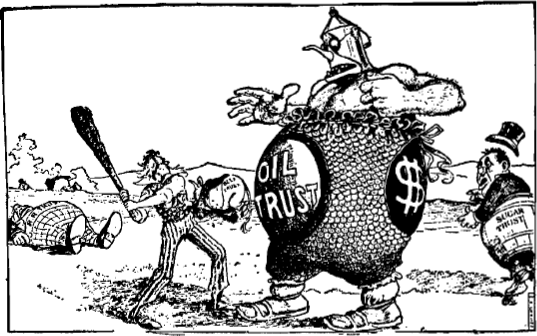
UNCLE SAM, THE MODERN GIANT KILLER.
(From the Saturday Globe, Utica. Referring to Anti-Trust Law)
There were other bogus companies. Down in Texas the independents were harassed by the Security Oil Company, a bogus independent. The stock of this company was owned by the London Commercial Trading and Investment Company. Mr. Frank B. Kellogg, government attorney prosecuting the Standard, was surprised to find that this London Commercial Company had the same offices and the same secretary as the Industrial Development Corporation which owned the Manhattan Company. Before Mr. Kellogg got through he showed that this company too in fact belonged to the Anglo-American Oil Company. There was still another mysterious independent—the Republic Oil Company. Scofield, Shurmer, and Teagle had fought John D. Rockefeller from the earliest days right up to the late nineties. Then they quit the field and sold their business to the newly organized Republic Oil Company of New York. This concern began to operate as an independent in Missouri but other independents soon found that it seemed to be on the side of the Standard. Suspicions were murmured. Charges were uttered aloud. From 26 Broadway came an indignant denial. The president of the Republic Company sent out to all its employees and managers a strong statement denying that there was any truth in this. But all the time the reports of the Republic Oil Company were being sent secretly not to 26 Broadway, but to 75 New Street, its back door. Its dummy directors met in the office of Mr. Tilford, a director of the Standard.
These were cases of bogus oil independents on a large scale. The principle was used even to harry and ruin little dealers. At Oneonta, New York, a small concern, the Tiona Oil Company at Binghamton, had gotten the best of the Standard. The dealers there were almost all selling Tiona oil. A Standard Oil tank wagon driver from Albany was sent to Oneonta. He was instructed to buy twenty-five barrels of oil from the Tiona Company at Binghamton and then to take it to Oneonta and to peddle it around from house to house at the price he paid for it. He was to put a sign on his wagon announcing that it was Tiona Oil at eight cents a gallon. The other dealers seeing this cut the price of their Tiona oil and soon there was a price war in Oneonta. It became bitter. One dealer put a sign out saying: “Free Oil—Come and Get Your Cans Filled.” Of course the dealers began to blame the Tiona Oil Company, accusing it of selling to others at lower prices than the general rate and thus involving them all in a ruinous rate war. This was what the Standard wanted. A condition like this afforded it an opportunity to go into Oneonta and take a lot of the Tiona’s trade. In this particular case the Tiona Oil Company investigated and learned where the rate war started. They refused to sell any more to the Standard’s secret bogus independent. He used Standard oil for a while, but hearing rumors of approaching trouble from the enraged dealers he left Oneonta while his skin was whole.
All these bogus oil independents were now to turn to ashes in Mr. Rockefeller’s hands.
V
ON THE wave of a popular uprising in Missouri, Joseph W. Folk, the intrepid prosecuting attorney of St. Louis who had wrecked the ring of boodlers in that city, was elected Governor of Missouri. Into office with him went an ambitious, vigorous, and able young attorney-general, Herbert Hadley. The notorious Henry Clay Pierce, with his Waters-Pierce Company, continued to pose, despite Texas revelations, as an independent defying John D. Rockefeller and fighting the Standard for the oil trade of Missouri.
Herbert Hadley had collected evidence that the Waters-Pierce Company and the Republic Company were both bogus independents and in 1905 he brought suit to forfeit the charter of the Waters-Pierce in Missouri and to prohibit the Republic Oil and the Standard of Indiana from doing business in that state. He alleged that they were all owned by the Standard Oil, constituted a monopoly and divided the oil business of Missouri between them. The young attorney-general wanted the testimony of the Standard officials and armed with a commission to take testimony arrived in New York in January, 1906. He caught Henry H. Rogers with a subpoena, but the others scuttled away. Then began a hunt to find Rockefeller. He seemed to have dropped utterly out of sight and the whole country looked on as the process servers looked everywhere for him. At Tarrytown people said he was safe in the vast Tarrytown estate. There Superintendent Hemingway laughed at this and said he was 400 miles away. Reporters sought him in Cleveland. Friends there said he was on a private yacht cruising along the Atlantic. In February a correspondent in Naples reported that Rockefeller arrived there on the Deutschland. William was safe from the process servers in Italy. Dr. Charles Eaton, Rockefeller’s pastor, declared he knew nothing of his patron’s whereabouts. The good doctor thought it was all a great joke—“the cutest thing Rockefeller ever did. The cunningest process servers, the shrewdest detectives, and smartest reporters in the country can’t find him.” But soon a letter from a Lakewood resident revealed that the old monopolist was there safe from the subpoena. Hadley’s commission was no good in New Jersey. Then the facts came out. When Hadley reached New York, Rockefeller literally fled from his process. With his trunks he drove to the ferry landing at Tarrytown but gave out that he was leaving Tarrytown by railroad. Reporters waited at the station but the old fox fled over the river by ferry. He took refuge in his great estate there with a guard at the gate and guards surrounding the grounds. Searchlights, operated by armed guards, were installed covering all roads. Delivery wagons were searched at the gates. Even members of his family unknown to guards had difficulty getting in. If visitors were expected a full description of them was given at the gates. Then only John received them. This John was a “guard”—a handsome, polished, courteous Irishman, said to be a graduate of Trinity College, Dublin, who spoke several languages and was said to be a very high salaried person.
About this time his son, young John D., was blessed with a new baby and the old gentleman was very anxious to see it. This softened him a little. Moreover his whereabouts had been discovered and Mr. Archbold, who was being examined at the time by Hadley, announced that Mr. Rockefeller’s health was not good and that maybe if Hadley paid him a visit he would answer his questions. Hadley replied there was one place to answer questions and that was in the witness chair. But Hadley relented sufficiently to say that if Rockefeller wanted to visit New York to see his new grandchild and would ask immunity from a process server it would be granted. Whether Rockefeller asked or not, the fact is reporters found him one day on a ferryboat bound for New York. “Are you going to see the new baby?” they asked. “Oh, I can’t say anything. Whenever I have anything to say I send it to the papers. I can’t say anything about my plans really.” In the end Hadley gave up for the time being so far as Rockefeller was concerned and went back to Missouri. A few days later Mr. Rockefeller emerged and where, more properly, than at his Sunday School? Is there a plaintive note in the talk of this certain rich man who had gone down from Pocantico to Lakewood to hide from his tormentors?
“It is wrong,” he told his class, “to assume that men of immense wealth are always happy. If a man lives his life to himself and has no regard for humanity he will be the most miserable man on earth. All the money he can get will not help him to forget his discontent. To hide one’s self from the world and live alone, secluded from one’s fellow men like a hermit, will make a man’s nature sullen and wretched. The kind of man I like is one that lives for his fellows—the one that lives in the open, contented with his lot and trying to bestow all the good he can on humanity.”
Hadley, however, kept at his job and succeeded in getting Mr. Rockefeller and his colleagues on the stand. Every conceivable obstacle was put in the way of the hearing. At the first session Standard attorneys insisted that testimony be taken in long hand. When the responsible executives reached the witness chair they took refuge behind the familiar “I decline to answer on the advice of counsel.” They denied that territory was divided between Standard units to prevent competition. Hadley asked:
“Does the Standard Oil of Ohio have a limited territory?”
Rockefeller answered: “It has not.”
“Has it not in the last five years?”
“Not to my knowledge. Its field is the world. That is its mission, to light the world with the cheapest and best.”
When Rockefeller made this answer Hadley had before him maps showing the territory within which the Standard of Ohio and other Standard units were required to operate, maps which were kept on every executive’s desk.
Hadley had difficulty catching Henry Clay Pierce as a witness. When he was finally brought to the stand he unbosomed himself with amazing frankness. For years Rockefeller and his associates had resolutely denied that the Standard had any interest in the Waters-Pierce Company. Pierce himself, to get back into Texas under Bailey’s counseling, had sworn that the Standard people owned no stock in his company. Now he testified to the following story: When he reincorporated to get back into Texas in 1901 all the stock was issued in his name. Mr. Charles Pratt went with him to the Mechanics National Bank in New York where Pierce transferred 2,750 shares, representing the Standard interest, to a Mr. Garth, cashier of the bank, retaining 1,250 for himself. Dividends were sent to another person until 1904 when Garth turned the stock over to Mr. M. M. Van Buren and it was then registered in Van Buren’s name. Van Buren was John D. Archbold’s son-in-law. That settled the question of the Standard interest in the Pierce Company and down in Texas Pierce was promptly indicted for false swearing.
Pierce further swore to Hadley that the Standard dictated his policy and that territory was allotted to him covering Missouri, beginning at Hannibal and extending diagonally across the state to a point south of Fort Scott, thence along the route of the Missouri, Kansas, and Texas Railroad, including Oklahoma, Louisiana, and Texas. North of that line belonged to the Standard of Indiana.
Hadley had established all his charges against the Standard. After denials by Archbold and others the Standard was forced to admit that it owned the Republic Company. The Standard of Indiana then made a remarkable proposal. It suggested to the State of Missouri that it would incorporate a separate company in Missouri and the stock for four years would stand in the name of two trustees, one selected by the state and one by the Indiana corporation, all under the approval of the Supreme Court. The state declined the offer but a more outright invitation to government regulation has never been known in business. Hadley obtained complete judgments against the three defendants and all were affirmed by the higher courts, which also approved a fine of $50,000 against each of the three defendants. This was a disastrous battle for the Standard.
VI
THE ARROGANCE and folly of the Standard Oil management in Kansas were now to bear bitter fruit. As a result of that episode, James R. Garfield, under the Campbell resolution, had been investigating the Standard performances in Kansas as well as upon the larger scale of national operation. Garfield planned a series of reports covering production, transportation, refining, and marketing. When Congress convened in December, 1906, following Roosevelt’s election, the Hepburn bill for railroad rate regulation was immediately pressed for passage. The President gave the subject of rate regulation first place in his message and with little or no delay the Hepburn bill was passed by the House by an over whelming majority—346 to 7. But in the Senate, packed with the representatives of the railroads and the trusts, the Committee couldn’t agree on a report. Elkins, coal and railroad and utility magnate, chairman of the Senate Committee, and his colleagues objected to the clause which permitted the Interstate Commerce Commission to fix rates and put those rates into effect immediately. They wanted to reserve to the roads their appeal to the courts and have the new rates suspended pending court action. The bill was finally reported out without recommendation and Washington enjoyed the spectacle of Roosevelt’s rate bill committed in the Senate to the direction of his bitterest enemy, the Democratic Tilman of South Carolina, who had been mortally insulted by Roosevelt when the President struck his name from the Senate invitation list of the White House. Foraker, Elkins, and the whole railroad and oil Camorra fought the measure.
In the midst of this battle Roosevelt sent to the Senate a report of the Corporation Bureau made by Garfield dealing with transportation in the oil industry. In transmitting it Roosevelt said: “The Standard Oil has benefited almost up to the present moment by secret rates, many of these secret rates being clearly unlawful.” This really summarized Garfield’s findings. The report itself contained an impressive array of facts outlining countless discriminations on the New York Central, New York, New Haven, and Hartford, the Illinois Central, Southern, Chicago, and Alton, and the Chicago, Burlington, and Quincy. Archbold, for the Standard, replied to the Garfield report, called it “unjust and unfair,” complained that the investigation had been made to study the Kansas case and was now used to influence railroad legislation while Garfield refused to make public the facts in Kansas. He insisted no rebates were found, that the complaints were merely about so-called “secret rates” and he denied that competitors were crushed, insisting that there were 125 independent refineries then doing business. Roosevelt was denounced for making Garfield’s report on Transportation public out of its regular order as if there were some sort of infamy in this. But Roosevelt’s blow was well-timed and aimed. Garfield’s report was released by the President May 2nd and before the month was out the rate bill was passed in the Senate and became a law. The cause of the Standard was hardly helped by the exhibition, throughout the discussions, of Mr. Rockefeller’s flight from the processes of the Missouri courts.
VII
THROUGHOUT these events Rockefeller was planning his first trip abroad to visit his daughter, Mrs. Strong. A strange malady had fallen on this young woman. The daughter of the world’s richest man, a nervous disorder had brought her down to where she lived in continual fear of dying in poverty. Just after the passage of Roosevelt’s rate bill and the departure of Attorney-General Hadley for Missouri, Rockefeller sailed on the Deutschland accompanied by his wife, his daughter, Mrs. Parmalee Prentice, and his physician, Dr. M. F. Biggar of Cleveland. About the same time Andrew Carnegie sailed for Europe. Yet how different the setting-out of these two men. Carnegie hard, ruthless, guilty of far more serious breaches of established ethics than Rockefeller, left acclaimed by newspapers and a host of friends to go to a kind of triumphal tour of Europe, received by ministers, writers, and potentates. Rockefeller’s departure was cloaked in the usual secrecy, his name not on the passenger list, no one at the steamer to bid good-by save his son. When the cry of “All Ashore!” was sounded young John D. turned and said: “Well, I guess I shall go ashore, father.” “All right,” replied the elder Rockefeller and without more ado or even a handshake the son walked down the gangplank.
Immediately the newspapers said Rockefeller had gone to avoid appearing as a witness before the Interstate Commerce Commission. This was not true. But he was hardly comfortably established at Compiègne, France, when in July he was indicted in Hancock County, Ohio, along with several directors of the Standard of Ohio for violating the Valentine anti-trust act of Ohio. The warrant out now was for his arrest and at 26 Broadway it was said that he would return July 28th. The sheriff of Hancock County announced he would be at the pier to arrest the harried oil man. When he did return he was an unhappy man who had need of all his fortitude. On the way home, as on the journey to France, he found himself shadowed by two reporters. “That was hard to bear,” he said, “but I don’t think they liked it either.” He left behind, in a state of great exhaustion, his stricken daughter. Stories of the death of his mysterious father had gotten into the papers and it is possible they were true. The country was ablaze with criticism, denunciation, exposure of himself and his career. It was known that Roosevelt was preparing a major blow.
Almost for the first time in public he softened the surface of the soul which he exposed to his enemies. To a reporter he opened his heart. “I never despair,” he said a little wistfully. “Sometimes things that are said of me are cruel and they hurt, but I am never a pessimist. I believe in man and the brotherhood of man and I am confident that everything will come out for the good of all in the end.” He talked about life and men. “I know you have tried hard to see me,” he said. “I admire persistence. It is commendable, especially in young men, and it will win in the end.” Then he added a word about the country which was then bristling with hatred and damnation of him. “Europe is a nice place, but I love my country best. Yes, all the hard things that my countrymen say of me can never be cruel enough to offset my love of country and home.”
He was not arrested at the dock. His counsel had arranged for his appearance in Ohio and when he landed he went in a few days to Forest Hill in Cleveland. There he expressed the hope that the public suspend judgment until both sides should be heard. He was becoming more and more sensitive to criticism. To some one else he said that he wished he and the public might become better acquainted. He began to think that perhaps his side of the story was not being heard at all. He had made little effort to get it heard save by legislators and courts and Congress and officials and then the talking had been done mainly in that form of utterance which Mr. Archbold specialized in. As for the public, Mr. Rockefeller now perceived that it had some sort of mysterious power in its hands. It got its information chiefly from headlines. “We are leading an awful fast life in this country,” he told a reporter in Cleveland. “It is simply rush along all the time. The newspapers for the most part keep pace with the times. They show the life of their readers. Their life is accelerated by the headlines; concentrated excitement all bound up in a few words. People see the big lines, rush to read the paper, rush off again to read some other paper and rush to a fire. It’s rush, rush, rush all the time.” He entered a plea of “Not Guilty” in the Ohio suit and then settled down in Cleveland for the Winter.
VIII
THIS was not a pleasant Winter for Rockefeller. He was now one of the celebrities of the world. His name was a household word on every continent. Wherever he went crowds gathered to have a peep at him and to a man of John D.’s yearning for privacy in all that he did this was a source of endless annoyance. Through the Spring the papers were filled with the uproar in Washington as Roosevelt and the balky Republican Senators battled over Roosevelt’s program. After Garfield’s report the public awaited with interest the blow which was expected to fall on the Standard crowd. This heightened the interest in Rockefeller. Every Sunday when he appeared at the Euclid Avenue Baptist Church crowds gathered there for a glimpse. And among them were reporters seeking interviews, photographers hunting pictures, cranks seeking redress, mendicants of every station looking for help and a sprinkling of people who had a grievance against Standard Oil who came for justice. Rockefeller found it necessary to employ a bodyguard who would look out for him, chiefly in navigating these crowds. Dr. Eaton, the pastor, was in a state of frequent apprehension for the safety of his distinguished worshiper. “Keep a sharp look-out for Mr. Rockefeller,” said Eaton to Rockefeller’s protective companion. “I fear these ugly crowds that gather to see him get in and out of his automobile.” Finally Eaton asked for special plain-clothes men to watch the crowds.
A good many of the curious gave cause for apprehension. One day a drunken man stepped out of the crowd and put his hand on Rockefeller’s shoulder. Before he could open his mouth, Rockefeller’s attendant took the offending hand and shook it warmly while the oil man slipped away. Another Sunday an old lady stepped in front of Rockefeller. She had come all the way from Kentucky and announced she had brought her trunk and expected Rockefeller to care for her while she remained in Cleveland. She had been hit by a Standard Oil wagon and wanted Rockefeller to settle with her. Another Sunday a well-dressed man with a large bundle of letters in his hands blocked Rockefeller’s path into the church. He announced dramatically he was a nobleman and an officer and that he wanted justice. Rockefeller, with the pastor, hurried forward into the doorway and up the stairs, the “nobleman” behind him and Rockefeller’s attendant in hot pursuit. Upstairs Rockefeller and the clergyman locked themselves in while the attendant got rid of the intruder.
One night a trustee informed Rockefeller that there was a socialist present occupying a pew opposite Rockefeller’s. The oil man kept his eye on the man throughout the service, who in turn eyed Rockefeller furtively. Rockefeller intended to speak that night but was so disturbed that he kept his peace. After this incident Rockefeller confided to his attendant that Mrs. Rockefeller thought he ought not to speak at meetings.
Above all he was in mortal fear of reporters. One day a reporter of a Cleveland paper accosted him. Rockefeller looked at him and recognizing him said: “You are the only reporter who ever quoted me correctly.” Later he said: “I am not afraid of reporters publishing what I say but what I do not say.” Hence he steered clear of them always.
With the coming of Spring Rockefeller went to Pocantico where he resumed the development and expansion of his estate. He began the building of his new home to replace the one destroyed by fire. He planned his house so that the sun would shine in it all day. He looked after every detail of the plan himself and was so busy with it that he did not have time to play golf.
About this time Rockefeller’s secrecy about his health manifested itself. There was little doubt that he had retired from active business management because of his health and frequent references were made to it by members of his family. It was a subject in which the public which disliked Rockefeller got a good deal of satisfaction. The spectacle of the richest man on earth unable to eat a square meal was a little too good not to be enjoyed. Endless quips and many grim jests were made about it. About two years before a report from Atlantic City was printed that Rockefeller had offered a standing reward of a million dollars to any one who would restore his stomach. This was later denied but the story persisted and was passed about with evident relish. When Rockefeller arrived from Europe attended by Dr. Biggar, the latter, when asked by reporters about Mr. Rockefeller’s health, replied a little crisply: “Mr. Rockefeller is in the best of health. Mr. Rockefeller has enjoyed excellent health for the last eighteen years.”
As the years have gone by this attitude with reference to the illness episode has been adopted as the settled policy of Rockefeller and his immediate family and entourage. Inquirers are told today that Mr. Rockefeller was not sick when he retired, that as a matter of fact instead of suffering from stomach trouble he was overweight and his first care was to reduce his weight. It is, as a matter of fact, a question whether Rockefeller was ever very seriously ill. In spite or the denials today he did suffer with stomach trouble but there is some ground for suspecting that the ailment was not a very grave one and that it was greatly exaggerated in Rockefeller’s own mind, taking on, in fact, for a while the form of an obsession. In any case about this time his health was greatly improved. He was again able to eat freely, though he continued to eat with discretion. Moreover he was now approaching seventy, growing older, and he continued to follow the careful program of rest, exercise, and moderate eating which had brought about his recovery. Secret in all things, he now sought to be secret even about his illness.
He had now adopted that regimen of orderly living which he has kept up to this day and in which his life was coming to be lived in a fixed orbit. He rose at 6, breakfasted at 8, and from 9:30 to noon played golf usually with some visitors. After lunch he rested on a couch. After this he went for an automobile ride which he never failed in no matter what the weather.
All this time the threatened attack from Roosevelt was much on his mind. He got many visits from Samuel C. T. Dodd, chief counsel of the company, and once actually made a visit to his office at 26 Broadway, the first in many years. He visited the luncheon room and was surprised at the number of new faces he saw there. “We old fellows are being pushed aside,” he commented.
Roosevelt at least would do something to accelerate the push. The blow he had been preparing was now ready. The first phase of it came in the Fall. It was an indictment of the Standard Oil Company of Indiana for violations of the Elkins Act.
The company was charged with accepting secret rates on shipments over the Chicago and Alton Railroad from Whiting, Indiana, to East St. Louis. The published rate on oil between these points was eighteen cents a barrel. The Standard was charged with getting a secret rate of six cents for three years. Garfield had traced 1903 carload shipments and each carload shipment was set down as a separate offense and made the subject of a separate count.
The other case was instituted in Missouri and was an action under the Sherman anti-trust law to dissolve the Standard Oil monopoly. It was alleged that the Standard Oil Company of New Jersey was a holding company which had merely stepped into the shoes of the old trust, that this holding company held the stocks of all the other subsidiaries and ruled them as a single concern; that it used them to destroy competition and enjoyed a practical monopoly of the business of refining and piping oil. Of all the great suits against the Standard this was to be the most sensational.
Rockefeller was at Forest Hill when the news of this attack was brought to him. The same day news came from France that his daughter Bessie, the wife of Charles A. Strong, had died the preceding day at Cannes.
The same day a Grand Jury in Ohio brought in another indictment. In various places a dozen actions were being pressed against him and his company. The tide seemed now to be running strong against him.
As for the indictments and suits, they made a stir when brought in, but in a little while men said nothing would come of them. Even the grave and conservative Dr. Lyman Abbott in the Outlook thought the forces “that make for combination are too strong. . . . Can wealthy and influential law breakers be made to obey the law?” People everywhere answered to themselves “No.”
CHAPTER X. THE BIG STICK STRIKESTHE YEAR 1907 opened with major actions pending against Rockefeller and Standard Oil in three spots—in Ohio, Indiana, and Missouri. At this moment, Rockefeller, now within hailing distance of seventy, was for the first time seriously concerned about his fame. The flood of abuse even within the church and the endless attacks made this aging man feel that as he neared the grave he was leaving a very dubious monument.
An interview with an able reporter, Mr. William Hoster, had served to open his eyes a little to this problem of publicity. Hoster had been sent by his paper to cover Rockefeller’s European trip. With a good deal of tact, he managed to get acquainted with Rockefeller, through Dr. Biggar, and to reveal frankly his mission. Rockefeller took a fancy to him and on one occasion in Compiègne opened up his heart. When Rockefeller complained of the harshness of the public judgment Hoster surprised him by saying:
“It is your own fault, Mr. Rockefeller. You refuse to see reporters or to make known your side of the case. Here I have had to come all the way to Europe to get you to talk to me and even now you insist nothing shall be printed. It’s your own fault.”
“So it’s all my fault,” he returned, eyeing the reporter quizzically. Then he shook his head. “Perhaps it is.
“They will know me better when I’m dead, Mr. Hoster,” he continued. “There has been nothing in my life that will not bear the utmost scrutiny. Is it not patent that I have been made into a sort of frightful ogre, to slay which has become a favorite resource of men seeking public favor? It is not from the body of the people whence I sprang that these denunciations come, but from the self-seekers who would be leaders. What advantages had I that every other poor boy did not possess? No one could have begun life with less than I had. Does any fair man accuse me of grinding him down?
“I am talking to you now as man to man. I am not one who wears his heart on his sleeve, and I cannot bring myself to make fit answer to these repeated slanders. But it is a fact that all of this criticism comes from, or is inspired by, men who have been my business competitors—men who would have bested me if I had not bested them—and from public officials seeking favor, agitators and demagogues.”
A little later he said: “I believe Mr. Roosevelt is a sincere man. He undoubtedly has the confidence of the people. He is robust, virile, dashing; he appeals to their imagination somewhat as Napoleon appealed. A man so busy cannot be always right. We are all bound to make mistakes at times. I think he does not always grasp every side of a question. Sometimes I wish that he might be more fair. I do not mean that he is consciously unjust. He is often uninformed.”
“As a matter of fact, Mr. Rockefeller,” Mr. Hoster inquired, “do you really know exactly what you are worth?”
“Of course I do,” he replied. “That is simply a matter of looking at the balance sheet which is submitted at the close of the day.”
“And you do not possess a billion?”
“Nothing like it—not by one-third of that amount. I want to make clear to you the injury that is done to me by these persistent stories that I am worth a billion dollars. They provoke in the minds of thousands thoughts which lead to great unhappiness. Is any one so foolish as to believe that there is a man in the United States worth a billion dollars? Do you understand how much money that is? That story is a ridiculous fable.”
In February then when he made his greatest gift, $32,000,000 to the General Education Board, while many editors hailed it as a magnificent and intelligent endowment, there were many who believed he was moved by a desire to brighten the colors of the cloud in which, of necessity, the judges then considering his cases must view him. He had previously given $11,000,000 to the Board. Now he added $32,000,000 more, the gift being transmitted by his son. By this time Frederick T. Gates was president of the Board.
II
HARDLY was the gift published when the irrepressible state of Texas indicted Henry Clay Pierce for false swearing and instituted ouster proceedings against the Waters-Pierce Company based on the revelations in Hadley’s Missouri suit. Pierce had sworn that Standard Oil had no interest in his company when under Bailey’s advice he applied for reentry to Texas in 1900. The habit of resting heavily upon fictions can poison the mind in the end. When Pierce was reported to have been indicted for perjury he indignantly replied: “That is not true. I was never indicted for perjury. It was for false swearing.” “You lie,” cried Jacques in the “Two Orphans” when accused of stealing a coat. “It was a cloak.”
Here we may dismiss Pierce from this history. He resisted extradition but Governor Folk turned him over to Texas. He was tried in November, 1909, in a sensational trial but acquitted, since the only evidence of his false swearing was his own statement in the Missouri court. The victory, however, was a dubious one. For before this his company, the Waters-Pierce Company, belonging mainly to the Rockefeller interests, was convicted for violating the Texas anti-trust law and fined $1,623,900. Pierce paid the fine to prevent confiscation of the company’s property. But now the state compelled him to sell all the property of his company in Texas and this brought $1,431,741—$200,000 less than the fine. The sale, however, was just one more fiction. In 1911 when the Standard Oil dissolution decree was affirmed by the Supreme Court, the company was considering the expulsion of Pierce. It planned to elect the now famous Col. Robert W. Stewart president. The fight came to a head at the annual meeting of the company in 1912 and after a bitter struggle, which went through the courts, the Standard sold out its holdings to Pierce. But this vigorous, unscrupulous, audacious man continued in trouble and in 1923 died leaving less than a million out of a fortune which must have been not less than twenty times that much at one time.
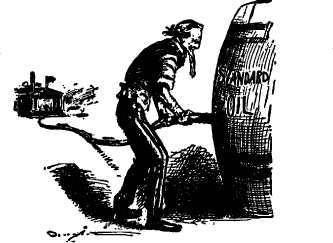
THE NEW PIPE LINE.
(By Davenport in the Evening Mail, New York)
III
ON AUGUST 13, 1907, the country was treated to a genuine sensation when Judge Kenesaw Mountain Landis, in Chicago, fined the Standard Oil Company $29,000,000. Rockefeller was visiting an old friend and distant relative, a farmer named William Humiston, outside of Cleveland, when news of the fine was brought to him. He seemed little disturbed by it but continued to talk of farming, lunched under the trees in the farmyard and during the meal lectured his host on the evils of over-eating. Later a reporter called on him and he gave out a statement. “A great injustice has been done the company,” he said. “It was from ignorance on how the great business was founded. For all these years no one has known and no one seems to have cared how it came into existence.”
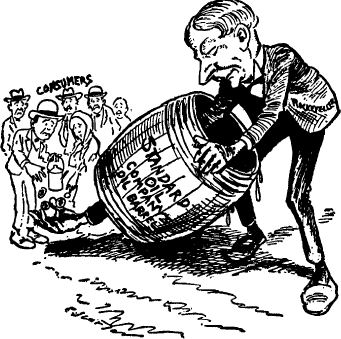
A FLOOD OF CARTOONS LIKE THIS PLAYED ON THE MANNER IN WHICH ROCKEFELLER WAS CHARGED WITH PAYING FINES AND MAKING GIFTS AND COLLECTING THEM FROM OIL CONSUMERS.
(From Minneapolis Tribune)
Judge Landis had held the company guilty on 1,462 counts, calling each carload shipped at the secret rate a separate offense. When the jury found the company guilty Landis called on its counsel to furnish him with statements of the company’s net profits from 1903 to 1905. They complied and showed a profit of $81,336,994 in 1903; $61,570,110 in 1904, and $57,459,356 in 1905. Counsel had urged that the so-called secret rate injured no one as there were no other shippers of oil over the road. “It is novel indeed,” replied Landis, “for a convicted defendant to urge the complete triumph of a dishonest course as a reason why such course should go unpunished.” He thereupon imposed a fine of $20,000 for each of the 1,462 counts, thus arriving at the figure of $29,240,000.
The fine instantly hoisted Landis into fame. He was then just forty-one years old. He had begun life, after graduating at law, as secretary to Roger Q. Gresham when he was Cleveland’s Secretary of State and later practiced law successfully in Chicago, representing many corporations and railroads.
While most papers praised Landis and even lamented that jail sentences were not possible, for the first time in Rockefeller’s history a large number of editors were on the other side. It is “yellowism in the judiciary,” said the Brooklyn Eagle. “No theory of law or justice sustains such a thumping penalty,” complained the New York Times. The Hartford Post swallowed the whole Standard Oil defense and criticized Landis. “Mere futile sensation,” “Playing to the galleries,” “An imposition on its face,” “Claptrap and farce,” “Opera Comique,” said papers from Boston to Denver.
The Standard itself, which now had in Mr. Jerome I. Clark a press agent, went into a frenzy of defensive publicity. Men worked through the night sending out huge packing cases full of copies of a statement of the company’s side framed for employees but sent to newspapers and schools and others.
IV
A WEEK after this famous fine, there was a severe slump in the stock market. Some stocks, such as Union Pacific, went off as much as seventeen points. Standard Oil stock, oddly enough, resisted longest, but after a few days sank from 500 to 421. Immediately Wall Street and corporation leaders sent up a chorus that Roosevelt was driving the country headlong into ruin. The Landis decision was blamed for shaking confidence in “business.” Harriman always claimed this started the 1907 panic. Meantime Roosevelt had directed suits against the Tobacco Trust and the Powder Trust. The Interstate Commerce Commission was investigating Harriman’s vast schemes and reported with alarm that Harriman’s consolidations had ended railroad competition in one-third the territorial area of the United States. Franklin K. Lane, who wrote the report, recommended that railroads be prohibited from owning shares in other roads. To a reporter Rockefeller said:
“The runaway policy of the present administration can have but one result. It means disaster to the country, financial depression, and chaos.” Roosevelt was not the man to be deterred. He denounced the “malefactors of great wealth” as the real guilty agents behind the depression. “As far as I am concerned,” Roosevelt said, “and for the eighteen months of my administration that remain, there will be no change in the policy we have steadily pursued, no let up in the effort to secure the honest observance of the law, for I regard this contest as one to determine who shall rule the government.” Rockefeller confided to a friend later that his statement about the “runaway administration” had been made to a reporter with the understanding that it would not be published. “I could have cried for that young man,” he said, referring to the youth who had betrayed him.
As a matter of fact, there had been a serious slump in railroad shares and a slight stock market panic back in March many months before the Landis fine. Then Harriman blamed Roosevelt. The situation had been brewing for some time. It had been created by the irresponsible, selfish, and wild speculations of the large group of railroad, mining, and industrial promoters who had been permitted through two administrations to carry forward their audacious schemes. The guilty hands behind the whole bad business were not those of Roosevelt and Kellogg and Garfield and Landis and the men who sought to check the frenzy, but those of Harriman and Morse and Heintz and Flint and Rogers and William Rockefeller and Morgan, who had pumped the financial structure of the country full of water. The shaky edifice was now springing leaks everywhere. The water was running out at a hundred rotten holes.
When about two months later the crisis was reached with the failure first of the corrupt combinations of Heintz and Morse and then a flood of rumors about banks everywhere, the crumbling of stock market values and finally the crash of the Knickerbocker Trust Company, the only thing which the financial saviors thought of was the stock market. Roosevelt’s Secretary of the Treasury George B. Cortelyou was induced to release $25,000,000 of government funds to national banks in New York. J. P. Morgan, who had rushed back from an Episcopal convention to save the situation, became virtual dictator. In his library, with the Stillmans and Garys and lesser figures moving about like so many secretaries, he moved the pieces on the board. The government funds placed by Cortelyou were used to make loans to stock brokers to save the crashing values in stocks, many of them worthless. Roosevelt was bitterly criticized for this, but he knew nothing of it and it is probable that both he and Cortelyou were imposed on by the great bankers who were managing things. Morgan began to assemble funds to steady credit as he did in 1893. Again it was Stillman who brought in large gobs of the necessary cash. They got $10,000,000 from “Uncle John” as Rockefeller referred to himself in describing the incident. “They always come to Uncle John when there is trouble,” he commented with ironic relish.
Then came an incident which was to call for an endless amount of explanation later. Colonel Oliver H. Payne, so long treasurer of the Standard, was now busy chiefly managing his great fortune. The firm of Moore and Schley was one of the most important brokerage houses in Wall Street. It handled accounts for the insiders and was looked upon as one of the most solid in America. As a matter of fact, at the time the firm held an immense amount of the stock of the Tennessee Coal and Iron Company as collateral for loans. Payne was not only one of their largest clients but a close friend. The Tennessee Coal and Iron stock was then almost worthless on the market. The brokerage firm was on the verge of bankruptcy. Payne advanced them large sums and exchanged securities with them to save them. His loans were threatened with complete loss if Moore and Schley were not rescued. Payne had his attorney go to J. P. Morgan and lay the matter before the dictator. He explained that there was no hope for Moore and Schley but to have the United States Steel Corporation buy the Tennessee Coal and Iron Company. This would save Moore and Schley’s loans and also Payne’s. The United States Steel Corporation wanted this company though Judge Gary and Henry C. Frick pretended at the time that they did not. The situation offered them an opportunity to swallow the Tennessee Company if properly managed. Gary and Frick hustled by special train at midnight to Washington and called on Roosevelt in the morning before nine o’clock. They explained to him that the Steel Corporation was urged to take over the Tennessee Company because an “important” company held an immense amount of the stock as collateral and was threatened with ruin. In fact it would collapse unless the Steel Company took over the Tennessee concern before the opening of the Stock Exchange. The collapse of this “company” would be a crushing disaster, they explained. Their only anxiety was their fear that the President would not understand their motives and if they took this iron concern it would result in a prosecution under the Sherman law, a thing they had been worrying about for some time. The gravity of the situation appealed to Roosevelt. They did not disclose the name of the “company” that was in danger and he supposed it was a trust company. He assured them that he would not consider it any part of his duty to interpose objections. Gary telephoned the Morgan offices a little before ten o’clock that everything was all right and when the Exchange opened almost the first announcement was that the Steel Corporation had taken over the Tennessee Coal and Iron Company. It was not until the Stanley investigation in Taft’s administration that it was learned that the whole performance had been staged on one side to save, not a trust company as Roosevelt supposed, but a stock brokerage house and on the other side to enable the Steel Corporation to gobble up another powerful subsidiary without bringing on a collision with the impetuous president.
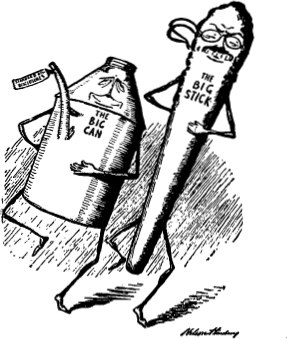
“WE’VE BOTH HAD A PERFECTLY CORKING GOOD TIME!”
(From the Daily Eagle, Brooklyn, N. Y.)
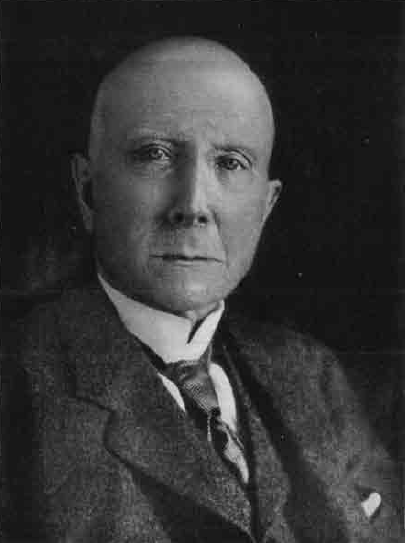
JOHN D. ROCKEFELLER.
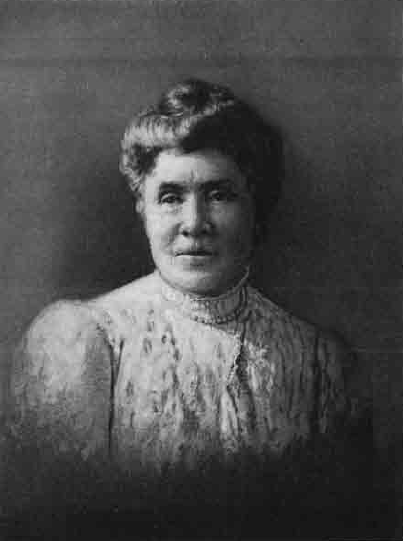
MRS. JOHN D. ROCKEFELLER IN 1904.
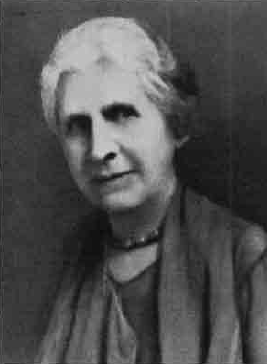
IDA TARBELL.
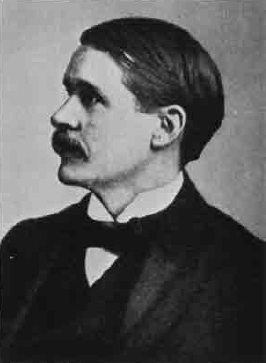
FRANK S. MONNETT.
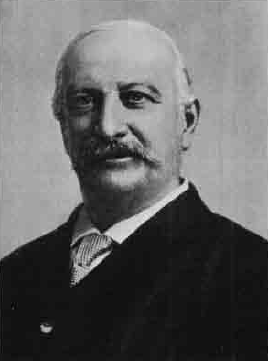
GEORGE RICE.
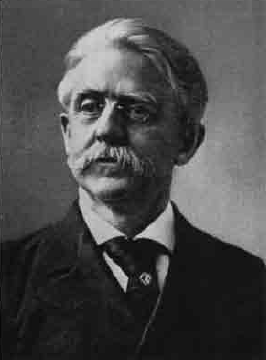
HENRY DEMAREST LLOYD.
There is a little more to this story which has to do with the manner in which Payne and Pratt—the two Standard Oil directors—became interested in the Tennessee Coal and Iron Company. The Steel Corporation had really wanted the Tennessee company. Sometime before George Kissler, an able and audacious Wall Street promoter and operator, had gotten control of the Tennessee company. He had bought the stock in the open market at from $22 to $97 a share. Then he decided to unload and through the firm of Moore and Schley organized a pool to push the price of the stock up. Moore and Schley interested Payne and Pratt in this pool—a pure gambling operation. Kissler sold out 225,000 shares of his stock to this pool, at $115 a share. Moore and Schley held all this stock as collateral.
Having sold out to the pool, Kissler went into the open market and quietly accumulated the remaining 110,000 shares of the company, a powerful minority interest. When the pool heard of this its members became worried. A gambler like Kissler in the market with such a block of stock could mean no good for their speculation. Moore and Schley then got in touch with Kissler and entered an agreement that he and the pool would not sell any part of their stock at less than $150.
Then they tried to sell out to the Steel Corporation. Morgan favored buying. But Gary and Frick balked, insisting they could buy, if they held out, at half the price. Meantime the dark clouds of the panic of 1907 gathered over the market. Stock prices sagged. There were no buyers for Tennessee Coal and Iron Company. The Steel Corporation wanted it but held aloof. Hence the price of the company’s stock also slumped. It was thus Moore and Schley found themselves trapped holding this huge amount of collateral. Payne and Pratt and the whole pool were involved. Payne advanced securities to Moore and Schley to tide them over. But as the approaching panic gathered force, Payne and his associates faced heavy losses and the brokers, ruin, if they could not unload the Tennessee Coal and Iron Company stock at a good price. It was at this point that Payne’s attorney went to J. P. Morgan and appealed to him to save the brokerage house. It was then this famous deal, to save a couple of stock brokers and their rich clients from loss in a gambling pool, was put over on the unsuspecting President.
However, neither of these expedients—the Cortelyou $25,000,000 government deposits nor the Tennessee Coal and Iron Company purchase—averted the panic. By December the country was in the midst of a serious financial depression.
V
THE LANDIS fine was of course promptly appealed to the United States Circuit Court of Appeals. But the Standard Oil effort did not stop there. Roosevelt got many letters expressing amazement at the destructive character of his crusade against business. Lee Higginson of Boston wrote him begging him to mitigate the vigor of his thrusts. Henry C. Frick, who was close to Roosevelt, felt the fine was the most serious cloud over-hanging the country. He went to Philander C. Knox, then in the Senate, and urged him to intervene with the President. Knox prudently suggested that Frick write Roosevelt. Frick did and urged the President to take some steps to have the Department of Justice settle the matter to which Roosevelt replied that it would be better to have the Standard Oil attorney make some proposal. Nothing came of it all, however, and the case had to take its course through the appellate courts. A year later, in August, 1908, that court repeated the sensation of the original judgment by reversing Landis’ decision, revoking the fine, ordering the case back for a new trial and severely criticizing Judge Landis for his decision.
The opinion was read by Judge Grosscup who held that Landis erred in considering each carload shipment as a separate offense and he stigmatized the big fine as an “abuse of judicial discretion.” Judge Grosscup ordered a retrial of the case and Landis promptly let it be known that he would not sit in a second trial. Roosevelt was aroused by the reversal and spoke his mind. “The President would regard it as a gross miscarriage of justice if through any technicalities of any kind the defendants escaped the punishment which would have been meted out to any weaker defendant guilty of an offense. The President will do everything in his power to prevent such a miscarriage of justice.” He directed Attorney-General Bonaparte to bring into the case Frank B. Kellogg who had successfully prosecuted the Northern Securities case and was now pressing the Government’s dissolution suit against Standard Oil. Judge Grosscup refused to comment on the President’s implied strictures in spite of the fact that he came in for a good deal of savage criticism. He had had a very distinguished career as a liberal jurist, had written several vigorous anti-trust decisions, including one in the packers’ cases and was a student of the economic conditions of the times. In spite of this there is little doubt that the decision, as pointed out at the time by the San Francisco Bulletin, produced a very unpleasant effect upon the minds of the people.
CHAPTER XI. MURDER WILL OUTMR. JOHN D. ARCHBOLD had a negro valet, named James Wilkins, who for twenty years had been a trusted employee. Wilkins had a son named Willie Winkfield and he, with Charles Stump, worked as messengers and file clerks in the office of the great Mr. Archbold. Willie was well aware of the important spot in which he worked and was more than a little interested in some of the documents which he saw on Mr. Archbold’s desk and in the files. There were letters and wires to great statesmen, lordly senators, rulers of men, reaching as high as vice-president of the United States and even to certain presidential aspirants.
Willie found himself in 1904 in need of funds for some reason. The 1904 election was in full blast and it must have occurred to the wily negro that some of the letters that went across his employer’s desk would make mighty ammunition in an election. The thought took root and germinated in his mind. He confided it to Stump, who was a white man, and the two decided to try their hand at a little profitable pilfering. They went to the New York American, Hearst’s morning paper, informed the managing editor that they were in possession of some very valuable documents and proposed to sell them. Finding him a prospective customer, Winkfield and Stump then hung around Archbold’s files as much as possible. They took away at night letters and telegrams which they delivered to one of the editors of the New York American. The documents were photostated and returned to Archbold’s files. They got $20,500 for their loot. Sometime later for some reason wholly unconnected with their offense they were dismissed from the company. The editor’s eyes opened wide as he read these incriminating documents and he took them at once to his chief, William Randolph Hearst. Hearst did not publish the letters then but put them away in his safe to await the day when it would suit his purpose to bring them to light. Mr. Archbold continued to sit at his desk and write to his political allies and employees, little dreaming of the sword which hung over his head. Through 1907 and the early part of 1908 Taft and Foraker jockeyed for the Republican presidential nomination, though as the convention approached it was clear Taft, with Roosevelt’s powerful backing, would get the prize. For a while the Standard Oil crowd, bitter in their hatred of Roosevelt, were prepared to raise an immense fund to punish the warlike President. However, Taft was named, with Bryan as Democratic candidate. William Randolph Hearst brought out his Independence League party and nominated Thomas L. Hisgen, of Massachusetts, for President. Hisgen was a manufacturer of axle grease from crude petroleum and had been at war with the Standard Oil for years.
The campaign was moving along rather dully when on September 17th, 1908, Hearst appeared at Memorial Hall in Columbus, Ohio, in Taft’s own state, as a speaker with Thomas L. Hisgen. Hisgen droned along in a tedious criticism of the trusts. Then Hearst arose. In the high inadequate voice for which he is noted he began to read some of the letters which had rested for three years in his safe. They were to Senator Foraker and Mark Hanna. The letters directing these powerful gentlemen what to do were interspersed with others remitting certificates of deposit for large sums. The speech was artfully contrived and when it was printed through the country in full the next day with copies of the letters it created a profound sensation.
At 26 Broadway the leaders were thrown into consternation. Archbold of course issued a denial. Foraker, wiser in such matters, admitted the genuineness of the letters but said that they dealt with state affairs in Ohio where he held no official position and hence were quite ethical. He added, “That I was employed as counsel for the Standard Oil Company at the time and presumably compensated for my services was common knowledge. At least I never made any effort to conceal it. On the contrary I was pleased to let people know I had such clients.” He had forgotten how he had denied his employment to an Associated Press reporter when asked about it at the time. However, Hearst was ready with a crushing reply in his next speech. He read a letter from Archbold to Foraker about the Jones bill pending in the United States Senate intended to strengthen the Sherman anti-trust law. About the same time he received from Archbold a certificate of deposit for $50,000. Foraker replied that letters and telegrams commending him poured in from all over the country. The eccentric Col. Henry Watterson wrote an editorial denouncing Hearst and calling Foraker’s vindication complete. Frank S. Monnett, former attorney-general of Ohio, came forward and told how Foraker had attempted to call him off the Standard Oil prosecution, and repeated the story involving Governor Haskell of Oklahoma, who was now treasurer of the Democratic Campaign Committee. Then followed from Hearst right up to the end of the campaign an almost daily ration of letters to prominent Republican politicians—Quay, Penrose, Platt, Depew, Elkins, Fairbanks, Joe Sibley, in the House, Nathan Scott of West Virginia, and others. And as a counter accompaniment denials and cross charges and denunciations came from the lofty gentlemen who wriggled and squealed in the grasp of Hearst. Hearst was called a scoundrel for buying stolen letters. But this did not in the least dilute the poignancy of the poison which he poured over the Standard and its hirelings in Washington.
Roosevelt, who hated Foraker, flew to a denunciation of him and rang the charges every day upon the wickedness of Haskell, “the Standard Oil hireling,” who was now the Democratic treasurer. Haskell resigned as treasurer and T. Coleman DuPont as Chairman of the Speaker’s Bureau of the Republican Committee. The exposure in the end drove Foraker from public life and shortly afterward he resigned from the Senate.
Through all this John D. Rockefeller himself said nothing until near the end of the campaign. On October 29th, he appeared suddenly for the second time in 14 years at his office at 26 Broadway. Reporters were sent for and the following statement was given out, as if in answer to a question as to whom he would vote for:
“I will vote for Taft. If for no other reason I support Taft because on comparing him with Bryan, his chief opponent, I find the balance of fitness and temperament entirely on his side. The election of Mr. Taft, will, I believe, make for law and order and stability in business. He is not a man, I judge, to venture with rash experiments or to impede the return of prosperity by advocating measures subversive of industrial progress. . . . I feel the more impelled to answer this question because it cannot be said that the present administration has in anyway whatever favored the special interest in which my life has been devoted.”
Roosevelt became furious at this statement. “It is a perfectly palpable and obvious trick on the part of the Standard Oil people to damage Taft,” read a statement from the White House. “It is a cheap trick intended to aid Bryan. Rockefeller has everything to gain by his election,” said James R. Garfield, Secretary of Commerce. Lodge in Boston cried out it was an eleventh hour trick to defeat Taft. Another statement from the White House charged by implication that Rockefeller’s statement was made by agreement with the Democratic party. Norman Mack from the Democratic side charged that Rockefeller had contributed $1,000,000 to Taft’s Committee.
The simple truth is that Rockefeller’s statement was a perfectly honest one and expressed his genuine opinions. He was not a man to be swept off his feet. He had made his estimate of Taft better than either Roosevelt or the country. And he knew perfectly that Taft as President with a Republican Senate and House was infinitely to be preferred by his interests to Bryan. And he was far too clear-visioned to permit his hatred of Roosevelt to confuse him on such an important decision as this. Here, as in so many other places, history vindicates his wisdom.
II
TAFT’S administration was but a few months under way when the case against the Standard in which it had been fined $29,000,000 was retried, this time before Judge Anderson. When the government’s testimony was presented, Judge Anderson, without calling on the defendant, directed the jury to bring in a verdict of “Not Guilty.” Thus ended the great fine and men everywhere repeated what had been said so many times that nothing could ever be done to Standard Oil. In fact, Wall Street was so highly concentrated on the fine case that it had almost lost sight of the more important dissolution suit which Frank B. Kellogg had been pressing.
Mr. Rockefeller continued to play golf daily. One day he was interrupted in his game to be told that Henry H. Rogers had died. This was May 19, 1909. These grim warriors were wearing out. Rogers had been more or less inactive for about two years. The death of his wife had been a serious blow to him. Mark Twain tells how he found Rogers in his home after that event quite dazed and helpless. “Everything is going away from me,” he almost sobbed. “I am being left alone.” His own death followed a stroke of apoplexy. Rockefeller a few days later produced a mild sensation by appearing once more at 26 Broadway. Rogers’s death necessitated attention to certain matters and this had brought the more or less retired oil man to his old office. It was his last visit to those old haunts.
All through 1908 Frank B. Kellogg had been grilling witnesses and putting together the long history of the Standard Oil monopoly in the dissolution suit. In that suit Kellogg assembled most of the charges against Rockefeller and his company which have been reviewed in this history. He alleged not merely that the Standard Oil Company of New Jersey, controlling 65 corporations, possessed a monopoly over the petroleum industry, but that it employed “rebates, preferences, and other discriminatory practices,” “restraint and monopolization by control of pipe lines and unfair practices against competing lines; contracts with competitors in restraint of trade; unfair methods of competition such as local price cutting at the points where necessary to suppress competition; espionage of the business of competitors, the operation of bogus independent companies and payment of rebates on oil, with like intent”; and so on. The case brought before the court the accuracy of the whole indictment of the conduct of the Standard Oil Company and the career of Mr. Rockefeller. Through three years Kellogg put together through the evidence of innumerable witnesses whose testimony filled 20,000 pages, the long story of John D. Rockefeller’s war on competition. On November 20, 1909, the court crowned Kellogg’s immense effort with a complete judgment and ordered the Standard Oil Company of New Jersey dissolved as a holding company and directing it to divest itself of all its subsidiaries in thirty days. The decision was a double blow to Rockefeller, not merely because it ordered in the most complete way the dissolution of his great monopoly but put the seal of judgment on most of the charges which his enemies and critics had brought against him. The decision of the lower court was unanimous. However, the Supreme Court of the United States remained and people simply shrugged their shoulders and said: “Wait! Nothing will ever come of it.”
III
THE MOST relentless of John D. Rockefeller’s pursuers was Joseph Pulitzer, publisher of the New York World. He was a bitter critic of Rockefeller’s methods. Back in 1900 he had offered a reward of $8,000 for information of the whereabouts of Rockefeller’s father and at intervals had kept newspaper men on the hunt for the old man whose wayward life was the skeleton in the Rockefeller closet. Pulitzer was a little criticized for this as it had the appearance of an ungenerous personal attack on a phase of Rockefeller’s life which seemed not in the domain of permissible criticism. But Pulitzer pursued the search for years and in 1908 published a story of the final end of old Dr. William Rockefeller, which dealt a deep wound to the feelings of the Rockefeller family. Pulitzer’s story charged that Dr. William Rockefeller had settled in South Dakota and for 35 years had lived a double life, with a wife in Freeport, Illinois, to whom he had been married shortly after the family moved to Cleveland. The article which was written with a great deal of circumstantial detail set out that the old man had died in 1906 at the age of 96 and was buried in an unmarked grave in Freeport, Illinois.
Rockefeller himself ignored this report, though Frank Rockefeller denied its truth, saying his father was still alive on his ranch in South Dakota.
The publication of the story made an unpleasant impression and perhaps produced a reaction of sympathy for Rockefeller. It was, however, an example of the virulence of the attacks made upon him at the time.
IV
ALL THIS hatred and odium began to sear the souls of these hitherto self-sufficient gentlemen. They began to think about public opinion a little. Mr. Rockefeller had told a reporter when he returned from abroad that he wished he and the public might get a little better acquainted. It would not be true to say that Rockefeller had made his great gifts to buy public favor. But having made them it is not too much to suppose that so astute a man as Rockefeller was blind to the opportunities they offered for reaching the public mind. When a group of men were called together to discuss the General Education Board we find among them Dr. Albert Shaw and Walter H. Page. At that time the three important journals of review were the Review of Reviews, the World’s Work and the Outlook. Dr. Shaw edited the Review, Mr. Page was editor of World’s Work. It was within the possibilities of human nature that these men, after sitting down to dispose of Mr. Rockefeller’s millions, would feel at least more restrained in their criticisms. As for the Outlook, the venerable Dr. Lyman Abbott, who edited that journal, had been the beneficiary of the bounty of James Stillman of the National City Bank who had contributed liberally toward the Outlook. In one way or another not only Mr. Rockefeller but other powerful financial leaders were nestling up close to the magazines and newspapers. It would not be true to say that these men were bought. But certainly their minds were affected. Dr. Abbott and Dr. Shaw had both criticized Standard Oil. But one begins to perceive a tendency to what might be called reasonableness. When Rockefeller was indicted in Ohio in 1906 Dr. Abbott, chronicling the fact, hastened to warn readers that an indictment was not a conviction though the indictment was for things which everybody knew the Standard Oil was guilty of.
In 1924 an old friend of this narrative turns up as manager of the Industrial Relations Department of the General Electric Company. It is Dr. Charles A. Eaton, Rockefeller’s old pastor, who, like Dr. Gates, ends up by forsaking the cloth for the counting room. In addition he goes to Congress. At a convention he tells the National Electric Light Association:
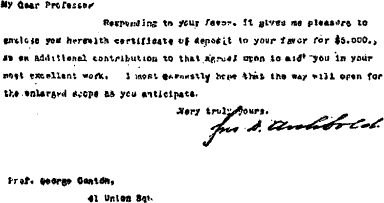
LETTER FROM ARCHBOLD TO PROF. GEORGE GUNTON, EDITOR OF “GUNTON’S MAGAZINE,” SENDING AN “ADDITIONAL” $5,000 “CONTRIBUTION” FOR “YOUR EXCELLENT WORK.”
(From Hearst’s Magazine)
“In this country we are supposed to be governed by ideas; we live by the art of thinking. The three institutions that deal in ideas are the school, the church, and the press and those are the three institutions that we persist in starving to death. . . . What I would like to suggest to you gentlemen is that while you are dealing with the pupils, give a thought to the teachers and when their vacation comes, pay them to come into your plants and learn the public utility business at first hand and then they will go back and you needn’t fuss—they can teach better than you can.”
Dr. Eaton was not the first to discover the three starveling professions. Back in these early days J. P. Morgan had put the redoubtable George Harvey in as editor of Harper’s including Harper’s Magazine and Harper’s Weekly. Archbold stood ready to lend a helping hand to any underpaid journalist. To Prof. George Gunton, editor of Gunton’s Magazine, he writes: “My dear Prof.: Responding to your favor it gives me pleasure to enclose you herewith certificate of deposit for $5,000 as an additional contribution, etc.” When Ida M. Tarbell’s story was published Gunton rushed to the attack. He writes a long diatribe crying down the book. He accuses her of stealing it all from Lloyd and calling it a “history” to mislead. He is full of fear for “honest history and decent literature.” This amazing hireling, who, according to Ida M. Tarbell, got $15,000 a year from Archbold for 15 years, includes in the same volume which denounces Miss Tarbell a spicy article flaying Bourke Cockran for “selling his eloquence.”
To R. H. Edmonds, of the Manufacturers’ Record, Archbold writes: “Your own work has been most admirable” and follows this with a certificate of deposit for $3,000 for another year’s subscription. The Hearst papers turned up another Archbold letter enclosing $1,250 to Thomas W. Grasty for a year’s subscription to the Southern Farm Magazine.
We have seen how that other group of the “starveling professions,” the pulpit, fared. One of the most notorious was Chancellor Day of Syracuse who is said to have invented the system of shaking down rich men for college endowments. It was impossible to bring any sort of charge against the Standard leaders which Chancellor Day was not willing to defend. One clergyman publicly called upon the church to turn him out. But instead the church offered him a bishopric. He called Roosevelt’s denunciations “the ravings of a disordered mind” and playfully sends to Archbold a little ditty which the boys at Syracuse sang:
We have a Standard Oil pipe running up to John Crouse Hall
And a gusher in the stadium will be flowing full next Fall.
We need the money, Mr. Archbold,
We need it right away.
It’s the biggest “ad” we’ve had
Since the bull-dog ran away.
In 1905 Archbold’s handy man Sibley in one of his numerous letters writes him:
“An efficient library bureau is needed, not for a day or a crisis but a permanent healthy control of Associated Press and kindred avenues. It will cost money but will be the cheapest in the end.”
Apparently something like that was done. An old journalist named J. I. C. Clarke was installed as publicity man. What he was able to do of course is not known. But a most noticeable rift is to be observed in the cloud of criticism. Papers begin to speak a little more kindly of Standard Oil and Mr. Rockefeller. The Woman’s Home Companion prints a nice little piece about “How the World’s Richest Man Spends Christmas.” Mr. Archbold turns up in the Saturday Evening Post with a defensive article and confesses that the company has made the mistake of not stating its side of the case.
Then in 1908 Mr. F. N. Doubleday of the World’s Work falls in with Mr. Rockefeller and is charmed at his simplicity, his directness, his lack of secrecy, and so on. It ends by Mr. Rockefeller agreeing to write his memoirs for World’s Work. Before they are printed, however, Mr. Doubleday writes a very fulsome account of Rockefeller, draws a most alluring portrait and disposes of all the ugly charges made against him. Then Rockefeller’s “Random Reminiscences of Men and Events” begins to run serially in the World’s Work in October, 1908. It is then published as a book and is, of course, not so much a collection of reminiscences as a defense of Mr. Rockefeller’s life and deeds.
V
THE DECREE ordering the dissolution of the company was appealed to the Supreme Court. The counsel proceeded with their preparation for its argument there and Mr. Rockefeller went his way to nurse his health and press forward his great philanthropies. The enemy movements of 1908 had doubtless impaired his mood for giving. But in 1909 he again unloosed his bounty. One famous gift of a million dollars to fight hookworm in the South was made and two considerable donations were offered, one to the Anti-Saloon League and another to the Bureau of Municipal Research. Additional sums were handed out to various colleges. He gave perhaps $15,000,000 this year, which the impious sneeringly said was a kind of fifty per cent split with the Lord on the savings in the Landis fine case. And while he waited for the Supreme Court to pass upon the validity of his towering industrial edifice, he had to listen a little to the small voice of murmuring ministers within his own church. “How long will the Baptist Church continue to maintain an attitude of timidity whenever John D. Rockefeller and Standard Oil are mentioned?” asked a young minister at a Boston conference amid an embarrassing silence.
All the time he was meditating his most important philanthropy. He began by giving $10,000,000 to Chicago University. The gift was made from the General Education Board. Then Frederick T. Gates pointed out that Rockefeller had given $50,000,000 to the General Education Board altogether, that $30,000,000 was for the Board and the other $20,000,000 to be used during his lifetime as he and his son might direct. In making this gift Rockefeller required that $1,500,000 of it be used for a chapel “as the spirit of religion should penetrate and control the university.”
In 1910 on March 9 the Standard Oil attorneys filed in the Supreme Court their briefs in the dissolution case. Five days before a bill was introduced in Congress to incorporate the Rockefeller Foundation, Rockefeller’s latest benevolence. He proposed to give a huge sum to this Foundation which was to carry forward, with the aid of intelligent research, the giving away of his vast fortune. It was a magnificent conception. He had already given away about $150,000,000. The Foundation was designed to distribute his millions for the “acquisition of knowledge, the prevention and relief of suffering, and the promotion of any and all the elements of human progress.” It was to be a clearing house for all his benefactions and young John D. had just withdrawn from almost all his directorships in order to devote his whole time to the management of the great benevolent trust. The endowment of the Foundation was to be in perpetuity, its resources were to be $100,000,000, it was to be exempt from taxation and to be under the direction of a self-perpetuating board. As Rockefeller had been the most thoroughly constructive and most honest of all the great captains of industry he now proposed to make the most impressive use of his great fortune in the cause of humanity. Criticism to many features of his proposed Foundation was uttered. But on the whole men began to say that, after all, John D. Rockefeller’s millions were coming to the public use at last. Some, however, did not fail to observe that as the $32,000,000 gift to the General Education Board had been timed just before the Landis decision, this $100,000,000 gift was timed just as the Supreme Court faced consideration of the dissolution suit. In any case the spectacle of two arms of the government facing two aspects of the activities of this extraordinary man appealed to the imagination of the time—Congress considering the greatest gift in history for the alleviation of human suffering and the Supreme Court considering whether or not it ought not declare the whole structure by which this money had been made an offense against the laws of his country.
Congress did not immediately act on the Foundation. But before the year was out the Supreme Court pronounced its verdict upon Rockefeller’s work. It upheld the decision of the lower court and in one of the most important judicial pronouncements of the great court, ordered the Standard Oil monopoly dissolved within thirty days. The decision was rendered by the late Chief Justice Edward Douglas White in an opinion unhappily clouded by a singularly cumbersome and obscure English style, but weighty and momentous for all that. Reviewing the facts Chief Justice White said:
“We think no disinterested mind can survey the period in question without being irresistibly driven to the conclusion that the very genius for commercial development and organization which it would seem was manifested from the beginning soon begot an intent and purpose to exclude others which was frequently manifested by acts and dealings wholly inconsistent with the theory that they were made with the single conception of advancing the development of business power by usual methods, but which, on the contrary, necessarily involved the intent to drive others from the field and to exclude them from their right to trade, and thus accomplish the mastery which was the end in view. And, considering the period from the date of the trust agreements of 1879 and 1882, up to the time of the expansion of the New Jersey corporation, the gradual extension of the power over the commerce in oil which ensued, the decision of the supreme court of Ohio, the tardiness or reluctance in comforming to the commands of that decision, the methods first adopted and that which finally culminated in the plan of the New Jersey corporation, all additionally serve to make manifest the continued existence of the intent which we have previously indicated, and which, among other things, impelled the expansion of the New Jersey corporation. The exercise of the power which resulted from that organization fortifies the foregoing conclusions, since the development which came, the acquisition here and there which ensued of every efficient means by which competition could have been asserted, the slow but resistless methods which followed by which means of transportation were absorbed and brought under control, the sytem of marketing which was adopted by which the country was divided into districts and the trade in each district in oil was turned over to a designated corporation within the combination, and all others were excluded, all lead the mind up to a conviction of a purpose and intent which we think is so certain as practically to cause the subject not to be within the domain of reasonable contention.”
Here was a verdict on the whole history of the great company which was conclusive not only in law but in history, since it was the unanimous affirmation by the highest court of an unanimous finding of the lower court.
The decision was unanimous on the facts and on the question of dissolution. But there was one dissenting opinion to one phase of the law expounded by the Chief Justice. For the first time he gave judicial sanction to what has come to be known as the “rule of reason”; the doctrine that the restraint of trade to constitute a violation of the Sherman anti-trust law must be “an undue restraint,” an “unreasonable restraint” to be determined by the court on all the facts. To this the aged old warrior of the court, Justice Harlan of Kentucky, who had stood as the uncompromising champion of the law from the start, filed a protest of unusual vigor. It inserted “words in the anti-trust act which Congress did not put there,” he declared, as he pounded his desk. It was “judicial legislation.” The court said to business, “You may now restrain commerce, provided you are reasonable about it; only take care that the restraint is not undue.” The old justice grew eloquent and predicted that many mischiefs would flow from the court’s pronouncement and endless uncertainty. Who can say he was not right in this? The rule of reason proved to be the break in the law through which the United States Steel Corporation and other great combinations were able to crawl. The decision was the beginning of the end of the monopoly of the Standard Oil Company, though no one believed it then and many doubt it today. But it was the beginning of a new phase of trust law development in this country.
The court commented on the delays which Rockefeller had managed to force in dissolving the old Ohio dissolution decree of 1892 and gave the company just thirty days to divest itself of its 33 subsidiaries. This presented the directors with a difficult problem. There were 983,383 shares of Standard of New Jersey, valued at $98,338,300. Each holder of one of these shares was to receive for it an equivalent in the shares of each company—thirty-four altogether, the Standard of New Jersey and each of its 33 subsidiaries. John D. Rockefeller owned 249,995 shares of the holding company. He therefore received  of each company. In the case of the small stockholders it was difficult to make this fraction represent an exact unit or block of stock.
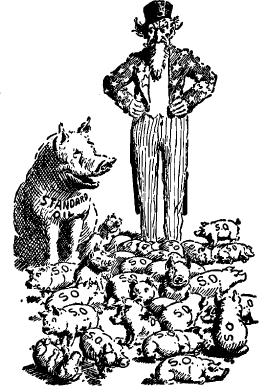
“PIGS IS PIGS.”
(From the Post-Dispatch, St. Louis)
The liquidators worked over the problem for the full thirty days allowed by the court without giving out any information as to what they would do. The distribution was made on the last day allowed. The managements of the companies began to move around. When it was all complete there were thirty-four companies, each under the immediate and final management of its Board of Directors, instead of the directors of the New Jersey company. Of course, they remained as they had been—producing companies, manufacturing companies, refining companies, pipe lines companies, marketing companies, without a shadow of competition between them, each with its territory and its functions marked out as definitely as before. Moreover the majority of the stock in all companies belonged to a small group of men. The same men therefore were able to command the obedience of the directors in each company. To 26 Broadway each company looked for its guidance and the final word in all matters of policy. For this reason the country began to laugh a little at the “alleged” dissolution. Four months later a newspaper commentator pointed out that when the company was “dissolved” its shares were valued at $663,793,525 and that March 8th the stock market valuation was $885,044,700. The net result of the dissolution seemed to have been to add $200,000,000 to the company’s market value and over $56,000,000 to the market value of Mr. Rockefeller’s holdings.
The reason for this was obvious. The public for the first time learned what the real assets of Standard Oil were worth. Unlike every other company, which was bulging with water, the Standard companies were all capitalized at far less than their true value. When that value was learned speculation in Standard Oil stock became a little wild. To the public at large, however, the rise in value seemed to be the unconquerable John D. Rockefeller’s answer to the Supreme Court. It was not so. With the details of the dissolution completely worked out, Mr. Rockefeller formally resigned as the executive head of the Standard Oil companies. He had retired in the middle nineties, but had always retained his titular post as president of the Standard of New Jersey. How far after that he exercised any actual authority is not easy to say. When charges were made against the conduct of the company he was always ready with the explanation that he had retired. However, he did not fail to boast several times of reforms like old-age pensions, which were not instituted until after his retirement. Archbold had been the actual director of the company’s affairs for many years and now he was named president to succeed Rockefeller. If Rockefeller was in no way responsible for the shameless operations of Archbold in the bribery of public officials, he certainly joined now in a tacit endorsement of that ambitious and extensive episode of political corruption by making Mr. Archbold his successor.
The excuse continually offered that he could not be held responsible for all the offenses charged against all the numerous employees of the company loses much of its force when we remember that there is no record of any of the accused officials ever being dismissed or disciplined—neither Daniel O’Day in the Marietta Railroad rebate scandal, nor the Everests after the convictions in Buffalo nor Archbold after his exposure by Hearst nor any of the innumerable smaller fry caught in the act of oppressing their immediate competitors.
In any case Rockefeller stepped out now and along with him his brother William and several other of the old guard directors. From this point on the forces of our vast economy, more powerful even than John D. Rockefeller, set to work upon the dynasty he had reared and slowly, imperceptibly as the years wore on, developed again in the oil industry the competition against which he had battled and in his own group of companies introduced the elements of final emancipation from his power.
VI
FOR A little while the name of Rockefeller was to have a brief rest. McCutcheon had made a cartoon in the Chicago Tribune, depicting Rockefeller standing before a newsstand covered with magazines bearing his name on the cover and asking the dealer: “Have you got something here to read not about me?”
He busied himself with his vast Pocantico Hills estate, transplanting giant trees twenty inches in diameter. “It is truly interesting what liberties you can take with trees if you once learn how to handle the monsters.” He had learned that about society itself. He looked with a distant interest at his vast fortune. The papers occasionally carried stories about Rockefeller dickering with the Gould estate for the Missouri Pacific or Denver and Rio Grande, or changing the management of the Western Maryland or increasing his holdings in Standard Oil stock. But the impression these created that he still gave his time to business was wholly erroneous. He had an office and a staff headed by Gates and his son which looked after such matters. He discussed them with these agents as little as possible.
He saw with satisfaction the “very sensible” manner in which Mr. Taft was managing things and blamed him but little for the outrageous legacies of suits against the trusts which Roosevelt had left him. Taft had become very kindly in his feeling toward Roosevelt’s old enemies and Roosevelt looked upon it with growing resentment. He played golf with Frick and dismissed the warnings from some of his intimates about it. It was only Mrs. Taft’s influence which prevented him from playing golf with Rockefeller. J. P. Morgan would slip up to Beverly, the President’s Summer home, in his motor boat to see Taft without being detected. Taft told his aide that Senator Aldrich had suggested that he would call at the White House and bring John D. along for a conference on some business matters but that Taft had declined the conference. In April, after the Supreme Court decision, dissolving the Standard Oil, Aldrich made an appointment to visit the White House with his daughter and her husband, John D. Rockefeller, Jr., for lunch. Taft didn’t want any one to know of the visit. He had the usher telephone Senator Aldrich to drive to the East Entrance where the party was hustled by a side door into the White House. Taft directed that no entry or minute of the visit be made anywhere. “It is strange how public men shudder at the names of Aldrich and Rockefeller,” commented Archie Butt who managed the details of the secret visit. The campaign was coming on. The split with Roosevelt had come. In another year, Woodrow Wilson was nominated by the Democrats and Taft went down to the most ignominious defeat ever suffered by a candidate. Woodrow Wilson and a Democratic administration moved into power. Rockefeller shook his head at that and chalked up another bad mark against his old enemy Roosevelt.
VII
WHILE all this was going on Mr. Rockefeller was busy with his health and his plans for his great Foundation. He divided his time between his various estates, spending the Summer at Forest Hill, the Winter in Florida, the Spring in Lakewood, and the Fall and portion of the Winter at Pocantico.
He was now devoted to golf. He had begun this game in February, 1899, at the suggestion of a gentleman named Elias Johnson who had observed to Rockefeller that his long, measured sweep in pitching horseshoes indicated that he had the makings of a good golf swing. For some time he played with just a moderate interest in the game. However by April, 1903, we find him writing from Lakewood to a business associate: “I believe I have recovered my health. I feel better now than I have felt in years, but at my age a man’s health is as uncertain as April weather. I believe the improvement in my condition is due to my newly acquired habit of playing golf. During my California stay I became an adept and enjoyed the game immensely. I feel like a new man.”
He used a bicycle to ride around the golf course, pedaling from one shot to another. He had the usual difficulty keeping his eye on the ball. Hence his caddy was instructed to stand in front of him as he prepared to swing repeating over and over, “Keep your head down! Keep your head down!” Those who played with him then and since are a unit in saying that Rockefeller is scrupulous in reporting his score. He never fools himself. “If his ball went into the woods,” said a well-known publisher who played with him often, “he plays it out no matter how many strokes it takes and counts them all. I have played with Andy Carnegie, also. And I found that Andy would bear watching—he would cheat a little on the score.” Rockefeller himself complained to a friend “that he was sorry to say he had met ministers who did not hesitate to cheat a bit on the links.” Then he gave a humorous imitation of a well-known minister kicking the ball surreptitiously from behind a stump. In golf Rockefeller followed a principle he adhered to in business. George Harvey once asked him to what one thing more than another he attributed the success of the Standard Oil Company. After pondering a while, Rockefeller replied: “To the fact that we never deceived ourselves.”
He had become by 1912 a very proficient golfer. His best score at this time furnished by a man who played over 500 games with Rockefeller, was made October 30, 1912. His score for the nine holes was:
4 4 3 4 6 4 6 4 4 = 39
He enjoyed riding around the country in Cleveland or New Jersey or New York, constantly changing the course. He would wear a yellow duster and on cool days a paper vest under that and a straw turtle hat, occasionally tied to his head with a veil, if there were a lady along. And he had already got into the habit of picking up for company on his rides working people or neighbors he might pass on the way—provided, of course, he knew them.
His chief concern at this time was his plan for organizing the Rockefeller Foundation. Mention has already been made of the bill introduced into Congress to charter it. The bill was offered March 2, 1910, in the Senate. After an explanation of its purposes by Starr J. Murphy it was promptly reported favorably.
The announcement of the plan brought out a wave of acclaim. Of course the chorus of preachers lifted up their voices. Men like Dr. Charles F. Aked of the Fifth Avenue Baptist Church called Mr. Rockefeller “the most valuable single asset humanity possesses today,” and papers like the Philadelphia Press spoke of the “far sighted benefaction which dwarfs all other gifts and sets before the world a world example.” More significant were the comments of papers like the New York Press which had talked much of tainted money but now said: “A better and broader dissemination of great wealth could scarcely be imagined.”
But there was plenty of criticism. The Springfield Republican said the gift called for “the greatest scrutiny.” The stream of protest swelled and made itself felt until finally the bill was withdrawn and redrafted. It was not introduced again until 1912. Then it was proposed that if at anytime a public institution should be set up by Congress or the states, embodying the same purposes as the Foundation then the remaining assets of the Foundation should be turned over to such public institution. It provided that Congress might at any time limit the activities of the Foundation; that the gift should be no more than $100,000,000; that the income should be spent and never added to the principal; that any gift to the Foundation might be ordered distributed fifty years after being made upon approval of two-thirds of the trustees and that then it must be distributed within the next fifty years; that objection to self-perpetuating boards might be met by providing that new members must be approved by the President of the United States, Chief Justice, Vice President, and Speaker of the House, and the Presidents of Harvard, Yale, Columbia, Johns Hopkins, and University of Chicago, and that the property of the corporation should be exempt from the federal tax only.
In this form the bill was passed by the House and reported favorably by the Judiciary Committee of the Senate, but in the rush of legislation in the last days of the session in the dying hours of the Taft administration it was not reached for a vote. Thereafter it was never re-introduced. Instead a charter was asked and granted by the State of New York, May 14, 1913. Immediately the incorporators, including John D. and his son, perfected organization and shortly after Dr. Charles Eliot of Harvard and A. Barton Hepburn, who thirty years before had denounced Standard Oil, were added to the board. In three payments Mr. Rockefeller handed over in securities a little more than $100,000,000.
A list of the securities included in this gift must have been interesting to the investor of that day. It included stock in all the thirty-three Standard Oil units valued at $49,503,455.36. There were seventy-two different bond issues and stocks in some forty companies—railroads, ship-building, banks, hotels, development, steel, equipment companies—selected from among the Rockefeller assortment.
Mrs. Rockefeller added her mite, $48,000 in bonds in four separate groups, the income to be used at the Board’s discretion to various Baptist ministers’ homes. Thus this great work was launched. At the outset the trustees resolved “that the advancement of public health through medical research and education, including the demonstration of known methods of treatment and prevention of disease afforded the surest prospect of such usefulness.” The Rockefeller Sanitary Commission set up by the Institute for Medical Research had been grappling with the hookworm disease in the South. That commission had found over 2,000,000 persons afflicted with the disease there and had treated or caused to be treated some half a million of them. The Foundation adopted its cue from that work and set up an international commission to cope with hookworm throughout the world.
In a few months the Foundation was busily at work. Mr. Rockefeller was enjoying the acclaim which he was receiving. He was at Forest Hill and, upon the whole, happy. He was also a little saddened by the death (May 20, 1913) of his oldest partner, Henry M. Flagler, in Florida at the age of eighty-eight. There was one cloud on the horizon. It was the illness of his wife. There was, indeed, another which he could not see and which was preparing at that very moment to shatter very rudely any illusions he may have entertained of the early redemption of his name from its old infamy.
CHAPTER XII. THE LUDLOW MASSACREROCKEFELLER left Forest Hill in August, 1913, the day after tax listing day. The assessors had been after him. Ohio had a new law compelling any one living for more than six months in the state to pay taxes on their real and personal property. The assessors sensed a juicy cut of some $12,000,000 in taxes on Rockefeller’s supposed $900,000,000 estate. That battle waged for a year much to Mr. Rockefeller’s chagrin. Indeed he soured a little on Cleveland after that. He declared he would spend a fortune rather than pay a cent of the tax, which was finally fixed on an appraisal of $311,000,000. But Rockefeller took the matter to court and won and the two tax assessors who attempted to collect were dismissed by the governor.
As he left Forest Hill for Pocantico an ominous event was taking place in Denver, Colorado—an incident which was to end in putting upon his already deeply tarnished fame its last serious stain. In 1902 Rockefeller became interested in the Colorado Fuel and Iron Company. He owned not a majority interest but a large enough minority interest to have actual control of the company. It had been worked extensively for eleven years and was now a valuable property consisting of twenty-four mines in Colorado.
The actual management of these mines was in the hands of the Board of which John D. Rockefeller, Jr., Frederick T. Gates, and Mr. Jerome D. Greene, all members of what we have seen was Mr. Rockefeller’s personal staff. Mr. Gates had now retired, his place being taken by Starr J. Murphy, a lawyer. Mr. Rockefeller himself, it must be said in all fairness, was very far from these properties, knew little or nothing of what went on there, treated them pretty much as just an investment and left all the details of more immediate contact and management to his staff. The immediate management was in the hands of the Chairman of the Board, Mr. L. M. Bowers, and the President, Mr. J. F. Welborn, two thoroughly reactionary figures.
Iron mines, as frequently happens, do not get discovered on the edges of cities. They are apt to turn up in remote and desolate places. That is what happened in the case of the Colorado Fuel and Iron Company mines. When mines are worked, however, they must have workers and these must be housed. All the property in and around the mines belonged to the company and, of necessity, it was compelled to build houses to shelter its workers and their families. The necessary fruit of this, of course, was that a town sprang into being, with houses, streets, stores, and people, who required food, medical attention, religious consolation, and policing. The company proceeded to supply all these things. It owned the houses and the streets, the store and the church and the meeting hall. It hired the doctor, the preacher, and the police. The workers were subject to it therefore, not merely in their actual employment but in their homes, their schools, and in all the intimate matters of their lives.
That abuses should grow up in such a community was inevitable. These abuses, affecting hours, pay, working conditions, however, became intensified when to them was added the additional abuse that the men could not even discuss their grievances among themselves. The company would not suffer them to organize. It would not permit them to even meet to discuss organization. It would not allow United Mine Workers’ organizers to even enter the town. And any man who displayed restlessness under these conditions and exhibited symptoms of revolt was promptly packed out of town. To be fired was to be evicted though cases were known where men were driven from the town, though their families remained and they could not even enter it again to visit their own wives and children. The town was the private property of the company. One of the chief grievances of the men was against the criminal guard system, the privately hired and paid deputy sheriffs who ruthlessly enforced the intolerable ordinances of this medieval community.
In August of 1913, as Mr. Rockefeller prepared to move from his Forest Hill estate, the miners made a demand upon the company for certain reforms. They had, of course, met in another town and the demands were sent through Frank Hayes, organizer of the United Mine Workers. They asked for recognition of the union, a ten per cent advance in tonnage rates and the Wyoming day scale, the eight hour day for all, pay for narrow work as well as dear work, and a miner elected checkweighman. Two additional demands might well have commanded at least the attention of employers anywhere in this twentieth century. They demanded the right to choose their own doctor, to trade at any store, and to board anywhere. They demanded the abolition of the infamous criminal guard system and the enforcement of the Colorado mining law. The demands conformed to the conditions in mines in Illinois, Indiana, Ohio, and Pennsylvania. These demands the company did not even answer. Then on September 15th the workers met in a Denver convention and called a strike for September 23rd. The Organizer Hayes made numerous efforts to get the mine officials to talk with him. They refused. He sent letters to the operators urging a conference. They were ignored.
On September 23rd, the miners struck. To strike was not merely to leave their jobs. It was to leave their homes. They took their belongings and went out en masse, men, women, and children, and into the mountains where they set up tents near a place called Ludlow, to which name they were to give a dark and sinister fame. This was beyond the limits of the mine property. Immediately the company had the sheriff, Tarr, whom it had elected and controlled, swear in 326 deputy sheriffs many of them belonging to the Baldwin-Felts detective agency famous for its strike-breaking activities. These guards patrolled the limits of the camp and as was to be expected almost daily clashes occurred. There were three battles in October, the worst being on October 17th near the Forbes mine. These clashes were alternately the fault of the miners and of the guards. Finally on October 29th, the Governor sent the militia to Ludlow to supersede the guards.
This restored order, but sullen and angry order under pressure. The adjutant in command, General Chase, a confirmed miner hater, was a red flag to the strikers. He set up a commission to hear cases; put men into a filthy jail at Trinidad, held prisoners incommunicado, including Mother Jones, and even refused to honor habeas corpus writs of the court on the ground of military necessity. Finally by April of 1914 the striking tent colony at Ludlow had been sufficiently reduced to permit of the withdrawal of a large part of the militia. A detachment of thirty-five men was left to preserve order under Major P. J. Hancock. Hancock had with him Lieut. K. E. Linderfeldt, a soldier of fortune, who had been in endless quarrels with the miners and who had sworn “to get” John Tikas, one of the mine leaders. Linderfeldt commanded one small company. Another company was made up wholly of mine guards who had been enlisted in the militia.
Once again clashes began between the strikers and the militia, chiefly under Linderfeldt. On April 20th a fight started. A bomb was exploded as a signal for help which everybody mistook for the beginning of a fight and in a few minutes a battle was in progress between the militia and the miners. It lasted from morning until night and ended in the capture by the militia under Linderfeldt of the Ludlow tent colony which he promptly proceeded to put to flames. John Tikas was captured and brought before Linderfeldt. While thus in custody Linderfeldt struck him over the head with the butt of his gun, killing him. The next day the strikers found in caves under some of their tents the charred bodies of two women and eleven children.
The news of this grewsome discovery swept through the now dispossessed and desperate miners. Almost crazed with anger and grief they became in an instant a mob of madmen howling for revenge. The cry of the “Massacre of Ludlow” went up through the region. The call to arms swept the mining country and the strikers rushed through the mining district of the Colorado Fuel and Iron Company, burning and destroying whatever they could lay their hands on. The Empire mine was set on fire. Three mine guards were killed in one battle. The battle raged into the Black Hills and was renewed daily. The whole country was shocked.
April 29th the strikers fired the Forbes mine and killed nine employees there. Later in the day they killed Major Lester. The warfare was not ended until the Federal Troops arrived. Linderfeldt was court-martialed and released. But about 163 miners were arrested and charged with murder. One of them was John Lucas, a strike leader, who had lived in the Ludlow tent colony. This briefly is a fair account of the famous Ludlow massacre and the Battle of the Black Hills which shocked the country and resulted in bringing John D. Rockefeller once more and for the last time before the bar of public opinion.
Now for Rockefeller’s part in all this. First of all it must be remembered that the closed camp condition in Colorado was a heritage—a legacy from another day. Slowly throughout the country the workers fought relentlessly against these ancient abuses and drove them out. The Colorado mines had resisted this partly through the bad social minds of their immediate managers and partly through the languor of the workers themselves. Perhaps nothing was more remote from John D. Rockefeller’s attention than the conditions in this property. Moreover he became interested in these mines after he had ceased to take a very active part in business and when he was disposed to permit his holdings to pass into the condition of mere investments. As a matter of fact Rockefeller had studiously focused his attention even in his days of active business upon the Standard Oil Company. It is not difficult to perceive how many bad conditions could have grown up in Colorado without exciting his attention. In the case of his son, John D. Rockefeller, Jr., and the pious Frederick T. Gates, perhaps, a more serious case might be made out. They were members of the board and were supposed to be familiar with the workings of the company. A condition like the closed camp at Ludlow ought to have made some impression upon the minds of a humanitarian like Dr. Gates who was ranging the world for causes on which to bestow Mr. Rockefeller’s benevolence, and Rockefeller, Jr., who was now chief manager of his father’s benevolent trust. After all is said that can be said for these two men, there still remains a weight of responsibility which they cannot escape. One must be less than fair, however, if he fails to remember that a man’s mind is after all an instrument of limited range; that young Rockefeller’s energies had been taken up completely with the management of his father’s vast benevolent interests, that he too had looked upon his father’s holdings as investments; that the mind can receive only a limited number of impressions; and that, in the multitude of his interests, the conditions at Ludlow simply did not make any impression on his already completely usurped attention. This, it would seem, is but fair, in spite of the fact that attention had been directed to the sore ten years before by a similar, though far less violent strike.
It is not so easy to acquit the Rockefellers for their conduct after the strike broke in all its fury. However, it is easy to see a difference here between the younger Rockefeller, the product of a newer age, and the older Rockefeller, who though he had been a pioneer in the development of the purely material mechanism of big business, lagged behind in a remote age of the mind in reference to its social phases. He was in every sense a very old-fashioned man. He believed in the Bible of John Calvin and Roger Williams. He accepted the view of divine interposition in human affairs and piously admitted, like the haughty George Baer, that God had committed to his own humble hands the administration of the material things he had accumulated. He leaned contentedly to the Pauline doctrine of good masters and obedient servants. He did not in the least perceive that the rise of huge organized groups of men within society put the unorganized part of society a little at their mercy and exerted a strain on the theory of the individualism he worshiped along with all his Victorian contemporaries. The public interest in another man’s business—railroad or factory—seemed to him the veriest heresy. The right of private property he surrounded with all the sanctions of his religion. Workmen used his property, his tools and while they were at liberty to employ those tools or put them aside, they were utterly without right to tell him how the tools ought to be used. They had no right to organize and above all no right to strike. A strike was a use of force. It was violence in itself. The employer had a right to ignore the striker, to hold him off, to resist his force, and, if necessary, to put him down. When Henry C. Frick shocked the country by shooting down ruthlessly the striking iron workers at Homestead, John D. Rockefeller wrote him a letter approving his course and expressing sympathy. Only this very year when Colorado was aflame and his name was bandied about in hatred and fear, he refused to give his own workers on his estates a holiday on Labor Day. “Instead of spending money on amusements my employees will have an opportunity of adding to their savings,” he said. “Had they been given a holiday money would have been spent foolishly.” Their right to spend it foolishly and their hunger for something besides mere working and saving were something he simply did not consider.
To all this must be added that in the oil business and at his home he was the best of employers. He paid the best wages, ensured continuing and permanent employment to his employees, provided hospital facilities for them when sick, and old age pensions when aged and in all his long career, outside of a little trouble here and there, never had a strike. But all this he accorded to his employees in a spirit of benevolent paternalism. Their right to demand it and to organize to get it he never conceded, in spite of the perfectly obvious fact that there was not very much benevolent paternalism among most employers.
Therefore when the tent colony was burned on April 20th and Colorado was on fire with indignation and horror at the spectacle of maddened workers burning, slaying in desperate and blind vengeance, Congressman Martin D. Foster went to New York to get Rockefeller to intervene in Colorado, he met with a flat refusal. Foster did not see the elder Rockefeller, but appealed through his son. He left New York declaring that Rockefeller’s attitude was little short of defiance not only of the government but of civilization itself. Rockefeller’s mind had a trick, not an uncommon one, of closing up tight to the logic or appeal in his enemy’s argument the moment that enemy rose to assert his own rights by the use of those weapons which Rockefeller himself employed to protect his own. He was for making no concessions whatever to organized labor.
II
IT WAS at this stage that a great white light broke upon the mind of the younger Rockefeller. The chorus of denunciation which came from numerous sources shocked him. The nation had felt the invigorating effect of a dozen years of social reform. The spectacle of this odious survival of labor conditions supposed to be extinct caused not only the older Rockefeller but his son to be bitterly arraigned by men and journals the younger man, at least, was compelled to respect. He saw the rise of the storm with a good deal of horror. It seemed to shake him from the ground on which he had been standing so long without examining it. His first reaction was a determination to put his side of the case before the people. He got plenty of advice. Much of it was the kind which appealed to the old-timers—the kind that led Archbold to subsidize the Guntons and Days and Boyles. He was urged to hire advertising space and tell his story. Some advised him to buy a newspaper and make it ring with his defense. At this point some one suggested that he seek a professional adviser and named Ivy Lee as the most likely one for the job. Lee was acting in the capacity of publicity man for the Pennsylvania Railroad with the title of executive assistant. Young Rockefeller had him call, induced him to undertake the job of straightening out their public relations in the mine strike and got the Pennsylvania to release Lee temporarily for the job. Lee’s counsel, Rockefeller said, was the first advice he had had which did not involve deviousness of one kind or another. What Lee proposed was really something new in the Rockefeller system—the study of public opinion. It meant not merely placing the affairs of the corporation before the public in the most favorable light, but “shaping the affairs of the corporation so that when placed before the public they will be approved.”
Immediately newspapers and public men began receiving bulletins signed by the president of the iron company giving its side of the events as they developed. This was the publicity part of Lee’s campaign. But something else happened. The Rockefeller Foundation named W. MacKenzie King, former labor minister of Canada, a commissioner to study the whole subject of the iron company’s labor relations and recommend a plan for reforming it. This was modifying the company’s conduct to command public approval. It was the beginning of a wholly new policy on the part of the Rockefellers and the Standard Oil Company. King went to work and very soon made a report recommending an elaborate system of relations which was a little hastily dubbed the plan for industrial democracy. The younger Rockefeller urged this plan upon the coal company officials in October, 1914. Welborn replied that it seemed meritorious but that it would embarrass the company while the strike was pending. The miners, in fact, were now virtually defeated. And in December they capitulated completely. December 10th the strike was declared ended.
Immediately the company took steps to put into effect what came to be called the Rockefeller Plan which had been outlined by King. On January 15th, 1915, delegates of the miners—one for each 250—met with the mine operators in Denver to discuss the plan. That plan provided that employees at each mining camp would have the right to meet once a year, elect by secret ballot their own chairman and secretary and select from among their number representatives to act for them with respect to working and living conditions. The camps were divided into five districts for election purposes. Each district was provided with a conference committee and the miners each year would have the right to elect representatives to a joint conference committee on conciliation, safety and accidents, sanitation, health, housing, education, and recreation. The scheme was criticized by the United Mine Workers and undoubtedly had some defects. It was, however, an immense step in the direction of civilized working conditions and a year later the Industrial Commission expressed the belief that it was adopted in good faith.
But the agreement included some other features which represented a concession to the miners of some of those demands on which they had launched their strike. Employees were conceded the right to hold meetings on company property; to buy in any stores they chose; to select their own doctor; employ their own weighmen, and to carry complaints from district superintendents to superior officers and finally to the president of the company. Two years later John Fitch, who had made a study of the controversy for the Survey, returned to Colorado and found a great and favorable change visible there. He found union locals organized in all Colorado Fuel and Iron Company camps and ninety per cent of the miners in them. They held meetings openly, though the unions were not recognized. All of the objectionable political figures had been gotten rid of and there were no company marshals in evidence. Fitch found Welborn actually in conference with a representative of the union. The unions were not officially friendly to the plan and there was some talk of a strike for union recognition and the grievance machinery was not being much used. Yet on the whole the condition of the mine property represented a great advance over the indefensible medievalism which existed before the strike.
To the plans of young John D. for all this the old industrialist at Pocantico Hill was opposed. It is not difficult to imagine what his objections were. Nevertheless he interposed no obstacle to what he must have supposed was his son’s chimerical dream. He did come around to approving it later. The reforms inaugurated, however, and the plan for resisting forces which were loading the Rockefeller name with odium were the younger man’s. The old man, then seventy-five, was at the end of his business and public career. The years had rolled over his head producing no change in the antiquated social philosophy with which he had started his business life. All that came after 1914 was the work of his son, imbued with the spirit of a new generation. It was to confer upon the fame of the older man an immense cleansing and regenerating boon.
CHAPTER XIII. MRS. ROCKEFELLER’S DEATHWHILE the miners and operators struggled in Colorado, the I.W.W. made several demonstrations against the Rockefeller home at Tarrytown. Some of the agitators got into the grounds and smashed windows. Later the dairy barn was burned and this was attributed to incendiaries. Guards were thrown around the estate and Rockefeller’s going and coming was kept a profound secret. In June, annoyed by the conditions in Tarrytown he and his family made a little trip to Maine heavily guarded. They were back again soon. This was the first Summer they had not gone to Forest Hill. Mrs. Rockefeller was quite ill and her illness, together with the unpleasant agitation about the estate and throughout the country and the feeling about the old home in Cleveland, threw a shade of sadness over the family. Rockefeller felt thrust out from Cleveland. He dared not go there lest he be served with papers in the tax suit involving millions. In spite of all the money he had given Cleveland, in spite of all the countless millions he had bestowed upon the country which persisted in harrying him, now he seemed an exile from the home his wife loved best.
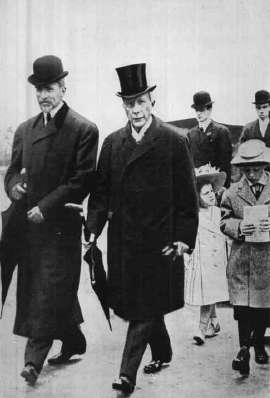
JOHN D. ROCKEFELLER, ABOUT 1907, RETURNING FROM CHURCH. TWO OF MR. ROCKEFELLER’S GRANDCHILDREN ARE WALKING JUST BEHIND.
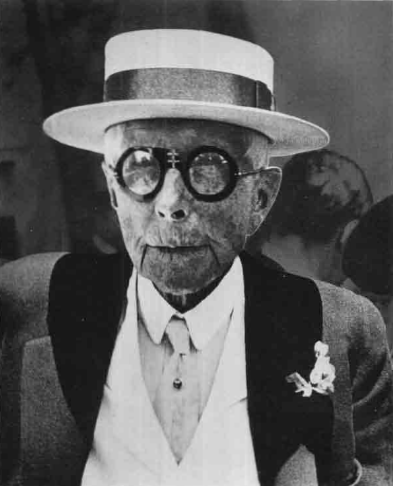
Copyright by International News Photos, Inc.
JOHN D. ROCKEFELLER AT THE AGE OF 93.
From a photograph taken in June, 1932
On September 8th, 1914, he and his wife celebrated their golden jubilee. How far they had moved since that far-away day when the young oil refiner and the little black-haired schoolteacher had joined hands in Cleveland. She was wheeled out on the lawn and there enjoyed a quiet celebration with her children and grandchildren. The next day was her seventy-fifth birthday and her husband had a brass band come up from New York as a surprise for her to give a concert and play the tunes she liked best. Slowly all the familiar things in Rockefeller’s life were moving away from him. During their last stay in Cleveland one day at the Euclid Avenue Baptist Church he was making a talk. Mrs. Rockefeller sat beside him. He was talking about his own life when suddenly he stopped and looked into the pallid face of his wife.
“People tell me I have done much in my life,” he said, then paused. “I know I have worked hard. But the best thing I ever accomplished and the thing that has given me the greatest happiness was to win Cetty Spelman. I have had but one sweetheart and am thankful to say I still have her.”
He was not to have her long.
Toward the end of January he left the Calvary Baptist Church where he had gone for some years and returned to the Fifth Avenue Baptist Church. “It is good to be home again,” he said. Then he left for Ormond Beach in Florida. Mrs. Rockefeller was too ill to go along.
As March dawned Mrs. Rockefeller became quite ill. A specialist made some blood tests and said she would be better. In about a week she expressed a wish to go out into the gardens and see the flowers. Servants carried her out. On March 12th, she said to her sister, Lucy Spelman, who had lived with her since their father’s death and who always kept close to her, that she would like to have a wheel chair so as to go oftener into the garden and see the flowers. Her sister sent a messenger posthaste into the city for the chair. An hour later her nurse handed her a glass of milk. She drank it and said it tasted good. Then she sank back on her pillow. Her nurse and her sister rushed to her but she had already ceased to breathe.
Rockefeller and his son, who was with him, started immediately for New York. Of course, the news of Mrs. Rockefeller’s death was immediately known throughout the country. The news came following all the bad temper and hard words of the Ludlow episode. Death, however, has a gentle way with it. As the train moved north from Florida with the aged oil man he was much surprised and deeply touched by the tenderness with which every stranger he met, railroad officials, conductors, brakemen, and strangers who recognized him, spoke softly and looked with sympathy, and even expressed their sorrow at his grief.
The funeral was held at Pocantico Hills March 15th, in the room where Mrs. Rockefeller died. Young John D. and his father stood together. “Mother,” said the younger man, “looks so beautiful lying there in bed that we simply cannot take her out of our home today. She looks as if she were just sleeping.” The older man remained silent. In the midst of his grief some voice within must have murmured against the strange ways of Fate. The family vault was in Cleveland. Now with his wife dead a hand seemed to be raised against him there. The tax case! If he were to take her there officers would meet him at the train and serve him with papers—those process servers! Would there never be an end of it! And after the funeral service on the fifteenth the body continued to rest in her room until next day. Then it was taken from the Pocantico Hills home and placed in the Archbold mausoleum in Sleepy Hollow. Armed guards remained at the tomb. A few weeks later Governor Willis of Ohio removed the two tax commissioners who began the $311,000,000 tax assessment suit and plans were made to dismiss the suit to collect the taxes. Rockefeller waited for this proceeding to take his wife’s body home.
On July 15th, Rockefeller went to Forest Hill to make arrangements for the funeral in Cleveland. He went heavily guarded. On August nth, in a blinding electrical storm, Mrs. Rockefeller’s body was removed from the Archbold tomb and sent to Cleveland where she was buried finally in the family tomb in Lakeview Cemetery, with only members of her immediate family present.
A few months later—November 22, 1915—an attempt was made to assassinate John D. Archbold. A bomb was found in the driveway of his Tarrytown home. The police attributed it to the I.W.W.’s, as a protest against the execution of Joseph Hillstrom in Salt Lake City. This was at best a guess. The bomb was found, before it exploded, by a gardener. The following year, December 5, 1916, in his sixty-eighth year, John D. Archbold ended his turbulent career.
CHAPTER XIV. THE LAIRD OF KIJKUITWHILE the miners in Colorado muddled through their squalid war with Rockefeller’s thirteenth-century-minded executives, Europe flung herself into a very modern orgy of blood-letting and destruction. And presently America, which had been enjoying the spectacle through the papers, the magazines, and the movies as a fascinating and majestic hippodrome, suddenly found herself, with a little dismay, drifting into the carnage.
Rockefeller looked on the European war with undisguised disfavor. In 1915 America announced a billion-dollar loan to the Allies. Newspapers printed an alleged interview with Rockefeller in which he said he had refused to participate in that loan. Earlier in the war, to companions on the golf links, he had expressed himself freely against the war. But Standard Oil officials quickly gave out that the company would take a portion of the allied loan a little later. Rockefeller, returning from Cleveland and asked if he had any hand in the loan, replied: “Ridiculous! You boys know very well I retired from business twenty-five years ago.”
The truth was that Rockefeller’s vast business structure was world-wide and under it, like a collection of wholly disconnected foundations, were the nations of the world. He saw those scattered pillars quivering, swaying, some crumbling, all threatened with collapse. He was of course against the war—the chaos and disorder which delivered those shocks.
As the United States stood on the brink of the war, some of Rockefeller’s statements were recalled. They were interpreted as being unfriendly to the Allies. However, friends pointed out that he had never made a public statement, that what he had said was merely his private views and that what he deplored was the conflict itself. When America plunged in he found it advisable to make a statement. He handed this to newspaper men:
“We must all stand behind the President regardless of consequences. Party, racial, and religious differences must be sunk into the melting pot of the common cause—harmonious patriotism. A state of war already exists with Germany. German U-boats are sinking ships without regard to cargo, life, nationality, or property values as recklessly as any pirate of the Spanish Main and American vessels are being compelled to arm themselves to stand off this menace.”
It was under the hammering of the war, which shook up and beat out so many enduring prejudices among us that the old, hard, refractory hatred of Rockefeller began to crack a little. He made immense purchases of liberty loans. Toward the end of 1917 it was said his contributions to Y.M.C.A., Red Cross, liberty loan, and other drives amounted to seventy million dollars. As drive succeeded drive and patriotic donations were called for at public meetings, in theatres, churches, immense subscriptions by John D. Rockefeller produced thunderous applause. Men were applauding and cheering the name of Rockefeller. He made a gift to the town of Dole in France where Pasteur was born and the town named a street after him—the Avenue John Rockefeller. He gave with a free hand to all sorts of private activities. He contributed generously to Belgian relief and in 1919 when Cardinal Mercier visited America, accompanied by Cardinal Hayes, the venerable prelate went to Pocantico to deliver the gratitude of the Belgian people. The Rockefeller Foundation also not only made numerous excellent gifts but took an important part in all sorts of relief work. In 1917 the Foundation released $10,000,000 of its funds for war work, thus invading its principle funds. In August, 1917, Rockefeller reimbursed the Foundation the sums expended out of its principle to the extent of $5,500,000. He turned his New York City house into a Red Cross workroom and put the now unused Forest Hill estate in Cleveland at the disposal of the city for a war truck garden. His name now became associated weekly, almost daily, with patriotic giving and with works of healing and relief, as it had once been confounded wholly with deeds of ruthless trade war. The inscriber of resolutions who for more than forty years had been busy “whereasing” the name of Rockefeller into infamy and abhorrence, was now no less diligent in engrossing memorials of gratitude from men and officials and associations all over the land. Meantime he now had a brand new and highly intelligent public relations counsel, Mr. Ivy Lee, the heritage of the Ludlow episode. And all the good deeds of Mr. Rockefeller got faithfully recorded. Even when twenty-five men of draft age from his estate went into service the incident was chronicled as if Mr. Rockefeller himself had generously added them to our war machine. Even his hitherto reprobated huge income came in after a fashion for some of the new immunity, for did it not yield to the government, as the rumor went, $38,000,000 in income tax in 1918? This rumor was denied. A tax of $14,000,000, however, was paid by some one. And of course Rockefeller alone seemed capable of yielding so much fruit.
But Mr. Rockefeller had not yet wholly adjusted himself to the technique of personal salesmanship which Mr. Lee had invented for him. He still had a way in certain small matters of irritating the public. In 1918 as the coal shortage loomed, he laid in an immense store for Pocantico, buying direct from the mines. When his bins were filled he had several carloads over. People at Pocantico asked that he let them have the coal at the mine price. But he shipped it back to the mines. His own bins filled, he replied that the country might need the coal on account of the war. He closed his garage and other buildings at Pocantico to save coal. This left him with a surplus which he graciously sold to 98 families at Ossining and charged $8.75 a ton for it. The official distributor at Ossining refused to approve any such price, lopped $1.32 a ton off Mr. Rockefeller’s bill and settled for $7.43 a ton. It would take a little more time before Mr. Rockefeller’s able and adroit public relations counsel would rid him of all his unpleasant habits. Nevertheless his name came out of the war, as out of an alchemist’s crucible, if not pure gold, at least with a first plating, over which time, clever management, and above all the changing world would lay many another coating.
II
ROCKEFELLER was a very old man now. As the war came to an end he stood upon the threshold of fourscore years. For many years his most constant and dearest employment was in the building of his magnificent estate at Pocantico. Now, nearing the age when most men sink wearily into the arms of senility he found himself in endless struggles with his neighbors and with the towns about him as he pushed out relentlessly all over the country around Tarrytown the frontiers of his immense estate. In the breast of the vigorous old monopolist the law of his nature seemed to be as potent as ever—the inordinate appetite to own everything about him. There was, indeed, in his bosom an old, deeply rooted love of land, of trees, of roads, and landscapes, going back to the remote days when as a boy he sat under the apple trees and looked with pleasure upon the richly clothed hills of his own Finger Lakes country. But there was something more than just love of the land in his heart. There was his ceaseless hankering to mold all the things he dealt in to his own plans, to order things as he wished them, to make the roads run his way, to impose his design upon the landscape. Town officials got in his way, as legislators and prosecutors did of old. Men’s homes stood in his path as other men’s oil plants had stood in his path twenty and thirty years before. In pursuing his plan, however, to devour the whole countryside about him he considered very little the feelings of the small home owners who were his neighbors and whose hearts might be as deeply rooted in their small patches as his was in his expanding acres. He was always willing to pay well for land and doubtless John D. Rockefeller has never been able to understand why any poor man could reasonably stand in the way of one able to buy his way. To those who stood in his way—house owners, railroads, commissioners—he opposed the same ceaseless purpose, the same stubborn patience which wore out the resistance and fortitude of all his old adversaries in oildom.
As Rockefeller bought extensively on both sides of the tracks of the New York Central’s Putnam Division he soon found he had a railroad running across his estate. This road was essential to the village of Tarrytown. In 1917 the Central notified the village trustees that the division would remove its tracks and run them around another section of Rockefeller’s property. It is said this operation cost Rockefeller $700,000.
Apparently he did not count the cost of anything needed to build this huge toy of his. At one point in his path as his advancing acres flowed over the Tarrytown region, St. Joseph’s Normal College, standing on 300 acres, was in his way. He gave the college $500,000 for its land and then handed it over another million to build another college on another site. Then he turned the place into a beautiful woodland.
North Tarrytown wanted to build a stand-pipe near Croton Aqueduct on a piece of Rockefeller’s property. It was essential to the town’s water supply. But the old watchdog of his acres objected. It would spoil his view. He put up $25,000 and induced the trustees to build elsewhere. Far away on a piece of public property stood a smokestack. As his eye roved over the landscape this distant chimney disfigured the picture. He did not rest until he persuaded the trustees of that village to camouflage the offending object.
Through his estate ran the Longwood road from North Tarrytown to Mount Pleasant. Rockefeller had gradually acquired property on both sides. But the road was still used by many people. However, he wanted it discontinued as a public road and in January, 1926, filed a formal petition. Here he encountered one of those implacable enemies with which his career has been strewn. John J. Foley, a milkman, had inherited his quarrel with Rockefeller. Twenty-five years before Rockefeller had sought to close another road on which Foley’s father operated a hotel and bar. The elder Foley had fought but finally Rockefeller had had his way. Now as Rockefeller sought to close the Longwood Road, Foley, the son, appeared with a petition signed by 100 citizens of North Tarrytown protesting against his application. The petition was defeated by a vote of three to two. But the aged battler had long ago learned that almost everything can be accomplished by him who keeps everlastingly at it. Within three weeks the petition was again renewed. Foley and his protestants were absent and the vote went to Rockefeller. He had succeeded in quieting the rebel milkman and his neighbors.
Years before a Swede named John Melin owned a saloon on the edge of Rockefeller’s estate. He had a neighbor named Hyman Levy, a merchant, and the two made a solemn compact never to sell their lands to Rockefeller. They resisted the continuous persuasions of Rockefeller’s agents. Then one day, several days later, Levy scratched his leg and worried so much about contracting blood-poisoning that he lost his mind, a thing no man can afford to do who has John D. Rockefeller to deal with. In spite of this Melin held to his agreement. But as years passed misfortune dogged his steps; his wife and then his sister died; his business languished; he married again and sank deeper into debt. Finally on July 25th, 1908, his saloon was put on the block. John D.’s agent of course was there and got the property.
Some five years later on a cool November day Hyman Levy suddenly recovered his mind. He looked about and was amazed to find Melin’s saloon gone and the land enclosed in the Rockefeller estate. Rockefeller’s agent was promptly on the scene. He convinced Levy that Melin had violated his agreement and induced the merchant to sell his own place for a good round sum.
Here in this more than royal demesne, this ancient compound of industrial Croesus and country squire, in a life as inexorably planned and ordered as the solar system, carries on with relentless purpose the design of lengthening out his existence to the last possible minute. But not at all in that perfect simplicity and frugality which good salesmanship has induced the world to imagine characterizes the ways of Rockefeller. No other human being lives in so costly an estate. The estate itself extends northward from North Tarrytown to the very boundaries of Ossining and takes in all the village of Eastview, Briggsville, Pocantico Hills, and Mount Pleasant. Scores of large estates and many hundreds of small homes have given way to make room for this private park, exceeding in extent and beauty any great public park in the world. Hundreds of old houses, renovated and improved, are now occupied by his superintendents, foremen, and workers. The old Foley Inn still stands, repainted, and fitted with modern improvements. The village of Eastview now makes a settlement for some of his employees. He owns it all save the poorhouse! The village of Pocantico is no more. Within his fences are 5,000 acres. Outside them is another 3,000 acres of the costliest suburban land in America. The land alone over which his vast parks and countless buildings are spread can be worth no less than fifty million dollars. And this is but one of his homes. The beautiful estate at Lakewood is still kept up and religiously occupied for a month or two each spring. Rockefeller still owns the fine estate at Forest Hill, though the house has been destroyed by fire and he has not been in Cleveland for sixteen years. He has a fine estate at Ormond Beach in Florida where he spends his winters and still owns, or did until two years ago, the Euclid Avenue home in Cleveland and has the town house in Fifty-fourth Street in New York.
But the place he calls home is Kijkuit, the broad house on the hill of that name, the little Olympus where the Jove of Pocantico reposes, though the town house in Fifty-fourth Street is his legal domicile. The summit got its name from the Dutch, who merely translated the Indian name which meant Lookout—an apt name, for from this beautiful home the present Sage of Kijkuit may range with his failing eyes the broad sweep of the Hudson from West Point to New York. This house, of course, is merely one of more than seventy-five buildings on the estate occupied by Rockefeller, his family, and his attendants. More than a hundred families live within his fences. Besides the elder Rockefeller’s home, John D., Jr., has a still more beautiful and elaborate ivy-covered palace of brick and stone. And John D.’s married grandchildren live on the estate also in their own homes. Pocantico is an all-Rockefeller settlement. There is a children’s playhouse which cost more than a million to build. Mechanical toys of the most elaborate kind, gymnasium apparatus, bowling alleys, a swimming pool—sixty by one hundred and twenty feet—are in this building. Next to it are the tennis courts and near by the house is John D.’s famous golf course.
The costly old stable has been replaced with a huge garage which houses John D. Rockefeller’s fleet of fifty cars, including nearly every known make. These, of course, are the cars used for various purposes on the estate. Mr. Rockefeller himself used one car for fifteen years. There are repair shops—like a good-sized factory—dairy houses, and numerous other service buildings.
Seventy miles of private roads wind to every part of the estate, all beautifully paved and laid out to harmonize with the landscape. Many lakes, little streams, and rivulets, and a picturesque little Japanese lake dot the estate. The Japanese lake is enclosed by little walls of red Japanese stone and is surrounded by Japanese Ginkgo trees and strange shrubbery and plants from Japan. Indeed the estate is a veritable exposition ground of trees and plants. There is a grove of so-called dwarf orange trees, each over 300 years old, each standing twenty feet high, planted in huge tubs brought from the estate of the Marquis d’Aux at Le Mans, France. There are bay trees from Italy, ancient box trees and hedges from Holland, jasmine from the south of France, more than 40,000 rhododendrons. There are many other orchards and vegetable gardens which afford John D. and his immense retinue much of their fresh foods. What is needed from the outside is ordered from local dealers. It is ordered by the housekeeper at the main house by telephone. When the delivery truck reaches the road a little distance from the house it is switched off into and through a small tunnel to the delivery entrance and then sent out again without ever getting very close to the house. No one gets near the house without passing inspection. There are many gates and all are guarded. Indeed the whole estate is carefully policed.
The year around this extraordinary menage employs about a thousand people and at times the number is increased to fifteen hundred. The management of so extensive and complicated a domestic establishment becomes a problem not of housekeeping but of government. And upon the model of a city government the estate is organized. It has its own waterworks, with an appropriate department. It has its Department of Safety, which includes a completely organized fire and police department. There is a Department of Public Works which manages the roads and a Department which among other things manages the assessments of the estate, for Rockefeller’s property is assessed not as one but as a thousand parcels. Over all is a superintendent, of course, and over him as chief burgomaster, Lord of the Manor or Great Earl, the Aged Laird of Kijkuit himself. As a matter of fact, however, in recent years his son John D. Rockefeller, Jr., has taken over little by little the details of management and may be said to be now in fact the officiating Administrator or Acting Mayor.
Whatever else this amazing barony may be, it is assuredly not true that the man who surrounds himself with such elaborate magnificence and such an extensive establishment lives with typical American simplicity. Here Rockefeller, far in advance of his contemporaries in the invention and organization of means to develop and direct the rushing era of mass production, but with a sixteenth century mind in the realm of social and religious phenomena, is able to play out his final years in the role most pleasing to him—that of a benevolent despot.
III
THE WAR interrupted the orderly course of Mr. Rockefeller’s benefactions. With the return of peace he was able to turn again to the development of the several great boards which he had founded—the Rockefeller Foundation, the General Education Board, the Institute for Medical Research.
From the first Mr. Rockefeller had reserved to himself and his son the disposal of two million dollars a year of the revenues of the Foundation. In 1917 he relinquished that and two years later—December, 1919—he gave to the Board an additional gift of $50,438,768 in securities. It is not easy to trace all his separate gifts to the Foundation which on the face of the reports seem to have been $155,000,000 by 1919. Dr. George Vincent, President of the Board, however, in the 1922 report credited Mr. Rockefeller with having given the Foundation $182,704,624.
All this time the General Education Board had been handing around great sums—$15,700,000 between 1902 and 1919. This had gone to 120 different colleges. And as a college, to obtain a donation, had to raise an additional sum itself, these colleges were thus enabled to increase their endowments by $50,000,000.
On Christmas Day, 1919—when he announced his grant of fifty million to the Foundation—Rockefeller gave the same amount to the General Education Board to be used in cooperating with institutions of higher learning to increase teachers’ salaries.
In the preceding year he had made another princely gift. The Medical Institute concentrated on the laboratory study of disease; the Foundation dealt with a multitude of human welfare problems throughout the world; the General Education Board was devoted to aiding education. This left a large field of philanthropy untouched. Mrs. Rockefeller, during her life, aided many causes which appealed especially to her—missions, hospitals, churches, child and woman welfare activities. Mr. Rockefeller continued to aid these through his personal staff. However, in 1918 he decided to establish these philanthropies upon the same business and organized basis as his others. He therefore set up a new foundation which he called the Laura Spelman Rockefeller Memorial Foundation and endowed it with $73,000,000.
After a time it became apparent that these various boards were crossing into each other’s territory, duplicating effort, which was wasteful and, perhaps, getting into jurisdictional quarrels. In 1928 therefore he decided to apply to them the same process he had used on oil refineries. He decided to do a bit of consolidating. The Laura Spelman Rockefeller Memorial and the Rockefeller Foundation were merged into a single new corporation called the Rockefeller Foundation. The General Education Board was left intact. But the frontiers between the two were carefully staked out. The Foundation now has as its major function the advancement of knowledge of the medical sciences, the natural sciences, the social sciences, formerly the special care of the Spelman Memorial and the humanities. The Foundation divides with the General Education Board the field of education. The work of educational research belongs to the Foundation. The work of education belongs to the General Education Board. Where an undertaking embraces both objects then it will belong to the Foundation if research is the principal object; to the General Education Board if education is the principal object.
Thus the giant Rockefeller benevolent trusts stand, though we must make an addition. In recent years he has managed to permit the great bulk of his vast fortune to drift into the hands of his son by some process, we may be sure, which will save it from the ravages of the inheritance tax collector. And there has been a kind of understanding that this mighty fragment which exceeds what he has already given away (or did before 1929) shall be in itself a kind of benevolent trust at the disposal of his son. That son himself has made some very extensive benefactions. The most important is his creation of an International Education Board, incorporated under the laws of Virginia, and provided with a fund of $21,000,000 and chartered “to promote and advance education, whether international or otherwise, throughout the world.” This body has also been incorporated in the Foundation. But the younger Rockefeller has made numerous other gifts to universities, libraries, churches, institutions, and various public purposes. By the end of 1928 his gifts had totaled $65,234,606.29.
The total Rockefeller gifts, therefore, up to 1928, have been as follows:
By John D. Rockefeller:
| Rockefeller Foundation and Laura Spelman Memorial . . | $256,580,081.87 |
| General Education Board . . . . . . . . . . . . . . . . . . . . . . | 129,197,900 |
| Medical Institute . . . . . . . . . . . . . . . . . . . . . . . . . . . | 59,778,141.14 |
| University of Chicago . . . . . . . . . . . . . . . . . . . . . . . . | 45,000,000 |
| Miscellaneous | 18,365,000 |
| Total . . . . . . . . . . . . . . . . . . . . . . . . . . . . . . . | $508,921,123.01 |
By John D. Rockefeller, Jr:
| Various gifts . . . . . . . . . . . . . . . . . . . . . . . . . . . . . . | 65,234,606.29 |
| Total . . . . . . . . . . . . . . . . . . . . . . . . . . . . . . . | $574,155,729.30 |
This, however, is not the total of the sums which the public has received. For many years in addition to grants out of the principal of these endowments, immense sums in interest have been dispersed which would add not less than $175,000,000 to the above, so that it may be reasonably stated that various public philanthropic enterprises have received from the Rockefellers a sum equaling seven hundred and fifty million dollars.1
How much of this great fortune then is left? No one not in Rockefeller’s confidence can answer. Several extraordinary facts, however, stand out in this connection.
First, Rockefeller’s gifts have been about three times as great as the fortune with which he retired in 1896.
Second, that fortune could not have been more than two hundred million and an amount at least four times as much was added by sheer investment after retirement.
Third, in 1929, after having given away the immense sums tabulated above, the fortune in the hands of John D. Rockefeller and his son must have been very near a billion dollars. In other words, Rockefeller’s fortune has grown through mere increment faster than he could give it away.
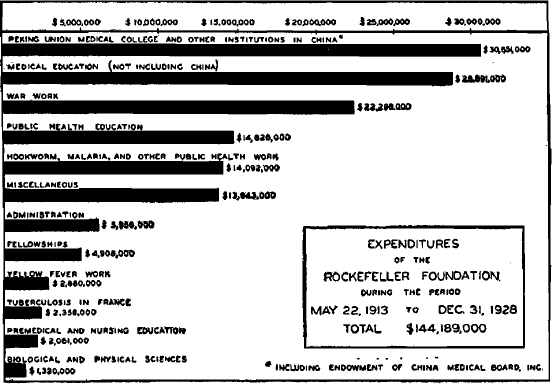
(Courtesy Rockefeller Foundation)
Fourth, that fortune must be, at this time (1932) enormously reduced as a result of the widespread and drastic contraction of security values due to the depression.
Some light is thrown on this by the fate of a trust fund set up by Mr. Rockefeller in 1917 for his daughter, Mrs. Parmalee Prentice. Then the father set aside 12,000 shares of the stock of the Standard Oil Company of Indiana in a trust under the control of the Equitable Trust Company and certain trustees. The income was to be paid to Mrs. Prentice along with $30,000 a year to her husband. At the time these shares had a par value of $100 but were quoted on the curb at $750. The Standard of Indiana thereafter had a phenomenal growth and the stock was split once while several times thereafter stock dividends were declared. When the stock was split it became 48,000 ($25) instead of 12,000 shares of $1,000 each. The 48,000 shares ultimately became 356,350 shares, not counting a few thousand which were disposed of. In 1929 they were worth $63 a share or $22,450,050. Today (May 27, 1932) the trust has shrunk to $6,102,497.
How shall we measure in terms of wisdom, virtue, and social utility these extraordinary gifts, so stupendous in terms of dollars? The answer calls up the whole question of the soundness of private philanthropy. Looked at subjectively the matter involves the intricate and obscure anatomy of human motive. Men have said that Rockefeller gave to create an ambush of good will behind which he might carry forward his schemes of profit or that he was silencing the murmurings of a guilty conscience, or to redeem his damaged fame.
Rockefeller’s large-scale philanthropy did not begin until he had retired from active participation in his most cherished great dreams of profit. And as to the murmurings of a guilty conscience, there is no evidence that Rockefeller’s conscience has ever troubled him. He has been well content with his course. He has been always committed to that paternal concept of Christian society in which the management of affairs is supposed to be entrusted by Divine wisdom to the efficient and the strong, who, in accumulating riches for themselves, provide employment for their less capable brothers and who, upon the principle of noblesse oblige are charged with the obligation to use their riches for a good purpose. This may be said to be the superficial reason for Rockefeller’s philanthropies.
When this has been said it is still to be admitted that men’s minds arrive at such convictions by processes not so obvious to themselves. It falls out that such a philosophy fits admirably the purposes of the acquisitive man. And no man who has examined the operations of his own mind or who has read the history of human weakness needs to be told that the mind has an infinite talent for inventing philosophies to support its own desires. It would be folly to deny that vanity plays a large part in the motivation of rich men’s public charities. And then there is the pure luxury of giving as a form of personal indulgence; a kind of weakness which leads men to seek the pleasant sensation of witnessing his beneficiaries basking in the warmth of his own generosity; a weakness which leads him to lie down and luxuriate in the gratitude of others as some men do in a warm bath. The element of sacrifice in Mr. Rockefeller’s giving can hardly be considered, for after handing cut more than half a billion dollars, he still retains at least as much for himself. Nevertheless it ought to be conceded that there is something on the side of the rich man like Rockefeller whose weakness is for giving usefully to a world for which he feels a bond of sympathy rather than one like Morgan, who spent his money chiefly upon himself and who got his delights out of wallowing in his fortune and looking down with scorn upon the men from whom he had squeezed it. Subject to all these considerations, therefore, Rockefeller must be given credit for having used his fortune for a social purpose. He has done something more. He did not merely give. He brought to bear upon his giving the same patient intelligence he employed in his gathering.
He assembled machinery to be sure his gifts were not wasted on unworthy objects. He aimed to put aside the salve box for the knife in reaching the cause of human suffering. He had a horror of giving where the gift was not needed. Some Brooklyn citizens wanted to build a hospital. Through St. John McKelway, they asked Rockefeller to bear half the cost. He asked for time to consider the matter. They thought it a polite refusal. Months later he sent for McKelway. He had an exhaustive report before him and a large map of the neighborhood of the proposed hospital. “If you will examine this map,” he said, “you will see there is already a hospital in this neighborhood doing most of the work you propose as well as your hospital could do it. The other part of the work, which is not being done, will, however, require twice as much as you seek to raise. If you will change your plans and double your part, I will give you twice what you ask for. And now how do you propose to support the institution?”
“The Lord will provide,” answered McKelway, whose group had really not considered that point.
“Perhaps he will,” said Rockefeller. “But the Lord is pretty busy. I think we had better create a little surplus.”
“To give is an art,” he said. “To give to everybody who asks is an injustice, because it takes from more deserving ones. I am fortunate that there are times when I can say ‘No.’”
As time wore on he ceased to be interested in helping people directly. The processes of his giving were focused on the root causes of human suffering. The area of his assistance ranged over a vast territory. It required human agents. It would be strange if these have always answered to the most perfect standards of human behavior. His gifts must be judged by the broadness of the conception, the dignity of the purpose, and the magnificence of the bounty.
The Medical Institute has now organized an extensive plant for the laboratory study of disease. It has an extensively equipped institution in New York and another in Princeton where a staff of some twenty-two able medical scientists and twice as many associates and assistants are enabled to pursue “under favorable conditions and with adequate support for an indefinite period, unhurried and unhindered by the urgency of obviously practical or immediate results” the problems of diseases in men, animals and plants. It has three departments—its laboratories, its hospital and its department of animal and plant pathology. Its whole resources are devoted to research. There is no teaching. Its hospital is purely for experimental and clinical research.
The Institute has studied cerebro-spinal meningitis, infantile paralysis, epidemic influenza and epidemic encephalitis. The public is in some degree familier with the work of such men as Dr. Alexis Carrel in surgery, Dr. Hideyo Nagouchi in Rocky Mountain spotted fever, trachoma and yellow fever; Dr. Rose in the study of hookworm; Drs. Wade Hamptom Brown and Richard Mills Pearce in the study of syphilis. The net dividends of the Institute to society, however, would require an amount and degree of auditing which the present writer feels he has no capacity to make. Its work is in the domain of the physical sciences and there progress must depend upon the patient accumulation of knowledge. At intervals startling discoveries excite the popular imagination. Not infrequently they represent the final reaching and grasping of some rich result in which the long, patient and almost unrewarded climb up the lower stages of the journey are almost obscured. Every such discovery is always just one more piece of knowledge achieved on top of other immense accumulations of knowledge. Mr. Rockefeller has wisely provided a mechanism for slowly, patiently broadening the base of knowledge and piling it up for the benefit of those who may be moved to climb higher. The conception would seem to be an intelligent one. The provision in the way of funds is ample. The care in organizing has been minute. Whether or not the mechanism thus created achieves as much as it might reasonably be expected to achieve, will depend upon the human energy with which it is implemented at different periods in its life.
As to the General Education Board—it has given up to 1929, $81,068,510.73 to more than 200 colleges and innumerable schools. The giving has been done according to a plan which has resulted in the accumulation of twice as much again in endowments. The more substantial result has been the creation of a huge plant for education in America. That is a beginning. Perhaps the education will come later. Up to now the system of which this has been so important a part, has had one unhappy effect. Almost every college president in the land has been hanging with his hat in his hand and his eye on his economics department around the almoners of the Rockefeller boards and other rich men of the country. Putting our system of higher education at the mercy of millionaire industrialists and financial promoters has had upon our colleges the same influence as it has had upon the church and the press. This, we may hope, is a passing phase. It may be that in another generation the schools and the endowments will remain free from the influence of the donors and their economic interests.
As for the Rockefeller Foundation there can be no doubt of the immense value of its assistance to countless worthy and noble human activities. It has aided innumerable medical schools, it has made studies of disease all over the world—tuberculosis in France, yellow fever in Guatemala and other places, malaria in Arkansas and Mississippi, hookworm in the South and throughout the world, infantile paralysis everywhere. It has established scholarships and has supported hundreds of fellowships to assist earnest students to pursue their researches, equipped laboratories, and done a hundred other useful works.
The popular picture of the philanthropist Rockefeller is of a cold and bloodless incarnation of scientific giving. As a matter of fact, he has always had his own little private charities. He maintains a large pension list on which appeared until they passed away the names of many of the old timers of Oildom, not a few those who claimed they had been crushed by the ruthless industrialist of the earlier days.
IV
WHAT of the vast enterprise which Mr. Rockefeller reared and the system of which he was the chief architect? One must concede that it has borne rich fruits for its creators. What have been the dividends of society, of labor, for instance?
Before the Sunday School class of the Fifth Avenue Baptist Church, May 1, 1910, Mr. Rockefeller said:
“I think the most valuable donation is a gift to honest labor. During the forty years I have been in a particular branch of business our company has paid out each working day from $60,000 to $70,000 or $20,000,000 a year to honest laboring men. This in forty years makes a total of from $600,000,000 to $700,000,000. That I regard as the greatest pleasure which may be given to man.”
The statement is full of meat. It is fully in harmony with the Wesleyan ethic that from the upper levels of the social structure the benefits of wages descend upon the workers beneath as a kind of gift “to honest labor” from the appointed of the Lord. But this is the least of its implications.
In those forty years the laborers had drawn from the enterprise $600,000,000. But in that same time Mr. Rockefeller and his associates had drawn a sum equally as large in dividends. But there still remained in undistributed assets a sum at least as large again, the accumulated value of the years which had not been withdrawn. This belonged to Mr. Rockefeller and his colleagues. To put the matter differently, Mr. Rockefeller and his few associates took as their share a sum twice as great as the thousands of workers. It is probably true that Rockefeller paid as good if not better wages than most of his contemporaries and that he did not loot his enterprise through the medium of stock jobbing operations as most of his contemporaries did. The Standard Oil may be looked upon, in the matter of administration and treatment of labor, as a capitalistic administration at its best. Yet there seems to be something obviously out of gear in a mechanism which makes so unjust a distribution of the rewards of industry.
What of the public dividend in the way of lower prices for oil? There is but very little evidence that the Standard was ever actuated in Rockefeller’s day by any overmastering desire to reduce prices. It was in pursuit of profits all the time. It was in pursuit of monopoly until restrained by law. The price of oil fell over a long course of years under the influence of innumerable developments. The Standard, so far as appears in the records, was never a leader in the reduction of prices. It was a leader in the adoption of modern producing methods as they appeared and in the perfection of large-scale and economic management. But it passed on to the public the benefits of those economies only to the extent that it was pressed by actual or threatened competition.2
Mr. Rockefeller’s achievement must be classified under the head of organization. He originated practically nothing. He added little or nothing to the innumerable devices by which the price of oil was brought down. But he led the way in the use of almost everything, in the organized employment of all the devices and forces which were available for large scale production. He was also among the first to deal with the new problems of industry. The forces of trade and industry had become wild—no longer amenable to the corrective elements of the old automatic economy. These new forces needed regulation, but society remained blind to this. In a growing and spreading collectivism they continued to talk the language of the old individualism. Government disclaimed the right to regulate. Rockefeller discarded, after experiment, the idea of regulation by association. He committed his fortunes to regulation by private monopoly through the corporate form. Sixty years ago he saw the need of planning against the untamed and destructive forces of an unregulated economy. He set about erecting a mechanism for planning in the industry in which he worked. He left out of the planning authority the public which paid all the bills. His mechanism might be good as long as it was benevolent. But sixty years of such planning have served to demonstrate that it is almost never benevolent and that it will not work. It is now in process of abandonment. It is for this reason we may properly say that we approach the end of the Rockefeller era.
V
SINCE 1915 we have been witnessing the phenomenon of selling Mr. Rockefeller to the American people, a process carried on under the sales direction of Mr. Ivy Lee, who, as we have seen, joined the Rockefeller staff at the time of the Ludlow troubles. Mr. Lee has done a most excellent job. But he has had the collaboration of forces even more potent than his efficient sales machine.
Mr. Lee introduced something new into this sort of personal salesmanship. He asked Mr. Rockefeller and Standard Oil to look itself over, to mend its manners, to remove “the harmful irritants,” from its methods and to consider the public reaction to its acts when making its policies. He went further and induced the great company to take the public more into its confidence, to remove the Chinese wall of secrecy behind which even its most harmless operations took place. The press was supplied continuously with full information about all the good deeds of Standard Oil. So far as I know, however, but little effort has been made, in recent years at any rate, to interfere with the printing of anything. The emphasis has been placed rather upon cultivating good relations with the press.
But something more potent than all this has been at work. Before 1915 Mr. Rockefeller was performing on a wholly different stage. Then he was at war with the existing system. Newspapers and magazines were filled with the stories of his ruthlessness, of attacks by legislators and prosecutors, the flight of witnesses and the pursuit of marshals, the tales of men who had been ruined, stories of bribed lawmakers, of railroad corruption, of unfair discriminations. But for years Rockefeller had no part in such transactions. The old headlines read “Rockefeller Indicted Again,” “Standard Oil Before the Bar,” “Oil Men Lay Ruin to Rockefeller,” “Standard Oil Magnates Dodge Subpoenas.” The modern headlines run: “Rockefeller Gives Another Million to Unemployment Fund,” “Rockefeller Foundation Fights Pellagra in Georgia,” “John D. Gives Dimes to Children.” In the old magazine the stories were entitled: “Is the Senate the Corrupt Tool of Standard Oil?” “Tainted Money,” “The Church and the Reward of Iniquity,” “Rockefeller Faces Justice.” Today they are: “How the Rockefellers Give Millions,” “When I Caddied for John D.,” “Employee Representation in Standard Oil,” “Rockefeller Now Plays One Hundred Per Cent Golf.”
The figure of the striding, ruthless monopolist in high hat and long coat gripping his walking stick and entering a court house has been replaced by pictures of a frail old man, playing golf with his neighbors, handing out dimes to children, distributing inspirational poems, and walking in peace amid his flowers. Another generation has rolled in upon us. He has outlived the men who denounced him and the generation which hated him.
The world has changed. The industrial world has changed to conform to the pattern he set for it. The press has changed. The old press was owned or controlled largely by men interested in politics. It reveled in the denunciation of business men. The modern press belongs to business. It is on the side of business. It is very naturally on the side of the advertiser, particularly the big advertisers. Standard Oil is a very big advertiser. Stories criticizing Rockefeller are not now desired. Stories critical of business are not desired. What is called “constructive” material is what is wanted. We have seen not merely the sale of Mr. Rockefeller to the public but all business and along with it the once-hated master of Standard Oil.
VI
WHAT of the great company? The evidences of its life and ubiquity dot the roadsides of the world. People have a way of thinking of it as a vast empire, operating under scores of different names, but all ruled by a few master minds at 26 Broadway under the dominion of John D. Rockefeller, acting through his son. It is a hardy legend. But it isn’t so.
The Standard when dissolved in 1911 split into thirty-three corporations. But all had the same stockholders. The old directors continued to rule the affairs of each company. Under the old order each corporation had a separate region to work in. The Standard of New York operated in New York and New England. The Jersey company had New Jersey, Maryland, Virginia, District of Columbia and the Carolinas. Pennsylvania was served by the Atlantic Refining Company. The Standard of Indiana had as its domain Indiana, Illinois, Iowa, Michigan, Minnesota, Missouri, North and South Dakota. The Standard of California had the Pacific Coast and part of Arizona. Then there were the Standard of Kentucky, of Kansas, of Nebraska, of Ohio, the Continental Oil Company, the Vacuum Oil Company, each with its special sphere of influence marked out. These were refining and marketing companies. Besides there were pipe line, shipping, manufacturing and financial corporations. After the dissolution all these companies continued to operate in their allotted fields. People laughed when they thought of the “dissolution decree.”
But now the old regional frontier lines of the great Standard confederacy are being slowly obliterated. Competition, the arch devil of business in Rockefeller’s creed, has actually invaded Standard Oil itself. The Rockefellers have actually withdrawn from five Standard units. The various Standard units are becoming wholly independent and competing concerns spreading out over their old boundaries as full-fledged rivals of each other.
VII
AMID the elaborate and ostentatious settings of his various estates the sober-faced boy of the Finger Lakes regions, who wanted to be worth a hundred thousand dollars, moves toward the final scenes in his long and significant life. The country has become familiar with an aged, slightly stooped, amazingly wrinkled old gentleman photographed in a hundred attitudes on the golf course. Rockefeller plays every day when the weather permits and always has a guest or two or more to play with him. To his various homes comes a steady stream of friends, curiosity seekers, old associates, and new ones anxious to have a game of golf with the richest man in the world.
Wherever he may be his daily routine is about the same. He rises at seven, strolls around his house and perhaps the garden giving nickels to each member of his establishment he meets. He glances at the newspaper and then has breakfast. At a quarter to nine he indulges for fifteen minutes in a game of numerica—something like Canfield solitaire. This sort of lubricates and cranks up his mental machinery.
At nine he is in his office, where a secretary and several assistants look after his business affairs. At 26 Broadway under the direction of his son is the more imposing business staff which manages his vast investments. But here at home he keeps a certain amount of business under his own hands. He likes to buy and sell stocks. He always has a collection of shares which he keeps more or less active in the market. This keeps his mind from growing rusty. He gets reports on the progress of all his great philanthropic boards and on the major features of his larger investments. Sometimes he puts his hand deeply into some enterprise that interests him particularly, as when he had Andrew J. Thomas, the famous architect, build for his son a large group of model apartments in Tarrytown. A voluminous mail is delivered to Pocantico every day. Sometimes there will be 2,000 letters, most of them asking for money, many of them telling him what to do with his wealth. He never reads an appeal for help. It goes to his staff at 26 Broadway.
At 10 o’clock business is done and he is on the golf links. He will have the village minister or the priest at Tarrytown, the high school principal, some friends, or some notables anxious to meet him as partners and foes. He used to play nine holes, but now plays no more than eight but stops short of that if he feels fatigued. At noon he is done. Then he bathes, changes his clothes, lies down for a rest, and lunches at 1:15. After lunch he plays two or three games of numerica and at half past three goes for a motor ride. He seeks always new routes and is apt to invite into his car any person of the village he meets whom he knows. This ride may extend from twenty-five to fifty miles. At 5:30 he enjoys a long rest, after which he changes into his dinner jacket and sits down to his table with a group of guests. He never dines alone. At 8:30 dinner is over and then he brings the day to a close with his guests in conversation, perhaps music from his magnificent pipe organ or perhaps a performer or two brought to the house for the purpose, or some games of numerica, or songs. He is in bed by 10 o’clock.
This program is almost unvarying. The names of the guests who will sit down with him to dinner on any day can be given at any time by his household a week or two ahead.
The favorite guests are the simple people who live around his homes. Rockefeller never has felt any hunger for the companionship of the brilliant. He has had few if any friendships among scholars or thoughtful men save such alleged scholars as have been the beneficiaries of his bounty. He has not been a student himself; he has read little; he has pondered very little the abstract and philosophical basis of things. In religion he has been satisfied with the theology of the village preacher. In economics he has been content with such principles as have fallen in with his own interests. In government he has been well pleased with what we have had, save that he would like to see the government remain out of business affairs as thoroughly as it did when he first set to work. In politics he has taken his beliefs from the bookkeeping sections of his mind and always supported the Republican candidates. The test of his own interests has been the basis for adopting views on most subjects and about the fundamental principles of all these things he has reflected hardly at all. His mind is perfectly adapted to weighing and measuring material things. It is formed to proceed with perfect orderliness. His spirit is regulated by an almost boundless patience and a relentless appetite to have its own way. It has been able therefore to move with extraordinary efficiency toward any goal it selected. When it relaxed, however, and sought diversion, the conversation of workmen, clerks, village preachers, and business men like himself afforded him all the variety he needed.
A few years ago after service one Sunday morning at Lakewood he handed around to all, instead of dimes, little slips of paper on which was printed a poem. He had a reporter read it while he listened raptly.
“Lord of all pots and pans and things, since I’ve no time to be
A saint by doing lovely things for watching late with Thee,
Or dreaming in the twilight, or storming heaven’s gates,
Make me a saint by getting meals or washing up the plates.”
“Isn’t that beautiful?” murmured the aged man, moved by this glorification of lowliness from the soul of a servant girl poet.
It must not be supposed that his life, though rigidly ordered, is merely a wearisome plodding on to the final goal. Rockefeller has said many times that he is happy. “He lives each day with a zest and a satisfaction and happiness given to few men,” says a friend who has seen much of him. “From his early morning stroll in the gardens, singing the songs of his youth or the old hymns in a round full baritone voice, to the time when he listens to the last strains of the evening music his daily life is a round of work, play and, above all, of gratitude.” There is no reason to doubt this picture. Nor is there any reason to withhold admiration for the man who, by his complete conquest over himself, has exhibited the capacities of the human mind for achievement. His is the outstanding example of a planned life.
For the rest almost any newspaper reader can tell the round of Rockefeller’s life—his journeys at stated seasons each year to Florida, to Lakewood, to Pocantico; his giving away of dimes wherever he meets people, his birthdays each year, his golf games and his advice about cheerfulness and health and work and lately his appearances in the sound pictures and, we must not fail to observe—the movie audiences who smile pleasantly at his appearance and applaud as he murmurs, “God bless Standard Oil.”
VIII
MR. ROCKEFELLER once wrote:
“The great majority of my associations were made so many years ago that hardly a month goes by that I am not called upon to send some message of consolation to a family with whom we have been connected and who have met with some fresh bereavement. Only recently I counted up the names of the early associates who have passed away. Before I had finished I found the list numbered some sixty or more.”
This was written twenty-four years ago in the World’s Work when Rockefeller, nearing seventy, thought himself an old man. Since then another quarter century has rolled over his head. It has washed from the scene practically all that was left of the men who worked with him and served him and fought him. As he sits now by the fireside in his room at Pocantico, musing upon all that great company of adventurers and crusaders and counts them over the number must appall him—the serious and authoritative Pratt, the dashing and commanding Harry Rogers, the sly and truculent Archbold, the bold and unscrupulous Henry M. Flagler, and a host of still younger men; the Hannas and Aldriches and Sibleys and Elkinses and Forakers who served him so profitably and the Rices and Lawsons and Pulitzers who harried him and the more powerful antagonists—the Roosevelts and Bryans who laid on such heavy blows—all are gone. Rockefeller himself, who by the force of his patience, his resoluteness, and his irrefragable concentration, became the master of all his associates, has, by aid of those same qualities, hung grimly to life and outlived them all.
3An idea of the sums received by the public, as distinguished from the capital sums given by Rockefeller, may be gathered from the following. He gave the Rockefeller Foundation $182,704,614. But that Foundation, up to 1928, gave away the following sums:
| Before 1922 . . . . . . . . . . . . . . . . . . . . . . . . | $ 76,000,000 |
| 1922 . . . . . . . . . . . . . . . . . . . . . . . . | 9,911,408.78 |
| 1923 . . . . . . . . . . . . . . . . . . . . . . . . | 8,431,075.20 |
| 1924 . . . . . . . . . . . . . . . . . . . . . . . . | 7,288,822.39 |
| 1926 . . . . . . . . . . . . . . . . . . . . . . . . | 9,113,730.43 |
| 1926 . . . . . . . . . . . . . . . . . . . . . . . . | 9,741,473.66 |
| 1927 . . . . . . . . . . . . . . . . . . . . . . . . | 11,223,123.79 |
| 1928 . . . . . . . . . . . . . . . . . . . . . . . . | 9,690,738.52 |
| Total . . . . . . . . . . . . . . . . . . . . . | $141,400,372.77 |
After which most of the principal was still intact.
The author has been given another account of this from a source close to Mr. Rockefeller. It is that Mr. Rockefeller never met Morgan more than twice—once casually at a railroad station and once at a dinner. Mr. Morgan, according to this account, asked for a conference, but Rockefeller declined and sent his son and Frederick T. Gates to Morgan’s office. Morgan began with: “What is your proposition?” and the young man answered: “We have no proposition. You must have been misinformed. Good morning, sir.”
However, Ida M. Tarbell in her “Life of Judge Gary” declares Morgan told Judge Gary he had seen Rockefeller.
Anglo-American Oil Co.
American Petroleum Co.—Holland.
Americanisch Petroleum Co.—Germany.
Deutsche-Amerikanische Co.—Germany.
Danish Petroleum Co.
Königsberger Handels Co.—Germany.
Mannheim Bremen Co.
Korft Refining Co.
Stettin-Amerikanische Co.—Germany.
Roumanian-American Petroleum Co.
Societé ci-denant H. Reith et Cie—Belgium.
Italian American Petroleum Co.
Vacuum Oil Co.—Austria. .
International Oil Co.—Japan.
Colonial Oil Co.—Africa and Australia.
Devoe Manufacturing Co. (makes tin cans).
Oswego Manufacturing Co. (wooden cases).
American Wick Manufacturing Co.
Thompson, Bedford and Co.—European trade in lubricating oils.
Many Vacuum Oil Companies in Copenhagen, Genoa, Hamburg, Moscow, Stockholm, Bombay, Kobe, Capetown.
- 1An idea of the sums received by the public, as distinguished from the capital sums given by Rockefeller, may be gathered from the following. He gave the Rockefeller Foundation $182,704,614. But that Foundation, up to 1928, gave away the following sums:
- 2For a full exposition of the course of prices during Rockefeller’s regime as head of the Standard see “The Trust Problem” by Jeremiah Jenks and Walter E. Clark, Fifth Edition, pp. 107-114 (Doubleday, Doran).
- 3This, however, is not the total of the sums which the public has received. For many years in addition to grants out of the principal of these endowments, immense sums in interest have been dispersed which would add not less than $175,000,000 to the above, so that it may be reasonably stated that various public philanthropic enterprises have received from the Rockefellers a sum equaling seven hundred and fifty million dollars.

