
God’s Gold
Part Seven: The Final Flight

THERE were many men in America richer than John D. Rockefeller. But as he stood now, at forty, master of the greatest industrial institution in the country, he was certainly among the richest. The properties of the Standard Oil group were valued at $70,000,000. Rockefeller owned 191,700 trust certificates worth $70 each. Thus he was worth in Standard Oil holdings alone something more than thirteen million dollars. He must have had as much again invested in other properties. Almost all of this had been accumulated in ten years.
Though now a man of vast wealth, Rockefeller had given little thought to the question of philanthropy. His wife was greatly interested in the missionary work of the Euclid Avenue Baptist Church and practically all his benefactions, except occasional help to individual needy cases, were to the missionary work of this church. His mind was at this time wholly on the problem of building his fortune.
While retaining the old residence in Euclid Avenue, he acquired about this time the beautiful Forest Hill estate further out on the same boulevard, at that time a suburban site. He had always wanted an extensive country estate where he might build roads, lay out the grounds, and play with trees and landscapes. Forest Hill was acquired as a country home. About this time, however, the growth of his interests on the Atlantic seaboard made it necessary that he spend most of his time in New York, which had now become the oil capital. For several years the family lived at the old Euclid Avenue home in the Winter and at Forest Hill in the Summer, while Mr. Rockefeller stayed for the most part through the Winter months at the Buckingham Hotel in New York. In a few years, however, the supremacy of New York was so complete that Rockefeller decided to move his family to the East and he then acquired the home at No. 4 West Fifty-fourth Street, which he has continued to own to this day. Here then the family took up its Winter quarters, but for many years made Forest Hill in Cleveland its Summer home. Thus, he now possessed three homes—all fine places but nothing gaudy or ostentatious about them.
The made millionaires of the day ran to the most extravagant exhibitions of their wealth. For the Rockefellers it must be said that they behaved with decency and dignity in their new wealth. They were from the start fearful of the effect their wealth might have upon their children. They employed the most elaborate care to protect them from that. When they moved to New York young John D. went to a preparatory school and walked to and from class, while his classmates passed him on Fifth Avenue in their handsome rigs, many accompanied by grooms. The children, so far as possible, were kept from knowing the wealth of their father lest they take an air of superiority with their companions. Edith was at a girls’ college and with some classmates went to buy a desk for some common purpose. They wanted to have a bill sent, but the merchant wanted some identification and asked if any of the girls would give the name of their fathers who might be in business. Several girls immediately named their fathers, whereupon Edith said: “My father is in business, too.” “And what’s his name?” asked the merchant. “Rockefeller, John D. Rockefeller. He is in business in New York.” The girl had no idea of the magnitude of her father’s affairs nor of the importance of his name. But the merchant did.
Some years before the children wanted a tricycle. Rockefeller suggested to his wife that they buy one for each.
“No,” she said, “we will buy just one for all of them.”
“But, my dear,” he urged, “tricycles do not cost much.”
“That is true,” she explained. “It is not the cost. But if they have just one they will learn to give up to one another.”
Rockefeller himself had always had a strong strain of old-fashioned sentiment. He found his chief pleasures in the companionship of his family and the acquaintances of the Baptist Church. The pleasures of intellectual conversation have never meant anything to him. The small affairs, the trivial chatter of people who talked about their neighbors and their Sunday School completely satisfied his social and intellectual appetites. He attended church with unfailing regularity and when, occasionally, Mrs. Rockefeller could not attend, he would make careful notes of the sermon and then repeat to her the wisdom which fell from the lips of the preacher.
He never missed prayer meetings or trustees’ meetings when in Cleveland. In the old days of the Erie Street Mission he had always rung the bell on Sundays and, when he was Sunday School Superintendent, went over regularly before meeting and kindled the fire. He was already one of the leaders of Cleveland business at this time. But since 1871 the congregation had been installed in its new church building at the corner of Euclid Avenue and Huntington (now 18th Street). The simple ways of the old church were no longer in vogue. Mr. Rockefeller was rich. There were several other rich men in the congregation now. The name of the church was changed to the Second Baptist Church and then in 1877 to the Euclid Avenue Baptist Church, a name under which it was destined to attain fame as Rockefeller’s place of worship.
He continued to act as Sunday School Superintendent and to deliver instruction to his classes. Rockefeller’s presence was an attraction to young men. Acquaintance with the wealthy man and large employer was a thing to be cultivated. After Sunday School pupils would manage to talk to the teacher, to let him know they were candidates for jobs. Rockefeller on his side, when boys seemed a bit unruly, would say: “I keep my eye on the boys in Sunday School. You know we hire a great many people and some of you apply for positions. I watch your conduct in the Sunday School and judge from that when you come to get positions, whether you would be the right sort of boys to work for me.” A great many employees of the Standard Oil Company in Cleveland were recruited from those Bible classes.
Rockefeller himself always felt it incumbent on him to give an example in carefulness and economy. As soon as the last Amen was pronounced in his class he made ready to turn out the gas light and when the last pupil went out he turned it off.
About this time he wrote to the pastor pledging certain weekly sums: “Mrs. Rockefeller, $10 each week; self, $30 each week; each of our children, 20 cents each week.” He added: “The 20 cents from each child will be earned by the sweat of their brows, pulling weeds, etc.”
These, of course, were merely his regular contributions. He came forward in a larger way whenever the church needed money. And he distributed to members of the congregation many and frequent beneficences. There were several old people in the congregation who were entirely dependent on his bounty. During the service he would look around to see who was present. Then he would take envelopes from his pocket and put certain sums in each envelope and write the names of the intended beneficiaries on them. After service as he was shaking hands he would manage to leave the envelopes, well folded, in the palms of those for whom they were intended.
Rockefeller went out hardly at all to social affairs. But there were plenty of family gatherings at home and the Euclid Avenue Church picnics and entertainments were almost always attended by the family. The Rockefeller children all played different instruments and all were members of the church orchestra.
He was devoted to his children. Unlike Morgan, whose children fled from him in terror, Rockefeller fraternized with his. The Forest Hill estate had a fine lake. Many days when, outside that pleasantly wooded park home, his enemies raged in war against his plans and reporters and process servers harried the old Irish guard at his gate, a sturdy swimmer might have been seen, with a straw hat on his head, moving slowly, with a strong, leisurely breast stroke, around the lake. Behind the oil king his children, who were his pupils, struggled industriously in their swimming lessons. Rockefeller would swim sometimes a mile without stopping. In the Winter the frozen surface of the lake afforded a place to skate when Rockefeller made his occasional visits to his family.
“Father was always an enthusiastic skater,” John D. Rockefeller, Jr., has said, telling of these early days. “I recall going with him to test the thickness of the ice to see whether it was safe for our sport. The lake was deep, so father deliberately chose a means of saving ourselves in case the ice gave way. We took under our arms long narrow boards, which would hold us up in case we broke through. I didn’t realize it at the time, but later I came to realize that this was characteristic of him.
“Well do I recall that one Winter evening when I was staying at Forest Hill and father was there on a visit, his enthusiasm for skating led him to get up shortly after midnight on a Monday morning to go with some of the workmen to our little lake to flood the surface of the ice so as to make it smoother for skating that day. He went at this unusual hour because he would not have the work done on Sunday.
“I have heard father say that he regretted he did not have more time for his family during those early years; and had to leave so much of our training to our mother. Nevertheless, he was always the companion and friend of my sisters and myself, and we learned much from him; but this was not so much by precept as by example.”
The Rockefeller children were systematically made to want for things instead of having their wants immediately gratified. Other children they knew had far more than they did. This was particularly true of their cousins, with whom they were always comparing themselves. “We felt we were in a terrible plight compared with them,” said John D., Jr. All the children were assigned tasks and were made to work. And for this work they were paid. Indeed, they got no money save what they earned. They were also taught to save. That lesson was incessantly enforced. When one of the children saved ten dollars, the father would then put another ten to it for encouragement. At church they were taught by their mother to put something in the collection plate out of their own earnings. They were rewarded for all attention to duty, but the rewards were nickels and dimes. Young John D. was taught the violin. When he practiced he got five cents an hour. Later, when he was old enough to work around the Cleveland estate, he was paid the same wages as the laborers.
II
WILLIAM ROCKEFELLER lived altogether in New York. Frank was still in the oil business as secretary of the Pioneer Oil Company. Old Doctor William Rockefeller had been drifting more and more out of the family picture. He had always continued at his old trade, spending little time in Cleveland. Gradually his absences became more and more prolonged until about this time, when he disappeared altogether. His name went out of the Cleveland directory. The elder Mrs. Rockefeller continued to live at 33 Cheshire Street, the home from which John D. went to be married. She was a devout member of the Euclid Avenue Baptist Church, at which, in fact, all the Rockefellers, including Frank’s family, worshiped. But she was rapidly becoming an invalid. She watched with great pride, of course, but with some dismay, the meteoric rise of her extraordinary son. His picture hung in the place of honor over the parlor mantel. After he moved to New York she made occasional visits to his home and as the years wore on divided her time among the homes of her various sons and daughters.
CHAPTER II. THE GREAT STRUCTURETHE COUNTRY was now well aware of the industrial giant who appeared in their midst. Congress, legislatures, political parties, newspapers, and publicists began to give Mr. Rockefeller and his company their attention. And well they might, for he had not only reared the most powerful business structure yet seen in the world but had created for them a whole series of bewildering problems.
What was known as the Standard Oil consisted of forty corporations. Mr. Rockefeller and his associates owned fourteen of these completely and controlled a majority of the stock in twenty-six others. In 1870 he had incorporated his company with a million dollars’ capital. Now the capital was seventy million. Those two original partners—Rockefeller and Andrews—had increased to thirty-seven stockholders. But Andrews was gone. The rapid growth of the company, the swift pace of his ambitious partner, kept him in a state of nervous terror from the beginning. He was the mechanical director of the concern in Cleveland and each time he learned of the latest adventurous extensions of his more audacious partners, Rockefeller and Flagler, he suffered a shock. The tremendous acquisitions preceding 1879 were too much for him, and Rockefeller became annoyed at his older partner’s incessant apprehensions. Finally one day in 1880 Andrews said: “I wish I was out of this business.” “What will you take for your interest?” asked Rockefeller calmly. “One million,” said Andrews, never dreaming he would get it. A few days later Rockefeller appeared with the million in cash and Andrews went out of the company, breathing a sigh of relief, the first of that extraordinary group to break away. Very soon after the stock went up much higher in value. Andrews complained to friends that he had been pushed out of the company. These murmurings came to Rockefeller’s ears. He asked Warden, a fellow-director, to go to Andrews and say that he might have his stock back at the price he sold it for. Andrews, however, said he was through with the oil business. Had he held on he would have ranked next to Rockefeller in wealth. Thereafter he drifted wholly out of the scene. In Cleveland he had built a gaudy and ostentatious mansion which was called “Andrews’ Folly.” He left little other claim to fame.
It was indeed an industrial empire which was ruled from that small old-fashioned building at 140 Pearl Street. There were refineries at Buffalo, Philadelphia, Cleveland, Baltimore, New York, Portland, Maine, Pittsburgh, Hunter’s Point, Bayonne, Rochester, and in all the cities of the oil regions. Practically all the company’s leaders were now in New York. Over these men Rockefeller presided as absolute master. His preëminence was never questioned. In spite of this, however, he made it a rule never to act without consulting his colleagues and never to take an important step without unanimous agreement of all the directors. There probably has never been another such board of directors. They met daily. A majority could be assembled at a moment’s notice for any important action. They operated behind closed doors. They denied everything and talked outside about nothing. As early as 1876 they formed the habit of lunching together each day, at 140 Pearl Street. William Rockefeller perhaps established and developed the custom. Oddly enough, it was not John D. Rockefeller who sat at the head of the long table, but Charles H. Pratt. On Pratt’s right sat Flagler, on his left Rogers. Along the right next to Flagler sat, in order, John D. himself, Archbold, J. A. Bostwick, E. J. Pouch, John Bushnell, and Paul Babcock. Along the left after Rogers sat William Rockefeller, Thomas Bushnell, Benjamin Brewster, F. Q. Barstow, J. Crowell, and J. H. Alexander. At the foot of the table sat James McGee. These were the rulers of the great corporation. Of course, as the years passed other men took their places at this board. They are all dead now save the undisputed master himself who modestly sat third from the head.
Flagler continued to be the closest man to Rockefeller. All directors had separate offices but Rockefeller and Flagler continued to have their desks together. Flagler was attached to no department. He was the “lawyer” of the crowd. He was the cold, remorseless analyst. He had a flare for sensing the legal values in a plan; was the wizard in contract making. He doubtless conceived the combination idea and invented the drawback scheme. J. J. Vandergrift and Daniel O’Day continued to rule the pipe lines. Jabez Bostwick was the buyer. Henry H. Rogers was in charge of manufacturing. Pratt was the great merchant of the group. Warden and Lockhart looked after their own plants. O. H. Payne was the treasurer. But William Rockefeller, who had confined his attention to exports, was slowly moving over into the financial department over which John D. himself exercised the closest supervision.
Rockefeller expected these leaders to divest themselves of details. Each plant, each corporation, was organized as a unit. Its managers were given wide discretion and held accountable for successful operation. These divisional chiefs were expected not to trouble the minds of the leaders with small details. Rockefeller set up a system of sifting committees, which were empowered to handle all ordinary problems. Only the major question reached the general staff. There was a committee on marketing, a crude oil committee, a manufacturing committee, with departments dealing with making refined products, developing new products. Committees covered all the functions of the vast business.
Rockefeller’s hatred of waste ran through the whole enterprise. For the first time a business had been organized on the principle of assembling the best brains in the industry and putting them to work on all of its countless problems. The problem of waste was one of these. Rockefeller saw that the waste of a few pounds which would not be noted in a small business, when multiplied many times in a huge concern, would amount to a large sum yearly. Thus we find the purchasing department sending to the barrel factory this note:
“Last month you reported on hand 1,119 bungs. 10,000 were sent you beginning this month. You have used 9,527 this month. You report 1,012 on hand. What has become of the other 500?”
It is a favorite criticism of Rockefeller that he initiated nothing; that he seized other men’s ideas—pipe lines, tank cars, by-products—and used them for himself. The complaint ignores the character of Rockefeller’s mind. One might say of Napoleon that he invented neither explosive nor gun. Rockefeller was a commander, not an inventor. The time when a single small business man might attempt to supply all the talents needed to conduct a business was passed. It was Rockefeller’s genius to perceive that business on a great scale would need to assemble the differing talents of many men. He did not invent tank cars or pipe lines or paraffin or refining processes. But he organized and used them intelligently. He was among the first to see the changing conditions in our economic world and the need of applying scientific knowledge to industry. He could not be a chemist and physicist and engineer and financier. But he could see the need of chemists and engineers and physicists to improve methods and processes. But he saw also what men have been talking glibly about these last twenty years as if it were just discovered—the principle of integration in industry. He saw men getting rich making barrels, glue, hoops, and lending money to refiners and producers. Much has been written about Rockefeller’s predatory competition, but little about the drove of little business men who preyed on producers and refiners, particularly the bankers and money lenders who squeezed them with heavy bonuses. Rockefeller saw barrels made by the most wasteful and expensive processes. The industry paid an oppressive toll for this inefficiency. So he began making his own barrels, his own glue, and hoops, and material of every sort. He used only the best wagons. Horses were bought young and used for three or four years only. Their feed was watched, their stables kept scrupulously clean. In 1872 barrels cost $2.35 each. In 1888 they cost $1.25 each. As the company used 3,500,000 barrels a year this meant a saving of $4,000,000. In 1874 cans cost 30 cents each. In 1888 they cost less than 15 cents and on 36,000,000 a year Rockefeller effected a saving of $5,400,000. The same thing was true of tanks, stills, pumps, everything used in the business. Experts were at work constantly studying better methods of manufacturing the by-products of oil. It is a fair statement that when Rockefeller’s battle with the Tidewater was ended he had brought into being the most efficient large scale industrial manufacturing business in the world, in which every detail was watched with care, in which every saving was made and in which the products were the best that human ingenuity could produce and in which the integrity of the company’s brand was guarded as a priceless possession, as indeed it was. For people might curse John D. Rockefeller; but they preferred his kerosene.
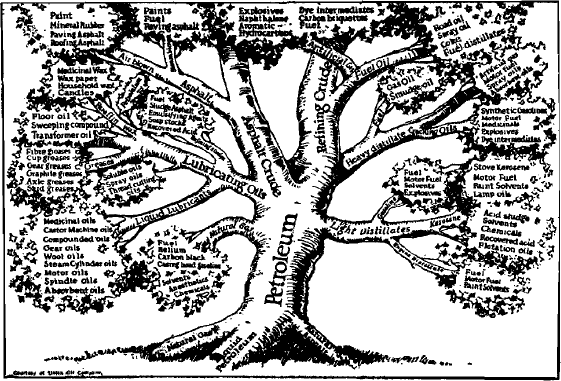
THE BY-PRODUCTS OF PETROLEUM.
(Courtesy Union Oil Co. of Cal.)
II
IN 1870, Henry Clay Pierce, another one of the infant prodigies of the oil business, at the age of nineteen was in possession of a wife and the entire kerosene business of St. Louis. In this year the youthful magnate kissed his still more youthful wife good-by and set out upon an exploration of the then wild and woolly plains of the Southwest. He toured Arkansas and Texas on a pony, with his lamp in one hand and his kerosene samples in the other, astonishing the natives of those primitive provinces with the new illuminant and appointing agents of H. C. Pierce and Company as he traveled. Later he took a partner to supply cash to push his adventurous progress and his firm became known as the Waters-Pierce Company. By 1875, Mr. Pierce, aged 25, was the oil marketing king of Missouri and the great Southwest. Then he looked up one fine morning to find a challenge to battle at his doorstep.
Over in Louisville was another enterprising firm, Chess, Carley, and Company. They had a small refinery or two, but in reality they were marketers, their territory being Kentucky, Tennessee, and certain contiguous states. Chess, Carley, and Company wanted to expand and so they had sent agents into Missouri to contest that profitable market with young Pierce. Pierce, aggressive, warlike, swift in action, replied by throwing an advance army of agents into Kentucky and before Chess, Carley, and Company realized it they were losing more business in Kentucky than they were gaining in Missouri. The war was brief. Chess, Carley, and Company ran up the white flag, they sat down and talked it over with Pierce and wound up with an agreement under which the combatants were to remain thereafter in their own provinces.
But each party carried away something from that conference. Chess, Carley, and Company made a very considerable appraisal of young Mr. Pierce’s abilities. And Mr. Pierce found he had been doing battle with the great John D. Rockefeller, disguised as Chess, Carley, and Company. The territory lying west of Cleveland had always been his especial ground. Pierce was not a refiner. He had been buying most of his refined oil from the Standard. The established method of marketing kerosene was from the refiner to the wholesaler, from the wholesaler to the retailer—mostly grocers—and then to the consumer. The Waters-Pierce Company was a wholesaler. So was Chess, Carley, and Company. But the latter was in reality a subsidiary of the Standard Oil which meant that the Standard was actually engaged in wholesaling its own products. After 1875 Rockefeller had decided to wipe out the wholesaler entirely and to market his own oil directly to the retailers and even to retail it to the larger buyers. Accordingly he established other subsidiaries all over the country like Chess, Carley, and Company. And within a few years he was in almost complete possession of the marketing machine. This, as we shall see, was a fateful decision. It produced two results. One was that it became the most powerful weapon in his kit for riveting his monopoly on the oil business. The other was that it became also the most violent irritant on public opinion and resulted in more angry denunciation of the monopolist than anything else he did.
In any case he worked in this with the same swiftness he employed in everything else. In 1878 Mr. Pierce needed money. His business spread out mightily. So he reorganized his company. Forty per cent of the stock was taken by Chess, Carley, and Company, forty per cent by H. A. Hutchins and W. P. Thompson, Standard Oil dummies, of Cleveland. Mr. Pierce and Mr. Waters held only twenty per cent. Shortly after Rockefeller took over the eighty per cent not held by Pierce and Waters. Pierce later proclaimed that he had been tricked and that he immediately bought out Waters and then declared the Standard, which owned 80 per cent of his stock, should never rule him. Twenty years later he was still reciting this brave piece, though Mr. William Randolph Hearst was just sharpening up his big saber to smite the pretense. Gentlemen like Henry Clay Pierce, submerged in prooccupation with money-making, find little use for their sense of humor. The idea of a minority stockholder defying John D. Rockefeller in a corporation in which the latter holds 80 per cent of the stock is a little bit funny, to say the least. We shall see more of all this and of Mr. Pierce.
Mr. Rockefeller had parceled the whole country out into marketing regions. Chess, Carley, and Company had Kentucky, Tennessee, Mississippi. The Waters-Pierce Company had Texas, Arkansas, Louisiana, Kansas, and Missouri. Other subsidiaries handled the marketing in other regions. The whole business centered in New York.
The logic of Rockefeller’s great design carried him inevitably into marketing his own products. The old wholesaler was as inefficient as the small manufacturer. He was careless, wasteful, costly. Where there was one competent merchant there were a dozen incompetents. The hard-won savings in the cost of making kerosene were quickly squandered in the costly system of distributing it. Furthermore the job of pushing the uses of kerosene was in the hands of the wholesaler. Only by having possession of the machinery of distribution could Rockefeller exploit the use of his product. There was a still more powerful reason, the importance of which we may see more vividly in its actual operation. This phase of the business Rockefeller had seen in the operation of the Chess, Carley, and Company suit. If he could hold in his hands the instruments of wholesale distribution of the whole country his rivals would be powerless to oppose him.
Of course, Rockefeller’s new marketing machine worked with the same meticulous efficiency as his refineries and pipe lines. The old disorder of the coal oil jobbing station was quickly eliminated. Scrupulous cleanliness, constant inspection of implements, buckets, tanks, pumps, and pipes, and wagons and horses, precautions against fire, perfect delivery service, scrupulously just measure—all these things made retailers, whatever they thought of Rockefeller, prefer to buy from him. But in a very short time, as they began to perceive, they had hardly any choice in the matter.
The manner in which this new step made monopoly possible and secure is worth pondering. It illustrates a profound truth in all forms of business and that is that the greater part of all business is transportation. By controlling pipes and railroads Rockefeller had whipped his manufacturing rivals up to the point of getting kerosene to the neighborhood where it must be used. Once at that point there was still a problem of transportation—getting the oil to the retailers. Refined oil was run from the refinery by a pipe into a tank car on a railroad siding. The tank car delivered it to the town where it would be used and emptied it into a storage tank. From there it went to the storage tank of the wholesaler. From this point it must be delivered to the storekeeper. There were several methods. One was to put it in a barrel which was delivered by a truck. The other was in cans protected by a wooden frame. The other was by means of tank wagons. At this time America was a country of small towns. And in a little town a single tank wagon was sufficient to deliver all the oil it needed. Let a wholesaler get possession of the oil trade of a town and a newcomer who introduced a second tank wagon would merely duplicate delivery facilities. The cheapest method of delivery was by tank wagon. But unless the wholesaler had enough customers to keep the wagon busy it was not so cheap. He had to deliver in barrels and cans which was far more expensive. Now in most communities the wholesaler used the barrel and can method. If he did Rockefeller had no difficulty dislodging him by installing his tank wagon delivery. If the wholesaler had a tank wagon service Rockefeller could buy him out or put a wagon into competition with him. The moment he did he cut prices. In this game, which came to be known by the name of predatory price cutting, the individual wholesaler was no match for the Standard. If he attempted to match Rockefeller’s drastic cut, his entire business was affected by it. It led to swift and inevitable ruin. Rockefeller could easily cut prices in a single community and assess the losses against business in other places. In this he was ruthless. And in a short time the wholesale business of the country fell into his hands. He controlled the production and course of his product from the refinery to the grocer’s door and in many cases to the actual consumer. Smaller refiners who could not hope to own their own marketing machine could not invade most of the communities of the country because there was no jobber left to handle their product.
The country began to be filled with stories of men everywhere being put out of business by the heartless monopoly. Before this the operators who were crushed were limited to a few spots—the few refining cities—and they were not so numerous. Now the men squeezed out were numerous and they were to be found in every city, in every town. Their lamentations were loud, their stories vivid, their characterizations of the monster sulphurous.
III
EVEN at this early day Rockefeller began to encourage office employees to own a little Standard stock. The pompous Col. Payne summoned the office boy one day. “Mr. Rockefeller thinks you should have a little stock in the company,” he informed the boy. The lad went to the president of the savings bank across the street and told him he had a chance to get some Standard Oil stock at $25 a share. The banker nearly jumped from his seat. “Get all you can. Get some for me too and I will finance you on your purchase.” The boy got 25 shares and the banker took ten of them. The banker’s investment was $250. When that gentleman died years later the Standard stock still in his estate was sold at $330,000.
IV
TO THE reader of today it is difficult to think of the oil industry without gasoline. At the time of which we write the chief business of the Standard Oil Company was the manufacture of kerosene for illuminating purposes. Candles were still widely used in remote places and gas in the better class homes in the larger cities. But for the most part it was the coal oil lamp which supplied the world’s chief barrier against the darkness. And as Europe was the most populous and richest part of the world it was the chief market for Rockefeller’s kerosene.
This export trade was from the beginning handled by exporters—jobbers who bought the refined oil from the Standard or other refiners and shipped it abroad to wholesale dealers in various countries who in turn sold it to the small retail outlets. It goes without saying that these small wholesale outlets were for the most part inefficient and that they also controlled, subject to competition, the price and service of kerosene to the consumer. They could, of course, shift their business from one refiner to another at will. The whole system of distribution was sloppy, inefficient, wasteful, and costly. All Rockefeller’s laboriously wrought economies were thrown away when the oil passed into the hands of the jobber. It was natural, therefore, that Rockefeller should seriously ponder the wisdom of eliminating the exporter and distributing his own product abroad.
Meantime, various incidents began to press upon his attention. Back in 1876, for instance, after he had gotten control of a large section of the refining interest and just as the Empire fight was brewing the exporters in New York began to balk at the price of kerosene. The complaint went up that Rockefeller was destroying the whole industry by raising the price of refined oil. Apparently there was an organized boycott by exporters to bring down the price. But Rockefeller stood his ground, threatened to close refineries and finally in the Fall the exporters yielded.
But there was another consideration. Reports reached Rockefeller continually of oil being found in other parts of the world. The chief point of competition was Russia. On the shores of the Caspian Sea had burned for centuries the Sacred Fires of Baku. This was nothing but a flame of petroleum bursting up through the rocks. Long before Drake had bored for oil or even before Kier had sold his rubbing ointment crude petroleum was an article of commerce in Russia. But in 1872, the year of Rockefeller’s first consolidation, the oil fields of Baku passed into private hands and exploitation began in earnest. By 1879 there were 195 refineries in the Baku district and 1,400,000 barrels were being produced annually. Here was a threat to the markets of Europe and the Orient. Then the experience of America with combination found its way into Russian oil. Nobel Brothers put in $2,500,000. They put down pipe lines, built docks, and tank ships, bought 2,500 tank cars, modernized refineries, built case and can factories, warehouses, tanks, and all the paraphernalia of large scale business. And Russian oil began to find its way into the Orient, to Germany, Austria, and even England as well as Russia. This was a severe threat.
Rockefeller saw all this with growing alarm. He faced the spectacle of his greatest market in the hands of a distribution system which was disorganized, unintelligent, grasping, and ineffective. He decided to become his own distributor. Starting out as a refiner he had gone into the pipe line business, then into the business of manufacturing the by-products of the residuum. Now he believed himself compelled in defense of his markets to enter the distributing business. He was reaching now for every department of oil save production. Out of this he kept religiously. But going into distribution abroad meant also that he would take the step at home too. And this he proceeded to do in 1879.
His first step was to begin the organization of the home markets as we have already seen. His next was to send experts to Europe to study the problem there. Here again he did nothing precipitately. And for five years his agents abroad collected facts, surveyed routes, studied local customs, methods of distribution. Nothing was done until these reports were in hand.
All this may seem elaborate and unnecessary caution. It was not. Rockefeller planned to end the day of the commission man and the jobber. The commission man was or might be an American. The jobber was a native of the country to which he planned to go. He knew that an immense outcry against his new plan might defeat its own end. He had seen much of that at home. Moreover Europe and the Orient were infested with difficulties—tariffs, trade barriers of all sorts, excessive taxes. In China in some small communities the mandarins made it a capital offense to use petroleum; the native priests made anathema any person who used it. There were many in China in influence and power who were interested in the sale of vegetable oils and so in places the great commercial guilds boycotted those dealers who handled kerosene. Many of the same difficulties were met in Japan, India, Siam, Soudan, Liberia, Morocco, Congo, and other places. They had to be overcome or at all events studied. By 1885 the Standard was ready for the inauguration of its foreign merchandising service.
New companies were incorporated in Europe. Rockefeller formed alliances with companies there. He built refineries, put tank cars on the railroads, set up bulk stations, planted small stations. There was an outcry against all this but it did make refined oil cheaper in Europe. Up to this time the Standard sold cargoes of oil of 2,000 to 10,000 barrels to commission men who sent it over in barrels. But in 1885 the company ran its first oil tank steamer carrying a million gallons of oil. In the old days the freight was from $7 to $14 a ton. This was lowered until by 1906 it was $2.50. This business grew amazingly. In about ten years the company had 70 large importing stations abroad, 4,000 interior stations, 16 manufacturing plants, 2,000 tank cars, 4,000 tank wagons, 150 coasting vessels, and barges. It had more wagons retailing oil in Europe than it had in the United States.
The name of the Standard became a household word in every quarter of the globe. The Standard tank was a familiar object in every village of Europe, Asia, and Africa. The Standard delivery service was as familiar along the Nile and the Ganges and the Danube as it was in America—donkey trains in Tunis and Morocco, the camel caravan crossing the desert of the Sahara, with Pratt’s Astral Oil, elephants in India bearing the ubiquitous Standard White.
CHAPTER III. THE TRUST IS BORNTHERE were forty corporations in Mr. Rockefeller’s group. People spoke of them as part of the Standard Oil Company. But Rockefeller and his comrades denied that this was so. Rockefeller swore in 1880:
“The Standard Oil Company owns its own refineries at Bayonne; it has no other refineries nor any interest in any other refineries. . . . The Standard Oil Company is not now nor has it ever been a stockholder in any railroad, pipe line or other common carrier.”
The verdict of the country on this was that Rockefeller lied. John D. Archbold, a Standard director, swore that the Acme Oil Company, of which he was president, was not owned or controlled by the Standard or its directors or affiliated with it. He swore he didn’t know the United Pipe Lines were controlled by the Standard. Henry H. Rogers swore that Pratt and Company was not owned by the Standard. After much fishing he admitted Pratt and Company was “in harmony with it.” Rockefeller swore that “the Standard Oil Company never had any contract with any lines of transportation in which it was stipulated that it should have a lower rate of freight than other shippers undertaking the same obligations and furnishing the same facilities.”
These were categorical denials of everything which the country believed to be well known and the whole batch of Standard leaders were put down as liars and perjurers. One must know something of the set up of the whole Rockefeller group to understand precisely the elaborate details they arranged to enable them to swear to these things or at least most of them, without actually committing legal perjury. And this introduces us to one of the most remarkable figures in that group of remarkable men—Samuel C. T. Dodd, the lawyer of the Standard.
Dodd, like petroleum, was a native son of Venango County, just three years older than John D. After working at the printers’ case, he graduated from Jefferson College at Canonsburg, Pennsylvania, studied law, and was admitted to the bar the year Drake struck oil. He tasted his first fame as a member of the constitutional convention of the state by his denouncement of Rockefeller’s first attempts at monopoly. He was attorney for Captain J. J. Vandergrift and when that gentleman joined the Standard, Dodd was adopted by Rockefeller as his attorney. Dodd was an eccentric genius. He was a lover of classic literature, had a weakness for exercising his literary powers, wrote occasional magazine articles and at intervals even broke into verse. He wrote the first poem on petroleum to appear in print:
“The Land of Grease! The Land of Grease
Where burning oil is loved and sung;
Where flourish arts of sale and lease
Where Rouseville rose and Tarville sprung;
Eternal Summer gilds them not
But oil wells render dear each spot.”
Thus sung the barrister who was to achieve fame as the inventor of the trust. After Dodd hit upon this device he became a man of one idea and busied his mind inventing fictions for Standard managers to hide behind. His mind, which at times seemed expansive and humane, was at other times busy treading the narrow mazes of legalistic subterfuge. He affords an instructive example of the curious phenomenon which advocacy works in an honest mind. For himself he always insisted on receiving a very modest retainer for his services to the company. Rockefeller, a little troubled at Dodd’s small salary, had an associate urge him to buy some Standard Oil stock, from the increment of which Rockefeller knew he could reap a rich reward. Dodd refused. He insisted that ownership of the company’s stock would deprive him of that perfect detachment essential to sound legal service to his client. He might find his interest at war with his judgment and hence obscuring it. Yet this able and upright lawyer could invent with perfect spiritual composure the scheme which helped to explain Rockefeller’s alleged falsehood; which enabled Standard leaders, while violating laws in fact to tread with legal safety upon the edges of perjury.
The name Standard Oil was used even at this time to describe a refining corporation—the Standard Oil Company of Ohio (and of Pittsburgh)—and to describe a group of interests. As a matter of fact those interests comprised many corporations—forty of them—of which the Standard Oil of Ohio was just one. The stocks of all these corporations belonged, not to the Standard Oil Company, but to some thirty-seven stockholders, all of whom were stockholders of the Standard. Apparently from 1874 on when corporations were acquired, the stocks were transferred to various Standard men. This is what happened in the case of the Acme Oil Company, the United Pipe Lines, Chess, Carley, and Company and others. And so Mr. Rockefeller and Rogers and Flagler could truthfully say these companies did not belong to the Standard Oil Company. They belonged to the stockholders of the Standard. Here was the forerunner of the present bank-affiliate. However, it was not so easy to swear truthfully that Standard Oil did not own them or control them or have any interest in them “directly or indirectly.” And so in 1879 when investigations began and prying eyes peeped at them through every chink in their wall, Samuel Dodd cooked up a little scheme which to his legalistic mind added enough to the indirection to make it invisible. On April 8th, 1879, the stockholders of the Standard and of all the other corporations conveyed their stocks to three trustees, George H. Vilas, M. R. Keith, and George F. Chester. These men were employees. Vilas was the head bookkeeper and traveling auditor (the first of the breed). These stocks, valued at $55,000,000, they held until 1882. These three men now owned the companies. This was just a fiction and a legal fiction at that. But it was enough to enable Rockefeller and his associates to deny all sorts of connection with their various holdings.
The public used the term Standard Oil to refer to a very definite group of interests controlled by Rockefeller and his associates. Those gentlemen always refused to understand this perfectly simple and obvious use of English. The Standard Oil had no interest in the United Pipe Lines, they would gravely assert in one breath. But in the next, when they wished to boast of the achievements of the Standard Oil they would tell of the magnificent system of the pipe lines the great company had endowed the oil industry with. Archbold could say the Standard did not own the Acme, that the Standard stockholders did not own it. The Acme stock they owned had been conveyed to Messrs. Vilas, Chester, and Keith. With such thin and watery fictions Dodd’s special pleading mind could be satisfied. When Rockefeller was asked in 1888 if he owned any stock in the Southern Improvement Company, he looked gravely at his questioner and replied: “No.” The name of the company was the South Improvement Company. The committee was investigating that. Men spoke of it interchangeably as the South and the Southern Improvement Company. On this count he was roundly denounced as a perjurer. But Lawyer Dodd ransacked the old Pennsylvania statutes and actually found a company called the Southern Improvement Company. Rockefeller was quite right, he argued, and later Starr J. Murphy, Mr. Rockefeller’s personal attorney, wrote a little article in support of it, in denying he was a member of the “Southern.” He would have been untruthful if he had answered otherwise.
Thus these gentlemen escaped the legal definition of perjury. What their moral responsibility was will vary with the philosophy of their critics.
II
OUT OF this fictitious trust of Vilas, Chester, and Keith was born in the mind of Samuel Dodd his great trust idea. And in 1882 he completed for Rockefeller that epoch-making scheme, which was to be so widely copied and was to give a name to the modern big business enterprise. This was the Standard Oil Trust.
By this famous agreement all of the stockholders in all the corporations conveyed their stocks to nine trustees. These trustees were John D. Rockefeller, O. H. Payne, William Rockefeller, J. A. Bostwick, H. M. Flagler, W. G. Warden, Charles Pratt Benjamin Brewster, and John D. Archbold.
These trustees then became the stockholders of all the corporations. They exercised all the duties of stockholders, to elect directors; to have custody of the stocks and bonds, to collect the interest and dividends paid by all the corporations and distribute those earnings to the proper parties.
The trustees were empowered to name themselves as directors on the various corporations thus brought together and of course, this they did, so that they held in their hands the immediate control and direction of the whole fabric.
The various stockholders who thus delivered their stocks received in return trust certificates in denominations of $100. The trustees were then directed to dissolve any of the corporations they wished and to organize others in each state to take over the business of the existing corporations. And these corporations were to be known by the names of the states in which they might be formed. It was in pursuance of this plan that very soon the trustees began forming the Standard Oil Company of New Jersey, the Standard Oil Company of New York, and others.
Such was the first great trust. Its capital was fixed at $70,000,000. And of this amount the nine trustees controlled 466,280 shares out of 700,000. Thus they owned two-thirds of the stocks in all the companies. It did not change their control which they already enjoyed. But it unified it and effectually prevented any of the rapidly increasing number of stockholders from having any finger whatever in the various corporations.
Dodd, the maker of screens, was much impressed with this invention. He wrote of it in 1888:
“Stockholders of the various corporations referred to became mutually interested in the stocks of all. It was a union, not of corporations, but of stockholders. The companies continue to conduct their business as before. They ceased to be competitive in the sense of trying to undersell each other. They continued to be competitive and are to this day competitive in the sense that each company strives to show the best results in making the best products, at the lowest prices.”
With such a definition of competition could this ingenious solicitor be satisfied. Like most lawyers he had a way of mixing up the economic and legal meaning of words.
Of course this trust agreement, like the preceding one to Vilas, Chester, and Keith, was kept a profound secret. It was several years before its general form became known to certain leading business men. It was not until 1888 that the general public became acquainted with its terms.
III
WHILE Rockefeller, under the guidance of Dodd, thus consciously shaped his course, Fate spun its threads for the larger fabric of his destiny at many points remote from him. George B. Selden filed a few years before (1879) papers for a patent on a device for driving a vehicle by an internal combustion engine. Three years before that a German named Otto had invented the four-cycle internal combustion engine and a few years after Selden filed his patent, another German, Gottlieb Daimler, of Manheim, perfected a system of ignition for the combustion engine which added enormously to its utility and in another two years Carl Benz was to build a car driven by gasoline which would actually go. And by this time all over America and Europe, in little shops, in kitchens, in woodsheds, skilled and unskilled visionaries worked to perfect that long-dreamed of monstrosity, the horseless carriage which, when it came, was to add to John D. Rockefeller’s fortune, after he retired, a greater heap of gold than he was able to earn through all the years of his active business career.
IV
BUT OTHER forces were at work, some favorable, others hardly so good. For one, it was this year, 1882, when Dodd was fashioning his precious trust, that Theodore Roosevelt, twenty-three years old, was making his entry into public life as a member of the New York legislature. He would bring many a pang to the heart of the good Mr. Rockefeller, who as the agent of the Lord (as he was now coming to think himself) was heaping up riches to advance the works of the Kingdom.
And the year before (1881) the first magazine article to reveal an insight into the true significance of what Rockefeller was doing was printed in the Atlantic Monthly. The author was Henry Demarest Lloyd, whom we will meet again, and who was destined to perform a historic service some years later. His article—“The Story of a Great Monopoly”—was almost the first to reveal expressly that Rockefeller’s progress was an attack on the very fundamental economic religion of the time. Hitherto most of the cries which went up against Rockefeller and the trusts were from his direct victims—refiners and dealers. Here was a warning from a disinterested journalist and student who had become fascinated by Rockefeller’s operations in 1876 and had been making notes about them since that time. Lloyd noted that among a large section of our people, immersed in the pursuit of riches, there was a profound admiration for our growing industrial giants. His article produced a good deal of a stir among thoughtful people. Charles Edward Russell stumbled upon it in a library and was deeply moved by it. “It marked a turning point in our history,” he said later. The Atlantic Monthly ran through seven editions because of that article.
And in 1880 occurred another event of more than passing note. An old schoolmate of Rockefeller’s, Marcus Alonzo Hanna, organized the Cleveland Business Men’s Marching Club and thus made his entry into politics. Some students have put this down as the beginning of the definite alliance between politics and business. Before this business men kept aloof from politics. Certain large scale gentlemen who wanted franchises and political favors went into the market—the legislature or the aldermanic chamber—and bought them outright. Hanna now tried a different way. He was, unlike Rockefeller, a man of many interests. Starting as a wholesale grocer, he found himself in many ventures. He was interested in iron and coal and ships. He was deeply interested in street railways and became later one of Cleveland’s street railway magnates. He bought a theatre and produced a few plays. Later he became president of a bank. Now in 1880 he went formally into politics and took with him a train of marching sheep called business men. His move was to produce far-reaching results.
There was to be plenty of business mixed in the politics of the coming years. Rockefeller himself took no active part in political life, though he, as well as Flagler and Archbold and Payne, contributed liberally to campaign funds. Rockefeller gave to the Republicans. Payne made his checks to the Democrats. But there was little or no intimate party affiliation. In 1880, Garfield was a candidate for the presidency—Garfield, whose son, twenty-five years later, would deal Rockefeller and his friends such a crippling blow. Garfield wrote Amos Townsend of Cleveland to know “if Mr. Rockefeller would be willing to assist?” He added: “Do you know his state of feeling toward me? Is it such that I might safely invite him for consultation and talk freely with him about Indiana and ask his coöperation?” But already Mr. Rockefeller’s name was a dangerous one to utter during a campaign. “It would not be safe for him to visit you as it would be reported and cut like a knife in Pennsylvania. He is, however, all right and will do what he can.” Then the cautious Townsend advised Garfield “to keep your hand off paper.” What did Garfield want? Not “raising of means.” Mr. Rockefeller can “do what is more important than that.” Indiana is the pivotal state, thinks Garfield. McGregor, the Standard agent in Indiana, is anxious to help Garfield. He has charge of the Standard forces in Ohio. Will Mr. Rockefeller back him up in this? “He could use 500 more of the right sort if sent.” Is the presidential candidate suggesting that the Standard send 500 men into Indiana?
V
ONE MEMBER of the Standard Oil group, Col. Oliver H. Payne, looked upon himself as infinitely superior to his able but humble associates. Some of them occasionally referred to him as “God.” He was full of exalted ambitions. One of them was to make his father, Henry B. Payne, president of the United States. Henry B. Payne was a distinguished member of the Ohio bar. He had served in Congress. His most distinguished service had been as chairman of the committee of the House which united with the Senate to arrange the Hayes-Tilden inquiry. To the oil trust his chief service had been to defeat the Hopkins and Reagan interstate commerce bills. Now Ohio had named a legislature with a commission to deal with the monopoly evil. Before that legislature ended its life it came to be known as the “Coal Oil Legislature.” It defeated the free pipe line bill. The agent of the corrupt interests, himself a member, appeared one day upon the floor drunk. This outraged the dignity of the House. It instituted proceedings against him. He loudly threatened to make public the names of members he had purchased and the proceedings were dropped.
The Democrats had the majority. Who would be United States Senator would be settled at the Democratic caucus. The chief candidates were Pendleton, Booth, and Ward. Pendleton declared he had a majority of the Democrats definitely pledged to him. The Democratic caucus was delayed until the night before the day on which the legislature was to ballot on the election of a Senator. Suddenly there appeared in Columbus Col. Oliver H. Payne, Treasurer of the Standard Oil Company, and various associates. The candidacy of Henry B. Payne for Senator was suddenly sprung. Money made its appearance. It was charged that Col. Payne brought $65,000 to Columbus. Witnesses declared afterward that in the hotel room which was Payne’s headquarters Payne sat behind a desk on which the currency was arranged in denominations. The air was full of rumors, charges, denunciations of bribery, and corruption. The Democratic caucus met. The Payne managers moved that the ballot be secret, which was an innovation. When the votes were counted, to the amazement of every one Payne had 46 votes, Ward 17, and Pendleton only 15. Under a cloud of suspicion Henry B. Payne took his seat as a United States Senator.
Later, when the Cincinnati Commercial Gazette charged that Payne’s election had been bought the House of Representatives of Ohio ordered an investigation, produced a mass of testimony, and then sent a memorial to the United States Senate demanding an investigation. When the charges were first made Payne wrote, “I challenge the most thorough and rigid scrutiny.” But when the matter was referred to the Senate Committee on Privileges and Elections, he held his peace and his friends fought any attempt to investigate. He asked that the petition of the Ohio House be referred to the proper committee and characterized the testimony accompanying it as “hundreds of pages of gossip.” Thereafter he refused to utter another word in his defense. The Republican Central Committee of Ohio filed a bitter denunciation of his election as procured by fraud and corruption. A convention of Republican editors presented a similar petition. Various Democrats added their criticism. Senator Sherman, Payne’s colleague, said: “I believe from my own knowledge of the history of events in Ohio, as well as from papers sent to us, there is a profound conviction in the minds of the body of the people of Ohio of all political parties that in the election of my colleague there was gross corruption.” Senator Hoar vigorously denounced Payne’s election and led the fight for an investigation. The testimony submitted by the Ohio House is still extant. It is indeed filled with gossip and rumor. But it is also filled with a mass of statements which warrant an inescapable suspicion that that election was tainted by fraud and justified an inquiry. Nevertheless the Senate refused to make it. Sometime later, provoked by a remark of Senator Hoar, Payne broke his silence briefly to defend himself and praise the Standard Oil Company. The venerable Senator Hoar arose and said:
“A Senator who, when the governor of his state, when both branches of the legislature complained to us that a seat in the United States Senate had been bought; when the other Senator from the state arose and told us that that was the belief of a large majority of the people of Ohio, without distinction of party, failed to rise in his place and ask for the investigation which would have put an end to the charges, sheltering himself behind the technicalities which were found by gentlemen on both sides of the chamber . . . I should think forever after would hold his peace.”
By the time this statement was made Grover Cleveland was President of the United States. Payne, father of the Standard treasurer, was Senator from Ohio. J. N. Camden, president of a Standard subsidiary, was Senator from West Virginia, William C. Whitney, allied to the Payne family, was Secretary of the Navy. And Grover Cleveland said more than once to friends that he owed his nomination to Whitney. The alliance between business and politics was proceeding merrily.
CHAPTER IV. THE STORY OF RICETHERE now appeared in the public notice one of the most troublous of the many thorns which pricked the cuticle of John D. Rockefeller. George Rice, a virile and resolute warrior from the Green Mountains of Vermont, began his adventures in oil in the lost town of Pithole. Before that greasy bubble sank back into the jungle Rice went to Macksburg, Ohio, and built a refinery there. He had built it to a capacity of 2,000 barrels a week. He operated at a very low cost, acting himself as chief of staff, while one of his daughters was bookkeeper, another secretary, and his son-in-law general manager.
Rice sold his oil throughout the South in competition with Chess, Carley, and Company and later with the Waters-Pierce outfit. Of course, he soon found himself at war with these ruthless merchants. Everywhere his agents ran into the cruel competition of these powerful and unscrupulous organizations. Rice’s agents made a sale to a man named Armstrong in Louisville. But at the last moment Armstrong notified Rice’s man that he could not go through with it. He was afraid. Chess, Carley, and Company had told him point-blank that if he bought oil from anybody but them they would break him, that they would spend $10,000 to do this, that they would sell groceries cheaper than he could and thus put him out of business. In Nashville, Chess, Carley, and Company wrote over their signature to Wilkerson and Company that they regretted to learn of the latter’s refusal to make proper arrangements. “It is with great reluctance that we undertake serious competition with any one. And certainly this competition will not be confined to coal oil or any one article and will not be limited to any one year.”
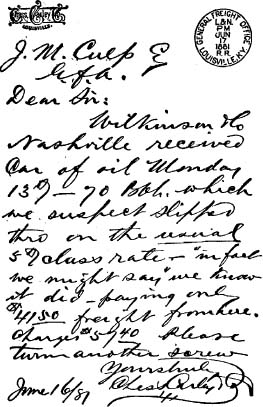
FACSIMILE OF LETTER FROM CHESS, CARLEY & CO. TO RAILROAD FREIGHT AGENT.
(Reproduced from S. O. Company, First Decade by Geo. Rice)
To H. R. S. Duck, of Atlanta, they wrote: “We learned with regret of your receipt of oil from a competing interest. . . . For you to unite with the enemy and turn against the oil position in Atlanta, will of course bring a competition on other goods and general loss to us and probably to you.”
What was meant by “competition on other goods”? These dealers in oil were primarily grocers. If they bought oil from a competitor of Chess, Carley, and Company they were threatened with competition on their groceries. In one town a grocer bought from a Standard competitor. So we find Chess, Carley, and Company writing to its agent, W. C. Chase, there: “The rust proof oats will go today. You had better put your sign out—Rust proof oats to arrive at 98 cents to a dollar a bushel. This will kill him. The same sign should be used for meats, sugar, coffee, etc.” In Columbus, Mississippi, the grocers bought their oil from Rice. Chess, Carley, and Company, as was their right, sought to sell these grocers but without success. Then they threatened: “If you do not buy our oil we will start a grocery store and sell goods at cost and put you all out of business.” They made good on the threat, at least to the extent of setting up a grocery at which everything was sold at cost and below. But the local grocers met and issued a statement to the public exposing the cruel stratagem. Not a customer crossed the threshold of the Standard store. Rice shipped oil to Wilkerson and Company in Louisville, at the customary fifth class rate. A few days later (June 16th) Mr. J. M. Culp, General Freight Agent of the Louisville and Nashville Railroad, got this letter from Chess, Carley, and Company:
“Wilkerson and Company received car of oil Monday 13th—70 barrels which we suspect slipped through at the usual fifth class rate—in fact we might say we know it did—paying only $41.50 freight from here. Charges $57.40. Please turn another screw.”
Five days later freight rates on Rice’s oil were advanced fifty per cent. The Standard shipped in tanks. Rice shipped in barrels. On oil in tanks the Standard paid twenty-five cents a barrel. In barrels the rate to Rice was fifty cents. Rice tried to get an arrangement with the railroad to use tanks but could never bring them to the point. What was worse, the Standard companies operated 3,000 tank cars. On these they paid freight on the basis of 20,000 gallons to each car. Of the 3,000 cars only two held 20,000 gallons. Most of them held over 30,000 and many as high as 44,000 gallons. These are but a few of the countless instances of this kind of warfare which Rice met everywhere. It is not to be wondered at that the man became bitter.
II
OIL BEGAN to appear in quantity in the Macksburg field and immediately Rice started production there. At the same time the Standard Oil sent its pipe lines there. The field was served by a small railroad called the Cincinnati and Marietta Railroad. It was in the hands of a receiver—a queer old fellow named Phineas Pease, destined to play a most embarrassing rôle. Daniel O’Day, representing the Standard, demanded that Pease post an open rate of 35 cents a barrel on oil and that he turn 25 cents of this over to the Standard. Pease was troubled by the demand but was afraid of Rockefeller. He wrote his attorney, Edward S. Rapallo of New York, asking how it might be done without involving himself in personal responsibility. Rapallo advised that it could be done and outlined one of those merry little legal fictions so popular then and now. The rate was made thirty-five cents. All shippers paid it but not to the road. It was paid to an agent who represented the Standard and the receiver. This agent turned over 10 cents to the road and 25 cents to the Standard on every barrel shipped. And so between March 20th and April 26th, 1885, the Standard collected $340 in drawbacks on the oil shipped by Rice, while the road got only $136.
When Rice learned this he stopped shipments, built his own small pipe line and quietly started to collect evidence of the outrage. Then in October he filed suit against Pease and got an order directing the terrified old receiver to report on all rates, rebates, etc. Pease sent his freight agent posthaste to O’Day and in twelve days Mr. Rice found in his mail one morning a check from the Standard Oil Company for the $340 of which he had been deprived. But Rice wanted more than the check. He wanted Pease to confess. And so the court compelled Pease to produce all the correspondence. In the end Judge John Baxter, of the United States Circuit Court of Ohio, removed Pease as receiver. “The discrimination complained of in this case,” said Judge Baxter, “is so wanton and oppressive it could hardly have been accepted by an honest man, having due regard for the rights of others or conceded by a just and competent receiver . . . and a judge who would tolerate such a wrong or retain such a receiver capable of perpetrating it ought to be impeached and degraded from his position.”
The judge named George K. Nash, former governor of Ohio, master to take testimony. To him Pease swore he never paid the Standard any part of the money. Of course he had not. Pease stuck to the fiction invented by Rapallo. But Nash laboriously untangled the skein and resolved the fiction. He also brought out that the Standard had been paid $614 on another man’s oil and $639 on still another. And so the Standard returned both these sums.
These revelations raised a storm of abuse and deepened the hatred in which Rockefeller’s name was being held by the country. It was a black piece of injustice and it gave a blacker hue to the character of many acts which were not so unjust. O’Day explained that the 25 cents was a charge for carrying the oil in the Standard pipes to the railroad. But this was untrue as Rice’s oil was not carried that way. Rockefeller was ultimately compelled to notice this charge. “We repudiated the contract,” he told a New York World reporter March 29, 1890, “before it was passed on by the courts. It was not agreed to by the officers of the company because our counsel declared it illegal.” Then he added a defense which was to be heard many times later. “In a business as large as ours, conducted by so many agents, some things are likely to be done which we cannot approve. We correct them as soon as they come to our knowledge. The public hears the wrong—it never hears the correction.”
Rockefeller liked this explanation so much he made it in substance the first sentence of his defense of his company in his book of reminiscences. “It would be surprising if in an organization like ours which included a great number of men there should not be an occasional employee here and there who acted in connection with the business in a way which might be criticized.”
Daniel O’Day could not be included under the classification of an occasional employee. Neither could Carley, of Chess, Carley, and Company, who wrote so many of the letters referred to at the beginning of this chapter. Moreover, the same terms, including the drawback, which was undoubtedly the invention of the fertile and unscrupulous mind of Flagler—were levied on many other roads. The money was not returned until eight months after it was squeezed out of Rice and then only when an exposure was threatened in the court.
III
IT IS not true, as has been so many times asserted, that the progress of John D. Rockefeller was due wholly to the rebate and the drawback. His immense efficiency was perhaps the most important force back of his progress. But it would be equally untrue to say that these unjust discriminations did not contribute enormously to his success by helping to cripple his rivals as well as by adding to his profits. Mr. Lewis Emery, Jr., for the Industrial Commission, estimated that between October 11th and March 31, 1879, the Standard Oil Company shipped 18,556,277 barrels of oil. This was the period of the contract with the four trunk roads under which carrying percentages of the freight rate were rebated to the Standard. These rebates ran from 11 per cent on the Baltimore and Ohio to 47 per cent on the Pennsylvania. They averaged about 55 cents a barrel. On that basis the total rebates paid the company were $10,151,218. John D. Archbold, testifying before the same Commission, denied the truth of these figures and offered some evidence in rebuttal. But at best Archbold’s defense, in part wholly false, would call for only some modification of Emery’s computation. Even after allowing for some reductions such an advantage would hardly be called an unimportant one.
For years since the first appearance of Rockefeller the odor of rebates filled the air. But certainly there was nothing new in rebates when John D. Rockefeller began to use them. “The Standard Oil Company of Ohio did receive rebates prior to 1880,” he admitted in later years. “But it received no advantages for which it did not give full compensation. The reason for rebates was that such was the railroads’ methods of doing business. A public rate was made and collected by the railroad companies, but, so far as my knowledge extends, was seldom retained in full. A portion of it was repaid to the shippers as a rebate.”
That was the truth. But as to never being retained, it was retained against the “innocent and the weak” as one commentator phrases it. And Mr. Rockefeller was not playing long with this unfair and vicious weapon before he found new uses for it and began to see that the number who enjoyed it was constantly diminished.
Rebattre, to beat down, that is the origin of the word. It involves the suggestion of bargaining. And that is what it was. The rebate went back to the earliest days of the roads, who were its first victims. The wielder of the weapon then was the canals. For when the railroads came the canals saw their day threatened. And the canals, like the roads later, were in the hands of men who had learned how to play politics and use the lobby. They were able to compel the roads by law to pay to them rebates on every ton of freight they carried. Indeed many of those roads which were in competition with the canals were thus prevented from carrying freight at all and were limited to passengers. Some of these laws were not repealed until the late fifties. Thus in turn each mechanical contrivance fights the coming of its successor. The horse cars held off the trolleys. The trolley lines fight the bus, the little grocer fights the chain, the candle maker fights the kerosene lamp, and the gas company fights the electric light company.
When the railroads got under way they slid into the habit of discriminatory rates so easily and smoothly that they must have been hardly aware of it. At first, of course, they knew little of the modern cult of cost accounting. What the cost was to haul things was a mystery. To complicate this larger shippers at first frequently supplied their own wagons for freight and in certain cases their own locomotives. Hence there were differences in rates depending on what the shipper supplied, and the service he asked. And so in an age of bargaining, every shipper bargained with the railroad company and each shipper, as Rockefeller said, “made the best bargain he could, but whether he was doing better than his competitor was only a matter of conjecture.”
Andrew Carnegie was a railroad man before he was a steel master. He was assistant to that master manipulator of rails and men, Tom Scott, of the Pennsylvania, when Scott was the superintendent of the Pittsburgh division and Pittsburgh was just a small city rising on the hills. The railroads wanted traffic; hence they were keen to develop new industries. The man who walked into the superintendent’s office and said he was going to start a factory that would have goods to ship could be sure of getting a rate from the road that amounted to a kind of subsidy. In later years Carnegie told how eager Scott was to develop local freight. A man came in and declared his intention of cutting bark to ship to a tannery, hoping later to start a tannery of his own, provided the road would give him a low rate and encourage him. He was sure to get it. A quarryman came to say he was going to open a quarry and wanted a low rate. He got it. When another man came and said that he too proposed to start a quarry, then, as the canny Andy put it, “the plot thickened.” Coal mines, iron works, all sorts of plants came one after the other, each asking at first a kind of fostering rate. They got these rates. There was no rule. But by this means the road built up the most extraordinary region of local traffic ever known in railroad history. Moreover the traffic then was from east to west. The freight trains came back to Pittsburgh empty and this led to the road’s offering any kind of rate to get freight into those cars on the return trip east. In the end the situation was one in which almost every shipper was paying a different rate, and in which every locality had a different place in the preferences of the schedules. The most ridiculous discriminations arose.
Carnegie laughed over some of these results. Pittsburgh shippers would often send their cargo west on the Ohio River to Cincinnati, a distance of 500 miles, where it would be loaded on the Pennsylvania and would then start back east for New York. It would travel back over those 500 miles by rail and go through the streets of Pittsburgh and on to New York for a cheaper rate than if it had been sent direct from Pittsburgh. “The Pennsylvania Railroad was regarded as a monopoly strangling local interests,” said Carnegie, “and so indeed it was.”
But he knew how these strange rates had originated and he withheld his criticism.
When, therefore, the railroads sent their branches into the oil regions the scramble for rates began at once. Everybody went to the freight agents and bargained for rates. Who was getting the best rates nobody could tell. We may assume, however, that John D. Rockefeller was not behindhand. Much depended, he explained, upon whether the shipper had the advantage of competition among the carriers.
“The Standard Oil Company,” he said, “being situated at Cleveland, had the advantage of different carrying lines, as well as water transportation in the summer; taking advantage of those facilities it made the best bargains possible for its freights. Other companies sought to do the same.”
That was true. At the time when the oil men were bitterly denouncing Rockefeller, we find a member of their committee, W. T. Scheide, collecting $7,000 in two months on rebates for the oil shipped by his principal, Neyhart, of New York. This same Neyhart is down in a list of rebates and returned overcharges paid by the New York and Lake Erie Railroad for $188,127 in 1879 and two other shippers, Gust. Heye and S. D. Karns, are credited with over $7,000 apiece. This list was furnished to the Hepburn Committee. Not only in the oil fields but everywhere it was the same.
There is another phase of the rebate which must be conceded in Rockefeller’s defense. The simple truth is that in the end the matter resolved itself more or less into a case of quantity discount. There is much to be said for the quantity discount. After all the cost of anything we buy, commodity or service, in an ideal system might well be put down as a figure made up of the cost of rendering the service plus a reasonable profit. If we buy a single article of anything we pay one price. If we buy a dozen or a case we expect to pay proportionately less. And justly. For after all it costs a merchant less per article to sell a number of articles than one. There is one operation instead of a dozen, one package instead of a dozen packages and a quick turnover of money. So it costs a railroad less to stop and pick up fifty barrels of oil at one station than to stop and pick up five barrels of oil at each of ten stations. Particularly is this true when the quantities handled become large. There is no doubt, therefore, that the Standard Oil Company was in a position to ask with some show of reason for a lower rate on 2,000 barrels of oil a day than the man who shipped 50 one day and none the next.
On the question of rebates, therefore, it must at this day be conceded that Rockefeller in asking them was doing nothing more than every other shipper who had enough business to make the demand. Moreover there was on the side of the practice itself—outside its abuses—the defense that it was based on cost of handling and the theory underlying the quantity discount.
If the quantity discount had been recognized as an established principle and rates had been definitely graded based on costs of handling in different quantities and these rates had been open to all a good defense could be made for them. They were, however, a practice which had grown up. And criticism for using them must rest on almost all. Criticism may well be directed at the system but not at Rockefeller for using it.
While this much must be said for Rockefeller, he was not on such solid grounds when he demanded them for himself and insisted that they be refused to others. Rockefeller has always found complete shelter for his conscience in legal and business fictions which he has set up to cover the real character of his acts. For instance, he has always insisted that the railroads reserved the right to grant the same rates to any other shipper handling as much as he did. That is true. But there was no such shipper and could not be any other. After a certain development was passed the reservation would be meaningless. But there was an agreement that no other shipper should be permitted to get as big. There was an agreement to protect the Standard Oil against competitors and whenever competitors threatened to grow big enough to match shipments as in the case of the Equitable Pipe Line and the Tidewater, Rockefeller called on the railroads to protect him by lowering rates.
When Mr. Ohlen and others went to Cassatt to demand the same rebates as Rockefeller got and Cassatt refused, Ohlen asked if he would grant them if they shipped as much as Rockefeller. Cassatt bluntly and frankly said No. One asks why the railroads should go so far to protect Rockefeller. Cassatt gave that answer. Rockefeller was the only one who could keep peace among the roads. And how did Rockefeller do this? The roads had made a pool to divide the traffic between them. They could not possibly carry out such an agreement if the traffic was coming from hundred of small refiners and shippers. If it came from one shipper who was in the agreement with them it could be done. Here was the method. Each road was entitled to a specified percentage of shipments from various refining points to others. At the end of the month it was inevitable that these percentages would not work out perfectly. The Standard Oil Company could then rectify these differences the following month by shifting its shipments. This is what Cassatt meant by keeping peace among the roads. This, however, did not mitigate the injustice done to other shippers who were prevented by this means from bargaining for advantageous rates. No one was allowed to bargain but Rockefeller.
But there was one practice which the Standard Oil exacted and which apparently these oil men invented for which no excuse can be found; a practice which perpetuated an injustice so grave, so cruel, so indefensible, that its exposure put a stain upon Rockefeller’s name which he has never been able to efface. This was the drawback. Some searcher in our economic history may find a prior use of this deadly and ruthless weapon. I have not been able to find it. It was one thing to go, like every other shipper, to a railroad and demand a rebate of ten or twenty or fifty cents on his own shipments of oil. It was another thing to demand that no other shipper should get a rebate and that, furthermore, Rockefeller should receive a drawback of ten or twenty or fifty cents a barrel on every barrel of oil his rival shipped. By this system Rockefeller in one instance paid $1.20 a barrel for the shipment of his own oil. The railroad gave him back twenty cents as a discount. His rival also paid $1.20. But the railroad gave the twenty cents on his oil to Rockefeller. It was of course secret. Without knowing why, his competitor was being bled white by Rockefeller. The Standard Oil Company always denied this. Rockefeller has never admitted it. But that this was done is attested by evidence so overwhelming that at this day it is fatuous to deny it.
In February and March of 1878, Mr. H. C. Ohlen shipped 29,876 barrels of oil over the Pennsylvania Railroad to New York. On these shipments the Standard Oil Company, which performed no service for Ohlen—which contributed not one cent to the production, transportation, or handling of his oil—collected from the Pennsylvania Railroad 20 cents on every barrel shipped. The road paid the Standard in these two months $5,975.20 profits thus secretly squeezed out of Ohlen.
One cannot help wondering how any business man would have the audacity to approach a railroad with a proposal for such a favor. One wonders why the roads granted it.
It is not easy to trace the genesis of the drawback. Its first appearance is in the South Improvement Company contract with the railroads. There it is all set out in black and white in a contract which bears the signature of the company’s officials. The South Improvement Company was to get a set of rebates for itself. In addition to this it was to get $1.06 a barrel on all oil shipped by its rivals to New York. An attempt has been made to explain the reasonableness of the drawback and the inevitable professor is found to do it. The theory advanced is that at the time and for years later it was common for men to hire whole trains. A well-known instance is the excursion train which associations often engaged to run privately-managed excursions. They would then have the right to sell tickets at any rate they chose. Rockefeller made an agreement with the railroads to run a daily train, guaranteeing enough oil to justify a full train. He supplied the cars, the handling, and terminals and was, therefore, entitled to a low rate. Before this an oil train would go along every day, stopping at numerous depots. The oil men would deliver their oil in marked barrels to these depots—one, two or fifty to be picked up by the train, just as milk cans are now. There was never any guarantee as to how many barrels there would be at any station. When a daily train cargo was guaranteed by Rockefeller, the train became in effect his. And as the train continued to pick up barrels for others, Rockefeller was entitled to a part of the profit of that traffic. This is another one of those numerous fictions which strew the path of Mr. Rockefeller. This one is a pure fiction from beginning to end. First of all in 1872 when the South Improvement Company contract was made there was no such train, no such arrangement, no Rockefeller-owned terminals, or handling arrangements. It was not until after this that Rockefeller’s shipments justified a train. But it was never regarded as Rockefeller’s train. Moreover his train loads ran only from certain places and other trains between other points had to be run just the same; yet he got his drawbacks on these other train shipments. The whole thing is a fiction invented after the fact by an over-zealous apologist. Rockefeller himself never made any such defense. He and all his aids always denied the drawbacks. It was possible to get them because Rockefeller had convinced the railroad presidents that it was to their interest to stop fighting and that the only way to do this was to have one big oil shipper. When he became so powerful he was able to demand it.
CHAPTER V. AN EXPLOSION IN BUFFALOIT is Winter in New York. The great oil man is ready to go to his office. His home is at No. 4 West Fifty-fourth Street. He himself is arrayed as becomes the great figure he is. Serious, grave, particularly during these days when many oppressive problems weigh upon him, his large frame clad in its unvarying frock coat and striped trousers and high silk hat—there is nothing in the man’s bearing which suggests playfulness. He goes to the rear of his home where there is one of those small square yards common to downtown Manhattan homes. The yard is paved solidly, rounded at the edges to form a small basin and is flooded with water which, on this cold winter’s day, is frozen hard. Mr. Rockefeller has had this small skating rink built for his children and himself. A servant adjusts the skates to his patent leather boots and then, with his arms folded on his chest, his frock coat flying out behind him, the silk-hatted monopolist proceeds to skate smoothly and solemnly around the yard, doing the “outer edge” until he has gotten the exercise he has prescribed for himself. Then the skates are removed and he drives to his office downtown.
II
BY THIS time the Rockefeller family was definitely established in New York. Mr. Rockefeller himself was fond of returning to Cleveland as much as possible in the Summer. He was drawn there by his growing interest in his fine estate at Forest Hill. He began to steal time in the warm months for playing with the grounds around his new home. Chiefly he laid out walks and drives and, as far as he was able, superintended the laying out of them himself. He tried to get in four or five afternoons a week on his estate. Messenger boys on bicycles would carry messages and papers to him from the Cleveland office. Then he had a telegraph instrument installed and an operator remained on duty at the house every business day.
His friends in Cleveland, as in New York, were almost wholly his business associates—Mark Hanna, Norton Dalton, and G. M. Rudd, and his physician, Dr. Biggar. He made an occasional call on some old friends associated with him in the Standard and had them call. On Saturdays Mrs. Rockefeller frequently had associates in the Sunday School at the Forest Hill home. In New York Flagler lived close by on Fifth Avenue. John D. Archbold, who was rising in power in the company and in Rockefeller’s confidence, also had a home on Fifth Avenue.
III
WHEN Mr. Rockefeller went to his office now it was to the new quarters of the Standard Oil Company—26 Broadway, that famous spot which was to become known as the citadel of wealth and power. In 1882 the company had moved from Pearl Street to 44 Broadway. Then in 1885 the Standard Oil Company of New York, a newly-formed corporation, bought the old building at 26 Broadway. One of its tenants was the Standard Oil Trust. Oddly enough, though the nature of that mysterious thing, the trust, was unknown, its existence was quite public, the name “Standard Oil Trust, 26 Broadway,” appearing in the city directory.
IV
ABOUT this time Rockefeller made one of his first known welfare gifts. His daughter, Alta Rockefeller, was born deaf. The affliction endeared the girl very strongly to her powerful and self-sufficient father. She had a strong religious streak, spending a good deal of her time in the company of her Sunday School companions in both New York and Cleveland. Moreover, Rockefeller’s wealth and his Euclid Avenue Baptist Church affiliations drew to him all sorts of clerical gentlemen with worthy causes. In 1885 the Rev. A. B. Christy, pastor of the Lakeview Congregational Church, interested Miss Alta and through her Mr. Rockefeller in the Day Nursery and Free Kindergarten Association and Rockefeller made one of his first, if not his first, gifts for the establishment of a welfare institution to this group. He contributed the funds for putting up a building which was to be known as Alta House.
It must not be supposed, however, that this was by any means his first piece of philanthropy. As soon as he began to make money he began also to increase the scale of his giving. As early as 1881 he gave $3,500 to the Baptist Union Theological Seminary, the forerunner of the University of Chicago. His old letter files at this time abound in records of gifts. February, 1882, he writes Dr. Duncan, pastor of his church: “I will give $1,000 to this object and hope you can get through with it. . . . If, however, you cannot get through with this I will lift again.” Later in the year he sends the last installment on a $20,000 pledge to Denison University at Dayton. A letter to some one asking for help advises: “I have already exceeded my appropriation for benevolences for the whole year of 1884. by some $30,000 or $40,000 and have three months with many pledges yet to meet.”
There are many purely personal benefactions. One letter is to Pastor Bickel in Germany “to take a long rest and travel at my expense.” Another in 1884 runs: “I have been thinking I ought personally to do something for Dr. Clough. The more I see and know about him the more favorably I am impressed with him. He is a great and good man. Before receipt of the letter I had thought to hand Dr. Clough $500; but I have got it up to $1,000 this morning and think it will reach $2,000 by night.”
His gifts were scattered around on no special pattern. But even at this early day one notes a sense of dissatisfaction in this more or less disorganized mode of giving. He writes Mrs. Laura M. Irvine that he doesn’t like fairs and other devices for raising church funds. He pledges $1,000 a year to a missionary chapel but “I am not willing to be a party to a failure in this undertaking” hence he wants “all who pledge to pay as they are called on.” He doesn’t like giving a meal a year to “all the tramps that come” to the Five Points Mission in New York. He would do it oftener and “would give them work and make them earn their food.” He refuses another appeal forwarded by his mother. “I want to know surely in giving that I am putting money where it will do most good.”
V
THIS year a picturesque gentleman appeared upon the stage. He was a vigorous, voluble, bellicose Irishman, named Patrick Boyle. Boyle was a product of Donegal, who, with scant education, joined up for a fight in the Union army when he was only 16 years old and from the battlefields of the Civil War went to the battlefields of Pithole in 1866. After working at various odd jobs he set up a small paper with the pretentious name of The Laborer’s Voice. Next he turned up with another paper making war on the nitro-glycerine monopoly and still later as a scout for oil locations. In 1885 he was superintendent of the Union Oil Company in the Southern Ohio district. From there he went to Oil City to become the owner and editor of that once fiery tribune of the oil producers—the Oil City Derrick.
But the fire of the Derrick had been quenched long before this. It hurled its last thunderbolt in 1879. Then, as its owners trembled with rage and disappointment at the spectacle of the mighty Standard gobbling up all the refineries of the regions, the omnivorous octopus wound one of its tentacles around the Derrick itself. Did this mark a change in Rockefeller’s attitude toward publicity? It is altogether probable that this acquisition was the work of that active and sinister intelligence, John D. Archbold. About this time, Archbold had completed through the Acme Oil Company the absorption of the region refiners. At the same time the Standard Oil, in another region, bought a controlling interest in the Vacuum Oil Company in Buffalo. John D. Archbold, along with Henry H. Rogers, was the instrument of this conquest. In both places we find the Standard making its first steps in news control. In Buffalo Charles Matthews, employed by the Vacuum, founded a newspaper financed by that company called the People’s Journal. The People’s Journal did not last very long. And the Derrick did not do so very well either. And so in 1885, Boyle, who had experience both as newspaper editor and oil man, bought the Derrick, financed by the Standard. Boyle was an aggressive and capable editor, according to the standards of the time, and he soon not only revived the languishing Derrick but began to wield the cudgel for his patrons with an unsparing hand, laying about him all the enemies of the Standard as vigorously as the old Derrick had thwacked the “Anaconda.”
What part Rockefeller had in inspiring these purchases is not known. He of course knew of them. However, he did begin to display some sensitiveness to the incessant criticism which was showered on him. He said to a friend: “You can abuse me, you can strike me, if you will only let me have my own way.” But the abuse and the blows were rising in frequency and violence. And occasionally he expressed a sense of hurt.
VI
AT THIS time the great man perceived certain signals from within. Rockefeller had always been supersensitive about his health. Had he had the leisure for brooding he might have become a hypochondriac. He always looked with disgust at the bad eating habits of other men. He often spoke of how others bolted down their food. At an earlier period when he traveled often on the old lines of the West where the trains stopped twenty minutes for meals, Rockefeller took good care not to be hurried. “I noticed,” he said, “how in the brief time allowed others gobbled down their food, particularly at the last moment when the train was about to leave, as it so often did, before the full time was up. If I could not finish eating properly I filled my mouth with as much as it would hold, then went leisurely to the train and chewed it slowly before swallowing it.”
He was still careful about his food. But in these last dozen years the demands on his time and energy were enormous. He tried to neutralize the drain by taking a brief nap in the afternoon. But in spite of his deliberate and patient methods, his nerves began to exhibit some signs of wear and his stomach began to announce some of the symptoms of indigestion.
He tried to take a little leisure to work on his beautiful estate, but his vast interests, his incessant wars, his relentless critics and enemies, as well as his own insatiable ambition left him no rest, and the disorder continued to express itself at intervals.
VII
IN THE meantime the country was kept continually aware of the so-called depredations of Rockefeller through the stories of threats on little grocers everywhere and the measures used to crush competitors in marketing. So many stories got currency that it was no longer necessary to furnish proof to have them believed. Tales of weird and savage forms of persecution of rivals were circulated, most of which, of course, were without any foundation. However, in July, 1886, Rockefeller received a shock and along with him the whole country when the Grand Jury of Erie County, Buffalo, New York, indicted John D. Archbold, Henry H. Rogers, Ambrose McGregor, and Hiram B. and Charles M. Everest for conspiracy to blow up the works of the Buffalo Lubricating Oil Company, Ltd. Stories that the Standard had set fire to the plants of its competitors had been told before. Now here was a grand jury actually indicting Standard Oil officers for such a crime.
The Standard had bought in 1879 three-fourths of the stock of the Vacuum Oil Company from Hiram B. and his son, Charles M., Everest, who had organized it in 1866. The Everests were retained as managers and they, with Rogers, Archbold, and McGregor, constituted the Board of Directors. The Vacuum had a special process for refining oil which was protected by patents.
In 1881 Charles B. Matthews, J. Scott Wilson, and Albert Miller started the Buffalo Lubricating Oil Company, Ltd. All had worked for the Vacuum company. Matthews was the manager, Miller a practical refiner, Wilson a good salesman. Miller made castings of the Vacuum company machinery to use in the new works. Wilson, the salesman, proposed to go around to Vacuum customers, of which he had a list, and offer them “Acme Harness Oil made by the Vacuum process.” This was not a pretty start and Everest was with some reason indignant at what he called their disloyalty. Everest proceeded to block them and he started by going to Miller, the refiner, and inducing him to betray his partners by wrecking their machinery. This was done by building a very hot fire under the oil the first day the new refinery opened and shutting off the safety appliances. This blew out the machinery the very first morning.
The defendants were charged with this as part of a conspiracy to destroy their new rivals. The indictment contained eleven counts charging other oppressive measures, chiefly the bringing of numerous harassing lawsuits which were designed to harry and embarrass the defendants and consume their resources.
The indictment produced a sensation and was eagerly seized upon by Rockefeller’s enemies as evidence of his violent methods. Before this Matthews had brought a civil suit for damages against the Vacuum Oil Company on the same grounds and gotten a judgment for $20,000, which was set aside because the damages were not proved. He thereupon instituted another suit for $250,000 and this was pending.
The case was called for trial May 3rd. It made something of a show in Buffalo, for the sanctuary of the court was crowded, not only with many distinguished counsel, but the even more distinguished prisoners. Mr. Rockefeller and his brother William were there as witnesses. The evidence of the blowing up of the stills was quite complete. The fireman testified he had been ordered by Miller to force the fires and Miller testified he had been hired to desert his partners by Everest. Everest before this had taken Miller to his (Miller’s) lawyer to learn if he could break his contract with the new company. The lawyer advised it could not be done. Then Everest said to the lawyer: “Suppose we were to arrange the machinery so that it would bust or smash; what would be the consequences?” The lawyer advised it might involve criminal guilt. “Well,” said Everest, “such things would have to be found out before that could happen.” No doubt was left in the judge or jury’s minds that the Everests were guilty of this atrocity. But there was no evidence directly connecting the Standard leaders, Rogers, Archbold, and McGregor, with the deed and so before the case was given to the jury the indictment was quashed by the trial judge as to these three men.
The evidence of the other acts of oppression was hardly less convincing. Matthews told of threats of suits in the presence of Rogers. Three suits were brought against his company for infringement of patent and all thrown out, the court holding that the Vacuum had no legal patent. Matthews testified he met Everest. Everest said: “I shall do all I can to injure you. How are you going to get your crude?” “From the Atlas,” said Matthews, to which Everest replied: “You will wake up some day and find there will be no Atlas or it will be in the Standard.” And so it turned out. The Atlas was bought by the Standard.
Great interest was felt in the appearance of Mr. Rockefeller. The court room was crowded to have a look at him. On the stand he was asked:
“What is your business?”
“Engaged in oil refining in Cleveland.”
“Where besides Cleveland?”
“I am engaged in it nowhere else.”
“Nor ever have been?”
“Never.”
These seemed to be extraordinary answers for the man who was then drawing $30,000 as head of the trust with its refineries in a dozen places. Mr. Rockefeller did admit that he knew Rogers and McGregor and Archbold. Archbold had some connection with the Standard but Mr. Rogers was vice-president of the Pratt Refining Company. He knew that these gentlemen had contemplated buying the Vacuum Oil Company but the Standard had no interest in the sale. At the very moment the stocks of Rogers and Archbold and Everest and McGregor in the Vacuum Company were in John D. Rockefeller’s possession as one of the Standard Oil Trust trustees and its president.
The jury convicted the two Everests. On the day of the conviction a New York Tribune reporter called on Mr. Rockefeller at his home in Fifty-fourth Street. “As far as the Standard Oil is concerned it is completely vindicated by the exoneration of Messrs. Archbold, McGregor, and Rogers.” The fact that the managers of a Standard Oil Company, two of its directors in fact, had just been convicted of an outrageous criminal conspiracy to destroy a rival, including an attempt to blow up the works, did not seem to Mr. Rockefeller to in any way dim the radiance of the Standard’s exoneration.
“What will be the effect on the Vacuum Company?”
“Oh, it will go on the same as ever . . . so far from the Vacuum wishing to crush out rivals, when it began it had fifty-seven competitors. Now it has ninety-seven. That does not look like a desire to crush out rivals, does it? No, the whole purpose behind this prosecution has been to annoy us.”
One wonders how Mr. Rockefeller, who testified under oath that the Standard had nothing to do with the Vacuum, could assume to say what the future course of the Vacuum would be. Even so cautious a man as Mr. Rockefeller could not always remember Mr. Dodd’s little fictions.
The sequel to this comedy is worth recording. The Everests, who were convicted of conspiring to destroy a rival’s business and of procuring an explosion in their plant, were fined $250 each. But they continued to manage Mr. Rockefeller’s Vacuum Oil Company. The connection did not affect their standing. As for Matthews, their victim, the conspiracy to destroy him by harassing suits was successful. Before his damage suit for $250,000 could be tried he went into the hands of a receiver. A few months later the defendants—including the Standard Oil directors—settled for $85,000. Then the receiver filed an accounting. The whole amount was consumed by debts and lawyers’ fees. Matthews collected nothing. Thus justice triumphed.
But the incident left its mark upon at least one of the participants—Henry H. Rogers. Rogers was deeply humiliated by the experience of sitting at a trial table charged with a felony. Thereafter he harped upon the incident. He collected papers, statements, documents, to prove his innocence. He was horrified lest his children should ever think he had taken part in such a crime. When Ida Tarbell was writing her book on Standard Oil Rogers brought out his papers to her. Thus fifteen years later he spoke with deep emotion of the experience.
CHAPTER VI. WAR ON THE TRUSTSROCKEFELLER had dealt with a new problem—the problem of using the new tools, the management of bigness and the control of production. These same problems faced every industry. The country was definitely committed to the process of assembling business into immense units. Numerous forces were driving it in that direction. It was nobody’s coldly conceived plan. It was not the result of a conspiracy. It was the inevitable result of all the new conditions.
In whiskey as in oil wild over-production bedeviled the industry. During the war the government made four successive increases in the tax on whiskey. Each time it did distillers rushed to manufacture as much spirits as possible before the tax went into effect. When the tax became effective there was a let-down in production. But in this curious situation new distilleries were always established during each period of production and speculation in whiskey became as wild as speculation in oil—teachers, ministers, as well as business men, engaging in it. As early as 1871 the whiskey men attempted a pool to limit production, but nature came to their rescue. It ruined Europe’s grain crops and those countries had to buy spirits from America. New distilleries bloomed again. There were four times more distilleries than were needed. A new pool in 1881 proposed to limit production and to dump the surplus on Europe. New pools were formed each year up to 1887. Col. Payne was interested in the whiskey business and doubtless from him the distillers got some information of the details of Mr. Rockefeller’s trust and so they organized a whiskey trust patterned after the oil trust.
The same story was repeated in other lines. It is said Henry M. Flagler was interested in the cottonseed oil business along with General Samuel Thomas, who had made millions out of Standard Oil stock. A story went around Wall Street that the cottonseed oil people paid the Standard men $250,000 for a copy of the trust agreement and that this was the first time that famous document was ever seen outside the oil trustees’ room. There is no proof that this is true. But the cottonseed oil people did form a trust. There was also the rubber trust, Havemeyer’s sugar trust, the butcher trust, the glass trust, the furniture trust, the tobacco trust, and numerous others. Local industries began arming against competition in the same way or by the means of pools and outright monopolies.
The nation suddenly saw its vast natural resources pouring forth in an uncontrolled stream. It was playing with that immense and dangerous tool, machinery. Railroads brought the country together into a few vast regional neighborhoods. Cities saw rivals entering with goods which once belonged only to local manufacturers. Thus refrigerator cars enabled the packers to sell all over the country meat slaughtered in Chicago. The local butchers and slaughterers were violently opposed to this and they sought laws to prohibit the sale of beef more than 100 miles distant from the point of slaughter until the packers began selling their stock to the local butchers. The immigrant flood poured over our frontiers, creating a limitless reservoir of cheap labor and an enormous population of consumers. Gold flowed from our mountains, silver and the baser metals were found in prodigious volume. New inventions amazed the world. The rude yet dazzling, brilliant, and vulgar pageant of rich America in feverish movement amid her treasures, her squalor, her glories, and her greed began to astonish and amuse the world.
For the first time in the country’s history an immense population of very poor people were assembled in our growing cities. The labor problem terrified men like Jacob Riis and saddened men like Henry George. Labor leaders saw in the rise of the Octopus the approaching slavery of the working man. At first the outcry was confined to Pennsylvania and the oil fields. But gradually the areas of discontent widened as other towns discovered their rubber trusts and milk trusts and sugar trusts and, most hated of all, the railroad trusts. The severity and fury of competition had driven the roads to set up pools, to fix rates, and shipping terms. Cities were discriminated against, shippers crushed by the favors given their rivals. Loud and fierce were the cries which went up from shippers and towns.
Labor troubles grew more intense. Henry George’s “Progress and Poverty,” a serious attempt to understand the causes of poverty, made a powerful impression on thoughtful men. Former President Rutherford B. Hayes, visiting New York, was surprised to find men like Bishop Whipple, Chief Justice Waite, and Robert C. Winthrop, the personification of Puritan culture, in sympathy with George’s doctrines. Hayes himself was touched with this new radicalism. “What?” he said to William Henry Smith, referring to the trusts, “leave uncontrolled the power that buys your councils, your legislatures, your courts?”
The employer as a rule cared little for his workers. They were only so many tools in the furious drive for profits. The workers became conscious of their wrongs. Leaders sprang up to lead them. The Knights of Labor rose to power. By 1886 they had grown from a membership of 110,000 to 730,000. Grand Master Workman Terrance V. Powderly was their Moses. He preached the gospel that “an injury to one is the concern of all.” Labor unions appeared everywhere. Strikes became a matter of almost daily occurrence. The walking delegate was abroad in the land. In 1886 the great Southwestern Railroad strike was called. Powderly sought to make it an orderly frontal attack within the law. But there were other leaders with other plans who wished to fan the flames into a great revolutionary conflagration. In the midst of labor’s honest movement for the eight hour day there came a strike at the plant of the McCormick Reaper Company in Chicago. There was a collision with the police and some strikers were injured. Next day a great meeting was called in Haymarket Square to protest against “the atrocious attack of the police in shooting our fellow workmen.” An anarchist was addressing the crowd. A police captain decided to arrest him. A shot was fired; a bomb was thrown. Eight policemen were killed; sixty persons wounded. The Haymarket riot set the nation aflame. And while it produced a serious re-action against the labor movement, thoughtful men saw in it the germs of serious trouble unless something were done to heal the widening breach between the workers and their employers.
Two other phenomena outraged public sentiment. One was the spectacle of extravagance and riotous living of the new aristocracy. The other was the growing corruption of public officials by big business concerns. The daughters of rich beef and soap and sausage barons began giving their hands to titled European vagabonds. Gaudy mansions rose on the Fifth Avenues and Michigan Boulevards of the country. Mrs. Astor with her snobbish premier, Ward McAllister, proclaimed the caste of the 400. Railroad, street car, and electrical and gas franchises were in the market places of the legislatures and aldermanic chambers and unscrupulous adventurers bribed lawmakers and city fathers in the most unconscionable manner.
For the family of John D. Rockefeller it must be said that it took no part in the vulgar display of its wealth. The family lived decently, quietly, and unobtrusively, its only extravagance being the fine Forest Hill home, which they were then developing. Mrs. Rockefeller was and remained for years unknown to the fashionable society of New York.
II
THIS growing economic and social problem was getting into politics. As early as 1872 in the Greeley-Grant campaign a national party was launched at Columbus called the Labor Reformers with one of its leading planks a demand for government control of railroad rates. The Republican and Democratic platforms were silent nor did they mention it until twelve years later. In 1880 the Green-backers renewed the attack. “It is the duty of Congress,” it declared, “to regulate Interstate Commerce.” It went further: “We denounce as destructive to prosperity and dangerous to liberty the action of the old parties in fostering and sustaining gigantic money, land, and railroad corporations.”
Two facts stand out. The first attacks on big business took the form of demands for regulating railroads. And it was, not from the people as a whole, but from little business men who saw their stores and shops threatened, that the attacks came. Little business men hated the railroads because they looked upon them as the instrument by which competitors in distant cities reached into their towns and took their trade. By 1884 the cry of monopoly had risen to commanding volume. The first political convention to assemble that year was the Anti-Monopoly Party. It denounced pooling, stock watering, and rate discrimination and demanded the immediate enactment of an interstate commerce law. Public opinion was aroused. This year, for the first time, the two major parties noticed the issue. The Republicans, behind Blaine, pledged their support to “such legislation as will fully and efficiently carry out the power of congress” over interstate commerce, and it favored the principle of regulation of railroads. The Democrats who nominated Cleveland were less specific. They were in favor of legislation to “prevent monopoly and to restrict enforcement of individual rights against corporate abuses.”
From every side swelled the demand for an interstate commerce law, for which agitation had been kept up since the defeat of the Hopkins and Reagan bills. The National Grange had forced the passage of state laws but the courts had emasculated them. These decisions which held the states could not regulate roads engaged in interstate commerce served to give impetus to the demand for a federal law. Finally in 1887 Senator Shelby Cullom, of Illinois, introduced a bill to regulate commerce between the states and providing for an Interstate Commerce Commission. From all over the country Chambers of Commerce and business organizations showered Congress with petitions demanding the passage of this law. This pioneering act by the federal government to interfere in business was undertaken almost exclusively at the demand of business itself.
President Cleveland was called on to name five members of the first commission. As chairman he appointed Judge Thomas M. Cooley, a lawyer of great ability and universally recognized integrity. Morrison, of Vermont, was a socially-minded man. The others were railroad lawyers. The federal courts promptly sheared the commission of all effective powers. There was a powerful element in the Senate which tried to defeat it. Senator Payne of Ohio, O. H. Payne’s father, and Senator Camden of West Virginia, a Standard Oil official, both voted against the bill. And critics insisted later that the bill was artfully contrived to invite nullification by the courts. The following year, Commissioner Prouty, newly appointed, said: “If the Interstate Commerce Commission were worth buying the railroads would try to buy it. The only reason they have not is that the body is valueless in its ability to correct railroad abuses.”
III
THE WORD “trust” was now in popular use. The people knew well enough what they meant by a trust. But there was a great deal of curiosity among the well-informed as to the precise character of these mysterious things, particularly the Standard Oil Trust. It was getting that kind of dominance in conversation and public discussion which prohibition and gangdom enjoy today. And so in the early days of the session of 1888, the New York Senate ordered an investigation of the trusts. That inquiry occupied only a few days but it produced a collection of revelations which began to give direction to anti-trust agitation. The Senate Committee, with Col. Bliss as its council, met February 28, 1888, in the rooms of the Superior Court in New York City. And with its assembling came the first instances of the practice of process dodging by trust magnates which was to irritate and divert the country for a generation. Subpoenas had been issued for Mr. Rockefeller, his brother William, Archbold, Havemeyer, and others. At Mr. Rockefeller’s office the process server was told he was out of town. At his home the officer was informed his quarry could not be seen. Next morning the process server camped in front of the 54th Street home at an early hour. But Rockefeller did not come out and when the impatient officer rang the bell he was told Mr. Rockefeller had already gone. When the process server went to William’s house, he was in formed that William had gone to Florida. Other oil magnates were out of town when the officer arrived with subpoenas. Finally John D. Rockefeller appeared. He asserted he was not ducking, that he had been in Ohio and hurried back as soon as he learned he was wanted. This is probably partly true. He wished to choose his own time for appearing. In any case on February 28th, amid a great buzzing in the investigation chamber, which was crowded with newspaper men and with spectators eager to see the great monopolist, the committee assembled and Mr. Rockefeller arrived flanked by Joseph H. Choate and Samuel C. T. Dodd, his counsel.
Mr. Choate, then in the full flower of his great reputation at the bar, entered the hearing that morning full of misgivings about his witness. Henry H. Rogers had told Choate when he was employed that Mr. Rockefeller would be their chief reliance on the stand. Choate insisted on having a preliminary conference with Rockefeller. He was taken to 26 Broadway and there he found Mr. Rockefeller lying languorously on a couch in his office. He greeted the great lawyer and then stretched out again in a state of perfect relaxation. Choate sought to ask him questions to draw out his knowledge of the company’s affairs. When he left the office Choate turned to Dodd and said: “I don’t like your witness, I must say. He seems indifferent and difficult and moreover I got nothing but questions out of him. I hope he makes a better showing on the witness chair.” Incidentally, the habit of lying down during conferences and board meetings was common with Rockefeller. It was with this witness Mr. Choate now appeared.
The high light of the investigation arrived when Rockefeller took the witness stand. The great oil Croesus had been brought to bay at last. He was dressed in his frock coat and striped trousers. His hair was beginning to be sparse. Some spectators thought his face appeared a little bony. His light brown mustache was now very close-cropped. There was a look of intense concentration on his countenance mingled with an expression of dreamy sadness. A reporter thought, “It is only when his face is in profile that it exhibits any indications of shrewdness. When fronting one, these characteristics seem to vanish and are replaced by that aspect of mild benignity which one is expected to look for in the Sunday School and pulpit.” The reporter missed that intense, unwavering bearing upon one of those small yet piercing eyes.
Rockefeller was a most accommodating witness. The New York Tribune reporter next day said: “He seems the embodiment of sweetness and light. His serenity could not be disturbed. With the same sweet smile he replied to Col. Bliss’s sarcasms and General Pryor’s scornful adjurations. In tones melodious, clear, and deliberate he gave his testimony. The Standard Oil people did well to select him to bear the brunt of the battle. At times his manner was mildly reproachful, at others tenderly persuasive, but never did he betray any ill temper or vexation.”
Reading the report of his testimony today one is struck by the apparent frankness with which he answered every question. There was an occasional polite resistance. But on the whole it cannot be said he held back much.1
An intense moment arrived when Col. Bliss asked the distinguished witness to produce the copy of the trust agreement. Mr. Choate made a feeble protest against making the document public but finally consented it should be read. As Col. Bliss rose to read it a tremor of expectancy ran over the crowd. But the document proved singularly disappointing and dull reading, in spite of the sensation it produced after its contents had been printed and digested.
Rockefeller answered all other questions freely. The trust now had a capital of $90,000,000. It controlled about 75 per cent of production. Its dividends averaged 7½ per cent a year; its certificates were worth $165; hundreds of its employees owned certificates of the trust. But “monopoly!” Dear no! the Standard Oil Company had no monopoly. There were eleven companies competing with it in the country as a whole. And as for trouble with its competitors! “We have had, and today have, very pleasant relations with those gentlemen.”
The man’s vast wealth, his appalling success, shone round him like an aura and compelled the men who were trying to convict him of being a public enemy to treat him with the greatest respect. When he left the stand he graciously bestowed his thanks upon all. But he was a little weary of his own tolerance. “You will furnish the list of questions?” he was asked by Col. Bliss. “With pleasure,” he replied with the air of a martyr. “Anything, gentlemen, if you will only make an end of me.” Then he was asked for the minute book of the trust. “It seems to me,” he murmured, “there could be left some little thing that you did not exact of me.”
That committee in its brief few days of probing made up an astonishing story of trust development. It is unnecessary to repeat it here since it brought to public attention for the first time much that has been narrated in this volume. The activities of various other trusts covering sugar, cottonseed oil, elevators, and other commodities were pictured in its report.
IV
WHILE the New York Senate was busy with the affairs of the state’s great trust makers, the House of Representatives in Washington, January 25th, directed the Committee on Manufactures to investigate the trusts. And just about the time the New York Committee was making its report the House Committee under its chairman, Henry Bacon, began an inquiry into the history and operations of the Standard Oil Trust and the Sugar Trust. The field seemed so vast that the committee decided to limit its probe to these two greatest of combinations. Once again John D. Rockefeller appeared as a witness, but this time without resistance. His testimony was not very important, was brief and got little attention—only a paragraph—in the newspapers of the day. But from March 8th to July 20th the committee called before it almost all the leading characters in the great drama of oil—most of whom we have met in these pages—Rockefeller and his chief associates, Flagler and Archbold and Dodd and O’Day and Bostwick, and all his old foes, John Teagle with his tale of suits and rebates; George A. Rice with his story of espionage, price cutting, and railroad wrongs; B. B. Campbell and Patterson of the Producers’, Emery of the Equitable, and Potts of the Empire. The whole disordered and hectic story of the long war over oil was unfolded before the committee. But unfortunately the meat and meaning of it was buried in nearly 1,000 pages of the printed report.
V
AFTER these investigations it was inevitable that some action must be taken by the general government to curb these business monsters. New York State had attempted to deal with the sugar trust. But that institution comprised eighteen corporations only one of which was in New York and within reach of its courts. And so when the Fifty-first Congress convened December 4th, 1889, the first bill introduced in the Senate was by Senator John Sherman of Ohio—an act to “declare unlawful trusts and combinations in restraint of trade.” On July 2nd, 1890—the 115th anniversary of the signing of the Declaration of Independence, as some one observed—the famous Sherman anti-trust law was signed by the President of the United States.
The bill was passed unanimously in the House; in the Senate there was one vote against it—Senator Blodgett of New Jersey—and he never vouchsafed the reasons for his opposition. But for all that the measure had hard sledding in both houses. Senator George Vest, of Missouri, thought it unconstitutional. Senator Teller, of Colorado, feared it would be futile, would hit the Farmer’s Alliance and National League (another farm organization) and would be invoked against the Knights of Labor. Senator Sherman was sure neither of these bodies would be affected. Senator Morgan, of Alabama, a great lawyer, rose and uttered these words: “All the big fish will escape. The little fish are the men who will have the trouble.”
VI
THIS law came at once to be known as the Sherman law because, as Senator Hoar observed, “John Sherman had absolutely nothing whatever to do with it.” Whether this was true or not the authorship of the Sherman law has continued to be a subject of controversy ever since.
In 1903, Senator Joseph B. Foraker, of Ohio, made a speech in which he referred to Sherman’s great work in connection with the trust law. Senator William Hoar, of Massachusetts, wrote Foraker correcting him. “If there was any man in the world who did not have anything to do with the Sherman anti-trust law it was John Sherman,” he said. He elaborated his position in a second letter in which he said: “I wrote every syllable myself.” Sherman, said Hoar, had a way of introducing a great many bills by request. “I suppose he introduced this one by request. I doubt very much whether he read it. If he did I don’t think he understood it.” As a matter of fact, the original anti-trust bill introduced by Sherman was not passed. It was referred to the Judiciary Committee, where it was discussed and altered and finally rejected and an entirely new bill written and reported. It was this bill which was passed. Certain it is that when the House disagreed with the Senate over certain provisions and a conference committee was appointed, it was Hoar and Edmunds who were named for the Senate and they were named again when a second conference committee was required. There can be no doubt that it was not Sherman’s bill that was passed and that aside from introducing the original measure, he played a minor role in the whole episode. But who did write the bill is not so easily settled.
Foraker, when challenged by Hoar, employed M. H. Humphreys to study the whole record and Humphreys wrote a 120-page book about it. About the same time Senators Edmunds and Albert H. Walker made a similar study. Walker also wrote a “History of the Sherman Law.” He found that Sections 1, 2, 3, 4, 5, and 6, with the exception of 7 words in Section 1, were written by Senator George, Section 7 by Senator Hoar, Section 8 by Senator Ingalls. Humphreys came to the same conclusion. What is probably true is that these senators supplied the sections attributed to them and that the bill, when finally agreed upon in committee, was re-written by Senator Hoar, a good deal of a scholar and a master of legislative English who was frequently called upon to pour rudely-wrought measures into clear and concise language.
In any case, the new law was hailed by many trusting souls as a settlement of the trust problem.
CHAPTER VII. WAR WEARYBY THIS time John D. Rockefeller had completely divested himself of every minor job it was possible to discard. He reserved his mind for the more important problems of grand strategy. When he wrote a note on his desk, his negro servant promptly blotted it for him. He had practically ceased to see people save about essential personal matters. All the affairs of the great company requiring contact with strangers he left to his associates.
The habit of his mind was to simplify everything. Unlike many modern executives he took no delight in surrounding himself with extensive and complicated systems of doing things. His treatment of his daily tasks is a sample of this. When he reached his office in the morning he had as a rule several notations on his cuffs. On his desk he found a single pile of papers requiring his attention. He looked them over one at a time. As he examined each paper he made his decision about it, gave his order, and laid the paper on one side of his desk. If the matter required further thought, he put the paper on the other side. When he was through he had two piles of papers—one with which he was done and which was at once removed, the other representing the problems which required further attention. He then proceeded to go through them again, sending for such officials as were necessary to dispose of them. Each paper represented a decision required of him. He never shrank from the decision.
He could not be hurried. And he could never be threatened, even in a small bargain. One day he was considering the purchase of a horse. The man, to hurry him, said: “Unless you buy the animal today at this price another purchaser stands ready to take him.” “Very well,” said Rockefeller quietly, “let him have the horse by all means. I do not wish to buy.” That ended the matter. Another time a business man left papers for Rockefeller’s consideration in connection with a business deal. He returned in a few days and expressed disappointment and annoyance that Rockefeller had not yet examined his proposal. “Mr. Rockefeller promised to look over my papers and I want his decision.” The message was carried to Rockefeller. He called for the papers, held them under his chin and with a twinkle said: “Tell the gentleman I have looked over his papers and that I do not care to do anything about the matter.”
It was said of Alexander Hamilton that the United States government was the product of his bookkeeping. The Standard Oil Company in part at least was certainly the fruit of Rockefeller’s bookkeeping. And to the last he continued to exercise a scrutiny over the accounts of the company. He had also a respect for the man who could manage figures and very little for the man who couldn’t. One day he walked into his office apparently in a hurry and summoned his young secretary. He spread out on his desk a sheet of paper covered with columns of figures. Then he took out his watch.
“Mr. Rogers,” he said, “I want to see how quickly you can add this sum. I am going to time you. Go ahead.”
Rogers knew enough of his new chief to realize that this was a test to hurry or fluster him. Very cautiously the young man went up one column and down the other, thinking of accuracy rather than speed. When he put down the final figure, Rockefeller said:
“Well, you have completed it in the required time. It is very good.”
The man’s vast wealth was piling up now to fabulous proportions. And of course his investments in stocks and bonds necessarily became enormous. He kept his securities in a vault in the Produce Exchange Building. As they increased, it was necessary to take additional boxes and these were spread out throughout the bank’s vaults. His secretary felt this was not a very satisfactory system and so proposed to the Safe Deposit Company that they set aside a compartment for Mr. Rockefeller’s treasures where they could be kept together. The company promptly complied with this plan and in due time a large compartment, equipped with many boxes separated from the other boxes by a special steel door and with table and chair for comfortable examination of securities was installed. The secretary was so pleased with this that he wanted Rockefeller to have a look at it. But the great man did not seem to have much interest in the household conveniences of his huge fortune. He put off going for many months. One day the secretary met him as he was entering 26 Broadway and suggested that he go to look at his vaults. Rockefeller consented. Once there he chatted a moment with the bowing vice-president, stepped into the vault, behind which his countless millions were stored in neatly polished steel boxes, looked at one or two boxes and said:
“Yes, Mr. Rogers, it’s all very nice. Shows a good system. I’m glad to have seen it. Let’s go.”
Rockefeller respected money. “You will find it the best of friends—if not the best friend—you have,” he told this same secretary. But he cared not at all to finger his wealth or to contemplate its mere evidences. One day as he was leaving his office he felt in his pockets to find that he had not even a nickel there. He wanted to borrow a nickel from his secretary. But Rogers insisted on giving it to him. “No, Rogers,” he said, “don’t forget this transaction. This is a whole year’s interest on a dollar.”
II
HERE we must stroll from 26 Broadway around the corner to 52 Wall Street to the National City Bank to meet another figure who now begins to bulk large in the Rockefeller empire. This is James Stillman, small, dark, dapper, elegant, silent—the most taciturn man in Wall Street—more silent than John D. Rockefeller himself. Stillman was the new head of the National City Bank—that extraordinary institution which, with the aid of Rockefeller millions, began to spread out about this period.
Stillman, member of a great cotton house, Smith, Woodward, and Stillman, who had inherited a fortune from his father (a brilliant adventurer who called himself Don Carlos Stillman) came into the Rockefeller compound through his friendship with William Rockefeller. They met in 1883 when Stillman was made a director of the Chicago, Milwaukee, and St. Paul Railroad where William Rockefeller and Harkness were already installed. The pair became fast friends. “I like William Rockefeller,” said Stillman, “because we don’t have to talk. We sit for fifteen minutes sometimes before either breaks the silence.”
When Stillman became president of the National City he made a determined campaign to get into his bank the deposits of the great industrial corporations. He clearly foresaw the coming day of big business. A few years later when his bank reached the $100,000,000 mark in deposits, he observed to a friend that he might live to see it with a billion. “Not in half a century,” said his friend. “Oh, yes,” replied Stillman, “in a quarter of a century.” His forecast was good. But at the time of which we write the bank had only $15,000,000 in deposits. Stillman foresaw that the Standard Oil crowd would be their own bankers and he did not rest until he had William on the board of directors and the Rockefeller millions in his vaults. The bank was then in a little building across the street from its present imposing home where indeed it had been since 1812. Upstairs Evarts, Choate, and Beaman had their law offices and John D. Rockefeller had already engaged the brilliant and witty Choate as his counsel in various investigations and suits aimed at the Standard. The Rockefellers themselves and their associates—Rogers, Archbold, Payne, and others—were already reaching out with their growing surpluses to make profitable investments. Standard Oil directors had for some years been investing in railroad stocks. They sat on the boards of directors of roads controlling 33,000 miles of track. Very soon Stillman was soundly entrenched in the confidence of John D. and was placing large sums for him. As in the case of all his major lieutenants, Rockefeller reposed implicit confidence in Stillman. The telephone at Rockefeller’s office in 26 Broadway would ring. Stillman would tell Rockefeller to send him five million. He was always on the lookout for good things and “they were coming along.” There would be little questioning. In a day or two Rockefeller’s check for five million would be on Stillman’s desk. The securities in the new vaults in the Produce Exchange Building were growing rapidly.
III
THE ROCKEFELLER circle of hatred continually widened. First oil producers and refiners cursed his name. Then kerosene jobbers and dealers joined the ranks of odium. Now gas users added their voices to the chorus of opprobrium. “Mr. Rockefeller has no interests in either gas or copper,” said Samuel Dodd, the screen maker. This meticulous word juggler for once was careless. Rockefeller had two gas interests. For one, gas oil was coming to be the chief material for manufacturing illuminating gas. His interest in selling gas oil to gas companies was very great. What Dodd meant was that John D. had no interest in the various municipal gas companies which Henry H. Rogers and James Stillman and Charles Pratt were getting hold of at this time. But he was very deeply interested in natural gas companies. As head of the trust he had in his possession the stocks of sixteen natural gas companies which were supplying illuminating gas to many cities in the Middle West. But of course all this was secret—secret as all of Mr. Rockefeller’s doings.
One of these companies was the Northwestern Ohio Natural Gas Company, another the Eastern Ohio Natural Gas Company. In 1887 these two companies applied to the city authorities of Toledo for franchises to supply gas. The people thought this an excellent thing—two companies competing for their trade. They granted the franchises. Then they discovered that both companies belonged to the oil Octopus and that they had been hoodwinked. Great was their chagrin at the deception. Rows began quickly about rates. Then the people of Toledo decided to erect their own gas works. A battle started at once between the Rockefeller outfit and the people—litigations, political contests, financial struggles over bonds, and what not. The newspapers rallied loyally to Toledo. Suddenly in the midst of the fight one paper went over to the trust gas company. The trust had bought it outright. This was denied but two of the trust lawyers appeared on its board of directors. Then that valorous pen-brandisher, Patrick Boyle, now editor of the once independent Oil City Derrick, appeared in Toledo as manager and editor of the trust paper. He came snorting fire and brimstone. He immediately branded the distinguished and highly respectable editor of the Toledo Blade as “that hoary old reprobate, senile old liar.” This must have pleased Mr. John D. Archbold in New York, who liked that sort of language. Another journalistic opponent Boyle called “that aged, acidulous, addlepated, monkey-eyed, monkey-browed monogram of sarcasm and spider-shanked, pigeon-witted public scold, Major Bilgewater Bickham and his back-biting, blackmailing, patend medicine directory, the Journal, etc.”
Thus the Standard’s early steps in publicity seemed to be in bad hands. It was not long before the scurrilous Boyle was indicted for slander, and convicted. He got a new trial and then pleaded guilty in order to get a fine instead of a jail sentence. Then the paper failed and was sold. But Boyle’s furious barrage of vituperation was but part of the “new publicity.” There appeared about this time something quite novel—the Jennings Publishing Company—a press bureau. The fruit of this institution began to reveal itself quickly in the press of Ohio, for the Northwestern Ohio Natural Gas Company and the Eastern Ohio Gas Company were having plenty of trouble all over the state. Here is a little morsel of comment from the Xenia Herald:
“Whether the Standard Oil Company is in a trust or outside a trust is a question for the courts to decide; but whether the consumers of oil are getting a better grade at less cost and handling with greater safety is a question for the people to decide. . . . Monopoly and Octopus, Combines and Trusts are haughty words. But the best grades at lower prices are beneficial things.”
At the same time advertisement of paraffin and other Standard products began to appear in Ohio papers. The Xenia Herald had a contract for advertising with the Standard through the Jennings Advertising Agency and in the contract was this clause:
“The publisher agrees to reprint on news or editorial pages of such newspapers such reading notices—and set in the body type of said paper and bearing no marks to indicate advertising—as are furnished from time to time by the Jennings agency at the rate of per line.”
Later Francis S. Monnet, Attorney General of Ohio, declared that his office had found 110 papers in Ohio which had similar contracts. Here then were 110 purveyors of news and opinion where the flooding tide of abuse of Rockefeller was checked. As we watch the rise of the deluge of hate which overwhelmed the name of Rockefeller and reached its height around 1911 and then see the waters recede slowly but surely until the name stands up like the peak of Tabor with the sun shining on it; as we witness the slow redemption of the name of Rockefeller from odium and the resurrection of its owner to a kind of sainthood and wonder a little at this amazing and interesting—and significant—phenomenon, it will be well to remember this episode of the Jennings Publishing Company. Here is the precise point at which the miracle began.
IV
THE SIGHT which met Mr. Rockefeller now as he looked into his mirror filled him with foreboding. There in the candid glass he saw an old man. The ceaseless work, the endless worry, the streams of abuse, the sleepless nights, and the lack of exercise and rest—all these conspired in a man who was always apprehensive about his health to turn the premonitory warnings of his stomach into a profound menace. The sturdy appetite of the hardy farm boy had gone. His skin had a yellowish hue, the hair was graying and thin at the top and sides. The high cheek bones stood out, pressing tightly against the skin smoothed out almost to shining at those points. Wrinkles appeared here and there in a face that looked bony and old. He must have seen in it even then a resemblance to his mother now herself an old lady, sick, troubled by the brooding shadow of the wayward husband whose mysterious life darkened the hearts of the whole family. A kind of sadness fell upon Rockefeller at this point in his life. He had yet to feel the full fury of the nation’s scorn. But public censure was sufficiently robust to have penetrated his soul. The man who had said, “You may kick me and abuse me provided you will let me have my own way,” now saw powerful and angry forces in arms against him to thwart him, and he saw that the kicks and abuse were a very high price. To a friend and neighbor he confided that he would like to be loved. But wherever he turned he saw the evidences of hate. And now, in spite of all his minute and fatiguing care, he saw his great structure menaced by multiplying attacks, and his own body at fifty-two, prematurely aged and threatened with collapse. The threat was an offense against his pride. It was inconceivable that he, with his strong constitution and his rugged ancestry and his superior attention to all the details of life, should fail in this one while Flagler, ten years his senior, was still pursuing the ladies. He remained secretive about his occasional indispositions. His friends never spoke to him about it. He tried for a while to put it out of his mind. But it was preparing a decisive blow.
V
HIS MOTHER was now a confirmed invalid. She had been confined to her bed or a chair for some years. In some way stories have gotten printed in later years that Rockefeller neglected his mother and became indifferent to her. He was in fact deeply devoted to her and wrote to her in terms of gentle and tender endearment, begging her to find the strength to spend a little time with him. About old Doctor Bill a complete silence was maintained. Yet about this time he turned up one day in New York to look over his son’s empire. The old medicine trader who had found modern Cleveland too tight-fitting and had pushed farther on toward the new frontiers now, past eighty, came to have a look at the great new Babylon. He was a huge, powerful, broad-shouldered old warrior, with bushy chin beard and clean-shaven upper lip, with long-tailed coat, low-cut vest, and high silk hat at a rakish angle, full of boastful tales of his own prowess. Rockefeller’s secretary, George D. Rogers, took him for a stroll around New York. The old sharper who had lived by his wits amid the primitive business civilization of the forests and prairies looked with a suspicious eye upon his guide. Then, by way of letting Rogers understand the formidable fellow he had to deal with, he told his guide of another young fellow who had taken him for a walk in Chicago, three times around the same block, calling him by a different name each time, but never the right one and then asking if they hadn’t met in such and such a place. The old fellow stopped as he told this story, held the secretary still with his stick and said: “Well, young fellow, I said to him, ‘you’re right. I also have been trying to place you and your record, and it just comes to me. You see I have been a government detective for many years and have dealt with many criminals. But your name just comes to me. It is—.’ But before I could say another word the young rascal took to his heels.”
And the old fellow paused to permit Rogers to admire his smartness. Then he laughed heartily at his own fictitious cuteness. When he left New York he was not seen again for many years.
VI
ON THE twenty-eighth day of March, 1889, Mrs. William Rockefeller at the age of 76 breathed her last. She died at the home of her son William, conscious to the last. Around her grave in beautiful Lakeview Cemetery in Cleveland, her famous sons gathered for their farewell to the strong-minded, brave-souled woman who had watched over all their early privations and difficulties in the old Susquehanna country of New York. Old Doctor Bill was not there. On her tombstone the family cut her name “Mrs. Eliza Rockefeller, Widow of William Rockefeller.”
All the old days came back to Rockefeller now, swarming over his busy and troubled mind, and touching in him those deep wells of homely sentiment which are part of the man. A little after his mother’s death he and his brother William made a visit to the old homes at Richford and Moravia and Owego where they had passed their boyhood. The houses were still standing almost as they were in that distant day when they made their way up to the Lakes and across to Ohio.
VII
THERE was one spot to which Mr. Rockefeller, the man who wanted to be loved, could always turn for a kind word. This was the church. Sometime in 1889, the Reverend Washington Gladden, a Congregationalist minister of some note, criticized the oil trust at a Chautauqua meeting. He was promptly rebuked by a religious leader present. About the same time the National Baptist, a small Baptist journal, expressed a severe criticism of the Standard Oil Company. The Examiner, official organ of the Baptist Church, flew to the rescue with the assurance that in business many “leaders are Christian men of the highest excellence. The four most prominent men of the oil trust are eminent Baptists, who honor their religious obligations and contribute without stint to the noblest Christian and philanthropic objects.”
The Church Edifice Department of the Home Mission Department of the Baptist Church added its word:
“The oil trust was begun and carried on by Christian men. They were Baptists and the objects and methods of the oil trust are praiseworthy.”
There are four activities in our society which are financially nonproductive yet which require a great deal of money to support. They are the church, the press, the college, and political parties. These are the vehicles for expressing and exploiting ideas. The church with its multitude of social and welfare and propaganda enterprises needs money at every turn. It must appeal for aid to those who have money. No one has yet devised a means of making the newspaper pay. In earlier days editors depended on subsidies. Then they discovered advertising, which is really another business which has fastened itself upon the press. As for parties and schools, their impecuniosity is well known. Mark Hanna was at this time in way of solving the problem of the former. A whole host of highly pragmatical prexies were giving their attention to the latter. The press was finding its way toward support, as witness the Jennings Publishing Company. As for the preachers—they have always been quite shameless. Long begging has made them hard. They swarmed about Rockefeller for gifts—small and great. And those who got their gifts as well as those who prayed for them made up a chorus of praise which washed as a cooling lotion over the hot soul of the abused monopolist. And so as they turned more and more to Rockefeller he turned more and more to them. But he handed out his benefactions only to the Baptists. And in return they stood ready to defend his name against all comers. The daily newspapers pounded away at him. “It will be a sorry spectacle,” said the National Baptist, “if the secular papers shall be ranged on the side of justice and the human race while the defense of monopoly shall be left to the so-called representatives of the religious press.”
CHAPTER VIII. DISSOLVING THE TRUSTTHE ANTI-TRUST law having been passed, now found itself in the hands of lawyers and the courts. The law itself directed the Attorney-General “to institute proceedings in equity to restrain” violations under the law. The Attorney-General of the United States was William Henry Harrison Miller, who for fifteen years had been a law partner of President Harrison before his election. And that gentleman functioned for nearly three years after the law was passed. In those years he instituted five proceedings under the law, one against a group of lumber dealers in Minnesota, one against a group of coal dealers in Nashville, one against the Trans-Missouri Freight Association, a fourth against the National Cash Register Company and a fifth against members of the Distillers and Cattle Feeding Company.
Of these prosecutions one was successful—the one against the Nashville coal dealers, which was quite open and shut. Old Senator Morgan of Alabama shook his head gravely in the Senate cloak room and reminded his colleagues of what he had said about the “little fish only getting caught.”
Two of these cases made it quite clear that the war on the trusts must face the awful barrier of the bench and the bar. In the case against the lumber dealers of Minnesota, it was charged that the defendants had conspired “among themselves” to restrain trade by an agreement to raise the price of lumber fifty cents a thousand. Judge R. R. Nelson held that the restraint complained of was not a violation of the Sherman law because in their agreement the restraint “operated among themselves”—their agreement, in other words, restrained no one but themselves. This amazing interpretation, which leaves out utterly the restraint upon the consumers who had to buy their lumber, was sufficient to kill the case. In the Trans-Missouri case, some eighteen western railroads were charged with making an agreement to fix rates and conditions of traffic and these roads controlled the traffic of half the surface of the United States. Another distinguished jurist, Judge Riner of Wyoming, but sitting in Kansas, held that the Sherman law did not apply to railroads and that even if it did the agreement was a reasonable one and the Sherman law was directed only at unreasonable restraints. The railroads were represented in that case by John M. Thurston, general counsel for the Union Pacific, who would very soon be sent to the United States Senate from Nebraska.
The case against Patterson and the National Cash Register Company had a notable dénouement. The Attorney-General charged a series of acts committed by Patterson against his competitors to destroy them. After a long legal battle and before a jury trial, Mr. Patterson and the competitors got together; the National Cash Register Company opened its jaws and the competitors floated in. The attack on competition which Patterson had made was thus, in the very midst of the suit, nailed down and completed. In the meantime, President Harrison and General Miller had disappeared from the picture. Cleveland was president and Richard Olney was his Attorney-General. In one of the five cases brought by Miller, that against the Distillers and Cattle Feeding Company, Mr. Olney had appeared with Elihu Root for the defense. Now Mr. Olney was Attorney-General and when Patterson replied to the government’s attack by gobbling his competitors, Mr. Olney considered that a perfect defense and dropped the case.
Those who, in their child-like innocence, supposed the Sherman law would end the trusts must have begun to doubt the efficacy of their medicine. The country swarmed with trusts—the beef trust, the sugar trust, the cottonseed oil trust, the barbed wire trust, the cordage trust, the whiskey trust and numerous others. But they pursued their course without obstruction from the federal government.
II
THERE was a statute in Ohio requiring the attorney-general to proceed against any corporation violating the laws of that state, just as there was a clause in the Sherman law directing the Attorney-General of the United States to proceed against offending corporations. But in Ohio there was a very different attorney-general from the gentleman who filled that post in Washington. He was David K. Watson, then a young man under forty.
The Standard Oil Trust agreement had been read in both the New York and the United States trust investigations in 1889. But in spite of that few people ever had seen it in print. The newspapers, particularly in Ohio, gave it little prominence. Even the attorney-general of Ohio had never read it. He came across it accidentally in a little volume on trusts which he picked up one day in 1889 as he rummaged around a book shop. The moment he read that agreement he perceived that the Standard Oil Company of Ohio, an Ohio corporation, had actually surrendered its functions to the Standard Oil Trust. That was an act in violation of its charter and its corporate powers.
Watson saw what was coming to be overlooked and what has since come to be completely obscured, that a corporation is a creature of the law. Those tall gentlemen who today make such a clamor about government interference in business forget that the very existence of their corporations is the result of one of the most far-reaching government interferences in business ever undertaken. The government has actually tried its hand at the business of creation—bringing into being fictitious entities, resembling human beings in all things save their impersonality, having the capacities of human beings without having to assume the unlimited responsibility of real persons. Watson saw that the Standard Oil Company of Ohio had actually abdicated the powers conferred on it by law and permitted another organization, not recognized by Ohio law, to assume it function.
Some months after this discovery, on May 8th, 1890, Rockefeller was amazed and shocked to learn that the attorney-general of Ohio had instituted proceedings in the Supreme Court of Ohio to declare the charter of the Standard of Ohio revoked. The blow was a serious one and instantly Mr. Joseph H. Choate, Mr. Samuel Dodd, and Virgil Kline, a new addition to the Rockefeller array of counsel, made an appearance for the company.
About the same time Mr. Rockefeller’s old schoolmate, Mark Hanna, then a real power in Ohio politics, was in New York. Mr. Rockefeller told him with a long face of the awful thing which had been started by the irresponsible young attorney-general of Ohio. Thereupon Mr. Hanna wrote to Mr. Watson. Mr. Hanna intimated to Mr. Watson that unless the suit was withdrawn Watson would be the subject of the vengeance of the corporations. Then he added a sentence which was to plague the Ohio boss for many a day. “You have been in politics long enough to know that no man in public office owes the public anything.” Mr. Hanna concluded: “I understand that Senator Sherman inspired this suit. If this is so I will take occasion to talk to him sharply when I see him.”
It is fair to say that the original of this letter was never published and that the excerpts given here were pieced together seven years later for the New York World by one of its reporters who was permitted by Watson to read the letter. However he enjoyed the collaboration of several other friends of Watson who had read it. Watson, who had done his duty in the case, shrank from any sensational publicity. A copy of Watson’s reply to Hanna, how ever, which was printed, contained pretty good corroboration of the above rendering.
Neither the interference of Mark Hanna nor the legal subtleties of Messers. Choate, Kline, and Dodd availed. The Supreme Court of Ohio, March 2, 1892, decided that the trust agreement was void, not only because the Standard Oil Company of Ohio was a party to the agreement, but also because the agreement itself was in restraint of trade and amounted to the creation of an unlawful monopoly. The court did not deprive the Standard Oil Company of Ohio of its charter but ordered it to withdraw from the trust.
The dispatch from Columbus which brought the decision was a blow, but one which undoubtedly was expected. A Tribune reporter hurried to the home of Samuel C. T. Dodd with the news. “The decision is a most important one for us,” commented the Standard lawyer, “but we shall not take the trouble to carry it further in the courts.” The course of the company had already been mapped out. Dodd tried to minimize the whole matter. “The agreements were not really necessary. They were simply made as a matter of conscience. The only effect of the decision will be to inconvenience us a little.”
A meeting of trust certificate holders was called for March 11th at which it was practically decided not merely to have the Standard of Ohio withdraw from the trust but to dissolve the trust itself. Another meeting was called for March 21st and Virgil P. Kline hurried to Columbus. He explained to the court that when the trust was formed there were but thirty holders of certificates. Now there were several hundred. The trust certificates would have to be recovered and the stocks returned to their respective owners. All this would take time. The court granted the time and on March 21st the trust held a meeting at 26 Broadway with 200 certificate holders present and formally declared the trust dissolved. Mr. Alexander E. Orr made a speech:
“While the Standard Oil has more than met the expectations of its stockholders . . . it has minimized the cost of production and given to the richest and poorest alike a magnificent light at a bagatelle of the cost that comes within the reach of all. I affirm without hesitation that this trust . . . has been during the period of its existence a boon to the people of the United States and indeed, I may add, to the people of the civilized world and uncivilized world.”
The “stricken” certificate holders thus assembled in their lugubrious obsequies felt a touch of martyrdom. In 1884 their certificates were worth $70 on the market. Now they were worth $169. It was difficult for them to think other than well of a hunted friend who had done so well for them besides paying fat dividends every year. Mr. Dodd was especially depressed. With a touch of patriotic pathos he spoke of this trust which had saved the petroleum business of America against the Russians.
But even at this meeting it was clear that Mr. Rockefeller and his advisers had no intention of surrendering the substantial qualities of this precious possession. Already the original forty companies had been reduced to thirty and of these thirty many, like the Standard of New York and of New Jersey, were new. It was decided to wipe out ten or twelve of them—Pratt Manufacturing, Stone and Fleming, Archbold’s Acme and others. Various smaller companies were to be merged with the Standard of Kentucky and still others with the Buckeye Pipe Line Company. It was decided that the capital of other companies should be greatly increased—the Standard of New York from five to seven million; the Standard of New Jersey from three to ten million; the Atlantic Refining Company in Philadelphia from $500,000 to $5,000,000. Plainly there were great plans afoot. But the Supreme Court of Ohio did not know of them yet. The trust was dissolved. But there was plenty left to the tale.
How much the Standard’s monopoly was destroyed may be deduced from the following headline which appeared in the New York Tribune about one year later: THE STANDARD OIL’S LAST RIVAL GONE. Beneath this announcement ran the story of the purchase of the Manhattan Oil Company in Findlay, Ohio, by the Standard. It had forced Rockefeller to raise the price of crude oil from fifteen cents to forty-eight cents a barrel. It had immense refineries at Townsend, Walker, and other points. But it lost millions and the property which the Standard acquired was valued at fifteen million.
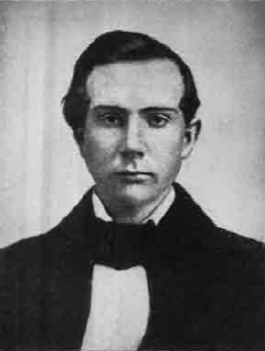
JOHN D. ROCKEFELLER AT 18 YEARS OF AGE.
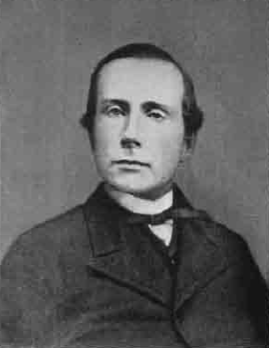
IN 1865.
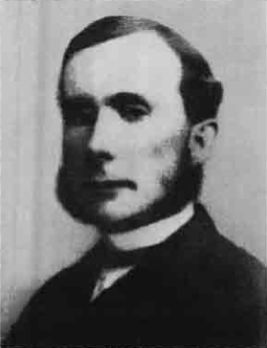
IN 1867.
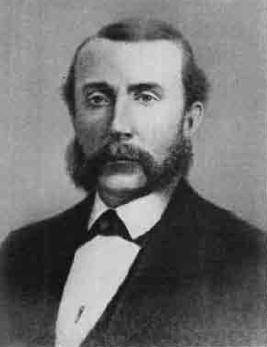
IN 1870.
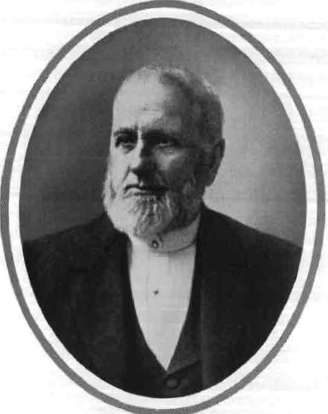
WILLIAM A. ROCKEFELLER, FATHER OF JOHN D.
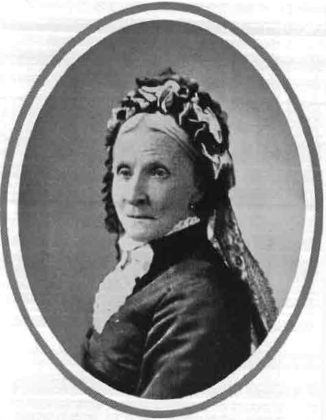
ELIZA DAVISON ROCKEFELLER, HIS MOTHER NOTE THE STRIKING RESEMBLANCE TO JOHN D. AS THE PUBLIC HAS COME TO KNOW HIM.
CHAPTER IX. THE GREAT BAPTIST DREAMTHERE now drifted into John D. Rockefeller’s life a man who was to have a profound influence upon it and upon his plans and fame. In Minneapolis was a preacher named Frederick Taylor Gates, who was holding there since 1880 his first and only pastorate. The son of a poor Maine preacher, Gates had worked his way through the Rochester Theological College and was now making something of a name for himself in a local way as a very level-headed minister with a strange mixture of practical sense and evangelical zeal. George A. Pillsbury, the flour king, in 1888 wanted to donate $50,000 to Pillsbury College on condition that the people of Minnesota would give the same amount and he approached Gates with a proposal to raise that sum. Gates resigned his pulpit and in six weeks’ time had the $50,000 in hand.
About this time the American Education Society was formed in Chicago. The first article in its program was to establish a great Baptist educational institution in Chicago. And Fred T. Gates was made secretary of that body. His capacity as a finder of funds had become known.
John D. Rockefeller, since the early eighties, had been vice-president of the Baptist Theological Union in Chicago. He had made many generous gifts to that body and had also passed over several checks to the Baptist Union Theological Seminary which languished under the auspices of the Union. Gates soon found he had ample opportunities to see and talk with the great multi-millionaire and to inflame him with some of his own passion for the project he had been enlisted to carry forward. At the same time in New York, the New York Baptists were fired with the ambition to have a great Baptist seat of learning there. Dr. R. S. MacArthur, pastor of the Calvary Baptist Church, was interested in the plan which was to raise $20,000,000 and of course John D., New York’s richest Baptist, was selected as the patron. It was a race between Dr. MacArthur and the Reverend Gates. But in some way Gates got the inside track. He and Dr. William R. Harper went over the subject with Rockefeller many times. They finally induced him to pledge $600,000 for the founding of an institution which would be known as the University of Chicago. Gates’ hand is seen in the proviso that the benefaction would be made on condition that another $400,000 be contributed by subscription. He had learned that trick from Pillsbury and now taught the lesson to Rockefeller.
THE LADIES: “HOW SWEET THE DEAR, GOOD MEN ARE, NOT TO FIGHT. THINK HOW DREADFUL THE CONSEQUENCE MIGHT HAVE BEEN TO ONE OR BOTH OF US.”
—The Minneapolis Journal
There had been an “old University of Chicago” established in 1856 by Stephen A. Douglas but this had died of inanition in 1886.
This was Rockefeller’s first great philanthropic gift and the news produced a very considerable stir, coming at a time when he was being roundly denounced all over the country. Gates went to work to raise the required $400,000 and succeeded with astonishing swiftness. Marshall Field gave a tract of land for the site which was valued at $125,000. Rockefeller handed over his $600,000, the University was incorporated September 10, 1890, and the following July, Dr. William Rainey Harper was named president. Meantime Gates had established very cordial relations with Rockefeller. The latter took a very decided fancy to his new-found clerical friend. As a matter of fact, Gates happened along at the most opportune moment. Rockefeller had been contemplating retirement for some time. He was in his fiftieth year and his health was very much impaired. Moreover his fortune had swollen to vast proportions and he wanted to find some means of making a sound use of it which would be pleasing to the Lord. Gates’ fiery zeal impressed Rockefeller because it was coupled with a profound strain of very canny business sense. Accordingly the proposed modest institution which was at first planned to grow under the Harper and Gates husbandry at the time of incorporation got an additional million from Rockefeller. A condition of this was to include the Baptist Union Theological Seminary at Morgan Park as part of the University. New buildings were begun and by October, 1892, instruction began in Cobb Hall, the only building ready for occupancy.
II
WHEN the news of Rockefeller’s princely gift was made known the National Baptist Educational Society Convention was being held in Boston. The announcement of the gift was received with cheers—which was quite natural. What was interesting to say the least was that when the announcement was being made and before the audience knew its purport, at the mention of Rockefeller’s name the audience broke into enthusiastic applause. When the gift was named and the actual sum of money pronounced the audience rose and sang the Doxology. Men burst out into exclamations of praise and joy. “The man who has given this money is a godly man,” chanted one leader. Another rose and exclaimed: “The coming to the front of such a princely giver! A man to lead! It is the Lord’s doing. God has kept Chicago for us. I wonder at his patience.”
On the following Sabbath throughout the country sermons of thanksgiving were preached in almost all Baptist pulpits. “When a crisis came,” intoned one minister, “God had a man to meet it.” “God,” cried out another, “has guided us and provided a leader and a giver and so brought us out into a large place.” In scores of pulpits the phrase: “Man of God!” was uttered. A writer to the Independent said: “No benefaction has ever flowed from a purer Christian source.”
Upon the ears of John D. Rockefeller, assailed by the relentless abuse of the profane press, these blessings must have fallen like a benediction. A few years later, speaking to the first graduating class of his New University, he said: “It is the best investment I ever made. . . . I am profoundly thankful that I have had something to do with this great work. The good Lord gave me my money and how could I withhold it from the University of Chicago?”
This brought the first criticism of Rockefeller’s benefactions. The Chicago Chronicle said: “John D. Rockefeller has fallen in line with Benjamin Harrison and Mark Hanna and modestly announced that Divine Providence is keeping a special watch over him and his monetary affairs. . . . ‘The good Lord gave me my money’! Let the ruined refiners, the impoverished producers, the corrupted legislators of the oil belt stand as an answer to the blasphemy.”
III
THAT John D. Rockefeller made this gift as a means of influencing the economic education of the young mind is probably far from the truth. He was a man with countless millions looking for a place to continue the habit of giving to worthy religious causes which he began back in the days when he recorded ten-cent benefactions in Ledger A. And he fell by chance into the hands of men who wanted to start a university. He might have begun with a hospital or any other sort of institution if his fortunate pilots at the time were thus interested.
However, while Mr. Rockefeller did not consciously design the University of Chicago as a fortress in the long line of defenses of the economic system under which he flourished, it is not to be denied that such institutions at least tend to take on that character. It is customary for those who resent this view to insist that Mr. Rockefeller and other rich donors like himself “have never interfered in matters of academic freedom” or have never sought to dictate courses of study or the character of personnel. Such interference or dictation is seldom if ever necessary. The gentlemen who accept the commission of these wealthy benefactors may usually be depended upon to possess a sufficient sense of eternal fitness not to permit subversive philosophy to creep into their class rooms. Here two important incidents bearing on this matter may be disposed of.
Before any of the buildings of the new university were fully finished and within a month of the opening, in a still uncompleted building, a Journal of Political Economy appeared in print. It may be accepted freely that John D. Rockefeller did not suggest that; that he did not even know of it. It is at least singular that thus early in the life of this new college—in its very first days—almost the very first use to be made of Mr. Rockefeller’s generous money gift was to establish a Journal of Political Economy.
Thereafter for a number of years this journal was published each month through a period when the subject of industrial combinations and “trusts” occupied almost a first place in the public mind, when newspapers, popular magazines and economic courses in other institutions bristled with controversy over this important subject. Yet one may search through the table of contents of the Journal of Political Economy for many years before he finds any reference whatever to this issue. It just simply was never mentioned.
In a letter to the writer Dr. J. Laurence Laughlin, now eighty-two years old and a widely-known economist who specialized in the subject of money and finance, then editor of the Journal, says: “I was editor of the Journal of Political Economy and know that articles were chosen solely for their economic quality. We could discuss trusts or any economic subject. No one ever tried to use our columns for their private purposes.” One may very well acquiesce in this statement. Yet the fact remains that trusts were never discussed. Which seems to afford some ground for recognizing the validity of that principle already referred to, which operates almost with the force of a law, that it is not necessary for generous donors to lay down rules for intelligent practical beneficiaries who know without being told what is the path of security.
The other incident has the same moral. Prof. Edward W. Bemis was an instructor at Vanderbilt University who was brought by Dr. Harper to the University of Chicago in the Extension Department. In addition he devoted a portion of his time to lecturing in the Department of Economics. Bemis, while by no means a radical, was far removed from the extreme conservatism of Dr. Laughlin. Dr. Laughlin objected to him and he was moved to the Department of Sociology under Dr. Small. Later, while he was not precisely dismissed, he was not reappointed. Thus he found himself out of the University.
A good deal of controversy followed his exclusion. It was whispered around that he had been let out because his views were disliked by the University’s rich patron. Dr. Harper finally declared he was let out because he was incompetent. Dr. Laughlin says: “While in the Department of Sociology he got into trouble; and some of his pronouncements fell into the hands of a printer who sold them to a reporter who scented notoriety in them. An examination by the trustees followed and he was not reappointed. There was no intention to make the matter public. There was no truth in the story that he was dropped because of his opinions but because he was not of university caliber. He was an agitator, not a scholar.”
Bemis’s own story is somewhat different. It is fair to say that Bemis, who became widely known later in the field of public utility regulation and attained to some distinction as one of the pioneers in utility control, was a man of indefatigable industry and unquestioned sincerity. He was, perhaps, not a brilliant economist, but he was far abler than most of the economists who calibrate for university work. He was not a radical but rather a believer in the system of regulation which now has become universal in utility control. He had a collection of views on this subject but was hardly any more an agitator than Dr. Laughlin, for instance, has been in the field of banking and currency management. He has been spoken of in the highest terms by such economists as Dr. Richard T. Ely, E. Benjamin Andrews of Princeton, John R. Commons, and many others. An unprejudiced observer of this whole incident will have to conclude that Bemis was not let out because he was incompetent.
Bemis had made some criticism of the railroads in the famous Pullman strike. The president of a railroad complained to the trustees and to President Harper. Harper then wrote Bemis, July 28th, 1894:
“Your speech at the First Presbyterian Church has caused me a great deal of annoyance. It is hardly safe for me to venture into any of the Chicago clubs. I am pounced upon from all sides. I propose that during the remainder of your connection with the university you exercise great care in public utterances about questions that are agitating the minds of the people.”
It ought to be observed that Bemis in the criticized speech had condemned the strikers but had merely said—by the way—that the railroads had not shown their employees a very good example and did not come into court with clean hands.
An implied confirmation of this version is found in a letter from President Harper to Bemis even before this incident. It reads in part:
“I hoped that as time passed there would be opportunity for you doing a larger amount of work in the University proper. Instead of the opportunity becoming better for work on your part the doors seem to be closing. . . . I am persuaded that in the long run you can do in another institution, because of the peculiar circumstances here, a better and more satisfactory work to yourself. I am personally very much attached to you. . . . You are so well known and your ability so widely recognized that there will surely be no difficulty in securing for you a good position, one in which you will be monarch, and one in which you will be, above all things else, independent.”
At the moment when this episode was weaving itself into the history of our schools, colleges and educators everywhere were standing suppliantly with their hands out to the wealthy industrialists and promoters who were pouring out their wealth in endowments to institutions all over the land.
All this refers to a period more than thirty years ago. It must be said in all fairness that for some years the University has assumed a far more liberal policy and that at the present time no obsequious reverence for its founder leads it to undue restriction upon the academic freedom of its teachers.
IV
BEFORE the great Baptist dream flowered in brick and stone upon the new campus, Gates found himself installed as John D. Rockefeller’s most intimate adviser. In the Spring of 1891 Rockefeller’s indigestion expressed itself in such violent form that he quit work for a while and retired for several months from active work. He spent a certain amount of time each day in the fields with his laborers, ate simple foods, slept longer hours. Gradually by the end of the Summer, the color came back to his face and he was able to resume his duties. It was during this time that he resolved definitely to retire from business. But the country was moving into trouble and with his far-flung fortune at stake he did not feel at liberty to carry out his plans. The preceding year the great Baring failure had shaken London and the rest of the financial world. America was shielded from its most virulent effects because of a bountiful wheat crop. But the following year all the forces of business disturbance were assembling, though the country as a whole hardly realized it. Gold was leaving the country at an alarming rate.
In this situation Rockefeller became disturbed about certain enterprises in which he had invested a great deal of money. At the time Gates was traveling about North, South, East, and West raising funds for the new university and rousing the Baptists to his new holy war for Baptist learning. One day he was going South when Rockefeller asked him to have a look at an iron mill in which he had a large minority investment. When Gates returned Rockefeller was astonished at the shrewd and wise account of the business Gates was able to give him. “His report,” said Rockefeller, “was a model of what such a report should be.” It revealed furthermore that the concern was sailing into troubled waters. A little later, as Gates was going West, Rockefeller asked him to make a similar inspection of a large investment he had in that quarter which was supposed to be very prosperous. Gates found it in very deep water and made an elaborate and able report. This so much impressed Rockefeller that he immediately asked Gates to enter his employ as a personal adviser, “to become, like myself, a man of business,” as Rockefeller put it, to assist him in unraveling some of his tangled investments and in working out his proposed philanthropic plans. Gates then became the head of what came to be Mr. Rockefeller’s personal staff—the force which looked after his interests outside the Standard Oil Company. One of Gates’s chief business services at this time was gathering together Rockefeller’s scattered investments in iron mines and railroads and organizing them into the profitable group which Rockefeller later transferred to the United States Steel Corporation. When this work was completed and the Lake Superior Iron Ore Company was brought under Rockefeller’s dominion, Gates became its head. Nothing could be stranger than the spectacle of this impecunious Baptist preacher setting out to raise funds for a religious college and winding up in a few years as the president of an iron mine and ore railroad company worth twenty millions, and finally the almoner of America’s greatest multi-millionaire, with the power of the purse over those vast treasures.
V
THE PLANS for the great university expanded rapidly under the encouragement of Rockefeller’s munificence. In 1893 he gave another half million, $175,000 of it to be used for current expenses and another $50,000 in 1894. Then in 1895 he electrified his Baptist wards with a letter proposing an outright gift of $1,000,000 in cash or securities at his option and an additional two million on condition that the University raise another two million. Here was a princely gift—five million if successful. The new students of Chicago University were thrown into a frenzy of delight at this munificence. To the tune of Daisy Bell they marched around the campus and sang:
John D. Rockefeller
Wonderful man is he.
Gives all his spare change
To the U. of C.
He keeps the ball a-rolling
In our great varsity.
He pays Dr. Harper
To help us grow sharper
For the glory of the U. of C.
But the grateful boys were mistaken in one thing. Dear old Chicago University didn’t get all his spare change. That same year B. T. Quillan, deacon of the Euclid Avenue Baptist Church, said that Rockefeller had given in different unrevealed gifts to Cleveland over two million dollars.
In any case with these events, the engagement of Gates, the founding of the University of Chicago, Rockefeller’s great career of philanthropy had been launched.
VI
THESE were busy years for the Lord—the land swarmed with his self-appointed agents. Moody and Sankey plucked brands from the burning by the thousands and in the wake of their success a wave of evangelism swept over the country. In Rockefeller’s state of Ohio the Reverend H. H. Russell of Berea arose and said: “The time will come when the Lord God Almighty will take a spear like a weaver’s beam and he will drive the Satanic liquor traffic down to its native hell.” The modest Mr. Russell then proceeded to announce himself as that weaver’s beam and to describe rather particularly how the Lord went about acquainting him with his appointment. He thereupon suggested the plan for and forged that mighty instrument of the Lord—the Anti-Saloon League.
“The Anti-Saloon League was begun by God Almighty,” he said forty years before Scott McBride made the same claim. And very early in the game God’s agent No. 2—Brother Russell—began to get aid from God’s agent No. I—Brother John D.—in the shape of modest slices of God’s Gold which had been entrusted to the latter agent. At this time there were in the country three million Baptists and three million Methodists and a million and a half Presbyterians and between them they were ruling the land for the Lord. And there were no works of the Lord under the especial care of the Baptist division of this mighty army which Mr. Rockefeller was not willing to help a little. With good reason Baptist ministers occasionally said, referring to him, in a spirit of pious levity: “And there was a man sent from God and his name was John.”
CHAPTER X. IRON MEN AND WAXEN LAWSALMOST the first major enterprise which the Rev. Mr. Gates supervised for his great patron brought upon Mr. Rockefeller’s head one of the most unpleasant attacks he was called upon to suffer since the Backus case—an attack in which he was pictured as the unfeeling Shylock, squeezing his partners out of a vast fortune through the manipulation of a small loan.
Some of the charges in this case were first made in a lawsuit in 1894. The more damaging ones were not heard until 1912 when Alfred and Leonidas Merritt appeared before the Stanley Committee investigating the United States Steel Corporation.
The first charge was that Rockefeller had tricked the Merritts by palming off on them in a consolidation a group of worthless iron mines. The charge made later was that he loaned them $420,000 on a demand note, then in two months called it suddenly, forced them to the wall and took their mines which he sold later to the United States Steel Corporation for $39,000,000.
The Merritts’ charge as unfolded before the Stanley Committee was as follows: They were a pair of innocent and, like all Rockefeller’s victims, generous, honest, and trusting old lumberjacks who had discovered the iron ores of the Missabe Range in 1890. They had to build a 64-mile railroad from the range to join the nearest trunk line. In the midst of this work the panic fell upon them. They were desperate for money. Whetmore, an agent of Rockefeller, put into their heads the thought that Rockefeller would lend them money. What Rockefeller really wanted was to get their line and their mines to consolidate with his own. The upshot of it all was that they went into a consolidation with Rockefeller, becoming his partners. They put in their mines and railroad for stock; Rockefeller demanded bonds for his properties. They borrowed $420,000 from Rockefeller on a demand note with the understanding he would carry them until they were out of the woods. Instead within two months he called the note. The panic was still on. They couldn’t get the money, so Rockefeller took their properties and left them almost penniless. These properties contained 700,000,000 tons of iron ore, as valuable as the mine holdings of the United States Steel Corporation. They subsequently sued Rockefeller and a jury brought in a verdict for them. Rockefeller settled for $525,000 but he kept the mines.
This was the Merritts’ story. Here are the facts. They were not innocent souls as pictured. They were promoters; audacious but not wise ones. Their mines belonged to a corporation which they controlled. Their railroad belonged to another corporation. The Merritts organized a third concern—a construction company—which they also controlled and which made a contract with their railroad company to build a 64-mile road. The construction company spent $660,000 to build this road. In payment they got from their railroad corporation $1,250,000 in stock and $1,250,000 in bonds. An additional $3,500,000—half bonds and half stock—was issued by the company.
Rockefeller did not propose a consolidation to them. They proposed it to him. They made two unsuccessful attempts at consolidation before they approached Rockefeller. Whetmore was not Rockefeller’s agent, but a lawyer and independent promoter who teamed up with the Merritts and worked with them. When the 1893 panic swept down on the Merritt enterprises, Whetmore, peddling the Merritt railroad bonds around, sold one-fourth of them to Gates, as Rockefeller’s agent. By July the Merritt dream was foundering. Desperate, Whetmore and Leonidas Merritt went to Gates again. They wanted a consolidation and a loan. It was decided to form a consolidation of all Rockefeller’s iron holdings and the mines of the Merritts on the Missabe Range and the railroad. Rockefeller financed the road to the tune of $500,000, taking in payment the Lone Jack and Adam mines of the Merritts and these Rockefeller put into the consolidation. Rockefeller took bonds for his own holdings. The Merritts took stock for theirs. Rockefeller took bonds based on the value of his holdings. But the Merritts issued stock for theirs for over $26,000,000, taking $10,000,000 themselves, for all of which they had put in practically nothing save funds they had borrowed from other people. This was an outrageous piece of watering. In addition to all this Rockefeller loaned the Merritts personally $ 150,000. The Merritts were profoundly grateful to him. Leonidas wrote Gates he wanted to call on John D. and “grasp him by the hand.” He wrote a friend in St. Louis he had “been working for months to effect a consolidation of iron interests on the Missabe Range” and had finally connected with Rockefeller. He felt so highly elated he wrote a volume of blank verse on the subject.
But all this did not save the Merritts. The panic deepened and by January, 1894, they were in troubled waters again. They again went to Gates and asked for money. They sold Rockefeller 90,000 shares of their stock for $10 a share. It was stipulated they could buy back 55,000 shares in a year at the same price plus interest. This they never attempted to do. They took a different course instead. They did not give Rockefeller a call note for $420,000 as they swore to the Stanley Committee. Rockefeller had no such note which he could call. He had loaned them $ 150,000 and only $25,000 of that was due. To this part of the Merritts’ story there was not a scintilla of truth and there is no doubt that the whole tale as told to the Stanley Committee wronged Rockefeller.
The other part of the story is more involved. It was that Rockefeller had put in properties which were worthless and he had gotten his bonds for them upon deliberate misrepresentation and fraud. This charge was made by the Merritts a few months after they sold their 90,000 shares to Rockefeller at $10 a share. It was made in a suit filed by the Merritts in which they asked damages against Rockefeller of $1,500,000. The outcome of this suit, simply stated, leaves something to be desired on Rockefeller’s side. A jury decided the case against Rockefeller; the higher court reversed it; and then Rockefeller settled with the Merritts for $525,000. Why did he settle for so much money if the Merritt charges were not true? Frederick T. Gates in 1912 made an elaborate argument to prove Rockefeller’s innocence of this charge. Beyond doubt he made a powerful case against which nothing stands save the settlement by Rockefeller. Here is Gates’s story, pretty well substantiated. A few months after the consolidation the Merritts fell into the hands of Messrs. A. A. Harris and Son, lawyers. These gentlemen called on Gates and insisted that Rockefeller buy the Merritt holdings above the market. When turned down Harris brought suit against Rockefeller for damages of $1,250,000 on the ground that the Wisconsin and Cuban properties of Rockefeller had been sold them under fraudulent misrepresentation. Rockefeller’s defense was first that there was no misrepresentation; that the mines were actually valuable mines, that no damage was suffered and that the Merritts knew fully what they were doing. The jury found for the Merritts, but the court of appeals rejected the verdict and ordered a new trial. Thus the matter stood when Rockefeller settled for $525,000. The settlement would be very much against Rockefeller but for one or two facts. Gates declared the settlement was made to avoid further litigation, to get a retraction of the charges, to end expired option on the 55,000 shares, now worth $20 a share and to quiet a number of other Merritts, twenty-three of them, members of the family holding various nebulous claims. Mr. Rockefeller’s surrender under a charge of fraud gave rise to much unfriendly comment. However, two facts conspired to aid Rockefeller’s position. For one, Merritts’ lawyer, Henry E. Harris, called on Gates during the litigation and tried to sell telegrams and other valuable evidence belonging to his clients. And later the Merritts themselves brought suit against Harris and his son revealing a good many disreputable activities of Mr. Harris in his relations with the Merritts. Also the Merritts signed a statement in which they retracted all the charges made against Rockefeller, declaring they were satisfied from recent independent investigation made by them that no misrepresentation was made nor fraud committed by Mr. Rockefeller. The so-called worthless properties put in by Rockefeller turned out to be very valuable and the whole property, under Rockefeller’s wise management and the very canny business judgment of the one-time Baptist minister, became a magnificent property. Not, however, until Rockefeller had put into it many millions for development and eight years of Rockefeller management.
II
IT WAS easy now to get things believed about John D. Rockefeller. The tide of hate which later rose against him was now in flow. Old enemies found the time propitious to call up old scores. Years before old George W. Girty had been cashier of the Standard of Ohio. He was among the first employees. When prosperity came he drew a salary of $10,000 a year. He made money and had a home in Cleveland worth $100,000. Then he defaulted to the extent of more than $275,000. He came home one day with threats of suicide and, without telling his wife the reason, got her to sign a paper transferring their Cleveland home. In spite of the trouble he remained in the employ of the Standard and when he died was given a “state funeral,” the Standard spending $1,000 for a special car to carry his remains. He had told his wife his old losses were due to speculation in Standard stocks in which the Standard officials, led by William Rockefeller, had tricked him. Now in 1894 Girty’s widow sued the Standard Oil Company for damages in a perfectly hopeless suit.
George Rice roamed up and down the land hurling shafts at the head of Rockefeller. The Central Labor Council of New York, inspired by Rice’s attacks, made an application to have the Standard Oil charter of New York revoked. Ladenburgh, Thalman, and Company, refiners, brought suit against the Standard to recover $300,000 damages suffered as a result of freight discriminations—one of the earliest civil suits under the Sherman act—and the court had commanded the Standard to bring its books into court. “Ah!” people said, wagging their heads, “Mr. Rockefeller’s chickens are coming home to roost.”
III
IN TEXAS was a huge man, weighing 300 pounds, whose name was Hogg. He was governor of the state. Moreover he was a resourceful, popular, and resolute fighter. The wild and woolly Texas kerosene customer found himself in the grip of the Waters-Pierce Company and this, Texans said, is just a wolf in the clothing of a bigger wolf, the Standard Oil Company. This was true, but at the time Texas had no proof of it. Then in the midst of all these other attacks, the grand inquisitors of McLennan County, sitting at Waco, brought in an indictment for criminal conspiracy against John D. Rockefeller, Henry Clay Pierce, Flagler, Archbold, Brewster, and various other lesser fish including a very small fish named E. T. Hathaway, division agent. Governor Hogg immediately made a requisition on Governor Flower of New York for the bodies of Rockefeller, Rogers, Flagler, and others. Governor Flower’s secretary informed reporters that a protest was made against honoring the requisition as it was not shown that the culprits were ever in Texas and hence could not be fugitives. But Waco hungered for her prey. Sheriff W. L. Burke was all packed ready to come to New York to bring the villains back. He wrote the sheriff of New York to wire him the moment he had the gang in custody, and that he would hurry on. Governor Hogg fulminated but at 26 Broadway they only laughed at the Waco comedy. Samuel Dodd said it was all done under the new Texas anti-trust law, “one of those crazy socialistic laws which are unconstitutional.” And then Mr. Dodd, still slumbering amid his fictions, said the Standard Oil had no interest in the Waters-Pierce Company. Hogg sent a requisition to Florida for Flagler who was a citizen of that state, and it was said Governor Mitchell would honor it. In the end, however, none of the great sinners was caught. The dénouement gave old Senator Morgan of Alabama another good laugh. Mr. E. T. Hathaway, the division agent, was convicted and fined $50. The little fish was caught. He refused to pay his fine, went to jail pending further litigation, remained there for a year handsomely compensated by his powerful patrons, and was released in a year when the conviction was reversed.
IV
WHILST all this was in progress, the American people, sullen in the midst of the depression of 1893, languishing in widespread unemployment and growing poverty of the masses, indignant at the blatant and vulgar displays of a host of rich rogues wallowing in the fruits of dishonesty and graft, shocked by exposures of corruption in public and private life, were treated to one of the darkest chapters in the history of its judiciary.
The Sherman law had been passed, wisely or unwisely, to curb the activities of trusts and monopolies in business. It was aimed at nothing else. During Harrison’s administration practically nothing was done under the law. We saw how Mr. Richard Olney, a great New York lawyer, appeared as the counsel for the distillers in the first important suit against the law. When Mr. Cleveland became president he named this same Richard Olney as his Attorney-General, a man notoriously unfriendly to the act. During the next four years—1892 to 1896—there were ten cases either begun or prosecuted under the act. Only one against a large trust was successful—the suit against the Trans-Missouri Freight Association, decided in favor of the Association in Harrison’s administration in the lower court. The Supreme Court reversed that decision and held the agreement to fix freights unlawful. There were three other cases against large trusts, one against the pipe trust, one against the sugar trust, and a third against a railroad trust in New York. In the sugar case, the American Sugar Refining Company, making 65 per cent of our domestic production, bought four refineries in Pennsylvania, making the remaining 35 per cent. Here was a complete monopoly. The trust lawyers contended that the Sherman law did not apply to such a combination. These refineries were factories—producers of sugar. The Sherman law applied to combinations in restraint of trade in interstate commerce. These refineries were not in commerce. They made sugar. The sugar did not get into commerce until after they made it. But the court could not presume they made it with the intent of having it flow into commerce in violation of the law. So strained, so grotesque, so fantastic a construction of the law could hardly be born anywhere save in the brain of a very hard-pressed special pleader. Yet, difficult as it is to believe, the Supreme Court adopted this view, Chief Justice Fuller writing the opinion in the cases. In the third suit—against 32 railroads in the East, which made an agreement to fix rates—the Supreme Court held that transportation was not commerce and that the law did not apply to the railroads. Against these incredible decisions, which could have come only from minds utterly steeped in the worship of the rights of property and money, was heard in dissent the strident voice of old Justice Harlan, who was shocked at the decision and wrote vigorous dissents.
One victory for the law was registered. A man named Moore, in Salt Lake City, refused to sell coal to anybody who was not a member of the Salt Lake Coal Exchange. Moore was convicted and fined $200 but even this conviction was reversed because the court did not have jurisdiction. Truly old Senator Morgan seemed to have been right. Indeed if this were all it would be bad enough. But there were five other cases prosecuted—all against striking workingmen, one in New Orleans against the Workingman’s Amalgamated to restrain it from promoting a strike, the other four against various labor leaders, including Eugene V. Debs, to restrain them from or punish them for carrying on the famous railroad strike of 1892-94. Singularly enough all these prosecutions were successful save one, which was dismissed because the indictment was improperly drawn. In the others, in Missouri, Illinois, and California, the courts held that the law applied to striking laborers. Eugene Debs and others were thrown into jail for three to six months. At the end of six years, therefore, the slate of the government’s war on trusts was to see almost every trust prosecuted escape through fantastic interpretations by the courts, save in one case, the New York railroad agreement, and one labor man in jail. Against the great trusts whose subjugation the law was especially framed to achieve, no finger was raised. The net that was contrived to catch the Rockefellers, the Havemeyers, the Archbolds, and their like had landed Eugene V. Debs in jail. It was a discouraging phenomenon and afforded endless ammunition to the radical orator and agitator who was then industriously fomenting the elements of discontent in the country.
CHAPTER XI. OLD ENEMIES ON THE MARCHWE MUST go back now a few years to see what Rockefeller’s old enemies, the oil men of the regions, were doing. The oil men had tried to get a bill through the Pennsylvania legislature prohibiting railroad rate discriminations. On the night of April 28th, when that bill was defeated, through the machinations of the Standard, wrath ran high in Harrisburg. The producers called a meeting in Oil City and organized another Producers’ Protective Association “to defend the industry against monopolies by selling its own oil.”
The first proposal was to stop the drill and limit production. Thomas W. Phillips rose. He was the largest oil producer. “There are 30,000,000 barrels of oil in storage now,” he said. “It all belongs to John D. Rockefeller. He bought it at low prices. Stop drilling and the only one you will help will be Rockefeller. His 30,000,000 barrels of oil will immediately become more valuable.” He then proposed that a committee call on the Standard and suggest an arrangement; that the Standard sell them 5,000,000 of those 30,000,000 barrels at 62 cents. They would then limit their production to 17,500 barrels a day. Any rise in price would then add to the value of their 5,000,000 barrels. The producers thought this an excellent suggestion. The fact that a shut-down would throw several thousand laborers out of work did not trouble them at all. The regions were made for the producers. However, Phillips thought of the workers and insisted that a million barrels be dedicated to them. Mr. Phillips pointed out also that the drill could not be stopped without the cooperation of the drillers. So the profits of a million barrels were dedicated in trust for them on condition that they refuse to drill wells. The committee called on John D. Archbold in New York and that gentleman promptly agreed to the plan. The drill was stopped, the output limited, and oil rose at once twenty cents a barrel. A few prospectors, who still believed in the old doctrine of laissez faire, individual liberty, which the producers preached, refused to quit drilling. A little nitro-glycerine in their works, put there by the kindly producers in the sacred name of individualism, soon fixed them. Oil went to 96 cents a barrel by the end of the year 1888, but this was very far from the three dollar oil or even two dollar oil they dreamed of. What was worse, in spite of all these elaborate schemes, the output continued to be excessive.
II
BY THIS time the Producers’ Protective Association decided to pin its faith on a scheme known as the United Oil Company, a corporation to be owned by the producers to engage in refining. They selected H. L. Taylor as chairman of the committee to organize the project. The reader may remember the name—H. L. Taylor who, with Satterfield, five years before, tried to throw the Tidewater Oil Company into a receivership for the Standard. Why was Taylor selected?
Taylor had a producing company, called the Union Oil Company. Rockefeller at this time had decided to go into the production of oil. He sent an agent to Taylor and arranged to buy out his Union Oil Company. All was profoundly secret and Taylor went on representing the Producers until a rumor of his treachery got out. The Producers summoned him and accused him of selling out to Rockefeller. He admitted it, and was compelled to resign from the Producers’ committee.
This year Rockefeller bought substantial interests in three other producing companies—Forrest Oil Company, North Pennsylvania Oil Company, and the Midland Oil Company. This entry of Rockefeller into production cast another shadow over the regions. As for Taylor he continued to prosper and died in 1894 in Buffalo, well-known as a multi-millionaire.
III
WHEN news of Taylor’s treachery got about the producers decided to attempt to cut off crude supplies from Rockefeller. They organized the Producers Oil Company owned by 1,000 producers and planned to sell their crude oil abroad. But they failed to find a market and decided they must build up an independent refining interest to buy their oil. They gathered together a number of small independent refiners and organized them into the Producers and Refiners Company with $250,000 capital. The Producers Oil Company took $160,000 of this. They laid pipes and pumped crude from the fields to the refiners cheaper than the Standard would carry it. But they still had to get the crude and refined oil to the seaboard.
IV
ROCKEFELLER now met a foe worthy of his steel. This was Louis J. Emery, who in 1892 undertook to meet the need of the new refining interest to pipe oil to the seaboard. He organized the United States Pipe Line Company. He planned to pipe oil from Bradford to Hancock in New York. From there the oil would go by rail to the Hudson River and then down the Hudson to the sea. When Emery got his pipes as far as the Erie tracks seventy railroad workers attacked him. They captured the territory around the tracks and camped there. Emery made preparations for a counter attack, massed men, provisions, muskets, and food. But the battle never came. While he was making this demonstration he secretly got another right of way seventy miles nearer Wilkes-Barre and before Rockefeller realized it had his line completed to the New York, Ontario, and Western Railroad at Hancock. He completed another line from the regions to the sea for piping refined oil—a new idea. Here was a serious threat now for Mr. Rockefeller—a new refining interest with capital, adequate independent pipes from the wells to the refineries and pipe lines to the seaboard to carry both crude and refined oil. The new interests now had crude and refined oil at the seaboard independent of the railroads and of the Rockefeller pipe lines. But they still had to find customers for it. This Rockefeller now proceeded to make almost impossible by cutting prices.
The going was hard for the independents. It would have been impossible but that the United States Pipe Line carried oil for them at cost. As usual the weak spirited were for yielding. A committee went to New York and literally begged Mr. Rockefeller for mercy. He told them in his soft, benevolent tones there was no hope for them but to sell. And this they proposed to do. But a few hardy souls counseled a further effort. They called a mass meeting in January, 1895, at Butler, Pennsylvania, to organize a new company. A great crowd appeared. They came in special trains. There was the usual stirring oratory and excitement. In a few minutes $75,000 capital had been subscribed; in a few days $200,000. The new company was to be called the Pure Oil Company. It was not to supersede the Producers Oil Company or the United States Pipe Line and the latter’s subsidiary the Producers and Refiners Company. Its object was to provide funds for refiners who might be hard-pressed.
The organizers were determined that Rockefeller should not get control of this company. To prevent it they created a voting trust and put one half of all the stocks into the hands of “five champions of independence” who were bound to vote the shares only in the interest of the independent interests. Heartened by this new movement the battle was renewed. But hardly had the cheers subsided when a new blow descended. A man named Herman Roth was the agent of the independents in Europe. When the committee called on Rockefeller with a plea for mercy, his agents in Europe called on Roth, informed him the independents were about to sell out to Rockefeller and that he would soon be left in the lurch. Roth believed them and sold his business to the Deutsche-Americanische, the Standard subsidiary in Germany. Emery had to hurry to Europe for the Pure Oil Company and immediately organized another selling subsidiary.
V
THE STRUCTURE of the independent battle was now as follows: The Producers Oil Company organized to find a market for the producers’ oil; the Producers and Refiners Oil Company, controlled by the Producers Oil Company to pipe oil from the fields to the refineries; the United States Pipe Line Company, with pipes for both crude and refined to the seaboard.
It was now proposed to unite the United States Pipe Lines which operated trunk pipes and the Producers and Refiners Company which operated pipes to gather oil from the fields. A meeting was called to consider it. Col. John J. Carter, supposed to be an independent producer, was a member of the Producers Oil Company. He owned 300 shares of stock. He went into court to obtain an injunction against this merger. In the hearings it came out that the Standard Oil Company owned 60 per cent of the stock of Col. Carter’s oil company. A storm of anger broke out at this. Would the independents never be rid of the perils of traitors and spies? Patterson had turned on them; Taylor had sold them out twice. Now Carter had sneaked into their company. Another meeting was called. Col. Carter appeared. To the amazement of everybody he had not only his original 300 shares but 13,013 more and these belonged to the Standard Oil Company. He had other shares besides—21,848 in all. The leaders were astonished, but they mustered over 30,000 shares and controlled the meeting. The incident shocked and frightened them however. Later they denounced Carter as a traitor and expelled him from the Producers’ Association. But the Standard went on buying shares. By January, 1896, they had 29,764, enough with Carter’s 300 to control the company. But they laid low. In 1896 Col. Carter bought out the Standard shares and went to the next meeting of the Producers Oil Company with a clear majority. The directors refused to let him vote them without authority of a majority of the stockholders. The company was a limited partnership and stock could not be transferred without the approval of the company. Carter took the fight to court but lost and sold his stock below par.
VI
MICHAEL MURPHY was an active leader in the United States Pipe Lines. One day in August, 1895, the stockholders were meeting when a Mr. J. C. McDowell appeared at the door with 2,613 shares. Murphy stopped him and told him that he believed him to be a Standard Oil spy and that if he attempted to cross the threshold he would throw him out. Mr. McDowell departed. But McDowell brought suit and won. The United States Pipe Lines was not a limited partnership. It was a corporation and the Standard interest was entitled to appear at stockholders’ meetings and ultimately gained a director on the board. Assuredly Mr. Rockefeller was an incorrigible man.
VII
THUS this ambitious movement of the independents stood in 1896. One other incident discouraged them. In 1895 Emery decided to extend the pipe line from Wilkes-Barre all the way to Bayonne. He had to cross the Pennsylvania tracks. So he bought an acre over which the Pennsylvania tracks ran, believing this would entitle him to run his pipes under the ground beneath the tracks. But long litigation held him up. He then bought a farm at the tracks of the Delaware, Lackawanna, and Western road. The farm was low and the tracks ran over a trestle 17 feet high. Emery with fifty armed men went at night, laid his pipes along the level under the road and four feet under the ground, fastened them with heavy timbers and anchored them, set up a camp and prepared for war. Railroad men with picks and bars attacked them and were driven off. Next day two wrecking cars with 250 men renewed the attack. They were again repulsed. There was a truce and an arrangement to refer the matter to the courts. While this was pending two locomotives descended on the camp and attacked it with hot water and coals. The countryside rose to aid Emery. The local G.A.R. loaned 48 muskets. Emery bought some Springfield rifles and held his ground in a state of siege for seven months. In the end the court decided against Emery and the pipes were torn up.
Thus the battle raged when John D. Rockefeller carried out a resolution he had been considering a long time and which will be recorded in the next chapter.
CHAPTER XII. LEAVING THE STAGEAS THE year 1893 dawned the world was in so disturbed a state that Rockefeller found it necessary in spite of his seriously impaired health to remain close to his interests. Under the incessant urgings of Dr. Biggar, however, he had made up his mind to retire from active business. Therefore, from 1893 on he was keeping his eye open for the moment when business would be out of its difficulties so that he might carry out this intention to retire.
II
THE TIMES were indeed troubled. Two hundred thousand coal miners were on strike in the Middle Atlantic states. In the Summer of 1894 came the disastrous Chicago Railway strike under the leadership of Eugene V. Debs, the calling of the United States troops by Grover Cleveland and Deb’s arrest. Coxey’s Army was marching on Washington. The hot sirocco devastated the corn belt. Wheat went to 49 cents, its lowest price. Gold was flowing out of the country. When Cleveland entered the White House in 1892 we were very much in the condition of England in 1931. We had five dollars in paper money outstanding for each dollar in our gold reserve. The government was almost bankrupt. The Secretary of the Treasury under Harrison had stood in Wall Street with his hat in his hand almost begging for gold from the bankers there. In the midst of this in 1894 Cleveland’s Secretary of the Treasury, John G. Carlisle, went to J. P. Morgan to ask for $50,000,000 in gold. Morgan replied gruffly that the thing was impossible. The great Bull was for the moment at least terrorized. James Stillman was called on. He went across the street to Morgan’s office. Morgan was in a state of awe-inspiring disintegration. As Stillman entered Morgan held up his hands. “They expect the impossible of me,” he cried. Stillman thought he was on the verge of tears. Stillman, small, calm beside the bulky and turbulent Morgan, calmed the great banker and suggested that he, Stillman, be given an hour to see what he could do. Stillman went at once to Rockefeller who immediately authorized a draft of $10,000,000 on Standard Oil European funds. Stillman, with this beginning, got in touch with a few other capitalists and gathered up another ten million. Then he went to Morgan.
“I have twenty million,” he said when he entered Morgan’s office. “Where did you get them?” cried Morgan, leaping up and throwing off his despair like a cloak. “He became perfectly bombastic and triumphant,” said Stillman, relating the incident later to a Parisian friend. “He took the pose of savior of his country and assumed all the credit.” And then Stillman added: “Of course; but then you see he is a poet. Morgan is a poet.”
Rockefeller’s funds were in demand through these troubled days. The Reverend Frederick T. Gates, who sat at Mr. Rockefeller’s cash window, was a busy man. “I have today on my desk,” wrote Gates to Andrew R. Merritt October 2nd, 1893, “urgent imperative appeals to save old friends [of Mr. Rockefeller’s] amounting to many hundreds of thousands of dollars. I have incurred the enmity of many important business enterprises because I have had to decline to assist them in the last few days.”
On that day, Gates said, Rockefeller had loans outstanding to fifty-eight men and companies amounting to $5,969,422—men who could not have gotten money anywhere else. And to do this Rockefeller had borrowed from the banks over $3,000,000, his bank account that day being overdrawn $30,000.
Rockefeller spent a great deal of his time in the seclusion of his Forest Hill home. But he had private wires to his New York offices, his bankers, and other places. Telephones and wires throughout the estate kept him in touch with affairs no matter where he might be. Messages poured in every day keeping him informed of affairs. He was heavily involved in the market and changes in quotations and in the conditions of business were so rapid that his messages were telegraphed direct from the stenographers’ notes and were transcribed afterwards.
Rockefeller was deeply interested in the Northern Pacific Railroad. It was in desperate straits and its president, George Baxter, was making heroic efforts to save it from bankruptcy. The day arrived when there was but another twenty-four hours to meet the interest on its bonds. Rockefeller carefully canvassed all his resources to see what he could spare in cash to meet the situation. Throughout the night he arranged to have central offices and stations and branches all along the line of the road report by wire to him the amount of cash in every drawer of the company in the hope that enough might be thus scraped together to save it, supplemented by his own resources. By midnight it was clear when all returns were in that the Northern Pacific did not have enough and so he had to let it sink into bankruptcy.
III
IN THE midst of all this, in 1894 there appeared a book which produced a greater impression than any which had appeared in America since Henry George’s “Progress and Poverty.” Edward Everett Hale said it was the most important book which had appeared in America since “Uncle Tom’s Cabin.” It was called “Wealth Against Commonwealth,” by Henry Demarest Lloyd. This was the same Lloyd who had in 1881 made the first serious economic analysis of Standard Oil in an Atlantic Monthly article. “Wealth Against Commonwealth,” which was rejected by a number of publishers, was brought out by Harper Brothers. It contained a vivid, dramatic, highly colorful, yet thoroughly faithful and authentic account of the whole course of Rockefeller’s great monopoly from its inception. It was indeed the first connected history of Standard Oil up to that time. There was portrayed the story of the South Improvement Company, the numerous efforts of Rockefeller to form air-tight trade agreements and the final perfection of Rockefeller’s monopoly through rebates and various unjust discriminations. The book was unsparing in its denunciations, and revealed a mind on fire with indignation at the attack which Rockefeller’s whole course had made upon the system of individualism which Lloyd accepted as proved and established.
Lloyd himself was a man of no small attainments. Born in 1847, the son of a Dutch Reformed minister, he studied for the bar and became after his admission in 1869 secretary to Chief Justice Salmon P. Chase. After that he followed the profession of journalism rather than law, wrote editorials for the New York Tribune and contributed to various magazines. He spent several years preparing his book and, as a matter of fact, though its accuracy of statement was questioned, went to great pains to verify all its statements. When it was published William Dean Howells wrote him:
“To think that the monstrous iniquity whose story you tell so powerfully, accomplished itself in our time, is so astounding, so infuriating, that I have to stop from chapter to chapter to take breath. It is like a tale of some remote corruption, some ancient oppression far from ourselves.”
The book had an immense circulation and perhaps for the first time gave to the thinking element of the country a clear and connected understanding of the phenomenon at work in their midst. But no one connected with the Standard Oil Company made a reply. This made a most unhappy effect on many hitherto undisturbed minds. Lloyd had drawn a specific, an able, a serious, and a disinterested indictment and the accused persons preserved a profound silence. Finally Rev. B. Fay Mills, a well-known clergyman of the day, went directly to 26 Broadway where he was received by Dodd and one he calls “Rockefeller’s manager”—perhaps the Rev. Frederick T. Gates. “I told them,” he said later, “I had come to ask them what was Mr. Rockefeller’s theory of life by which he seemed in his private life to be so estimable and in his public life so wicked.” Dodd declared they would welcome a complete inquiry into their affairs by a committee of clergymen and economists. And Mills undertook to assemble such a committee. He wrote men like Edward Everett Hale and invited Lloyd to be present and present his proofs. This invitation Lloyd quickly accepted. But the Rockefellers refused to permit Lloyd to appear and the other persons invited refused to serve as judges and the whole project fell through.
Still no answer was made to Lloyd. A year later a reply appeared to come from a wholly disinterested source. Professor George Gunton wrote an answer in the Social Economist. He wrote as one who was profoundly concerned for the integrity of economic literature because of this irresponsible performance. He quoted a letter from Professor John A. Hobson, noted English economist, corroborating Gunton’s views. Lloyd wrote Hobson who promptly replied that he had written Gunton but that he had written exactly the opposite. Lloyd denounced Gunton for this distortion and Brother Gunton remained silent. Later he appeared as the editor of Gunton’s Magazine which functioned for many years, a persistent defender of almost everything Rockefeller and the oil trust did. In 1908 it came out that he who had trembled for the integrity of “economic literature” had been getting money regularly from John D. Archbold. Henry Demarest Lloyd and Professor George Gunton may be said to be the originals of two widely different birds in our public history. Lloyd was undoubtedly the first of that band of earnest men who grew in number and aroused the conscience of the nation until they suffered somewhat from Theodore Roosevelt’s unjust characterization of “muckrakers.” Gunton was at least among the first of that merry band of college professors who write “studies” and “surveys” and “books” and what not for wealthy but undisclosed patrons and seek to give to otherwise dishonest and unimportant creeds the respectability which flows from their titles as professors of economics.
At a later day John D. Archbold attacked Lloyd. In 1900 Rev. Hever Newton at the Conference on Trusts in Chicago, expressed surprise that Standard Oil did not bring suit against Lloyd. Archbold wrote Newton reproving him and adding: “His [Lloyd’s] motive was first sensationalism to sell his book, and second, I have personally a strong suspicion which I think is well grounded that there was a motive on his part meaner and more mercenary than this.”
What this motive was Archbold revealed three years later when he said before the Industrial Commission that he suspected Lloyd hoped to share in the proceeds of damages which Rice expected to collect from the Standard.
Of course, there was and there could be no evidence of this and it is doubtless true that Archbold spoke from no other grounds than his natural disposition to look upon every man who disagreed with him as a scoundrel. Archbold, exposed as a briber and corrupter of all sorts of men, unfeeling and boisterous in his attacks on others, left behind him a vast number of words in letters, testimony, and public documents of various sorts. One may search them in vain to find a decent or honorable motive attributed to any man. Lloyd was a highly honored member of the writing profession and after a long life spent in fighting for the interests of the masses, the downtrodden, and the poor, he died in 1903 in Chicago with a touch of martyrdom upon his brow in the thick of a battle against the corrupt traction ring of that city.
IV
AGAIN events moved here and there to touch with gold Mr. Rockefeller’s course. In the midst of the great panic there appeared on the streets of Chicopee Falls, Massachusetts, a curious-looking vehicle which moved along the streets without a horse. It was driven by George Duryea, its inventor, and was the first American automobile to actually move on its own power. Thus in this simple way dawned the age of gasoline, foreshadowed fourteen years before when George Selden applied for his patent, and which was to pile upon Mr. Rockefeller’s hill of gold a mountain of that same metal. When in 1896 John D. Rockefeller retired his entire fortune could not possibly have exceeded $200,000,000, if indeed it was so great. One is wholly in the realm of guesswork when estimating Rockefeller’s fortune. Yet in 1882 it is difficult to see how he could have been worth more than $40,000,000. This would be a very liberal estimate. Between 1882 and 1896 the Standard Oil Company paid dividends of $164,490,000 and of this Rockefeller collected at the most $25,000,000. There was an immense increase in the value of his holdings of Standard stock, yet these in 1893 could not have been worth more than $40,000,000. Of course he had great and extensive holdings in railroads, banks, various industrial corporations including iron and steel. The largest were iron ore and these we know he sold in 1902 to the United States Steel Corporation for $32,000,000. But they were worth not one-third that in 1893. It must be understood that Rockefeller himself had not engaged in any of those extravagant and adventurous stock jobbing transactions like Amalgamated Copper which were the work chiefly of Henry H. Rogers and William Rockefeller. On the whole, therefore, an estimate of $200,000,000 on Rockefeller’s fortune at the moment when he retired from active business life and became thereafter merely an investor is quite liberal. This being accepted we are able to see one of the most important and significant facts about the fortune of this man. He was the greatest money maker in the history of the world. Yet in a career devoted without distraction to money making he could not accumulate more than $200,000,000 while afterwards without any effort save as an investor he accumulated four times that sum in half the time. With the advent of the gasoline age which was now dawning, his refineries were to become far more profitable. Gasoline was to outdo kerosene as a maker of money for Rockefeller.
V
TWENTY-FIVE years before the oil regions arrogantly announced that it would wipe Cleveland from the oil map as with a sponge. Cleveland bristled at this. Rockefeller, whatever else might be said of him, was in a way the champion of Cleveland in the oil war. Now Cleveland was to be wiped almost, if not completely, from the map. May 13, 1896, Cleveland papers announced that six months after this date Standard Oil would close its immense plant in Cleveland. A small plant for supplying the local trade was all that would remain. Four hundred would be thrown out of work. The oil capital had moved East. Mr. Rockefeller was a citizen of New York State. He had already bought large acreage at Tarrytown and gotten interested in the building of a country home on the Hudson to supplant the one at Forest Hill. His migration, however, was somewhat softened in its effect by his gift two months later of $600,000 to Cleveland on its centennial anniversary for a park.
VI
BUT WHILE all this was in progress, while the country, whipped by a hundred restless forces, worked itself into a lather and plunged on into the hectic Bryan years, Rockefeller, in spite of the commanding dangers to his business, was compelled to halt. Dr. Biggar demanded that he withdraw from business and give himself up to a rigorous regime of exercise, diet, and rest which he prescribed. And this he did.
And as the country plunged on into the troubled and finally prosperous years of McKinley’s régime, the busiest man in America quit work and went in for play. While in the East he spent some time every day in the open playing with his new estate at Tarrytown, building roads, laying out walks and gardens. He drove about in his carriage, mingling with his neighbors and playing neighbor to the old ladies and young teachers he met on his carriage drives. He went on a severe diet of milk. He followed regular hours and got plenty of sleep.
He found time again to devote to his family and his home. His daughter Alta was married about this time to Mr. E. Parmalee Prentice and for the first time the Rockefellers found themselves compelled to deal with certain society notables. His son, John D., Jr., was a student at Brown University.
A wave of evangelism was sweeping over the country. Rockefeller threw himself with zest into his Sunday School classes. His talks to his classes began to appear in the newspapers. The Sunday School was invited frequently to Forest Hill for pleasant evenings and occasionally for picnics when they made merry amid the bowers and lawns of the beautiful estate and sang the old hymns and along with them some of the new ones which Sankey made as famous among Middle West evangelical Christians as the latest Irving Berlin hit might be among modern Americans.
The great social drama of American life rose in intensity and tempo. New forces were appearing and new problems usurping the attention of the people. Rockefeller, whose mind had never dwelt on them, who had never pondered abstractions or wandered deeper into the affairs of the spirit than Sunday School Baptist theology might lead one, let them pass by. His gifts to Chicago University under the piloting of his new-found friend, Dr. Gates, and his small benefactions to countless Baptist churches satisfied him that he was the instrument of the Lord and brought him back balm in the shape of adulation from his beneficiaries. Beyond a doubt Rockefeller spent precious little time analyzing the ethical values in his career. And now that he was through with business and was determined to devote the rest of his days to administering his great fortune in the interest of worthy Baptist objects he felt secure of salvation. He read a little—Artemus Ward, a little of Mark Twain, for whose strong meat he found small appetite, and best of all, Ella Wheeler Wilcox. Better still it was to go to Sunday School and better than all to have the classes out to Forest Hill to frolic and picnic and sing hymns. When the merrymaking was done, in the evening with the old and young of the Euclid Avenue Baptist Church he would stand under the trees and sing out lustily: “When the roll is called up yonder, I’ll be there.” He had no doubt that this was so.
2The Rockefeller family account of this hearing is that General Pryor was so much impressed with Rockefeller’s testimony that, although he began with a ferocious cross-examination, he ended by shaking Rockefeller’s hand and becoming a life-long friend. The General told Rockefeller he would like to see his marvelous system at work. The General’s son, I am informed, who was present in court, corroborates this.
- 1The Rockefeller family account of this hearing is that General Pryor was so much impressed with Rockefeller’s testimony that, although he began with a ferocious cross-examination, he ended by shaking Rockefeller’s hand and becoming a life-long friend. The General told Rockefeller he would like to see his marvelous system at work. The General’s son, I am informed, who was present in court, corroborates this.
- 2Reading the report of his testimony today one is struck by the apparent frankness with which he answered every question. There was an occasional polite resistance. But on the whole it cannot be said he held back much.

