
God’s Gold
Part Five: The Great Consummation

A TALL gentleman, in frock coat and silk hat, leaves his bulky, mansard-roofed home in Euclid Avenue in the morning. Almost before he reaches the sidewalk Mr. Rockefeller is joined by another silk-hatted, frock-coated companion who greets him familiarly. The two, with canes swinging, walk briskly down Euclid Avenue. This other is Henry M. Flagler, Rockefeller’s most intimate partner. They walk to work very frequently. Rockefeller has a little stoop in his strong shoulders and a shamble in his gate. Flagler is more erect, more handsome, older, more distinguished looking.
They are noticed as they stride down fashionable Euclid Avenue, with its massive brownstone and brick mansions squatting back from the sidewalk amid gardens still bare and gray in the late Winter. Smart rigs stand in front of some of these homes of Cleveland’s new gentry of iron and oil and ships. Some of the barons are already on their way downtown behind spanking teams, their own luxuriant whiskers pressed back by the breeze. Rockefeller’s fortune has just broken into Cleveland gossip. The aura of worldly success shines around him. People look back at him as he passes.
Rockefeller walks with a measured pace listening. Flagler talks vehemently, gesticulates decisively. He is a man of bold schemes, always for action, for daring stratagems. These two men are in the first stages of a revolution in business. They are preparing without realizing it one step at a time the movement of American life in a new direction.
Rockefeller sensed his unpopularity. The shafts of the relentless Derrick stung him a little. The stories circulating in Cleveland about how he had squeezed his former rivals hurt him more. Flagler cared not at all. But Rockefeller was a righteous man. He leaned heavily upon the Baptist Church and its gospel and his Bible. He was a great figure in the church now and all heads turned when he appeared in the aisle on Sunday with Mrs. Rockefeller. He had done nothing for which his conscience reproached him. In a world which at this period was reeking with dishonesty Rockefeller knew he was an honest man. He dealt fairly with his partners; with his customers; with his bankers. Against his rivals he committed the sin of being more intelligent and industrious. There was no law of God against combinations or mergers or rebates. One finds in all this Rockefeller’s profound need of the lawless Flagler. The two men were admirably suited to each other. Rockefeller needed about him the odor of sanctity. Yet in the more or less cruel world of business it must have seemed often that certain Christian practices fitted hardly at all. Thus Flagler, a bold, unscrupulous self-seeker, made no bones about conscience. He did whatever was necessary to success. He could be relied upon to propose the needful course, however dishonest or ruthless. Thus he could do a great deal of thinking for Rockefeller untrammeled by the limitations of a Christian conscience. When he produced a workable scheme Rockefeller could be depended upon to find the permissible Christian factors in it. Indeed this dilution of the Christian’s soft code with the hard realities of Flagler’s rude pragmatism accounts, perhaps, for the refuge which Rockefeller early sought in the conviction that in some way God was concerned in the production of his success—that he was working for God and towards God’s ends.
In the late evening Rockefeller—a grave figure—might be seen walking home alone. He saw little as he passed. On these walks it was his custom to review the day, fixing events, dates, faces, names, figures, in his tenacious memory. Also he pondered his situation. The advantages lay all with his rivals could they have known it. But they clung to an outworn system that was unworkable and Rockefeller was one of the few living men who realized this fully. The old day of men working by simple processes from limited supplies and for purchasers near by whose wants were known had passed. The oil regions tinkered with vast mineral supplies, and for a worldwide market. The demand was limited; the supplies were not. Rockefeller knew that this producing machine had to be controlled. He had gotten hold of it in Cleveland, but everywhere else it was untamed. A way must be found to tame it. Thus he began the long fight on competition. It was not inspired wholly by his appetite for wealth. Competition was wasteful, disordered, lawless. The man’s mind craved order as the drunkard’s blood craves alcohol. Moreover competition had now become war—not a maze of countless little wars between countless little warriors—but a war between powerful antagonists with each other, between great warriors and little ones, war to the death. Rockefeller must crush the oil regions or they would crush him. He knew the almost unanimous judgment of the business world would be against him. He had braved public opinion in its most furious mood and he knew he could stand it. That this thing Public Opinion was something he could and ought to deal with did not enter his mind. He took shelter from it in his scorn.
II
IN THE business offices of Cleveland men began to analyze Rockefeller’s success. One general verdict, as Mark Hanna is supposed to have said later, was that “the man was mad about money.”1 He himself said he “was all business.” He divided his time with nothing, neither boards, nor committees nor politics. He focused his attention on his objectives with a concentration never surpassed and cultivated a mental composure which permitted nothing to ruffle it—neither anger, nor hatred, nor jealousy, nor pride.
There were other elements in his success. Business had complete confidence in his honesty and judgment. A man like Col. Payne, who hated him, could turn his business over to him. Fire almost wiped out his plants. Rockefeller went to Harkness, a stockholder, and asked him for a loan. “All right, John,” said Harkness, “I’ll give you all I’ve got.” He was a borrower in every bank. He moved so fast some directors asked questions about him. After his great fire one director said at a meeting: “Rockefeller will probably be around for money. Is he sound?” Stillman Witt sent for his bank box. “These young men are all right. If they want money and you want more security, here it is. Take what you want.”
He saw to it that he had friends planted wherever they might be needed. When his credit was discussed in one bank there was Harkness, a stockholder, to vouch for him. If it was brought up in another bank, another stockholder, Stillman Witt, was there to aid him. When he wanted railroad favors, there was Amasa Stone and Watson, also stockholders, to stand by him. By this time he had tied to his enterprise, one way or another, most of the men of wealth and power in Cleveland.
Rockefeller in his soul was a bookkeeper. He watched his books with loving care. He prided himself on knowing each day how he stood with the world. But he neglected no phase of his business. He visited all plants and talked with the superintendents. They called him the Sponge because he would soak from them whatever information they possessed about everything.
He kept himself away from the public. During the recent oil war, though reviled and haunted by reporters, he remained silent. He was the most difficult man in Cleveland to see. One day he found a subordinate talking in his outer office to a stranger. The clerk later said the man was a friend.
“Well, be very careful what you say. What does he want here? Don’t let him find out anything.”
“But he is just a friend. He doesn’t want to know anything. He has just come to see me.”
“Quite so, but you never can tell,” warned the cautious oil man. “Be careful, be very careful.”
After a while he began to grow secretive even with his partners. When they asked questions, he would sometimes say:
“You’d better not know. If you don’t know anything you can’t tell anything.”
The man was always careful of the art of make-up. He nurtured his dignity. Just thirty-three, yet he was laying down the law to some of the foremost business oldsters of Cleveland. He had grown upon his cheeks a set of side whiskers—red ones. These were gone now. Instead he retained an ample reddish mustache rolling over his thin, compressed lips. His skin was clear and clean. He was tall, strong, a trifle stooped, but big enough to produce an impression.
III
IN NOVEMBER, 1872, a congressional election came on. R. C. Parsons, who had been charged with being a professional lobbyist, was a candidate. In the midst of the acrimonious campaign, there went out to all Standard Oil employees a circular letter which for some reason was called Order No. 1. “We deem the election of R. C. Parsons vital to our interests as well as yours,” read Order No. 1. To it was signed the names of Amasa Stone, Stillman Witt, Truman Handy, all Standard directors.
“Why,” asked the Plain Dealer, “does the Standard Oil want Parsons elected? Has the company any lobbying to do at Washington? It is somewhat strange this corporation should take such an active interest in the election of a man so notorious as a lobbyist.”
This order had gone to men who had suffered from the shutdown and who had been helped by public subscription when the Standard did nothing for them. A blast of denunciation greeted the order. But Parsons was elected. Thereafter the Standard Oil was looked upon as a force to be watched in politics.
CHAPTER II. THE COMBINATION OF BRAINSIN MAY, after the fall of the South Improvement Company, a congressional committee made its report and declared that concern to be one of the “most gigantic and dangerous conspiracies ever attempted.” Titusville oil men had just read this in their papers when they were amazed at the appearance of John D. Rockefeller on the streets of Titusville. What could he be doing there? What was worse he was seen on the streets walking with Henry M. Flagler and Jacob J. Vandergrift. Vandergrift! One of the leaders of the region refiners! The three were calling on the Creek refiners and their plan soon became known. Rockefeller proposed that the refiners everywhere join in an association to control production. He had convinced not only Vandergrift but John D. Archbold of this. Finally a meeting was called May 15th and 16th to consider the plan. Flagler was the spokesman. He proposed that all refiners form a Central Association. Each refiner would continue to operate his own refinery, but all purchases of crude oil and all transportation agreements would be made by a central board, which would also allocate to each refiner the amount he was refine.
At the same time a meeting of producers was in progress in Petroleum Center to consider an offer from “Cleveland capitalists,” said to have $20,000,000 capital, headed by a Mr. H. Wayne, to buy all their crude for five years at $5 a barrel for seven-eighths of their output. But the producers were afraid of this proposal and rejected it. In Titusville, where Rockefeller sat silent, listening to Flagler’s plea, men jumped to their feet and cried “traitors! deserters!” to Vandergrift and Archbold and those refiners who supported Rockefeller’s plan. They refused indignantly to join with the “Cleveland conspirators.” So Rockefeller and Flagler went back to their offices. They were convinced that action through the organization of all refiners was impossible. They were now ready for their next step.
II
JOHN D. ROCKEFELLER now began to put into motion that extraordinary series of moves which culminated in 1877 and which led with the inevitableness of Fate to his complete mastery of the oil business. First of all he saw clearly that united action among refiners was impracticable. Next he saw that the oil regions must always remain a threat to him. The interests of the refiners and producers in the regions were antagonistic, yet they had always acted together under the spell of community spirit. The producers he cared nothing about, but he was afraid of the refiners. Their crude oil was at their door. He had to haul his to Cleveland at a cost of 50 cents a barrel. Moreover they had a shorter haul for their refined to the seaboard. He did not fear the small refiners. But suppose a powerful combination like his own should be formed in the regions? There were men of brains there. Pondering this, his plans took form. He made up his mind to bring all the able refiners to his side, not only those in the regions, but in all refining centers—Lockhart and Frew in Pittsburgh, Warden in Philadelphia, Pratt and Rogers in New York, Vandergrift and Archbold in the oil cities. What he sought above all was a combination of brains.
“I wanted able men with me,” he said later. “I tried to make friends with these men. I admitted their ability and the value of their enterprise. I worked to convince them that it would be better for both to coöperate . . . and if I had not succeeded in getting their friendship the whole plan of the Standard Oil Company would have fallen to the ground. I admit I tried to attract only the able men; and I have always had as little as possible to do with dull business men.”
His first step, therefore, was a combination of the strong refiners in a coöperative association. This was the prologue to the swelling theme of his final plan. This was necessary to prove to him the futility of mere association; the necessity of absolute central control. “It is not always the easiest of tasks to induce strong forceful men to agree,” he commented afterwards. But he set to work.
III
IN THE first days of August newspapers in the regions carried the report that refiners throughout the country had organized a new association. Rockefeller had moved and the news was out. It leaked out through a letter to the Derrick signed “Petroleum” and revealed the startling fact that while John D. Rockefeller was president, Jacob J. Vandergrift was vice-president and Charles Pratt, of Reynolds, Devoe and Pratt of New York City, treasurer. Here was a blow. Captain Jacob J. Vandergrift, the foremost refiner and business man of Petrolia, had gone over bag and baggage to the hated Rockefeller! Captain Vandergrift had gone into oil from the Susquehanna River. When oil was discovered he was the first to tow barges loaded with barrels of oil to Pittsburgh. Later he built the first bulk boat—the precursor of the tanker. After the war he moved to Oil City, drilled for oil, and built a refinery. He was a pipe line pioneer, building a four-mile carrier—the Star Pipe Line—from West Pithole to Pithole—the small germ which by additions and extensions was one day to expand into that far-flung tangle of pipes owned by the Standard. He had varied interests. With his partner, George V. Forman, he owned the Oil City Trust Company. His United Pipe Lines were the largest in the regions. He was a large producer and refiner. Rockefeller had scrutinized closely that patriarchal countenance—the close-cropped chin whiskers covering the strong jaw. He was a man of wealth and a man of God. He hated liquor. In short he was a man who could talk Rockefeller’s own language.
Pratt of New York, the most important refiner there, who had been with the regions in their fight on the South Improvement Company, was also in the deal, and Henry H. Rogers, Pratt’s partner. The oil men remembered Rogers, handsome, erect, dashing, with flashing eye, as he marched at the head of the New York rebels when the regions mobilized against Rockefeller. What had this indomitable man in Cleveland that he could get hold of such strong men?
The new combination proposed to put the buying of crude and the selling of refined oil in the hands of a committee headed by Rockefeller. The country was divided into districts and each district permitted to refine a certain amount. The Derrick said Cleveland was to have 25 per cent, Pittsburgh 25 per cent, New York and Philadelphia 32 per cent and the Oil Regions 18 per cent. It included almost every refiner of importance and was called the National Refiners’ Association. Rockefeller went resolutely to work to perfect it. But it took him just six months to convince himself that even an association of the leaders was as impracticable as a general association of all refiners; that they would not obey orders or listen to reason. Accordingly on June 23rd, 1873, Rockefeller summoned a meeting and the refiners’ association was disbanded. The experiment, however, was useful for it convinced him definitely that he must do in the country as a whole what he had done in Cleveland. He recalled now how swiftly the whole industry in Cleveland had collapsed into his hands. His appetite now was whetted for greater and more ambitious results. He began to contemplate the world upon a larger scale. The young bookkeeper had grown and he began to see himself the central figure of vaster schemes. Here was born the dream of world-wide monopoly. That then was his next move.
IV
HERE we may take a glance at the oil regions of 1873 as John D. Rockefeller looked them over and made his great resolution. The legend of the oil regions runs thus—a ruthless monster devouring the kindly, amiable, petroleum producers of the Creek. The story is hardly a fair one. The interests of the Creek towns were many—hundreds of crude oil producers with thousands of wells, many brokers and shippers and about thirty-three refiners. In all the tales of Creek warfare, producers and refiners are successfully confused. But they were in fact antagonistic. The Creek refiners justly feared Rockefeller. But he had never engaged in oil production and had never sought to injure the crude producers. He was concerned about them only to the extent that they could be organized on the side of the Creek refiners and thus cut off his supply of crude. The producers had one great enemy. That was not Rockefeller but over-production. They had indeed another which was the parent of the first—their own inability and blindness to the changed world about them. They have been dramatized as innocent victims of Rockefeller. They were foolish enough to suppose they had some sort of God-given right to the oil because they were located at the spot where it flowed. But they were for the most part newcomers in the oil country—adventurers who had flooded in when oil was found, who never dreamed this magnificent treasure was a gift from nature to the nation and that the public had rights superior to their own.
These oil producers were of two sorts. There were the land owners, the old settlers, chiefly ignorant Dutch farmers. The oil had oozed around the farms for ages. It meant nothing to them until an outsider, amid their sneers, proved its value and volume and gave to their worthless farms an almost fabulous value. They still did nothing—merely rented their land out under royalty leases and sat in idleness while other men worked the drills and paid them rich profits. Coal Oil Johnny was one of these. Old Benninghoff, whose murder was the crime classic of the regions for years, was another. Benninghoff demanded his royalties in cash and hid them in all the corners of his dilapidated farmhouse, and went on living in squalor. One night an assassin bashed in his skull and made off with most of his worthless fortune. These were the original royalty owners whose successors have been the curse of petroleum. When the producers sought to save themselves at this time by stopping the drill it was these illiterate farmers who made trouble and demanded that the flood of oil should go on.
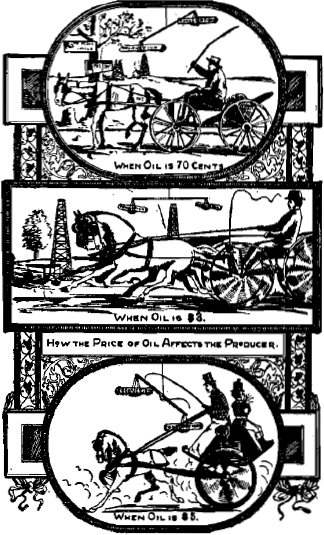
STAGES IN THE VARYING FORTUNES OF THE OIL PRODUCERS.
(From McLauren’s Sketches in Crude Oil)
As for the oil well owners and operators, they were inefficient and wasteful, ignorant, and utterly oblivious of the problems in industry produced by a wholly new set of conditions. They wanted five dollars a barrel for their oil, a price based on the production costs of the most inefficient operator by the most antiquated and wasteful methods plus an indefensible profit. “The profit which men in trade all over the country were glad to get,” said Ida Tarbell, who had a profound sympathy for them, “the oil producer despised.” They clamored for all sorts of help save self-help. They despised Rockefeller because he appeared on the scene with a perfect respect for all the little things of the business, the little wastes and leaks which they ignored and because he had brought into industry a machine for doing his part of the business which was the most perfect yet produced in the annals of business. They called for laws, more laws. At St. Petersburg they met and resolved “that to give a wider market throughout the world to petroleum, to enhance its price” a committee be appointed “to ask foreign governments to put a proper tariff on refined oil and to admit crude oil free.” This is the only instance known of American business men actually petitioning foreign governments to erect a tariff wall against American goods.
To keep the price of crude oil up to American consumers these producers who denounced monopoly now proposed to organize a producers’ monopoly, a step which under the laws of today would get them all indicted. The leading spirit in this organization of the Producers’ Association was Captain William Hasson, who represented in his character the strength and weakness of the old school as Mr. Rockefeller represented the strength and weakness of the new. In their aims and principles these two men were as far apart as the poles. Captain Hasson was one of the few old Creek settlers who rose to the new opportunities. He was born on a farm at the mouth of Oil Creek which had once belonged to the great Indian Chief Cornplanter. When Drake struck oil Hasson’s father sold 300 acres of this land for $750,000. There the son saw Oil City rise. He had headed the Producers’ Association which had defeated the “Anaconda.” Now he revived it to fight the new “Anaconda”—Overproduction. The price of oil sank steadily. In December, 1872, it was $4.55 a barrel. By February, 1873, it was $2.12. Tanks in the regions overflowed. Hasson’s association got an agreement among producers and drillers to sink no new wells for six months. They formed a vigilance committee to enforce the agreement. Groups of men patrolled the country at night to punish offenders. Despite all this production increased. Then they decided on a thirty-day shutdown of all flowing wells. In ten days not a barrel of oil was being pumped. Silence fell over the regions. Then Hasson formed the Petroleum Producers’ Association with a million dollars authorized capital. Stock at $100 a share was limited to oil men and their friends. It proposed to buy all oil produced at $5 a barrel, to pay cash if possible, if not to pay $3 cash and the balance when the oil was marketed. This move was noted away from the regions. “It is an attempt,” said the New York Herald, September 9th, 1873, “to force oil to high prices for the public; the consumers are likely to take a hand in the matter and use their effort to frustrate the design and intent of the shutdown movement by refusing to pay the advanced price.” Rockefeller was building a monopoly based on efficient and economical operation, the only excuse for monopoly. Hasson was attempting a monopoly built upon a continuance of waste and extravagance. The public seemed to have a choice between the monopoly of Rockefeller and a few dozen refiners on the one hand and Hasson and a few hundred producers on the other. Hasson’s combination was not a defensive one against Rockefeller, as has been supposed. It was an offensive one against the public.
At this point Rockefeller came forward representing his National Refiners’ Association and signed a contract with Hasson to buy 200,000 barrels of oil from the Producers’ Association. A sliding price scale was fixed. When refined oil sold for 26 cents a gallon Rockefeller was to pay $4 a barrel for crude. For every cent refined rose the price of crude was to be advanced 25 cents until it reached $5. The refiners pledged themselves to admit every existing refiner to their combination. The producers pledged themselves to admit all producers, existing or newcomers. The Derrick called this an “unholy alliance.” It called attention to the limitation in the refiners’ agreement to admit only existing refiners. It opposed the treaty. So did Captain Hasson. They predicted it would fail. And it did fail. Before Rockefeller had gotten 50,000 of his first 200,000 barrels he notified the Producers’ Association that he would exercise his right to cancel the treaty. Again the producers denounced him. Yet what he did was perfectly proper. He would have been a madman to have acted otherwise. The producers had agreed to stop the drill and limit the output to 15,000 barrels a day. Instead the regions proceeded immediately to produce 5,000 barrels a day more than was required by the market. The guaranteed price stimulated production. Independent refiners were buying oil for $2.50. Why should Rockefeller go on paying $4? He had reserved the right to cancel and he used that right. The Producers’ Association blew up. A few months later, as already pointed out, Rockefeller dissolved the National Refiners’ Association and took his stand upon the historic conclusion that henceforth he would consolidate the refining interest by absorbing it rather than by entering into a voluntary association with it.
CHAPTER III. BUILDING STANDARD OILFOR THE next year Rockefeller devoted himself to building and strengthening his own organization from within. The times were troublous. The nation had been racing through one of the most feverish orgies of financial and public corruption and social extravagance in its history. Suddenly on September 18th, 1873, the great banking house of Jay Cooke and Company in Philadelphia closed its doors. It had been caught in the wreckage of the Northern Pacific scandal. A wave of fright ran through the whole business world. The New York Stock Exchange, for the first time in its history, closed its doors. The great panic of 1873 was on. All over the country business men talked in excited gestures of the great disaster. Stocks and bonds fell to ridiculous figures. Banking houses, brokerage houses, like Henry Clews and Company, manufacturies went into bankruptcy.
Grain rotted at the sides of railroad tracks. Ships laden with wheat stood idle in New York harbor. Banks quit paying in currency. Scores of thousands were thrown out of work. Rumors of railroad wrecks filled the air. The oil towns read with a mixture of pleasure and fear that Thomas Scott, master of the Pennsylvania Railroad and of Pennsylvania, had had his notes go to protest. Bread lines formed in all cities. Collections were taken in the churches for the needy. In Cleveland every day brought news of new failures. Some 200 business houses closed their doors there in a short time. Rockefeller, with notes for great sums in every bank, kept close to his books.
Into the small three-room office of the Standard his tall figure appears noiselessly. Silence falls on the whole shop as his silk hat and frock coat are framed in the doorway.
“Good morning, gentlemen,” he greets his office with the most meticulous formality. The bookkeeper slides from his high stool and pretends to work at a desk. Rockefeller mounts the stool, looks diligently over the ledgers, turning pages with a grave scrutiny. Then he lapses into thought and gazes out the window without seeing for fifteen minutes, before he slides down from his stool and goes into his private office.
Out of the fever of the depression rose all sort of agitations—labor leaders, socialists, anarchists, apostles of new cults, prophets of doom and of judgment. Among them Cleveland saw the most violent crusade the country had ever known against liquor. It was backed by the church people, though Rockefeller’s Euclid Avenue Baptist Church took no part. But the movement swirled all around him and his office. A clergyman and a group of women assembled in front of the old Star Church and marched to Richards and Company, a saloon near Rockefeller’s office in the Public Square. The women knelt on the sidewalk, prayed, and sang, “Nearer, My God, to Thee,” entered the saloon, knelt on the floor, and read from the Scriptures. They went from saloon to saloon, calling on the proprietors to sign the pledge. Crowds growing in disorder followed them. One saloonkeeper followed with a buggy and beer kegs, passing out free beer. The women attacked their tormentors who returned the attack. For thirty days Cleveland was in a turmoil over this crusade. Rockefeller saw it rise with disapproval. He hated liquor, hoped to see the day when it would be extinguished. But he hated disorder too. And this was disorder.
The oil industry fell amid the depths. The Creek producers who had plotted for five-dollar crude saw it decline to two dollars and then to eighty-two cents a barrel. Refined oil which had sold for 22 to 26 cents in 1872 sagged to around 13 to 16 cents a gallon. The whole nation had sunk down exhausted at the end of its orgy.
II
STRONG men feed on depressions. Rockefeller now nailed down two important advantages for himself. He had been shipping his oil in tank cars over the New York Central to Hunter’s Point, Long Island. There it was put into barrels for shipment to eastern points. The barrels were made there in his own cooperage.
The Erie Road had a similar plant at Weehawken, New Jersey. They called on Rockefeller to get some of his Eastern shipments.
“Why,” said the plausible Mr. Rockefeller, “should I ship oil to your plant at Weehawken when I have my own plant at Hunter’s Point? However, we will give you a portion of our oil if you will turn over your Weehawken plant to us so we can handle our own barreling and shipping.”
“But,” said the railroad, “what will we do about the oil of our other shippers which we now handle at that plant?”
“That will be quite simple,” Mr. Rockefeller explained. “We will do the work for all other shippers. We will make the same charge you now make and out of the profit pay you a profit of ten cents on each barrel.”
The Erie agreed and the Standard took over the Weehawken plant, thus controlling the terminal facilities of two railroads in New York. Now see the profound shrewdness of this move. Every barrel of oil shipped east by his rivals passed into his hands at Weehawken. Thus he came into possession of full information about the volume, character, and destination of their sales.
This led to the second advantage which he now obtained. The Erie deal produced irritation among the Central and Pennsylvania chiefs. A new rate war threatened. Col. Joseph Potts of the Empire Transportation Company, a Pennsylvania subsidiary, now interposed a friendly voice. We shall hear more of this Col. Potts. Now he warned the roads against another costly war and induced them to hold a conference to agree on some partition of the oil business among them. Rockefeller knew everything that went on behind the scenes and at once saw his chance.
We have seen how he feared the oil regions. He had to haul crude oil to Cleveland and then ship refined oil over a longer haul to New York. Now he saw his opportunity to wipe out this geographical advantage. While they were pondering Col. Potts’ suggestion, Rockefeller appeared with the very same proposal. But he had another tucked away in it. He proposed that freight on refined oil to the east be the same no matter where the shipment started from. The suggestion was well baited. The rate on kerosene from Cleveland to New York was $2. From the regions it was $1.50. He urged that the rate on the regions be raised to $2, which suited the roads. It was no more than just, he argued, as that would put all shipping points upon a just equality. But there was another little item in the plan. Before he could ship kerosene to New York he had to haul crude oil from the oil wells to Cleveland. That cost 50 cents a barrel and was a heavy handicap against him. He now proposed, to perfect this equality he talked of, that the railroads should practically haul crude oil from the regions to any refining point free. That is, he suggested that on every barrel of refined oil he shipped east he should have returned to him the freight he had paid on the crude needed to make that much refined oil. It took seven barrels of crude to make five barrels of kerosene. On every five barrels of kerosene shipped to New York he would have returned to him the freight he had paid on seven barrels of crude to Cleveland. The principle was to apply to every refining point. Thus the whole advantage enjoyed by the oil regions was wiped out at a blow. He was able to apply pressure to the roads at two points. First he threatened to move his oil industry away from Cleveland to the Creek. This forced the Central into line. Next he proposed that he would divide his shipment among all roads. Without Rockefeller it would not be possible to carry out an agreement for division of freight.
The new rate was announced for September, 1874. It was received in the oil towns with a growl of indignation. What strikes the observer, however, is the mildness of this outburst compared with former blasts. There was no public meeting—just a general grumbling. A group of twenty-eight producers met at Parker’s Landing and protested. But, after all, the rates applied to the refiners, not the producers, and the refiners seemed too languid to act. There was no leadership and the rank and file were discouraged by their many “victories” from which this indomitable defeated man seemed always to rise with the prize.
III
WITH these new parts added to his machine, Rockefeller was now ready for his grand design. At the same time an event occurred which moved him mightily. To his house, with its three daughters, a son was born. “Always a John in the Rockefeller family,” his father had said as he walked through the night with his own mother when the great oil man lay in his cradle on Michigan Hill. Now the next generation of Rockefellers was provided with its John—John Davison Rockefeller, Jr.
CHAPTER IV. THE GRAND DESIGNROCKEFELLER had an almost absolute monopoly of the oil business in his territory—Cleveland and the West. His business was in perfect order, almost completely integrated. He had wiped out the geographical advantage of the oil regions. He owned the eastern terminal facilities of two railroads and thus had an eye to the keyhole of his competitors. He had Flagler, Andrews, Payne, William Rockefeller, and Jabez Bostwick. But there remained outside a group of men of great ability—Charles H. Pratt and Henry H. Rogers of New York, John D. Archbold and Jacob J. Vandergrift of the regions, W. G. Warden of Philadelphia, Charles Lockhart of Pittsburgh. Now if he could bring all these men into a combination with himself at the head, a single, unified extension of the Standard Oil Company, which would do in New York, the regions, Philadelphia, and Pittsburgh what he had done in Cleveland, the oil industry of the nation would be in his hands. As organized at the time the refining interest of the country was distributed about as follows: New York, 15 refiners; Philadelphia, 12; Pittsburgh, 22; the oil regions, 27. There were some others in Baltimore, Erie, Boston, and a few other places. In Cleveland, of course, Rockefeller was supreme. He determined to bring all these into the Standard.
He began with Warden of Philadelphia and Lockhart of Pittsburgh. Lockhart, a Scotchman, was one of the foremost men in the industry. A successful merchant in Pittsburgh, he had seen a commercial use for oil as early as 1852. He was perhaps the first Pittsburgher, after Dr. Samuel Kier, to buy oil when Drake made his strike. He organized one of the first Pittsburgh refineries—Phillips, Frew & Company. He was the first American to sell oil in Europe. He went abroad with samples in 1860 and set in motion the vast export trade which was the chief support of his business. In 1865 he established a Philadelphia branch—Warden, Frew and Company, and this firm built the Atlantic Refinery, the beginning of the Atlantic Refining Company, the great Standard Oil concern of Pennsylvania. Thus Warden was Lockhart’s partner and together they were the most powerful figures in Philadelphia and Pittsburgh. Rockefeller and Flagler pressed the plan on Lockhart and Warden. Rockefeller proposed first that Warden and Lockhart should come into the Standard—turn over their plants, take Standard stock in payment, and become Standard directors. He would induce Vandergrift, Pratt and Rogers, and Archbold to join on the same terms. Next he proposed that in each city these leaders would begin the acquisition of their smaller rivals as he had done in Cleveland. They would go frankly to those with whom they felt they could make an open offer to buy. In addition he suggested that an association be formed to be known as the Central, of which he would be president. Where caution was necessary this association should invite independent refiners to join as members. This would be a blind for ultimate absorption into the Standard. Lockhart was reluctant as was Warden. Warden, as an officer of the South Improvement Company, had borne the brunt of the heckling and probing at that time. Both were in the Refiners’ Association. They were weary of the turmoil and brawling and struggle and wanted to go along in peace. The long beards which hung beneath their shaven lips were growing white. But Rockefeller was relentless. He pressed the argument with all the power of his shrewd and canny mind. During this period it was Rockefeller whose persuasive and overmastering plausibility in face-to-face argument was always used in great moments. But Warden and Lockhart were cautious. They visited Cleveland. They had their accountant go over the records of the Standard Oil Company. Both men had doubted Rockefeller’s claims as to the price at which he could make kerosene. They asserted they were making it as cheaply as it could be done. But after weeks of examination and comparisons they learned to their amazement that Rockefeller was making kerosene so cheap that he could sell it to them at a profit at a price below their own costs. Rockefeller was making money. They were not. So they decided to go in with him.
Rockefeller and Flagler then went to New York where they got Pratt and Rogers and Archbold and Vandergrift to come into the plan. This was in the summer of 1874.
No time was lost reorganizing the Standard Oil Company, increasing its capital stock to absorb its new members and adding to its board that extraordinary group of men who were henceforth to direct its destinies. All the leadership in the oil industry was in that group—outside there was no leadership. Rockefeller had literally raided the oil business and confiscated all its brains.
The Standard Oil Company has always been spoken of as a combination of capital. It was that, but, far more important, it was a combination of brains. That was Rockefeller’s great design. It was not an accident that a board of directors should have included so many brilliant business men. They did not just happen to come together. They were deliberately handpicked by a master assayist of human ability and put together cunningly, and in accordance with a plan. Moreover as fast as the Standard or its new leaders bought up an independent plant, the personnel of that plant was picked over for its best men to be retained in the combination.
Of course, all this was carried on behind the most profound secrecy. The public learned nothing of it all until the Spring of 1875. Then the New York Tribune, which always kept a sharp eye on the oil business, reported that an attempt to reorganize the refiners’ association was being made through the Central Association with New York men as prime movers. A month later it warned of an attempt to “rehabilitate the South Improvement Company.” It sent reporters to the oil men in Broad Street. Most of them thought the new plan would fail—the oil business was too big for any one man or group to control. What was actually being done was not yet suspected.
Meantime, in Pittsburgh Lockhart had been at work. He formed the Standard Oil Company of Pittsburgh with himself, Frew, Warden, Bushnell, and Flagler as directors. Thus his alliance with Rockefeller became known. He began buying and leasing his rivals. As in Cleveland the weak sisters quit with surprising facility. Some held out, but pressure was applied through railroads and pipe lines. Independent refiners could not get cars. Rates were rigged against them. They tried carrying oil by barges, but the pipe lines refused to run oil to the barges. Railroads refused to accept oil brought by barges. Lockhart bought his first competitor in 1875. By 1877 he had acquired his last. Two years later there was but one refiner in Pittsburgh who held out, of all the twenty-two in existence when Lockhart began. The Standard now had Cleveland and Pittsburgh.
In Titusville, John D. Archbold, the fiery young crusader against Rockefeller, appeared one day. He organized a new company—the Acme. Its ownership by the Standard was secret. But it began buying rivals. Archbold, destined to become one of the most ruthless of the Standard chiefs, used the well-tried Standard methods of persuasion. In three years the Acme had all the region plants. Two refineries remained—the Acme and the Imperial—and the Standard owned them both.
In New York, Henry H. Rogers was at work buying up the competitors of Charles Pratt and Company. He got many. But many held out. Here a real battle of the independents was threatened. When suddenly in the midst of these operations a new battle was precipitated—one of the most spectacular and dangerous ever waged by Rockefeller—the battle which was to put upon him for all time the mark of unconquerability.
CHAPTER V. THE BATTLE WITH THE EMPIREROCKEFELLER’S battles hitherto had been against smaller rivals and disorganized producers. He was now to lock horns with an antagonist worthy of his steel, more powerful even than he, backed by money, political influence, and the moral support of a whole industry. This was the powerful Pennsylvania Railroad under the leadership of the resourceful Tom Scott. To understand this contest, however, one must know the story of the pipes.
I
THE FIRST carriers of oil were the teamsters, to be succeeded quite early by the pipe lines. The two pioneers in this field were Van Syckle and Harley. Van Syckle early ran into the tyranny of the teamsters and built his first pipe line to defy them. Armed guards had to be used to protect the pipes from the infuriated teamsters. But by the industry as a whole the innovation was hailed as the greatest thing since Drake’s well. It was not long before Henry Harley was running oil seven miles from Pithole Creek to the Island well through the pipes of his Pennsylvania Transportation Company. Others began to operate—chiefly Col. Joseph Potts and Captain J. J. Vandergrift. And so the earliest pipe line promoters were Van Syckle, Harley, Vandergrift, and Potts. At first they merely piped oil from the wells to the railroads and Creek refineries, making one of the first great cuts in the cost of producing oil. They were in incessant war with the teamsters. In 1866 we find Harley calling on the governor to protect his pipes. The lines were cut, railroad cars burned, tanks set on fire, and an occasional teamster shot by the guards. Here was the perennial fight of the older order against the new.
By 1872 the Empire Transportation Company of Col. Potts and the Pennsylvania Transportation Company of Henry Harley began taking over the smaller lines. Thus the process of absorption which Rockefeller was carrying on among the refiners of Cleveland was going on among the pipe line companies of the oil regions. By this time the pipes were the one great gatherer of the regions and they had come pretty much under control of the railroads. Jay Gould had seen Harley, who was a civil engineer, a graduate of Troy Polytechnique Institute, had picked him as an able manager, and had bought a controlling interest in his Pennsylvania Transportation Company in 1868, making him general oil agent for the Erie. Joseph D. Potts was engaged in the early sixties to unify the freight services of the Pennsylvania Railroad and this led him to the pipe lines as the natural auxiliaries of the roads. He induced the Pennsylvania to buy Van Syckle’s pipe line to Pithole. Potts was the first to issue pipe line certificates for credit balances of oil, a form of paper which was to become almost the same as currency in the regions. Thus his Empire Transportation Company and his lines were owned by the Pennsylvania.
Vandergrift got into the pipe line business when his partner became the receiver of the Oil City and Pithole Railroad. He laid pipes from West Pithole to Pithole to get his oil to the road. This he called the Star Pipe Line. He built other pipe lines until they became so numerous that he combined them all under the name of the United Pipe Lines. These three men therefore—Harley, Potts, and Vandergrift—dominated the situation in 1872.
There was still another figure. He was Daniel O’Day, a Clare County Irishman, who had been raised on a New York farm, had begun work as a freight handler and later was employed by Bostwick and Tilford as an oil buyer. This firm in reality belonged to the Standard and because of his Standard Oil connections, O’Day was almost mobbed during the 1872 oil war. After that war, Rockefeller decided he would have to have pipe lines of his own. Accordingly Bostwick commissioned O’Day to build a small line as a starter which was called the American Pipe Line. O’Day soon extended this to some 80 miles and then in 1875 ran his pipes into Bradford County. In 1874 Rockefeller bought a third interest in Vandergrift’s United Pipe Lines and in two years, with the development of O’Day’s lines, the Standard owned 40 per cent of the pipes of the regions.
Around 1874 there appeared another picturesque character, Dr. David Hostetter, the maker of Hostetter Bitters. He believed he could pipe oil to Pittsburgh, connect there with the Baltimore and Ohio Railroad and ship it to Baltimore. The B. & O. decided to make Baltimore the chief refining center, and cut its rates. In 1874 Philadelphia exported over 94,000 barrels of oil, Baltimore, 3,315. In a year Philadelphia exported 33,550, Baltimore 35,331. Hostetter, thus encouraged, formed the Columbia Conduit Company. He laid his pipes to within a few miles of the B. & O. tracks when he came to a point where he had to put his pipes under the Pennsylvania tracks. The Pennsylvania ran over a bridge at that point spanning a creek. Hostetter claimed he had bought the bed of the creek and put his pipes down. Next day Tom Scott sent a crew of men, tore up the pipes, and fortified their position. Oil producers, rallying to Hostetter’s aid, marched in a body on the creek and drove off the defenders. The Pennsylvania force then returned with a sheriff and an armed posse and arrested thirty of the oil men for riot. None of the arrested men was tried. But a long litigation followed which disgusted Hostetter. He leased his line to three young men—B. D. Benson, David McKelvey, and Major Robert E. Hopkins of Titusville. They ran their oil to the bridge, pumped it into tank wagons, drove it over the tracks, and repiped it to Pittsburgh.
Thus the matter stood in 1876 when Rockefeller’s great combination was moving toward completion. As already pointed out all the refineries of Cleveland and Pittsburgh and most of those in other places had been bought by Rockefeller. The last stand of the independents was in New York. At this point came the battle to which we have already alluded—the greatest of Rockefeller’s career, the one which was to test his mettle as a militant general and which was to establish him finally at the goal he had set for himself—to be the absolute master of the oil industry of the world.
II
ONE MAN who looked upon the swift extinction of these independents with growing dismay was Col. Joseph D. Potts, of the Empire Transportation Company. If Rockefeller should succeed in getting all refineries in his grasp, the Pennsylvania Railroad Company and the Empire would be at his mercy. He could dictate rates and even drive the Empire out of business by merely withholding oil. With these fears in his heart Col. Potts went to Tom Scott, president, and Benjamin Cassatt, vice-president, of the Pennsylvania with a proposal that was to have far-reaching results. The only hope, argued Potts, for the Empire was to establish its own refineries as a guarantee of business for its pipes.
One day in New York Henry H. Rogers, busy gathering up his enfeebled rivals, learned with surprise that a New York refinery had sold out to Potts. Almost at the same time Lockhart in Philadelphia discovered that Potts had bought a refinery there. The two together had a capacity of 4,000 barrels a day. What did this mean? Rogers and Lockhart got in touch with Rockefeller. Was the Empire Transportation Company about to go into the refining business? Was the Pennsylvania Railroad to become a refiner of oil? Could it be that at the very moment when their grandiose plans were flowering so beautifully that so powerful and rich a corporation, backed by the puissant Tom Scott, who carried the Pennsylvania legislature in his pocket, was preparing to throw down the gage of battle to them?
In the presence of such a threat Rockefeller acted with that swiftness and resoluteness which characterized all his moves in a crisis. As he had hurried across the public square to Col. Payne four years before, he now went directly to Tom Scott and Cassatt. He protested. This was unfair. The Pennsylvania Railroad was a carrier. It had no business in the refining field. The Empire was a transportation company. It had no business manufacturing kerosene. Mr. Scott might have answered very pat that the Standard Oil Company was a refiner and had no business in the pipe line field. If he had Mr. Rockefeller would have been ready with his answer—the Standard owned no pipe lines. He always protested as much. Scott and Cassatt, however, stood their ground. Very well, said Rockefeller, it was most unfortunate, but the Standard Oil Company must take its own measures. Here was the threat of war—a threat with iron in it concealed under the air of sanctimonious regret with which it was uttered. The news leaked out among rail leaders. Vanderbilt of the Central, Jewett of the Erie, hurried to Scott. They urged Scott to recede. After all, this was not a fair form of railroad war. Rockefeller again urged Scott to reconsider his decision. A war would be so costly to every one and yet there seemed no other way unless Mr. Scott decided to take his railroad out of the refining business. This time Rockefeller, a persuasive negotiator, made an impression on Cassatt. Cassatt went to Potts. He pictured to Potts the alternative to surrender. It meant war—war with an antagonist who had hitherto proved himself indomitable, war that would cost millions. He urged Potts to sell the refineries or at least lease them to Rockefeller. But Potts was adamant. The man was one of those who hated with all the fury of his Presbyterian soul the new era of corporate industry for which Rockefeller stood. He could grow eloquent as a preacher talking of it. And so Scott had to tell Rockefeller that they had decided not to yield.
That settled the matter. It was war and Rockefeller immediately summoned around him all those brilliant and resourceful men he had been so patiently recruiting. Almost at the same time he sent word to the New York Central and the Erie that he expected them to stand with him in the coming battle. Then he struck his first blow immediately. He cut the price of kerosene in every market where Potts’ refineries sold their kerosene.
But Potts too was a resolute and resourceful foe. He was also a man of imagination, inflamed now by what seemed a kind of providential commission to strike the thing he hated so much. He went out at once to organize the independent oil refiners. He moved also to bring the oil producers to his side. He began to build a large refining interest. Before long he had more refineries, tank cars, ships, wharves, and barges—the whole paraphernalia of a vast manufacturing and distributing machine. Here was the foe Rockefeller feared. Here was the man of imagination and brains who was not brought into his combination—the man of brains backed by great wealth, a great railroad, the sentiment of the unconquered portion of the industry, and the political power of the state. Here was a threat which must be met without ruth and without quarter or all his great dreams would crumble like a house of cards.
In reply to the cutting of rates on the Central and the Erie the Pennsylvania also cut its rates and it did so with a vengeance. Cassatt admitted later that the road paid back in rebates in some cases more than it received in freight. In one case it carried oil to New York at eight cents a barrel less than nothing. In other words, it actually paid men for the privilege of hauling their oil.
Potts was busy everywhere. At some stations his famous green cars were cheered. Men looked at them roll by as they would army trucks going into action. He himself worked feverishly to unite all independents in a powerful defensive combination. It was not easy. They were weak sisters and Rockefeller’s ruthless price cutting wherever they had a footing produced consternation among them. The refiners lost vast sums. Scott and Cassatt became a little alarmed when they saw the huge losses inflicted on their road. Then a heavy blow fell on them.
The element of luck cannot be said to have played a very decisive and controlling part in the achievements of John D. Rockefeller. But now Fate struck a blow on his side. In July the Baltimore and Ohio Railroad ordered a ten per cent wage cut and its engineers and firemen walked out. At Martinsburg they drove strike breakers from their locomotives. Governor Carroll called out the militia and rioting followed in which thirty or forty persons were wounded and about nine killed. Four years before the Pennsylvania had cut wages ten per cent. In June Scott ordered another ten per cent reduction. In spite of much grumbling the reduction was accepted. Then in July, while disorder paralyzed the B. and O., the Pennsylvania increased the length of its freight trains from eighteen to thirty-six cars without increasing its crews. The trainmen walked out and in a few days there was a general railroad strike throughout the East. Mobs attacked and destroyed Pennsylvania Railroad property in Pittsburgh. Governor Hartranft sent troops from Philadelphia and a pitched battle was fought at the roundhouse, soldiers killing twenty, wounding thirty (three children) on the first volley. A wave of anger and horror swept over the country. The soldiers were driven into the roundhouse and the strikers sent in after them cars of blazing whiskey and oil. The roundhouse was burned and with it the union depot, grain elevators, Adams Express, and other buildings. Governor Hartranft personally led 3,000 troops to Pittsburgh to compel peace. He succeeded but not until twenty-five people were killed and 1,383 cars, 104 locomotives, and 66 passenger coaches burned.
The losses to the Pennsylvania Railroad were appalling. Scott and Cassatt were almost crushed. For the first time in its history the road had to pass its dividend. Its stock fell to 27. Scott, Cassatt, and Potts looked at their powerful enemy and saw him prospering in spite of the battle. The Standard made money everywhere. Potts’ independents were facing bankruptcy. Everywhere they pressed for business there was a Standard agent and as fast as Potts cut the price of kerosene, the Standard cut lower.
In August Scott and Cassatt called on Rockefeller. They had decided to sue for peace and they had to go to Mr. Rockefeller with their hats in their hands. They went to Cleveland and to Rockefeller, Flagler, and Warden and declared they were ready to give up the fight. Rockefeller made his terms. The Empire Company must give up its refineries to the Standard Oil Company. Scott and Cassatt returned to Philadelphia to break the news to Potts. That heroic warrior was almost frantic with disappointment and rage. He refused to surrender. Thereupon Scott informed him mournfully that the Pennsylvania Railroad had a contract under which it could buy the entire Empire plant at any time. The road, he now announced, formally exercised that option. The blow fell on Potts with crushing force. News of these negotiations got out and financial, oil, and business circles buzzed with rumors. Later Rockefeller and Flagler went to Philadelphia for Scott’s answer. It was ready. The Pennsylvania would exercise its option to buy the Empire. It would turn the refineries over to the Standard. The railroad did not want the pipe lines. So Mr. Rockefeller replied that he would take the pipe lines too and the railroad might have the cars.
The final agreement was reached in October and on the seventeenth of that month the entire business which Potts had reared—refineries, pipe lines, tanks, wharves, ships, everything—were handed over to Mr. John D. Rockefeller. That victorious gentleman was not present in person to receive them. But in Potts’ office in Girard Street, at midnight, William Rockefeller, Flagler, Lockhart, Pratt, Bostwick, Daniel O’Day, and J. J. Vandergrift and their counsel received the sword of the defeated Potts. The purchase price was $3,400,000 and the Standard envoys handed over to Col. Potts a check for $2,500,000 as the cash payment. As John D.’s victorious plenipotentiaries filed out into the night Col. Potts found himself in his office alone. The strong jaw muscles under his close-cropped beard tightened, the shaven upper lip pressed down, his arms spread out before him on his desk, his head sank on his arms and he wept. In Cleveland at his Euclid Avenue home, Mr. Rockefeller got a wire announcing completion of the surrender. His prayer of thanksgiving that night must have been more than usually fervent. Had not the Lord God of Abraham, who had divided the Red Sea to drown the Egyptians and covered the land with locusts and sent a murrain upon the horses of Pharaoh, now sent a general strike to confound his enemies?
“I have pursued mine enemies and overtaken them; neither did I turn until they were consumed.”
III
WHEN the news of this disaster to the powerful Pennsylvania Railroad reached the oil trade a tremor of despair ran through it. Men talked as if all were over. The Empire pipe lines were added to the others in Vandergrift’s system and all combined into one great system, called the United Pipe Lines. As soon as Dr. Hostetter heard the news he hurried to Rockefeller with an offer to sell. Rockefeller took the Columbia Conduit Company and so by the end of the year 1878 he had the entire pipe line business in his hands.
At the same time he brought the railroads together in a new oil freight pool. This time the Baltimore and Ohio came in with the Pennsylvania, the Erie, and the Central. The Pennsylvania got a guarantee of 21 per cent of the traffic to New York and 26 per cent to Philadelphia.
Rebates and drawbacks were not overlooked in this new deal. A rebate of 10 cents a barrel was reserved for all Rockefeller oil. On the side he forced from the Erie an agreement for a drawback of 20 cents a barrel on all oil shipped by competitors. There were still a few scattered operators and this provision was for the purpose of keeping the opposition weak and helpless. In February, 1879, Rockefeller demanded the same drawback from the Pennsylvania. The demand was made by O’Day upon Cassatt in a letter. Cassatt at first demurred. But O’Day exhibited receipted bills from the Erie proving his claim. O’Day did not request. He demanded. And Cassatt agreed.
The refiners, chiefly in New York, who had held out on the hope of Potts’ success, now collapsed. In New York they went directly into Rockefeller’s bag. In Baltimore they were gathered into a new company called the Baltimore United Oil Company of which J. N. Camden was made president. He had been the head of the Camden Consolidated Company of Parkersburg, West Virginia, a Standard ally.
As 1878 dawned Rockefeller’s ambition was realized. The entire oil business of America—refining and gathering—was in his hands, the most complete monopoly that had yet been built in American industry.
2Senator Hanna’s wife, after his death, referring to this remark said: “My husband was such an admirer of Mr. Rockefeller that I cannot believe he ever thought such a thing, much less said it. If he had thought it, I am sure he would have said something to me about it.”
- 1The Rockefeller family insists that the elder William Rockefeller went to Richford with his family and that the story given here is not true.
- 2Thus William Avery Rockefeller, the father of John D. Rockefeller, arrived in Richford. When he got to his mother’s home he continued to use his slate to the great distress of the whole family. When his joke had gone far enough he broke into a loud laugh and announced that he intended to live in Richford.

