
God’s Gold
Part Eight: Mountains of Hate

AS ROCKEFELLER walked out of 26 Broadway he left his great company in the hands of the men who had begun by fighting him. John D. Archbold, vice-president, became the executive head.
Archbold was a little fellow with a large head and in almost all things the faithful imitator of his great chief. He looked like a preacher. He was a good Baptist and a church trustee. Rockefeller had his University of Chicago and his Dr. Harper. Archbold had his Syracuse University and his notorious Chancellor Day. But there were points of difference. He was an extravagant talker, a truculent battler, full of terrible threats, aflame with righteous indignation, a blustering bluffer with a sharp tongue and a willingness to use it. He believed his side was wholly right and his enemies all scoundrels and blackmailers. He liked a good story and could tell one, loved a game of poker, and was a most ingratiating gentleman in the presence of the ladies.
Many supposed Henry H. Rogers to be the new master mind of Standard Oil. He was as different from Archbold as men could well be. The two hated each other. John D. himself leaned towards the pious and willing servitor, Archbold. Rockefeller for years had a direct wire to Archbold’s office and kept that functionary on the griddle. But upon the imperious and profane Rogers he looked with a suspicious eye.
Rogers was a gambler. As a newsboy at fourteen he got his batch of papers one morning in Fairhaven and saw that the packet boat had gone down out of Boston with 500 barrels of sperm oil consigned to a local dealer. Rogers hurried to the dealer and proposed to sell him all his papers, thus suppressing in Fairhaven news of the disaster and allowing the dealer to hurry around and buy up and corner the limited supplies of sperm oil, provided the dealer would let him in on the deal to the extent of his $200 savings. The shrewd Yankee whale oil man saw the possibilities instantly, bought all the papers, destroyed them, rushed around and cornered all the oil in Fairhaven and in a single day made a profit which more than trebled young Rogers’ $200 investment. This exhibition of brains resulted in a recommendation to Charles Pratt in New York, then looking for a smart boy. He got one.
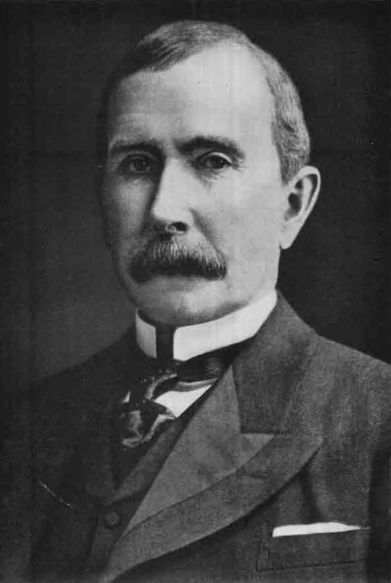
MR. JOHN D. ROCKEFELLER IN 1888.
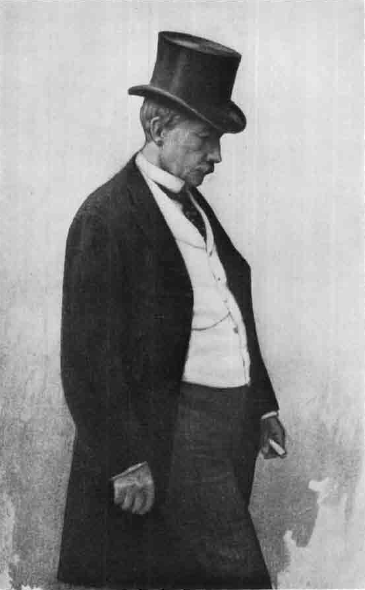
JOHN D. ROCKEFELLER.
From a photograph taken at Chicago University in 1900
Rogers was a magnificent and commanding figure, with a gaze which all agreed was the most terrifying in Wall Street. He looked with scorn upon lesser men and critics. “We will see Standard Oil in hell,” he thundered, “before we will let any set of men tell us how to run our business.” His cronies were Tom Reed and the unregenerate Mark Twain. Men said of him that like the moon he had a bright and a dark side. Among his family and friends he was gentle, generous, warm-hearted. When he crossed the threshold of 26 Broadway the iron and acid in his nature took dominion. His hand was always in a dozen daring enterprises. Mystery and intrigue dwelt in his offices—a series of separated rooms where visitors never saw each other.
His philanthropies were utterly unlike Rockefeller’s. Individual and present suffering did not interest Rockefeller. He dealt with human weakness in the abstract. Archbold, son of the oil regions, made his gifts to Syracuse University. Rogers, son of New England, pensioned Drake and built a hospital and nursing home for the men of the oil regions. He gave to men and women, not to causes. He read and laughed uproariously at Mark Twain’s “Innocents Abroad.” “If I ever meet that man I’d like to do something for him,” he said. One day in the Murray Hill Hotel Dr. Clarence C. Rice introduced him to Mark Twain, who at the time was crushed under the weight of the Webster failure. Rogers invited him to his home, took over his affairs, and brought him back to solvency. He did it with infinite delicacy. He gave to Clemens not his money but his time, let him go into bankruptcy, attended creditors’ meetings, spending hours and days discussing little bills, all of which he could have wiped out with a pen stroke, then managed Clemens’ productions until the bedeviled author came through on his own exertions and with his pride intact.
Rogers found himself in communion with William Rockefeller as John D. fraternized with Archbold. William now held the purse strings of Standard Oil. Because he did he held numerous directorships on financial institutions. He too was an audacious and unscrupulous speculator. There was, however, no serious conflict between Rogers and Archbold. The latter managed the vast physical structure of the oil industry. Rogers, supported by William Rockefeller, commanded in the expansion and operation of the funds of the Standard Oil leaders in their numerous and complicated investments outside of oil.
Ida Tarbell, who was to deliver very soon a devastating blow to Rockefeller’s trust, liked Henry H. Rogers. She saw much of him when preparing her attack on Standard Oil. “He was a pirate,” she said, “but he was not a hypocrite. He flew his black flag.” He said to her in 1906, “I am not a favorite here. I am always for fighting. Mr. Rockefeller is always against fighting. I am a gambler. Mr. Rockefeller does not like gambling. He hates the market. I love it. Every now and then John W. Gates will come here and say: ‘Henry, don’t you think it’s time we had a little fun in the market?’ I was always for it and we made lots of killings and had plenty of fun. I must have action. And on Saturday afternoons when the market is closed I’ve got to have a poker game.”
Old Charles Pratt was dead. Stephen V. Harkness was dead. Flagler, oldest of them all, had really ceased to take an active part in the company’s affairs. As early as 1877 he had visited Florida, fallen in love with it and, afire with virility and energy, set about building it into an American Riviera. Now, his mind was engrossed with that. When he was seventy-one he was named co-respondent in a divorce action in Syracuse, a circumstance which caused his younger partner, nursing at Pocantico a refractory stomach, to shake his head mournfully. A few months later Flagler got a divorce from his wife under a Florida law which he got the subservient legislature to pass and in a week married a young lady and gave her a wedding present of $4,000,000.
II
STANDARD OIL was now a name signifying many things. To many it was synonymous with John D. Rockefeller. Then there was Standard Oil, the great oil company. Then there was what was generally known in Wall Street as the Standard Oil gang—that group of Standard leaders whose funds were used in all sorts of adventure.
As for Rockefeller himself, he was after 1896 very little connected with any of these groups. He remained as president of the Standard Oil Company, but his retirement, like everything else, was kept a secret. He had not retired to a life of idleness. He had three great interests outside of Standard Oil—his health, his charities, and his personal investments.
About this time—in 1897—young John D. Rockefeller appeared at 26 Broadway, fresh from his graduation at Brown. He occupied his father’s office and began to move around from one department to another of the Standard Oil learning all its ways. He was, of course, closely watched as a source of Wall Street news. But he emerged in the limelight but little, save as a director of the Delaware, Lackawanna, and Western Railroad, his first important connection, and as the hero of a flier in leather stocks in which he made considerable money. He was, like his father, a methodical, pious young man, whose chief public activity was as leader of a Sunday School class in the Fifth Avenue Baptist Church, as successor to Charles Evans Hughes.
III
MR. ROCKEFELLER’S benefactions were now closely watched by the public—a stream of gifts to various Baptist institutions, chiefly on advice of the Baptist Educational Society and Mr. Frederick T. Gates—gifts to Barnard, Dennison, Wellesley, Lincoln Memorial in Kentucky, and other colleges. Columbia got $100,000 for a chair of psychology. These gifts did not fail to excite suspicion. Attorney-General Monnett of Ohio was asked to speak on trusts before the People’s Institute in New York. Monnett was firing at Standard Oil in Ohio. About this time a gift of $300,000 from Standard Oil executives to the People’s Institute was made and the invitation to Monnett was canceled. Some ministers murmured against Rockefeller. At the New York Missionary Society meeting Rev. F. C. Tyrell of St. Louis declaimed bitterly: “We have come to the day when the commercial brigand stands not at the highway but behind an oil faucet. The smell of Rockefeller’s oil will not impregnate the air with one half the stench as do his donations to colleges of the land for the latter are given in the name of religion.”
Dr. H. C. Applegarth, pastor of the Euclid Avenue Baptist Church, undertook to defend his mighty parishioner. “People charge Mr. Rockefeller with stealing the money he gave to the church,” he said, “but he has laid it on the altar and thus sanctified it.” This was a dubious defense and Rockefeller resented it.
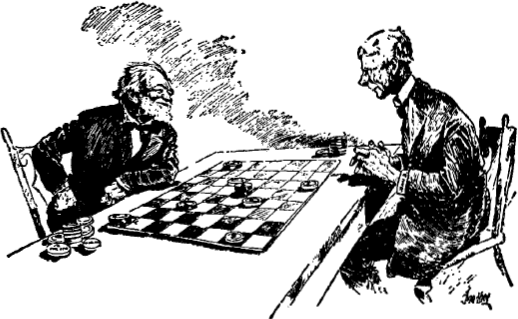
MR. CARNEGIE TO MR. ROCKEFELLER: “IT’S YOUR MOVE, JOHN!” THIS REFERS TO WHAT THE PUBLIC SUPPOSED WAS A CONTEST IN PHILANTHROPY BETWEEN THE TWO MILLIONAIRES.
(From Cleveland Plain Dealer)
But as a rule the preachers and college presidents looked with hungry eyes toward the great giver and kept their mouths shut. Wherever Rockefeller went the preachers approached with their hands out. At Douglas, Arizona, Rockefeller, after the service, slipped a fifty-dollar bill into the pastor’s hand. “I wish you could help us pay the debt on our church,” the preacher said. “It would be unfortunate for you,” said Rockefeller. “You have a congregation of miners who earn $4 and $5 a day. Induce them to pay the debt. It will cement the church as nothing else could.” This was his usual reply.
A curious hunger for Rockefeller money infected some of the preachers. The Tabernacle Baptist Church, Tenth Street and Second Avenue, New York, proposed to build a home for young women. Rockefeller contributed $50,000 in Northern Security five per cent bonds. Later the Northern Security Company defaulted on the interest and Dr. Daniel Potter, the fat, nervous, and bellicose pastor, brought suit against Rockefeller to compel him to pay the interest. Potter’s lawyers put Rockefeller through a grilling in court but the pastor had to go without his interest.
Of the gift to Columbia the World suggested that “we naturally expect important light on this science from the Rockefeller endowment. One of the obscure problems of psychology is the problem of telepathy.” Then the editorial pointed out that the magnate at his desk seemed to be able to communicate mysteriously with distant legislatures, and asked if the new department would explain such mysteries. Meantime the redoubtable Professor George Gunton was first in the attack upon all Rockefeller critics. And from the department of literature of Chicago University came the voice of Professor Oscar L. Triggs proclaiming Rockefeller and George M. Pullman “superior in creative genius to Shakespeare, Homer, and Dante.”
IV
SECRECY continued to cloak the operations of the Standard. Its leaders resolutely refused to answer the simplest questions about it—ofttimes to the point of making themselves ridiculous. In the Ladenburgh, Thalman, and Company case against the Pennsylvania Railroad to recover discriminatory rates William Rockefeller was a witness. Counsel had great difficulty getting him to admit, even at this late date, who were on the board of directors with him in the eighties. Once when asked a question he replied:
“I decline to answer on advice of counsel.”
“On the ground that the answer will incriminate you?”
“I decline to answer on the advice of counsel.”
“Or is it that the answer will subject you to some forfeiture?”
“I decline to answer on the advice of counsel.”
“Do you decline on the ground that the answer will disgrace you?”
“I decline to answer on the advice of counsel.”
“Did your counsel tell you to stick to that one answer?”
“I decline to answer on advice of counsel.”
Whereupon the courtroom burst into a general laugh in which William Rockefeller himself joined.
Another sample of a Standard official on the witness stand is the following:
Counsel: “Will you produce a copy of the Standard Oil Trust agreement?”
William Rockefeller: “I cannot.”
“Do you know where it is?”
“I do not.”
“Where did you last see it?”
“I don’t remember.”
“When?”
“I couldn’t say.”
“What is your difficulty?”
“My failure to recollect.”
John D. himself was always very adroit on the stand. He had a caustic tongue too, which he could use with mortal amiability.
“Does the draught bother you?” asked counsel, noticing the open door.
“Oh, no! the draught is not from the door. It is here,” pointing to the window at which the lawyer stood.
“Oh, it is from the window?” asked the lawyer.
“No,” replied Rockefeller, smiling sweetly and placing his finger on the lawyer’s breast. “The draught is right here.”
“Pretty hot one, isn’t it?” countered the lawyer.
“Oh! a perfect cyclone,” replied the oil man with mock alarm.
V
SIX YEARS had elapsed since the Supreme Court of Ohio had ordered the Standard Oil Company of Ohio to withdraw from the trust. When Rockefeller decided to dissolve the trust it was settled that each trust certificate holder should surrender the certificate to the liquidating trustees. He was to receive in return the equivalent of stocks in the various companies. But after six years only half of the trust certificates were turned in to the liquidating trustees. The result was that they went on administering the affairs of the trust precisely the same as if it had never been dissolved. Sam Dodd, the weaver of fictions, had tricked the Ohio courts.
All was running smoothly when, on the motion of Francis S. Monnett, the new Attorney-General of Ohio, the Supreme Court haled the Oil Trust and its rulers on a charge of contempt. These proceedings brought Mr. Archbold to the front, for the first time, though as always, the great Mr. Rockefeller was the central figure. The testimony of the trust heads was taken in the old Hoffman House in New York by a commissioner of the Ohio Court. At first Mr. Archbold swore that the company was absolutely disentangled from the trust—just a bit of old-fashioned perjury. Then he gave the public an exhibition of his nature. At one point, angered, he shot his finger out at one of the State’s Prosecutors, W. L. Flagg, and shouted:
“You keep still or I’ll expose you right here.”
“You expose!” cried Flagg. “You can’t expose—”
“You low-lived—” interrupted Archbold.
“Can any one be low-lived in comparison with a Standard Oil magnate? A decent man would be ashamed to walk on the street with you.”
“You’re a liar and a coward,” cried the little oil executive.
“You are a liar,” retorted the lawyer, “and a coward too and all your millions won’t help you.”
“You are a dirty, stinking liar,” yelled Archbold, his supply of invective failing him.
Archbold always had an eye peeled for a blackmailer. He put down every man who challenged the course of Standard Oil as trying to get money out of him. Sitting in the room as he testified was old George Rice, sick, weary with much fighting. Archbold saw Rice there and charged that he had attempted to blackmail the company out of $500,000 by threatening to make trouble for it. When Monnett asked him if Rice had ever been forced to pay thirty-five cents a barrel for hauling oil from Macksburg to Marietta while the Standard’s oil was hauled for ten cents, Archbold denied absolutely any such agreement, although he knew a court had passed on the matter. Throughout his testimony he flung insults at Rice. Towards the end he said:
“He has been too busily engaged in his attempts to harass us to attend to business. . . . I can say again I consider his case pure cussedness. . . . But his time is coming and he will meet retribution in the courts. He’ll get none of our money.”
Rice leaped up: “I don’t want any of your money. You have got only dirty money obtained by robbing people.”
“Oh, dry up!” sneered Archbold. “There is nothing to you but weight and wind.”
How different from the quiet and almost papal dignity of Rockefeller on the stand. When Rockefeller testified Rice still sat in the room. As the great oil man left the stand he walked over to Rice, and putting out his hand kindly, said:
“How are you, Mr. Rice? You and I are getting to be old men, are we not?”
Rice rose and stood coldly without extending his hand.
“Don’t you think, Mr. Rice, it would have been better for us all if you had taken my advice years ago?”
“Perhaps it would,” answered Rice as people gathered around the two old men. “You said you would ruin my business and you have done so.”
“Pshaw! Pshaw!” ejaculated Rockefeller.
The old man’s anger flared up.
“Don’t you pooh-pooh me. I say that by the power of your great wealth you have ruined me.”
“Not a word of truth in it,” Rockefeller muttered, turning and pushing his way through the crowd. “Not a word of truth in it.”
Before this sensational trial was over Monnett charged that the Standard burned its books to escape detection and that an attempt had been made to bribe him with an offer of $400,000 and his predecessor Watson with $100,000.
The company had steadfastly refused to produce books of record ordered by the court. Then, acting on advice in an anonymous letter, Monnett proved that sixteen boxes of books had been burned in the company’s furnaces. Monnett challenged the company to produce a single book to refute the charge. However, he failed to establish that the books burned were those wanted, though later he obtained the testimony of a salesman that the latter had been gathering from various branches account books under pressure and that the company said the law “was hot on their trail.”
On the bribery charge the record remains incomplete. The bribe charge was first made by the irrepressible Rice. The company’s lawyers demanded that Monnett give names and dates. Monnett replied the proposal had come from Charles Squire, who claimed to be acting for F. B. Squire, secretary of the Standard, Frank Rockefeller, and Charles N. Haskell. Archbold claimed that he had demanded Monnett prove this charge. Monnett claimed that he was about to take testimony to do so when Judge Schauch, in the presence of the Standard attorney, ordered him to cease, declaring the court was able to protect itself. The available testimony relating to both these charges is still extant. Apparently Charles Squire made the proposal to Monnett, but he was quite irresponsible and there is nothing to show he acted for Standard Oil. There remains only the fact, later well-established, that always one of Mr. Archbold’s first weapons was bribery.
In any case the contempt proceedings were dismissed, the court dividing three to three. The three judges who voted against conviction were the new members elected since the dissolution decree was made. As a by-product of this contempt proceeding Monnett had instituted ouster proceedings against the Buckeye Pipe Line Company, Solar Refining Company, and the Ohio Oil Company, Standard subsidiaries. These cases never came to trial. Monnett was defeated for re-nomination and Joseph M. Sheets was elected Attorney-General by the Hanna-Foraker machine. Sheets’ first act was to dismiss all the Standard Oil suits.
VI
THE STANDARD OIL leaders were now playing with the court. They had no idea of surrendering their monopoly. They were merely looking around for another device to substitute for the trust. They found it in New Jersey. There a law had been passed permitting corporations to hold stocks freely in other corporations. The Standard Oil Company of New Jersey increased its capital from $10,000,000 to $110,000,000 and all the stocks of all the constituent companies held by the liquidating trustees were turned over to the Standard Oil Company of New Jersey which became a great holding company. The holding company was merely substituted for the trust, and everything went along precisely as before.
CHAPTER II. THE STANDARD OIL GANGIN THE late nineties the country began to hear of the “Standard Oil Gang.” This was something apart from the Standard group of oil corporations. Its chief figures were Henry H. Rogers, William Rockefeller, and James Stillman. It had its beginnings in the panic of 1893. While these able men were building their great oil empire they were accumulating vast personal fortunes. The panic of 1893 with its collapse of stock values gave them an opportunity to pick up here and there numerous profitable investments and as the prosperous days following the War with Spain and the discovery of gold in the Klondike rolled in on the country they found themselves richer than they had ever dared to dream. And, directed chiefly by the daring speculative genius of Henry H. Rogers, they embarked on that era of feverish and audacious adventure which Thomas W. Lawson immortalized in iniquity as “Frenzied Finance.”
One of the most sensational of their performances was Rogers’s Amalgamated Copper episode. Rogers arranged with Marcus Daly, a famous old prospector, and his partners, to buy from them the Anaconda Copper Company for $24,000,000. Certain other mines were added for $15,000,000, making a total of $39,000,000. Now watch closely the magician Rogers as he pulls millions from his hat.
First he and William Rockefeller took title to the mine properties, giving to Marcus Daly a check on the National City Bank for $39,000,000, with the understanding that the check was to be deposited in the bank and remain there for a definite time.
At the same time Rogers organized the Amalgamated Copper Company with a lot of clerks as dummy directors. Next he transferred all the mines to this Amalgamated for $75,000,000. The Amalgamated gave him not cash, but all of its capital stock. Then he took this $75,000,000 of stock to the National City Bank and borrowed $39,000,000 on it. This took care of the check to Daly and his friends.
The next step was to have the National City Bank sell the $75,000,000 of stock to the public. When this was completed Mr. Rogers and his pals had enough to liquidate the $39,000,000 loan from the bank and allow a neat little profit of $36,000,000 made, as you will see, out of nothing.
This was only a beginning. The stock soon fell to 33, at which price the gang bought it back, to resell it later to the same gullible public at 100, thus repeating the profit. This is what Lawson called the dollar-making machine.
II
LAWSON credits Rogers with the invention of this system. As a matter of fact, an Englishman named Ernest Terral Hooley in the early nineties combined ten plants in Great Britain. The plants were worth $10,000,000. Hooley bought them for that, turned them over to a new corporation, and issued $10,000,000 of preferred stock and $10,000,000 of common. At the time, in America were various excessively smart gentlemen busy with merger dreams. One of them was John W. Gates, salesman, promoter, and gambler extraordinary. Mr. Gates was very different from John D. Rockefeller. The latter had built the Standard Oil Company purely as an industrial enterprise. He was not a promoter. There was never any watered stock in Standard Oil. Gates, who began as a barbed wire salesman, was a promoter. Rockefeller made his money manufacturing, transporting, and selling oil. The promoters made theirs manufacturing and selling stocks. Rockefeller and his contemporaries built trusts but purely as incidents to their business as producers. Now onto the stage stepped Gates and Reid and Judge More and Morse and Addicks and Flint and Morgan and, of course, Rogers and William Rockefeller, who began to put together industrial combinations of all sorts with no other aim than to make millions from the stocks. Gates heard of the Englishman Hooley’s scheme. And when he showed a barbed wire manufacturer that he could sell his plant to the combination for preferred stock up to its full value which could be sold to the public, and still have common stock for as much again, which he could sell or hold, his scheme to organize the American Steel and Wire Company moved fast. And at his elbow in those days was his adviser, Judge Elbert H. Gary. And when these two got Morgan interested in their $90,000,000 promotion, they laid the foundation for steel history.
After this the mergers blossomed everywhere. America became a jungle of promoter-made, stock-jobbing combinations. Then broke into flower that parent of so much controversy and woe—the holding company in the utility field. This year Standard Oil paid dividends of 94 per cent on its $100,000,000 of stock and this made a juicy example to dangle before the eyes of owners and investors. Judge More formed the Tin Plate Trust, put together plants valued at $12,000,000 and issued $50,000,000 in stock, taking $10,000,000 as his share. Flint formed a chewing gum trust—the American Chicle Company—and assembled $500,000 worth of assets against which he issued $3,000,000 of preferred stock and $6,000,000 of common and the common sold as high as 200 before it collapsed. In the case of United States Steel the Bureau of Corporations reported that its entire issue of $508,000,000 of common stock was water and from one to two-fifths of its preferred as well.
Rogers and William Rockefeller went into gas. The Standard Oil supplied illuminating gas oil from which the artificial illuminating gas was made. This gave them an interest first in edging into gas companies which used the oil and later in controlling and exploiting them. They got control of the Consolidated Gas Company of New York and then went with Elkins, Dolan, and Widener into the United Gas Improvement Company in Philadelphia which took hold of, operated, and exploited gas and electric lighting companies in a score of cities. It was all a merry dance. The nation felt a kind of pride in it as it mounted in fury and extent through the golden years of graft and loot under the benign rule of William McKinley and Mark Hanna.
III
IN THE midst of this growing and disordered orgy, two great powers began to manifest themselves, two powerful financial groups sometimes acting more or less together, sometimes in violent collision and even open warfare. These were the Rockefeller and Morgan groups. There were scores of lesser men who pressed forward their separate ambitions, but sooner or later they found themselves crossing the territory of these giants and falling into their arms. This gave rise to what came to be known as the money trust, particularly when these financial monarchs decided the time had come when they must march together.
Between the two groups the connecting link was James Stillman. Stillman belonged to the Rockefeller crowd, but spiritually and socially he was akin to Morgan. Morgan, huge, masterful, bullying, often violent, now the Master of Wall Street, and Stillman, small, elegant, vain of his small feet, dark, handsome, and silent, grew to be fast friends. Both were autocrats and aristocrats. Both inherited their wealth and looked with disdain upon the men of common clay who surrounded them. Morgan hated Rockefeller and his piety. Morgan and Stillman both hated Carnegie. Morgan awed Stillman a little sometimes with his over-powering personality, but the great man always respected Stillman’s profound wisdom in money matters and even more the immense reservoirs of cash which he could command.
The center of the Standard Oil group was the Standard Oil itself, the wealth of its leaders and the great banks under Stillman’s domination—the Hanover, Second National, United States Trust, Farmers Loan and Trust, the Central Realty Bond and Trust as well as the National City. There was the Amalgamated Copper, Smelter Trust, and Tobacco Trust, and the magnificent iron ore properties of John D. himself. There were railroad lines referred to as the Rockefeller-Gould group, and then such roads as the St. Paul, special pet of William Rockefeller and the Harkness family, and the Western Maryland of John D. Rockefeller. There were vast telephone, telegraph, and utility concerns, such as the Rhode Island Securities Company (Aldrich-Rockefeller-Elkins), Interborough Rapid Transit (Rockefeller and Belmont), Philadelphia Rapid Transit (Rockefeller, Elkins, Widener), United Gas Improvement Company (Rockefeller, Elkins, Widener), Brooklyn Rapid Transit and Metropolitan Securities (Rockefeller-Ryan), and of course many others, including the powerful Public Service Corporation of New Jersey.
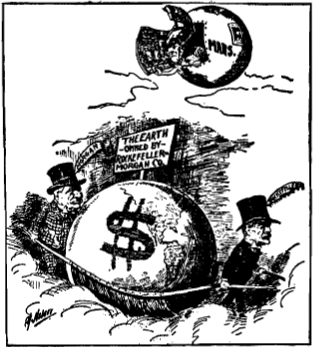
MARS: “I SEE; THEY HAVE BEEN TOO BUSY TO NOTICE MY SIGNALS.”
—The Philadelphia North American
The Morgan group was made up chiefly of the great railroad consolidations he had effected, the various industrial corporations already formed or in the process of formation by him, like the United States Steel Corporation, Rubber Trust, and others, and his group of banks and insurance companies.
IV
JOHN D. ROCKEFELLER himself had never been on any board of directors save that of Standard Oil. And at this time he took no discoverable part in the vast schemes of exploitation directed by the Standard Oil gang, though he did at times invest in them. He was busy with his philanthropies and in a supervisory way with his personal investments, but these were coming more and more under the immediate direction of young John D., now a part of what was called his personal staff, of which Frederick T. Gates was the head.
In 1901 Andrew Carnegie, master of steel, wanted to retire. J. P. Morgan had put together his rival steel merger, Federal Steel. Carnegie had made up his mind to unload his vast holdings on Morgan. He drove Morgan to a consideration of the project by a series of militant threats against the various units of Morgan’s new combine. “If I were Czar of the Steel Company [which he was],” he said, “I would pay no more dividends but put every dollar into tube and wire and nail and hoop and ship plants.” As an opening gun he planned the construction of a $12,000,000 tube plant at Conneaut—a gun pointed at Morgan’s National Tube Company. Wall Street brokers had shelves full of the stock of the eight metal concerns just formed by Morgan and all outrageously over-capitalized. Morgan was alarmed and was an easy prey for the proposal of a great steel combine when, under the cunning Andy’s direction, Charles Schwab at a dinner artfully spun the plan out for Morgan’s benefit. Morgan began the formation of his great steel trust and after long negotiations had gathered together a great array of competing plants—all save the Rockefeller ore properties in Michigan. Of these Morgan was afraid. He told Gary these must be included or the whole plan must fail.
To do this Gary told Morgan he must see Rockefeller.
“I would not think of it,” growled Morgan.
“Why?” asked Gary.
“Because I don’t like him.”
But he yielded to necessity and sent word to the secluded oil king that he wished to speak to him. Any one else Morgan wished to see he sent for. But Rockefeller was greater even than Morgan. And so Morgan asked to be permitted to call. Rockefeller said he would be glad to have Morgan visit him, but it must be understood no business was to be discussed as “Mr. Morgan knew he had retired from business.” The reply of the old fox infuriated Morgan. But he took a chance and called. The moment Morgan opened his mouth to state his business, Rockefeller cut him short. Mr. Morgan had evidently misunderstood. He never talked business with any one. Mr. Morgan might take up any matter he had in mind with his son “who would undoubtedly be glad to talk with Mr. Morgan.” The old lion left inwardly roaring at the manner in which he had been dismissed by the fox. He risked one more humiliation and asked young John D. to call on him. When that young business man found himself for the first time in the presence of the great Morgan he was a little abashed. Morgan launched his business brusquely:
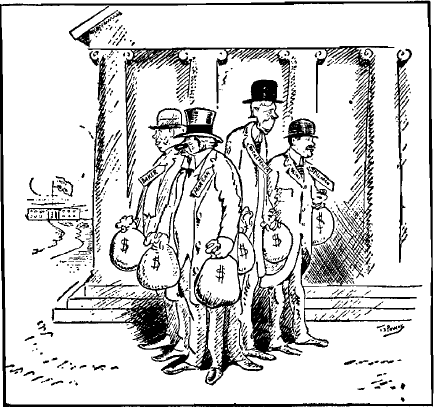
THE MONEY POWER.
(Cartoon by T. E. Power in the New York Journal)
“I understand your father wants to sell his Minnesota ore properties and has authorized you to act for him. How much do you want for them?”
Young John D. stood up.
“It is true I am authorized to speak for my father in such matters,” he replied, “but I have not been informed that he wishes to sell these properties. In fact I am sure he does not.”
And the young man bowed respectfully to Mr. Morgan and walked out, leaving the great banker humiliated again and in silence.
Going at once to his father the very much troubled son reported the interview and asked if he had behaved correctly.
“Time alone,” answered the even-tempered father, “can tell whether you acted wisely or not. But I may say to you, my son, that had I been in your place I should have done precisely what you did.”
Morgan then sent for Henry M. Frick and asked him to go to Rockefeller and to tell him the “outside price” the combine would offer for his properties. Rockefeller liked Frick. He received him kindly. But the moment Frick mentioned an “outside price” he interrupted. He would not deal with a purchaser who attempted to fix an “outside price.” That sounded too much like an ultimatum. Mr. Rockefeller had never submitted to ultimatums. Then he astonished Frick with his proposal:
“I am not anxious to sell my ore properties. But I do not want to stand in the way of a worthy enterprise. Now, Mr. Frick, I will tell you what I will do. I want only a just price. You know better than those gentlemen what that is. I know your judgment is good and I believe you to be a square man. I am willing, Mr. Frick, to put my interests in these properties in your hands. You need not hesitate, Mr. Frick. My confidence is complete. You will receive no complaint from me. Now you will wish to be on your way. I thank you for coming to me.”
In a few days Frick reported a price from Mr. Rockefeller $5,000,000 more than the outside figure fixed by Morgan at Judge Gary’s advice.
“That is prohibitive,” said Gary.
“Judge Gary,” said Morgan, “in a business proposition as great as this would you let a matter of $5,000,000 stand in the way of success?”
“But I told you, Mr. Morgan, my price was the outside figure.”
“Well,” said Morgan, “write out an acceptance.”
Later Rockefeller said that he doubted that any one but Mr. Frick could have induced him to sell. “And in my opinion,” he added, “if these properties had not been included, I doubt if the United States Steel Corporation could have survived the stress of its formative period.”
CHAPTER III. IN THE LABORATORY OF A CORRUPTIONIST
IN MARCH, 1897, William McKinley, under the sponsorship of Mark Hanna, became President of the United States. And the nation, emerging from the long depression, entered upon an era of rising prosperity. It was the beginning almost of a new age in which the new tools of corporate organization and mechanical invention became a kind of delirious vogue. Combination in the national field of railroads, and industries and in the local field of traction, gas, and electric light companies, sent swarms of lobbyists to the national and state legislatures and aldermanic boards. Corruption and bribery upon a grand scale became the order of the day. Politics became a profession of rich and juicy profits, bosses arose everywhere to seize and manage the distribution of the swag. Mr. John D. Archbold, corruptionist extraordinary, official bribe-giver of Standard Oil, was exceptionally well placed in the matter of benevolent relations with bosses. Boss Reed, of the House, was the crony of Henry H. Rogers. Boss Hanna, of the Senate, was the old schoolmate and friend of John D. Rockefeller. Tom Platt, Republican boss of New York, was another old schoolmate of John D. at Owego Academy. Boss Croker, of Tammany, had as his guide, philosopher, and friend, William C. Whitney, of the O. H. Payne connection. Boss Aldrich, of the United States Senate, was a financial ally but, better still, was in the way of becoming the father-in-law of young John D.
But Mr. Archbold did not rely on old memories and pleasant friendships. He talked to his political hireling with bribes, and his guilty cash found its way into some of the most exalted pockets. Of course, the Republican campaign managers were around him continually with their hands out. Letters went back and forth between Archbold and Hanna. In 1900 Hanna writes for money. “There are many important interests in this fight. Should Johnson [Tom L.] carry the legislature the corporations will catch it, as I am their representative so-called.” Hanna comes back frequently for money and Archbold writes Hanna whenever there is legislation which Standard Oil fears.
Archbold’s chief secret agent in Washington was Congressman Joseph Sibley, of Pennsylvania, destined to achieve upon his exposure, a unique infamy in our congressional history as Archbold’s jackal. Sibley was a man of some wealth, president of the Signal Oil Company in Venango County. He had a taste for politics and entered Congress in 1892 as a Democratic reformer representing the oil regions. He was an ardent bi-metallist and a more or less blatant tribune of the people. In the Democratic convention of 1896 which nominated Bryan he received a considerable vote for vice-president. Around 1898, however, if not sooner, Mr. Sibley began to exhibit marked symptoms of friendship for the much harried trusts. Around 1900 we find Mr. Archbold writing Mr. Benjamin Cassatt, of the Pennsylvania Railroad, that they “hope he will do everything possible in Mr. Sibley’s favor on the sure ground that all corporate and vested interests will have at least fair consideration at his hands.”
“Fair consideration” were hardly the words. Sibley bombards Archbold with letters, tells him of Senators and Congressmen in need of financial help. He even visits Roosevelt and tells him: “No man should win or deserve to win who depended upon the rabble rather than the conservative men of affairs.” He reports this triumphantly to Archbold. Sibley writes Archbold: “Had long talk with Mr. B. a friend in the Senate, a Democrat. . . . Had you not ought to have a consultation with him . . . if you want to see him I think I could arrange a call in New York.” September 23rd, 1903, he writes: “A Republican United States Senator came to me today to make a loan of $1,000. I told him I did not have it but would try and get it for him in a day or two. Do you want to make the investment?” Sibley’s letters ranged over the whole field of business and politics. “If at any time my long scribbles annoy you,” he humbly bleats to his patron, “chuck them into the waste basket.” And again: “If you think of anything for me to do, let me know.” Archbold finds plenty for the busy jackal. Some Senator is to speak against the Standard. Archbold is weary of the “old round of lies” and wonders “if you can find out who it is and guard against the explosion.” The chairman of the Republican Congressional Campaign wants $25,000 and turns up later for $5,000 more. Sibley, congressman, paid servant of the people, carried around with him the Standard Oil code—the “Devil’s Lexicon” as one critic called it—and used it in some of his reports to Archbold.
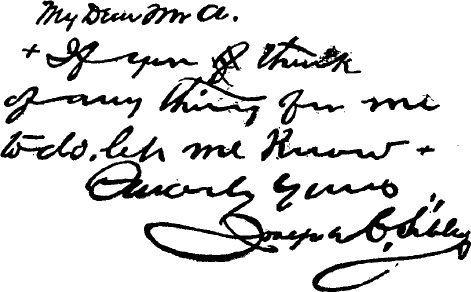
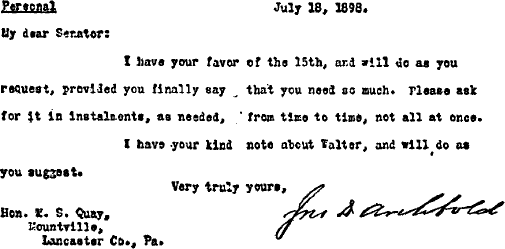
PART OF LETTER TO ARCHBOLD, WHILE SIBLEY WAS A MEMBER OF CONGRESS FROM THE OIL REGIONS.
(Reproduced from Hearst’s Magazine)
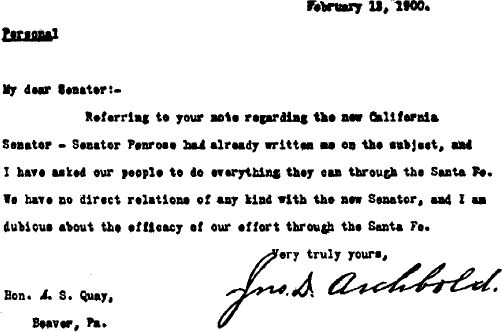
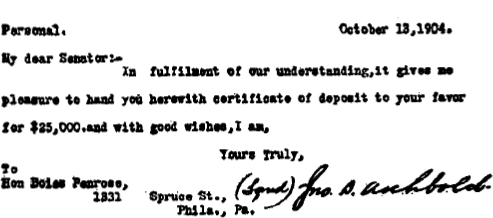
Matthew Stanley Quay’s admission to the Senate was contested on the ground of fraud—Quay, whose career of bribery and corruption in Pennsylvania reached epic proportions. Archbold writes Deboe, Depew, Fairbanks, Foraker, Spooner, Platt, Scott, Sewell, McLaurin, to support Quay. Archbold has a big money interest in Quay. That voracious grafter delivers only for big pay. Archbold sends him plenty, but he wants more. “My dear Senator,” writes the Standard bribe-giver, “not because I think we should, but because of your enticing ways, I enclose you Certificate of Deposit for $10,000.” Another time—“My dear Senator: I will do as you say, provided you finally say you need so much. Please ask for payments as needed from time to time, not all at once.” Even Standard Oil must resort to installment payments to the imperious and hungry Quay. Then later, after death has cut down the Master Quay, a Certificate of Deposit goes to the pupil, Boise Penrose.
In 1898 Monnett brought his contempt action against the Standard in Ohio. Immediately Archbold gets in touch with Joseph B. Foraker, just elected Senator from Ohio. Foraker sees Monnett in Washington and warns that he will be driven out of politics if he persists in his tactics. Foraker declares he, United States Senator, has been employed by Standard Oil. When Monnett expresses surprise at this peculiar employment the haughty Senator replies tartly that he can form his own professional ethics. But a little later a report reaches Akron that Foraker has been retained by the Standard. The Associated Press asks the Senator about it. “It is impertinent,” he replies. “You might as well ask me how much money I have in my pocket. The report is untrue.” If the reporter had asked the Senator how much he had in his pocket twelve days later he might have answered $15,000 of Standard Oil money. A certificate of deposit was sent him that day by Archbold. Senator Foraker never appeared on record in the extensive and numerous hearings of the famous case. Why was he employed?
His employer writes him about the Meigs bill in the Ohio legislature amending the so-called anti-trust law, also about a “malicious resolution” for an investigation of Standard Oil and intimating that the hated Monnett might be engaged to conduct it. A few weeks later another letter goes to the Senator asking about “another objectionable bill” which “needs to be looked after.” Later a bill by Senator Price in Ohio needed looking after. Archbold notified Foraker; Foraker sent Archbold’s letter to Governor North, who sent for Price and told him Senators Hanna and Foraker both opposed these bills and feared they might damage President McKinley in the approaching campaign. Thereupon Price withdrew them. Senator Jones of Arkansas introduced a bill to strengthen the Sherman anti-trust law. Archbold writes to “my dear Senator” Foraker to look after it.
All this Senator Foraker did not do for nothing. March 26th, Mr. Archbold sent him $15,000, three weeks later $14,500 more; six months later $10,000 and soon after another $5,000—$44,000 in all. About the same time a friend of Foraker’s wanted to buy a newspaper and needed $50,000. Foraker got the loan from Archbold, though the paper enterprise fell through and the loan was repaid. All this was in profound secrecy of course, no hint of the Senator’s employment reaching the people.
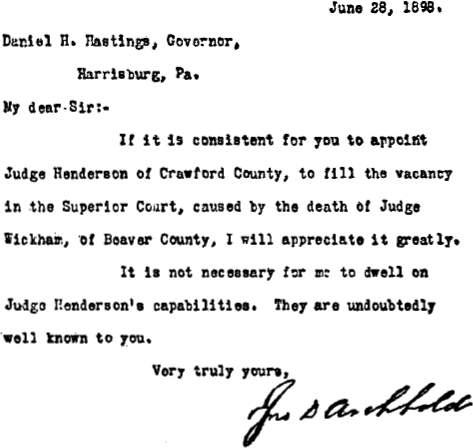
When Judge Jacob Burkett of Findlay, Ohio, was a candidate for reëlection to the Supreme Court, Archbold became very active. We find him writing to Foraker to be sure of that gentleman’s support and urging the judge’s great qualifications and integrity and ability. He was one of the three judges who had voted against holding Standard Oil guilty of contempt in the Monnett case. The judge is to be rewarded. But Monnett and Bennett are to be punished by the imperious trust. “We hear with surprise,” writes Archbold to Foraker, “that Smith W. Bennett, Monnett’s brother-in-law, is to be candidate for Attorney-General” and suggests as a conclusive reason against Bennett’s ambition that “he was active against our interests.”
Mr. Archbold’s allies in Washington were many and we may form some notion of the persuasiveness of the arguments which Mr. Archbold used from the case of old General Grosvenor of Ohio. Grosvenor around 1897, like Sereno E. Payne and some other Old Guard leaders, was very much for dealing with the trusts. Grosvenor proposed a measure to make the Sherman law more drastic. After 1900 we find him among Archbold’s correspondents seeking at one time a thousand dollars for his campaign, which he gets and at another time help, the precise amount of which is not disclosed, and also trying through Sibley to get in touch with Archbold personally.
II
THESE years saw the United States Senate at its lowest level. Standard Oil had plenty of friends. So had other trusts. “We get a great deal of protection for our contributions,” said Havemeyer of the Sugar Trust who told the Industrial Commission his trust gave to both parties. The role of dishonor was a long one. There was the aged Tom Platt. When news of Platt’s death was brought to Roosevelt years later he said: “Dead or alive he’s still a damned scoundrel.” Platt’s partner from New York was Chauncey M. Depew, a member of seventy or more boards of directors and window-dressing president of the New York Central, who began life as a lobbyist for Vanderbilt, and got smeared with some of the muck in the Equitable Insurance scandal. Nobody needed to bribe Depew. He had been the lifelong messenger boy of the money crowd.
The shipping subsidy bill bobbed up continuously and mysteriously through these years. The Review of Reviews observed that apparently no one seemed to be interested in this measure. But we find Mr. Archbold writing Sibley and his chief lobbyist, Col. Manley, once presidential campaign manager of Tom Reed, about it. Mark Hanna becomes suddenly interested in the bill and takes charge of it in the Senate. Senator Depew decides to make a speech in favor of it—a great effort. He sends an advance copy of the speech to Archbold before delivering it and that gentleman writes back, “Thanks for your efforts in our behalf.” Standard Oil has been interested in subsidies a long time. In 1892 a bill was passed to exempt two ships, the City of Paris and the City of New York from the law permitting only home built and manned ships to fly the American flag and collect mail subsidies. The Secretary of the Treasury who first urged this measure was that same Governor Foster who was head and front of the Standard Oil gas fight in Toledo already described. Why did he urge it? The two ships favored belonged to the Inman Line, later the International. And of this line Henry H. Rogers was president.
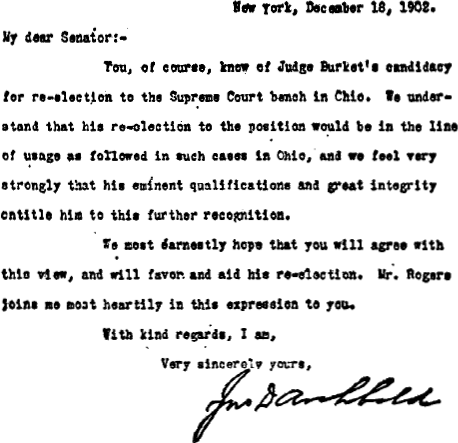
LETTER FROM ARCHBOLD TO SENATOR JOSEPH B. FORAKER IN SUPPORT OF ONE OF THE THREE JUDGES WHO HAD VOTED AGAINST HOLDING STANDARD OIL GUILTY OF CONTEMPT.
(From Hearst’s Magazine)
The right arm of the interests in the Senate was Nelson W. Aldrich, of Rhode Island, soon to become young John D.’s father-in-law. Aldrich, like Mark Hanna, began life as a wholesale grocer and ended by being a utility magnate tied up with the Elkins and Rockefeller interests. Arthur Pugh Gorman, multimillionaire, after a lifetime in politics, Democratic leader, was called the left arm of the interests. Senator John W. McLaurin of South Carolina was also one of Mr. Archbold’s pensioners. There was John W. Spooner, a fiery protagonist of the people, the flag, and the old soldiers, but in reality a true soldier of the interests until Bob LaFollette ousted him from the Senate.
There was John Kean of New Jersey, who made millions in gas and coal-carrying roads, himself an unscrupulous competitor in the utility field. There was of course the notorious Matt Quay and his dark and silent lieutenant, Boise Penrose. When Quay died Pennsylvania sent the attorney for the Carnegie Steel Company, Philander C. Knox, who turned out better than his antecedents warranted.
There was Stephen B. Elkins of West Virginia, who made millions in a land-grabbing ring in New Mexico before he settled in West Virginia to make more in coal, railroads, and utilities and then turned up as Chairman of the Interstate Commerce Committee of the Senate. Elkins was close to Standard Oil in utility investments and we find Archbold writing his representative in West Virginia at Elkins’ request to work for the Senator’s election. On election night we behold the other West Virginia Senator, Nathan B. Scott, sending bulletins at intervals to Archbold keeping him posted on the count. “Thanks to you and other friends,” he wires, “we now have West Virginia by 25,000.”
Presiding over all was the mighty Mark Hanna. When McKinley was elected, he wanted Hanna in his cabinet. Hanna wanted to go to the Senate. But there was no Ohio vacancy, so old Senator John Sherman, on the brink of the grave, was lifted by McKinley to the important office of Secretary of State to make a vacancy in the Senate for Hanna by appointment. Later he was elected by the Ohio legislature. But the election was contested and one representative swore that he was given $1,750 cash to vote for Hanna, and produced the cash. Hanna denied knowledge of it. And the United States Senate refused to exhibit any curiosity as to where the money came from. Later the figure of Mark Hanna was to rise ominously in what looked like a drive by the dark and sinister forces behind all this corruption to seize the very presidency itself. That we shall come to later. For the moment the new Moloch—Big Business—sprawled at its ease in Washington particularly in the Senate, corrupt, contemptuous, greedy, certain of its power. Meantime a half-crazed boy, hanging around anarchist meetings, brooding over the wrongs of the world, was preparing a blow which would give a new turn to all this soon.
CHAPTER IV. LIGHTING THE WORLDFOR YEARS the cry of “Oil!” had continued to circle the world, first Pennsylvania, Ohio, West Virginia, Indiana, California, Texas, Kansas, Oklahoma, and Louisiana and abroad, Baku, the Dutch East Indies, Galicia. Wherever the cry arose the Standard Oil man with his pipes was there among the first. No matter how remote the well the Standard pipe line was immediately installed. The driller had but to produce his oil and instantly there was a market for it. He ran it into the Standard pipe line, got a certificate for the oil and this certificate he could sell anywhere at any time as good as a government bond. The pipes thus became the real tentacles of the Octopus.
But another grim figure stalked the newly drilled well—War. For oil meant struggle; at first among the oil men of America, then among the great oil men of the world—the Rockefellers, the Nobels, Rothschilds, and between governments—Russia, Roumania, Austria, England, America, and Mexico.
Early in 1888 a Mr. Frank E. Bliss arrived, wholly unnoticed, in London. A few days later the Gazette recorded the formation of the Anglo-American Oil Company, capital £500,000. Among the directors were Henry H. Rogers, John D. Archbold. But these names were not so well known then in England. This was the Standard Oil’s first great corporate subsidiary abroad. Before long the Anglo-American Oil Company had a monopoly of England’s oil trade and held it for years. After that Rockefeller spread his incorporated subsidiaries all over the globe.
In 1898 for the first time production of oil in Russia exceeded that in America. This continued until 1901 when oil began to gush forth in various American fields. The fact, however, reveals the extent of the competition abroad. And that competition was incessant, bitter, and attended with recurrent rate wars, financial stratagems, and international intrigue.
In Manchuria Rockefeller had to fight first Russian and then Dutch East Indies petroleum. He tried to buy a Dutch company in Sumatra, the Moera Enim Company, and the shareholders were about to ratify the sale when the Dutch government intervened and announced: “No Standard Oil in Dutch possessions!” The companies fell into the bag of the Royal Dutch Company. In 1902 the Standard attempted to buy out the Shell Transportation Company of Sir Marcus Samuel. Almost at the moment of success the deal fell through. This was one of the Standard’s major set-backs, for a few years later the Shell combined with the Royal Dutch under the domination of the then young Henry Deterding, who was one day to capture the world’s oil premiership once held by John D. Rockefeller.
In Russia the Standard was in bitter competition with the Nobels, the Rothschilds, and many smaller interests. The Standard induced the Nobels to form the Russian Refiners Union under which Russian output was limited and the Nobels became the sole distributors. Three years later when the union was dissolved the Nobels had the only marketing machine and the Standard made a working agreement with them. The Rothschilds were indignant and ready for alliance with the Royal Dutch Shell.
In the Galician fields the Austrian government discriminated against the Standard not only by imposing a tariff, but by prohibiting the company from selling to Austrian railways. In Roumania the Standard was permitted to build a refinery but no pipe lines. In Mexico Lord Cowdray held concessions from the Mexican government and the Waters-Pierce Company, which carried the war there, found itself hampered by a $4.50 tariff.
CHAPTER V. SENATORS IN HARNESS
DURING the years following Rockefeller’s attempt at retirement the fruits of his planting were to be offered to him in a singularly bitter mixture. From all sides—from men who believed themselves wronged—an outraged public, politicians, and rivals, came attacks of every sort. The country was ready to believe anything of Rockefeller.
Among the first was one of those three or four cases which put him in the posture of fleecing his friends. In the seventies John and James Corrigan sold their Cleveland refinery for 2,500 shares of Standard Oil stock. James Corrigan then went into iron. In 1883, with Frank Rockefeller as a partner, he bought the Franklin Iron Mining Company. When the panic of 1893 came Corrigan and Frank Rockefeller found themselves in trouble. Corrigan went to his old friend John D. and borrowed $171,000 at 7 per cent, putting up his 2,500 shares of Standard stock as collateral, a perfectly good business transaction. Later Frank borrowed from John D. and Corrigan endorsed the note putting up his Franklin Iron Mine stock. The pair now owed $402,000. By 1894 the panic deepened and Corrigan and Frank could not meet their notes. They scuttled around frantically and got the Iron Range Company to agree to take the loans but John D., according to Corrigan, frightened the Iron Range people off. To satisfy the loan Rockefeller took the Standard Oil stock, allowing 168 for it. Corrigan protested it was worth 300 but John D. told how the depression had injured the Standard’s assets. In their plight Corrigan and Frank, as the story went, were compelled to sell the Franklin Iron Mine Company, worth nearly $2,000,000, for $500,000. Corrigan now brought suit to compel John D. to return the Standard stock on the ground that being in a position to know its value, as president of the company, he had lied about it to Corrigan. The papers aired the story freely and Rockefeller got a good deal of unsavory advertisement. The Backus case and Merritt case were recalled. Rockefeller was the man who swindled his partners. Yet after all the facts as outlined above do not hang together very well. Corrigan claimed he had paid his $171,000 and that the amount due was Frank’s share of the loan, something over $200,000. The 2,500 shares of Standard Oil stock at 168 would amount to $420,000, double the amount said to be due. There would therefore be no need to sell the Franklin Company unless other causes intervened. The story that Corrigan had paid his loan and was sacrificed for Frank’s is wholly refuted by the allegation that Rockefeller demanded the sale of the collateral when Corrigan defaulted on a $46,000 note, which was the amount of Corrigan’s first note. Why did Rockefeller demand payment? He certainly had a right to do so and there is good reason to believe that when he looked into the state of the investment he found that Frank, a notoriously careless business man, and Corrigan, no business wizard, had got the whole investment into a hopeless snarl.
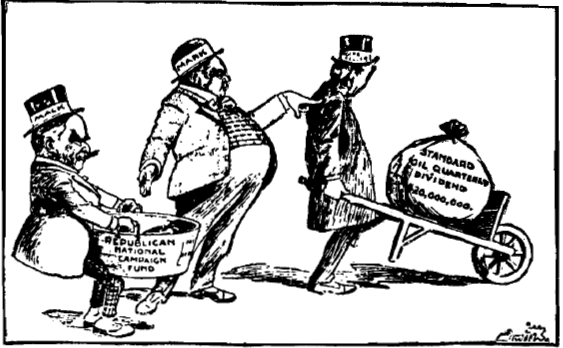
“NOW, JOHN D., LET ME INTRODUCE MY FRIEND.”
(The Rocky Mountain News, Denver)
In any case Corrigan’s suit was submitted to arbitrators—William D. Guthrie, William A. Lynch, and William G. Choate, eminent lawyers—and they decided it in Rockefeller’s favor.
II
THROUGHOUT the country the irritation produced by the Standard’s methods and the whole trust issue grew in intensity. The Standard’s war on small dealers brought the subject to the very doors of the people. Monnett’s suit in Ohio kept the name of the company and Rockefeller in the public notice and in a dozen states people clamored for some kind of action against the oil Octopus. In Nebraska Attorney-General Smythe began proceedings in August, 1899, under the state anti-trust act, and asked that the company be enjoined from doing business in Nebraska.
Smythe appeared in New York with a commission to examine the Standard leaders. But they laughed at him. “He is just seeking notoriety,” said Samuel C. T. Dodd. As for Rockefeller, Smythe’s attempts to subpoena him were utterly futile. Out in Ohio too and in Texas the legislatures and attorney-generals stormed against the “oil monster.” But Mr. Rockefeller, the retired country gentleman, was more interested in his great and growing Pocantico Hills estate, in his petty wars with the tax assessors, and his battles with the town authorities to build roads. While the great war against the trusts raged over the land, rising to boisterous volume under the lashings of Bryan and the perfect inactivity of McKinley, the hero or rather the archvillain of the piece amused himself in a series of opéra bouffe struggles with village statesmen.
Rockefeller wanted a road to his brother’s home. The road had to run under the Croton reservoir, property of New York City, and a private individual could not build such a road. Rockefeller asked the Tarrytown officials to build it, he supplying the money. The officials, however, replied that to build such a road they would have to condemn several private homes. And after some quarreling the project was dropped. A mere matter of taking away from people the small homes they owned in order to make a road from his own to his brother’s property did not seem at all unusual to the man who always had his way. John Weber, president of the village, tried to stop Rockefeller’s workmen, who in building a road were encroaching on his property. He ordered the arrest of the foreman. The chief of police refused. Weber attempted the arrest himself with his sons. A signal went up and over the hill came charging another crew of Rockefeller workmen armed with picks and shovels to drive the village president off.
The great estate grew amazingly. The farms all around began to come within Rockefeller’s fences. He owned practically all of Sleepy Hollow. Each year he added more ground—fine estates like that of Rufus A. Weeks for $50,000 and little plots and houses for as little as $1,700. By 1899 over 1,600 acres surrounded the old house on Kijkuit. The Rockefeller legend of simple living began to suffer a little. New stables were built costing $100,000, three stories high, with two electric elevators, grooms’ quarters, and stalls for 22 horses, and young John D. began to scour England for the choicest cobs for the great stables. Carloads of shrubs and trees for fall planting were arriving. “I intend to have a nice house,” he told a friend, “even though I have to live on a crust.” He had several nice houses now—the town house on Euclid Avenue, Cleveland, beautiful Forest Hill, an estate fine enough for a monarch; the New York town house in Fifty-fourth Street, and Pocantico Hills which, with ducal generosity, he now threw open to the public on certain days as a park. On a sunny day, when the Nebraska attorney-general was storming about his subpoena, a group of citizens of Pocantico called at the great home to thank the squire for all he had done for the town.
Attorney-General Smythe finally gave up his effort, the referees, on his own testimony, finding in favor of Standard Oil and that attack collapsed.
III
DOWN in Texas the law was hot on the trail of Mr. Rockefeller’s trust, which operated there under the name of the Waters-Pierce Oil Company. Rockefeller and others had been indicted, as we have seen, and the law had got hold of an underling, Hathaway, who served a year in jail before the sentence against him was reversed. Shortly thereafter the state began proceedings against the Waters-Pierce Company to oust it from Texas and on March 19th, 1900, the United States Supreme Court affirmed the ouster decree.
It may be remembered that Mr. Sibley, Archbold’s procurer in Congress, wrote his master about a certain Mr. B. in the Senate. This was no less a person than the brilliant and colorful Joseph Bailey of Texas, who had been Democratic leader in the House and was now a candidate for the Senate. Bailey was a glamorous creature, tall, statuesque, handsome, distinguished, the greatest constitutional lawyer and one of the great orators and debaters of his time. He was almost the last of the old order of statesmen, acting and dressing up to the part. At the moment he was the idol of Texas. But Bailey had a fondness for luxury and show, a weakness which requires money.
The keen eye of the wily Sibley saw all this. The two had known each other in the House. About this time Sibley introduced Bailey to ex-Governor Francis of Missouri, a man of great wealth and then spoken of as a possible candidate for the presidency. Francis and Henry Clay Pierce were friends. Pierce was looking for aid and Francis suggested Bailey. Francis wired Bailey to come to St. Louis and Bailey went. There Francis introduced him to Pierce. Pierce explained that he wanted to get back into Texas.
“Very well,” said Bailey, “I will do what I can for you.”
“And what will be your fee, Senator?” asked Pierce.
“This is a political matter,” returned Bailey, assuming the tones and posture he knew so well. “I practice law, not influence. There will be no fee.”
This was very beautiful. But the great Senator a little later in the day unlimbered his dignity long enough to ask Pierce for a loan of $3,300. For this he gave his note. But Mr. Pierce immediately charged it off. It was never intended to be paid.
Bailey then had Pierce re-incorporate as a new company—the Waters-Pierce Company of Missouri. He then called on the secretary of state and attorney-general of Texas and assured them that this was an entirely new company, that Standard Oil had no interest in the Waters-Pierce Company whatever and that Mr. Pierce would make an affidavit to that effect. The Attorney-General showed Bailey a copy of the original Standard Oil trust agreement with the name of the Waters-Pierce Company on it. Bailey said he preferred to believe Pierce. Pierce made the affidavit and the company was re-admitted to Texas.
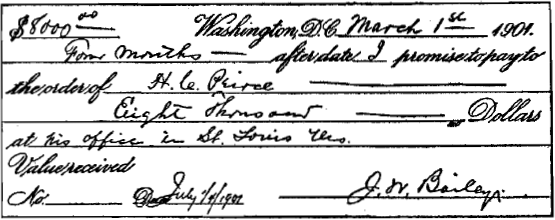
NOTE MADE BY SENATOR BAILEY TO HENRY CLAY PIERCE AND WHICH WAS NEVER PAID.
(From Hearst’s Magazine)
Bailey got charged with acting for the Standard in the senatorial canvass which followed. The legislature even investigated it. But it heard nothing of Mr. Bailey’s $3,300 loan. He was elected to the Senate. The day after his election he went to Pierce and borrowed another $8,000. A few weeks later he asked for $1,750 more for Attorney-General Henry, who, of course, never got any of it.
Thus began the downfall of a fine figure. Not long afterward Bailey was in New York. Pierce was there and they met on the street downtown. Pierce took Bailey by the wrist and led him into 26 Broadway and up to the office of the Great Corruptionist himself. The Senator’s feet were in the trough now. And he kept them there until he was discovered.
IV
ONE BLOW was aimed at the trusts during the administration of William McKinley—the creation of the Industrial Commission—and this was done on the eve of the approaching congressional campaign. The men of the oil regions had never wholly rested. The Pure Oil Company kept up its rivalry with the trust. Toward the end of Grover Cleveland’s administration Thomas W. Phillips, one of the organizers of the Pure Oil Company and then in Congress from the oil regions, got Congress to pass a resolution providing an industrial commission to investigate the trusts. But Grover Cleveland vetoed it. Now in 1898 the measure was again brought forward, passed, and signed by the President. The Commission included five Senators, five Representatives, and nine members appointed by the president. McKinley named Thomas W. Phillips as one of his appointees. Senator Kyle was made chairman and Phillips vice-chairman of the Commission. Senator Boise Penrose was a member.
(From Hearst’s Magazine)
The Commission began with the best intentions in the world. It named a group of economists who have since achieved distinction to make its various studies, Prof. Emery R. Johnson of Princeton, W. Z. Ripley, then of the Massachusetts Institute of Technology, Samuel McCune Lindsey, Prof. John R. Commons, and Prof. Jeremiah K. Jenks of Cornell. The more important studies were made by Dr. Jenks. It is perhaps true that but for Jenks’ knowledge of the subject and his persistence in searching out the facts, backed by the vice-chairman of the Commission, Mr. Phillips, very little would have been achieved by the Commission. It investigated the Standard Oil Company, National Steel Company, American Steel and Hoop, Federal Steel, American Steel and Wire, American Tin Plate, National Shear, and International Silver Company, the sugar, and whiskey trusts. And it later went into the affairs of the tobacco, salt, wall paper, cordage, thread, baking powder, coal, and other combinations. It examined 63 witnesses including John D. Archbold, Gary, Schwab, Havemeyer, Flint, and Gunton. It worked through 1899 to 1901, brought in a preliminary report in 1900 and other reports later, filling, in all, fourteen large volumes which today form an immense reservoir of information for the student of our economic history.
(From Hearst’s Magazine)
Some very damaging evidence of the operations of the sugar and whiskey and other trusts was brought out. Some more or less troublesome facts about the Standard got into the testimony. When the report was made, however, it dealt with singular gentleness with the Oil Company. For the first time an official body recognized the permanency and usefulness of the combination idea. “Industrial combinations have become a fixture in our national life,” its preliminary report announced. “Their power for evil should be destroyed and their means of good preserved.”
When the Commission was formed, that busy gentleman at 26 Broadway, Mr. Archbold, did not, we may be sure, relax his vigilance. The appointment of Senator Kyle as Chairman pleased him. When the Senator died, just after the first report, Archbold wrote to a congressional confidant of “the lamentable death of Senator Kyle.” During the investigation Mr. Archbold became disturbed “about some questions antagonistic to our interests.” On the Commission was Representative Gardiner of Atlantic City. So Mr. Archbold wrote to Senator Sewell of New Jersey: “We understand that for some reason his [Gardiner’s] feelings toward us are not very friendly. We would greatly like to have him set right and are sure if we could have an opportunity of personal contact with him we could set him right, etc. . . . Can you pave the way for us to see him?”
(From Hearst’s Magazine)
Senator Sewell was the official pass-dispenser of the Pennsylvania Railroad and of course the good senator arranged matters and Mr. Archbold wrote him acknowledging his goodness and, for some reason, put on the letter: “William Rockefeller present.”
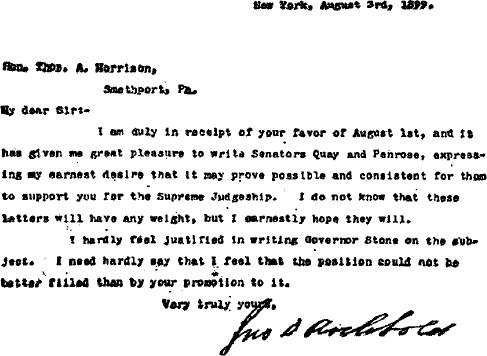
Two months later the Commission was preparing its report. Archbold wrote Sewell again: “It seems very important that this report should be wisely and conservatively shaped. Representative John J. Gardiner of New Jersey is a member of the Commission and we think it very desirable that you have a word with him on the subject. We have no doubt from what we know of him and coming from the locality he does, that he will treat the subject judicially and sensibly.”
When the report was ready Senator Penrose in January sent secretly an advance copy of it to Archbold. Archbold objected to one portion of it. That objection in the light of subsequent corporate history is interesting:
“Corporations should not be required to make public the names of all stockholders. It is an unjust and unnecessary inquisition into the private affairs of stockholders and serves no public good. . . . Private corporations should not be required to make public items of receipts and expenditures, profits and losses. A statement of assets and liabilities is all that can benefit the public. Items of receipts and expenditures, profits, and losses can only benefit the competitors.”
A month later Senator Penrose sent Archbold another copy of the report which had been toned down. Archbold replied:
“I have your kind note of yesterday with enclosures, which latter I beg to return herewith. We think the report is so fair that we will not undertake to suggest any change.”
It was only a little while before this that Archbold had written Penrose that “I am making a further special effort today to reach Senator Fairbanks on the Quay case.” Thus the favors went back and forth.
When Senator Kyle died the Commission needed a new chairman. Archbold had a bright idea of his own. He wrote Senator Penrose:
MY DEAR SENATOR:
Following the lamentable death of Senator Kyle, we are very strongly of the opinion that you should take the Chairmanship of the Industrial Commission. This seems eminently fitting from every point of view. Your name as chairman would give the report exceptional assurance of integrity and intelligence. You are the ranking senatorial member of the Commission; the interests of your state are preëminent in the matter, and last, and we hope not unfairly, we make it a strong personal request.”
This was Boise Penrose, notorious as Quay’s fellow corruptionist in Pennsylvania. Mr. Archbold seemed to think he could manage the matter. For he added to his letter a request for “an affirmative answer by wire,” so that “we may do what seems possible to aid in the matter.” Archbold then wrote a similar letter to Matt Quay urging Penrose’s appointment.
A little later Senator Mantle of Montana resigned from the Commission and Senator Thomas R. Baird of California was named. Immediately Archbold got in touch with Penrose:
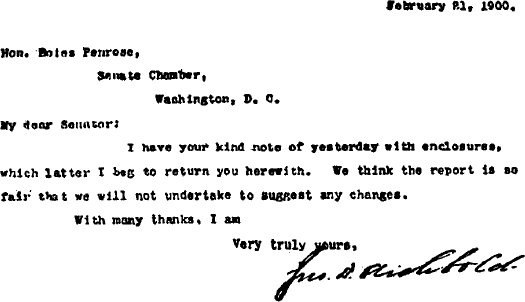
LETTER FROM ARCHBOLD TO PENROSE, MEMBER OF INDUSTRIAL COMMISSION, APPROVING COMMISSION’S REPORT EIGHT DAYS BEFORE IT WAS FILED.
“I have further information that a determined effort will be made at the meeting early in September by the Democrats and disgruntled Republican members to make political capital against the so-called trusts. If Senator Baird can be counted on for sensible action in regard to this question, an effort should be made to have him present at the meetings. It is very desirable also to have him favor Col. Clark for the chairmanship. Can you reach him and will you try?”
Apparently Senator Penrose was coy about the chairmanship. But the Standard had another candidate, Albert Clarke, and Clarke was named.
Before this Commission John D. Rockefeller did not appear. But he filed a series of answers to questions propounded to him. He was asked what are the dangers of combination. He answered:
“The dangers are that power conferred by combination may be abused; that combinations may be formed for speculating in stocks rather than for conducting business; and that for this purpose prices may be temporarily raised instead of lowered. But this fact is no more an argument against combination than the fact that steam may explode is an argument against steam. Steam is necessary and can be made comparatively safe. Combination is necessary and its abuses can be minimized; otherwise our legislators must acknowledge their incapacity to deal with the most important instrument of industry. Hitherto most legislative attempts have been not to control but to destroy; hence their futility.”
In answer to the question what legislation he would suggest he replied that he favored a Federal Incorporation act and uniform legislation encouraging corporations and supervision not to hamper business but to prevent fraud.
CHAPTER VI. MICE AND MENIT WAS about the middle of August, 1901, that Archbold was writing Boise Penrose about rigging the Industrial Commission. For the next few weeks the “Political Purchasing Agent” of Standard Oil was a busy man, pulling his wires. While he was doing this Theodore Roosevelt, vice-president of the United States, was at the Minneapolis State Fair, where he made a speech. “More and more it is evident that the State and if necessary the nation has got to have the right of supervision and control as regards the great corporations which are its creatures particularly as regards the great business combinations which derive a portion of their importance from a monopolistic tendency.” And he used in this same speech the phrase which was to become famous, a reference to the old axiom, “Speak softly but carry a big stick.” But his was a distant voice. Roosevelt was futile as vice-president, into which helpless job he had been pushed by Matt Quay and Tom Platt. William McKinley was preparing to go to the Buffalo Fair. And at the moment there is no doubt that the nation was utterly in the hands of the great combinations of capital, which everywhere, in cities, states, and nation, had corrupted the government.
Hanna, who had called himself the “representative of the corporations,” was in control. Morgan was putting over unhindered all his famous consolidations. Harriman bought the Southern Pacific and was building ahead in his adventurous career. Speculation in railroad shares rose to dizzy heights. The trust makers were at work everywhere. In New York Morgan built his steel trust. In Salt Lake City the American Cattle Growers Association, in Florida the Pineapple Growers, in New England the brick-makers made their lesser trusts. Corrupt utility gangs were seizing railroad franchises for nothing. The conscience of the people seemed to have been completely paralyzed under the pressure of the dazzling power of the new Captains of Industry as they were more or less affectionately called. “In not one of the forty-eight states is anything being done to prevent the formation of colossal corporations or interfere with those which already exist,” said the Review of Reviews. The old individualists seemed weary of the struggle. Moreover popular wrath was quenched in the rising tide of prosperity. Dr. Albert Shaw assured them “in an age of constructive genius” these great combinations like the Steel Corporation, the Standard Oil, and others “would be able to avert violent panics.” The fights between the Harrimans, Hills, Rogers, Addicks, and others made a heroic spectacle. The munificence of the great barons touched the imaginations of the people. Carnegie in three months promised libraries to a hundred cities, and proposed to New York City to build sixty-five branches. Even some of the old anti-trust warriors had dropped their weapons and joined in the mad pursuit of wealth. Ex-Governor Hogg found oil on his own paternal acres in Texas and was now marching on riches. Former Governor McMillen of Tennessee was busy building oil interests in Texas. Even the misanthropic Senator Pettigrew was found in Wall Street hunting for the pot of gold.
As August came to an end young John D. was in England looking, it was reported, for a castle in Devonshire for his parents to spend a Summer. John D. himself kept close to the heart of his vast estate which was well supplied with guards because of threats made during the pending steel strike. Senator and Mrs. Aldrich announced the engagement of their daughter Abby to Mr. John D. Rockefeller, Jr., and the two houses were busy with preparations for the happy event. Then in the first week of September, Theodore Roosevelt went into the Adirondacks to hunt, William McKinley went to Buffalo to make a speech and young Czolgosz left Cleveland with a revolver in his pocket. On September 6th McKinley made his speech and when he finished, Czolgosz shot him.
At 26 Broadway the Standard’s first thought was of Roosevelt. The man they had shelved was about to be President. In a hundred offices of trust magnates a kind of fear fell on the great captains—fear of uncertainty. They whispered among themselves. The nation went a little mad. A traveling salesman got his name in the papers because he said he overheard a conversation near the Illinois Central depot in Chicago outlining a conspiracy to murder McKinley, Morgan, and Rockefeller. The guards around the Rockefeller estate were doubled and John D. remained indoors. The newspapers poured upon the head of the maddened boy who had assassinated the President the vials of its wrath and hatred. “Futile fool,” said a dozen journals. “Not merely the cruelty of it, but the madness and futility of the act.” Cruel? Yes. But it had many far-reaching consequences though not those intended by the assassin. All the millions of rounds of ammunition fired in the Spanish-American War never wrought greater and profounder changes than that single pistol shot.
For the moment, however, the nation was thoroughly poisoned by its pursuit of wealth. The death of McKinley left behind a pall under which was tolerance for all the things he stood for—the figure of Mark Hanna standing in tears beside his bier, a hatred of the so-called radicalism which was blamed for unbalancing the mind of his slayer. At this moment Conservatism, fat, rotten, lawless, was at its flood.
II
MR. ROCKEFELLER himself was all this time as busy with the rebuilding of his health as he had ever been with the building of his fortune. He played golf every day, using a bicycle to ride from one shot to another, a fact which amused some of the ancient and honorable in Scotland who had a good laugh at this device as some of the few American golfers smiled at the pictures of Arthur Balfour playing the game in spats.
He was still a sick man, limited to a diet of milk and graham crackers, watching his temperature to keep from getting overheated. In Winter when golf was denied him he went for long walks and sometimes when stopping in New York City could be seen even in the stormiest weather heavily wrapped walking near his town house.
Life was a mixture of rewards and punishments. He was overjoyed when his daughter Alta, who had been deaf from childhood, returned from Vienna late in 1901 able to hear. A little later she was married to E. Parmalee Prentice at a quiet wedding to which only 150 guests were invited. But a kind of shadow fell over the occasion by the death, a little while before, of Jackie McCormick, Rockefeller’s only grandchild, to whom he was tenderly devoted. Then came the marriage of John D., Jr., to Senator Nelson W. Aldrich’s daughter Abby. But this was not a quiet affair. The rich Senator provided a spectacle worthy of the union of the two powerful houses. The great gray tea house in which the wedding took place was built especially for the occasion at the Aldrich Summer home at Warwick Neck, overlooking Narragansett Bay. The couple were married before a huge fireplace in the immense chamber, sixty by one hundred feet, provided for the purpose. A thousand guests graced the ceremony and a fortune in rich gifts greeted the bride. There was no wine, for the groom had asked that this be omitted. John D. himself looked with a little disapproval on the elaborate preparations. His wishes, however, were not consulted by the haughty Senator save in one sentimental incident. The wedding was performed by an aged minister, the Rev. J. G. Colby, a superannuated Congregationalist minister, who, thirty-five years before, had married the groom’s parents. The pious Baptist youth was married according to the Episcopal service by a Congregationalist minister.
Here again the joy of this highly approved union of his son was diluted by the stormy and truculent Frank Rockefeller, who broke out into one of his frequent quarrels with his older brother. Pulitzer, the editor of the World, had watched these quarrels with growing curiosity for a long time. He kept his busy newspaper on Rockefeller’s trail. Of all the journals which at the time heaped almost daily coals upon the head of the harried oil man the one he hated most was the World. Only a little before this Pulitzer had touched a tender nerve when he announced that he would give a reward of $8,000 for any information of the whereabouts of Rockefeller’s father. He had made several attempts to locate the wayward old doctor. Suddenly a few months before young John’s wedding Frank amazed Cleveland by removing the bodies of his two children from the family plot in Lakeview Cemetery. The newspapers published varying explanations of this. In Cleveland newspaper circles it was believed the two men had quarreled about their father. It is probable that the quarrel had to do with the Corrigan suit and nothing more. It made a succulent morsel for the newspapers and the reporters flocked to Frank. He talked volubly but incoherently. He talked about the Corrigan case. “That treacherous act was but a detail in my brother’s long record of heartless villainy.” He stormed about many things. “When I make all the facts public as I shall, the world will be amazed.” The breach between the two men was now irreparable. Later he again startled Cleveland by resigning from the Euclid Avenue Baptist Church and announcing dramatically that he and his family could not worship in a church that harbored John D.
The incident was a source of pain and humiliation to Rockefeller. But now past sixty, this resolute man, who had planned his life and lived all its parts with a cold and reasoning deliberation, permitted neither his family quarrel, the incessant beating of the drums of detractors and critics, the hammering of old business rivals and new enemies nor the still more formidable disorder in his body to ruffle the surface of that illimitable patience with which he looked out on life.
III
IN JUNE, 1901, five men sat down at the Arlington Hotel to discuss a proposal which came from Mr. Rockefeller. They included Dr. R. Emmett Holt, Dr. William H. Welch, Simon Flexner, T. Mitchell Prudden, and Christian A. Herter. Mr. Rockefeller’s proposal was that he would contribute $200,000, or $20,000 a year for ten years, toward establishing an institute for medical research.
Rockefeller had been thinking much about the art of giving. Dr. Gates had already organized a bureau of research for studying gifts and the idea of the benevolent trust was taking shape in Rockefeller’s mind, fed doubtless by the active mind of Gates, now largely concerned with Rockefeller’s investments. About this time Dr. Gates, who had read at the recommendation of a young physician Dr. Osier’s book “The Principles and Practice of Medicine,” was impressed by the elaborate attention of the medical fraternity to the cure of disease and the neglect of preventive measures. Gates thought much of this and was surprised at the almost complete lack of medical research work in America. Gates discussed it with Rockefeller and the germ once planted in the latter’s mind found itself in hospitable soil. His offices and home were deluged daily with letters asking aid and the utter futility of most giving was borne in on his mind. Letters and reports from those institutions which he had helped came in abundance. These he made a practice of reading at his family table and discussing in order to interest his children in this work and the transient character of most of the help given filled his practical mind with a sense of dissatisfaction. When the proposal for a medical research institute was made to a group of leading American physicians they plunged into the plan with eagerness and enthusiasm. The institute was incorporated June 14th, 1901. It began by supporting scholarships and fellowships and made grants to eighteen laboratories for research studies in existing institutions. At the end of the first year the Board decided it ought to have its own laboratory and so in June, 1902, Mr. Rockefeller gave $1,000,000 to acquire land and erect the necessary buildings. Dr. Simon Flexner, Professor of Pathology in the University of Pennsylvania, was chosen to head the work. A site was bought on the East River at East Sixty-sixth Street and work began on the building. But Dr. Flexner organized his laboratory immediately in temporary quarters in July, 1903, with four assistants. This was the beginning of the Rockefeller Institute for Medical Research.
It is not difficult to trace in the plans of the older Rockefeller the influences of his boyhood—the solitary lad of the Finger Lake Regions and its lovely landscapes spending his days producing around his Pocantico and Forest Hill homes a vast demesne of beautiful parks and endless roads; the solemn-visaged Sunday School boy who gave away dimes to church and mission and Y.M.C.A. and Deacon Sked, giving dimes to all he meets; the son of the old quack doctor who roamed the countryside with his futile pills, now creating a great institution for the scientific study of disease.
IV
THE FIRST days of Roosevelt’s régime were quiet. The trust makers proceeded upon their hectic course. Mr. Hanna pushed through the ship-subsidy bill. A great anthracite strike got under way with the reactionary and haughty railroad chieftains defying the unions. Even Richard Olney called them unblushing law breakers. Morgan formed the International Harvester trust. That contemptuous banker assumed a kind of majesty. The Census announced there were 185 combinations of capital controlling over 2,000 plants. When Aldrich wanted advice about the tariff on steel he wrote to Frick for “some one in your concern who would make suggestions as to the proper relative rate on products.” Hill and Harriman fought for the control of the Burlington and Northern Pacific. The Rockefeller interests backed Harriman. The country enjoyed the great show of these giants battling in Wall Street for Northern Pacific stock, resulting in the disastrous Northern Pacific corner. Then Morgan, Hill, Harriman, got together and patched up the quarrel by forming the Northern Securities Company to hold the stock of the Great Northern and Northern Pacific and the Burlington. Some cautious men in Wall Street shook their heads. The new President might make trouble. But the leaders felt there was a grain of security in the presence of Philander Knox in the cabinet, who could steer the President safely.
Governor Van Zandt of Minnesota had his attorney-general apply to the state courts for an order against the Northern Securities Company. But the order was denied. Then the Illinois antitrust law was declared unconstitutional. All seemed serene. Suddenly, like a bolt out of the blue, Attorney-General Knox announced that the President had asked him whether he considered the Northern Securities Company a violation of the anti-trust law and that he had answered that it was, and that at the President’s order he was about to begin proceedings against the company. Stocks fell in Wall Street. Soon another blow fell. The beef trust had raised the price of meat. Hordes of women on New York’s East Side assaulted their butcher shops. Knox filed a suit in Chicago asking for an injunction against the unlawful price-fixing agreements of the trust.
Many obese and plethoric gentlemen in Wall Street cursed the President and said, “I told you so.” Then Congressman Littlefield of Maine introduced a bill to compel corporations to file yearly statements, revealing certain essential facts about their operations. Knox collaborated with Littlefield and suggested a Bureau of Corporations with unlimited power of investigation. “The fellow is a renegade,” said the barons. Senator Knute Nelson offered a bill creating a new Department of Commerce comprising a Bureau of Corporations. Roosevelt got Nelson to offer an amendment authorizing the President to make public the information of this bureau any way he pleased. The matter was before the Senate. Standard Oil was in arms. Archbold was busy writing letters. Suddenly Roosevelt called in two newspaper reporters and informed them that he had seen telegrams to nine Senators—Hale, Spooner, Elkins, Kean, and others—from Rockefeller. They read: “We are opposed to the anti-trust legislation. Our counsel will see you. It must be stopped. (Signed) John D. Rockefeller.” Most of the Senators named denied they had received such wires. When the bills were passed Roosevelt admitted that he had released the information to help the passage of his bills. This was the first taste of that peculiar way of fighting which Roosevelt was to use many times thereafter.
Another measure was the Elkins rate bill providing penalties for rebates and rate discriminations. Still another measure made it possible to expedite the trial of anti-trust cases. Under this the Northern Securities case was hurried to trial and decided in favor of the government. This was the first great anti-trust law victory. It shocked and angered the bewildered industrialists. For the new Department of Commerce Roosevelt named as Secretary George L. Cortelyou, his secretary, and to the Bureau of Corporations he appointed James R. Garfield, son of the former President, a young man of energy, enthusiasm, and lofty civic consciousness. It was now clear that the man in the White House was in earnest about his trust policy.
V
THERE was but one safe course for the confessed industrialists—to get rid of Roosevelt. And so an impetus was given to one of the most extraordinary presidential campaign booms in our history. Hanna and Roosevelt drifted farther apart. Hanna, who had shrunk from a cabinet post, had now become so completely the embodiment of all the troubled yet powerful forces of finance and corruption in the Republican party that he came to be looked upon as their logical candidate for the presidency. The former wholesale grocer, traction magnate, political boss, and slush-fund dispenser actually came within hailing distance of the White House. The time for the conventions was approaching. Hanna’s strategy was to have all delegations go uninstructed. The forces of money and of the organization were on his side. Roosevelt’s position was precarious. But now Hanna was afraid of Matt Quay. When Quay’s seat in the Senate was being contested Hanna had fled from Washington to avoid voting. Now Quay was showing a strange friendliness for Roosevelt. Hanna wanted to bring him into line. He wrote Archbold to handle that commission. Archbold wrote Quay and asked him to call. But the old Pennsylvania fox found excuses to remain away. Archbold kept after him and kept his secretary busy sending letters and wires wherever his influence would help Hanna.
Meantime Hanna became ill and Roosevelt began to make love to Archbold. Sibley wrote Archbold in February, 1904, that the President was anxious to have him for lunch. “He urged strongly that you come over to meet him.” But Archbold thought it best to remain away. Sibley wrote again that the President was delighted to hear of the friendly attitude of Standard Oil and said Senator Aldrich had given him the same assurance. Were the wily Standard chieftains playing a double game with Roosevelt? All this time they were working industriously for Hanna. But the Ohio boss was a very sick man. What if he should die on them? And so the oily Sibley kept in touch with Roosevelt. The game came to a head quickly enough for in a few weeks Hanna died in Washington. The whole opposition to Roosevelt collapsed. The Supreme Court affirmed the Northern Securities decision. Old Matt Quay died. Prosecutions of trusts were popping up everywhere. At a gridiron dinner Roosevelt shook his finger under the nose of the great J. P. Morgan. Surely the drift was away from the captains. Doom seemed to stalk their plans. They turned to Judge Alton B. Parker for a Democratic candidate, sponsored by Thomas F. Ryan and August Belmont, associates of the Rockefellers in the New York utility field. Parker said: “The common law as developed affords a complete legal remedy against monopoly.” What more could a trust magnate want? But the Parker hope turned to ashes in their hands. After all, there is plenty to government besides the president and there was more danger in a congress of Southern Democrats and Western radicals than in Roosevelt. And as election approached the business leaders drifted back into the camp of their old love, the Grand Old Party. The Standard contributed $25,000 to the Republican congressional campaign fund, another $25,000 to the Roosevelt fund through Senator Penrose and handed a check for $100,000 to Bliss, the Republican treasurer, the same gentleman who collected for Hanna and another $30,000 from Archbold, Rogers, and William Rockefeller to Harriman’s fund. In the end all the forces which had stood behind McKinley lined up behind Roosevelt. The Bryan wing of the Democrats remained cold to Parker and the mis-cast Democratic candidate was ingloriously defeated.
VI
WHILE all this was in progress Rockefeller remained studiously away from the spotlight and the stage. What part he took behind the wings must be a subject of guess. We find Archbold in 1902 writing the industrious Sibley, who for some reason wanted to see Mr. Rockefeller, that “Mr. Rockefeller never comes to business and I see him infrequently.” He had quite ceased to visit his office. He did, however, have a direct wire to Archbold’s office and was in frequent communication. Did he discuss Mr. Archbold’s contributions to the sly art of “setting statesmen right”? We may well guess that he did not. Rockefeller did not require the discussion of details like this—indeed preferred not to have them. It was the settled policy of the company to use its money everywhere and anywhere, in state and national councils, to produce results. The policy settled, Rockefeller never concerned himself with the details of carrying it out. William Rockefeller, always very close to his brother, knew all about such matters. And undoubtedly John D. knew in general, if not in detail, what was being done. He took no part in the campaign, however, as indeed was his custom. He looked with growing distrust upon Roosevelt but for the time being kept his counsel.
He had during these years, for the first time in his life, leisure for meditation. And he began to talk to men who looked out upon a larger world of thought than he had ever explored. We begin to see evidences of his moving beyond the bounds of the little Baptist universe in which he had done his very meager thinking. He begins to talk about higher education and its importance and finally betrays an interest in extending his educational gifts beyond the Baptist corral.
In 1898 an educational movement got started in the South at the First Capon Springs Conference for Christian Education in the South. The next year appeared Mr. Robert C. Ogden, John Wanamaker’s partner, as a participant and very soon he was the head and ruler of what came to be called the Ogden movement. Meantime Rockefeller had been managing his gifts to Baptist institutions through the Baptist Educational Society still dominated by Dr. Gates. And out of these two movements grew the plan for the General Education Board. Early in January, 1902, acting as counsel for Rockefeller in this matter, Edward M. Shepard submitted to a small group the plan for the General Educational Association. The group was interesting. It included young John D. Rockefeller, Frederick T. Gates, and Dr. Wallace Butterick, who was responsible in a measure for the plan, Robert C. Ogden, and a few others. But it is significant to note the presence of Dr. Albert Shaw, editor of the Review of Reviews and Mr. Walter H. Page, editor of World’s Work. The Ogden movement found itself merged into the Rockefeller Board. After a while Mr. Ogden became president of the Board with Dr. Wallace Butterick as secretary. The founder’s gift this year was a million dollars. The charter set forth the objects of the Board as “the promotion of education within the United States without distinction of race, sex, or creed.” But the first million gift was specifically limited to education in the South, the principal to be expended over a period of ten years. It was not until June, 1905, that Rockefeller gave to the Board its first permanent endowment of $10,000,000 to be used for higher education in the United States.
Meantime a stream of princely gifts to various causes were made—seven million to the Post-Graduate Medical College and hospital in Chicago, a half million to Johns Hopkins Hospital, $350,000 to Teachers College in New York, a thank offering for the escape of his family without injury when his Pocantico Hills house burned in 1904. Besides he had begun the custom of giving each year a Christmas gift of a million dollars to the University of Chicago.
He nursed with unending care his precarious health. And while he seemed to be somewhat better, a strange affliction came upon him, which induced him to remain in seclusion for some months. This new disease was called alopecia. It caused his hair—on his head, his mustache, his eyebrows—to fall out with startling rapidity so that he remained utterly bald. When he got back to Pocantico the villagers hardly recognized him. Thereafter when he appeared in public it was in the little dark skull cap which became familiar in his pictures.
CHAPTER VII. THE MUCKRAKERSIN APRIL, 1906, while fighting to put through his railroad bill, Roosevelt in a speech dedicating the new House of Representatives Office Building, made a reference to the Man with the Muckrake in Bunyan’s “Pilgrim’s Progress,” “the man who could look no way but downward with the muckrake in his hand,” who could not see the celestial crown offered him because he continued to “rake to himself the filth of the floor.” He was repeating a phrase which he had used a few weeks before at the gridiron dinner.
Roosevelt was referring to that extraordinary group of journalists who, in magazines and books and newspapers, were uncovering the amazing graft of business and politics and were producing what the Atlantic Monthly called the “literature of exposure.” This eruption of denunciatory writing constituted a phenomenon in the life of the time and exercised a powerful effect upon the public mind. As in all movements, the dramatic narratives of dishonesty in high places came from the pens of a mixture of serious and able men and from pure sensation mongers. Roosevelt’s unlucky phrase grouped them all together and furnished his own enemies with an odious label which they proceeded to make powerful use of. Every critic thereafter was called a muckraker. Every unfriendly discussion of the vast, undisciplined pestilence of knavery in big business and public life was refuted by being branded as muckraking. No historian of the times now pretends to deny not merely that grave abuses grew up, but that the public conscience seemed to have become inert. That the revelations of the so-called muckrakers, which turned the light upon these dark places, were the most potent agent in awakening that languid conscience, cannot be denied. Roosevelt’s phrase did an injustice to the earnest writers and editors who not only furnished for him the most effective support he got but made a contribution of lasting benefit to the developments of the times.
Roosevelt had a way of turning upon his own friends to square himself with powerful enemies. He was a very practical politician. The great trust buster and political reformer, he still knew how to cultivate the trust barons and the bosses. He invited Morgan to dinner when he was elected vice-president. He tried to make friends with Mark Hanna. George W. Perkins was one of his staunch friends. Roosevelt always liked and fraternized with old Matt Quay. When he thought he might have gone too far in any policy of attack he would turn upon those in the same pack with himself to mollify the pursuers. This he did when he made his “muckrake” speech.
Oil and its battles, however, had receded from her interests. It was far from Titusville—in Paris—that her attention was redirected to the Standard. Wickham Steed had read Lloyd’s book and the two talked of it. This interest remained academic until after the success of her “Life of Lincoln” in McClure’s when the magazine was looking for another big story. While the story was in preparation Mark Twain called on S. S. McClure to inquire what kind of story was being prepared and to suggest that his friend Henry H. Rogers would like to talk to McClure. McClure suggested that Miss Tarbell see him and she jumped at the chance to try out some of her findings on some one representing the Standard Oil side.
When she called on Rogers at 26 Broadway he received her cordially and inquired: “Is there any way we can stop this?” She answered: “No, there is no way on earth in which you can prevent the publication of this story.” He did not press the point but asked her to promise that before she printed any charges she would bring them to him and give him an opportunity to explain. To this she agreed and thereafter, while preparing her story, called at 26 Broadway at least twenty times and had as many conferences with Rogers. Rogers made a profound impression on Miss Tarbell. She liked him, found herself admiring his frankness, his lack of pretension and cant. Once when she outlined to him a particularly bad performance at Titusville, he shook his head gravely and said: “You know, that was the worst thing we ever did.”
Miss Tarbell spent two years following the course of Rockefeller’s company, visiting the oil regions, Rockefeller’s early homes in New York, Cleveland, and other oil centers. And in 1902 McClure’s Magazine began publication of her story. The serial ran for two years and was read with hungry interest by people everywhere. Miss Tarbell retold again much of the early history and many of the incidents which had been first narrated by Lloyd. But she had the benefit of a fuller understanding of those events and the accumulation of a great mass of data which were not open to Lloyd. Besides she carried the story further along—to the formation of the Pure Oil Company in the late nineties. She talked with Lloyd at the outset of her labors and while her story was being published Lloyd followed it and expressed the greatest satisfaction and delight at her fine performance.
Miss Tarbell’s story was not, of course, a life of Rockefeller, but a record of the abuses of the Standard Oil Company from 1872 to 1898. It was a mixture of historical narrative and indictment. No critic could complain that she had not examined the facts, for the evidences of minute and painstaking investigation were stamped upon every part of the work. Less dramatic in its style than Lloyd’s book, it was nevertheless far more dramatic through the skillful management of its incidents. An analysis of a great economic episode pushed forward serially through two years (later in two volumes) with remorseless logic, it was at the same time a story of absorbing interest. Of this remarkable book it is just to say that it remains to this day the ablest document of its kind ever produced by an American writer.
The success of this monumental work was so great that before it had been completely published as a serial critics of the current vogue of graft in business and politics sprang up everywhere and the age of the muckrakers was in full career. Burton J. Kendrick told the story of the Astor Fortune and writers like David Graham Phillips, with his “Treason of the Senate,” Lincoln Steffens with his “Shame of the Cities,” and dozens of others dealt crippling blows at the respectability of some of our commercial and political nobility. The movement for Pure Food laws, for honesty in advertising and against the patent medicine fakirs which got its impetus from Dr. Harvey Wiley and his “Poison Squad” in the Department of Agriculture was pushed with dramatic fervor by magazines like Collier’s. Thomas W. Lawson electrified the country for a while with his “Frenzied Finance,” published as a serial in Everybody’s. This was a lurid, highly fevered account of the operations of Henry H. Rogers and William Rockefeller and James Stillman in Amalgamated Copper, Boston Gas, and other hectic financial stock manipulations. The whole subject of the grasping, unscrupulous, domineering business man and his corrupt political ally got into fiction and on the stage. And by a kind of fatality each offense fastened on other rich men and each blast of invective hurled at others, left another coating of infamy upon the name of Rockefeller. “There are worse men than John D. Rockefeller,” said the Arena. “There is probably not one, however, who in the public mind so typifies the grave and startling menace to the social order.” He had indeed taken on the character of a symbol. He was the victim of another circumstance. The same writer expressed it. “John D. has one vulnerable point, his religious instinct. Dissimulator and hypocrite by nature, the so-called development of veneration is nevertheless plainly marked.” People felt less repugnance for the heretical Carnegie or the unregenerate John W. Gates or the worldly Rogers or the magnificent Morgan than they did for the pious John D. who was put down as a hypocrite, giving with one hand to countless charities and with the other collecting back the sum of his bounty from the poor by raising the price of kerosene.
As in the case of Lloyd, so Rockefeller kept his peace in the face of the Tarbell articles. In the South a friend undertook to suggest that he would reply on some points to Miss Tarbell. “Not a word!” Rockefeller interrupted. “Not a word about that misguided woman.” Gaylord Wilshire met Rockefeller at a banquet in Santa Barbara and asked him about the Tarbell articles. “All without foundation,” Rockefeller replied. “The idea of the Standard forcing any one to sell his refinery is absurd. The refiners wanted to sell to us and nobody that has sold and worked with us but has made money and is glad he did so. I thought once of having an answer made to the McClure articles, but you know it has always been the policy of the Standard to keep silent under attack and let our acts speak for themselves.”
II
THE ORGY of denunciation and exposure got a lively and sensational turn from an attack on Rockefeller from within the church which loaded his name with more odium and gave him more pain perhaps than any other which he suffered. In April, 1905, he gave very secretly $100,000 to the American Board of Commissioners of Foreign Missions, a Congregational body. A body of Congregational ministers meeting in Boston engaged in a hectic debate over a resolution that “the acceptance of such a gift involves the constituents of the board in a relation implying honor to the donor and subjects the board to the charge of ignoring . . . the repeated and formidable indictments in specific terms for methods which are morally iniquitous and socially destructive.” Immediately the newspapers broke out into a violent discussion of “tainted money,” a phrase which was to share with “muckrakers” the popularity of the papers for some years. Every editor, educator, and preacher in the country contributed his view to the propriety of accepting Rockefeller’s money. Precious few said a word for Rockefeller himself. There were many, however, who, while condemning the manner in which Rockefeller made his money, defended the gift. Of course, the clerical and pedagogical beneficiaries of his gifts came bravely to his defense. “Why let the devil have all the good tunes?” said the New York World. Letters poured in to the New York Tribune which made much of the matter. One of these urged that the money “be taken out of its evil path,” and used the phrase “the tainted money of Judas,” from which, perhaps, the term “tainted money” sprang. “Take it from the unspeakable Turk; take it from the devil himself. Above all take it from a bad man, a gambler, a thief, if with his wickedness he has a weakness for doing good. Let the taint in some of his money be cleansed. Let the gold as well as the wroth of a bad man prove the good,” suggested the Independent.
The Memphis Commercial Appeal expressed most graphically the essence of the attacks. “Captain Kidd was a pirate. If he had quietly dropped into a New England town some night and left a lot of stolen goods with a fence he would be liable under the law. If on the other hand he had made his way to a parsonage, told the minister who he was and that he wanted to make a present of 10,000 Spanish doubloons to build a new chapel, what would be thought of the preacher who could accept that which it would be a crime for a fence to receive?”
The most redoubtable of all Rockefeller’s assailants was the Rev. Washington Gladden, of Ohio, a widely known preacher of the day and a moderator of the Congregational Church. Gladden indeed moved merrily to the attack. Gladden was a product of the Finger Lake Region, like Rockefeller, and actually went to the old Owego Academy where Rockefeller got his early education. He had been belaboring Rockefeller for many years. Now he raked over Rockefeller’s past to prove the charge of the Boston ministers that Rockefeller’s money had been obtained by “methods morally iniquitous and socially destructive.” He filed a written protest with the Prudential Committee of the Congregational Church. “The good that is done,” he protested, “by lowering our ethical standards might best be left undone. Shall the young men and women of the missionary colleges be taught to regard Mr. Rockefeller as a great benefactor? The colleges might better be closed.”
At first the Prudential Committee declared the gift had come “voluntarily and unsolicited,” giving an impression that to refuse it would be an ungracious and unChristian act. They spoke of it as a “surprise.” They maintained this attitude until Frederick T. Gates threatened to expose their importunities if they did not reveal frankly the conditions under which Rockefeller made the gift. As a matter of fact, the gift had been made reluctantly by Rockefeller only after he had been pestered by the Rev. James Barton, of the Committee. Both young John D. and Frederick T. Gates had written Barton refusing the interviews he asked with the old man. But Barton kept up his importunities and finally Gates sent $100,000 saying very significantly, “There is no reason known to me on Mr. Rockefeller’s part why you should make any distinction in acknowledging this contribution than if it had been made by any one else.”
The religious journals flew to Rockefeller’s defense, approved the gift and the man who made it. Dr. Lyman Abbott in the Outlook thought the Boston protest showed the church could not be bought. Certainly it proved no such thing for the church officials approved and accepted the gift. Those who denounced it were rebels in a small minority.
Rockefeller himself, throughout, though deeply pained and chagrined, remained silent. He went to prayer meeting at Euclid Avenue Baptist Church where he was received with acclaim and asked to speak. He talked a little and then said: “I have talked too long, I am afraid. There are others here who want to talk. I don’t want you to think I am a selfish monopolist.” The congregation caught the meaning and laughed and applauded him heartily.
Gladden told reporters he was going to start a movement against accepting gifts from rich malefactors but the agitation soon died down. The appetite for gifts from “those rich malefactors” was too extensive and voracious. In the midst of it all Rockefeller made his contribution of $10,000,000 to the General Education Board. The agitation undoubtedly left a deep stain upon his name, but it made some friends for Rockefeller too. “What was intended,” said Current History, “as an earnest, intelligent protest, took on the character of an uproar, made Rockefeller look like a much abused man and brought him much undeserved sympathy.”
The unreasoning distinction made against Rockefeller among rich men was a little puzzling. The same papers which fulminated against the oil man, supported the countless local pleas being made everywhere to Andrew Carnegie for libraries. A candid, unbiased examination of the Rockefeller fortune at this time must have forced any man to admit that of all our great fortunes it was the most honestly acquired. Rockefeller had dealt honestly with his associates, with his workmen, and with his customers. His wealth had been accumulated out of the profits of building a great industrial enterprise. His offenses had been committed almost wholly against his competitors. They consisted in those deceptions, intrigues, and stratagems which had always been employed in business against rivals. They seemed worse perhaps because used upon a larger field. Also they got so much advertisement. But they were employed not as the main engine of his success, but merely as part of a larger design; they were incidents in a grandiose scheme of industrial empire building which had as its fundamental, major objective the development and perfection of a new system of business—a system which was destined very soon to be universally adopted. The cruelty of Rockefeller’s own conduct is much magnified by focusing the attention upon the sufferings of the victim, particularly when we overlook altogether the part which stupidity and ignorance of most of the victims played in their own destruction. For years the Rockefeller legend was the story of little men crushed. The tale of a small refiner or dealer brought to ruin always made an appealing story. The constructive work of Rockefeller in building a great business and in pioneering in the field of efficiency and honest administration within the business itself was wholly overlooked. Even the establishment at this time of a pension system for old employees, thirty years in advance of scores of large business concerns today, was almost completely passed over. The distinction between the Rockefeller fortune made by way of accumulated profit in the building not merely of a great business but a great business system and those fortunes made by the group of glorified stock-jobbers like Morgan and Gates and Havemeyer and Moore and Reid and Gould and others was utterly overlooked. You will look in vain in the Standard Oil Company for performances like the organization of United States Steel where plants were bought for double and treble their value in stock and where promoters’ fees running to hundreds of millions of dollars were drawn out by the organizers and where the entire half-billion shares of common stock had no physical property whatever back of it. The Standard Oil was never over-capitalized. Indeed, it was always under-capitalized. When Rockefeller acquired a company he paid its actual value in cash or stock. There was no water. And this, oddly, was one of the first causes of his damnation. It came from the sellers who thought they ought to get fancy prices for the “good will” of their business. And even so intelligent a critic as Ida Tarbell joined in this reproof without, it seems, quite understanding its import.
All this was very puzzling to Rockefeller. “Standard Oil,” he said later, “has no water in its stock, has never issued bonds or shares through bankers, no underwriting syndicates of selling schemes, has always paid bills, keeps 60,000 men employed, pays well, cares for them when sick, pensions them when old, brought a million dollars a week into the country.”
Yet he was loaded with contumely and shame while the Morgans and Carnegies and Garys and others were honored. Carnegie had sold armor plate to the Russians for $249 and exacted from the United States Navy from $520 to $700 a ton. Moreover a congressional committee had said of the steel leaders, Carnegie, Corey, Schwab, “The unblushing character of the frauds to which these men have been parties and the disregard for truth and honesty which they have shown for our committee render them unworthy of credence.”
Out of the capitalizations of Morgan countless millions of dollars had been lost by the hapless thousands of investors who had been lured into putting their savings into the outrageously watered stocks. When the panic of 1907 came all the industrialists in steel and copper and cotton cut wages, but Standard Oil not only did not cut wages but increased employment by providing during the recession for extensive construction works, an expedient for depressions which today, more than twenty years later, we are still considering.
Rockefeller could not, therefore, understand what could be the explanation of the odium in which he was held while his fellow capitalists came in merely for a kind of good-natured spoofing, from the people who otherwise admired them.
As for his money and his gifts, he said nothing, though he was stung into submitting to his first interview. This was in the Woman’s Home Companion in 1915. And in that he made merely an indirect reference to the storm which raged around his gifts. He said: “God gave me my money.”
CHAPTER VIII. GOD’S GOLDDOWN on his knees in the dim glow of the Wall Street twilight old Daniel Drew prays to the Lord for a blessing on his latest market venture. Uncle Dan’l with his clever pupils, Jay Gould and Jim Fisk, had just completed their most daring raid on Erie stock. In its train came a string of losses, bankruptcies, and suicides which made it a classic in Wall Street villainy. Now secretly old Dan’l had deserted his two confederates and set a snare for them. He had promised sometime before $250,000 to build a theological seminary at Madison, New Jersey. Now the $250,000 was due. And old Uncle Dan’l planned to catch his partners, Gould and Fisk, unawares and squeeze from their unregenerate wallets the $250,000 needed for his divinity school plus a good deal more for the pious founder himself. His bomb was placed. The fuse was lit. The event was in the hands of Heaven. And so now as Wall Street hurried home from its day’s labors, the devout old gentleman fell upon his knees amid his ledgers and his market tables and implored the Lord to smile upon his new enterprise for the sake of his divinity school. As it turned out, however, the Lord was on the other side of the market. Gould and Fisk fooled their pious old master, shifted their position, squeezed him mercilessly and wrung a million from his sanctimonious hide.
But the picture of Daniel Drew, as pious an old cutthroat as ever scuttled a pool or squeezed a short, on his marrow bones praying the Lord for the success of a crooked Wall Street deal, so that he might endow his college of divine learning, is one which has provoked no end of mystery, scorn, and derision. For it is but a symbol of a phenomenon very familiar to the last generation and not wholly expunged from this one.
No stranger bedfellows ever lay down together in a man’s soul than this oddly assorted pair—religion and thrift—room-mates in the breast of the business man—living together, as many people have believed, in sin.
John D. Rockefeller of course was the outstanding case. But there were many others. Rockefeller’s day was signalized by the appearance of three very famous Sunday School superintendents—John D. himself, John Wanamaker, and John E. Searles. They were the rich apostles. Whatever they did, they had their texts ready, particularly John Wanamaker, who was a veritable man of texts, who went about with his Bible and the day’s lesson marked with an American flag. Rockefeller, stung by the “tainted money” episode, submitted to his first interview. It was in the Woman’s Home Companion and in it he declared that “God gave me my money.” Searles was a grave, narrow Puritan, with a clean-shaven lip and a long patriarchal beard. At the Methodist conventions he looked more sacerdotal than any preacher. The rising generation does not know him but he was familiar to the last one in the investigations of the Sugar Trust and its unscrupulous financial operations which he directed with a rare genius for intricate antisocial corporation promotion.
But they were not the only ones. In New York City all the multi-millionaires were well-known church members, save perhaps Andrew Carnegie. And Andy was something of a dissenter in the matter of religion, whiskey, and living. But most of the multimillionaires of the day were well-known members of the various Protestant churches, so that the churches were actually identified by their names. Grace Church was the church of J. P. Morgan and R. Fulton Cutting. St. Bartholomew’s was the devotional refuge of the Vanderbilts and their connections. At Trinity Church there were the Astors. Old John Jacob started out as a member of the Dutch Reformed. In the days when he was performing some of his most skillful operations on the trappers of the Northwest the consistory used to meet at his house and he soothed his troubled spirit at eventide reading his Bible and the “Rise and Progress of Religion in the Soul.” But now his family had soared upward, as so many good Baptists and Methodists and Lutherans, upon the wings of wealth into the lofty reaches of the Episcopal Church. Of the 75 multi-millionaires of the New York of the 1900’s, half were communicants of the Episcopal Church. St. Thomas parish alone had seven multi-millionaires. All the others had their wealthy trustees and vestrymen. The Baptists and Methodists, however, were not so well supplied though the Baptists had in Mr. John D. Rockefeller the prize package of all. In all churches the odor of prosperity mingled with the odor of sanctity. It looked as if one of the greatest tactical blunders in the life of Christ was his unthinking shot at the rich man, the Kingdom of God, the Camel and the Needle’s eye. No one can say with certainty that these rich men actually got into Heaven. But certainly they were to be found herded in large numbers in the vestibule.
II
IF THE rich man goes after the church, it must be said in all fairness, that the pursuit has not been a one-sided affair. Mahomet has not had to go far. The Mountain has more than met him halfway.
It is no longer possible to run a church on a shoestring as Christ did. The open-air church is not popular with either apostle or disciple. Even the Salvation Army has moved in out of the weather. Particularly in our modern cities, with high real estate values, excessive costs of raw materials, coal and light, help and religious paraphernalia, and the growing love of the prosperous Christian for luxury and comfort, the plant cost and overhead of religion are appalling.
These great expenditures arise out of the weakness which the modern apostles have for the good things of life and out of the adventitious aids which religion must call to its service to put its messages across.
It is the church’s unappeasable appetite for funds to support its vast array of secular activities and its costly ritualistic services which makes it the slave of Mammon. The value of church property in New York as put down by the tax assessors for exemption purposes is $282,659,289, which is far below its actual value. And this does not include, besides, large holdings of taxable real estate stocks, bonds, and cash held for investment purposes. Trinity Church alone has dividend-paying real estate valued at $15,000,000 and an income of nearly $2,000,000 a year from its investments. It takes a lot of money to shelter a Christian soul. St. Paul’s Chapel is valued at $5,000,000 with but 334 dues-paying communicants—an average of $15,000 per soul, which is more than three times as much as the investment required to house a whole family in the flesh. The church of Christ at Broadway and 71st Street has a plant valued at $1,200,000 with 400 dues-paying members or about $3,000 per member.
The excessive character of this is evident from the investment of the Roman Catholic Church. In Manhattan the plant of all Protestant communions averages $900 a member. The Catholic establishment averages $66 a member. And the latter includes not merely churches, but hundreds of schools, hospitals, colleges, asylums, convents, and club houses.
In the Protestant churches these sums are raised largely through the munificence of a few wealthy patrons. In the Catholic Church they are collected in small bits from the masses of its devotees.
The effect in each case is somewhat different. In the Protestant churches it has set the preachers to running after rich men. In the Catholic Church it has tended to subordinate piety in the priesthood to the hardier and more indispensable virtues of practical business capacity. No one can blame a poor bishop for preferring a hardheaded business man as a pastor, one who can frisk the congregation extensively and meet the parish bills, to a pious but impractical priest who may save a lot of souls but put the parish into bankruptcy. After all lost souls drop more or less noiselessly into hell, but the parish budget is loud and irrepressible.
In a simpler age St. Francis of Assisi said: “It is my definite wish that the brothers shall avoid the acceptance of churches, dwellings, and all other things that may be offered them on conditions which are unfavorable to the holy poverty we prize as our rule.”
But there is no “holy poverty” in the Protestant churches today and not too much of it in the Catholic Church either. Instead we have “holy riches”—God’s Gold. The preachers therefore cannot be too squeamish about the texts in the Bible dealing with riches and business. Hence we have seen an incessant appeal to wealthy men to get them inside the church. And as the church has taken on these passengers one by one it has had to keep on dropping text after text which could no longer ride with them. At the time of which we write a well-known Protestant clergyman turned a bit of light on the lay deputies of the Protestant-Episcopal Church of America. Out of four deputies from New York, three were multi-millionaires. From Long Island two of the four were millionaires. Massachusetts sent two multi-millionaires, West Massachusetts sent three, and Pittsburgh two. Of course, the great lay figure of the Episcopal Church of that day was J. Pierpont Morgan. As a New York delegate he appeared surrounded by that magnificence which attended him everywhere. He rented a house in the convention city which was always referred to as Syndicate House. A special train brought him and his guests, bishops, and important divines to Syndicate House where they were entertained upon the most lavish scale. But all the wealth and magnificence was not at Syndicate House. After one of these Triennial conventions the hotel proprietor declared that while he had entertained railroad, fraternal, sporting, and other groups at his hotel he had never seen men spend so much money or women who wore so much jewelry as these Episcopalian leaders who met to set in order the temporal affairs of the religion set up by the wayside preacher of humility and poverty who walked barefoot the hard roads of Galilee.
Practically all of the Standard leaders were godly men and many of them sprang from the loins of preachers. Archbold was a deacon in the church, William Rockefeller worshiped in the church he built in Tarrytown. Old Jacob Vandergrift was a man of exacting piety and a soldier in that division of the Lord’s army that warred on the Demon Rum. William Wardell was almost a professional pietist, was the first real angel of the prohibition party and ran first for Mayor and then for Governor of New York on the Prohibition ticket. Charles Pratt was a generous giver to religious work of all sorts in Brooklyn. James Stillman ended the day always with a prayer that God would protect the deposits of the National City Bank. When William McKinley was reëlected in 1900 and marched back into office followed by that picturesque and picaresque crew of the anointed—Quay and Penrose and Foraker and Kean and Elkins and Platt and Depew and Aldrich and the rest to the chantings of the Archbolds and Havemeyers and Harrimans and Rogerses and Addicks and Morgans and the lesser Keepers of the Sacred Gold, Mark Hanna wired the president in congratulation: “God’s in His Heaven. All’s well with the world.”
III
“CALL upon me in the day of trouble and I will deliver thee and thou shalt glorify me” There is a text the business man can understand. He sees himself actually propositioned by the Lord. The Party of the First Part will help the Party of the Second Part when the latter is in trouble. In consideration thereof the party of the second part will glorify the party of the first part. There is the coin in which the Lord’s dues can be paid. Glorification. What is the Lord after? That’s the natural inquiry for a business man, even though he doesn’t put it into words. The Lord wants to be glorified. It runs through the whole of the Old Testament. The prophets promulgate many laws, but those decretals which are set forth with the greatest particularity refer to this demand for glorification.
And so old Daniel Drew on his prayer bones in Wall Street and John Wanamaker kneeling in his first store praying for credit and issuing promises of glorification knew what they were doing.
“Jesus is the best friend you have,” says a minister of the gospel. “He can pull you out of the worst perplexities. Why, Christ meets the business man in the street and says: ‘O Business Man, I know all thy troubles: I will be with thee. I will see thee through.’ Look out how you try to corner or trample on a man who is backed by the Lord God Almighty.”
This is not an isolated view. The Christian preacher is continually pointing out the advantage of belonging to the Christian church. Our Christian Science friends, though they press the matter further, are not the only ones who promise treasures here as well as in Heaven.
“The wealthy men of our cities as well as of our farms are chiefly religious men,” says the Rev. Wilbur F. Crafts. He tells us he got a prominent Chicago business man to make a list of 100 leading business men and the survey showed 70 church members, 24 who attended service frequently, three dissipated, and three Jews. And why not? “The Bible books,” he explains, “from Joshua to Job are a series of sermons on success and failure, illustrated by brief biographies of 50 rulers, all enforcing the text which is the keystone of all Old Testament history—As long as he sought the Lord, God made him to prosper.”
IV
WHEN in July, 1902, the country was on the verge of a coal famine and the anthracite regions on the verge of civil war, George Baer, the leader and spokesman of the coal barons, was appealed to in the name of religion and humanity to do something for the workers and thus avert the threatened catastrophe.
“I beg you not to be discouraged,” he replied. “The rights and interests of the laboring man will be protected and cared for—not by the labor agitators but by the Christian men to whom God in His infinite wisdom has given control of the property interests of the country.”
This was a well-settled view. It arose out of the very necessity of bringing all this gathering of gold into conformity with the Christian ideal. It flowed too from that development of Christian philosophy which began with Calvin when the idea of individual development was stressed and social obligation almost completely obscured. Money getting and piling was so inevitable, and the money getters so essential to the church which could count on no other means of support that it was easy to invent the idea of the Divine Trust. The rich men gathered their riches in the vineyard of the Lord, They did so as His servants and agents. The money was not theirs at all, but the Lord’s and they held it in trust for Him. “The silver is mine and the gold is mine,” saith the Lord. “Is not Gold the sole proprietor of everything?” asked Wesley. “God gave me my money,” said Rockefeller. Here is the foundation of Rockefeller’s paternalism in employment and in social giving. To William Hoster, he said: “Perhaps I might have succeeded as a preacher, if I had been good enough. I have the most radical, old-fashioned ideas about the duty of every man to contribute to the betterment of his race. I believe the power to make money is a gift from God—just as are the instincts for art, music, literature, the doctor’s talent, the nurse’s, yours—to de developed and used to the best of our ability for the good of mankind. Having been endowed with the gift I possess, I believe it is my duty to make money and still more money, and to use the money I make for the good of my fellow man according to the dictates of my conscience.” This strange phenomenon is explained by John A. Hobson, the English economist, as a kind of partnership between God and Mammon in which God is very decidedly on the big end of the bargain. Mammon presides over the accumulating or gathering department; God, over the giving and spending departments. Mammon makes the money and God spends it.
V
NOW IT is very easy to poke fun at these hard-headed, profit-sharing, percentage partners of the Deity. The phenomenon, however, is not to be dismissed with a gesture of derision. The soap-box orator is ready, of course, with an explanation of the business man’s piety as he is everything else. He writes them down as hypocrites who use religion as a cloak for their own wickedness or as an instrument for supporting established interests, lulling the worker to slumber, to look for his reward in Heaven instead of in his pay envelope. But these explanations have the fault of being too obvious.
Doubtless there is a good deal of hypocrisy among business men as among all sorts of men. But this does not explain their religious leanings. Certainly it does not explain John D. Rockefeller’s religion. Rockefeller was a pious boy long before he was a millionaire business man. His loyalty to the Sunday School of the old gardener Deacon Sked when he was in his teens can hardly be set down by the most hardened critic as a plot to blind the workingman with religion or to shield the rascalities of an inoffensive boy. John D. did a good many things later in life when he was struggling against the forces of ignorance, cupidity, and conservatism which could hardly have gotten by the Founder of Modern Business but his religion then, as now, was about the same as it was in his youthful days at the Erie Street Baptist Church mission. John Wanamaker and John E. Searles and John D. Archbold and many other business men flaunted religion a bit ostentatiously in their later years. But Wanamaker, the Y.M.C.A. secretary, preceded Wanamaker the merchant and Archbold the minister’s son antedated the munificent benefactor of Chancellor Day’s Syracuse University and Archbold the writer of the famous Foraker and Bailey bribe letters. Rockefeller’s many declarations of religious belief are marked by simplicity and genuineness. “I have never had occasion to doubt,” he said. There is every reason to believe this.
A sounder explanation may be that the business man’s religion is not the offspring of his business instincts. It is the other way around. His business instincts are the children of his religion. The religious boy is the father of the business man.
The most vital part of our present-day religion comes from the Old Testament. In the early days of Christianity an effort was made to apply the principles of Jesus to life and it resulted in a social order which was almost communistic. This lasted until a Roman Emperor was converted and the Christian religion became a state religion and Christian bishops became interested in state subsidies and rich benefices. After that the Christian religion began slowly to disappear and Europe went back to the Old Testament for its morals and its ethics. And the ethics of the Old Testament are bad ethics. Who has not observed the devotion of the modern Christian to the Old Testament? The New Testament is infinitely richer in spirituality and in elevated philosophy. But the Old Testament is richer in drama. It is indeed one of the greatest of dramatic narratives, teeming with high adventure, vigorous characters, stiring descriptions, and magnificent imagery, with salacious details, tragic situations, and poetic fervor. It is the Old Testament and its heroes that the modern Christian is in love with. I do not know a worse collection of heroes to hold up for the imitation of the young mind than these gentlemen.
Abraham, afraid of being slain by some monarch who coveted his wife, passed Sarah off on Pharaoh and then on Abimelech as his sister. Sarah herself was not above telling a lie outright directly to God himself. Jacob put over on Laban when dividing the goats a deal as raw as any real estate shark ever practiced on an unsuspecting prospect. He was guilty of an abominable deception on his poor blind father to rob his own brother of his rightful blessing and he was abetted in the swindle by his mother Rebekah. As for Jacob’s son Joseph he knew how to turn a pretty trick whenever it served his purpose and he became famous for one of the most complete and ruthless grain corners in history when as Pharaoh’s minister he got the Egyptians at his mercy during a famine and stripped them of their cattle, their lands, and their treasure. These men were not the villains of the stories. They were not the black sheep. They were the prophets of the Lord—the holy men of the race who walked and talked with God. Jacob, fresh from his shameless swindle of his brother, was immediately confirmed without reproof by his father in the blessing he had stolen and went forthwith to the famous dream of the ladder of angels where the Lord made him a big grant of land and said to him, “Behold, I am with thee.” Indeed God himself was represented as not above a little swindle, for did He not instruct Moses how to advise the Jews on the eve of their deliverance to go about borrowing jewelry from their Egyptian neighbors so that when a few days later they would move out of the house of bondage they would have a nice load of ill-gotten loot to carry off with them?
These are the books, this is the God, these are the tales, and heroes held up to us for generations. It is difficult to see how a business man raised on this pabulum, confronted with the necessity of putting over a little deal like Jacob’s goat trick on Laban or Joseph’s grain corner or Moses’ big jewelry loan in Egypt, could help feeling, after all, that if these great Prophets of the Lord could get away with it why could not they?
The whole emphasis of the Old Testament is laid on the rituals, as well as on the human passions with which God himself was perpetually tortured. Who can read Leviticus without having a vision of a God in a frenzy of pride and anger and egotism, strutting, swaggering, menacing, denouncing penalties, threatening death, suffering, almost frothing as He punctuates every sentence with a crescendo of boasting that “I am the Lord thy God.”
This religion has held up to us a selfish, jealous, pitiless Deity. Is it not hard to believe that one who follows the Old Testament faithfully, believes it, honors it, reverences it, will be implicated almost of a necessity in a low order of ethics and will have all the emphasis of spiritual life transferred from the substance of religion and humanity to its dramatic forms.
It is impossible to read the Old Testament without getting the impression that religion was pretty much a matter of burnt offerings, of killing the bullock properly, separating the fat and washing the inwards according to the law; a religion of hosannas and praise-giving; a religion of glorification. This is the religion which was ladeled out to the young people of the last generation and which the business man received along with the rest of the faithful. And as these business men grew in years and intellectual power, their energies were consumed in their material pursuits. They had neither the time nor the inclination to stand off from their early religious ideas and scrutinize them. When the gnawings of spiritual hunger attacked them at intervals they turned very naturally to the only religious nourishment they knew, the old-fashioned religion. It was a moronic kind of religion seen nowhere in its undiluted form better than among the negroes. “Glory to God!” the ejaculation with which the colored worshiper punctuates the singing of his spirituals and the chant-like exhorting of his preachers, is a perfect expression of this religion—not a religion of thought or a religion of ethics, but a religion of praise-giving and glorification of the Lord God of Hosts.
CHAPTER IX. ENEMIES CLOSE IN
ALL THE opponents of Mr. Rockefeller’s great company and the system he had organized were now rising to their full power. The Old Guard won a victory in the final session of Roosevelt’s first administration when they defeated in the Senate the Hepburn rate regulation bill which had passed the House. Foraker was among the leaders in opposition. The Depews and Platts and Elkinses and Keans were there to strangle it. Congress adjourned amid the ceremonies of Roosevelt’s inauguration. And then began that series of attacks which did not end until Rockefeller’s great company was dissolved. During McKinley’s administration but six anti-trust suits had been prosecuted, two of those legacies from Cleveland’s lethargic regime. One of these suits was an important victory for the Sherman law—the famous Addy-stone Pipe case in which the early contention that restraint among producers that was mutual and did not apply to non-members was not unlawful. The Supreme Court upset that untenable position. With the advent of Roosevelt, prosecutions were begun by Knox. Knox had done nothing in his year of office under McKinley and in his first year’s report did not even mention the Sherman law. Up to this time the law was practically a dead letter. But thereafter he instituted five prosecutions—one of them the Northern Securities case. Now, however, Knox was in the Senate and there began a frontal attack upon the trusts along the whole line. During Roosevelt’s second term thirty-nine suits were instituted, most of them major prosecutions of the leading combinations, something which had not been done before.
Rockefeller looked with rising disgust at the whole proceeding. He remained quiet but when the attack against the packers rose in intensity he could restrain himself no longer. He gave out a statement of protest. He declared:
“If we limit opportunity we will have to put the brakes on our national development. Will the individual strive for success if he knows the hard-won prize is to be snatched from him at last by his government? We must build up, build up for years to come. Is it common sense to tell our young men on whom the future depends that they can hope for no other reward for carrying our commercial flag forward than frenzied attacks at home? And all the handicaps their government can pile on their business to satisfy the violent prejudice against them? Take the attack we made upon our own packing business, for example. I know none of the men in the beef trade. I never dealt with them. . . . But it is safe to assume from the proportions of their industry that they are sound business men. And it is safe to assume too that no business could have been built to such proportions on such false principles or by such unsound methods as they are charged with. We are too young a nation for this tearing down.”
Opportunity! The land of opportunity! That was the slogan we liked. Rockefeller was still talking about individualism. The packers were sound because they had built a big business. That was his test.
II
UP FROM the West welled the voice of unrest. The first revolt against the House rules which would flower later under Taft in the disarming of Cannon was staged then. In Wisconsin appeared a figure which was to assume the proportions of a phenomenon later—LaFollette—“Little Bob”—who had won one campaign for governor on the direct primary issue and a second one in a fight against tax-evading railroads. Now he was demanding railroad regulation in his state. The day of populism was past. The revolt was in the Republican party. Hepburn, Republican leader in the House, sounded a warning to the railroads—“reform or a revolution at the ballot box.” Public ownership sentiment was growing everywhere. Chicago elected Mayor Dunne on that issue. And this produced a sobering effect upon the minds of the railroad leaders. Then came the insurance scandals. An interesting sidelight was furnished on the attitude of men toward large scale scoundrels in business. Young James Hazen Hyde had been caught red-handed in shameful conduct of the controlling interest he held in the Equitable Life Insurance Company. Henry C. Frick had made the report which unmasked him. Then Frick went to Roosevelt to suggest that Roosevelt make Hyde ambassador to England to get him out of the Equitable. Roosevelt, oddly, was not shocked at this preposterous proposal, and actually offered to send Hyde to Belgium. But Hyde declined. The anthracite strike under the reactionary Baer in Pennsylvania shocked the country. Everywhere men saw corruption. Senator Mitchell of Oregon was convicted of accepting fees from land grabbers to represent them against the government. Senator Burton of Kansas was indicted and convicted for taking fees to represent other interests. Roosevelt kept up his attacks, undoubtedly arousing the conscience of the better elements among the business men of the nation. Against Rockefeller he directed more than one telling shot. The nation, he warned in one speech, must grapple with the problem of its great fortunes. “Of course no amount of charities,” he said, “in spending such fortunes can compensate in any way for misconduct in acquiring them,”—an obvious thrust at Rockefeller. And he suggested the possibility in time of taking them over through progressive inheritance taxes. Roosevelt undoubtedly had the ear and heart of the country. But the whole troupe of Mr. Archbold’s performing seals and Mr. Rockefeller’s fawning beneficiaries dutifully stood to their guns for their rich patrons. The religious defenders were the most blatant. Rockefeller and Archbold indignantly denied the use of rebates and drawbacks. But in the Bibliotheca Sacra, one of the most dignified of religious journals, one writer called rebates quite proper and even defended the ethical character of drawbacks.

