
God’s Gold
Part Three: Oil Dorado

EARLY in the Fall of 1859, John G. Hussy, a banker and one of the leading produce merchants of Cleveland, went away on a trip. Hussy’s establishment was not far from Clark and Rockefeller’s. Clark had worked for Hussy for six years and there was a good deal of visiting between the offices of the two firms. And so, while there was much secrecy about Hussy’s trip, Clark and Rockefeller knew where he had gone. He had gone to Venango County, Pennsylvania, where there was great local excitement about some new means of getting petroleum.
Some weeks later—November 18th—the Morning Leader in Cleveland carried a brief item with an inconspicuous heading. It recited that “the oil springs of northern Pennsylvania were attracting considerable speculation,” and that there was “quite a rush to the oleaginous locations.” It also noted that Drake’s well “yielded 25 barrels of oil a day at 10 cents a barrel.”
This was the first printed notice of the event in Cleveland almost three months after it occurred. Hussy was one of those who had “rushed to the oleaginous locations.” Apparently he was the first Clevelander to rush and the only one for some time.
II
SOMETIME in 1854, when John D. Rockefeller was still a student in the Central High School, Mr. George H. Bissell walked into the rooms of his old friend and teacher, Professor Crosby at Dartmouth College. Bissell, a graduate of Dartmouth, had first taught school in New Orleans and later became a lawyer in New York. He had just gone back for a visit to his old school. During their chat Professor Crosby picked up a small bottle filled with a thick, dark fluid.
“That is petroleum,” said Professor Crosby.
“And what is petroleum?” inquired his former pupil.
“Well, it is a mineral oil found in a good many places which some people use for medicine. In a few places it is used as an illuminant. This bottle was sent to me by an old friend of mine, Dr. F. B. Brewer, who once studied here. Brewer says this is found floating on the surface of most of the creeks in his part of Pennsylvania. He believes it can be refined and used as kerosene is used.”
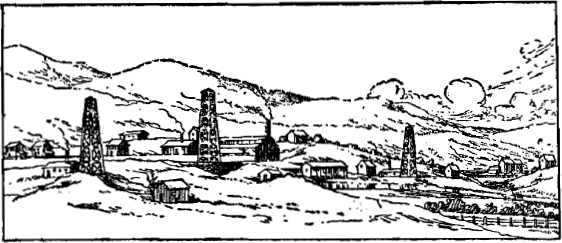
BRINE WELLS IN TARENTUM, PENNSYLVANIA, WHICH YIELDED SOME PETROLEUM AS A NUISANCE BY-PRODUCT.
(From Romance of Petroleum by J. D. Henry)
Crosby then explained that he had refined some of it and that it made a very good illuminant and he believed that it might be possible to collect enough of it on these Pennsylvania creeks to make it pay. Crosby’s seed fell upon fertile ground. Bissell thought a good deal about it and finally decided to go to Pennsylvania and investigate. He reached the oil creek regions in the fall of 1854 and spent much time wandering around the little settlement of Titusville examining the greasy coating of the little stream called Oil Creek. Without disclosing his plans Bissell bought 103 acres of land on Oil Creek in Cherrytree Township from Brewer and Watson, who owned a sawmill close by. This Brewer was the brother of the doctor who had sent the bottle to Professor Crosby. In November Bissell paid $5,000 for the land. But the deed, with an eye to future corporate operations, proclaimed the price to be $25,000.
Back in New York, Bissell, with his partner, Jonathan G. Eveleth, organized the Pennsylvania Rock Oil Company. This was the first oil company. Very fittingly it had plenty of water in its capitalization. This was fixed at $250,000. The land was turned in at $25,000. All this was completed by December 30th, 1854.
The Pennsylvania Rock Oil Company, however, did not travel very far. The promoters soon found that it was impossible to gather enough oil by known methods to make the business profitable. Skimming the oil from the surface of the creeks, soaking it up by spreading blankets on them or collecting a few barrels here and there from the salt wells in which petroleum was a by-product, were the only means known of recovering petroleum. The promoters spent all their available money and the enterprise came to a standstill. The stage was perfectly set for a great oil industry if the oil could be obtained. The coal-oil business had been enormously expanded. Everybody who could afford it used kerosene lamps with coal oil made from coal shale. The difficulty with coal oil was its cost, which went as high as a dollar a gallon. Refining a good illuminant from petroleum was far less expensive. But there was no petroleum.
III
THERE was, of course, nothing new about petroleum, as a possible illuminant. Away back in 1833 Professor Benjamin Silliman wrote about the oil he had studied from the famous Cuba Spring in New York—“a fountain of petroleum near the line which divides Allegany County from Cattaraugus.” He had also studied Seneca Oil, which he said came from Oil Creek. “I have frequently distilled it in a glass retort and the naphtha which collects in the receiver is of a light straw color and much lighter, more odorous and inflammable than petroleum.”
We have seen how Samuel Kier put petroleum up in little medicine bottles and sold it as Kier’s American Oil. But Kier had an inquiring and adventurous mind. From his salt wells at Tarentum in Pennsylvania he got far more petroleum than he could use for medicine. That required only two barrels a day. He played continually with the idea of finding other uses for the oil. He had seen the people around Tarentum use it as an illuminant, burning a cotton wick dipped in the crude petroleum and emitting a dim, foul-smelling mixture of smoke and flame. Kier took some samples of his oil to Philadelphia and to a chemist named Professor J. C. Booth. Booth suggested refining by distillation and he gave Kier directions for erecting a still. Kier constructed a one-gallon still and produced a good grade of refined oil which he called carbon oil, a name which clung to the business for many years. But it would not burn in the ordinary coal-oil lamp. Kier thereupon invented a lamp suited to the new oil. He then went into the business of refining and selling this oil. And he also manufactured in small quantities the lamp he had invented.
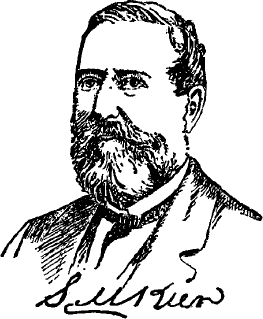
SAMUEL KIER.
About this time there was in business at 187 Water Street, New York, a man named Colonel A. C. Ferris. There is no doubt he was among the first to see the commercial value of oil as an illuminant. Ferris was in what he called the carbon oil business. He also had perfected a lamp which would burn this carbon oil. In February, 1858, we find him contracting for two-thirds of the oil product of MacKeon and Finley from their wells at Tarentum. The New York Kerosene Company, venders of coal oil made from shale, about this time became excited over the possibility of making kerosene from petroleum and in March, 1858, we find them buying nine barrels of carbon oil from Ferris and nineteen barrels in April for $581.47—more than $30 a barrel. The New York company wanted more but Ferris could not give it to them without depriving other customers. Thus we see there was a good market for petroleum and its use as an illuminant was well established. But all of the pioneers were baffled by the problem of getting crude oil.
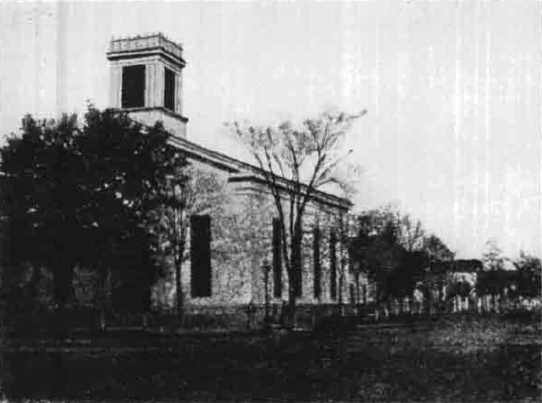
ERIE STREET BAPTIST MISSION, ROCKEFELLER’S CHURCH IN CLEVELAND AND PARENT OF THE PRESENT EUCLID AVENUE BAPTIST CHURCH.
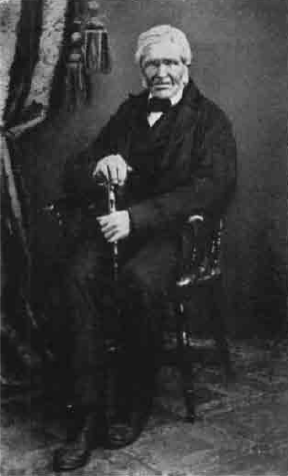
DEACON ALEXANDER SKED, WHO RECEIVED ROCKEFELLER INTO THE CHURCH.
Courtesy of Euclid Avenue Baptist Church
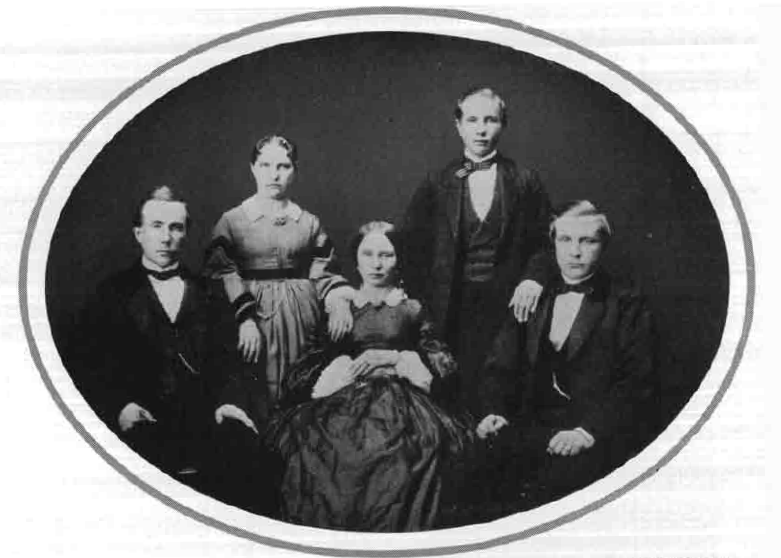
Courtesy of Miss Kate Steele Curtis of Chicago
ROCKEFELLER FAMILY GROUP ABOUT 1859. SEATED LEFT TO RIGHT, JOHN D. ROCKEFELLER, LUCY ROCKEFELLER, WILLIAM ROCKEFELLER; STANDING, LEFT TO RIGHT, MARY ANN ROCKEFELLER AND FRANK ROCKEFELLER.
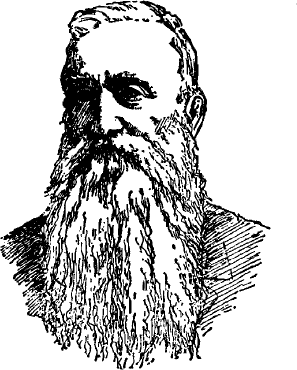
COLONEL A. C. FERRIS, FIRST NEW YORK CITY OIL MAN.
IV
ON A warm summer’s day Bissell, walking along the street, took refuge from the sun under an awning which shaded a druggist’s window. He was immediately struck by the window display which was given over wholly to Kier’s American Oil. Scattered among the bottles were Kier’s famous $400 bank notes. One side of the note simulated a government bill. The other side bore the advertisement for Kier’s oil. It was the picture on the advertisement which struck Bissell—a derrick supposed to represent the well—the salt well—from which Kier obtained his oil.
That is the way to get petroleum, thought Bissell—drill for it—drill deep. Oil had always come up from the ground in salt wells. The deeper the well the more oil. What if we drill deeper—may we not reach the true and abundant source of oil?
The thing seems so obvious that one wonders why no one thought of it sooner. Kier boasted that he got his oil by drilling. Yet it had not occurred to him to do that very thing. All the time Kier had the secret but did not know it. Bissell, as we have seen, was a man of action. Having formed this plausible theory he was ready to act upon it. All this was sometime in 1857, just as young John Rockefeller was setting up as a produce commission merchant in Cleveland.
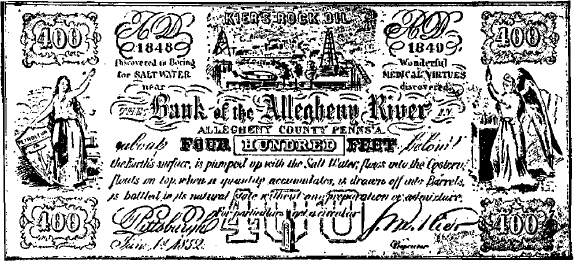
KIER’S $400 ROCK OIL NOTE WHICH SUGGESTED METHOD OF DRILLING FOR OIL.
For three years the Pennsylvania Rock Oil Company was nearly dormant. Bissell had submitted a sample of the oil to Professor Benjamin Silliman of Yale, the son of that Professor Silliman who twenty years before made the first oil studies. Silliman declared the oil excellent as an illuminant after distillation. To this he added: “There is ground for believing that the company has in its possession a raw material from which by simple and not expensive processes they may manufacture very valuable products.” On the strength of this Bissell interested several New Haven capitalists, among them a banker named Townsend.
At this time there was in New Haven a tall, solemn man of great dignity who was a conductor on the New Haven Railroad. His name was Drake. Edwin L. Drake was born March 19, 1819, at Greenville, Greene County, New York. He had wandered about much. His early boyhood was spent in the Catskills. Later, in turn, he worked on a farm in Vermont, on a Lake steamer between Detroit and Buffalo, then in Ann Arbor, Michigan, as a night clerk in a hotel at Tecumseh, back to his old home in the Green Mountains and then to New Haven where he became a clerk in a dry goods store. Later still he turned up as a dry goods clerk on Broadway and after that as express agent on the Boston and Albany Railroad. In 1849 he got a job as a conductor on the New York, New Haven and Hartford Railroad and settled down in New Haven. Drake had a small savings account in Townsend’s bank and that gentleman advised the quiet, gentle, amiable conductor to put something into the oil investment. Drake risked $200.
When Bissell conceived his great idea to drill for oil he went, all on fire with the scheme, to his New Haven associates. Infected by Bissell’s enthusiasm they organized a new company called the Seneca Oil Company and looked about for a man to command the drilling expedition into Pennsylvania. Townsend thought of Drake. The conductor, who had moved about so much, was ready to try it again. The Seneca Oil Company made a contract with E. E. Bowditch and E. L. Drake to pay them five and one-half cents’ royalty on every gallon of oil recovered. This was later raised to twelve cents a gallon for forty-five years.
Thus we see Drake did not originate the idea of commercializing oil. Many men—Kier, Peterson, Ferris, and others—had severally nursed that notion. Neither did Drake invent the plan to drill for oil. The credit for that simple but epochal conception must go to Bissell. But from this point on the credit belongs to Drake.
V
DRAKE made his appearance in Titusville in December, 1857. He was now Colonel Drake. Townsend, the canny old New England banker who had chosen him for this job, had elevated him to the rank of Colonel. This title, Townsend explained, would serve to command attention and respect for “Colonel” Drake amid his new surroundings. Titusville, in the northwestern corner of Pennsylvania, sprawled on the banks of Oil Creek, a diminutive settlement of two hundred and fifty souls—farmers and workmen in the lumber mill. Lumber was being cut all along the Allegheny and rafted down the river to Pittsburgh. Titusville was one of the stopping places for the loggers and there were four hotels to refresh and shelter them. Having looked over the ground Drake went back to New Haven to gather his family and belongings. When he got back to Titusville—May i, 1858—he got lodging and board for his entire family, including his horse, for six dollars a week. He went to the sawmill of Brewer and Watson and announced his intention of boring an artesian well.
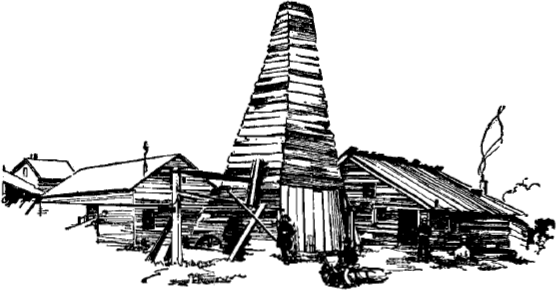
COL. EDWIN L. DRAKE’S FIRST WELL NEAR TITUSVILLE.
When Drake began he met every kind of difficulty. He engaged two men as drillers successively and each one failed to appear. He could get no driller. Meantime his funds began to dwindle. The Seneca Oil Company seemed to lose interest in his expedition. By the Fall of 1858 he had made practically no progress and his funds were gone. But Drake saw the growing market for kerosene made from coal. Moreover he had visited Ferris on his way through New York and Kier at Tarentum. And he was profoundly impressed with the importance of finding an adequate supply of oil. And so in spite of every obstacle—the failure of his drillers to appear, of his engine to come, of the Seneca Oil Company to send funds and of the coming of the winter—he was undismayed. He found two kindly friends who were impressed with his earnestness and honesty. They were Uncle Peter Wilson and a man named R. D. Fletcher and they endorsed his note for $500 and enabled him to go on with his plan.
During the Winter Drake sought another driller. He went to Tarentum and called on a Mr. Peterson who had been operating salt wells for years. Peterson put him in touch with Uncle Billy Smith, an old Tarentum blacksmith, who turned out to be the very man for Drake. Uncle Billy was a patriarchal Vulcan with a huge gray beard. Born in the early days of the century, he was a blacksmith of the old school who shoed horses but also turned out all sorts of iron and steel tools—a hinge for the house door, a hammer for the carpenter. Smith had made the salt-drilling tools around Tarentum for years for both Kier and Peterson. Smith agreed to go with Drake for $2.50 a day and pay for his two sons, Sam and James. He made his appearance in May, 1859, with drilling tools forged in his own blacksmith shop. He built a rude frame house for himself near the site of the proposed oil well—the very spot where General Benjamin Lincoln had passed with his troops during the Revolution and where his weary Continentals had bathed their tired feet in the healing oil that floated on Oil Creek.
When Smith and his sons got their drill down eighteen feet the soil caved in. Uncle Billy asked Drake to get a hollow pipe six inches square through which the drilling tool might be sent down. At thirty-six feet the drillers hit rock. And, with the aid of a little six-horse-power engine, they began actual boring through the rock on August 1st. They went down three feet a day. On August 20th, Saturday, the men stopped work. The tools were withdrawn from the soil. They had gone down 69½ feet. Next day—Sunday—Smith and his son Sam went to the well to look around. The boy strayed over to the tubing and looked down.1 He saw something about a foot from the top. In great excitement he uttered a cry: “Oil! Oil!”—a cry that has stirred the blood of men many times since. The old man saw at a glance that their labors had been rewarded. He rigged up a simple pump and began to pump the dark liquid out. Drake did not arrive until the next day. When he came he found Smith and his son guarding the well. Smith led Drake solemnly to the pump and pointed down.
“What’s that?” asked Drake.
“That’s your fortune,” proclaimed Uncle Billy. The old blacksmith then put in a seed bag and pump and in a moment the oil was flowing all over. A new era had been born. A new form of wealth had come into the world. Sam Smith ran to the Brewer and Watson mill with the news. The mill hands ran about collecting barrels of all sorts. Jonathan Watson came and, stroking his long white beard, looked for a while with a critical eye at the flowing oil. Then he ran back to the mill for his horse. Reining up before the mill office for a moment he called to William Kirkpatrick, the head sawyer.
“Bill, I’ve got to go home on some business right away,” he told Kirkpatrick. “You stay here and look after the mill until I get back”
Watson, now thoroughly excited, put spurs to his horse. He was galloping as fast as the animal could carry him to gather up as many leases of the adjoining land as he could get.
Kirkpatrick watched his employer ride away through the forest clearing. It took him just two minutes to decide what was up. So he called to his assistant, Jim Tarr.
“Watson wants me to look after the mill until he gets back,” he hurriedly informed Tarr. “He’s gone away on important business. But I got important business too. So you look after the mill ’til I get back.” Kirkpatrick leaped on his horse and was off at a gallop. Jim Tarr stood watching his disappearing superior and wondering what madness had suddenly seized the mill. Up to now it was Drake and Uncle Billy who were looked upon as a little crazy. Now suddenly everybody had become a bit touched.
As for Drake, he got aboard his horse and lit out in the direction of Meadville to get barrels. He managed to get twenty-eight. At the same time he made a deal with a teamster named Alderman to haul his oil to Meadville. Here then was born in that one day the whole creaky machinery of the new oil business—the wildcat well, the barrel business, the teamster, the lease hunter, whose tribe was to increase until all the valley swarmed with them.
By evening there was a ring of farmers and village folk from Titusville around Drake’s derrick. The news that Drake had succeeded swept over the countryside. For days the farmers straggled in and stood around watching the oil being pumped into barrels, tins, anything. The whole valley of Oil Creek slowly rose to a pitch of wild excitement as the value of Drake’s achievement seeped into the minds of the landowners.
Off in New York two men shared the excitement. They were Bissell and Eveleth. Bissell’s fever in the oil quest had cooled considerably. Now a telegram came from Drake announcing the discovery of oil. Both law partners kept the news to themselves, but, with as little show of excitement as possible, hurried around to all the stockholders of Seneca Oil Company stock and bought it for as little as possible. Then Bissell went with all speed to Titusville.
Today in a little clearing in the forest about three miles from the center of the present city of Titusville, close by the sluggish, greasy water of Oil Creek, there stands a huge bowlder bearing on its face a bronze tablet marking the spot where this historic well was bored. As one stands before it, out of the stillness of the woodland comes the steady muffled pounding of innumerable little oil wells which, seventy-one years after Drake’s discovery, are still bringing petroleum to the surface.
VI
THIS was the news which sent J. G. Hussy from his bank and his produce business in River Street, Cleveland. But few others, if any, knew of the event in Cleveland. The popular story has it that the news ran over the country instantly like wild-fire. Hussy and perhaps a few others knew of it in Cleveland, but the news did not begin to spread around the country for three months and it was not until after Christmas that the tide of adventurers began to flow into the regions.
The news reached Pittsburgh before it did Cleveland. And one of the first men on the scene was Samuel Kier. He bought the first oil from Drake. He contracted for two-thirds of the output at fifty-six cents a barrel. The balance was shipped to Schieffelin and Company, wholesale druggists in New York City. Alderman, the teamster Drake had contracted with at Meadville, would fill four barrels and wagon them to Meadville, one load a week over the old road by way of Kerr Hill and another load in some other direction.
Drake’s well continued to flow at the rate of about twenty-five barrels a week and Uncle Billy Smith continued to operate it.
VII
JONATHAN WATSON, who had galloped away from his mill as soon as he heard the news, got a lease on the farm of the Widow McClintock and without delay set up a derrick. An Englishman named William Barnsdall formed a partnership—Barnsdall, Mead, and Rouse—and started drilling in Crawford County close to Tidioute. The derricks began to appear all along Oil Creek. Ferris, the New York pioneer kerosene trader, came down to look over the situation. He immediately got leases under the firm name of King and Ferris and began drilling at Tidioute. Before Christmas the derricks were in place on numerous farms between Titusville and Oil City and as far as Franklin. No more oil was brought in before Christmas but the entire valley buzzed. The farmers had just had the most disastrous year in their history. This was the year of the June frost. And while the inhabitants were bewailing the strange mishap which had killed a large part of their crops another frost appeared and completed the work of destruction. And now suddenly from out of the depths of despair they found themselves rising on a tide of prosperity.
Lease hunters were running up and down Oil Creek buying the land if they could, leasing it where they could not buy. Here was born the thing which has been the curse of the oil industry—the royalty owner. The leases provided for cash payments and then a percentage for the landowner of all oil recovered on the land leased. That system has persisted to this day. Between the mouth of Oil Creek and its confluence with the Allegheny River there were forty-three farms and these had suddenly acquired an amazing value. It was believed at the time that all the oil was close to the creek and no drilling was attempted anywhere else. Before Christmas, along this lazy stream could be heard the sounds of numerous little engines pounding away as they raised and lowered their wooden walking beams and sent the pipes down through the rock in search of this new wealth.
VIII
JAMES EVANS, a blacksmith, living on French Creek, a tributary of Oil Creek near Franklin, was boring for salt. He was not looking for oil. And when oil began to show in the flowing brine he was disgusted. On second thought he decided to have a look at Drake’s well. What he saw there decided him to proceed with his drilling. He saw what Bissell had guessed and what Drake had proved, that, while salt water came up at a level of about fifteen or twenty feet, the oil lay deeper down below the surface of the rock. Evans went on with his drilling, working by man power without the aid of an engine. After days of toil he saw a black fluid rising in the tube. That news that oil had been struck in Franklin spread like wild-fire. The town dropped its work and rushed hatless to Evans’ well. Evans’ daughter got the news from a neighbor. She ran out crying: “Dad’s struck ile.” The town took up the cry. “Dad’s struck ile” was shouted by every one in glee. The church bells were rung. The court, which was in session, adjourned and judge, lawyers, litigants, and attendants all went out to see the mighty work of the heroic blacksmith Evans. The oil he pumped out was clear, smooth as silk and free from grit. And soon it came to be known as Franklin Lubricating Oil.
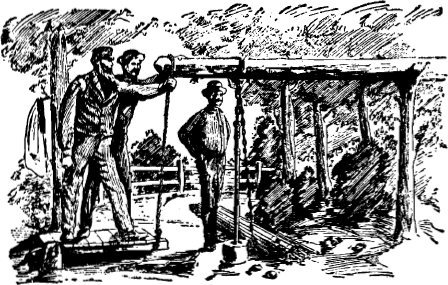
KICKING DOWN AN EARLY WELL.
(From Frank Leslie’s Illustrated Newspaper, 1865)
In January, excitement was sent to a higher pitch by the coming in of oil on the Hamilton McClintock farm two miles above Oil City. The petroleum shot out at the rate of sixty gallons a minute. Just before this Mr. Hussy, the Cleveland produce merchant, arrived in Titusville. He became, so far as is known, the first buyer of royalty oil. A farmer named David McElhenny sold the oil rights on his 180-acre farm for $1,500 and one-fourth of all oil recovered. Hussy bought out McElhenny’s royalty.
Now the era of quick profits was coming. Barnsdall, Mead, and Rouse had been drilling since September. In February after oil was found on the Hamilton McClintock farm, they sold a one-third interest in their as yet unsuccessful well to William H. Abbott for $10,000. Two days later the well began pumping and in its first six months yielded 56,000 barrels of oil worth $16,700. The next month Jonathan Watson’s well on the Widow McClintock’s farm came in. And now the excitement rose to great heights and the valley began to fill up with prospectors and adventurers from every part of the country.
IX
ODDLY enough Drake did not realize the extent of his discovery. He believed he had hit the only vein and he smiled indulgently at the men who ran about madly looking for oil land, until the busy walking beams began to drive their pipes into oil pools. Drake loved to play cards and he was a devoted fisherman. He did not permit these distractions to take him from his business, but he looked after his own well and at his leisure put down a line for fish or sat around in a friendly game. One day a little after the coming in of his well he was out fishing with Mr. R. D. Fletcher who had helped finance him. They were joined by a farmer named Gibson and of course the talk turned to oil and the Drake well.
“I’ll bet there’s oil under my farm,” said Gibson, whereupon Drake and Fletcher broke into a hearty laugh. Drake was not the only one who felt that way. There was Dr. Brewer. He was among the first to suspect the petroleum floating on Oil Creek might have a commercial value. He was the man who had sent the sample to Professor Crosby of Dartmouth which had started Bissell on the quest. But at the very moment when Drake’s well seemed to prove the whole case Dr. Brewer seemed to lose faith in the value of the oil finds. He was a pleasant, jolly man and one day he handed around some cigars and said: “Have one on me. I traded oil stock for these.”
Uncle Billy Smith, an expert driller, who had learned much’ about oil at Tarentum, was offered large sums to go into drilling with other men at many times the price paid him by Drake. But he stuck with Drake for three years and then left the oil regions.
Drake himself got a commission as a justice of the peace and as such helped to draw up most of the leases of oil lands. Even after other wells proved the richness of the valley Drake failed to see that fortune in oil which Uncle Billy promised him as he looked for the first time on the black liquid in his well. He made no effort to exploit his find in any way. He sold the oil from his own well and made good fees as a justice of the peace. It is said he bought one lease from Jonathan Watson in Titusville for $2,000, but could not keep up the payments and in 1863 sold it for $10,000. Center Street runs through that piece of land now. He made about $3,000 a year as a justice of the peace and in 1863 left the oil regions with about $15,000. He went to another region where men often are lured to drill for riches—Wall Street—and there lost all he had. Then for a long time he dropped out of sight.
Yet he had made a far richer discovery than the man who first turned up a nugget of gold on Sutter’s farm in California. Since 1859—the year of Drake’s discovery—this country has produced three billion dollars in gold. In 1929—a single year—our wells yielded a billion barrels of crude oil—forty-two billion gallons worth 9.7 cents a gallon in the crude state or over four billion dollars and worth three times that much in refined products. A year of petroleum is worth a cycle of gold.
CHAPTER II. A VISITOR AT THE CREEKALONG River Street they talked about oil. The produce trade knew that Hussy had made an investment in Pennsylvania and that he was drilling. But as usual most people said nothing would come of it. Meantime young Mr. John D. Rockefeller kept his mind severely on his produce business.
He was now twenty years old. He had been a merchant for two years and in a small way he was already a successful business man. River Street had come to know his sagacity and gravity. It saw him come to work every morning early. It did not see him go home very often at night. Those who remained late saw him many times at the high bookkeeper’s desk poring over the firm’s books under the yellow light of a gas jet. The man was marked by a tremendous earnestness and concentration. He belonged to no organizations. He went to no theatres. He attended no dances or parties. He had one diversion—the Erie Street Baptist Church. Of course the pastor was one of his very good friends. Old Deacon Sked, now very old and a florist, continued to be a close church companion. Rockefeller was a faithful attendant at Scripture lessons every Wednesday evening.
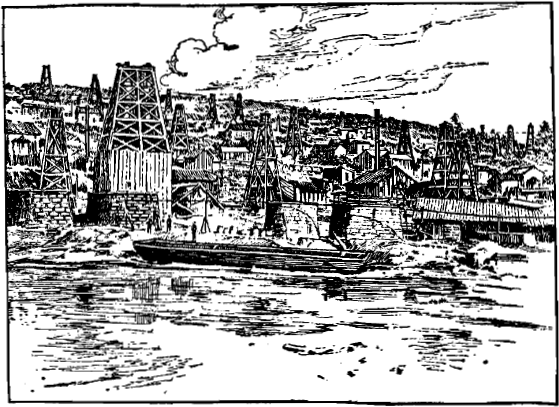
OIL CREEK A FEW YEARS AFTER DRAKE’S DISCOVERY.
(From Romance of Petroleum by J. D. Henry)
He was tall, raw-boned, holding his head erect, yet appearing a trifle stooped because of his strong, full, rounded back. He dressed in the best of clothes and with the greatest care. His bearing was dignified and calm and he took care to detract in no particular from this effect. Although but a youth among the seasoned merchants of River Street every one addressed him as “Mr. Rockefeller.” The man’s countenance had already acquired a maturity far beyond his years. A careful observer might have noted that while his face and head were large, the size was accounted for by the large rounded jawbone and the broad area of the parietal region. The nose seemed inadequate and weak. The eyes were the most unusual feature. They were small and the brow was quite smooth, yet these eyes and this brow gave an appearance of thoughtfulness without any of those wrinkles, furrows, and frowns which artists use to depict this effect. The eyes, in fact, were not so small as they appeared. They were brilliant, but the visible area of these luminous balls was reduced by the drooping lids which hung low over them. At a distance this gave an illusive appearance of languor to the face which was suddenly dissipated on a nearer approach, much to the discomfiture of many a man who advanced on him in argument. He had a way of looking ahead of him—walking along the street, in his office, moving from one spot to another, appearing not to see anything but what lay straight ahead. But he looked with extraordinary intentness at anything on which he fastened his gaze. Even as a young man he had a way of looking straight into the face and eyes of those he addressed with unfaltering steadiness. The whole effect of the young man’s appearance was one of quiet, composed, grave preoccupation.
He was beyond a doubt resolved to be rich. He was already on the road to riches. He would have grown wealthy had he never heard of oil. This second year of the produce business had brought to him and his partner a net income of $17,000—which they divided—a large sum for those days. He had, apparently, no grand designs at this time. He met each day’s problems as they arose and they were just the ordinary problems of the small business man.
He had learned one important lesson. He had seen that to go along slowly on one’s own earnings was a snail’s pace. Hussy, who had already plunged into oil, like many business men of the period, prided himself on the fact that he never owed a dollar to any man. His firm paid its bills with promptness, bought everything for cash and never sought a loan from any one. But young Rockefeller saw that by using as much of other people’s money as he could borrow he could accumulate in a single year the growth that would take five or six years to attain. He has spoken many times of his prodigious energy as a borrower. His partner, Clark, was fond of telling a story of his youthful associate. One day a wealthy business man stepped into the office of Clark and Rockefeller and after greeting Mr. Clark asked for Rockefeller and said:
“Mr. Clark, you may tell Mr. Rockefeller when he comes in that I think I can use the $10,000 he wants to invest with me for your firm. I have thought it all over.”
“Good God!” cried the amazed Clark. “We don’t want to invest $10,000. John is out now trying to borrow $5,000.”
To prepare his subject for a little loan of $5,000, Rockefeller had told him he was thinking of investing $10,000 in the banker’s business. When Clark told Rockefeller of this on his return, the young merchant was shocked at Clark’s folly in letting the cat out of the bag.
“And the funny part of it,” Clark would say, “is that John got the $5,000 after I had made my blunder. Oh! he was the greatest borrower you ever saw.”
The Rockefeller family was now on a rising tide. Frank was at work. William was with the firm of Hughes and Lester and saving his money. In another year he was a partner. A group picture extant taken at this time of the three boys and two girls reveals a group of well-to-do young people. All are in good clothes. The boys all wear large watch-chains, a luxury at that period. The girls have the conventional jewels. John and his elder sister—Lucy—strongly resembled each other and their mother. William and Mary Ann were alike and bore a striking resemblance to their father. Frank seemed a composite of both strains. The father, old Doctor Bill, still roamed the highways vending his pills. But now he remained away for longer periods. His stays in Cleveland were shorter. The family no longer depended wholly on him for support. It must be said of him that he had always borne that obligation well, but now when it pressed upon him less urgently he seemed to let it fall gradually and lightly from his shoulders. He was drifting slowly out of the lives of the family in Cheshire Street.
II
HOWEVER close Mr. Rockefeller held his nose to the grindstone in River Street he could not fail to hear the talk about oil. The coming of new wells confirmed the discoveries of Drake. Oil began to find its way to Cleveland. Several Cleveland merchants made the trip to the “oleaginous locations” and returned with glowing tales of its coming wealth. The coal-oil refineries in the city were alarmed and there was talk of erecting a refinery or two in Cleveland to handle the local trade.
About this time several Cleveland business men decided the matter ought to be looked into. Young Rockefeller was called into the discussion. Some one, it was agreed, should be sent to Titusville—some one who could be depended upon not to be swept away by the prevailing excitement. The man chosen to make the journey was “Mr. Rockefeller,” the young merchant just approaching his twenty-first year. Old newspapers in Cleveland refer to this group of men and to the sums which they agreed to contribute to the enterprise. These accounts fix the date of the investigation sometime in 1859. It is probable, however, that it was sometime in the early Spring of 1860, after the new oil developments had confirmed the value of Drake’s discovery. In any case, it came about that Mr. Rockefeller made his first visit to the oil regions of Pennsylvania.
III
TO GO to Titusville Rockefeller had to go by railroad to Meadville and then by team overland through the forest roads. As he reached the creek the scene which greeted his eye was very different from that which met Drake’s as he first entered the region. The first oil rush, with the end of Winter, had begun. Here was the beginning of one of those strange episodes in American history which have been repeated at intervals—such as California saw in the gold rush of forty-nine. The cry of “Oil!” ran around the country as the cry of gold had done ten years earlier. Rockefeller, as he wandered along Oil Creek, saw its banks and those of French Creek and the Allegheny River dotted with tall derricks and dumpy engine houses with tall thin smokestacks, from which the black smoke poured over the once green farms of the creek. There was a steady stream of arrivals into the new towns—Titusville, Oil City, Franklin, Meadville, Tidioute. These tiny settlements were once just clusters of a few small stores and loggers’ hotels. Now hastily constructed shacks were going up and rudimentary business streets were taking form, lined by small, rude, unpainted one-story affairs, roughly boarded stores, lawyers’ offices, oil drillers, notaries, and traders, and a few saloons. Oil City had been just a hotel, a gristmill, a store and two houses. Now it was a forest of derricks and a huddle of shacks. The trees along the banks of the stream—green and pleasant hemlock and pine—were felled and in their places were dirty mounds of coal and cinders and logs and charcoal and noisy, chugging engines and ceaselessly swaying walking beams.
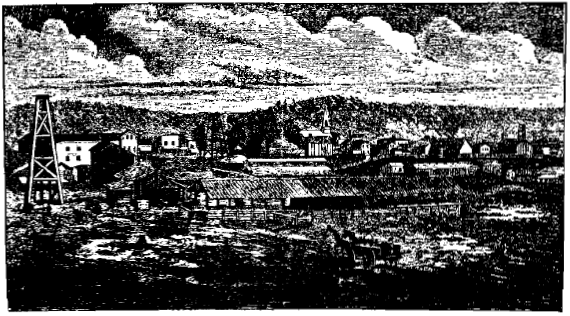
TITUSVILLE, THE NEW OIL CENTER, SHORTLY AFTER DISCOVERY OF PETROLEUM.
(From an old print)
A new industry had sprung into life. Everything had to be provided for it. One of the first great needs was barrels. Brewer and Watson, the sawmill men, in addition to drilling, turned their mill into a barrel-making business on a large scale. It is said this firm expended $750,000 on barrel-making before it began to make any money. Bissell, too, set up a barrel factory at Franklin.
Drilling was proceeding feverishly along the lowlands of the creeks and river. Smaller fry were soaking up the waste oil from the streams with blankets. Excitement was rising higher with each new well. Every week dozens of new drills were started. Every now and then the cry ran ’round the region that oil was found in some new location. The engines were pounding at Tidioute. Watson, Tanner and Company brought in a well there yielding 480 barrels a day and another well was opened at the same time yielding 300 barrels a day. There was a rush for Tidioute. Then came news of oil at Henry’s Bend. The drillers rushed down to the Bend. In one place men anchored a raft in the river and began boring in the river bed. There was an angry cry against this. At night citizens cut the ropes of the raft. Fights followed. The raft went on with its drilling, its defenders camped at its edge with shotguns.
Rough men were coming in—floaters without money or plans—attracted by the tales of quick and easy wealth. The barrooms were crowded at night with boisterous, noisy adventurers playing cards, drinking whiskey, arguing and brawling. More serious prospectors sat around the hotel lobbies—the American House, the Anthony Hotel, the Eagle House, and dozens of others. The talk was of oil, oil, always oil; and sometimes about this new man Lincoln who had been named by the Republican party to run for President.
IV
WAGONS! Long, incessant lines of wagons! Like a huge snake that endless procession of wagons crawled out of Titusville and Oil City. There were no railroads. The nearest railroad station was at Corry, sixteen miles away. There was another at Union City, twenty-two miles away, another at Meadville, thirty miles away and a fourth at Erie, forty miles distant. Pittsburgh became the first great oil market. It was reached by Allegheny River boats. But Erie became the first important overland market. And oil was sent to Erie and the other railroad connections by wagons. Small refineries went up along Mill Creek there. They were just little stills ranging from a barrel or two to ten or fifteen barrels a day of refined oil. The teams made two trips a week and some men like the Hon. Electra K. Range had as many as twenty hauling his oil. Every stable and barn in the neighborhood of Mill Creek was used for wagons and teams. One might see as many as fifty oil wagons parked around the corner of Eighteenth and State streets in Erie.
A long, low dray, carrying from six to ten barrels, sinking deep into the mud of the dirt roads, the horses straining furiously to drag it forward, urged by a flow of picturesque and vehement profanity from the grimy, burly wagon driver and a crack from his long blacksnake whip—this was the first transportation engine of the oil regions. The teamsters had to be strong, fearless men. The going was hard and when the weather was bad and the roads impassable the teams pulled off the roads and traveled over the harder grounds of the farms. This brought war with the farmers. But the teamsters were resolute, brawling men who found diversion in these turbulent encounters. More than one farmer saw the great blacksnake whip uncurl menacingly toward him. Finally the farmers armed themselves. Occasionally a teamster was shot or a farmer beaten up. And so the long, slow procession of wagons lumbered on to Erie through the plowed-up roads and hostile farmsteads, with their teamsters cursing, singing, fighting, exploding their long whips and brandishing their muskets when necessary. They became the masters of the region. They made their own terms for hauling oil. Crude petroleum that cost eight dollars a barrel and later two dollars a barrel, cost five dollars a barrel to haul to Erie. A few of the teamsters hoarded their money and later grew to be rich men as producers and refiners. Most of them spent it in the saloons which now began to appear all over oildom and with the gamblers who came with their cards and their roulette wheels and other devices of the devil.
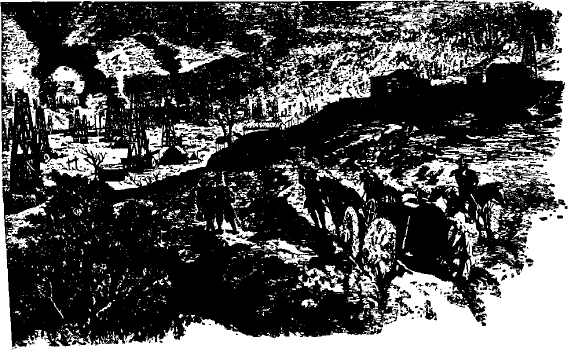
TEAMING IN THE OIL REGIONS.
(From Frank Leslie’s Illustrated Newspaper, 1865)
There were as yet no turnpikes or prepared roads of any sort. The traffic to Pittsburgh went by river. Oil City became the center for this trade. Oil was carted from the wells to Oil City and then towed along the Allegheny River. Refineries appeared also in New York. The crude oil was put aboard boats at Erie and carried by water to the metropolis. Kier was refining it in Pittsburgh, Ferris and Schieffelin in New York. As yet Cleveland and Philadelphia had not gotten into the trade.
V
YOUNG Rockefeller surveying the situation at Titusville quickly saw that this oil business divided itself into three departments—producing, refining, and transportation. It was plain to be seen there was money in the refining industry. Crude oil cost from two to twelve dollars a barrel and the cost of refining it was but thirty cents. Coal oil made from shale cost one dollar a gallon and it was clear that there would be a shift from shale oil to petroleum. But would the supplies of petroleum hold out? No one could say anything on this point with authority. The refining business was as yet, like almost all business, purely local. In Erie they made oil and sold it to grocery stores in the town and its environs. The same thing was true of Pittsburgh and New York.
As to producing, the disorder of this must have shocked Rockefeller. It would be impossible to imagine a business more harried by uncertainties and wild competition. After Drake hit oil and until January, 1860, crude fetched twenty dollars a barrel at the well. In February it was eighteen dollars a barrel. In April it was twelve. The wells were coming in now in numbers and with abundant production. No man could tell what the price of crude oil would be. As a matter of fact, it went to seven dollars before the Summer was over and by December sold from two to three dollars and a half a barrel. The producing business was worse than the refining business. The latter was subject to the peril of an extinction of oil. The former would of course die if the oil gave out but it was open also to the alternative danger of being ruined by excessive overproduction and price demoralization. Moreover the swindling stock faker had already invaded the oil fields. Several wild-cat oil companies were formed in Erie and stock salesmen were at large reciting luminous tales of golden riches and selling beautifully engraved certificates of stock.
This was the new industry which young Mr. John D. Rockefeller surveyed. He made up his mind definitely that the business of drilling for and producing crude oil was an excellent business to remain away from. As to refining—there were not enough facts available for an intelligent decision. It was a pure gamble. Thus he reported to his associates when he returned to Cleveland. Stay out of the oil business. But keep an eye on it. If the supply of crude petroleum should ever be established as a continuing product, then consider entering the refining business but leave production severely alone. Here was wisdom in good earnest. Seventy years of the oil business have confirmed the soundness of that judgment based on a first inspection of oildom by this twenty-year-old business man.
CHAPTER III. VEGETABLES AND WARNOW WHILE the countryside swarms to Titusville and Oil City and the Creek regions for oil and riches, the shadows gather over the country. They fall long and dark over Cleveland. In the Summer, while the lease hunters and the derrick men are rushing to Oil Dorado from all parts of Pennsylvania and Ohio, these two states are at fever pitch over the approaching storm. They have formidable candidates in the field for the presidency. Pennsylvania backs Simon Cameron. Ohio puts forth Salmon P. Chase. And in June the Republican Convention nominates Abraham Lincoln! Down in River Street they have hardly heard of him. It is probably certain young Mr. Rockefeller had not. The debates of Lincoln and Douglas had interested him little. He was full of scorn of the politicians who were always stirring up trouble, paying attention to every one’s business but their own. As for him, all this was no part of his business and he paid no attention to it. In River Street the talk of politics became almost unbearable. Incessant gabbing about slavery and Kansas and Nebraska and state’s rights.
But as the Winter came on Mr. Rockefeller did notice one thing. This oil business was getting more interesting all the time. Wells were coming in with great frequency. Refineries were going up now—small affairs—along Woolworth Run in Cleveland. Oil had been found in West Virginia and some at Mecca in Ohio. It looked as if the fears of a failure of supplies were unfounded. Take away that fear and the oil business was worth going into. Rockefeller kept his eyes on it without taking them off his produce business. But now he had them fixed on another thing too. Lincoln had been elected and South Carolina had answered with a broadside of gunpowder at Fort Sumter. The state had formally seceded. By Christmas it was plain the other Southern states would secede. The South was actually setting up a rebel government. All this foreboded trouble and in Cleveland things looked black indeed. For Ohio, which gazed over its northern border across the Lake to Canada, looked over its southern frontiers into the slave states of Virginia and Kentucky. Both were aflame with the war spirit. What about business? What about the produce business? Here was the country climbing out of the panic of 1857 and now war-makers were preparing to imperil business again. It was enough to stir the wrath of any business man.
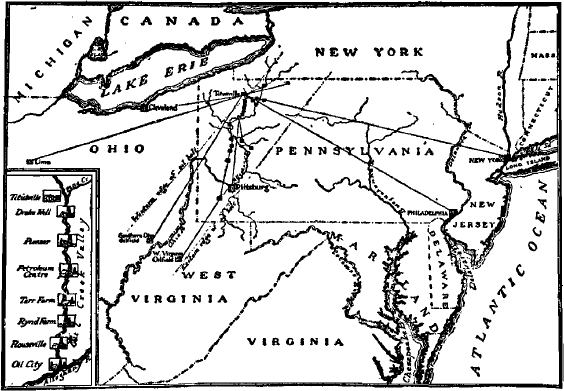
MAP OF EARLY OIL REGIONS IN PENNSYLVANIA.
As for Cleveland—it seemed to have lost its senses—to be scarcely less inflamed than Kentucky. The madness had even invaded River Street and the Flats. One day a low rumble rolled along the river—a muffled roar from the Public Square. The produce district saw crowds running toward the center and soon men and boys from the produce district rushed out to follow the roar. The cry went up that a mob was moving on the jail. Lucy, an octaroon girl, had escaped from Kentucky and was trying to make her way across Lake Erie when she was arrested by the slave catchers in a house on Prospect Street not far from Rockefeller’s home. The race between the slaves and the slave catchers was long an irritant to Cleveland because of its nearness to Canada. Here another slave girl was in a Cleveland jail at the very moment when the South—or a large part of it—was in armed rebellion. Indignation in Cleveland broke all bounds. The mob blackened around the county jail and demanded the girl’s release. But the officers in some way spirited her out of the walls and into Kentucky. This was the last slave to be sent back from the North under the fugitive slave law. And Cleveland was sullen and angry.
Business was practically suspended that day along River Street. Feeling was high and men talked about war. But there was one business man who did not run to the county jail nor take any part in the angry conversation about the slave catchers and the South. He held close to his books and his business. This was Mr. Rockefeller.
Hardly had the slave girl fury died down when the town was aroused by the passage through it on his way to Washington of Abraham Lincoln, the president-elect. Once again men and women left their offices and shops and homes and thronged to greet the new hero. A mass meeting of 30,000 howled themselves hoarse in Melodeon Hall where the tall, solemn Lincoln spoke to them gravely of the great burden he was on his way to assume. Sentiment in Cleveland was at fever pitch. And so two months later when Lincoln issued his call for 75,000 volunteers the men of Cleveland sprang to arms in great numbers. Fort Sumter fell April 12th. Ten days later the Grays marched away from Cleveland and Camp Taylor was established. In a few weeks another regiment—the Seventh—departed and others were organizing. The Lincoln Guards were formed in May. “Are you going?” That was what the young men of Cleveland asked each other. Mr. Rockefeller pondered the question. In 1854, a youth in high school, he had written in his essay on Freedom: “It is a violation of the laws of our country and the laws of our God that man should hold his fellow man in bondage. Yet how many thousands there are at this present time even in our own country who are bowed down by cruel masters to toil beneath the scorching suns of the South. How under such circumstances can America call herself free? It is a freedom which if not speedily checked will end in the ruin of the country.”
The youthful essayist was a good prophet. Here was the chance as Lincoln had said as a young man “to hit this thing hard.” Here too was the threat of the country’s ruin at its door. But Mr. Rockefeller did not rush to arms. Here he was with a growing business on his hands, moving toward that wealth he so much coveted, and here were politicians and cranks pushing the country into war. Still the situation was difficult. All the young men were going. Young clerks and some little more than office boys, truck drivers, and messengers and a good many merchants were going from River Street. It was a hard problem.
Apparently William was not going either. Then in September the youngest brother—Frank—not yet eighteen, enlisted and marched away. This made the situation more difficult. It was troubling young Mr. Rockefeller very much, particularly as some twenty-two men went from the Erie Street church. Lucy, his older sister, wrote to her friend Mary Curtis—John D.’s old school-teacher—back in Owego and told her all the news of the family. All the young men were going to war, she wrote. But John is considering the matter. He has not yet made up his mind. But he finally settled the matter. He decided he would not go. There were plenty of men to do all the fighting necessary. He needed to stay at home and look after his business. And so Mr. Rockefeller never went to war.
Many years later, in 1903, John D. Rockefeller, retired, was playing golf with Levi T. Scofield, a retired architect from Cleveland who was a Civil War veteran. A newspaper reporter went to Rockefeller one day as he finished his golf game and informed him that Mr. Scofield had just given on his own authority some details of Rockefeller’s war record. Scofield said that young Rockefeller, while he did not enlist, more than made up for it. He had only $10,000 in cash at the time, all tucked away in a strong box. Nevertheless he gave Scofield $300 out of his strong box to enable him to go and then guaranteed to give the families of twelve soldiers each $300 a year until the war ended. The reporter asked Mr. Rockefeller if this was true.
“I guess it is a fact,” he answered, “if Scofield says it is, although I had forgotten all about it until now. There were few banks then that were reliable and we kept our money in our safes. I had but $10,000 then.”
This incident is reported for what it is worth as Rockefeller’s own version of the war episode. In later years Mr. Rockefeller claimed to intimates that he contributed to twelve soldiers’ families in order to enable the men to go to war.
II
BUT YOUNG Mr. Rockefeller was not the only business man who kept away from war. Henry H. Rogers was twenty-one when the call to arms came and Flagler was thirty. Andrew Carnegie, an ardent patriot, went into the military railway service. John Wanamaker, too, was an extraordinarily patriotic man, keeping his place in his Bible marked with a little American flag, but he went not to the wars save as a man with goods to sell the government. J. P. Morgan, who said, “Don’t be a bear on the United States,” as a young man made his first big money during the war “selling the United States short” in the Gold Room and devoted the remaining years of the war to building up his new banking business. Armour, Clark, Gould, and scores of others each attended to their own special business interests, leaving the fighting to be done by others.
The business men of the country did not appear to very great advantage during the Civil War. That is a chapter which has not yet been written. There was much profiteering among merchants and manufacturers and shameful extravagance among the newly rich. Congress had to investigate charges of corruption. Contractors made exorbitant profits and swindled in the most orthodox fashion. Shoddy was delivered to the soldiers. Lincoln had to remove his Secretary of War. Professor Charles Beard says that from one-fourth to one-fifth of the money paid out of the Federal Treasury was tainted by the tricks of swindlers.
As for Rockefeller, his firm made a great deal of money during the war so that when it was over he was a rich man. But there is no evidence that he engaged in any questionable transactions or dealt in any improper way with the government.
III
THE WAR brought the curtain down upon the first act in that hectic tragi-comedy of the oil rush. It fell upon a scene which made a fitting finale for the wild performance which had been in progress along those turbulent Creeks.
On April 17th, 1861, a group of men were sitting around the lobby of Anthony’s Hotel in Titusville. News had just come of the fall of Fort Sumter—five days after that momentous event. What did this mean to the oil industry? The more sanguine thought the fight would soon be over. But the oil industry itself was moving into troublous days. Oil was down to a dollar a barrel. The great ogre overproduction was devouring it. The wells had been coming in so fast the excessive supplies of oil were getting out of hand. But there would soon be an end of that. While they talked the gods were even then making ready to open their hands and let disaster drop upon the regions. A man red with excitement rushed in.
“Oil!” he cried. “Millions of gallons! A regular fountain of oil! Shootin’ up in the air like a fountain!”
“Where! where!” cried every one, jumping up.
“At Rouseville,” the frantic man answered. “Little and Merrick’s well on the Buchanan place. Come quick! Nothin’ like it ever seen!”
He rushed out and behind him every man in the hotel. The word had gotten around and all Titusville had rushed into the streets. It was five o’clock, just growing dark. One of the men in that lobby was Mr. Rouse, after whom Rouseville was called, a large producer. He ran with the rest. As the crowd neared the Buchanan farm they beheld a stream of oil flowing heavenward sixty feet high—a huge, black eruption of petroleum—the first great oil gusher. The crowd stood in a ring around the amazing geyser which made a black lake of foaming grease. Suddenly a blinding flash of red flame leaped heavenward with a roar as of a thousand cannon. In some mysterious way the first gusher had caught fire almost in the moment of its birth. The blazing oil was thrown in a shower of fire over the spectators and in a moment scores of persons were running about like so many living torches. A wide column of flame rose heavenward as from a giant jet and disappeared into a rolling mass of black smoke shot with streaks of flame overhead. The cries of the victims as they leaped about in a death panic added to the horror of the scene. Suddenly the crowd saw Mr. Rouse making his way across the sea of grease. Fire shot from his clothing. Twice he stumbled but rose, laboring, ablaze, through the burning oil. The crowd saw him put his hands in his pockets, take out his wallet, his papers, and hurl them with all his strength outside the rim of fire where they were picked up. He pushed on out of the flaming lake and collapsed on its shore. Portions of his body were burned to a cinder. Yet he remained calm and when carried to a place of safety, as attendants gave him after every word spoonfuls of water, he dictated his will leaving large gifts to various public purposes, among them a sum to build a good road in the oil regions. Then he expired. Ten persons were killed and eleven others were seriously burned. The scene of this tragedy is still pointed out in the oil regions and may be reached along that road which the heroic oil man provided for in his will as he died.
The righteous lifted their eyes to heaven and shook their heads as if they understood. The wicked oil cities had felt the hand of Divine vengeance. “For behold, the Lord will come with fire and with his chariots like a whirlwind to render his anger with fury and his rebuke with flames of fire.”
Thus the news of the war came to the oil regions. This catastrophe spread a cloud of gloom over the whole countryside. It was the first great fire in a country which was destined to live for years under the dread of fire day and night. The fire burned for three days, by which time it was smothered with earth and manure. Then Little and Merrick began to barrel the oil it yielded. The full extent of the disaster was not the fire. As this well gave off thirty barrels an hour oil fell to fifty cents a barrel. Then came Lincoln’s call to arms. Many who had begun to find petroleum was not so generous a mistress as she promised to be forsook her for the field. Many, however, remained to continue their drilling. In June there were sixty-one wells on Oil Creek, nine at Franklin, six on French Creek—135 wells producing 1,300 barrels a day. And new wells came in every week. Then in September came the great Phillips well flowing 4,000 barrels a day. Soon followed the Empire well with 2,000 barrels a day. The nation could not have supplied barrels for this flood any more than the world could buyers. Thousands of barrels of oil were flowing into the streams. Wells were plugged. By the end of the year oil had dropped to ten cents a barrel. The war was under way. The adventurers who had flocked into Titusville and Oil City were now flocking away. It looked as if the great Oil Bubble had burst.
CHAPTER IV. ROCKEFELLER GOES INTO OILCLEVELAND was beginning in 1862 to be aware of a nuisance along Walworth Run. Little refineries had appeared there for distilling petroleum into kerosene. From his store young Mr. Rockefeller could see the unpleasant scum which trickled down from the Run into the Cuyahoga River. Citizens complained about this, but there were some men who said that the industry which produced that scum would some day make Cleveland rich. Occasionally a young fellow named Samuel Andrews would come over to Rockefeller’s store. Andrews had a little refinery—a small affair of ten barrels’ capacity. He was essentially a mechanical man and among the first in Cleveland to see that kerosene would supplant coal oil as an illuminant. He was desperately poor and really lacked business ability. He had gone into oil refining from candle making—a natural drift. He devised methods for getting a higher yield of kerosene from crude oil than his neighbors and was the first, or among the first, to find a use for the residuum as a fuel for his still. Andrews’ wife took in sewing to help him. He saw the need of more capital and he kept pressing Rockefeller and his partner to back him in a larger refinery. Andrews’ attention to details and economy in his little refinery commended him to Rockefeller. But this cautious young merchant weighed other considerations as well. The produce business was prosperous. The war was bringing plenty of business and high prices. Though but twenty-two years of age Rockefeller found himself among the well-to-do men of Cleveland. Moreover he was committed to the idea of fixing his attention upon one business. Yet this oil industry fascinated him. He had been watching it for two years. He had been listening to Andrews for almost that long. Now in 1862 the oil industry seemed to have reached its lowest estate.
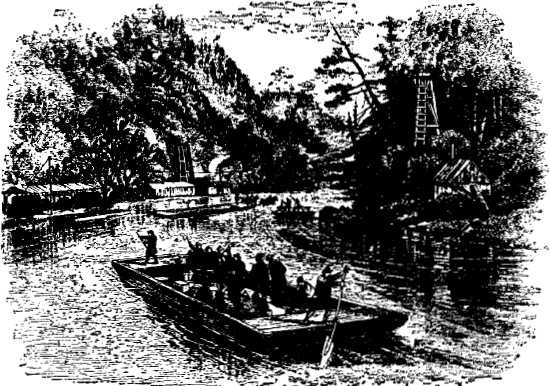
“POMEROY’S EXPRESS”—PROSPECTORS ARRIVING BY BARGE.
When this year opened crude oil was selling for ten cents a barrel. The price began to improve as the months wore on, but a new difficulty had revealed itself. The oil regions began to assert themselves as the natural refining center. There were plenty of refineries at Erie, Pittsburgh, Philadelphia, New York, Cleveland, and other places. But refiners began to ask themselves how they could compete with the region refiners who had the crude oil at their doors. Several Cleveland refiners answered the question by taking their refineries to the Creek—as the oil country was then called. One was Lowry, Fawcett and Company. Another was a firm of which Alexander Scofield was a member—one of the ablest business men in Cleveland. Great refineries were arising in the oil cities. On the whole, in this year 1862 the oil industry in Cleveland did not offer a very rosy promise to the business men along River Street. Yet it was in this year that young Mr. Rockefeller made his decision after two years of cautious examination to yield to the persuasions of Samuel Andrews. With his partner, M. A. Clark, he invested several thousand dollars in a new firm which was called Clark and Andrews. His own name was kept out of it. But John D. Rockefeller was now in oil.
II
THIS year a husky, aggressive, yet genial young Scotchman named Andrew Carnegie made a journey from Pittsburgh to the Creek. There he saw with amusement and surprise the signs of a feeble attempt to stage a second oil rush. He saw men knocking up a shanty in a few hours, teams of two men working the treadles of the oil drills, a few new adventurers arriving at Oil City by barge with their carpet bags and their chests on their shoulders. On one drill with its puffy little engine chugging away was a sign announcing the destination of the drill—“Hell or China.” It all looked good to the shrewd Andy Carnegie for he and his partners this year bought a farm and backed a company to drill for oil. The farm later yielded a million dollars’ cash dividends in a year and later came to be worth five million dollars.
III
THIS year a new word came to be pronounced frequently in the Pennsylvania oil regions. It stood for something new in American business. Combination. In January a group of oil-well owners along the Creek met to discuss their affairs. The flood of oil threatened to destroy them. And so these individualists who really believed that men should be left alone to pursue their own interests—the doctrine of Adam Smith that the world will run along best by itself which all men cherished—these individualists met to see if something could not be done to assist the world in its way of running. Let us combine, they said, to hold the price of oil up to two dollars a barrel. Oil cannot be produced profitably for less. Apparently there was something wrong somewhere with this theory of laissez faire. Here was a little heresy though the heretics did not realize it.
IV
SURELY great changes had swept over the face of the land in the twenty-three years since the baby John Rockefeller was born at Richford. Chief among these was that the infant manufactures of 1839 had now grown to robust manhood. Already the value of manufactured products exceeded the value of agricultural products. There were what men called big factories.
Matthew Baldwin was building one hundred locomotives a year and employing eight hundred men. Robert Hoe was making rotary presses for Europe as well as America. Up in Hartford the Colt Arms Factory was doing things which set men to talking as they now talk about Ford. Indeed E. K. Root, the Colt superintendent, was the Henry Ford of his day. He did audacious things. He did away with handwork. He tooled up his machines, and put everything on platforms and jigs and cranes. Business men said he was crazy. Social workers said he was an enemy of mankind. But Colt paid him the staggering sum of $25,000 a year. The sewing machine makers were rising to be the magnates of the day—like the automobile makers of this decade. Isaac Singer and Elias Howe and Wheeler and Wilson had formed a patent pool. They maintained gaudy salesrooms glistening with mirrors and gilded furniture in the big cities. Sewing machine row with its shiny showrooms was the precursor of automobile row.
The age of iron and the age of invention was dawning. The telegraph, the cylinder printing press, the penny newspaper, the Atlantic cable, the sleeping car, the shoe-sewing machine, the passenger elevator, the Great Western, above all the Bessemer process for making steel—these marvels astounded the people. Great factories were rising everywhere. McCormick was making reapers, Case was making threshing machines. Studebaker wagons were known everywhere. Deer was making plows. The foundations of huge enterprises were being laid. Epoch-making first steps were being taken in the great American field of machine tools. The English already had sent a commission to study American methods. At Chicopee Falls Ames Brothers employed a thousand men. Most important of all, the railroads had now established their dominance. They were no longer just feeders of the canals and rivers and lakes. In 1850 there were no lines connecting East and West. A traveler from New York to St. Louis before this would have had to use fourteen different railroads, several canal boats and two or three stages. Now—by 1860—a vast net-work of rails spread over the whole East from the seaboard to the Mississippi and on into Iowa and Missouri.
Motion—powerful, irresistible, surging motion—agitated the nation, almost unperceived amidst the smoke and clouds and fogs of political discussion and then of war. Waves of new peoples flowed in from Europe, the immigrant trains moved endlessly westward, filling the middle-western prairies and crossing the mountains. Above all the vast natural resources of the continent were being uncovered—copper and silver and iron and coal and gold—the vast grain fields of the West and Northwest—the seemingly limitless timber riches now available because of the railroads—petroleum and salt and sulphur and zinc. America became a land teeming with riches, with a busy, new, hungry, undisciplined horde of workers from every corner of the world feverishly digging and hunting and struggling in a wild scramble called competition to find the treasures and rush them into the markets of the world.
And while the armies drove at each other upon the battlefields of the South, the Morgans and the Carnegies and the Rockefellers and the Havemeyers and the Goulds and the Vanderbilts and their fellows looked calmly over all this chaotic scramble and searched for the road to order. Slowly, in little spots here and there, the germs of organization were incubated. Many men, while they still talked about individualism, saw there was something wrong. Some force had to step in somewhere to restrain the savage elements of competition which seemed to devour the weak and the strong. And so here and there—while social reformers cried out against the machine and the rich—and the rising labor leaders denounced the capitalists—other men were pronouncing that word which was to bring upon itself the execration and hatred of the nation for the next fifty years—the word which a few Creek oil producers in the year 1862 used in Oil City and which, perhaps, John D. Rockefeller had never yet even heard of—Combination.
V
JOHN D. ROCKEFELLER was now twenty-two years old. It is an age at which young men think of many things besides business. Mr. Rockefeller was thinking of something else. But not much else.
He was thinking, for instance, of the Erie Street Baptist Church. This was his one diversion. He taught a Bible class there on Wednesday nights. He never missed a Sunday service. He attended faithfully the meetings of the trustees. His was the last word in counsel about the financial affairs of the congregation. In all things he conformed to the model he had seen set forth by St. Paul in his Bible—“Not slothful in business; fervent in spirit; serving the Lord.”
He thought of one other matter. His mother noted that he made visits to a young lady he had known in his high-school days. This was Laura Celestia Spelman. He had had his nose buried deep in his business since those old days. But she had moved about a bit. She was born in Massachusetts and then went to Akron, Ohio, to live. Then her father moved to Cleveland where she went to high school and came to know John Rockefeller. After graduation she was sent to a boarding school in Worcester. She returned to Cleveland the year Colonel Drake struck oil.
She was a serious, but pretty, little black-haired girl, amiable, but knowing well her own mind. Her graduation essay was entitled “I Can Paddle My Own Canoe.” And that she was now doing as a teacher in the Cleveland public schools. She lived in an atmosphere of severe religious devotion. Like her young friend Mr. Rockefeller she was brought up from her childhood to hate liquor with all her soul. Her mother was an active member of the W.C.T.U. Her father established a seminary at Atlanta in later years for negro girls. Religion was therefore an obvious tie between this young teacher and the youthful produce merchant who had just invested in oil. They went to different churches, but after a while people began to notice that Cetty Spelman was going to the Erie Street Baptist Church with John Rockefeller. That dominating young gentleman, who has always ruled everything he has touched, and who as a boy required all games to be played his own way, had brought the pious young lady from her aristocratic Episcopal parish to the humble Baptist mission.
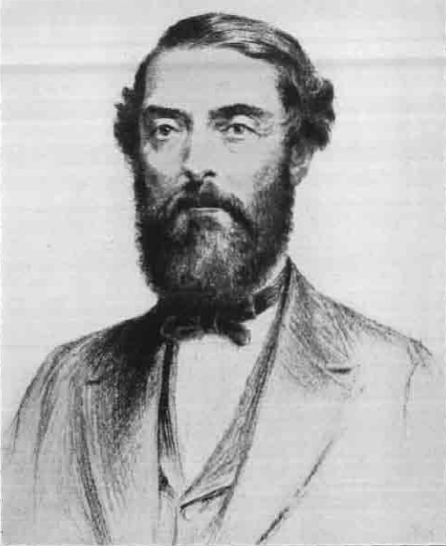
“COLONEL” EDWIN L. DRAKE, WHO DRILLED THE FIRST OIL WELL.
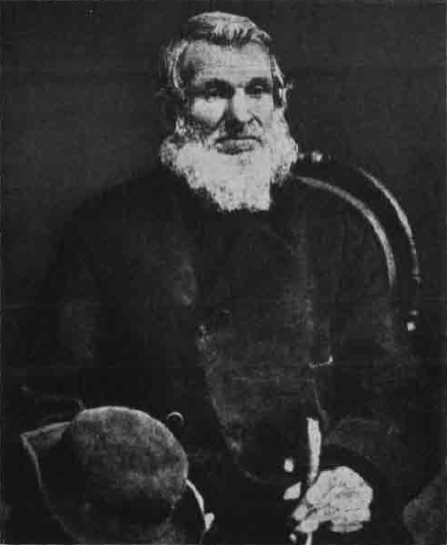
BILLY SMITH, HIS DRILLER.
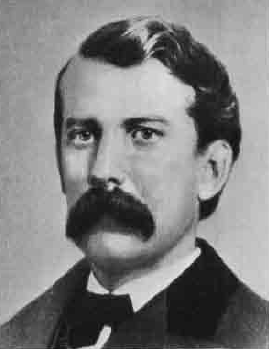
HENRY M. FLAGLER.
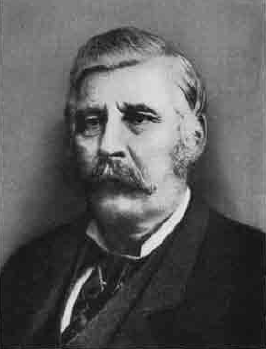
S. V. HARKNESS.
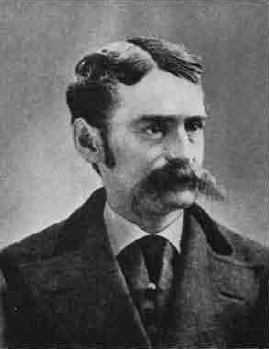
HENRY H. ROGERS.
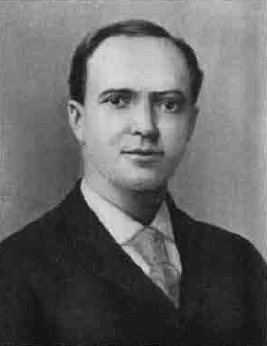
JOHN D. ARCHBOLD.
However, the courting was neither energetic nor conspicuous. It did not take the young business man away from his business many nights a week. Indeed many friends of Cetty Spelman failed to observe that usually conspicuous phenomenon—the growing friendship which leads to the altar.
VI
THE TIDE of war was rolling close to the oil creeks of Pennsylvania. Lee’s victorious and apparently invincible army was marching northward. May 2nd and 3rd, 1864, the Battle of Chancellorsville was fought and Lee was driving further north into Pennsylvania. The news of this movement sent a shudder of alarm through the oil regions. There was an almost total suspension of business. The price of oil shot upward. Men were asking $3.50 a barrel at the wells. But workers were leaving for the army. The draft officers were moving around the country gobbling up the slackers. By the end of June notices were posted in the oil towns that the draft officers would be in the oil country Monday and Tuesday, July 9th and 10th. The government wanted seven hundred men from that district. It would be a blow to the business. “But,” said the Oil City Derrick, “unless we are mistaken, every one is ready to face the music.” Then came the belated news of the defeat of Lee at Gettysburg and Fort Hudson. And a wave of relief swept over the regions.
VII
IN CLEVELAND, Mr. Rockefeller, busy with his produce business, was becoming more and more interested in his oil investment. The oil firm of Clark and Andrews was prospering. The demand for kerosene was growing. The old coal-oil business was swept away. The trade to Europe was growing. In 1862 Europe took eleven million gallons. In 1864 it took twenty-seven million. Moreover the business was becoming organized. The railroads were extending their lines into the regions. The Atlantic and Great Western had a line as far as Meadville and now it was pushing a branch from Meadville into the regions as far as Franklin. Then it ran its line on to Oil City. Other railroad schemes were afoot. While the state was aflame with excitement over Lee’s invasion, Dr. Samuel Kier was busy incorporating a road to be known as the Mahoning and French Creek Railroad. At the same time work was being rushed on a new division of the Philadelphia and Erie that promised a new outlet to the lakes and the seaboard. Thus the oil regions at first bottled in the mountains from their natural markets, reached only by barges and teamsters, was opening its doors. Up to this point the teamsters carried the oil to the distant railroad connections. Now the teamsters were required merely to carry oil from the wells to the oil region railroad depots.
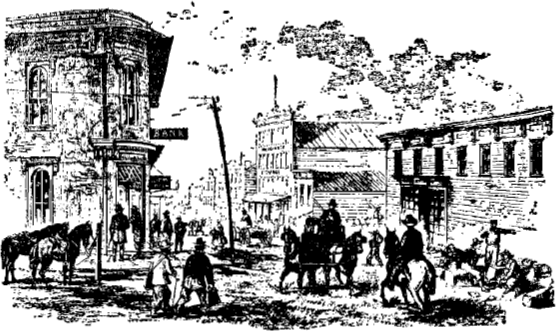
STREET SCENE IN TITUSVILLE—HER FAMOUS STREETS OF MUD.
VIII
ONE DAY in March, 1863, the Widow McClintock thought she would hurry along the kitchen fire. So she poured some kerosene from a small can of oil into the stove. It was an historic act. The oil caught fire, leaped to her clothing, spilled in flames over the floor, set fire to the house and burned the unhappy woman’s body to a cinder. The Widow McClintock was a pioneer, for thereafter the same happy thought was to occur to thousands of servant girls and housewives with almost the same tragic results. But this was but the beginning of the story.
Mrs. McClintock had an adopted son named John Steele. He was twenty, handsome, married, and a teamster. He had a local reputation for the vigor and richness of his profane vocabulary. But he was a thrifty and likeable chap. When the McClintock farmhouse fire was extinguished, neighbors went in search of John Steele. When they found him with his team he hurried back to the farm. He was genuinely grieved at the tragic end of his foster-mother. But he remembered that she had always hidden her royalties from the farm oil leases around the house. Before Johnny Steele ended his search of the house that day he unearthed several hundred thousand dollars. At least so runs the legend, though Steele always insisted it was not nearly so much. Also he found a will leaving all to him. Thus began one of the most picturesque and widely-advertised careers of the time—the adventurous performances of Coal Oil Johnny—the first gift of the oil regions to the entertainment and amusement of the nation.
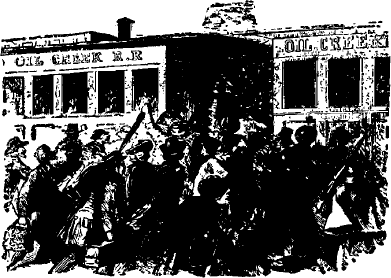
ADVENTURERS RUSHING TO THE CARS STARTING FOR OIL CREEK.
By this time the oil cities had blossomed like the gold towns of California, with their crops of saloonmen, gamblers, prostitutes, idlers, and thugs. The dance halls lined the main streets of all the towns. Coal Oil Johnny, through with his wagon and his team, went at once to the man he had commissioned to watch them and presented him with the outfit. Then, accompanied by an agreeable companion, he arrayed himself in conspicuously modish clothes and set out to see the world, beginning in the gambling hells and dance halls of Titusville. Of course, he fell at once into the hands of sharpers. He made his progress to New York and then through all the cities of the East, followed by newspaper reporters and schemers of all sorts. For a while his royalties amounted to hundreds of dollars a day and these, along with his principal, he flung about him with a lavish hand. He stopped at the most fashionable hotels, appeared at the race tracks and the smartest restaurants attended by sycophants and parasites of both sexes. He would build a monument to soldier heroes anywhere on request. He handed out gifts to charities with magnificent gestures. He gave the reporters interviews about the millions he had inherited and the daily thousands that flowed into his hands. Whatever the actual sum of his fortune was he did not take long to spend it. Very suddenly the wells on the McClintock farm became sluggish and stopped. And quickly thereafter Coal Oil Johnny was broke. His brilliantly arrayed figure disappeared from the bright places and the legendary name of Coal Oil Johnny faded from the papers. He returned to the oil regions where he was soon found slinging baggage at the depot in Franklin. Later he moved to Nebraska where he settled down as a hard-working, substantial family man who tried to forget the hectic year of fabled riches through which he had passed as through a fire. Another generation so far forgot all about him save his name that it supposed the title of Coal Oil Johnny belonged to John D. Rockefeller.
CHAPTER V. TWO DECISIONSTHE WAR was now drawing rapidly to a close. John D. Rockefeller had done well. He thought he could see ahead now clearly. And so he made the two most important decisions of his life.
One was to ask Cetty Spelman to be his wife. Her decision could hardly have been difficult. John Rockefeller was twenty-five years old. He was tall, strong though lean, handsome, with well-rounded strong jaws and a large firm mouth. He carried himself with dignity very unusual in so young a man. In the church he was looked up to as a successful man. He was already regarded as rich. His income was considerable. He was moving with long strides toward his goal of the large riches he so much coveted. He was quiet, kindly in his bearing. Above all he was strong.
But he was immersed in business. And so when Miss Spelman accepted him, he surrounded his approaching marriage with the secrecy in which he enveloped all the other important events of his life. And when he was married, it was very quietly. There used to be a story among his old Standard Oil companions that he spent the afternoon at the circus and at night put in several hours’ work at his office. Though this story is vouched for by one of the oldest of his former associates it must be repeated with caution.
He certainly did spend some time that day at work in his office and he visited the small cooperage plant of his oil business. Before he left he treated the workmen there to a good dinner. And as he was leaving he said to the foreman: “Treat them well, but see that they work.”
He was married September 8th, 1864. The young couple moved into a house next door to his father’s home which still was at 27 Cheshire Street. The Cleveland directory gives his own residence as Number 29.
II
THE SECOND decision had to do with oil. As the end of the war came into view with its promise of a great revival in the oil industry, Rockefeller began to make plans to abandon the produce business altogether and devote himself wholly to oil. In January, 1865, an event occurred which hastened that step. This was the discovery of oil at Pithole and the rise of another oil fever which ran over the country like a madness.
Andrews and Rockefeller had hit it off well together and had decided to make a go of it without Clark, the other partner. This meant that Rockefeller must sell his interest in the produce business to Clark and buy out Clark’s interest in the oil firm. There was no difficulty about selling his produce interests. But Clark had his own ideas about oil. He wished to remain in the oil industry and proposed to buy out Rockefeller. We have Rockefeller’s own account of how the matter was settled. The partners met to discuss it. Clark appeared with his lawyer. Rockefeller went alone. It was decided to collect all the cash assets of the oil business, pay the debts and sell the plant and good will to the highest bidder. Some one said: “Let us sell them now and let the lawyer act as auctioneer.” This suited all parties and the auction began. Clark said $500. Rockefeller promptly raised the bid to $1,000. The bidding went back and forth a little breathlessly. Rockefeller was surprised at the price Clark was willing to pay. But he had formed his own opinion of the value of this business and he continued to top Clark’s bid each time. Finally Clark said $72,000. Rockefeller, without a moment’s hesitation, said $75,000.
“I’ll go no higher, John,” said Clark. “The business is yours.”
“Shall I give you a check for it now?” purred Mr. Rockefeller.
“No, settle at your convenience.”
This twenty-five-year-old business man had done well indeed. He could make his check for $75,000. More than this his credit was so soundly established that his partner, who knew his affairs better than any one else, was willing to refuse the check and permit Rockefeller to pay in his own time.
Thus John D. Rockefeller committed his fortunes wholly to the oil business which for the next thirty years was to feel the influence of his dominating genius and for the next sixty years was to be more or less under the shadow of his reign, long after he had withdrawn from actual rule.
2Sam Smith was living in Titusville in 1929 when the writer visited him. Many of the details of the Drake discovery were supplied by him. He insisted that oil was struck on Saturday, August 20, not Sunday, August 21. However, all the evidence among the records of the regions support the date used in the text.
- 1The Rockefeller family insists that the elder William Rockefeller went to Richford with his family and that the story given here is not true.
- 2Thus William Avery Rockefeller, the father of John D. Rockefeller, arrived in Richford. When he got to his mother’s home he continued to use his slate to the great distress of the whole family. When his joke had gone far enough he broke into a loud laugh and announced that he intended to live in Richford.

