
God’s Gold
Part Four: War at the Creek

A FARMER named Thomas Brown thought there might be oil under the farm of Thomas Holmden, about four miles from Plumer and six from the Allegheny River. So he proceeded to look for it with a hazel twig. Professor Silliman of Yale had just lectured all those foolish persons who resorted to the spirits and divining rods to find oil. But Thomas Brown had never heard of Professor Silliman. If he had he would have known better than to look for oil with a hazel twig. As it was he sauntered forth on the Holmden farm along Pithole Creek with his mystic twig and where it dipped he put down his drill. On January 8th, 1865, a few days later, Brown hit oil. And the well at once brought in two hundred barrels a day. The news ran over the region like a prairie fire and immediately prospectors began flocking to the spot. In January, when Brown started to drill, there was in the forest an old farmhouse or two and some unprofitable farms. By May the countryside was sprouting derricks. In another month a town had been laid off 3 two entire streets were built, lined on both sides with shops, offices, dance halls, and saloons. Pithole, the magic city of Petrolia, had sprung almost full blown out of the forest.
Wells were coming in almost daily. Farms were being bought and sold and leased and split up and, while huge sums of money were passing, still more amazing figures adorned the tales that were spread throughout the country. The simple truth might have served to stir the cupidity of the country’s adventurers. A farmer named Rooker sold his farm for $280,000. The purchasers within two months had leased out ninety sites on it on the usual royalty basis and cash bonuses of $315,000. The United States well on the Holmden farm where the oil was discovered was producing eight hundred barrels a day and the farm was estimated to be worth three million dollars. By October the oil regions as a whole were producing about 10,000 barrels of crude a day and Pithole was supplying 6,000 of them. The new city had a population of 15,000. Ten months before it was a clearing in an un-peopled wilderness.
The name of Pithole flew over the country. It was on every tongue. The oil regions gained a kind of fabled notoriety exceeding that which followed Drake’s discovery. The war was over. The energies of the nation were released for new pursuits and new excitements. Newspapers sent correspondents to make word pictures of it. Oil companies sprang up everywhere. Over 1,000 blue sky oil stock concerns were formed in Philadelphia. The actual capital in use in the regions was estimated at from one to three hundred and fifty millions, but twice as many millions in worthless stock certificates were hidden away in the strong boxes and mattresses and mantel clocks of people all over the country. Stock salesmen swarmed over the land with their beautifully engraved certificates and almost every one with a few spare dollars owned a few shares in some wild-cat adventure.
Towns sprang up everywhere. And the names suggested a picturesqueness which appealed to the imagination and recalled the brave days of ’49. There were Stand-Off City and Short Stop, Red Hot, Alamagoozlum, Tip-Top, Two Thieves, Dead Beat, Strychnine, Chance Shot, Calaboose Run. But the two towns whose reputations for wild and riotous living rose to the most dubious fame were Pithole and Petroleum Center. To these suddenly transformed wheat farms flowed the adventurers of a continent. By train, by stage and wagon, on horseback and afoot they flooded in. Men fought to get on the trains. The hotels were crowded. The guests were glad to sleep on the chairs in the lobbies. Hundreds of men worked almost madly felling trees to make lumber for houses, hotels, shops, and derricks. The Astor Hotel got hammered up somehow. One might see there a huge room with fifty or sixty cots hired to lucky sleepers at a dollar apiece a night, each man slumbering with one hand under his pillow on his revolver. The city grew faster than order and government could be fitted to it. Before it was ten months old, however, it had fifty hotels, three of them palatial buildings according to the standards of the time. Its streets were lined with buildings—some of them very good ones, schools, churches, banks, and stores. But in all of these new towns were those sinks of iniquity, the dance halls. In Petroleum Center were several blocks given over to saloons, gambling joints, and dance halls. The Union army was being demobilized. Soldiers were streaming home and thousands of them flocked to Pithole and other oil towns. Creek settlements were filled with lieutenants, captains, colonels, and even a few generals. As for the rank and file, released suddenly from the iron discipline of the army and with their pay in their pockets, they reveled in the licentious merriment of Pithole’s free-and-easies.
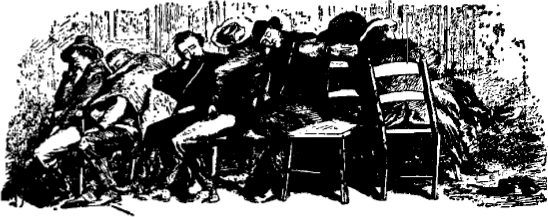
NIGHT SCENES IN OIL REGION HOTEL LOBBY.
Chief among these frolickers were the teamsters. They were the blades who were making the money from the boom. Little was needed to enter this rough calling. A good spring wagon, a pair of horses and a resolute soul. The oil poured from Pithole so fast that there were hardly wagons enough in the land to handle it. Fifteen hundred teamsters were busy hauling oil from Pithole to the refinery at Miller’s Farm. They also carted the crude in barrels to the dump boats and the dump tanks by the river. At times these ravenous profiteers demanded as high as three dollars a barrel to haul oil from the well to the refinery. Twenty and even thirty dollars a day was not excessive for the teamster to make. And as the money was easily made it went quickly when the shadows gathered over the little red-light districts of Petroleum Center and Pithole.
II
ONE STRANGE visitor well-lodged at the United States Hotel watched the opening scenes of this turbulent and colorful drama. For weeks he remained there playing billiards with some of the young dandies, visiting the cafés, attending the prize fights, and generally amusing himself but giving no evidence of the amazing tragedy he was composing. Early in April, just as the throng of prospectors and speculators was moving toward Pithole, this faultlessly dressed sojourner left Oil City and went to Washington. On the night of April 14th, 1865, he murdered Abraham Lincoln.
III
WHILE Pithole and the mushroom towns that lined the Creeks wallowed in their disorder and wickedness, the more antique cities of Oil Dorado—Titusville and Oil City and Franklin—fell slowly under the dominion of the policeman, the Chamber of Commerce, the preacher, and the “better element.” They ceased to be sinks of iniquity, but, as one traveler put it, they did not cease to be “sinks of mud.”
The hills and banks of the streams were greasy with the pitch of petroleum and crowded with its derricks, its shacks, its little engine houses. Piles of barrels, pools of crude oil, smoke, charred trees, and blackened hillsides, cinder heaps that marked the many fires—the whole valley presented an appearance of indescribable blackness and bleakness. The towns were for the most part hastily assembled rows of plain board shanties, an ill-defined street where the business was done, the rude homes standing in the open fields. But even in Oil City and Titusville and Franklin, where brick buildings and good homes were making their appearance, the pervasive smell of the oil, the streets, churned up channels of slush, lit at night by smoking oil lamps and natural gas flares, presented a dismal appearance.
But the two mighty Amazonian twins of the times—Culture and Righteousness—had invaded these cities. Gentlemen with high hats and long coats and elaborate whiskers and their ladies, reveling in the luxury of their newly acquired wealth, began to form themselves into clubs and literary societies and social organizations of all sorts. The hotel dining rooms could be converted into ball rooms and Titusville soon became noted for its balls—from the teamsters and the drillers up to the lawyers and traders and brokers. Oil City had Bliss’ Opera House and Corinthian Hall, the Academy of Music and Crittenden Hall. Dramatic troupes from New York made their appearance and singers, piano and violin soloists, lecturers, came through in a steady procession. Even Pithole—wicked, vulgar Pithole, the Upstart of the Creeks, began to take on airs. The Swordsmen’s Club was the rendezvous of the Pithole aristocracy. It had a clubhouse which pretended to elegance where the elect of the town could repair for drinks and cards and convivial society. Its balls and promenades were the last word in the gay social life of Petrolia—Alas, too gay! the ladies and the ministers in Oil City and Titusville sighed. For there in Titusville and Oil City the Devil had been having a hard time of it. At least the Sabbath had been rescued—no amusements, no trains running from Oil City to Franklin on Sunday, no Sunday barber—a barber had just been fined ten dollars for shaving a man on the Sabbath—even the famous Sunday well, which ran six days a week and rested automatically for one, closed down every Sunday. The hand of God was in that, to be sure, said the pious wild-catters and speculators.
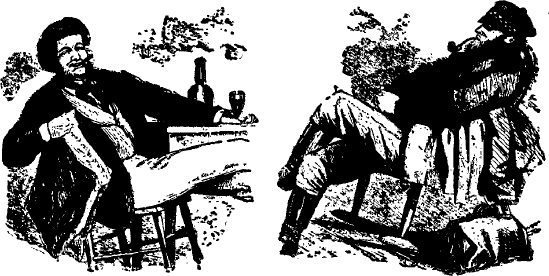
OIL SEEKERS—ONE SEEKS AND FINDS; THE OTHER SEEKS AND DOESN’T FIND.
(Frank Leslie’s Illustrated Newspaper, 1866)
IV
SAMUEL VAN SYCKEL found himself in a violent quarrel with the teamsters over the hauling of his oil from Pithole. The teamsters quarreled with every one—the producers, the railroads, the refiners, the farmers. But the quarrel with Van Syckel was one they had reason to regret forever. For it ended their days in the regions. Van Syckel determined to be rid of these troublesome tyrants. So he built a pipe line four miles long from Pithole to Miller’s Farm. In the gin mills and dance halls the teamsters roared with laughter at this crazy experiment. But on October 1st, 1865, Van Syckel drove oil at the rate of eighty barrels an hour to the refinery at Miller’s Farm. Working ten hours a day it could do the work of three hundred teams. And it could work twenty-four hours a day. Van Syckel’s experiment proved the pipe line to be feasible and began a new era in the oil industry. Immediately other lines were built. The Pennsylvania Transportation Company built one paralleling Van Syckel’s. Henry Harley built another from Benninghoff Run to the Schaeffer Farm.
The Oil City Register hailed Van Syckel’s pipe as “a wonder of wonders.” But the teamsters saw it first with sullen, then with violent anger. The pipes ran along the ground and the oil was forced through by means of three engines stationed at intervals. The teamsters cut the pipes and the line had to be guarded. Of course, they were still required in places but as the pipes grew in length and number, the teamsters ceased to be the tyrants and chief human problem of the region. The great Amazons, Culture and Righteousness, smiled as they departed.
Van Syckel sold his pipe line to Abbott and Harley who consolidated it with their own into the Allegheny Transportation Company. As for Van Syckel himself, he was another picturesque pioneer with whom Fate dealt cruelly. He introduced many innovations into the oil regions but finally got involved in expensive and ruinous litigation with the Standard Oil Company over patents and processes and died in Buffalo with but little material reward for his services.
V
IN FEBRUARY, 1866, the Widow Rickerts, a washerwoman who owned a lot in Pithole, went out to her well to pump some water. She brought up a bucket of petroleum. The news of Mrs. Rickerts’ good fortune ran around the neighborhood and there was a hurried lowering of buckets into wells. Other neighbors brought up petroleum. The excitement ran all along the Creek. Thousands rushed to Pithole to see the wonders. Have the water wells of Pithole turned to Oil? Is the whole valley dissolving into petroleum? The sky is red with the flames of the Tremont Hotel, which, like so many of the new buildings of Pithole, is being fed to the Fire-God and, by the red light, Pithole people exhibit to their neighbors the miracle of the water wells. Soon the story gets around that it is all due to the leakage from some of the pipe lines. In the midst of the fever that fills the atmosphere on Pithole Creek a strange foreboding fills the air. At the very moment when the town is being organized, a government provided, and a new police chief is summoning the populace to order, some of the bigger wells seem to halt their flood. Disasters hang upon the town. The ice in the Creek breaks up as Pithole’s first winter melts and rushes down upon the town, causing the waters to rush over the city. Boats ply along Center Street. The ice hurls itself against the bridges, rushes over the banks, and crushes down buildings. The fires come almost weekly. The Franklin Hotel burns. The Mead House and fourteen buildings burn. Next month half the town is swept away. The wells pause. A kind of panic runs over the place. People who two months before choked with emotion as they cheered for Pithole as if it had been their childhood home tore down their dwellings and moved away the lumber to some fresh oil farm. The Pithole Register implores them to remain. But the blight is on the town. The cry of oil goes up from Olean and Pleasantville. The evacuation of Pithole has begun. Buildings are coming down. The roads are full of teams hauling lumber and pipes and engines and derricks to Pleasantville. The Oil City and Pithole Railroad becomes bankrupt. Fires sweep the remaining unguarded buildings. Every day oil wells gasp and falter and quit. Men are rushing away from the doomed city. The Postmaster says his office, which six months ago ranked third in Pennsylvania, is now choked with uncalled-for letters. Pithole, that rose from the forest like the rabbit from the magician’s hat, is ready to give itself back to the wilderness. In another year it will be just a huddle of rotting, falling, or charred ruins. In a year or two more, with a church and two dwellings and a population of six people, it will be only a memory.
CHAPTER II. THE HOSTILE CAMPSTHERE swims into this story now a dashing figure destined to play a part of the first importance in the destiny of John D. Rockefeller. About the time Rockefeller launched out into the oil business a young man appeared in Cleveland with an invention—nothing less than the perfect horseshoe. He was seeking financial backing and took desk room in an office in the same building with Clark and Rockefeller. This man was Henry M. Flagler.
Flagler was born in 1830 in a little village just south of Rochester, New York, the son of a Presbyterian minister. He got some education up to the time he was fourteen, when he tumbled his small belongings into a carpet bag and struck out to hunt his fortune. He landed in the little town of Republic, Ohio, with a five franc piece, a five cent piece, and four coppers. This was a small capital, but apparently it was more than enough, for Flagler never spent the five cent piece. He owned it the day of his death. He wandered about, working as a clerk in a store selling candles, shoes, and soap, a boat hand on the Erie Canal, a general store helper in Orleans, New York. Here he saved a modest stake and went to Saginaw, Michigan, and into the salt business.
The importance of this step can hardly be exaggerated, as will appear later. In Saginaw Flagler married the daughter of Dr. Harkness, of Bellevue, Ohio, who was interested in the Saginaw salt wells. Many tales of his adventures here are told. One is that he amassed a fortune of $50,000 and lost it. If he made a fortune he certainly lost it for he then went to Bellevue, his wife’s home, and into the grain business. Through his shipments of grain to Cleveland to the firm of Rockefeller and Clark, he became acquainted with John D. Rockefeller. And when he took himself out of the grain trade and decided to stake his fortune upon his invention of a perfect horseshoe, he went to Rockefeller’s offices and settled down with a desk in the same building.
At this time Flagler was thirty-five years old, a man of extraordinary virility and good looks. He was the very glass of fashion. He possessed a mass of luxuriant wavy hair, which he combed with the most scrupulous care, and affected a flowing mustache artfully curled at the ends. He was saved from being a dandy by his distinguished appearance and the brilliant and commanding glance of his eyes—eyes which exercised an extraordinary spell over women and which never failed to perceive the near approach of beauty. The lure of riches was always alive in the strong, restless mind of Flagler. He was bold, fearless, unscrupulous. Rockefeller was not slow to perceive that the new tenant in the Case Building had a mind of rare clarity and vigor. Rockefeller was exceedingly cautious in his friendships. But very soon these two men were drawn together. Flagler would drop in to talk about the business, about oil and the times. And the busy Mr. Rockefeller would pause to talk with him. Ofttimes they walked home together.
II
WHEN Rockefeller bought the interest of his partner, Clark, in the oil firm he immediately formed a new partnership which he called Rockefeller and Andrews. Its office was located in the Sexton Block. The refinery, located across the river, had a capacity of one hundred and fifty barrels of crude a day.
Rockefeller immediately proceeded to organize his new business. As he looked over the oil industry of that day he saw nothing but disorder, chaos, waste, incompetence. The system which men worshiped with a kind of religious reverence—free competition—had now gotten complicated by some new factors which the average business man did not understand. But Rockefeller did understand them. The man who, when a boy, would not do any little task without sitting down and thinking out the easiest way, would not now attack a new career without examining with a minute scrutiny all the factors in the picture. Rockefeller saw that competition was complicated now by two powerful forces. One of these was this new flood of raw materials which was pouring out upon the nation. The other was the widening of the markets. The country was producing with ease far more materials than it could use and hence the wild scramble of producers to sell and the utter demoralization of price. Moreover, the railroads now made almost the whole country a possible market. A man was now in competition not only with his rivals in the town, but with innumerable other rivals in other towns and states. All this Rockefeller saw but the method of dealing with it in a large way had not yet dawned on him. But he did two things which mark the beginning of his complete design.
First of all he inaugurated a policy of ruthless economy in all operations—what he called “attention to little details.” Andrews was a good mechanical man. Rockefeller prodded him ceaselessly for more tightly organized production, improved processes, more kerosene from crude. He began to make his own barrels. He cut away from the draymen who had that branch of the business in their hands and did his own hauling. Refiners in Cleveland bought their oil from jobbers who bought it from the wells. Rockefeller went to Titusville and made arrangements to purchase his oil direct from the wells. John D. Rockefeller was turning out his kerosene at a lower cost than any other refiner in Cleveland. He was selling it in Cleveland and the adjacent territory but was slowly building up the Western and Southern trade, selling his oil at wholesale to the jobbers there.
Now he saw that the export side of the oil business was growing rapidly. American refiners sent 30,000,000 gallons abroad the year Rockefeller and Andrews began business. This more than doubled the next year. The next year—1867—it was 97,000,000 gallons. Very little oil had been exported from Cleveland. Rockefeller saw that this would be the most important part of the industry. Hence in 1867 he induced his brother William, then a young produce merchant, member of the firm of Hughes, Davis, and Rockefeller, to abandon his produce and go into oil. He formed a separate firm called William Rockefeller and Company and sent William to New York, where he opened an office at 181 Pearl Street. This year—1867—William’s and John’s names appear for the first time in the New York directory. But William alone settled there. He became a selling agent for Rockefeller and Andrews in the export trade. He was a pleasant, smiling, genial young man, with much of his father’s jovial and friendly nature, and a good salesman. He soon became a familiar and well-liked figure along the docks, trading with the exporters of kerosene. Thus in 1867 Rockefeller had already split his business into two firms—one a refining firm in Cleveland, the other a selling firm in New York.
III
THERE now emerged what might be called the battle of the cities. There were, perhaps, 250 refiners of oil scattered in various places, all in violent competition with each other. But this competition was not merely a contest between individuals. It was also a contest between cities. At first each city’s refineries manufactured kerosene to market in its own immediate neighborhood. But now the use of kerosene was general throughout the United States and the world. And so each city found itself contending for a share of those markets. The chief refining centers were New York, Erie, Philadelphia, Pittsburgh, Cleveland, and the little cities of the oil regions usually grouped together. Baltimore and Boston and Buffalo refined only small quantities, but they were important shipping points.
The refiners in the oil regions—at Titusville, Oil City, Franklin, and neighboring points—enjoyed the greatest advantage. The oil was produced at their door. They needed to make but a single shipment—refined oil to the seaboard. New York refiners, too, had to pay freight on but one shipment, but that was crude oil, and hence it was bulkier and more costly than refined. Besides New York was closest to the most populous markets and strategically located to negotiate foreign sales. The same thing was true of Philadelphia, whose refiners had to pay but a single freight charge on crude. Pittsburgh and Cleveland were at a distinct disadvantage. The refiners in Cleveland, for instance, had to bring crude oil from the regions, a long haul, and then ship the refined oil over a much longer distance back to the seaboard. They enjoyed a favorable position for capturing the Western and Southern trade, but they were seriously handicapped in the race for the richest trade of all—the oil markets of Europe. Pittsburgh was in a better position than Cleveland. It had better railroad connections and besides enjoyed the advantage of cheaper river transportation rates on crude oil from the regions by way of the Allegheny River.
It is obvious that the oil region refiners possessed such natural advantages that it is easy to see that many Cleveland refiners thought the regions would ultimately have the whole business. The largest refineries in the world were there. Downer Brothers had developed an immense plant making not only kerosene but pure white paraffin and some lubricating oils. There was also the refinery of the Ludovici Brothers. The Ludovici Brothers were two Germans who came to the regions in 1862. They built a refinery which cost half a million dollars—a forerunner of the elaborate modern business plant. There were beautiful offices, hardwood floors, marble mantels, fine furniture, rich carpets, mirrors, pictures, and statues. William Wright, who visited the regions in 1865, writing in Harper’s, reported twenty refineries between Oil City and Titusville. They were making kerosene, naphtha, benzine, and gasoline. But of course kerosene was the chief product—kerosene for illuminating purposes.
In spite of its handicaps, however, Cleveland had thirty refineries along Walworth Run and the Kingsbury River. And in 1866 these refiners made three times as much kerosene as they did in the preceding year.
IV
OIL, FROM its birth, has been at once the child and mother of wars! Refiners battled with each other; producers and refiners quarreled over prices; cities fought for markets and advantages. But to understand the events upon which we are about to enter we must keep in mind that there was a war between railroads as well.
When oil was discovered there were no rail lines entering the oil regions. They could be reached only by boats and wagons. Three railroads, however, approached the oil creeks. And as soon as the industry developed these roads built branches into the oil cities. In the end the railroad map was about as follows: The Pennsylvania tapped the producing country two ways—the Oil Creek Railroad to Corry, connecting with the Philadelphia and Erie (a branch of the Pennsylvania) running to Erie; and the Allegheny Valley Railroad from Franklin to Pittsburgh.
The New York Central had one outlet. A branch of the Lake Shore and Michigan Southern ran from Franklin to Ashtabula on Lake Erie connecting with the main line of the Lake Shore which ran between Cleveland and New York.
The Erie had one outlet. It had a branch running from Titusville to Corry and Meadville connecting with the Atlantic and Great Western, a subsidiary of the Erie.
The railroad wars which followed then were between the Pennsylvania, the Erie, and the New York Central. Later the Baltimore and Ohio entered the fight and each of these roads was presided over by men who have since been admitted to a kind of legendary gianthood.
Commodore Cornelius Vanderbilt had just assumed the mastery of the New York Central. Jay Gould by 1868 had got control of the Erie, after the long and costly battles between Vanderbilt and that brazen and pious old scoundrel, Daniel Drew, for possession of the road. J. Edgar Thompson, a great railroad builder, ruled the Pennsylvania, but he was assisted by the handsome, dashing, powerful Tom Scott, through whom, as vice-president, the Pennsylvania effected its control over the politics of the state. The legislature was called Tom Scott’s legislature. Later Scott became president of the road and Cassatt vice-president. These two men were to play a leading rôle in the battles which were to agitate all the oil regions.
Scott was the son of a tavern keeper on the old turnpike from Philadelphia to Pittsburgh. He began life with little education and as a toll collector on the state road. He entered railroading as a station agent at Altoona. He rose rapidly and was a vice-president of the Pennsylvania when the war broke out. He directed the transportation of the first troops rushed from the North to the defense of Washington and he did this with such ability that he was brought to Washington, made a Colonel of Volunteers and later assistant secretary of war and given command of the transportation of troops throughout the remainder of the war. His assistant earlier in life when a train dispatcher was Andy Carnegie. Now Carnegie worked with him on his wartime job. After the war he took command of the railroad’s machinery for riveting its hold upon the state, directing its elections, managing its lawmakers and executive officials and even dominating its courts.
These were the men who were to direct the armies of the railroads in the swiftly oncoming war of oil. In the battle between the cities the roads had their favorites. The Pennsylvania threw its power on the side of Pittsburgh and Philadelphia. The New York Central was disposed to favor Cleveland. The Erie gave its support to Buffalo and New York. The oil regions seemed to have no railroad friends. The interest of the roads was in hauling oil out of the regions, not in developing refineries there. Thus stood the oil scene—refiners everywhere looking at each other with suspicion and distrust, formed into loose groups of unfriendly local rivals, each group arrayed against every other group and supported by a friendly railroad—all save the cities of the oil regions which had only nature on their side.
V
AT THIS time, John D. Rockefeller was, as he himself later said, “all business.” He was literally engulfed in the ceaseless labor of developing his oil firm. As a result he had grown serious to a degree which amounted to almost complete isolation from all other impressions save business. His mind was on his plans morning, noon, and night.
He was but twenty-eight years of age, but he was already one of the moderately rich men of Cleveland. He moved this year to a new home on Euclid Avenue, an imposing house, roomy, sitting in the back of a large corner lot, such a house as only a man of means could afford to occupy. The house still stands in Cleveland and still remains the property of the Rockefeller family. From this house he would walk every morning to his office. Frequently he went home to lunch and very often walked home after office hours. It was a long walk but his only exercise. But even these moments were not lost for they were spent in conferences with employees or associates or in turning over in his mind his plans. Incessant planning—this was the key to his progress. For every occasion as it arose Rockefeller had a plan. He left, so far as he could control it, nothing to the whimsical forces of Chance. Chance is made up of those unforeseen elements which the planner leaves out of his calculations. To defeat chance is to look closely and see ahead all those possible combinations which others overlook. To plan minutely, to see more than any one else, is to reduce the control of chance over one’s fortunes. This is what Rockefeller did. But he was far from the modern efficiency man making elaborate charts and tables and laying out precise schemes on paper. In later years he said: “I have small faith in the man who plans elaborately on paper. I once asked a landscape gardener to undertake the improvement of 2,000 acres of land. He set to work on an elaborate scheme which I saw at a glance was impossible. He was not practical. He planned too much on paper.”
Rockefeller planned in his mind. His mind was a living plan. He made everything show up for some use or else he rejected it. “It has always been my rule in business to make everything count,” he told an old friend in Owego. “To make everything count something. I never go into an enterprise unless I feel sure it is coming out all right. For instance, a promising scheme may be proposed to me. It may not altogether satisfy and is rejected. My brother Will would probably go into it and make $10,000. Another equally promising scheme comes along. He goes into that and loses $10,000. The result is he hasn’t made any advancement in these two ventures and is actually losing time. Meantime in some surer enterprise I have made, say, $5,000 in the same time the other fellow has lost twice as much. But mine counts and his doesn’t. I believe the only way to succeed is to keep getting ahead all the time.”
This is why Rockefeller was often accused of being timid. It is why it has seemed difficult for some critics to reconcile his timidity in some things with his apparent audacity in others. He was not timid. He refused to enter upon operations where he could not see the project all the way through. But having satisfied his mind and gone in he hesitated at no sacrifice, no cost, no measures, however vast and even cruel, to drive through to his objective.
At this time he had literally no amusements. He dressed himself with scrupulous care. He went to his office with a high silk hat, frock coat, and striped trousers. He had by now hung upon his pale and bony cheeks a thin drapery of side whiskers, reddish and straight. It was an age when men made up elaborately for their parts. Whiskers trained into the most fanciful cuts and shapes and elegantly barbered were employed to add dignity and éclat to the countenance of the rising sons of the soil as they moved toward riches. Rockefeller’s appearance has always been as carefully planned as any other feature of his life. He began with the side whiskers resembling Piccadilly weepers. Later these were trimmed and finally the cheeks were swept clean altogether, the subject committing his dignity to a long mustache which rolled over his lips. Little by little this mustache was edited and limited, the ends were shortened, the hairs more closely cropped until finally it was banished altogether. At the time at which we are arrived the sideboards were in bloom and along with them went all the haberdashery required by the imposing codes of the day.
He had literally no intimate friends. There were no spare nights save Wednesday when he went to his Bible class. Here he had already become a figure of importance. He was the model of the Christian business man. Profound, almost funereal seriousness, fervent attention to prayers and the hymns and the lessons—outside that a deep and solemn composure. In the Bible lessons he read to his class he found many points he was able to apply to himself and incorporate in his own policy. “Study to be quiet and do your own business.” This he did. “Seest thou a man diligent in his business, he shall stand before kings.” He was the most diligent Christian in Cleveland. “Who can find a virtuous woman? For her price is far above rubies. The heart of her husband doth safely trust in her, so he shall have no need of spoil. She will do him good all the days of his life.” Beside him sat his faithful wife, almost his only friend. This was all an excellent religion, thought Mr. Rockefeller. Indeed, at this time his religion took a new hold on him for his first child—Bessie—was born (August 23, 1866). Mrs. Rockefeller was not able to go to church with him so he went faithfully, made notes of the sermons, and was able to repeat to her the wisdom he had gathered from the Euclid Avenue pulpit.
Ida Tarbell talked with many men in Cleveland who knew Mr. Rockefeller at this time. They told her that he rarely smiled and almost never laughed. The only sign of hilarity he ever gave was when he struck a good bargain. This would make him clap his hands. Let it be a very good bargain and he would throw up his hat, kick his heels, and hug his informant. This was written long ago before he took up golf and countless witnesses had beheld him repeat this performance over an exceptionally good putt. One time, Miss Tarbell recounts, he was so overjoyed he kicked his heels and hugged himself and said: “I’m bound to be rich! Bound to be rich! BOUND TO BE RICH!”
Instructing his Bible class he warned them over and over against the perils of drink and the dangers that lurked in good-fellowship. He repeated this lecture many times as he grew older.
“Don’t be a good fellow,” he would say. “I love my fellow man and I take great interest in him. But don’t be convivial, always ready to pitch in and be one of the crowd. Be moderate. Be very moderate. Don’t let good fellowship get the least hold on you. If you do, you are lost, not only you but your progeny, your family for generations to come.
“Now I can’t be a good fellow. I haven’t taken my first drink yet. Some of my friends think that I take a too decided stand but I don’t. . . . It is my firm conviction that every downfall is traceable directly or indirectly to the victim’s good fellowship, his good cheer among his friends, who come as quickly as they go. We have to apologize every day for this class of man who fills our hospitals, our asylums, our poorhouses and the very gutters of our streets. Look on him and don’t be a good fellow.”
Rockefeller’s mother still lived at Cheshire Street, a grave, strong, kindly woman, deeply religious and now a little mellowed as she found herself drifting into easier circumstances. Her husband, the old Doctor, had taken to such very long absences that it was the exception when he was at home. He preserved the deepest mystery about his operations during these absences, though he would tell with elaborate embroidery the most extraordinary tales of how he had gotten the best of all who crossed him. These absences now far from troubling the family were a source of relief. William was in New York. John had moved to his imposing home on Euclid Avenue. Frank was still at home and working in a small produce business of his own in Merwin Street.
VI
THE NEED of money—that was the problem which perpetually haunted Rockefeller in these days. Competition in Cleveland was growing at a furious pace. The oil business there was growing, but Rockefeller and Andrews were moving forward faster than any of their rivals. Rockefeller continually saw his pace halted by the lack of capital. Looking back later, he mused to a friend that often at night he went to bed wondering how he would ever pay the large sum he had borrowed that day and woke up next morning wondering how he might borrow more. He had been for some time meditating a step which promised a solution of this and now in 1867 he was ready, after his usual long, cautious examination of the plan, to put it into execution.
Rockefeller had been watching Flagler, his neighbor in the Case Block. He had shrewdly appraised the talents of that gentleman. But he had also perceived something else. Flagler had married the niece of a man who had lately made a great fortune. This man was Stephen V. Harkness. Harkness owned a distillery near Monroeville, Ohio. Toward the end of the war when the government was raking the land with a fine-tooth comb for values to tax, it fell naturally upon whiskey. John Sherman knew the government was going to put a heavy excise upon whiskey and he mentioned the fact to his friend, S. V. Harkness. Harkness needed nothing more than this tip. He proceeded to buy up with all the funds he could collect every barrel of whiskey he could lay hold of. When the tax was levied, Harkness found himself with an enormous amount of untaxed whiskeys which he could sell at the high prices exacted because of the tax. He promptly turned his investment into cash. This provided him with one of the amplest fortunes in Cleveland. Rockefeller knew of this adventure. And here was Flagler, Harkness’ nephew by marriage, at Rockefeller’s very door. Here was an entrée to Harkness’ treasure chest.
In his many talks with Rockefeller, Flagler’s mind had been prepared by well-wrought tales of the fortune in petroleum. Flagler had seen this. The man’s mind was so formed that the very difficulties which beset the business attracted him. Finally, at the proper moment, Rockefeller proposed that Flagler should become a partner in his firm and that Harkness should put a lot of money into it as a silent partner. Flagler proved an eloquent advocate with Harkness and the old whiskey baron put $70,000 into Rockefeller’s oil business and Flagler entered as a partner to protect the investment. The firm was promptly reorganized under the title of Rockefeller, Flagler, and Andrews. And with its new capital, reënforced by the dynamic and imaginative mind of Flagler, the new oil concern set out upon that extraordinary career in which it made vast fortunes for all its managers and allies, but moreover, organized and built up an amazing industry, brought into vogue a new method of doing business, created a whole brace of social and political issues and—in short—inaugurated an era.
CHAPTER III. A NEW WEAPONAS SOON as the new combination of partners got under way two important moves were made. A second refinery was built and operated under the name of William Rockefeller and Company. William remained in New York as selling agent for Rockefeller, Flagler, and Andrews. The new refinery was merely labeled with his name.
The other move was of more far-reaching consequences. Rockefeller and Flagler went to Amasa Stone, vice-president of the Lake Shore and Michigan Central Railroad, and asked for a rebate. There were about thirty refiners in Cleveland in violent competition. But they had made an arrangement with Stone to pay one cent a gallon on shipments of crude oil from the regions to Cleveland. This amounted to forty-two cents a barrel. The rate on the shipment of refined to New York was of course higher. Rockefeller saw he could not compete with the refiners in New York, Philadelphia, and the oil cities unless he could even up the conditions by freight concessions. So he demanded a lower rate. He was in a position to do this. Cleveland was growing as a refining center. Rockefeller was the largest of these Cleveland refiners. The feeling in the oil regions was already bitter toward Cleveland because of its rising importance. The oil towns felt that the refining business belonged to them. Rockefeller laid all this before Stone. He complained that other railroads were favoring Pittsburgh, New York, and Philadelphia. And he probably dropped a hint that his firm might have to remove its refineries to the Creek. Stone agreed to give him a rebate—how much has never been disclosed. But it was at least 15 cents. He probably got a rebate on refined oil shipments to New York, but there is no direct evidence that he did. There was nothing unusual in this procedure. Though he denied it many times, Rockefeller admitted later that he received rebates up to 1880. But “the reason for rebates,” he averred, “was that such was the railroad’s method of business. A public rate was made and collected by the railroad companies, but so far as my knowledge extends, was seldom retained in full; a portion of it was repaid to the shipper as a rebate. By this method the real rate of freight which any shipper paid was not known by his competitors, nor by other railroads, the amount being a matter of bargain with the carrying companies.”
It was common enough, but not so general as Mr. Rockefeller claimed. It was an advantage open to those strong enough to force it. The smaller shippers paid the published rate. But in every case the rebate was secret. In any case men in Cleveland began to be suspicious about the progress of the firm of Rockefeller, Flagler, and Andrews. They wondered at it. By 1869 Cleveland had passed Pittsburgh and become the largest refining center. Rockefeller’s refineries had a capacity of 1,500 barrels a day—the largest in the world. He had his own warehouses in New York. By this time the wooden tank car had arrived and he owned his own tank cars. He employed about a hundred men in his refineries in Cleveland and some seven or eight hundred were occupied in making barrels for him. He owned about twenty teams and in this year spent $60,000 on improvements. The firm loaded and unloaded its own tank cars and employed several chemical and mechanical experts to improve its processes of manufacture and make a greater use of the crude by-products.
What could account for this amazing success? His competitors could explain it on no grounds save that he must enjoy some advantages which they did not have. They did in fact overlook his extraordinary sagacity and his slavery to the management of his business. But, as it turned out, they were right in suspecting there was some other explanation.
Among those who suspected this was his brother Frank Rockefeller, who had now gone into the firm of Alexander, Scofield and Company. It was the beginning of the lifelong enmity which grew up between these two brothers. Alexander promptly went to the agent of the railroad, charged him with favoring Rockefeller and demanded an equal rebate. Stone allowed him fifteen cents. W. H. Doane, another refiner, moved by his suspicions, made a similar demand and got ten cents. But both these men declared that though they tried they were never able to get a rebate on their refined oil to New York. Rockefeller did not invent this system, declared Samuel C. T. Dodd, the famous lawyer of the Standard Oil in after years. There is no doubt that Rockefeller did not invent the rebate. But he did introduce it into the oil business. He demanded and got rebates at a time when no one else was getting them.
All this must be looked at in the light of the conditions which existed at that time. Today we understand that the railroads are not strictly private concerns. They enjoy monopolistic franchises from the government. They carry on functions which belong to the people. They have no more right to make discriminatory rates than the post office has. But this idea had practically no public support in the sixties. The roads were in the possession of men who believed they had a right to run them to suit themselves. They charged as much as they could get and surrendered on price when they had to. The policy of the day was for each man to look out for himself. The railroads were in a state of perpetual warfare with each other. The managers were attempting to build their roads and the territory through which they ran. In this competition they made all sorts of concessions to large shippers. And it is quite certain that when Rockefeller and Flagler went to Stone for a rebate they believed they were acting not only within their rights but in accordance with the permissible stratagems of the game.
II
THE BUSINESS of Rockefeller, Flagler, and Andrews had now grown to imposing proportions. The partners therefore decided to incorporate. This was in 1870. Men had been playing with this instrument for some time. As early as 1823 eight states had incorporated 557 manufacturing concerns with authorized capital of $72,000,000. Most of them were in New York and Massachusetts. Oddly enough, Pennsylvania, the great industrial state, lagged behind. By 1837 it had but twenty-two corporations. As late as 1845 we find a Pennsylvania company—the Gloucester Print Works—going to New Jersey for a charter. However, it is worth noting that in this year 1870, when John D. Rockefeller was incorporating the Standard Oil Company, J. Edgar Thompson, president of the Pennsylvania Railroad, was forming the Pennsylvania Company, a holding company, to collect into one owning and controlling agency the various railroads and other holdings of the Pennsylvania Railroad.
By 1870 there were innumerable corporations all over the country. In some states you could incorporate a half million dollar company for fifty cents. But the greater number of these organizations were blue sky ventures brought into being to sell gold, silver, and oil stock to the unwary. Practically all business enterprises were owned by individuals or partnerships. And, aside from the railroad companies, most of the industrial corporations were what the Rockefeller corporation now proposed to be—a partnership, a union of a very limited number of owners employing the corporate form for greater convenience. Real corporations were so rare at the time that in the city directory of Cleveland there was a classification in the back of the volume listing the incorporated companies, and they numbered thirty-two.
The size of Rockefeller’s business about this time may be seen from a letter written September 20, 1869, by Dan P. Eels, president of the Commercial National Bank of Cleveland, to Henry F. Vail of the National Bank of Commerce in New York, commending as clients Rockefeller, Flagler, and Andrews.
The letter reads in part: “I have never known him to equivocate or in any particular to misrepresent the facts about his business. . . . His transactions with us have been at times very large, amounting in the aggregate to a number of millions and we have sometimes had his paper to the amount of $250,000 at one time. The present firm employs in its business about $1,000,000 of which $360,000 has been invested in their refinery and real estate and the balance, say, $600,000, is used by them in carrying on their business. . . . They have a manufacturing capacity of nearly 3,000 barrels of crude oil a day, requiring to produce it a daily expenditure of $15,000 to $20,000 a day.”
Their actual output, however, was from 1,200 to 1,500 barrels a day. The New York bank, however, did not accept the account of Mr. Rockefeller’s firm. Oil was still looked upon as too risky a business.
The Rockefeller company was incorporated January 10th, 1870, in Cleveland. The whole act of incorporation did not exceed two hundred words. It stated the name of the concern—THE STANDARD OIL COMPANY OF OHIO. It declared its purpose to “manufacture petroleum and to deal in petroleum and its products.” The stock was put at one million dollars, divided into shares of one hundred dollars each. The signers and incorporators and the shares subscribed for were: John D. Rockefeller, 2,667 shares; Henry M. Flagler, Samuel Andrews and William Rockefeller, 1,333 shares each; S. V. Harkness, 1,334 shares; O. B. Jennings, 1,000 shares. The firm of Rockefeller, Flagler, and Andrews took an additional 1,000 shares. They turned their plant and business in at $400,000.
There was another Standard Oil Company at the time—the Standard Oil Company of Pittsburgh which was incorporated by Lockhart, Frew and Company in Pittsburgh, capitalized at $300,000, the year before. That perhaps suggested the name for the Ohio company.
This has been spoken of as a combination—Rockefeller combining all his companies into one. Of course, it had none of the characteristics of a combination. There were no other Rockefeller companies than the firms of Rockefeller, Flagler, and Andrews and William Rockefeller and Company. And these were just two sets of names for two departments.
Of this new venture Rockefeller was easily the master. And this he remained to the end. He was the master then, as he was later, of strong men. Flagler was a man of extraordinary talent. He had more imagination than Rockefeller. He was more restless, more impatient. He was, as Rockefeller said, “on the active side of every question.” He was a driving force. He “always wanted to go ahead and accomplish great projects of all kinds,” Rockefeller said of him. He had an orderly, analytical mind. He was the “lawyer” of the group. He could grasp the essentials of any transactions and reduce them to a simple statement. He was the oldest of the group and though he spoke in a soft, velvety, pleasant voice, he was a man of resoluteness. He ranked easily next to Rockefeller in the power and influence he exercised over the company. Rockefeller leaned on his advice more than on that of any other partner. Harkness was merely a monied man. His financial position in the community gave weight to the company’s credit. And many times he was called on to advance cash. Andrews was merely the mechanical man. He was superintendent of the plants and as the business grew he began to manifest a hesitancy, a timidity, which irked Rockefeller at times. William Rockefeller was the strong reliance of his brother for personal contacts in hostile places. His pleasant ways disarmed hostility. He was always under the domination of his strong, silent, older brother. In later years Frank Rockefeller, who liked William as much as he hated John, said William was always under John’s orders.
As for John D. himself the town was beginning to talk about him. He had become a figure. Men turned to look after him as he passed along the street—this man of thirty years—who had built a million-dollar corporation. Yet much as he was talked about it was noted that few people knew him. He was a member of no clubs. He took no part in politics. He was seen on no civic committees. He appeared at no public places or social affairs. A local historian writing about him at this time said: “Although quite a young man he occupies a place in our business circles second to few. Mr. Rockefeller never retrogrades. He has always advanced from the commencement. Close application to one kind of business, an avoidance of all positions of an honorary character, that cost time, and strict business habits have resulted in his success, the fruits of which he now enjoys. He has worked himself and kept everything pertaining to his business in so methodical a manner that he knows every night how he stands with the world.”
This was the group of men which started out upon their conquests under their newly unfurled banner—that of the Standard Oil Company.
III
JUST about this time Colonel Zebulun Martin, the genial, prosperous host of one of oildom’s best hotels, was visiting New York City. He saw, shuffling along Broad Street, a tall, emaciated, broken man, holding the hand of a boy of twelve. Martin was shocked when he recognized in the shabby and bent form Colonel Edwin L. Drake, the discoverer of oil. After losing his small savings in Wall Street, Drake, in failing health, had moved to a farm in Vermont. Later he appeared at Neversink, near Long Branch, New Jersey, where he hoped the sea air might improve his health. He grew steadily weaker, supported by his wife who took in sewing. He had now scratched together a few dollars to take him and his little twelve-year-old son to New York hoping some old friends might find work for the boy. But he was meeting with no luck. Martin, who met him as he trudged around half leading, half leaning on the child, was touched at the poverty of a man who had opened up such a mine of wealth for the world. He gave Drake twenty dollars—all the change in his pockets. When he returned to Titusville he immediately raised a fund for Drake’s relief which amounted to $4,833.50. This money was turned over to Mrs. Drake. That faithful partner of the broken pioneer moved her rapidly failing husband and family to Bethlehem, Pennsylvania, and in 1873 the Pennsylvania legislature granted Drake a pension of $1,500 a year for life.
He died November 8th, 1880, and sometime later a handsome monument was erected over his grave in the cemetery at Titusville. On its base is carved a lengthy epitaph ending with these touching lines:
“His last days, oppressed by ills,
To Want no Stranger,
He died in comparative obscurity.”
Many years later three additional lines were carved under these. They ran:
“This monument erected by
Henry Huddleston Rogers
In grateful recognition and remembrance.”
Then it was known for the first time that the monument, costing $60,000, had been erected by Henry H. Rogers, one of the most extraordinary characters thrown up by the oil business. It also came out then that Rogers had contributed a liberal addition to the monthly allowance paid Drake by the state and had kept up the payments to his wife after Drake’s death. Among all the millionaires of the Standard Oil who amassed fabulous fortunes as the result of Drake’s discovery Rogers was the one who cherished for him a warm and grateful remembrance.
Like Drake, old Uncle Billy Smith, who actually drilled the well, never made a dollar out of oil. It is indeed strange that these men, Drake the commander and Smith and his two sons, profited not at all out of their historic achievement. Smith worked for Drake for three years and then went back to his Tarentum farm. His wife died and in a few years he re-married. But he was a widower again in three weeks. However, this robust son of Vulcan was not destined to celibacy. He married again in less than three months and his third lady, as he put it, “fetched him three children”—General Grant Smith, General Willoughby Smith, and General Worthington Smith. Alas! Smith was not fashioned to make money. Back around his farm in Butler County oil was discovered later and wells drilled on every farm around his save his own. He died suddenly July 29th, 1890.
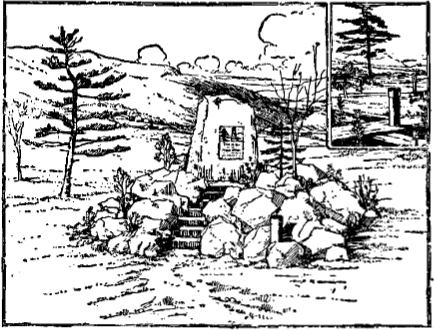
THE DRAKE MONUMENT ON THE SITE OF THE OLD WELL.
Oddly enough these men shared the fate of others like them. Shaw, who discovered oil in Canada and who was voted a medal by the Dominion government, died at Titusville where he was working for two dollars a day, a stranger and forgotten. General Sutter, on whose ranch the first gold was found in California, died penniless, a half-crazy old man on the steps of the Capitol in Washington.
CHAPTER IV. THE DREAM OF MONOPOLYUP TO this year, 1870, the progress of Rockefeller had been that of a shrewd business man—shrewder than his fellows. There is no evidence that he entertained any other idea than that he would make his business as big as he could, be the largest figure in the oil industry and make as much money as possible. He has said as much. “None of us ever dreamed of the magnitude of what proved to be the later expansion. We did our day’s work as we met it, looking forward to what we could see in the distance and keeping well up to our opportunities, but laying our foundations firmly.” It is probable that few of the millionaires of the succeeding decades “could see in the distance” the lengths they would travel. Just about this time Andrew Carnegie, living in the St. Nicholas Hotel in New York, wrote in his diary: “Thirty-three and an income of $50,000 per annum. Beyond this never earn. Make no effort to increase fortune but spend the surplus each year for benevolent purposes.”
But in this year Rockefeller began to see more imposing things in the distance. He saw the desirability of getting his rivals in Cleveland out of the way. Very quickly he saw the possibility of such an objective. He made up his mind to bring about a monopoly of the oil-refining interests in Cleveland and proceeded to lay his plans.
Up to this time politicians had played with this word “Monopoly.” The cry against monopoly is almost as old as Anglo-Saxon civilization. But men were never more set against it than now. America, the land of individual opportunity! This was one of the favorite themes of the orator. There had not been much of anything that could be called monopoly in America, yet it was frequently and feelingly denounced as if it existed. So profoundly was it hated that mere bigness was mistaken for monopoly. There was a deep-rooted notion that the safety of the state lay in widespread free competition. The ambitious man could look forward to being the biggest of his trade. But the idea of getting control of an industry hardly occurred to him. But now free competition began to work strange and destructive phenomena. That destructive giant Over-production began to lay about him. There was something new altogether. Back in 1828 we find the President in his message referring to the tariff and saying, “Domestic competition under an illusive excitement has increased the production [of textiles] much beyond the demand for home consumption.” And Clark, in his “History of Manufactures,” refers to “Occasional periods of over-production which continued to embarrass American manufactures after 1832.” But these were chiefly textile manufactures and over-production was merely occasional and affected only a small section of the population. Now over-production was appearing everywhere—in iron, salt, sugar, tobacco, whiskey, oil, chiefly as a result of the discovery of our natural riches.
John D. Rockefeller and Henry M. Flagler now looked this problem squarely in the face. Other men talked about it, bemoaned it, wondered what could be done about it, whimpered that there were too many in the business. It was characteristic of Rockefeller that he faced it, not as a problem to be wept over, but to be dealt with. He decided to deal with it in Cleveland. And this he now resolutely proceeded to do.
II
AT THE time he formed this resolution there were about thirty refiners in Cleveland. The refining capacity of the town was about 12,000 barrels a day, perhaps more. This was enough to handle nearly all the oil produced in the oil regions, if New York, Pittsburgh, Philadelphia, Erie, Buffalo, and the oil regions refiners did not distill a gallon. It was certainly more than enough to supply the needs of the world. Of this the Standard Oil refineries had a capacity of 1,500 barrels. It will be seen, therefore, that the refining industry was in a very bad way as a result of this over-production. The price of refined oil had been falling since 1865. That year it ranged from 51 to 70 cents a gallon. It was 31½ cents as 1870 opened. In the Fall it was 23 cents. And now to complicate matters Europe, which had hitherto imported only refined oil, began to build refineries and import crude.
Rockefeller’s chief competitors in Cleveland were Clarke, Payne and Company, Alexander, Scofield and Company, Clark, Shurman and Company, Hanna, Baslington and Company, Westlake Hutchins and Company, the Cleveland Petroleum Refining Company, Critchley, Fawcett and Company. There were a number of smaller plants. Many of them refined just a barrel or two. And most of them used inefficient and wasteful methods. About this time, General James H. Devereaux became vice-president of the Lake Shore and Michigan Railroad and he said that these Cleveland refiners “without exception” had come to him and declared they could no longer compete from Cleveland and that they must either abandon their business or move to the oil country. The open rate on crude from the regions to Cleveland was forty cents; on refined from Cleveland to New York it was two dollars. Had it not been for a water rate in the summer months by lake and canal of one dollar these refiners would have died of their own weakness.
Rockefeller had been getting a rebate on his crude oil and some concessions on his refined shipments to New York. But at this period he determined to better his position with the roads. He sent Henry M. Flagler to General Devereaux with a proposition. The Lake Shore should give him a rate of thirty-five cents a barrel on crude from the wells and $1.30 on refined from Cleveland to New York. In return for this Rockefeller would guarantee to ship sixty carloads a day and assume all risk of fire and load and unload his own oil. Devereaux admitted these rates on the witness stand later. But it is probable that the rate from the regions was twenty-five instead of thirty-five cents and as for the rate to New York, refiners insisted at the time that it was ninety cents and not $1.30. General Devereaux accepted the proposition and this immediately put Rockefeller in a position to out-distance his rivals without any difficulty.
It was not such a secret either. Many competitors knew of it as they did of the earlier rebate. The larger ones tried to compel the Lake Shore to give them the same rate. General Devereaux told George O. Baslington of Hanna, Baslington and Company (Hanna was the uncle of the famous Mark Hanna) that he would give any shipper the same rate who would make the same guarantee. Of course, no one could make such large shipments. Hence no one else got the rates.
This rebate became the subject of violent and unmeasured denunciation as an outrage upon the other refiners in Cleveland. Yet if we leave out the fact that the railroads are public carriers, there is not much difference between what Rockefeller got and what at the time and since large concerns get in the way of what are called quantity discounts. It is still a trade custom to quote one price for a small order and a lower price for a large one. There is scarcely a housewife who pays ten cents for a can of milk who doesn’t think she should get three for twenty-five cents. And there is a sound defense of this too. If we believe that the seller ought to make a charge for his service in proportion to the cost of that service and it can be shown that the larger order costs less to fill, there seems no reason why the larger order should not be favored with a lower price because of the economies it permits. This is what the chain store does today and it bases its right to existence on the economies which result from mass buying. Wholesalers know that they actually lose money on orders under a certain amount. This is what happened in the case of the Rockefeller deal with the Lake Shore. When Flagler made the proposal to ship sixty carloads a day Devereaux made a calculation—or perhaps it had already been made for him by Rockefeller. He figured that the amount of business Rockefeller guaranteed, handled in the ordinary way, would require an investment of $900,000 in cars because it would take thirty days to route cars to New York and back and this would use up eighteen hundred cars. But with a guaranteed shipment of sixty cars a day the business could be handled with only six hundred cars and an investment of $300,000. Devereaux claimed he could make more money for his road under this plan at $1.30 a barrel than he could at $2 a barrel handling oil for numerous shippers in the old haphazard way. And Rockefeller could not see why he was not entitled to get the benefit of the savings in operation he was able to assure the road. However, if we introduce the fact that the railroads are public carriers and ought not to make discriminations between shippers then a new face is put upon the matter. But at this time the public character of the roads was not recognized and there was no law prohibiting the managers from fixing their own charges.
With this advantage the business of the Standard went forward at a rapid rate. Within a year there were only twenty-six refiners left in Cleveland. Four went under.
III
AT THIS time Rockefeller and Flagler were inseparable. Their desks were near each other in the same small private office. They lived not far apart. They walked to the office in the morning frequently. They walked out to lunch together and often went home together walking the whole way. They were together at Rockefeller’s home frequently at night. They talked of business—nothing but business. The planning went on endlessly, interrupted by nothing.
But just at this point the planning and the absorption in business was broken for just a brief day by an event at the Rockefeller home. Another baby arrived in April, 1871—another girl—and John D. wanted a son. This child was called Alta Rockefeller. Mr. Rockefeller now had a growing family as well as a growing business and a growing fortune.
IV
IN THE early Fall of 1871 the plans were all fairly well laid. From this point on a series of moves were pushed with remorseless persistence—plans which were to make an immense noise in the world.
Things were looking up for the producers of crude oil. They brought up too much petroleum but the output was less in 1871 than in the preceding year. Then it was over 18,000 barrels a day. But the Fall of 1871 it was under 14,000 barrels. Pictures have been made of the pitiable plight of the well owners. Yet at the end of 1870 they got three dollars a barrel for oil and by the following Summer the price had gone to five dollars. The growing demand for oil helped this. Also the regions were storing oil. Running through the old newspaper files one sees frequent notes of producers building storage tanks. Also the pipe lines had developed greatly and they provided a large storage while the speculators gambled in pipe line certificates. Thus the price of crude oil went up while the price of refined oil went down. The smaller refiners were threatened with ruin. Even a large concern like Alexander, Scofield and Company shut down their refinery at Columbia Farm in September announcing that they “declined to run it at a pecuniary loss.” The Oil City Derrick printed a report that unless the price of crude oil declined many refineries would suspend. There were too many refineries. For every barrel of demand there were three of refining capacity.
Rockefeller’s plan was to buy up all his competitors in Cleveland. But how could he force them to sell? Now, however, it was becoming plain that something more than this must be done. There was still the excessive production of the other cities. Cleveland led all other cities—it could turn out 12,732 barrels a day. New York and the oil regions were next with 10,000 barrels’ capacity each. Pittsburgh was third with 6,000 barrels. Boston had half that. Philadelphia, Erie, Baltimore, and other points ranked in the order named. As long as other cities were producing too much a monopoly in Cleveland would not be a complete solution.
Besides, as long as the railroads fought among themselves each trying to build up its favorite locality with freight preferences the position of the Standard of Cleveland would be imperiled. Then there was this growing shipment of crude, instead of refined, oil to Europe. If Europe got to making her own refined oil five-sixths of the refining industry in America would be lost. The industry would be ruined. The remedy for all these weaknesses was plain.
First, Rockefeller must end competition in Cleveland.
Second, the big refiners in other cities must end competition in their respective cities by getting control of the smaller concerns.
Third, to make this possible the railroads must end their rate wars, enter an agreement for the parceling out of the oil trade and make a decisive rebate agreement with Rockefeller and his allies.
Fourth, these allies would be the large-scale refiners in the other cities with whom, after their small competitors were crushed, he could enter into an agreement covering production.
Fifth, the railroads must then refuse to accept crude oil for shipment to Europe.
Here was a bold and revolutionary scheme, fraught with difficulties, but promising much. Many accounts of this daring plan have since been written but all of them suffer from the temptation to picture Rockefeller and the big refiners as wicked, greedy, unscrupulous brigands, and the producers and smaller refiners of oil in the oil regions as helpless, amiable, kindly, generous souls trampled under the cruel heel of the mighty combination Moloch. The telling of this story has been much affected by adherence to the hero-villain theory of history—in which all the dramas of industry consist of a cast of characters made up of powerful scoundrels and kind-hearted small competitors. Of course, history does not get made according to this pattern. Hence to understand the impending conflict one must understand the character of the oil regions.
V
NO ONE can read the records of the oil regions without gathering the impression that the men there had come to think that they had a right—some kind of God-given right—to exploit the oil industry for their own advantage. Cleveland and Pittsburgh and New York and other refining centers they looked upon as invaders of their natural right. Of course, these Oil Creek gentlemen were themselves all outsiders. The drillers, the wild-catters, the producers, and refiners in the oil country were all newcomers who had flocked into the regions when the cry of oil went up. The original owners of the farms fared very well. They supplied nothing but the land on which they happened to be settled when oil was found. Few of them engaged in drilling or developing. They gave leases from which they collected royalties and accumulated fortunes.
As for the producers and refiners, some of them were good business men according to the standards of the time, but most of them were not. They knew little of the oil business and had not an inkling of the changing forces which were pressing on society at the time. They were inefficient even according to the tests of that day. More than one traveler commented on the obsolete machinery they used. They wanted nothing better than to be left alone to pump their wells as fast as they could and sell their oil at the highest price. And as they pumped they had no conception of the problems which their flood of oil was creating. The fire god hovered over the regions sweeping away some well, some tank, some building, often whole blocks of buildings every day and chiefly because of the wanton carelessness of the people. They blamed their troubles on every passing event, never pausing to accuse themselves. Thus they blamed the Franco-Prussian war or the Fenian rebellion or the finding of oil in the East. They often got ridiculously high prices for their oil and they wanted nothing else.
They made the air red with their denunciations of Rockefeller’s attempts to combine the refiners. But they were always attempting combinations of their own. In November, 1866, the producers were discussing a “combine for the purpose of attempting to make better terms with the refiners in the price of the crude product.” Before the year was out the Oil City Register said, “Producers at Titusville and other places are clamoring for a convention of interested persons to take some action looking toward better prices for oil.” These were the men who were such ardent devotees of the law of supply and demand and the institution of free competition when Rockefeller proposed a combination and when production was less than consumption and when they could get four and five dollars for their oil. But as soon as the supply became excessive and prices fell they lost some of their love for the laws of trade and the principle of competition, as it related to themselves. Then they wanted to combine.
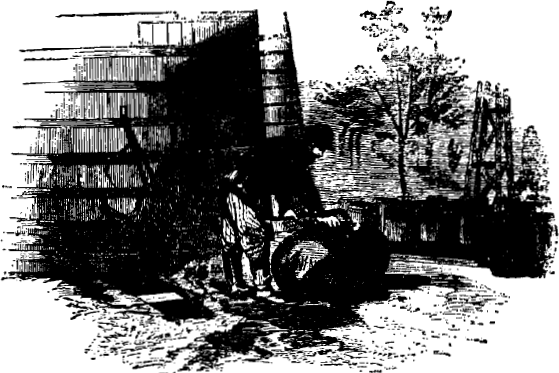
PRIMITIVE METHOD OF FILLING BARRELS.
(From Frank Leslie’s Illustrated, Newspaper)
The teamsters had resented the coming of the pipe lines as an invasion of a business which they thought belonged to them. They hitched their teams to the pipes and pulled them apart until the pipe owners protected their property with armed guards. The jobbers felt the same way. They were discussing a combination and association with a capital of a million dollars to build tanks and store oil to regulate the price. The refiners of the region had done well—those with intelligence and industry. Their natural advantages more than offset Rockefeller’s rebates. One of the largest refineries was that of the Columbia Oil Company which in seven and a half years had paid its stockholders $3,017,600 in dividends. But these refiners had decided their Cleveland and Pittsburgh competitors had no right to exist. They formed into a league with their producing allies and openly boasted in the streets of Oil City that they were “determined to wipe Cleveland out as with a sponge.” In 1870 the producers met in Library Hall, Oil City, and adopted a resolution to stop the drill for three months in order to raise the price of oil to the public. It got nowhere because they failed to live up to their resolution, for the papers were filled in the next three months with stories of unrestrained wild-catting. In other words, the men in the oil regions were determined to build for themselves a monopoly of the oil business. The rights of the public to the benefit of improved methods of producing and refining were not within their vision. If they did not succeed in their plans it was because they were too inefficient, too ignorant. And all this was before Rockefeller made any attempt at combination.
These were the men who raised a cry heard “’round the world” when they learned the refiners had succeeded in doing what they had tried but failed in. A recognition of this fact is essential to an understanding of events which are to follow.
VI
IT WOULD be interesting to know with whom the scheme of the South Improvement Company originated. It is almost certain it did not originate with Rockefeller. Henry M. Flagler testified before the House Committee investigating trusts that it originated with Peter H. Watson and W. G. Warden, who came to him and Rockefeller with the plan full-blown. “We did not believe in it,” he swore, “but the view presented by other gentlemen was pressed upon us to such an extent that we acquiesced in it to the extent of subscribing our names to a certain amount of stock which we never paid for.” As it happens, however, Mr. Flagler’s assertions, on or off the Bible, are of no value. The scheme adopted has all the earmarks of Flagler’s mind and experience. Mr. Rockefeller has always insisted the plan originated with Tom Scott of the Pennsylvania and that Logan and Warden were the instruments; that he and Flagler did not like the scheme but went into it because they did not like to break with the powerful Tom Scott; that his plan was to enlarge the Standard Oil Company and take the refining interest into partnership with them; that they felt the South Improvement Company scheme would fail and that then he could say to the others—“Now try our plan.” Later, telling of this to a confidant, he said, “I had our plan clearly in mind. It was right. I knew it as a matter of conscience. It was right between me and my God. If I had to do it tomorrow I would do it again in the same way—do it a hundred times.” It may seem far afield, but the facts which follow, interesting in themselves, become doubly interesting when connected with the course of events in Cleveland and the oil regions.
This forgotten chapter in American industrial history took place along the course of the Saginaw River in Michigan. In 1859, the year Drake discovered oil, the Saginaw Salt Manufacturing Company drilled for salt in East Saginaw. The first year it produced 4,000 barrels. As soon as this venture proved successful, lumbermen along the river also drilled for salt and got it. In a short time there were sixty-six different manufacturers producing salt. At the same time salt was being produced on the Ohio River and in Onondago, New York. In a short time the market was glutted. These salt men, almost all Saginaw River lumbermen, saw that their problem was a matter of orderly marketing. The Saginaw Salt Company was organized to act as a sales agency. Before long almost all of the salt men in Saginaw one by one had turned their salt over to the Saginaw Company to sell for them. In April, 1868, they formally organized a central coöperative selling agency—the Saginaw and Bay Salt Company. Its stock was owned by the various producers. It effected a virtual monopoly of Saginaw salt, but felt the competition of the Ohio River and Onondago producers. Hence in March, 1871, after much negotiation, the three districts formed themselves into a pool to sell their product, the whole project being committed to the management of a board made up of one member from each district. Each district was allotted a fixed percentage of sales and prices were fixed for salt at various points.
It is interesting to note that Henry M. Flagler had been among the first to engage in the salt industry at Saginaw. His father-in-law was a lumber manufacturer and salt producer along the Saginaw River. He had kept in constant touch with the affairs of the salt producers and knew all about this experiment. The completed arrangement governing the salt pool was effected March, 1871, and immediately thereafter we find Rockefeller, Flagler, Watson, and Warden formulating plans for a similar deal in the oil regions.
VII
WHOEVER originated this scheme, Watson, Warden, and Lockhart undertook the business of handling the organization in the oil towns outside of Cleveland. And when the plan was launched Watson became its president and got much of the odium which was heaped upon it. Watson was a man of great force and energy. He was a patent lawyer. He had been assistant secretary of war under Stanton and had a great flowing beard with a clean upper lip like Stanton whom he much resembled. After the war he was made general freight agent of the Lake Shore Railroad and president of the branch running from Cleveland to the oil regions. He owned some oil property himself and had some storage tanks at Franklin. Watson’s chief interest, however, was in the railroad rate war. He was alarmed lest the threat of the regions be made good and Cleveland be destroyed as a refining point. This would have wrecked the branch of the Lake Shore of which he was president. And, of course, because the Standard Oil was the largest shipper he was on terms of business intimacy with Rockefeller.
The plan worked out was as follows: Rockefeller in Cleveland, Logan and Frew in Philadelphia, Lockhart, Waring, and Warden in Pittsburgh, and Jabez A. Bostwick in New York agreed to organize a central corporation or association which would comprise the most powerful refiners in the business. Each one in his respective territory was to buy up, with the aid of the pressure the central organization would supply, their competitors in their own districts. They would demand from the railroads a contract which would give them a large rebate on their own shipments and an equally large drawback on other people’s. They would aid the railroads by guaranteeing to them some equitable distribution of the freight business. Their advantage would be so great that they could force all competitors to come in while those they did not want would be driven out of business. With the control of the refining business in their hands they could dictate to producers the price of crude oil and they could destroy the competition of refiners in the oil regions whom they all feared.
Through the Fall and Winter of 1871 the business of perfecting this scheme went forward but with such absolute secrecy that not a word of it got around the oil regions. Charters were not so easy to get then as now and so, having decided on forming a new corporation, the promoters had to get hold of a charter. They were able to buy one—an old charter of a company which had been incorporated years before and which was now practically defunct. It was called the South Improvement Company and it was an excellent vehicle for their designs, since it authorized the company to engage in almost any kind of business. In each refining territory the promoters decided on such refiners as they wished to bring in. These they approached but before disclosing their plans they compelled them to sign a written pledge of secrecy. The pledge, which bears upon its face the flavor of Rockefeller’s methods, ran as follows:
“I,——do solemnly promise upon my honor and faith as a gentleman that I will keep secret all transactions which I may have with the corporation known as the South Improvement Company; that, should I fail to complete any bargains with the said company, all the preliminary conversations shall be kept strictly private; and finally that I will not disclose the price for which I dispose of my product or any other facts which may in any way bring to light the internal workings or organization of the company. All this I do freely promise.”
While the refiners were being rounded up, Peter H. Watson went to the railroads. He dealt with Vanderbilt of the Central and H. F. Clark, president of its subsidiary, the Lake Shore, who was also Watson’s own chief; Jay Gould of the Erie and General George B. McClellan, president of the Erie’s subsidiary, the Atlantic and Great Western, and Tom Scott of the Pennsylvania. Here Watson struck a snag which the promoters had not counted on. The roads insisted all refiners should be taken in and Tom Scott insisted that the producers also should be included. This was no part of the plan. As to the refiners, Watson did a little lying. He said the promoters already represented the refining interest of the country. As a matter of fact, they represented about one-tenth of the refining interest. As to the producers, Watson demurred about inviting them in. He argued that their interest was antagonistic and they could look out for themselves. But Scott insisted and finally Watson drew up a penciled draft of a proposed contract with producers. Nothing, however, came of this for reasons we shall see.
On January 2nd, 1872, the promoters met in Philadelphia and formally organized the South Improvement Company. And shortly thereafter that company signed written contracts with the railroad companies. These were remarkable documents—perhaps nothing like them had yet appeared in the course of business in this country. The substance of these contracts was as follows:
First, it was agreed that shipments of petroleum products to the seaboard should be allotted to the three railroads, 45 per cent to the Pennsylvania, 27½ per cent to the Erie, and 27½ per cent to the New York Central. Shipments westward were to be divided one-third to each of the roads.
Second, the railroads agreed to allow rebates to the South Improvement Company on all shipments by its members. The contract fixed certain open, gross rates on crude shipments from any point in the oil regions to all refining cities. These rates were 80 cents to Cleveland and to Pittsburgh, $2.41 to Philadelphia or Baltimore, $2.56 to New York and $2.71 to Boston. These figures meant that existing rates were doubled. A similar table of open rates on refined oil between various points was fixed. Then the South Improvement Company was granted rebates on all such shipments ranging from forty to fifty per cent on crude and from twenty-five to fifty per cent on refined. Thus all the refiners in Cleveland would have to pay eighty cents a barrel on crude oil brought in from the regions. Rockefeller would pay this price too but he would get back a rebate of forty cents. The open rate on refined oil to New York was fixed at $2. Rockefeller’s rebate was fixed at fifty cents. Refiners in the region would have to pay $2.92 to ship refined to New York, though it was closer to New York than Cleveland from which Rockefeller had to pay only $1.50.
There was nothing new in all this save that it was made between the roads and a combination of leaders of the industry on a large scale to concentrate the business in their hands. But to all this was added another scheme which, so far as I can trace, was quite new and put into the hands of the combination a weapon so deadly that no opposition could stand up against it. This was the drawback. Under this plan Rockefeller in Cleveland, for instance, would pay 80 cents but would get back from the railroad 40 cents on every barrel of oil he brought from the wells. His competitors too would have to pay eighty cents. Forty cents of this eighty cents would be returned, but not to the competitor. It would be returned to Rockefeller. Thus he got a rebate of forty cents on every barrel he shipped and a drawback of forty cents on every barrel his competitors shipped. A more deadly arrangement for the destruction of rivals could hardly be invented. All this was put down in writing, in minutest detail and signed by the railroads and the South Improvement Company.
One other mortal device was introduced. The railroads agreed “to make manifests or way-bills of all petroleum or its products transported over any portion of its lines,” which manifests “shall state the name of the consignor, the place of shipment, the kind and actual quantity of the article shipped, the name of the consignee and the place of destination,” and this copy the roads agreed to send to the South Improvement Company. In other words every sale made by an independent competitor, together with the name of the customer and all facts about the transaction, was to be reported to the combination. Thus all the details of a rival’s business were to be completely exposed to the combination by the roads which were supposed to serve those rivals.
By the middle of January this curious engine for crushing competition was ready to begin its work and Watson was made president.
VIII
ROCKEFELLER now gave an example of the swiftness in action of which he was capable. Perhaps no man in business history has been given to more deliberate meditation upon his plans. He did nothing without long and careful reflection upon every side of a proposed course of action. However, having satisfied himself, he could amaze and confound his opponent with the suddenness of his thrusts. The moment the South Improvement plans were sufficiently advanced to permit safe action he went to work. He watched for the right moment and then one day, he put on his high silk hat and walked across the Public Square to the office of a leading banker.
“I want you to have Oliver H. Payne here for a conference,” Rockefeller announced. The banker was a little surprised for he knew there was little love lost between these two men. However, he assured Rockefeller that Payne would be there at three.
The firm of Clarke, Payne, and Company was Rockefeller’s chief competitor. Payne was the Standard’s strongest foe. He was a man of great importance in Cleveland, a grandson of old Nathan Perry who had left a fortune made in the wholesale liquor and grocery business. His father, Hon. Henry B. Payne, was a lawyer of the highest standing at the Ohio bar who was later elected to the United States Senate and was once mentioned prominently for the Presidency. Payne had what Rockefeller did not have—abundant capital, high social standing, powerful political and financial connections. He was a proud, haughty man, who bore himself with such an air that one of Rockefeller’s associates spoke of him as the “kin of God.” He looked with disdain on the energetic and resolute young man who was challenging him in the oil business and doing it successfully. He had an additional reason for hating Rockefeller. When Payne’s father ran for Congress Rockefeller and his associates put up money to defeat him. Payne was proud of his father and deeply resented this. When Rockefeller, therefore, decided to deal with Payne he took the risk of being snubbed. But he did not send an emissary. At three o’clock he strode across the square to the bank where he found Payne waiting for him. He told Payne that he had come to the conclusion that the oil business of Cleveland was doomed unless the leading refiners got together—the interests of all were being impaired by the unintelligent competition of a large number of small, poorly equipped and under-financed refiners who were moving themselves to ruin and involving all in the mess. The leading refiners should put aside their enmities and combine. If they did they could all get preferential rebates and drawbacks from the railroads; they could buy out the weak ones, utilize the good plants and close the poor ones, operate more economically on a large scale, unite with the leaders in other cities, defeat the threat from the oil regions and bring the whole industry under the control of a few powerful leaders.
Rockefeller was never a popular man even before his great moves made him hated. But he had about him a power which few men could resist in argument. It must have dawned on the mind of the haughty Payne that he stood in the presence of a master, an enemy who had the audacity to propose that he turn his business over to his keeping. The interview was brief, curt, but decisive. Payne listened and said little. Rockefeller concluded:
“If we can agree upon values and terms do you want to come in?”
“Yes,” Payne replied, put on his hat and walked out. Later that day Payne sent his clerk over to complete the terms with Rockefeller. He did not go himself. When the clerk saw Rockefeller’s books and the profits he had made he was astonished.
In later years Rockefeller, recalling this interview, spoke with a little asperity of Colonel Payne’s pompous manner. However, at the time he knew that with Payne in his camp in Cleveland, his plans were safe. Payne turned his business over to Rockefeller and took stock for it in the Standard Oil Company. Also he became a member of the Board and later treasurer of the company.
IX
THE DAY the South Improvement Company was formally organized Rockefeller increased the capital stock of the Standard Oil Company from one to two and a half million dollars. The additional stock was provided to issue to such Cleveland refiners as the Standard should absorb. Immediately Rockefeller and Flagler began to call on all their twenty-five rivals in the city. They proposed simply that the refiners should sell out to the Standard. In increasing the stock of the company Rockefeller brought in several new stockholders—O. B. Jennings, Benjamin Brewster—both oil men, Truman P. Handy, Amasa Stone, and Stillman Witt, officers of railroads entering Cleveland. If anything was needed to convince oil men that the railroads were on Rockefeller’s side these railroad stockholders were sufficient. When Rockefeller approached a competitor he laid the whole case before him, the hopelessness of the business, his utter lack of any chance of success outside of Rockefeller’s combination, Rockefeller’s freight arrangements, which gave him a complete and final advantage. “I will send my appraisers to your plant and fix its value. You turn it over to us and we will pay you in cash or in stock of the Standard Oil Company. You will then own, instead of a refinery that is doomed to failure, stock in a company which is progressing.” Then he would add in a tone of friendly and confidential assurance: “Take Standard Oil stock and your family will never know want.” No guarantee was ever sounder. What is more, Rockefeller believed in it profoundly. He had absolute confidence in the oil business and in himself. But most of those who heard this promise had no faith in it or in the oil business, which they believed was heading for doom.
The partners in Alexander, Hewitt, and Company, which included Isaac L. Hewitt, Rockefeller’s first employer, talked it over. They had received an offer and they called on Vanderbilt. Vanderbilt refused to be drawn out. They went to Peter H. Watson, whom they knew well. Watson equivocated. Then he said ominously: “You had better sell—better get clear.” The partners were plainly frightened. They decided to seek a further conference with Rockefeller. Alexander refused to talk to Rockefeller—he hated him. Hewitt, for whom Rockefeller professed a strong friendship, said he would go. He called at the Euclid Avenue home in the morning and walked into town with his old office boy—now tall, immaculate, imposing in his high silk hat and long coat and garmented in the aura of success and power. Rockefeller assured his old employer that if they did not come in his firm would be crushed: “I have ways of making money you know nothing about,” he added. “We felt a pressure brought to bear on our minds,” Alexander explained later. The firm decided to surrender.
All the refiners approached were sworn to secrecy, but of course, talk got around. Hanna, Baslington, and Company were a strong firm. The Hannas were powerful in Cleveland. They refused to sell. They had made big profits the preceding year and saw no reason to sell. They made up their minds to refuse before Rockefeller got around to them. When he did, Hanna refused point-blank. Rockefeller raised his eyebrows and shrugged his shoulders as if all were up with Hanna’s firm. Then he revealed that he had gotten possession of most of the other refiners. Hanna was amazed. So secretly had Rockefeller worked that these men knew nothing of his progress. Then he pressed the point of his advantage from railroad rates.
“You will stand alone,” he warned them. “Your firm can never make any more money in Cleveland. No use trying to do business in competition with the Standard Oil Company. If you do it will end in your being wiped out.”
This firm decided to sell out too. A few demurred more stoutly. One of these was Frank Rockefeller, John D.’s brother, a partner now in the firm of Scofield, Shurmer, and Teagle. Rockefeller was somewhat shorter with his brother.
“Very well,” he said. “We have a combination with the railroads. We are going to buy out all the refiners in Cleveland. We will give every one a chance to come in. We will give you a chance. Those who refuse will be crushed. If you don’t sell your property to us it will be valueless.”
Frank was indignant, furious in fact. But the firm decided Mr. Rockefeller was in earnest. So they too sold.
The two oil men—Rockefeller and Flagler—kept at it until every refinery in Cleveland, save two or three, sold out. A kind of terror got abroad among the refiners as they talked among themselves almost in whispers about the thing that was wiping them out of business. They had a feeling of despair that odds utterly beyond their strength were being raised against them. In less than a month, twenty of the twenty-five refiners in Cleveland were in Rockefeller’s hands.
When Rockefeller was done he had practically the entire refining capacity of Cleveland in his hands—capacity for refining 15,000 barrels a day—the largest by far of any refining point in the country. He had succeeded completely in his part of the great plan and with amazing swiftness. He had a monopoly in Cleveland.
When it was accomplished it was said that Rockefeller had “crushed” his rivals and that he had forced them to sell at sums far below the true value of their plants. Alexander said he had to sell a plant worth $150,000 for $65,000. Robert Hanna insisted he was forced to accept $45,000 for a plant worth $75,000.
There are, of course, two sides of this story. It is quite certain that of the 26 refiners in Cleveland almost all of them were heading for ruin. It is also quite certain that almost all had lost faith in the oil business. They did not believe that even John D. Rockefeller could succeed in it. Mark Hanna was in the oil refining business when he married. His wife’s father, Mrs. Hanna has said, objected to her marrying him because “he said the oil business was not a legitimate business; it was speculation.” Mr. Rockefeller contradicts the statement of Isaac L. Hewitt already reported. Hewitt, he declares, told him his combination could never succeed. “John,” he argued, “it can’t be done. We’ve tried it on the Lake Erie shipping companies. They didn’t hold together. Yours won’t. You’ll find it is a rope of sand.” Another leading business man in Cleveland objected that Rockefeller’s scheme was “too scopey.” Even Colonel Oliver H. Payne’s partners were skeptical. One of them, James Clarke, who hated Rockefeller and was always berating him, sold his share of the Standard stock—1,000 shares—to Colonel Payne for $113,500. Another, John Huntington, got 500 shares as his part of the sale of Clarke, Payne and Company. He was prevented from selling by Colonel Payne, who guaranteed him against loss. The stock he held later made him a man of great wealth.
Those who were glad to sell and get out but who thought they ought to get a fancy price for their plants abused Rockefeller for not meeting their own appraisals. There were others who welcomed the opportunity to sell at any price. One of these, Frank A. Arter, had a refinery which had cost him $12,000. “It was a hard blow,” he said, “when Rockefeller’s appraiser valued my plant at $3,000. I had a debt outstanding of $25,000. But what could I do? When conditions were so bad in the oil business that a small refiner could not make money, his plant was worth only what it would fetch as material. So I sold out for $3,000. I had my choice of cash or Standard Oil stock. I asked Rockefeller and Flagler which I ought to take. They both spoke at once. ‘If you will take the stock and hold it some day you will get back the full price you asked for your refinery.’ I had a hard pull carrying the $25,000 indebtedness for the next four years in order to hold that stock. Sometimes I got worried. One day I met Mr. Rockefeller and asked him: ‘How are things going?’ He asked: ‘Are you still holding your stock?’ I said that I did in a way, that I had it what you now would call ‘in hock’ and was trying to follow his and Mr. Flagler’s advice. Rockefeller leaned over and in an undertone said: ‘Sell everything you’ve got, even the shirt on your back—but hold on to that stock.’”
Mr. Rockefeller has persistently denied that any coercion was used in this episode. Yet he was a member of the South Improvement Company. That concern did have a contract with the railroads—all of them—for heavy rebates and enormous drawbacks against which no rival could compete. It would have been simply necessary to show this advantage to Cleveland refiners—already discouraged—to make it plain to them that their lot was hopeless and several refiners have testified that this was done either directly or by innuendo. In any case they understood. It was all done in a pleasant and friendly voice. But it was none the less effective.1
Meantime, Logan and Frew were busy in Philadelphia, Lockhart, Warren, and Warden in Pittsburgh, Bostwick and Brewster in New York. But they were moving slowly. These were all able men, but they lacked that resistless power and that furious drive which marked the operations of Rockefeller.
X
SEVERAL times in the midst of this campaign Rockefeller had to make quick trips to Titusville. There oildom worried on its perplexed, half-busy way, utterly oblivious of the blow which hung suspended over it. The visitor from Cleveland walked into a hotel. The lobby was filled with gossiping men and tobacco smoke. “Gentlemen will please keep out of the office and off the counter,” read a sign on the wall. Loud talk and boisterous laughter came from the adjoining bar. Rockefeller signed his name on the register and looked it over to see who was in Titusville. Just a few lines above his own he read:
John D. Archbold, $4.00 a bbl.
The inscription struck Rockefeller’s fancy. He supposed it then and years later to be a kind of bold announcement of what the signer wanted oil to cost. As a matter of fact, it was Archbold’s method of advertising free that he was there prepared to pay four dollars a barrel for oil—that was his bid and his way of making it. Rockefeller had heard of him. He was a very young man, born nine years after Rockefeller (July 26th, 1848). He was but twenty-four years old, the son of a preacher who had shuffled off when the lad was only ten. Two years’ clerking in a country store, then to a job in Titusville with William Abbott in the oil business, then a member of the firm while still in his teens, then part of a refining firm in Titusville and then a representative in New York of the refining firm of Porter, Moreland, and Company, of which he was a member—this was the brief but successful career of Archbold. He was a strong, ardent, pugnacious, daring operator and the signature with its flourish about four-dollar oil made Rockefeller feel that he wanted Archbold in the new combine. So he took care to have that gentleman approached. In New York later the promoters there got him to sign the pledge of secrecy and then unfolded this plan. Archbold rejected it indignantly. But he kept his counsel.
XI
ON FEBRUARY 21st, Rockefeller read in the Cleveland Plain Dealer the following:
“A gigantic ‘little game’ has been going on in oil circles in Cleveland to the effect that a single firm has bought up or got control of all the refineries in the city and proposes to monopolize the business, having allied itself with the oil-carrying railroads as well as a similar monopolizing firm in Pittsburgh. Rockefeller and Andrews of the Standard Oil Works are credited with being the shrewd operators in Cleveland.”
The paragraph is interesting because, with its critical tone, it was the first bit of criticism to appear in print of John D. Rockefeller upon whose head was to descend such floods of abuse for the next thirty years. What alarmed Rockefeller was not the criticism but the leak. Some weeks before the Titusville Herald had spoken of a rumored agreement between the railroads to abolish rebates and equalize freight rates. But this was wide of the mark.
The day following the Cleveland story came a copy of the Petroleum Centre Record referring to a “rumored scheme of gigantic combination among certain railroads and refiners to control the purchase and shipment of crude and refined oil from this region.” It spoke of “robbing and swindling” and hinted at dire reprisals. Next day the Derrick said “a torpedo is filling for the scheme.” A kind of fear filtered through the regions. The rumor went around in angry murmurs. Cleveland buzzed with the story. In February a Plain Dealer reporter went to the Standard Oil office and tried to draw out Flagler.
“Do you suppose any one firm exists which can obtain control of all refineries here? In this country a man wants to look after his own money and no man or set of men can buy up all the refineries.” Yet at this moment the Standard had in its breeches’ pockets all the refineries in Cleveland.
“What is this South Improvement Company?” asked the reporter.
“I don’t know,” said Mr. Flagler.
“I didn’t know but what the Cleveland combination might have some connection with it and you could tell.”
Flagler laughed. “Do you suppose I would be fool enough to tell you?” he asked and walked away.
February 26th the news was out. After all the planning an error of a subordinate railroad official caused the proposed new schedule of open rates doubling the old ones to be put in force on the oil branch of the Lake Shore Railroad. The meaning of this flashed upon the oil men along the Creek in an instant. Like a blaze of hot anger the news rolled over the Creek. It meant the combination would seize the whole refining industry and would have the Creek refiners by the throat. Business stopped. Producers, refiners, shop-keepers, shippers, drillers, rushed out into the streets of Titusville and Oil City.
In Cleveland reporters went to the Standard Oil office. Rockefeller refused to see them. But they told Flagler the news. Three thousand men had gathered in Parshall’s Opera House in Titusville “to defy the ‘Anaconda.’”
“Just a few soreheads who have been preying on the oil regions,” Flagler assured them. “This agitation will soon cease.”
Nevertheless disturbing reports continued to come in from Titusville. Watson and Warden and other allies were sent for. Rockefeller and Flagler were plainly surprised at the extent of the outburst against them. They had thought little of this in advance. Mr. Rockefeller really had as yet not learned much of how the human mass mind works. He had supposed that the whole thing could be carried out quite secretly. But now it was plain that he faced a fight—the first battle in a long career of warfare, war upon him by courts, by district attorneys, by independent traders, by newspapers, by legislators, Congress, by society itself, war in which he was to be lampooned and excoriated, called by every bitter name the inventive fury of man’s anger could conceive, until in the end he was the worst-hated man in America.
XII
IN THE oil regions the wrath of the producers and refiners swept up and down the oil creeks like a flame. Men talked of mob action, said the Oil City Derrick. At the head of that paper appeared a figure now destined while his brief editorial reign lasted, to be a voice of thunder among the revolting oil men. He was C. E. Bishop. He had come to Oil City in 1871 from Jamestown, New York, and, with the early partisan journalist’s flare for adopting warlike causes, he summoned his extraordinary talents for invective and scorn to castigate Rockefeller and his associates. He perhaps invented the terms “Anaconda,” “monster,” and “Octopus” which for a generation served orators well in flaying the trusts. At once Bishop printed at the masthead of the Derrick an ominous black box and in it the names of the “conspirators” headed by Rockefeller. This black list he published daily until the war was ended. The streets of all Titusville were black with angry men. On the night of the twenty-seventh men poured in from all the towns in the region to a great mass meeting in Parshall’s Opera House, Titusville. Speeches were made denouncing the monster. Resolutions were passed condemning the railroads, the combination, the legislature for “putting chains on the people” by creating such charters as the South Improvement Company. Then the meeting adjourned to meet at Oil City two days later. These men were angry. They talked of violence, of burning refineries, of tapping tanks, lynching the leaders. Two days later the producers met at Love’s Opera House in Oil City. Orators lashed them to fresh fury. “The South Improvement Company is well named,” one said. “In the South they enslave blacks. And this is an improvement on the South for it is intended to enslave whites. John S. Rich declares he will burn every barrel of oil he owns before he will sell it to the South Improvement Company.” Then a young man arose—small, thin, pale-faced, looking like a young divinity student. He was John D. Archbold. He told in tones full of scorn how he had been approached by the conspirators and sworn to secrecy. He denounced the “conspiracy” and called on producers and refiners in the regions to “unite against the common enemy.” It was the region producers who made the most noise. But the refiners came in with a resolution saying they might have made money by going into the combination but preferred to remain out and cast their lot with their neighbors in the regions. Again the meeting adjourned to meet in Franklin. Everywhere similar meetings were in eruption, orating, resolving, reporting, exhorting, sizzling with hatred and threats. A 3,000-gallon tank belonging to Peter H. Watson was tapped and 500 gallons of oil run out. A secret society was formed—the Oil Men’s League—with fiery oaths, rituals, passwords and slogans about “saving the resources of Pennsylvania.” When the full force and meaning of the proposed drawback was understood the fury of their anger knew no bounds. A petition to the legislature for relief was hastily dispatched and 1,000 men were held in readiness to march on the State Capitol to compel the lawmakers to grant that relief. New figures arose to add to the volume of abuse directed against Rockefeller and Watson and Warden—figures which look strange to us now in these roles. From New York came a delegation headed by Henry H. Rogers of Charles Pratt and Company. In the state constitutional convention a young lawyer rose to call attention to the dangers of monopoly threatening the liberties of the people as exemplified in the South Improvement Company. This was Samuel C. T. Dodd, later to become John D. Rockefeller’s counsel and the inventor of the trust. Captain J. J. Vandergrift, one of the leading refiners, signed the resolutions of the Creek refiners—Captain Vandergrift, who was to be a Oil director and head of its pipe lines. Baltimore refiners wired they were ready to join in the fight. At Buffalo citizens met and proposed an independent railroad to the regions and bound the city to raise a million dollars for this purpose and some days later a delegation of Buffalo oil men marched into Oil City headed by the mayor. Delegations arrived from Philadelphia and Erie. Suddenly the newspapers of the country bristled with this exciting story.
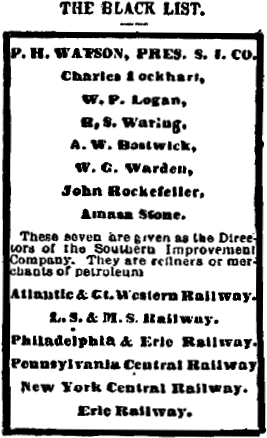
THE BLACK LIST PUBLISHED BY THE OIL CITY “DERRICK.”
XIII
IN CLEVELAND Rockefeller, amazed at the outburst, retired to the silence of his office and refused to see any one, most of all the reporters who clamored for news. He had not counted on anything like this. He and his allies were plainly puzzled. A leading Cleveland railroad man, interviewed, said: “Oil producers will do nothing as they have not the brains, backbone or means to organize resistance.” Apparently they thought the tempest would blow over. They tried to induce the New York refiners to come into the combine, offering them a place on the directorate. Watson wired the region urging them to send a committee to confer. But they indignantly repelled his emissary. Gradually news arrived at the Standard office which was indeed disturbing.
In the midst of all the confusion in the oil country it began to look as if something was being gotten done. The oil men had organized the Producers’ Protective Association. Captain William Hasson, known to be an able and resolute man, was named president. It mapped out a program—to shut down all work on Sunday, to start no new wells for ninety days, to cease using torpedoes to increase the flow of wells. A joint committee of regions refiners was named to control the whole situation. Creek refiners pledged themselves to rush their operations while producers slowed up theirs. Above all, producers pledged that no crude oil was to be sold to John D. Rockefeller and his associates and to insure this that all oil be delivered to the committee. A million dollars to finance home refiners was pledged and the region divided into sixteen districts to raise the capital and handle the oil. A bill was introduced in Harrisburg to repeal the charter of the South Improvement Company and a bill to authorize the building of pipe lines was offered. Congress was urged to investigate the oil industry, a committee started to Washington to demand action and another bill was offered forbidding all rail discriminations as between localities. To back all this a petition ninety-three feet long was sent to the national capital.
Rockefeller saw that the railroads were plainly frightened. Cornelius Vanderbilt wired the oil men to suspend judgment and action until his agent could treat with them. Rates on the Jamestown and Franklin road were changed four times in as many days. The Atlantic and Great Western restored its old rates.
Rockefeller quickly learned that the resolution not to sell him oil was serious. Word came from his buyers along the Creek that no one would sell them a drop of oil. Brokers suspected of dealing with Rockefeller’s agents were watched. Half a dozen were summoned before the Oil Exchange and threatened with expulsion if they sold oil in Cleveland. One man charged with procuring oil for the Standard was Daniel O’Day. He was a big, fearless, resourceful Irishman. He denied the charge, but was tried along with some others, found guilty and ordered to resign from the Exchange. O’Day didn’t know he was representing the Standard. His principal was Bostwick in New York who had secretly sold out to Rockefeller. At Tidioute, Rockefeller agents offered an advance of thirty cents for oil but could get none. In the Derrick of March 21st we read that a contract was offered to a producer for his year’s output at $4.50 a barrel. His name was F. S. Tarbell—a name later to become famous in the oil regions. Tarbell refused the offer.
What Rockefeller saw at this stage of the war must have perplexed him. Here was every refinery he had just purchased and his own in Cleveland completely shut down because he could not get oil. Meantime the oil regions had now done what men said never could be done—they had organized, were raising funds, had a strong, a resolute leader. Was the threat that they would wipe out Cleveland as with a sponge to be carried out? The Oil City Derrick of March 21st said feeling against the combination in Cleveland was strong, that “a special detail of police is necessary to guard the property of the ring, sixty men in all being thus employed. A half dozen are stationed around the residences of the officers of the South Improvement Company, the balance of the detail is placed over the Standard Oil works and copper shop.” However, no Cleveland paper mentions this and it is probably exaggerated.
No one was more alarmed than Tom Scott. The free pipe line bill disturbed him. But his agent in Harrisburg attended to that threat in the usual way. He got slipped into the bill a little joker to the effect that oil could not be piped out of the state. But Scott arranged a conference with the committee of the oil men in New York. Rockefeller heard of this—that the railroad chiefs were trying to back out of the scheme. He and Watson hurried to New York. There they learned that Tom Scott, Commodore Vanderbilt, and other railroad men were meeting with the oil men. Among the representatives of the oil men were John D. Archbold and Henry H. Rogers. Rockefeller and Watson went boldly to the meeting, knocked on the door, and demanded admittance. The man who opened the door promptly closed it and reported that Watson and Rockefeller wanted to be admitted to the meeting. Henry H. Rogers, using strong language as was his wont, objected to their entering. However, the chairman—an old friend of Watson’s—insisted on his coming in. The great bearded railroad man was allowed to come in. A blast of angry protests greeted his entry. Rockefeller remained outside in the hall pacing up and down. In a few moments the door opened and Watson came out red-faced and flustered. Reporters there at the time wrote that as the pair turned to go away, Mr. Rockefeller seemed “very blue indeed.”
The game was going against them now. That day the railroads signed a contract with the producers to end the South Improvement Company contract and to equalize rates. From every quarter now the blows came. In a few days the bill repealing the charter of the South Improvement Company was passed and signed by the governor. The “Anaconda” was slain by law. Rockefeller went back to Cleveland. But in the oil regions men danced for joy. The great beast had been conquered. All over the country news of the defeat of the South Improvement Company was printed. It was indeed defeated. What the oil men did not see for some time was that John D. Rockefeller was not. When the smoke of the battle cleared away it was seen that he had in his hands as a result of the campaign the complete oil industry of Cleveland. In less than a month almost every refinery there had fallen into his hands. He had not won his whole design. But he had won much. He was the only gainer. He had had his first touch of war. He was not to know peace for a generation.
2Mr. Rockefeller’s own explanation, as made to Mr. William O. Inglis, later, is as follows:
“The procedure was without precedent. We find here the strongest and most prosperous concern in the business, which had made money in each year of its existence, turning to its less fortunate competitors, who, it well knew, had been losing money and become discouraged and saying to them, practically: ‘We will stand in for the risks and the hazards of the refining business. You need not contribute any money unless you desire to do so.’ And I believe in only one instance was any concern willing to do so, and that was in the case of Warden, Frew and Company and Lockhart and Frew.
“The Standard Oil Company assumed all the risks and at a time when it was evident that the larger number of its competitors could not continue to compete with it in the struggle for existence. What did it do? It turned to these men with whom it had been in sharp competition and said to each: ‘Come with us, and we will do you good. We will undertake to save you from the wrecks of this refining business and give you a return on the capital which you have in the plant and land; or, if you prefer, we will take the business off your hands.’”
- 1The Rockefeller family insists that the elder William Rockefeller went to Richford with his family and that the story given here is not true.
- 2Thus William Avery Rockefeller, the father of John D. Rockefeller, arrived in Richford. When he got to his mother’s home he continued to use his slate to the great distress of the whole family. When his joke had gone far enough he broke into a loud laugh and announced that he intended to live in Richford.

