
God’s Gold
Part One: The Quiet Years

FOR FORTY years—from 1872 to 1914—the name of John D. Rockefeller was the most execrated name in American life. It was associated with greed, rapacity, cruelty, hypocrisy, and corruption. Upon it was showered such odium as has stained the name of no other American. Theodore Roosevelt denounced Rockefeller as a law-breaker. William J. Bryan, his fellow Christian, went up and down the land demanding that he be put in jail. The attorney-generals of half a dozen states clamored for his imprisonment. LaFollette called him the greatest criminal of the age. Tolstoi said no honest man should work for him. Ministers of the gospel called the money he showered upon churches and colleges tainted. For years no man spoke a good word for John D. Rockefeller, save the sycophant and the time-server.
Then somehow a kind of languor fell upon the man’s traducers. As the years passed there came a mitigation of the old hatreds. In some way the once hated Rockefeller emerged into a kind of genial sainthood. A newspaper poll voted him one of the greatest Americans. John Singer Sargent, who made his portrait, said that when painting him he felt himself to be in the presence of a medieval saint—compared him to St. Francis of Assisi. His birthday has become a kind of annual newspaper event. One may wonder if the redemption has not been quite as excessive as the damnation.
The beatification of Rockefeller in this second phase of his career may well reveal to the practiced eye all the mechanism of patient and sustained propaganda. What is not so clear to the casual observer is that the earlier proscription was equally the work of propaganda. It was propaganda even more intense and sustained, but not so obviously propaganda, because it proceeded, not from a centrally organized bureau, but from the outraged interests of thousands of little, wasteful, inefficient, selfish business men who at the time clung to the unworkable methods of the old school and were in possession of the favor of press, political leaders, and all the agencies of opinion. The implements for making and spreading opinion have changed hands. The result has been to shear Mr. Rockefeller of his horns and fasten a halo where they grew. Perhaps the truth about Mr. Rockefeller lies somewhere between the extravagant abuse of the politically-owned press of the last century and the extravagant approval of the business-owned press of this one.
The story of Rockefeller is not just a tale of piling up a vast fortune. The chronicles of American fortune building are not very noble ones. The first great American millionaires like Astor and his contemporaries came from the land. Astor himself laid the foundations of his fortune trading with the Indians and swindling them by the generous use of rum. The millions he later amassed were got in land grants, many of which were acquired by sheer corruption. The ultimate value in the land was expanded by just holding on and doing nothing. Most of these early aristocratic fortunes were built by sitting idly upon their acres while the great cities grew around them through the energies of other men.
The fortunes of the next generation were for the most part acquired through downright frauds or stock-jobbing operations closely bordering upon fraud. Russell Sage laid the cornerstone of his by stealing a small railroad from a city of which he was an official. Upon that foundation he built through a series of land swindles and railroad adventures of amazing audacity. The Gould fortune was reared through a career of almost unparalleled security frauds in which one episode was the looting of the Erie Railroad in an adventure which still stands as a masterpiece of knavery. The great railroad fortunes of the West—of Huntington, Leland Stanford, Crocker, and Mark Hopkins—were chiefly the fruit of gigantic frauds upon the government, upon the public through stock issues and upon stockholders through schemes directed against their own companies. The Elkins fortune began in land grabbing in the Southwest and ended in widespread utility promotions in the East. Most of the fortunes of Rockefeller’s wealthiest contemporaries were made through stock promotions, including those of Morgan and Harriman. And if all of these were not utterly dishonest they were certainly parasitic, collected without the performance of any important or necessary service to society.
Singularly, no one of these men has come in for the robust hatred which was expended on Rockefeller. And yet Rockefeller’s great fortune was not only the most honestly acquired but was amassed in the building of a great constructive producing business and in the development of a new system in industry. His wealth was made up of profits taken out of a productive industry, not out of stock schemes or land and franchise raids.
It is therefore not merely the least tainted of all the great fortunes of his day, but is easily the most important and significant. To tell the manner of its making is to tell the story of the development of American business as we now know it. It is to trace the evolution of the economic system under which American business now flourishes. For this reason the career of this man cannot be told by limiting it to his own immediate surroundings. His portrait must be painted upon a canvas large enough to include, not merely his figure and those of his immediate collaborators, but a background of the forces in our whole economic life. The story of Rockefeller and his “crimes” which the last generation relished was the story of a brutal big business man projected against a background drawn to include a lot of things which that generation loved much, but which we have come to know were not so desirable and are no longer possible. It was dramatized as the story of the lion and the mouse. It was rather the story of a large, powerful, intelligent lion who knew what he was doing in a vastly altered jungle and a whole race of mice, disordered, disorganized, running about in circles without any notion of the changes that had taken place in the forest. We know a good deal more about that background now and by correcting its outlines, its colors, and composition to conform to the facts, the whole picture of Rockefeller and his contemporaries becomes different. This is the reason why this volume must be a history of Rockefeller and his times.
Was he an honest man? Was he a great man? What was his chief contribution to the world? What was the chief injury which he inflicted on it? Did he give to the world more than he took from it? What were the chief elements behind his success? Indeed was his life a success at all? Could such a career be duplicated now? The answer lies of course in the simple facts of his life and times. The answer begins in 1839 when Martin Van Buren was President of the United States.
CHAPTER I. MICHIGAN HILLON A summer’s night a horseman galloped up to a small house on the edge of the village of Richford in New York. Without dismounting he knocked clamorously above the door. A nightcapped head was pushed out of the upper window.
“What’s all the noise?” it asked in a sleepy voice.
“Tell Mrs. Thompson,” the horseman replied breathlessly, “to come over to our house at once. Mrs. Rockefeller is goin’ to have a baby.”
The man in the window saw that the rider held by the bridle another horse to carry Mrs. Thompson to the Rockefeller house on Michigan Hill. In a dozen minutes a woman climbed into the saddle and, through the darkness and over the uncertain roads, the two picked their way up the hill. Across the twin brooks and through the circle of apple trees and they were on the crest of Michigan Hill and before the cottage of Bill Rockefeller.
Inside Mrs. Thompson found Eliza Rockefeller in the small room at the front and to the right of the house on her bed of pain. The room was little bigger than the bed and almost bare. In a cradle at the left of the bed another child only 18 months old slept undisturbed by the groans of the mother. A sperm candle filled the room with a dim yellow glow and with dimmer moving shadows. And in the shadows, near the head of the bed, stood a tall, broad-shouldered young man, handsome, a little frightened and looking down with a troubled eye upon his frail wife, rigid and white with pain, her teeth set as she fought the surging agony.
Before the night was over the baby came. It was a boy. Then the broad-shouldered man went out and walked hurriedly across the top of the hill to the house of his father, Godfrey Rockefeller. But not to his father. He was going to his strong-minded mother to tell her that Eliza had been delivered of a son. Very soon the pair were walking back through the early dawn to Bill Rockefeller’s own cottage.
“What are you going to call him?” the mother asked.
“Well, we haven’t had much talk about it yet. But I know Eliza will want to call him after her father, John Davison. John’s a good name for a Rockefeller. There’s always been a John in every generation of Rockefellers.”
And so they called the boy John Davison Rockefeller.
II
ALL DAY that big man gazed down upon the indefinite infant with a puzzled look. Now, at the end of more than ninety years, the world looks no less puzzled at the old man, who was that infant, hidden away amid his five thousand acres of more than regal park, surrounded by a thousand servants, concealed in the depths of the most magnificent estate in the world. No man has been so much scrutinized; about no man does the world know less. Newspapers have printed more about him than about any American president. For years certain editors kept men continuously on his trail. In a dozen sensational lawsuits he has been pilloried and examined and searched. Twenty times the United States Congress and the legislatures of various states have investigated him, searching out all the acts of his life. Enemies—thousands of them—have followed every minute suggestion of wrong-doing and scandal. He has been grilled, exposed, turned inside out. Yet he has remained actually one of the most completely unknown men in American public life.
III
THE SCENE we have described took place in the little village of Richford on July 8, 1839—a small village of New York about one hundred and twenty-five miles from New York City.
Some years before this a powerfully built young man, astride an excellent horse, galloped one morning into the village square of Richford. The square looked then much as it does today. There was the broad, triangular green, with its high grass and the roads meeting in a fork. On the west side was the store of Chauncey Rich. There was an old hotel at one end of the Green and another store on the left, opposite Rich’s. The hotel and both stores are standing today. There were a good many lumbermen coming into Richford all the time and farmers bringing in their produce and occasionally wagons of travelers—immigrants on the move and striking north for the lakes and across to Ohio. There were always a goodly number in little groups in that busy village plaza.
Into this square rode the big man on the horse. He was a striking figure. His clothes were good. He wore a broad-brimmed hat and long black coat. His horse too was a good one and he rode it like a true horseman. He reined up in front of a small group near Rich’s store and saluted them. Then he drew from under his coat a small slate with a pencil tied to it. He wrote on the slate:
“Where is the house of Godfrey Rockefeller?”
He exhibited the slate to the group and made signs to indicate that he was deaf and dumb. One of the men who could write scribbled a direction under the question and pointed to the narrow wagon tracks leading off to the east and up the hill. That was where Godfrey Rockefeller lived. The big man wheeled his horse about and galloped briskly up the hill.
Thus William Avery Rockefeller, the father of John D. Rockefeller, arrived in Richford.1 When he got to his mother’s home he continued to use his slate to the great distress of the whole family. When his joke had gone far enough he broke into a loud laugh and announced that he intended to live in Richford.
For many weeks young Bill Rockefeller remained under the family roof on Michigan Hill. And for most of this time, when around the village square, he carried on his pretense of dumbness. Then he suddenly recovered his speech and spent many hours every day near the village green. He wore good clothes, seemed to have nothing to do and no plans aside from amusing himself in conversation.
Now he made up for his recent dumbness, for he became known as a glib talker, a little given to speech-making. He was but twenty-six years old, but he had traveled about a good deal and this gave him a marked advantage over the yokels who haunted the little common, most of whom had never been outside of Tioga County.
In a few weeks Big Bill, as he came to be known, was seen no more about the public square. But he had remained long enough to make an impression and to be the subject of talk. What did Bill Rockefeller do for a living? That’s what the village busy-bodies wanted to know. He seemed to have plenty of money in his pocket. But he said nothing about his business. They put their heads together and allowed it was very strange. But Bill was gone now and in a few more weeks was out of people’s minds.
IV
GODFREY ROCKEFELLER—Big Bill’s father—a thriftless, shiftless fellow, fond of his tipple, liked to talk about his grandfather, Johann Peter, who planted the Rockefeller seed in America. More than a hundred years before this—in 1722—Johann Peter Rockefeller had come over from the village of Sagendorf in Germany, bringing with him his second wife and a goodly progeny by his first wife. He settled in Somerville, New Jersey, where other children were born. He was a farmer there, though he had been a miller in Germany, and in 1729 we find him purchasing some land in Amwell, New Jersey, where he was to spend the remainder of his life. He died in 1765, the year an English parliament imposed the Stamp Tax.
Johann Peter had five children by his first wife, all born in Germany. Two were boys and both were called Johann. Big Bill was right when he said there was always a John in every generation of Rockefellers. In this one there were two—Johann William and Johann Peter. They were brought with the other children to Somerville and later to Amwell.
This second Johann Peter married twice. His first wife presented him with nine children. There was a John among them. But we are concerned with the fifth, William Rockefeller. This William, born in 1750 in Amwell, married another Rockefeller, Christina, the granddaughter of Diell Rockefeller, in Germantown, New York. There are two Rockefeller strains in America. One flows from that Johann Peter, who settled in Amwell. The other flows from Diell, who settled in Germantown. The William whom we have now reached united both strains by his marriage to Christina.
To this union were born many children. One of them was Godfrey Rockefeller, who was born in Germantown just two years after the surrender at Yorktown. Godfrey married Lucy Avery of Great Barrington and promptly settled there. This pair had ten children, the third oldest being that huge fellow named William who appeared on his horse and in his fine clothes and pretended to dumbness on the Richford common sometime in 1836 or 1837. This William Rockefeller, who was born at Granger, New York, November 30, 1810, was the father of John D. Rockefeller.
These Rockefellers were a fecund and long-lived strain. The original Johann Peter lived to be eighty-four. His son, Johann Peter, died at the age of three score and fifteen. His son William’s age is not known. But Godfrey Rockefeller, in spite of a generous disregard of the laws of health, lived to be seventy-four. William Avery—Big Bill—lived to be at least ninety-six.
This is, perhaps, all that is known with certainty of the Rockefeller line. But a richly embroidered tapestry of noble and near-royal progenitors has been woven by the inevitable genealogists of the millionaire American.
There is in existence an organization known as the Rockefeller Family Association—one of those numerous confederations of miscellaneous kinsmen which are preserving the virtues of clan life in America. The Rockefeller Association, whose members become more numerous with each year, now has more than 800. It meets annually. It has regional branches which hold their own conclaves and in many states there are chapters which foregather more frequently. The proceedings of the national body are preserved each year in printed reports. And in the last few years they have set up a magazine published quarterly called the Rockefeller Family News. Thus all the doings of the far-flung clan, the trivial performances of all the aunts and uncles, their small visitations to other members of the family, are recorded in verse and in prose, which sometimes rises to lofty altitudes.
There is no record that John D. Rockefeller, in whose reflected glory the association has its being, has ever joined it. Neither is the name of John D., Jr., found on its rolls. When the family meets in New York, a visit to Pocantico Hills is always the high spot of the meeting. The great herd of cousins go to the magnificent barony of its most illustrious scion. But John D. is never there when they arrive. The flag is flown—a favorite Rockefeller gesture. But the honors are extended by the superintendent.
In 1906 the family, through the munificence of John D., erected at Somerville, New Jersey, a modest monument to the first American Rockefeller—Johann Peter of Sagendorf. There were speeches and the story got into the newspapers. In some way it drifted over to Germany. There a modest little minister, the pastor of a church at Rheinbrohl, read the accounts. He sat down at once and wrote to John D. Rockefeller. There were still Rockenfellers at Sagendorf, he announced, and what was more, the old stone mill where Johann Peter had ground his rye flour was still standing. And moreover these Rockenfellers at Sagendorf and all about that part of Germany had always believed they were of the same blood as the great American Oil King. John handed the letter to his brother William and William handed it to Mr. Aaron R. Lewis, the genealogist who had traced the American lineage. Mr. Lewis went to Germany and investigated. And in October, 1907, he stood before the assembled kinsmen at their annual convention and revealed to them the result of his researches and the secret of their existence. It was a story which made them swell with family pride. He carried the line back to 940 A.D. The family had been delighted at the simple Rockefeller origins in Sagendorf. But Mr. Lewis had a more impressive tale to tell. “There is no doubt,” he said, “that your family originated in France, down in the Southern part, in that old province known as Languedoc, near the old cities of Montpellier, Nîmes, Toulouse, and Beziers.
“I have been able to trace your name back as far as the year 949 in the old town of Lodève near where they owned a château.”
This was a precious morsel. It drew additional flavor from the discovery that the name was originally Roquefeuille and that there was a Latin rendition of it—Rocafolio. And then the whole clan leaned forward breathlessly as the speaker assured them:
“They were titled people (these Roquefeuilles) and married and inter-married with the nobility and associated with the best people of their day and generation.
“Away back in the money age,” he proceeded, “they had money—coins—bearing their name.”
Money called after Rockefeller 900 years ago! The kinsmen smiled knowingly at that. Then Mr. Lewis begged them to read the history of France from 1640 and 1690 and then to go back still further and read especially the story of that grim slaughter of Protestants at St. Bartholomew in 1572. On that dark night the assassins murdered that great Admiral and Huguenot leader, Gaspard Coligny.
“Read how he was murdered,” ended Mr. Lewis, “while sitting wounded in his room, his body thrown from a window to the street, the head severed from it and then the headless trunk hung up in a public square for days to be scoffed at.”
Then, as these gruesome incidents sank in, Mr. Lewis uttered his climax:
“It was his grandson, Gaspard Coligny 3rd, who married one of your kindred.”
These German Rockenfellers at Sagendorf then were old French Huguenots who had fled from persecution. The dramatic fitness of all this must have fallen with a thrill upon the souls of the Rockefeller clansmen, for at the moment of its telling—1907—the hue and cry was raised all over America after their celebrated kinsman, John D. Rockefeller, and with an intensity which must have seemed hardly less furious than the hatred which did for the unhappy Admiral so many centuries before.
A Cleveland genealogist named Avery has traced the ancestry of Rockefeller’s grandmother back to John Humphrey of Massachusetts, exiled sword bearer of the parliament which beheaded Charles I and beyond that to the Plantagenets, including 16 English kings, one king of Scotland, a king of France and a German emperor.
This history does not vouch for the authenticity of this imposing Avery record—which has been questioned—nor for the somewhat fanciful generations of Roquefeuilles unearthed by Mr. Lewis. Providing American millionaires with aristocratic and even regal ancestries has become a recognized industry. Perhaps no genealogist has disinterred and laid down in his client’s drawing room a more extensive quantity-delivery of kings and princes than Mr. Avery did for Mr. Rockefeller.
V
THIS chronicle has now arrived at what might be called the confluence of the royal blood of the Plantagenets and the noble corpuscles of the Roquefeuilles, which rush together in the veins of William Avery Rockefeller, the father of John D. This was achieved through the union of Godfrey Rockefeller with Lucy Avery at Great Barrington in 1786. The Averys were thrifty farmers and neighbors wagged their heads mournfully when Lucy Avery joined fortunes with this careless, restless, tippling man. But Lucy was more than a match for him. Under her strong hand Godfrey settled down to make something of himself. He became Sheriff of Great Barrington, but lingered not long in this eminence, for before his second child was born he had changed his base again and was at Granger, New York. Lucy bore him ten children, one at Great Barrington, three at Granger, three more at Ancram, and finally three more at Great Barrington to which they had returned. The third of these children was William Avery Rockefeller. He was born at Granger in 1810.
After all these moves, Godfrey Rockefeller at fifty was ready for another change of base. He settled in Richford. What brought him to Richford is not known. It is a little village in Tioga County, New York, on Owego Creek and about seventeen miles north of Owego, the county seat. It is near the southern boundary of New York State and a little northwest of New York City. It lies about fifty miles south of Lake Ontario and reposes in the soft, fertile, undulating country just off the lovely Susquehanna River and just beyond the reach of those beautiful Finger Lakes which, like the fingers of a giant hand, reach down from Lake Ontario to grasp it.
When Godfrey Rockefeller entered the village it was a prosperous settlement of fifteen hundred souls. Land was going up in price. Lumbering was the chief occupation along Owego Creek, but the village had all the little shops which went to form the self-contained community of that day. There was a sawmill, two general stores, a millinery shop, tin shop, harness, wagon, and blacksmith shops, two grist mills, a small whiskey still, and a church, a hotel, a post office, and a schoolhouse.
Godfrey bought a farm on Michigan Hill, located about two miles from the center of the village. The houses on the hill were rude farmer homes. Godfrey’s, which still stands, was the best of the lot. But he was known here as a thriftless man, a poor farmer, a source of endless trouble to his wife. She more than he managed the farm and the home. There is still standing, a score of yards from the house, a heap of field stones—the remnant of a stone fence which Lucy Rockefeller built. This rugged woman marked out the line and bossed the job and while two men under her put the heavier rocks in place she carried some of the smaller ones in her own apron.
The Rockefellers worked the farm and some of the boys helped. But Big Bill was never seen there until the day he made his curious entry into the village with the mockery of dumbness. Nor did he ever do any work on the farm. He would be gone for months at a time. Then he would come home, always unheralded and either astride a good horse or driving a decent-looking rig. At such times he spent most of his days around the grass common. He was full of tales of Indians. He had stories to tell of trips through New England and all over Northern New York. He used no liquor. He could g row eloquent against the rum mill of the town. But his companions observed that no pretty girl passed without a complete scrutiny by Bill. He was a handsome fellow, with a fine figure, a kind of virile and obvious strength which made him seem bigger than he really was. Women looked at him with an approving eye. He had a strong jaw and a commanding glance. He was jovial and a good story teller. He liked to tell tales of his own smartness—to laugh at the work of suckers he seemed to meet everywhere. There was just a little bluster and swagger about the fellow. He kept his business to himself, however. But he was a man of huge animal spirits and a quick mind who apparently found his fun along with his business as he traveled about.
Whatever Bill Rockefeller did for a living, it was plain that all his expeditions did not take him great distances from Richford. He was often seen up around Auburn, the prison city, in Cayuga County and frequently roved about the country that skirted Owasco Lake. He had a way of captivating the younger people and filling the older heads with suspicion. And so there was much talk when the neighbors around Niles noticed the swaggering big fellow who drove up in such a good-looking rig so often to the home of farmer Davison. John Davison was one of the most prosperous farmers around Niles. These Davisons were a mixture of Scotch and English, a little dour—stern Baptists, the kind of people who are fond of using the word “righteous.” Bill would sit for long hours talking to Eliza Davison. In some way she had met him as he roamed the country-side. She had been brought up in an austere atmosphere by a stern father. But she was not so austere herself. She loved a good laugh and a jolly prank and it was plain to solemn old John Davison that this righteous Baptist daughter of his had fallen in love with this unknown adventurer. As in Richford there was much curiosity as to what Bill Rockefeller did. Well, he was a salesman—or so he said—and he sold medicines and traveled about to do it. In any event, he satisfied Eliza Davison, though he did not satisfy her father. And when Bill proposed marriage John Davison held out against it. So one day in February, 1837, Bill drove up to John Davison’s home in broad daylight in a good rig and Eliza drove away with him to the house of a friend to be married. It was not an elopement. It was a quiet marriage but without the blessing of the bride’s father. A little later Bill and his wife drove up before Godfrey Rockefeller’s home on Michigan Hill.
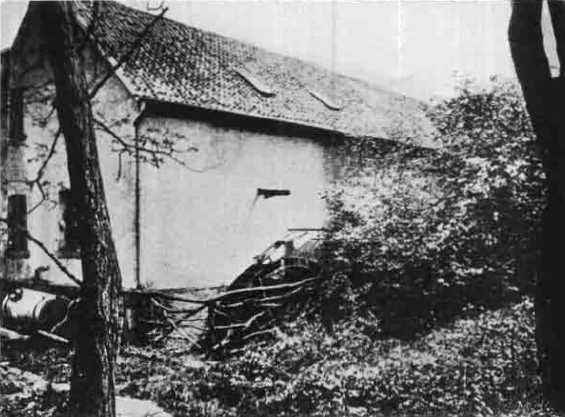
OLD ROCKEFELLER MILL OPERATED BY JOHANN ROCKEFELLER IN ARINHELLKR, GERMANY, DURING THE LATTER PART OF THE 17TH CENTURY.
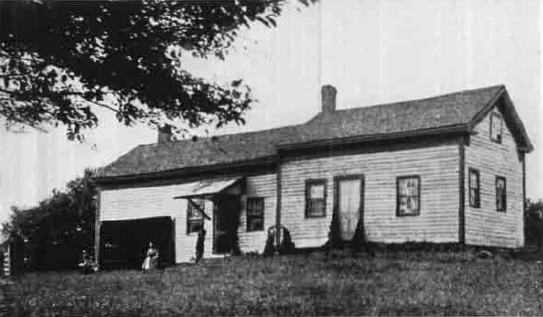
JOHN D. ROCKEFELLER’S BIRTHPLACE AT RICHFORD, N. V, PHOTOGRAPH TAKEN IN 1873.
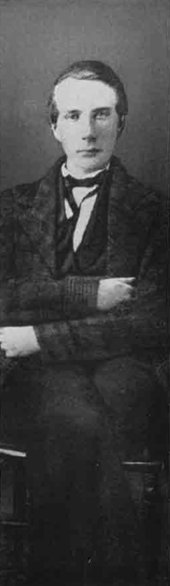
JOHN D. ROCKEFELLER AT THE AGE OF 13.
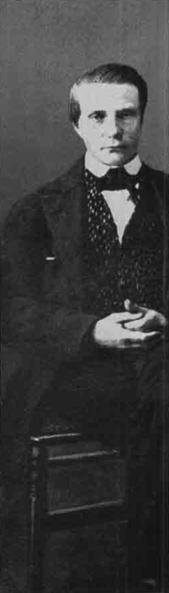
HIS BROTHER, WILLIAM ROCKEFELLER, AT THE AGE OF 11.
VI
ON THE road leading over Michigan Hill to Godfrey Rockefeller’s farm was a new house. It had been built two years before by a man named Avery Rockhill, perhaps a relative of Bill Rockefeller’s mother. It was strongly made, though a simple cottage. It stood on the very crest of the hill and commanded a beautiful view of the surrounding country and the soft green hills to the West. Just below the last rise of the hill are two brooks which meet there and flow off toward Harford Mills. Bill Rockefeller’s sportsman’s eye quickly observed that there were trout in these brooks. The house itself was surrounded by apple trees. The trees—very old and gnarled—are there yet, for this is a country of old trees. The house was small, the lower floor being divided into three rooms—one main chamber and two quite small ones. To the left—a kind of separate annex—was a kitchen and a woodshed, both of which have been removed.2 The second floor is just a half-story attic in which one must stoop to walk about. There were then and still are two very large barns. One of these barns has been cut into in its upper wall for ventilation and decoration with three small openings. On close inspection it is seen that this is a godless bit of art—a decanter and two glasses—on the barn of the rum-hating Bill and Eliza Rockefeller. A farm of sixty acres stretched back from the house. Here Bill Rockefeller established his young wife. And here just one year after their marriage the first child was born—Lucy Rockefeller, called after her grandmother. Then eighteen months later the boy was born whose arrival is chronicled in the opening paragraphs of this story. Two years later another boy, William, appeared.
Bill Rockefeller, the father, did no farming. He had a hired hand who worked a patch of ground and helped around the place. Bill himself was away most of the time, coming home at intervals, always a welcome arrival to his wife and his small brood.
VII
IN THE year 1840, the country was, as Henry Clay said, like an “ocean convulsed by a terrible storm.” William Henry Harrison, the hero of Tippecanoe, was the Whig candidate for president. Against him was pitted Martin Van Buren. Up in Tioga County the wide circling waves of this turbulent battle were rolling in upon the forest towns. Around the village common of Richford the yokel statesmen talked about the panic of 1837. Down in Owego the county leaders were preparing a great meeting.
On the morning of this great event the people of Tioga County were pouring in from every road—on horseback, in farm carts, on foot, their wives and children and hired hands with them, their blankets and copper pots and dishes of wood and victuals for a stay of a day or more.
That morning the population of Richford was on the move. It was a good twelve miles’ journey down to Owego and the quiet village of lumbermen and farmers were aboard their carts and rumbling down to the county seat at an early hour. The air was filled with a festival odor. There was a jug of whiskey and a larger jug of cider on every wagon. Richford, as well as all Tioga County, was a drinking community. The remains of the old whiskey still not far from the green still stand. Everywhere liquor was as free as water. The village merchants sold liquor and at low prices so that the poorest man was able to buy all he could carry. In most of the stores there stood upon the counter a pail of whiskey and a tin cup so that the customer was able to dip out a stout drink for himself. Liquor was kept in every home. “The children were helped moderately in their infancy and helped themselves abundantly in later life,” says an old chronicler. “The house was but indifferently furnished which had not a jug of black strap in its cupboard.”
But there was one house where there was no black strap. And as the farmers moved into Owego that morning there was one wagon in which reposed no jug of cider or whiskey. That was the wagon of Bill Rockefeller. Bill was back for the big meeting at Owego. And this morning, with his wife and little Lucy, then two years old and the infant John held close in his mother’s arms, he was on his way with all the residents of Richford.
Into the famous county seat upon the Susquehanna, Rockefeller’s wagon, drawn by two excellent horses, moved amid an uproar. Tioga was Whig. Everybody said New York State would surely go for Harrison and Tyler if it were not for that wicked Tammany Hall in the big city down state. Around the Awaga Hotel idle crowds were gathered looking up at the place where the great men of the county were housed for the moment. Important-looking gentlemen in high hats and bottle-green coats went in and out. The streets were filled with a talking, laughing, noisy people, hailing each other from a distance, hucksters selling corn and cider and baubles and flags. Down beyond the public square and across the bridge over the Susquehanna in the open fields the wagons were camped and women were making ready for the noon-day meal over the camp spits.
Big Bill saw more than one face he knew. He hailed acquaintances with a broad laugh. But Eliza Rockefeller looked with dismay upon the almost riotous merriment of this crowd. Everywhere were men well-steeped in whiskey or sinking rapidly into that condition. There were some Rockefellers there no better than the rest. The air had the odor of wickedness for Eliza. She was not any more the merry girl of Niles. A young mother of two small children living in a lonely farmhouse from which her adventurous husband was almost always absent, she had become a little sad faced and a little stern. Now she was a troubled woman. She wished she had not come.
This was a Whig crowd, filled with enthusiasm for its candidates—Tippecanoe and Tyler Too. But there were a few whose enthusiasm was a trifle dampened as Eliza Rockefeller’s was. There was more than one strait-laced, God-fearing, rum-hating farmer who was disturbed at what seemed the bungling of the Harrison managers. Harrison to be sure was a cider drinker. But so was everybody else. Yet somehow there had been so much talk of the General’s cider drinking that one might suppose he did nothing else. The Whigs had played up the fact that General Harrison had been born in a log cabin. Down in Baltimore an editor with a caustic pen had replied that Harrison seemed more in his element in his log cabin with his cider barrel than he would in the White House. Everybody had read that in the little weekly Democratic paper of Owego—the Gazette. The Whigs had replied by making the cider barrel along with the log cabin the emblem of the Whig campaign. The log cabin was all right. But the cider barrel—to some that was a godless symbol. And the Democrats were making much of it. But the vast majority of the crowd this day seemed to like it as they seemed also to like their own cider barrels.
Bill Rockefeller has parked his wagon under a broad elm near the river within view of the speakers’ stand. And now, just after noon, there is a general movement toward the courthouse square. The big parade is getting under way. The crowd is forming around the speakers’ stand. On the outskirts of the square men and women are standing in their carts to get a better view. The sound of drums and fifes comes from the direction of Front Street and the Awaga Hotel. The rattle of the drums and the squeal of the fifes grow louder and suddenly the parade emerges upon the square. There are Whigs on horseback made up like Indians and others, in their coonskin caps, dressed as frontiersmen. Then come the big Whigs on horseback. Now a great shout—the float is in sight. There is a broad wagon and on it a small log cabin. In front of the cabin is a cider barrel. Men in buskins stand about ostentatiously dipping out of the barrel with cups and drinking with a flourish to the health of the crowd. A shout goes up from the godless rabble. There is something more than mock cider in those dancing men on the float. The crowd is delighted. Shouts and wild laughter vie with the screaming fifes. Most of the crowd have had their cider and whiskey for their dinner. Many dance up and down and emit yells like Indians and squeal for joy.
Here and there a few grim-visaged men and women look with disgust and horror upon the spectacle. Big Bill Rockefeller stands at the back of his wagon supporting with his powerful arms the woman in front of him, her shawl wrapped about her and sheltering the infant in her arms. She sees this unholy joy with horror. The undying hatred of her life is rum. She remembers all the liquor guzzling she has seen about her, especially since she has come to Richford. Why does a just God permit such an evil in the world? When will He drive it forth? She feels a twinge of fear for the boy at her breast. She presses him closer to her heart. How little she knows—this strong, resolute, pious woman—she holds in her arms Nemesis—the boy who will be a man and whose gold will smite the cider barrel and the rum bottle. She holds in her arms the instrument of God.
VIII
HARRISON and Tyler were elected. Perhaps never again was a man to be elected President who could get votes with a cider barrel. He was inaugurated March 4, 1841. A month later Harrison died. The news reached Richford about the middle of April. Then Eliza Davison was looking forward to the coming of another child. Big Bill was home, as usual, to be by his wife’s side. And a month later the child arrived. This boy was called after his father—William. He was born May 31, 1841. After this Bill remained around, making only a few, brief, swift journeys on his mysterious adventures, until the summer. Then one day he went down to the store of Mr. Rich and announced that he was going away on a long journey.
“Look after my family’s wants, Mr. Rich,” he said. “Give them whatever they require. I’ll be gone longer than usual. When I return I will settle as always.” A day or two later he drove away leaving Eliza with three small children in the small house on Michigan Hill. This was a lonely home for this woman. Bears were still in the forests. Occasionally a panther ventured to the edge of the clearings. Sometimes an Iroquois Indian roamed up from the Susquehanna.
There is little doubt that at this time the Rockefellers were in straitened circumstances. Bill Rockefeller found himself moving through occasional patches of mild prosperity. At such times he would return to look after his family. But when he went away again the family quickly consumed the money he left. The credit at Rich’s store was their sole support. Sometimes it was a grim battle to keep the wolf from the door. Young John, all through these early years, must have seen his mother practice economy that extended to every little item. The house itself was a poor place. It was one of the humblest in the neighborhood. It stands today a witness of this fact. From its roof emerged a brick chimney. Every well-to-do house had a fireplace, broad and comfortable. The Rockefeller house had a chimney, but no fireplace. The chimney was just an humble piece of outward show. It can be seen today where it begins, just under the roof of the attic, resting on a wooden platform and then pushing up through the shingles, making a brave show outside.
Here, in this small cottage, looking out upon a glorious landscape of soft green hills and luxuriant foliage, this boy spent his first years. Here he lived until he was four years old and his sister Lucy and brother William were respectively six and two. There were plenty of Rockefellers just over the hill where Godfrey and his numerous family lived, and, apparently, in no great state of peace. This little John was a strong, quiet, grave-faced child, with a habit of looking intently at people and things, and a fondness for playing by himself. Eliza Rockefeller had little occasion to be merry and slowly grew to be a serious-faced woman. There was no great religious activity around Richford. As for Eliza there was no church for her to attend. She was not an active church member yet and her husband was in no sense a religious man. A few rods from the house was a little one-room schoolhouse. There is such a one standing there today. It is pointed out to visitors as the first one John D. attended. He never attended school there. Moreover the small frame structure now standing is not the one which stood there in those days. But the presence of the school and the teacher helped to fill up some of the lonely days of Eliza Rockefeller while her husband was away on his mysterious jaunts. Bill was never away for any fixed period. Usually the first notice of his return was the sight of his spanking rig and team coming up the slope of Michigan Hill. Whenever Eliza looked down the hill; when the children looked that way, always there was the thought that perhaps the big, jovial, laughing, handsome father might suddenly appear around the bend of the road. All through the year 1843, Richford folks whose business brought them across that trail, became accustomed to the occasional sight of Eliza Rockefeller standing at her door, looking through the apple trees, across the twin brooks and down Michigan Hill.
IX
THESE were the quiet years. A candle burning in a cottage. The sound of horses’ hoofs upon a dirt road. The muffled thump of the water wheel at the side of the little mill. These represented the light, the power, and the transportation of the America of that early day.
When night came down upon the Rockefeller cottage a candle of sperm or tallow furnished the light for the brief period after dark before bedtime. This was the age of the candle.
Though the small boy of 1843, playing under the apple trees and in the twin brooks of Michigan Hill, gave it no thought, America was at this moment looking with busy eyes for light. Larger factories, railroad trains traveling at night, steamboats on the rivers—all these things needed light. The farthest advance made was in the use of coal gas. Twenty years before Boston streets were lit by gas. A little later New York, Philadelphia, New Orleans, and other smaller cities had gas-lit streets. The gas was made from coal, but a few companies made it from resin and tar. Even natural gas had been used to light a few villages. But the country as a whole depended on a few lamps and its candles. Down at Owego in the beautiful home of Mr. Hewitt there were lamps with their Argand burners and glass chimneys which burned whale oil. Some of the better homes in the West burned lard oil made in Cincinnati. A few fine old mansions in the South burned cottonseed oil made at Petersburg, Virginia, and along the Gulf coast resin and turpentine were distilled for camphine, a dangerous illuminant. But the candle, made from fats or sperm or spermaceti lit almost all the homes in America. The biggest oil industry was on the New England coast. Its headquarters were at New Bedford. The oil men went out to sea in ships to fetch their oil from the whale. And the great man of that industry was Mr. Gideon Howland, Jr., the grandfather of Hetty Green.
There was another oil man, far more obscure, but interesting in the light of all that has followed. His name was Cary. Far from New Bedford and from Richford, in Crawford County, Pennsylvania, Cary had settled on that crazy little trickle of grease and water called Oil Creek. A queer ill-smelling oil called petroleum floated on the surface of this creek. The Indians used it as a medicine and the settlers about rubbed their joints with it for pain. Cary skimmed the oil from the creek, put it into kegs, hung one on each side of his horse and rode 150 miles along the Allegheny River to Pittsburgh. There he traded his five-gallon kegs for commodities, which he packed back to Crawford. In value he got about ten dollars. At Pittsburgh the petroleum was sold in small quantities to apothecaries who used it for medicine.
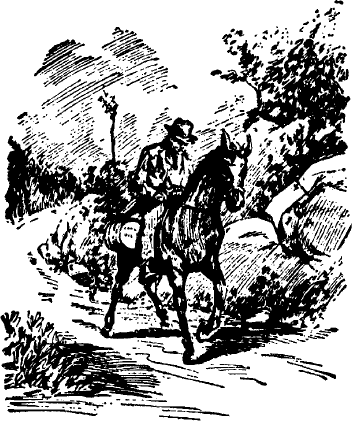
CARY, THE FIRST OIL MAN.
(From Leslie’s Illustrated Newspaper, 1865)
Cary was the first oil producer. He was producer and transporter. Occasionally some river man would gather a barrel of oil and deliver it to Pittsburgh. If he got there before Cary that gentleman found the market glutted on his arrival. He was the first to suffer from that monster, over-production of oil.
X
“THE SPONGE OF MONOPOLY has absorbed the whole wealth of the nation.” Thus the Alabama legislature fulminated against the tiny octopus whose feeble tentacles wriggled a little a few years before John D. Rockefeller was born. This feverish sentence seems a little absurd to describe the simple economic life of that remote day. More than any other place in the world the northern states, at least, were committed to the system of individualism which had grown increasingly popular since the Physiocrats and later Adam Smith had proclaimed it in the preceding century. These states were quite settled that the main business of the state is to keep order. In the industrial and economic world the great regulating force is self-love. Laissez faire, laissez passer. Economic life will develop best when it is wholly unhampered. Free competition—that was the stimulating and regulating power. Each man following his own special advantage, driven forward by the desire of living and for riches, will develop his own forces to the limit to the general advantage of all. Each man does the thing he likes best and can do best. For the next one hundred years this word “competition” will be heard again and again until men will yield to it a kind of religious worship. Into such a world John D. Rockefeller was born like a germ. He would learn quickly enough to despise competition. But he would cling to the other word, “individualism,” after the meaning had gone out of it. His entry into business and his career after that would be in large measure the story of American economic development and the war on laissez faire.
The life of that day was so different from our own that it is difficult for us to picture it. A line drawn along the western boundary of New York State, across the northern line of Ohio, Indiana, Illinois, and then southward along the western frontier of Missouri, Arkansas, Louisiana, marked the western frontier of all the states. Beyond Missouri were no states. Michigan, Wisconsin, Kansas, Iowa, were not yet states. Texas, Arizona, Idaho, Oregon, Washington, California, belonged to Mexico. There were just thirty states and the population of all of them was not as great as that of New York and Ohio today. Boston, Baltimore, and Philadelphia all had less than 100,000 people. The bulk of the population was gathered along the Atlantic coast, save in Ohio where over a million people had already settled. But from the Atlantic to the Mississippi there was a thin layer of population everywhere. This population was almost wholly agricultural and those who did not live on farms lived in small villages, and these villages were of the old-fashioned, self-sustaining type. The government was in the hands of men sympathetic to the agricultural population. The conditions of life did not favor the growth of large cities. There were some good-sized factories; there was steam and there were railroads. But these things were new and exceptional. They did not give to the country its special character.
One might find, traveling about, every stage of development—the primitive, economically independent farm, the self-sustaining village, the small water-driven mill of the merchant-manufacturer, the large corporation-owned factory. In or near Richford all of these periods were represented. In the Valley of the Susquehanna were farms where the householders raised their own cattle and swine and sheep. The itinerant butchers slaughtered their meat and the hides were taken to the village tanner and then to the currier. The wool from their sheep they had worked into yarn and cloth by the village wool carder. Cotton cloth they bought at the village store but they made their own clothes, save the fine gentlemen who lived in Owego and went up to Auburn or even across to New Haven for tailors. They got good iron plows from the factory set up by Jethro Wood, the first man to make a metal plow in interchangeable parts, for Wood lived close by. But most of their other farm tools were made by the village blacksmith. The saddler and harness maker, the joiner and cabinet maker, the blacksmith and the gunsmith, the shoemaker, these supplied the industrial wants of the village and the open country about it. There was a gristmill, a sawmill, and a whiskey still, and, of course, a barber.
But factories were coming. There were even some large plants—large at least for that day. At Waltham and particularly at Lowell huge textile mills employed each many hundreds, chiefly women. William Morris made locomotives in Philadelphia and even exported them. The Great Western Iron Works, later the Brady’s Bend Iron Co., had an investment of a million dollars and housed 537 families on its property. A single clock firm sold 40,000 clocks abroad. There was about $50,000,000 invested in cotton mills and $250,000,000 in factories of all sorts.
But even the large factories were not very big measured by later standards. Thus the Ames Works made shovels, and people gasped at the output of 480 shovels a day. But most of the factories were hardly that at all. They were mills or shops where some machinery was used. They were small affairs run by merchant-producers, men who made their small supply of products and sold them directly. The tin manufacturer put his pack on his back or mounted his wagon and peddled his wares from house to house. Others sold their output chiefly in the villages and surrounding country. Others filled their wagons and carted them to the nearest city. The iron-mill producer loaded his output into a flat boat, moved it up the canals and rivers and sold directly from the barge. But however small, they were beginning to find themselves and they were also beginning to cluster around given points. Danbury was a hat town, Gloversville a glove town. Lynn was known for its shoe factories, Lancaster for its metal workers, Germantown for its knitted stockings, Wilmington and Rochester for their flour.
But chiefly these little plants were found around water-power sites. There were steam factories, particularly in Pennsylvania. But in New York and New England the water wheel was the power machine. Along the valley of the Blackstone, for instance, between Worcester and Providence in 1840 there was a continuous string of factories—ninety-four cotton mills, twenty-two woolen mills, thirty-four machine shops and iron works. Steam had been used as far back as 1803 for pumping out mines and twenty years before steam engines were being manufactured in Pittsburgh. Now in Pennsylvania perhaps half the factories were run by steam. But in New York, New England, and New Jersey water was king.
The railroads had come but as yet they performed no very important service in freight transportation. The farm cart and stagecoach were as yet the chief means of travel and for heavy freight the barge and steamboat on the canals and rivers and lakes. This steamboat and canal development had greatly enlarged the life of the people and expanded their trading areas. But now the railroads were to influence the course of business and life. It is easy to see why men lived in small neighborhoods and limited their business to local markets when it cost four dollars to send a barrel of flour overland from Pittsburgh to Philadelphia. With the horse, overland freight cost twenty to sixty cents a ton mile. Early railroad charges soon fell to three cents a ton mile.
Now these forces—machinery and railroads—were to set the young nation upon a new course. The year of Rockefeller’s birth marks the end of the old era and the beginning of a new one. The country, without being aware of it, was under the dominion of new forces which were gathering. Everything was in motion. Always since the end of the Revolution the endless migrations west were under way. The wagons were on the move first beyond the Alleghenies, then beyond the Mississippi, then on beyond to Oregon. From New York and Connecticut the caravans moved to Ohio and every day the carts and covered wagons rumbled along the road past the square of Richford, up to Lake Erie. Everything was in ferment. New peoples were pouring into the country—a half million in the ten years before Rockefeller’s birth, three times that many in the next ten. Now, added to the migrations, there was a further movement—just moving and shifting about. Girls were leaving the farms to go to the textile mills in the near-by towns. The new things were making changes in the lives of the people. The grain fields were moving west. New cities were springing up in remote Ohio and Missouri and Indiana. The rule of old aristocrats was over and new men, men of the soil, men of the log cabins, had taken hold. The rustle of life was in the air; the invisible winds that sweep through peoples, stir them, and hurry them forward were blowing over the land.
The older people shook their heads. Factories were breaking up the American home, they moaned. Senator Isaac Hill, of Vermont, addressing the conscript fathers, spoke feelingly of the good old times when every family raised and spun and wove materials for its own clothing. “Now large factories supported by overgrown and unscrupulously managed capital had annihilated the household industry.” Over in the House, Representative Christopher Rankin of Mississippi, bewailed the “death of so many small establishments which might separately and silently work their way into honorable existences.” “Now,” he moaned, “one great establishment rises on the ruins of all the surrounding ones.”
Thus they looked with fear upon these little corporations and their plants employing five hundred or a thousand people, capitalized at half a million or more and engaging the activities of only a very small percentage of the population. How little they supposed that a boy was then playing barefooted in a home-made muslin suit on a village farm who would before another half century passed, amass a fortune sufficient to buy out with a fifth of his capital every factory great and small that affrighted the souls of the America of 1840.
XI
IT IS true that one generation always nurtures the germs of the forces which will dominate the next one; one social system breeds the things which control the one which succeeds it. In 1840 there was present, even in that scarcely launched small factory age, almost all of the devices which Rockefeller and his contemporaries would use to build the era of mass production. At that very moment England was repealing some thirty or more old regulatory laws to make way for the golden age of unregulated competition. But at the same time all of the tools which Rockefeller would use to rear his industrial empire and undertake privately to supply the regulation of trade where the government had abdicated were in use. Not only was the corporation being developed, but the widespread sale of stock to provide the funds, while at the same time a few gentlemen at the center usurped the control, was already understood by a few. By 1840, the fifteen original owners of a Massachusetts corporation called the Merrimac Company had been expanded to 390 stockholders all over New England. Already it was charged that a clique of Boston stockholders had learned how to perpetuate their control by having the stockholders sign proxies in their favor. They held stockholders’ meetings in small rooms and called many meetings of various companies at the same hour to divide the opposition of the independent stockholders who owned shares in various companies. In this way the affairs of most of the manufacturing companies in Massachusetts were under the dominion of less than a score of Boston capitalists. One man is said to have been a director in twenty-three companies. These financial magnates also controlled a Massachusetts life insurance company with a capital of $500,000 and with that they dominated nearly ten times that amount of investment funds.
They had already carried out a corporate merger and invented a holding company. Lowell, Moody, Appleton, Kirk Booth, and others brought about a merger of the Boston Manufacturing Company, the Merrimac Company, and the Pawtucket Canal Company in order to combine the processes of the first, the capital of the second, and the water power of the third. Developing more water power than they needed and controlling the process patents, they proceeded to sell the excess power and rent out the patents. They manufactured textile machinery and set up as a subsidiary a building concern to erect textile plants. Thus they would help finance the formation of a new company, put up the building, supply it with machinery, sell it a site, and furnish the water power. All this in addition to their own business which was thus a perfect example of an integrated industry. Moreover, in the process they built the first tailor-made industrial city—Lowell, Massachusetts—and to unite their various holdings the principle of the holding company was introduced. In addition to all this they formed a patent pool.
Lowell and Moody and others continued to carry on experiments in perfecting textile and power machinery, thus establishing the first industrial research. They introduced company hospitals, libraries, improvement circles, night schools, clinics, and an extensive housing program and a very remarkable magazine edited by the girl employees which brought high praise from Charles Dickens and was the parent of the long line of house organs and company journals now so numerous.
One thing had not yet appeared. Along with machinery and the railroads and the development of corporation finance it was to be the most powerful factor in the magic development of the next fifty years. This was the uncovering of the vast natural resources of America. Perhaps no one thing, economically, makes such a difference between the America after the Civil War and the America of 1839 as this. It is a common notion that this immense continent and its riches lay here almost like an open paradise of natural treasures. But when the Rockefellers lived at Richford our natural riches were almost unknown. American blacksmiths made shoes from iron gotten mostly from Great Britain. Our first textile mills used cotton which they imported. It was the presence of the mills which encouraged Southerners to plant cotton. Such copper and other metals as we required came from abroad. The tin makers of Connecticut got their sheets from Europe. Our rum makers imported molasses from Great Britain. And our tanners had to get most of their hides from other countries. Even wood—strange as it may seem in a land of primeval forests—began to be scarce. For the little steam engines burned all that was in the neighborhood and transportation was far too costly to permit of the carriage of wood. Our chief wealth was in grain and this was located along the Atlantic seaboard though now the grain fields were moving west. The making of flour and whiskey was the chief manufacturing supported by our own produce. We had a little iron and some coal—indeed a little of everything but not much of anything. Men had not yet begun to scratch under the surface of our mountains and valleys. But they were to begin this soon. And that was to mark the next great change in the lives and industry of the people.
XII
THE NEW nation had already harvested its first crop of millionaires. There were no less than twenty-five of them. The most important of them were land barons. John Jacob Astor led the list with a fortune of $25,000,000. His son, William, was reputed to have $5,000,000. Next was Stephen Van Rensselaer with $10,000,000. The well-known names of Henry Brevoort, Gouverneur Morris, Peter G. Stuyvesant, Peter Schermerhorn, James B. Lennox, and William Crosby follow, each worth from one to four million and all immortalized in the names of New York streets. There were two bankers—Isaac Bronson and John Mason—worth around a million each. There were some traders—merchant-adventurers of the old school in New York, Philadelphia, and Boston—Stephen Hunt, John Bohlen, Samuel Appleton, Peter C. Brooks, John Bryant, John P. Cushing, Thomas H. Perkins, and Robert G. Shaw. The richest of these—Stephen Girard—had died the year before in Philadelphia leaving about $7,500,000.
The industrialists were few—Amos and Abbot Lawrence, textile manufacturers worth together $5,000,000. David Sears in Boston was something quite new—a millionaire stockholder in many enterprises. Equally new was Jacob Little, the first professional security speculator, the first bear, and possessor of the dubious glory of inventing the short sale. August Belmont had just arrived from Cuba, the agent of the Rothschilds, the first of that line of bankers to handle the flood into America of foreign funds into our railroad and utility investments. There is not a single descendant of this list of twenty-seven millionaires of 1839 who qualifies for a place on the roll of the nation’s business leaders today.
Some of the names on the list are familiar. The descendants of most of these men are still among our wealthiest families. But this only serves to emphasize that while they may retain much of the wealth piled up by thrifty ancestors, they do not continue to exercise a control over our industrial or financial affairs. The wealth may remain, but it is no longer dynamic. Its fecundity is enormously diminished. Its possessors are merely rich men; they are not powerful men. Still less are they dominant leaders.
XIII
THE WEEKS following Bill Rockefeller’s departure wore on into months. The winter of 1843 came down with all its rigors—and this was a cruel winter. Eliza Rockefeller looked across the apple trees and down the trail toward the village many days. But Big Bill Rockefeller never appeared. Lucy was a handsome child of five, John an active, large boy of four, the baby, William, was almost 18 months old. And in this little group the endless question was when will the father come home. Across the hill the other Rockefellers would ask if there was news from Bill. Apparently there was no great bond of affection between Eliza and her husband’s family. They were a different breed from herself. They were a hard, restless, worldly lot. There was plenty of liquor drunk among them. Occasionally she would see one of them go reeling over the hill past her door to Godfrey’s home. Jacob Rockefeller, Bill’s youngest brother, was the most persistent tippler. In old man Pierce’s store in Richford today is preserved an old ledger from Rich’s store where the Rockefellers traded. One day Rich said to Jacob Rockefeller that he would give him five dollars if he would come into the store sober once. Jacob owed a bill and went into Rich’s store to pay it. He was sober and Mr. Rich, true to his promise, gave him a credit of five dollars on his bill. And there is the entry to this day on Rich’s ledger—“Allowed Jacob Rockefeller, for not drinking, five dollars.”
Amid these neighbors much of Eliza’s merriness was leaving her. The cares of motherhood, the loneliness, the long winter days and nights waiting for her husband’s return had sobered her face and written some lines in it. She had lapsed into the religious mood of her serious forebears. She disliked Richford. It was a godless place. Many years later John D., when he was a great figure, told his fashionable Cleveland minister, Dr. Eaton, that he was glad he had not grown up in Richford, that it was an irreligious and godless town, and the daughter of that same storekeeper Chauncey Rich publicly took him to task for the statement. But his mother was weary of Richford and her in-laws down the road. And she grew impatient of Bill and his long absences. Then one day in November a black figure patterned itself against the powdery snow down the road to Richford. There was a hurrying and scampering among the children. In a few minutes Bill was driving a handsome rig into his dooryard. He wore better clothes than he had ever had on. He had plenty of money in his wallet—a great wad of it. He had already stopped at Rich’s store and paid his whole bill—nearly a thousand dollars. The children clambered over his giant figure. Eliza wept and later poured out her woes. She wanted to be nearer her own people. Bill agreed to make the change and before long the Rockefellers were on the move for their next home in Moravia, about forty miles northward toward Lake Ontario. Eliza had been angry with him. And yet she must have loved him. Beyond a doubt this man who had taken her against her father’s wishes and in spite of her trim, puritanical training and his own roving, adventurous, mysterious ways, exercised a powerful influence over her mind. As he came home now, full of news and of money, with his fine horses, settling up all his accounts and looking like a figure of fashion and romance, her heart melted. This was November. Nine months later, when they were in Moravia, another child was born. Bill had been forgiven.
CHAPTER II. THE LAND OF SUPERIOR CUNNINGTHE HOUSE which William Rockefeller provided for the family was about three miles north of the village of Moravia. Moravia was at the time a small settlement of perhaps not more than five hundred inhabitants. It had a cotton mill run by water power that employed a hundred people. The Moravia Hotel which still stands was its chief ornament. Built in 1831, it is a huge, box-like structure with a great porch running about its whole length. These large early hotels, out of proportion to their villages, are explained by the heavy traffic by horseback and river boat and stagecoaches in those days. Men broke their journeys by night in hotels, as they do now in automobile travel.
The town is built on an expanse of rolling upland broken by the deep and narrow valleys of Owasco Inlet and its tributaries. Rockefeller’s house was on the Lake Road. On a sloping terrace it looked out over Lake Owasco, the smallest and loveliest of the celebrated Finger Lakes. It was a country of abundance with many good farms raising grain and truck and cattle and hay. The woods were filled with game and in Lake Owasco were pike and pickerel and bass and trout. This lovely country, filled with glens and falls and gorges, was the home of the famous Six Nations—the Mohawks, Oneidas, Onondagas, Senecas, Tuscaroras, and Cayugas. Here near Owasco the Cayugas made their home. The county was called Cayuga County. Cayuga means “Land of Superior Cunning.” Here, then, William Rockefeller proceeded in his odd moments to sharpen the wits of his boys and chiefly that silent, searching lad named John.
The house was a much better one than the cottage they had left at Richford. Moreover this one Bill Rockefeller bought. There were a hundred acres of farm land behind it. It was a better place for Mrs. Rockefeller because her father’s home was on the other side of the Lake and near by were neighbors on each side of her home. On one side was the Rosekrans family, on the other side the Hewetts. Their descendants still occupy those houses. The Rockefeller house is no longer to be seen. It was destroyed in 1926 by fire when being used as a convict camp.
Big Bill went on with his old business—selling medicines—and his old ways, his long absences, though he spent more time with his family now. He mingled more freely with his neighbors. Turkey shoots were a favorite sport of the day and Bill, who loved a good rifle, never missed a turkey shoot when he was home and he never failed to delight his boys with his great skill as a shot. He took some part in local affairs. He was an advocate of building a new school and somehow was charged with the commission to locate it. The dispute over the site Bill settled by declaring it should be located in the precise center of the district. And this he proceeded to ascertain by an original method. He drove his rig from north to south and then from east to west, counting the revolutions of the wagon wheels. Then he repeated the process, driving only half the number of revolutions north to south and east to west. This gave him the center. It turned out to be near his own home, a fact which he observed with a twinkle in his eye.
There was a hired man on the farm but not a great deal of farming was done. Bill’s chief occupation was his selling. But, he allowed, he turned a penny now and then trading horses. And he bought up some timber rights and hired a gang of men to cut the trees and haul them down to Lake Owasco, where they were rafted to Prison City as Auburn was called. This was just a flyer in lumber, not a regular business. He still was a little mysterious. His neighbors were never quite sure what his business was and they wagged their heads about it.
But for all his swaggering, wandering, extravagant ways, and his long absences, this odd, fun-loving man, given a little to brawling and with a ready eye for a good-looking woman, loved his family in his strange way. He knew how to play with the children and he had a special weakness at first for his son John. He took the boys down to Owasco Lake, taught them how to swim and row a boat. He showed them how to drive a horse, to ride in the saddle and to hold a gun. He supported his family, though in a manner uncertain and harrowing to his poor wife. He was by turns flush with money and in want. Always he came home with plenty of money and with a new team of horses. Moreover he brought with him great tales of the Indians he had met and the great figures of the day he had seen and of the wonders of the railroads and steamboats and huge water wheels. But gradually there accumulated on his head a weight of suspicion which filled the whole countryside.
II
ON A chest in the living room stood a little blue bowl. Here, when John was seven years old, went two York shillings—the first money he had ever earned. Precocity in finance is as common as in literature. The man who founded the House of Rothschild began to be interested in coins at the age of ten. Hetty Green opened her first bank account when she was eight and at ten could name offhand the prices of most New York Stock Exchange securities. Russell Sage was a successful wholesale merchant at twenty-four. John D. Rockefeller picked up stones on a neighbor’s farm and was paid two shillings. His first real business venture was to come later.
One day, as he stood near the house, the boy saw a turkey peering cautiously about her, sniffing the wind, pushing her long neck in different directions with great stealth. The country boy did not have to be told what this meant. He knew the turkey was preparing to “steal her nest.” He ran at top speed to his mother with the news. Eliza told her excited son that if he would follow the turkey and find her brood he might have them and raise them for himself. This was not such an easy task. It meant stalking the mother turkey. She eluded the boy for two days. But she little knew the spirit of the patient mind that shadowed her. She was perhaps the first victim of that relentless, ruthless patience with which this boy would pursue greater objectives in the years to come. In the end the young turkey fancier entered the woodshed with a huge basket and in it his cargo of young turkeys.
Among the pursuits of that primitive region was driving wild turkeys to market. Men came through at intervals like drovers, pushing ahead of them huge flocks of the birds. The flocks scampered ahead of their drivers, by day filling the countryside with their clamor. At night they darkened the trees near the farmhouse where the turkey drover roosted for the night. Thus John, the young turkey man, had a ready market for his turkeys when the next drover came through. He continued to manage his flock, selling off some of them and building on the foundation of York shillings in the blue bowl on his mother’s mantel.
III
THESE were troubled, difficult days for Eliza Rockefeller. Not long after the family settled in Moravia a fourth child—Mary Ann—was born. Two years later Eliza bore twins. One of these twins was Frank, who was to play so strange a part in the life of his famous brother. The other was called Francis, a frail child demanding incessant care. With six children to care for—the oldest little over seven—Mrs. Rockefeller’s cares were many. For some reason she mixed very little with her neighbors. They were a strange crowd.
But the children—all save Francis—grew amazingly. They were growing to be large-boned and powerful. John was not robust and deep-chested like William, but he had a large frame though there was little flesh on it. This Finger Lake region is a land of big men and big trees and of long-lived men and trees. All through the region one is shown ancient trees—the great giant elm at Waterloo believed to be 350 years old, the Patriarch Elm beside the Old Indian Trail, another veteran of 350 years, and a famous tree at Naples which local authorities believe, perhaps without sufficient data, to be the oldest tree in the world. As for men, the crumbling tombstones at Harford Mills tell of its hardy octogenarians. And as for strength and size, they used to tell in Moravia of old John Sabin, who could lift two cider barrels filled with cider by holding them with his fingers in the bungholes. The boys went swimming in Owasco Lake and brought trout and bass home to their mother to cook. William and Frank were given to waywardness. They were hard to control. People said they were like their father. But John was like his mother. He was quiet, reserved, shy, serious. He had a narrow, long, lean face, lacking in mobility of expression and small bright eyes that looked with great intentness at one. And as he grew older he grew closer and closer to his mother. The children went to school in the little near-by schoolhouse which Bill had planted so conveniently. But the schooling was very slight. The teacher was there for but a few months in the year. The source of their scholarship was those old Peter Parley books then as much in use as McGuffey’s books were at a later day.
IV
STRANGE stories were going about Moravia about horse stealing. Eliza Rockefeller had liked very little the godless neighborhood of Richford. She now found that she liked less the even more godless neighborhood in which she lived. A stranger collection of neighbors was never gathered together in a quiet rural setting. Before long stories began to connect the names of these neighbors with the horse thefts. Rockefeller’s hired man, Scott Brower, was under suspicion and people whispered the name of Big Bill himself as implicated in the conspiracy. Some said he acted as the fence, receiving the horses in his large barn and then running them across the country through a deep gully still to be seen near the ruined foundations of the old Rockefeller cottage. These rumors were not long in blossoming into definite indictments. Several of the neighbors were arrested. No charge was made against Bill himself and he returned home in the midst of the scandal with something of the air of a man who was not afraid. The men arrested were convicted and sent to State’s prison. And to this day there are people in Moravia who will tell you that Bill escaped because he knew how to cover his tracks. This is doubtless unfair to Rockefeller. There is no evidence of any sort connecting him with these horse stealings. But the whole episode left a stain on his name and made life in Moravia difficult and painful for his wife.
To deepen the shadows about her the youngest child—Francis—died about this time. And the sorrow of Eliza Rockefeller was intensified and complicated by a new group of rumors which went around about her husband’s relations with women. She was now, under the weight of many cares, turning more and more toward religion and to the stern morality of her forebears. She was a proud woman and as the shadows gathered about her she exhibited a strength of character which commanded the respect of her neighbors. But she clung to her wayward husband and there are no stories in the neighborhood of any serious trouble between them.
V
THE LAKE ROAD which passed the Rockefeller home led to Prison City—Auburn. On the other side of the lake was the Plank Road along which the endless caravans of pioneers moved toward Lake Erie and across to Ohio and further West. But when the weather was good those who wished to save the toll fees traveled by the Lake Road. Young John could see the wagons moving, scores of them every day, in that ceaseless westward migration which had begun thirty years before. By this road the silent boy would sit in the long summer evenings. To get down to Lake Owasco he had to cross the road. And always, like his mother, and his older sister, as he sat there or wandered across the road he cast a glance toward Auburn hoping perhaps his father’s horse might come swinging around the sharp curve.
Big Bill came home in May. He arrived in great good humor and with his pockets full. At the moment Moravia was in great excitement over the wonderful thing which had happened in California. A man had found gold on his ranch—General Sutter. The wagons began to pass in greater numbers—great Conestoga wagons now. Men were flocking across the mountains and on horseback. The fever for gold was in the air. Politics, rum, riches, and religion—these were the favorite topics of American cracker-barrel debaters. Now riches outranked them all. Only a little while before Mr. Meade—G. L. Meade of Moravia—a farmer, with his gun strapped to his back and a sea-chest on his shoulder, had started for Auburn. There he joined the expedition of the Cayuga Joint Stock Company—seventy-nine hardy gold hunters who had put in five hundred dollars apiece and chartered the barque Belvidere and were making ready to sail around the Horn to San Francisco. Each man took his chest, his arms, supplies for three years, and medicines and mining tools. Here was an adventure to stir the imagination of a small boy. The barque Belvidere actually sailed in February. Three months later Bill came home full of stories about the gold rush. John listened to all this, looked wistfully at the little blue bowl that held his fortune and put all this wisdom away in his head.
VI
THE NAME of Johann August Sutter—and gold—was on every tongue. But there was another name, which we have forgotten now, but which came in for a little mention then—and another article more precious than gold. Dr. Abraham Gessner and coal oil. Up in Prince Edward Island, Dr. Gessner, an able engineer, successfully distilled oil from coalshale. He called it kerosene. This was in 1846. But in a few years it was introduced into the United States. The North American Gas Light Company set up its refineries at Hunters Point on Long Island and soon became rich making coal oil. Coal-oil lamps appeared in the Moravia Hotel. The lamp was a wonderful thing. And men said this new form of lighting would soon sweep the world. Refineries sprang up everywhere. The whale-oil business of New England saw its days numbered.
VII
BILL ROCKEFELLER remained about Moravia for a while—longer indeed, as we shall see, than was good for him. His reputation was now seriously tarnished. But he was a great talker, a pleasant companion, a man of the world. He did not drink but he spent much time on the old Moravia Hotel porch and in the bar where there was plenty of talk about the gold in Cal-a-for-ny-ae and the coming election and the fact that Millard Fillmore, who lived a little way up the road, was going to run for Vice-President.
About this time a great agitation swept over the country for temperance. The Washington Society was organized to fight liquor and a branch of it was set up in Moravia. Bill was always ready to hold forth eloquently against liquor and to illustrate his talk with horrific examples from his own family. If he didn’t drink, however, he had other ways of regaling himself. There was a girl working in the Rockefeller home named Anne. She was young and comely. Among the neighbors it was whispered Bill made love to her violently, an alleged transgression which was to have a powerful influence on the subsequent history of his family. It was May—Spring—when a man’s fancy lightly turns to thoughts of love. Bill’s fancy, said his unfriendly neighbors, turned in that direction now—but not lightly. A little later he left Moravia on one of his trips.
After he had gone the story got about. His enemies were anxious to see him out of Moravia. How long he was gone we do not know, but in July of the following year the Grand Jury of Cayuga County returned to the Court of Oyer and Terminer an indictment against him for ravishing Anne.
Rockefeller was warned in advance. He went to Niles, the home of John Davison, his father-in-law, and begged him to sign his bail bond. Davison said he was too old to go bail for any man. As a matter of fact, he hated Rockefeller and now had an additional grievance against him. Bill owed him money.
The hotly pressed man went at night to his home near Owasco Lake. The sheriff was notified of his presence and hurried down from Auburn. But Bill got wind of his coming, bade good-by to his family and left Moravia forever.3
A few days later John Davison brought suit on two notes made in 1845 and 1846 by William Rockefeller for nearly a thousand dollars. A few days after that the sheriff returned to Moravia, and added to the shame and grief of Eliza Rockefeller by appraising and seizing the farm and its personal effects upon the application of her father. The following year after the family had left Moravia it was all sold for $4,173.
VIII
AFTER the indictment life in Moravia any longer was insupportable for the family. A little later William Rockefeller sent word to his wife that he had rented a house near Owego, the county seat of Tioga County, the county where John D. was born. That was only about forty miles away, but was separated by a wilderness. It was far enough away for Bill’s safety and the peace of his family. And so in 1850 the remnants of the household effects not taken in the attachment were piled upon a wagon. Lucy sat beside her mother holding the infant Frank. John, now tall and angular, dangled his long legs over the back of the poorly stocked wagon, with chubby little William beside him. The Rockefeller family, bankrupt save for the courage of their Spartan mother, was on the move again.
CHAPTER III. “HE WHO SEEKS THE WAMPUM BELT”MRS. ROCKEFELLER now found herself with her brood of five small children secluded in a small house off a remote road about three miles outside of Owego. Her husband was gone. She was among strangers. Moravia had been a complete disaster. The world had come down about her ears and she faced the future filled with many misgivings and forebodings.
The house was well away from the beaten road. That, doubtless, was why it was chosen. It was not so good as the place they had lost and left in Moravia. It is by no means certain that the house still standing and visited by many people as the boyhood home of John D. Rockefeller is the one to which Bill had brought his family. The house now in existence belonged to Buffington Montaigne, whereas their first refuge in Owego belonged to the LaMonte family. It is likely the first house was destroyed by fire after which Bill went to Montaigne and rented the second one. Fire has seemed to pursue John D. Rockefeller. The Moravia house was burned to the ground. This Owego asylum went the same way. The house they lived in at Strongville, Ohio, was destroyed by fire. The fine home at Forest Hill was razed to the ground by fire. The original home at Pocantico was also destroyed by fire. And in the early days of the oil business Rockefeller himself said they lived in perpetual fear of the fire alarm bell. Many fires wiped out hundreds of thousands of dollars. One almost wrecked his business.
The house where the family finally settled was and still is near the banks of the Susquehanna River and opposite an island then called Big Island but now known as Hiawatha Island. This island was the favorite playground of the young Rockefeller boys. And some one has called attention to the fact that it now bears a name (Hiawatha) which means “He Who Seeks the Wampum Belt.”
Eliza Rockefeller was now thirty-six years old. Her full, well-rounded face had now grown thin, her eyes wide, her forehead streaked with care. But there was a certain delicacy about her features, a certain keenness mixed with wistfulness, which led Ida Tarbell to observe later, very justly, her resemblance to Letitia Romolina, the mother of Napoleon. Managing her three sons, alive with the energy of robust boyhood, drew heavily upon her strength. But she was a stern disciplinarian. Believing in the rod, she was forced to brandish it over the heads of her turbulent colony many times. One day the whole flock broke into a kind of general riot. The mother hailed them into the house, stood them in a row and went for her rod. This she flourished over their heads in a manner which left no room for doubt that she was prepared to use it. When complete silence fell upon the shuffling row of rebels she said:
“Now do you think you can play without fighting?” She compelled each child in turn to answer that question and then dismissed them all amid silence.
Once John was summoned for a switching. In the midst of it he attempted a panicky and explanatory defense.
“Never mind,” she interrupted. “This will do for the next time.”
John and William loved to skate on the Susquehanna near Big Island. Once their mother, fearing the ice was too fragile, forbade them to go on the river. But they crept away and were in full career on their skates when they were startled by a cry for help. Another boy skating alone had broken through the ice and plunged into the water. John and William raced to his rescue, pulled him through the ice and then, forgetting their own transgression in the wave of heroism that engulfed them, went proudly home with the news of their achievement. Their mother greeted them with her switch, praised them for their bravery and then whipped them for disobeying her.
But the river beckoned to John. Somehow he has always contrived to keep himself rooted close by the water. His last home looked out on Owasco Lake. Here at Owego he could gaze wistfully for hours at the Susquehanna. In Cleveland his first job planted him on the very banks of the Cuyahoga and his first business was on River Street beside that same stream. In New York his office has always looked out upon the Hudson and today, from his home upon a hill at Tarrytown, he has expended endless money and attention upon the views of the glorious river which open to him there. “He shall be like a tree planted by the rivers of water, that bringeth forth his fruit in season; his leaf also shall not wither and whatsoever he doeth shall prosper.”
II
THIS year—1849—when America was aflame over the discovery of gold, young John Rockefeller, just ten, made an equally famous discovery for himself. He discovered interest. Through all the family trials John had held fast to his little blue bowl and its growing fortune. One day he was told a farmer near by wished to borrow $50. The farmer was willing to pay seven per cent interest. This boy, wise in money beyond his years, wanted to know all about interest. What is it? What is seven per cent? How much is that on $50? And so out of his blue bowl he counted fifty dollars and the small boy, only a little over ten, loaned the grown man the desired sum. This was the first act in that adventure. A year later the farmer went to the Rockefeller house and handed John his fifty dollars and the three dollars and fifty cents interest along with it. Then the quiet, solemn-visaged boy went aside and looked with intentness at that interest. He had been hoeing potatoes for another man and had just been paid for the work. It amounted to thirty-seven and a half cents a day, which was very good pay for a boy. As he looked at his interest money an illuminating thought broke in his mind. This $3.50 interest was as much as ten days’ pay. This fifty dollars had been working for him all through that year, night and day, and had earned for him as much as he could earn himself working hard all day for ten full days. What if he had another fifty dollars at work and many of them? The discovery fascinated him. In later years he said: “From that time onward I determined to make money work for me.”
III
ELIZA ROCKEFELLER, as she grew more religious, had been compelled to manage along without a church. In Owego, however, her neighbor, Mr. LaMonte, would take the Rockefeller family along with his own in his wagon to the village on Sunday for services.
Mary Curtis was the schoolmistress. A brisk young woman, she got eight dollars a month and board in the homes of the various scholars. Mary Curtis’s daughter still lives in Owego and retains many memories of her mother’s early friendship with the Rockefellers.
The Rockefeller children did not do so well in school. Mrs. Rockefeller was unable to preserve in their small front room at night that calm required for study. William and Frank were disturbing elements. Down the road lived the LaMonte family. The LaMonte children were rated the best students in the school and Susan, sixteen years old, the eldest, was the prize scholar. Mrs. Rockefeller wondered why her children were so backward and the LaMontes so advanced. She adopted the most direct means of resolving the point. She went one night to Mrs. LaMonte and asked. She was told that the LaMonte children sat quietly and studied every night under the direction of Susan.
“Well,” said Mrs. Rockefeller, “that’s what my children need and I don’t seem to be able to help them. I wonder if mine couldn’t come down here in the evening and study with your children?”
“They can if Susan says so,” replied Mrs. LaMonte. “Susan’s the head of this school.”
Susan assured Mrs. Rockefeller her children might come on one condition—that they remain quiet, that they study and do not distract the others.
Without further delay Lucy, John, William, Frank, and Mary went each evening after supper to the LaMonte study hour. Susan soon noticed that John was in earnest but that his brothers were chiefly bent on knocking some fun out of the session. They kicked each other under the table, made faces, snickered and had a good time generally. When their fun-making became too troublesome good Mrs. LaMonte led them into the next room where they would distract no one. And while they played, their sober-faced brother bent over his book in the next room.
These details are worth recording for this was the beginning of one of the most notable careers of any American woman in the field of education. Susan LaMonte, now ninety-seven years of age and known as Mrs. Susan Life, is still living in Owego, after a long and brilliant career as the founder and mistress of the Rye Select Academy for Girls, where many of the most widely known women in America were reared under her hands. John D. Rockefeller himself has never visited these old boyhood haunts without calling on both Susan Life and Mary Curtis, the daughter of the little schoolmistress.
IV
AFTER a year in Mary Curtis’s school John, William, and Lucy were sent to Owego Academy. Owego was the home of many prosperous families whose fine houses are yet to be seen on Front Street almost facing the Susquehanna River. The young men of these families were sent to Yale University. It was not uncommon to see the wealthier ones being driven after holidays to college in fine carriages attended by their servants. But there was no preparatory school. And so the citizens established Owego Academy, “for males and females.” Dr. William Smythe, who had his Bachelor’s Degree from Edinburgh, was brought over to be the master. He remained for many years, later establishing a weekly paper which still flourishes under the editorship of his son. A substantial brick building was put up for the Academy and this may be found standing opposite the courthouse. It is used now as an office building. The sons and daughters of Owego’s best families went to the Academy. The tuition was for Reading, Writing, Orthography, Elocution, Mental Algebra, Geography, and use of the globes and was three dollars per term. More advanced students had to pay five dollars for Latin, Greek, Hebrew, French, Moral Science, Political Economy, Botany, Mineralogy, Geology, and other natural sciences. To this was added a charge of twenty-five cents for fuel in the Fall term and thirty cents in the Winter.
This curious course cost little enough if we understand the fees in the money of our own day. But it was considerable for that period when dollars were very scarce. How much a dollar was worth may be seen from another entry in the catalogue which announces that board with a respectable family could be had for from 14 to 16 shillings a week—the shilling at the time being worth 12½ cents.
With three pupils in the Academy it will be seen the Rockefeller family was spending $10.50 a quarter for tuition and another 75 cents for fuel. They did not board in the town but lived at home and walked the three miles back and forth each day.
V
THERE were other boys in Owego Academy at the time who would be heard from in after years. One of them was to become United States Senator, to be known as the “easy boss” of New York State and one of the leaders of the Republican party in the Senate—Tom Platt. Another—Ben Tracy—with the title of General—would become Secretary of the Navy under Hayes. Still another was Frederick Hewett, to become a man of vast wealth and the munificent donor of $2,500,000 to the New York Post Graduate Hospital and $250,000 to Yale. There was another potential general among them—General Isaac C. Catlin—and George Worthington, to become Bishop of Nebraska.
VI
ONE DAY a photographer arrived at the school to take group pictures of the class. When John’s and William’s classes were lined up to be photographed, the two boys remained apart. That picture hangs today in the home of Dr. Smythe’s son. A few years ago John D. Rockefeller and a grand-nephew visited Mr. Smythe. The nephew scanned the picture looking for the boyhood countenance of his famous uncle.
“Uncle John,” he said, “I don’t see your picture.”
“No,” answered the great man, “William and I had to remain out of it. We didn’t have good enough suits.”
Much has been made of the children’s attendance at this school to prove that Rockefeller was brought up in a well-to-do family. As a matter of fact, they were poor—not poor in the meaning of that word today, for then no one was in actual want. But they were not so well off as most of their neighbors. The charges at the school were a heavy burden. But this proves no more than that Bill Rockefeller, for all his faults, looked after his family. They were not so poor that they had to invade John’s blue bowl. He was permitted to keep that intact.
This boy, now in his teens, was at least among better people than he had known before, though it was by no means an atmosphere of culture. His preference, as always, was for arithmetic. He had a fondness for calculation and particularly for mental arithmetic, though in later life he insisted even arithmetic did not come easy to him. When he had grown to manhood he was never given to laying out plans on paper. One day after his rise to fame he called his secretary, reeled off some figures and asked for the answer. The secretary worked it quickly in his head. That pleased Rockefeller very much. He knew the answer and smilingly told his assistant he had given him the problem just to see if he could manage it. There were no books in the house. Poetry, pictures, art, the well-known literary classics—these things he heard little of. But he did hear a good deal about figures from both his father and mother.
Money was much on his mind at the time. To go to school he had to pass the handsome home of Mr. Hewett, Owego’s richest citizen. There were other rich men’s homes on the way. One day as he was walking home from school he said to his boy companion:
“Charlie, what do you want to do when you grow up?”
Charlie extended his arm in a sweeping gesture.
“I want to own all the land,” he confessed, “from here down to the schoolhouse. And you—what do you want to do?”
“Charlie,” he replied with the air of one whose decision had been deliberately taken, “you know what I want to do? When I grow up I want to be worth $100,000. And I’m going to be too.”
He liked to play checkers. Once when playing his companion became a little impatient at John’s deliberation. He took plenty of time over every move. Finally the boy said:
“Hurry up and move. What do you take so long for?”
John looked up gravely.
“I’ll move as soon as I know what move to make.”
He pondered a moment longer. Then he commented:
“What do you think I’m playing for—to let you beat me?”
When released at recess if John was in the mood to play at all, he invariably had his own idea of the game to be played. If the others were satisfied to play his game he went along with them full tilt. But if he suggested a game and some other were adopted, he would remain out of the play. An old schoolfellow of his, telling of this, said: “He would not get mad. He would stand on the side and watch the game. But he wouldn’t play.” The game had to be his or none.
Another schoolfellow told an odd story of him, the meaning of which was wholly lost on the teller. “John,” he said, “seemed a lazy boy. William was brisk and energetic. If he had something to do he would pitch right in and do it. But not John. If he was told to do something he would sit around and start figuring out the easiest way. He was lazy.”
It was impossible for Rockefeller to begin any job in a haphazard way. The oil world was to learn one day that whenever John D. Rockefeller moved it was after he had sat around and figured out the way. The key to this man’s life is that everything in it has been carried out in accordance with a carefully considered plan. His life has been as completely devoid of accident as that of any other human being who ever lived. He has lived a planned life in everything—in his work and his play.
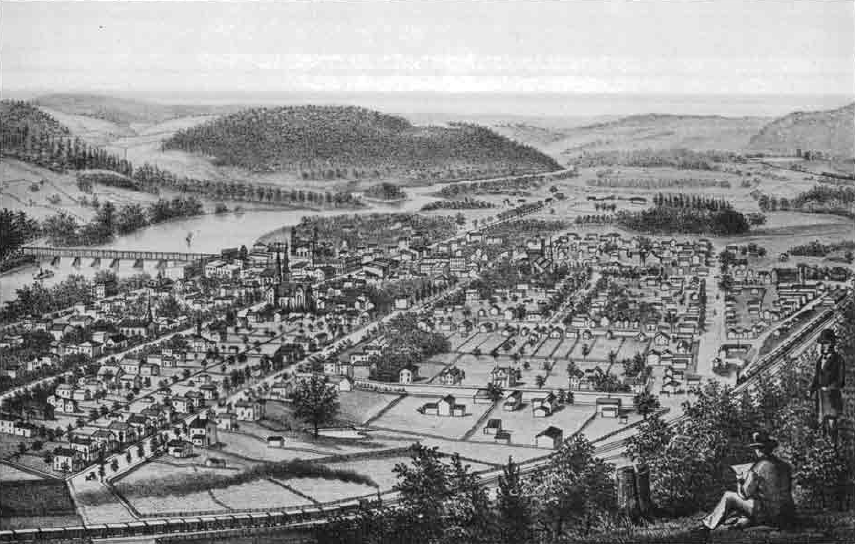
VIEW OF THE ROCKEFELLER COUNTRY.
In the foreground, Owego, about the middle of the last century. Rockefeller’s home was opposite Big Island, which is seen in the Susquehanna River. Richford, Rockefeller’s birthplace, nestles Among the hills in the background to the right. Citizens of Owego cherish a hope that the Rockefeller family may acquire and make into a state park, to be known as Rockefeller Park, the hilly country stretching northward from Owego.
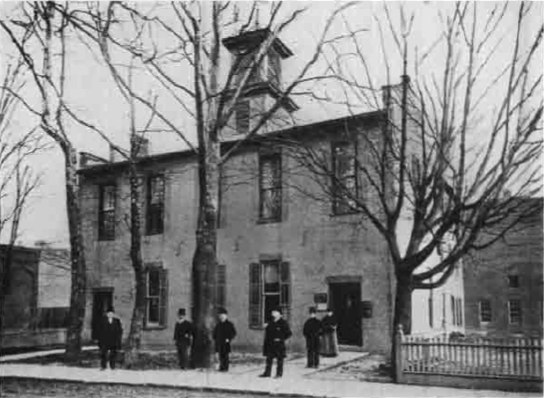
OWEGO ACADEMY, WHERE ROCKEFELLER ATTENDED SCHOOL.
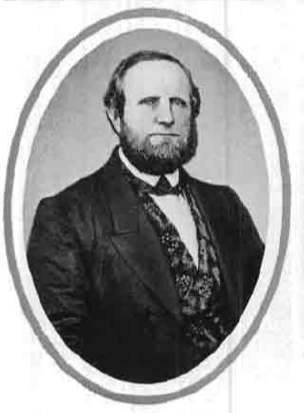
“DR.” WILLIAM ROCKEFELLER.
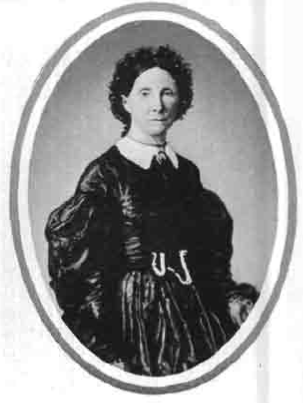
ELIZA DAVISON ROCKEFELLER, FATHER AND MOTHER OF JOHN D.
VII
THE SMALL house across the bay from Big Island is in darkness. The children are in bed. The hired man has retired and Eliza Rockefeller sits alone. By the fire in the front room she sits mending the boys’ clothes, thinking of her fugitive husband and smoking her pipe. She has taken to that now to beguile her loneliness. Presently she is done with her work and taking her candle she goes, accompanied by huge bobbing shadows, to her room upstairs. She is soon in bed but not asleep. Always she lays awake and listens—thinks and listens. For what?
Along the road out of the darkness emerges the shadowy figure of a man on horseback. He puts his horse quietly in the barn and then goes cautiously to the side of the house. There is a ladder lying on the ground. It is always there. He raises the ladder to the side window of the attic, well-concealed behind the trees. This big man cautiously mounts the ladder. At the window he takes a coin from his pocket and taps crisply on the tin smoke pipe which emerges from the side. In an instant the window is opened and Big Bill Rockefeller crawls through the window. The candle glows again downstairs. Eliza is listening to her strange husband’s account of his wanderings.
Since the family appeared at Owego Bill has not been seen by the neighbors. They know nothing of him or his whereabouts or his habits. People talk about him in whispers. The charge still stands against him in Auburn and so whenever he visits his family it is at night and by stealth, entering through the upper window in order not to excite attention.
In the morning there is a great pother among the children over the arrival of their father. He is full of jokes and stories and he always comes home with his pockets full. He gives each child a five-dollar gold piece. What the other children did with theirs is not known but John’s always went into the blue bowl.
The family seemed rich when William Rockefeller was home and when he left he gave his wife what perhaps seemed ample funds to last until his next visit, to pay the bills, provide for the house and pay the charges at Owego Academy. But ofttimes his absences were longer than the supply of money he left behind. And Eliza knew this. And so she watched the pennies with a jealous eye. As for John, he hoarded his small fortune. He grew more attentive to his savings as he advanced in years. He was able to see the grim processes of economy at work. He might lack a good enough suit to get into the school picture, but he held fast to his gold pieces at home.
Big Bill is older now—past forty, and a little sobered. But he is no solemn-visaged puritan. There is a wild, lawless streak in the man’s make-up. He will never sit down to a life of revolving daily duties. Where has he been? What has he been doing? This remained a mystery to his family, at least to the younger ones, who had learned, somehow, not to talk about their father’s affairs. It is doubtful if Eliza knew fully how her husband was occupied. It is probable he had shifted his operations—his medicine selling—further West for he talked about Ohio and the great movement over the mountains.
It is also probable that he is doing somewhat better—enough to provide for his family to which he was devoted in his rough way and to see whom he risked the return to Owego and made long and arduous journeys through the forests. But the family is still poor. They are not without food or shelter or clothes, but their house is humble and poorly furnished, most of their food is such as they produce themselves and their clothes are made from cloth purchased in the village and put together by Eliza herself. Many of the old inhabitants who were acquainted with the family seem to be agreed about this.
Thus the family lived until 1853. The older children had two years at Owego Academy. John himself was fourteen years old, though he was far older than this in gravity and intelligence. Then one night Eliza was aroused by the tapping of the coin on the stove pipe. A few days later the neighbors saw the Rockefeller belongings being loaded on a wagon—boxes, baskets, furniture. Mrs. Rockefeller went among them and with tears in her eyes said “Good-by.” The Rockefeller family were on the move once more—this time for a long journey, up past Richford and over the plank road around Lake Owasco and on to Lake Erie and then, over the Alleghenies into the Western Reserve, into New Connecticut as Ohio was then called. Thus the family brought to a close its troubled life in New York.
4The Rockefeller family insists that the elder William Rockefeller went to Richford with his family and that the story given here is not true.
5The remainder of the house still stands. It was purchased three years ago from Mrs. Carrie Rockefeller, a cousin who owned and had lived in it, by Mrs. Sarah S. Dennen of Brooklyn, to be moved to Coney Island and set up there as a Rockefeller museum and exhibit. The plan was opposed by the members of the Rockefeller Family Association and ultimately abandoned. It is a cherished hope of the people in this region to have the old Rockefeller farm and adjacent country developed into a “Rockefeller Park” with the house as a central attraction. A generous Rockefeller contribution to this end is eagerly hoped for as the basis of this dream.
6This simple statement of facts hardly tells the whole story. If Rockefeller was innocent why did he run away? Unable to obtain bail the prospect of remaining for a long-siege in jail awaiting trial may have been a sufficient reason to a man who lived as much on the fringes of organized society as the elder Rockefeller. Besides he may have felt in great peril from the presence of many very industrious enemies. The whole incident is a little lighted up by a curious volume which appeared in print for private circulation in Moravia only three years ago. This extraordinary literary production was called “Joshua, a Man of the Finger Lakes.” It was the product of a literary grocer of Syracuse, who was inspired and commissioned by a descendant of one of Bill Rockefeller’s Moravia neighbors. Joshua, the man of the Finger Lakes, was Joshua Rosekrans who was indicted for horse stealing at the time. The belief persists among his descendants that this indictment was the work of Bill Rockefeller. The book, after all these years, was produced to prove that Joshua was as innocent as the driven snow, the real culprit being William Rockefeller. The author has sufficiently examined the facts surrounding the writing of this astonishing volume to know that much of it is pure fiction. The book reveals, however, what the Rockefellers in the district have always believed: that there was a deep-seated enmity toward the elder Rockefeller among his immediate neighbors. They have always believed that this enmity was responsible for the charges made against him at Auburn. In any case, it is worth observing that the indictment made in July, 1849, was based on an alleged offense committed in April, 1848, nearly fifteen months earlier.
- 1The Rockefeller family insists that the elder William Rockefeller went to Richford with his family and that the story given here is not true.
- 2The remainder of the house still stands. It was purchased three years ago from Mrs. Carrie Rockefeller, a cousin who owned and had lived in it, by Mrs. Sarah S. Dennen of Brooklyn, to be moved to Coney Island and set up there as a Rockefeller museum and exhibit. The plan was opposed by the members of the Rockefeller Family Association and ultimately abandoned. It is a cherished hope of the people in this region to have the old Rockefeller farm and adjacent country developed into a “Rockefeller Park” with the house as a central attraction. A generous Rockefeller contribution to this end is eagerly hoped for as the basis of this dream.
- 3This simple statement of facts hardly tells the whole story. If Rockefeller was innocent why did he run away? Unable to obtain bail the prospect of remaining for a long-siege in jail awaiting trial may have been a sufficient reason to a man who lived as much on the fringes of organized society as the elder Rockefeller. Besides he may have felt in great peril from the presence of many very industrious enemies. The whole incident is a little lighted up by a curious volume which appeared in print for private circulation in Moravia only three years ago. This extraordinary literary production was called “Joshua, a Man of the Finger Lakes.” It was the product of a literary grocer of Syracuse, who was inspired and commissioned by a descendant of one of Bill Rockefeller’s Moravia neighbors. Joshua, the man of the Finger Lakes, was Joshua Rosekrans who was indicted for horse stealing at the time. The belief persists among his descendants that this indictment was the work of Bill Rockefeller. The book, after all these years, was produced to prove that Joshua was as innocent as the driven snow, the real culprit being William Rockefeller. The author has sufficiently examined the facts surrounding the writing of this astonishing volume to know that much of it is pure fiction. The book reveals, however, what the Rockefellers in the district have always believed: that there was a deep-seated enmity toward the elder Rockefeller among his immediate neighbors. They have always believed that this enmity was responsible for the charges made against him at Auburn. In any case, it is worth observing that the indictment made in July, 1849, was based on an alleged offense committed in April, 1848, nearly fifteen months earlier.
- 4Thus William Avery Rockefeller, the father of John D. Rockefeller, arrived in Richford. When he got to his mother’s home he continued to use his slate to the great distress of the whole family. When his joke had gone far enough he broke into a loud laugh and announced that he intended to live in Richford.
- 5ON THE road leading over Michigan Hill to Godfrey Rockefeller’s farm was a new house. It had been built two years before by a man named Avery Rockhill, perhaps a relative of Bill Rockefeller’s mother. It was strongly made, though a simple cottage. It stood on the very crest of the hill and commanded a beautiful view of the surrounding country and the soft green hills to the West. Just below the last rise of the hill are two brooks which meet there and flow off toward Harford Mills. Bill Rockefeller’s sportsman’s eye quickly observed that there were trout in these brooks. The house itself was surrounded by apple trees. The trees—very old and gnarled—are there yet, for this is a country of old trees. The house was small, the lower floor being divided into three rooms—one main chamber and two quite small ones. To the left—a kind of separate annex—was a kitchen and a woodshed, both of which have been removed. The second floor is just a half-story attic in which one must stoop to walk about. There were then and still are two very large barns. One of these barns has been cut into in its upper wall for ventilation and decoration with three small openings. On close inspection it is seen that this is a godless bit of art—a decanter and two glasses—on the barn of the rum-hating Bill and Eliza Rockefeller. A farm of sixty acres stretched back from the house. Here Bill Rockefeller established his young wife. And here just one year after their marriage the first child was born—Lucy Rockefeller, called after her grandmother. Then eighteen months later the boy was born whose arrival is chronicled in the opening paragraphs of this story. Two years later another boy, William, appeared.
- 6The hotly pressed man went at night to his home near Owasco Lake. The sheriff was notified of his presence and hurried down from Auburn. But Bill got wind of his coming, bade good-by to his family and left Moravia forever.

