
Free Market Economics: A Syllabus
7. Savings, Tools and Production
7. SAVINGS, TOOLS AND PRODUCTION
SUGGESTED ACTIVITIES
Several of the activities outlined below—suggested here in anticipation of Unit 8, “The Entrepreneur and the Profit and Loss System,” and Unit 11, “Competition, ‘Big Business’ and Monopoly”—take time to carry out. Therefore, if they are to be attempted, the sooner started the better. In addition to the brief description of each activity here, see also the pertinent sections in those two later Units.
1. This is a good time to introduce the subject of stock exchanges and their role in the market economy. If a local exchange or broker’s office welcomes visitors, plan a class field trip to see its facilities. Many stock exchanges and some of the larger brokers furnish free literature to students. Each student might write to a source of material on stock market trading—for instance, the New York Stock Exchange (11 Wall Street, New York, New York 10004) or the publisher of The Wall Street Journal (Dow, Jones & Co., Inc., Educational Service Bureau, P. O. Box 300, Princeton, New Jersey 08540)—for copies of brochures and pamphlets available to students.
2. Each student might write for a recent Annual Report of a large corporation whose stock is traded on the market. These corporations and their Annual Reports are discussed on pp. 76-77.
3. Show the students how to read the reports of daily stock exchange transactions, as they appear regularly in local newspapers, The Wall Street Journal and Barron’s. See the excerpt from one day’s stock report, reproduced and explained here on pp. 58-61.
4. To help explain the role of the stock market as a means for pooling the savings of many persons, perhaps a share or two of stock in some company may be purchased. There are legal restrictions on the ownership of stock by minors. If the students are over 18, however, they may form an investment club, collect a small sum from each student member and buy stock in the name of the club. If the students are younger, they will have to pretend to buy the stock, or have it bought in the name of an adult. In any event, discuss various industries— aviation, mining, railroads, petroleum, entertainment, retail food stores, etc. Then select a specific firm whose stock is currently traded on the market at a price within the limits of the sum to be invested. Local libraries, investment brokers or securities analysts may be willing to let one or several students consult their files on various firms for information on their products, history and future plans. The students should also watch for articles about specific companies in magazines and newspapers such as Barron’s, Business Week, Fortune and The Wall Street Journal. If a few shares are actually to be purchased, one or several students should make the arrangements through a local broker or banker. The certificate of stock ownership may take several weeks to come from the company, so the earlier this project can be started, the better. Also, to assure prompt completion of the transaction, it should probably be made “at the market.” Once a purchase is made—in fact or in fiction—the students should follow the company’s progress, perhaps charting the daily or weekly closing prices of its stock on graph paper or the blackboard. If exceptional changes in price occur, speculate- on their likely causes—in the light of current events and the economic theories being studied.
5. Another way to interest students in the stock market is to have each “invest” a hypothetical sum —$10,000 to $100,000. This should also help to illustrate the great contribution stock markets have made to production by permitting the accumulation of vast sums, from the savings of many relatively small savers and investors, to carry out gigantic enterprises that would not have been possible otherwise. At the same time stock markets provide flexibility of investment, as stockholders may buy and sell with relative ease, thus shifting their savings when it seems advisable in anticipation of changes in consumer needs and wants. As hypothetical investors, the students should look for firms whose products they expect will succeed in satisfying the future wants of consumers. They should investigate the recent record of the companies whose stock they consider buying, their products, research activities and future plans. Look for information in such periodicals as Fortune (see especially its annual directories in May, June and August of the largest firms in various categories), The Wall Street Journal, Business Week, Barron’s etc., and such aids to investment as Moody’s, Standard & Poor’s, and the U. S. Department of Commerce’s industrial reports. When a student has selected one or several stocks to “buy” with his or her fictitious nest egg, have each proceed as follows:
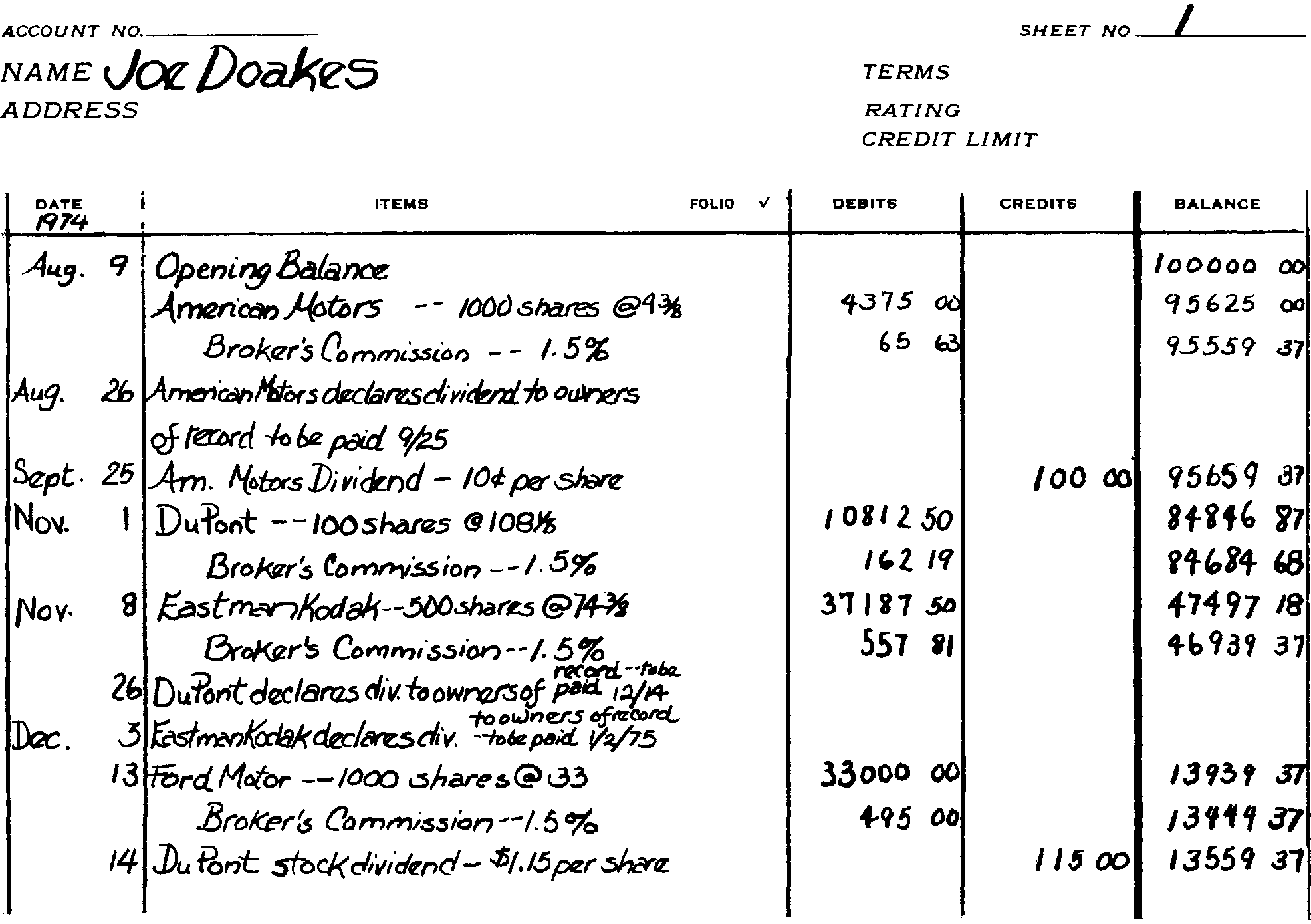
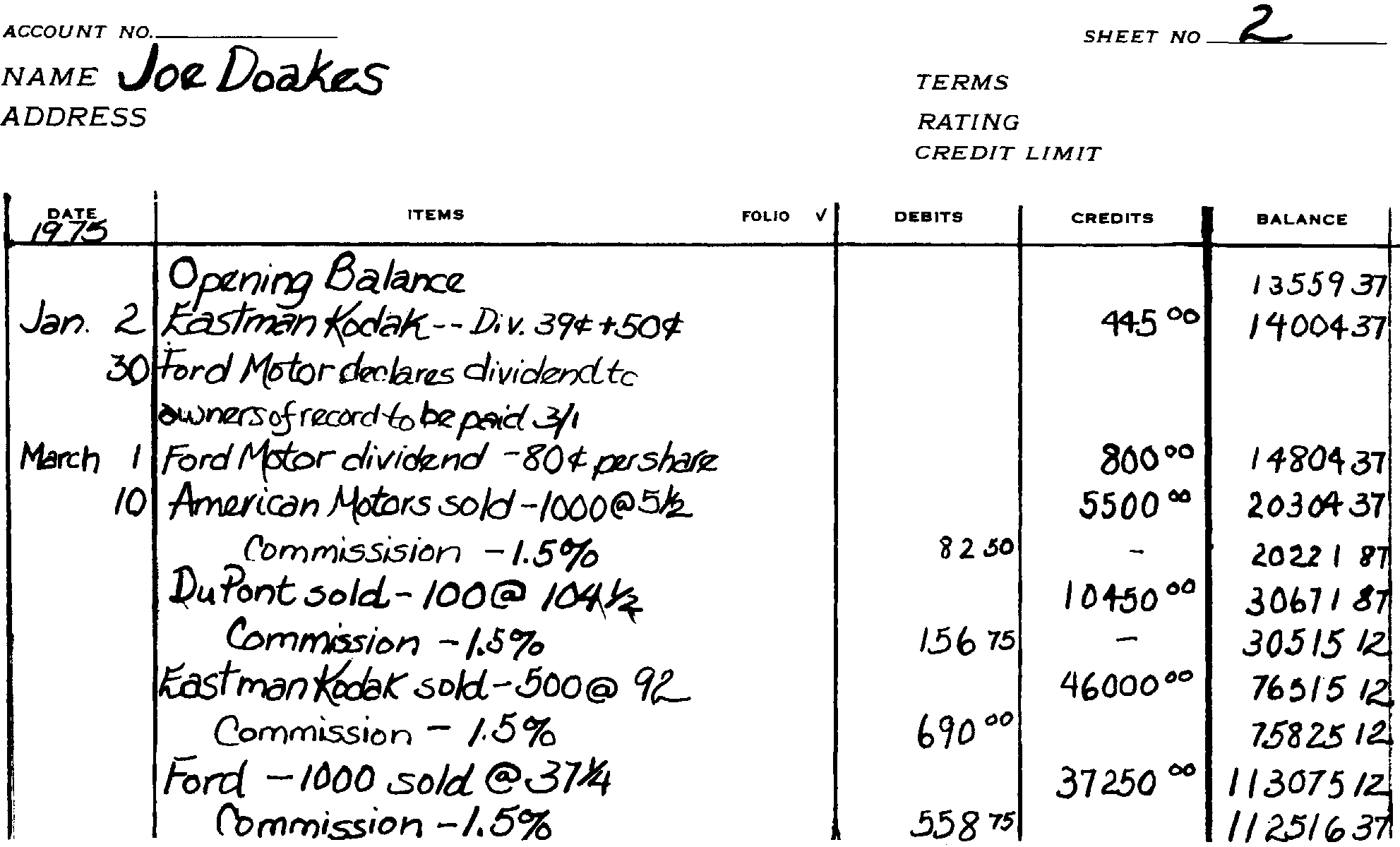
a. Prepare a personal ledger sheet (see sample, p. 57) to record stocks purchased, costs involved, receipts from dividends, sales, etc. If printed ledger sheets are not available, have each student draw the necessary columns—date, item, debit, credit and balance—on ruled paper.
b. As explained, the major contribution of stock markets is to permit the accumulation of vast sums for capital investment. At the same time, the ease with which individual stocks may be purchased and sold allows for flexibility of investment in response to shifting consumer demand. However, current governmental restrictions and the tax structure add to the cost of every stock market transaction, promoting an artificial rigidity of investment. To illustrate the situation as it actually is, the students’ investment activities should be as realistic as possible within the restrictions imposed by their simplified record keeping. With respect to estimating the taxes they would have to pay on all earnings, see paragraph (g) below. Allowance should be made in their accounts for a broker’s commission on every purchase or sale. Add a flat charge (1.5% more or less) for the broker to the price on all stock purchases or sales—small, medium or large. See the sample ledger sheets on page 57.
NOTE: Brokers’ fees, formerly figured on a sliding scale (from about 10-12!? on small orders down to .5 or .25% on large ones) became competitive on May 1, 1975, when the SEC abolished fixed commissions. Because stock market purchases and sales are traditionally handled and reported in “round lots” of 100 shares each, the percentage charged by brokers for arranging the sale or purchase of a “round lot” of 100 shares is somewhat less than for handling a purchase or sale of stock in “odd lots,” i.e. in lots of a smaller number of shares, several “lots” of which must be assembled to make a “round lot” before the sale or purchase may be completed.
c. For the sake of convenience, it should be assumed that all stocks are traded (bought or sold) at the stock’s closing price of the previous day, as reported in the morning’s paper.
d. Perhaps one student in the class, whose interests turn in this direction, will volunteer to act as class “broker.” If a calculator is available, that would be helpful. At some definite pre-determined time each day—limited perhaps to the first 10 or 15 minutes of the class period—each student should submit to the class “broker” his buy or sell orders, if any, signed in writing.
The student “broker’s” responsibility would be to calculate the cost of any student investor’s transaction, figure the price of the stock at the previous day’s closing price, record the transaction on the student’s personal ledger sheet and issue to each stock purchaser, as evidence of ownership, a simple typed, handwritten, or mimeographed “stock certificate” as follows:
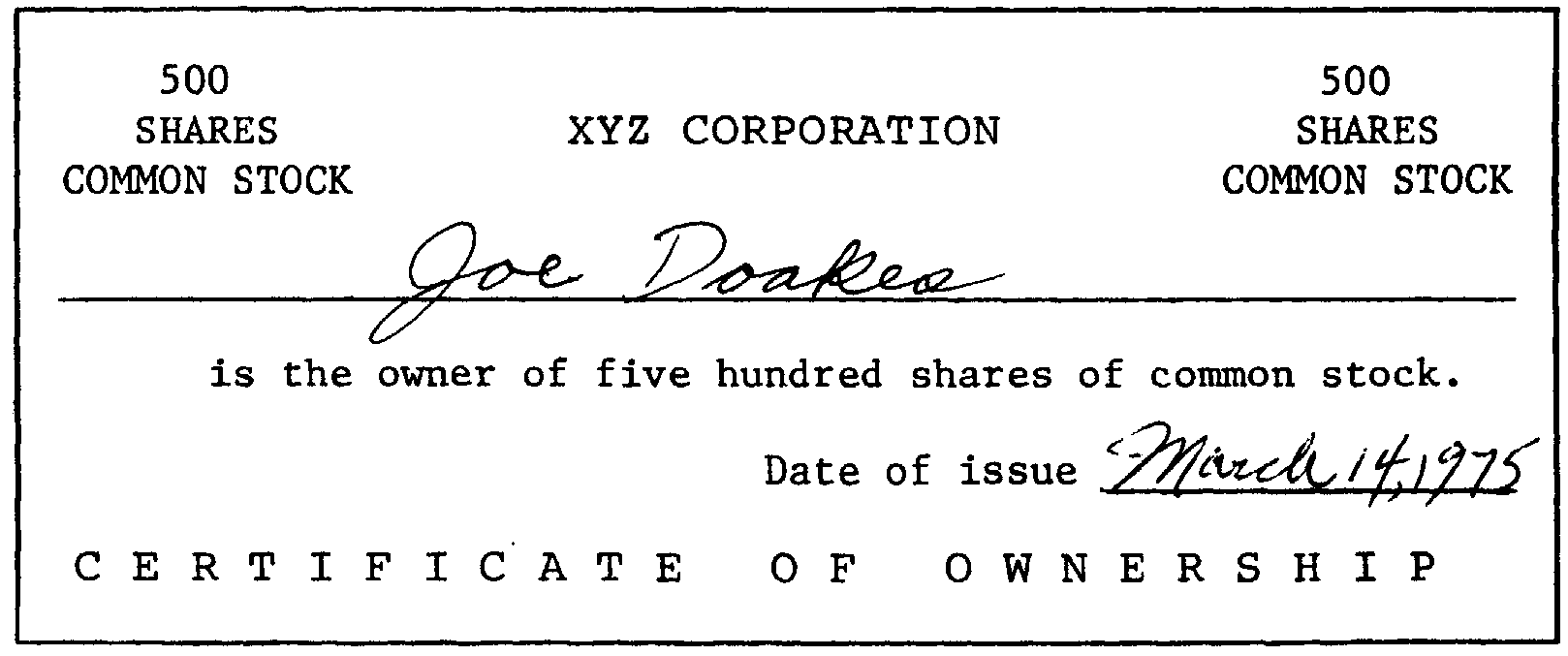
If the student shareholder, in this case “Joe Doakes,” sells his stock, he will surrender this certificate, receiving in exchange a receipt for the shares he is selling, a money credit on his ledger sheet, a new certificate for the number of shares still held from his original purchase if he keeps some rather than selling all, and/or a stock certificate for any new shares he may purchase with the proceeds of the sale. For keeping these records for the entire class, the “broker” might be given credit equivalent to a term paper or some special research assignment required of the other students.
e. The students should watch the papers for news of dividends issued by the various companies whose stock they “own.” The Wall Street Journal has a regular column entitled “Dividend News.” Barron’s is especially helpful, for it includes this information in each of its weekly stock market reports. Whenever a dividend is announced as “payable” on stock a student holds as of the “date of record,” that student should make a note to remind the class “broker”—perhaps each student should set up his own “tickler file”—when the payment date arrives. On that date, the class “broker” will then calculate the total dividend due on the number of shares in that student’s portfolio on the date of record and enter the appropriate credit in the proper column of the student’s ledger account.
f. The students may “buy” and “sell” shares of stock as they wish, so long as they invest no more than that to which they are entitled by their original hypothetical $10,000 to $100,000 nest egg. If they receive cash or stock dividends, that increases their assets. If they sell shares which have appreciated in value, then too they may have more money than before. However, their assets will decline if the market prices of the stocks they buy go down. And they may dwindle also as a result of deducting the two brokers’ commissions involved —i.e., the fee charged for arranging the original purchase and the second fee made for arranging the sale.
NOTE: Frequent transactions should not be encouraged because (1) they are costly; (2) the importance of the stock market as a source of funds for long-term investment should be stressed; and (3) the mechanics of handling multiple stock transfers each day could become extremely time-consuming to the detriment of the regular class instructions. However, the students should have an opportunity to trade when they consider changes in their market portfolios advisable.
g. Whether or not the students are asked to take into account in their fictitious transactions the income taxes they would have to pay in real life if they became successful investors, they should at least be told about them. If their investments were “for real,” they would have to report their income at the end of the year and pay a tax (roughly 25% at current rates, depending on their total income) on any income—over costs—received from the sale of stock held less than six months from the date of purchase. (If stock is held six months or longer, any increase in its market price is now considered “capital gains” and the tax of about 25% is figured on only 50? of the gain from its sale.)
h. The students might prepare a graph for each stock purchased, charting the fluctuations in its price per share at the close of each day (or week), depending on the stock, the number of weeks available and the time allowed each day for this project.
i. At the end of the course, or term, the students should “sell” or estimate the then-current market value of their holdings—as of the closing price per share on the class’ final day of trading—and compare it with their original “nest egg.” Even if the market prices of the stocks “purchased” have risen it is not likely that many students will have reaped tremendous paper fortunes during the few weeks of the course. Brokers’ commissions and taxes will probably have taken most of any gains, especially if the students have bought and sold with any frequency. However, each student should prepare a “Statement” of the market value of the holdings in his portfolio, as of the close of business on the last trading day of the term. (See sample, p. 57.) The exercise should be enlightening and educational, however, irrespective of paper profits or losses.
NOTE: It might be well to give some recognition to the students who follow current events, business news and corporation activities closely and, as a result, wind up with the best returns on their original $10,000 to $100,000 “investment.” Suitable awards would be a typed certificate presented with fanfare, inexpensive bull or bear cufflinks, pins, tie tacks, dollar-sign money clips or perhaps copies of a suitable book.
6. Discuss the theoretical distinction between (a) the goals, ends or values people are aiming at and (b) means, resources or “tools,” i.e., anything they consider useful in helping them attain their various goals, ends and values. After defining “tools” (see glossary definition) in the broadest sense of the word, ask the students to name some “tools” they use each day and the purpose each fulfills. Write the names of various tools in one column on paper or the blackboard and in another column the purpose for which each tool is used.
The students should think of such tools as automobiles used for transportation, hammers used to drive nails and build houses, coats worn to keep warm, stoves used to cook on, books, coffee pots, pencils, etc., each of which serves a specific purpose. Highways used to travel on are also “tools” in this sense. So is pocket money which is available to use in case one wants to buy something. So too are recipes, facts or knowledge which help people accomplish what they want to do more easily, quickly or better. The purpose of this activity is to point out that a “tool” is anything which has a use to an acting individual. It is its usefulness in the eyes of individuals that makes it a “tool.” Something no person can conceive of using for any purpose would not be a “tool” by this definition. The idea of a “tool” has meaning only from the point of view of individuals with personal (subjective) values and ideas, who reason, make choices, act purposively and use resources and means to accomplish particular goals.
7. To dramatize the advantages furnished by savings over many centuries, ask the students to name the places they and other members of their families have traveled in recent months—for fun over weekends and holidays, for business, to and from stores, schools, the homes of friends, etc. Write these locations on the blackboard, or have each student list them on paper. Calculate the distances traveled on each occasion, and the time consumed en route. Then ask the students to do a little research. Have them talk with older friends and relatives. How would (a) their parents and (b) their grandparents have gone to the same places when they were teenagers? What kinds of vehicles would their parents have used, 20 to 25 years earlier? their grandparents, 40 to 50 years ago? How long would the trips have taken them? In addition to the reminiscences of persons who remember, other sources of information about travel in the fairly recent past might be consulted—old travel guides and magazines of several decades ago. Books and articles about the history of ships, trains, automobiles, trucks, planes, etc., would be helpful also, as well as biographies of people who were living and traveling then.
8. Going back a little farther in history, the students might look up Marco Polo (1254-1324). Compare his prolonged travels to China with the recent journeys of Presidents and Secretaries of State. Discuss the savings needed to produce jet planes, airports, communications systems (radio, TV, telephone, relay satellites, photographic equipment, typewriters, electronic tapes, radar, and so on)—all of which were lacking when Marco Polo lived but which help make a modern traveler’s journey quick and comfortable.
9. What tools now help to make travel easier and quicker than it used to be? Perhaps a bulletin board exhibit could be planned around the theme of transportation—to illustrate how more savings made possible better tools enabling us to travel farther and faster than our ancestors could. The bulletin board should include not only pictures of old and new automobiles, planes, highways, airports, etc., but also pictures to show how savings were used to produce modern vehicles—factories, machines, assembly lines, electronic computers, vehicles used for transporting parts and raw materials and also the mines, plantations, rivers, etc., from which the raw materials themselves were taken.
10. Each of the readings recommended for this Unit might be assigned to be read, summarized and discussed. Ask the students to list the various tools mentioned. Do the readings offer any explanation as to why or how savers and inventors developed these tools? How is each used? How does each tool help to improve conditions for the people over what they were before? Does it also contribute to increasing future production?
EXPLANATION OF A DAILY REPORT OF NEW YORK STOCK EXCHANGE TRANSACTIONS
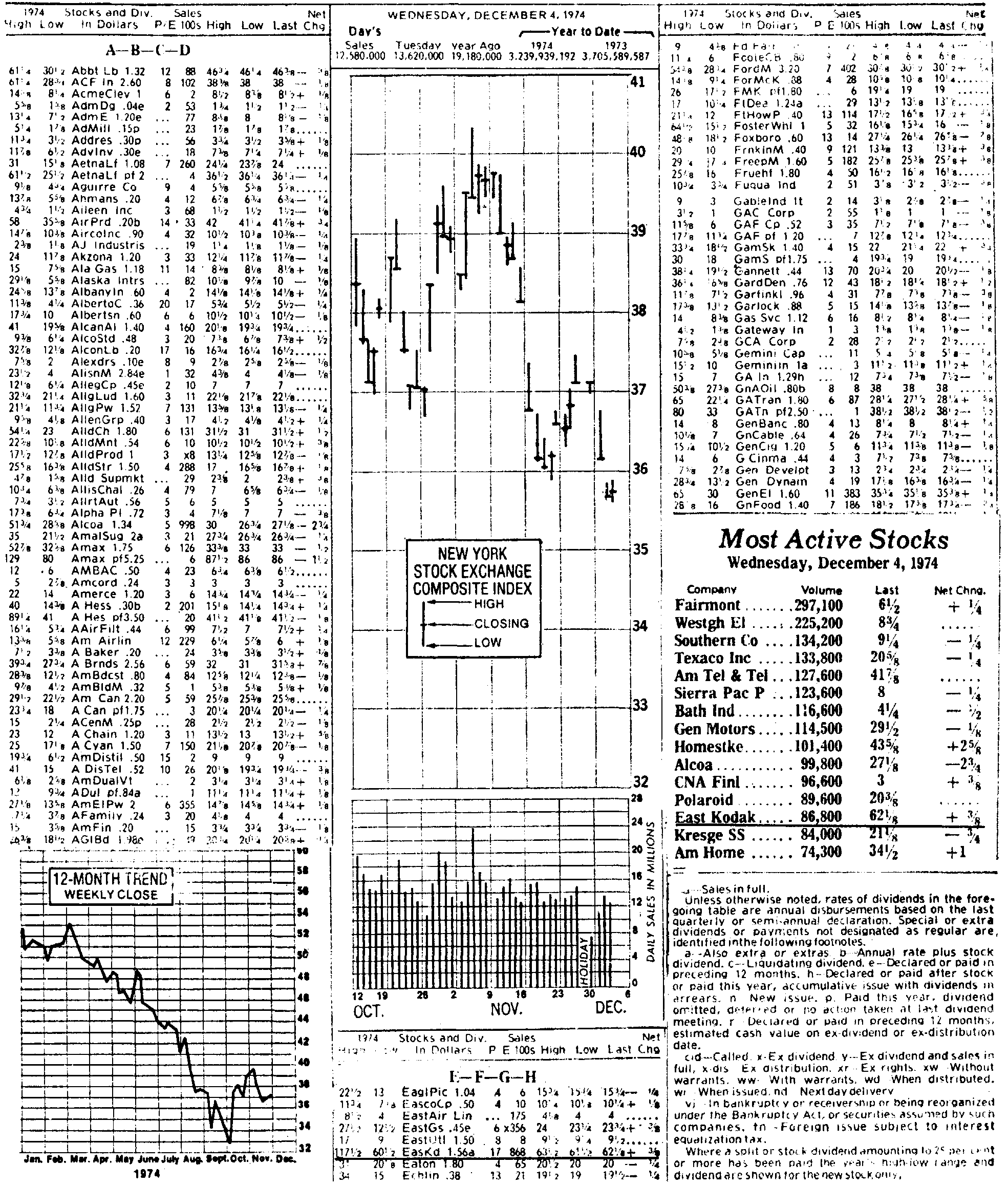
Reprinted opposite is a small section from the Daily Report of the NYSE transactions for December 4, 1974, as it appeared in The New York Times the following day. Every company listed on that Exchange, whose stock was traded in the course of that day, was included on the Daily Report together with miscellaneous additional information about each firm’s stock and that day’s transactions. Prices are reported in dollars and eighths of dollars. The various data presented are arranged in columns, reading from left to right, as follows:
THE NEW YORK TIMES, THURSDAY, DECEMBER 5, 1974
New York Stock Exchange Transactions
Copyright 1974 by The New York Times Company. Reprinted by permission.
Column
1 & 2 —The highest (and lowest) prices at which a share of that company’s stock had been traded so far during 1974
3 —The name of the company, followed immediately by the annual dividend paid per share of stock (see footnotes at bottom of right hand column for explanation of small letters)
4 —The ratio of the Price (P) of a share of the company’s stock to its Earnings (E) reported during the previous 12 months
NOTE: P/E ratios are recalculated daily by dividing the firm’s earnings into that day’s closing price per share of stock. A low P/E ratio indicates a higher potential yield to the investor who purchases stock at that day’s closing price than does a high P/E ratio. For instance, a P/E ratio of 10 means the company’s reported earnings during the previous 12 months were about 1/10th of that day’s closing price for a share of stock, whereas a P/E ratio of 25 means the firm earned only about 1/25th of its stock’s closing price that day. P/E ratios fluctuate, therefore, with the firm’s earnings and with the price of its stock. Note also that a firm’s earnings and its dividends practically never coincide. Many companies prefer to reinvest a substantial portion of their earnings in their operations so they usually pay out in dividends only a fraction of their earnings. However, a company’s dividends may temporarily exceed its earnings; if a firm incurs losses, it may choose to continue paying dividends for a time as usual—out of savings—to maintain a consistent record of dividend payments and in anticipation of economic recovery and a return before long to earning profits.
5 —Total sales that day, in round lots of 100 shares, of that company’s stock 6 & 7 —The highest (and lowest) price at which a round lot of 100 shares of that firm’s stock was traded in the course of the day’s transactions
8 —The price at which the last round lot of 100 shares of that company’s stock was traded on that particular day
9 —The difference (i.e., net change) between the closing price of that company’s stock that day and its closing price the day before.
Let’s consider a particular firm’s stock:
Eastman Kodak—Wednesday, December 4, 1974: This stock was one of the most actively traded stocks this day on the Exchange. See the list of “Most Active Stocks” at the right. The first two columns report a substantial range between the highest price, 117 1/2 ($117.50) and the lowest price, 60 1/2 ($60.50) at which a share of the company’s stock had been traded during the calendar year 1974, prior to December 4. Column 3 gives the name of the firm, Eastman Kodak, and its annual stock dividend per share—$1.56 + unspecified extras (indicated by the reference to footnote “a”) which could have been an additional money payment, stock dividend, rights to purchase stock at a special price, etc. Column 4 shows the P/E ratio to be 17, revealing the company’s reported earnings for the previous 12 months to have been about 1/17th of the day’s closing price. Column 5 reports a total of 868 round lots of 100 shares traded during the day, i.e., 86,800 shares of Eastman Kodak stock changed hands on December 4, 1974. The prices paid for Eastman Kodak stock on December 4 (columns 6, 7 and 8) varied between a high of 63 1/2 ($63.50) and a low of 61 1/2 ($61.50), and it closed at 62 1/8 ($62.125), up 3/8 of a dollar, or 37.5¢ (column 9) from the closing price of the day before. Now that we know Eastman Kodak’s closing price ($62.125) and the P/E ratio, we can calculate its reported earnings for the previous 12 months as being in the vicinity of $3.68 per share of stock.
Using this explanation as a guide, let the students explain another listing on this excerpt, or from another recent Daily Report of the NYSE. Take a later listing of Eastman Kodak, for instance, General Motors, or any other corporation reporting sales of stock on the Exchange. Reproduce one of several such listings on the blackboard and ask the students:
1. Is this company’s stock now priced high or low in comparison with its price over the last 12 months or so?
2. How many round lots and/or shares of stock were traded that day?
3. At what prices?
4. What was the closing price?
5. Using the P/E ratio and the closing price, estimate the firm’s approximate earnings during the previous 12 months.
The chart labelled “Daily Sales in Millions” shows the total number of shares of stock traded each day on the NYSE, and needs no further explanation.
Changes in stock prices are also studied assiduously by many market investors in the attempt to discover trends in business conditions. The chart entitled “New York Stock Exchange Composite Index” is made by totalling, averaging and then charting the daily averages of high, low and closing prices of all stocks listed on the “Big Board.” Each vertical line extends from a day’s average low to that day’s average high; the short cross-bar represents that day’s average closing. The “12-Month Trend, Weekly Close” chart is similarly prepared from the closing prices of all NYSE stocks during the previous 12 months at the conclusion of each week’s trading on Friday—or earlier if for any reason the market was closed on Friday.
NOTE: Many investors on the stock market consider the total number of shares sold and average prices significant for anticipating future trends in business conditions. Few sales and low prices are often thought to be signs of economic depression while many sales and high prices are considered indicative of improved business conditions. However, both high or low prices and slow or frantic activity on the stock market may be due to other factors. As we learned in Unit 6, prices are exchange ratios, reflecting the relative eagerness of owners and would-be purchasers to trade specific units of particular goods or services at particular times and places. Thus a high (low) price for a share of a firm’s stock may reflect (a) the anticipation of future profits (losses) for that company and/or (b) declining (rising) confidence in the future of the dollar. Thus, if many persons are eager to exchange dollars for tangible goods—such as shares of stock in various corporations, which they expect will retain their market values better than dollars will—the prices of shares of stock on the market will tend to go up. Generally rising prices on the stock market, therefore, may reflect a widespread anticipation of future inflation (increase in the quantity of money) and need not necessarily mean that traders expect economic conditions to improve. Moreover, it is important to remember that such statistics are necessarily always historical; they are based on data derived from past events. Thus the significance of stock market statistics and charts rests on the way they are interpreted.
For additional comments on stock market activities and reporting, see Unit 11, pp. 127-130.
EXPLANATORY TEXT
The simple message of this Unit is that people can eat more, enjoy higher standards of living and have more leisure and cultural advantages if more is produced and available to consume. The easiest and quickest way to produce more is to use more and better tools. And the only way to have more and better tools is to save, i.e., to consume less than the total amount of things produced and devote these savings to developing tools.
1. How do savings start? If people are allowed to own private property and are not prevented from using it as they wish, some of them quite naturally and inevitably, will try to accumulate a little more food, clothing and shelter than they need at any one moment. Life is uncertain, especially for primitive peoples who have only their own hands, wits and human energy to use in providing for themselves and their families. Sooner or later, if they are able, they will start accumulating some reserves for “rainy days.” Prehistoric men who lived in caves must have known from bitter experience that there were times when they would be cold, hungry, sick and helpless. If they could manage in “good” times to consume somewhat less than they produced, then they would have some supplies left to tide them over bad times. Aesop’s story of “The Ant and the Grasshopper” illustrates this point:
On a cold frosty day an Ant was dragging out some of the corn which he had laid up in summer time, to dry it. A Grasshopper, half-perished with hunger, besought the Ant to give him a morsel of it to preserve his life. “What were you doing,” said the Ant, “this last summer?” “Oh,” said the Grasshopper, “I was not idle. I kept singing all the summer long.” Said the Ant, laughing and shutting up his granary, “Since you could sing all summer, you may dance all winter.”
Aesop’s moral to this little tale was: “Winter finds out what summer lays by.” Following Aesop’s fable, we may contrast the grasshopper’s “time preference” with the ant’s “time preference.” The grasshopper prefers to consume and enjoy life today; the ant prefers to consume today only a part of what it produces and set aside something for the coming winter. There is a little grasshopper in each of us; we all consume some part of what we produce today—as a matter of fact we must consume something today in order to survive. But most of us also have some of the ant’s “time preference”; we set aside a part of what we have for tomorrow, next week, next winter or next year. It is the ant-like time preference in persons which induces them to try to prepare for the “rainy days” that are bound to come from time to time. The savings of “ants” are “rainy day savings.” Rainy day savings consist of stocks of consumers’ goods— food, clothing and shelter—that individuals produce, do not consume immediately, but set aside to eat, use and wear later.
The first step in accumulating rainy-day savings must always be the acquisition and/or production of various consumers’ goods; the next step is to exercise restraint so that some of these goods are not consumed in the present but are set aside for future use. To start saving for “rainy days,” men must have more food, clothing and shelter than they absolutely need for basic day-to-day survival. Men living under primitive conditions may come by such a “surplus” by hunting, fishing or foraging extra long, extra hard, or through an extra lucky find.
2. What induces men to accumulate “rainy-day savings”? Change is a part of life in this world of ours. Change is one of the six basic a priori assumptions which make it possible, desirable and necessary for men to act. The existence of change means inevitably that things may get better—or worse! In any event, change creates uncertainty.
To survive change and uncertainty may be difficult if one has no surplus stocks of consumers’ goods to fall back on. Therefore, men reasoned, some reserves might be helpful to tide them over difficult times. And they began to make conscious efforts to prepare for “rainy days.” Thus, reason and the drive to relieve “felt uneasinesses” and attain ends induce men to adopt the time preference of Aesop’s ant. Rainy-day savings, therefore, are the outcome of conscious, rational and purposive actions. Among rational, thinking human beings, the time preference which leads to restraint in consumption is strengthened by reason, logic and the expectation that saving some things to consume later will enable them to cope more successfully with the uncertainties the future is likely to bring. The specific form “rainy day savings” may take will depend on the ideas and personal (subjective) values of the individuals involved, as well as on the raw materials, energy, knowledge and time they have available—plus their anticipations of the future.
As we learned in Unit 3 (p. 17) three conditions are necessary for men to act: (1) some dissatisfaction with their present situations, (2) an idea about conditions which would represent an improvement, (3) the hope that action will make things better. Applying this analysis to “rainy day savings,” we can easily recognize that men will try harder to produce more and to refrain from consuming a part of their production in the present only if they (1) are dissatisfied, perhaps apprehensive in some respects about the future, (2) believe that having a reserve of consumers’ goods will help them cope with future uncertainties, (3) have some hope that their actions will benefit them and their loved ones. Why put forth greater effort if there is no chance of personal benefit? Why bother to work, produce and to save if they expect the wealth they accumulate to be confiscated or taken from them by force? Refer here to the moral of W. A. Paton’s “The Tale of the Little Red Hen” (Reading No. 70).
The time preference Aesop attributed to ants rests, among acting men, on reason and logic—they consider it in their personal interest to try to save something for the future. Those most likely to make the effort to save for “rainy days” are those who have confidence that they and their loved ones will be able to reap the potential advantages of any savings by being better able, as a result, to cope with “rainy days” when they arrive. For the ant-like time preference to exist and have a significant impact on the actions of men, their rights to own private property, hold, accumulate and dispose of it as they wish (Unit 4) must be recognized and safeguarded. On the other hand, the grasshopper-like time preference is bound to prevail among men who have little hope of benefitting from putting forth greater effort to produce and from demonstrating greater restraint in consumption. Had Aesop’s grasshopper succeeded in forcing his demands on the ant, or had the other barnyard creatures ganged up on the Little Red Hen and taken her production by force, neither ant nor Little Red Hen would have been likely to work so hard another time. They would not have postponed consumption in the expectation of reaping later benefits, but would have consumed their entire production “today.” People among whom a grasshopperlike time preference prevails, therefore, inevitably consume almost immediately practically everything they produce and find themselves poorly provided for later when “rainy days,” or “bad times” come.
3. How were tools first developed? Pure manual labor is hard, tiring and not very productive. Thus men quite logically look around for ways to make their efforts less tiring and more effective. Sooner or later, even among primitive peoples, someone will have an idea for using some object to make hunting, fishing or foraging a bit easier and more efficient. Someone might try using a large stick as a club, a log as a float, a stone as a missile. Once a person recognizes (a) an object (b) to be useful (c) for a purpose, he has a “tool.”
Archeological artifacts reveal evidence of die things people produced in ancient times. Anthropological studies describe how men lived in primitive societies. Both archeologists and anthropologists report evidence that, very early in the history of the world and at widely scattered locations, individuals developed tools to help them better satisfy their basic needs. Many museums display some of these simple tools. Further evidence of the production and use of tools by primitive peoples is furnished by modern anthropologists and sociologists who study groups of people living today completely removed from civilization—such as the cave-dwelling Tasaday Tribe in the Philippines and various isolated Indian tribes in South American jungles. Living in warm, lush climates, these peoples need very little clothing or protection from cold. They can forage for food in luxuriant forests. Yet they still accumulate some meager reserves of consumers’ goods, some “rainy day savings,” so they may devote some time and energy to other than their immediate necessities and transform the raw materials at hand into a few simple tools.
The starting point of any tool is (1) an idea. But the development of tools also requires the earlier accumulation of (2) “rainy day savings” so that some persons may spend their (3) time and (4) energy to develop the idea into tools. Tools save time and effort. But their main advantage is that they enable the user to increase production. As more is produced more will be available to consume. Also as more is produced, it becomes easier to set aside still more reserves for later “rainy days.”
4. What makes it possible to develop the complex, sophisticated and efficient tools used today in mines, factories, on the highways and wherever production is carried on? Ideas, PLUS plain or “rainy day savings,” PLUS materials, PLUS time, PLUS energy enable people to produce tools. Once they have a few tools, they can produce more consumers’ goods more easily. If they produce increased reserves of consumers’ goods, large enough not only to tide them over “rainy days” but also to last while they devote more time and energy to implementing new ideas for developing still better tools, their next logical step is to start accumulating reserves of tools. More tools and better tools enable them to produce still more in the future, more easily and more efficiently. If people then start saving purposively to produce tools, their savings are no longer simply “rainy day” or plain savings of consumers’ goods. Purposive saving for the production of tools, that is for the production of producers’ goods or factors of production, is “capitalist saving.”
Capitalist savings are undertaken to increase the stocks of consumers’ goods—but not directly. Capitalist savings increase the quantities of consumers’ goods indirectly—by first increasing the available supplies of producers’ goods or tools with which still more consumers’ goods may be produced in the future.
The production of consumers’ goods with the aid of tools, machinery and other factors of production, made possible through capitalist savings, is sometimes called a “round-about method of production.” But this term is slightly misleading. The reason tools and machines are used in production is because they actually help make production more effective, more efficient, more fruitful. Thus production with the use of tools and machines is really the most direct method of production available. As a matter of fact, without the aid of countless, specialized tools—in mines, on farms, in factories and so on—it would be impossible to produce the tremendous quantities of consumers’ goods now needed to support the world’s population. Thus, no matter how complex, sophisticated and time-consuming it may be, production with tools that proves economical, not wasteful (i.e., it produces profits for the enterprise, not losses) is not a “round-about” method of production at all; it is really the most direct and most efficient production method known.
When producers have more and better tools to work with, they can expand production. The more they produce, the more people can consume while still setting something aside for the future. Some of their increased savings will be in the form of greater stocks of consumers’ goods, reserves for “rainy days.” But in a capitalistic society, some of the people who refrain from consuming a part of their production will produce and accumulate not only plain or “rainy day” savings to consume later but also “capitalist savings,” i.e., tools and machines to be used for the further development and production of tools and machines. These “capitalist savings” may then be employed by producers who specialize in making still more and better tools. Today’s very complex and sophisticated machines and production methods are merely the outcome of this simple sequence. As production increased over the centuries step-by-step improvements were made in tools. With more and better tools available, it became possible to produce even more, permitting the development of still more and better tools. And so the process continued down to modern times.
5. What determines how much will be consumed and how much saved? People act on the basis of their ideas. Their decisions to spend or to save are also determined by their ideas and values. Most people would probably prefer to spend than to save, to enjoy life like the grasshopper without having to think about the future, rather than to plod along steadily in the manner of the ant, refraining from consuming all they produce in order to save something for tomorrow. However, few people if any are entirely “ant” or “grasshopper” in their time preferences. Most people consume something—even ants must eat to survive— and most set some things aside, refrain from consuming some things immediately, in order to have them available for later use. The ratio between what persons consume and what they save depends on their individual time preferences.
Different people have different time preferences and the same person has different time preferences at different times. Those of us with a grasshopperlike time preference tend to value present goods above future goods; we will pay a premium to consume today; we are apt to buy on credit because we want a thing now, agreeing to pay later with interest. On the other hand, the “ants” among us give more thought to tomorrow and place a relatively higher value on the feeling of security that comes with being prepared for “rainy days.” An ant-like time preference plus respect for private property has led many people to save with the result that tremendous amounts of capitalist savings were accumulated, especially during the last two centuries. These capitalist savings provided the opportunity and the means for inventors to develop their ideas so that specialized and efficient tools, machinery, equipment and plants could be constructed and ever larger and larger quantities of goods and services could be produced for people to consume, use and enjoy.
6. How are the savings of separate individuals assembled and combined to make large investments and tremendous enterprises possible? If a man has an idea about how to produce some good or service that calls for bigger and more complex tools and equipment than he can make himself or afford to purchase, he will try to find others to cooperate with him. There are several ways they may contribute. They may lend or rent him the necessary materials and equipment. They may lend him funds so he can buy or rent the needed factors of production from someone else. They may become partners in the business, furnish a portion of the funds or other resources needed, with the understanding that they will share, according to a previously agreed upon arrangement, in any profit or loss the partnership makes. They may also contribute by furnishing funds to set up a company, with officers and employees to engage in a business as a “corporation.”
NOTE: The legal technicalities of corporations are not of particular significance for this course. However, if questions arise it should be helpful to know something about them. A corporation is a specific legally defined form of enterprise that makes it possible to embark on a project and to continue operating as an entity even if one or all of the persons putting up the original funds should die or sell their interest in the enterprise to someone else. The specific rules and regulations controlling the operations of corporations are determined by law and so have varied from time to time and from place to place—since the earliest corporations were set up in Ancient Rome.
The major reason for establishing corporations is to make it possible to undertake projects that require large sums of money and so need to attract funds from many individual savers and investors. Any individual who buys a share in a corporation acquires some of its stock and becomes a “shareholder,” i.e., a part owner in the business. Under our laws today, an individual who buys a “share” of stock in a corporation receives a “Certificate of Ownership,” giving his name, the date of his acquisition and the extent of his interest in that company. As a part owner of the company he receives a share of any profit or loss the corporation makes. He may sell or transfer his interest in the firm to another person. In that case the rights and obligations, to the extent of the interest indicated on the “Certificate,” go with it.
The various stock exchanges in the world were established as meeting places, i.e., markets, where savers seeking investment opportunities and producers looking for funds could come together for the purpose of trading with one another. The famous New York Stock Exchange was started in 1792 when a few businessmen began gathering regularly under a certain cottonwood tree on Wall Street to buy and sell securities. The spot came to be recognized as a “market” where company stocks could be traded. From that small beginning grew the mighty New York Stock Exchange (NYSE) which now (March 1975) lists shares of stock in close to 1750 different corporations.
A brief discussion of stock markets will help prepare for Unit 8, “The Entrepreneur and the Profit and Loss System” and Unit 11, “Competition, ‘Big Business’ and Monopoly.” The important thing to emphasize in this Unit is that the stock market is a means for assembling savings, which permit the development of more and better tools which, in turn, make it possible to increase production further. Here are the most significant points:
a. The stock market is a natural and logical outcome of the cooperation of savers, each acting purposively to attain various personal, subjective, goals. They found they could pool their savings with the savings of many other individuals and so invest larger sums and engage in bigger enterprises than could any single saver alone or even in combination with several associates.
b. A stock market, like any market (Unit 5) is a meeting place where owners of something to sell may expect to encounter potential buyers.
c. The commodities traded on a stock market are shares, portions or fragments of specific business firms. A person who buys a share of a company’s stock has actually bought a share in its ownership. Thus, every stockholder is a part owner of the company whose stock he owns, entitled to a proportionate share of the firm’s profits (if any) and responsible for bearing a similar share of any loss it may make.
d. Modern stock markets transact tremendous volumes of business daily, arranging for the transfer of millions of shares of stock in many thousands of companies. Enterprises that handle so many transactions every day try to take advantage of any tools available to make their work easier. As a result the various stock exchanges in the country now use complicated electric and electronic machines and computers to record sales and purchases and to calculate income, outgo, commissions, fees, etc. The complexity of such “automated” equipment may make a stock market’s operations appear complicated, but it doesn’t alter its basic character as a meeting place of individuals who own something and individuals who are thinking of buying. Their electronic computers are merely tools, complicated ones to be sure, which enable them to handle many transactions promptly.
e. Practically every stock exchange today is subject to many governmental controls and regulations. The Securities and Exchange Commission, for instance, is concerned almost exclusively with stock market transactions. This intervention of government may hamper the making of stock offers, sales and purchases. However, it does not affect the basic purpose of the stock market. The important thing to emphasize is that a stock market is a specialized market, where buyers and sellers may meet; it permits the savings of many persons to be assembled and invested, so that even a very small saver may become a part owner in the largest of corporations.
Stock exchanges develop as a logical attempt to facilitate the performance of businesses which become very large, with millions of dollars in assets. The total investment involved in the operations of a single large-scale enterprise may become so great that no one man, or even group of men, has access to sufficient funds to finance it. Its assets may then be divided into small portions, each then being offered as a “share of stock” to anyone interested. Our economy is so large and there are so many companies with an interest in finding buyers for “shares” in their firms, that these shares are marketed by organizations that do nothing but arrange for the trading of such shares. The New York Stock Exchange, often spoken of as “the big board” is the world’s largest. The other major stock exchanges in this country and abroad are:
American
Midwest
Pacific Coast
Phil.-Balt.-Wash.
Boston
National
Detroit
Toronto
Montreal
Buenos Aires
Tokyo
Sydney
Johannesburg
London
Paris
Brussels
Zurich
Amsterdam
Frankfurt
Milan
Some companies, usually smaller ones that do not satisfy the requirements imposed by the various stock exchanges for being listed on their “board,” may also offer stock to the public. Such sales are listed and traded by brokers over the counter.
7. Before leaving this Unit, it might be well to cite specific examples of the way capitalist savings are used to manufacture complex tools and equipment and employed in several branches of production. The essay, “I, Pencil” might be a good place to start. Call attention to the many tools mentioned there which are used to make an ordinary pencil—coal and iron mines, steel saws, axes and motors, logging camps, lumber mills, factories, steamships, trucks, and so on almost ad infinitum—all of which require the previous accumulation of both “rainy day savings” and “capitalist savings” so that the tools, machines and factories needed to produce these tools, machines and factories could first be manufactured. Tracing a pencil back to its source—geographically and historically—would be similar to trying to decide whether the hen or the egg came first, except for the fact that the logic of economic theory permits us to trace the creation of a pencil and of all its component parts to their sources—the ideas of acting individuals. An idea sparked every one of the many steps involved. Then other ideas motivated other persons to refrain from consuming all they produced, accumulate savings and apply a portion to developing tools so that in time the production of pencils became a reality.
Another industry in which capitalist savings and tools have led to dramatic and easily demonstrated improvements is transportation. Until fairly recent times, travel was so difficult and tiring that few people ventured away from their native villages. Only the young and hardy traveled very far afield. It was a long and gruelling journey for the Crusaders to reach Palestine (c.600-1300 A.D.) across Europe on foot or horseback, or sailing the Mediterranean, and countless thousands died en route. It took tremendous courage for Columbus to venture across the vast Atlantic for long weeks of time with only sails and the wind to rely on, no engine to drive his tiny ships along in the event of storm or calm.
The Polish astronomer Copernicus (1473-1543) traveled several hundred miles to Italy as a young man of 23, remaining there for five or six years to study without once returning home for a visit. Martin Luther (1483-1546) was quite a traveler for his day. He visited many towns, ofttimes traveling on foot several hundred miles from the University of Wittenberg where he taught and preached.
George Washington rode up and down the eastern seaboard on horseback. The miles that could be covered then in one day’s journey between dawn and dusk, when the roads were poorly laid out, narrow and rutted or muddy, were very few as compared with those one can now travel easily in a day. Thus Washington had to spend many nights on the road and slept in a great many different houses between Boston and his home in Virginia, a distance that jet planes can now cover in about an hour.
In the summer of 1776, with the question of this country’s independence hanging in the balance, Delegate Thomas McKean of Delaware sent a messenger by horseback (no telegraph, telephone or radio then) to Dover, Delaware—about 70 miles away—urging his colleague Caesar Rodney to come to Philadelphia immediately for the vote on independence. Delegate Rodney rode horseback through a storm all that night, but he reached
Philadelphia in time to vote for immediate action. That same distance from Dover, Delaware, to Philadelphia may now be covered easily by automobile in about an hour, riding smoothly on broad superhighways.
Before the development of trains, cars and planes, travel by water was the smoothest, quickest and easiest way to ship goods and people. Yet before the steam engine was adapted to boats, even water travel was often slow and uncertain. When the land west of the Alleghenies was opened to settlers, the Ohio River became a major highway to the frontier. Merchants, settlers and other travelers sailed down the river at a leisurely pace on flatboats or barges. But returning these craft upstream was slow and wearisome. Without motor power these vessels had to be rowed or poled laboriously foot by foot. “A boat or cargo of 10 to 40 tons, and a crew of 8 to 20 men did well to average 6 miles per day upstream.” (Carlyle R. Buley. The Old Northwest. 2 vols. Bloomington: University of Indiana, 1950. Vol. I, p. 413.) With the advent of steamboats, ships were soon averaging the same number of miles upstream per hour as they had formerly made in a day!
It was the increase in capitalist savings which permitted the improvement of tools—in this last case the introduction of the steamboat—and made remarkable advances in transportation possible. And it is thanks also to the capitalist savings of past generations that we are able to travel so easily today in comfortable automobiles and speedy jet planes. Tremendous accumulations of capital are needed to back up every form of transportation we now enjoy. A single journey involves a complicated array of capital set aside from earlier production in the form of mines, shipping facilities, factories, universities, research laboratories, etc. And if orbital or rocket flights into space should become routine, additional quantities of capitalist savings will have to be accumulated— out of the production of individuals, which they do not consume at the time but set aside to be used later to further production.
GLOSSARY WORDS
(For definitions, see glossary, pp. 223ff.)
Capitalist savings
Consumers’ goods
Consumption
Corporation
Factors of production
Interest, interest rate
Invest, investment
Market
Producers’ goods
Production
“Rainy day” (or plain) savings
“Round-about” methods of production
Saving
Savings
Stock exchange
Time preference
Tool
RECOMMENDED READINGS
More advanced materials are indicated by an asterisk (*)
Articles
In the BASIC READER:
19. “Letter to His Grandson,” Fred I. Kent
20. “Technological Status,” John W. Campbell
21. “Where Karl Marx Went Wrong,” Samuel B. Pettengill
22. “The Great Mistake of Karl Marx,” Benjamin F. Fairless
23. “The Role of Savings,” Brian Summers
24. “Tools,” Jasper E. Crane
25. “The Liberation of Women,” Bettina Bien Greaves
26. “Industrialism: Friend or Foe?” V. Orval Watts
* 27. “The Economic Role of Saving and Capital Goods,” Ludwig von Mises
76. “How to End Poverty,” Dean Russell
Additional Titles:
“Thrift: Prerequisite of Economic Progress,” Hans F. Sennholz—in The Freeman, March 1964
Books
Bastiat, Frederic. Economic Harmonies (Van Nostrand, 1964; FEE, 1968). Chapter 7, “Capital”
* Mises, Ludwig von. Human Action (Yale, 1949/1963; Regnery, 1966). Chapter XVIII, Sections 3, 4 and 5 on capital goods
Smith, Adam. The Wealth of Nations (1776). Many editions. Book II, Chapters I and III

