
Free Market Economics: A Syllabus
12. Interregional Trade
12. INTERREGIONAL TRADE
SUGGESTED ACTIVITIES
1. Here are four quotations, one or all of which the teacher might write on the blackboard for the students to refer to from time to time in the course of this Unit:
The real gain of foreign trade to any country lies not in its exports but in its imports.
Henry Hazlitt, Economics in One Lesson (2nd ed., MacFadden, 1962), p. 63
The inhabitants of the Swiss Jura prefer to manufacture watches instead of growing wheat. Watchmaking is for them the cheapest way to acquire wheat. On the other hand the growing of wheat is the cheapest way for the Canadian farmer to acquire watches. The fact that the inhabitants of the Jura do not grow wheat and the Canadians do not manufacture watches is not more worthy of notice than the fact that tailors do not make their shoes and shoemakers do not make their clothes.
Ludwig von Mises, Human Action (3rd ed., Regnery, 1966), p. 395
When the baker provides the dentist with bread and the dentist relieves the baker’s toothache, neither the baker nor the dentist is harmed. It is wrong to consider such an exchange of services and the pillage of the baker’s shop by armed gangsters as two manifestations of the same thing. Foreign trade differs from domestic trade only in so far as goods and services are exchanged beyond the borderlines separating the territories of two sovereign nations.
Ludwig von Mises, Human Action (3rd ed., Regnery, 1966), p. 666
“If goods do not cross frontiers, armies will.”
Anonymous
2. Ask the students to re-read “I, Pencil” by Leonard E. Read (Reading No. 15). Call special attention to the widely separated geographical areas from which the raw materials used in a simple lead pencil must he assembled. Not only are some of them shipped many thousands of miles within the U. S. to the pencil factory in Pennysl-vania, but some of a pencil’s component parts are made from raw materials extracted in far distant countries. An exhibit might be constructed to dramatize the widely separated areas that contribute to the manufacture of a simple pencil. Mount a map on the bulletin board and note on the map, by posting labels, flags or parts of pencils at the locations where the various components originated.
3. If such widespread interpersonal cooperation is required to produce simple lead pencils, more complicated items undoubtedly call for many more parts produced from raw materials assembled from even greater areas over even more intricate networks of trade. One or several students might talk with representatives of a local factory, plant or store to find out as much as possible about the sources from which it obtains the various raw materials, parts or commodities it purchases to assemble, fabricate or sell. Detailed research along these lines could produce the kind of information about a local product that Mr. Read compiled on pencils. Reports of such interviews might be presented to the class, outlined on a world map or illustrated by diagram on the bulletin board.
4. Mount on the classroom bulletin board or in the school corridor a large map of the world or of the United States or distribute small outline maps to every student. Then ask the students to look around at home or in local stores for various items produced in other parts of the world or fabricated from parts or raw materials that came from afar. Challenge the students to find “imports” from as many different countries or states as possible. Have the students note on the outline maps the places where the various items originated—using pins or flags on a large bulletin board map, words or numbers keyed to footnotes on small individual maps. Or prepare an exhibit to illustrate interregional trade, with actual objects, miniature copies or pictures of imports, each tied with a ribbon or tape tacked to the map at the place from which it came. Refer students to atlases, encyclopedias and economic geographies for suggestions. For whatever help it may be to the teacher, here is a list of the items—one from each of our 50 states and Puerto Rico—which U. S. Secretary of Treasury George P. Schultz placed in the “market basket” he presented (June 23, 1973) to USSR’s Foreign Trade Minister Nikolai S. Patolichev:
Alabama—peanut butter
Alaska—crab
Arkansas—mineral water
Arizona—dates
California—wine
Colorado—apricots
Connecticut—cheese
Delaware—oysters
Florida—oranges
Georgia—pecans
Hawaii—pineapple
Idaho—potatoes
Illinois—beef briskets
Indiana—ham
Iowa—cereal
Kansas—whole wheat bread
Kentucky—bourbon
Louisiana—sugar cane
Maine—clam chowder
Maryland—chicken
Massachusetts—Boston baked beans, clams
Michigan—strawberries
Minnesota—cheese
Mississippi—cotton
Missouri—com
Montana—barley
Nebraska—com
Nevada—beef
New Hampshire—cheese
New Jersey—asparagus
New Mexico—sorghum
New York—champagne
North Carolina—tobacco, cigars
North Dakota—flax
Ohio—corn
Oklahoma—mung beans
Oregon—salmon
Pennsylvania—cheese
Rhode Island—strawberries
South Carolina—rice
South Dakota—chicken
Tennessee—sour mash whiskey
Texas—beef briskets
Utah—cherries
Vermont—maple syrup
Virginia—ham
Washington—apples
West Virginia—cheese
Wisconsin—cheese
Wyoming—sugar beets
Puerto Rico—rum
5. If the class has access to an August issue of Fortune Magazine, see its list of large foreign industrial firms. Many of the firms will be recognized as producers of familiar consumer products— Royal/Dutch Shell, for instance, Toyota Motors, Bayer, Sony, etc. Ask the students to look for advertisements of such foreign-based firms, also articles about them in newspapers and magazines. Then have the students check local stores for products of these firms to see how many different foreign companies they can find represented. Exhibits, notebooks, files, lists, etc., may be built on the theme of foreign producers and their products.
6. If one or several students can visit an exporting company or a local plant which distributes its output far and wide, have them ask about the items it sells, how they are transported, where and how they are sold, by whom they are consumed and how payment is made by the foreign purchasers, how it is returned to this country, and eventually, reaches the local exporting business firm. This should include acquiring some familiarity with the definitions and abbreviations of technical terms used in international trade—ASP (American selling price), B/L (bill of lading), CAF (cost and freight, no insurance included), CIF (cost, insurance, freight), FAS (free alongside), FOB (free on board), TSUS (tariff schedule of the United States), etc. Once again, the routes traveled by an exported product and by the payment for it as it travels back to this country from the buyer abroad may be illustrated on maps.
7. The U. S. government now influences international trade in many ways. Some laws hamper imports by imposing tariffs, quotas and other restrictions. Other laws have been enacted in the attempt to promote exports—by negotiating trade agreements and promoting foreign trade—by subsidizing shipping and the export of certain items. Ask one or several students to write to their Congressman, or to the Department of Commerce (Domestic and International Business, Main Commerce Building, Washington, D.C. 20230) for information on U. S. foreign trade policy to share with the others in the class.
8. Any student reports prepared on the history of trading routes, in line with suggested activity No. 3, Unit 5, may be turned in or presented to the class at this time—or later in conjunction with Unit 15, if that seems preferable.
9. Call the students’ attention to various examples of government intervention that affect interregional trade. They should notice references concerning such interferences in the daily press, economic newsletters and business journals. As a guide to the teacher, see the list of federal, state and local government actions of this type and their effects on interregional transactions—paragraphs 5 and 6 of this Unit.
EXPLANATORY TEXT
In this Unit, we shall be dealing with trade among individuals in different parts of the world. Trade itself is an outgrowth of the concepts discussed in Units 2, 3, 4, 5 and 6. Thus, before considering the intricacies of interregional trade, we shall review the most important ideas dealt with there in order to explain the nature and the role of trade itself. Then we shall consider interregional trade, trade among individuals in different parts of the world. Interregional trade will be treated primarily as an economic phenomenon, i.e., as a “natural” outcome of the purposive actions of individuals in the pursuit of their various goals.
If time and student interest permit, the teacher may “enrich” this Unit by introducing discussions and research projects on the historical development of interregional trade over the centuries— from its very simple beginnings down to the large-scale complex intermeshed transactions of today— and the technology of modern commerce and shipping. The remainder of the Unit deals with interregional trade as it is conducted in the world today, the interdependence of people, as a result of highly developed interregional trading throughout the world and the impact of government on trade.
1. How does trade originate? As pointed out in Unit 2, economics is the study of the conscious, purposive actions of individuals. Every one of us acts purposively, doing what seems best at the time to accomplish our own personal aims, ends, goals, values. At times we act alone; at other times we cooperate. A trade or exchange of commodities is one possible consequence of action and cooperation on the part of two individuals, as each person seeks to attain his/her various goals, as each seeks to “do his own thing.” In the process, as each person trades to satisfy his own wants he necessarily contributes to the welfare of others. To acquire the things he wants he must offer others something they want in order to persuade them to part with their goods or services.
NOTE: Perhaps it should be emphasized here again that economics is the study of peaceful and voluntary human actions only. The use of force or threat of force —interpersonal or international—lies outside the field of economics, except as such activities influence the ideas, choices and actions of individuals trying to cope with the problems they cause.
When an individual acts, he must always take into consideration the nature of the universe. Thus every conscious, purposive, human action is predicated on the six fundamental a priori categories set forth in Unit 2—(1) regularity, (2) logic, (3) causality, (4) time, (5) change, (6) value. Every action a person takes on the basis of these six a priori categories is an attempt to adapt and adjust available resources as well as possible to serve a person’s various purposes, wants and needs.
Whenever a person acts, he is making an exchange or a trade—of one situation for another, of one thing for another, of one good or service for another—in the hope of improving his situation. As explained in Unit 4, any exchange or trade is an offshoot of the fact that there is, or has been, a certain amount of division of labor or specialization. Without such specialization, the idea that it might be worthwhile to trade could not even arise. Another requirement for an exchange or trade to take place is private property. For a person to trade something he must have effective control over it; he must have the right to dispose of it as he chooses. It would be helpful to review once more the discussion of these concepts in Unit 4.
Yet even these—division of labor or specialization and the right to private property—are not enough to bring about a trade. There is still a further prerequisite. The potential parties to a trade must expect to be better off as a result of the exchange than they would otherwise have been. The actions a person takes and the trades and exchanges he makes depend on his subjective (personal) values. As we have seen, people act on the basis of their ideas. Any trade depends on the ideas of both parties as to the relative importance of the specific quantities or units of the certain goods or services involved at a particular time and place.
The subjective values of different individuals for specific units of various goods and services are different and ever-changing. This fact makes voluntary exchanges both possible and—barring force, fraud and human error—mutually advantageous for both parties to every such transaction. The opportunity for gains—monetary and/or subjective or psychic—helps potential traders recognize when it is worthwhile for them to trade with one another.
NOTE: A brief review here of Units 3, 5 and 6 with special attention to subjective value, scales of value and the role they play in prices, social cooperation, the market economy and production, might be helpful. See also the glossary definitions of “Profit” and “Psychic Profit.”
2. Why do persons trade with other persons in other parts of the world? People trade with one another for one reason only—to get something they want which they couldn’t have had at all without trading, or at least could not have had as cheaply. The reason for trading remains the same whether two traders live next door to one another, across town, many miles away, or even on different sides of national borders. Both parties to an exchange are seeking specific quantities of some good or service which they (a) couldn’t produce or obtain themselves at all or (b) at least couldn’t produce or obtain otherwise without putting forth more time, effort and/or money than the value to them of what they must now give in exchange plus the value to them of the additional time, effort and/or money it takes to make the trade.
Every person contemplating a trade considers the relative value to him/her of the specific units involved. Don’t let the students forget that trades are always of specific units at a specific time and place. Individuals are always comparing in their minds the relative values or utilities to them of the specific units of a good or service they will be relinquishing, with the utility they expect to derive from the various units of things they will be receiving in exchange. If both traders expect to gain something they value more than what they must give in exchange, they will trade. But trading will cease when the utility to either trader of what he or she expects to receive has fallen below that invisible line, the margin that divides in a person’s mind the values worth striving for from those that are not.
Every person has many different and ever-shifting subjective (personal) values as well as varied and ever-changing value scales. When individuals discover that their personal values differ from the values of other persons in such a way that they dovetail, gains may be made by exchanging specific units of certain goods or services for others. For instance, assume that A values a unit of X more than a certain quantity of Z. B’s values are different; B values Z more than X. Then it is obvious that A and B could gain by trading. A would be willing to give up Z for X. Similarly B would be willing to give up X for Z. In any society, even very small ones, many such mutually beneficial transactions may be carried out precisely because everyone in the world has different subjective (personal) values—if individuals are free to look around, investigate, experiment and take advantage of the trading opportunities they discover. The infinite variety of contrasting, yet dovetailing, values and value scales among the world’s 2+ billion persons, makes it possible for them to arrange countless voluntary, often extremely complex trades every day throughout the world—to the mutual benefit of both parties to every such transaction. The development of trade over large geographical areas and among increasing numbers of persons is simply an outgrowth of the fact that individuals place different subjective (personal) values on specific units of the same items and have different wants from one another. Their subjective values must, of course, be sufficiently different to spark the idea of exchanging and to make taking the time and trouble to trade seem worthwhile. When a voluntary trade has taken place, that is evidence that both parties expected to receive something on which they placed a higher value, in exchange for something they valued less. A completed transaction also proves that the two traders considered trading to be the easiest, quickest and/or cheapest way to satisfy some one of their respective subjective (personal) values.
3. How do the many different transactions (purchases and sales) undertaken by separate individuals result in the complex integrated worldwide market of interregional tradeP An individual trades with someone else, as we have seen (a) when he considers it to his advantage and (b) when he can find someone else whose subjective (personal) values dovetail so that he too considers it advantageous to trade. As many such separate transactions accumulate, the units of goods and services traded mount up. As the number of transactions increase and the geographical area over which goods and services are exchanged is enlarged, the conscious purposive actions of individuals become intertwined step-by-step, intermeshed and integrated into an ever larger and larger market. The “cobweb-like” pattern of interregional trade at any moment in time is simply the outcome of countless such separate exchanges, each undertaken in the past by individuals, hoping and expecting to improve their own personal situations as best they could. Like “the mighty ocean” and “the pleasant land,” the world market is simply the product of many distinct and separate, yet interrelated and mutually interdependent, transactions:
Little drops of water,
Little grains of sand
Make the mighty ocean
And the pleasant land.
(“Little Things” by Julia Fletcher Carney)
Every single step in a complex interregional trade—from an individual’s personal production in his own home town, shipping it out to a near or distant land and exchanging it for something to bring back home again—is a separate transaction, a simple trade of specific units of goods, services and/or money for one another, decided upon by the individual traders involved in each specific transaction. Interregional trade appears complicated only because so many interrelated trades must take place in sequence, frequently on a large scale and often over wide geographical areas, long periods of time, to complete a circle of exchanges. Nevertheless, each mutually interdependent trade is made separately on consideration of its own merits only. In time, as a result of countless sequences of exchanges local individuals may obtain the many things they want in their own home town, more easily and cheaply than they could produce them locally, acquire them by traveling far and wide to purchase them or even arrange to barter directly for them by offering their own specialized labor or output.
4. How does each of us actually compensate other producers, shippers and suppliers for their contributions to the goods and services that come to our local market? Every one of us relies to a considerable extent on the efforts of many other persons in various parts of the world to provide things we use and consume that we could not obtain locally at all, or at least could not obtain as easily or as cheaply as we can get them elsewhere. The easiest and cheapest way to acquire these various things we want from abroad is to produce things other people want that may reach them through the market. We pay for the things that come into our own community from other parts of the world by helping to produce goods or services that enter the world market economy and, sooner or later, directly or indirectly, help to provide our suppliers with things they want. What we produce may be transported directly to persons in other geographical areas of the world, or it may be consumed or used locally by someone who produces something that is shipped directly or indirectly to persons abroad. A farm worker, for instance, may help to produce wheat which is shipped directly to England or Switzerland. Or the wheat he helps to produce may be baked into bread locally, consumed by a truck driver who transports gasoline to Detroit where it is bought by a worker in a factory making tractors which are sold abroad. In any event, every one of us who buys and consumes things that come from abroad pay for them with our own production—by producing things other people want to have, to use and/or to consume.
We pay for the output of other persons which reaches us from different parts of the world with our own production. In the quotation cited above in suggested activity No. 1, Professor Mises described very simply the advantages of interregional trade when he said that “Watchmaking is for [the Swiss] the cheapest way to acquire [Canadian] wheat.” The Swiss pay for the wheat they need for bread by making watches that are purchased by persons in many parts of the world, not only in Canada. The purchaser of a Swiss watch in the United States may have received the money he used to pay for it from his employer, who paid him for helping to make machinery that was sold to a Hong Kong manufacturer of electronic parts that were shipped, in turn, to Canadian wheat farmers in exchange for money. Thus, by a sequence of exchanges, each considered on its own individual merits, the circle of trade is complete. The path goods and money follow in interregional transactions may be diagrammed as follows:
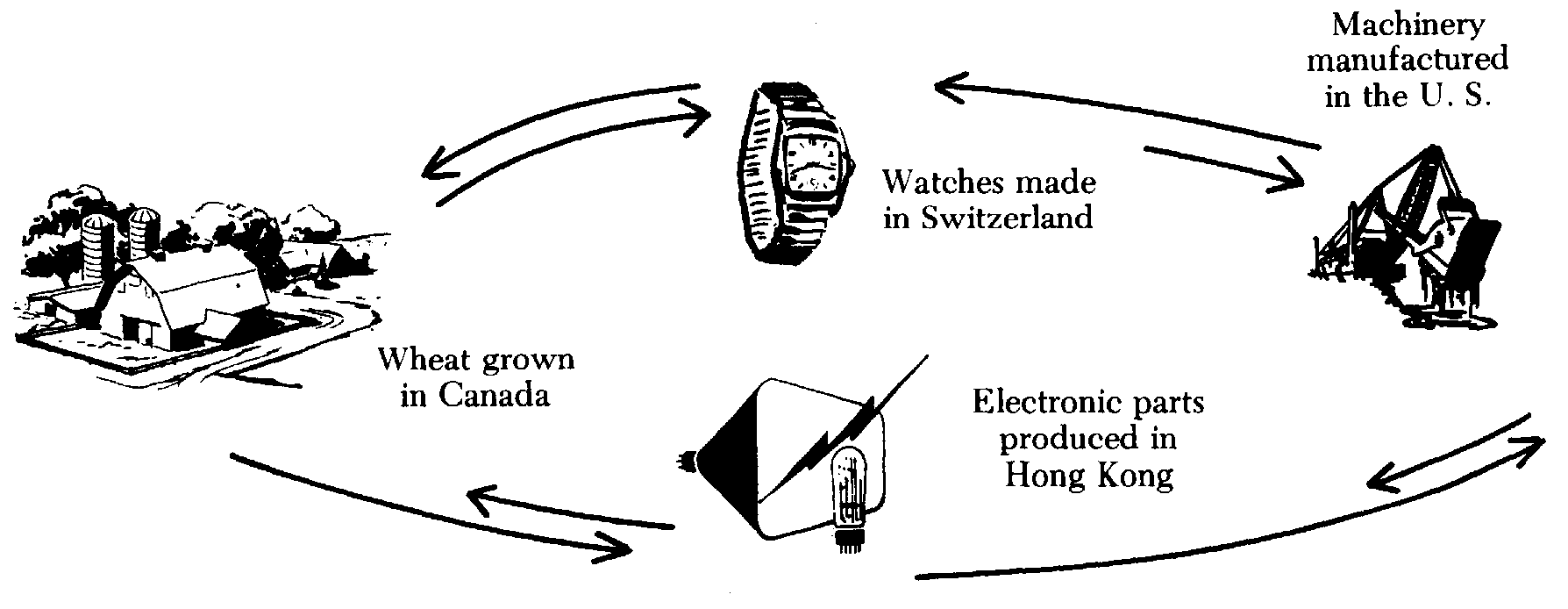
The goods shown here are being transported clockwise, the money in the opposite direction. Most interregional transactions would be much more complicated to diagram than these. However, this illustrates the most important point to stress in the classroom, namely that, sooner or later, directly or indirectly, we always pay for the goods and services we consume with our own production, whatever that may be.
Most of us pay for the things we want with money received in wages or salaries from our employer. He, in turn, has received the money he pays us—which tends to equal the value his customers place on our respective contributions to the products we help him produce—from his customers as his “gate” or “box office receipts.” To barter the specific good and service we are producing locally for the various things we want from all over the world would not only be extremely timeconsuming and complicated but virtually impossible. The use of money simplifies these transactions. Money is tremendously important, imperative, vitally necessary for the carrying out of interregional transactions involving countless interpersonal exchanges over large geographical areas. However, the use of money as an intermediary doesn’t alter the fact that we pay with our own production for the many things we consume, whether they are produced at home or abroad.
When we produce something others want and are willing to pay for, we are creating our own purchasing power. This becomes evident when we may use what we have produced to purchase something we want which was produced by someone else. Their willingness to accept our output in trade —and our eagerness to acquire theirs—is proof that purchasing power comes from production. The more anyone can contribute to what others want, therefore, the more purchasing power a person will be able to acquire. In other words, in an economy where specialization and the division of labor are developed, the output of a specialized worker becomes purchasing power for the many things he wants to consume as it is traded on the world market to other persons who want it. By producing goods and services to be distributed and sold to others throughout the world, therefore, every producer creates his own purchasing power. At the same time he creates a demand for the production of others. This great economic truth, the “law of markets,” was recognized and explained (Reading No. 63) by Jean Baptiste Say (1767-1832). As a result, every one of us is spurred on—by our own personal desire to consume—to produce goods and services for the consumption of others at home as well as throughout the world.
NOTE: Every student in the class probably uses and consumes many items produced in other parts of the world, near and far, or made from raw materials that come from abroad. The lists of imports and sources of raw materials which the students may have compiled in connection with this Unit’s suggested activities 2, 3 and 4, should help to reveal the economic interdependence of peoples throughout the country and the world.
5. What are the differences, if any, between trading among next door neighbors or with persons across the street, across town, across the state, across state lines and across national borders? Whether something is produced within a community or brought from somewhere else to be sold there makes no difference as far as the consumer is concerned. Consumers are interested primarily in obtaining, as easily and as cheaply as possible, the things they want most urgently. People from different geographical locations trade with one another simply because interregional trading appears to be easier and cheaper for obtaining the various things they want than producing them at home or seeking them from nearby neighbors.
NOTE: In considering interregional trade, it is important to stress the thesis to which we have referred again and again in this syllabus: To understand and explain any economic phenomenon, break it down into the specific units of which it is composed. The units involved in any interpersonal transaction—(a) the individuals who are doing the trading, (b) the various ideas and values that spur them to trade, (c) the particular units of the specific goods and services that each potential trader is evaluating and comparing with a view to exchange.
Every person is constantly weighing in his own mind the relative advantages of trading or not trading. Anything that adds to the difficulties of supplying something to a market tends to raise the price an entrepreneur must ask for it and consumers will have to pay for it—if that enterprise is to cover costs and stay in operation. Anything that helps to make that something easier and cheaper to produce will tend to lower its price on the market. Bringing an item to market from another geographical area may add to its relative production cost—especially if it is expensive to ship—but more importantly, the opening of interregional trade offers an opportunity to reduce production costs. Interregional trade permits increased division of labor and specialization and the concentration of large-scale enterprises in those geographical areas which are best suited and most richly endowed for their purposes and where the least expensive and most suitable workers are available. Thus, interregional trade helps to direct production to places where it is most economical.
The distance something travels to reach consumers is irrelevant to them. The important thing in their minds is whether or not it serves their purpose at a cost they are willing and able to pay. The advantages and savings to be derived from specialization often make the bringing of goods and services into a community from far away the easiest and cheapest way to get them. Things as heavy as a grand piano or as fragile and delicate as artificial flowers may quite possibly be produced abroad and shipped half way around the world, ofttimes by air, and still sell for less than it would have cost to produce them at any location closer to their markets. The principal advantage of interregional trade, therefore, is that it opens up an opportunity to carry on more specialized production on a larger scale in the geographical areas most suitable for the purpose. Thus, interregional trade helps to make production more economical and goods and services more readily available. In a free market economy, there is no difference in theory between trade among next door neighbors and trade among persons at opposite ends of the earth. The only question is whether or not the customers want the goods and services in question enough, at a particular place and time, to pay the prices being asked by their owners.
In his book, Socialism (Jonathan Cape, 1951/ 1969), Professor Ludwig von Mises expressed this thesis as follows:
If trade were completely free, production would only take place under the most suitable conditions. Raw materials would be produced in those parts which, taking everything into account, would yield the highest product. Manufacture would be localized where the transport charges, including those necessary to place the commodities in the hands of the ultimate consumer, were at a minimum. . . . Under Capitalism, frontiers would be without significance. Trade would flow over them unhindered. They would prohibit neither the movement of the most suitable producers towards immobile means of production, nor the investment of mobile means of production in the most suitable places. Ownership of the means of production would be independent of citizenship. Foreign investment would be as easy as investment at home. (pp. 227-235)
It is easy to understand that interregional trade would be worthwhile if everything were produced under absolutely optimum conditions, where it could be made cheapest and best by workers whose aptitudes and training in each field were tops. Canadian wheat farming and Swiss watchmaking approach that ideal. Yet it could very well be that a factory could be built in the midst of the Canadian wheat belt where still better and cheaper watches could be made than in Switzerland. Even though Canadians might be able to out-produce the Swiss in both fields of production—growing wheat and making watches—the super-superiority of the Canadian climate and soil gives them a relatively greater comparative advantage as wheat farmers. Specializing in the field in which they are Number One, thanks to their resources and skills, yields them relatively more purchasing power than if they used some of their time, energy and raw materials in somewhat less productive enterprises such as watchmaking.
David Ricardo, the noted economist of the Classical School, was the first to explain the pattern of international trade in terms of “comparative advantage.” Ricardo pointed out (Reading No. 57) that trade among specialized producers was still worthwhile, even if the potential productivity of one producer might be greater in every field of production than the productivity of any and every other single producer. By purchasing or importing items which are relatively difficult and expensive to produce at home it becomes possible for every producer to specialize in the particular field of production which yields him the very most in the way of goods and purchasing power. In other words, by buying some things, each of us is able to concentrate in the particular field in which we enjoy the greatest comparative advantage.
In a worldwide free market economy, there would be no difference in theory between trading within a small geographical area and trading over great distances. However, in the world in which we live, there are significant differences in practice due to man-made distinctions. If units of goods, services and/or money are transferred from a geographical region under the jurisdiction of one government to a region under another government’s jurisdiction, there may be substantial differences in costs and ease of trading. The acts and decrees of local state and/or national governments may foster local interregional transactions and hamper those that involve more than one governmental jurisdiction. Legal actions may lead to sharp differences between domestic transactions and trade across political boundaries.
Any government—local, state, federal or regional (such as NATO or the European Common Market) —may influence interregional trade in several ways. The government of the region where a good or service is originated, the government of the place to which it is shipped to be sold, as well as any government having jurisdiction over its shipper and/ or over the route it is shipped, may interfere to affect prices, production and/or exchanges. One or all governments may levy taxes at one or several stages in production. One or all governments may regulate, control or limit production at any step along the way—from the processing of the needed raw materials down to the sale of the final product to consumers. One or all governments may offer special aids or subsidies to stimulate the production of certain goods or the performance of certain services. At the instant any government takes such an action—to tax, regulate or subsidize certain steps in production and trade—it creates a distinction between (a) local interpersonal transactions and (b) trades with and among persons outside its jurisdiction.
NOTE: The main emphasis of this Unit, as throughout the syllabus, is on economic theory, in this case the theory of interregional trade. However, if time permits, the students should learn something about the more important government actions which affect interregional trade.
Legal and political factors may alter the pattern of production and trade in many ways. Certain activities may be encouraged, others discouraged. However, trade and production still tend to gravitate to those geographical regions where they enjoy a relative or comparative advantage, in the light of the new situation. But when governments interfere, economic considerations will no longer be controlling. Political and legal factors must also be considered then in estimating production costs and potential markets. People will continue to trade with one another, of course, so long as it is allowed and so long as it appears worthwhile. However, the pattern of production and channels of trade will be significantly affected in various ways.
To determine whether or not a specific law or regulation introduces non-economic factors which affect interpersonal transactions so as to create distinctions between domestic and international trade, analyze its effect on the prices and supplies of specific goods and services. Does it contain provisions that create artificial (non-economic) differences between the prices and supplies of some good and/or service (a) within and (b) beyond the government’s jurisdiction? If so, then sooner or later such government actions will lead to distinctions between domestic trade, i.e. interregional trade within the area of a government’s jurisdiction, and interregional trade which takes place into, out of, and across the borders of a nation, state or some other governmental jurisdiction. This is the criterion used here for determining which government actions affect interregional trade.
Prevent and/or discourage imports:
Taxes on imported goods (tariffs), ofttimes to protect infant industries Prohibitions against certain imports (embargoes) Legislation urging, or requiring, purchasers to patronize domestic or local producers, i.e., to “buy American”
Limitations on the amount of specific items which may be imported (quotas)
Legal “escape clauses,” calling for tariffs or quotas to be imposed at some specific “peril point,” when the administrators of the law determine that domestic producers are economically threatened by imports from abroad “Anti-dumping” legislation, i.e., prohibition of dumping or below-cost selling of imported goods
Restriction of imports which may hamper national defense Requirement of a special license or govern-ment-approval—by Food and Drug Administration, sanitation or health inspectors, etc.—to sell within a geographical area An inflation which is not recognized in official foreign exchange ratios, a monetary unit (the U. S. dollar, British pound, Italian lira, etc.) remaining legally over-valued in terms of other currencies; foreigners will not want to exchange goods, services or money for a money which the market values below its legal or official exchange rate Limitations on, or control, of the amount of foreign moneys (foreign exchange) traders may acquire
Encourage imports:
Government subsidies to importers Government subsidies to foreign producers, i.e., foreign aid
Tariff reductions on some or all imports from all other countries or from only certain specified “most favored nations”
Price and wage controls—production declines because domestic sales become less and less profitable so consumers come to rely more and more on imports Prevent and/or discourage exports:
Limitation of exports, i.e., export quotas Prohibition (embargo) of exports Requirement of government license or special permission to export certain items Special taxes on exports
Threat of confiscation or expropriation of capital invested abroad Taxation of income received from capital invested abroad Encourage exports:
Subsidies to encourage production for export Subsidies to finance exhibits by domestic producers at foreign trade fairs Government loans to exporters at lower-than-market interest rates Government grants or loans to foreign governments (foreign aid) to help finance their imports from the country supplying the funds Government-financed insurance of foreign investments
Relaxation of antitrust provisions to permit several U.S. firms to combine for purposes of foreign trade Government tax havens and free ports An inflation which is recognized by international traders but which has not yet had its full impact on prices within the country—foreign traders will be eager to exchange their currencies and goods for money which the market values more than its legal or official exchange rate, whether U. S. dollars, German Marks or Swiss francs, or for goods which are priced in those currencies below their world-market values Raise production costs—making it more difficult to compete on world markets, thus discouraging exports indirectly:
High taxes to finance such government programs as Social Security, unemployment compensation, relief, welfare Local sales and business taxes Local regulation of wages, hours, working conditions
Restrictions on the mobility of workers and would-be workers Government-required approval and inspection of production facilities and output Government-required licenses or authorization to go into business as a producer, dealer, merchant
The need to comply with complex, time-consuming and costly bureaucratic red tape
Threat of antitrust prosecution which may hamper economies of large-scale production and merchandising
6. What is government policy—federal, state, local—concerning interregional trade? The legal basis for action on the part of the U. S. government concerning interregional trade stems from authority granted by our Constitution. Several provisions (Article I, Section 8, paragraph 3; Section 9, paragraphs 5 and 6; Section 10, paragraphs 1 and 2) were intended to prevent the erection of trade barriers by the states, within the nation’s borders, and so to assure domestic free trade. Other provisions of the Constitution (Article I, Section 8, paragraphs 1 and 3) refer to the powers of Congress respecting foreign trade. Thus the national government has developed two different classes of trade legislation—(a) that relating to “interstate commerce,” i.e., trades among the several states, and (b) that involving trade into, out of, and across the nation’s borders.
The economics of interregional trade rests on the basic principle of human action, namely the drive on the part of individuals to relieve felt uneasinesses. If they are not prevented from doing so, the inhabitants of one geographical location will exchange goods, services and/or money with individuals in other geographical regions—whenever they consider trading to be of mutual advantage. No act of any government can ever negate that principle. However, government laws, orders, decrees and rulings can profoundly affect the alternatives available to would-be traders and, thus, their choices and actions.
Prior to World War I, the principal way the U.S. government influenced international trade was through the enactment of tariff legislation. As a matter of fact, the first revenue bill passed (1789) by the very first U. S. Congress called for tariffs on certain imports. Any tariff will alter selling prices to some extent. However, the rate of tariff levied makes a big difference. A low tariff may not present a serious obstacle to importing; foreign goods may still be able to compete on the domestic market, will continue to come into the country and tariffs on them will be paid, yielding an income to the government. A high tariff, on the other hand, may reduce imports so much that fewer or no foreign goods can be sold in the domestic market. Thus, a high tariff doesn’t necessarily mean more revenue to the government. A high tariff could reduce government revenue from imports, or eliminate it entirely. At the same time, by effectively protecting domestic producers of competitive products from foreign imports, a high tariff gives local businesses a tremendous advantage in selling on the domestic market. The major controversy over trade policy throughout this country’s first 100-150 years, therefore, was between advocates of a relatively low tariff “for revenue only” and those who wanted higher tariffs “for protection.”
Since World War I, the U. S. government has taken a much more active role in trying to regulate and control interregional trade. As a guide to the teacher, here is a list of the more important laws and types of laws enacted at various government levels, which have been responsible for shaping (a) international, (b) interstate, and (c) intrastate trade policies in recent decades. This list points up the major developments only. To include every law and every revision of the laws affecting interregional trade would be impossible.
a. International:
1918—Webb-Pomerene Act—In order to promote exports, this legislation exempted U. S. firms from antitrust prosecution under certain circumstances, permitting them to form combinations to engage in foreign trade
1921—Anti-Dumping Act—Condemned imports brought into the U. S. at “less than normal value,” which was defined as less than their market price at home
1922—Tariff Act of 1922—Introduced the policy of offering to make mutual tariff reductions among “most favored nations”
1930—Tariff Act (Hawley-Smoot)—Increased tariffs on many imported items, and required country of origin to be shown on all imports
1933—Buy American Act—When making purchases with federal funds, government agencies were required to give preference to domestic producers, primarily from depressed areas, unless the prices of comparable imports were substantially less than those of U. S. manufactured items. How much below U. S. prices imports would have to be before federal funds could be used to buy them instead of products of U. S. manufactory was left to executive or administrative decision.
Ban on the export of gold and on the ownership and use within the country of monetary gold by U. S. citizens. This is only one of many acts on the part of the federal government which has significantly affected international transactions in terms of money
1934—Reciprocal Trade Agreement Act
Export-Import Bank—Set up to make loans in order to promote imports and exports
World War II—Many laws were enacted to facilitate trade, to provide materiel and loans to the Allies and to prevent trade that might give aid or comfort to the enemies
1945—Foreign Aid—Several programs enacted to provide grants, loans and gifts to other nations in the form of credit, machinery and surplus farm products Establishment of the International Bank for Reconstruction and Finance (World Bank) and the International Monetary Fund
1947—General Agreement on Trade and Tariffs (GATT)—This agreement provides the framework within which member governments carry on discussions for the purpose of liberalizing trade. It aimed to reduce import quotas (quantity restrictions) on imports but it retains a provision permitting governments to apply for relief from injurious imports when a domestic industry faces economic losses due to foreign competitors
1948—Export controls for the sake of national security, restricting trade that might aid Soviet aggressive expansion
1950—Embargo on exports to Communist China
1955—Restrictions on the importation of goods which might adversely affect national security
1956—Customs Simplification Act
1960—Embargo of all exports to Cuba except foods and medicines
1961—Foreign Assistance Act—A reorganization of the International Cooperation Administration (ICA) and the Development Loan Fund (DLF) as the Agency for International Development (AID)
1962—Trade Expansion Act—Passed upon the recommendation of President Kennedy, intended to reduce tariffs and increase international trade
1966—Export Control Act—Liberalized trade with Eastern Europe and the USSR 1969-1971—Step-by-step removal of 1950 embargo on trade and travel with Communist China
International Commodity Agreements—For years, governments have tried to “stabilize” certain world commodity prices. As early as 1925, in the case of sugar, 1926, in the case of steel, attempts were made to regulate prices and quantities traded. Other commodities covered by similar agreements have been cocoa, coffee, cotton, rubber, tea, tin and wheat.
b. Interstate:
It is impossible to list every act of the federal government which has had some influence on interregional transactions that take place within the nation’s borders but across state lines. Perhaps the first major intervention of this type was the establishment of the Interstate Commerce Commission in 1887. Since then numerous federal laws have been passed and countless federal agencies have been established to regulate and control “interstate commerce.” There is, of course, no need to go into these details. However, the teacher should call attention to the fact that as a result of various federal government interventions, officials in Washington exercise a profound influence on the economy. To give an idea of the extent of federal influence on production and interregional trade, here are some of the more important federal government interventions which have affected production and trade and which have led to increases and decreases in the relative scarcity of certain goods and services in some parts of the country and thus to higher or lower prices for various goods and services. See a recent U. S. Government Organization Manual for information on the legislative history of any specific federal agency. Regulation of interstate transport carriers Regulation of “labor-management” relations, wages, hours and working conditions in business firms engaged in “interstate commerce” Subsidies to states and local governments or agencies for specific purposes such as the construction of schools, libraries, housing, post offices, highways, airports, canals, dams, power projects
Programs for slum clearance or urban renewal Relief to economically depressed areas Aid to disaster areas
Farm price supports, crop insurance, and payments for soil bank, reclamation and/or conservation
Grants for research and development Welfare and relief
Loans at below-market interest rates to certain borrowers, small business firms (SBA), rural users of electricity (REA), homeowners (FHA), etc.
Government-financed production of arms and military materiel Government payments to certain individuals— veterans, unemployed, oldsters, dependents, disabled, students on scholarships, etc.
c. Intrastate:
In spite of the constitutional provisions made in Article I, Sections 9 and 10, intended to assure freedom of trade among the several states within the country, many obstacles to domestic transactions have developed. State and local laws, statutes, regulations and ordinances have led to many differences in prices for the same good or service in different localities. For instance, laws restricting the hours when stores may open for business can encourage sales and shopping in communities permitting evening and weekend business while making it relatively more expensive to operate in other localities. Preventing the sale of certain goods across state lines—for instance grapefruits or tomatoes below certain weights or sizes—may make “sub-standard” fruits and vegetables cheaper within a state’s borders while tending to raise the out-of-state prices of the larger fruits and vegetables. Among state and local restrictions that alter the prices at which goods and services are traded are state and local sales taxes, quality controls on produce (milk, for instance) shipped into or out of an area, compulsory sanitation and safety inspections, licensing requirements, building restrictions, zoning ordinances, limitations on hours for conducting certain businesses, maximum size and tonnage allowances for trucks, and so on. How much class time, if any, may be spent on a discussion of local trade barriers will depend on the situation. However, the teacher should at least mention the fact that government actions at the state and local levels also affect interregional prices, sales, purchases and transactions.
7. What are the leading problems raised in recent discussions of international trade? As we have seen in the course of this Unit, individuals trade voluntarily across national borders for the same reason they trade with other persons at any time or place—next door, across town, from one geographical area to another. They are seeking to relieve some felt uneasiness; they hope to acquire some good or service they want that they couldn’t have at all, or couldn’t get any other way as well, as cheaply or as easily. This insight is derived from an understanding of subjective (personal) value and the theories of human action, choice and marginal utility. Barring force, fraud or human error, both parties gain from a voluntary transaction. Placing obstacles in the path of voluntary transactions, therefore, only tends to make it more difficult if not impossible for individuals to help themselves. In spite of this lesson to be learned from the logic of modern economics, however, many persons fail to comprehend its implications.
Many people today believe as the Mercantilists did in the 17th century, that only the seller of a good or service benefits from trade, to the disadvantage of the buyer. It is held that the seller receives money in exchange which makes him richer, while the buyer has to pay money out, which presumably makes him poorer. There are two fallacies here. Both may be proven wrong by reasoning logically from the six basic a priori categories and the nature of human action.
The first error is in claiming that one party gains from a voluntary trade while the other party loses. Barring miscalculations, both parties gain. Individual values and value scales differ. Two persons trade only if, as and when their values and value scales dovetail so that both expect to receive in exchange something that they value more than they value whatever they give in trade. When they trade voluntarily it is always in anticipation of relieving some felt uneasiness and thus of improving their respective situations.
The second fallacy implied above is that only money is wealth, that only the person who gives goods or services in exchange for money gains, while the other person, who pays money out to obtain goods and services, is poorer as a result of a trade. Yet the fact is that when money is taken in exchange, it is only a temporary makeshift, so to speak, on the road to the final goal of consumption. The value of money stems only from its being a medium of exchange, something which may be traded later, more or less at will, for other things to use and consume. The ultimate purpose of any voluntary trade is to obtain goods and services to consume. Adam Smith said it as follows: “Consumption is the sole end and purpose of all production.” (The Wealth of Nations, Book IV, Chapter VIII. Modern Library ed., p. 625). Thus, acquiring money is only an intermediate step in obtaining other goods and services to use, consume and enjoy.
These two Mercantilist fallacies linger on today. They are partially responsible for foreign aid and other subsidies to foster exports of goods and services, as well as for protective tariffs, import embargoes, quotas and various other measures designed to preserve domestic markets for domestic producers. These two Mercantilist fallacies have contributed to the complex of government interventions listed above following Question No. 5 of this Unit. The Mercantilist philosophy prevails widely today because people do not realize that any voluntary trade—whether sale or purchase, import or export—benefits both parties.
Before leaving this analysis of the issues currently influencing trade policy, a few comments should be made of the terms “balance of trade” and “balance of payments.” Most discussions of international trade in recent years have been dominated by the concern that a nation should have a “favorable” balance of trade and a “favorable” balance of payments. These two terms come to us from old Mercantilist fallacies which have survived for several centuries.
a. Balance of trade: It was a Mercantilist idea that the citizens of a nation are better off if its trade on net balance in the world market consists of exporting goods and services and importing money. Inherent in any such doctrine is the thesis that the country, the nation, is a separate entity, with interests and goals as a unit over and above the interests and goals of the individual citizens. This is macro-economic thinking. The idea that the balance of trade is important belongs to macro-economics. It ignores individuals and the nature of human action. It fails to recognize that individuals trade voluntarily across national borders, as they do at any time or place, only if it seems in their selfinterest. Due to lack of economic understanding, it fails to note that behind every individual trade there is a conscious decision, a purpose, an idea, goals and values.
To analyze the balance of trade doctrine it is well to use the same technique used in analyzing other economic concepts—breaking it down into its component parts, the individuals who are trading and their separate individual transactions. It becomes easier to understand a nation’s balance of trade if we consider first an individual’s personal balance of trade. When a person is working for wages or selling a good or service for money, his temporary balance of trade—in the terminology of the Mercantilists—is “favorable.” If a person accumulates funds over a period of time, in anticipation of a large expenditure, his balance of trade will appear “favorable” in the Mercantilist view, so long as his daily cash income exceeds his daily cash outgo. When he spends the money he has earned or saved for anything, no matter how urgently he wants it— whether food, clothing, shelter, fun or a luxury item—Mercantilists would bemoan his balance of trade, saying it was “unfavorable.” No matter how eager he is to acquire what he buys with his savings—be it a new motorcycle, a second-hand car, a stereo tape deck, college tuition, a necessary medical operation, an airplane ticket, or whatever —Mercantilists consider his balance of trade during the period of time when his money expenditures exceed his money income, “unfavorable.” Thus, in Mercantilist terminology, an individual’s net balance of trade will be “favorable” at times, “unfavorable” at others. From the individual’s viewpoint, however, it is immaterial whether his balance of trade is “favorable” or “unfavorable.” If his balance of trade is the outcome of his subjective (personal) values and preferences and his voluntarily-made individual choices and actions, it is the product of his attempts to relieve as best he can his personal felt uneasiness at any moment.
A nation’s balance of trade is simply a composite of the balances of trades of all persons living within its borders. Just as the market economy was demonstrated to be a composite of countless interpersonal transactions and agreements (Unit 5) and the price of any specific item at a particular time and place was shown to be the outcome of countless individual value judgments, choices and actions (Unit 6), so is a country’s balance of trade during any specific period of time, the product of the balances of trade of all individuals involved— “favorable” at times, “unfavorable” at others.
b. Balance of payments: A nation’s balance of payments, like its balance of trade, is a composite, the sum of the separate net balances of payments of all the individuals involved. As currently used in discussions of international trade, a nation’s balance of payments is a balance sheet recording its transactions during a certain time. It reveals the net flow of cash into, or out of, a country during that period of time. A country’s balance of payments is referred to as “favorable,” if it shows a net inflow of cash, or as “unfavorable,” if cash is flowing out on net. Yet this is a misuse of terms, as anyone who understands something about accounting procedures and statements of accounts will recognize. Every statement of accounts always shows a balance between debits and credits. Balances of payments, therefore, always balance. Every net debit on a balance sheet, personal or national, will always be balanced by credits of some kind—or vice versa.
Thus a nation’s balance of payments, like all the individual balances of payments from which it is composed, will always be in balance. Gifts of cash, foreign aid, unpaid loans, tourist spending abroad, etc., will be balanced on the statement by credits of some kind, good will, IOUs, income from foreign investments, or some such. Thus, it means little to speak of a “favorable” or an “unfavorable” balance of payments.
SUMMARY
The principles of international trade are the same as those involved in any interpersonal transaction. Individuals will exchange specific units of a good, service and/or money with one another when both parties expect to benefit. Barring force, fraud and human error, therefore, trades which are voluntarily agreed upon are advantageous for both of the traders concerned. Any outside factor which prevents or hinders voluntary transactions can only make trade and production more difficult, more time-consuming and more expensive, to the detriment of all individuals concerned. Many, if not most of the government programs now in force that affect international trade fall in this category of disruptors of peaceful and voluntary transactions.
The current concern for having “favorable” balances of trade and balances of payments is founded on Mercantilist fallacies. If the flow of cash, in or out of a country, is the consequence of voluntarily-made, uncoerced, personal, individual choices and preferences, one-way traffic in either direction for goods and services or money will never last for long. Trade is always a two-way affair. The ultimate goal of any transaction is always to acquire goods and services for use and consumption. This brings us back to Henry Hazlitt’s quotation at the start of this Unit:
The real gain of foreign trade to any country lies not in its exports but in its imports.
Voluntary, interregional trade is an outcome of conscious, purposive human action, interpersonal cooperation, specialization and division of labor. Voluntary, interregional trade is one of the most important means for increasing production and improving the living standards of every one, especially the poor, the handicapped and the least capable.
GLOSSARY WORDS
(For definitions, see glossary, pp. 223ff.)
Balance of payments
Balance of trade
Balance sheet
Comparative advantage
Cooperation
Division of labor
Dumping
Duty
Embargo
Exchange
Export
Foreign exchange
Free port
Free trade
Import
Infant industry
Macro-economics
Margin
Mercantilism
Most favored nations
Multinational corporation
Non-tariff barriers
Protectionism
Quota
Specialization
Tariff
Trade
RECOMMENDED READINGS
More advanced materials are indicated by an asterisk (*)
Articles
In the BASIC READER:
15. “I, Pencil,” Leonard E. Read
55. “The Candlemakers’ Petition,” Frederic Bastiat
56. “Free Trade: Domestic/Foreign,” Dean Russell *57. “On Foreign Trade,” David Ricardo *58. “Foreign Investment vs. Foreign Aid,” Henry Hazlitt
* 59. “Restrictions on International Trade,” W. M. Curtiss
* 60. “The Failure of International Commodity Agreements,” Karl Brandt
Additional Titles:
“The Multinational Corporation,” Mark Peterson—in The Freeman, January 1974
Books
Bastiat, Frederic. Economic Sophisms (Van Nostrand, 1964; FEE, 1968)
Carson, Clarence B. Throttling the Railroads (Liberty Fund, 1971)
Curtiss, W. M. The Tariff Idea (FEE, 1953/1962) Fleming, Harold M. States, Contracts and Progress: Dynamics of International Wealth (Oceana Publications, 1960/1966)
Hazlitt, Henry. Economics in One Lesson (Harper, 1946; 2nd ed., MacFadden, 1962; Manor Books, 1973). Chapters 11 and 12
* Mises, Ludwig von. The Free and Prosperous Commonwealth (Van Nostrand, 1962). Chapter 3
Polo, Marco. The Travels of Marco Polo (c. 1300). Many editions
Smith, Adam. The Wealth of Nations (1776). Many editions. Book IV
See also: Miscellaneous references in local libraries dealing with specific phases in the history of trade—the Phoenicians, the spice trade, the impact of the Crusades on European imports, medieval trade fairs and markets, itinerant peddlers, explorations in search of new trade routes, the era of the clipper ships, the opening of the Western United States to Eastern markets thanks to steamboats on the Mississippi and cross-country trains, the increased use of airplanes for shipping, etc.
POSTSCRIPT (November 1976): The longstanding dominance of Swiss watches on world markets, accepted without question when this Unit was written, has since been seriously threatened. Accurate and inexpensive digital watches, developed as a spin-off of computer science and electronics, have challenged the pre-eminence of Swiss watchmakers, making obsolete their traditional skills and tools. This shift in interregional specialization illustrates how changes in trade take place as entrepreneurs innovate, if they are free to do so, in the attempt to satisfy consumers better.

