
Free Market Economics: A Syllabus
13. History of Economic Thought
13. HISTORY OF ECONOMIC THOUGHT
SUGGESTED ACTIVITIES
1. It should be helpful to have each student construct a “family tree” of the men who contributed to developing the major economic ideas presented in this syllabus. See the chart on pp. 162-163. Have each student draw his or her own skeleton outline, or have copies mimeographed or dittoed in quantity. If the teacher has an overhead projector, he or she can make a transparency of the skeleton outline and fill it in during the class lecture as the various men, economic “schools” of thought and their interrelationships are discussed. The students can then write in the pertinent names on their outline drawings as the teacher talks.
2. Students who wrote term papers on specific economists or theoretical schools of economics might turn them in at this time. Perhaps a few could be read aloud and discussed in the classroom. This assignment should be made early in the course to allow time for research. Have each student clear his or her topic with you as teacher to make sure they select an economist or “school” on which sufficient material will be available. To encourage the use of libraries and reference materials, ask each student to consult five specific sources as a minimum and to list these sources as the paper’s bibliography. Conventional encyclopedias usually include short bibliographies at the close of any major article, so encyclopedia articles are good places to start such research.
3. Exceptional students with some imagination and research ingenuity might compile an anthology of excerpts from the writings of old-time economists which deal with problems similar to those facing the world today—inflation, shortages, government controls, etc. Or quotations from their works could be used as the basis for composing a mock “newspaper.” Its headlines might read, for instance, “Economist discusses proposals for new public works,” and the article that followed could quote a Keynes’ statement in favor of government spending to promote economic prosperity. Another article might purport to be a news story on price and wage controls, citing Adam Smith’s recommendations for free market prices even when there are shortages due to war or famine (see “Dearth” in the index to Smith’s The Wealth of Nations). Or one of Bastiat’s satires could be used to expose the fallacy of imposing tariffs on imported oil. A student reporter could relate an imagined interview with Plato, Smith or Bastiat as to the role of an overall planner or the “invisible hand” in directing the provisioning of Paris, New York, or Dallas, for instance. Such a project should help the students realize that problems similar to those we face today have arisen before and that most of the interventionist solutions now being proposed have been made many times before.
4. If class interest warrants it, students who have researched the theories of particular economists in depth might take part in a round table discussion, each speaking as if he or she were the person whose ideas they had studied. The formats of TV interviews or panel discussions could be adopted. Some students would then play the role of guest economists or “experts,” others the parts of reporters or journalists asking questions. The questioners would also have to familiarize themselves with the theories of the men they were interviewing, so as to pose suitable questions on pertinent economic issues and various government programs.
EXPLANATORY TEXT
This Unit is supplementary to a basic course on economic principles, for the most important theories of human action have been covered in the preceding Units. However, if time permits it would be helpful, even in an introductory course, to include some mention of the historical development of a few of the major economic theories. Or the material in this Unit might be used as the basis for a second economics course, possibly even expanded into a full semester by making full use of the references in its fairly ample list of recommended READINGS.
DATES
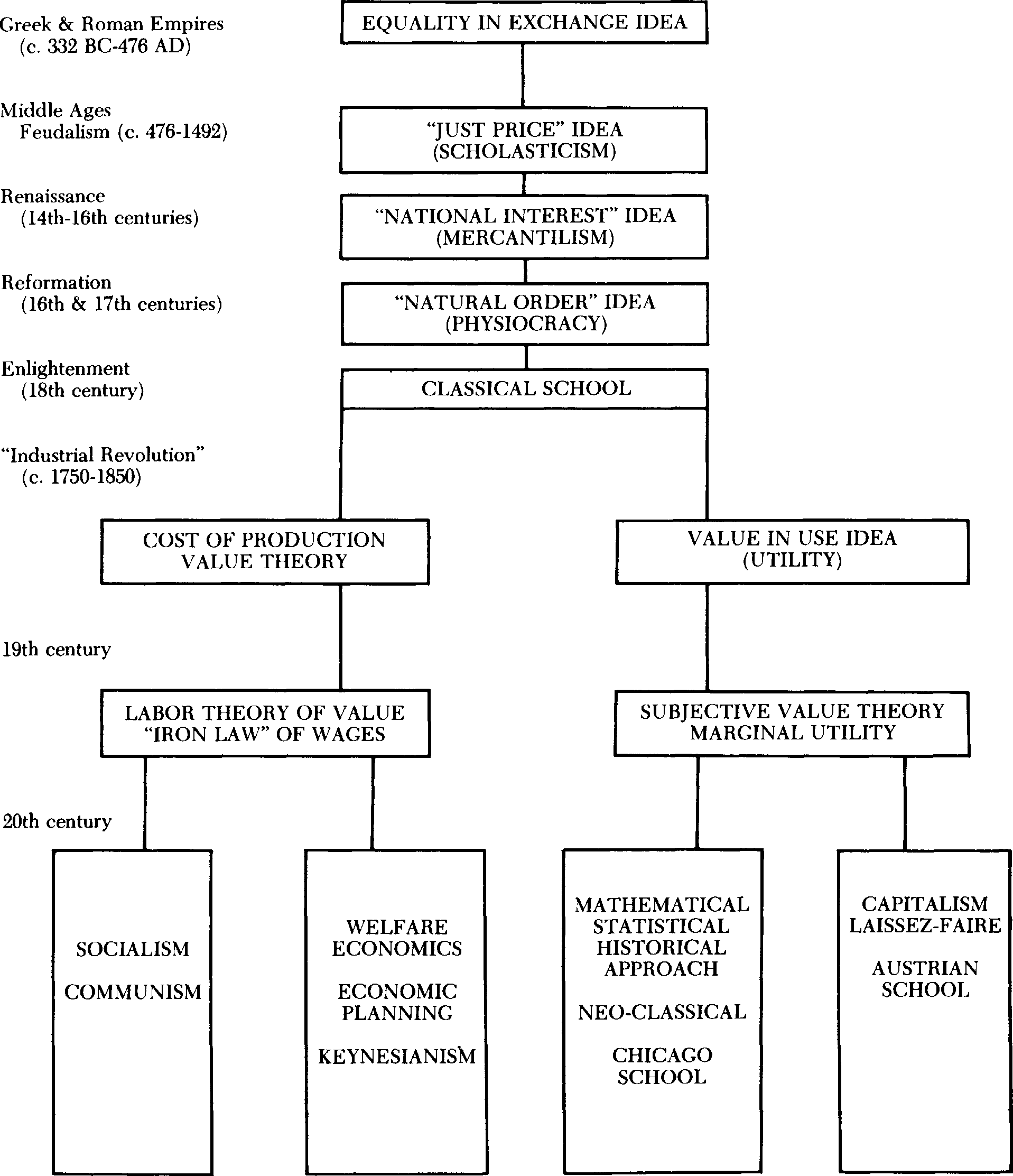
MAJOR ECONOMIC THEORIES AND LEADING THEORETICIANS
Greek and Roman Empires
Equality in exchange idea
Socrates (470?-399 B.C.)
Plato (427?-347 B.C.)
Aristotle (384-322 B.C.)
Middle Ages, Feudalism
Scholasticism and the “just price” idea
Thomas Aquinas (1225-1274)
Renaissance & Reformation
Mercantilism and the “national interest” idea
Thomas Mun (1571-1641)
Jean Baptiste Colbert (1619-1683)
Sir William Petty (1623-1687)
Sir Dudley North (1641-1691)
John Law (1671-1729)
Richard Cantillon (1680-1734)
Period of the Enlightenment
Physiocracy and the “natural order” idea
John Locke (1632-1704)
Francois Quesnay (1694-1774)
Jacques Turgot (1727-1781)
Classical School
David Hume (1711-1776)
Adam Smith (1723-1790)
Thomas Malthus (1766-1834)
David Ricardo (1772-1823)
John Stuart Mill (1806-1873)
“Industrial Revolution”
Cost-of-production value theory
Comte Henri de Saint-Simon (1760-1825)
Jean Charles L. Sismonde de Sismondi (1773-1842)
Pierre-Joseph Proudhon (1809-1865)
Value in use, utility idea
Jeremy Bentham (1748-1832)
Jean Baptiste Say (1767-1832)
Frederic Bastiat (1801-1850)
Hermann Heinrich Gossen (1810-1858)
19th century
Labor theory of value and the “iron law” of wages
Karl Marx (1818-1883)
Ferdinand Lassalle (1825-1864)
Subjective value theory, marginal utility
20th century
Nikolai Vladimir Ilich Lenin (1870-1924)
John Maynard Keynes (1883-1946)
Alfred Marshall (1842-1924)
Philip Wicksteed (1844-1927)
John Bates Clark (1847-1938)
Irving Fisher (1867-1947)
This Unit is necessarily a much abbreviated history of only a very few of the more important economic theories and doctrines. The selection for emphasis of one or several of the most important ideas for which an individual or a “school” has become known is not intended to imply that those early thinkers were narrow or single-minded—their views were just as varied and complex as are those of individuals today. Thus there was considerably more variety of views and difference of opinions among the adherents of the various economic “schools” of thought than one might conclude from this simplified history. However, it should suffice as an introduction to the historical development of a few of the more significant economic concepts. Moreover, studying the history of ideas offers one more opportunity to explain that all knowledge and the entire history of the world are products of the ideas and actions of separate and unique individuals. At the same time, the students should recognize in the theories of early thinkers the sources of some of the currently widespread economic fallacies.
1. What basic economic questions have challenged thinkers throughout the ages? Ever since men began to notice some regularity and order in interpersonal arrangements, they have sought to explain (a) the origin of market values and (b) the reasons why economic production and trade proceeded in a more or less orderly fashion without any overall direct or conscious supervision. The tentative early answers posed to these questions contained gaps and inconsistencies. Not until the end of the last century were thinkers and philosophers successful in answering them satisfactorily. About 1870, a few pioneering intellectuals explained in detail for the first time how market prices are derived from the subjective (personal) values of individuals. This insight also furnished the further understanding necessary for solving the second enigma. Production and trade too are explained by the subjective (personal) values of individuals. Producers and traders in a market economy look continually for guidance to the actions individuals are taking on the basis of their personal (subjective) values. No economic tsar need tell producers or traders what to do, for the purchases or refusals to purchase of individual consumers tell them what to produce, where and in what quantities.
2. How do knowledge and understanding progress over the years? The very earliest men on earth had to learn everything for themselves and reason things out alone. Until men were able to communicate over space and time, the learning process had to start over again and again in every community and with every generation. Gradually, however, people learned to share with others what they had learned and reasoned out. Those who came later had an advantage. Even if the ideas, knowledge and understanding passed along to them were rudimentary and unsatisfactory in many respects, they were still of some assistance. The mere formulation of a question or even a wrong answer may sometimes help other persons along the road to correct solutions. Thus, ideas, theories and doctrines were gradually developed and refined and later thinkers were able to build on them.
NOTE: To impress on the students how our understanding and knowledge depends on the work of other individuals, draw a simple line drawing on the blackboard of a giant with a dwarf who can see over the heads of other giants and beyond, because he is standing on the shoulders of a giant.
In this Unit, we shall try to fit into place some of the many jigsaw-puzzle-like ideas, each shaped and contributed by many individual thinkers who have helped to formulate modern economic theories. We shall discuss the attempts of early thinkers to explain the two basic economic enigmas—(a) the reason for market values and (b) how production and trade are arranged without the overall direction of a planner. We shall show how, step by step, the explanations offered became more and more successful at explaining the way men act in real life.
3. How did the study of “economics” begin? The word “economics” is a compound word derived from the Greek oikos, meaning house, and nemein, meaning to manage. In the time of the ancient Greek philosophers, the operation and management of the household was called oiko-nomia. Some communication and trade among households, communities and even among other peoples beyond the country’s borders took place in the time of the early Greeks but the basic unit seen and analyzed by thinkers of that era was the family household.
The greatest Greek thinkers, whose ideas live on in modern theory and philosophy, are Socrates (470?-399 B.C.), a teacher of Plato, Plato (427?-347 B.C.), who was a teacher of Aristotle, and Aristotle (384-322 B.C.).
Socrates is known primarily for his philosophy and teaching technique. Although nothing has come down to us that he may have written, his name has lived on through his students, his philosophy and his teaching method. The “Socratic method” is to ask questions and encourage students to reason things out for themselves. Socrates, considered one of the wisest men of all times, was an original thinker for his time. Because of his refusal to conform with conventional practices and beliefs, he was condemned to death and forced to drink a cup of poison hemlock.
Plato was a student of Socrates. His name is more closely associated with what is now considered economic theory, the field of human action. His description of the division of labor, which he considered the basis of society because cities were built on the division of labor, was a partial explanation of the economic arrangement responsible for production and distribution. The state’s role, according to Plato, was to protect the community. There different people specialize in different activities. The police themselves are specialists. He pointed out that:
All things are produced more plentifully and easily, and of a better quality, when one man does one thing which is natural to him and does it at the right time and leaves other things.
Plato apparently didn’t realize, however, that producers and traders in a free society do not need to be ordered to produce and trade. His views have come down to us through his Dialogues, the most pertinent being The Republic, in which he describes his “ideal state,” a planned community in which each person would be assigned a particular role. Everyone’s daily activities would be directed by a “Philosopher King” with the wisdom to see that the interests of everyone were served. Plato apparently didn’t realize that his “Philosopher King” would have to be a dictator. Nor did he realize that even a dictator could not create an “ideal state,” for the insight, knowledge and abilities of even an ideal dictator would be limited. Whether or not Plato’s portrayal of a “Philosopher King,” governing an “ideal state,” was made in seriousness or in jest for educational purposes, is debated to this day.
Aristotle studied under Plato. His philosophy and logic have stood up over the centuries better than has his analysis of the physical world, which he believed to be made up of four elements—earth, air, fire and water. Aristotle contributed to explaining economic relationships by criticizing Plato’s totalitarian communistic “ideal state.” He pointed out that “people pay most attention to their private property and less to that which they have but a part interest.” He opposed abolishing existing relationships for the sake of drastic reform, lest the result lead to worse conditions than those they replaced. He stood for gradual change, recognition of the nature of the individual and the encouragement of personal initiative and a sense of private property. However, he did not question the institution of slavery, which was then considered “natural.”
Ideas have changed radically over the centuries, but many of Aristotle’s ideas have stood the test of time. His theories profoundly influenced modern logic and, thus also, the a priori assumptions and logic from which economic principles are derived. Aristotle is perhaps best known in the field of economics for his attempted explanation of market values. His position was that when a trade takes place the two sides of the transaction must be “equal” in some respects.
When people get as the result of exchange exactly what they had at the beginning, neither more nor less, they are said to have what belongs to them and to be neither losers nor gainers. . . . The builder is to receive from the shoemaker of his ware, and to give him of his own. If then there be first proportionate equality, and then the Reciprocation takes place, there will be the just result which we are speaking of. If not, there is not the equal, nor will the connection stand, for there is no reason why the ware may not be better than that of the other, and therefore before the exchange is made they must have been equalized. . . . How many shoes are equal to a house or a given quantity of food? As then the builder to the shoemaker, so many shoes must be to the house (or food, if instead of a builder an agriculturist be the exchanging party), for unless there is this proportion, there cannot be exchange or dealing. . . . Agriculturist: Shoemaker: Wares of shoemaker: Wares of agriculturist . . . when they have exactly their own, then they are equal and have dealings, because the same equality can come to be in their case.
Aristotle’s reasoning—since superseded by the logic of subjective value theory—leads to the conclusion that if one person profits from a trade, it must be at the expense of another. In the Aristotelian view, this must be the case in a reciprocating market transaction for then the commodities offered on both sides are equal. If there is gain on one side, it must then be offset by a loss on the other. Aristotle did not realize that when two parties trade voluntarily, both are “trading up,” so to speak, i.e., they are both exchanging something they value less for something they expect will be more valuable to them. Thus in a free market transaction, both parties expect to gain and both will gain as a result of the trade—barring force, fraud and human error. Aristotle’s explanation of market values persists to this day and is still influential, in spite of the logic of modern subjective value theory which has shown up its error by demonstrating that both parties to a trade can be, and usually are, gainers (Units 3, 6 and 12).
4. How has economic knowledge and understanding advanced over the years? Ideas are passed on from generation to generation by “teachers” in the broadest sense of the word—anyone who tells or shows another something he or she has learned. From one experimenter-learner-thinker-teacher to students, who become in turn experimenters-learn-ers-thinkers-teachers themselves, ideas are spread directly in conversation, in writing and by any and all other means of communication.
Persons who hold similar views in any field are considered members of the same “school” of thought. Anyone with convictions who is persuasive enough may try to attract others to his way of thinking and in this way, a new “school” of thought may come into existence. The views of the adherents of a specific “school” are that “school’s” doctrines. The doctrines of some philosophical or ideological “schools” are based on a correct understanding of reality. However, men make mistakes, thus there is no guarantee that their ideas will always be correct. Thus, many “schools” of thought whose doctrines are poorly conceived and based on only partially correct or even completely false interpretations of reality, often attract adherents and have significant influence. It is important, therefore, to analyze any theory carefully so as to be better able to distinguish truth from falsehood, logic from illogic, more helpful interpretations of reality from less helpful ones. Only in this way may fallacious ideas be gradually weeded out and those found consistent with reason, logic and the course of events may be organized into a scientific body of knowledge. In this process, the “dwarf” who deals with ideas developed earlier has a “headstart” over intellectual “giants” of the past who developed from scratch the ideas the “dwarf” uses as tools to build on.
The first major economic “school” of thought to develop out of the ideas of ancient Greece and Rome, was Scholasticism. In the Middle Ages, St. Thomas Aquinas (1225-1274) took Aristotle’s idea of market values—namely that the goods or services exchanged for each other in a voluntary trade must be in some way “equal”—and went one step farther. Aquinas claimed that “equality” on both sides was necessary if there was to be any kind of justice. He developed the “just price” idea which he considered consistent with “natural law.” According to this thesis, a price may be too high, or too low, to be “just.” As Aquinas phrased it:
If the price exceeds the value of a thing, or conversely if the value of a thing exceeds the price, justice is violated.
Reasoning from this thesis, Aquinas and the Scholastics of the Middle Ages argued that charging interest on a loan was “wrong” and they denounced interest-taking as “usury.” Not until the modern subjective value theory was developed was the fallacy in this reasoning pin-pointed and exposed; there is nothing “wrong” with charging interest on a loan in a free market for the amount of interest is the outcome of voluntary bidding among would-be borrowers and would-be lenders (Unit 10). Nevertheless, a critical attitude towards charging interest lingers on. There is still a tendency on the part of many persons to frown on any lender who asks a borrower to pay what seems to them a “high” interest rate on money.
The next significant economic “school” of thought was Mercantilism, which flourished about the 17th century. Its leading spokesmen were Thomas Mun (1571-1641), Sir William Petty (1623-1687), Sir Josiah Child (1630-1699) and Sir Dudley North (1641-1691). The Mercantilists reasoned that the more money (i.e., gold and silver) an individual had, the wealthier he was. Similarly, the more gold and silver there was within a nation’s borders the wealthier that nation would be. In the eyes of these men, therefore, the goal of trade was to improve the nation’s wealth and the fortune of its king. As a result the Mercantilists’ concern was the nation’s “balance of trade” and the “terms of trade.” The “national goal” should be to export goods and import the precious metals and metallic money.
The Mercantilists failed to understand the fundamental economic lessons of this syllabus. They didn’t realize that the purpose of production and trade was consumption, that people work, produce and trade in order to obtain things to consume and enjoy. They failed to realize that money was only a temporary expedient, a “trading commodity,” a medium of exchange that people want to have on hand only for a time until it seems desirable to spend it. They thought money was the goal of production and trade. Therefore, they equated wealth and money, not wealth and increased quantities of consumers’ goods and services, and they advocated direct government action to influence the “balance of trade” and encourage the import of gold and other precious metals, which they considered the most valuable goods in the world. Thus they advocated regulating industry and trade by political privilege and subsidy on occasion, to encourage the export of commodities and foster the import of metallic money. As Thomas Mun wrote:
Behold then the true form and worth of forraign Trade, which is, The great Revenue of the King, The honour of the Kingdom, the Noble profession of the Merchant, The School of our Arts, The supply of our wants, The employment of our poor, The improvement of our Lands, The Nurcery of our Mariners, The Walls of the Kingdoms, The means of our Treasure, The Sinnews of our wars, The terror of our enemies.
In the 17th and 18th centuries, a new economic “school” of thought came to the fore—the Physiocrats. To a considerable extent the Physiocrats relied on the philosophical ideas of John Locke (1632-1704), spokesman for “natural law,” limited government and the protection of private property. Among the leading Physiocrats were Francois Quesnay (1694-1774) and Anne Robert Jacques Turgot (1727-1781). The Physiocrats held that nature, the “natural” and “natural law” were good. To live close to nature, to till the soil and to engage in agriculture were more noble pursuits than manufacturing. Many people today have similar ideas which no doubt contributes to the emotional attachment so many of them have for agriculture and the “family farm.” Because of their veneration for farming as a way of life, the Physiocrats favored government aid to agriculture. Otherwise the government should not interfere, economic activities should be allowed to develop “naturally.”
5. From what economic “school” of thought did modern economics originate? Modern economics probably really started in the 18th century with the “Period of Enlightenment” and the development of the “Classical School of Economics.” David Hume (1711-1776), the leading philosopher of that time, wrote many volumes, still worth reading, on the nature of the individual, the role of government ethics and moral principles. A young friend and student of Hume’s philosophy, Adam Smith (1723-1790), often called the “first economist,” made the first extensive analysis and comprehensive study of economic activity—An Inquiry into the Nature and Causes of the Wealth of Nations (1776), usually referred to simply as The Wealth of Nations. He explained fairly satisfactorily one of the two basic economic enigmas. Although he didn’t understand the reasons—which were not to be fully explained for another century when the subjective value, marginal utility theory was elaborated by the founders of the “Austrian School of Economics”—he pointed out that production and trade proceed in a more or less orderly fashion without the need for an overall dictator or planner. The businessman is led as if “by an invisible hand to promote an end which was no part of his intention.” The baker could judge pretty well how many loaves of bread to bake each day. The shoemaker could estimate fairly well how many pairs of shoes and what sizes people would ask for. No Philosopher King or dictator had to tell them what to do. Businessmen were fairly flexible; it was in their personal interest to shift and juggle their production plans continually and adapt to changing market conditions and market prices. Thus, a tendency always prevails on the market toward “equilibrium” between the supply of goods available and the demand for them by consumers. Smith’s reasoning led him to advocate laissez faire, French for “leave the people alone,” or let them “do their own thing.” Smith recognized that Mercantilist interventionist policies had frequently caused economic bottlenecks, surpluses of some things, shortages of others, so he favored government non-interference. In the view of Adam Smith:
The statesman, who should attempt to direct private people in what manner they ought to employ their capitals, would not only load himself with a most unnecessary attention, but assume an authority which could safely be trusted, not only to no single person, but to no council or senate whatever, and which would nowhere be so dangerous as in the hands of a man who had folly and presumption enough to fancy himself fit to exercise it.
The Wealth of Nations (Modern Library ed., 1937), p. 423
Smith and his colleagues in the Classical School failed, however, to explain satisfactorily the other economic enigma—the reason for market prices. They couldn’t understand why some very useful things, things which were needed to sustain life itself—air, water, food—were not as valuable in exchange as were many luxury items—gold, silver, diamonds—which were of little use to people except perhaps for ostentatious display and adornment. The inability of the Classical economists to explain this apparent “paradox of value” was due to their considering consumer wants and consumer goods in categories, in the aggregate, rather than in units. They failed to realize the importance of the fact that potential traders always consider wants and goods individually in their minds, in “bite-sized pieces,” that individuals contemplating a trade are always weighing mentally the relative values to them personally of one more, or one less unit of a specific good or service at a definite place and time. They lacked an understanding of the subjective value theory which lies at the crux of the explanation of market prices. They also failed to see the importance of the concept of the “margin,” the invisible line which separates in a person’s mind the units of a good or service he or she is willing to relinquish from those they are not, and the units of a good or service they consider worth acquiring from those that are not.
It took thinkers and economists another century to come up with the subjective value, marginal utility theory (Unit 6). Today, by being able to explain market prices as Smith and the other Classical scholars could not, we are like dwarfs on the shoulders of later intellectual giants who built on the contributions of Adam Smith and his colleagues. Thus, it is possible for us to surpass their understanding and to explain market prices more satisfactorily than they could. Nevertheless, their ideas are important for the history of economic thought. So a few more comments are included here about some of the leading exponents of the “Classical School of Economics.” Among those who helped to elaborate the theories Smith introduced were Jeremy Bentham (1748-1832), Thomas Malthus (1766-1834), David Ricardo (17721823), James Mill (1773-1836) and his son John Stuart Mill (1806-1873).
Jeremy Bentham’s views on value, utility and utilitarianism became stepping stones from the doctrines of the Classical economists to those of the modern subjective value, marginal utility economists of the “Austrian School.”
Thomas Malthus wrote an important essay on The Principle of Population, for which he was criticized for his pessimism in anticipating “population explosions” with starvation and epidemics as inevitable because the then existing agricultural methods were inadequate for feeding many more people. However, his explanations did call attention to the economic “law of diminishing returns,” the fact that the yield of any single piece of land or other factor of production begins to decline once it passes its productivity peak.
David Ricardo made a major contribution to explaining economic arrangements in setting forth the doctrine of “comparative advantage” (Unit 12 & glossary). Almost everyone can recognize that persons may gain by exchanging things they can produce easily and inexpensively for things they find more difficult to make for themselves. Ricardo explained that both parties can gain even if one person is more efficient, more productive and more capable in every respect than the other. The more proficient person gains from a trade with someone less capable, because the goods and services he receives from the less advantaged person save him the time and trouble of producing them for himself, thus permitting him to specialize in the things he does still better. Both parties to such a trade— the more proficient and the less proficient also— have a relative “comparative advantage” in trading with each other. The “law of comparative advantage” helps to explain the gains to be derived from trading with others, both within and across national boundaries, irrespective of the relative wealth, economic status or abilities of the parties concerned. It was a step toward the realization that self-interest guides people—the orders of dictators aren’t necessary—to take advantage of trading opportunities.
James Mill helped make Smith’s views better known, though he himself contributed nothing significantly new to economics. His influence was felt primarily through his son, John Stuart Mill.
John Stuart Mill was a genius and a prodigious student. Before he was six he knew many languages and by the time he was twelve, he was reading and writing philosophical treatises. He had a “nervous breakdown” when he was 20, apparently due to the intense pressure to please his father and succeed in his studies. When about 26 years old, he met and fell in love with Harriet Taylor, a young married woman and mother of two children. For twenty years the two were close friends, working and frequently traveling together, apparently with Mr. Taylor’s consent. Harriet Taylor nursed her husband faithfully during his last six months, when he was dying of cancer. A proper two years after Mr. Taylor’s death, Mill and Harriet Taylor married. By then, both were suffering from ill health and they had only a few years of married life before she died. He lived about 20 years longer, served in the British Parliament and continued to work and write. His The Principles of Political Economy, widely used as a textbook for many years, even decades, had a tremendous influence on economic thought. He wrote a popular essay in the field of political economy, On Liberty, still widely read today and he also produced several important treatises on logic and philosophy. He was a serious student and a prolific author throughout his life.
Many of the ideas of the Classical economists have stood the test of time. Smith, Bentham, Mal-thus, Ricardo and the two Mills were undoubtedly intellectual “giants.” However, by “standing on their shoulders,” so to speak, later economists were able to see farther and more clearly. As a result they succeeded in time in improving on their rudimentary theories. Today, by “standing on the shoulders” of those later intellectual giants, we too are in a position to recognize some of the flaws in the Classical theories of Smith, Bentham, Mal-thus, Ricardo and the Mills.
The spokesmen of the Classical School of Economics recognized three distinct categories of economic factors of production—land, labor and capital—based primarily on their physical characteristics. Yet physical traits have no significance for economics; for economics the important thing is the subjective value individuals attach to an object for some specific purpose. (See “Objective characteristics” and “Subjective value” in the glossary.) Also, the failure of the Classical economists to recognize the importance of subjective (personal) values and consumer sovereignty led them to attribute selling prices to production costs and to credit labor almost exclusively with the responsibility for a finished product. Yet in view of the “niggardliness” of nature, they considered pretty slim the chances workers had of earning much more in the long run than their basic subsistence. This pessimistic doctrine, that wages were severely limited to what was required for bare survival, was later termed the “iron law of wages.” The Classical economists’ pro-labor bias, combined with their crude labor theory of value, led them also to neglect the importance of the human mind and ideas in planning what and how to produce. They also failed to recognize the significance of time, the fact that all actions, production and consumption, take place over time. These flaws in Classical doctrines led many of their followers off at tangents. Probably the most noted student of the Classical theories to be led astray by many of the “School’s” wrong ideas was Karl Marx.
Karl Marx (1818-1883) was strongly influenced by the philosophical ideas of Georg Wilhelm Friedrich Hegel (1770-1831). Marx’s views on social organization came from early socialist thinkers, such as Jean Charles L. Sismonde de Sismondi and Comte Henri de Saint-Simon. He was bitterly critical of both (a) those who advocated a “utopian” socialism and (b) those who favored capitalism. But Marx also studied thoroughly the doctrines of the Classical School and many of his economic ideas were derived from the errors of Adam Smith and David Ricardo. Marx elaborated the Classical School’s “labor theory of value” representing prices as depending almost exclusively on their labor costs. His labor theory of value was much more explicit than Smith’s or Ricardo’s. Marx went on to say that labor was the sole source of a product’s market value and that anyone who received interest on savings or profits on investments was “exploiting” the workers, “stealing” from them something to which they, the workers, were entitled. Marx also accepted Smith’s concept of the three basic factors of production—land, labor and capital. Variations of these Marxian doctrines persist in the minds of many persons today, who would be astonished indeed to learn that quite a few of their views on economics were developed by the “Father of Communism.”
6. Who were the economists who helped to bridge the gap from the labor theory of value to subjective value, marginal utility theory? Adam Smith had described two kinds of value—“value in use” and “value in exchange.” The market price of a good or service was derived from one or the other, or a mixture of the two. This lack of clarity led into a dilemma. Smith could not explain why a commodity with a high use value, such as coal or iron, had a low exchange value as compared with less “useful” commodities like gold or diamonds. Nor could other economists of the Classical School explain this “paradox of value.” However, a few writers were beginning to hint at the correct explanation. We shall mention a few of them and cite several short quotations:
“The value of all Wares arise from their Use; Things of no Use, have no Value, as the English phrase it, They are good for nothing.”
Richard Cantillon (1680?-1734)
Nicholas Barbon (c. 1640-1698)
“A thing does not have value because of its cost, as some suppose; but it costs because it has value.”
Richard Cantillon (1680?-1734)
Abbé E. B. de Condillac (1715-1780)
“It is not that pearls fetch a high price because men dive for them; but on the contrary, men dive for them because they fetch a high price.”
James Maitland, Lord Lauderdale (1759-1839)
Johann Heinrich von Thünen (1783-1850)
Richard Whately (1787-1863)
“Let us now inquire, what happens with respect to value, at the time when the demand or want is thus fully satisfied? It will be found that, in the case of every commodity, its value vanishes at the very instant of satisfaction.”
Nassau William Senior (1790-1864)
Samuel Bailey (1791-1870)
William Forster Lloyd (1795-1852)
“The scarcity (rarété) of certain useful objects ‘makes them capable of being appropriated, and thus value is an idea prior to that of property.’”
Antoine Augustin Cournot (1801-1877)
Antoine-Auguste Walras (1801-1866)—father of Léon Walras
“When an exchange is made therefore it may be fairly presumed that each party to it has gained something, by receiving for the article he disposed of something. . . . which is, relative to him, of more utility.”
Mountifort Longfield (1802-1884)
Gossen came close to describing what later economists called “marginal utility,” for he described the principle of diminishing utility and showed that “subjective (use) value attaches to a good only when the supply is smaller than the quantity demanded.” However, his book had little sale and, in disgust, he asked the publisher to destroy all copies. Only by chance did his views, written in German, become available to English readers through William Stanley Jevons, about whom we shall learn more later.
Hermann Heinrich Gossen (1810-1858)
NOTE: If local libraries are amply enough stocked with histories of economic thought and encyclopedias, some students might choose to write term papers on these forerunners of modern subjective value economics, rather than on a single economist or economic “school” of thought.
A Frenchman of this period—Jean Baptiste Say (1767-1832) deserves special notice. His Treatise on Political Economy (first edition, 1803), widely used in English translation as a textbook, was tremendously influential in the English-speaking world. Adam Smith had correctly pointed out that “consumption is the sole end and purpose of all production,” that people don’t work for the love of work but because they want what they can get by working—consumers’ goods and services or purchasing power to obtain consumers’ goods and services. Say expanded on this idea. Not only was consumption the goal of production, he argued, but this gave assurance that there was no need to fear general economic “over-production,” i.e., a general surplus of goods and services, with a “shortage of money” in the economy for buying the goods and services that had been produced—as some earlier thinkers had held was possible. Say pointed out that there could be no general “shortage of money” in an unhampered market economy because money prices tend to adjust. Thus purchasing power stretches, or shrinks, to make any quantity of money suffice.
Sales cannot be said to be dull because money is scarce, but because other products are so. There is always money enough to conduct the circulation and mutual interchange of other values, when those values really exist. . . . A product is no sooner created, than it, from that instant, affords a market for other products to the full extent of its own value. . . . Thus, the mere circumstance of the creation of one product immediately opens a vent for other products.
The quantity of money in a society isn’t the crucial factor for its economic well-being; it is the supplies of goods and services produced that are important and that create the purchasing power for consumers’ goods and services. The more goods and services produced and offered on the market, the more purchasing power the producers of those goods and services will have, for the goods and services a person produces give him leverage (bargaining power) on the market for obtaining the various things he wants. Thus the production of something creates at the same time a market for things other people have produced. A producer may not always receive as much in trade for his produce as he would like; he may not even receive enough to cover all the costs incurred in production; but the goods he produces that other people want furnish him with something to trade with them for money or whatever else he chooses. It is not the quantity of money that is important. Money is merely a temporary way station, so to speak, between production and consumption, a convenient “medium of exchange” that makes transactions easier than they would have been under barter. By pointing out that everything produced creates a demand for other goods and services on the market, Say’s “law of markets,” as it is called, successfully refuted the idea many people held that a widespread “shortage of money” may lead to a general slowdown in business. Production itself represents purchasing power to its producer and thus creates a demand for other goods and services on the market.
Another Frenchman of the early 19th century who deserves special mention is Frederic Bastiat (1801-1850). Bastiat was impressed by the writings of Say. He became a journalist and a member of the French Chamber of Deputies. He was a strong free trader, an ardent anti-socialist and a prolific pamphleteer. Tariffs on imported goods were his special target—see “The Candlemakers’ Petition” (Reading No. 55). Through his clear explanations of economic theory and political economy, he was influential in the 19th century free trade movement. The short excerpt on the provisioning of Paris, reprinted from one of his essays in Unit 5 under suggested activity No. 2, illustrates his skill in describing how economic activities proceed in an orderly fashion in a market economy without the need of general supervision or central planning. His writings, now available in modern colloquial English translations, have gained a new audience in recent years among persons interested in free market economics and the limited government philosophy.
7. Discuss the origins of the modern subjective value, marginal utility theory of economics. As we have seen, the 19th century was a time of intellectual ferment. Many ideas about political economy were being vigorously discussed throughout the civilized world. Thinkers were pondering, lecturing, listening to lecturers, conferring at economic meetings, talking informally in salons, arguing with one another in coffee houses and writing books about their explanations for market values and other economic phenomena. In this stimulating intellectual climate, three men, in three different countries, each working independently apparently without any knowledge of what the other two were doing, developed at about the same time the subjective value, marginal utility theory. The names of these three men and the titles of the books in which they presented this idea are:
Carl Menger, an Austrian—his Principles of Economics was written and published in German in 1871.
William Stanley Jevons, an Englishman—his The Theory of Political Economy also appeared in 1871.
Léon Walras, a native of France living in Switzerland—his Theory of Exchange, written in French, was published in 1874.
Each of these three men, intellectual giants themselves, stood on the shoulders of earlier intellectual giants whose ideas contributed to their own understanding. Reasoning as logically as they could along the lines anticipated by their predecessors and by the forerunners of the concepts of subjective value and marginal utility, each of these three men reached essentially the same conclusion—namely that economic values rest on the ideas of individuals concerning the importance they attach to specific units of particular goods or services.
The more urgently a person wants something, the more he values it, the more he will be willing to offer for it in trade. The market is a composite of countless such acting individuals, each thinking, choosing and seeking his or her various personal goals and values. Market prices evolve out of the interplay of countless such persons, each acting on the basis of his or her individual scale of values. The more limited the quantity of anything and the greater the relative demand for each unit the relatively higher price consumers will be willing to pay for it. In their desire to earn profits out of their own personal interest, producers try to satisfy the most urgent demands of consumers for various goods and services. To do this successfully and stay in business, they must compete with other producers over and over again on the market for the purchases of consumers. At the same time they must keep their production costs lower than the prices consumers are willing to pay. Thus, in one fell swoop, by recognizing the significance of individual ideas and values in determining market prices, the theories derived from the work of these three men explained (a) the origin of market values and (b) the reasons why economic production and trade proceed in a more or less orderly fashion without any overall direct or conscious supervision.
8. How has the work of Menger, Jevons and Walras influenced the later development of economics? Over the century since the appearance of their books on subjective value theory and marginal utility, the science of economics has undergone a revolution. The concept of marginal utility broadened the subject matter of economics and altered its methodology. However, the different approaches the three men used have led to different economic “schools” of thought. Jevons and Walras tried to express marginal utility in mathematical terms. Thus, their work inspired several “schools” of mathematical economists who have compiled reams of statistical data in the attempt to measure economic phenomena and to forecast the future. On the other hand, the Austrian Carl Menger, used the “literary” approach exclusively. He relied on logic, reasoning from fundamental a priori assumptions to explain value theory, marginal utility and other economic phenomena. This approach—the one used throughout this syllabus —led to the “Austrian School of Economics,” so named in honor of Menger and other prominent spokesmen of that “school” who were natives of Austria (Austria-Hungary before World War I).
As a result of the work of Jevons and Walras the number of “mathematical economists” and statisticians has multiplied. They assemble mathematical data, draw charts and graphs and compile statistical tables in the hope that these will enable entrepreneurs, savers, investors, traders, businessmen and government officials to anticipate the future more correctly. However, statistics are necessarily data based on past events. Statistics are always history. Their value to anyone depends on the way they are interpreted and the interpretation depends on the ideas of the interpreter as to how long the trends revealed by the statistics will continue. No amount of statistical data can predict if, as and when a change in trends will occur.
Moreover, statistics are usually totals and aggregates, frequently pertaining to the activities of groups, associations and communities of people, not individuals. Thus, the statistical method tends to obscure the individual and his evaluation of specific units of a good or service, to which Menger, Jevons and Walras directed attention as being responsible for market prices and economic arrangements. Therefore, by trying to use the statistical method in economics, the key that unlocked the door to explaining market prices and all other economic phenomena in the first place is buried under stacks of statistics.
This entire syllabus is based on the theories developed by Carl Menger, especially as they have been elaborated by his most noted successors in the “Austrian School”—Eugen von Boehm-Bawerk and Ludwig von Mises. However, a few comments should be included here about some of the more prominent individuals and “schools” which have adopted the statistical method in the attempt to explain economic phenomena:
Alfred Marshall (1842-1924)—an Englishman who taught for many years at Cambridge University. Marshall attempted to combine the teachings of the Classical economists and the concept of marginal utility with mathematics and differential equations. His teachings are the basis for the doctrines of the “Neo-classical School of Economics.”
Wesley Clair Mitchell (1874-1948)—an American, research director for many years at the prominent National Bureau of Economic Research, an institution dedicated to accumulating statistics on many aspects of economic life in the United States in the hope eventually of being able to explain economic phenomena and to forecast business fluctuations.
John Maynard Keynes (1883-1946)—an Englishman whose influence on the economic policies of governments in recent decades has been tremendous. His major work was The General Theory of Employment, Interest and Money (1936). His thesis was that certain rigidities and inequities are inherent in free enterprise unless government interferes to manipulate the quantity of money and stimulate consumer spending. This theory has led to inflation and many government spending programs, some of which will be discussed in Unit 14.
Frank H. Knight (1885-1972)—an American, professor for many years at Chicago University. Although an advocate of free market prices and wages, he and his colleagues in the “Chicago School of Economics” have favored government intervention to compensate for what they see as injustices and inequities arising out of the free market system. Thus, the “School’s” most articulate spokesmen have advocated that government (a) expand the quantity of money at a steady rate per year to maintain “stable prices” as production increases, (b) enact a “negative income tax” to replace the existing hodgepodge of welfare programs and (c) regulate some economic activities to produce certain desired results which they maintain may be statistically determined with some assurance in advance.
9. Why was the development of the subjective value, marginal utility theory an important milestone in the history of economic thought? It represented a completely new, revolutionary approach to economics. For the first time, the individual actor himself became the unit with which economics was concerned. His actions, his responses to specific units of particular goods or services at certain places and times, were recognized as the key to explaining market phenomena. At every instant, an individual has in his mind a mental cutoff point, an invisible dividing line which separates the units of a good or service that he considers worth striving for from those that are not, and the units of a good or service that he wants to retain from those he is willing to relinquish. The logical and consistent application of the theory of subjective value and the concept of the “margin” changed the nature of the subject matter of economics. Economics had been concerned previously only with physical goods and services and the means men used for the satisfaction of their various material wants. It had dealt with the relatively narrow fields of monetary transactions—production, commerce, trade. With the recognition of the importance of the individual’s personal (subjective) values and the utility of the marginal unit the science of economics was broadened to encompass all human (purposive/conscious) actions. It became a study of any and all the peaceful (non-violent) means men use to attain any and all of their various ends—material, primitive, physical, base or immaterial, ethical, cultural and higher. The purposiveness of their actions is the important thing. With this shift in emphasis, tremendous importance attaches to the role of ideas in motivating men to act. The full significance of this intellectual “revolution” is probably still to be revealed by future economists. However, it is hoped that this syllabus contributes in part to explaining clearly the significance of the subjective value, marginal utility, theory by showing how the ideas, values and actions of individuals account for all economic phenomena.
GLOSSARY WORDS
(For definitions, see glossary, p. 223ff.)
Austrian School of Economics
Balance of Trade
Chicago School of Economics
Classical School of Economics
Communism
Comparative advantage
Economic “school” of thought
“Iron law of wages”
“Just price” idea
Labor theory of value
Laissez faire
Markets, Say’s law of
Mercantilism
Neo-classical School of Economics
“Niggardly,” “niggardliness” of nature
Paradox of value
Physiocrats
Purchasing power
Scholasticism
Socialism
Subjective value
“Usury”
Value
Value theories
“Welfare economics”
RECOMMENDED READINGS
More advanced materials are indicated by an asterisk (*)
Articles
In the BASIC READER:
8. “Freedom’s Theory of Value,” Leonard E. Read 21. “Where Karl Marx Went Wrong,” Samuel B. Pettengill
55. “The Candlemakers’ Petition,” Frederic Bastiat *57. “On Foreign Trade,” David Ricardo
* 61. “The Formation and Function of Prices,” Hans F. Sennholz
* 62. “The Consumer Theory of Prosperity,” John Stuart Mill
* 63. “Of the Demand or Market for Products,” Jean Baptiste Say
* 64. “Marx’s View of the Division of Labor,” Gary North
* 65. “The Fallacy of ‘Intrinsic Value’,” Gary North
* 66. “The Man Who Answered Marx,” Dean Lipton
68. “The Communist Idea, I,” Karl Marx
* 75. “Food Control During Forty-six Centuries,” Mary G. Lacy
76. “How to End Poverty,” Dean Russell
* 79. “Progress or Regress?” Hans F. Sennholz
Additional titles:
* “The Austrian Economists” (1891), Eugen von Boehm-Bawerk—in Shorter Classics of Boehm-Bawerk (Libertarian Press, 1961)
“Capitalism and Morality,” Edward Coleson—in The Freeman, October 1973
“Marx, Mises and Socialism,” Dave Osterfeld—in The Freeman, October 1974
“Who is a Teacher?” Leonard E. Read—in Notes from FEE, March 1974
Books
Ballvé, Faustino. The Essentials of Economics (Van Nostrand, 1963; FEE, 1969)
* Hayek, F. A. The Counter-Revolution of Science (Free Press of Glencoe/Macmillan, 1952/1964)
* Hazlitt, Henry. The Failure of the “New Economics” (Van Nostrand, 1959; Arlington House, 1973)
* Kirzner, Israel. The Economic Point of View (Van Nostrand, 1960)
* Mises, Ludwig von. The Historical Setting of the Austrian School of Economics (Arlington House, 1969)
* North, Gary. Marx’s Religion of Revolution (Craig Press, 1968)
Roche, George C., III. Frederic Bastiat: A Man Alone (Arlington House, 1971)
NOTE: For additional material on the history of economic thought, several general encyclopedias will probably be available in library or classroom. As to specific economic encyclopedias, the International Encyclopedia of Social Science (17 volumes published by Macmillan & Free Press, 1968) and its predecessor, the Encyclopedia of the Social Sciences (15 volumes published by Macmillan, 1937) are both massive and expensive. Many histories of economic thought are in print—some good, some bad, some indifferent. The histories of these men are among the better ones: John Fred Bell, Edwin Cannan, Alexander Gray, Lewis H. Haney, John Kells Ingram, W. E. Kuhn, William A. Scott and Henry W. Spiegel. Especially helpful is the anthology of essays about various economists written by other economists, edited by Henry W. Spiegel—The Development of Economic Thought: Great Economists in Perspective (New York: John Wiley & Sons, Inc., 1952) and The Critics of Keynesian Economics, edited by Henry Hazlitt (Princeton, N.J.: D. Van Nostrand, 1960). Some writings of the more noted authors in the field should also be available— notably those of Adam Smith, David Ricardo, John Stuart Mill, Karl Marx, Alfred Marshall, John Maynard Keynes and, of course, the “Austrians”—Carl Menger, Eugen von Boehm-Bawerk and Ludwig von Mises—on whose contributions this course has been based. Excerpts from the works of these men are often available in anthologies. See also miscellaneous biographies (books and encyclopedia articles) about individual economists, schools of thought and economic doctrines.
Footnotes
1 Principal contributors to the subjective value, marginal utility, theory
2 As translated and quoted by Robert Burton (1577-1640) in Anatomy of Melancholy and by Samuel T. Coleridge (17721834) in Essay No. 8, “The Friend.”
- 1On coming to Paris for a visit, I said to myself: Here are a million human beings who would all die in a few days if supplies of all sorts did not flow into this great metropolis. It staggers the imagination to try to comprehend the vast multiplicity of objects that must pass through its gates tomorrow, if its inhabitants are to be preserved from the horrors of famine, insurrection, and pillage. And yet all are sleeping peacefully at this moment, without being disturbed for a single instant by the idea of so frightful a prospect. On the other hand, eighty departments have worked today, without co-operative planning or mutual arrangements, to keep Paris supplied. How does each succeeding day manage to bring to this gigantic market just what is necessary—neither too much nor too little? What, then, is the resourceful and secret power that governs the amazing regularity of such complicated movements, a regularity in which everyone has such implicit faith, although his prosperity and his very life depend upon it? That power is an absolute principle, the principle of free exchange. (1845)
- 2On coming to Paris for a visit, I said to myself: Here are a million human beings who would all die in a few days if supplies of all sorts did not flow into this great metropolis. It staggers the imagination to try to comprehend the vast multiplicity of objects that must pass through its gates tomorrow, if its inhabitants are to be preserved from the horrors of famine, insurrection, and pillage. And yet all are sleeping peacefully at this moment, without being disturbed for a single instant by the idea of so frightful a prospect. On the other hand, eighty departments have worked today, without co-operative planning or mutual arrangements, to keep Paris supplied. How does each succeeding day manage to bring to this gigantic market just what is necessary—neither too much nor too little? What, then, is the resourceful and secret power that governs the amazing regularity of such complicated movements, a regularity in which everyone has such implicit faith, although his prosperity and his very life depend upon it? That power is an absolute principle, the principle of free exchange. (1845)

