
Free Market Economics: A Syllabus
10. Money, Credit and Banking: Barter vs. Monetary Transactions
10. MONEY, CREDIT AND BANKING: BARTER VS. MONETARY TRANSACTIONS
SUGGESTED ACTIVITIES
1. As an introduction to this Unit and as a change of pace, it might be desirable—if funds are available for the purchase of a film strip—to show “Understanding Inflation” by Henry Hazlitt, economist, and George Koether, writer-producer. This film strip, prepared for showing on a Dukane Projector, has sound accompaniment and lasts 20 minutes. For prices write to: B. G. Koether Associates, Box 1419, Bridgeport, Conn. 06601.
2. To help the students understand barter, hold a sort of trade fair or market in the classroom. Name a certain day as “Swap Day.” Ask each student to bring to school on that occasion one or several items, large or small, which they would be willing to part with if they could swap it for something else they wanted. The students may bring anything they would like to trade, such as extra ball-point or felt-tip pens, unappreciated gifts, a battery radio no longer needed, last year’s textbook or an old novel, a sweater that is too large or too small, an old beat-up frisbie, a guitar no one in the family wants, a game left over from childhood, and so on. Caution the students that the item(s) they offer to swap must be their own personal property, things they are free to dispose of.
When the class assembles on Swap Day, have each student show the thing, or things, he is offering. Then, let the members of the class mix and mingle, to higgle and haggle with one another. Remind them that all trades consummated at the classroom trade fair will be “for real.” Assure the students, however, that no one is forced to barter. Exchanges are to be made only when both students concerned in a trade are persuaded that what they will receive in the barter is something they really want more than what they will be relinquishing to make the trade. All trades must be barter transactions—commodity for commodity only—no dickering or bargaining in money allowed.
Trades can be carried out, of course, only when two parties, each with something to offer that the other prefers to what he has, actually succeed in discovering each other. It may be that no trades will result. Perhaps no student will be willing to part with the item he offers for what another is willing to give for it in exchange. For instance, a girl whose ballpoint pen one of the boys wants may not be interested in the particular necktie he is willing to give for it in trade. She would be willing to take his old battery radio, but he values that more than her ball-point pen and refuses to trade. Perhaps these two potential traders can find a third student who wants the necktie and has a scarf the girl would like. The girl can then give the pen to the boy with the scarf who, as a result, will be able to trade the pen for the necktie he wants.
When all the barter transactions possible under the conditions prevailing in this particular classroom market have been concluded, explain the purpose of barter, its advantages and disadvantages (see p. 107).
3. A few days after Swap Day, announce a second trade fair, a sort of “White Elephant Sale.” Have the students bring to class, as they did for Swap Day, one or several items they no longer want or need. They may even offer once more the same items they tried to barter earlier but kept because they could find no one with anything suitable to give in trade who wanted them. Students at this “White Elephant Sale” may either barter or offer money. Bargaining on money terms may take some higgling and haggling, but the students will probably discover it is easier to arrange trades satisfactory to both parties if they need not be limited to trading directly commodity for commodity, but have the option of trading in units of a “medium of exchange,” money. For an explanation of the advantages over barter of trading for money, see p. 107.
4. A “White Elephant Sale” could be held on a school-wide basis to raise funds for a class or school project. The economics class should solicit from the entire student body “white elephants,” objects from garages and attics that students and their families no longer want. The economics students should make all arrangements, being responsible for setting up displays and pricing each item as they would at a church fair or bam sale. In the beginning allow no higgling or bargaining among the students; have the objects priced as they would be in a store—for the buyers to accept or reject as they choose. After a certain time when the bulk of the initial sales have been concluded, the students should re-price the remaining items, reducing their prices in the hope of attracting some buyers who refused to purchase at the original prices.
Having to cut prices to make sales will provide another opportunity to point out that any fair or market is a complex of many auctions—between owners, who would like to sell if the price is right, and potential customers. The sellers set asking prices for the various goods and commodities; potential buyers purchase these items at the prices asked, or refuse to purchase them as they see fit, each in accord with his subjective (personal) scale of values. The “law of price,” defined in Unit 6, explains every trade completed in this “White Elephant Sale” just as it does any other voluntary transaction. Having to reduce the prices of some items to complete sales also illustrates the fallacy in the idea of “administered prices.” Just because a seller names the sum of money he would like to receive for an item doesn’t mean he can “administer” or fix any price he chooses. If his asking price is more than potential customers will pay, he has no ability under free enterprise to make them pay it. If he wants to sell, he must reduce his asking price to a more realistic figure, until some customer is ready to pay it.
5. One extremely important point to be explained in this Unit is that almost everyone wants a cash holding, some cash money on hand at all times. A second extremely important thesis of this Unit is that an individual’s desire for cash holding
(a) is limited—no one, except perhaps a miser, wants to accumulate an unlimited amount of money for its own sake; (b) varies according to the particular time, place, situation and personal circumstances. A cash holding is a necessity and/or a convenience for most people—they want cash on hand so as to be prepared when expenses arise. Few people want to hold large sums of cash money for very long. To bring these two truths home to the students, ask each to make a list of what he or she would do with a half-million dollar “windfall,” should they win a lottery or inherit that sum unexpectedly from a distant uncle. How much would they spend on various items? How much would they save, invest or bank? How much cash would they actually keep in their pockets? Discuss their lists in the classroom, drawing attention to the following points:
a. the aims and goals of different students vary widely
b. they all have different scales of values (Unit 3)
c. they all have different time preferences (Unit 7)
d. everyone retained some cash for daily spending, but their cash holdings are small relative to their half-million dollar “windfall”
e. although almost everyone would be pleased with a half-million dollar “windfall,” practically no one wants to keep that much money as cash—few persons want money for itself alone; they want money only for what it can buy, i.e., for its purchasing power
f. money, therefore, is a means (medium) for making trades (exchanges). Thus money is a “medium of exchange,” a “trading commodity” which helps people obtain what they really want.
6. Start a collection of coins in the classroom, so the students may examine and compare the various denominations and types currently in circulation in this country. If any students have a few pieces of old or foreign money at home, perhaps they would bring them to class so the others may see and compare them with modern U. S. coins. There are many inexpensive books on U. S. coins and coin collecting that describe changes over the years in coin denominations, designs, etc. How many differences can the students spot in currently used coins—design, color, make-up, mint marks (S for San Francisco, D for Denver, P for Philadelphia), and so on.
NOTE: Due to defense needs during World War II, the metals which had been used in minting coins became more valuable for industrial uses than in coins. Producers of munitions and other commodities requiring copper, for instance, bid higher prices for that metal in market “auctions” than government mints would or could. So the formulae of alloys used in pennies and nickels were changed. Industrial demands have also raised the price of silver on the market in recent years. As a result, government reduced the amount of silver in monetary alloys and in 1965 substituted cupro-nickel “sandwich” coins for silver ones. Silver dollars no longer circulate as money at all and even the new sandwich-type Eisenhower dollars are rarely found outside coin collections. Silver half dollars too have become so valuable to producers for their silver and so popular with coin collectors that they are practically never used as money. Even the sandwich-type 50¢ pieces rarely stay in circulation very long. For amplification of the reason why metallic coins disappear from circulation during an inflation, see the text that follows and definition of “Gresham’s law” in the glossary.
7. Ask the students to examine and compare various types and denominations of paper money.
See the notation across the top of the face of each bill. Silver Certificates were not printed after 1963, and U. S. Notes are rare. Thus, unless some students have samples of old types of paper money, they are not likely to locate any but Federal Reserve Notes.
Discuss the information revealed by the various numbers and letters appearing on both sides of a Federal Reserve Note. See the following diagram.
There have been three kinds of paper money in recent years—designated on the face of each bill at the top, and also by the color of the seal at the right:
Green Seal and Serial numbers—Federal Reserve Notes
Blue Seal and Serial numbers—Silver Certificates
Red Seal and Serial numbers—U. S. Notes
The large letter in the black seal at the left of Federal Reserve Notes, as well as the initial letter in the serial numbers printed in ink, indicate the Federal Reserve District as follows:
| A—Boston | G—Chicago |
| B—New York | H—St. Louis |
| C—Philadelphia | I—Minneapolis |
| D—Cleveland | J—Kansas City |
| E—Richmond | K— Dallas |
| F—Atlanta | L—San Francisco |
The large numbers in the comers show the number of dollars, the note’s “denomination.”
The four middle-sized numbers indicate the Federal Reserve District issuing the particular notes: 1 corresponding with A (Boston); 2 with B (New York) and so on, down to 12 which corresponds with L (San Francisco). Some Federal Reserve Notes have a small star (in place of a letter) in front of the serial numbers, indicating that these particular notes replaced notes mutilated in printing.
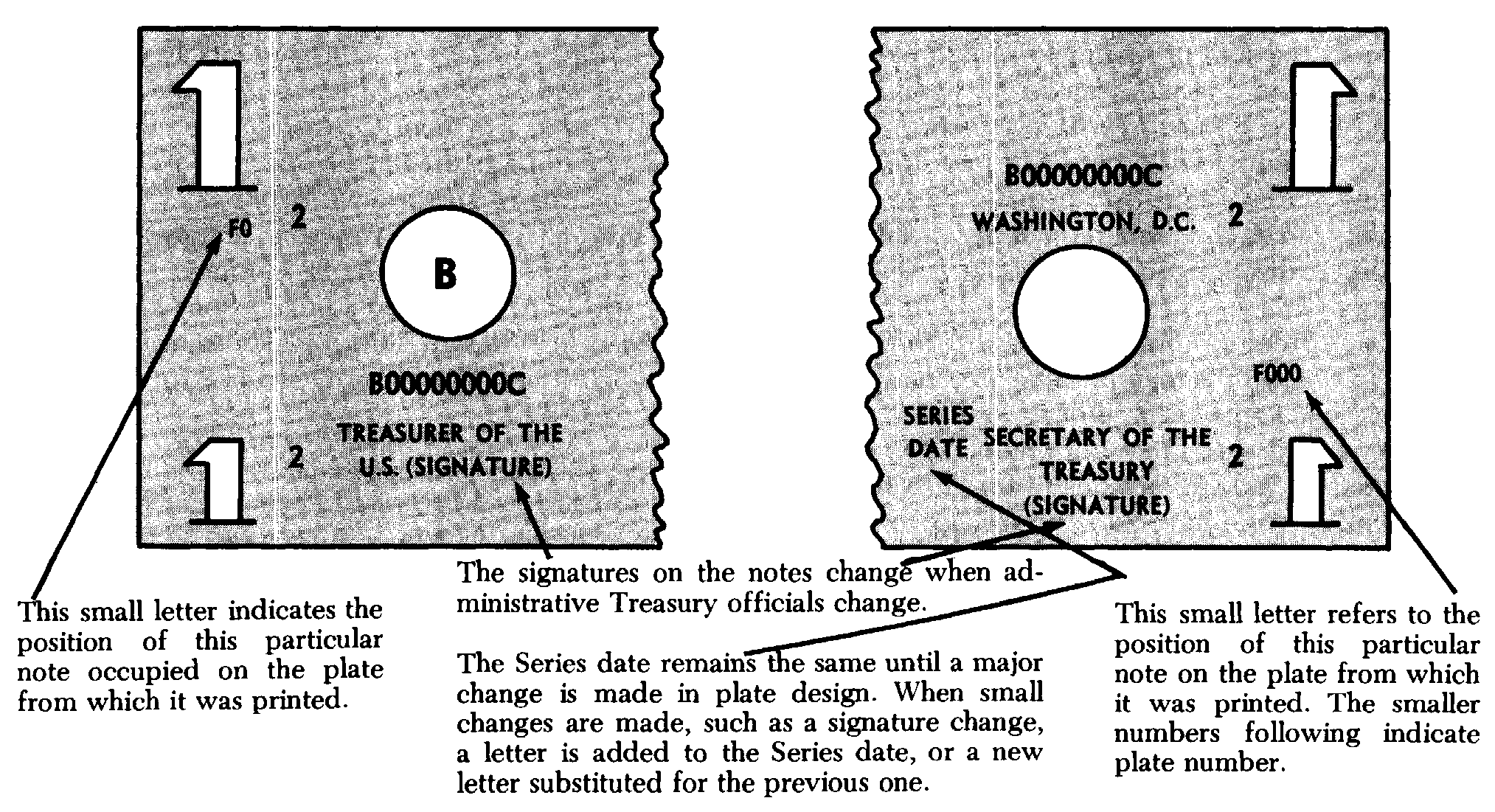
REVERSE SIDE: The phrase “In God We Trust” was first printed on Federal Reserve Notes in 1957 (Series 1957), and then in 1962 on some of Series 1935. The only number on the back of a note, other than its dollar denomination, is a small number in the lower right hand comer, the plate number from which that note’s back was printed.
Have the students compile as complete a list as they can of the persons whose portraits appear on the front of each denomination of our paper money, and of the engravings that appear on the reverse. This list is for the teacher’s reference:
| Denomination | Portrait on Face (obverse) | Engraving on Back (reverse) |
| $1.00 | George Washington | Great Seal of the United States |
| 2.00 | Thomas Jefferson | Signing of Decl. of Indep. |
| 5.00 | Abraham Lincoln | Lincoln Memorial |
| 10.00 | Alexander Hamilton | U. S. Treasury Building |
| 20.00 | Andrew Jackson | White House |
| 50.00 | Ulysses S. Grant | U. S. Capitol |
| 100.00 | Benjamin Franklin | Independence Hall |
| 500.00 | William McKinley | Ornate denominational engravings |
| 1,000.00 | Grover Cleveland | |
| 5,000.00 | James Madison | |
| 10,000.00 | Salmon P. Chase | |
| 100,000.00 | Woodrow Wilson |
8. Now we come to banking. The theory of banking is very simple. Banks are either (a) warehouses for money deposited with them for safekeeping or (b) money lenders. When these two functions are combined, as they are today in our Federal Reserve System, the situation can become very complicated. Most publications of the Federal Reserve and of the larger commercial banks are pretty technical. However, the teacher should have some of their regular bulletins and newsletters available to students for reference—as suggested in the Introduction—including some of those the “Fed” has published especially for classroom use. Copies of these may usually be obtained in quantities sufficient for every student to have his own to read, study and discuss. Here are the names of several banks that have issued such releases describing banking operations. The titles of the more difficult ones are marked with an asterisk (*):
Federal Reserve Bank of Philadelphia, Department of Bank and Public Relations, Philadelphia, Pennsylvania 19101
Fifty Years of the Federal Reserve Act
The Four Hats of the Federal Reserve
* Guide to Interpreting Federal Reserve Reports
* Introduction to the Federal Reserve System
* Monetary Policy: Decision-Making, Tools, and Objectives
Federal Reserve Bank of New York, Public Information Department, 33 Liberty Street, New York, New York 10045
Key to the Gold Vault
* Money and Economic Balance
Federal Reserve Bank of Chicago, Research Department, P. O. Box 834, Chicago, Illinois 60690
* Modern Money Mechanics
9. Perhaps an official of a local bank would be willing to visit the class to explain his bank’s operations. The students should learn something about the mechanics of personal banking, the different kinds of accounts (checking and savings), how to make deposits and write checks, and the meaning of the numbers appearing on the face of checks. They should hear about safe deposit vaults. They should be told what banks do with funds deposited with them, how they make loans and to whom they lend money. The students should also learn something about how banks keep records, arrange check clearings daily and how they ship money and checks, as required, from bank to bank and from one locality to another. Once they have some understanding of the role and operations of local commercial banks they should be better able to grasp the role of the Federal Reserve System as banks where private commercial banks keep their deposits.
10. Have one or several students, or perhaps the entire class working together, make a chart showing the changes over recent years in the money stock and gold reserves. These figures are published regularly in the monthly Federal Reserve Bulletin. The farther back they may be traced, to show how “Fed” authorities have reacted to historical events and shifts in the gold supply—contracting or expanding the quantity of money as they judged advisable—the more interesting such a chart will become. However, statistical series and compilations are altered from time to time so that the figures published are not always comparable. With respect to money stock, for instance, try to be consistent. Use either estimates of M-1 (currency in circulation outside of banks + demand deposits) or M-2 (which includes not only M-1 but also time deposits at commercial banks other than large certificates of deposit—see Federal Reserve Bulletin releases for details). And use either “Seasonally adjusted” or “Not seasonally adjusted” statistics. For further suggestions in this connection, see pp. 119-120.
EXPLANATORY TEXT
This Unit treats money from two points of view. In the first place, it discusses monetary theory and explains how money originated—through barter—as a readily-marketable commodity which became in time the generally accepted medium of exchange. In the second place, it describes the monetary system as it operates in this country, the coins and paper money we use, as well as current banking procedures. It might help the students understand money and monetary theory to retrace from the a priori assumptions the steps in deductive logic developed up to now in this syllabus.
1. Is there something mysterious about money? Or is money the outcome of a simple logical development? Many people think money started when governments passed laws decreeing something to be money. Others believe money is so complicated that it is almost mysterious. However, the clues to understanding money, its origin and its importance for economics are contained in the theories developed so far. The steps in logic, necessary for understanding monetary theory, are repeated here briefly:
UNIT 2-(1) We live and act in a world characterized by:
(a) Regularity—order, consistency
(b) Logic—every person thinks and reasons in the same way
(c) Causality—one thing leads to another
(d) Time—there is always an interval of time between cause and consequence
(e) Change—everything in the universe is in flux and when men act they bring about further changes
(f) Value—individuals have preferences
(2) Everyone acts consciously, purposively to attain various goals
UNIT 3-(3) Everyone arranges, ranks, grades his various wants, goals, values on his or her subjective (personal) scale of values, in the order of their relative importance
(4) Individuals act when they have
(a) some felt uneasiness, feeling of dissatisfaction
(b) an idea concerning a better situation
(c) the hope that action will improve things
(5) To act individuals need:
(a) a plan
(b) time
(c) resources—knowledge, energy, raw materials, tools, etc.
UNIT 4-(6) Each of us has many wants, needs, wishes, goals
(7) However, each of us has available only a limited amount of time and resources (knowledge, energy, raw materials, tools, etc.)
(8) Because of the gap between what people want and what they have, everyone wants to use his resources as effectively as possible
(9) Individuals eventually recognize that they may accomplish more if they cooperate, divide the labor necessary to produce and share the products with the others who help
(10) As a result of the division of labor, individuals may specialize on the tasks they enjoy more and for which they are relatively better suited
(11) Individuals find it helpful to have some things of their own, to use as they wish for their own personal purposes. Thus, they seek to accumulate private property
(12) Individuals who own and control some private property are better prepared to pursue their various personal goals than if they didn’t have any property at all at their disposal
(13) Individuals who own property may cooperate, specialize, produce and then trade their output with one another
UNIT 5-(14) If people trade with one another voluntarily it is because they expect to be better off as a result; they expect to receive in exchange something more valuable to them under the circumstances than what they give up to get it
(15) Thus, barring force, fraud and human error, voluntary exchanges benefit both parties
UNIT 6-(16) As individuals meet to trade, each compares the relative value to him or her of specific units of the various goods and services they are offering and being offered on the market
(17) Units of some goods and services are more urgently wanted by many persons than are units of other things
(18) Individuals compete more energetically and offer higher inducements to obtain units of those goods and services they value more relative to the supply available than they do to acquire things they value less
(19) Thus, the exchange ratios (prices) of different items to units of money at different times and places always reflect the subjective (personal) values of the various individuals concerned, as they are expressed in bids or refusals to bid for specific units
(20) The relative exchange values on the market of particular commodities may be traced back in this way to the possible advantages individuals expect to derive from them at particular times and places. In other words the price of something on the market depends on the anticipated utility of the specific quantity or unit under consideration.
With these 20 steps we have developed the logic of the economic theory formulated so far in this syllabus, based on the a priori assumption that men act purposively—within the limitations imposed by the nature of the universe and society— in the attempt to relieve felt uneasinesses. This logic explains market prices as results of the expressed preferences of individuals who trade or refuse to trade (Unit 6). This logic also explains savings, tools and production (Unit 7), the entrepreneur and the profit and loss system (Unit 8) and labor, wages and employment (Unit 9). In this Unit, monetary theory is shown to rest simply on following this reasoning a bit further. By their purposive choices and actions, individuals gradually transform direct exchange or barter into indirect exchange whereby commodities are traded for a “medium of exchange” or money. The succeeding steps in this logic follow and are more fully explored in the course of this Unit:
(21) When a person offers some portions of his or her private property or agrees to perform a service, in exchange for something he or she wants still more, they may not be able to make a trade because:
(a) he or she may not find anyone willing to offer in exchange the particular things they want
(b) persons who happen to have what they want may not be willing to part with it for what he or she has to offer
(c) the timing may be wrong—when two potential traders meet, one or both may have changed their minds, or the particular items they might have traded may no longer be available or suitable for trading
(22) Then one day someone, who could not find anyone with the thing he wanted who was willing to accept what he had to barter, must have had a bright idea. Why not trade what he had for units of a third commodity? Even if that were not precisely what he wanted for himself at the time, if it were something many persons wanted and frequently looked for on the market, he would be in a better position for trading later than by keeping what he had originally tried to barter
(23) It is generally easier to find a taker for something that is urgently wanted by many people than it is to find buyers for items in less demand. So trading a less urgently wanted item for something that is more urgently wanted makes it easier to acquire at another time what a person really wants
(24) In this way, one commodity which was very useful and urgently wanted by many people gradually became more and more widely traded and accepted in exchange, until it was in demand not only because it was useful in itself, but also because it could be used for trading
(25) As such a particularly desirable commodity became generally accepted by almost everyone, its new use in trading, as a medium of exchange or money, made it even more urgently wanted than ever before. This new demand for it sharpened the competition to obtain it on the market, raised the marginal utility of a single unit, its exchange value (price), and made it still easier to find persons ready to accept it at any time in trade.
2. How did money arise historically from barter? Men trade with one another, as we have seen, out of their natural desire to improve their respective situations as they see them. They seek to exchange something they have for something else they want more urgently. Trading appears to be the quickest and easiest way, under the circumstances, for them to relieve their various felt uneasinesses.
When two persons exchange directly, bartering commodity-for-commodity (direct exchange), each considers only the use value, the usefulness or utility to him or her personally of the goods they are taking in trade. When it became difficult to arrange a direct exchange transaction, it must have occurred to some traders, one-by-one, to consider not only the use value but also the saleability, marketability or exchange value of the things they might take in trade. As a result of this new approach, trading began to take on a different form. Direct exchange gradually faded out and indirect exchange was introduced step-by-step into that economy.
The distinction between direct exchange (barter) and indirect exchange rests on the intended use to be made of the items exchanged. When a consumers’ good, a commodity intended for use directly, is exchanged for another consumers’ good, that is direct exchange. When at least one of the two items traded is not a consumers’ good, intended for use by the recipient himself, but a commodity intended only for use in exchange later, to obtain then some item to be consumed, that is an indirect exchange. The commodity used as the intermediary in such an indirect exchange is a “medium of exchange,” i.e. money.
Archaeologists and anthropologists have described barter and trade among primitive peoples. They have speculated as to how some individual traders may have experimented with exchanging for a third more marketable commodity, a rudimentary medium of exchange. Throughout the history of man, many different commodities have been used at different times and places as media of exchange. The teacher might challenge the students to list, perhaps on the blackboard, as many different primitive moneys such as wampum and sea shells which they can find mentioned in various references. Perhaps some students will have relatives or acquaintances who can tell of using cigarettes or nylon stockings as “money” in Europe after World War II. Did the war-ravaged economies of Korea and Vietnam produce similar commodity moneys? This will be another opportunity for the students to become familiar with research methods and library facilities. Ask them to cite the source of their information in each case—a specific reference work, encyclopedia article, economic or history text or a personal friend or relative. To help the teacher, here are some of the items listed in the 1906 Encyclopaedia Britannica article on “Money,” as media of exchange among “savage tribes and ancient races”:
| skins | maize | haiqua-shells |
| leather money | olive oil | cowries |
| cattle | coconuts | whales’ teeth |
| sheep | tea | red feathers |
| oxen | tobacco | stone |
| slaves | ornaments | mineral products |
| corn | salt |
Carl Menger, the first “Austrian” economist to set forth clearly the theory of subjective value or marginal utility, described the gradual shift—requiring no act on the part of governments—from barter (direct exchange) to the use of money in transactions (indirect exchange). Here are a couple of paragraphs from his book which may be worth discussing in the classroom.
As each economizing individual becomes increasingly more aware of his economic interest, he is led by this interest, without any agreement, without legislative compulsion, and even without regard to the public interest, to give his commodities in exchange for other, more saleable, commodities, even if he does not need them for any immediate consumption purpose. . . .
But the actual performance of exchange operations of this kind presupposes a knowledge of their interest on the part of economizing individuals. For they must be willing to accept in exchange for their commodities, because of its greater marketability, a good that is perhaps itself quite useless to them. This knowledge will never be attained by all members of a people at the same time. On the contrary, only a small number of economizing individuals will at first recognize the advantage accruing to them from the acceptance of other, more saleable, commodities in exchange for their own whenever a direct exchange of their commodities for the goods they wish to consume is impossible or highly uncertain. This advantage is independent of a general acknowledgement of any one commodity as money. For an exchange of this sort will always, under any circumstances whatsoever, bring an economizing individual considerably nearer to his final end, the acquisition of the goods he wishes to consume. Since there is no better way in which men can become enlightened about their economic interests than by observation of the economic success of those who employ the correct means of achieving their ends, it is evident that nothing favored the rise of money so much as the long-practiced, and economically profitable, acceptance of eminently saleable commodities in exchange for all others by the most discerning and most capable economizing individuals. In this way, custom and practice contributed in no small degree to converting the commodities that were most saleable at a given time into commodities that came to be accepted, not merely by many, but by all economizing individuals in exchange for their own commodities.
Principles of Economics (Free Press of Glencoe/ Macmillan, 1950), pp. 260-261
3. What is money? Briefly, money is a commodity that people use to facilitate trade. That is all money is. Money is simply a commodity which is used in trades as a medium of exchange.
As a result of the transition from barter to trading in money, one commodity which was already considered desirable and useful—even if only for purposes of ornamentation, ostentation or prestige —acquired an additional importance as a medium of exchange or money. This new use by no means replaced or destroyed its pre-existing usefulness as a commodity. As a matter of fact, it was precisely the pre-existing exceptional demand for that particular commodity on the part of many persons which first made people consider taking it in trade—everyone was fairly confident that it would be easy for them later to find others who would also be willing to accept it in exchange. Thus, the particular commodity selected acquires, on top of its former uses which remain, a new use as a “trading commodity” or medium of exchange. Money, therefore, is a commodity, an especially desirable and easily marketable one to be sure, but nevertheless money is simply a commodity, nothing more than a commodity and nothing less than a commodity.
4. How is the value of a commodity affected when it acquires a new use as a “trading commodity”? The more useful a person expects something to be to him, other things being equal, the more eager he will be to hold on to the units he has and/or to bid more for additional units. The demand for each available unit, relative to the supply available, will tend to rise as a result and so will the price people pay per unit. Consequently, if people begin to use for trading a certain commodity which had previously been used for other purposes only, its value on the market will rise. Let us review the way this happens.
Assume that a commodity now being used as money was valued before for consumption only. Today it is valued also for exchange. More and more people have discovered that by exchanging what they have for an easily marketable temporary expedient, a “trading commodity,” they may obtain the various things they want more easily than they could expect to acquire them through barter. The suitability of this particular commodity for trading further enhances its marketability, making it even more desirable and acceptable to almost everyone and, as a result, suitable as a medium of exchange or money.
Trading will become easier, thanks to the relative simplicity of arranging trades in terms of a “common denominator.” The number and frequency of transactions may then be increased. With more and more monetary transactions taking place, the demand for units of the “trading commodity” tends to rise still further. Competition pushes the market or exchange value of its marginal units up higher, signalling everybody that this particular commodity is in great demand on the market for purposes of trading. Most people will soon discover that the increased competition for this particular commodity has made it more expensive than before and they will try to use the available stocks more sparingly for purposes other than trading. At the same time its higher market value spurs producers to try to increase its production. Of course, some persons will probably continue to hold substantial quantities of this trading commodity for other purposes—personal enjoyment, ornamentation, gratification and prestige—in spite of the increased market demand for it. But the major purpose for which most people will want to acquire stocks of the commodity will be to keep in “cash holdings” to trade off later for consumers’ goods as needed. Thus, individuals gradually shift the available supply of that commodity away from its less urgent uses and channel an increasingly large percentage of it into the market as money. Even those persons who ostentatiously flaunt their holdings of that commodity before others—as jewelry made of feathers, wampum, gold, or in the form of silver spoons or plates—have in the back of their minds that these items are reserves that could be converted into money.
The experience of gold furnishes a specific illustration of how the stocks of a “trading commodity” are shifted through the market and so reserved for its very most urgent uses. Some of the students in the class may have studied chemistry. If so, ask them to describe gold’s physical characteristics and list ways it could be used in industrial production. For instance, gold is a good conductor of electricity, its melting point (1063°C) is almost that of copper and it may be drawn out easily into wire. Why then is gold not used in electrical wiring? Gold is heavy, highly resistant to corrosion, and strong when alloyed with other metals. Why then is it not used in the foundations of buildings, wharves, bridges? Gold is malleable enough to be fabricated into almost any shape and it is insoluble in nitric, hydrochloric or sulfuric acids. Why then are these acids not sold commercially in containers made of gold? Perhaps students in the class can think of other uses, such as paper weights, ashtrays or toys, for which gold, in view of its physical properties, would be suitable. Point out to the class that in almost every one of these possible uses today other raw materials are used—not gold. Why? The clue to the answer rests on an understanding of the auction-like process by which goods and services are channelled by the market bidding of owners and would-be owners into those uses where they are expected to be most valuable.
Gold is still more valuable throughout the world as a trading commodity than for almost any other purpose. Those persons who are most eager to obtain units of gold and who will bid the most for it are those who want to use it as money. As a result, they outbid most everybody else who might want gold for other purposes. Producers, dentists, jewelers and so on are persuaded by the high price of gold to use it only when no other less costly material can serve their purposes. Thus, the relatively strong demand for gold as money helps to assure everybody that the bulk of the gold in the world will be kept in reserve and made available for use as money when needed. Even gold jewelry is a potential reserve of monetary gold for it may be converted into money if need be.
5. List the relative advantages and disadvantages of direct and indirect exchange. Upon completing either a direct or an indirect exchange— barring force, fraud and/or human error—both parties have traded something they had for something they wanted more urgently. As a result of such transactions voluntarily agreed upon by the two traders involved, therefore, goods and services are continually being shifted, step-by-step, from persons who value them less to persons who value them more. Through such a series of voluntary exchanges, goods and services are transferred into the hands of persons who expect to appreciate them more fully and to devote them to more important purposes. However, the difficulties of arranging specific commodity-for-commodity barter trades may make direct exchanges extremely time consuming and costly in terms of human energy. Thus, the possibility of trading goods and services for a third commodity, a widely-accepted medium of exchange, money, representing potential purchasing power that may be exchanged at a future time for an infinite variety of consumers’ goods, makes trading much easier and simpler. The use of money, therefore, makes it possible to complete more transactions in less time. Thus the introduction of indirect exchange increases trade, expands the trading area, promotes greater specialization and division of labor and permits production to be increased. A further advantage of making transactions in terms of money is that it allows traders to make comparisons easily among many different goods and services in many different places throughout, the world. Buyers and sellers throughout the trading area may calculate mentally by comparing everything with a single “common denominator”—the generally accepted medium of exchange, money. In this way, entrepreneurs may plan enterprises to be carried out over great distances and long periods of time. Such economic calculation makes it possible to accumulate capital savings, invest and undertake huge enterprises, increasing still further capital accumulation, investment and production of the goods and services people want most.
| DIRECT EXCHANGE (Barter) | INDIRECT EXCHANGE (Monetary transactions) |
| If an individual (A) wants to obtain something by direct exchange, he must: | If an individual (A) wants to obtain something by indirect exchange, he must: |
| 1) have, find or produce some good or service he can offer in exchange; | 1) have, find or produce some good or service to exchange for money |
|
2) spend time and effort to search, perhaps traveling far and wide, until he locates a potential seller (B) who a. wants the particular good or service A is offering b. at that particular time c. in that particular quantity d. of that precise quality; and e. has available at the same time f. the precise object(s) A seeks g. in a suitable quantity h. of suitable quality; and i. has a scale of values which differs from A’s in a special way. (B must value what A is offering more than the item B already has and A is seeking to obtain through barter); |
2) locate a potential seller (B) who a. has the particular good or service A wants and b. is willing to part with it c. for the current medium of exchange, money; |
| 4) exchange the two commodities. | 4) trade or refuse to trade; |
| 5) Without a widely used trading commodity, a “common denominator” with which all goods and services may be compared, economic calculation is not possible. | 5) economic calculation becomes possible as traders everywhere may easily compare the relative market values of different factors of production, labor and various finished goods and services in terms of a “common denominator,” money. |
6. How much money is needed to facilitate trade? Almost everyone living in today’s monetary economy wants to have some cash holding on hand at all times to meet necessary cash expenses. How large a cash holding anyone will have will depend on the particular person and the particular situation. Every individual, business firm or other legal entity, each acting according to his own best judgment, in the light of his various goals and values, decides how much cash money to keep on hand. Every one of us tries constantly to adjust the size of his cash holding so as to be prepared for future contingencies. When we anticipate an increased need for cash, we try to increase our cash holdings—by withdrawing cash from savings, selling something or doing work for an employer to earn money. If a person’s need for cash declines— for instance, if he should move from city to farm, walk to work instead of driving or riding a train or bus, carry sandwiches for lunch or grow some of the food he consumes in his own garden—he will very soon reduce the amount of cash he carries in his wallet. Few people want to keep more idle money on hand in their pockets and checking accounts than they expect to need in the near future as cash or emergency reserves.
NOTE: The teacher might discuss at this time the ideas the students had for using their $500,000 “windfall” (suggested activity No. 5 of this Unit), the size of the cash holding each chose to keep on hand for ready spending and their reasons for preferring other things to holding additional cash.
In a barter economy, would-be traders were at a disadvantage in not having any one commodity they could use any time an opportunity arose to trade for the specific goods they wanted. Once indirect exchange prevailed, people could have available at all times a certain amount of latent or “built-in” purchasing power in the form of money. By having some money on hand, a cash holding, they could be prepared for many contingencies.
Today, in our modern monetary economy, the need for a cash holding of ready purchasing power is more urgent than ever before in history. Practically no family or community is self-sufficient nowadays. Practically everybody is now integrated into the money economy—receiving payment in money for his labors and paying money out for most of the consumers’ goods he wants. With a cash holding of the proper size, the cash holder has some assurance and peace of mind for he expects to be able to purchase the consumers’ goods he wants as need arises. Thus, a cash holding of reliable purchasing power serves a necessary purpose in a money economy. Exactly how large a cash holding any individual will want varies from person to person and from time to time—according to one’s anticipated cash expenses, the date of his or her next pay check, alternate means of making payment and other prospective demands for cash.
The sum total of all the cash holdings of all the participants in a society, i.e., the total amount of money being held by all individuals, businesses and other legal entities at any particular time with a view to handling their most pressing personal and business transactions, is the total quantity of money in that economy. This amount of money—all legally owned and included at every instant in the cash holding of some particular participant in that society—is all the money there is in existence in that society. Thus, the total quantity of money in circulation in an economy is always exactly equal to the total demand for cash on the part of all participants in that society. This is not to say that every person in that society has as much money or purchasing power as he or she would like to have, but only that in a free market economy, where people determine for themselves within the limits of their personal abilities and situations the size of their own personal cash holdings, there is always “enough” money to satisfy all the demands for money on the part of all participants in that society.
Every individual, business concern or other institution in a free market society is actively interested in maintaining a certain sum of money in their own cash holding. When not prevented from exercising their own best judgment, everyone will see to it that they hold on to the money they need most urgently. Thus, every unit of money in a free market society is being held in the cash holding of someone who has made the conscious decision to hang on to that amount of money for some reason. No money can “flow out” of such a society except as the result of further conscious decisions on the part of various specific participants to reduce their own personal cash holdings for some reason. Such a free market economy need never fear an “outflow” of all the money in circulation there, so that —barring force, fraud and/or human error—there will always be “enough” money in such a society for persons and other entities to trade with one another and to satisfy their most urgent needs for cash.
7. How is the market value of money determined? The market value of anything is expressed in terms of what it can be exchanged for on the market. The market values of most goods and services, i.e. what they may be traded for at any particular time and place, are usually expressed in terms of money. The quantity of money for which a particular item is exchanged upon a specific occasion is its “price.” However, to speak of a “price” for money, that is to refer to the quantity of money for which a quantity of money may be exchanged, tells us nothing at all. We might as well say—with apologies to Gertrude Stein—“A dollar is a dollar is a dollar.” To be meaningful, the value of any monetary unit must be expressed in terms of something else. Just as we express the market value of goods and services in terms of money, so we reverse the formula and express the market value of money in terms of the other goods and services for which it may be exchanged on the market, i.e. for what it may be used to purchase. Thus, the market value of a unit of money is known as its “purchasing power.”
The purchasing power of a unit of money is the outcome of the exchange ratio between a unit of money on the one side and an assortment of goods and services on the other. It is determined on the market by the choices, actions and preferences expressed by actual and potential buyers and sellers. Every one of us acts, trades, exchanges things he has when it seems advisable, in the attempt to acquire things he wants more urgently. At every step of the way every one of us constantly weighs the pros and cons of continuing to hold the money we have in our cash holdings or of disposing of some of it to obtain something else.
Every one of us is at the same time weighing (a) the advantages and disadvantages under the circumstances of acquiring one more or one less coke, pizza slice, LP record, pair of blue jeans, stereo, camera, sports outfit or what-have-you, with (b) the pros and cons of decreasing our cash holdings by the number of dollars required for such a purchase. Similarly, every potential seller is always comparing the relative importance to him of (a) relinquishing one more or one less unit of whatever he is offering on the market and (b) what he expects to gain from the additional dollars he would receive. Both buyers and sellers compare simultaneously their respective needs and desires for cash holdings with their respective needs and wants for other things. In this way the prices of specific goods and services and the purchasing power of units of money are determined at one and the same time—by the continual push-and-pull, give-and-take, bid-and-ask of countless persons buying and selling, or refusing to buy and sell.
There is a tendency in a money economy to think that the only bidders at market auctions are those who are offering money to buy goods and services. People forget that the would-be sellers of goods and services are also bidding—for money. On one side of the auction, would-be purchasers are offering units of money in the hope of acquiring certain goods and services. On the other side, owners are offering goods and services on various terms in different quantities and qualities in exchange for money. Would-be buyers will bid higher dollar prices to obtain things they want very much. Similarly, when would-be sellers are eager to dispose of their possessions for dollars, they will lower their asking prices or offer more and/or better quality goods and services for the same price. Thus, the market value, exchange ratio or purchasing power of a dollar fluctuates—in response to the bidding of the owners of dollars and of the would-be “buyers” of dollars—just as does the market value, exchange ratio or price of anything else.
The greater the demand for any specific good, service or unit of money, relative to the quantity of each available on the market at any time, the more would-be buyers must bid to obtain a single unit. Where there is free and open competition, those who want something most urgently will keep bidding more for it until those who want it less urgently drop out of the “auction.” Thus, a higher price for a specific good or service is a reflection of a shift in its supply/demand exchange ratio. The cause of such a shift in relationships may be due to (a) changes in the supply of the specific good or service involved or (b) changes in the demand for it. If the money prices of many, or even most, goods and services have risen, it is not likely that the explanation will be found in shifts almost simultaneously in the supply of, or demand for, all or most goods and services. The explanation for higher prices of almost everything must, therefore, be sought on the money side of the exchange, i.e. in changes in the supply of, or demand for, money. Generally higher prices inevitably reflect (a) an increase in the number of units of money available on the market, (b) a drop in the demand by market participants for units of money to be held in their cash holdings, or (c) both. In any event, generally higher prices are due to the fact that the value of a single unit of money relative to other things, i.e. its purchasing power, has declined.
If the purchasing power of the dollar is expected to rise, the demand for dollars will increase as people generally will be more eager to acquire dollars to enlarge their cash holdings in anticipation of being able to buy more goods and services of greater value later with every dollar. If the purchasing power of the dollar is expected to go down, people will try to keep their cash holdings as low as possible and to convert their money into other goods. In that case, the demand for units of money will decline. As the expectations of individuals with respect to the future value of money become wider spread, they may have a spiralling effect on the market value or purchasing power of the monetary unit. Such widespread shifts in the demand for money in a single direction usually have their origin in the artificial manipulation of the quantity of money—coin clipping, coin debasement, inflation and/or credit expansion—all to be treated below. Before discussing them however, it should be clearly understood that the value of the monetary unit at any time and place depends on its exchange ratio to other things, its purchasing power, i.e. the relative value or utility of what it will buy on the market.
To recapitulate, the market value of a unit of money is derived from the value the individuals concerned attach to the utility or usefulness of the good or service of whatever that unit of money will exchange for on the market. The exchange ratio or purchasing power of the monetary unit is determined simultaneously with the determination of the prices of the various other goods and services being traded. The individuals concerned rank units of money on their personal (subjective) scales of values along with everything else—bidding for goods, services and/or money as they think best. A person who buys a portable TV, for instance, is “selling” a certain number of dollars for that appliance and at the same time, on the other side of this exchange, the seller of the TV is “buying” a quantity of money with the TV he hands to his customer. Thus the purchasing power of a unit of money, like anything else, conforms to the law of price. It is a reflection of the number of units in existence on the market, relative to the demand for them on the part of the individuals concerned, each of whom considers the relative service or utility he or she expects to derive from a unit of money on the one hand and the particular good or service that monetary unit can command on the market.
8. What is government’s responsibility with respect to money? In this Unit so far, money has been described simply as a “trading commodity,” the most readily marketable commodity in an economy. It has been explained that money originated out of barter as a result of the ideas, choices, actions and market transactions of individuals. When individual traders began, one-by-one, to shift from direct to indirect exchange, they were merely trying to simplify their own personal trading activities. Yet in the process the most marketable commodity in the economy gradually evolved into a medium of exchange or money.
Misunderstandings may arise very easily over the terms of a trade, even among very cautious and well-meaning traders. The mere passage of time, before a contract agreed upon is fulfilled, can lead to problems. To prevent disputes over the terms of an exchange, therefore, two traders would often ask a third party to witness their transactions, to examine, weigh or measure the commodities being traded, so as to reassure both that neither was being cheated. Quite often it was enough to consult another private citizen, an unbiased witness, perhaps another merchant. However, if a serious dispute arose, a mutually recognized arbiter, a representative of government or a judge of some kind, would have to be consulted to settle the argument. If the delivery at a later date of a particular commodity was called for, the judge might have to rule as to whether the goods being tendered at the time were sufficient and suitable to satisfy the terms of the contract. In the course of time, as a result of adjudicating many such disputes, judges —and thus governments—were placed in the position of having to decide what was meant in various contracts by the term “money.”
Whenever a trader bids for anything on the market, he wants to have a pretty good idea of the quality of what he will be getting. This is true whether he is seeking a specific consumers’ good, or money to use later in the purchase of consumers’ goods. For instance, Indians who wanted to exchange deer meat or moccasins for wampum, or vice versa, would try to check the quality of the deer meat or moccasins and wampum to be sure they were not being cheated and that everything was as represented. When traders came to use the precious metals as media of exchange, they had to weigh the gold, silver or copper being offered and sometimes even to test it to determine the percentage of these metals in the alloy and to make sure they were not being cheated. Then two or three thousand years ago, some individuals apparently conceived of the idea of casting the precious metals into rings, discs, oblongs or squares and stamping on each the fineness or quality of the alloy used. If traders trusted the stamper to be honest, they no longer needed to test the metallic pieces they were exchanging for purity, but only to weigh them. The next step in simplifying indirect exchanges came when the weight also was marked on each metallic piece intended for use in exchange.
Private merchants, goldsmiths and jewelers, as well as local princes and city governments were among the first to fabricate coins and mark on them their weight and metallic content. Insofar as traders could rely on the markings on such coins, it became much easier for them to complete their various transactions. However, the sizes, shapes and metallic content of these early coins often varied so much as to be confusing. Also, not all coin manufacturers were completely reliable. Traders still had to exercise due caution in distinguishing between coins of various manufacture. In time it became evident that transactions could be made still simpler if the coins being used as money could be uniform and consistent in quality. In the course of this development, many governments were led eventually to specify the commodity which would be legally recognized within their jurisdiction for use as money in the payment of debts. Thus, governments often declared some specific commodity to be legitimate money or “legal tender.” Anyone who settled debts in terms of this legal tender was assured that his creditors could not dispute the payment. The decisions of judges also were made considerably easier by this development. To conclude that the monetary terms of the contract had been satisfied, they needed only to determine then whether or not the money tendered in payment was in fact the proper sum of the government’s legal tender.
The theory behind legal tender laws was not to persuade or to compel people to take something they didn’t want to accept as money. The intent of legal tender laws was merely to give legal status to the commodity already selected as money by traders through market transactions. However, with the introduction of legal tender laws, governments inevitably came to have an increasingly significant influence on the commodity used as money in the market.
Many governments have misused the legal tender laws. They have frequently forced creditors to accept at face value clipped or debased coins and paper money as legal tender in payment of debts. Governments can certainly disrupt the market seriously by using force to compel traders to take payment at face value in a depreciated money they would otherwise reject or accept only at a discount. It was in the attempt to prevent such abuses by the States that it was specified in our Constitution (Article I, Section 10) that “No State shall . . . make any Thing but gold and silver Coin a Tender in Payment of Debts.”
A government’s apparent success in compelling traders to deal in a deteriorating medium of exchange temporarily does not mean it can succeed in doing this forever. Nor does it mean that the government is actually determining what the money is in the market economy over which it has jurisdiction. Don’t let the students forget for a moment that governments don’t create money. The money in any market, at any place and time, is determined as described here—by the actions and transactions of individual traders.
Judges and governments became involved with money in the course of their perfectly legitimate and proper role of trying to settle disputes, to define and clarify the terms and intentions of the contracting parties who specified payment in money. They were not at first trying to pioneer new territory. In defining money, they were simply attempting to fulfill their responsibility of protecting and defining individual rights and private property and to settle disputes among citizens by adjudicating the terms of contracts. When governments proceeded a step farther and enacted legal tender laws, they originally intended only to give sanction to the commodity the market had selected as money so as to simplify the making of contracts. What the legal tender laws have permitted governments to do over and beyond this is another story which we shall be discussing next.
9. In what ways have governments influenced money and monetary transactions? In the course of settling disputes among citizens, judges have often ruled on contracts being adjudicated as to what constitutes money—in the light of the specific terms of the contracts, the intentions of the contracting parties, established traditions and generally accepted business practices. Over the centuries, however, many governments went beyond this relatively simple and limited task of settling specific disputes and proceeded to define the legal tender monetary unit and then in time to become involved with banks and banking. Step by step, for one reason or another, on one excuse or another, they became deeply concerned with monetary transactions, influencing decisively what was used as money and so had to be accepted in trades. Here are some of the ways various governments have radically affected the character and use of money:
a. To facilitate exchanges, some governments began to mint coins from the raw metal
b. To further facilitate exchanges, some governments began to standardize the issuing of coins and to stamp them to indicate metallic content and perhaps also weight
c. The edges of coins were often ridged to prevent wear and tear and to make it difficult for persons to clip or shave stamped coins surreptitiously so as to produce new and perhaps smaller coins from the clippings or shavings
d. When it seemed especially inexpedient to levy higher taxes, some governments clipped coins themselves to help cover their own expenses. They would accumulate or call in the metallic coins, clip or shave them in size, melt the clippings and shape them into new smaller coins, all of which would then be stamped and marked as if they were of the same size and weight as the previously circulating unclipped coins. The governments then forced the sellers of the various goods and services they wanted to buy to accept the old clipped coins and the smaller new coins as if they actually represented the unrealistic size and weight marked on them. This is coin clipping, a form of coin debasement
e. Another form of coin debasement was also used at times by some governments to help cover their expenses when they found it inexpedient to levy higher taxes. They called in gold or silver coins, melted them down, and then diluted the alloy of which they were made by adding some less valuable metals so as to reduce the percentage of the precious metals it contained. Coins were then cast from the new alloy, but these new debased coins were stamped and marked as if composed of the same high quality alloy as that from which the previously-issued coins had been made
f. Many, perhaps most, governments have laws defining legal tender, the commodity or money which persons must accept, when tendered, in payment of a monetary debt. Legal tender laws, intended simply to describe the unit of money which is legally recognized for the payment of debts, have frequently been used by governments to serve their own purposes. Many times throughout history creditors have been required to accept clipped or debased coins and depreciated paper money as legal tender—oftentimes when tendered by the government itself in payment of its own debts and expenses—as if they were full weight and full quality. Thus, legal tender laws have frequently led to severe economic losses for many persons, notably lenders and creditors whose assets are fixed in terms of monetary units
g. In time, many traders developed the practice of completing business transactions by transferring bank “receipts” or banknotes, rather than taking the time and trouble to redeem them for the metallic money they represented. After the invention of the printing press by Gutenberg (circa 1456), the production of banknotes became still easier than before. Eventually some bankers were tempted by these developments to start issuing more banknotes (promises to pay) than they had gold or silver on deposit. Some governments became aware of such overissues. To reassure savers that the banks, whose notes were being used in trade, had adequate reserves to redeem them as promised, many governments passed laws to limit the over-issue of notes. In doing this, however, they actually sanctioned the practice. By placing a legal limit on the over-issue of banknotes, governments were in effect granting banks the legal right to issue banknotes over and above the metallic money in their deposits—up to the limit specified by law
h. As we shall discuss below, banks developed to serve two major functions—as warehouses and as money lenders. Government officials recognized that banks might well be useful to them in this second capacity. If a government could borrow whenever and as much as it wished, this would help solve its financial problems. Thus, most governments found ways to enable the banks to lend them generous sums of money, even if new banknotes or credit had to be created for the purpose. The remainder of this Unit is devoted primarily to banks and banking, with special reference to related government interventions.
10. How did banks develop as warehouses for money? The storage of the precious metals and other moneys for safekeeping is one basic service banks perform, for which depositors are willing to pay a fee. Banks developed several centuries ago, as the outcome of the actions and choices of countless individuals, each seeking to do “his own thing,” i.e., to attain his own personal goals to the best of his ability and means. As individuals traded with one another to relieve felt uneasinesses, one-by-one, they gradually discovered that some goods were more easily marketable than others. Then, step by step, some traders turned to arranging transactions in terms of these more readily exchangeable items. In time, one single commodity came to be recognized as the most marketable thing in that trading area. That one commodity— —whether wampum, cattle, coconuts, shells, feathers, tobacco, gold, silver, or something else— became the generally accepted medium of exchange.
Because of the difficulties and costs involved in safely warehousing a large stock of such a very desirable commodity as the medium of exchange many persons who had accumulated wealth in this form looked around for some place safer than their own homes to store it until needed. Savers were fearful of possible theft if they kept on their premises large quantities of gold or silver jewelry, plate, coins or bullion. They often turned then tor gold- or silversmiths, or traders in gold and silver, who were likely to have strong boxes or specially-built locked rooms or vaults with space they could rent to other people for the storage of gold or silver.
Goldsmiths who warehoused gold or silver for someone else would frequently write out receipts in the name of the depositor, acknowledging the owner’s right to claim his precious metals according to terms agreed upon between them. This receipt was a promissory note—note for short—i.e., an IOU or promise-to-pay a certain person a certain sum of gold or silver under certain conditions. As time went by, the owners of gold who deposited it for safekeeping with goldsmiths found they could save considerable time, trouble, expense and risk of loss or theft, if they didn’t actually retrieve the gold itself from the warehouse for making purchases but could pay for things by handing over the goldsmith’s promissory note instead. The transfer of such a note to a third person had to be acknowledged and signed by the original gold owner or depositor, in whose name the gold had been deposited and the receipt issued.
NOTE: Such transfers are similar to the endorsements used nowadays on bank checks. When the payee named on the face of a check wishes the payer on whose account the check is drawn to make payment to a third person, he endorses it on the back as follows:
“Pay to ( Name of third party )”
and then signs his name indicating approval of the statement appearing immediately above.
This would be a suitable time to explain to the class the mechanics of banking, checking accounts and check-writing. Perhaps an official of a local bank could visit the class as mentioned in suggested activity No. 9. If this is not possible, the teacher should at least explain how to write checks and endorse them. Point out the similarities and differences to be found among:
(a) Warehouse receipts for anything (gold, wheat, furniture, etc.)
(b) Banknotes, promissory notes or bank certificates which are redeemable in gold or silver
(c) A businessman’s promissory note
(d) A personal check drawn on a personal checking account
(e) Federal Reserve Notes currently in circulation which are not redeemable in any tangible commodity but which are declared by law to be legal tender (see the notation on the face of each F. R. Note).
With the increased use of notes replacing metallic money on the market, goldsmiths or other custodians of stocks of the precious metals being held for safekeeping on behalf of depositors made their warehouse receipts “Payable to Bearer,” instead of payable to a specific depositor by name. Notes which were “Payable to Bearer” could be used over and over again very easily in transactions without having to be endorsed, re-endorsed or returned for redemption to the bank of issue. If the bank of issue was considered reliable, traders were usually confident that it could and would redeem its notes as agreed upon, so that most sellers were willing to accept its notes in payment of debts. In this way, banks as we know them today gradually evolved from warehouses of money to banks of issue whose “warehouse receipts” or banknotes came to be used in trade in place of the gold or silver money on deposit for which the notes had originally been issued.
11. How did banks develop as money lenders? The second major service banks perform for which people are willing to pay is money lending.
Ever since people began trading with one another on the market there have been savers and borrowers (Unit 7). Every one of us at times follows the practice of Aesop’s ant and refrains from consuming a part of what we produce in order to save for “rainy days.” At other times we adopt the ways of Aesop’s grasshopper and consume practically all we produce. These two different time preferences are expressed alternately by everybody in varying degrees, depending on specific situations, our various wants, goals, values and the relative urgency to each of us of consuming or refraining from consumption today for the sake of tomorrow. When a person wants to consume or invest in production today more than he or she has available at the time, he or she looks for savers who may be willing to lend. As savers often kept their savings in banks, it was logical for bankers to act as intermediaries between savers who were willing to lend and persons who wanted to borrow. A banker who succeeded in bringing together a would-be lender and a would-be borrower and arranged a loan was performing a service that helped both parties. It is not surprising, therefore, that banks which began as warehouses for the funds of savers found it natural to serve as intermediaries between savers and lenders.
Whenever a banker received some gold, silver or other precious metals to store on behalf of someone else, he would usually issue his IOU, promise-to-pay, or banknote, often made “Payable to the Bearer.” Each such note specified the sum deposited at the bank for safekeeping, for which it would be redeemed as pledged. In time, as depositors found it increasingly convenient to use a bank’s IOUs or notes for making purchases and paying bills, they were less and less inclined to retrieve their precious metals from the bank. Titleholders to deposits could point out to potential sellers that a banknote, which could be redeemed at any time for gold or silver, was really “as good as gold or silver”—or even better because it was easier to carry around and to use in trading. As a result of this development, the banknotes of banks considered financially reliable were often widely used almost as if they were media of exchange or real money, and the funds on deposit in such a bank’s vault would remain there for long periods of time untouched.
This situation led bankers one by one to the conclusion that it was unlikely that many of their depositors would ask, at any one time, to retrieve from their vaults large sums of metallic money. Some bankers reasoned, therefore, that it should be fairly safe to lend out some of -the money lying idle in their vaults which they had accepted from depositors for safekeeping. Eventually some of them decided to make a few loans. Their own savings were very likely included, but the bulk of these funds came from the deposits of other persons, left with the bank for safekeeping and being held in trust for them.
A banker could arrange loans from the money stored in his vaults in one of several ways:
a. He could consult his depositors, the savers, request permission to lend some of their gold or silver and agree to share with them any of the interest income that resulted from the premium borrowers repaid to the bank as lender, over and above the sum they had borrowed. The banker might well ask in exchange that the depositors agree not to withdraw their gold or silver for a certain time. Once the banker is assured that his depositors will no longer ask for their money “on demand,” he can feel relatively safe in lending out a portion for limited periods of time. If the length of time for which the loans are made coincides with the time depositors have agreed to leave their funds untouched—and if all goes well—the borrowers will have repaid their loans before the depositors are once again entitled to claim their deposits
b. He could lend funds left with him for safekeeping without notifying the depositors. Few depositors are likely to ask at the same time to retrieve their entire deposits. As a result some less cautious or less scrupulous bankers risked lending out at interest some of the funds deposited with them for safekeeping—without telling their depositors anything about it. Although this may seem relatively safe, any goldsmith, silversmith, dealer or banker who does so inevitably runs some risk, takes a chance. He is operating on the assumption that (1) his depositors will not ask for more money at any one time than he then has on hand and (2) those to whom he lends will repay their loans in full and in time for him to meet any demands on him from depositors. Such lending operations are based on the theory that the banker will be able to juggle his reserves successfully so that he will be in a position at any time to satisfy the actual demands made on him by his creditors for funds. Even though he could not fulfill all outstanding pledges at any one moment, he expects to be able to do so in time—as his borrowers, one by one, repay their loans
c. He could make loans in the form of banknotes in excess of the funds he has on hand. Once a bank’s notes have become the accepted medium of exchange in an economy, that bank may make loans in banknotes. In lieu of actually lending out the precious metals in his vault, the banker may then—if he chooses to risk increasing his obligations beyond his reserves—simply issue additional banknotes to lend. Would-be borrowers, confident that they can use these notes to buy the things they want, will be willing to accept them. These new notes could be made to look exactly like the old “warehouse receipts,” which had been issued as evidence of gold or silver deposited with the banker for safekeeping. These new notes, like the previously-issued ones, would represent the banker’s IOUs, promises-to-pay certain sums of gold or silver to the bearer upon demand. Yet these new notes would not actually represent new deposits warehoused in the bank’s vault. Therefore, in issuing these new notes, the banker is releasing more promises-to-pay than he can redeem at any one time; his reserves will then constitute only a fraction of the face value of his outstanding banknotes. With the issue of such unbacked notes, bankers institute “fractional reserve banking.”
12. How has the development of fractional reserve banking affected banking operations? Increasingly throughout history, these two basic banking functions—(a) the storage of depositors’ money and (b) money lending—have become more and more intertwined. The first step was for a single bank to pool the deposits of its many customers so as to spread the risk and make it relatively safe to lend a portion of this large fund. If such a bank did this by issuing banknotes which did not represent gold and silver in its vaults but which it pledged to redeem at face value, as described in 11 (c) above, it was obviously no longer solvent. It had issued more pledges, promised to redeem more IOUs, than it possibly could with its fractional reserves. Yet everyone who held one of that bank’s notes—those acquired as receipts for actual deposits of gold or silver or taken in trade directly or indirectly from such a depositor, as well as those acquired when the bank issued additional notes in making purchases or loans—was entitled to call on the bank at any time to redeem them in gold or silver.
Over-issuing notes in this way was a lucrative business—as long as all went well. It enabled the bank to receive interest payments on loans which cost no more than the cost of printing new banknotes or of keeping the records in granting expanded credit. But over-issuing notes and expanding credit was very risky business! The bank’s situation was obviously untenable and anyone who analyzed the nature of the bank’s operations would realize this. A few of its more knowledgeable noteholders might well question the ability of the bank to redeem its notes as pledged and appear at the bank to ask that their notes be redeemed as promised in gold or silver. As other noteholders became suspicious and one by one sought redemption, that bank’s situation became truly precarious. A “run on the bank” was inevitable as the news of the bank’s over-extension spread farther and wider. Everyone with any of that bank’s notes would then “run” to the bank in the hope of obtaining gold or silver money for their notes before the bank’s fractional reserves were exhausted. Like the game of “musical chairs,” where there are never enough chairs to go around, so is there never enough gold, silver or other metallic money to meet the demand when a banker has issued banknotes or credit with a face value greater than that of the reserves in his vaults.
When a bank that has inflated the quantity of banknotes in circulation or expanded credit realizes it no longer has sufficient gold, silver or money to redeem the pledges on all its notes, it must declare bankruptcy and close its doors. Such an inflation or credit expansion is the modern counterpart of the ancient world’s coin clipping or coin debasement. Most bankers realize the risk in the over-issue of notes and credit and try to proceed with caution. They know that if they inflate beyond what public opinion will tolerate, the game of “musical banknotes” will begin, with everyone scrambling to redeem his notes as pledged at the bank. No banker dares to persist in such a risky policy without the protection of government.
When any business goes bankrupt and fails to fulfill its obligations in full, its creditors are hurt. The holders of a bank’s notes are creditors of that bank. If that bank goes bankrupt and fails to redeem its notes as promised, everyone who holds one of that bank’s notes will inevitably suffer a loss. Every noteholder will be swindled when it becomes impossible to exchange his notes for the precious metals they were claimed to represent, notes that had been willingly taken in trade because they were “as good as gold, or silver.” Over the years, banks have sought to avoid such unfortunate bankruptcies. Yet they have refused to give up the principle of fractional reserve banking, despite the fact that it is inherently unstable and cannot be maintained indefinitely. Moreover, governments have often actively encouraged them to continue the lucrative business of printing new banknotes or expanding credit to lend out at interest, over and above the face value of their reserves.
When a private bank ran into trouble as a result of its over-issue of banknotes, several private banks often cooperated, pooled their resources and agreed to assist one another if one of the group was threatened by a “run” because it had gone too far in issuing banknotes. The next step was for all the banks in a country to cooperate, so as to make the resources of all available to help any one which might be in financial trouble. Then governments began to enter the picture. In the attempt to prevent noteholders from being fleeced as a result of taking notes in good faith which later prove worthless, many governments sought to regulate and control the over-issue of notes. They have often specified by law the reserves a bank must hold in its vaults to back up a certain number of notes. They have also frequently limited the privilege of issuing banknotes, granting that privilege to one single bank only, the central bank of issue, and declaring the banknotes of that central bank to be legal tender “for all debts, public and private.”
NOTE: Call attention to the statement printed on every U. S. Federal Reserve Note concerning its status as legal tender. This would be a good time to study all the numbers and letters on our dollar bills, the Federal Reserve Notes now in daily use in this country. The large letter in the seal and the four middle-sized numbers (not those indicating the denomination of each note) refer to the specific Federal Reserve Bank by which that particular note was issued, where the reserves for that particular note are held, and to which that particular note must eventually be returned. See the diagram on page 100. Originally (until 1934) the Federal Reserve Bank of issue was obliged to redeem its notes upon request in gold or “lawful money.” Silver Certificates (none issued since 1963 when the One Dollar Silver Certificates were discontinued) were also, in effect, redeemable “warehouse receipts” for silver. See, for instance, the specific wording on U. S. paper currency of forty or more years ago—in museums, collections, or in book illustrations of old U. S. paper money—and on recent Federal Reserve Notes which no longer represent promises to pay anything.
13. Describe the history of banking in the United States, the Federal Reserve System and its operation. Over the centuries bankers have continued to follow the practice of fractional reserve banking begun by the early goldsmiths—pooling the deposits of all their customers and using those funds as reserves to back up the issue of additional banknotes and/or bank loans. So long as the nominal value of a bank’s fractional reserves represented a substantial portion of the face value of its outstanding notes, its noteholders were not likely to doubt the bank’s ability to redeem them as promised. However, whenever a bank exceeded its customary limits in the over-issue of banknotes, some depositors were likely to question its financial reliability. If many came to doubt its solvency and asked to withdraw their deposits, that would precipitate a “run on the bank,” the game of “musical banknotes” which signals the depreciation of the bank’s notes and the failure of the bank itself. The history of banks and banking in the United States as well as in the rest of the world is really little more than an account of alternating (a) inflations or credit expansions—usually ventured only with some encouragement by governments—and
(b) deflations or credit contractions—brought on when some bank and/or government officials, fearing the government-privileged bank’s fractional reserves had sunk so low that it would not be able to fulfill its obligations and redeem its notes, called a halt to further expansion.
NOTE: A banker who issues more banknotes and/or credit on the basis of lower fractional reserves than his contemporaries consider adequate is often described as a “wildcat” banker. One theory traces this nickname to the inclination of unscrupulous bankers to locate their banks in the wilds, where wildcats abounded, to discourage depositors from calling to withdraw their savings.
The practice of fractional reserve banking, the over-issue of notes and of loans, creates a shaky “house of cards,” an inverted pyramid of large quantities of notes resting on a narrow base, its fractional reserves. When the practice becomes widespread, the day of reckoning may bring about the collapse of many banks, resulting in a large scale monetary crisis or financial panic. In the attempt to alleviate the effects of financial panics, governments have often come to the aid of banks that have been bankrupted in this way. As a matter of fact, governments have helped out so frequently in this country and elsewhere that few bankers have learned the lesson their experiences might have taught them concerning the risks inherent in fractional reserve banking.
Our state and federal governments have often sanctioned and actively encouraged the banks to issue notes and loans on the basis of fractional reserves. Then when banks have over-extended themselves and gone bankrupt governments have taken steps to suspend specie (gold or silver) payments, i.e., to relieve the banks of the obligation of redeeming their notes as promised and to arrange for them to settle their debts by making only partial payments to creditors. As a result of government actions of this type, the banks themselves have not had to pay the full costs of making the over-issue of notes and loans a regular practice. A bank’s creditors including its noteholders, who are paid only in part if at all, and the country’s taxpayers, who contribute to the government’s subsidy to the bankrupt bank, are forced to share the bank’s losses.
Because of such intermittent interference by government in the affairs of banks in this country, few banks, if any, have operated for long on consistent free market principles. Sooner or later— with the sanction if not the active encouragement of government—they have embarked once more upon fractional reserve banking, which is bound to lead them to over-issue notes and to over-extend credit. A financial crisis of some kind then becomes inevitable when they must finally face reality.
Several monetary panics—each due to economic distortion and mal-investment as a result of the over-issue of banknotes and/or the over-extension of credit on the part of a number of banks—occurred in the 19th century. Note that the depression of the 1930’s also as well as more recent recessions have been caused by similar practices. The immediate pressure for national banking reform which led to our Federal Reserve System grew out of the Panic of 1907. Many banks in this country had again expanded credit considerably more than their assets warranted. Some of the largest New York banks especially, associated with stock market investors and speculators, had promised to pay more than they could deliver. When banks in other parts of this country and in Europe began to question their solvency, the New York banks were called on to pay their debts and redeem their pledges. This resulted, as we would expect, in a game of “musical banknotes” which disclosed the gap between their fractional reserves and their outstanding obligations. The outcome was that many banks were forced to close their doors.
The Panic of 1907 was more severe than any previous monetary crisis because the world market economy was more integrated than ever before in history. By 1907, New York City had become an important financial center. The division of labor was practically worldwide. The activities of individual producers and traders throughout the world were then more thoroughly enmeshed and intertwined than they ever had been, and relatively fewer people were living as self-sufficient family units outside the market economy. Thus when many banks in this country had expanded credit considerably more than their assets warranted and it was discovered that several New York banks were unable to pay their debts as promised, the repercussions were felt far and wide.
After several years of study and investigation by Congressmen, economic professors, bankers and businessmen, several proposals for new banking legislation were made. In 1913, the Act establishing our Federal Reserve System was passed and signed into law. The Federal Reserve System was based on the principle of fractional reserve banking and it embodied several measures specifically intended to safeguard its member banks from bankruptcy while still permitting them to expand their issue of notes and credit. Its major goal was to provide an “elastic currency,” which could be expanded and contracted to meet the “needs of business.”
Primarily because there had been widespread distrust of centralized authority in this country, our Federal Reserve System was not set up in the traditional European central bank pattern. For administrative purposes, the “Fed” was made up of twelve Federal Reserve Banks, each in its own separate Federal Reserve District (see the map on the inside back cover of each month’s Federal Reserve Bulletin) and each with jurisdiction over the banks within its District which became members in the system. The activities of all twelve Federal Reserve Banks are overseen and coordinated by a presidentially-appointed Board of Governors.
Many, if not most, of the private commercial banks in all twelve districts have chosen to join the Federal Reserve System. Every member bank is required to keep on deposit with the Federal Reserve Bank in its District a certain “required reserve,” representing a specified fraction (7 1/2% to 16 1/2% as of July 31, 1976, depending on the sum involved) of the total amount of deposits it has from its customers. With its fractional reserve on deposit with the “Fed,” a member bank is then permitted and encouraged to lend, spend or invest the balance of its funds, so long as it does not violate the “Fed’s” rulings. Thus Federal Reserve legislation specifically provides that each member bank pool the deposits of its customers and then spend, lend or invest the major portion—after depositing a small fraction of the total as “reserves” at its bank, the “Fed” located in its District. As a result, the outstanding obligations of every member bank— to its depositors and other creditors—far exceed the total cash it has on hand at any moment. The member banks operate on the assumption that their depositors will not all want to withdraw their entire deposits at the same time. From this they conclude that they can safely make loans and expand credit—beyond the sum of their deposits—so long as. they stay within the legal limits set by the “Fed” and maintain at their Federal Reserve Bank the fractional reserves required. As a matter of fact, many people now actually believe that it is economically desirable for the member banks to expand credit on the basis of their fractional reserves, by making cheap and easy loans to their customers, subject only to “Fed” supervision.
The commercial banks that belong to the Federal Reserve System are not the only ones to expand credit on the basis of fractional reserves. The twelve Federal Reserve Banks themselves also engage in fractional reserve banking. Each Federal Reserve Bank acts as the bank, or depository for the “required reserves” of all the member banks in its District. Each Federal Reserve Bank is permitted to issue notes and loans, provided it maintains a certain fraction of the total as reserves—in the form of gold, gold certificates (i.e., “warehouse receipts” for gold on deposit in the U. S. Treasury), government bonds and certain types of IOUs representing businessmen’s promises-to-pay. The exact percentage of each type of asset required, or considered “eligible,” as backing for Federal Reserve Notes has been changed from time to time since the System was established. Until June 1945, each Federal Reserve Bank was required to hold gold or gold certificates representing at least 35% of its deposits and at least 40% of the face value of all Federal Reserve Notes it issued. When this restriction proved too severe to permit the amount of inflation or expansion government officials considered necessary during World War II, the amount of gold reserves required was reduced to 25%, only to be repealed entirely as of March 18, 1968. Since that date, not even the smallest fraction of gold remains in reserve as backing for our dollars, the Federal Reserve Notes which the government has decreed to be legal tender money. Although U. S. citizens may legally hold gold coins and gold bullion once more as of December 31, 1974, this right does not affect our paper dollars—they are still merely paper money, decreed to be legal tender, without any direct tie to gold or any other metal and not redeemable in anything except other paper currency.
The Federal Reserve System, as it now operates, is the product of several major legislative acts, amendments and numerous rulings by “Fed” officials. Established to provide an “elastic currency,” which could be expanded and contracted within certain limits to suit the “needs of business,” the System has maneuvered primarily by (a) changing fractional reserve requirements from time to time, raising or lowering the percentage member banks must pay to discount “eligible” business IOUs for cash or credit at their Federal Reserve Bank, (b) creating funds to lend the U. S. government in return for its IOUs (bonds), (c) buying or selling government bonds on the open market. Although the original intent was to provide for downward as well as upward flexibility in the quantity of money, the general trend over the decades has been to increase it. This continual increase in the money stock has been made possible by legally reducing and diluting the fractional reserves required for expansion, by eliminating the requirement for any and all gold or silver reserves and by sanctioning and encouraging easier and cheaper credit to borrowers.
NOTE: The latest statistics available on money stock, gold stock, member bank reserve requirements, and so on, are published each month in the Federal Reserve Bulletin. Information can also be found there as to when and how member bank reserves and discount rates have been changed from time to time. Some students might be interested in charting changes that have occurred over several years in the money stock and gold stock. The two sets of figures may easily be shown as two lines on the same chart. The farther back they may be traced and compared, the more interesting such a chart will be and the more obvious it will become that the money stock has risen and the amount of gold on which Federal Reserve Notes and credit are based is infinitesimal—and since 1968 nonexistent. To help students do the research for such a chart, a few significant dates and figures are shown on the following pages.
Incidentally, the “Fed’s” monetary statistics were again revised slightly at the end of 1974—after these charts were completed—and monthly data were recalculated on the new basis back to January 1968. Thus, M-1 and M-2 statistics reported here may not precisely match those in the “Fed’s” post-1974 releases.
| DATE | MONEY STOCK (in billions) Gold, coins + notes | ||
| Federal Reserve Act | 1913 | ||
| 1914 (June 30) | $ 1.890 | $ 3.798 | |
| U. S. in World War I | Feb. 1917-Nov. 1918 | ||
| 1919 (June 30) | 3.113 | 7.688 | |
| 1922 (June 30) | 3.784 | 8.276 | |
| 1927 (June 30) | 4.587 | 8.667 | |
| 1929 (June 30) | 4.324 | 8.538 | |
| Stock market crash | 1929 (October) | ||
| 1930 (June 30) | 4.535 | 8.306 | |
| 1932 (June 30) | 3.918 | 9.004 | |
| Banks closed by proclamation | 1933 (March 6) | With the retirement of gold coins and gold certificates from circulation, the Federal Reserve revised some monetary statistics Currency outside of banks + demand deposits |
|
| Gold payment clauses in private contracts outlawed and U. S. citizens prohibited from owning monetary gold | 1933 (June 5) | ||
| Gold stock revalued after devaluation of U.S. dollar (from 25.8 grains of gold to 15.5/21 grains). Effective January 1934, 1 oz. of gold = $35 | 1934 (Jan. 31) | 7.438 | $ 17.470 (Dec. 31, 1933) |
| 1934 (June 30) | 7.856 | ||
| 1935 (December) | 10.125 | 26.600 | |
| 1938 (December) | 14.512 | 31.761 | |
| 1939 (December) | 22.737 | 48.607 | |
| U. S. in World War II | Dec. 1941-Aug. 1945 | ||
| 1944 (December) | 20.619 | 90.435 | |
| Gold reserve requirements on notes and deposits reduced to 25% | 1945 (June 12) | ||
| 1946 | |||
| 1947 | 22.754 | 113,597 | |
| U. S. involved in Korea | June 1950-July 1953 | ||
| 1950 (December) | 22.706 | 117.670 | |
| 1955 (December) | 21.753 | 133.300 | |
| (seasonally adjusted) | |||
| 1959 (December) | 19.507 | 144.824 | |
| 1961 (December) | 16.889 | 150.578 |
| DATE | MONEY STOCK (in billions) | |||
| M-l Currency outside of banks + demand deposits | M-2 (M-1 + time deposits at commercial banks other than large Certificates of Deposit) | |||
| Start of additional series of statistics on money stock (not seasonally adjusted) August 1962 | This statistical series retitled “M-1” in 1971, was revised and figured on the new basis back to 1947 | This statistical series (M2), started 1971, was figured back to January 1964 | ||
| 1964 (December) | $15.400 | $ 160.5 | $273.8 | |
| 1965 (December) | 13.799 | 168.0 | 298.1 | |
| 1966 (December) | 171.7 | 314.0 | ||
| 1967 | 12.436 | 186.9 | 349.7 | |
| Repeal of 25% gold reserve requirement for Federal Reserve Notes and deposits (March 18, 1968) | ||||
| 1968 (December) | 207.6 | 387.0 | ||
| 1969 (December) | 10.367 | 214.7 | 396.8 | |
| 1970 (December) | 227.6 | 430.0 | ||
| President Nixon announced (August 15, 1971) that U. S. would release no more gold to foreign governments or foreign central banks; gold sales discontinued (until resumption, January 1975) | 1971 (December 1) | 10.132 | ||
| President Nixon announced (December 18, 1971) an 8.5% devaluation of U. S. dollar. Effective May 8, 1972, $38 = 1 oz. gold | 1972 (December) | 10.487 | 263.0 | 530.7 |
| President Nixon announced (February 12, 1973) new ratio of U. S. dollar to gold—$42.22 = 1 oz. | ||||
| 1973 (December) | 11.652 | 279.1 | 577.3 | |
| 1974 (December) | 11.652 | 292.2 | 619.4 | |
December 31, 1974—Legal right of U. S. citizens to own gold coins and gold bullion restored.
January 1975—Sales of gold from U. S. government holdings resumed.
14. What is the economic basis of interest and how are interest rates determined in a free market? Interest is an economic phenomenon which traces back to the fact that actions take time and that people have time preferences.
NOTE: The whole subject of interest theory is more complicated than need be explained in a high school economics course. However, the teacher should be ready to refer any exceptionally alert students who are interested in this subject to the advanced readings recommended at the close of this Unit. There they will find a discussion of the three component factors that determine the market rate of interest on loans:
a. originary interest, based on time preference. When people have a choice they prefer things now rather than later. Time preference is allegorized in several familiar proverbs, “A bird in the hand is worth two in a bush,” “Eat, drink and be merry, for tomorrow we die,” etc. In other words, time preference is a consequence of the fact that life is uncertain, no one can know what the future will bring, so most actions a person takes reflect a preference for immediate, over postponed or delayed, satisfactions
b. the risk factor involved in the specific project concerned. Is the investment likely to succeed? Will the producer make a profit? Is the borrower responsible and expected to pay his debts as due?
c. the price premium, based on any general shift in prices anticipated. Does it seem likely or probable that the quantity of money in circulation will increase (or decrease)—due to the actions of gold or silver miners, government decrees or the banks—so as to alter the market value or purchasing power of the monetary unit. In other words, are dollar prices expected to be higher in the future when the loan is scheduled for repayment because each dollar is relatively less valuable and it takes more of them to purchase the same thing? If so a lender will insist that a “positive price premium” be included in the rate of interest to compensate for the anticipated loss in the dollar’s purchasing power during the period of the loan time when he foregoes the use of his money. Or will the purchasing power of the dollar improve by the time the loan is repaid so that money prices will be lower then and the dollars used to repay the loan will buy more? If so, a lender will be ready to accept a lower gross rate of interest, reduced by a “negative price premium” reflecting the anticipated greater purchasing power of the dollar and generally lower prices.
For purposes of this syllabus, it will suffice to point out that—barring force, fraud or human error —the interest, or interest rate, any particular person pays on the free market to borrow a particular sum of money is determined by the same principles as are involved in determining prices. Everyone who has saved—i.e., accumulated a surplus by refraining from consuming his entire production—is a potential lender. Would-be borrowers compete with one another on the market for portions of the available savings just as would-be buyers compete in pricing auctions for units of the goods and services available. Would-be borrowers bid for loans by offering the best terms they can afford and by trying to reassure savers of their financial reliability. Savers who wish to lend or invest compete with other would-be lenders by offering the most favorable terms possible to the most reliable would-be borrowers or those whose projects seem most likely to succeed. Such auctions among savers and would-be borrowers are constantly taking place on the market. The bidding continues until everyone who wants to lend or borrow at the rate of interest finally agreed upon finds a willing partner to the trade. How much any particular person will be willing to bid to borrow a particular sum of money at a particular time and place will depend on his subjective (personal) values and his eagerness to have these funds at his disposal right away. How much he will have to offer to induce a particular saver to part with this particular sum will be determined by the bidding and competition in market auctions of potential lenders (savers) and other would-be borrowers. The money borrowers pay lenders, over and above the number of dollars they borrow, is interest. Thus we may explain the determination of interest rates on a free market by adapting the same steps in logic used in describing prices (Unit 6) and wage rates (Unit 9):
(1) Everyone—would-be lender and would-be borrower alike—bids in the attempt to improve his or her situation as he or she sees fit under the given circumstances
(2) Every would-be lender bids according to his or her own personal time preference, as well as his or her subjective (personal) scale of values. So long as it seems advisable, a would-be lender will keep on offering better terms in the attempt to attract the most
reliable potential borrowers, so as to place his savings where he thinks they will be relatively safe and paid back on time with interest. Any would-be lender who wants to increase his loans must necessarily reduce the interest rate he asks, offer easier repayment schedules or be willing to lend for riskier ventures
(3) Every would-be borrower looking for a loan considers the pros and cons of specific offers —the rate of interest asked, the time when the funds will be available, requested schedule for repayment, etc. So long as it seems advisable a would-be borrower will keep on raising his bid to potential lenders as much as he can, so as to compete successfully with other borrowers and obtain the funds he wants. The more he wants to borrow the better terms or greater security he will have to offer a lender. What any borrower will be willing and able to pay will depend on his or her time preference, as well as his or her subjective (personal) scale of values, other sources of funds and alternative activities which could be undertaken with his available time, energy and other resources
(4) No one who lends money voluntarily is forced to offer or to accept a lower interest rate, and he may very likely receive more, than the value he would expect from devoting his savings to other potential uses
(5) No one who borrows money voluntarily is forced to bid or to pay a higher rate of interest, and he may very likely pay less, than the value he places on having the amount of the loan made available to him immediately, under the circumstances and terms called for
(6) If neither lender nor borrower makes a mistake in anticipating their immediate and future wants, they both expect to be better off —from the point of view of their respective time preferences and subjective (personal) values—as a result of making the loan, than they would otherwise have been
(7) Would-be lenders looking for borrowers on the free market do not consider borrowers en masse, but individually, weighing at each instance the relative advantages of lending more, or less, money to the particular person or firm concerned for use on the specific project proposed
(8) Those who neither lend nor borrow to undertake new purchases or investments consider other pursuits more advantageous under the circumstances than it would have been to spend or invest more with the aid of funds loaned or borrowed
(9) Thus, barring force, fraud and human error, there is a tendency on the market for savings to be held by, and/or offered as loans to, those who are most eager to acquire funds and so bid for them most urgently
(10) Insistence by any would-be lender on interest rates higher than those established by the bidding of would-be borrowers and lenders on the market—whether due to error, ignorance, stubbornness or outside interference (government-imposed, artificially low, ceilings on interest rates, for instance) will prevent that lender from lending funds at that time.
(11) Insistence by any would-be borrower on low interest rates, below those established on the market for projects and risks comparable to his—whether due to error, ignorance, stubbornness or outside interference—prevents that would-be borrower from borrowing funds under those conditions
(12) However, barring force, fraud or human error, there is a tendency on the free market for every would-be lender who is willing to lend at market interest rates, and for every would-be borrower, who is willing to pay market interest rates to borrow funds for his most urgent purposes, to find loan opportunities they consider suitable in view of all available alternatives
(13) Both would-be lender and borrower judge specific situations to the best of their abilities—comparing all other opportunities with that offered by lending (or refusing to lend) or by borrowing (or refusing to borrow), a particular sum of money for a particular project at a particular time and place. The lender lends and the borrower borrows a specific sum of money if, as and when the terms agreed upon seem better to both than does any alternative open to either. At the same time, the lender or borrower who rejects a specific loan does so because he does not consider the potential interest payments sufficient to compensate him for the temporary transfer of savings and other opportunities lost. Thus, voluntary loan agreements will be made on a free market only if, as and when both parties concerned expect to gain as a result
(14) The gross market interest rate for a certain quantity of money, while necessarily acceptable to both lender and borrower involved, depends on supply and demand which, in turn, rest ultimately on the time preferences and subjective values of the persons involved—all things considered
(15) The interest rate paid on the free market for any particular loan, therefore, conforms to economic law. It is forced by competition among would-be borrowers and lenders to fall within certain limits determined by the supply of funds to be lent and the demand for borrowed money, both of which may be explained by referring to the time preferences and the subjective values of the borrowers and lenders at the margin—i.e., the invisible dividing line between those who lend (and borrow) and those who refuse to lend (and borrow) under the specific terms and conditions involved.
15. How have the “Fed’s” operations affected the quantity of money and the purchasing power of the dollar? The “Fed” has openly and frankly increased the quantity of legal tender paper dollars and credit significantly—and it continues to follow essentially this same policy. This increase in the quantity of what we use as money necessarily alters the ratio of every single dollar to everything else. It leads to a decline in the relative value of a dollar and in its anticipated purchasing power.
Every one of us bids at auction, so to speak, for all the various things we want—dollars, goods, services, etc.—seeking at every instant what we want most urgently and rejecting other opportunities. In our minds, every one of us is always valuing everything, unit by unit. When the number of units available of a thing is severely limited relative to the demand for it, we do our best to economize, to devote each unit only to its very most important purpose. The value of a single unit in our minds, its marginal utility, is then very high. On the other hand, when something is relatively plentiful, we can afford to splurge a bit and use some units for less urgent purposes. The marginal utility of a single unit is then lower and so is its value to each of us personally. As a result, there will be less competition for each unit on the market and the price at which it will be traded will be lower.
Units of money are similar in this respect. The value of a single dollar bill like that of anything else depends on what it is exchangeable for, i.e. what it will purchase. When the number of dollars is increased, relative to the quantity of other things, a single dollar no longer brings as much in trade as before. Its value on the market, its purchasing power, declines. Thus, the more dollars there are around, the less valuable each one will be in comparison with other things and the higher will be the dollar prices we must pay—other things being equal—for most of the things we purchase on the market. The fact that prices of most things are higher today than yesterday, last month or last year, is a reflection of the substantial increase in the number of paper and credit dollars during recent years. It was this increase in the quantity of money that caused the subsequent decline in value of every single dollar in the eyes of traders and, as a result, the dollar’s loss of purchasing power.
Paper dollars (Federal Reserve Notes) can be, and are, easily and cheaply printed. Bank credit also can be, and is, very simply created merely by a bookkeeping entry. Gold and silver are not, and never have been, so easy to produce. When the number of dollars in the form of paper notes and bank credit is increasing, while new gold and silver coins are not being produced at all, or at least not at the same rate, the ratio between them shifts. Every gold or silver coin then becomes more valuable to savers and manufacturers than their value in exchange as legal tender, i.e. the nominal value printed on the face of each. Under these circumstances, debtors will inevitably try to hold on to any gold or silver money in their possession and to settle debts with the relatively more plentiful paper notes, decreed by government to be legal tender at their face value. Similarly, creditors too, if offered a choice, will much prefer gold or silver money.
Then almost everyone, debtor and creditor alike, is anxious to hold onto any gold or silver money that comes his way and resists passing it along in later trades. Then it will not be long before gold and silver coins will disappear completely from the market to be concentrated in private hoards, coin banks, and money collections. People will hold their gold and silver coins and use in paying their debts the relatively more plentiful and relatively more easy-to-come-by legal tender paper money. Thus, the effect of the government’s decree in making the relatively plentiful paper notes legal tender, which creditors must accept when tendered as payment of a debt, is to compel debtors to accept payment in a monetary unit that is depreciating and to force gold and silver coins out of circulation. This phenomenon which was noted and described by Sir Thomas Gresham (1519-1579) is known in his honor as “Gresham’s law.” In popular terms, Gresham’s law has been simplified to “Bad money drives out good”—i.e. “Bad money [money which is less valuable on the market than its government-decreed legal tender value] drives out [of circulation] good money [money which people want to hold onto because it is more valuable on the market than its government-decreed legal tender value].”
Gresham’s law explains why silver dollars and silver 50¢, 25¢, 10¢ coins are seldom seen on the market nowadays. Gresham’s law is simply an application to money of the basic desire of individuals to economize, i.e., “to try to use the easiest, cheapest and most effective means available to accomplish one’s ends or goals, all things considered.” In other words, if people have a choice of moneys when paying for a good or service, they will use the money that is easiest and cheapest to come by, which will serve their purpose satisfactorily.
SUMMARY
To recapitulate once more, the most important points made in this Unit are as follows:
1. Money originates on the market as an outcome of countless purposive actions on the part of many individuals, each seeking to improve his or her situation in accord with his or her own personal value scales
2. The commodity which becomes money is selected through the market because it is widely recognized as the most readily marketable, saleable, exchangeable commodity within that trading area
3. When a commodity becomes money because it is generally accepted in trades by almost everybody, it helps tremendously in promoting increased specialization and trading
4. As a result of its new use as an aid to facilitating trade, a commodity which becomes a market’s money acquires an added value as a “trading commodity” so that it is used more sparingly for other purposes
5. Banks and banknotes also originated as the outcome of countless purposive actions on the part of many individuals, each seeking to improve his or her own situation in accord with his or her own personal value scales
6. Bankers learned in time that it was lucrative, if risky, to lend out at interest a portion of their depositors’ money. So they pooled the funds left with them by depositors for safekeeping and began to inflate or expand credit to some extent by issuing new banknotes on the basis of fractional reserves. Most bankers realized this practice Was risky, that it held the threat of a “run on the bank” and possible bankruptcy. However, some governments wanted to borrow from the banks at low interest rates themselves, or wanted their political favorites to be able to borrow, so they intervened at this point to sanction and even to encourage expansion on the part of certain banks, by declaring their banknotes to be legal tender and offering assistance if they over-expanded. If they had not had such help, the expanding banks would have been bound to fail sooner or later. Thus, extended periods of serious inflation and credit expansion are possible only because of government interference with money, credit and banking
7. Time and again, governments have favored certain banks and bankers to the detriment of their depositors—by failing to enforce the contracts savers had made with banks where they deposited funds for safekeeping
8. Government-sanctioned and/or government-encouraged inflation and credit expansion are the cause of higher prices. They also lead in time to serious economic distortions and mal-investments, which inevitably result in widespread economic losses, “runaway” or hyper-inflation, political controls and/or economic collapse and depression. For a more detailed explanation of the many repercussions of government intervention with money, credit and banking, see especially the references cited on this Unit’s list of recommended readings
9. It is to the credit of Jean Baptiste Say (Reading No. 63) that he recognized early in the 19th century that there could be no such thing as a general “scarcity” of money on a free market. The purchasing power of the monetary unit is always being adjusted, thanks to the bidding of consumers at “auctions,” so that prices fluctuate to make the quantity of money suffice for the purchase of the goods and services available
10. There is nothing mysterious about money. Money is simply a “trading commodity,” i.e., a medium of exchange. Almost everyone wants to have some money on hand at all times, a cash holding. The total money stock in an economy at any time is merely the sum of all such cash holdings.
NOTE: This Unit, perhaps more than any other in the syllabus, raises very difficult questions, the answers to which are beyond the scope of this syllabus. Therefore, the list of recommended readings attached has been amplified by a third set of “Supplementary (Advanced) References.” These additional titles explore in more detail the complex aspects of money, credit and banking and explain the role of government’s monetary manipulations in causing inflation, credit expansion and the alternating economic booms and busts characteristic of the trade or business “cycle.” The teacher may refer to these books, of course, or recommend them to questioning youngsters.
GLOSSARY WORDS
(For definitions, see glossary, pp. 223ff.)
Banknote
Banks, Banking
Barter
Cash holding
Central bank of issue
Coin clipping or Coin debasement
Credit expansion
Direct exchange
Economic calculation
Economize
Entrepreneurial profit
Federal Reserve System
Fractional reserve banking
Gold
Gresham’s law
Indirect exchange
Inflation
Interest, interest rate
Legal tender
Margin
Marginal utility
Medium of exchange
Money
Money stock
Promissory note
Purchasing power
Savings
Specie
Time preference
“Wildcat” banking
RECOMMENDED READINGS
More advanced materials are indicated by an asterisk(*)
Articles
In the BASIC READER:
42. “Million Dollar Dream,” Employers’ Assn. of Chicago
* 43. “Not Worth a Continental,” Pelatiah Webster
* 44. “The Value of Money,” Hans F. Sennholz
* 45. “The Gold Problem,” Ludwig von Mises
* 46. “How Much Money?” Percy L. Greaves, Jr.
* 47. “Back to Gold?” Henry Hazlitt
48. “Eternal Love,” Lawrence Noonan
* 63. “Of the Demand or Market for Products,” Jean Baptiste Say
Additional titles:
* “The American Economy is NOT Depression-proof,” Hans F. Sennholz—in The Freeman, November 1972
* “The Federal Reserve System,” Hans F. Sennholz— in The Freeman, April 1972
* “The Future of the Dollar,” Henry Hazlitt—in The Freeman, January 1974 “The Gold Standard: A Standard for Freedom,” Paul Stevens—in The Freeman, January 1975
* “How NOT to Advocate a Gold Standard,” Paul Stevens—in The Freeman, August 1973
* “Lower Interest Rates by Law,” Percy L. Greaves, Jr. —in The Freeman, December 1974 “No Shortage of Gold,” Hans F. Sennholz—in The Freeman, September 1973
“You Cannot Trust Governments with Your Money,” Henry Hazlitt—in The Freeman, July 1974
Books
Curley, Charles. The Coming Profit in Gold (Bantam Books, 1974)
* Greaves, Percy L., Jr. Understanding the Dollar Crisis (Western Islands, 1973) Chapters V, VI, and VII
Hazlitt, Henry. What You Should Know About Inflation (Van Nostrand, 1960/1965; Funk & Wagnalls, 1968)
Rothbard, Murray N. What Has Government Done to Our Money? (Rampart College, 1964/1974)
White, Andrew Dickson. Fiat Money Inflation in France (1912) Many reprints
* Supplementary (Advanced) References
Anderson, Benjamin M. Economics and the Public Welfare: Financial and Economic History of the United States, 1914-1946 (Van Nostrand, 1949/1959/ 1963)
Bagehot, Walter. Lombard Street: A Description of the Money Market (1873) Many editions. Paperback published by Richard D. Irwin, 1962
Menger, Carl. Principles of Economics. From the German, 1871. (Free Press of Glencoe/Macmillan, 1950). Chapter VIII, “The Theory of Money.”
Mises, Ludwig von. Human Action (Yale, 1949/1963; Regnery, 1966). Chapters XVII-XX
__The Theory of Money and Credit (Jonathan Cape, 1934; Yale, 1952; FEE, 1971)
Rothbard, Murray N. America’s Great Depression (Van Nostrand, 1963; Nash Pub., 1972)
Footnotes
1 The Wealth of Nations, Chapter II, 1st paragraph
2 It was Adam Smith who described this as the “higgling and bargaining of the market.” (Op. cit., Chapter V, 4th paragraph)
3 Gold stock valued as follows:
1913-1933—1 oz. of gold = $20.67 1934-April 1972—1 oz. of gold = $35.00 May 1972-September 1973—1 oz. of gold = $38.00 As of October 18, 1973—1 oz. of gold = $42.22
4 Seasonal adjustments are made to even out the effects of exceptional month-to-month changes. Except as noted, when only seasonally adjusted figures were available, we have tried to avoid using “adjusted” statistics in these Tables.
5 Gold stock valued as follows:
1913-1933—1 oz. of gold = $20.67 1934-April 1972—1 oz. of gold = $35.00 May 1972-September 1973—1 oz. of gold = $38.00 As of October 18, 1973—1 oz. of gold = $42.22
6 After January 1970, some of the Federal Reserve statistics on “gold reserves” include some quantities of Special Drawing Rights (SDRs).
- 1On coming to Paris for a visit, I said to myself: Here are a million human beings who would all die in a few days if supplies of all sorts did not flow into this great metropolis. It staggers the imagination to try to comprehend the vast multiplicity of objects that must pass through its gates tomorrow, if its inhabitants are to be preserved from the horrors of famine, insurrection, and pillage. And yet all are sleeping peacefully at this moment, without being disturbed for a single instant by the idea of so frightful a prospect. On the other hand, eighty departments have worked today, without co-operative planning or mutual arrangements, to keep Paris supplied. How does each succeeding day manage to bring to this gigantic market just what is necessary—neither too much nor too little? What, then, is the resourceful and secret power that governs the amazing regularity of such complicated movements, a regularity in which everyone has such implicit faith, although his prosperity and his very life depend upon it? That power is an absolute principle, the principle of free exchange. (1845)
- 2On coming to Paris for a visit, I said to myself: Here are a million human beings who would all die in a few days if supplies of all sorts did not flow into this great metropolis. It staggers the imagination to try to comprehend the vast multiplicity of objects that must pass through its gates tomorrow, if its inhabitants are to be preserved from the horrors of famine, insurrection, and pillage. And yet all are sleeping peacefully at this moment, without being disturbed for a single instant by the idea of so frightful a prospect. On the other hand, eighty departments have worked today, without co-operative planning or mutual arrangements, to keep Paris supplied. How does each succeeding day manage to bring to this gigantic market just what is necessary—neither too much nor too little? What, then, is the resourceful and secret power that governs the amazing regularity of such complicated movements, a regularity in which everyone has such implicit faith, although his prosperity and his very life depend upon it? That power is an absolute principle, the principle of free exchange. (1845)
- 3How does a complex market economy, like the one we have today, evolve from the simple exchanges and cooperative efforts of a few individuals? There are at least three ways to speculate on the make-up of today’s market economy—(a) chronologically, as the outcome of an irregular historical development since time began, evolving as a result of countless events and purposive actions of individuals, (b) economically, starting with a specific item purchased by a particular person and tracing its production in time and space throughout the economy, back to the entrepreneurs whose original ideas were responsible for its creation, and (c) schematically, as if one were to snap a giant photograph with a tremendous magic camera, equipped with special lens and film that could freeze and record every activity going on throughout the entire economy at one particular instant, revealing the elaborate legal and economic network of interconnecting cooperative agreements and contracts. The mutual interdependence of every one of us may be demonstrated by all three approaches. To explain more fully, let us examine each in turn.
- 4How does a complex market economy, like the one we have today, evolve from the simple exchanges and cooperative efforts of a few individuals? There are at least three ways to speculate on the make-up of today’s market economy—(a) chronologically, as the outcome of an irregular historical development since time began, evolving as a result of countless events and purposive actions of individuals, (b) economically, starting with a specific item purchased by a particular person and tracing its production in time and space throughout the economy, back to the entrepreneurs whose original ideas were responsible for its creation, and (c) schematically, as if one were to snap a giant photograph with a tremendous magic camera, equipped with special lens and film that could freeze and record every activity going on throughout the entire economy at one particular instant, revealing the elaborate legal and economic network of interconnecting cooperative agreements and contracts. The mutual interdependence of every one of us may be demonstrated by all three approaches. To explain more fully, let us examine each in turn.
- 5GOLD STOCK (in billions)
- 6105

