
Free Market Economics: A Syllabus
6. Prices, Pricing
6. PRICES, PRICING
Suggested Activities
This Unit on market prices and pricing is one of the most important in the syllabus. The pricing auctions described below provide a change of pace from more traditional classroom work and should be fun. They demonstrate that market prices (a) are based on the subjective values and actions of the individuals concerned and (b) help to direct goods and services to the persons who value them most. Ample time should be spent on this Unit. Once the students understand the connection between the subjective values of individuals, their actions, and market prices, the rest of the course should be relatively clear sailing.
1. To demonstrate how prices are determined, the teacher should hold a fictitious auction in the classroom. The specific object to be “auctioned” should be described in detail. It should be something with which students are familiar, preferably secondhand so that its market value will depend on the eagerness to trade of potential buyers and sellers, rather than on a manufacturer’s recommended “list price.” Here are a few suggestions—an automobile (Ford, Pinto or Volks, perhaps), a motorcycle, electric guitar and amplifier, a stereo tape deck or combination tape recorder and player, portable TV, record player or AM/FM radio. The description should give brand name, original price, date of purchase, general condition, type of equipment, accessories, etc. See classified ads for suggestions. It might be well to write a description on the blackboard. When the items being auctioned have been described, ask each student to decide whether to participate in this fictitious auction as an owner and thus a possible seller of the item—if the price is right—or as a potential buyer seeking to make such a purchase. Each should write down his decision—“owner/seller” or “would-be buyer.” Then ask (a) each owner/seller to make a note—for his eyes only—of the lowest price at which he would be willing to sell and (b) each would-be buyer to write on his sheet—again for his information only— the highest price he would offer for such a purchase. To add drama to the auction, all potential sellers might be asked to move to one side of the room before the bidding starts, the would-be buyers to the other. The teacher, as auctioneer or moderator, should then call for bids. As the teacher names a price, have those students who would be willing to sell, or buy, at that suggested price, raise their hands, stand up or move to the center of the room. The lower the price, the more would-be buyers will be bidding and the fewer, if any, owners will be ready to sell. As the bids rise, less eager buyers will drop out of the bidding; more owners will enter the auction as higher prices make selling seem more advantageous. The object is to find the “market price,” the price that will “clear the market” under the circumstances, i.e., the price at which the number of items offered and the number of items wanted are the same. It may be that at times a few eager would-be buyers will offer such high prices for an item that owners are enticed to offer more units on the market than buyers will purchase at the price. In that case, keep the bidding going; lower the asking price somewhat; the number of units offered will then decline, the number of units wanted will rise, until eventually supply and demand on the market will be equal.
2. The purpose of this fictitious pricing auction activity is to show that the prices at which goods and/or services are exchanged on the market—if nothing interferes—are always determined by the choices and preferences of individuals. At the conclusion of the auction, explain in simple terms that it illustrates how individuals act, bargain and compete with one another, each on the basis of his own personal (subjective) scale of values, needs, wants, ends and goals. See p. 52 of this Unit for a list of the steps in this logical explanation.
3. Again and again in the course of this Unit the teacher should emphasize that the entire market economy is a complex of many such auctions, all overlapping and interconnected with one another. Auctions are taking place all the time, whenever and wherever two persons consider trading with one another. They may decide to exchange, or they may decide against exchanging, but in either case, goods, services and/or money, were placed “on the auction block,” so to speak, and offered to potential takers. All goods and services offered in any way to potential buyers—through advertisements, on grocery shelves, in department stores, at gasoline service stations, auto show rooms, restaurants, bookstores, theaters, etc.—are up for “auction,” i.e., available to potential customers for purchase or rejection. Potential traders —buyers and/or sellers—consider the specific units available, compare various alternatives and circumstances, their respective scales of values, and then bid for definite items—perhaps successfully— or refuse to bid and walk away. The market economy at any instant is the product of countless such “auctions,” each resulting from specific decisions by specific individuals who have bought, sold, or refused to buy or sell specific items offered. Market prices emerge from the specific purchases, and/or refusals to purchase, of countless individuals, each acting on the basis of his own personal subjective values, ideas and goals.
4. Perhaps it would be helpful to conduct a second and/or a third auction in the classroom. Select another object, describe it in detail and let the students choose once more whether to act as owner, and thus a potential seller, or as a would-be buyer. Have each buyer note his top offer, each owner his rock bottom selling price. Then proceed with the bidding for this second item. At the conclusion of this auction, repeat once more the logic it demonstrates as set forth in the explanatory text that follows.
5. Three problems for the especially interested student follow (pp. 38-43 of this Unit). They may be copied on the blackboard, shown on an overhead projector, or duplicated in sufficient quantities to distribute to every member of the class. Each problem is an auction, describes units of an object being offered on the market, the value placed on each unit by their owners and the prices various potential buyers are willing to pay. With respect to each problem, ask (1) the number of trades that will result under the assumed conditions and (2) the limits within which the market price will fall. Answers and explanations to each problem follow immediately. One problem might be discussed in the classroom. See the conclusions on p. 52 for the reasons why the market price must fall within certain limits. Then reproduce copies of the other two problems for the students to figure out for themselves—as homework or in the classroom.
PROBLEM A
|
BILATERAL COMPETITION
ASSUMED SUBJECTIVE VALUATIONS OF SIMILAR TAXIS |
|||||
| OWNERS OF 13 TAXIS | POTENTIAL BUYERS | ||||
| Ace’s | 1st | $4,000. | Law’s | 3rd | $2,750. |
| Bag’s | 1st | 3,800. | Moon’s | 2nd | 2,920. |
| Cod’s | 1st | 3,750. | Nid’s | 2nd | 3,080. |
| Ace’s | 2nd | 3,600. | Law’s | 2nd | 3,130. |
| Dove’s | 1st | 3,500. | Ott’s | 1st | 3,400. |
| Eby’s | 1st | 3,450. | Pry’s | 2nd | 3,550. |
| Bag’s | 2nd | 3,380. | Moon’s | 1st | 3,680. |
| Ace’s | 3rd | 3,360. | Law’s | 1st | 3,780. |
| Fork’s | 1st | 3,330. | Pry’s | 1st | 4,100. |
| Guy’s | 1st | 3,250. | Nid’s | 1st | 4,250. |
| Ace’s | 4th | 3,050. | |||
| Bag’s | 3rd | 2,800. | |||
| Dove’s | 2nd | 2,600. | |||
NOTE: This auction approach, based on explanations set forth by the Austrian economists, Eugen von Boehm-Bawerk and Ludwig von Mises, was developed to explain market pricing by Professor Percy L. Greaves, Jr., in the course of his years of teaching and lecturing. This particular problem is reprinted from pp. 82-87 of his book, Understanding the Dollar Crisis (1973).
PROBLEM A (Answer)
BILATERAL COMPETITION
ASSUMED SUBJECTIVE VALUATIONS OF SIMILAR TAXIS
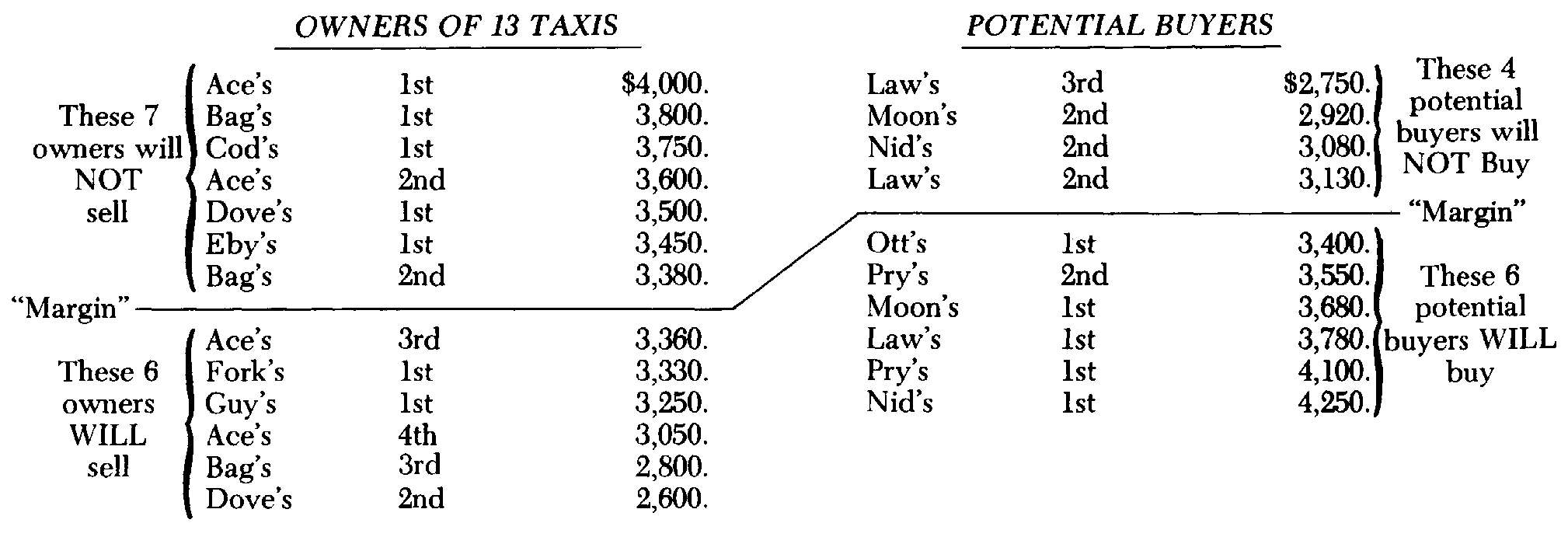
How many sold? 6 Within what price range? Between $3,360 and $3,380
To understand the way a pricing auction works —in this example or in real life—is not easy. Therefore we shall try to make it clear by spelling out the logic of the answer, step-by-step.
Imagine an auctioneer asking for bids:
$2,600—10 potential buyers will clamor to purchase, but only a single cab will be offered $2,800—9 eager buyers want to buy, but only 2 cabs will come on the market $3,050—8 potential buyers are willing to pay that much, but only 3 cabs will appear on the market
$3,130—7 would-be purchasers are bidding, but only the same 3 cabs are offered by their current owners
$3,250—6 would-be buyers are now in the market, but only 4 owners of cabs are willing to sell—too few to satisfy the demand at this price
$3,300—6 would-be purchasers are still bidding and a 5th owner is now ready to sell, but this is still one short of satisfying the market demand at this price $3,360-$3,379.99—SOLD!
Once the auctioneer raises the asking price to $3,360 (but not up as far as $3,380), a 6th cab will be offered, bringing to the market the number of cabs needed to satisfy the demand at that price. Thus, to “clear the market” in this example, the price must be:
1. more than $3,130—to keep would-be buyers from bidding for a 7th cab which no current owner would be willing to sell at that price
2. less than $3,400—to persuade a potential buyer to bid for a 6th cab.
BUT the market price for cabs is also more narrowly defined in this example between $3,360 and $3,380 as follows:
3. $3,360 or more—to induce the owner of a 6th cab to sell
4. less than $3,380—to prevent a 7th cab, for which no potential buyer is available in this example, from being offered on the market.
Remember that no one who wants to buy a cab (or anything else) will knowingly allow anyone else to bid it out from under his nose for less than he is willing to pay. The more eager of the would-be purchasers will offer enough more to bid the cab away from other potential buyers who don’t value it that much—up to the point (the margin) at which the dollars they would have to pay are worth more to them than the cab (or other item) for which they are bidding.
Similarly, no owner who is willing to sell will knowingly permit another owner and thus potential seller to make a sale at a higher price than he would be willing to accept. If an owner wants the money being offered for a cab (or anything else) more than he wants the cab (or other item), he will try to undercut other would-be Sellers, up to the point (the margin) at which keeping the cab (or other item) is worth more to him than the money he would receive in trade.
The end result of this particular auction, therefore, is that the 13 available taxis wind up in the hands of the persons who place the 13 highest values on owning them. A shorthand way to figure the answer—given the values placed on cabs in this particular example and barring changes of any kind which might cause the market participants to reshuffle in their minds the relative values, i.e., the relative importance to them, of cabs and dollars—is to count the number of cabs in existence (13) and then to determine where the 13 cabs would be most highly valued. Upon completion of the bidding and the exchanges that take place as a result of this auction, the 13 cabs will be found in the hands of the persons who want them the very most, those who place the 13 highest values on having them. In this diagrammed example, the 13 cabs would wind up in the possession of the buyers below and the owners above the line who value having (keeping or purchasing) a cab as much or more than whatever the market price proves to be, between $3,360 and $3,379.99.
PROBLEM B
|
10 IDENTICAL UNITS (OR SETS)—PORTABLE TVs, STEREOS, MOTORBIKES, ELECTRIC TYPEWRITERS, ELECTRONIC COMPUTERS, CAMERA EQUIPMENT, SPORTS OUTFITS, ETC.—OFFERED FOR SALE ON THE MARKET. |
|
| Top offering price of 20 potential BUYERS | Rock bottom price of 10 owners i.e., potential SELLERS |
| $372.50 | $400.00 |
| 370.00 | 375.00 |
| 365.00 | 360.00 |
| 362.50 | 355.00 |
| 360.00 | 350.00 |
| 357.50 | 347.50 |
| 345.00 | 330.00 |
| 330.00 | 320.00 |
| 323.00 | 310.00 |
| 310.50 | 295.00 |
| 300.00 | |
| 290.00 | |
| 272.50 | |
| 267.50 | |
| 255.00 | |
| 250.00 | |
| 230.00 | |
| 227.50 | |
| 225.00 | |
| 170.00 | |
How many units (or sets) will be sold? At what price?
PROBLEM B (Answer)
10 IDENTICAL UNITS (OR SETS)—PORTABLE TVs, STEREOS, MOTORBIKES, ELECTRIC TYPEWRITERS, ELECTRONIC COMPUTERS, CAMERA EQUIPMENT, SPORTS OUTFITS, ETC.—OFFERED FOR SALE ON THE MARKET.
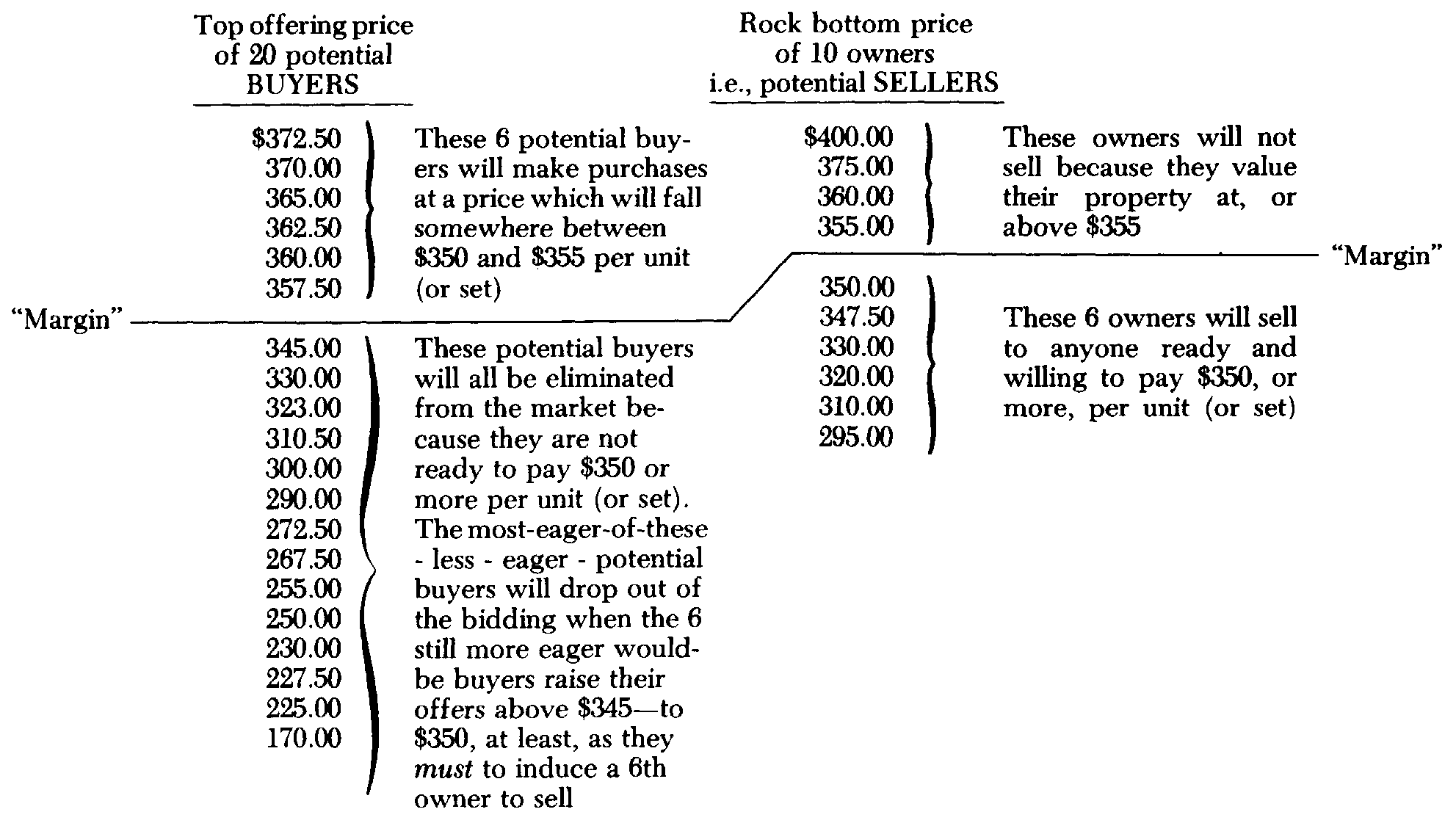
How many units (or sets) will be sold? 6
At what price? At or above $350 but under $355. Only if the price is within this range will it make supply and demand equal and “clear the market.”
PROBLEM B
This example could be described as a temporary “sellers’ market.” The would-be sellers of a product may have a heyday for a time in a sellers’ market for they may receive what they consider a really good price for their product. In a “sellers’ market,” would-be buyers are demanding more of a good or service at prices sellers are asking than is readily available on the market. As a result, eager would-be buyers compete vigorously with one another to purchase the existing supplies, thus bidding up the price per unit. In time this will stimulate more owners to sell and/or potential producers to increase production. Thus, the same principles apply in a so-called sellers’ market as in any free market auction when exchanges are completely voluntary:
1. no one trades unless he or she expects to be better off as a result of the transaction than they would be otherwise
2. at the conclusion of the auction, the available supplies wind up in the hands of those persons who place the highest values on them—previous owners who choose to keep what they have and would-be purchasers who want some of the good or service being traded enough to persuade previous owners who value it less to relinquish some of the units in their possession
3. at the market price finally agreed upon, the supply offered and the demand for it, are equal —any temporary advantage to sellers produced by the relatively eager demand of would-be buyers is dissipated as information concerning the market supply and demand situation is dispersed, in the course of the pricing auction, by the bids and asks of market participants.
PROBLEM C
| 20 IDENTICAL UNITS (OR SETS)—PORTABLE TVs, STEREOS, MOTORBIKES, ELECTRIC TYPEWRITERS, ELECTRONIC COMPUTERS, CAMERA EQUIPMENT, SPORTS OUTFITS, ETC.—OFFERED FOR SALE ON THE MARKET. | |
| Top offering price of 10 potential BUYERS | Rock bottom price of 20 owners, i.e., potential SELLERS |
| $400.00 | $372.50 |
| 375.00 | 370.00 |
| 360.00 | 365.00 |
| 355.00 | 362.50 |
| 350.00 | 360.00 |
| 347.50 | 357.50 |
| 330.00 | 345.00 |
| 320.00 | 330.00 |
| 310.00 | 323.00 |
| 295.00 | 310.50 |
| 300.00 | |
| 290.00 | |
| 272.50 | |
| 267.50 | |
| 255.00 | |
| 250.00 | |
| 230.00 | |
| 227.50 | |
| 225.00 | |
| 170.00 | |
How many units (or sets) will be sold?
At what price?
This example could be described as a temporary “buyers’ market.” Would-be buyers of a product enjoy making purchases on a so-called buyers’ market. On a buyers’ market, the quantity of a good or service available at prices potential buyers are willing to pay tends to exceed their demand for that particular item. Thus, would-be sellers compete vigorously with one another to make sales, lowering their asking prices in the process. On a so-called buyers’ market, sellers usually receive somewhat lower prices for their merchandise and buyers are apt to find what they consider real “bargains”—unless or until owners of that particular item decide it is not worthwhile to sell at the price they will receive and/or producers make plans to restrict production and/or turn to producing something else they expect consumers to want more urgently. However, the same principles apply in a so-called buyers’ market as in any free market auction when exchanges are completely voluntary:
1. no one trades unless he or she expects to be better off as a result of the transaction than they would be otherwise
2. at the conclusion of the auction, the available supplies wind up in the hands of those persons who place the highest values on them—previous owners who choose to keep what they have and would-be purchasers who want some of the good or service being traded enough to persuade previous owners who value it less to relinquish some of the units in their possession
3. at the market price finally agreed upon, the supply offered and the demand for it, are equal —any temporary advantage to buyers produced by the relative eagerness to sell on the part of owners and producers of the item being traded is dissipated as information concerning the market supply and demand situation is dispersed, in the course of the pricing auction, by the bids and asks of market participants.
PROBLEM C (Answer)
20 IDENTICAL UNITS (OR SETS)—PORTABLE TVs, STEREOS, MOTORBIKES, ELECTRIC TYPEWRITERS, ELECTRONIC COMPUTERS, CAMERA EQUIPMENT, SPORTS OUTFITS, ETC.—OFFERED FOR SALE ON THE MARKET.
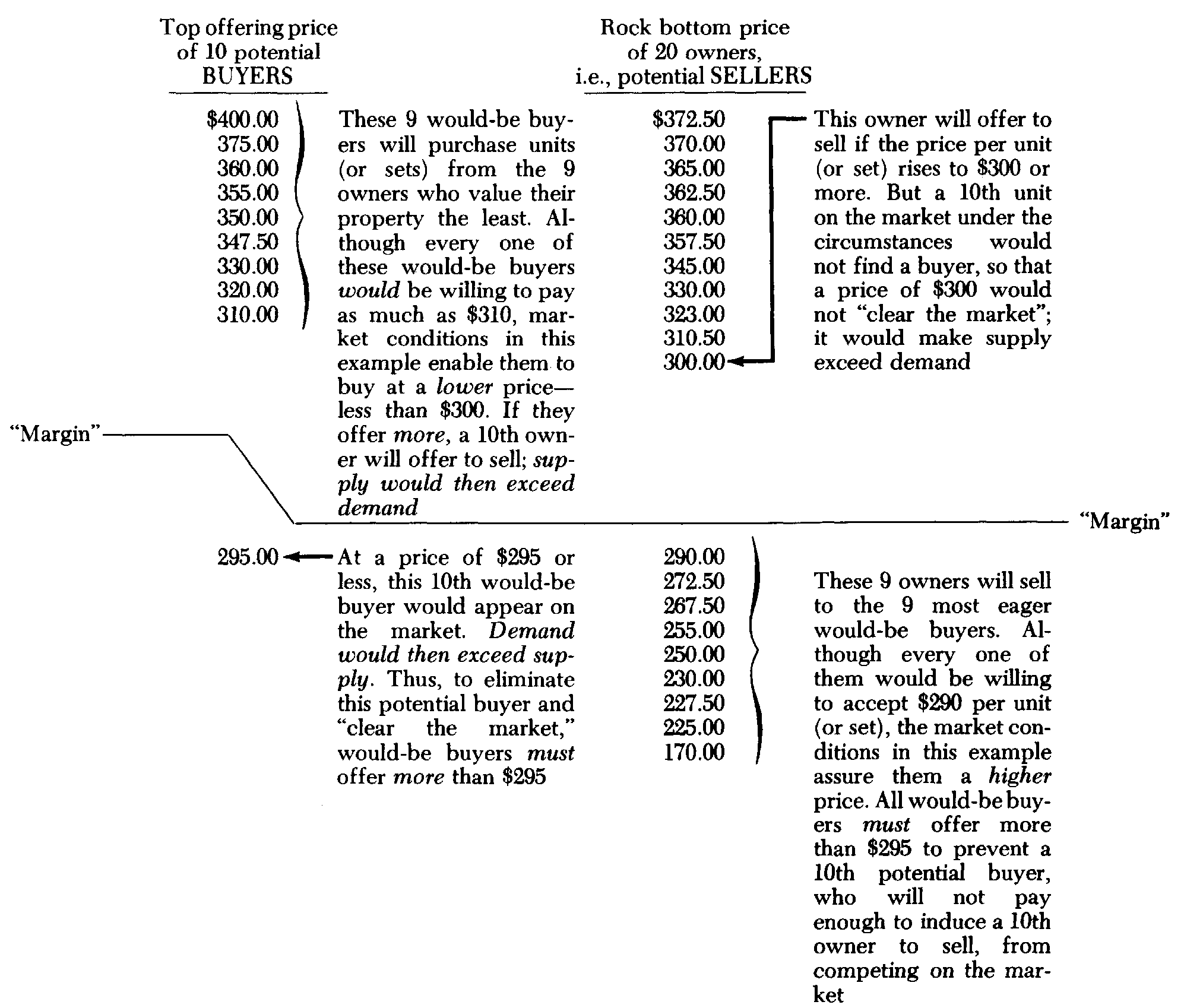
How many units (or sets) will be sold? 9
At what price? More than $295, but less than $300.
EXPLANATORY TEXT
If time or class interest does not permit devoting attention to the basics presented in Part I, the teacher may start with this Unit. As a matter of fact, Part II alone should furnish more than ample material for a semester course, for practically all the topics traditionally included under “economics” are covered here. For the benefit of anyone starting with this Unit, therefore, a brief summary of the basics dealt with in Part I follows:
1. What are the basic assumptions and steps in logic on which economic theories rest? Economics is the study of the conscious, purposive actions of individuals, seeking to relieve some “felt uneasiness” and thus to accomplish the most
urgent goal on his or her personal scale of subjective values.
a. Individuals are able to act to attain various goals because of the nature of our “ordered universe,” where six a priori characteristics prevail. (Unit 2)
1. Regularity
2. Logic
3. Causality
4. Time
5. Change
6. Value
b. We know things about the nature of conscious action because we are all acting individuals ourselves. (Unit 3)
1. Men act purposively to attain ends
2. Their wants are endless
3. Their means are limited
4. Their values are personal (subjective)
5. Their ideas, values and goals are always changing
6. They may make mistakes
7. At any instant in time, they are always aiming at what they consider most important
8. They always try to use the easiest and simplest way to get what they want; in other words, they “economize”
c. Three conditions are necessary for an individual to conceive of acting. (Unit 3)
1. Some dissatisfaction, a “felt uneasiness”
2. An idea concerning a better situation
3. The hope that action can accomplish something worthwhile
d. There are three requirements for acting. (Unit 3)
1. Planning
2. Time
3. The necessary resources (tools, knowledge, etc.)
e. Individuals are always pondering and experimenting to find easier and better ways to accomplish the things they want. Some of their thoughts and efforts have proven successful. Thus, acting men have discovered a number of helpful devices for attaining their various ends. They have found they can accomplish more of their goals better, easier, or better and easier if they respect the rights of individuals to acquire, hold and use private property as they wish. By specializing, cooperating and exchanging with one another, everyone can have more than if he lived and labored in isolation. Thus, it becomes apparent that the basic economic concepts follow “naturally” and logically from the nature of man and the universe:
1. Private Property (Unit 4)
2. Specialization and Division of Labor (Unit 4)
3. Exchange (Unit 4)
4. Social Cooperation (Unit 5)
5. Markets (Unit 5)
It is the task of economic theory to explain—with the use of logic—how the complex modern market economy has developed out of the purposive actions of individuals. In this Unit, we shall show how prices evolve as individuals—each acting independently and/or in cooperation with others through the market—value, choose, express preferences and seek their various, most urgent goals.
2. What is the significance of the fact that every individual always aims at what he wants most? An individual’s urgency, or indifference, with respect to various goals is reflected in his actions. A person’s eagerness, or lack of eagerness, to acquire a particular good or service affects the “price” he is willing to pay for it in terms of other goods and services. If he considers something vitally important, perhaps even necessary to keep him and his family alive and well, he may be ready to give almost anything he has to get it. The more urgently he wants something, the greater effort he will be willing to make, the more he will be ready to offer for it, the harder and longer he will work if necessary and the more eagerly he will bargain. How much difference this will make under any particular circumstance will always depend on his personal (subjective) values, other alternatives open to him and the urgency to him of the want he hopes it will satisfy.
Whether we realize it or not, every one of us is always weighing in his mind the relative worth to him of (a) what he wants that he does not have and (b) what he has that he might be able to offer in trade. Economic texts frequently refer to the tremendously high value a person will place on a drink of water if he is lost in the desert. If coal, oil, gas and electricity for civilian use are scarce or non-existent as in wartime, a family might burn books or furniture to keep warm—books or furniture which, under other circumstances, would be much more valuable for other purposes than as fuel.
Everyone has a different list of wants and scale of values but everyone will work hardest and most energetically for the things he values most. We all act this way. A child who is saving for a new bike will be eager to help with family chores if that increases his weekly allowance. A teenager who
wants a car of his own will be willing to work hard to pay for it and its operation. High school girls will want to baby-sit long hours if this provides money for exciting vacations and travel.
The more we want something, the more we will offer if we think we have a chance of getting it. This means that when the best and easiest way to get the things we want most is to buy them on the market, we will be ready to work longer hours to earn more money and pay higher prices for them. The more eager buyers are, the more urgent their demand—other things being equal—the higher the prices they will offer.
Sellers, too, are individuals who aim at whatever they want most. Instead of offering money for goods and services, sellers offer goods and services for money. The more eager they are to find buyers and make sales, the greater the inducements they will offer and—other things being equal—the lower the prices they will be willing to accept for a specific item. Thus, the eagerness of sellers tends to push prices down.
The market price of any definite quantity of a good or service at a particular time and place is the result of a meeting between persons with different viewpoints—sellers who are offering goods and/or services and buyers who are offering money for goods and/or services. Both parties may higgle and haggle to obtain the best trade possible. They may both begrudge what the other is asking, but if a willing exchange results, it is because both believe it will improve their respective situations and so help both acquire something or reach some goal on their respective lists of wants or scales of values:
It is naught, it is naught, saith the buyer: but when he is gone his way, then he boasteth.
(Proverbs 20,14)
A person’s incentive to act at a particular place and time comes from the satisfaction he expects to derive from the action or from the specific unit or quantity of the good or service he hopes to gain. Individuals don’t act in a vacuum. They always act in the light of a specific situation. They consider circumstances. They look at alternatives. For instance, if there is lots of clean, fresh water around so that it is easy to have a drink at any time, they won’t offer much for a cup of water, though they probably would offer a great deal for potable water in the middle of a desert. Even though every one of us must have water to live, we will not, and need not, pay as high a price for a drink when good drinking water is readily available as we would if that particular quantity of water was the only water available for survival. Thus, the value of any particular item at a particular place and time depends on the urgency of the individual’s demand for that particular thing under the circumstances prevailing.
On a desert, where a canteen of water is the only potable liquid within miles, it may represent the difference between death and survival. In that case it could be as valuable to an individual as his life. If he had a bottle of soda also, a flask of wine, or a retinue of attendants all bearing provisions, the value of that one canteen of water would be somewhat less. How much less would depend on circumstances. If that same person were camped by a mountain stream or seated in a well-equipped home with hot and cold water available at the turn of a faucet, he probably would not pay a penny extra for a glass of drinking water. In either case, the important consideration is the individual’s evaluation of the specific quantity of the good or service in question, given the situation—his specific wants and needs, the available supply, other possible sources, potential substitutes and anticipated changes.
The value of diamonds is explained in a similar way. The important consideration is always the value to the individual concerned of the satisfaction which depends on the specific diamond in question, given the particular situation. What is the value to him of the use or pleasure a particular diamond may provide? How plentiful and accessible are similar diamonds? Are suitable substitutes obtainable? If so, how difficult or expensive will it be to acquire them? Are the individual’s values likely to change in the future to render this particular diamond more, or less, important to him, or perhaps even a source of misfortune? Are future mining or production techniques likely to make diamonds more plentiful, more easily accessible, more available for less important uses and, thus, less valuable to individuals who will then find that only a lesser satisfaction depends on a single diamond? Or might diamonds become more desired in the future for industrial uses, jewelry or investment, relatively more scarce and less easily accessible when compared with the demand for them. In that case, the limited supply of diamonds would be devoted only to providing more urgent wants or needs. As a result, the value to a specific individual of a single diamond—on which a more urgent satisfaction now depends—will tend to rise. Just as in the case of drinking water, the value of a particular diamond will always depend on the urgency of the individual’s desire for the satisfaction he expects it to yield at a particular time and place—in comparison with other alternatives.
4. How does an individual decide among many possible alternatives? Most people usually know at any moment what it is that they want most. Once in a while, a choice may be difficult. We may even decide later that the decision we made was not a wise one. However, few people become so overwhelmed by the complexity of a situation that they freeze and cannot act at all. We usually decide and act with little hesitation and our actions usually produce about the results expected.
Almost without realizing what we do, most of us, most of the time, analyze a situation mentally and break it down into manageable portions before acting. We eat a meal a mouthful at a time; we climb a mountain step by step; we construct skyscrapers brick by brick or steel beam by steel beam. We break things down into “bite-sized” pieces or stages. Similarly, when we go to a store, the decisions we face at any instant are always narrowed down to comparing the advantages and/ or disadvantages of buying or not buying a certain quantity of a particular item, with the advantages and/or disadvantages of holding on to, not parting with, the particular units of money or of anything else that the item we are considering would cost.
Whenever we act—produce, buy, sell, trade, consume, etc.—we always consider a specific situation in the light of the particular conditions we are facing at the time. An individual acts only when the satisfaction he expects to derive, or the dissatisfaction he expects to avoid, by acting is worth more in his mind than the value of the time and energy and everything else he must give to make the exchange. The value, usefulness or “utility” of whatever it takes to tip the scales at the “margin” and actually induce a person to act is called the “marginal utility.”
The price of an item on the market depends on its marginal utility in the minds of the particular persons who are potential competitors for the available supply. The marginal utility of a particular unit of a good or service to any individual depends, in turn, on the satisfaction that particular item is expected to furnish him under the circumstances, i.e., the satisfaction he would lose if this particular unit were lost. As we have seen, the loss of a canteen of water on a desert could mean the loss of a person’s very life and under that condition, the marginal utility of a canteen of water would be worth that person’s life. On the other hand, in a comfortable home or beside a mountain stream, the marginal utility of a glass of water would be no more valuable than the relative enjoyment of remaining at rest in an easy chair or beside the campfire; a person would have to want a drink of water more than his ease to be persuaded to walk to the kitchen tap or to the side of the mountain stream to fill his glass or cup.
The marginal utility of any item hangs or falls on the possession of one more, or one less, unit of that particular good or service. This is the “marginal unit” of any item, the last unit for which the money and/or effort it costs seem worthwhile, the last unit that is worth striving for under the circumstances. No one will knowingly or voluntarily work harder or pay more for any additional unit of something than its marginal utility to him, i.e., the value of the satisfaction he expects to derive from that one unit. If conditions change, so will the “marginal unit” of a good or service as well as its “marginal utility.”
note: The concept of the marginal unit and its marginal utility was developed primarily by the “Austrian School of Economics” (Unit 13). To spark discussion and explain more fully the importance of the marginal unit, i.e., the particular quantity of a good or service being considered, and its marginal utility, i.e., the particular satisfaction which hangs or falls on the possession of the marginal unit, the teacher might write several quotations on the blackboard. For suggestions in guiding the discussion, see the comments below each quote.
“A horse! A horse! My kingdom for a horse!”
William Shakespeare, Richard III (Act V, Scene IV)
What is the marginal unit? A horse.
What is its marginal utility? Its usefulness to Richard III as a means to retain his ill-gotten kingdom.
What is the value of this marginal unit? To Richard III, at that moment in battle it was practically as important as the kingdom for which he had lied, conspired and killed.
How is the value of this marginal unit to Richard III related to the price he was ready to pay, or promise, for a horse under the circumstances? Let the students speculate on the urgency of Richard Ill’s demand for a horse, relative to the supply available, in the midst of the battle to save his kingdom. Note that the supply available in the midst of a battle is by no means the same as the supply available in the kingdom.
“A little Neglect may breed great Mischief: for want of a Nail the Shoe was lost; for want of a Shoe the Horse was lost; and for want of a Horse the Rider was lost, being overtaken and slain by the Enemy; all for want of Care about a Horse-shoe Nail.”
Benjamin Franklin, Maxims prefixed to Poor Richard’s Almanac (1757)
What is the marginal unit? A horse-shoe nail. What is its marginal utility? Its usefulness as an aid to the proper care of a horse.
What is the value of this marginal unit? Practically the equivalent of the rider’s life. Note that here again the circumstances under which the marginal utility of a horse-shoe nail is equated with a rider’s life must have involved a chase when lack of time and opportunity made it impossible for the rider to obtain a new horse-shoe and wait for the horse to be shod.
“Wherever men recognize that the requirements for a good are greater than its available quantity, they achieve the further insight that no part of the available quantity may lose its useful property or be removed from human control, without causing some concrete human needs previously provided for to remain unsatisfied, or without causing these needs now to be satisfied less completely than before.”
Carl Menger, Principles of Economics, p. 95
Menger (1840-1921), “founder” of the Austrian School of Economics, was the first to clearly describe the concepts of “marginal utility.” His book, written in German, was published originally in 1871.
Re-read Henry Hazlitt’s “The Broken Window” (Reading No. 3) in the light of this quote. What “concrete human need” did the baker lose when the hoodlum threw the brick? Protection against the elements and window display space.
After the baker replaces the window, which of his wants will be less well satisfied than before? Clothing.
Speculate on the effect of this loss on the tailor. His wants cannot be as well satisfied as if he had been able to produce and profit from the sale of an additional suit of clothes.
Bring to class a recent newspaper account of an accident or natural catastrophe (flood, fire, earthquake, bombing, etc.). Discuss the “concrete human needs previously provided for” which must now, as a result of this loss of useful property, remain unsatisfied. To replace the property lost or destroyed, goods and services must be shifted from uses for which they had been intended. This means that lumber, bricks, stones, mortar, labor, etc., used to rebuild the structures destroyed, will not be available to expand production. Thus, any form of destruction makes each unit of the remaining stocks more valuable, i.e., it increases its marginal utility and hampers increased savings, investment and thus, economic development.
Is it possible to estimate the economic value of the loss from such a catastrophe? Like the broken window, every loss has far-reaching consequences, often difficult or even impossible to trace. However, it is possible through economic calculation, to compare the monetary value of the material loss and the monetary value of the goods or services needed to compensate for the destruction. In the process of making repairs and restoration, people who want goods and services very urgently for these purposes will bid them away from those who value them less. As a result, the goods and services used to compensate for losses are taken from where they have not had as much value given the new circumstances—i.e., they would be shifted from uses that are now “submarginal”—so they may be applied to uses which have become more urgent as a result of the catastrophe. In this way in “The Broken Window,” the baker shifted money he would have used for a new suit, now rendered a “submarginal” use of funds in his view, to replace the window, which had become his most urgent unsatisfied want. On the baker’s scale of values, the marginal utility of a new window was more than that of the new suit he relinquishes. Thus, the economic value of property destroyed may be calculated by comparing it with the “marginal utility” of the goods and services used in the attempt to make up for the loss.
Human lives, historical treasures and natural wonders are irreplaceable. Their full values are impossible to estimate in money terms. In calculating the “marginal utility value” of such losses, one must make some attempt to consider not only the money equivalent of the income they would probably have furnished in the future, as judged from past experience, but also the contributions—in the form of love, pleasure, local pride, etc.—they would have been expected to make if they hadn’t been destroyed.
“And the common people have furnished excellent proof of their sensitivity in economic matters by recognizing the essential nature of value long before the scientists did. Science was misled by confusing utility with value, and so it declared goods like air and water to be things of the greatest use value. The man in the street observed or sensed with greater accuracy and in spite of science treated air and water as they deserved to be treated, namely as things without value. And for centuries, long before science set up the doctrine of marginal utility, the common man was accustomed to seek things and abandon things, not in accordance with the highest utility that they are by nature capable of delivering, but in accordance with the increase or decrease in concrete utility that depends on each given good. In other words, he practiced the doctrine of marginal utility before economic theory discovered it.”
Eugen von Boehm-Bawerk, Value and Price, an extract from Capital and Interest (1960 ed., pp. 203-204; 1973 ed., p. 102)
Boehm-Bawerk (1851-1914), noted economist of the “Austrian School,” also served as Minister of Finance in the government of the old Austro-Hungarian Empire. His major contribution was in applying the theory of subjective value to explain how interest rates are determined by the choices and actions of individuals (Unit 10).
What do economists seek to accomplish in developing economic theories? They want to explain the way people act. With a better understanding of the actions of individuals, we are in a better position to cooperate and work effectively through the market economy. One of the greatest insights to be derived from an understanding of the way people act is that we “common people” recognize quite logically and naturally that goods and services, which are scarce relative to demand have value, and those, which are overabundant in relation to their known utility, do not. In Value and Price (1960 ed., p. 136; 1973 ed., p. 21) Boehm-Bawerk wrote:
. . the common man would not be misled into the erroneous selective judgment that every quart of water he draws from the kitchen tap is therefore a treasure of immense value, and cheaply purchased at $1,000.”
What is the significance of this insight—namely that the “common man” readily recognizes the “marginal utility” of a good or service and considers this when acting? Most people generally know very well what is, and what is not, valuable to them and to the market. As a result, they tend to “economize.” They try to use sparingly those things of the greatest value, saving them for only their most urgent needs. Things which are relatively more abundant, more readily accessible and, thus, somewhat less valuable on the market may be used more liberally and applied to relatively less important purposes also.
How does this tendency to “economize” affect the “marginal utility” of a good or service and, thus, its market price? No one will knowingly or voluntarily pay more or work harder for something than he has to. The scarcer a good or service is, relative to the demand for it, the more competition there is for it on the market, the higher the price people will be ready to pay per unit, and thus the greater the pressure will be to see that it is reserved for only its most important uses. This helps to assure that its utility at the “margin,” i.e., the least important purpose for which it will be used, will reflect the urgency of the demand for it relative to its supply. This “marginal utility,” reflected by individuals through their choices and actions, then helps guide persons in comparing values and bidding on the market. Thus the market prices that result from the competitive bidding of owners (potential sellers) and would-be owners (potential buyers) are determined by the natural and logical attempts on the part of countless individuals, each seeking to accomplish as easily and as cheaply as conditions permit, his or her most urgent goals, consistent with their personal (subjective) ideas and values.
“The law of marginal utility does not refer to objective use-value, but to subjective use-value. It does not deal with the physical or chemical capacity of things to bring about a definite effect in general, but with the relevance for the well-being of a man as he himself sees it under the prevailing momentary state of affairs. It does not deal primarily with the value of things, but with the value of the service a man expects to get from them.”
Ludwig von Mises, Human Action (3rd ed., 1966), p. 125
Mises (1881-1973) was the leading spokesman of the Austrian School of Economics for many decades. He authored several important books and numerous articles on economics and the limited government philosophy of classical liberalism.
Review the meaning of “value” and the difference between the “objective characteristics” of an item and its “subjective value.” (See the explanatory text of Unit 3 as well as the glossary definitions of these terms.)
How does an understanding of “subjective value” explain why some people will offer more money for some things than would seem to be justified by their objective attributes? How about such things as a rabbit’s foot, tickets to sports events or first night shows, wide or narrow neckties, cigarettes, mink coats, stylish clothing in the latest fad, or a Rolls Royce? As Mises says in the quoted passage, the value of things, which is reflected in their marginal utility per unit, is derived from “the value of the service a man expects to get from them.” [Italics added]. This may, or may not, be related to the physical and chemical service it actually renders.
Comment from this point of view on the value of some of the goods and services the students, or their families, appreciate subjectively for qualities other than their objective (physical and chemical) characteristics. For instance, contrast the objective traits of a “fun” vacation, a foreign sports car, a new fashionable outfit, the prestige of belonging to a popular social set, club, group or gang, the pleasure of gaining recognition for prowess in sports, etc., with the possible subjective satisfaction each may furnish.
5. How do the ideas and values of countless individuals lead in time to market prices? Now we come to a consideration of the way the uncounted billions of individual value judgments and actions fit together to make the market. The most important thing to keep in mind is that the entire market economy and everything in it are continually in flux. We might compare the economy with a gigantic ever-moving jigsaw puzzle, composed of countless ever-changing pieces. Every personal value judgment, choice, preference or action is a piece in this huge jigsaw puzzle. As individuals alter their personal (subjective) values and take actions in response to the new circumstances with which they are faced, the overall market jigsaw is altered.
Individuals meet, cooperate, exchange and trade in the attempt to attain their various and respective goals. In this process their personal values and actions bump up against one another. Each individual influences others and is, in turn, himself affected by these interpersonal contacts. The ideas of others often lead us to change our views, shift our personal scales of subjective values and take different actions from those we had intended. The competition of others for a good or service we had thought we wanted could, for instance, persuade us to put forth greater effort to obtain it, i.e., offer a higher price or a greater inducement to its present owner to part with it. Or on the other hand, that very same competition might cause us to shift to a substitute good or service or even change our plans completely.
Let us take one example—for instance, pizza slices or hamburgers and cokes. If we are willing to work harder or longer to earn more, in order to gorge ourselves on pizza slices or hamburgers and cokes, our eagerness will lead us to increase our production. This will permit others to have and enjoy more of the particular good or service we are producing and offering. Thus it becomes easier and cheaper for others to attain their respective goals. On the other hand, our eagerness to put forth greater effort, offer more and bid higher prices reflects the marginal utility of pizza, hamburgers and cokes in our eyes and helps to enhance their value on the market. Our more eager bidding tends to increase their prices and make them more expensive for others to purchase. This increased demand, relative to supply, induces some people to economize by consuming fewer pizza slices, hamburgers and cokes. At the same time it may persuade someone to open a new pizza parlor or hamburger outlet. In this way, the ideas and actions of one individual eventually impinge through the market on the ideas and actions of all other individuals associated in any way with that particular trading area.
6. How do the ideas, values, choices and actions of an individual help to determine the pattern of production? Everyone is a consumer. We work, either to produce what we want to consume or to earn money so as to be able to buy what we want to consume. Once a person has acquired some purchasing power, by having produced some good or service for which others offer something in trade, he appears on the market as a potential buyer. He then bids for goods and services—rejecting some items and bargaining in the attempt to obtain others, the things he wants most urgently. As a customer each of us acts in response to his own varied and ever-changing personal value scale. He spends money for things he hopes will furnish satisfaction.
Persons in sports speak of their “gate,” people in show business of their “box office receipts.” Gate or box office receipts reflect the preferences of consumers. They represent the “votes” on the market of persons who chose to buy tickets for a particular event or show in preference to anything else they might have purchased. The more popular the star, or athlete, the more exciting or enjoyable a game or performance is expected to be, the more customers will want to buy tickets and the larger the gate or box office receipts will be.
The hundreds of thousands of dollars per film that producers pay a big movie star are furnished by hundreds of thousands of customers, customers like you and me, who buy tickets to see these stars because that is what we, the customers, want most urgently under the circumstances in exchange for our dollars. The box office receipts from movies like “Gone With The Wind,” “The Sound of Music,” “My Fair Lady,” etc., are tremendous because thousands and thousands of customers paid to see them, enjoyed them, and recommended them to others who did the same. The box office receipts of less popular actors and less successful shows may be so small that they do not even cover all costs. The producers of such shows lose money. Thus every producer of movies, sports events, or anything else, wants a big gate or large box office receipts, so he aims at supplying consumers with what they want.
NOTE: Ask the students where the money comes from that famous movie stars pay for their elegant homes and expensive cars, clothes and jewels. Why do football and baseball managers sometimes pay millions of dollars to hire a particular player? Are such high salaries “justified”? If they are justified, why do you say so? If not, why not? Is anyone harmed if some persons are paid such huge sums? Suppose movie producers and the owners of football or baseball teams were not allowed to pay any popular star or player more than a limited amount. How would that affect (a) their business (the production of movies or the sport involved)? (b) its customers or fans? (c) the individual actors or players?
We may apply this same terminology to any business. The money a firm’s customers pay for the goods and/or services it produces determines the company’s “gate” or “box office receipts.” Even the wages paid an employee may be looked on as “box office receipts.” For instance, the “box office receipts” of a secretary or of an automobile mechanic reflect the value to customers of whatever good or service he or she contributes to the product their employer is selling. (See Unit 9 for a full explanation of the way wages are determined on the market.)
A firm’s box office receipts may sometimes fall below, or only barely cover costs for some reason— because its managers underestimated expenses, misinterpreted markets, or did not satisfy customers sufficiently, etc. Then it may earn no profits at all and even end up with losses. Practically no one wants such a state of affairs. As a matter of fact, no businessman who wishes to stay in business, continue operating and maintain his capital investment can long afford losses. Therefore, his goal must be to supply consumers with things they want and will pay for. So producers study the purchases consumers have made in the past for clues as to what they are likely to want in the future. They try to avoid producing things consumers will not buy. In this way, producers are guided by the purchases consumers make—or refuse to make. On a free market, therefore, where every dollar a firm takes in comes from customers who are “voting” their preferences, the consumers direct producers almost as puppeteers control their marionettes by pulling strings.
Let us go back to the simple lead pencil mentioned in Unit 5, where we considered cooperation through the market. Suppose you buy a pencil. In making that purchase you act like a puppeteer manipulating all the various producers involved. You pull strings which lead to lumbermen, steel workers who make saws, miners of graphite on the island of Ceylon (now Sri Lanka), manufacturers of paint and lacquer, truckers who bring the pencils to market, the local stationer, his sales clerk and stock boys, and so on—all this and still more when you simply buy a humble pencil. (Refer once more to Leonard E. Read’s “I, Pencil,” Reading No. 15.)
If someone wants entertainment, he pulls different strings, manipulates other producer-mario-nettes than those in the pencil industry. Entertainment-seeking consumer-puppeteers pull strings leading to rock bands, TV or movie producers, actors, singers, comics, electronic specialists, film manufacturers, etc. Thus, individuals who purchase specific items and refuse to purchase others, give “orders” to producers and influence, through them, the future pattern of production. When tomorrow comes, the goods and services that will then be offered on the market will reflect the actions of individuals today, as these actions have been interpreted to the best of their ability by businessmen planning future production in the hope of making profits by satisfying future consumer wants and needs.
NOTE: Businessmen today do not operate in a completely free market, of course. Many artificially-created obstacles and restrictions interfere with, and disrupt, the transmission of clear and distinct signals from consumer-puppeteers to producer-marionettes. These artificial interferences—as well as the natural, physical, geographical and market factors businessmen are always coping with—must be taken into consideration. These artificial interferences include many government rules and regulations such as subsidies for some persons, penalties for others, restrictions, tax levies, etc. The effects of such government interventions are another story—to be dealt with later, especially in Unit 14.
7. How do the ideas, choices and actions of individuals help to determine market prices? Persons with goods or services they hope to sell must continually experiment to discover the “market price” of any particular item. As the students will have learned from the classroom auctions, it is possible to determine, by continued bargaining, the price at which an item will “clear the market” at any particular moment. At that price, determined by the relative eagerness and subjective values of owners or potential sellers and would-be buyers, the number of units of a good or service wanted and the number offered will be the same. But no one can know in advance what this price will be. Charts, graphs and computers offer no help. Businessmen consider past experience but temper it with their best understanding of the situation and their most intelligent estimate of the expected demands of consumers in the future.
Businessmen experiment with various prices on a trial and error basis. Experience and market studies furnish some clues, but the best they can do is to select a tentative price for their good or service on the basis of their best estimate of what consumers will pay per unit. This becomes their “asking price.” This “asking price” may appear to be “fixed” or “administered.” They may print this “asking price” on their product’s label, list it in advertisements and even instruct their salesmen to quote this price to potential buyers on a take-it-or-leave-it basis. However, this “asking price” is actually just the first step in trying to bring about a trade that will be mutually satisfactory. If a businessman wants to sell his entire stock eventually, if he wants supply and demand to come out more or less even, his “asking price” cannot be considered as permanent or “fixed.” Nor can he “administer” prices. If he does not enjoy a specially privileged position, protected by government from competitors, it is the businessman’s potential customers who can say “take it or leave it,” refuse to buy from him and look for substitute goods and services. Thus if the businessman wants to sell, he must remain flexible and willing to raise or lower his “asking price” according to the wishes and whims of consumers, as they express them on the market.
Whether the would-be seller of a product is a large corporation, be it General Foods or General Motors, or a peddler in a Middle East bazaar, he is always at the mercy of consumers on a free market. If he wants to sell and cannot find a buyer at his current “asking price,” he must be ready to adjust to the situation. He need not necessarily change his “asking price” directly in terms of money. He may juggle the “real price” in a number of ways, some of which the students will recognize as more or less common. If stocks remain unsold after some time, the would-be seller may hold an “end of the season” sale of remainders at “special” (lower) prices. He may give discounts, offer refunds under certain conditions or make special offers—two for a dollar and so on. He may increase or reduce the original guaranty, depending upon the consumer demand for his product. He can give trading stamps or special giveaways to purchasers, distribute coupons offering money off on purchases. He can furnish free installation and/or service, or he can charge extra for one or both. In any event, businessmen are continually juggling their “asking prices,” in the attempt to discover the price at which their particular good or service will “clear the market.” The better they succeed in doing this repeatedly and continually, the more profitable their business will tend to be, and the better they will satisfy the personal (subjective) values of individuals, each of whom is being helped in the process toward his own various ends and goals.
8. What are the logical conclusions to be drawn from an analysis of a free market auction? After conducting a classroom auction according to the procedure described in suggested activity No. 1 of this Unit, itemize and discuss the following specific points demonstrated by the auction:
a. Everyone—owner or potential seller and would-be buyer alike—was bidding in the attempt to improve his or her situation as he or she saw it under the given circumstances.
b. Everyone bid according to his or her own personal (subjective) scale of values.
c. Would-be buyers of a good or service do not consider the total supply. Rather each compares in his own mind the relative advantages and/or disadvantages of buying—or refusing to buy—a certain specific quantity or unit.
d. Owners, i.e., potential sellers, also consider their property in units, weighing separately in their minds the pros and cons of selling one more, or one less unit or item at the specific terms being offered at a specific place and time.
e. If neither buyer nor seller makes a mistake—due to unexpected changes in value judgments, future needs and wants, etc.—both expect to gain from the trade.
f. No one who sells anything voluntarily expects to receive something he values less, and he very likely receives something he values more, than what he relinquishes in trade.
g. No one who buys anything voluntarily is forced to pay more, and he very likely pays less, than the value he expects to derive from the item he takes in trade.
h. Owners who do not sell hold on to their property because they consider it more valuable under the circumstances than what they could then receive for it in trade.
i. Thus, barring force, fraud, violence and error, there is a tendency on the market for goods and services to be traded to, and held by, those who want them most.
j. Any owner who insists on asking more than the market—whether due to error, ignorance, stubbornness or outside interference (price maintenance agreements, for instance)—will sell fewer units than he would at the market price and he may sell none at all.
k. Any would-be buyer who refuses to offer at least as much as the market price—whether due to error, ignorance, stubbornness or outside interference—will find fewer units available for him to buy and he may not find any at all.
l. In the light of (j) and (k), therefore, it is apparent that the greatest possible number of voluntary, mutually agreeable transactions take place at the market price. When would-be buyers refuse to pay that much per unit for anything, owners refuse to sell as many; when owners insist on a higher price per unit, would-be buyers are not ready to buy as many, m. The would-be buyer buys and the owner sells a specific item because, at the terms agreed upon, trading seems more beneficial to both than any alternative open to either. At the same time, those who refuse to buy or sell a specific item do not anticipate a gain sufficient to compensate for the trade or for other opportunities lost.
n. Thus, the market price for a certain quantity and quality of any good or service depends, in the last analysis, on the personal (subjective) values of actual and potential buyers and sellers.
o. The price paid on the free market for any particular item, therefore, conforms to the “Law of Price.” It is forced by competition and the pricing process to fall within certain limits determined by the personal (subjective) values of the buyers and sellers at the margin—i.e., the invisible dividing line between those who buy and those who refuse to buy the specific units of goods and services produced and offered on the market.
SUMMARY
The free market is a complex of many “auctions,” going on continually everywhere as persons who have goods and services consider alternatives, seek to improve their respective situations, try to exchange what they have, in order to acquire things they prefer and decide whether to buy, sell, or refuse to buy or sell, in any given situation.
In the world we live in, changes are always taking place. Everything in the market economy is continually in flux. However, one tendency prevails in a free market economy. The available supply of any item is always being shifted—from those who value it less to those who value it more. Potential buyers will keep bidding its price up until those who want it less urgently are eliminated from the bidding. By the same token, the owners most eager to dispose of the good or service being auctioned will experiment with lower asking prices until they succeed in finding buyers for the stock they want to sell. On a free market, there is a tendency for this bargaining process to continue until the quantity offered at a certain price precisely equals the quantity buyers are willing to purchase at that price. The actual price at which sales will be concluded at a particular time and place will never be less than the lowest price any successful seller would have been willing to take nor more than the highest price any successful buyer would have been willing to offer. Thus, in any voluntary transaction, barring force, fraud or human error, both buyer and seller consider they have made a good bargain.
In a free market, the price of any item must always fall somewhere between the limits set by the value scales of the buyers and sellers at the “margin,” the invisible dividing line between those who trade and those who don’t. This is the “Law of Price.”
It might be mentioned in passing that the greater the number of potential buyers and sellers in any market, the closer the “bid” and “ask” prices will come to one another and the more narrowly the market price will be determined by the subjective values of the marginal buyers and sellers. Thus the tremendous size of the modern market economy and the great numbers of potential buyers and sellers in the trading area mean that the prices of many items quoted on the market fall within such narrow margins that they practically appear to be objectively based. They may seem to depend almost entirely on the physical characteristics and production costs of the goods and services in question. However, even in such a large trading area, the market prices of both consumers’ and producers’ goods still stem from the personal and subjective ideas, values, choices and actions of separate individuals.
World market prices are arrived at in a way similar to that demonstrated in capsule form through the classroom auction experiment. World market prices too are the outcome of purchases and refusals to purchase, i.e., the bargaining of individuals, each acting in accord with his or her own personal (subjective) ideas and values, each aiming at what he or she considers most urgent at the moment, in the light of prevailing circumstances.
GLOSSARY WORDS
(For definitions, see glossary, pp. 223ff.)
“Administered price”
Buyer
Economic calculation
Economize
Margin
Marginal unit
Marginal utility
Paradox of value
Price
Price, law of
Purchasing power
Seller
Subjective value
RECOMMENDED READINGS
More advanced materials are indicated by an asterisk(*)
Articles
In the BASIC READER:
16. “Cost-Plus Pricing,” Paul L. Poirot
17. “Charging ‘All the Traffic Will Bear!’” Leonard E. Read
18. “How Should Prices Be Determined?” Henry Hazlitt
50. “Freedom to Shop Around,” Hart Buck *61. “The Formation and Function of Prices,” Hans F. Sennholz
Books
* Boehm-Bawerk, Eugen von. Value and Price (Libertarian Press, 1960; 1973)
Greaves, Percy L. Jr. Understanding the Dollar Crisis (Western Islands, 1973). Chapter III
Hazlitt, Henry. Economics in One Lesson (Harper, 1946; 2nd ed., MacFadden, 1962; Manor Books, 1973). Chapters 15, 16, 17, 18
* Menger, Carl. Principles of Economics (English trans. of 1871 German, Free Press of Glencoe/Macmillan, 1950). Chapters V, VI and VII
* Mises, Ludwig von. Human Action (Yale, 1949 and 1963; Regnery, 1966). Chapter XVI
Footnotes
1 See Unit 13 on the “History of Economic Thought” for an outline of this intellectual development.
- 1On coming to Paris for a visit, I said to myself: Here are a million human beings who would all die in a few days if supplies of all sorts did not flow into this great metropolis. It staggers the imagination to try to comprehend the vast multiplicity of objects that must pass through its gates tomorrow, if its inhabitants are to be preserved from the horrors of famine, insurrection, and pillage. And yet all are sleeping peacefully at this moment, without being disturbed for a single instant by the idea of so frightful a prospect. On the other hand, eighty departments have worked today, without co-operative planning or mutual arrangements, to keep Paris supplied. How does each succeeding day manage to bring to this gigantic market just what is necessary—neither too much nor too little? What, then, is the resourceful and secret power that governs the amazing regularity of such complicated movements, a regularity in which everyone has such implicit faith, although his prosperity and his very life depend upon it? That power is an absolute principle, the principle of free exchange. (1845)

