
Free Market Economics: A Syllabus
4. Private Property and Exchange
4. PRIVATE PROPERTY AND EXCHANGE
SUGGESTED ACTIVITIES
1. Write one or all of these quotations on the blackboard, or distribute them on mimeographed sheets:
a. If wishes were horses then beggars would ride.
b. Thus human economy and property have a joint economic origin since both have, as the ultimate reason for their existence, the fact that goods exist whose available quantities are smaller than the requirements of men. Property, therefore, like human economy, is not an arbitrary invention but rather the only practically possible solution of the problem that is, in the nature of things, imposed upon us by the disparity between requirements for, and available quantities of, all economic goods. (Carl Menger, Principles of Economics, p. 97)
c. Property is the fruit of labor—property is desirable—is a positive good in the world. That some should be rich ... is just encouragement to industry and enterprise. Let not him who is houseless pull down the house of another; but let him work diligently and build one for himself, thus by example assuring that his own shall be safe from violence when built. (Abraham Lincoln. Address to the Workingmen’s Association of New York, March 21, 1864)
Discuss these three quotes with the class. It may prove suitable to refer to them from time to time in the course of this Unit for taken together they describe one aspect of reality—the “economic problem.” (a) Everyone dreams of the delights to be realized from having more than he can ever realistically expect to attain in view of his available resources, (b) There is not enough of everything in this world for everyone to have all he wants of everything. Parents may say of a youngster who wants to gorge on candy that “his eyes are bigger than his stomach,” i.e., his desires are greater than his “resources,” his limited stomach capacity. Similarly, each of us, like the beggar who wishes for a horse, wants many things, aims at stars, dreams of “castles in Spain,” but has at hand only limited time, energy and resources, (c) It behooves us, therefore, to see that those who have property are free to use, invest and enjoy it in peace for only then can each of us be assured that he will be permitted to do the same, if, as and when he acquires property of his own.
2. Draw a simple diagram on the blackboard as follows:
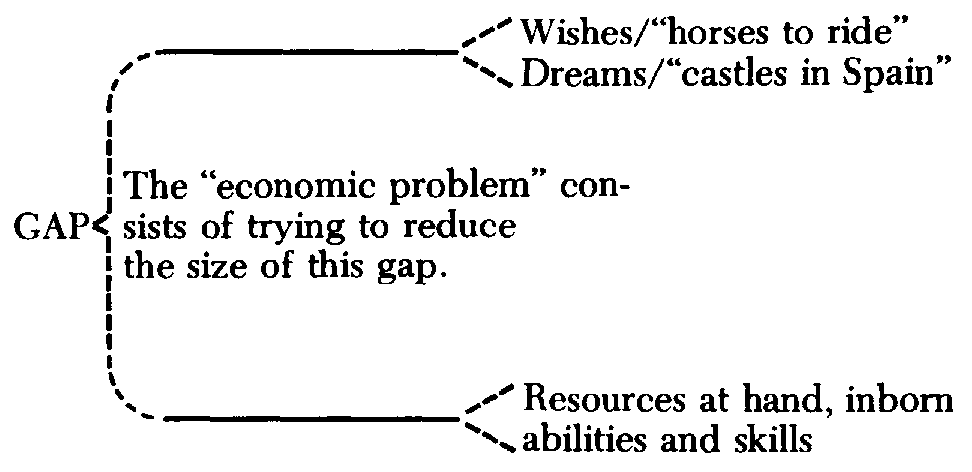
So long as we live, act purposively, and do not relinquish all thought of trying to improve our situation, we must face this “economic problem.” That is if we hope to attain our most urgent goals, each of us must try to expand his own resources and improve his own abilities, so as to raise the bottom line in this simple diagram as close as possible to the upper line, representing our respective dreams. In this Unit, we consider how available resources may be increased through voluntary exchanges.
3. Discussing these three quotations could lead to an anlaysis of “property rights” and “human rights.” If property is one resource or means needed for attaining various goals, ends and values— whether material or immaterial—do not a person’s “human rights” actually depend on his “property rights”? “Property rights”—i.e., the right to acquire, keep safe from violence and use physical things as one wishes—are essential for the protection of “human rights”—i.e., the right to be free, think as one wishes, follow one’s personal religious
beliefs, pursue philosophical and intellectual goals and enjoy leisure time. Point out that production calls for the use of private property and savings. Even those persons who do not themselves crave many physical possessions—modern hermits or civilization “drop-outs,” for instance— still use and consume many things that require the use of property others have saved and invested, for they usually depend to a considerable extent on the market and mass production for their basic food, clothing, shelter and transportation. Value scales may differ, what one wants to have, to consume and to use may vary drastically, but everyone benefits from a policy that helps to keep safe from violence the physical property belonging to them as well as to anyone else whose production they may some day want to use. Thus, it is only the protection of “property rights” that makes possible the enjoyment of “human rights.”
4. Private property, its historical development and its importance, would be a suitable topic for term papers. The subject could be tackled at different levels, depending on student interests and aptitudes. Student essays could be simple reviews or summaries of the writings of Frederic Bastiat, whose works most high school students should understand, and his thesis of “legal plunder” as a violation of private property rights. Or they could be based on research into the historical and legal basis for private property—referring to more advanced studies, such as Gottfried Dietze’s In Defense of Property and Ludwig von Mises’ Socialism. In either case, daily newspaper items—concerning the uses of private property (to develop mines, construct factories, build private homes, advertise merchandise for sale, etc.) and concerning the destruction of private property through criminal violence and governmental interventions, such as progressive taxes, land reform, price/wage/rent controls, and so on—may be cited to illustrate current attitudes toward private property here and abroad. To interpret daily news events in the light of the respect, or lack of respect, accorded the owners of private property today, see various articles in the basic reader, especially those recommended for use with Units 14 and 15 (Nos. 67-79).
5. Start a bulletin board exhibit to dramatize the thesis of Henry Hazlitt’s “The Broken Window” (Reading No. 3). Clip and post news stories about the destruction of private property and discuss the consequences. Floods, fires, quakes, storms, landslides, etc., destroy tremendous amounts of property every year, causing severe personal suffering and loss of wealth and production facilities. Armies lay waste to private farms, factories and homes. Refer to the fates of individuals affected by recent disasters, pointing out how difficult it is for persons to help themselves when they have lost property and tools. When their wealth is destroyed, they must devote tremendous effort to mere survival and to trying to replace what they have lost. As Mr. Hazlitt explains, productive efforts and purchases are shifted—to acquire the things now needed—to the detriment of the business firms that would have been patronized otherwise. Like the owner of “The Broken Window,” a person whose home is destroyed transfers his business from the tailor from whom he would have purchased a suit if all had gone well, to the glazier and other construction workers who can replace and repair the damage.
NOTE: If some losses are compensated for by charity or covered by insurance paid for in advance, this does not invalidate the theory. A charitable contribution or an insurance policy simply spreads the cost of a loss over a longer period of time and among more people— all those who contributed to the charity or bought insurance policies and have not been compensated for losses. Anyone who donates to charity or buys an insurance policy is paying—in advance and in installments—a part of the cost of repairing future broken windows while refraining at the time from buying tailored suits for himself. Thus the economic effect is the same whether the cost of replacing the broken window is paid directly or indirectly through charity or a prior purchase of insurance—some would-be purchasers of tailored suits are paying the cost of the broken window’s repair, thus stimulating temporarily the business of glaziers to the relative disadvantage of the tailors.
6. Students should be encouraged to look for illustrations of the importance of private property in their readings for other classes—literature and history, for example. Men denied the freedom to use as they wish property which they have acquired by moral means—so long as they do not interfere with the equal rights of others—are reduced to the status of beggars or slaves. Consider, for instance, the experiences of Jean Valjean in Les Miserables and Winston Smith in George Orwell’s 1984. Many other novels and incidents in history furnish ample evidence of the importance of private property for the well-being and freedom of individuals, ofttimes by reverse example, as when governments confiscate private property.
EXPLANATORY TEXT
Economics, we have seen, is the study of the conscious, purposive actions of individuals. Each of us is always trying to attain his, or her, most urgent goal under the prevailing circumstances. Each of us always seeks to use the means which he hopes will prove most suitable for attaining this particular goal. The opportunity to acquire property, to hold and to use it as each of us thinks best, is essential if we are to plan and to act with any hope of accomplishing our various goals. In this Unit we shall be discussing the role of private property and trying to dramatize its importance to every single one of us.
1. Why do acting individuals want to own property? Individuals have many goals in life. Various means (resources or “tools,” material and immaterial) are needed to attain these goals. Thus, individuals want to gain control of the necessary means. Control is crucial. If a person cannot control the way resources are used, these resources are really not available to him. He cannot consider them his.
Most people want to survive, so they seek first of all to acquire the necessary means for survival. They seek ownership and control of their basic material needs (food, clothing, shelter). It was the desperate urge to survive and to sustain his family that led Jean Valjean (Victor Hugo’s Les Miserables) to the theft of a loaf of bread when he saw no legal opportunity open to him to obtain food. Only after persons have access to these fundamental necessities can they start thinking about living well or living leisurely. Then, if it appears feasible, almost everybody will try to obtain a few “extras,” which they believe will make living more comfortable and enjoyable. Most people also usually have some ideological, cultural or spiritual goals, which cannot be satisfied merely by acquiring more physical goods and services. However, even such “higher” goals depend to some extent on having control of physical goods and services, i.e., resources. It is a rare person indeed who is so much on fire with the desire to create, to invent, to paint, to write, etc. that he can ignore being wet, cold and hungry. Most persons who want to write ideological essays or philosophical books appreciate having a typewriter, a dictating machine and the services of a stenographer.
The satisfaction of the various wants which appear on every individual’s unique and ever-changing scale of personal (subjective) values, depends on the ownership and control—or at least the opportunity to acquire ownership and control—over the use of resources and “tools” suitable for attaining these wants. The greater the means at a person’s disposal, the more successful he is likely to be in accomplishing the things he wants in life. As pointed out above, control is essential! If the students are familiar with Orwell’s 1984, they will recognize that Winston Smith was not a free man because of Big Brother’s restrictions on the ownership and use of private property. Recording his thoughts in a private diary was suspect. His rental of a room for private purposes was forbidden. To be free one must have the opportunity to control the means needed to obtain one’s goals. To control the use of resources, one must own them or be free to cooperate or make agreements with their owner. Therefore, the desire for private property, the wish to own resources personally, so as to be able to use them as desired, is a logical outcome of the a priori fact that individuals have “felt uneasinesses,” values and goals which they want to satisfy.
2. What is the origin of “private property”? It is popular to point out that all private property originated with the use of force, through conquest or simply by the occupation of vacant land. This is undoubtedly true. Cavemen and nomad tribes settled unclaimed land. Kings and armies conquered territory from previous occupants. In either case, they appropriated something to themselves without having produced or traded to obtain it. Their “might” may not have made “right” but it gave them the power to assume ownership and to exercise control. They held and used their lands as long as they could, to produce for themselves and reward friends and supporters, relinquishing territory only when forced to do so by a stronger power. In this way, property was acquired, held and parcelled out by the conqueror, in the feudal, status society, among his knights and vassals. Less fortunate persons survived as serfs and lackeys, their very lives depending on the whims and sufferance of the “nobles” whose property they worked.
Today’s pattern of ownership throughout the world has evolved over many centuries as the result of countless billions of successive transfers. Although most transactions have probably been voluntary, some have been involuntary and/or coerced. Many shifts in the ownership and control of property have resulted from conquest, violence and deceit. When that is the case and the wrongdoers can be apprehended, prompt retribution for the misappropriated and stolen property should be demanded. However, as time passes, it becomes increasingly impossible to make any meaningful reimbursement. To try to make restitution now, for instance, for the conquests of kings and warlords centuries ago would be absolutely hopeless. Who among us today would be willing to relinquish home and savings to the present-day descendants of the Celtic tribes whose properties were seized in 1066 by William the Conqueror? By what logic would the posterity of the wandering Asiatic tribesmen, dispossessed in the 12th and 13th centuries by Genghis Khan, be entitled to claim your property or mine?
Natural catastrophes and accidents also play a role in shaping the ownership of wealth and property. Newspaper photographs frequently reveal the helplessness of the victims of wars, floods, fires, earthquakes, etc. If the opportunity to work, amass property and trade exists, those made destitute by the loss of their property will begin once more to acquire and to produce the things they need to accomplish their various ends. The experiences of the early settlers at Jamestown and Plymouth show the effect of permitting individuals to own property and use it as they wish. Without the opportunity to acquire property, the Colonists had been close to starvation. See “American Communism, I and II,” (Reading No. 77). Still today, if victims of disaster have no hope or opportunity of acquiring property, they must beg for handouts and will survive only as the dependents of other persons who continue to produce with the aid of private property. The bulk of the wealth in existence today has undoubtedly been created by the inspiration, peaceful production and voluntary transactions of individuals with the aid of privately owned resources.
3. How is the “distribution” of property arranged? Over many centuries, laws and judicial decisions have defined “private property,” drawing the line between what is my property and what is yours, deciding what “belongs” to whom. Procedures have been developed for settling disputes among persons who disagree as to who is entitled, legally and morally, to any particular item. Policies have also been established to assure property owners of the freedom to hold or dispose of their own private property as they wish—so long as they do not use it in such a way as to violate the equal rights of other persons.
In a peaceful society, when a good or service is produced, it comes into existence as the private property of the persons involved. If there is no interference with force or threat of force, the value of any good or service produced is apportioned among all who have helped in its production, in accordance with the relative value of their respective contributions. If something is produced from scratch by one man, from raw materials he grew or extracted on his own land using only his own labor—as Robinson Crusoe did—he is obviously entitled to consider it his own private property. If he produces it from materials purchased with prior earnings or borrowed funds and manufactures it with the assistance of many persons, each cooperating in accordance with a previously agreed upon contract or understanding, its market value will be shared by all who helped in its production in line with their earlier agreements. This process makes it possible for everyone to know in advance how they will share in joint efforts. In this way, the market values of goods and services produced in a peaceful society—where government recognizes and protects the right of persons to own property, to make voluntary contracts with producers and suppliers of raw materials, workers, shippers and retailers—are “distributed” in the course of production.
Most of us acquire the relatively small share of the total holdings of private property in the world which each of us calls his own by producing and trading. In the free market economy wealth comes into existence in the course of being produced by specific individuals. This means that most wealth in existence—in a society in which government recognizes and protects the right of persons to own private property and to use it to seek his own ends —is legally owned and controlled at the instant it comes into existence by those who earned it fairly and squarely on the market, acquired it in trade, or received it as a gift or inheritance from someone else who earned it fair and square. Private property is already widely dispersed, therefore, in the process of its production.
NOTE: To show the class how the production process itself “distributes” or disperses property and thus the ownership of wealth, ask them to list—perhaps on the blackboard—the many types of workers who contribute and, as a result, receive an agreed-upon sum for their efforts. For help in thinking along these lines, see Leonard E. Read’s “I, Pencil” (Reading No. 15). The students might mount, on a world map or globe, pictures or dollar figures representing the goods and services produced and dispersed as private property in the process of the production of pencils, for instance. Logs are shipped to a Pennsylvania factory from the Pacific Northwest and graphite from Ceylon, but the money paid to lumberjacks and graphite miners remains with them to exchange as they wish for goods and services. Their wages represent their share of the final value of the property (i.e., the pencils) they helped to produce.
4. How is the ownership of property related to exchange? Every action is an exchange. Whenever an individual acts—in the attempt to relieve a “felt uneasiness”—he is exchanging one situation for another. He may be trading a position, a commodity, a service, a promise or information, for something else which he hopes will furnish him with more satisfaction. If all goes well, he expects the new situation will be an improvement over the previous one.
Persons trading in a peaceful society must have the legal and moral right to dispose of whatever they are offering to exchange. No one can trade what he does not have or is not free to dispose of as he chooses. Thus, the act of exchanging, itself, requires that the individuals concerned own, and be entided to control, what they are exchanging.
NOTE: This is the essential difference between capitalistic production in a free market, and communism. In a free market, individuals own property and are free to use it as they wish, provided of course they do not violate the equal rights of other persons in the process. Under communism, the right to own and dispose of private property is severely limited. Even commodities intended for personal consumption may not be freely traded. Still more significant is the fact that under communism the right to own and trade the goods and services used in production—raw materials, factories, machines and labor—is almost completely monopolized or controlled by government authorities. This distinction will be further elaborated in Unit 14.
The important thing to note at this point is that voluntary exchanges depend on the existence of private property and the capability of owners to dispose of their property as they choose. Exchanges are seriously hampered and trade declines in societies where there is little or no assurance that property will be “safe from violence,” or where government denies and/or restricts the right of individuals to own property and their freedom to use it. On the other hand, voluntary transactions multiply and, as a result, trade and production flourish in a free market, capitalistic society where individuals have the opportunity to acquire, hold and freely dispose of their property. Thus exchange is an outcome of the right to own private property.
5. How is the right to own property related to specialization and the division of labor? Unless people can acquire private property, they have nothing to exchange. If they cannot acquire the basic necessities of life through trade, they must produce them themselves. Therefore, in societies where the right to accumulate private property is absent or severely limited—by law, isolation or religious taboos—every family unit must become almost completely self-sufficient, gathering and producing its own food, clothing, shelter and everything else its members want. In such small communities necessity compels everyone to be “a jack of all trades, master of none.” A trip to a museum to study the historical exhibits or artifacts of aboriginal societies should help the students visualize their simple production methods. The members of such communities specialized very little because they had no opportunity to trade the products of specialized production, whether baskets or arrows, for other things they would have liked but could not find or make locally.
In today’s society, we can see the results of many centuries of permitting individuals to own private property and to trade. Traders have faced serious obstacles at times—physical difficulties as well as pirates, highwaymen, thieves and other swindlers as well as severe and often unpredictable government restriction and regulation. Nevertheless, by dividing die process of production into many specialized tasks and exchanging with one another the results of their individual efforts, producers and traders have learned over the years how to produce more and more of the various things people need and want to have.
Individuals today may specialize in any one of countless types of work, according to their respective situations, interests, health, talents, inclinations and personal values. They may then exchange the products of their efforts for whatever others are willing to give for it on the market. In this way, specialists obtain their basic necessities and the various other things they want. Exchanging the good or service they produce for the goods and services they want is the easiest and cheapest way for them to accomplish their respective goals. When the steam-shovel operator digs an excavation, the wheat grower operates a farm, the actor appears in a show, the automobile mechanic repairs a car, or a stenographer types business letters, each is using the simplest, most efficient and most congenial means available to him to obtain his various necessities and other wants on his own personal scale of values. Today’s extremely complex system of finely-divided labor with its superfine specialization, mass production and trade has evolved step-by-step over centuries. It is the outcome of the right of individuals to own private property, to use it as they choose and to trade it for something else if they wish—so long as they do not interfere with the equal rights of others.
6. What is the role of government with respect to defining, “distributing” and protecting private property? Government is the generally recognized, organized agent of force in any society. Its major responsibilities are keeping the peace, settling disputes and protecting private property. Protecting “private property” assumes, of course, that what is “private property” has already been determined in principle, that there is general agreement as to how decisions shall be made as to who is entitled to what and what belongs to whom. The limited supplies of things in the community must already be apportioned among the many persons who would like to have them in accord with some generally accepted arrangement which almost everybody accepts as final. In a totalitarian state, the dictator decrees how much everyone is to have. In a communal society, where all property belongs to the collective, there must be some scheme for deciding how to distribute an “equal share” of everything that is available—baby diapers, tobacco, crutches, eyeglasses, musical instruments, and the like as well as the customary items of food, clothing and shelter—among all those entitled to share in its consumption.
In a capitalistic free market society, as we have seen in paragraph 3 above, property tends to go to those who help produce it, in proportion to their respective contributions. Those who contribute a great deal receive the most; those who contribute little, receive little; those who contribute nothing at all are not entitled to anything unless someone —a loving parent, a friend or philanthropist— chooses to share with the non-producer a part of his own production. This arrangement seems “fair” and “just” to most people. Children usually see the logic of this position when they read about it in “The Tale of the Litde Red Hen” (Reading No. 70). Its apparent fairness not only helps most people to accept it readily but also makes it relatively easy to implement and to enforce. Also, when people expect to receive a larger share of production if they put forth greater personal effort, they have an incentive to work harder, longer and more intelli-gendy. Once the colonists at Jamestown and Plymouth, who had been on the verge of starvation, recognized this logic and permitted individuals to own private property and keep their production for themselves, they began to prosper. See “American Communism, I & II” (Reading No. 77).
The institution of private property obviates the need for “distributing” what is produced, for property is already widely dispersed, in the capitalistic market economy, in the course of production. Thus, the role of government is to protect the rights of individuals who have acquired property by peaceful means (through production, voluntary exchange, donations or inheritance), settling disputes that may arise as to ownership, and assuring the rightful owner that his property shall be kept safe from violence insofar as possible.
If a person expects that his actions will enable him to acquire personal property, and that greater, more effective effort will permit him to acquire more property, thus increasing his resources and the means available to accomplish his various ends, he is spurred on to greater productive effort. Once a person recognizes this and has reasonable assurance also that his property will be kept safe from violence, he will expect to gain more by honest effort than by force or threat of force. He will then have reason to respect the equal rights of others to acquire, hold and use private property for their wishes. Peaceful interpersonal cooperation and exchange rely on this mutual respect.
Abraham Lincoln realized this. He knew that producers needed an incentive to produce; they must have a reasonable expectation that what they produced would be safe. Thus, the government should not allow anyone to destroy the property of others. The acquisition of property furnishes producers with the incentive to produce so that it was desirable that “some should be rich.” As Lincoln put it:
Let not him who is houseless pull down the house of another; but let him work diligently and build one for himself, thus by example assuring that his own shall be safe from violence when built.
In this way, by permitting and protecting the right of persons to own private property and to use it as they wish so long as they do not interfere with the equal rights of others to own and use their private property, greater and greater division of labor, specialization and trade, have become possible throughout the ages. Increased production has been the result. At the same time, the right to acquire property has given people the opportunity to attain personal independence, freedom and security. Those who cannot own property must rely on a “master” to provide them with the necessities of life. Without the right to own property, men can be no more than serfs or slaves. The history of individual freedom and independence, therefore, has been the history of recognizing private property and protecting it from violence and confiscation.
NOTE: The progressive “liberation” of women, blacks and members of any other minority group in this country would be a suitable topic for student research. The recognition of such persons as individuals, with rights equal to those of any other individual, has been accompanied by and dependent upon the recognition of their rights to acquire property, to dispose of it as they personally choose, and to make contracts in their own names.
7. How does private property help to resolve the “economic problem”? By now the students should be aware of the fact that every human being has many more wants than he can satisfy with his available resources. As a consequence, everyone is always competing with others in the attempt to increase his available means, attain more of his many wants and accomplish more of his goals, more easily and more promptly than he otherwise could. To explain this gap between resources and wants, which is inherent in the nature of the world and the nature of men, refer once more to the simple diagram (p. 21) illustrating “the economic problem.” Thus, both market economy and private property had their origin, as Carl Menger pointed out in the quotation cited (p. 21) in the fact that goods are not as plentiful as the things men want.
Property, therefore, like human economy, is not an arbitrary invention but rather the only practically possible solution of the problem that is, in the nature of things, imposed upon us by the disparity between requirements for, and available quantities of, all economic goods.
In our “niggardly” world of limited means, where men have unlimited wants, it would seem inevitable that the “law of the jungle” would prevail, that men would live a “dog-eat-dog” existence, and that only the “fittest” would survive. However, men have found a peaceful way to increase their resources (through owning and exchanging private property), to expand production (through capitalism) and thus to help reduce the gap between resources and wants.
NOTE: It was John Stuart Mill (1806-1873), the Classical economist, who described the world as “niggardly,” implying that it was “stingy” or “tightfisted,” so to speak, unwilling to relinquish resources unless men put forth much strenuous effort. For further comments on Mill, and his place in the history of economic thought, see Unit 13.
SUMMARY
The institution of private property evolved on account of the “niggardly” nature of the world (limited resources) and the nature of man (limited with respect to available time, energy, tools and abilities but unlimited with respect to wants). By making it possible for people to benefit personally if they put forth greater effort to produce more for themselves or to exchange, the right to acquire private property encourages them to try to overcome the “niggardliness” of nature. Thus the institution of private property is perhaps the most important means available for coping realistically with the “economic problem.”
The right to own and control private property permitted the development of individual freedom, independence and relative economic security. Individuals who may own food, clothing, shelter and various other things needed to satisfy their wants, need not do the bidding of a “master.” The obligation of a government that wants to preserve personal freedom, independence, economic security and a relatively peaceful society, therefore, is to protect the “property rights” of all citizens equally, without prejudice or favor. Only when there is widespread recognition and protection of the right of individuals to acquire and to hold property is it possible for the market economy to flourish and for people to produce more, confident that their property will be safe. When they are more amply supplied with resources to use themselves or to trade with others, they are in a better position to narrow to some extent the gap between what they have and what they want, and so to accomplish more of their various goals.
GLOSSARY WORDS
(For definitions, see glossary, pp. 223ff.)
“Distribution,” economic Division of labor “Economic problem”
Exchange “Human rights”
“Niggardly,” “niggardliness” of nature
Private property
Production
Property rights
Resources
Slavery, serfdom
Specialization
RECOMMENDED READINGS
More advanced materials are indicated by an asterisk (*)
Articles
In the BASIC READER:
9. “Property,” James Madison
10. “Letter to His Stepbrother,” Abraham Lincoln
11. “Property Rights and Human Rights,” Paul L. Poirot
12. “Who Conserves Our Resources?” Ruth Shall-cross Maynard
13. “The War on Property,” Paul L. Poirot
70. “A Lesson in Socialism,” Thomas J. Shelly
71. “The Tale of the Little Red Hen,” W. A. Paton 73. “Not Yours to Give,” David Crockett
77. “American Communism, I & II,” Percy L. Greaves, Jr.
Additional titles:
* “Changing Concepts of Private Property,” Bertel M. Sparks—in The Freeman, October 1971
“Ownership As a Social Function,” Paul L. Poirot—in The Freeman, October 1971
* “Prophets, Jurists, and Property,” William J. Palmer—in The Freeman, February 1967
* “The Puritan Experiment in Common Ownership,” Gary North—in The Freeman, April 1974
Books
* Boehm-Bawerk, Eugen von. Value and Price (Libertarian Press, 1960)
* Dietze, Gottfried. In Defense of Property (Regnery, 1963; Johns Hopkins, 1971)
Fleming, Harold M. States, Contracts and Progress: Dynamics of International Wealth (Oceana Publications, 1960)
* Menger, Carl. Principles of Economics (Free Press of Glencoe/Macmillan, 1950). Chapter IV
* Mises, Ludwig von. Socialism (Yale, 1951; J. Cape, 1969). See Chapter I in Part I, and the index citations
* Smith, Adam. The Wealth of Nations (1776). Chapters I-VIII

