
Free Market Economics: A Syllabus
14. Capitalism, The Hampered Market Economy, Socialism (Communism)
14. CAPITALISM, THE HAMPERED MARKET ECONOMY, SOCIALISM (COMMUNISM)
SUGGESTED ACTIVITIES
1. The teacher will find current newspapers and magazines increasingly helpful in connection with this Unit. Both teacher and students should bring to class articles dealing with economic activities here and abroad—production, construction, trade, merchandizing, retailing, etc. In this Unit the emphasis will be on the interaction of government and individuals, i.e., the effects of government intervention, government controls, regulations and planning on the actions of individuals and, thus, on freedom of choice and production. Have the students sort the articles according to country first of all. Then have them sort the articles about economic activities in the U. S. into the following three categories, each to be discussed in this Unit:
a. Articles about privately-owned and operated enterprises—the development of resources, inventions, plans for production, projects, construction, merchandizing, trade, etc. and proposals for introducing new ideas, schemes and changes.
b. Articles about government-operated enterprises —i.e., public hospitals, clinics, housing, schools, buses, railroads, employment offices, lending agencies, storage facilities for farm products, minerals and other resources, race tracks, printing offices, etc.
c. Articles about government regulation and control of privately-owned businesses—i.e, reports that a firm must have a government quota or license, fill out government forms, comply with restrictions in land use, follow local building codes, use certain procedures in dealing with workers and would-be workers, pay certain government-fixed prices, seek government approval to expand, merge or sell a business, and so on.
2. If the students are especially sharp, it should be feasible to use the pricing auction problems
given in Unit 6 (pp. 37-43) to illustrate the effects of government interventions. Reproduce copies of Problems A (p. 38) and B (p. 40) to distribute to the students. Ask them to recalculate the margins within which the free market price would fall in each case. (See pp. 39 & 41 for answers and explanations.) Then have the students calculate the prices and the number of transactions which would be made under the conditions described in the diagrams that follow:
a. if taxes were levied (p. 176)
b. if price ceilings were imposed (pp. 178 & 179).
Solutions and explanations follow the diagrams.
3. To explain the effects of various government interventions on (a) prices and (b) number of transactions, conduct another fictitious auction in the classroom, according to the procedure described in Unit 6. Once the “market price” for a particular item is determined, levy an imaginary sales tax, tariff or impose a ceiling on the price sellers may charge. Then ask the students—would-be buyers and owners (potential sellers)—to bid once more on the basis of their original subjective value scales, but this time in the face of the specified government restrictions. The results should demonstrate that such government interventions (a) reduce the number of voluntary transactions that may be made and/or (b) raise prices, thus making it more difficult or more costly for traders and would-be traders to improve their respective situations. See pp. 179-180 of this Unit for further explanations of these results.
4. Student reports previously assigned on books in this area might be presented to the class or turned in at this time. Ask each student reviewer to notice whether the book describes persons who were free to decide how to use available resources. Or were their choices restricted? If so, how and with what results? The more such details they mention, the better. Especially suitable for discussion in connection with this Unit are the following books (see Bibliography, pp. 9-10):
1. Bastiat, Frederic—The Law; Economic Sophisms; “What is Seen and What is Not Seen”
2. Campus Studies Institute—The Incredible Bread Machine
3. Fleming, Harold M.—States, Contracts and Progress
* 4. Hayek, F. A.—The Road to Serfdom
5. Hazlitt, Henry—Man vs. the Welfare State
* 6. Mises, Ludwig von—Bureaucracy; Planned Chaos
7. Read, Leonard E.—The Free Market and Its Enemy
5. This Unit offers another opportunity for a local businessman to speak to the class or for students to report on interviews with local businessmen. On this occasion, the local businessmen should be encouraged to explain how they plan production for the market, what type of information they look for, and how they adjust to new conditions. How do they learn about and take account of (a) recent consumer purchases in their fields of production? (b) potential shifts in consumer demands? (c) changes in the costs of necessary raw materials? (d) introduction of new materials or methods in their fields? (e) new potential sources of supplies? (f) possible techniques for cutting costs and/or improving quality of output? (g) daily requirements of plant maintenance? (h) the threat of new government regulations or controls, etc.? How much flexibility do they have to make changes as necessary? Ask them to discuss any restrictions there may now be on their freedom to use their factors of production—land, plants, equipment, energies, time and capital—to adjust to new conditions as they arise. How much time must they and/or their employees spend in complying wth government regulations? How much consideration must they give to government restrictions of various kinds—on hiring? firing? determining wages and/or hours of work? controlling product quality? using land? introducing safety devices? labeling? pricing? etc.?
NOTE: Businessmen are often unaware of government interventions as such. They must accept the laws on the books when they start in business and consider them along with all other factors when making their original plans. The drive to survive economically compels them to adjust to changes—step-by-step, almost without realizing what they do. Only when some new government intervention seriously affects their operations do they become aware of restrictions on their freedom to maneuver. However, every interference by government in the market—large or small—tends to hamper entrepreneurs from exercising their best judgment and leads in time to economic distortions, discrepancies between supply and demand, and so on.
PROBLEM A—EFFECT OF TAXES (Answer)
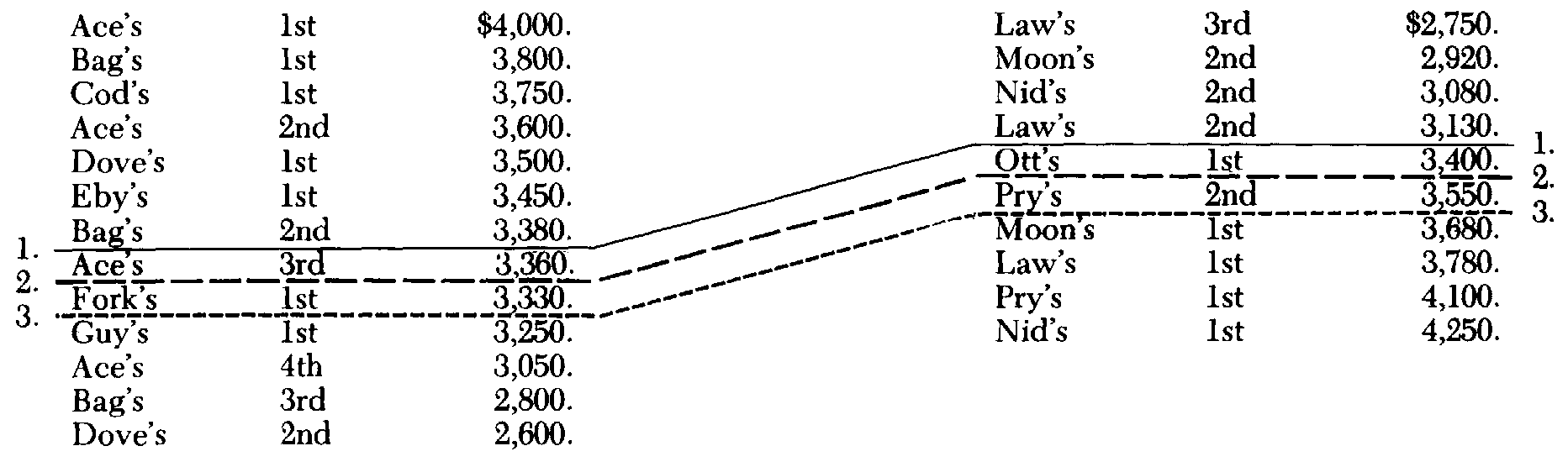
Assume the following subjective valuations for similar taxis:
OWNERS OF 13 TAXIS POTENTIAL BUYERS
How many will be traded:
1. under conditions of free market competition? 6
2. if there is a sales tax of $50? 5
3. if there is a sales tax of 10%? 4
1. Under conditions of free market competition: As explained in Unit 6, pp. 38-40, six taxis will exchange hands, as a result of the bidding outlined there step by step, at a price somewhere between $3,360 and $3,380.
2. If there is a sales tax of $50:
a. Let us say that the tax-collector intervenes, once a price has been determined by free market competition, at the moment the would-be buyers are handing over their money to the cab owners who have agreed to sell—“You must pay an extra $50 as sales tax.” The cost to each would-be buyer suddenly becomes $50 more than he had agreed to pay—i.e. between $3,410 and $3,430. This brings the total price of a cab above the top amount Ott is willing to pay.
b. Ott drops out of the market—because a cab is not worth more than $3,400 to him. As a result, the number of cabs offered at that price (6) now exceeds the number of cabs wanted at that price (5). Thus, the bidding must resume to equate supply and demand.
c. With Ott out of the picture, only 5 potential buyers remain in the running. Thus the net price must drop below $3,360 ($3,410 gross with the $50 sales tax) to keep Ace from offering a 6th cab on the market. However, the gross price must be more than $3,400 ($3,350 net + the $50 tax) to keep Ott from re-entering the bidding.
d. Thus, the addition of a sales tax in this example means that only five cabs will be traded at a gross price of just over $3,400 to just under $3,410 with the net return to the seller after the tax is paid, falling somewhere between $3,350 and $3,360.
e. Whereas, under free market competition, buyers in this example would have paid between $3,360 and $3,380 all of which would have gone to the sellers, they must now pay more— the gross price now being between $3,400 and $3,410—of which each seller receives less— somewhere between $3,350 and $3,360.
f. Thus it becomes obvious that the imposition of the sales tax (1) reduces the number of transactions that may take place, (2) raises the gross price to each potential buyer, but (3) reduces the net return to each owner-seller.
3. If there is a sales tax of 10%:
a. Let us say that once a price has been determined by free market competition, the tax collector intervenes at the moment the would-be buyers are handing over their money to the cab owners who have agreed to sell—“You must pay 10% of the price agreed upon as a sales tax.” The total cost to each would-be buyer suddenly becomes 10% more than had been agreed upon—in this case, between $3,696 ($3,360 + $336) and $3,718 ($3,380 + $338). This eliminates Ott, Pry and Moon from the market as potential buyers.
b. The number of cabs offered at that price (6) now exceeds the number of cabs wanted at that price (3). Thus, the bidding must resume to equate supply and demand.
c. If the gross price drops so Moon bids, 4 potential buyers remain in the market. Thus the net price must drop below $3,330 (gross $3,663 with the 10% tax of $333) to eliminate Ace and Fork from offering a fifth and sixth cab on the market. However, the net price cannot drop below $3,250 (gross $3,575 with the 10% tax of $325) if Guy is to be induced to put a fourth cab on the market.
d. Thus the addition of a 10% sales tax in this example means that only four cabs will be traded at a gross price falling somewhere between $3,663 ($3,330 + the 10% tax of $333) and $3,575 ($3,250 + the 10% tax of $325).
e. Whereas buyers in this example would have paid between $3,360 and $3,380 under free market competition, all of which would have gone to the sellers, they must now pay more—a gross price falling somewhere between just over $3,575 to just under $3,663 (not more, else Fork will be induced to offer a 5th cab on the market for which there is no taker). The net to each seller out of the gross price agreed upon will be less—somewhere between $3,250 and just under $3,330.
f. Thus, it becomes obvious that the imposition of this 10% sales tax (1) reduces the number of transactions that may take place, (2) raises the gross price to each potential buyer, but (3) reduces the net return to each owner-seller.
PROBLEM A—THE EFFECT OF PRICE CONTROLS (Answer)
Assume the following subjective valuations for similar taxis:
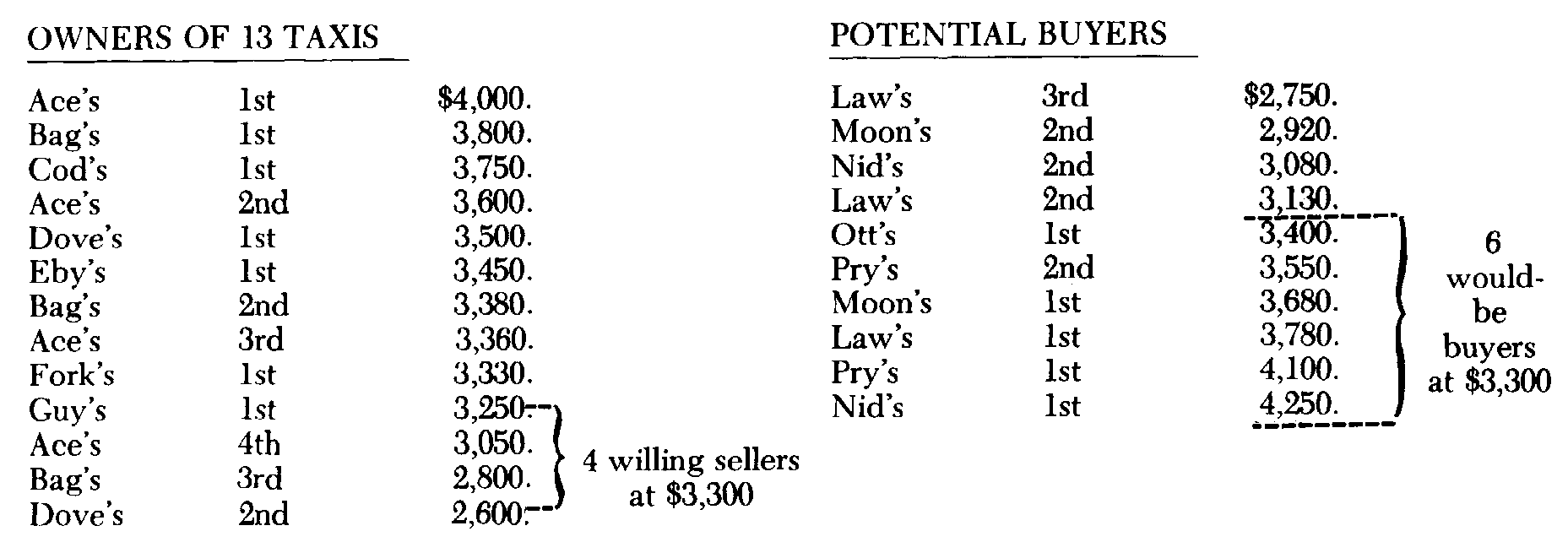
NOTE: See p. 180 for conclusions to be drawn from this Problem.
PROBLEM B—THE EFFECT OF PRICE CONTROLS (Answer)
Assume the following subjective valuations for:
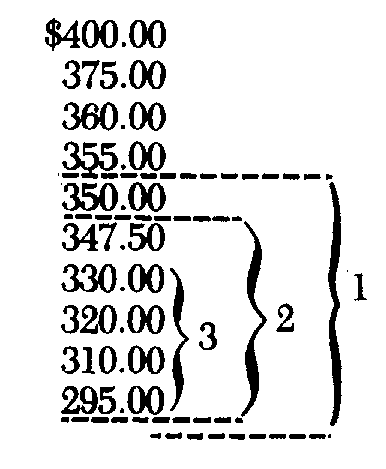
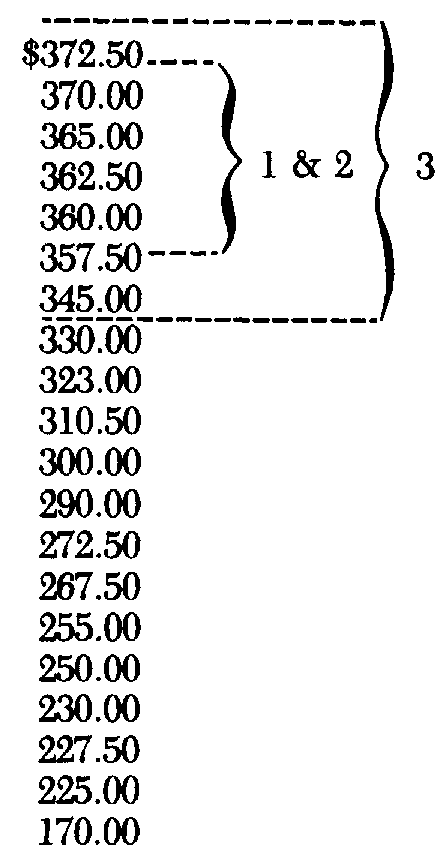
10 IDENTICAL UNITS (OR SETS)—PORTABLE TVs, STEREOS, MOTORBIKES, ELECTRIC TYPEWRITERS, ELECTRONIC COMPUTERS, CAMERA EQUIPMENT, SPORTS OUTFITS, ETC.
Rock bottom price of 10 owners i.e., potential SELLERS
Top offering price of 20 potential BUYERS
How many units (or sets) will be traded:
1. under free and open competition?
2. if controls force the legal selling “price” for such units (or sets) down to $347.50?
3. if controls force the legal selling “price” for such units (or sets) down to $340?
1. Under free and open competition: Six sales will be concluded to the mutual satisfaction of all parties concerned. Six would-be buyers are willing to pay enough (between $350 and $355 —as explained in Unit 6, p. 41 to induce six owners to sell voluntarily.
2. If controls force the legal selling “price” for such units (or sets) down to $347.50: Only five sales may be concluded. Only five owners are ready to sell; yet six potential buyers are still eager to purchase at this artificially low price.
3. If controls force the legal selling “price” for such units (or sets) down to $340: Only four sales may be concluded. Only four owners are ready to sell; yet seven potential buyers are now eager to purchase at this artificially low price.
CONCLUSIONS
First of all, see Unit 6, pp. 38-43 & 52, for the reasons why free and open competition produces the greatest number of voluntary transactions and the greatest possible satisfaction among buyers, sellers, non-buyers, non-sellers.
THE EFFECT OF TAXES
The imposition of a tax on a market transaction, other things remaining equal:
1. Reduces the number of voluntary transactions. Thus, fewer persons are able to improve their respective situations by trading than could have if competition had been free and open among all would-be buyers and sellers;
2. Raises the total cost to the purchaser of the good or service taxed;
3. Lowers the seller’s net return from the sale of the goods or service that is taxed;
4. Because it reduces the number of potential sales and lowers the return to sellers, it tends to discourage future production. As production declines, prices generally will tend to be relatively still higher than they would have been. This means that reducing the gap between what people have and what they want becomes more difficult and the hope of alleviating the “economic problem” grows fainter.
THE EFFECT OF PRICE CONTROLS
The imposition of controls compelling the owners of goods and services to sell at below-market prices, other things remaining equal:
1. Reduces the number of voluntary transactions. Thus, fewer persons are able to improve their respective situations by trading than if competition had been free and open among all would-be buyers and sellers;
2. Reduces the supplies available on the market; i.e. it reduces the quantity and/or the quality of the goods and services owners are ready and willing to offer at the artificially low prices decreed;
3. Increases the demand of would-be buyers to purchase goods and services at the artificially low prices decreed;
4. Dooms many would-be buyers to disappointment and calls for some technique other than competitive bidding on the market to determine which of the would-be buyers will actually receive the fewer units of goods and services which are available at the ceiling price. Would-be purchasers are denied the opportunity of showing legally their relatively greater desire to buy; the price control law prohibits them from trying to outbid competitors by offering owners higher prices for the limited quantities of goods and services available on the market at government-decreed “prices.” Therefore, the “lucky” ones who will be able to purchase some of the supplies the owners are willing to sell at the artificially low prices must be decided on some basis other than free and open competitive bidding:
a. willingness to spend a long time on queues, waiting to be served
b. surreptitious under-the-counter payments
c. extra non-monetary consideration, offers of special tips, personal favors, threats, pressures, etc.
d. reliance on personal friendship, political pull
e. enactment of additional laws to set up a legal rationing system
5. Because of the legal curb on selling, compelling owners to trade at below-market prices, suppliers have little or no incentive to offer more units of their stock on the market and/or to expand future production. As production declines, the gap between supply and demand will become still greater, making it still more difficult to reduce the gap between what people have and what they want, thus compounding the “economic problem.”
EXPLANATORY TEXT
Most textbooks on “comparative economic systems” describe the economic arrangements in various countries and then attempt to classify them by type. The result is usually a long list of different, vaguely-defined and overlapping economic “systems.” A much simpler way to distinguish one economic arrangement from another—and the only basis on which a clear-cut distinction may be made —rests on the method of the ownership and control of productive resources and property. Only one question need be asked: Are the factors of production—raw materials, land, factories, tools, machines, labor used in producing goods and services —owned and controlled by private individuals or by government officials?
In the course of this Unit, only three economic systems will be defined, each distinguished by the manner in which productive resources, factors of production, are owned and controlled: (1) capitalism or a free market economy under which the factors of production are fully owned and completely controlled by private individuals, (2) socialism or communism, under which the factors of production are owned and controlled by government officials of a totalitarian centrally controlled government state and (3) a hampered market economy in which factors of production may be nominally owned by private individuals but the use made of these factors of production is controlled or partially controlled by government rules and regulations.
1. How does private ownership and control of the products of production arise under capitalism? We learned in Unit 4 how the institution of private property evolved and how the right to own property permitted trade and exchange, specialization and the division of labor to develop. Thanks to increasingly complex arrangements for interpersonal cooperation (Unit 5) and the gradual accumulation of savings (Unit 7), entrepreneurs, inspired by consumer sovereignty (Unit 8), have developed more and more complicated, refined and efficient methods of production (Unit 11) and exchange (Units 5 and 12).
In such a peaceful society, distribution is no problem. (See the glossary definition of “‘Distribution,’ economic.”) Every good or service produced in the course of this cooperative process comes into existence as the private property of the particular persons involved. In a voluntary society, every piece of raw material or unit of labor which contributes in any way to the production of a good or service is furnished by particular individuals, in exchange for compensation previously agreed upon. Thus every individual who helps to make production possible is reimbursed at the time for his own personal contribution. His financial interest in the final product ends when he is paid for his labor or for the particular share of a factor of production that he furnishes.
The entrepreneur “gets it all together.” As he pays for things in the course of carrying out his project on the market, he acquires ownership, step-by-step, of the factors of production. With the ownership of these factors of production comes also the right of control, i.e. the opportunity to decide how they shall be used. Therefore, the products which are made from an entrepreneur’s resources—with the aid of (a) savings he has assembled or borrowed, (b) the voluntary cooperation of many persons with whom he made arrangements and (c) his ideas and planning—are his and his alone once he has fulfilled all previous commitments.
If we consider the products of any specific private enterprise from this angle, it is easy to understand why and how they become the private property of the entrepreneur who took the risk. His right to the output of his project depends, of course, on his having contracted for and paid in advance for all the goods and services which were used in the process. Under capitalism, therefore, the person to whom the final products belong has acquired legal and effective title to them by having previously acquired and paid for everything used in their production.
NOTE: Insofar as an entrepreneur may fail to fulfill his obligations, his title to the output of his enterprise will be flawed, it will not be free and unencumbered. Any of his workers, creditors or suppliers, who has not been paid as promised, may secure a lien and sue the person responsible for such reimbursement as that to which their contributions entitle them.
2. What is the significance of the fact that the factors of production may be owned and controlled by private individuals? When denied the opportunity and right to own private property men are little more than slaves or serfs, dependent on some lord or master and necessarily subject to his every whim. Once they can acquire property which they may dispose of as they choose—so long as they do not interfere with the equal rights of others—they can become free men, free to trade, buy, sell, save, invest, experiment, try out new ideas, move around and make any possible change that appears in their interest.
NOTE: Throughout this Unit, stress the importance of flexibility and freedom of choice in using the things one owns. A person who does not have control of his property in these two respects, is not really its owner; he is not in a position to use it as he chooses; he must follow someone else’s orders.
In primitive societies, when individuals were first able to keep for themselves and their families some of their own production, over and above what was needed for immediate consumption, no matter how little that might be, they could feel a bit more free and independent. With a small backlog of resources, “rainy day” (or plain) savings to use as they chose, they could be more confident about meeting future contingencies and even a little less fearful of arousing the ire of a tribal chief or “medicine man.” Without property rights all the material things they have and even their lives are at the mercy not only of nature, but also of the community “strong man,” king, ruler, dictator, gangster, or anyone who proves physically more powerful, more ruthless or more persistent in compelling others to do his bidding. The opportunity to own private property and to control its use, therefore, fosters individual freedom and independence even in primitive societies.
The right to own and control property is probably even more important in a specialized, division of labor, capitalistic economy. Personal freedom, independence and economic survival depend on that right. If property rights are protected and a person’s private home is “his castle,” a place to which he may retire in peace, he may be confident that he, the members of his family, his papers and effects will be safe there from unwelcome intrusions, “from unreasonable searches and seizures” as assured in the U.S. Constitution (Amendment IV). Moreover, the right to own and control private property is important to entrepreneurs and producers in a complex capitalistic market economy. But it is important not only to them. It is perhaps even more important to all the rest of us. As a matter of fact, most of us living today would not even be alive if producers had not been relatively free in the past to use their private property as they chose in the hope of earning profits. It is only because the property rights of producers, would-be producers, savers, investors, entrepreneurs, inventors, innovators, etc., have been respected and protected th&t they were willing and able to cooperate in expanding production. As a result, life expectancy has lengthened, death rates declined, population increased and people throughout the market economy now live longer, healthier lives and have a much greater quantity and variety of food, clothing, shelter, luxury goods and leisure than ever before. The reasons why this is so rest on the principles explained in Unit 4.
Every one of us acts in the attempt to improve his own situation as he sees it—from the point of view of his own subjective (personal) values. Each of us tries to remove felt uneasiness with the least possible effort and cost. Each of us wants to use his resources to best advantage—to yield the greatest possible return (psychic and monetary) to us as owners. Thus the opportunity to own private property and the freedom to use it as we choose—so long as we don’t use it to interfere with the equal rights of others—increase our options. The right to own property and to control its use, therefore, makes it easier than it would be otherwise for us to accomplish the many things we want.
Property owners are interested in using their resources to serve their own ends. They find that the surest way to attain their various ends under capitalism is by providing consumers with the various goods and services they want. As a result, property owners are challenged under capitalism to try to serve consumers. When they succeed in doing this, they can earn not only the psychic profit which comes from knowing they are helping others, but they will also be rewarded with monetary profits (Unit 8) for themselves. Therefore, if property owners expect their output to be reasonably safe, do not anticipate losing it through theft, violence and/or confiscation and have confidence that their productive efforts and initiative will not be thwarted or hamstrung or that the financial gains from their activities will be taxed away they will be anxious to use their property to produce things for consumers to buy on the market. In a capitalistic society, therefore, where private property is respected, the personal desires of individuals to improve their respective situations provide property owners and entrepreneurs with the incentive to develop their ideas, resources, property and labor for the benefit of other people.
3. Just how does the right to own property and the freedom to control its use affect production? To use their property to best advantage, property owners must be free to make their own decisions. Flexibility is most important. Persons with the grasshopper time preference may well consume almost everything they have as soon as they get it. On the other hand, those with the ant’s time preference will try to refrain from consuming everything today so as to set aside something for tomorrow—in the form of “rainy day” (or plain) savings. What they do and how they plan for the future will depend on their ideas, expectations and freedom to choose. If property is relatively safe, some will begin to use their “rainy day” savings to support themselves while they develop tools to make future production easier and more efficient. In this connection, the students might review Fred I. Kent’s “Letter to His Grandson” (Reading No. 19). As time passes and more and better tools become available some capitalist savings will be accumulated bit by bit. This makes it possible gradually to develop and produce more things, more quickly and more easily. What kinds of tools are developed, what form capitalist savings will take, and what will be produced will depend on the ideas and actions of specific entrepreneurs in the light of their understanding of conditions and their future expectations.
NOTE: Remind the students of the “line of command” on the market—from consumer-puppeteer to entrepre-neur-marionette, as explained in Unit 6 (p. 51). It was this consumer-directed process of production which has been responsible for the industrial expansion of the last two centuries and the tremendous increase in the quantities of the various things people want to have and to use.
The entrepreneur contemplates an ever-changing “half-baked cake,” a smorgasbord of (a) “rainy day” (or plain) savings, i.e., stores of available consumers’ goods, plus (b) capitalist savings in the form of potentially productive factors of production. He tries to juggle things around, reassemble them, and make them more productive. The entre-preneur-marionette must interpret correctly the yanks and pulls of the consumer-puppeteers by which they seek to “manipulate” him. To do this, he must study consumer purchases and refusals to purchase, analyze available resources, consider market prices of the very recent past and try to anticipate future conditions—all difficult tasks at best. If, as a result of his efforts, he can alter the various factors of production so as to serve consumers better and/or cheaper than before, they will become more valuable on the market. The more freedom and flexibility he has to act in accordance with his own best judgment, the better his chances are. The safer property is expected to be, the more capitalist savings he can expect to attract for investing in his enterprise. The more assurance entrepreneurs and investors have of being able to keep what they earn through the enterprise, the more incentive they will have to continue saving, investing, producing and serving consumers. Any outside interference that deters such enterprises will interfere or hamper their plans for production, reduce the amount of goods and services, and so cut down on the number of voluntary transactions possible.
NOTE: To help explain how important it is for entrepreneurs to maintain control over the factors of production, discuss specific examples. Some students might take a certain item and trace the orders its purchase engenders among suppliers, manufacturers, shippers, producers of raw materials, etc. Have students talk with local merchants, refer to encyclopedias or study the annual reports of corporations, to plot the course of their supply lines as far as possible. Call attention to the many transactions that must dovetail to keep the production process operating smoothly. Any change in consumer demands and/or in the availability of any good or service used in supplying the market will necessitate shifts in entrepreneurial plans, searches on the part of traders and/or producers for new sources of supplies and/or changes in the way factors of production are used. If the ostensible owners of the raw materials and factors of production involved do not really control them, and are not free to dispose of them as they wish in response to new and better price offers on the market, delays and difficulties will arise in adapting to changes. Bottlenecks and shortages will appear as producers hold up production while obtaining permission to switch factors of production from one use to another. Production will start to lag farther and farther behind demand until in time it loses all relationship to the wants and wishes of consumers. In a free market economy it is the interrelationship of various prices that keeps production moving in response to the demands of consumers.
Every time a person buys something—a pair of blue jeans, a hamburger, hi-fi equipment, or anything else—the retailer gains some idea of the popularity of that particular item and the latest ideas of consumers. If a would-be purchaser decides NOT to buy, that tells the retailer and his suppliers something too. In either case, a purchase or a refusal to purchase, the merchant gets the message loud and clear, with the information he needs for placing future orders. If sales of an item are brisk at its current offering price, he will want to replenish stock. If sales are slow, he will hesitate before re-ordering—unless he can find another supplier with something available to sell that the retailer considers better and/or cheaper enough to overcome the objections of those who refused to buy before. The more flexible a merchant is, the freer he is to change his plans, offer different items on the market, seek new suppliers of goods and services, arrange purchases through different channels, the more promptly he can act and the more responsible he can be to the ever-changing demands of consumers so as to increase transactions and overall satisfaction. Just as the retailer’s anticipation of consumer wants is his guide in placing orders, so do his orders furnish clues to shippers, suppliers and producers as to what to produce, how to schedule their activities, what methods of transportation to use, what machinery and raw materials to purchase, how many workers, with what skills, to keep or to hire, and so on.
Consider blue jeans, for instance. A few years ago all blue jeans on the market were made in practically the same style from essentially the same tough blue denim, with brass studs at seams and pockets. Then buyers began to ask for jeans in various styles and colors, showing their preferences through the prices they were willing to pay for new styles and their refusals to purchase old style jeans. Bell bottoms came in; stretch materials appeared; some buyers wanted their jeans to look faded and tom, even when brand new; others wanted elegant jeans, decorated with beads and sequins. Information on each new consumer fad was passed back by the retail merchants from consumers to wholesalers and then, in short order, to manufacturers and textile producers. Some ingenious persons developed ways to make brand new jeans look old and tom, ordered special chemical solutions for this purpose, bought large vats in which to pour the solutions, dip the jeans, and soon brand new artificially-aged jeans began to appear on the market. Some producers of jeans began to order denim in different colors, so that producers of denim had to order different colored dyes from producers of chemicals. Some manufacturers began to decorate blue jeans with beads and sequins to satisfy other consumers.
In every one of these cases, changes were made fairly promptly in the production of blue jeans because of shifts in consumer wants and the prices they offered. In every one of these cases, producers were in a position to make changes in their plants, buy different raw materials and machinery and bid for different kinds of workers because they owned and had substantially effective control over the property they worked with. They were relatively free to use their resources as they thought best and could be fairly flexible in adapting their factors of production as they chose. Without free market prices, arising from consumer preferences, to guide them, entrepreneurs would be like ships at sea without a compass, floundering around in a sea of goods and services lacking clues as to what direction to go to reach their goal—the satisfaction of consumers in the hope of earning profits. Without the freedom to own and control their property as they think best, without the flexibility to use, adapt and adjust their factors of production, their hands would be tied, their operations and attempts to serve consumers hindered. Given a market economy with specialization, division of labor, private property, exchange and the right to own factors of production and control their use, entrepreneurs on their own energy and initiative, have an interest in helping to expand production. The result over the last two centuries was a tremendous burst of production.
4. Suppose some one, or some thing, interferes —even if unintentionally—to break, weaken, or distort the lines of communication between consumers and producers? The lines of communication we have been discussing, connecting purchasers and non-purchasers through retailers to shippers, suppliers, fabricators and producers of raw materials, extend over large areas, touch many persons and involve long periods of time. Thus, they are vulnerable to interruption and breakdown—by (a) the forces of nature and/or (b) the actions of individuals, unintentional and accidental or purposive and malicious. Such disruptions are inevitable upon occasion, given the nature of the universe and the fallibility of human beings. The results are often heartbreaking and costly. Thus it is in the interest of everyone to reduce their frequency, minimize their unfortunate consequences, repair promptly insofar as possible any harm done, and smooth a return to uninterrupted communications and peaceful cooperation among individuals.
Left to themselves, individuals are tremendously resourceful. In the words of the old proverb, “Necessity is the mother of invention.” If people are free to use their own brains, ingenuity, efforts, energy, resources, factors of production to cope as best they can with problems as they arise, they can do a great deal to reduce disruptions, whether caused by natural or human forces, and relieve their disastrous consequences.
a. Forces of nature—When storms, floods, earthquakes, tornadoes or other cataclysms of nature destroy railroad tracks, highways, buildings, telephone lines and broadcasting stations, it is obvious that communications have been physically disrupted. Many people are inconvenienced. Some may suffer physical harm and even death. Many others face serious economic loss. Men have used a great deal of intelligence and ingenuity over the centuries in finding ways to reduce the damage nature may do them and their property. They can now build structures capable of withstanding much damage by fire, hurricanes, floods and even earthquakes. Nevertheless, human beings are still helpless at times in the face of the tremendous forces of nature and must cope as best they can with losses. Makeshift arrangements often prove expensive; scarcities and bottlenecks arise; the prices of things in short supply may go up calling for still further suffering, effort and conservation. Conditions will never really be the same again for the consequences of some losses go on forever. However, sooner or later, means will be found to repair a large part of the physical damage, restore essential communications, compensate for some of the destruction and adjust to some extent to the new situation. The survivors must then continue on as best they can, accepting as philosophically as possible the tragic consequences of such natural cataclysms as cannot be avoided.
b. Actions of individuals—It is not surprising that malicious actions, acts of violence undertaken on purpose to hurt others or to damage their property, are destructive. If a gunman demands your wallet, takes your money and runs away, it is clear you have lost ownership and control of some of your property. If the gunman approaches you in a restaurant, uses the gun as a threat to make you pay for a meal he has eaten, you have also lost ownership and control of property, even though the gun is concealed and you appear to be paying for his meal of your own volition. Such acts of theft and violence are obvious violations of your rights as a property owner. Property you had earned through your own efforts or had acquired honestly by some other means is taken from you by force. Control over property, which was legally and morally yours to use as you chose, is shifted to the thief who forced you to turn it over to him for his purposes. As a result, your freedom of choice is curtailed; purchasing power is taken from you; the communication lines from your decision to act and make purchases is destroyed, or at best interrupted or delayed, before it reaches entrepreneur and producer. All criminal acts have similar effects; they deprive owners of property and their freedom to control its use, interfere with their efforts to communicate their wishes through the market. Thus, the criminal’s demand on the market replaces the demands of those whose property (and purchasing power) he takes by force or deceit.
Even the actions of well-intentioned persons may backfire, due to error, ignorance, misjudg-ment. As pointed out in Unit 3, people make mistakes. Their mistakes may sometimes prove costly —not only in time and money, but also in life and limb. Once a person recognizes a mistake, however, he does his best to compensate. Discuss with the students some mistakes, and attempts to recoup, they may know about from personal experience. To start the ball rolling, here are several categories:
1. Mistakes on the part of businessmen that led to the purchase or production of things which couldn’t be sold at prices that covered costs, so that their enterprises suffered losses, had to go out of business or shift operations;
2. Decisions with respect to personal relationships that proved unfortunate—friendships made or broken, jobs accepted or turned down, residential moves made, trips taken, friends or relatives visited, etc., which had unhappy consequences;
3. Purchases that proved less valuable than had been expected because of changes in a person’s situation, tastes, interest, fashions, etc.;
4. Purchases that could not be used as intended because of new family circumstances, job changes, moves to a new location, unanticipated price shifts, unusual weather conditions, failure of the item purchased to perform as expected, etc.;
5. Actions which actually led to accidents, causing physical harm to life, limb and/or property;
6. Actions which failed to attain the goals sought because of poor timing, accidents or misjudg-ment. Mistakes may result from decisions or actions taken too fast, too slowly, too soon or too late—as in sports or in stock market speculations;
7. Judgments, decisions or actions taken by one person at the behest of another who used special pressure or even force, ofttimes with the best of intentions, to hinder or prevent freedom of choice.
Having to suffer the consequences of a mistake teaches a very important lesson—equally important to everyone of us as private individual, consumer, businessman, producer, etc. It is easier and cheaper all around to try to avoid mistakes in the first place. Timing is important. Within the limits of time and opportunities available, consult experts—
“Wisdom is the better part of valor.”
Study the pros and cons of a situation, consider well the likely consequences of every action and every decision—
“Look before you leap.”
Then use your best judgment. However, once an action is taken that proves a mistake, do your best to make amends and repair the damage as quickly, cheaply and effectively as possible—
“Don’t cry over spilt milk.”
However, individuals may also be deprived of life, property and freedom of choice in other ways. In addition to the forces of nature, acts of violence and human mistakes and accidents, market communication lines may also be disrupted by certain government actions.
5. What are the fundamental duties of government? To distinguish those government actions, which protect individual life and property and make it possible for individuals to cooperate and trade with one another in peace, from those government actions, which hamper market transactions, help some at the expense of others and make interpersonal cooperation and trade more difficult and costly if not impossible, we must discuss government and its basic role in society. Most high school students should have some ideas, gleaned from their various courses in history and government, as to the most important task of government —i.e., to protect the lives and property of its citizens. A brief review of this country’s early history might be helpful.
Early settlers in this country feared attack from outsiders—Indians, pirates and political enemies. They also wanted protection from possible harm by domestic troublemakers. In trying to provide for their own protection, no matter where they lived, they very soon organized some form of government, with police, sheriffs, judges, soldiers and/or “vigilantes,” to protect themselves, their families, their homes and their property. A few inhabitants of the new community were hired as full-time specialists in guarding the town and the people in it, their homes and their belongings. Then everyone else could go about their daily pursuits as they chose in relative peace. Relieved of the need to protect themselves and their families from persons who might use or threaten to use force to do them harm, the majority of the community’s citizens had more time, energy and freedom to do what they wanted—to farm, cook, sew, build, mine, trade, read, study, worship, play, relax, or what have you. They could better cope with natural forces and scarcities, accomplish and produce more than they could have otherwise. Everyone but the troublemakers gained as a result. Like a night watchman or an electrified fence—which passively prevents trespass, theft and molestation unless provoked into response by intrusion or violence—a community’s police and courts serve as a “catalyst” to peaceful activities. If the police and courts are not there to curb malicious acts of violence and to punish criminals, practically no production or trade can be carried on at all. Yet like the night watchman or electrified fence, just being there standing on the sidelines waiting to be needed, they act as a “catalyst” permitting peaceful transactions to be made.
Knowing protection is at hand if need be, the community’s inhabitants can go about their business without giving much thought to potential troublemakers—producing in the attempt to satisfy consumers, experimenting and trying out new things, all in the hope of improving their respective situations as best they can and earning psychic and monetary profits for themselves. At the same time, consumers too are as free as they can be under the circumstances to express their most urgent preferences. When such a “night watchman” government is at hand to deter persons who might try to use force or threat of force to interfere, the signals consumers transmit when they go to market reflect their most important desires and values and—barring ignorance, accidents and errors— they will reach the producers of the things they buy. Only when such a government is on hand to protect citizens and their property, is it possible for producers and consumers to trade in peace and to undertake—with some hope of success—the complicated voluntary transactions which make up a highly-specialized market society.
6. If the government in a community uses its power and influence to go beyond protecting equally the lives, property and freedom of all its citizens, i.e., if it tries to regulate and control their peaceful activities in various ways, how does this change the situation? Remind the students at this point of what they learned in history classes about the most serious shortcoming of a big and powerful government—i.e., its inability to provide the conditions necessary for its citizens to enjoy freedom and prosperity. No matter how well-intentioned a government may be, if it tries to control or regulate the activities of its citizens, if it gives special benefits to some citizens at the expense of others, it will no longer be protecting the lives, property and freedom of all its citizens equally. As a result of such government interferences, it becomes difficult if not impossible for the majority to pursue their own ends in peace. Their daily activities are affected in many ways by such a government. The more the people are hampered by government in doing the things they want to do most, in using their earnings as they would like, in trading voluntarily, in pursuing the goals they consider most important, the more oppressive it becomes.
The failure of a government to provide the conditions necessary for freedom and prosperity becomes obvious when its people are willing to undergo personal and economic loss, face danger and even death, to escape its jurisdiction in order to go to a land where they expect conditions to be better. As a matter of fact, most of the people who have come by choice to this country, from its early days down to the present, left their native lands because of government oppression. Many came because they opposed military conscription. Still others came because their governments taxed so heavily, imposed so many restrictions on their activities or confiscated their property so that it became difficult if not impossible for them to eke out a living. And quite a few came because their efforts and ambitions were thwarted in the “old country”—by government, conservative traditions and social rigidities. These immigrants who have come to our shores over the years—and who still come—came in search of freedom. They came from lands where the government failed to protect the lives and property of all its citizens adequately. They came—and they still come—from countries whose governments do not permit them the freedom to pursue their own personal interests and to acquire private property to use as they wish—to experiment by making changes and trying to implement new ideas. Immigrants have come to this country in the hope that here they would be better able to attain their personal goals and ambitions. They have come because our government was not expected to interfere so much with their daily activities, transactions and peaceful pursuits and ambitions.
Conditions in America for most newcomers have always been rough. For them life has been hard, even dangerous for those who sought to settle in a wilderness unpopulated as yet except by hostile natives. Yet even so, America was soon recognized as the land of freedom and opportunity. In America, every person had a chance. A new arrival could make a fresh start, confident of being judged on his own merits. Every mature and independent person knew that any property he acquired by honest means was his very own to dispose of as he chose. He was free to act in accord with his own personal (subjective) values, goals, ideas and interests, in the light of circumstances and his own best judgment at the time. Whether to consume and enjoy what he had, trade it for something he preferred, save it for future “rainy days,” offer it to consumers on the market, or use it as a factor of production to produce other goods and services, was his own decision. Because property was private, individuals were free to do with it what they wanted, within the limits imposed by nature and their own capabilities—to work, trade, experiment, play, rest, think, speak, worship, and so on—by themselves or with others, so long as they did not use force or threat of force to interfere with the equal rights of others. At the same time every individual realized that he was responsible for himself; his success or failure, even his very survival was up to him.
7. What are the different kinds of government? There are really only three different kinds of government: (1) limited government; (2) totalitarian government; and (3) interventionist government. The power at the disposal of government to use force has a significant impact on the ability of the individuals under its jurisdiction to cope with their daily affairs and to solve the economic problem. For the study of economics, the important question is whether the government (1) facilitates the peaceful and moral actions of individuals by leaving them alone while standing on the sidelines ready to intervene only when necessary to protect and preserve personal freedom, lives and property, (2) controls and plans every aspect of the daily lives of the people living under its jurisdiction, or (3) controls, plans, regulates and restricts some, although not all activities of individuals, often arbitrarily on a case-to-case basis, so that when people act and try to plan for the unknown future they must take into consideration additional uncertainties due to potential political interference.
NOTE: The subject of government is thoroughly intertwined with the study of economics. The acts and decisions of government officials seriously affect the conscious, purposive actions of individuals in their attempts to attain their various subjective (personal) values, ends and goals. However, in discussing each type of government in turn, keep in mind that this is a course on economics. Try not to let the classroom discussion become too much concerned with the form of government itself.
(1) LIMITED GOVERNMENT—a government that is limited to (a) protecting insofar as possible the lives and property of persons under its jurisdiction and (b) settling, according to established judicial procedures, disputes and controversies that may arise under its jurisdiction, among individuals, groups and/or representatives of individuals. A limited government is like the “night watchman” or electrified fence mentioned above that reserves its use of force to responding to provocation by the actions of individuals who invade or violate the equal rights of others. Under such an ideal limited government, individuals are free so long as they do not use force or threat of force to interfere with the equal freedom of anybody else. Under this type of government, property is owned and controlled by private individuals. Its citizens are as secure as possible from serious interference, friction or disruption caused by domestic or foreign troublemakers. Under a limited government, a contract society with a capitalistic or free market economy will evolve.
A limited government protects the rights of individuals to own, use, buy, sell and/or trade private property freely, so that capitalism or a free market economy may function in relative peace. Individuals are free to pursue their personal ambitions and goals in accord with their own subjective value scales—insofar as their capabilities and resources permit. Incentive and initiative are not needlessly or arbitrarily discouraged. Thus individuals remain free to act as they think best, relieve their many felt uneasinesses and use any peaceful and moral means available to pursue their various ends.
In a capitalist or free market economy, under the protection of a limited government, individuals are free to express their preferences as consumers. By their purchases and refusals to purchase, they help to determine the prices of consumer goods and services—as we learned in Unit 6—and thus furnish producers with clues as to what goods and services are wanted most on the market. Similarly, producers and would-be producers are free to own, buy, use, sell and/or trade their privately-owned property. Their actions as producers and potential producers reflect their interpretation of consumer wants and needs. Throughout the production process their decisions are expressed in their purchases of some factors of production and their refusals to purchase others. Just as consumer preferences, as expressed by their purchases and/or refusals to purchase, help determine the market prices of consumer goods and services, so do the purchases and non-purchases of producers help to determine the market prices of the various factors of production.
The bids and asks of producers and potential producers encourage the further production of some factors, discourage the further production of others and furnish clues as to how the various factors of production may be best and most economically employed. So long as producers and would-be producers remain free and flexible in buying, selling, competing, experimenting and trying out new products, technologies, distribution channels, etc., they will adjust and adapt as best they can to changes. Such give and take, bids and asks among many free and independent entrepreneurs, each seeking as best he can to satisfy his own most urgent personal wants and needs—i.e. competition and free market prices under the guidance of consumer sovereignty—help to ensure that the factors of production will be channelled into their most urgent uses. Producers then tend to be in a position to supply consumers as economically as possible with the greatest amounts possible of the countless goods and services they want.
NOTE: For a review of this free market process, see earlier parts of this syllabus, especially Units 5, “Social Cooperation and the Market,” 6 “Prices, Pricing,” 7 “Savings, Tools and Production” and 8 “The Entrepreneur and the Profit and Loss System.” For a discussion of how government may disrupt and interfere with the smooth operation of the market process, see below.
(2) TOTALITARIAN GOVERNMENT—a government which owns all property, controls distribution, as well as the activities of all its citizens. A completely totalitarian government would be a command, society. All production and consumption would be planned and controlled by a central authority and every individual’s position in life would depend on government decisions. Such a system may be theoretically described, but it would be impossible to implement in real life. In the first place, the officials in charge of the government would never be able to plan and control everything. They would not know enough, be powerful enough or be able to cope promptly enough with new and unexpected changes as they took place. At every moment of every day, every individual citizen would necessarily be making decisions and doing things, in the very process of living and surviving, in response to urgent and unpredictable personal and local situations, which no central planner could hope to anticipate soon enough to take into consideration in making plans for the whole economy. Also, even a completely totalitarian government, that aimed at eliminating private property and substituting community and/or government ownership and control, would still have to recognize private ownership of consumer goods and services once they were actually consumed (eaten, worn or used) by individuals.
The economic system under a government that is close to being totalitarian is usually referred to as communism or socialism. In a communistic or socialistic economy, private ownership and control of property is minimal. Except in the case of small scale operations where private ownership cannot be effectively eliminated, the managers of an enterprise do not own and/or control the factors of production in their custody. Under socialism or communism, the managers of an enterprise are merely government-designated caretakers. They are told what and how to produce, in what quantities and qualities, what prices to pay for resources and workers, and what to charge for their output Because no government can be completely totalitarian in practice, they are usually allowed some discretion at times. Nevertheless, the manager of an enterprise under communism or socialism may not expand or contract production at will or make substantial production shifts he might consider appropriate when conditions change. Nor is he permitted to transfer workers or other resources into a different field of production without first obtaining permission from the government departments responsible. In other words, there are strong, inflexible “strings” attached to the factors of production in his custody, obligating him to comply with the orders of government officials. Final control always rests with the government.
The factors of production in a communist or socialist economy are not owned and controlled by particular individuals who are free to act on their own best judgment—not by the manager of an operation where they are being used, or by any other person or persons who may dispose of them as they choose. The factors of production are not private property. They are not available to be moved, traded, bought, sold or transferred freely from person to person in response to their own ideas and to serve their individual purposes. Some private property does exist, to be sure, in most communist or socialist economies—as in Russia, for instance, where the opportunity has been given her citizens to farm small plots of land to grow food and to keep livestock for their personal use. However, factors of production are not traded widely among private owners in such controlled economies, as they are constantly under capitalism.
A person with a new idea in Russia or in any communist or socialist economy finds it difficult, if not impossible, to acquire the goods and services needed to put his scheme into operation. A would-be entrepreneur, who wanted to produce something new and/or different on a sizeable scale to offer consumers in a socialist or communist economy cannot just go out and buy on the market the factors of production he wants or hire the workers he needs to go into production, not even if he has savings of his own or can obtain funds from other savers, would-be investors or lenders. There just aren’t any factors of production to speak of available for sale. Practically everything is under the control of government officials. The first step a person with a new idea, who lives under such a system, must take is to seek government permission for this scheme. If timing is crucial, delay may be fatal. If nothing else, it is likely to dampen enthusiasm and discourage initiative and incentive. Even if he does succeed eventually, his experiences with the authorities and the limited opportunity available in such a government-controlled economy for earning and retaining any profit at all are not likely to spur many other would-be entrepreneurs into trying to follow his example.
According to communist or socialist theory, production must be centrally planned and controlled to function smoothly. This makes the central government authorities responsible for production. As a result they become hesitant, not surprisingly, to accept new ideas or to admit newcomers to the market who might upset the status quo and show up as uneconomic, wasteful or outmoded, the established enterprises on which their reputations rest. Then too, if they approve a new scheme and it fails, they will be blamed. So they generally play it safe, continue on in established channels, follow economic developments abroad and don’t experiment by permitting the introduction of questionable and as yet untried methods and products. Communications between consumers and entrepreneurs are effectively disrupted as plans for significant changes must be channeled through authorized government officials. Thus, production in a communist or socialist economy tends to become rigid and inflexible and to lag behind the methods being pioneered elsewhere by capitalistic entrepreneurs.
(3) INTERVENTIONIST GOVERNMENT—a government which interferes to restrict, regulate and/or control some of the activities of individuals but leaves them free in other respects. The economic system which prevails under such a government is a hampered market economy. Some interventionist governments interfere in the economy to such a considerable extent that they come close to being totalitarian; others interfere relatively little, leave citizens relatively free, so that they approach the ideal of a “night watchman” or limited government. In any event, most governments fall somewhere between the two extremes—the ideal of a limited government and the unattainable completely totalitarian government. Most economies, therefore, represent some form of a hampered market economy.
NOTE: After having discussed the characteristics of the two theoretical extremes, it should be relatively simple to consider our present interventionist government. Call attention to some of the government interventions that are responsible for shaping our particular brand of a hampered market economy. Stress at every opportunity the fact that government interventions disrupt the economy by interfering with the freedom and flexibility of owners to dispose of their property. Suggest that the students bring to class newspaper and magazine articles that illustrate some of the ways described below in which government interventions (federal, state and local) interfere with the ownership and control of the factors of production, raise costs of production, bring about changes in violation of consumer sovereignty and reduce the number of voluntary market transactions. Some students may also be able to report from personal experience—their own or that of a relative—on specific changes that had to be made because of government interventions. Speculate on the effects each intervention may have on production costs, market prices, individual purchases, the pattern of production, economic communication channels, entrepreneurial flexibility and the number of voluntary transactions.
Government interventions disrupt the economy by interfering with the freedom and flexibility of private individuals to own and control the factors of production. To meet the test of a free market economy, the factors of production must be privately owned and controlled. If owners are not free to use, sell or otherwise peacefully dispose of their factors of production as they choose, if they must first obtain approval from some government official, economic communications are hampered. The result is a hampered (not a free) market economy. In a hampered market economy, there may be several types of government interventions:
(1) Government enterprises. Government itself may undertake some projects. If so, it acts like a producer, buying factors of production, hiring workers on the market, producing, in accordance with legislation, some good or service which it then offers to consumers. The price a government enterprise asks for its output may not always cover costs, for it is expected that government funds will be available to make up the difference between the outgo and income. As a matter of fact, some government enterprises are established for the specific purpose of supplying people with something that private entrepreneurs are not willing to produce for the market at all because they do not believe consumers want it enough to pay, or at least are not willing and able to produce and offer it at as low a price as government officials want it to be available. Some government enterprises even give goods and services away free to persons who meet certain qualifications. The beneficiaries usually like this arrangement. But it is important to remember that when government supplies some individuals with “something for nothing,” other individuals are being forced to pay the cost—in taxes or in reduced purchasing power because of inflation. Thus when a government enterprise operates at a deficit, it is helping some people by depriving others of freedom of choice and a part of their own earnings. Here is a list of some government enterprises (federal, state and local) which actually own factors of production and so directly control their use:
Post offices and other facilities for delivering mail and parcel post
Public schools and universities
Public hospitals
Public housing
Public transit systems (buses, subways, trains, etc.) in many cities
Production and distribution of hydroelectric and atomic power in some areas
Rural electrification projects
Financing and insuring of real estate loans and mortgages
Scientific research
Recreational projects—state and national park facilities, community orchestras, theaters, golf courses, etc.
Printing and publishing operations such as the Government Printing Office Government employment agencies
Garbage, trash and sewage disposal in many communities
Provision of water supplies in some localities
Etc.
(2) Government interventions. These are acts of government that interfere with peaceful interpersonal transactions. They may take the form of:
a. controls or regulations that force persons to do things they wouldn’t have chosen to do voluntarily. If they would have, government would not have considered passing laws for the purpose of compelling them to act differently
b. special privileges, favors or advantages to certain persons denied others in the same situation. Special privileges frequently take the form of handicapping would-be competitors, domestic and/or foreign, making it more difficult, or impossible, for them to sell in certain markets. See the glossary definitions of “Protectionism” and “Producers’ policy”
c. subsidies, gifts of goods, services or money to some persons or groups who fulfill certain qualifications. See “Welfare economics” in the glossary. Government has no funds of its own to pay for such gifts. Their costs are always paid by specific individuals. If the funds for a subsidy come from taxes, the taxpayers who pay the costs are forced to get along with less. If the funds are made available by inflation, deficit financing and/or credit expansion, the cost is borne in part by everyone with dollars, dollar savings and other assets fixed in dollar terms, as every dollar in existence becomes less valuable and is deprived of some of its former purchasing power.
NOTE: Keep in mind always that the activities of a limited government (see above) are absolutely necessary for the protection of lives, private property, defense, peaceful market transactions and the operation of the judicial system. Thus they are not government interventions or interferences for they facilitate—they do not hamper—the market process. The government programs listed here are all government interventions because they force people engaged in peaceful (nonviolent) activities to act differently from the way they would have if they were not required to comply with the particular laws, statutes, decrees and/or regulations. Because they interfere with freedom of choice and action they have the effect of reducing the number of voluntary transactions and also, as a result, consumer satisfaction.
Here is a list of some of our more important government interventions, controls and regulations, special privileges and subsidies:
Progressive or regressive taxation Control of prices, wages, rents, etc.
Taxes on “capital gains,” i.e., on a capital asset’s appreciation in value over a period of time Sales or excise taxes on certain items Recognition of certain labor unions for purposes of bargaining Compulsory collective bargaining in some firms and industries Legally-decreed minimum wage rates Restrictions on wages and hours of employment Compulsory unemployment insurance Benefits—financed in part or in full by government—to certain persons such as the destitute, unemployed, handicapped, dependent children, aged, strikers, etc.
Restrictions on hiring or firing of workers because of age, sex, race, religion, union status, etc.
Government support of agricultural prices, crop insurance, soil conservation, irrigation, etc. Regulation and control of carriers engaged in interstate commerce—railroads, airlines, buses, trucks, etc.
Restrictions on vehicles for purposes of safety and/or pollution control Regulation of production and product standards to “protect” consumers U.S. government permission required for railroads or airlines to open up, or close down a route serving passengers
Government permission required to operate interstate communication facilities—telegraph, telephone, radio, TV, etc.
Government restrictions and specifications on product labeling Government required reports from certain businesses, including those listed and traded on stock exchanges Control and regulation of credit and banking Federal government grants to states and certain communities to help finance schools, students, libraries, scientific research and development, hospitals, nursing homes, the arts, highways, welfare benefits Public housing, slum clearance, urban renewal Environmental protection regulations Restrictions on land use, zoning Right of eminent domain
Licensing requirements to practice law, medicine and other professions, to operate certain businesses or even to go out of business, erect or remodel buildings Restrictions on international trading such as export or import quotas Tariffs or excise taxes on imports or exports Government grants or loans to foreign governments to help finance economic development there and/or to stimulate U.S. exports Government subsidies to U. S. firms exhibiting at international trade fairs Etc.
3. Economic consequences of government-operated enterprises and government interventions:
a. When government officials purchase factors of production, establish and operate government enterprises:
(1) Taxes must be raised and/or the quantity of money increased to cover the additional expenditures
(2) Those who pay these taxes or who are deprived of purchasing power because their costs are paid by inflation have to get along with less for themselves, their families and the projects they would otherwise have undertaken
(3) The prices of the factors of production the government officials buy will tend to rise in response to their demand
(4) The further production of the particular factors of production employed in the government enterprises will be encouraged, to the disadvantage of those factors private entrepreneurs would have chosen to use in their enterprises in response to consumer sovereignty
(5) Private entrepreneurs engaged in the same or similar operations will face serious competition, perhaps even losses and potential bankruptcy because of the “cutthroat” competition of government enterprises which are in a position to offer their production on the market below cost, or even free, confident that government funds will be provided to pay their expenses
(6) Production will be channeled into the areas government spending calls for and away from those private entrepreneurs would have chosen in the hope of pleasing consumers and earning profits in the process
(7) Private enterprise in the areas government takes over will be discouraged and anyone considering entering and/or expanding into these fields is very likely to be discouraged.
b. When government regulates and/or controls the operations of private enterprises in various ways, gives special privileges or grants subsidies to favored persons and/or groups:
(1) Taxes must be raised, or the quantity of money and/or credit increased to cover the costs of operating the bureaucracy required to administer the government regulations
(2) Those who pay the taxes or whose purchasing power declines because their costs are paid by inflation will have to get along with less for themselves, their families and the projects they would otherwise have undertaken
(3) Government regulations and controls necessarily tie the hands of private entrepreneurs to some extent in the employment of their factors of production. The owners are no longer completely free to buy, sell, trade, expand, contract, plan production, design products, adopt or reject new ideas or technologies in accordance with their own best considered judgment in the light of all conditions, keeping in mind the many interests of their potential customers. Ofttime businessmen are not fully aware of the extent to which they must conform with government rulings. The factors of production they employ—raw materials, tools, machines, workers, buildings, funds, etc.—may have to be shifted to meet government requirements. Entrepreneurial freedom of choice and flexibility in adapting to new conditions and consumer demands is hampered by the need to comply with the legal provisions which affect their particular operations
(4) The costs per unit of production are bound to rise as private entrepreneurs must spend more time, thought and energy in coping with the government regulations, shifting workers around, perhaps employing more persons to handle duties not directly related to production, such as additional record keeping, filing government forms, and making changes in production methods and maybe even products in order to comply with new government provisions and legal decisions
(5) As unit production costs rise, entrepreneurs must cut costs and quality, or ask higher prices, to remain solvent. Yet consumers will not, cannot, buy as many units at higher prices—other things being equal—as they would, or could, at lower unit prices. Thus sales are bound to decline; producers will no longer be able to maintain the same output or to keep on employing as many workers as before
(6) The pattern of production will shift bit by bit in response to the government interventions. Entrepreneurs will plan differendy because they will no longer be receiving information through the pricing system telling them what consumers would choose on the basis of their own subjective (personal) values. The responses of consumers are modified by their need to act on the basis of the actual situation as it has been altered by the intervention of government force. The communications lines between consumers and entrepreneurs are diverted, distorted, interrupted and sometimes even broken by the government interventions which have denied complete freedom of choice to consumers. The opportunities of consumers to compete in bidding for things they would have liked to buy are hampered, for instance, by quotas that prevent some would-be competitors from selling in certain markets, by price controls that restrict their freedom to offer higher prices for something they want very much, by minimum wage laws that keep some persons unemployed, by tariffs that raise the price of imports, by special privileges to labor unions that exclude nonunion workers from certain jobs and industries, by added taxes required to pay for the subsidies and bureaucracy that increase costs per unit of production and deprive taxpayers of purchasing power they would otherwise have been able to spend on consumption, or to save and invest enabling future production to be increased.
To list all the economic effects of any government intervention is impossible. Everything in the economy is always in flux. All of us are always trying to adjust as best we can to improve our own personal situation, to relieve our various felt uneasinesses, considering present economic conditions and all interventions and obstacles to our goals. To understand the full economic impact of any government intervention we would have to visualize what persons would have done in the absence of that interference, what new ideas and schemes would have been developed and how everyone else would have been affected if market transactions had not been so hampered and entrepreneurs so misled. This is impossible. However, encourage the students to think through as far as they can the likely long run, as well as the short run, consequences of an intervention. Call their attention to Frederic Bastiat’s essay where this thesis was developed, “What is Seen and What is Not Seen” in Selected Essays on Political Economy. Have them re-read Henry Hazlitt’s ‘The Broken Window” and perhaps his book, Economics in One Lesson from which that short article was taken. Keep in mind always that the intervention of government force makes it impossible for prices, production and personal consumption to evolve as they would have on a free market in response to consumer sovereignty resulting from the voluntary choices of individuals. To the extent that government interventions hamper and prevent us from pursuing our own subjective (personal) values and peaceful goals, they reduce personal freedom and satisfaction.
SUMMARY
As we have stressed time and again, entrepreneurs on the free market try to satisfy the wants of consumers in the hope of earning profits. To do this, they must keep on the alert to anticipate as best they can what consumers will be buying and not buying in the future and how much they will be willing to pay when newly produced goods and services can be offered on the market. Free market prices furnish the entrepreneurs with the clues they need to plan intelligently. However, just as telephone and telegraph lines may be broken by natural forces, so may the communication between consumers and entrepreneurs be disrupted by acts of violence—criminal and/or the intervention of government force.
The consequences of criminal violence are easy to see and steps to compensate are soon taken. However, the effects of government force are not so readily recognized. Nevertheless, it can be very destructive. It disrupts economic communications by distorting consumer price signals and/or by restricting and preventing entrepreneurs from using their factors of production as they think best to meet the future demands of consumers. Many persons, far and wide, will feel the effects in time. Freedom of choice and action are bound to suffer and living standards will be lower than they might have been as savings and investments are discouraged and production is shifted irretrievably into government-directed, i.e., non-consumer oriented, channels. Future generations will not be as well off as they could have been for they will not inherit as large a backlog of savings, investments and capital. The precise consequences of a specific intervention will vary in every case, of course. However, the general economic effect of any government intervention is to bring about a tendency to:
1. disrupt economic communications channels, making it more difficult if not impossible for consumer signals (prices) to reach producers
2. reduce the flexibility of producers in adapting to changes
3. hamper the accumulation of savings and investment
4. hinder the introduction to the market of new ideas, new products, new methods, etc.
All the effects of government interventions derive ultimately from the fact that they interfere with the freedom of individuals to express and pursue in peace their own personal (subjective) values.
GLOSSARY WORDS
(For definitions, see glossary, pp. 223ff.)
Bureaucracy
Capitalism
Command society
Communism
Contract society
“Distribution,” economic
Entrepreneur
Factors of production
Free market
Government control or regulation
Government intervention
Government, role of
Hampered market economy
Interventionist government
Limited government
Private property
Property rights
Slavery, serfdom
Socialism
Special privileges
Subsidy
Totalitarian government
“Welfare economics”
RECOMMENDED READINGS
More advanced materials are indicated by an asterisk (*)
Articles
In the BASIC READER:
* 32. “The Elite Under Capitalism,” Ludwig von Mises
* 61. “The Formation and Function of Prices,” Hans F. Sennholz
67. “A King of Long Ago,” Lewis Love
68. “The Communist Idea, I,” Karl Marx
69. “The Communist Idea, II,” Earl Browder
70. “A Lesson in Socialism,” Thomas J. Shelly
71. “The Tale of the Little Red Hen,” W. A. Paton
72. “The Beetle and the Centipede,” W. A. Paton
73. “Not Yours to Give,” David Crockett
* 74. “Intervention Leads to Total Control,” Gustavo R. Velasco
* 75. “Food Control During Forty-six Centuries,” Mary G. Lacy 77. “American Communism, I & II,” Percy L. Greaves, Jr.
Books
Bastiat, Frederic. Economic Sophisms (D. Van Nostrand, 1964; FEE, 1968)
__The Law (1850) (FEE, 1950/1961)
__“What is Seen and What is Not Seen” (1850) in Selected Essays on Political Economy (D. Van Nostrand, 1964; FEE, 1968)
Campus Studies Institute. The Incredible Bread Machine (World Research, 1974)
Carson, Clarence B. Throttling the Railroads (Liberty Fund, 1971)
Fleming, Harold M. States, Contracts and Progress: Dynamics of International Wealth (Oceana Publications, 1960/1966)
* Greaves, Percy L., Jr. Is Further Intervention a Cure for Prior InterventionP (FEE, 1956)
* Hayek, F. A. The Road to Serfdom (Chicago, 1944; paperback, 1956)
Hazlitt, Henry. The Conquest of Poverty (Arlington House, 1973)
__Economics in One Lesson (Harper, 1946; 2nd ed., McFadden Publications, 1962; Manor Books, 1973)
__Man vs. the Welfare State (Arlington House, 1969)
Mises, Ludwig von. Bureaucracy (Yale, 1944; Arlington House, 1969)
* __The Free and Prosperous Commonwealth (D. Van Nostrand, 1962)
* __Human Action (Yale, 1949/1963; Regnery, 1966)
__Planned Chaos (FEE, 1947/1961)
__Planning for Freedom (Libertarian Press, 1952/1962/1974)
* __Socialism (Yale, 1951; Jonathan Cape, 1969)
* North, Gary. Marx’s Religion of Revolution (Craig Press, 1968)
Read, Leonard E. Anything That’s Peaceful (FEE, 1964)
__The Free Market and Its Enemy (FEE, 1965)
Sumner, William Graham. What Social Classes Owe to Each Other (1883). Many reprints.
Footnotes
1 As explained on p. 39.
- 1On coming to Paris for a visit, I said to myself: Here are a million human beings who would all die in a few days if supplies of all sorts did not flow into this great metropolis. It staggers the imagination to try to comprehend the vast multiplicity of objects that must pass through its gates tomorrow, if its inhabitants are to be preserved from the horrors of famine, insurrection, and pillage. And yet all are sleeping peacefully at this moment, without being disturbed for a single instant by the idea of so frightful a prospect. On the other hand, eighty departments have worked today, without co-operative planning or mutual arrangements, to keep Paris supplied. How does each succeeding day manage to bring to this gigantic market just what is necessary—neither too much nor too little? What, then, is the resourceful and secret power that governs the amazing regularity of such complicated movements, a regularity in which everyone has such implicit faith, although his prosperity and his very life depend upon it? That power is an absolute principle, the principle of free exchange. (1845)

