
Free Market Economics: A Syllabus
11. Competition, “Big Business,” and Monopoly
11. COMPETITION, “BIG BUSINESS,” AND MONOPOLY
SUGGESTED ACTIVITIES
1. A field trip to a large industrial plant or factory would be a good introduction to this Unit. Such a visit could help to dramatize the tremendous amount of savings and investment in plant and equipment necessary for any modern large-scale industry. In the course of the field trip, call attention also to the importance of the division of labor and cooperation as indicated by the company’s reliance on workers with highly specialized tools and skills. The students should learn something about the history of the firm visited, how it developed from the idea of an entrepreneur who thought he could produce something consumers wanted. This is true also of every component part of the plant visited. Every structure on its premises, every piece of equipment and also every productive process it uses are all outcomes of many ideas on the part of many persons, each of whom was trying to fill some entrepreneur’s need for construction materials, tools or improved production methods so as to serve consumers better. As a result of countless little changes made from time to time to improve the firm’s existing structures, tools and methods, the modern industrial plant the class visits finally assumed its present form.
2. A visit to a local stock exchange or broker’s office—as suggested in Unit 7—might be scheduled in conjunction with this Unit. The relationship between stock market speculation and large-scale industrial development is explained in the following pages.
3. As suggested in Unit 7, each student should bring to class for analysis and discussion the corporation’s Annual Report he or she requested.
4. In preparation for winding up the stock market project described in Unit 7—whether shares were actually purchased by the class or hypothetical speculations made by each student—all investment accounts, brokerage records and graphs should be brought up to date. When preparing their statements, the students may follow the simple format suggested in Unit 7, page 57. The market values of all stocks should be figured as if sold at the closing price per share on the final day allowed for class trading. Allowances should be made for any brokerage fees, transaction charges and taxes due on earnings or gains in the value of stocks. If class time permits these projects may be continued until the end of the term, but this will be the last opportunity in the course to deal in any detail with the stock market. Some recognition might be given the student whose investments proved most successful.
5. The students might discuss and compare their respective experiences in making speculative investments. Here are several questions to pose for class discussion:
a. Did some of the stocks “purchased” by the students gain or lose dramatically in value on the stock market during the period concerned? Discuss possible reasons for any such marked price changes.
b. During this time, did some companies announce, or pay, dividends to stockholders of record as of a certain date? Were these dividends anticipated? Or were they unexpected? Did some companies announce that an anticipated dividend would not be paid? Did any of these announcements noticeably affect the price per share of the company’s stock?
c. Did any of the companies, whose stock students “purchased,” merge, combine, or take over other firms during the period of time concerned?
d. Did any news accounts or rumors about any students’ companies appear in the press during this period? If so, did these reports noticeably influence the market price of the company’s stock?
e. Did any of the companies involved in the students’ speculations give stock dividends or split? How did this affect their market prices per share?
f. Were any of the students’ companies involved in a proxy fight during this time? If so, the students should read all they can find about the controversy to try to understand what it means.
g. Were charges made by the government against any of the firms whose stock students had “purchased”? If so, what agency of the government was involved? What was the firm accused of? What was the outcome?
6. If teacher, student or class has assembled files of newspaper clippings concerning business firms, they may be exhibited and discussed at this time. Perhaps some could be displayed on bulletin boards. Separate them into two groups—those dealing with various entrepreneurial activities and those concerning government interventions with specific business firms. Arrange them by companies also, or categories. Bulletin board exhibits might be used to illustrate how business firms plan for expansion, improve production methods, compete in different markets, introduce new products, change advertisement techniques, and so on. Other displays could be made up of news stories concerning government controls and regulations, legal charges made against firms for alleged violations of laws or rulings relating to advertising, competition, labelling, pricing, hiring, firing, etc.
7. Students who have read biographies of businessmen or of business firms and have not reported on them earlier might do so now.
8. In connection with this Unit it would be helpful to have an official of a large firm address the class, preferably someone from a firm whose stock is listed on the market. If the speaker is open to suggestions, the teacher might suggest he or she discuss the firm’s sources of funds, stock offerings and stockholders, its use of advertising, its major competitors, its labor relations, its dealings with government, etc. as well as its products, methods of production and channels of distribution. If the speaker can bring copies of an Annual Report or Prospectus to class for discussion, so much the better.
9. “Big business” and advertising are blamed, often without cause, for many economic inequities. One of the major goals of the syllabus has been to explain that business firms may succeed and expand on a free market only by pleasing many customers better than their competitors. In this Unit we shall see that advertising is an essential step in accomplishing this. To succeed a businessman must make sure his potential customers know about his good or service. See Professor Kirzner’s explanation of advertising as a necessary part of production (Reading No. 54). Professor Kirzner points out in that article that a gas station owner’s task is not just to have gas or information available, but “to supply gas-which-is-known-about.” Ask each student to describe one or several ads that actually introduced him to a product so as to persuade him or her to make a specific purchase. It might have been a store display, an outdoor billboard, a sign or movie marquee, a TV spot, a printed newspaper or magazine ad, a mailed advertisement or a special coupon offering several cents off the regular price of an item. Perhaps some students will recall having made a purchase because of a friend’s experience, suggestion or advice. Businessmen consider such “word-of-mouth advertising” especially valuable. However, “word-of-mouth advertising” cannot be purchased directly but can only be earned by providing a product which is so good as to make “satisfied customers” tell others about it. In any event, some form of advertising is necessary for the entrepreneur to transform his ideas, raw materials and labor into a finished product in the hands of a final customer.
10. As a further aid to understanding stock market transactions, see a recent Daily Report of the New York Stock Exchange and compare the information it reveals with that explained below and in Unit 7, pp. 58-61.
EXPLANATION OF A DAILY REPORT OF NEW YORK STOCK EXCHANGE TRANSACTIONS
Compare the excerpt below from the Daily Report of New York Stock Exchange Transactions for February 27, 1975 (reproduced here from The New York Times of the following day) with that for December 4, 1974, reprinted in Unit 7 (p. 59). Here are two points to note:
1. Stock market prices generally have risen since December 4. Note the rising line on the “12-Month Trend, Weekly Close” chart as well as the upward trend of high, low and closing prices charted in the upper half of the middle column.
2. The total daily volume of sales on the NYSE was generally heavier during the first few months of 1975 than in the last quarter of 1974.
THE NEW YORK TIMES, FRIDAY, FEBRUARY 28, 1795
New York Stock Exchange Transactions
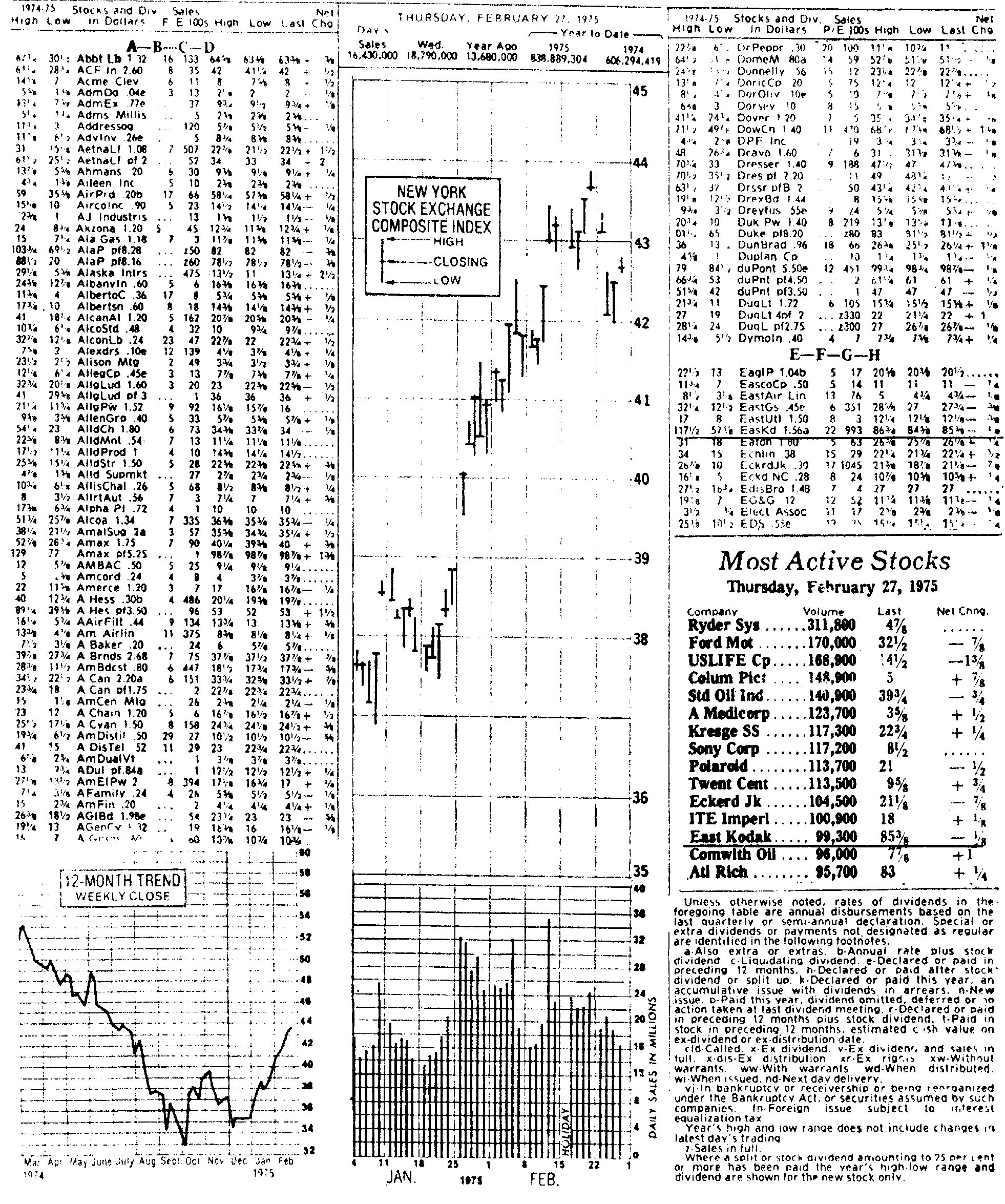
Copyright 1975 by The New York Times Company. Reprinted by permission.
The 35 million share day, February 13, 1975— 35,160,000 shares were actually traded—was an all-time high as of that date.
Eastman Kodak—Thursday, February 27, 1975: For the sake of a more precise analysis, compare the December 4, 1974 listing described on p. 60. Columns 1 and 2 report the 1974-1975 high ($117.50) and low ($57,625) prices. The high listed on December 4 had not been surpassed, but a new low was posted after that date. (Note that columns 1 and 2 are revised each year, after several months have passed, reverting to the calendar year basis. Thus Daily Reports appearing later in the year should be expected to show the high and low prices for the previous months of the calendar year only.) No comment needed on column 3, listing company name and annual dividend. The new higher P/E ratio (column 4) reflects the change in the relationship of earnings to the day’s higher closing price. The higher price of the stock means that the earnings are lower in comparison—l/22nd instead of l/17th of the price of a single share. Thus the yield on his money to an investor who bought Eastman Kodak stock at the February 27 price would be lower than if he had bought on December 4. Sales of Eastman Kodak’s stock (column 5)—993 round lots of 100 shares, i.e., 99,300 shares in all— again place it among the day’s “Most Active Stocks.” Columns 6, 7, 8 and 9 show the prices per share at which Eastman Kodak’s stock traded—the high, 86 3/8 ($86,375), low, 84 5/8 ($84,625) and closing 85 3/8 ($85,375), down 1/8 (12.5¢) from the previous day’s closing price.
The eternal goal of stockbrokers and stock investors, to be able to forecast future stock prices, is really “an impossible dream.” Nevertheless, stock market statisticians compile many statistical series and develop many charts with the hope in mind that the more they can know about past stock prices and past trends, the better able they will be to anticipate what will happen to stock prices in the future.
The three small graphs with the NYSE Reports (pp. 59 & 128) are such attempts. The students may notice three similar graphs—the widely-known “Dow Jones Averages”—printed each day in The Wall Street Journal. These three charts are based on daily prices of three Dow Jones selected lists of 65 stocks in three different categories—30 industrials, 20 transportation and 15 utilities. The Dow Jones index of industrials, started in 1884 with 12 stocks, revised and up-dated from time to time since, is followed by many persons looking for clues as to how to invest. However, statistics are always based on historical data. They tell us only what happened in the past and reveal nothing about the future or about when trends will change. Moreover, the potential investor’s interest is in the future prospects of specific firms, not the future trend in statistical aggregates. A change in the price for the stock of a particular company really tells something about the anticipation of investors as to the economic prospects of that particular firm. Generally higher prices, however, usually reflect only an increase in the number of dollars in circulation and/or going into the market and reveal nothing about specific investment opportunities. It may be of casual interest to note that the Dow Jones index of “industrials” topped 1,000— reaching a peak of 1,051.70 on January 11, 1973— then declined to its recent low of 584.56 on October 4, 1974. For the individual investor, however, the important thing is the anticipated prospects of the specific corporation whose individual shares of stock he owns or is considering buying or selling.
The students should remain alert to note changes that may be made from time to time in reporting NYSE transactions and also to compare its Daily Reports with those of other Exchanges appearing in local newspapers.
Let the students analyze a few more stock listings also, compare the different prices at which shares of a specific company’s stock are sold at different times and speculate as to the reasons for these fluctuations. A firm’s stock will rise (fall) in price if its prospects in the eyes of investors and potential investors seem rosy (poor). An announcement of a new product that promises to be popular with consumers and/or a report of unexpectedly higher earnings over the past year or quarter may send a company’s stock up on the market. On the other hand, the price of a company’s stock is apt to drop as the result of an announcement of poor sales and/or lower-than-anticipated earnings for the previous year or quarter. Any setback in a company’s fortunes is likely to have similar effects—labor problems, miscalculations on the part of management, loss of overseas plants, declining sales, etc.
Stock prices of many or most companies may rise in anticipation of inflation, leading investors and would-be investors to offer more than they otherwise would for a share of stock and present stockholders to insist on higher prices before they consent to sell. Declining prices for many or most stocks on the stock market may be the result of widespread economic hardship, uncertainty, anticipated tax increases and the threat of new government controls and/or regulations. Charts and statistics tend to reflect these general influences by making it appear that shares of stock traded on the market are all rising or falling more or less in unison. In actual fact, however, some stocks rise every day and others decline—the fate of any particular stock depending on the views of investors as to the success or failure of its managers to anticipate correctly market conditions, the wants of consumers and to respond to the general influences mentioned above that affect all economic activity to various degrees.
EXPLANATORY TEXT
This Unit relies heavily on the theories developed previously in this syllabus, especially in Units 6, “Prices, Pricings,” 7, “Savings, Tools and Production,” and 8, “The Entrepreneur and the Profit and Loss System.” Thus the teacher might like to review those three Units briefly, or at least review their final summarizing paragraphs and the definitions of their glossary words.
In this Unit we shall be dealing primarily with “big” business firms—how they became “big,” what limits there are, if any, on the size of a firm and whether “bigness” brings advantages or disadvantages to either business firms or consumers. We shall consider “big business” from three different viewpoints—historical, economic and legal. First, the historical development over many years of large-scale industries is discussed—mass production assembly line techniques, automation, etc. Then, secondly, the economics of large-scale production is analyzed—the role of consumer sovereignty, the importance of competition, the part played by advertising and the meaning of monopoly. Then in the final sections of this Unit, mention is made of some of the more important laws which affect business size, efficiency, production and consumption.
The principal point stressed here is that the success of any large corporation in a free market economy is the outcome of (a) the ideas and initiative of entrepreneurs, (b) profits (or losses) made on the market in free and open competition with other producers who were also trying to please consumers, (c) consumer sovereignty, choices and purchases, (d) personal savings and investments, (e) many changes, adaptations and adjustments over years in the attempt to better satisfy consumers. If the students gain nothing else from this Unit, they should at least learn that “big business” may become “big” in a free market economy only if it successfully and repeatedly serves many consumers. Moreover, customers and workers in a free market are not helpless pawns of “big business.” Rather the situation is the other way round; large-scale enterprises can stay in business and earn profits only if they retain the approval of many customers and continue to furnish them with things they want to have and to use. The situation is different, however, when business firms owe their very existence, size and success to government subsidy or special privilege; the consumers then are no longer sovereign.
1. How did today’s large corporations become large? Young people are inclined to think that the institutions they come to know always were and forever will be more or less as they are. Small day-to-day changes in their personal lives may be accepted as natural but the institutions of the outside world are thought to have existed and are expected to continue more or less the same almost indefinitely. This is especially true when it comes to very large business firms. Almost everyone assumes that such large and well-established firms as GM, GE, U. S. Steel, IBM, Xerox and Sears Roebuck have always been around and that they will last forever. Hardly anybody can conceive of the world without them. Yet there was a time when they didn’t exist. Every one of these big corporations had a beginning some time in the past and undoubtedly someday each of them will have an end.
The opportunity to experiment on the basis of new ideas is the essence of capitalism. Only in a capitalistic society where individuals may accumulate private property can they use it freely as they wish, take risks and try out new things in the hope of making profits. Every business comes into existence as a result of some venturesome entrepreneur’s idea. However, an idea alone is not enough to assure success, not even if the entrepreneur persuades investors to invest their savings in his venture. A business venture will be able to succeed, make profits and expand only if, as and when it serves consumers. To succeed, an entrepreneur’s output must be something consumers want and will purchase in sufficient quantities and at high enough prices to more than cover the full costs of producing and offering the finished items on the market. Only then can a businessman begin to accumulate something extra, “plow it back” into the enterprise, expand production, and enlarge his operations. In a free market the significant difference between a big business and a small one is simply that a big one has satisfied more consumers than a small one. To produce on a large scale a “big business” therefore must operate on a mass production basis.
NOTE: It should help the students understand how and why “big businesses” become “big” if they learn something about the beginnings and gradual expansions of several large companies. It always takes (a) an idea, (b) time, (c) savings, (d) investment, (e) effort, (f) the successful anticipation of consumer wants, for any business firm to become a large-scale producer in the first place and to continue in large-scale production—as he must to maintain his position of importance on the market in competition with other producers. Perhaps each student could research and report to the class on a different industry or firm. Countless books and encyclopedia articles deal with such histories. Books, articles and pictures describing various inventions, the development of mass production methods, new industrial techniques, automation and even those describing new selling and advertising techniques will help to show what is required to expand the production and the market for a good or service.
In the minds of many people the automobile industry has come to symbolize mass production, automation and “monopoly.” As a result the automobile industry is an especially good illustration to use in explaining how large-scale enterprises develop from small ones. Then too, a great deal has been written about it. Almost any library should be able to supply several books about the industry, many of them liberally illustrated, as well as a number of biographies of automobile producers.
Dozens, perhaps more, small automobile manufacturing firms were started, each by some hopeful entrepreneur. Some of these early companies failed, others merged and still others sold out to more successful competitors. It would be revealing merely to have the students list the names of as many different cars as possible which have been produced over the years. Perhaps the class could construct an exhibit with pictures of old automobiles, listing their names and manufacturers. Or build a “family tree” of the industry. Today’s “Big Four”—General Motors, Ford, Chrysler Corporation and American Motors—were formed by the coming together in one way or another of many smaller firms. However, the automobile industry continues in flux. The “Big Four” must still compete vigorously—against each other, against smaller, foreign and/or potential automobile manufacturers, and also against all producers of other means of transport as well as against the producers of all goods and services potential customers might prefer to buy with their money.
Today’s large-scale, specialized industrial structures gradually evolved from simpler and smaller enterprises of yesteryear. Every modern tool or machine—the computer, bulldozer, oil tanker, radio, TV, toaster-oven, snowmobile, camera, tape deck, or what-have-you—has also evolved over decades, perhaps even centuries, from early models that now seem antiquated, inefficient and crude. A study of former types and models will show that every modern implement is the product of countless minor changes made from time to time. No sharp line can be drawn between old-style products, cars for instance, and modern ones. One by one, minor changes were made in the automobiles being produced as researchers, inventors and producers kept trying to find ways to improve their cars and manufacturing methods, introducing mass production and automation so as to keep costs of production down and compete more successfully on the market. In this way, step-by-step, today’s comfortable and efficient automobiles, complex machines, home appliances, modern plants, large corporations, and so on, evolved from their cruder, less efficient and less sophisticated predecessors.
2. Why are some businesses able to make profits and expand, while others suffer losses and fail? Every entrepreneur is always spurred on by the hope that his particular idea or innovation will help to persuade consumers that his particular product is more desirable than that of his competitors. If it does he has a chance to earn a profit. As an example let’s stick with automobiles. If an entrepreneur helps to make a car that customers consider easier and/or cheaper to operate, more attractive to look at and more desirable to own than the models of his competitors, he will be able to sell more of them than he could have otherwise. With higher sales his gross receipts will rise and his chances of profit improve. It was in this way, step-by-step, that the Big Four gradually came to dominate the automobile industry in this country. Their success, generally speaking, was due simply to the usefulness and popularity of their cars. At the prices at which they were offered, their automobiles were so popular with buyers that their sales expanded, they took in huge “gates” or “box office receipts” as a result, which they used to plow back into the business to expand production.
In the final analysis, the present size of the Big Four, their earnings, profits and tremendous investments in plants, tools and supplies were all made possible by the dollars received from countless automobile buyers who preferred to purchase their cars to using that same amount of money for anything else. Remember, these automobile companies earned profits only because they were manufacturing cars in large numbers that many persons purchased because they wanted to use them! Should consumers refuse to buy so many of their cars in the future for any reason—because of economic hardship, the high price of gasoline, irritation at new government-required safety devices, etc.—the situation of the Big Four automobile manufacturers could become precarious, their profits vanish and their plants have to close down. No firm, no matter how large or how long it has been in successful operation, can remain impervious to shifts in consumer buying.
In communities where cars are commonplace, the teacher might poll the students, asking the make and manufacture of the cars they and their families own. Remind the students that every one of them who bought a car contributed in part to the profit, if any, earned by its manufacturer— whether one of the Big Four, a foreign company or a small machine shop producing custom-made models. This will give the teacher an opportunity to point out that it is only the popularity of the most widely-driven cars—Fords, Chevrolets, Plym-ouths, American’s Gremlins or Hornets, Volks, Toyotas—that enables their producers to sell them in large numbers, have a chance to earn a profit and expand. For many years the Big Four were the most successful. However, their foreign competitors are becoming increasingly skillful at making cars many U. S. customers want to buy and use. In any event, one thing is certain. On a free market, the companies that make the biggest profits must be efficient and successful at satisfying many customers over and over again.
It is a firm’s customers, the individuals who buy a firm’s products voluntarily, who are responsible for its “gate” or “box office receipts.” Every potential purchaser of a firm’s good or service reasons, thinks and acts individually. Each does as he thinks best under the circumstances, in the hope of relieving some “felt uneasiness,” attaining his most urgent goal of the moment, and satisfying his subjective (personal) value scales. Only if a firm sells its product to many customers will the few pennies or dollars received from each add up to the substantial sums it will need to become and remain a “big business.” Consumer sovereignty is responsible for determining not only which companies will survive but also which ones will succeed enough to expand. Like the “chocolate king” mentioned by the late Professor Ludwig von Mises, even large-scale entrepreneurs are subservient to the wishes of consumers:
The consumers patronize those shops in which they can buy what they want at the cheapest price. Their buying and their abstention from buying decides who should own and run the plants and the farms. They make poor people rich and rich people poor. They determine precisely what should be produced, in what quality, and in what quantities. They are merciless bosses, full of whims and fancies, changeable and unpredictable. For them nothing counts other than their own satisfaction. They do not care a whit for past merit and vested interests. If something is offered to them that they like better or that is cheaper, they desert their old purveyors. In their capacity as buyers and consumers they are hard-hearted and callous, without consideration for other people.
Human Action (3rd ed., 1966), p. 270
3. What business firms are the largest in the world? There are several ways to estimate and compare the sizes of different companies—on the basis of estimated money value of production, sales, invested capital, profits or gross income minus all expenses. Company to company comparisons are difficult at best because different firms follow different procedures in accounting and reporting. However, Fortune Magazine publishes lists each year of the business firms it considers the world’s largest in several categories. By studying Fortune’s lists over the years it becomes apparent that a firm’s “gate” or “box office receipts” vary from year to year, so that its position on one of these lists may shift. Some firms rise, others decline, still others disappear from these lists completely after a time, while newcomers appear to take their places. Here are the categories of large business firms listed by Fortune more or less regularly in their May, June and July issues:
500 largest U.S. industrial firms
2nd 500 largest U. S. industrial firms
50 largest U. S. commercial banking companies
50 largest U. S. diversified financial companies
50 largest U.S. life insurance companies
50 largest U. S. retailing companies
50 largest U.S. transportation companies
50 largest U.S. utilities.
The several hundred largest foreign firms are listed in the August issues of Fortune.
If the class has access to several years of Fortune Magazine, students might check a number of different companies to note name changes, mergers, shifts in position on the list, value of assets, sales, capital invested, number of employees, profits, etc. Occasionally, a company’s total sales may entitle it to a listing by Fortune even though its recent “gate” or “box office receipts” were insufficient to cover all its costs so that its operations failed to earn a profit for a year or so.
NOTE: Parentheses around a figure on an accounting statement normally indicate a negative figure, a loss, rather than a plus, or profit.
The footnotes on Fortune’s lists furnish additional information about specific companies. Not all of those on the Fortune lists are privately owned and operated. Some are owned, in part or in full, by government. Some may enjoy special government privileges or protection, giving them a competitive advantage so that they are private in name only, their sales not all being purely voluntary but coerced to some extent. However, that is another story—to be taken up in Unit 14. The fact remains that insofar as these companies produce and sell goods and services in free and open competition in a market economy, their very rating as among the world’s largest producers is evidence that they have served customers in large numbers. They have all earned their positions of prominence by furnishing goods and/or services through the market to many persons who wanted them for use or enjoyment.
4. How does a business firm attract the customers it needs to support its large-scale production? When a businessman, large or small, produces a good or service, his work is only partly done. It is not enough just to make something. His job also includes seeing to it that his output actually reaches persons who want to buy it in order to have it and use it. Unless he succeeds in getting his product into the hands of consumers eventually, he is not accomplishing his purpose for going into business in the first place and will have no reason to keep on producing for the market. Therefore, any businessman who wants to stay in operation must make sure that potential buyers know about his product. Potential customers must not only learn it is available but they must also be told enough about it so they can decide whether or not they want it urgently enough to buy it at the price being asked. Potential customers must be persuaded to spend some of their cash holdings to purchase the particular good or service in question voluntarily, rather than to use that sum of money for anything else. If an item will not be sold, there is no reason for producing it for the market in the first place. This means that telling potential customers about goods or services which are available and persuading them to buy are essential stages in production for the market.
NOTE: See the glossary definition of production as “the process of combining raw materials, labor and other factors of production or producers’ goods ... so as to create goods and/or services consumers want . . . any process which helps a product reach the final consumer.” This means that raw materials and labor must be transformed into finished goods ready for consumption. Discuss what “ready for consumption” means. Food is not “ready for consumption” until it is prepared and dished onto plates to be eaten; shampoos are not “ready for consumption” until they are available at home, unwrapped and ready to use; an automobile is not “ready for consumption” until the sales contract is signed, the car with gas in its tank delivered and its keys handed over to the new owner so he can drive it away.
Making something physically is only a part of the production process. Every action that helps in any way to place something in the hands of final consumers and make it “ready for consumption” is a necessary step in its production. Obviously, therefore, publicizing or furnishing information about a good or service—i.e., advertising—is a necessary and “productive” activity. Thus the cost of advertising must be recognized as one of the essential costs of producing something and advertising cannot be considered separately as an “unproductive” activity. Without advertising in one form or another there could be no mass production as we know it today.
5. Why do we have the kind of ads we do? It is seldom easy for a business firm to attract the attention of a sufficient number of potential buyers for his good or service. People are often busy, distracted, absentminded, intent on work or play. They may fail to see, hear or note much of what is going on around them unless it actually intrudes on their thoughts and actions. They are frequently surrounded by all kinds of product advertisements. Thus, to be effective an ad must be startling and striking enough to attract the attention of substantial numbers of potential customers, in competition with the many other activities, duties, products and ads bidding for their time and money. Consumer prejudice, apathy, lethargy, tradition and custom are serious obstacles in the path of entrepreneurs who want to sell their products. As a result, entrepreneurs, through their advertisers, do their best to pique the curiosity and enthusiasm of potential customers and to make it as easy as possible to find, buy, try and use their particular product. On a free market, producers must try to persuade—they cannot coerce—potential customers to buy a specific good or service.
Once entrepreneurs have conceived of an idea, produced something which they hope will please consumers, explained why its purchase would be to the advantage of customers, how it should help remove some “felt uneasiness,” further a potential customer’s particular goal or contribute to some subjective (personal) value, they must keep on doing this day after day to stay in operation. One-shot sales are not enough to maintain the tremendous “gates” or “box office receipts” a modern mass production enterprise needs yearly, monthly, even daily. Most businesses need to have many customers buy their products many times over. Hence, the tremendous sums spent on advertising campaigns, the serious efforts devoted to trying to develop original, dramatic and effective ads and the wide variety of gimmicks used to attract buyers—coupons, free samples, contests, bonus offers, special prices, etc.
Many people criticize advertisers for the kinds of ads they produce. Styles in ads change, just as do styles in dress, drama, literature or recreation. Old style ads now seem quaint, subdued and low-keyed in tone. They would hardly be noticed in competition with the kind of ads that are prevalent now. It is today’s noisy, flashy, brightly-colored, dramatic advertisements that have given advertisers and New York City’s Madison Avenue, where many have their offices, a reputation for high-pressure tactics and poor taste. Yet such ads reflect the times, current fads and fashions. The severe competition on the market, among producers and advertisers in trying to attract potential customers, helps to explain, if not to excuse, Madison Avenue’s actions. Today’s ads must be loud, strident, blatant, shocking or clever to attract attention in the modern world where every one is constantly being bombarded by ads for many products from every direction—billboards, signs, posters, radio, TV, newspapers and magazines.
NOTE: The students might be interested in compiling an exhibit of ads and advertising gimmicks, old and new. Reproductions of old ads frequently appear in books, posters or articles about advertising. See also offset reproductions of old mail order catalogs and of magazines and newspapers of 50 or 100 years ago.
The test of an ad’s effectiveness lies in the sales it produces. Only if an ad promotes enough sales to cover its full cost does it contribute to production and earn its sponsors the opportunity to continue in business. When it comes to influencing the types of ads that will prevail, consumers are sovereign on a free market, just as they are in determining the goods and services that will be produced. They may show their respect or contempt for an ad just as they may for a product, by purchasing or refusing to purchase the good or service it advertises. On a free market where opportunities and alternatives abound, no consumer is compelled to buy any particular product. No amount of advertising can make him buy something if he is persuaded it is not to his advantage. Sooner or later the advertisers responsible will notice the effects of consumer sovereignty. If their ads earn consumer approval and result in sales of the products they advertise, they will be able to expand; if their ads and the products advertised prove unpopular with consumers, their insufficient “gate” or “box office receipts” will compel them to bow to consumer sovereignty and change their methods of advertising or go out of business.
It is often thought that the only way consumers hear about available goods and services is through commercial advertising. However, one of the most effective ways to learn of products is through private conversation and personal recommendation. Such “word-of-mouth advertising” cannot be purchased directly. A producer can only try to offer a product that is good enough to satisfy consumers. If he succeeds, favorable “word-of-mouth advertising” will be his reward and will help to increase sales. If his product displeases customers for any reason, “word-of-mouth criticism” can destroy his enterprise very quickly.
NOTE: The students might discuss some specific purchases of their own, made as a result of “word-of-mouth advertising,” i.e. on the personal recommendation of a friend or relative—a snack at a certain pizza parlor, a new cold remedy, a ticket to a popular movie, a special LP recording, a particular brand of beer or even a choice of college. Ask the students to read Burton Rascoe’s “The Cow in the Apartment” (Reading No. 49) and discuss the role of advertising as presented there. For a more thorough understanding of the economics of advertising, see Israel Kirzner’s “Advertising” (Reading No. 54).
6. Where does a “big business” obtain the funds to finance its production? Every businessman hopes eventually to pay for all labor, tools, machines, supplies, plants and the other goods and services used in his operations out of his “gate” or “box office receipts.” However, many of these costs must be paid even before the firm can sell enough of its output to pay them all, perhaps even before it starts producing anything at all. Thus, a businessman must have access to some funds of his own, or someone else’s, to pay all necessary expenses before his enterprise starts yielding any income. Therefore, every business firm relies to some extent on someone’s accumulated savings—rainy-day savings and/or capitalist savings. These savings come necessarily from earlier production. In the past, someone must have produced more than he consumed and saved the balance.
Savers may use their savings in one of two ways to help themselves and yet, at the same time, to help business firms. They may (a) lend or (b) invest:
a. A saver may lend his savings to someone who wants to borrow. A saver who lends agrees to forego the use of certain funds for a definite period of time so as to let a borrower use them— in return for a promise to repay that sum, at the end of the term involved, plus interest, i.e. a certain agreed-upon additional fee or a certain percentage or rate per month or year. The written promise to repay the borrowed money to the lender is an IOU, known more formally as a “promissory note” or “bond.”
b. A saver may become an entrepreneur himself, speculating and investing his savings in a business that he or someone else operates. As an entrepreneur he could become the sole owner of a business, or a partial owner, sharing the risk with other partial owners if the business suffers losses but also sharing with them any gain, i.e. entrepreneurial profit, if it succeeds. If the saver is not interested in engaging in business himself or in becoming a part owner of an enterprise operated by friends or acquaintances, he may buy portions of one or several large companies whose shares are available on the market—i.e. he may buy shares of stock in a corporation. If the class purchased a share or two of stock through an adult or an investment club—as suggested in Unit 7—it actually bought part ownership in a particular firm, acquired a financial interest in its plant and production, sharing with all other partial owners the opportunity for entrepreneurial profit as well as the risk of loss.
One lesson of this syllabus is that whenever two or more persons exchange one thing for something else they constitute a market. Thus markets are inevitable outgrowths of the conscious actions of individuals, in a society where there is cooperation, private property and specialization. There are many markets in the world. On some, a wide variety of items are traded. Other markets are highly specialized, having available for exchange only limited kinds of goods or services. For example, a grocery store is a specialized market for foods and household supplies. Restaurants and pizza parlors are other specialized markets. Many jewelry traders have shops in one city block in New York City thus forming a specialty market for would-be buyers and sellers of jewels. And so on. Among the largest specialized markets in the world are stock markets, or stock exchanges where shares of stock in large companies or corporations are traded.
Shares of stock in many, if not most, large corporations are bought and sold on one or more of the large specialized markets or stock exchanges located in many of the major cities of the world (Unit 7). Savers who wish to invest their savings in business ventures go to a stock exchange and so businessmen go there too in their search for savings to finance new or expanding operations. A stock exchange, therefore, is a meeting place, market or auction where would-be investors and entrepreneurs trade shares of stock in specific firms, each on the basis of his subjective (personal) values and anticipations. By having the mechanics of their trades handled through a stock exchange, it becomes possible for the savings of many individuals to be pooled and invested in business enterprises.
7. How are stock exchanges organized? The largest stock exchange in the world is the New York Stock Exchange (NYSE), sometimes called the “Big Board,” which lists (as of March 1975) about 1,750 different companies. The precise number of firms listed for trading on the Exchange varies from time to time as new ones are accepted for listing and/or old ones drop off, merge, etc. About 12-20 million shares of stock are traded daily on an “average” day on the “Big Board”—a 35 million share day is exceptional! The short New York City street where the NYSE has its headquarters, Wall Street, has become practically synonymous with “high finance,” “big business” and stock market speculations.
Stock exchanges are cooperative ventures, membership associations. To become a member of an exchange, a brokerage firm must buy a “seat.” Prices for “seats” vary from time to time and from exchange to exchange, depending on the bids and asks of potential buyers and sellers, each based on the anticipated value to the trader of the opportunities offered by a “seat.” Since 1950, the price of a NYSE “seat” has ranged from $46,000 to $515,000.
A stock exchange, therefore, is an association of stockbroker firms. Each member firm employs highly specialized salesmen or customers’ men, who act as middlemen or agents for would-be buyers and/or would-be sellers of stock. The role of a customers’ man is to try to find customers for shares of stock in the companies listed on the exchange to which his firm belongs. Many become experts on specific commodities, industries or companies. Brokers arrange sales on a commission basis and handle the details of trades among savers who would like to invest in business firms, business firms looking for funds, or anyone wanting to buy or sell shares of stock in companies listed for trading on the stock exchange to which they belong. If the students have visited the facilities of a local stock exchange, a broker’s office, or heard a talk by someone connected with a stock market, they will have some familiarity with its role and mechanical procedures. Refer also to the excerpts from NYSE Daily Reports, pp. 58-61 and pp. 127129.
When planning their investment portfolios in connection with Unit 7, some students may have noticed the symbol “pf” beside some stock listings on Daily Stock Exchange Reports. Some firms issue two different kinds of stock—common and preferred. The symbol “pf” designates preferred, as contrasted with common, stock. Preferred stock usually pays fixed dividends. It also enjoys a favored position as compared with common stock if the issuing company should be liquidated. The claims of the owners of preferred stock are then considered ahead of those of the holders of common stock, just after those of the firm’s bondholders and other creditors. Owners of common stock share a greater risk in the event of the firm’s financial loss or bankruptcy. But by the same token the owners of common stock have a chance of greater reward if the company prospers.
Before leaving this discussion, mention should be made of the Securities and Exchange Commission. The SEC is an administrative agency of the U. S. Government. It was set up in response to legislation of 1933, 1934 and later amendments, “to protect the interests of the public investors against malpractices.” In the attempt to do this, the SEC regulates and controls corporations and brokerage firms dealing on the securities market. Its rulings have a profound effect on stock market transactions, business financing, investment and the prices paid for stocks and bonds. The SEC requires companies selling stocks, borrowing funds on the market, merging with or taking over other firms, etc., to register, file periodic reports, and issue detailed information in advance concerning scheduled financial operations. The SEC restricts the sale of stocks in some instances and limits their purchase for speculation by company officials or “insiders.” It also prescribes certain standards, procedures and commissions for brokerage firms in selling stocks and bonds to the public and in recording and accounting for such transactions.
NOTE: In the course of this discussion of stock exchanges, keep in mind always their extreme importance in (a) permitting the savings of many individuals to be pooled so that gigantic enterprises, producing large quantities of goods and services for many customers, can be financed and (b) providing the mechanism for small savers to become capitalists and investors and thus to have a chance to attain financial independence. Anything that restricts and hampers this outcome of voluntary cooperation in any way hinders production and makes it harder and more expensive for people to obtain the various consumers’ goods they want.
8. Does “bigness” in business, in itself, constitute a threat to the market? One of the most important points developed so far in this syllabus is that the size of any business on a free market is a reflection of its “gate” or “box office receipts.” Any large firm must necessarily produce on a large scale for many customers. Thus, inevitably, any enterprise that becomes a large-scale producer must have contributed substantially to the economic well-being of many persons, each of whom voluntarily purchased some of the firm’s output.
No firm can ever grow any bigger on a free market than consumer sovereignty allows. Competition sees to that. If a producer tries to increase his income by raising the prices he asks for his products substantially above their cost of production, new entrepreneurs, willing and able to produce and sell the same or similar items for less, will appear sooner or later and his customers will then start to desert him. Similarly, if a producer tries to expand by increasing his take at the expense of his workers or suppliers—refusing to pay them the full market value of their labor or materials—his workers and suppliers too will leave him. No one will voluntarily submit to such “exploitation” on the free market—and no one has to. Employees who consider their wages less than they could earn elsewhere for similar work will “goof off” or “gold-brick” on the job to reduce their output to what they consider more consistent with the wages they are being paid. Or they will look for different jobs at better wage rates. If suppliers do not consider adequate the prices paid for the goods they provide, they will furnish poorer quality merchandise and/or look for other potential buyers. As a result, the quantity and/or quality of the output of producers who try to cut costs too much will decline, so that their sales will drop—unless and until they pay market wages that suit their workers and market prices that satisfy their suppliers.
On the free market, no business firm, large or small, can ignore potential competition and consumer sovereignty in setting prices and wages. The prices a company charges for its products cannot be “administered” in the sense that it may set them as high as it would like and still find customers. Nor are employers in a position to “administer” the wages they pay employees or the prices they pay suppliers for the factors of production they provide. Free market prices are arrived at through the countless auctions that are always going on. Everyone concerned is always reviewing his/her respective situation and bidding or refusing to bid for units of specific items, in line with his/her changing wants, values, ends, goals and interests in life. When each would-be employer, employee, supplier and consumer is free to buy, or refuse to buy, as he wishes at any moment, in response to his own personal (subjective) scale of values, market prices that tend to satisfy everyone emerge, as everyone continually adjusts his actions according to his best judgment in the hope of accomplishing his most urgent wants and goals more easily and more promptly.
Every individual customer of a “big business” voluntarily elects to buy, or not to buy, a specific unit of the good or service offered, at a specific time and place. In making an actual purchase, every customer shows a preference—on the basis of his own personal, subjective scale of values and marginal utility—for the particular item(s) he is acquiring—over and above any other possible use he or she could have made of the sum of money involved. If a transaction is truly voluntary on both sides, if neither party uses force, fraud or legal privilege to prevent other would-be buyers and sellers from competing, both expect to be better off as a result of the trade than they would have been otherwise. And both of them will be—unless or until changes occur to alter their goals and subjective (personal) values.
The bids and asks of potential buyers and sellers, each in response to his or her own scale of values at the time, reflect their relative eagerness to trade. In conformity with the law of price, therefore, the free market price for any item traded at a particular time and place must always fall within certain upper and lower margins, permitting everyone concerned to be satisfied. On a free market, therefore, a “big business” has no special power to make people buy its output, to force them to pay more for something than they consider justified, or to impose its will on employees or suppliers. Every party to a voluntary market transaction must be pleased—in the light of all circumstances—time, place and subjective (personal) values. Otherwise there will be no trade. Thus, a “big business” is just as dependent on consumer sovereignty as a small one—perhaps more so, for it needs larger “gates” or “box office receipts,” hence bigger sales, and so must please, and keep on pleasing, more customers to stay in operation then small ones do.
To cover costs and then perhaps to earn an entrepreneurial profit also, any business must compete successfully with all other would-be sellers for the dollars and cents of consumers. Business firms, large and small, must be ready to adapt at any time to new conditions that arise, as the wants of consumers shift. On a free market none can remain aloof from the need to serve consumers. Those that expand are those which have succeeded in keeping their costs from rising and, at the same time, have best pleased large numbers of customers. Thanks to having anticipated the wants of consumers better than their competitors, thanks also to large accumulations of savings, modern technology, tools and machines, automation, assembly line techniques, efficient means of transportation, mass media of communication and advertising far and wide, large-scale enterprises are in a position to produce on a mass production basis to satisfy the wants and needs of many customers. “Bigness” in business, therefore, is never a threat on a free market. Rather the very “bigness” of a business enterprise is proof of past service.
NOTE: The students should be able to name many large firms whose “bigness” is easily explained by the popularity of the things they produce. This should further emphasize the basic thesis that the success and size of a business enterprise on a free market economy, where there is free and open competition, is a reflection of the satisfaction it gives consumers, as shown by its “gate” or “box office receipts.” The subject of monopoly, however, introduces an area of economic activity where consumers are not always completely sovereign. The purpose of the remainder of this Unit is to explain that:
a. Monopoly, in itself, is not bad. As a matter of fact, monopoly is inherent in the nature of things, for everybody is a monopolist with “exclusive control” of his time, energy, property and the space he actually occupies at any moment
b. Such natural monopolists constitute little or no threat to consumer sovereignty, for they face constant competition from all other natural monopolists and so must be responsive to the wishes of consumers in order to succeed. Only in very rare instances may a natural monopolist violate consumer sovereignty by charging consumers higher-than-market prices
c. A second type of monopoly, a government-created or government-protected monopoly, constitutes a much more serious threat to consumer sovereignty. Such a legal monopoly enjoys a privileged position, sheltered from potential competitors. Thus legal monopolies may frequently ignore the wishes of consumers and violate consumer sovereignty
d. The procedure by which legal monopolies may deny consumer sovereignty with relative impunity is to restrict their production and ask higher-than-market monopoly prices for their limited output. They are able to obtain monopoly prices for their production and reap monopoly gains only if consumers want what they produce so urgently that they are ready and willing “to pay ransom,” so to speak for the fewer units available. If this concept of monopoly price and monopoly gain seems too complicated for presentation to the entire class, it may be skipped completely or assigned for extracurricular study only by the more exceptional students. The most important point to stress about monopoly is that there are two forms— “natural” and “legal.”
9. What about monopoly? According to dictionary definitions, monopoly means the “exclusive control” of the supply of something—a specific good or service—at a given place and time. By this definition, monopoly is extremely widespread, even in a free market economy. Every one has such a market monopoly of his or her own particular time, labor, services, property and production. You are a monopolist. I am a monopolist. So is every teacher in the school, every comer delicatessen owner in town, every garage mechanic and every newspaper delivery boy. Each of us alone exercises “exclusive control” over his or her own personal time, labor, belongings and money. Each of us is free to decide whether or not to offer services for hire, property for sale, or money in trade. Such a monopoly is a natural phenomenon, inherent in the nature of the universe.
Obviously, such a natural monopoly gives no special advantage. The natural monopolist is seldom in a position to reap a special monopoly gain by charging higher-than-market prices for his goods or higher-than-market wages for his services. His goods and services face competition from all other natural monopolists. For instance, high school students may be monopolists in this sense; that is, they exercise “exclusive control” over the disposition of their own personal time and labor. Yet every high school student who has ever looked for a job will realize full well that he cannot make a potential employer pay whatever he wants. If he asks potential employers for a higher wage than that for which other equally-qualified persons are willing to do the same work, he will be promptly passed over in their favor. (A review of the job auctions described in Unit 9 should remind the students how wages are determined by competition among would-be job holders and potential employers.) No matter that each student enjoys a “natural” monopoly, he will never be voluntarily paid higher wages than an employer is ready and willing to offer him. Nor can an employer, whose enterprise is a monopoly in this sense, i.e., he exercises “exclusive control” over the supply of jobs at his particular location, exploit workers by compelling them to work for him at lower-than-market wage rates. Monopoly per se has little economic significance, precisely because every one is a monopolist in this sense. Thus a natural monopoly, in itself, grants no special power to exploit others through the market.
There are some rare situations, however, when having a natural monopoly of this type does have economic significance. Under certain circumstances, even when no force, fraud or legal privilege is involved, a natural monopolist may be able to ask and receive monopoly prices for his output, prices above those that would prevail under free and open competition. In that case, a natural monopolist may reap a special monopoly gain.
To illustrate, let’s consider a comer delicatessen. The owner enjoys a monopoly at his particular location, a “space monopoly” so to speak. Yet having this monopoly does not give him the power to exploit his customers. If he asks prices for candy bars and sandwiches that seem “too high” in the opinion of persons who might become customers, he cannot make them pay. They have several options. They can refuse to buy at all; they can walk or drive to more distant stores; they can try to bargain; or, if other shops are closed at the time, they can wait for them to open and then plan ahead another time so as to have ample food on hand to last until other stores are open. However, the delicatessen owner may sell some candy bars and sandwiches at his higher asking prices—to persons who are ready and willing to pay extra for convenience and availability at odd times of the day or night. The higher asking prices will inevitably reduce his sales—and probably also, although not necessarily, his box office receipts. But it is conceivable that by trial, error or happenchance he will earn a greater net return on the fewer items sold at monopoly prices, than he would have received from selling a greater quantity at lower, competitive, market prices. Any such extra income is a monopoly gain. Only occasionally can a “natural” monopolist reap monopoly gain in this way, by selling fewer items at higher prices. In most instances the net income of a business drops with a decline in total sales. Only if customers want the monopolist’s output urgently enough to pay the higher asking prices for his merchandise in sufficient quantities will he have a chance—although even then no guarantee—of earning a monopoly gain.
Dictionaries give several definitions of monopoly. At least one definition is bound to include the idea that monopoly is connected with legal privileges or government protection. In other words, in addition to “natural” monopolies, there are also “legal” monopolies. For all practical purposes, only “legal” monopolies, which depend to some extent on special government-granted privilege, have any real economic significance.
10. How do “legal” monopolies differ from “natural” monopolies? A legal monopoly is sheltered from competition by government. The protection from competition enjoyed by a legal monopoly distinguishes it very sharply from the natural monopoly that you and I each have over our own personal time, labor, location and property. A legal monopoly’s potential competition is reduced by legally restricting or hampering freedom of entry in some way into its particular field of production. As a result, the possessor of a legal monopoly can afford to be relatively indifferent to consumer sovereignty. Its managers need not worry very much about cutting production costs, improving their product, trying to reduce prices and/or seeking to satisfy customers better than would-be competitors might.
Whereas the ability to profit from a natural monopoly is always limited by what the natural monopolist can persuade employers and customers to offer voluntarily in exchange, legal monopolies have the power of government force on their side, helping to prevent competition and so to raise their selling prices. Because entry into their field of production is restricted, they may often disregard the wishes of consumers. A monopolist who enjoys legal protection may limit production and charge higher-than-market prices without enticing additional competitors to enter production—as would be the case on a free market where the anticipation of a substantial spread between production costs and potential box office receipts would be enough to signal new entrepreneurs to enter the field. Legally-protected monopolists, therefore, face relatively little risk of loss of sales and income due to charging higher-than-market prices. Insofar as potential competitors are hampered in entering this business or profession the legal monopolist enjoys a special government-granted privilege.
The history of legal monopolies is a long one. Throughout the ages, many governments have granted special privileges to specific individuals, giving them a legal monopoly to produce or sell a certain item in a particular community. This practice was especially common in the England of Elizabeth I. Her government often granted legal monopolies naming certain craftsmen and merchants as the only persons entitled to produce or sell such items as starch, playing cards, wine, tobacco or salt. Although production methods have changed drastically since then, many legal monopolies exist today. For instance, the producer of any economic good who is required to be licensed by government—national, state or local—is protected to some extent from competition. As an indication of the many ways our governments protect producers from potential competition, thus creating various forms of legal monopoly, here is a list of several:
a. Tariffs on imported goods make foreign imports more expensive and thus protect U. S. manufacturers from the competition of producers in other countries
b. Import quotas on certain items restrict the quantity that may be brought into the country, protecting domestic producers to that extent from foreign competitors and making it easier for U.S. concerns to sell their output at higher prices
c. State or city licenses required to practice many professions—law, medicine, pharmacology, hairdressing, real estate sales, plumbing, electrical installation and repairs, taxi service, etc. —reduce the number of persons legally qualified to serve consumers in these areas
d. Public transportation companies may be given special permission or franchises to operate in a community and so are assured that other concerns will not be allowed to compete in offering transportation along the same routes
e. Interstate air carriers must be licensed by the U. S. government’s Civil Aeronautics Board and no other commercial airlines may compete without obtaining similar CAB approval
f. Government-prescribed standards for food and drugs sold in certain markets help to protect established enterprises by making the “freedom of entry” by producers of new products legally difficult if not impossible
g. Strict building codes hinder the introduction of new construction techniques, giving producers of approved building materials a legal monopoly of sorts
h. The grant of the power of eminent domain to certain public utilities gives them a “legal” monopoly, protected from the competition of other potential suppliers who might have tried to compete in the areas served
i. Low-cost government loans give the borrowers a special advantage
j. To broadcast, a radio or TV station must have a government license, granted by the Federal Communications Commission. Once acquired, such a license grants a legal monopoly for a certain number of years, protecting the licensed station from competition by restricting the entry of would-be broadcasters who have not obtained legal authorization
k. Securities and Exchange Commission regulations and rulings favor large well-established corporations by making it much more complicated than it would otherwise be for new corporations to qualify for a listing on a stock exchange where they could sell stock and thus compete for the savings of would-be investors
l. The countless rulings and regulations with which a business firm must comply and the endless forms it must file in order to conform with the requirements of governmental agencies such as the NLRB, Social Security, state and local employment offices, etc., are making it more and more difficult and costly for new firms to come into existence. Insofar as “freedom of entry” is hampered or discouraged, existing concerns enjoy a legally-protected, if not a government-granted monopoly that helps to safeguard their position from potential competition, and permits them to ignore the wishes of consumers and consumer sovereignty as they could not afford to do if competition were completely free and open.
11. Just how does a legal monopoly help the monopolist at the expense of consumers? The grant of a legal monopoly protects the privileged person or firm from competition. It often permits them to maintain their income and perhaps even to reap an additional monopoly gain by making consumers pay dearly for each unit of production. Thanks to their privileged position, they may ask an especially high, legally-sanctioned, “ransom” price, so to speak, for each unit of their output sold. To understand the economics of this practice, two questions must be raised:
a. Will consumers be ready and willing to pay this monopoly price? The answer to this question depends on the urgency of their demand for units of the particular item being offered
b. Will the legal monopolist be able to earn a higher net income by selling fewer units at higher monopoly prices than he could by selling a greater number at lower, competitive prices? No one can ever be certain what will be the answer to this question. That will depend on whether the monopoly gain on the fewer units sold at monopoly prices is more than the net return would have been from selling a greater number of units at competitive market prices. A seller can, of course, count the sales he makes at one price under certain conditions and figure his net return over costs. But he can never reproduce precisely the same situation again to conduct a “controlled experiment”—as physical scientists do in the laboratory—to determine how many units he could have sold under those same circumstances, and how much his net return would have been, if he had asked a different price. Thus, the monopolist can only calculate and experiment in the attempt to estimate whether the extra monopoly gain, if any, from selling fewer units at the monopoly price will more than compensate for the “gate” or “box office receipts” he could have had by selling a greater number of units at prices consumers would have agreed to in free and open pricing auctions.
To explain why a monopoly gain is possible under some circumstances, we must understand “elasticity of demand.” In economic terminology, elasticity of demand reflects the relative urgency of consumers to acquire a particular item—as their urgency is affected by price. Demand is said to be “elastic” if (a) an increase in price of an item leads to a decrease in the number of units purchased or (b) a decrease in its price results in increased sales. Thus, elasticity of demand depends on the sensitivity of consumers to price. The more responsive consumers are to changes in the price of an item, the more “elastic” their demand is considered to be. For instance, the demand of most consumers for vacation trips and costume jewelry is usually quite elastic. If the price of either is increased, demand is likely to go down considerably as many consumers will be apt to curtail their consumption substantially.
On the other hand, if consumers are expected to buy essentially the same quantity of something, irrespective of its unit price, their demand for that particular item at that specific time and place is described as relatively “inelastic.” If a monopolist is to reap a monopoly gain—if he is to increase his net income by selling fewer units of a good or service at a higher price—the demand for it must be somewhat inelastic. The urgency of consumers to acquire individual units of his output must remain sufficiently firm, in the face of a rise in its price, to furnish him a higher return from fewer sales than he would have received from making more sales at the market price. To illustrate inelastic demand, economists often refer to the demand of consumers for pounds of salt or gallons of drinking water.
A change in the price of either of these will have little effect on sales. Few persons will consume much more salt or drinking water if their price is reduced, or much less if it is raised. Because the elasticity of demand for the products of a natural monopoly rarely fits this pattern—consumers usually have access to many alternatives, other potential sources, substitutes and choices—few natural monopolists are in a position to earn monopoly gains. Thus, it is primarily only legal monopolists, whose production is protected from competition, limiting the alternatives open and pressuring consumers to buy the monopolist’s product irrespective of its price, who are in a position to ignore consumer sovereignty, obtain monopoly prices and reap monopoly gains.
12. What about duopolies? Oligopolies? Cartels? Conglomerates? A duopoly, or oligopoly, is an arrangement based on a tacit, or explicit, understanding among two, or several, firms or corporations who, taken together, control the total supply of a specific good or service. It is held that the separate firms try to act in unison—as if they were a single entity, a monopoly under one management —restrict total output to raise unit prices and so to charge monopoly prices, in anticipation of reaping monopoly gains. Nothing need be added here to the above discussion of monopoly price or monopoly gain. The significant feature of any such voluntary duopoly, or oligopoly, is that it will not endure for long. The pressure on the part of each participating company to compete, in the attempt to improve each company’s own situation, is inherent in the very nature of private enterprise. The desire to compete remains so strong among privately-owned and separately-operated firms—even if they have agreed to act in unison in the belief that their interests were identical—that no arrangement which runs counter to this competitive drive can last for very long. Sooner or later, one of the parties to a duopolistic, or oligopolistic, understanding will become dissatisfied with its share of the reduced output and income. When that time comes, if the participating firms have retained legal and financial independence, one of them will be tempted to pull out, or to violate the understanding by trying secretly to increase its output and/or undercut the tacitly or explicitly agreed-upon selling prices, in the hope of improving its own profits. In either case, the ability of the duopoly, or oligopoly, to restrict production and to charge monopoly prices will then be at an end.
Cartels are legal monopolies created by the formal combination of several firms engaged in the same branch of production—with the sanction and support of government. A cartel which embraces all the domestic producers of an item can safely restrict production and charge monopoly prices because government is protecting it from competition. Perhaps the most prevalent protectionist measures are high tariffs and rigid quotas on imports. Protectionism of this type effectively keeps foreign goods from competing freely on the domestic market. When government has adopted such a policy in favor of domestic producers, the managers of a protected cartel can practically ignore potential competition from abroad. They may then act as if they really were a single monopolistic firm—restricting production, raising prices on the domestic market, “dumping” abroad (i.e., selling overseas at lower-than-market prices) any surpluses, allocating its limited production among the more efficient plants of its member firms, closing down those that are less economical and reimbursing their owners out of the monopoly gains received from selling fewer units at monopoly prices in the protected domestic market. The very creation of a cartel is an outcome of government protection. No cartel can survive without government protection. The loss of its government protection must bring an end to the cartel itself.
A conglomerate is a legal and financial entity made up of several companies, a combination under one single overall management, of several businesses, formerly separate and independent. The subsidiaries of a conglomerate may frequently be widely scattered geographically and engaged in extremely diversified activities. When one company purchases or merges with another engaged in a different field of production, a conglomerate is “born.” It may be formed for economic reasons— to branch out, diversify or spread its risks, in the hope of serving consumers better and thus increasing its chance of profit. However, one of the major reasons for the increase in the number of conglomerates in recent years has little or nothing to do with serving consumers. The increase in conglomerates may be traced to legal, rather than to market, considerations. Certain provisions of our tax laws have made the conglomerate structure financially worthwhile, contributing to the increased popularity of this particular form of business. As a result, conglomerates, formed for the tax savings involved, are “legally” protected insofar as tax legislation offers them certain financial advantages not available to other business structures.
13. How has government tried to discourage monopoly, prevent restraint of trade, and assure competition? In the decades following the Civil War, tremendous fortunes were accumulated in this country, by a number of successful entrepreneurs in several industries—shipping, railroads, steel, real estate, finance, merchandising, etc. This is not especially surprising, as production in the United States was expanding by leaps and bounds at that time, thanks in large part to the initiative and activities of entrepreneurs. In the relatively free enterprise climate of that time, anyone with a new idea was free to try it out—using his own savings or those of any financial backers he could find. Many opportunities for profit were open to persons who were willing to work hard and long, who would save a part of their earnings and who had the wit to anticipate correctly what consumers wanted.
The vast majority of the prominent capitalists of that period undoubtedly made real contributions to this country’s industrial development, economic expansion and the living standards of the people. Nevertheless, many people became concerned over the concentration of so much “economic power” in the hands of a relatively few businessmen. Their wealth provoked enmity, resentment, envy and criticism. Many people believed that individuals who accumulated such vast fortunes must have used unfair tactics, engaged in “cutthroat” competition and exploited employees and customers. It was claimed that by forming trusts they had been able to use force, or threat of force, to impose their will on others, thus acting in restraint of trade. As a result, pressures began to build for political action to curb the activities of such successful businessmen, industrial tycoons, “economic royalists” or “robber barons” as they were called.
Beginning in 1887, with the establishment of the Interstate Commerce Commission (ICC), a whole body of laws has been created in the attempt to control and regulate business activities in this country. To explore such antitrust legislation in detail is beyond the scope of this syllabus. However if a few students are interested in this subject, as some may well be, refer them to the pertinent references on the attached list of recommended readings. A report, written or oral, on this form of government intervention, would fit in well with Units 14 or 15. The major laws which have been enacted in the general area of antitrust legislation are listed here for reference:
1887—Interstate Commerce Commission, created by the Act to Regulate Commerce. This Act, since expanded, was aimed originally at controlling common carriers engaged in transporting passengers by rail and/or by water 1890—Sherman Antitrust Act passed, prohibiting all contracts, combinations and conspiracies “in restraint of trade,” as well as all “monopolies” and “attempts to monopolize.” The difficulty of defining precisely the technical terms used in this Act and others in this general area—such as “monopoly” and “restraint of trade”— has resulted in confusing and contradictory rulings. After all, if every one has a monopoly of his own output—in the sense described above in answer to question No. 9—how can an Act which outlaws monopoly be enforced?
1914—The Federal Trade Commission was created, with the power to investigate the practices of corporations, except banks and common carriers regulated by other legislation, and to prevent “unfair” methods of competition 1914—The Clayton Act, passed, prohibiting “price discrimination,” purchases of stock in competing corporations when the effect may be “to substantially lessen competition”
1934—Securities and Exchange Commission established “to protect the interests of the public and investors against malpractices in the securities and financial markets.” Issuers of securities making public offerings are required to file registration statements. Also required to register with the SEC are the national stock exchanges, brokers, dealers and national associations of such brokers and dealers, etc. The Commission has the power to make rules with respect to short sales, stabilizing, floor trading, specialists’ and odd-lot dealers’ activities, excessive trading by exchange members, minimum margin requirements, and so on 1936—“Fair trade” laws, the Robinson-Patman Act prohibiting price discrimination in fa-1937 vor of large buyers, supplemented (1937) by an Act permitting states to enact laws authorizing manufacturers to fix resale 1952 prices and, by amendment (1952), to enforce them even among retailers who had no such agreements with manufacturers. Competition, especially through “discount stores,” led many firms to abandon price maintenance, some states, and then the U. S. Congress, to repeal “fair trade” nationwide, effective in early 1976.
This list is by no means exhaustive. These basic Acts have been amended and revised over the years and many more laws to regulate and control in some respect the activities of businessmen have been enacted. The courts have ruled also many times, not always with clarity, in the attempt to develop reasonable and consistent interpretations of the technical terms used in the laws. This Unit’s list of recommended readings includes several references which fill in some gaps in this brief discussion of antitrust legislation.
Perhaps a fitting way to wind up this Unit is with another passage from Ludwig von Mises, which compares the market economy favorably with democracy:
With every penny spent the consumers determine the direction of all production processes and the details of the organization of all business activities. This state of affairs has been described by calling the market a democracy in which every penny gives a right to cast a ballot. It would be more correct to say that a democratic constitution is a scheme to assign to the citizens in the conduct of government the same supremacy the market economy gives them in their capacity as consumers. However, the comparison is imperfect. In the political democracy only the votes cast for the majority candidate or the majority plan are effective in shaping the course of affairs. The votes polled by the minority do not directly influence policies. But on the market no vote is cast in vain. Every penny spent has the power to work upon the production processes. The publishers cater not only to the majority by publishing detective stories, but also to the minority reading lyrical poetry and philosophical tracts. The bakeries bake bread not only for healthy people, but also for the sick on special diets. The decision of a consumer is carried into effect with the full momentum he gives it through his readiness to spend a definite amount of money.
It is true, in the market the various consumers have not the same voting right. The rich cast more votes than the poorer citizens. But this inequality is itself the outcome of a previous voting process. To be rich, in a pure market economy, is the outcome of success in filling best the demands of the consumers. A wealthy man can preserve his wealth only by continuing to serve the consumers in the most efficient way.
Human Action (3rd ed., Regnery, 1966), p. 271
UNIT 11 GLOSSARY WORDS
(For definitions, see glossary, pp. 223ff.)
“Administered price”
Advertising
Antitrust legislation
Automation
Bond
Capitalism
Capitalist savings
Cartel
Competition
Conglomerate
Consumer sovereignty
Corporation
“Cutthroat” competition
Duopoly or oligopoly
Elasticity of demand
Entrepreneur
Free market
Interest, interest rate
Loss
Madison Avenue
Mass production
Monopoly, monopolist
Monopoly price, monopoly gain
Producers’ policy
Production
Profit
Promissory note
Protectionism
Purchasing power
Restraint of trade
“Robber barons”
Savings
Stock, common and preferred
Trust
Wall Street
RECOMMENDED READINGS
More advanced materials indicated by an asterisk (*)
Articles
In the BASIC READER:
21. “Where Karl Marx Went Wrong,” Samuel B. Pettengill
22. “The Great Mistake of Karl Marx,” Benjamin F. Fairless
26. “Industrialism: Friend or Foe?” V. Orval Watts
* 27. “The Economic Role of Saving and Capital Goods,” Ludwig von Mises
* 32. “The Elite Under Capitalism,” Ludwig von Mises
* 33. “Profits,” Hans F. Sennholz
* 34. “Why Speculators?” Percy L. Greaves, Jr.
* 40. “Competition, Monopoly and the Role of Government,” Sylvester Petro
49. “The Cow in the Apartment,” Burton Rascoe
50. “Freedom to Shop Around,” Hart Buck
51. “Six Misconceptions about Consumer Welfare,” Joel Dean
52. “Is Economic Freedom Possible?” Benjamin A. Rogge
* 53. “The Phantom Called ‘Monopoly’,” Hans F. Sennholz
* 54. “Advertising,” Israel M. Kirzner
Additional titles:
“Antitrust and the Fear of Bigness,” Harold M. Fleming—in The Freeman, June 1967
“Antitrust ‘Humbug’,” Harold M. Fleming—in The Freeman, May 1967
“The Economic-power Syndrome,” Sylvester Petro— in The Freeman, April 1972
“The Purposes of Antitrust,” Harold M. Fleming—in The Freeman, April 1967
“The Ugly Market: Why Capitalism is Hated, Feared and Despised,” Israel M. Kirzner—in The Freeman, December 1974
Books
Chamberlain, John. The Enterprising Americans (Harper & Row, 1963/1974)
Fleming, Harold M. Ten Thousand Commandments: A Story of the Antitrust Laws (Prentice-Hall, 1951; Amo Press, 1971)
* Mises, Ludwig von. Bureaucracy (Yale, 1944; Arlington House, 1969). Chapters I, IV and VI
* --Planning for Freedom (Libertarian Press, 1952, 1962, 1974). See “Profit and Loss.”

