
Foundations of the Market Price System
Chapter X. The Consumers’ Sovereignty Problem
Consumers’ sovereignty may be the central political-economic issue facing people in modern society. The question of consumers’ sovereignty is not merely an empirical one—a question of whether the consumer is actually “king” in the market place, or to what extent the consumer exercizes any “sovereignty.” The more important question is the normative one: Should the consumer be “sovereign” in the market? In this chapter we will understand why the consumer should be “sovereign,” and how this “sovereignty” could be made optimal. We will then see why consumers’ sovereignty is not only crucial in a free society but may also be one of the central issues facing all of modern society.
The “Matching” Problem
Two basic facts lie at the root of modern economic systems. One fact is essentially natural and economic: the primary purpose of production is consumption. Man engages in production primarily or ultimately only for the purpose of producing the consumers’ goods he wants, including the capital goods with which to produce the consumers’ goods. As Adam Smith put it in The Wealth of Nations, “Consumption is the sole and end purpose of all production. . . .”1
Alongside this, however, is a great sociological-historical fact: man has become predominantly dependent on specialization and the social division of labor (hereafter termed DOL, for short) characterized by its elaborate system of exchange transactions among specialists of all types (recall the analysis above in Chapters II-IV).
Since man’s primary purpose in production is the creation of desired consumers’ goods, the logical arrangement would be one in which people, as producers, are producing or helping to produce things that they themselves want to consume. That is to say, it would seem reasonable that there should be a correspondence or matching between people’s demands and the quantity, variety, and quality of goods that get produced. Wherein, then, lies the modern problem? It lies in the fact that people are, by and large, no longer engaged in producing directly for themselves; instead, they depend on others to organize the sphere of production and sell goods to them. As a consequence, there arises the matching problem.
Households vs. Firms
The modern social DOL, as we saw in Chapter IV, characteristically created a functional separation with respect to production. The functional separation emerged historically when households relinquished to firms the special task of organizing production so that firms became the “producers” while household members specialized both as owners of resources (labor, land, etc.) and as “consumers.” The advantages were unquestionable: Firms have been better able than households to take advantage of the immense economies accruing to large-scale productive methods, and these gains were then shared with households in the form of tremendous output at lower costs and prices.
However, the overwhelming consequence of the separation of production from households under the DOL is the matching problem, whose outlines are drawn in Figure 32. (This is a duplicate of Figure 2 in Chapter II.) Formerly households combined all three economic functions within a single social unit—that is, the functions of owning the means to produce, production, and consumption. Now, in the DOL, we find production concentrated, by and large, within the framework of firms who have become the “producers,” while the other two functions, naturally, still reside with the households. Since households by definition include everyone in society, they naturally include all the owners of resources and consumers. This gives rise to a problem of the first magnitude: How can households influence firms to produce what households want as consumers—in the quantities, variety, and quality they want?
Interdependent Relationships
Once again, what are the primary relations between households and firms, as shown in Figure 32? For one thing, firms are necessarily dependent on households for the supply of labor, loanable funds, and other resources. Without these resources, firms simply cannot produce the consumers’ goods they want to sell to households. This brings us to a second dependent relationship: the firms’ dependence on consumers’ demand as the market for their consumers’ goods output. These two lines of dependence are shown by the two inner lines in Figure 32. Vitally related to these two inner lines are the two outer (dashed) lines, which represent monetary counterparts—the upper dashed line being the wages, interest and other income payments made to resources owners, while the lower dashed line is the consumers’ payments for goods purchased from firms.
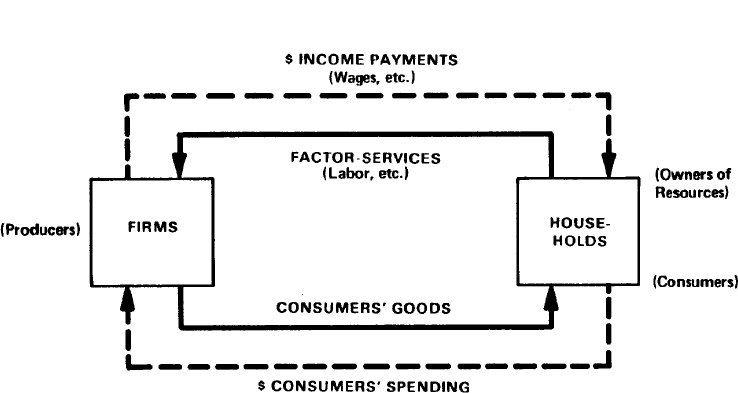
Figure 32:
RELATIONS BETWEEN HOUSEHOLDS AND FIRMS.
On the other hand, in what ways are households dependent on firms? Clearly, since households no longer serve as the locus of production, they now must look to the firms to produce for them the things they once produced themselves. Thus, there emerges in the DOL a mutual interdependence between households and firms. But beneath it all smolders the basic matching problem: How can households influence firms in producing the things that households want but which they no longer produce for themselves?
Optimizing the Match
There is another way of viewing the matching problem: How can society minimize the likelihood of mismatch between what consumers want and what firms actually produce? In the modern DOL, the likelihood of such mismatch is ever-present. Let us briefly review the argument.
As abundantly described in earlier chapters, firms naturally cannot possess perfect knowledge of market demand in a world of constant change. They have to chart their way in the market with varying degrees of ignorance and uncertainty. Thus there can be no guarantee that what firms produce at any given time matches exactly what consumers want. Thus it would seem to be desirable to create social arrangements that would be able to minimize the likelihood of mismatch—or, conversely, to optimize the correspondence between what consumers want and what firms actually produce. What would these optimal social arrangements look like? This is the central question which this chapter addresses.
When Mismatch Is Rare
It is ironic that the matching problem simply could not exist in Crusoe-like self-subsistence with its small-scale peasant families, clans, or tribes. True, such economies were characterized by primitive technology, low productivity, and low living standards, with their poverty, disease, and misery. But as to modern problems of “mismatch” between households and firms—between what people want and what actually gets produced? None of those! In the world of self-subsistence, what the people wanted they produced for themselves. The variety of goods produced may have been narrow and quantity meager, but at least there was a direct correspondence between goods produced and goods desired. How could it be otherwise when product was for direct use of producers themselves and not for sale in the market place.
Nor does the matching problem pertain when goods are made to custom-order. Whether it is a suit of clothing, a house, an automobile, or an industrial product—components, equipment, or buildings—the customer’s specifications and instructions to the producer minimize the likelihood of mismatch between what is ordered and what is actually produced. Even though the producer here is not the same person as the consumer, customized production can, by mutual agreement, achieve minimal or zero mismatch.
Similarly, in the area of services provided by doctors, lawyers, mechanics, and other professionals and artisans, the direct arrangements between consumer and producer enable a minimizing of mismatch. Finally, do-it-yourself activities by the householder who does his own repairs, maintenance, building, or other productive activities for his own direct use, permit a like degree of correspondence.
High Price of Self-Subsistence
Nevertheless, Crusoe and other self-subsistence or direct-use modes of economy come at a very high cost—isolated existence, primitive science and technology, low levels of production, and impoverished living standards. Man working with only primitive tools faces nature almost alone with bare hands. The existence he ekes out is meager in quantity and variety. So, while he suffers no correspondence problem, he suffers the threat of infertile soil and poor crops. And his technological backwardness narrows his scope of adjustment to alternative varieties of product and methods of production.
Yet, in contrast, the modern social division of labor (DOL)—with its ever-expanding exchange and production, application of science and technology, and use of money—inherently posits the matching problem. Therefore, to the extent that people become involved in the modern DOL, to that extent will the matching problem affect their interpersonal transactions, and to that extent does the crucial question become: How can people, as consumers, exert optimal influence over firms to produce the things they want? How can firms be made most responsive to consumers’ preferences?
The State and Planners’ Preferences
In this connection it is important to note that under socia1ism--especia1ly in highly centralized models like the U.S.S.R.—the matching problem becomes irrelevant as far as the ruling party is concerned, even though such systems rely more or less on extensive division of labor. In the rulers’ eyes, the state must maintain a total monopoly of production, including ownership of all physical resources used in production, and power to control all incomes and prices. In contrast, householders, shorn of property rights in the means of production, are not permitted access to own such means in order to produce for themselves what the state’s enterprises fail to provide. As far as the state is concerned, the only recourse left to the consumer is simply not to buy—to do without.
True, the consumer living under socialism can exercise more or less freedom of choice in his market purchases—freedom to choose from among the existing array of goods produced for him by the state. But that’s all. His “freedom” is limited in the most confined sense: He has no alternative but to buy or not to buy what the state proffers.
In this connection it should be noted that even in so-called free-market countries such as the United States, there are areas in which the matching problem also becomes irrelevant. For example, to the extent that the government intervenes into the economy to provide so-called public goods, such statist production necessarily competes for scarce resources and diverts them from the free-market sector that is consumer oriented. Since consumers are taxed and thereby forced to pay for public goods—goods that are by definition not subject to the free-market test of voluntary purchase—they are denied effective influence over what gets produced.
Optimizing Consumers’ Influence
Thus far we have mainly described the nature of the matching problem and why it is peculiar to the modern DOL. We have also indicated why it is a crucially important problem: because of the natural primacy of consumption as the purpose of production. Thus, to the extent that people are concerned about the primacy of consumption and in optimizing their influence over producers as to what ultimately gets produced, to that extent it becomes relevant to find an answer to the central intellectual problem imbedded in the matching problem: Under which conditions would it be possible to optimize the influence of consumers over what ultimately gets produced by the firms? That is, what social-political conditions—philosophy and ideals, on the one hand, and institutions and practices, on the other—would enable consumers to exert optimal influence over the assortment of goods ultimately produced? Alternatively, what conditions are required to make firms most responsive to consumers’ wishes?
Information and Motivation
Given the nature of the problem, some basic methodological considerations are in order. For one thing, required is some efficient mechanism for the transmission of information to firms about consumers’ preferences—as to what consumers want and as to whether their wants are being satisfied. Required is a vehicle that will reveal consumers’ preferences to the firms, so that the latter are guided as to what to produce, how much, and at what price. In other words, there must be an efficient method for “getting the message” from consumers to firms. Let us call this the information requirement.2
The second basic consideration involves incentives—the motivation of firms to produce according to revealed consumers’ preferences. Specifically required is an incentive system that, on the one hand, provides rewards to firms that cater successfully to consumers’ wishes and, on the other hand, penalizes them for failure to do so. The rewards must be sufficiently great in the long run to induce the firm to persevere despite short-term fumblings and setbacks. Initial difficulties are sure to confront the firm in its entrepreneurial ventures in the seas of competition and uncertain demand. The rewards must be large enough to justify the firms’ plans to survive and prosper.
On the other hand, punishment for failure to cater successfully to consumers must be severe enough to deter firms from ever believing that they could get away with putting out less than their best effort at all times. No matter how successful in the past, firms must be deterred from resting on their laurels; they must be kept on their toes. Good reputations must be deserved, not guaranteed. We will call this system of rewards and penalties the incentive requirement.
The Meaning of “Optimum”
Before proceeding, the meaning of “optimum” consumers’ influence should be explained. Above all, “optimum” calls for the listing of as many conditions as necessary to satisfy the requirements for optimal consumers’ influence.
Second, “optimum” does not mean that firms must produce exactly what people want. Not even in the best of real worlds would such optimality be possible in the social DOL. We can only define an “optimum” for the realm of the possible. Real-world firms cannot escape making decisions under conditions of uncertain demand. Thus we must allow for the likelihood that there will be some mismatch between what consumers want and what firms actually produce.
Nor does “optimum” mean maximum quantity of output. The matching problem is not about quantities of goods produced. Rather, it is concerned with the problems faced by firms seeking to produce what consumers want under conditions of the modern division of labor.
Consumers’ Dollar Ballots
The first step in our journey to discover the optimal conditions for consumers’ influence over firms is realization of the key role played by the so-called consumers’ dollar ballot—the dollar votes cast by consumers every time they buy something in the market. (It is represented by the bottom dashed line in Figure 32.)
At first glance, it might seem reasonable to be skeptical about the ultimate significance of the consumers’ dollar ballots. After all, consumers typically spend their money on goods that have already been produced by the firm. Typically, consumers come into the market only to find that producers have already anticipated their desires by proffering products for the consumers’ inspection and purchase. That is, firms do not wait for direct orders by consumers to tell them what to produce, how much, and at what price. They go ahead and produce in advance what they in their entrepreneurial judgment think people will want to buy. As we saw in Chapter IV, it is a system of “production first. . . buying later,” so to speak. So, how can consumers’ dollar ballots make for consumers’ sovereignty after the fact, so to speak?
The fact remains that firms, precisely because they “produce first,” are in a sense sticking their collective necks out for inspection by consumers, the latter being placed in the role of a final judge who has the power to accept or turn down what the firms proffer—to ratify and validate, or to veto and condemn. If consumers like what firms offer them, they will buy; otherwise they will not buy. In the modern DOL it cannot be otherwise. No matter whether it is capitalism or socialism, this is the predominant economic-sociological fact. To paraphrase Alchian and Allen, firms typically “proffer” goods, but it is the consumer who decides which goods to “prefer.”3 That is to say, consumers, after all, do have the final say. It remains for the consumer to decide whether the output of firms passes muster.
Dimensions of Competition
On what basis do consumers vote aye or nay on the goods proffered in the market? Primarily on the basis of price, quality, and variety. For any given quality of product, consumers prefer to buy at the lowest price. For any given price line, consumers prefer to obtain the highest quality. Finally, consumers look with favor upon firms that anticipate consumers’ tastes by producing an increasing variety of goods. In this way, price, quality, and variety are not only the main yardsticks by which consumers measure the popularity of firms, but they are also the main dimensions of competition among firms. That is, the ability of firms to survive and grow depends vitally on their competing successfully in terms of lower prices, better quality, and differentiation of product.
Economic Democracy and Proportional Representation
Thus, consumers’ voting with dollar ballots converts the market place, in effect, into a kind of economic democracy. Consumers’ ballots are the means by which consumers indicate whether they like the job being done by firms and whether firms are catering successfully to their preferences. It is presumed that so long as consumers buy a firm’s product, to that extent they show satisfaction with the firm’s efforts. Conversely, when they do not buy its product, they are indicating dissatisfaction.
Thus, consumers’ dollar ballots serve as the information mechanism through which consumers’ preferences are transmitted to firms. It follows that output by firms will increase where consumers’ dollars flow, and will decrease where consumers’ spending dries up. In this way the array of goods and services produced for the market will constitute a kind of “proportional representation” of consumers’ preferences.
In its working as an “economic democracy,” the market is not to be judged by the subjective standards of any one arbiter, be they aesthetic, philosophical, or religious. The issue is not whether the market produces too much or too little of “culture,” “material” goods, or rock music. So long as people buy what they think satisfies them, to that extent firms are producing what the people want.
Profit-and-Loss System
Furthermore, consumers’ dollar ballots play a second vital role: They directly determine the profits and losses of firms! When consumers buy, firms will earn profits, and when they sit on their hands, firms will suffer losses. More precisely, only when people buy at the price and in the quantities initially set by firms will firms earn the expected profit rate. Otherwise, profit rates will be squeezed, or even losses may be incurred—that is, firms may fail to cover their average cost-per-unit of product. In this way consumers’ dollar votes directly determine the economic fate of firms.
Seen from the individual firm’s point of view, consumer dollar ballots determine whether the firm reaps profits or losses. However, from the point of view of the market system as a whole, the casting of consumer ballots creates a profit-and-loss system. While some firms succeed in reaping the expected profits, others suffer disappointing earnings or losses. Although all firms seek profits, not all succeed. As long as it is possible for any given firm to suffer losses, there is no guarantee of profits.
“Consumers’ Sovereignty”
This brings us to the crux. To the extent that the very survival and growth of the firm depend vitally on its ability to earn profits and avoid losses, to that extent does the consumers’ dollar ballot determine the very fate of the firm. Indeed, to the extent that the only way for the firm to survive is by earning profits, to that extent does the consumer achieve “sovereignty” in the market place.
“Sovereignty” is really not the best word for what is meant here; the dictionary defines it as rule or dominion over others, whereas what is meant here is optimal influence by means of the consumers’ dollar ballots over what firms produce. Nevertheless, sovereignty is the term customarily used in economics, and we will hereafter use it, Sor convenience, to stand for the consumers’ ability to determine ultimately what firms produce. Thus, our original task can be restated as a search for those conditions that will optimize consumers’ sovereignty in the market.
Production for Use. . . for Profit
At this point it is appropriate to lay at rest an old cliche that the free market is inferior to the socialist economy because the former is merely a system of production for profit whereas socialism is production for use. The implication is that firms in the free market, being primarily motivated by profits, try to make profits by any means possible, by hook or crook, and the consumer be damned. In contrast, socialist firms are allegedly motivated primarily by the desire to produce useful commodities, with profits being a secondary or non-existent consideration. Yet it doesn’t take much to realize that the cliche “production for profit” versus “production for use” involves a fallacious dichotomy, to wit.
There is no doubt the free market is production for profit, but it does not necessarily follow that it cannot, in the same breath, be a system of production for use. Indeed, history has amply shown that only by producing goods that consumers think are useful can firms earn profits and stay in business. Clearly, it would be inconceivable that firms could survive by producing shoddy goods or anything less than useful commodities. Furthermore, history reveals that only paternalistic protection by the state—in the form of tariffs, subsidies and bailouts—has enabled firms to survive even though consumers themselves had already rejected the firms for failing to compete successfully for their dollars.
Profits Under Socialism
In this connection we should note that profits exist under socialism, too—both in theory and in practice—although they are called something else. Marx’s vision of socialism distinctly called for a profit margin to be earned by state enterprises. In the U.S.S.R., Soviet economists even boast that socialist profits are native to socialism and not an imitation of capitalism. Nevertheless, a profit margin by any other name is still a profit margin—a price spread between selling price and cost per unit of product. Socialists have variously called it a “common fund,” “turnover tax,” or “enterprise tax,” terms which vainly disguise the fact that each constitutes a price spread or profit margin.
There is a key difference—not in the name given to profits but in the way the profits originate. In free competitive markets, profits are earned from the voluntary purchases of consumers. Under socialism, however, profits derive primarily from the monopoly position of the state. The Soviet state, for example, is the only producer—without any competition. It uses the price spread as a tax margin: prices of products are set on a cost-plus basis and are adjusted up or down, depending on the state’s revenue requirements. Given the monopoly position of the state as producer, the pricing system used is, in effect, a tax mechanism.
Socialist Monopoly Profits
Another key difference between socialism and the free market is the way profits are used—that is, the extent to which profits are used for producing consumers’ goods. Firms in the free market are virtually compelled to reinvest their profits in the same useful way that they were earned in the first place, by catering successfully to consumers. Socialist firms, however, are under no such compulsion. To start with, socialist profits are practically guaranteed: All firms are monopoly agents of the state, facing virtually no competition. Their selling prices, as we have noted, are a form of tax. Profits, therefore, are not a measure of performance but of extortion; consumers have no alternative but to buy from a monopoly source.
In contrast, the free market, as we will amply see, is by definition predicated on unrestricted competition—on optimum access to alternative sources of consumers’ goods. Compared to the free market, socialism or any other system of controlled production by the state constitutes a drastic constriction of production opportunities; thus under socialism, firms are inherently incapable of optimizing consumers’ sovereignty.
The Meaning of “Free Competition”
This brings us to the next requirement for optimal consumers’ sovereignty. We have already discussed the need to make the earning of profits the only means by which the firm can survive. Now it is necessary to add another stringent condition: the fostering of maximum competition among firms. Availability of competition is one of the crucial differences between the free-market economy and socialism. The free market is “free” primarily in the sense of freedom to compete: “free competition” means precisely the liberty for anyone to enter into production. Let there be no artificial barrier or restriction on competition. Let all comers be free to compete—all for the purpose of optimizing consumers’ sovereignty.
Thus, if for any reason consumers become dissatisfied with the products of firms, the market must always be open for the entry of another firm that thinks it can do better. And if anyone thinks he can do a better job than the existing firms, but merely remains on the sidelines—ranting, raving or complaining about the disappointing performance of those firms—such mocking behavior in no way serves the consumer. Talk is cheap. To really serve the consumer, mere bystanders would have to roll up their sleeves and get into the competition to prove that they can truly do a better job than existing firms. Indeed, the condition of free competition constitutes the only true test of optimal catering to consumers. Any artificial restriction of competition or barrier to entry results in a less-than-optimal degree of competition.
Government Monopoly Grants
Restrictions on entry into production can take a variety of forms. Historically, the predominant source of obstruction to entry has been government regulation: The state possesses the monopoly power to determine who shall and who shall not produce by its requirement of charters and licenses and similar controls. In some fields government itself runs the enterprise, as is the case with first-class mail. In other fields—for example, so-called public utilities such as water, electricity, and gas—government assigns only one firm to provide the given service, thereby granting a monopoly privilege to the selected firm.
If we use the word monopoly in its correct literal sense, it simply means: one single seller—the only seller. Traditionally, governments alone have been able to grant monopoly privileges in trade and production. In creating public utilities, the rationale is that water, electricity, and gas are “natural” monopolies due to the peculiar economic nature of their product. In fields where production is on a smaller scale (such a taxicabs, barbershops, beauty parlors, plumbing, medicine, law, teaching. . . you name it!) government usually requires a special permit, license, or certificate in order to practice the given service.
Whether or not the doctrine of “natural monopoly” has any validity, the fact remains that it—or any other form of state-granted monopoly—is essentially a restriction of competition. By granting a legal privilege to one firm to be the only producer in its field, the government is blocking entry to any other firm, thereby protecting the monopoly firm against any competition. The legal muscle of the state prevents every potential competitor from getting a chance to outperform the monopolist and take his business away by driving rates (prices) down or by giving better service. In this respect, government protects the privileged monopolist from having to perform for the consumer in terms of price and quality. Far from being “natural,” the state-granted monopoly privilege is an unnatural, arbitrary restriction of the natural freedom to produce.
Monopolies in the Free Market?
In a true free market, by contrast, a monopoly position could emerge—and properly so—only by the firm outstripping its rivals in behalf of the consumer. Under open, unrestricted competition, no firm—whether it produces electricity or milk or drives taxicabs—could expect to become a monopoly except by excellent performance in terms of price and quality, by outperforming other firms in open competition for the consumers’ dollars.
Nor could this hard-earned monopoly ever be considered a privilege guaranteeing the firm protection against any potential competition. The free-market monopolist would daily have to prove himself the best against all comers; as “King of the Hill,” he could wear his crown only so long as he outperformed everyone else. And so long as the market remained open to one and all, his crown could not rest easily upon his head. There would never be respite from the threat of new competition. Without the state to protect him against potential rivals, his only shield against invasion of his market by competitors would be his low price and high quality.
Natural Obstacles to Entry
It follows then that in a free, open market the only obstacles to competition would be the truly natural ones that exist in any society at any time: scarcity of productive resources and the limited size of market demand.
For instance, not everyone can himself own all the necessary resources (of land, labor, capital) required to enter production. Nor does “free” competition mean costless entry—not requiring resources or sacrifice. Any new competitor would have to purchase, hire, or borrow resources from others for which he will have to pay a price, wage, or interest rate. Furthermore, individual differences in managerial and entrepreneurial skill will enable some potential competitors to be more successful than others.
Can Investors Be Attracted?
In this connection it is important to note the crucial financial role played by the money and capital markets—the former consisting primarily of commercial banks, and the latter consisting of financial intermediaries, such as the stock and bond markets, savings banks, and managers of trust and pension funds. It is through this vast, complex array of financial institutions that the owners of savings and other liquid wealth ultimately determine the availability and cost of their investment funds and, hence, the firm’s access to resources and production. However, the essential criterion for investors, in deciding whether or not to invest in a given firm, is the ability of the borrowing firm to succeed in market competition. Investors’ estimates of a firm’s competitive ability are, in the nature of the case, necessarily subjective, resting on intangibles such as the quality of the firm’s personnel, the morale and efficiency of its labor force, and the potential size of market demand.
Demand Cannot Be Guaranteed
On the demand side, as indicated, the obstacle to entry will be uncertainty about the size of market demand. Such uncertainty will usually be a problem in the case of a new product to which the market has yet to become accustomed. This does not necessarily mean that the market is foreclosed forever. Indeed, experience tells us that there is no way to foretell whether or not a new product will click upon introduction to the market. This is precisely what entrepreneurship is all about: the undertaking of projects in the face of uncertain market demand.
To be sure, market research and related investigations of market demand can help reduce the degree of uncertainty as to whether a new product will succeed. Otherwise, the only ultimate test as to whether the market is ready to welcome a new product and shower the firm with profits is for the firm to take the plunge into the cold waters and see for itself. There is truly no other way to find out if the demand is there or not, at least initially. If the demand is not there at the start, it may develop eventually if and when the product finally catches on. But this requires persistence and perseverance to wait it out—yet even then success cannot be guaranteed.
Competing Against Incumbents
Another reason to doubt the adequacy of market demand for the newcomer may be the apparently entrenched position of the firms already established in the market, each of which has already won for itself a seemingly impregnable share of the market which no upstart entrant dare think of capturing. But such incumbency of firms is, in the nature of things, a fact of life. The newcomer in the market must nearly always expect to compete against incumbents no less than does a presidential aspirant who has to decide whether or not to throw his hat into the ring.
Even if a new product were involved—one not produced by any existing firm—it would still not guarantee clear sailing. Its producer would still have to face an incumbency problem, one that takes a special form. Say the new product is a “smidget,” which its promoters regard as a sure-fire bet to catch on. Nevertheless the fact remains that, initially at least, consumers’ purchases of the new smidgets could only be made by their buying less of other things. (Think of television’s first days.)
Let us briefly expand on this. In practice, competition exists not only between different brands of a given product but also between different products themselves. Since all consumer wants are “competitive” with each other, it follows that all products are also in competition with each other—and no less than all the brands that compete with each other. In other words, a dollar spent on smidgets means, other things being equal, a dollar less spent on something else. Even if there were only one firm producing all products, there would still be this product competition, and the monopolist would not necessarily have a guaranteed market for his new product.
Competition of All Against All
Up to now we have described free competition mostly in terms of the absence of legal or other artificial restrictions on entry into production. New we must meet the other face of free competition—the variety of sources of competition from which new firms and new products can be expected to flow. Indeed, once we remove all barriers to competition, sources from whence will come the new competitors are unlimited.
To start with, existing firms in industry A could decide to invade industry B, and vice versa. It would be competition of all against all, regardless of the industry with which a particular firm is normally identified. For instance, a firm in industry A could decide to invade industry B. That is to say, it may decide to produce, in addition to its old product A, a new product B. Furthermore, it may be a fairly big firm, well-heeled and capable of giving firms in industry B a run for their money. No longer could the successful fat cats in B rest on their laurels, even after they have attained major shares of the market from the smaller firms in B. The reason is that well-established producers in industry A, as well as in C, D, and so on, stand as a constant threat to enter B and compete in it. And the same threats constantly face A, too, and C, and D, and so on!
This possibility of inter-industry competition opens up vistas of a vastly expanded arena of competition. Not only would firms in the same industry compete with each other, but so would firms in different industries compete with firms in other industries. Thus, competition would be pervasive—product against product, firm against firm. It is therefore reasonable to expect the emergence of conglomerates—firms that would be grandly diversified, so much so that some would be hard to classify in terms of the particular “industry” to which they belonged.
In Numbers There Is Strength
Thus it is appropriate to question the traditional notion that “bigness is bad”—that “giant” firms are “bad” because they are so big and efficient that small firms are too weak to compete against them. Such popular notions turn out to be fallacious; real-world experience is not so neatly stacked in favor of the big firm.
For one thing, there are those giant firms in the other industries (mentioned above) who often constitute the truly fearsome rivals of any big firm. For another, let us not underestimate the power of even the small firm. After all, smaller firms may be able to produce a given product as cheaply and capably as the large firm. Examples abound: toasters, radios, and a variety of other appliances. True, in any given market location, it would seem that a giant General Electric, for example, could easily muster all of its resources to drown out any one small competitor. But in practice it cannot actually do so, for GE faces not one but numerous small competitors in any given locale, as well as in many other locales throughout the country. Taken together, all these many small competitors add up, in effect, to a pretty big-size firm.
Consumer’s Last Resort
Last but not least, truly free competition would enable consumers themselves to take up the cudgels and compete in the market place. That is, if existing firms dared to disdain the consumers’ dollar ballot, and persistently failed to respond to consumers’ preferences, then the consumer would have the ultimate recourse: the freedom to undertake himself the production of what he wants. In the free market, the consumer himself—a “sovereign” in search of a crown—would also have freedom of access to the sphere of production. Since we are all consumers—each and every one of us—this means that, in the nature of things, each of us should be free to enter into production, unobstructed and unhampered by anyone.
Herein lies one of the truly vital differences between the free-market economy and socialism. Under socialism, because of its state monopoly of the means of production, the individual is prohibited from access to such property and hence to the sphere of production. In the free market, however, he is free to set up an individual proprietorship or a partnership, or form a corporation of stockholders or cooperative owners—it makes little difference which, at this point. The organization of production can take whatever form is deemed appropriate by the owner or owners of the firm.
It is therefore not surprising to learn that, almost from the very inception of the Industrial Revolution, ordinary people from all walks of life—given the environment of a relatively free market—were able to abandon their roles as workers, tinkerers, professionals, or peddlers and undertake the role of entrepreneurs. Their individual “success stories” abound in the pages of economic and business history of the Western world.4
These success stories are testimony to the readiness and ability of the “vital few” to venture forth with ideas for a new or improved product. Not satisfied with merely standing on the sidelines, they themselves seized the opportunity to undertake what others were not undertaking. It is this constant flow of new products which prompts the rest of us to remark, when we see them offered in the market for the first time: “Gee, why didn’t I think of that?”
Foreign Competition
As if all of this were not enough, free competition must also invite competition from still another source—from producers in foreign countries. So far we have considered only domestic sources of competition, but if we are talking about optimizing the conditions of consumers’ sovereignty, we must look to the world as a whole as our oyster, as far as sources of consumers’ goods is concerned.
One has only to point to recent economic history, particularly to the invasion of U.S. markets by foreign producers of automobiles, cameras, optical products, electronic appliances, textiles and a host of other commodities to see how important this foreign source of competition can be. So, on top of interindustry competition and competition from consumers entering production, we now must add the crusher: the foreign producer. Truly, there would be no rest for the weary in the world of free competition.
Free Trade vs. Nationalism
This brings us, therefore, to the related requirement, free trade—freedom of exchange. This freedom is accepted as a matter of course at home, in the domestic economy, but unfortunately it is not consistently extended to trade and exchange between people of different nation-states. Indeed, all sorts of restrictions on trade and exchange—in the form of tariffs, quotas on imports, bounties for exports—have become traditional. To the extent that trade between nations is restricted, to that extent is free competition itself restricted, and the consumer remains less than sovereign.
It should be noted that, historically, the restriction of trade between nations had its roots in the nationalistic policies of Europe’s mercantilist states from the 16th century onward. This is not the place to examine the pro’s and con’s of nationalism—as a phase in the history of people, on the one hand, and as an obstacle to truly free contact and exchange between people of different backgrounds, on the other. Suffice it to note that a policy of protecting domestic firms from foreign competition by means of tariffs, quotas, and non-quantitative barriers in general—apart from its denial of free competition and consumers’ sovereignty—is, from the consumers’ viewpoint, illogical: it is no more logical to protect the Chrysler Company from competition by Toyota or Honda than it is to protect it from competition at home by General Motors and Ford.
Role of Government
It should be clear by now why the consumer stands to gain most by a condition of free competition and free trade. Only open, competitive markets would cause firms to fear and tremble before every consumer, wondering whether the consumer will cast his dollar ballots for their product or for their rival’s? So far, so good. But, as already indicated, the greatest force for obstructing free entry, free trade and competition is government—the political power of the nation-state. This brings us to the next leg of our analytical journey towards optimum consumers’ sovereignty: What should be the proper role of government in the free market? What can government do to help optimize conditions for consumers’ sovereignty?
There is no need here to present a detailed analysis of government interventions in the market. Suffice to note that government possesses the power to fix price minimums (favoring producers) and price ceilings (favoring customers), and to prohibit exchange and production in varying degrees (e.g., allocations and rationing, labor laws, monopoly grants, tariffs, minimum wages). Here the discussion will be limited to a few main points.5
Removing Government Impediments
First of all, what is it that government should not do? As the preceding analysis implies, government should not place obstacles in the path of producers. This means an end to all restrictions on entry, such as licenses, charters, or monopoly grants. In the free market, it is not logical to force a practitioner to obtain a certificate or license in order to qualify as a producer. Let the practitioner decide for himself whether he needs a certificate. Let his concrete achievements—his successes and good reputation—suffice to speak for him, be he certified or not. And let consumers decide for themselves with which practitioners they prefer to deal. If some consumers, for instance, prefer their doctors, lawyers, teachers, and dentists to possess certificates of qualification—licenses, degrees, etc.—they are, of course, free to hire only those who have such certification, and shun those who do not.
No More Government Props
Nor should government come to the aid and rescue of ailing firms by providing subsidies or other financial nostrums. If firms get into trouble in the competitive market, it is due primarily to their inability to do as well as rivals in catering to the consumer. If consumers’ ballots have already spoken fatefully, “Exit from the stage,” no one else should thereupon tear this verdict asunder. After all, there are firms that do make profits because they are successfully catering to consumers—and these firms should be cheered on; on the other hand, firms who can only suffer losses should be booed and hissed off the stage. From the consumers’ viewpoint there should be cheers for the profit-maker but boos for the loss-makers.
As far as consumers are concerned, it is rubbing salt in their wounds for the government to take their tax money in order to subsidize non-competitive firms. Instead, government should defer to the consumer and let him decide which firms shall survive and which shall go under. For only when the firm is not protected by government against its failures—failure to cater to consumers and failure to match its rivals’ successes—does the consumer have a chance to be sovereign in the market. Conversely, any propping-up of firms by the state only weakens the effectiveness of the consumers’ dollar ballot: it prevents the consumer from effectively rewarding firms in accordance with their responsiveness to his wishes, and penalizing them for negligence or indifference towards him.
Meaning of Laissez-faire
Such a hands-off pro-competition policy by government was known from its inception in 18th century France as laissez-faire. Literally it means: let the people make or do; but figuratively it means: let the people, pursuing their own peaceful, productive ways, determine their own lives. “Laissez-faire!” was the great cry of the 18th century French economists, the Physiocrats, who sought a radical dismantling of the overregulated mercantilist economy of France in order to move it towards free production and free trade. Leave the market alone, unhampered by government regulations, and the people will flourish—that was the battle cry. Today, however, laissez-faire is in general disrepute—a much maligned and distorted concept, with a connotation totally opposite to its original meaning.
Adam Smith, who knew the Physiocrats well, carried the message to England. He, too, egged his generation to nail the lid on the coffin of Mercantilism in Britain. For Smith, Mercantilism was, among other things, a system of state protection of the special interests of producers against the consumer. He wrote:
. . . [I]n the mercantile system the interest of the consumer is almost constantly sacrificed to that of the producer; and it seems to consider production and not consumption as the ultimate end and object of all industry and commerce. . . .6
Adam Smith registered specific complaints against government “restraints” upon imports of foreign goods that were competitive with domestic output, and “bounties” (subsidies) to exporters of goods not able to compete on world markets. For him, both of these policies favored the domestic producer at the expense of the consumer.
Laissez-faire vs. Privilege and Protection
Thus it was that laissez-faire, far from being a policy of favoring the firm and sheltering it from consumers and competitors, originated as the great cry for free trade and competition—for the smashing of mercantilistic protectionism and monopoly privilege based on state charters, franchises, and licenses.
To be sure, one would not expect the entrenched propertied and business interests of the 18th century to rally behind the new banner of laissez-faire and free competition. For them laissez-faire represented a most unwelcome threat: the need to compete in the open market in order to acquire and preserve new wealth. Whenever possible, threatened interests balked and attempted to restore the system of paternalism and protection; in time they managed to chip away at the foundations of increased competition and freer trade laid in the Industrial Revolution in England and the American republic.
Property Rights and Production
Having just outlined the negative side of the coin—what government should not do for the market—let us outline the positive side: What positive government actions would promote optimal consumers’ sovereignty? Proponents of classical laissez-faire, consistent with their concept of non-interference in production and exchange, envisioned a system of limited government. That is to say, government should limit itself to a “nightwatchman’s” role of protector of individual property rights, since property rights—especially the right to own means of production—were naturally basic to production and exchange. Thus, property rights became a fundamental tenet of classical liberalism—“liberalism” meaning liberty or freedom from state interference and coercion.
For Adam Smith, it was sufficient to rely on the individual’s natural desire to seek gain or profit. Since individuals participating in the market economy could gain only be rendering useful products or services for exchange on the market, it followed that such gain-motivated actions would necessarily result in benefits to society. For Smith, as well as for other liberal theoreticians, this was the truly seminal insight into the wondrous working of the market. Smith attributed the miracle of gain-motivated social productivity to the “invisible hand,” a term whose metaphysical connotation unfortunately overshadowed the basic wisdom of his insight.7 What remained, then, for government to do? For Smith, it was a relatively few things: national defense, police, some public works (roads, for instance). In today’s world, that’s not very much when compared with the leviathan proportions of modern governments.
Consumer Under Socialism
With the institution of property rights, especially in the means of production, we come to the last of the conditions required to optimize consumers’ sovereignty. The property-rights requirement is one of the central features differentiating the free market from socialism or any government-controlled system. Socialism, by definition, is the abolition of property rights in the means of production. By extension, it also means the end of the free market: its price mechanism, its productivity, its rising living standards and expectations. What does all this imply for consumers’ sovereignty under socialism as compared to the free market?
Imagine, if you will, that you are living in the Soviet Union instead of the U.S.A. Each day you face the typical chores of the Soviet consumer: your daily rounds of shopping leave you thoroughly frustrated and dissatisfied because the selection of consumers’ goods in the state-owned stores is a far cry from the virtual cornucopias back in the States.
What was it specifically that left you dissatisfied? Was the price of goods too high? Was the quality inferior relative to the price asked, or unacceptable at any price? Was the variety of goods—in size, style, and design—too narrow? Or was the variety unbalanced (e.g., plenty of radio sets but not enough TV sets, cars, cameras, phonograph records, tape recorders, typewriters, or do-it-yourself supplies)? Was it the absence of competition among firms—that the state was the only producer? What on earth can you do about it all?
First of all you can simply refuse to buy—learn to do without. Even in the totally monopolized economy of the Soviet Union every consumer has this option. You try shopping at another store—but only to find the same story there: the array of goods is practically a carbon copy of those in the first store. So you look for a third store, but there may be none—or simply not enough stores as far as your tastes are concerned.
Planners vs. Consumers
When you came home you decide to dash off a letter to the state-owned newspaper, venting your frustrations roughly as follows: You have learned that the Soviet Constitution proclaims that “all power. . . belongs to the working people. . . .” If so, it appears that the state is much too indifferent toward people as consumers; that the planners don’t seem to be doing enough toward “raising the material and cultural standards” of the people as promised in Article 11 of the Soviet Constitution (1958 edition).8 You would much prefer to see some competition introduced in the market. To you, competition among firms makes perfect sense: consumers have everything to gain when firms are compelled to compete for the consumers’ rubles!
Then, having gotten this letter off your chest, you sit back and wait for some editorial response. You wonder, first, if they will dare publish your letter in the first place: Why should the state newspaper—the only paper in town—give your complaint the widest possible publicity? If your letter does get published, millions of other sympathetic consumers might read it and join you in a chorus of protest. Hopefully the state planners will get the message—especially if there ensue consumer boycotts and disappointing sales figures, and Party leaders will want heads to roll.
So the planners decide to make some concessions to consumers. They introduce a few new lines of clothing, negotiate a contract for a foreign automobile factory, add a few other product lines—only to find their efforts are in vain: consumers remain frustrated, want still more changes instituted, and write still more complaining letters—occasionally also asking why state resources are allocated for moon shots, space satellites, and imperial ventures in the Third World instead of consumers’ goods. And so on and so forth.
Property Rights a Necessary Condition
At some point you go into deep reverie of the way it was back in the U.S.A.—why it was so different there compared to here. In the U.S., individual property rights are recognized and implemented in great measure: almost anyone with sufficient capital—his own or borrowed—can go into business. You realize this is why private property, especially in means of production, is the crucial difference: in the U.S., individual ownership of property provides the freedom to jump into production and fill any perceived gap in the market.
In the U.S.S.R., however, individuals are denied the right to own means of production. Here is the way the Soviet Constitution (Article 4) puts it: “The economic foundation of the U.S.S.R. is the socialist system of economy and the socialist ownership of the instruments and means of production, firmly established as a result of the liquidation of the capitalist system of economy, the abolition of private ownership of the instruments and means of production. . .” (underlining mine).
Socialism Inherently Restrictive
It may be reasonably asked: Why is it legal for Soviet citizens to own consumers’ goods, which they can buy with their rubles, but it is not legal for them to own means of production—such as materials, machines, factories, work shops—to produce consumers’ goods for themselves, things like sweaters, cosmetics, stockings, cameras, and endless other things they can find a happy use for?
More specifically: Why is it legal for the Soviet state to be the monopolistic employer of labor services, but it is illegal for Soviet citizens to compete with the state by becoming employers in turn, entering into voluntary agreement with others as employees, and conceivably offering higher wage-rates than the state? To put it bluntly: Why is it illegal for Soviet citizens to undertake productive activities that increase the standard of living?
If a Soviet citizen can make a better mousetrap than the state, what reason could the state have for preventing him from competing with it? By outlawing private property in the means of production, is not the Soviet state simply stifling opportunities to increase production and consumption? Is it not sheer arrogance for the Party and planners to believe they alone know what and how much the people should consume? By what test can the state prove that it is “raising the material and cultural standards” of the people?
When Is a Socialist a Capitalist?
These questions are crucial: they penetrate to the essential anti-humanism of socialist prohibition of private ownership of the means of production. Before we explore this anti-humanism, we must first note a characteristic fallacy in socialist thinking. Article 4 of the Soviet Constitution correctly states that the U.S.S.R. has abolished private ownership of means of production; but it also claims the U.S.S.R. has abolished “capitalist” methods of production—which is grossly misleading.
First of all, we saw in Chapter IV that what makes production “capitalistic” is investment and use of capital goods and roundabout (indirect) methods of production, in cooperation with labor. Thus, there is no necessary connection between a “capitalist” method of production, on the one hand, and private ownership in the means of production, on the other.
It is true that capitalist methods of production have historically been most widely applied by systems based on private ownership, such as Britain and the U.S. The consequences are well known: greatly increased levels of consumption for tens of millions of people. But the economic fact remains that there is nothing in the economic concept of capital goods per se that implies private property.
Free Market vs. Mere “Capitalism”
Thus we can see the fallacy stated in the Soviet Constitution: its confusion of the terms “capitalist” and “private ownership.” To be sure, no one can deny the U.S.S.R. has legally outlawed private ownership in means of production, but certainly has not outlawed the use of capital goods—indeed, quite the contrary! Soviet emphasis on the use of machines and other capital goods in production—especially since the first five-year plan in 1928—makes the Soviet economy as capitalist as any so-called “capitalist” economy. For some reason, Soviet leaders as well as socialists around the world perpetuate a fallacy attributable to Karl Marx, the notion that there is an inherent relation between capital goods and the concept of property rights as the foundation of the free market.
Ironically, the Soviet Constitution, while denying people the right to own means of production, does not hesitate to offer them “freedom of religious worship,” the “right to vote,” “freedom of speech . . . of the press . . . of assembly . . . of street processions and demonstrations.” This raises a question: Why pronounce such “human rights”—so familiar in the Western world—but omit the human right to own resources for productive purposes? We will return to this issue below.
The Question of “Human Rights”
This brings us to the truly basic question: In the U.S.S.R., are not the “freedom of religious worship,” the “right to vote,” “freedom of speech . . . press . . . assembly . . . street processions and demonstrations”—all proclaimed by the Soviet Constitution—no more than mere words? How can Soviet citizens really implement these human rights in any practical sense? The issue is not whether the Soviet state is able to implement these rights according to its own lights—according to its own interpretation of the meaning of “human rights.” Rather the issue is whether the Soviet individual is able to implement these rights according to his own wishes. A few examples suffice to illustrate the point.
For instance, take the frustrated Soviet consumer. Suppose the state newspaper refuses to publicize his consumer complaints. What other recourse does he have? What if he wanted to start up his own newspaper, or a consumer’s newsletter, in order to bring his opposition message to fellow consumers? How on earth could he implement his “freedom of the press” when the state owns all the required means of production—the newsprint, the printing presses, the printer’s ink, the factory space, the delivery trucks, the mail service—and when the state also prohibits the hiring of wage labor? Is this real freedom of the press? As A. J. Liebling once put it: “A free press exists only when you own a press.”
Freedom of Speech, Assembly, and Religion
If freedom of the press under socialism is a mere hoax—a promise without substance—how about “freedom of speech and assembly” and “freedom of street processions and demonstrations”? What if activist consumers decide to take their cause into the streets—to shout their protest from every street corner, to parade with banners down the main boulevards, and to picket with signs in front of the appropriate ministries? Could they even get to first base?
Assume that protesting consumers actually march, speak out and picket—only to have the police storm them and break up their protest? Consumers might then set up a cry: Are not the streets the “people’s property”? The police reply that the protesters are “disturbing the peace” and “obstructing traffic.” How can this apparent conflict between the people and the state police be resolved? Who really owns the streets when the chips are down? So long as the state, and not the people, is the de facto owner of the “socialized” streets and sidewalks, then it is clear that human rights in the U.S.S.R. are at the mercy of the state’s minions.
Finally, what about “freedom of religious worship” in the U.S.S.R.? True, disgruntled consumers do not ordinarily resort to prayer in church as the solution to their shopping difficulties. But for people who are regular church-goers—what about them? What does their right to worship really amount to? Do they have the right to land on which to build their shrine? Can they hire labor to build it? Are firms free to produce church organs, velvets and raiments? Are printers free to produce prayer books? In other words, in what effective sense does a citizen possess true freedom of worship? The land belongs to the state, as do all the other means of production, and wage labor is prohibited. In a word, only the state has the political power to build the church and to control worship.
“Human Rights” Are Property Rights
It should be obvious by now that human rights such as freedom of press, speech, assembly, and religion ultimately depend on property rights. (By “property” is meant ownership.) Property rights in the means of production are crucial for all human rights. In practice, man must have the right to own the means with which to implement human rights. If a person does not have means of his own, then he must at least be free to hire them or borrow them from owners of means. Without property rights, human rights become de facto mere will-o’-the-wisps.
We can now also see why the familiar cliche that “human rights” are superior to “property rights,” is actually a fallacious dichotomy. We have just seen that there is no effective way to implement human rights without property rights in the means of production. Indeed, not only is the implementation of human rights dependent on property rights, but property rights are prior to “human rights.”
To go one step further: “Human rights” are derivative from property rights in the same sense as are products—the fruits of one’s labor: they both come to fruition only by use of one’s own means. Far from there being a conflict between “human rights” and “property rights,” the former are naturally based on the latter, and flourish only to the extent that the latter flourish. As one writer has put it: “. . .property rights are indissolubly also human rights.”9 It follows that a proper defense of “human rights” necessarily implies the defense of property rights.
Right of Self-Sovereignty
This basic truth is obvious in the case of Robinson Crusoe, isolated man. For Crusoe, his “human right” to life implies the right to keep the fruit of his labor—this alone sustains him. It follows that, if Crusoe has a natural right to own the fruits of his labor, he must possess the natural right to own and use the means of producing these fruits, including his own labor power. In turn, Crusoe’s right to own his labor power implies that he has the natural right to own his person and being. That is to say, he is by nature a self-owner. It is this natural property right in his own being—this natural right of self-sovereignty—which generates Crusoe’s right to the material goods that he produces.
What happens to Crusoe’s property rights—in himself, his means, and his product—if and when he comes into social contact with other people in society? Is it proper that these rights be in any way compromised or denied by “society”? For instance, imagine that one day Crusoe meets Friday. Friday, not wanting to work for his own sustenance, decides to set upon Crusoe and exploit him. Using his superior physical strength, he initially seizes Crusoe’s product and accumulated wealth, and then forces Crusoe to give him a portion of his product on a regular basis. To Crusoe it is obvious that Friday is exploiting him—forcibly enslaving him—invading his natural right of self-sovereignty. Now, it is clear that if Friday is not justified in exploiting Crusoe, then neither is “society” justified in similarly exploiting all the productive Crusoes. All of this raises moral issues beyond the scope of this book.
Socialism versus Property Rights
What does this excursion into the nature of property rights imply for socialism in general? By maintaining state monopoly ownership of the means of production, socialism must be viewed as a fundamentally exploitative system. Far from being “humanist,” as some socialists claim, socialism is ultimately anti-humanist precisely because it denies individual property rights in the means of production and, in consequence, denies the basis of human rights in general.
Thus an important truth emerges. The free market economy is not only the proper economic framework for optimizing production and consumers’ sovereignty; it is also the optimal social-political framework for the exercise of human rights in general. Just as interference with the right to own means of production, enter into production, and exchange goods is, willy-nilly, a restriction of consumers’ sovereignty, so is the denial of property rights a denial of human rights. We are all consumers, to be sure, but—more important—we are all human beings. The free market not only optimizes opportunities for consumers’ sovereignty but may also be the road toward optimal human rights.
Conclusion
The fact that we are all consumers has, in itself, a fundamental implication: the market-price system must be, above all, a system for consumers’ sovereignty—for the benefit primarily of people as consumers and not for the protection of business profits or political privileges. So-called capitalism or free enterprise is virtuous primarily by reference to its service to people as consumers. As one observer has put it: “. . . [B]usiness is not the element which benefits from [capitalism]. Businesses, in fact, are punished—or at least disciplined—by the free enterprise system. Only consumers benefit. . . . And we should not ask businessmen to assure market competition. If ever we’re to keep what economic freedom we still have, or roll back the smothering blanket of controls, we’ll have to . . . do it as consumers, not as businessmen.”10
Appendix
THE GALBRAITH EFFECT
This chapter primarily addresses two basic questions: Why should the consumer be “sovereign” in the market place? How can this sovereignty be implemented in optimal fashion? With very few exceptions, these fundamental questions have been curiously neglected or treated all too briefly or casually by economists. As noted in the first paragraph of this chapter, the alternative tendency has been to discuss consumers’ sovereignty primarily as an empirical issue involving such questions as: Is the consumer actually the boss in the market place? If so, to what extent? Does the consumer exert any direct or meaningful influence over what firms produce?
In this latter vein the main contribution has been made by John Kenneth Galbraith, who has concluded that there is no effective consumers’ sovereignty in the market place.11 It is this point of view on which this Appendix is focused.
According to Galbraith, the general reason for the absence of consumers’ sovereignty is that the modern firm has a kind of unfair advantage over the consumer. In the modern social division of labor it is necessarily the case that production by the firm comes first, and then only subsequently comes the consumer to buy the goods thus profferred to him by the firm. That is, since the firm does not take direct orders from the consumer but, instead, takes the initiative to proffer the menu of goods supplied to the consumer, the consumer apparently has no choice but to buy what the firm places in front of him in the shops and markets.
In this way, continues Galbraith, the consumer’s wants necessarily become “dependent” on what the firm produces—that is, the consumer’s wants are directly influenced by the firm’s offerings. Because of this dependence effect, as Galbraith dubs it, the consumer can in no way exercize any sovereignty over the firm. He puts it this way: “. . .[P]roduction creates the wants it seeks to satisfy. . . .[T]he process by which wants are satisfied is also the process by which wants are created. . . . [T]hus, wants are dependent on production. . . .The producer [has] the function both of making the goods and of making the desires for them.” (Brackets mine.)
Before I elaborate on this, by now classical, Galbraithian formulation and analyze its flaws, we should first note a basic agreement: the sociological fact that, in the modern division of labor between households and firms, production by firms necessarily comes first and consumers’ buying comes only afterward (see Chapters II, IV, and IX.) But then note the significantly different implications drawn. For the present author, this basic sociological fact, given the natural priority of consumption as the purpose of production, constitutes the essence of a weighty universal problem, the “consumers’ sovereignty problem,” which preoccupies this chapter.
For Galbraith, however, it constitutes the basis of a determinist argument, to wit: Consumers’ wants are necessarily “dependent” on (shaped by) what the firms produce; hence, consumers are in no way able to exercize any sovereignty over firms. Thus, for Galbraith, the fact that the firms produce consumers’ goods in advance so that they typically appear on store-shelves in advance of consumers’ purchases, necessarily predetermines consumers’ tastes and preferences, denies them the possibility of making “spontaneous” or “independent” choices, and therefore precludes any consumers’ sovereignty.
For this author, however, this argument involves a determinist fallacy—the idea that firms can prefix the consumer’s tastes and preferences, and thereby virtually compel him to buy their products. Such determinism overlooks two things. On the one hand, consumers are always free to decide whether to buy or not, or from whom to buy, and whether to change their tastes and preferences in the face of ever-changing offerings in the market place.12 On the other hand, successful sales to consumers can only superficially be said to originate exclusively in the supply side—in the firm’s initiative. On a deeper level, such sales reflect a successful appeal to pre-existing dispositions of consumers to accept the firm’s offerings.
In support of his main argument, Galbraith relies on a bisection of wants into two familiar categories. On the one hand he postulates “urgent” wants—wants that are “original” with man himself, that would be experienced “spontaneously” if the individual were left to himself, that are “independently” determined or established (that is, independent of advertising influence or the inducement to “emulate” what others are consuming). (Some have called these the “basic” or “innate” wants.) Curiously, Galbraith does not seriously catalogue or exemplify these “urgent” wants, except to incidentally refer to “hunger” and “physical want.” (“A man who is hungry need never be told of his need for food.”) One can reasonably assume that Galbraith would feel at home with the concepts of “absolute wants” and fixed “hierarchy” of wants discussed in Chapter V.
In contrast to these “urgent” or innate wants, Galbraith poses the category of “created” or “contrived” wants which emanate exclusively from the dependence effect described above. Created wants are typically imposed on consumers by the production process itself, in which firms, by producing first, are able to “create” consumers’ wants. For Galbraith, the created wants are generated in two ways. One is by the innocent “passive” process of “emulation.” (“One man’s consumption becomes his neighbor’s wish,” familiarly known as Keeping Up with the Joneses.) The second is the more active and “more direct” way to create wants: by “advertising” and “salesmanship.”
For Galbraith, advertising and salesmanship are associated primarily with the emergence of the higher or “affluent” standards of living achieved in the industrial age. Furthermore, the “central function” of advertising and salesmanship is precisely to “create desires—to bring into being wants that previously did not exist.” Indeed, for Galbraith, such want creation is “the most obtrusive of all economic phenomena” in the modern economy. It becomes easier to “synthesize” and “catalyze” people’s wants when they have already achieved loftier levels of consumption and are therefore “so far removed from physical want that they do not already know what they want. In this state alone men are open to persuasion.” (Underlines mine.)
Noteworthy is Galbraith’s reference to “already known” wants, presumably his innate wants—“independently determined” by life’s “physical” requirements (such as food, clothing, shelter). (Recall his bon mot: “A man who is hungry need never be told of his need for food.”) For Galbraith, any wants introduced beyond this basic level of urgency would merely “fill a void” in which alone people become “open to persuasion.” (As he puts it: “production only fills a void that it has itself created.”) Such persuasion, of course, becomes more effective the more the “value system” esteems keeping up with the Joneses and the more firms resort to advertising and salesmanship. That is, were it not for emulation and advertising, the “created” wants would simply not exist, since there is no natural “urgency” or “spontaneous need” to satisfy them.
Now to return to the original point. Galbraith’s bisection of wants, while superficially appealing, turns out to be inadequate and confusing. First of all, Galbraith’s innate wants are unjustifiably narrowly circumscribed, confined to wants usually disparaged as materialistic—wants that cry for the creature comforts satisfied by food, clothing and shelter. (Recall his relevant references to “hunger” and “physical want.”) However, in the broader perspective of the full stature and strength of man—giving man and human nature its proper due—Galbraith is clearly shortchanging us!
For instance, immediately coming to mind are Abraham Maslow’s five categories of basic wants: (a) physiological wants, to which Galbraith’s innate wants are limited; (b) desire for safety and security; (c) desire for affection and belongingness; (d) desire for self-esteem; and (e) striving for self-realization or self-fulfillment. This is more like it! Here is a range of wants that encompasses much more of human nature. But even Maslow’s list is incomplete—for the panoply of man’s wants most assuredly must include human preoccupations, propensities, and passions in such expressive dimensions as literature, music and the other arts (so-called “culture”); philosophy, religion and science; and—not the least—technology and technological progress.
Not only is Galbraith’s concept of basic wants unreasonably confined, his analysis is avoidably obfuscating: he seems unaware of the implication of the fact that the satisfaction of wants requires means. Thus, whereas the several categories of human wants—even in the broadest sense—may be regarded as finite or determinate, the variety of means or devices by which we may satisfy our wants must, in the full view of human historical achievement, be regarded as potentially unlimited. It is precisely in the area of means, instruments, implements and devices that man has been the most “creative” and “contriving” (innovative) of all creatures.13
If, therefore, Galbraith is complaining of the “created” and the “contrived,” it surely cannot be in the area of wants; since their number and type are finite and determinate by nature, there is no more room for man to “create” or “contrive” new wants. Instead, it is in the realm of means that man, in all of his reason and ingenuity, is the constant creator, contriver and innovator. Unwittingly, Galbraith is actually lashing out against this most precious of man’s proclivities! In view of man’s time-honored, ceaseless creativity and innovation, Galbraith’s case for a cessation of the “created” and the “contrived” would appear to be not only tilting at windmills but also reactionary to boot.
An illustration of this point should be instructive. While the basic drive to assuage hunger—which leads us to the act of eating—is a constant, the same cannot be said of the class of means called food, capable of satisfying hunger. The virtually endless variety of foods that clutter human diets and menus is necessarily created or contrived, mainly as a consequence of on-going social and cultural interaction and emulation. For example, take the lobster: To many people its appearance is so disgusting or outrageous as to deter them from eating it—at least until they first see it prepared and enjoyed as a food by others. Yet, for many others, it has been a traditionally natural food of unquestioned credentials. In Galbraithian terms, does the lobster represent a “basic” means or a “contrived” means?!
Or take the staple food, meat. So natural a component of the American hamburger would be treated as an unwelcome, unnecessary food for many people of India. How about insects? Such a natural component of the diet of Venezuelan tribes would be abhorred as an unseemly food by most Americans. Then again, it took some 200 years between 1550 and 1750 to overcome resistance in Europe and North America to one of the most nourishing and easily cultivated vegetables—the potato! What is illustrative here of the relation between eating (a constant want) and the variety of foods (man’s contrived means) can be multiplied by illustrations from virtually every other dimension of human wants.
In this connection, we should recall the significant symbiotic relation discussed in Chapter IX that exists between wants, or goals, purposes and ends, and means—a relation that involves the imputation of values. Specifically, the value a person attaches to any given purpose or want is naturally imparted or transmitted (“imputed”) to the means that are capable of satisfying the purpose or want. Thus any given want that is regarded as worthwhile by a person necessarily makes the means capable of satisfying that want equally worthwhile. Conversely, means, no matter how contrived or varied, are no less important than the wants they can satisfy.
It follows, then, that if we have no grounds for putting down or denigrating another person’s wants or desires, we have no basis for denigrating the value attached to the means that can satisfy those wants or desires. That is, there is no putting down of a means without implying a putting down of the want itself. Thus it is that when Galbraith puts down means by labelling them as “created” or “contrived,” he is willy-nilly also putting down the wants satisfied by these means. Given his fixation on “physical” wants, he would seem to be condemning us to egalitarian asceticism.
____________
14Adam Smith, The Wealth of Nations (New York: Modern Library, 1937), p. 625.
15A major work on the vital interdependence of the market-price system, information generation, and freedom, is by Thomas Sowell, Knowledge and Decisions (New York: Basic Books, Inc., 1980).
16Armen A. Alchian and William R. Allen, Exchange and Production (Belmont, Ca.: Wadsworth Publishing Co., 1969), pp. 142, 143.
17See John Chamberlain, The Enterprising Americans (New York: Harper Colophon Books, 1963).
18An excellent introductory analysis of the adverse, long-run effects of government interventions is by Henry Hazlitt, Economics In One Lesson (New York: Arlington House, Inc., 1979).
19Smith, The Wealth of Nations, p. 625.
20On the “invisible hand,” see pages 34–35 above.
21Quotations from the Soviet Constitution in this section are based on Robert LeFevre, Constitutional Government Today in Soviet Russia (Larkspur, Colo.: Rampart College, 1962).
22Murray N. Rothbard, Power and Market (2nd ed., Kansas City: Sheed, Andrews and McMeel, Inc., 1977), pp. 238-240.
23James E. Foy, letter to editor. Reason (October 1977), p. 9.
24John Kenneth Galbraith, The Affluent Society (College Edition, Boston: Houghton Mifflin Co., 1958, 1960), Chapter XI.
25People as consumers are surely no less free to choose in the market place than in the voting booth on election day. Indeed, it can be easily argued that the individual’s “sovereignty” as consumer exceeds his sovereignty as citizen-voter at the ballot box. At least, in the market place a person is not forced to buy what he does not want, whereas on the day after elections he can find himself stuck with things he did not want to “buy”—that is, with candidates and propositions against which he voted.
26Friedrich A. Hayek argues, in effect, that virtually the whole of “civilization” and the spread of “culture” among the world’s peoples are attributable to innovation and emulation in the means of producing goods and services. See his “The Non Sequitur of the ‘Dependence Effect’,” Southern Economic Journal (April 1961), pp. 346-348.
- 1See Thomas Sowell, Knowledge and Decisions (New York: Basic Books, Inc., 1980) for an elaborate analysis of how—despite the complex structures and environments of the modern division of labor—the free society and its market-price system generate, transmit, and apply “authentic” knowledge in the realms of economics, law, and politics. For an earlier treatment, see Friedrich A. Hayek, The Constitution of Liberty (Chicago: University of Chicago Press, 1960).
- 2Excellent examples of this type of supplementary work are John C. Goodman and Edwin G. Dolan, Economics of Public Policy: The Micro View (2nd ed., St. Paul: West Publishing Co., 1982), and Walter E. Williams, America: A Minority Viewpoint (Stanford: Hoover Institution Press, 1982).
- 3A notable exception is the above-mentioned text by Goodman and Dolan which analyzes public issues in terms of moral, political and economic criteria.
- 4For a philosophical treatment of morality in interpersonal relations, see John Hospers’ Human Conduct (2nd ed., New York: Harcourt Brace Jovanovich, Inc., 1982).
- 5For a detailed study of these and related issues, see Murray N. Rothbard, The Ethics of Liberty (Atlantic Highlands, N.J.: Humanities Press, 1982).
- 6For a well-rounded “pluralist” approach to the capitalist system that includes analysis of its “moral-cultural” dimensions, as well as the political and economic, see Michael Novak, The Spirit of Democratic Capitalism (New York: Simon and Schuster, 1982).
- 7On the centrality of the firm and entrepreneurship in the market process see Israel M. Kirzner, Competition and Entrepreneurship (Chicago: University of Chicago Press, 1973) and his Perception, opportunity, and Profit (Chicago: University of Chicago Press, 1979).
- 8On the market’s inherent tendency toward avoiding disequilibria and achieving stability, as well as the role of government interventions and war as major destabilizing factors, see Gerald Sirkin, “Business Cycles Aren’t What They Used to Be—and Never Were,” Lloyd’s Bank Review (April 1972), pp. 20-34; Murray N. Rothbard, Man, Economy, and State (Princeton: D. Van Nostrand Co., 1962), pp. 661-890, and his America’s Great Depression (3rd ed., Kansas City: Sheed and Ward, 1975).
- 9This chapter owes much to insights provided by Rothbard, Man, Economy, and State, Chapters 6-8, and Raymond J. Chambers, Accounting, Evaluation and Economic Behavior (Englewood Cliffs: Prentice-Hall, Inc., 1966), passim.
- 10Key inspirations for this chapter, in addition to Rothbard’s Man, Economy, and State, were Joseph A. Schumpeter, Capitalism, Socialism, and Democracy, Part II (3rd ed., New York: Harper and Brothers, 1950), and Friedrich A. Hayek, “The Meaning of Competition,” in his Individualism and Economic Order (London: Routledge and Kegan Paul, Ltd., 1949), pp. 92-106.
- 11Rothbard, What Has Government Done to Our Money?, is exceptional for his analysis of free-market money compared with government-controlled money.
- 12People as consumers are surely no less free to choose in the market place than in the voting booth on election day. Indeed, it can be easily argued that the individual’s “sovereignty” as consumer exceeds his sovereignty as citizen-voter at the ballot box. At least, in the market place a person is not forced to buy what he does not want, whereas on the day after elections he can find himself stuck with things he did not want to “buy”—that is, with candidates and propositions against which he voted.
- 13Friedrich A. Hayek argues, in effect, that virtually the whole of “civilization” and the spread of “culture” among the world’s peoples are attributable to innovation and emulation in the means of producing goods and services. See his “The Non Sequitur of the ‘Dependence Effect’,” Southern Economic Journal (April 1961), pp. 346-348.
- 14Add to this the obfuscations, deliberate or inadvertent, of those messianic types who would deliver us from all our travails by imposing their illusions, myths and Utopian visions on the rest of us—and it follows that the task of discerning and explaining the true nature of economic existence becomes so much more difficult,
- 15For the rest, for the purpose of greater illustration and application of analysis to public issues and policies, I defer for the most part to the numerous useful works devoted especially to this purpose. These works, including books of readings, provide ample supplementary materials that illustrate at length how economic theory or principles manifest themselves in practice and how economic analysis can be applied to practical problems.
- 16Before proceeding to the chapter-by-chapter introductions, it is necessary to point out that economic tracts—mainly because of materialist bias—usually omit the very important moral dimension, a dimension that is nevertheless relevant to economic reality—to economics in practice. First of all, economics as a social science is fundamentally concerned with exchange—“interpersonal transactions.” Exchange is inherent in every production and trade activity. Thus, the market-price system may be regarded as comprising multitudinous exchange transactions. Since exchange also infuses every interpersonal transaction in society at large, it also constitutes the basic coordinating mechanism of that most complex network of interrelationships called “society.”
- 17Exchange transactions regarded as interpersonal activity necessarily involve the elementary moral question: by what moral principle should exchange between party A and party B be governed? Here only two basic principles are relevant: either the principle of nonviolence (non-aggression) or its opposite, violence (aggression). Violence and aggression can be identified simply by such acts as theft, killing and fraud.
- 18From this perspective, the voluntary nature of market exchange transactions precludes violence or aggression, otherwise free exchange or trade would presumably not take place. Voluntary or non-violent mutual exchange respects the right of any party to a potential exchange (say, party A) not to be aggressed against, that is, not to be mugged, slain, or defrauded simply because someone else (say, party B) covets what A possesses. Thus, it is not to be taken for granted that free trade and interpersonal exchange will automatically occur without mutual respect for the moral precept of non-violence. Therefore, any sanction of violence and aggression in interpersonal relations would not only preclude real exchange possibilities but would give free rein to the law of the jungle and barbarism.
- 19Ultimately, all theoretical economic systems boil down in principle to only two: the free-market society and socialism. In that perspective, the present work on the free market-price system may also be regarded as a contribution, albeit introductory, to the study of comparative economic systems.
- 20There is also the need to amply demonstrate the centrality of the firm in the workings of the market process. This centrality was initially asserted in Chapters II and IV. Then in Chapters VI and VII, market demand is analyzed at sufficient length to comprehend all those relevant dimensions of demand (e.g., income, taste and preference, price elasticity) about which the firm must become informed. Mainly through market research and related studies, as well as through trial and error, can firms gain the knowledge needed to reduce the probability of error in its estimates and forecasts of market demand.
- 21In Chapter VIII, which ostensibly shows how the market determines prices, the analysis attempts to demonstrate that in reality it is not so much the “market” per se that establishes prices but rather it is the firm which sets them at all times. It is the firm that sets prices initially, and it is the firm that later adjusts prices (and quantities) in response to the market feedback of surplus or shortage. Even more significant, it is the firm, in its efforts to maximize profits (or minimize losses), that makes the price and quantity adjustments required to avoid disequilibria (surpluses, shortages), and thereby creates the market’s tendency toward stability of output and prices. The implication is clear: If the market process is shaped by a force that inheres toward stability, then the alleged “instability” and “anarchy” so glibly blamed on the market must be located elsewhere, in non-market sources.
- 22Formally this chapter develops material outlined in Chapter IV and ostensibly seeks to justify the profit margin. In the ensuing analysis the following concepts play a fruitful role: the fact that production takes time and the firm must wait to sell its product before it can earn any profit; the realization that time preference (and the pure interest rate) become relevant as the basic component of the gross-profit margin; and the fact that the firm “works back from price” (see Chapter IV) by discounting the future expected selling price. This not only makes the firm a discounter of future values, but also means that “prices determine costs” rather than costs determine prices.
- 23For one thing, the theory of perfect competition is a centerpiece in practically every textbook, so its omission might be too glaring. The decisive reason, however, is the smoldering need to subject this concept to extensive critical scrutiny. This chapter argues that perfect competition theory is a terribly flawed area of economics and without practical relevance to industrial capitalism; yet it remains a hallowed pillar of the intellectual edifice. Although economists have pecked away much of this pillar, it is long past time for a systematic dissection. Hence the chapter.
- 24Furthermore, monetary history discloses that the market not only invented coinage but also created appropriate forms of paper money—for example, warehouse receipts and bank notes—as a means of making the use of commodity-money more convenient. Just as coins were more convenient than metallic bars, so was paper more convenient than coins. But there was this crucial difference: Whereas metal bullion and coins were money proper, the new paper money was not so; rather, it was essentially a money substitute used for transferring ownership claims to money from buyer to seller and from debtor to creditor.
- 25For this author, however, this argument involves a determinist fallacy—the idea that firms can prefix the consumer’s tastes and preferences, and thereby virtually compel him to buy their products. Such determinism overlooks two things. On the one hand, consumers are always free to decide whether to buy or not, or from whom to buy, and whether to change their tastes and preferences in the face of ever-changing offerings in the market place. On the other hand, successful sales to consumers can only superficially be said to originate exclusively in the supply side—in the firm’s initiative. On a deeper level, such sales reflect a successful appeal to pre-existing dispositions of consumers to accept the firm’s offerings.
- 26Not only is Galbraith’s concept of basic wants unreasonably confined, his analysis is avoidably obfuscating: he seems unaware of the implication of the fact that the satisfaction of wants requires means. Thus, whereas the several categories of human wants—even in the broadest sense—may be regarded as finite or determinate, the variety of means or devices by which we may satisfy our wants must, in the full view of human historical achievement, be regarded as potentially unlimited. It is precisely in the area of means, instruments, implements and devices that man has been the most “creative” and “contriving” (innovative) of all creatures.

