
Foundations of the Market Price System
Chapter II. Scarcity—the Basic Economic Problem
As far as economics is concerned, the Bible could just as well have begun with the following words: “In the beginning there was scarcity. . . .” And there still is “scarcity”; its existence is a fundamental premise of economics, the belief that all of human existence and activity is characterized by this basic condition of scarcity.
I. The Meaning of Scarcity
To fully understand the concept of scarcity, let us first regard its opposite, the concept of absolute abundance. Imagine a world in which nature provides the means or goods capable of satisfying our every desire or want in such plentiful supply that man would not have to sacrifice an iota of time and effort to obtain them—a world in which man would not have to sacrifice any leisure time and expend labor effort to produce the things he wanted. Imagine that nature already has supplied desired goods in unlimited supply (i.e., absolute abundance), so that life could then be replete with pure leisure. As Li’l Abner’s girlfriend Daisy Mae once put it to him, when Dogpatch was faced with the prospect of just such a world of absolute abundance and pure leisure—a veritable Garden of Eden: “Then yo’11 have plenty o’time fo’ love!”1 In stark contrast to the imaginary world of absolute abundance and pure leisure, our own very real earth is saddled with a condition economists refer to as “scarcity.”
The Meaning of “Scarcity” in Economics
Economists use the term “scarcity” to epitomize two fundamental conditions of human existence: while on the one hand man is prone to “unlimited” wants, he is also confounded by the fact that the resources or means required to satisfy his wants are relatively “limited.” The fact that mankind in general has “unlimited wants” implies that there is no conceivable limit to the level, quality, or variety of man’s desires, wants, satisfactions, or “consumption goals.” On the other hand, wanting man is opposed by the fact that the natural and human resources available to him for realizing his goals—primarily natural resources and labor power—are relatively limited in amount or are inappropriate in their given forms; that is, they are “scarce.”
To put it another way, from the individual’s point of view: at any given moment a person has a whole array of wants he would like to satisfy, but he is stymied by the fact that his personal means of satisfying these wants—his labor power or personal wealth—are inadequate to the task; that is, no person can get all he wants. It follows that, at each and every moment, a person has to decide (a) what is the relative importance to him of each separately held want or consumptive goal; (b) to what degree does he want to realize these different goals at any given moment; (c) how should he act to realize all these goals, given the constraint that his means or capabilities are insufficient. Thus it is that at any given moment only some of a person’s goals (the more important ones) may be satisfied in varying degrees, while other goals (the less important ones) must be postponed. (These and related problems are analyzed in detail in Chapter V.)
Some Comments on “Wants” and “Consumption”
The wants people seek to satisfy include anything and everything one can think of, from the most materialistic to the most spiritual or non-material, including pure leisure. Man truly does not live by bread alone. However, some of his wants can be satisfied more easily than others. The desire for leisure, for instance, can be almost instantaneously satisfied: one needs only to stop doing any work. Leisure is any period of time in which a person is not working.
Unfortunately, most of our wants are not so readily satisfied as the desire for leisure. For example, food, clothing, shelter, and transportation are not so readily available as leisure; if we want them, we have to scrounge for means of obtaining them—usually by working for the money with which to buy them. This is true for most people, and therefore for the community in general, even though there are some who are physically unable to work, or who simply prefer not to work for temporary periods (e.g., the unemployed): for them, purchasing power is obtainable in the form of private charity or government handouts.
In contrast to the concept of wants, “consumption” in economics signifies the actual or direct act of satisfying a want by means of a good or service. It can take the familiar tangible forms of, say, eating food, wearing clothing, and driving a car, but it can also take such intangible forms as listening to music, enjoying a lecture, reading a book, or simply singing in a chorus. Thus, consumption is by no means confined to the enjoyment of “material” or physical objects. Any act in which a person experiences the satisfaction of a want or a goal can be regarded as an act of consumption. In this sense, therefore, the primarily vital function of man is “consumption,” since man must satisfy his wants or goals in order to survive and prosper.
On “Production” and the Use of Means
Realistically, practically all goal-satisfaction requires an act of production, that is, the use of labor power, materials, tools, machines, and working space and buildings. About the only exception (besides leisure) is the desire for fresh air; however, fresh air may itself not be readily available due to pollution. Furthermore, man not only has to produce the immediate things he wants, but he must also produce the means or resources required to make these things.
To be sure, the earth is endowed with a variety of (albeit limited) amounts of natural resources or “land”—cultivatable land, forests, mineral deposits, powerful and navigable rivers, and water-bodies of fish. As a rule, however, man has to work them (“mix his labor” with them, as John Locke put it) in order to obtain his clothing, shelter, etc. In this production process, man may require tools, machines, and buildings, that is, means of production, which clearly do not grow on trees but must themselves be produced, primarily by combining his labor power with natural resources. The latter two, labor and “land,” constitute the two ultimate or original means at man’s disposal. Anything else that he needs to carry on the technical process of production must be man-made as a means of furthering his production goals. (The concept of production is examined in detail in Chapter IV.)
The Way Out: Abundance vs. Asceticism
Throughout history man has tried to escape the specter of scarcity by considering two extreme alternatives. One alternative is to dream of a Utopia or Garden of Eden, in which the curse of limited resources is simply wished away by the assumption that resources are somehow “plentiful,” absolutely abundant. The other way out involves an ascetic, belt-tightening solution to scarcity: this calls for restriction of people’s wants, either by persuasion or physical coercion. In consequence, these extreme alternatives imply either (1) an abundance solution—a magical release of man from the real-world constraints of limited means, by assuming that means are somehow made abundant; or (2) an ascetic solution which involves a drastic reduction of man’s scale and variety of wants (i.e., “tighten the belt”) in order to “tailor the suit to fit the cloth,” so to speak.
Abundance: Absolute vs. Relative
So far, it is clear that the abundance solution has remained beyond man’s practical reach, and may never be realized in the absolute sense. In the real world, about the most that can be expected is relative abundance—an increase in the level of living or consumption significantly above the poverty levels that had plagued man until the Industrial Revolution of 1750-1850. To be sure, relative abundance does not in itself abolish the basic condition of scarcity; it can only reduce or modify it.
By a combination of efforts—intellectual as well as physical—man can increase the availability of resources, improve their quality, or increase the efficiency with which they are used, and thereby increase the supply of materials, machines, and buildings required to produce rising levels of consumption. His evident achievements over the past two hundred years, especially in Western economies, is eloquent testimony to this. As a result, Western man has been able to enjoy the “best of both worlds,” so to speak: an increase in material living standards, on the one hand, and an increase in leisure on the other, a unique combination of achievements that has become the envy of the rest of the world. (Detailed analysis of this process of production and economic growth is presented in Chapter IV.)
Concerning the opposite alternative, the ascetic solution, mankind does not on the whole seem to be sympathetic to it. There are few signs that people will voluntarily opt for reduced or stagnant levels of material wealth and/or leisure, that is, to go from “riches to rags.” In totalitarian systems such as the Soviet Union and China, where patterns of production and consumption are totally determined by coercive, centralized government, it is not the people but the party rulers and planning bureaucrats who are opting for the “ascetic” solution: in their allocation of resources, these monopolistic states give overwhelming priority to political, military, and statist economic objectives at the expense of higher consumption levels for the masses of people. As for the rest of the world, it remains to be seen whether governmental policies affecting the world’s resources—e. g., petroleum, grains, strategic minerals—will lead to “abundant” or “ascetic” consequences.
Emphasis on Resources and Production
It is important to stress that the scarcity problem is relative, not absolute. Economics cannot assume that there are absolutely no means or resources at man’s disposal, that is, that scarcity is “absolute.” Rather, it assumes that such resources as are available at any given moment are insufficient or inadequate, that is, means are scarce relative to wants. As a consequence, man is constrained either (a) to tailor his wants to fit the means at his disposal, or (b) to increase the resources available to him by a variety of devices, or (c) to resort to a combination of these two approaches.
In man’s unavoidable wrestling with scarcity, it appears that he has preferred to amplify resources—to increase the quantity, quality, and efficiency of productive means—rather than to restrict wants or consumption. This view is overwhelmingly supported by the experience of the past two hundred years. On the one hand, there is the tremendous growth of productive capacity and standards of living in the West, as a consequence of the great Industrial Revolution. On the other hand, it is precisely in the economically “underdeveloped” countries of the world—where productive capacity is small and masses of people live in poverty and misery—that the problem of scarcity is most acute.
Implication of Scarcity: “Production”
We now illustrate the preceding analysis by means of the diagram in Figure 1. Scarcity is seen here as comprising the basic conditions of both (a) unlimited wants and goals of all types, and (b) the constraint of relatively limited resources or means.
It is precisely at this point that we see the first major implication of scarcity for mankind as a whole—the concept of production. Only by engaging in productive activities can man expect to reduce or modify the condition of scarcity. The concept of production, which will be analyzed in detail in Chapter IV, encompasses all human activities designed to provide the very goods and services that can satisfy man’s multifarious wants.
II. Two Modes of Production
If we look back into history, two main modes of production can be discerned. One is the relatively primitive direct-use or self-subsistence mode of production, in which production is undertaken by people for their own direct satisfaction. The other mode is the market division of labor—based on production for the market, specialization, exchange and money—under which increasing numbers of people on the five continents have been living.2
Direct-Use Production
Direct-use modes of production can be found mainly in the less industrialized, so-called Third World economies, while the market division of labor (hereafter referred to simply as the market DOL) is predominant in the highly industrialized economies. (“Barter” economy is here regarded as a transitional mode between direct-use production and the market DOL, and will be discussed in Chapter III.)
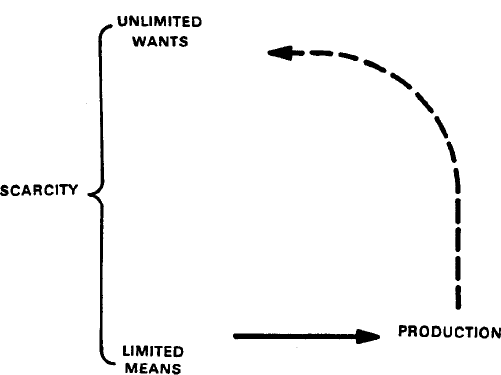
FIGURE 1:
SCARCITY IMPLIES PRODUCTION.
Direct-use production can take place in a wide variety of human contexts. At one extreme is the single isolated person living all to himself, in separation from others and working only for his own direct satisfaction—the so-called Robinson Crusoe model familiar to economists. At the other extreme we find the tribe, consisting of numerous individuals and families, in which production, although organized on a social basis, is still directed towards the tribe’s own desires and satisfactions.
In between these two extremes are the individual family unit and the small-scale communal group.
Common to all of these direct-use forms of production is the direct connection or correspondence between (a) what people want to consume and (b) the things that get produced. For example, if people want grain or vegetables, they themselves—singly or cooperatively—proceed to produce the grains and vegetables for their own consumption. The individual’s very survival and prosperity depends directly on his own ability and willingness to harness resources—labor power, land and water, tools—and apply them in appropriate technical combinations capable of yielding the desired product. Those who are not able to work or produce—infants, the diseased, and the infirm—are necessarily taken care of by their relatives. In Robinson Crusoe’s case, he has no one but himself to rely on.
Furthermore, the goods and services produced for direct-use are absorbed entirely by the producers themselves—none of it is supposed to be allocated for sale in the market place. Thus, the direct-use type of economy is, by definition, characterized by (a) self-subsistence production and (b) absence of production for exchange in the market.
Social Division of Labor
In contrast to the direct-use mode, the market division of labor (DOL) is oriented toward a radically different purpose. Remember: under the direct-use mode, the same person or group is simultaneously responsible for both production and consumption. For example, if person A or tribe A wants to consume fish, he or they must themselves undertake the catching (“production”) of the fish. In this way, one and the same person or group undertakes both functions of producing goods and consuming them. In other words, the household unit is the one and only center of both production and consumption activities.
Under the market DOL, however, the household unit is no longer the center of both production and consumption. Instead, production is relegated to and centered within a new social-economic unit called the firm. Although members of households continue to own and provide the means of production (especially labor power) which are required and employed by the firm, it is the firm—be it in the form of a factory, large-scale farm, retail department store, or service agency—that provides the predominant share of goods and services produced for ultimate consumption by members of households. (The nature and significance of the transition from direct-use production to the market DOL are analyzed in Chapter III.)
In this connection, one other difference between production under the direct-use mode and in the market DOL is noteworthy. It would be misleading to imply there is no specialization and division of labor under the direct-use mode. Indeed there is, but on a relatively narrow domestic basis: individuals may be assigned specific tasks or products within the family or tribe. But as a rule, the individual will have to be a Jack-of-al1-trades, capable of handling a variety of tasks. Even more important, however, individual household units are characteristically self-sufficient and not dependent on production-for-exchange in the market.
In contrast, under the market DOL, the orientation of domestic production toward the market—toward exchange with producers in other household units, near and far—generated increasingly larger scale of production and greater sophistication in technological change. These changes eventually gave birth to the factory-scale output that became characteristic of the Industrial Revolution. This breakthrough in large-scale industry induced, in turn, the further expansion of markets for new goods throughout the world.
Firms Depend on Households
The radically new forms of social interdependence and interrelationship that emerged in the market DOL are outlined in Figure 2. Note, first of all, that production has shifted from the context of the household to the firm; the firm is now virtually the center of all productive activity. Nevertheless, the firm remains dependent on the households in two crucial respects. On the one hand, the firm must look to households as the ultimate market for the goods it produces, especially consumers’ goods (see heavy line called “consumers’ goods”). This follows from the fact that households encompass everyone in the community, including single individuals or bachelors, and this makes everyone a “consumer.” Obviously, unless firms succeed in selling their product to consumers, they cannot remain in business. This raises the crucial question: How do households acquire the purchasing power (e.g., money) to buy up the firm’s output?
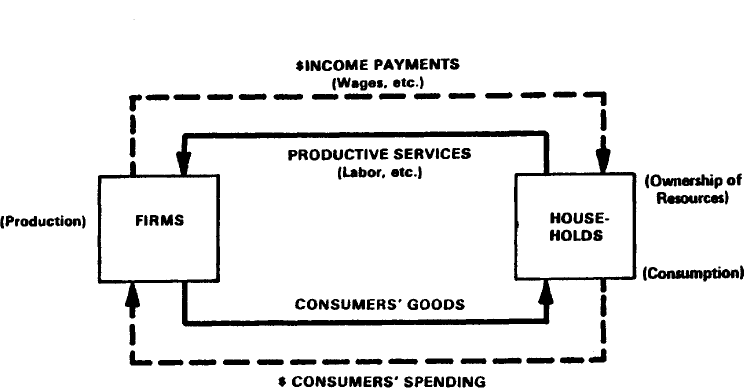
FIGURE 2:
RELATIONS BETWEEN HOUSEHOLDS AND FIRMS.
The answer to this crucial question brings us to the second basic dependence relation. The firm must depend on householders to provide the required productive resources (means of production). (See heavy line called “productive resources.”) For one thing, the firm has to hire householders to provide labor power. Thus, householders as workers will receive, in return for their labor services, payment in the form of wages and salaries. Furthermore, firms may have to borrow money to finance their purchases of capital goods (tools, machines, land, materials, etc.), but the people owning such loanable funds (in the form of savings that are made available to firms via savings institutions and stock and bond markets) are themselves members of households. (It should also be noted that commercial banks provide “new money” to firms in the form of commercial loans and the creation of check deposits.) In return for their loans and investments, householders receive interest and dividend payments. Finally, firms may also have to rent or lease space (land, factory, office) but the owners of these resources, too, are ultimately members of households, and the payment they receive in return for the use of these resources is called rent.
Firm as Generator of Income
Thus, by making their varied resources available to firms, households in the modern DOL—although no longer the center of production—are able to earn the purchasing power needed to buy the goods produced by firms. That is, by cooperating with firms in the production function, householders are able to earn a variety of income payments—wages and salaries, rents, interest, and profits—which in the aggregate are termed the national income. (See dashed line called “income payments” in Figure 2 and the “production-income” link in Figure 3). The income generated by firms thus becomes the prime source of the purchasing power that enables householders, as consumers, to buy up the firm’s output. (See dashed line called “consumers’ spending” in Figure 2).
These vital relationships between households and firms can be visualized alternatively, as in Figure 4 (parts A and B), which focuses on the firm in the role of intermediary. In part A of Figure 4, we see the firm as intermediary between household members as “consumers,” on the one hand, and household members as “owners of means of production,” on the other hand. In part B, we see (a) how the firm depends on consumers’ demand for its product and, in turn, (b) how this consumers’ demand determines the firm’s demand for labor and other productive resources, as filtered through the firm’s decision-making process.
In passing we should note something about the “production-income” link: it is also relevant to self-employed people such as farmers and professionals. Although these people depend primarily on their own (and not on any employer’s) ability to sell their products or services, this should not disguise the fact that the self-employed are merely a special type of firm whose “employees” are self-provided for the purposes of production and marketing.
Only Production is the Source of Income
Although the production-income link is explored in greater detail in Chapters IV and IX, it is useful to note here the following two important aspects. First, economics maintains that the only source of earned money-income is production. Use of the word “income” should refer solely to money-payments earned by people participating in production. This goes for the wages and salaries received by sellers of labor services as well as for the rent earned by people who rent or lease their property to others, the interest earned by people who lend money, and the profits received by enterprising owners of firms. The grand total of all such incomes is, as noted, the national income.
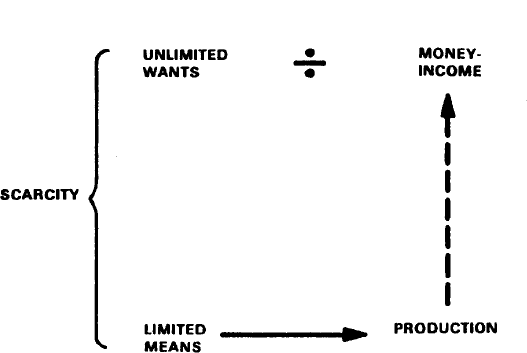
FIGURE 3:
PRODUCTION IS THE SOURCE OF INCOME.
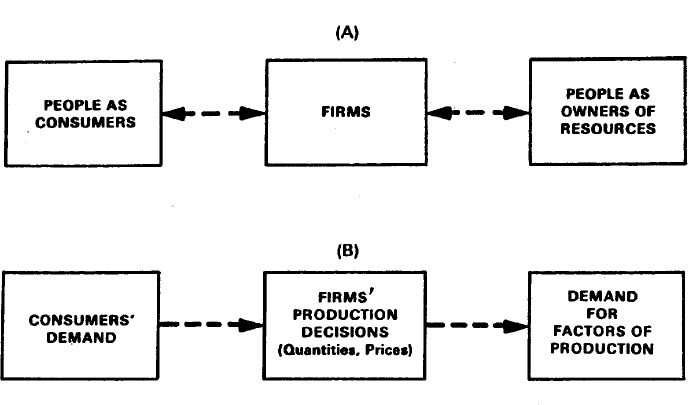
FIGURE 4:
THE FIRM AS INTERMEDIARY.
Second, because of the advanced stage of the division-of-labor in the modern economy, we find not only widespread occupational specialization but also an apparent functional specialization with regard to consumption versus production. For convenience, economics often refers to “consumers” as a group separate from “producers,” the former belonging to households, the latter comprising the production units called firms. This usage, however, causes a serious confusion. In practice, everyone is a “consumer,” including the owners and heads of firms; and every wage-earner or salaried employee, who as a member of a household sells his services to firms, is himself as much a “producer” as any head of a firm. Nevertheless, in our present context it is convenient to associate the functions of consumption with “consumers” and production with “firms” or “producers.” This facilitates references to the characteristic dependence of householders on firms not only for (a) the supply of goods they wish to consume, but also for (b) the income to be earned by their offering labor services or other resources.
Production is the Source of “Supply”
Now, there is another vital aspect to production in the modern economy: production is not only the source of income earned by factor-owners, but is also the source of physical supply of goods and services. This is the “supply” which firms offer for sale on the market, and is, therefore, available for purchase by the very same people who have earned income. This brings us to the “production-supply” link (see Figure 5) that is economically associated with the above production-income link.
In connection with supply it is important to note that the quantities supplied are always offered to the market at a price. The firm sets a price that it expects the market will approve and thereby compensate it for two reasons: (1) to recoup the income payments already made to wage-earners and other factor-owners, and (2) to yield a margin of profit on each unit of product. Only if market demand validates the firm’s expectations as to quantities offered, prices asked, and expected profit-rate will the firm be able to stay in production and generate income. Whether actual consumer demand in the market will validate all of the firm’s expectations as to sales and profits is, at any time, really a big “if.” In a truly free market, sales success is always an uncertainty: truly free markets imply open and unrestricted competition and an absence of governmental protection of profits (e.g., by tariffs or subsidies). (More on this in Chapters VI-XI.)
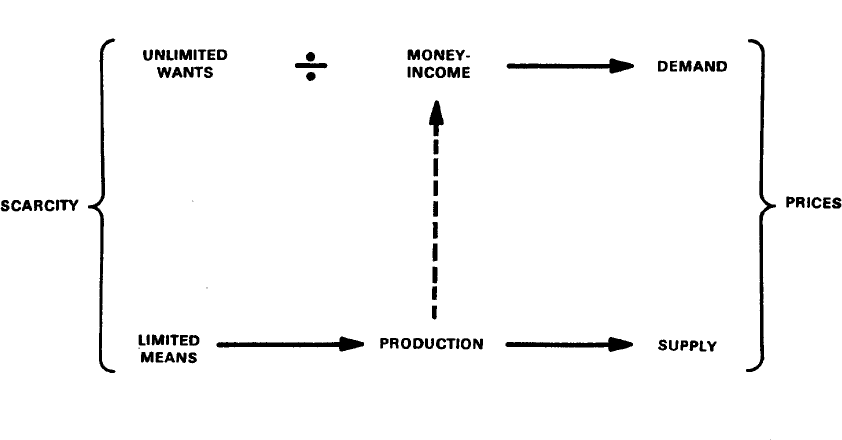
FIGURE 5:
BASIC ELEMENTS OF THE MARKET-PRICE SYSTEM.
Thus, even if a given firm enjoys success in its sales objectives at any time, this by no means assures continued profitable sales. No free market can guarantee sales so long as consumer demand is uncertain—so long as consumers can change their minds in unpredictable fashion. As soon as any firm experiences disappointing sales, it must decide whether and to what extent it should lower its price, curtail its supply, or do a combination of both.
Income, Transfers, and Demand
This brings us to another important link in the market economy: the “income-demand” link (Figure 5) in which market demand is presumed to derive entirely from the incomes earned in production. In practice, of course, market demand, although mostly based on earned income, also includes non-income sources of purchasing power. One such non-income source of money is government subsidies, technically referred to as transfer payments, such as old-age benefits, unemployment and other relief, bonuses, etc. (See Figure 6.)
Transfers typically go to people who, for one reason or another, are not working or whose incomes the government wishes to supplement. On the other hand, transfer payments are financed by taxation of the income of the rest of the community. Since these governmental transfers do not derive from the recipient’s own income earnings, it must be referred to as a non-income source of purchasing power. (It should be noted that in recent years, total government transfer payments have exceeded $400 billion, far more than the relatively small amounts of private transfers that are voluntarily channeled through charity.)
Inflation of the Money Supply
Another non-income source of market demand—also shown in Figure 6—is the “new money” associated with loans made by the commercial banking system, with the support of the Federal Reserve Banks. This type of purchasing power is typically borrowed from the banking system, which creates it literally “out of thin air.” The puzzling expression “out of thin air” aptly reflects the fact that the new bank money—in the form of artificially created check deposits—is not directly derived or channelled from anyone else’s income but is merely created by a bookkeeping entry by the banks. Firms usually obtain “new money” in the form of commercial bank loans for production purposes, while the federal government also obtains it to cover its budget deficits.
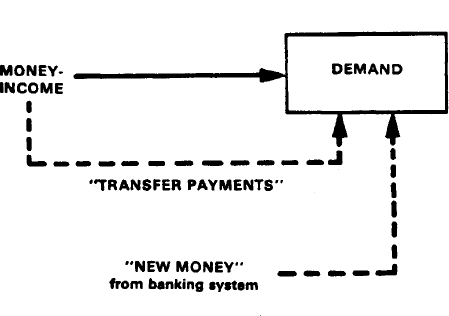
FIGURE 6:
“NON-INCOME” SOURCES OF PURCHASING POWER
(Transfers; New Money)
In recent decades, the “new money” created by the banking system has enabled the dollar-value of market demand to increase faster than the physical supply of goods and services, thereby becoming the crucial basis of price inflation. At this point it suffices to note that new bank money is not only funnelled to firms in the form of commercial loans but also to the federal government, to finance part of its transfer payments; in this way, the total of government handouts can exceed the amounts financed by taxation. (Details on bank creation of new money can be found in any textbook on money and banking.)
“Demand” vs. “Wants”
To avoid a possible confusion, note the distinction between wants and demand. The layman tends to use these terms interchangeably, but in economics they mean very different things. “Wants,” in their original and basic sense, are truly limitless: there is no conceivable limit to the quantity and variety of satisfactions human beings will want to enjoy. “Demand,” on the other hand, relates to the fact that in practice there is a limit to a person’s ability to satisfy his wants. Thus, while one may “want” pie in the sky, scarcity requires that one’s “demand” be tailored to one’s purchasing power. Such purchasing power typically depends on income earned, although it may also be supplemented by one’s own accumulated savings, or by borrowing, or by sale of one’s wealth assets, such as a car or house.
Also note that demand is exercised not only by “consumers” but also by firms as producers. People exercize demand not only for consumer goods, for their own direct consumption, but also exert a demand for productive resources (labor, etc.) to be used in production. The latter type of demand reflects the fact that some people—indeed, only a relative few—enter into the production process as heads of firms and “entrepreneurs” rather than as employees, albeit a riskier way of earning income. Thus, firms must rely primarily on their own income (i.e., profits) in order to finance their demand for factors of production. Typically, however, profits are not enough, and have to be supplemented by borrowing from the banks and other financial institutions.
The Role of Market Prices
We are now ready for the final leg of our survey of the basic social implications of scarcity: the central role of market prices both as (a) the resultant of the forces of supply and demand, and as (b) the fulcrum on which consumers and firms base their decisions to buy and sell. (See the extreme right-side of Figure 5.) From one perspective, market prices may be viewed as a resultant of supply (S) and demand (D) in the sense that prices will change according to changes in S and D. As will be seen in Chapter VIII, prices would be expected to increase whenever D increases, S decreases, or a combination of both occurs. Conversely, prices would be expected to decrease whenever D decreases, S increases, or a combination of both occurs.
In this connection, a glance at Figure 5 reveals that supply and demand are themselves resultants of more fundamental underlying forces. Thus, reading along the bottom line in Figure 5, we can see that market supply will increase or decrease according to the levels of production. Production itself will, in turn, vary according to the supply of means, the efficiency with which means are used, and the willingness of factor-owners to participate in production for the market. (More on this in Chapter IV.) Similarly in the case of market demand: D will be expected to vary according to (a) the level of income or other purchasing power, as well as (b) the character of people’s wants—their tastes and preferences and the intensity of their desires. (More on this in Chapter VI.)
On the other hand, market prices are the fulcrum of information on which buyers and sellers peg their respective buying and selling decisions. Higher prices tend to deter buyers from buying or reduce their rate of purchase, whereas they tend to induce producers and sellers to increase the rate of production and offer greater quantities. Lower prices tend to exert opposite effects: they induce buyers to increase their rate of purchase, but induce sellers and producers to reduce their rate of supply. (More details on this in Chapter VIII.)
Market Demand, the Ultimate Test
Thus there is a vital interdependence between the underlying forces of supply and demand, on the one hand, and market prices on the other. Chapter VIII will explore this interdependence in great detail. At this point it suffices to expand on a basic fact noted above: the marketplace constitutes the ultimate testing ground of the firm’s sales and profit expectations. In the marketplace, it is the actual state of demand—not the hoped-for or anticipated demand—which ultimately determines the fate of the firm’s profit expectations. (More on profits in Chapter IX.)
Furthermore, only if firms earn profits will they be willing to hire and purchase factors of production and thereby continue to generate incomes such as wages and salaries, rent, and interest. Indeed, directly or indirectly, the marketplace ultimately judges the income fate of all participants in the production process. Whether one participates as a wage-earner, a professional, or a head of a firm, everyone is in the same boat: all must await the final, albeit unpredictable, verdict of the market to see whether it ratifies or vetoes respective income expectations.
Market Demand and Uncertainty
On top of all this, not only is market demand the ultimate arbiter of the firm’s sales and profits, but it remains ever beclouded in uncertainty. For one thing, consumers’ tastes or preferences are subject to constant, unpredictable change, and thereby affect the quantities purchased or the selling prices finally negotiated. This in turn affects the profits actually realized. Add to this the ever-present threat of competition from rival firms at home and abroad. Nevertheless, despite these uncertainties, firms must somehow decide how much to supply and what prices to ask. Only the final showdown between suppliers and demanders in the marketplace determines whether firms will have guessed right or wrong, and, therefore, whether they will earn profits or incur losses.
In the last resort, if a firm guesses wrong as to quantity and price, it will have to adjust to its disappointment. It could slash its prices in order to move unsold goods. If it becomes pessimistic about the state of demand—believing that its disappointing sales are not merely temporary—it could reduce its rate of output. Over the long run, however, the firm cannot escape the market’s ever-present uncertainty and the consequent need to make adjustments in quantity produced, costs, and selling prices. Only the firm’s ability fo forecast business conditions more successfully, or to make adjustments when its forecasts prove incorrect, can enable the firm to survive and prosper.
III. Conclusion
One final perspective: the validity of this analysis of the basic implications of scarcity is reflected by the polar concepts of scarcity and prices depicted in Figure 5. Given the underlying human condition of scarcity, on the one hand, and the market-price system (further analyzed in Chapters VIII-XI), on the other, our diagram indicates that prices and scarcity are ultimately interrelated and interdependent: prices serve as the “reflector” of scarcity—they are expected to rise when scarcity conditions worsen and fall when scarcity conditions ease up.
A significant segment of economics is concerned not only with demonstrating that market prices are able to reflect scarcity conditions but, indeed, that the market-price system is the only economic mechanism capable of rendering this vital service. Chapter X will explore in detail the nature of the market-price system, based on consumer’s sovereignty, individual property rights, and voluntary exchange.3
__________________
4A1 Capp, The Life and Times of THE SHMOO (New York: Simon and Schuster, 1948), p. 22.
5I am indebted to Paul Craig Roberts and Matthew A. Stephenson, Marx’s Theory of Exchange, Alienation and Crisis (Stanford, California: Hoover Institution Press, 1973) for the distinction of direct-use versus market modes of production organization.
6This is not the place to analyze how a socialist society, in comparison to a free-market society, would try to solve the problems of coordinating the activities of households and firms—problems that are inherent in every modern industrial economy, be it capitalist, socialist, or communist. For a perceptive and provocative analysis of Marx’s concept of socialism as a reincarnation of the direct-use mode under modern industrial conditions, see P. C. Roberts and M. S. Stephenson, Marx’s Theory of Exchange, Alienation and Crisis (Stanford: Hoover Institution Press, 1973).
- 1See Thomas Sowell, Knowledge and Decisions (New York: Basic Books, Inc., 1980) for an elaborate analysis of how—despite the complex structures and environments of the modern division of labor—the free society and its market-price system generate, transmit, and apply “authentic” knowledge in the realms of economics, law, and politics. For an earlier treatment, see Friedrich A. Hayek, The Constitution of Liberty (Chicago: University of Chicago Press, 1960).
- 2Excellent examples of this type of supplementary work are John C. Goodman and Edwin G. Dolan, Economics of Public Policy: The Micro View (2nd ed., St. Paul: West Publishing Co., 1982), and Walter E. Williams, America: A Minority Viewpoint (Stanford: Hoover Institution Press, 1982).
- 3A notable exception is the above-mentioned text by Goodman and Dolan which analyzes public issues in terms of moral, political and economic criteria.
- 4Add to this the obfuscations, deliberate or inadvertent, of those messianic types who would deliver us from all our travails by imposing their illusions, myths and Utopian visions on the rest of us—and it follows that the task of discerning and explaining the true nature of economic existence becomes so much more difficult,
- 5For the rest, for the purpose of greater illustration and application of analysis to public issues and policies, I defer for the most part to the numerous useful works devoted especially to this purpose. These works, including books of readings, provide ample supplementary materials that illustrate at length how economic theory or principles manifest themselves in practice and how economic analysis can be applied to practical problems.
- 6Before proceeding to the chapter-by-chapter introductions, it is necessary to point out that economic tracts—mainly because of materialist bias—usually omit the very important moral dimension, a dimension that is nevertheless relevant to economic reality—to economics in practice. First of all, economics as a social science is fundamentally concerned with exchange—“interpersonal transactions.” Exchange is inherent in every production and trade activity. Thus, the market-price system may be regarded as comprising multitudinous exchange transactions. Since exchange also infuses every interpersonal transaction in society at large, it also constitutes the basic coordinating mechanism of that most complex network of interrelationships called “society.”

