
Foundations of the Market Price System
Chapter IV. Production, Income, and Economic Growth
Consumption is the act of satisfying a human want. As such, therefore, it is the most prevalent human action. Equally significant, however, is the fact that in the natural scheme of things consumption is the ultimate purpose of production. Human energies become “productive” to the extent that they are to be directed towards producing those things that are directly and indirectly useful to consumers. Only leisure and air are directly obtainable without any effort. Virtually everything else we want must be produced with the aid of scarce means; indeed, the latter become valuable precisely because they can serve productive purposes.
Elements of the Production Problem
What is the essence of production? Again, it is instructive to look at Robinson Crusoe in order to get the answer. A study of Crusoe also helps us better understand the complexities of the modern economy. The modern economy differs from Crusoe’s not in its essential functions but only in (a) its great degree of specialization, division of labor, and interdependence; (b) its scientific and technological levels of production; (c) the quality and variety of goods it produces; and (d) its social-political institutions and organizations.
For Crusoe, a number of things are pretty obvious. Whatever he wants—other than leisure and fresh air—he must produce; he must expend time and labor effort to provide those goods which can still his hunger, quench his thirst, and protect his body. Furthermore, as an isolated man, it is necessary that he himself engage in production if he is to survive. Only in the context of a society—be it a family, tribe, or nation—does it become possible for an individual to consume without himself producing what he wants to consume.
For most purposes of production, however, Crusoe finds that his time and labor are not sufficient. He also needs two other things: producers’ goods (i.e., capital goods) and technology. Producers’ or capital goods refer to those means, other than his own time and labor, that he works up into such forms as (a) inventories of materials, food, clothing, and other forms of wealth useful in further production as well as for direct consumption; and (b) tools and implements useful in production, such as knives, axes, fish nets, and traps. On top of this he must also develop a technology (that is, “techniques of production” or “know-how”)—a body of technical principles which guide him in coordinating and applying his resources to his production goals.
Crusoe Economy vs. Modern Economy
Thus, already in Crusoe’s starkly simple, primitive economy, it is clear that man is impelled by his wants and by the “stinginess” of nature to devise tools and methods that will enable existence. In these respects, isolated man’s predicament is essentially no different from that of people in the modern industrial economy. However, the modern production process involves a crucial difference: a characteristic specialization and division of labor.
As was noted in Chapter II, Robinson Crusoe is both producer and consumer. He therefore does not have to face the problem peculiar to the modern firm which produces for mass markets—of having to determine what and how much to produce for millions of other people. Crusoe the “producer” knows exactly what Crusoe the “consumer” wants. His only real problem is whether he possesses sufficient mental and physical resources to accomplish his production goals. In contrast, the modern firm faces the problem of uncertainty of market demand—what to produce (i.e., type of product, sizes, designs, quality), how much to produce (i.e., of each variety of product, at which season of the year, in which locality), and at what price. Uncertainty of market demand makes for uncertainty about the firm’s profit-rate—the margin of difference between the firm’s costs of production and the final selling price of its product.
Production as Utility-Creation
Finally, for both Crusoe and the modern firm, the results of production have no use-value unless the goods produced are capable of satisfying people’s wants. Textbooks usually refer to this necessary quality of usefulness with the word utility, and not “use-value.” In practice, the term “use-value” is less confusing than “utility.” For instance, in Chapter V the word “utility” is part of the term “marginal utility” which connotes subjective value or a personally-felt degree of importance attached to a unit of a good (say, a loaf of bread). In that context, the term “utility” has a subjective connotation that contrasts with the objective physical connotation in the present context. However, since the term “utility” is more customary than the more appropriate “use-value,” we will use it for convenience.
Types of Utility-Creation: Form-, Place-, and Time-Utility
Probably the most familiar type of utility created by production is form-utility. Form-utility is created whenever natural or processed materials are “transformed,” that is, are processed or converted from a less directly useful form into a more directly useful form. Examples of form-utility creation are easy to find: when grain is converted into flour; when trees are cut into timber to make lumber, pulp, and newsprint; when metallic ores are processed into iron and steel; when plants and animals are processed into oils, fats, meat, and leather—and when each of these materials is fabricated into a product used by manufacturer or household. Each case involves a process of conversion that yields form-utility.
Man has no alternative but to create form-utility: generally he does not find ready at hand the means that are directly useful to his purpose, neither as a consumer—even if he bakes his own bread or tailors his own clothes—nor as a producer.
Place-Utility
Another important group of productive activities centers around the creation of place-utility. This involves the transportation of goods and services from places where they are less preferred, therefore less valued, to places where they are more preferred and more valued. There would be no need to create place-utility if sources of supply were abundantly located at the right places—indeed, right at the foot of every consumer and producer, immediately available at their every beck and call. In the absence of such a paradise, people must depend upon various transportation services—rail, ship, road, and air—in order to save time and effort.
Place-utility can be created by the movement of people as well as goods—people who desire to be in more preferred locations. For example, people may want to visit friends and relatives, make business trips, and migrate overseas in search of a new homeland. In effect, transportation of things and people serves as a way of “moving” geographic areas.
Time-Utility
Last, but not least, is the creation of time-utility. Time utility can be provided in two ways. One way is by means of loans. A loan enables a person to obtain goods and services earlier rather than later, and enables him to consume more than if he had to wait until after he had worked and saved the needed money. Other things being the same, people prefer to have their satisfactions come sooner rather than later. (More on this time-preference in Chapter IX.) Second, time-utility is provided by storage and warehousing services. In this case goods are stored until a later time when it is more desirable to use them or sell them on the market. Processing activities like freezing or preserving fruits and vegetables also create time-utility. For example, production of frozen orange juice serves as a storage of oranges; similarly, the preserving or freezing of meats. In the above two ways, creation of time-utility is valuable because it can make goods available at a more desirable time in preference to a less desirable time.
Utility Creation Enables Increased Consumption
Curiously, time-utility can also be provided by the same productive activities that yield form- and place-utility. For instance, form-utility created by the transformation of trees into a daily newspaper also enables time-utility in communications; jet-plane transportation provides time-utility as well as place-utility. We can now see why all types of producers’ goods in essence provide time-utility. From the simplest tool to the largest electric generator, from the simplest shelter to the largest warehouse, from the smallest shop to the largest assembly plant—all of these producers’ goods not only increase the productive capacity of the economy but also increase consumption possibilities per unit of time.
Having said all this, utility is not enough. True, it is essential that goods possess utility in order for people to value them at all—but it is not a sufficient condition. Unless the utility possessed by goods has a subjective importance for people, people will not be willing to pay for them. Unless people want to use butter, for example, people will not buy it. Furthermore, it is the value that people attach to consumers’ goods that becomes the source of value attached to the producers’ goods (i.e., labor, capital, etc.) capable of producing those consumers’ goods. Thus, the value of an auto factory is derived from the automobiles it can produce for sale on the market.
In other words, it is not production per se—the mere physical creation of utility—that is the source of value of consumers’ goods. Rather, it is the consumers’ subjective value attached to consumers’ goods, and the prices they are willing to pay for them, which not only impart market value to consumers’ goods but also entice firms to undertake production and, in turn, to hire labor and other factors of production. (More on this in Chapter IX.)
Technology, or Various Ways of Skinning the Cat
Implicit at almost every step in the creation of utility is the intangible role of technology and technological progress. “Technology” may be defined simply as a body of technical knowledge or information on how to produce anything. The “anything” can be a physical product, a labor service, or a professional performance. Thus, there is a technology not only for making mousetraps and automobiles but also for “producing” a carpenter, a chef, a barber, a doctor, an engineer, or a teacher.
Notice the use of the words “knowledge” and “information.” This signifies that the essence of technology is an idea or concept, which may be expressed in a variety of ways—from a technical manual to a cooking recipe. Technology is thus not to be confused with the physical form in which an idea may be embodied, such as a combustion engine or a rum cake. Thus, technology may be transmitted in a variety of ways—from word-of-mouth, schooling, and espionage—all the way to the final product which enables it to achieve practical utility.
Adam and Eve, being the first on earth, unfortunately had no technology to inherit. For us moderns, however, the vast accumulated body of technology inherited from the past is, for the most part, available free or at relatively low cost. Contrast this with Robinson Crusoe’s plight in his lonely existence. Technologically, at least, he was more fortunate than Adam and Eve: he was able to bring with him—in mind or in manual—some rudimentary technological ideas on how to survive in primitive environs. If he had not already known how to fetch and prepare his food, clothing, and shelter, his days would have been numbered, indeed. Even if he had landed on the island totally empty-handed, so long as the natural environment was hospitable he would need only a few basic ideas on how to make an axe, a bow-and-arrow, a hut, and so on. He could then implement his ideas by working to produce the things required for survival. Otherwise, in dreadful ignorance, Crusoe would have to originate his own technology by trial-and-error, abandoning less efficient techniques for more efficient ones, and always perilously at the mercy of his own inadequate resources.
Technology Is Not Enough
These comments on the nature of technology are, strictly speaking, not of the essence of economics. Technology per se is primarily related to pure and applied science and engineering. Economics as such is not concerned with the creative mainsprings of specific technological ideas; rather, it is more concerned with how technology becomes physically embodied and implemented, and how its progress and diffusion are accomplished over the long run. Concerning these two aspects, economics can assert the following: the development and progress of technology necessarily involve economic processes of saving and investment, that is, capital accumulation. To these very crucial concepts we must now turn.
If our man Crusoe wants to produce a fish net in order to increase his fish catch and consumption, he will have to become a “capitalist.” This may sound strange, since we usually associate capitalists with modern industrial economy, and not primitive economy. How can a primitive like Crusoe be a capitalist? Let us put ourselves in Crusoe’s situation. Assuming we know how to make a net and nature provides all the required materials, we now face the primary economic task of capital accumulation.
The Role of Capital Accumulation
In order to build our fish net, what do we require besides technological know-how and some materials plucked from nature? One possibility would be overtime work to fetch and weave our materials. This overtime work involves a sacrifice of leisure—a precious consumer’s good—a sacrifice made especially difficult by the hard day’s work already put in. Another alternative is to tighten our belts by consuming fewer berries and other foods. This would enable us to allocate the time saved from fetching fewer berries, etc., to the making of the net. This, too, like the overtime loss of leisure, involves a sacrifice of current consumption.
There is a third possibility: we can work overtime or tighten our belts (or do a combination of both) in order to store up berries and other consumer items in sufficiently large quantities. This would enable us to devote all of our working time exclusively to net-making, without having to worry about our usual food-gathering chores. But this, too, calls for sacrifice of current consumption. And the same is true of the fourth alternative, which involves a combination of the other three.
Whichever course we resort to, there is no escaping the hard economic fact: production of the fish net requires an act of sacrifice—the forgoing of current consumption. The sacrifice of current consumption enables us to save some labor time which can then be devoted to (invested in) the fabrication of the net.
The Crux of Capital Accumulation
This economic necessity to save and invest confronts us whenever we have to build anything, be it a shelter, a ladder, a wagon, or a weapon. Further, so long as we believe that any of these things would enable us to live better tomorrow, we will be willing to save and invest. On the other hand, if we did not wish to live better tomorrow, we could simply postpone or avoid the saving-investment decision, and settle back into our customary style of living.
This is the crux of capital accumulation and economic growth: higher consumption levels in the future rest essentially upon the sacrifice of some consumption; the saved resources are then invested in making the producers’ goods (machines, etc.) that enable us to produce more consumers’ goods. Only if we expect the improvement in future consumption to be worth more than the sacrifice of present consumption will we undertake saving and investment, that is, become “capitalist.”
Capital Accumulation—Crusoe vs. the Modern Economy
Thus, the example of a primitive Crusoe enables us to understand the essence of capital accumulation: the sacrifice of present consumption (saving) and the allocation of saved resources to capital goods projects (investment) that enable increased future consumption. Indeed, there is no essential difference between Crusoe and the modern economy when it comes to the saving process. In both cases the source of saving is the sacrifice of present consumption.
For Crusoe, the sacrifice of consumption (saving) takes obvious forms: overtime work, tightening the belt, or storing up food. For us moderns, the sacrifice of consumption takes on institutionalized, more complex forms involving an elaborate system of financial institutions. Households can save by withholding from current income (from wages and salaries, rent, interest, and dividends) a portion that is “invested” in financial assets of all sorts (in check deposits, savings accounts, stocks and bonds, etc.). Firms can save by apportioning their undistributed profits and depreciation (i.e., “cash flow”) from their current sales receipts, for the purpose of acquiring new plant and equipment and inventories. Cash flow funds are “saved” in the sense that the firm could just as well have “eaten them up,” dispensing fatter salaries to executives and fatter dividends to stockholders and owners who could then spend these funds on consumption.
Similarities in Investment Processes
Nor is there any essential difference between Crusoe and the modern economy when it comes to the type of investments to which their savings can be allocated. First, both can invest in inventories of materials and other goods that will be useful for consumption—directly useful, when consumers’ goods are being stored, or indirectly useful, when the stored goods are raw or semi-processed materials. Second, both can invest in the making of tools and equipment (i.e., “durable producers’ equipment”) which, combined with labor, help man amplify his productive capacity far beyond anything that he could develop by the use of his labor alone. Third, both can invest by creating structures that are useful for dwelling and working space (i.e., “construction, residential and non-residential”). For each of these three investment purposes, the modern community no less than Crusoe must sacrifice (save) time and other resources, and reallocate them from the production of consumers’ goods toward the production of producers’ goods (invest).
Furthermore, even when it comes to the repair and replacement of their capital goods—when these goods become depleted, broken, worn out, or obsolete—both Crusoe and the modern economy face the same economic necessity to save and invest. In both cases the time, effort, and other resources required for the maintenance of capital goods against the ravages of time and productive use—commonly referred to as depreciation or “capital consumption”—can be supplied only by the sacrifice of current consumption.
Capital Accumulation and Living Standards
Finally, there is no essential difference between Crusoe and the modern economy in the significant increases in consumption that can be achieved through capital accumulation. Indeed, it is precisely this possibility of achieving great increases in consumption—or of forestalling threatened declines in consumption—that is the prime inducement for investment in capital goods. This investment can be done directly—as by a Crusoe, a peasant family, or a modern manufacturing firm. Investment can also be done indirectly, as when individuals invest in new stocks and bonds issued by firms, and thereby provide the firms with funds to acquire new plants and equipment. In both cases, the basic inducement is the same: individual preference for both increased consumers’ goods and increased leisure in the future. Only investment in capital goods has enabled the combined increase in consumers’ goods and leisure enjoyed by increasing numbers of people during the past 200 years of industrial capitalism in the Western world.
Capital Accumulation and Technological Progress
Nor is this all. Saving and investment are the sine qua non of technological progress itself. Let us see why. Technological “progress” simply reflects the changes in technology resulting from the introduction and diffusion of new technology. Technological changes occur in two different dimensions: via (a) the creation of new types of producers’ goods, such as new and improved machines substituting for physical or mental labor, synthetics substituting for natural materials, assembly-line methods, and computers; and (b) the creation of new types of consumers’ goods, such as phonograph records, radio, movies, television, automobiles, jet air travel, and motels. In both of these dimensions, it is not possible to introduce the new technology—whether it be by the lone inventor or by the corporate research team—unless there is saving and investment, that is, unless time, effort, and resources (otherwise available for current consumption) are reallocated toward creation of the new technology.
Technology and Production Costs
Specifically, producers will invest in new, improved producers’ goods when they believe this will reduce the average cost (cost per unit) of output. Other things being equal, a cut in the cost per unit of output represents per se an increase in profit rate per unit of output. Furthermore, a cut in production cost enables a reduction in the price per unit of output (e.g., the price of each loaf of bread, each car, each television set) without squeezing the profit margin. Since both of these possibilities can give the firm a competitive edge over rival firms that are not able to duplicate such cost savings, they constitute a strong inducement for the firm to search for cost-cutting technology.
Let us digress briefly to visualize the impact of a new technique of production on the profit rate of the firm. The profit rate will be analyzed in greater detail in Chapter IX; here it suffices to note that the profit rate represents the price spread or margin between the selling price and the per-unit cost of a product (as shown by the “profit margin” in Figure 7). “Outlays for factors of production” in Figure 7 include wages and salaries, rent, depreciation, and expenses for purchased services, materials, and supplies. The “profit margin” in the first stage A represents the profit rate which the firm earns currently. This profit rate is not a money-expense or cost in the same sense as wages or other outlays for factors of production. Rather, it is a margin of earnings—the inducement required by the firm to undertake a time-consuming and risky production process whose payoff is only in the future. The “profit margin” in stage B, however, is the expected increase in profit expected from the new cost-cutting technique.
Some Further Explanations
A further word of explanation about Figure 7 is necessary. The decline in “outlays for factors” represents a percentage or relative change, not an absolute one. It therefore does not signify a drop in the total amount of money wages, etc., paid out. Also, the numerical values shown are expressed only in terms of unit (average) costs and prices; they imply nothing about changes in the total volume (number of units) produced, nor the total number of workers employed.
Also, note that the selling price of the product is assumed to remain unchanged. In practice, reduction of the unit cost and the associated increase in profit rate would enable the firm to subsequently reduce the price to consumers, to grant an increase in wage rates, or a combination of both.
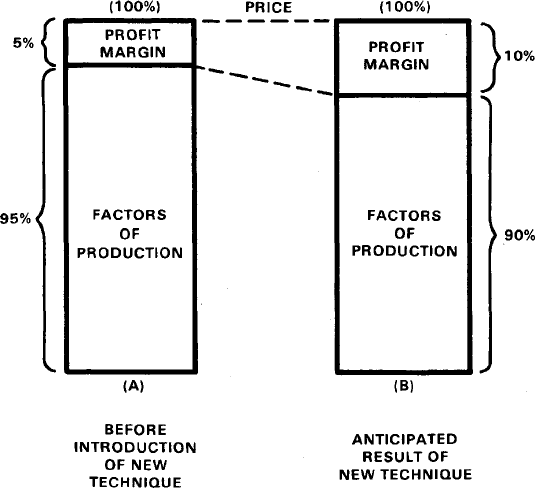
FIGURE 7:
EFFECT OF A NEW TECHNIQUE OF PRODUCTION ON PROFIT-MARGIN PER UNIT OF OUTPUT.
Technology’s unique Function
Finally, the introduction of new technology has always had another important function: the accomplishment of things not otherwise possible. Examples include the innovation of optical devices, nylon, nuclear energy, computerized operations, space propulsion, as well as consumers’ goods such as cars, television sets, and polaroid cameras. Here the inducement to apply new technology by firms is the potential new demand for the new product or technique and the potential new source of profits.
In both types of technological progress—that which enables reductions in unit costs and prices, as well as that which induces new demand for new products—the profit potential may be sufficiently large to induce firms to undertake major investment programs—to originate, develop, and implement the new ideas on a large-scale, commercial basis—despite the great uncertainty and risk usually attached to such new ventures.
“Innovation,” the Culmination of Technology
The great economist, Joseph A. Schumpeter, gave a special name to the culminating phase of technological progress—the phase characterized by large-scale application of new ideas and inventions on a commercial, mass-market basis. He called it innovation. Innovation is not to be confused with (a) the exploration for and statement of new ideas, as exemplified by pure science or research, or (b) inventions and applied science, in which a new idea is physically embodied in a “model” or “pilot project,” on a sample basis. We get innovation primarily through large-scale investment by firms in order to embody ideas or inventions in new and improved consumers’ products on a scale sufficiently great to enable masses of people to raise their levels of consumption.
Thus, it is the lure of profits from innovation that motivates firms to invest large sums in product research and development as well as market research. DuPont, for example, many years ago spent more than $20 million to bring nylon to the pilot-plant stage. The several billions annually spent by large firms on product “R and D” prompted the economist, Sumner Slichter, to coin the phrase “industry of discovery” to describe corporate preoccupation with developing a backlog of potential new products. Firms search for new products to replace old ones when sales of the latter level off or decline, and thereby enable the firm to survive or grow over the long run.
Innovation Is No Guarantor of Profits
Innovation, with all its potential for profits, nevertheless does not in itself guarantee profits. In the market place there simply are no such guarantees. First, there is the unpredictability or uncertainty of market demand. uncertainty of demand is caused by continuous change in consumers’ tastes and preferences, in market prices, and the character of competition from rival firms at home and abroad. On top of this is the specific uncertainty due to the untested nature of the innovation itself: a new consumer product to which masses of consumers have not yet become accustomed, or a new production tool or method that has not yet been proved out under factory conditions.
In other words, as long as the market environment is haunted by constant flux in key dimensions—in the quantity demanded of product, in the prices at which the product sells, in the technological longevity of equipment, and in the character of competition—so long will profit expectations be subject to uncertainty and risk.
The Entrepreneurial Function
It is this pervasive, continuing uncertainty that prompted some writers to give the name entrepreneurship to the function performed by stockholding owners of firms. Admittedly, everyone else involved in production—employees as well as top management—is perforce in the same boat as the owners themselves with respect to market uncertainty; the firm’s success or failure affects employees as much as it does the firm’s owners. Nevertheless, it is the owners alone who specialize in the entrepreneurial function of contending with uncertainty and risk. It is their capital assets that are being laid on the line—that are willy-nilly subjected to increase or decrease, according to the uncertain twists of the market and competition.
So long as the firm faces uncertainty in the market, so long will it be driven to speculate about the future market demand and prices—and so long will it remain in doubt whether sales will bring profits or losses. Indeed, the peculiar characteristic of production in the market economy is the entrepreneurial function thrust upon the firm.
The Entrepreneur As Intermediary
There is another sense in which the firm is entrepreneur—a sense alluded to in Chapter II. There we described the transition from the direct-use mode of production to market-oriented production. As a consequence of the division of labor between households and firms, the firm emerged as an intermediary between (a) household members as consumers and (b) household members as owners of means of production (see Figure 4, part A, in Chapter II). How is entrepreneurship manifested in this intermediary role of the firm? In the following way: On the one hand, the firm finds itself facing a consumers’ demand that is in constant flux and tinged with uncertainty. On the other hand, in order to earn a profit, the firm faces the task of obtaining resources (labor, etc.) at prices low enough to leave a profit margin between (a) the expected selling price to consumers, and (b) the unit cost of production.
Why do these tasks involve entrepreneurship? On the one hand, in spite of the uncertainty of consumers’ demand, the firm must nevertheless decide upon a definite price at which it expects to eventually sell its product, in the hope that when the product finally reaches the market the planned price will prove satisfactory to both consumer and firm. On the other hand, there is no guarantee that the firm will be able to discover resources at prices low enough to keep unit costs low enough to assure that the planned price spread (profit margin) between selling price and average costs will actually materialize.
Derived Demand for Factors of Production
What makes the firm, as intermediary and entrepreneur, so crucial in the market economy? It is the fact that householders—as owners of labor power and other resources—depend on the firm for employment and income (wages, salaries, etc.). It is the firm’s demand for factors of production which determines employment opportunities for resource owners, and hence their incomes as well.
Yet, this demand for resources owned by householders, in turn, depends on the firm’s estimate of market demand for consumers’ goods. Thus it devolves on the firm, as intermediary between consumer and factor-owners, to convert its estimate of consumers’ demand into a planned production program and a demand for factors of production. For this reason, the firm’s demand for factors has been aptly described as a derived demand—derived from the expected consumers’ demand for the firm’s product (see Figure 4, part B). Thus, the greater the anticipated consumers’ demand for its product, the greater the firm’s demand for labor and other factors; and vice versa in the case of a reduced demand for its product.
Firms As Generators of Income
It should be evident by now that the primary source of income for households is simply firms investing in the employment of workers, materials, and equipment for the purpose of production. This should be self-evident, but often it is not. Even among economists, there is still a lingering notion that it is consumers’ spending—not investment by firms—that is the source of people’s income. Thus, it is claimed that consumers’ spending is logically prior to investment by firms since consumers’ dollars provide firms the wherewithal1 to make income payments to wage-earners and others. As one writer has put it: “. . . [R]esource owners get their incomes from what consumers spend; but consumers’ income doesn’t come from what resource owners spend.”1
But this merely begs the question. First of all, where do consumers get the money they spend in the first place? Clearly, consumers’ purchasing power can originate only in the income earned by working for firms as wage-earning and salaried employees, or by otherwise participating in production as suppliers of services, materials, equipment, etc.
Second, how are we to understand the fact that when consumers enter the market with their purchasing power, the goods they want to buy are already on the store shelves waiting for them!? What does this imply? It means that the production of consumers’ goods by firms had already occurred prior to the consumers’ act of spending—and, as stated above, this flow of production had also generated an accompanying flow of income, the very same income that consumers only later spend in the market.
Where Do Consumers Get Their Money?
Thus we must ask: How is it possible for consumers’ spending to be a source of income for workers who had already been paid by the firm for producing the goods only subsequently purchased by the consumer? Indeed, all the money in the world would avail the consumer naught if there were no goods produced in advance and waiting on the store shelves. (Indeed, an abundance of money in consumers’ hands, in the absence of goods on the market, would simply drive prices sky-high in an inflationary binge.) To be sure, when consumers spend their money, they enable firms to stay in business and provide continued employment for wage-earners and others.
All of this recalls an amusing paradox once told by comic Nipsy Russell which, to the best of my recollection, ran as follows: “There’s one thing that’s really got me puzzled about the car I’ve just gotten,” said Nipsy. “In Malaya there are people making the rubber for the auto tires; in England they have people weaving fabric for the car seats; in Ohio they’re making the window glass; in Pittsburgh they’re rolling the steel for the car frames and bodies; in Detroit they have thousands of people busy assembling all these parts into a car—but what I still can’t figure out is how all these people all around the world can be making a living turning out a car that I can’t even afford to pay for.” For Nipsy, all of this constitutes a paradox. For us, however, it is a neat parable for the economic lesson drawn in these pages: people earn income by participating in production, which logically occurs prior to consumption and which economically is the primary source of purchasing power.
The Production-Income Regression
As a clincher, let us pursue this apparent chicken-or-the-egg problem by doing some chain-reasoning backwards in time and envision a past world devoid of the modern division of labor—a world based, instead, on the direct-use mode of production. As we saw in Chapter II, this pre-industrial world consisted strictly of households—peasant families, clans, tribes, and villages—which incorporated in their midst the production function as well as factor-ownership and consumption. In this former context, production as a matter of course is for the direct use of the households themselves, and not for sale in the market. To be sure, some product would occasionally be diverted from direct consumption toward exchange with other tribes or villages on a barter basis; these transactions, however, would be marginal or of secondary importance. In such a pre-industrial economy it was obvious that the only way people can acquire goods for their own consumption is by prior production. This brings us to the crux of the matter.
Production Is Prior to Consumption
The crux is this: The proposition that, in the modern economy, the firm is the primary generator of income is merely a roundabout way of saying that production is prior to consumption. Ironically, in the context of the complex, modern division of labor, this elementary fact may not be as readily discernible as in the simple, direct-use system of production. Nevertheless, in the modern economy, it is precisely because production is prior to income that it is also prior to consumption. In other words, the only difference between the pre-industrial direct-use system of production and the modern division of labor based on production for market sale is this: In the former case, producers acquire consumers’ goods directly as a result of their own productive efforts for themselves, whereas in the latter case, producers such as wage-earners, etc., acquire goods only indirectly, via the money income earned and used as purchasing power in the market. Otherwise, in both cases, it should be clear that production is prior to consumption.
Furthermore, the thing that imparts effective purchasing power to the consumers’ spending money is precisely the prior availability of consumers’ goods on store shelves in sufficient supply. Otherwise, as noted above, if the supply of goods is very low, an abundance of money in consumers’ hands would merely cause prices to skyrocket in an inflationary spurt.
Production Requires Investment
Here’s another way of looking at all of this. What would happen if the entire productive capital structure of firms would suddenly disappear and every consumer, therefore, had to return to Crusoehood to become his own producer? How much would consumers now be able to consume under these altered circumstances—even if they were loaded to the gills with money? How long could they avoid the economic necessity to save and invest their own time and labor in order to build the rudiments of a productive capital structure, much the same as Crusoe? It doesn’t take much thought to realize that money and consumption do not in themselves produce anything.
True, consumption remains the ultimate purpose of production, and it is therefore the ultimate goal of capital investment by producers—be they Crusoe or modern firms. Indeed, it is this ultimate purpose of consumption that furnishes the basic incentive to expend time, energy, and resources in production. Nevertheless, the fact remains that without prior investment in capital goods and other resources, there would be no capital structure capable of producing consumers’ goods; neither would there be the income streams generated by firms in the modern economy.
In this connection it is important to stress that investment outlays by the firm include not only outlays for capital goods—such as machines, factories, inventories—but encompass all of the firm’s expenditures on production, including wages and salaries, rent, advertising, trucking, and marketing. Without question, this makes investment expenditures by firms the primary type of spending in the modern economy, and clearly prior to consumers’ spending. The fact that only a few undertake the entrepreneurial role of the firm, and that most people prefer not to do so—nor to revert to Crusoe-like self-subsistence as an alternative—leads to only one conclusion: Most people find it preferable to “leave the driving” (that is, production) to the firm, and to enjoy thereby the greater productivity that is made possible by the modern industrial economy based on specialization and large-scale production.
The “Consumers’ Sovereignty” Problem
None of the above denies the fact that household spending on consumers’ goods does play a crucial role in the modern economy. It is the householder as consumer who plays the fateful role of ratifier or validator of the firm’s sales goals and profit expectations. Indeed, in the modern division of labor the consumer necessarily plays this ultimately fateful role vis-a-vis the firm. The firm cannot escape the fact that only if it caters successfully to the consumer—by providing desirable products at acceptable prices—can it hope to be rewarded by the consumer, earn profits, and avoid losses. Only by satisfying the consumer can the firm succeed in recouping its costs and earn its expected profit margin. (This fateful role of the consumer, as the ultimate ratifier of the firm’s sales and profit expectations, is also intimately related to the consumers’ sovereignty problem which is discussed in detail in Chapter X.)
More precisely, one of the key problems facing the firm is determination of the price at which the consumer is willing to buy. The firm cannot escape the fact that the price of consumers’ goods is ultimately determined by consumers—by their preference-scales and marginal-utility valuations (as will be shown in Chapters V, VI - VIII). It is this market price which signals to the firm whether and how much it will be able to produce. That is, only if the market price payable by consumers is expected to be sufficiently high—promising a margin of profit above the cost of factors of production—will firms be induced to invest in production.
“Working Back from Price”
Thus, it is very much to the point to describe the firm as having to work back from price. As already explained, only through validation by consumers—by their willingness to pay the price that firms expect, in order to recoup costs and earn a profit—can the firms survive and prosper. Contrary to what people usually think, it is not costs that determine the selling price set by the firm; rather, it is the prevailing or expected market price that determines the costs that the firm will find it profitable to incur.
More precisely, the firm “works back from price” in the following sense. It is primarily guided by its estimate of the market demand for its product, including the selling price at which it believes it can dispose of its output. Then it considers the profit margin it would like to earn on each unit of product (as shown in Figure 7). By deducting the profit margin from the expected selling price, the firm derives the limit to the factor outlays or costs that it can profitably incur in producing each unit of product. In this whole calculation process, entrepreneurial estimation of the profitable expected selling price is obviously of ultimate importance.
Discounting of Future Prices
First of all, only after the firm makes its most reasonable estimation of the future selling price, and discounts this price to allow for interest and risk, can it calculate the margin allowable for its factor outlays. Given this estimated limit or budget for factor costs, the firm must then calculate whether the prevailing market prices of factors of production (e.g., wages, rent) are low enough to permit the firm to obtain the required factors. (Chapter IX will discuss this relationship between selling price, profit margin, and factor costs in considerable detail.)
Second, and more basic, is the formidable task faced by the firm in determining the appropriate selling price in the first place. It is well known that selling prices are intimately related to consumers’ demand in the market place: if the price is raised, less will be purchased; if the price is dropped, more will be purchased. So the relevant question becomes: Which price of all the possible prices that can be set by the firm will be the most profitable one to set? The market, of course, in no way reveals this precious information to the firm directly or unambiguously. Yet, in practice, the firm must face up to the task of discovering this price, albeit by a process of trial and error, aided possibly by market research.
Conclusion
The market, through the operation of demand and supply forces, is precisely the mechanism which can and does reveal to the firm, sooner or later, which price is the most profitable, and which quantity to produce at that price. The process by which the market-price system helps to guide the firm in making its price and quantity decisions is the subject of Chapters VI - VIII. First, Chapters VI and VII examine the demand side of the market, followed by an analysis of how the market, through the interplay of its demand and supply forces, determines the prevailing price (Chapter VIII). Since the market place, as the ultimate determinant of profits or losses, is the crucial environment for the firm, an analysis of the interplay between demand, supply, and price becomes the heart of our task. But before we tackle these topics, let us prepare some essential background (in Chapter V) on the nature of human wants, subjective valuation, and motivations underlying human action.
____________________
2John E. Maher, What Is Economics? (New York: John Wiley & Sons, 1969), p. 102.
- 1See Thomas Sowell, Knowledge and Decisions (New York: Basic Books, Inc., 1980) for an elaborate analysis of how—despite the complex structures and environments of the modern division of labor—the free society and its market-price system generate, transmit, and apply “authentic” knowledge in the realms of economics, law, and politics. For an earlier treatment, see Friedrich A. Hayek, The Constitution of Liberty (Chicago: University of Chicago Press, 1960).
- 2Add to this the obfuscations, deliberate or inadvertent, of those messianic types who would deliver us from all our travails by imposing their illusions, myths and Utopian visions on the rest of us—and it follows that the task of discerning and explaining the true nature of economic existence becomes so much more difficult,

