
Credit Policies of the Federal Reserve System
XVI: The Quantity of Credit: Excess or Deficiency
CHAPTER XVI
THE QUANTITY OF CREDIT: EXCESS OR DEFICIENCY
We have now examined separately the dealings of the Reserve system with a number of specific issues—international comity, stabilization of business activity, the control of speculation, and the encouragement of credit operations of certain types at the expense of other types. It remains to undertake a more difficult task; to appraise the combined result of the varying degrees of attention given to these more or less conflicting considerations.
The question of the soundness of our bank credit policy has a quantitative and a qualitative aspect. In the years when the Reserve system was in the process of formation, there was much interest in qualitative issues such as the maintenance of bank liquidity, the discouragement of the use of bank credit in speculation, and the regional allocation of credit. In the post-war era a large share of the emphasis has shifted to the quantitative question. The primary concern of central banks is believed to be in the creation and maintenance of the right total amount of credit currency.
That I am in substantial agreement with this viewpoint is perhaps sufficiently indicated by the relegation of discussion of most questions of qualitative control to Part III as minor issues. And in Chapter XVII it will be argued that the most important of the qualitative issues, namely, the shift of banks from a policy of commercial lending to one of security purchases and security loans, derives its greatest importance from its bearing on the total quantity of bank credit. Other qualitative issues, including the use of credit for speculation, have been treated as of secondary importance.
Our principal interest is in the question whether too much, too little, or just enough bank credit has been created. Viewed from this standpoint the period covered by this study breaks into two quite distinct parts. In 1930 and 1931 Reserve system policy, like all other central banking policy, was dominated by an urge to stem the tide of liquidation, tempered in the last few months of 1931 by fears for the stability of the System itself. In the earlier period, 1922-29, on the other hand, the System operated under no such pressure and was free to shape its policies in the light of whatever standards it deemed most appropriate to an economic situation which was constantly changing but was never so critical as to compel concentration of effort on the immediate emergency.
We shall consider in this chapter chiefly the policies pursued between the end of 1921 and the end of 1929. The basic facts have all been stated in previous chapters. In summary, the policies pursued during these years were such as to cause, or not to prevent, the following developments:
1. For the period as a whole practically no change in the volume of Reserve credit outstanding.
2. A strong inflow of gold into this country (seriously interrupted only twice), the net increase over the whole period amounting to 624 million dollars—this in addition to a net inflow of 734 million dollars in 1921.
3. An increase of 616 million dollars, or 35 per cent, in member bank reserves.
4. An increase of 12,450 million dollars, or 54 per cent, in member bank loans and investments; and of 12,130 million dollars, or 58 per cent, in member bank deposits (net demand plus time deposits).
5. For the whole period a relatively slight net change in commodity prices, but considerable fluctuation from year to year.
6. A very great increase in the absolute and the relative amount of bank credit which was used to finance investment, either through the purchase of securities by banks or by the extension of collateral loans.
7. A great boom in security prices, followed by a crash.
8. A period of great industrial prosperity interrupted by two very brief depressions, and ending with a decline of extraordinary severity.
In the light of these facts, was our credit policy during these years to be classed as unduly liberal, harshly restrictive, or wisely neutral? How far is the Reserve system to be given credit for such prosperity and stability as we have enjoyed; and how far can it be blamed for our failure to achieve an economic millennium and stabilize our activities at that level?
As we have found in previous cases, there is no common judgment among critics, and no absolute demonstration that one student’s analysis is right and another’s is wrong. One influential group of critics, mostly Englishmen, hold that almost without exception the policies pursued were radically restrictive. In proof they point to the slow decline of prices from the end of 1924 through 1927 and the collapse of 1929-31, a decline which occurred in the face of an enormous increase in our share of the world’s monetary gold. Another group concludes that our policy on the whole was inflationary and points to an increase of 6 per cent per annum in bank credit, and to the rise in prices of stocks and of real estate.
The difficulty in securing agreement on this point is due in part to the somewhat anomalous character of the gold movement. Ordinarily an inflationist policy is expected to lead to a gold outflow, but here we have a steady increase in credit, outrunning the growth of production, yet frequently coinciding with a great inflow of gold. The credit figures suggest domestic inflation; the gold movement suggests domestic deflation; and the price changes do not clear up the difficulty.
The controversy does not relate to the question as to what actually was done, but to what ought to have been done; the issues are not those of history, but of policy. Any policy is called inflationary if it is less restrictive than the critic thinks it should have been, and deflationary if it fails to provide for the increase of funds which the critic believes to have been desirable. It is more important, therefore, in this final analysis to clarify the theory of sound credit policy than to elucidate further the basic facts.
It is necessary, however, first to clear up one issue of a purely technical character. This is the question whether in comparing the growth of credit with the growth of the country’s needs, the critical item is Reserve Bank credit, member bank reserves, currency, or the volume of bank deposits. For, as was noted above, the rates of growth of these items are widely divergent.
I. RESERVE CREDIT AND BANK CREDIT
It was pointed out above that over the years 1922-29 Reserve Bank credit hardly increased at all, member bank reserves increased 22 per cent, and member bank deposits increased 39 per cent. The differences are due partly to gold movements, partly to changes in the extent to which currency is used either for business or for hoarding purposes, and partly to technical changes in the relationship between member bank deposits and required reserves, such as changes in the proportion of deposits carried in banks under different reserve requirements and in the proportion of time deposits to demand deposits.
The question presented by the gold movements has been considered in Chapter IX, where the conclusion was reached that during the first part of the period under review it was sound policy to offset the outflow and inflow of gold by credit operations but that after 1924 or 1925 it would probably have been better to allow them to exert their full influence on the volume of credit outstanding.
As to the technical changes which have made possible a vast increase of credit in the United States without an increase of Federal Reserve credit, the principle is quite clear. Changes in the ratio of time to demand deposits, and changes in the proportion of deposits that are carried in banks which have different requirements, are equivalent to changes in the size of the credit base. They have no predictable relationship either to the volume of savings or to any conceivable rational policy of supplementing the volume of savings with a larger or smaller quantity of artificial purchasing power.
Such changes have been taking place on a tremendous scale, as is shown by the chart on page 316, and have made possible a very large expansion of member bank credit without a corresponding expansion either in Federal Reserve credit or in the gold supply. Because of these shifts, nominal stability of the credit base from 1925 through 1929 would have been equivalent to a secular growth of at least 2 per cent under more normal conditions.1 Obviously if we are to have a policy of credit control we must expect the controlling agency to neutralize all such unplanned changes in the technical requirements for credit, unless they happen to fall in with the drift of Reserve policy.
Member Bank Deposits, 1922-31
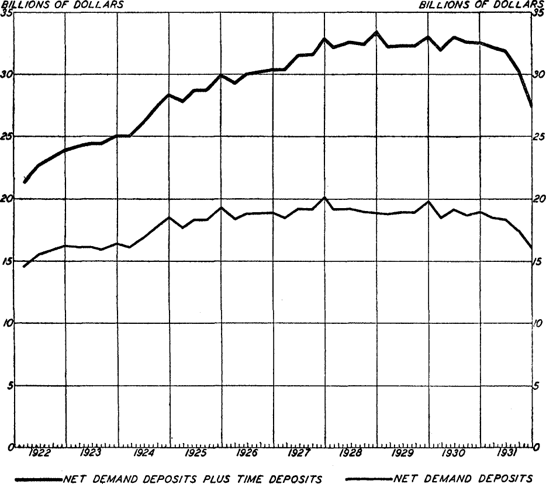
The same thing can be said, so far as the United States is concerned, of changes in the circulation of hand-to-hand currency. This would not be true of most countries, but bank deposits play so large a part in our economic life that there is no danger that an expansion of cash will result in disturbance of the equilibrium of production and consumption, unless there is also an undue expansion of bank deposits. Control of the volume of the note circulation is not an objective of credit policy; on the contrary the amount of notes used constitutes one of the conditions which determine the amount of Reserve credit that is needed. Thus the decline of hand-to-hand currency circulation which took place between the end of 1923 and the end of 1929 called for a corresponding contraction of Reserve credit, if the System was to hold itself neutral toward the money market. For this decline in currency in no way tended to create a shortage of funds; it was simply a change in the amount of currency which the business of the country required.
If these conclusions are accepted, it follows that the Reserve system can fairly be held responsible, within the limits of its powers, for the amount of change in member bank deposits which occurred during the period of our study.2 Changes in monetary circulation and changes in the proportion of deposits of different classes and in the proportion of deposits held in banks with different reserve requirements were not factors which should have been allowed to determine the volume of bank reserves; they were only factors determining the amount of change in Federal Reserve credit which was necessary in order to support a given volume of bank credit. The business of the Reserve system policy was to decide the total of member bank credit that was needed, and then adjust its own credit to the situation created by changes in these other items.
II. THE AMOUNT OF CREDIT WHICH A COUNTRY NEEDS
Any decision as to whether the credit supply is growing at the proper rate involves determination of the fundamental principles which should determine a central bank’s credit policy. Aside from the views of the few remaining advocates of laissez faire3 and those of the moderate expansionists,4 theories of the proper test of central bank credit policy fall into four main groups. These are: (a) the widespread advocacy of commodity price stabilization; (b) the suggestion of the stabilization of the value of the factors of production;5 (c) the doctrine of money market stabilization;6 and (d) the theory of neutral money.7
The last three types of theory are closely interrelated; indeed as I interpret them they come to practically the same thing. The doctrine of “neutral” money is simply that the allocation of the resources of society to the satisfaction of different wants should not be influenced by either the injection of new money into the processes of production and distribution or the elimination of money from them; that the market rate of interest should represent the free competitive price for the current volume of savings; and that disequilibrium results from any alteration of the money stream either by the creation of new money or by the abstraction of old.
It was pointed out in Chapter X that stabilization of the value of the factors of production is in effect stabilization of prices against all changes which result from monetary causes. This is really an attempt to keep the money “neutral” by watching certain prices which are free from the effects of changes in production technique in order to detect the effects of excessive or deficient money. A policy of stabilizing the money market against abrupt changes is also approximately a neutral money policy, since the causes of disturbance in the short-term money markets are either sudden changes in the money supply or else are substantially identical with the conditions which cause a neutral money supply to diverge suddenly from a stationary money supply.
I am in complete accord with the neutral money principle. I am inclined, however, to interpret the grounds for positive action on the part of the central banking system under this principle more broadly than the doctrine may seem at first thought to justify. Neutral money must not be identified with unchanging money. For it is clear that a money supply which for a given population is just adequate to effect the customary volume of exchanges and provide the customary volume of pocket and till money may become either redundant or inadequate, and hence in effect an unstabilizing factor, because of changes in the size of the population, in the amount of currency hoarded, in the relative popularity of checks and cash, or in public opinion concerning the outlook for a financial catastrophe or a financial millennium. Central bank activity which is designed to facilitate the readjustment of the supply of currency and credit to such changes must be regarded as wholly consistent with the maintenance of neutrality. And, as was indicated in Chapter X, changes in money which are designed to stabilize the prices of the factors of production are efforts to maintain the neutral character of money by permitting those changes in price levels which result from changes in the technique of industry, while preventing those changes which arise from the failure of the money supply to maintain its neutral character.
The clearest case is that of the seasonal fluctuation. Here the Federal Reserve system has adopted a consistently passive policy,8 and the results have been wholly satisfactory. It seems to me quite clear that in any country where there is a pronounced seasonal swing in the volume of credit or currency used in production and trade, the currency system can be made more truly neutral, and less susceptible to shock and strain, by a deliberate adaptation of the supply of credit to this seasonal change in demand.9 Likewise, a sudden increase in the demand for cash, such as occurred in the United States and in many other countries in the fall of 1931, if there is no adaptation of the supply of money, will make the actual supply less adequate and will operate just as would a direct withdrawal of cash under more normal conditions.
The proper treatment of cyclical fluctuations in the demand for funds presents a knottier problem, and one on which it may be wiser to suspend judgment until we understand better the nature of the business cycle, for a critic who has no panacea need not hasten to speak in a time like the present. The Federal Reserve system, in common with most other central banking systems, is definitely committed to the view that its duty is to try to stabilize business by making it artificially easy in periods of depression, and until a more promising remedy is brought forward it is certain that there will be extensive experimentation with the possibility of reviving business by cheapening money.
Although, as was indicated in Chapter V, I am extremely pessimistic as to the practical value of such expedients, I believe that they are theoretically consistent with the principles of neutrality of the money supply toward the rest of the economic order. A depression is characterized, among other things, by an accumulation of private unspent balances in the form of notes and of slow-moving bank deposits. These “hoards” are created by withdrawals from active circulation of cash and of deposits which would otherwise be offered for goods.10 Prices fall and production is curtailed because this demand for new savings in the form of cash and bank deposits involves a corresponding curtailment of money demand for goods in the flow of trade. If this is true, then it is a neutral rather than an inflationary policy for central banks to expand credit enough to offset the withdrawal from active circulation of funds which are tied up in the expanded “savings” deposits. The difficulty is, as was indicated in Chapter V, that the new supply does not necessarily replace what has been withdrawn from active use; it may simply augment the inactive hoards of cash and bank balances.
Likewise in times of unusual optimism it is a neutral, not a deflationary, policy for central banks to contract their credit operations so as to offset the effects of the boom spirit in bringing cash out of hiding and in shifting deposit accounts from the category of idle reserves into that of funds actively pressing on the market for goods. The difficulty here is to identify the situation which calls for restraint.11
An equally difficult question relates to the secular trend of the total volume of member bank deposits. Was the increase in bank credit between 1922 and 1930 too great to be absorbed by the normal increase in the volume of reserves needed to meet the demand for pocket money, service balances, pay rolls, and so on?
Professor Edie believes that a trend line of 4 per cent per annum is a norm for the growth of need for credit.12 By applying this criterion to demand deposits alone he shows that for the years 1922-27 the trend of credit growth was approximately that of credit needs, while after the beginning of 1928 deposits fell far below the norm.13 However, if this test is applied to bank loans and investments14 or to net demand plus time deposits (which are the principal offsetting items to loans and investments), it appears that the growth of member bank credit was far more rapid than the growth of the need for credit until the policy of repressing the stock market became effective in 1928 and 1929.
B. M. Anderson argues that the growth of credit was excessive, using detailed comparisons of the growth of credit with the composite indexes of trade and transportation.15 The argument of the price stabilizationists that prices did not rise is answered by pointing to the advance in technology which would have produced a much sharper decline of prices if there had been no credit inflation; and also to the rise of security prices and of real estate.
The issue cannot be disposed of with finality. The argument from falling prices is wholly inconclusive, for it seems certain that the price level would have fallen in relation to an ideally neutral money. The suggestion that credit should grow with the trend of business is probably inflationary, and in any case cannot be applied merely by a comparison of the growth of trade and the growth of deposits. Bank deposits and bank currency are not identical, though they are statistically indistinguishable. Bank deposits are only partly the money of the country; they are also a medium of investment, and until we know in what proportion bank deposits are held as medium-term investments, rather than as media of exchange, we have no clue to the proper relationship between the growth of deposits and the growth of trade.16 The line between time deposits and demand deposits clearly does not serve; many demand deposits are probably held as quasi-permanent investments. And even if we knew the relationship, we should have no assurance of stability, for bank deposits and money may change quickly from one category to the other.
In summary: the ideal solution of the credit manager’s problem is neutral money—that is, stabilization of the relationship between the supply of currency (including bank deposits) and the demand for currency, meaning by demand for currency not the turnover but the quantity of money and of bank deposits which the country is willing to carry idle in pocket and till money balances, operating funds, and “investment” deposits. Any injection into the currency of funds in excess of this amount means that the public is put in possession of purchasing power in excess of the funds which have been disbursed to the public as costs of production of goods which are coming on the market, thereby creating a temporary condition of ease in the short-term money markets, a fictitious appearance of abundance of capital for long-term investment, and to a less extent an artificial surplus of funds for consumptive expenditure. Vice versa, contraction of the volume of outstanding currency and bank credit, unless it coincides with a shrinkage in the real demand for cash and deposit balances, will have the opposite effects.
If the amount of purchasing power which the public will keep immobilized in the forms of till and pocket money, working funds, and deposits held as investments were itself stable, the maintenance of neutrality between the money supply on the one hand, and the absorptive capacity of the population on the other hand, would be very simple. In fact, however, the amount of purchasing power which the public is willing to keep immobilized is constantly changing; the task of credit control is to detect these changes and to vary the volume of outstanding Reserve credit so as to offset their effect. There is, however, no simple and dependable technique either for determining the volume of currency which would best meet the needs of the country, or for keeping the outstanding volume at that level.
The quantity of bank credit which a country “needs” is the resultant of a complex of forces. One is the simple growth of population. A second is the growth of per capita wealth and income which carries with it an increased demand for the luxury of an unspent balance. Third, there is a set of business changes which impinge upon the volume of bank balances needed to finance industry. Integration reduces the demand for bank money; specialization increases it. A fourth factor is the spread among banks of the practice of requiring service balances. Fifth, there are changes in the extent to which bank balances are used as a form of investment.
It seems evident that during the years 1922-29 there was a great change in the factor last mentioned, which reflected itself on the one hand in the enormous growth of time deposits, and on the other hand in an expansion of the investments of the banks. Whenever a bank buys a security and the former security holder takes time deposits in its place, the volume of bank credit is increased statistically, but there is no expansion in the sense which is significant for monetary policy in the ordinary sense of the term. Until we can segregate the investment from the currency element in the bank credit structure, statistics will throw little light on the question whether the flow of funds through the channels of trade has been unduly augmented.
In short, the volume of bank currency which was made available to the American public during the decade of our study cannot be shown to have been either excessive or deficient as measured by the long-run needs of trade, though it was clearly excessive in 1927 and deficient in 1929. The margin of uncertainty is wide and the actual results fall within that margin. There is no evidence that over most of the period the flow of goods from producer to consumer met a return flow of funds which was either unduly contracted or unduly expanded by the creation and liquidation of credit.
However, we can reach a more positive judgment by approaching the question from another angle. Inflation of the currency is not the only risk which inheres in the elasticity of bank credit. There is also the risk that the safety of the banks themselves will be impaired by too rapid a growth of their liabilities. The whole system of pyramiding a vast array of obligations which, technically or practically, are payable on demand, on a slender base of cash and an even slenderer base in the form of stockholders’ equity, placing dependence for solvency on assets which can only be liquidated by transfer or by wholesale destruction of monetary values—this whole system is inherently unstable, and its instability was evidenced in the decade of our study by an unparalleled record of bank insolvencies. This phase of the question is considered in Chapter XVII.
- 1The distinction between “banking policy” and “credit policy” is taken from Annual Report of the Federal Reserve Board, 1928, pp. 9-10.
- 2Compare pp. 132-40.
- 3This is, of course, in substance the position of the Banking School in the British banking controversy of the early nineteenth century.
- 4“. . . When increased credit demands can be met only by recourse to the Federal Reserve Banks, the volume of Reserve Bank lending is a sensitive indicator of credit conditions. . . .” (Federal Reserve Bulletin, 1923, Vol. 9, p. 411).
- 5Annual Report of the Federal Reserve Board, 1923, p. 10 (quoted below, pp. 79-80); Federal Reserve Bulletin, 1928, Vol. 14, p. 6.
- 6The omission of reference to price changes in the text is intentional and without prejudice. I believe that there is need of a thorough reexamination of the orthodox statement of the influence of gold movements on price changes and the extent to which in pre-war days changes in price levels were caused by gold movements and operated to check the gold movements.
- 7For fuller discussion of these points, see Chap. IX; compare also B. H. Beckhart, The Discount Policy of the Federal Reserve System, Chap. II.
- 8The cash balance carried in the United States Treasury was occasionally drawn upon to meet seasonal or crisis demands, either through the depositing of funds in banks or through the purchase of bonds by the Treasury, but the device was very crude and there was no continuity of policy in its management.
- 9Compare chart, p. 35.
- 10The possibility of temporary nullification of a central bank’s control through the mobilization of fresh resources is illustrated by an action of the Midland Bank, which in 1927 bought securities so heavily as to lower its own reserve ratio by several per cent. The amount involved was small enough so that the Bank of England was able to offset it. The net result was simply to increase the earning assets of the Midland Bank and decrease those of the Bank of England; not to ease the market.
- 11Compare p. 231.
- 12Annual Report of the Federal Reserve Board, 1927, pp. 10, 16.
- 13See pp. 104-05.
- 14Annual Report of the Federal Reserve Board, 1927, p. 11.
- 15The 4 1/2 per cent rate was charged on all maturities of less than 90 days, such paper making up the great bulk of the transactions.
- 16As reported by the New York Stock Exchange.

