
Credit Policies of the Federal Reserve System
VIII: The Reserve Board And The Stock Market: The Objectives of Control
CHAPTER VIII
THE RESERVE BOARD AND THE STOCK MARKET: THE OBJECTIVES OF CONTROL
In order to appraise the policies of credit restriction and credit allocation pursued by the Federal Reserve system during 1928 and 1929, it is necessary to examine with care both the utterances of Reserve officials and the actual performance of the Reserve Banks. Were the successive measures of credit restriction adopted in the interest of business stability, as this objective was stated in 1923-26; were they based on fears as to the safety of the outstanding loans of the banks; did they reflect merely a desire to protect the reserves of the Reserve Banks themselves; or was there an effort to protect the public from the direct losses which might one day result from a downward revaluation of popular securities?
Let us survey first the Federal Reserve Board’s own explanations of its policy. The annual report for 1928, though it devoted considerable space to credit policy, did not explain at all fully the reasons underlying the policies which had been adopted. The first relevant statement which we find is this: “Toward the end of the year [1927], however, in view of the rapid increase in the demand for credit from the security markets, these purchases [that is, of government securities] were reduced in volume and finally discontinued. . . . Early in 1928, when it began to be apparent that industry in this country was again active and that the emergency abroad had passed, the Federal Reserve system determined to exert its influence more actively toward firmer money conditions.” (Pages 3-4.) The report further points out (pages 7-8) that increased loans and investments of member banks, regardless of their purpose, result in the creation of additional deposits which in turn increase the demand for Reserve Bank credit. Therefore “excessive or too rapid growth in any field of credit” is a matter of concern to the Federal Reserve system. It is then shown in detail that in recent years the most rapid expansion of bank credit has taken the form of investments and loans on securities. “The proportion of bank credit that is based on securities has been rapidly increasing.”1
The annual report of the Secretary of the Treasury, which was released early in 1929, explained the restrictive credit policy as an attempt to curb speculation, but did not explain why such curbing was considered to be a duty of the Reserve Banks. This report said:
As it became apparent, first, that the objects of the policy originally adopted were being accomplished, and, second, that speculation was growing, the policy [that is the easy money policy of the summer and early fall of 1927] was reversed. . . . However, the action taken early in the year unquestionably was not effective with reference to speculation, partly due to the activities of powerful groups of speculators, and partly due to the fact that the public in general believed and acted as if the price of securities would indefinitely advance.2
A public statement issued on February 7, 1929, relative to “direct pressure,”3 developed the Board’s position more fully, as follows:
During the last year or more, however, the functioning of the Federal Reserve system has encountered interference by reason of the excessive amount of the country’s credit absorbed in speculative security loans. The credit situation since the opening of the new year indicates that some of the factors which occasioned untoward developments during the year 1928 are still at work. The volume of speculative credit is still growing.
Coming at a time when the country has lost some $500,000,000 of gold, the effect of the great and growing volume of speculative credit has already produced some strain which has reflected itself in advances of from 1 to 1 1/2 per cent in the cost of credit for commercial uses. The matter is one that concerns every section of the country and every business interest, as an aggravation of these conditions may be expected to have detrimental effects on business and may impair its future.
The Federal Reserve Board neither assumes the right nor has it any disposition to set itself up as an arbiter of security speculation or values. It is, however, its business to see to it that the Federal Reserve Banks function as effectively as conditions will permit. When it finds that conditions are arising which obstruct Federal Reserve Banks in the effective discharge of their function of so managing the credit facilities of the Federal Reserve system as to accommodate commerce and business, it is its duty to inquire into them and to take such measures as may be deemed suitable and effective in the circumstances to correct them; which, in the immediate situation, means to restrain the use, either directly or indirectly, of Federal Reserve credit facilities in aid of the growth of speculative credit.
Finally the annual report for 1929 amplified previous explanations in the following terms:
The year 1929 opened with total Reserve Bank credit outstanding in larger volume than in any year since the post-war crisis. Security loans of member banks and brokers’ loans had attained new peaks. Collateral indications derived principally from the intense activity of the securities markets and the unprecedented rise of security prices gave unmistakable evidence of an absorption of the country’s credit in speculative security operations to an alarming extent. There was nothing in the position of commercial credit or of business to occasion concern. The dangerous element in the credit situation was the continued and rapid growth of the volume of speculative security credit.
The measures taken by the Federal Reserve Banks in the year 1928 to firm-money conditions . . . had not proved adequate. The second half of the year 1928 witnessed an aggravation of the conditions that had called forth the firm-money policy of the Federal Reserve Banks in the first half of the year.
The credit situation confronting the Federal Reserve system at the opening of the year 1929, therefore, still stood in need of correction.4
The explanation of the policy followed in 1929 brings out a further item in the System’s set of standards to which reference had never been made before. The report stated:
. . . Loans to brokers by non-banking lenders, although they do not directly involve member banks, have nevertheless an effect on the banking situation, both because the banks are aware of the necessity of taking over such loans in case an emergency develops and because their existence and employment results in a much more active use of bank deposits.5
We may now summarize the standards which were stated to have determined the policy of the Reserve Board in 1928 and 1929:
1. The Board definitely abandoned the idea that the responsibility of the Reserve system’s management is solely for the amount of credit outstanding, not for the use made of it by member banks. Several Reserve Banks, including New York, clung to the earlier doctrine.
2. It was decided, or assumed, that the effect of stock market lending is to curtail the credit available for other purposes. There is not even a reference in Reserve system literature to the doctrine held by prominent European students that the stock market is only a channel through which credit flows without seepage to its industrial or commercial use.6
3. In 1928 the principle was laid down for the first time since the era of war-time controls that it is the business of Reserve management to see to it that no line of activity gets more than its share of the credit resources of the Reserve system. No general test for the determination of the fair share of any interest was set up, but it was clearly implied that any sharp change in the proportions going to different uses is presumptive evidence that some interest is getting more than its share. It was stated, indeed, that stock speculation was not entitled to any share, but no real effort was made to keep all Reserve credit from speculative uses. Such an attempt would have meant cutting the stock market off from all member bank credit, since all member bank credit rests on Reserve credit.7
4. In 1929 the principle that the stock market should not have access to Reserve Bank credit, or to more than its share of it, was broadened so as to apply to its use of credit obtained from other than banking sources. The situation was deemed not to have been corrected early in 1929, though member bank security credit was not expanding, because the stock market was now getting credit from other lenders.
5. As a practical matter, though not in theory, the Board assumed responsibility for the volume of stock trading and the level of stock prices. In the statement of February 7, 1929 it was said that: “The Federal Reserve Board neither assumes the right nor has it any disposition to set itself up as an arbiter of security speculation or values.” Similar statements were frequently made by Reserve officials.8 But the course actually followed by the Board and the Reserve Banks in 1928 and 1929 differs only in name from an attempt to set the System up as an arbiter of security values. It makes little difference whether the objective is to correct stock market values and reduce stock market activity or only to correct credit conditions, if stock market values and stock market activity are made the chief test as to whether credit conditions are in need of correction. And this seems to be a fair statement of what was actually done. Not only does the Board cite “collateral indications derived principally from the intense activity of the securities markets and the unprecedented rise of security prices” as evidence of absorption of the country’s credit by the stock market, but it admits that at the end of 1928 there was “nothing in the position of commercial credit or of business to occasion concern.”
The money market did not show evidence that speculation was absorbing credit which was needed elsewhere. The only evidence ever cited by the Reserve system in support of its conclusion that security speculation was absorbing an undue proportion of the country’s credit, aside from the fact that the volume of security loans and of brokers’ loans, the prices of stocks, and the turnover of stocks were breaking previous records, was found in the movement of interest rates. The statement of February 7 sets forth the view that “the effect of the great and growing volume of speculative credit has already produced some strain which has reflected itself in advances of from 1 to 1 1/2 per cent in the cost of credit for commercial uses.” This was a most surprising statement, since Federal Reserve policy had been vigorously directed for more than a year to the end of bringing about just such a rise in money rates. Since the System’s portfolio had been “practically exhausted by the sales made in the first half of 1928,”9 discount rates had been raised to 5 per cent at eight Banks, and strong “moral suasion” had been exerted against continuous borrowing, it would have been strange if open market interest rates had not advanced, regardless of whether the stock market got more or less than its share of credit.
The sequence of changes in Reserve policy and changes in money rates in the open market, shown in the chart on page 155, supports the conclusion that the tightness of the money market in 1928 and 1929 was due to Federal Reserve system policy rather than to stock market activity. In 1926, after years of stock market activity, money was not dear. It became cheap in response to Reserve system policy in 1927, and became progressively dearer as the Reserve system’s policy became more restrictive in 1928 and 1929. Every Reserve Bank advanced its discount rate to 4 per cent in late January or in February 1928, and to 4 1/2 per cent in April or May; in June and July the rate at eight Banks went to 5 per cent.
Discount Rate at New York, Security Holdings of Reserve Banks, and Commercial Paper Rate, 1928-29
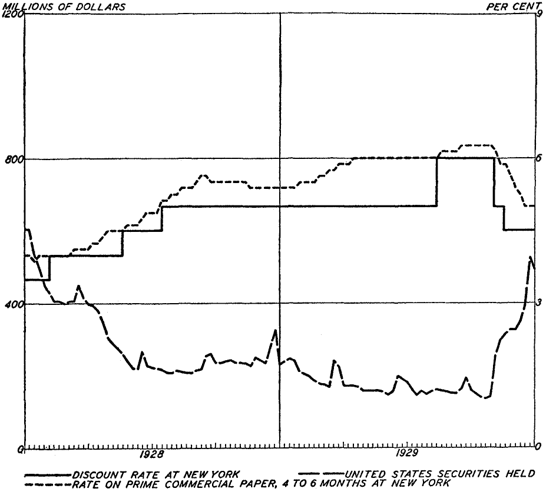
Reserve Bank holdings of United States government securities fell steadily and rapidly from 606 million dollars in December 1927 to 213 million dollars in July 1928. At first this decrease was merely the liquidation of abnormally large holdings accumulated late in 1927, but from May for more than a year the portfolio was considerably smaller than it had been since the early spring of 1924. Open market interest rates responded promptly to this change of policy. In January and February 1928 commercial paper rates ranged slightly below those charged a year before;10 in March they were at about the same level as in 1927; in April and May they were a shade higher; and from June on they were higher than they had been at the corresponding season since 1920. Other open market rates showed a similar tendency. Call loan rates advanced steadily, and from May on averaged higher than at any time since 1921. Time collateral loans showed the same trend. Rates charged over the counter in New York responded more slowly, but from June on were definitely above those of recent preceding years. There is an obvious parallelism between the advance of Federal Reserve discount rates and the reduction of holdings of securities on the one hand, and the advance of market rates of interest on the other hand.
In 1929 Reserve system policy became still more restrictive; the policy of eliminating open market holdings was extended to acceptances as well as government securities; rates were advanced to 6 per cent in those Banks which had a lower rate, and rediscounts were refused to banks which would not co-operate in the policy of starving the stock market. In spite of gold imports member bank reserves showed an actual decline. Money rates responded by a further very sharp advance.
The Reserve Board’s treatment of brokers’ loans on account of other than bank lenders did not reflect a whole-hearted desire to conserve credit for commerce
and industry. So far as the purpose was to conserve credit for the need of trade and not to correct security values, an increase in the non-banking loans should have been greeted with hallelujahs. For whenever a broker borrowed from an individual or corporation in order to pay off a loan at a bank, total deposits were reduced, and the necessary volume of bank reserves was therefore also reduced.11 Reserve credit was thus freed to support other credits for industry and agriculture, if there was a demand for them. And if the total volume of brokers’ loans increased because a broker borrowed from a corporation or individual, not in order to pay off a bank loan but to increase the total amount of funds at his disposal, there was no increase of bank deposits or decrease of reserves; hence there was no impairment of the lending power of the banks.
Nevertheless the attitude of our Reserve system toward this new credit system was one of suspicion and hostility. After the drastic liquidation of October and November 1929 the Board said:
Although there has been an increase in the volume of bank credit, as the banks have taken over loans of non-banking lenders, the total volume of funds used in the money market had decreased by a large amount and the general credit situation had been improved by the liquidation of these loans.12
The annual report for 1929 (page 7) gives two reasons for the Board’s interest in loans by “others”; first that loans to brokers have an effect on the banking situation because the banks are aware of the necessity of taking over such loans in case an emergency develops, and second that the existence of such loans results in a much more active use of bank deposits.13 Of these points the second was not at this time developed fully enough to be clear. More active use of bank deposits was certainly not in itself an evil to be corrected nor was it shown that it carried with it any undesirable consequences.14 The first point, namely that loans by non-banking lenders constitute a virtual contingent liability to the banking system because “the banks are aware of the necessity of taking over such loans in case an emergency develops,” is worthy of consideration. It is a new doctrine, the traditional banking theory being to the effect that when there is a conflict between commercial demand and stock market demand the stock market always has to give way. Undoubtedly, there is some force in the new view. The banks, including the Reserve Banks, did feel a certain responsibility to support the market when necessary by taking over these loans (though the commercial banks did not keep any unused margin of reserves for this purpose).
When the stock market collapse came it was in fact accompanied by a very large shifting of loans from “others” to banks. Loans on securities by reporting member banks jumped from 7,632 million dollars in the first week of September 1929 to 8,746 million in the first week of November, and brokers’ loans by domestic banks rose in one week from 1,077 million to 2,069 million. Offsetting this latter expansion there was a shrinkage of 1,400 million dollars in loans “on account of others.”
This shifting process, however, did not involve a tightening of the market and did not result in compulsory liquidation. The New York banks had already pegged the call loan market at 6 per cent and this rate was not advanced. Moreover, and more important, credit was available for everyone who had collateral. In previous panics margin speculators had been sold out because loans could not be obtained to carry them; in this panic many were sold out because margins were exhausted by the decline in the value of their collateral, but those who were able to keep their margins good were able to get credit throughout the panic period at rates much lower than had been quoted a few months before, while the market was booming.
How were the banks able to take over the load of loans on account of “others” without a credit strain? Partly by the support of the Reserve system. As has just been indicated, the Reserve Banks made very large open market purchases. From September 30 to October 31 the reserves of the member banks were increased in this way by 340 million dollars, or 14 per cent, which is several times as rapid an increase as had ever been recorded previously. When the non-banking lenders called in their enormous loans to brokers, they did not hide the proceeds away in cash in the corporate equivalent of a chimney corner. They did one of two things: they bought securities or they deposited the funds in banks. In the first case the need for brokers’ loans disappeared along with the loans themselves; in the second case the banks were put in possession of funds to lend to brokers and other security holders, but additional reserves were needed to support the additional deposits. The relative extent of the two processes is indicated approximately by the following figures: From October 2 to October 30 reported brokers’ loans on account of non-banking lenders shrunk by 1,443 million dollars; while brokers’ loans on account of banks expanded by only 177 million. Total security loans of reporting member banks expanded by 1 1/2 million dollars, while total deposits of reporting member banks expanded in the same period by 1,858 million.13 To support this increased volume of deposits it was necessary merely to release again the Federal Reserve credit the impounding of which led to the original creation of the loans on account of “others.” Federal Reserve credit expanded between September 30 and October 31 by 272 million dollars, considerably less than the amount by which it had been contracted in the single month of January 1928.
To what extent the outside lenders withdrew in panic and threw the burden on the banks, to what extent the shrinkage was due to withdrawal of loans by investors who wished to take advantage of the lower level of stock prices to make purchases, how far it was due to lowering of call loan rates, and to what extent it was merely a nominal change arising out of relations between banks and affiliated companies it is impossible to state. But it is certain the outside lenders did not withdraw their money from the market until concerted action by the New York banks lowered the rates below those which had originally attracted the outside lenders into the market. This fact makes it impossible to appraise the claim that loans “on account of others” present a dangerous element of instability. There is no doubt that the private lenders are easily driven out by falling interest rates, but falling rates are themselves an evidence of the ability and willingness of the banks to take over the load. They are not the evidence of an emergency. It is impossible, therefore, to base a valid conclusion on this experience as to how outside lenders would behave in an emergency great enough to justify the payment of emergency rates. Undoubtedly the supply of non-banking credit is elastic; that it is undependable has not yet been demonstrated.
We turn now to an appraisal of the objectives of Reserve system policy which, as we have noted, were common to both parties to the internal controversy. Did the Reserve system for these two years operate on a sound theory of the proper aims of central bank policy? We shall consider first the purpose which has been emphasized throughout the period; the safeguarding of the credit resources of the country against absorption by the speculative markets.
The theory that stock market speculation tends to curtail credit for other purposes has given rise to much controversy. With reference to the effect of stock market loans on the ability of the banks to make loans for other purposes, there is a wide divergence of opinion among students of economics. At the one extreme stand a group of bankers and scholars, mainly European, who contend that stock market loans absorb no capital whatever; at the other extreme are those who contend that the extension of a loan by a bank to a broker means a corresponding curtailment of the ability of the banking system to meet the needs of the commercial and industrial community.14
The first position was stated clearly by Professor Cas-sel at the hearings on the Strong bill and has been developed by him more fully in numerous writings. He has stated the doctrine as follows:
. . . we shall repeatedly come across statements to the effect that the loans to the New York Stock Exchange have withdrawn money from productive uses. We find bitter complaints that industry and agriculture have thus been deprived of working capital. It has also been contended that the large demands of the Stock Exchange have forced up the rates of interest on capital for productive purposes. And hopes have been expressed that it will eventually be possible, by restricting credits to the Stock Exchange, to cause speculation to collapse and thus release capital for productive uses.
This whole view is in reality devoid of any foundation. If the New York member banks increased their loans to the Stock Exchange, in round figures, from three milliard dollars in July 1927 to four and a half milliard dollars in June 1928, this by no means signifies that the enormous sum of one and a half milliard dollars has been withdrawn from industry and commerce. Viewed in the rough, what has happened is merely this, that speculators have borrowed one and a half milliard dollars in order to buy securities on the New York Stock Exchange, but that exactly the same sum has gone to the sellers of those securities, and has thus been placed at the disposal of the real capital market.15
And again as follows:
To begin with, it should be possible for all of us to agree on the following simple propositions:
1. If a new buyer of shares has appeared and has bought part of the stock of shares without any rise in price, and if he has paid for the shares solely out of his own resources, the Stock Exchange will not have absorbed any capital from outside, and the supply of capital in the country will remain as before. The buyer has indeed withdrawn capital from other uses, but the same amount of capital will have gone to the seller, who will invest it in industry or commerce, or, at all events, outside the Stock Exchange. If this transaction is repeated any number of times during the year, the result is bound to be the same. Thus it will make no difference whether in the course of the year any seller has appeared also as a buyer.
2. If a new buyer of shares has borrowed part of the necessary capital, this will not materially alter the position. The only difference is that the capital has been supplied by a larger group of persons; but the entire capital will have gone to the sellers, who will return it to industry and trade.
3. If the aggregate price of the shares has risen by a hundred millions, but if no shares have changed hands, the holders of the shares will not have withdrawn any capital from industry and commerce. True they now possess a larger capital than before, but this accretion of capital has been obtained in virtue of the rise in the value of the shares. Or, to invert the proposition: A larger amount of capital is indeed now required in order to hold the entire stock of shares, but the additional capital needed has been obtained by the holders through the actual rise in the price of the shares, and thus no capital has had to be withdrawn from other sources.
It has thus been established that no drain on capital is involved by the appearance of new shareholders, nor by the borrowing of money for the purchase of shares, nor by a rise in the price of shares. But, if none of these three factors entails the withdrawal of capital from industry and commerce for investment in shares, it follows that no combination of these factors can have that effect. Thus, if at the end of the year the entire stock of shares had passed into the hands of new holders, and if, in order to acquire it, they have borrowed a certain amount of capital, so that they are in debt to that extent, and if moreover the value of the stock of shares is greater by a hundred millions than at the beginning of the year, all these changes taken together cannot have entailed the withdrawal of any capital from industry and commerce. Thus the amount of capital available for industry and trade will at the end of the year be precisely the same as though these changes had not taken place.16
At the other extreme stands the view of Dr. B. M. Anderson who says, in connection with the passage from Professor Cassel’s writings first quoted above:
This argument is shot through with fallacies. An increase in commercial bank loans, of whatever kind, whether stock market loans, commercial loans, real estate mortgage loans, or loans of any other kind, tends to reduce the ability of the banks to make other loans, and tends to raise rates of interest to other borrowers. The point is that when a bank makes a loan, it must either pay out cash from its reserves, reducing its ratio of reserves to deposits, or else increase its deposits, which again reduces the ratio of reserves to deposits, though at a less rapid rate. With declining reserve ratios, interest rates rise. Stock market loans have precisely the same effect here that any other loans have. Interest rates in the United States today would undoubtedly be a great deal lower for all purposes than they now are if four or five billion dollars of deposits were cancelled in the process of liquidating four or five billion dollars of bank loans against securities.17
There are several distinct factors involved in a stock market boom, and the apparent conflict between Cassel and Anderson reflects chiefly a concentration of interest on different factors, rather than a difference of opinion as to what actually takes place. Professor Cassel’s argument is correct, in so far as it relates to the increasing turnover of old shares and the changes in the prices at which transfers take place. These changes do not of themselves withdraw any funds from industry. Nor is the case necessarily altered by the fact that buyers operate with borrowed money. Whatever credit is absorbed at one point is released at another point by payment for securities. The seller may use the money to finance his own business, or to pay off unsecured loans, or he may lend it to individuals who would otherwise themselves have become bank borrowers.
Similar considerations apply to the floating of new stocks. Stock market securities are merely evidence of the ownership of the capital of going industries. When a share of stock is first sold the issuing corporation gets the same amount of capital no matter whether the stock is bought by an investor out of savings or by a speculator who borrows the funds from someone else. And obviously it is no more likely to hold funds idle in the one case than in the other.
So far Professor Cassel is right. There are, however, two ways, not taken account of in this analysis, in which a stock market boom might “absorb” funds. One is the increased use of funds by brokers and speculators in financing the actual turnover of securities; the other is the creation of new deposits which remain idle in the hands of sold-out investors who believe that securities are over-valued. Both these points have to do solely with the effect of the boom on the volume of deposits which the banking system has to support; neither has anything to do with the volume of payments effected by these deposits.18 So long as the volume of reserves required is determined by the volume of deposits outstanding, the effect of the stock market boom on the supply of bank credit must be viewed in terms of its effect on the volume of deposits; only confusion results from attempts to relate the problem directly to the volume of payments to be effected.19
At first glance it would seem obvious that either an increased physical volume of stock market trading or an unchanged turnover of stocks at rising prices would require the maintenance of larger average cash balances on the part of both brokers and their customers. This is admitted by Professor Cassel in the following passage:
. . . The theory that the Stock Exchange absorbs capital must purport that the speculators pile up balances on current account to such a height that, in the last instance, the central bank has to increase its gold reserve. This reserve constitutes, however, only a small percentage of the banks’ total sight deposits. The possible increase in the demand for gold is in any case of a totally different magnitude than the demand for capital to which allusion is made when people speak of the Stock Exchange and its absorption of capital.20
This statement is not consistent with Professor Cassel’s sweeping denials that stock market loans absorb any of the lending capacity of the banks, and moreover gives a misleading picture of the situation. The point at issue is not merely whether a central bank has to increase its gold reserves, but whether member banks have to replenish their reserves by using more central bank credit and as a result are led to pursue a more restrictive credit policy. If a central bank follows the established tradition of carrying a surplus reserve to enable it to exercise discretion in its operations, the pressure on the commercial banks normally begins before the central bank has to import gold.
Practically, however, the point is of no consequence, at least for American conditions, because the turnover is so high and so elastic as to make the necessary amount of brokers’ deposits vanishingly small. Payments for stock are made largely by morning loans which are paid off during the course of the day. Longer loans may have to be made to pay for the net balance of stock delivered to brokers who have bought more than they have sold. But the funds paid over on a given day to a broker who has sold more stock than he has bought for that day’s settlement will be used to pay off his carry-over loans or those of others, so that as a rule the whole expansion of the deposits resulting from the morning loans is cancelled before the close of business and does not appear on the banks’ reports of deposits at the close of the day. There is no theoretical limit to the volume of business which can be supported by a given volume of reserves, if substantially everything is liquidated each day before the banks’ statements are made up. As service balances required of brokers do not vary in proportion to their loans, as is customary with commercial loans, there is no theoretical necessity for brokers to increase their average balances as their turnover goes up. And in fact brokers’ deposits do not, unless in periods of very slack business, represent more than an insignificant percentage of the amounts turned over through them.21
As to speculator’s balances, statistical information is lacking. Reisch has made much of the lag in the flow of funds through the stock exchange mechanism, suggesting that balances obtained by the liquidation of securities may remain in the stock exchange circle for long periods of time, passing from one hand to another.22 There seems to be no reason, however, why speculators should suffer the loss of interest involved in carrying large balances, even for short periods of time. Large sums can be loaned in the call market, and most speculators whose operations are not large enough to make the call market interesting carry their working balances on the books of brokers rather than of banks. Any tying up of reserves involved here must be insignificant.
Reference was made above to a second way in which a stock market boom may throw an increased load on the banks, and lessen their capacity to finance industry and commerce. This is through its tendency to encourage an indirect type of financing in which instead of investors owning stocks directly, the real investors carry bank deposits and the banks either own the securities or carry them as collateral for loans to speculators. The greater the proportion of this indirect investment the bigger is the body of bank reserves needed to finance a given volume of industry and trade at a given price level.23
Let us consider first the old securities. If the whole mass of securities which represent the country’s productive resources were owned substantially outright by investors who did not borrow from banks in order to carry their holdings, all the existing bank reserves would be free to support the deposits arising out of commercial and industrial working capital loans and none would be required to support the investment structure. If in this situation part of the securities are sold either to banks or to speculators who carry their holdings on bank credit, the former owners must take newly created bank deposits in exchange. They may decide to use these new deposits in industry or lend them to those who would otherwise be applicants for bank loans, but they may not. If they do not, part of the bank reserves will be tied up in support of these investment deposits, and the supply of bank credit for other purposes will be correspondingly curtailed.
The case of the new security issues is similar. If new issues are bought by investors who pay for them out of savings there is no net increase in deposits and consequently no load is thrown on the banking system; but if the new securities are taken over directly or indirectly by the banks, and those who have done the saving keep their funds in the banks, then reserves are tied up. Anything which increases the proportion of investment which takes the form of bank deposits—time or demand—decreases the total capacity of the banks to furnish funds for other than investment purposes.24
So far, however, our conclusion relates only to the effect of speculative carrying of stocks on bank loans as compared with outright purchase by investors. It remains to inquire whether this conclusion has any relation to stock market activity. Neither a rise in stock prices nor an increased turnover of stocks necessarily means that bank credit is used to carry any larger volume of stocks than before. A priori we should expect, however, that a major rise in the prices of stocks will be accompanied by increased resort to banks to finance the holding of stocks, and observation confirms this.25 The number of corporation stockholders increases in times of stock market depression and decreases in times of boom, which probably means that an increasing proportion of the stock passes, in times of lower security prices, into the hands of nonborrowing investors.26
This conclusion is confirmed by data published by the United States Steel Corporation concerning the percentage of its common stock which is registered in brokers’ names. The data are as follows:27
| Year | Percentage of Stock Held by Brokers |
|---|---|
| 1913 | 51.48 |
| 1914 | 46.73 |
| 1915 | 45.87 |
| 1916 | 55.08 |
| 1917 | 51.88 |
| 1918 | 43.22 |
| 1919 | 40.65 |
| 1920 | 30.65 |
| 1921 | 22.45 |
| 1922 | 24.36 |
| 1923 | 22.76 |
| 1924 | 22.97 |
| 1925 | 26.31 |
| 1926 | 28.01 |
| 1927 | 26.23 |
| 1928 | 23.69 |
| 1929 | 23.85 |
| 1930 | 18.84 |
| 1931 | 14.12 |
Though the most conspicuous thing about the figures is their downward trend, there is also some tendency for the holdings of brokers to increase in times of stock market enthusiasm.
The conclusion seems justified that one effect of a stock market boom is an increase in the proportion of the country’s investment securities which is carried in the banks. The resultant increase in the use of deposits for investment purposes is the most plausible explanation of the discrepancy between the growth of bank deposits which occurred in this country between 1921 and 1930 and the contemporaneous movements of commodity prices and the volume of trade. The new balances were not currency deposits;28 they were investments held by those who considered it better business to sacrifice current income for the sake of a more advantageous purchase at a later time. Such an increase even in the form of time deposits does necessitate higher bank reserves to carry the same volume of investment and could theoretically be of importance in cramping the expansion of trade. Anderson is right to this extent, and Cassel is wrong.29
It is to be emphasized, however, that there is not the slightest evidence that there was any serious locking up of deposits in speculation in 1928-29. Until well on in 1929 the growth of reserves was ample to keep pace with both the demands of industry and those of the investment market, as is evidenced by the lack of tension in the commercial paper and other short-term money markets. Because of the ease of flotation of stocks, many corporations were paying off their bank loans; the demand for short-term credit was contracted quite as much as the supply.30 Short-term money remained cheap until 1928 when the Reserve system deliberately curtailed available reserves in order to tighten the money markets and check the stock market boom. Even then there was little evidence that business activity was adversely affected. The rate of production and the rate of employment rose in the first half of 1929. The credit pinch was felt much less here than in foreign countries from which gold was being drawn by the high rates offered for credit in New York.
Brief consideration may be given to, the other arguments mentioned at the beginning of this chapter, which have been advanced by critics in justification of a restrictive policy though they have not been cited as standards by the Board or the Reserve Banks. These include, first, the impairment of the security behind bank loans from an over-valuing of stocks; second, the desirability of curbing speculation on account of its immoral character; third, prevention of the individual losses which attend a collapse and the depressing effect on trade which follows from such losses; and fourth, the direct effect of over-speculation in creating a trade boom by making long-time money abnormally cheap and by stimulating extravagant buying on the part of successful speculators.
The first and second of these points need not detain us long. From the standpoint of safety, speculative security collateral loans have proved themselves admirable bank investments. Their liquidity in ordinary times is excellent; in extraordinary times any type of loan is likely to freeze up.31 The facility with which bank officers can check up on the value of the collateral makes it easy to safeguard such loans. The danger of loss on account of a sudden collapse of values or drying-up of the market necessitates care in requiring an adequate margin, but it is easier to enforce the requirement that a margin shall be kept good with this class of loan than with any other. Even during the drastic liquidation period of 1929-31, call loans and time collateral loans on stock market collateral involved little loss to the banks.
The traditional hostility of this country to speculation on moral grounds has been a source of some pressure toward repressive action but has never been acknowledged by Reserve authorities as a guide to their policies, and probably has been of little real influence. The terms “speculation” and “legitimate business” are constantly used in antithesis, especially in Congressional debates and hearings. It is very widely assumed that any policy which minimizes the facility of speculative operations tends to support the foundations of morality.
The negative attitude of the Reserve system toward this argument seems to me correct, not because the moralists are 100 per cent wrong32 but because the question involves a balancing of social values which is not a proper task for an administrative body. The issue is legislative in character. If the net balance of social advantages and disadvantages is against the stock exchange, the proper line of attack is either to prohibit security trading, or to make stock speculation more difficult and expensive.
There is no assurance, however, that such measures would interfere with the undesirable more than with the desirable features of the trade. In any case, the formulation of public policy in regard to speculation is the task of Congress and of the state legislatures. It is no part of the task of credit control to remodel our business life by attacking an institution with which the legislative authority, after repeated investigations, has so far declined to interfere.
Many critics have made the point that speculators who sell out on rising markets increase their consumptive expenditures. Complaints on this score rest on a fact of observation, namely, that certain types of expenditure are stimulated by the cashing in of profits on rising stock markets. It does not appear obvious, however, that this is a procedure about which there need be any alarm. The whole end and aim of the economic process is consumption. Complaints that a particular economic development is enabling individuals to expand their consumption are only significant if it can be assumed or proved either that the pre-existing allocation of our social income between consumption goods and production goods is ideal, or that the ideal proportion of consumption to savings is being exceeded. This seems by no means axiomatic.
As to the dangers inherent in the over-valuation of securities, the only way in which any administrative body could exercise supervision over stock values would be to assume that past precedents will govern in the future. Any one can tell when prices are at an unprecedented height—no one can tell how long they will stay there. Earnings and dividends we know something about, but the rate at which the public is willing to capitalize those earnings and dividends no one can predict. For many years the element of safety in bonds was so over-valued that buyers of stocks on the whole came out better than buyers of bonds and buyers of second-grade bonds came out better than the buyers of first-class. Most stocks now seem to have been over-valued in comparison with other investments at 30 times earnings, but relative overvaluation is no proof of instability. Before the war, Iowa farm lands were capitalized on the basis of 40 times rents, and stayed at that level for years.
There are only two lines of argument in defense of the Reserve system’s attack on the Stock Exchange which seem to me at all forceful. One of these is the fourth consideration suggested above, namely, that the security boom was, or threatened to become, the generating factor in a dangerous industrial or commercial boom. If excessive optimism expresses itself through a stock market boom, with the result that corporations are able to float an excessive volume of securities and thus obtain funds derived from an expansion of bank credit, the checking of the boom may turn out to be the sort of service which the Reserve system all along had held itself responsible to perform. If a stock market boom was the channel through which credit inflation was taking place, the maintenance of a sound credit situation would justify the checking of such a boom, though there would be so much the less argument for “direct pressure” to keep the effect of credit restriction localized in the Stock Exchange.
However, it seems reasonable to assume that if a stock market boom is enabling business to finance a boom by an expansion of bank credit, transmitted to industry through the stock market channel, evidence of that fact ought to be found in the commodity markets and in the operations of industry. It is hardly safe to assume that, because stock prices are soaring, an excessive volume of investment, financed indirectly by bank credit, must be taking place.
The other legitimate ground of apprehension in connection with the boom concerns the effect of the growth of security loans and investments on the total volume of bank credit outstanding. Even though the deposits which were created on account of these assets were of the nature of investments rather than of currency, they increased the economic area subject to shock, and probably operated to intensify the depression of 1929-31, though they did not cause it. We consider this question more fully at a later point. Here it is sufficient to say that if the tendency to an expansion on the part of the banking system was dangerous—and I believe it was—the procedure was not to attack the stock market, but to bring pressure to bear upon the banks to decrease the volume and the proportion of their security holdings.33
In my judgment, the case for the campaign against speculation was weak. It is easy now to see the evidence of over-optimism in the judgment of those who made the stock prices of 1929—though today’s appraisals may look just as absurd three years hence. And it is easy to make the stock market boom the scapegoat for all the ills we have suffered since. But this is all post-rationalization, and is rooted in our ignorance of the forces that make one year briskly prosperous and another hopelessly depressed. There was no evidence in 1928 or 1929 that business and agriculture were suffering from the competition of the stock market—there was only apprehension that such suffering might ensue.
There was no evidence until late in the spring of 1929 of the existence of an unsound credit situation, if the soundness of the credit situation was judged by the standards set up in the Federal Reserve Board’s report for 1923 and in subsequent statements.34 There was no evidence in 1928 or 1929 that brokers’ loans were too high for safety, except that they were higher than a few years before. There was ground for apprehension that stock prices were, or would become, so high as to precipitate a crash, but the Reserve Board had no way to form an expert judgment on this question that was not open to the whole speculative public as well. To the conservative-minded, prices looked too high by the spring of 1928. They were just as high after the first great crash, say in December 1929, but they then appeared very low because everyone had become accustomed to the higher levels. There was really no reason to regard an index number of 151 as too low in December 1929, and one of 152 in May 1928 as too high; and no justification for trying to pull down the earlier figure and to bolster up the later one.
- 1The distinction between “banking policy” and “credit policy” is taken from Annual Report of the Federal Reserve Board, 1928, pp. 9-10.
- 2Compare pp. 132-40.
- 3This is, of course, in substance the position of the Banking School in the British banking controversy of the early nineteenth century.
- 4“. . . When increased credit demands can be met only by recourse to the Federal Reserve Banks, the volume of Reserve Bank lending is a sensitive indicator of credit conditions. . . .” (Federal Reserve Bulletin, 1923, Vol. 9, p. 411).
- 5Annual Report of the Federal Reserve Board, 1923, p. 10 (quoted below, pp. 79-80); Federal Reserve Bulletin, 1928, Vol. 14, p. 6.
- 6The omission of reference to price changes in the text is intentional and without prejudice. I believe that there is need of a thorough reexamination of the orthodox statement of the influence of gold movements on price changes and the extent to which in pre-war days changes in price levels were caused by gold movements and operated to check the gold movements.
- 7For fuller discussion of these points, see Chap. IX; compare also B. H. Beckhart, The Discount Policy of the Federal Reserve System, Chap. II.
- 8The cash balance carried in the United States Treasury was occasionally drawn upon to meet seasonal or crisis demands, either through the depositing of funds in banks or through the purchase of bonds by the Treasury, but the device was very crude and there was no continuity of policy in its management.
- 9Compare chart, p. 35.
- 10The possibility of temporary nullification of a central bank’s control through the mobilization of fresh resources is illustrated by an action of the Midland Bank, which in 1927 bought securities so heavily as to lower its own reserve ratio by several per cent. The amount involved was small enough so that the Bank of England was able to offset it. The net result was simply to increase the earning assets of the Midland Bank and decrease those of the Bank of England; not to ease the market.
- 11Compare p. 231.
- 12Annual Report of the Federal Reserve Board, 1927, pp. 10, 16.
- 13The 4 1/2 per cent rate was charged on all maturities of less than 90 days, such paper making up the great bulk of the transactions.
- 14As reported by the New York Stock Exchange.
- 15At least such a policy was promulgated by the Board. It is difficult to say how far the Reserve Banks went in carrying it out. Apparently the New York Bank did not give much heed to it; alleging, truly, that New York banks were not loaning heavily in the stock market. Compare p. 133.
- 16Indexes of Standard Statistics Company.
- 17This increase is not altogether due to the rate change, as the supply of acceptances is always increased by autumn exports. The increase in 1929 was much more than seasonal, however.
- 18See 70 Cong. 1 sess., Brokers’ Loans, Hearings on S. res. 113 before Committee on Banking and Currency.
- 19See testimony of Cassel, Fisher, and Foster in Hearings on H.R. 78955 William T. Foster and Waddill Catchings, “Is the Reserve Board Keeping Faith?,” Atlantic Monthly, July 1929, Vol. 144, pp. 93-102.
- 20From July 31 to December 31 the increase in acceptances held was 327 million dollars. In no other years except 1924 and 1929 has the increase exceeded 235 million dollars, and usually it has been below 200 million (in 1924, 363 million dollars; in 1929, 329 million). Computed from data published in annual reports of the Federal Reserve Board.
- 21From the beginning of 1922 to the end of 1927 member bank reserve balances had shown an increase in every year, the average gain being 120 million dollars, or about 6 per cent.
- 22Monthly averages, December 1927 compared with December 1928.
- 23Hearings on S. res. 71, Part 6, pp. 753-63.
- 24Federal Reserve Bulletin, 1929, Vol. 15, p. 94.
- 25“The Chairman. . . . It is the business of the Federal Reserve Bank to know what the borrower is doing and for what purpose he is doing it. If that is not the meaning of this Act why should they feel—your board of directors ever feel, in any sense or degree—warranted in admonishing member banks in New York to reduce their loans to brokers?
- 26Hearings on S. res. 71, Part 6, pp. 724-25.
- 27The production index of the Standard Trade and Securities Service for the first half of 1929 averaged 131 as compared with 120, 120, and 119 for 1926, 1927, and 1928 respectively.
- 28Hearing’s on S. res. 71, Part 1, pp. 56-57. It should be added that Governor Harrison explained the failure of discount rate advances to check the speculative movement in 1928 as a result of the loans on account of “others.”
- 29Ibid., p. 172.
- 30“The Federal Reserve Board was asked to approve an increase to 6 per cent on the understanding that that was to be the first step, and then other increases were to follow, if necessary. As a matter of fact, rates as high as 7, 8, and 9 per cent were discussed at conferences in the Board as being possible under such a drastic increased rate policy.” (Testimony of Mr. Hamlin, ibid., p. 174).
- 31“When a speculative mania is once under way you can not do anything with it by the use of higher discount rates; when speculation was beginning, higher rates might have been effective. But when you came to 1929, the period we were considering, it would have no effect whatsoever. The speculators, I believe, wanted us to approve the 6 per cent rate. Six per cent meant to those men easy money, because it meant, as they hoped, a discontinuance of direct pressure and permission to borrow all the money they wanted if they would merely put up good collateral and pay the increased discount rate. A 6 per cent rate would have been to the speculator a relief.” (Ibid., pp. 175-76.)
- 32Annual Report of the Federal Reserve Board, 1929, p. 218.
- 33Ibid.
- 34The Standard Statistics Company daily index of industrial stock prices dropped from 214.6 on Saturday to 208 on Monday; on the 16th it had stood at 223.5.

