
Credit Policies of the Federal Reserve System
IX: Reserve Credit and the Gold Supply
CHAPTER IX
RESERVE CREDIT AND THE GOLD SUPPLY
Up to this point we have made only passing reference to the international movements of gold in their bearing on the problems of the Reserve system. This is not because the gold flow has been an unimportant factor in the problems with which the Reserve system has to deal, but because its control has not, save in one or two instances, been an objective of policy.
The large excess reserves which resulted from the gold imports of 1920-21 and the liquidation movement of 1921 made it possible to ignore the gold movements to an extent quite unparalleled in the history of central banking. While the movement of gold has at times interfered with the smooth working of Federal Reserve policy, and has made it impossible to make decisions on the basis of American credit conditions in detachment from those of the rest of the world, the necessity of protecting the gold reserve has not dominated the situation.1
In this chapter we shall trace through the decade 1922-31 the time relationship of changes in the gold stock and changes in Reserve Bank assets in the hope of uncovering the mutual influences which credit policy and gold movements have had upon one another.2
I. THE GOLD MOVEMENT AND THE VOLUME OF CREDIT
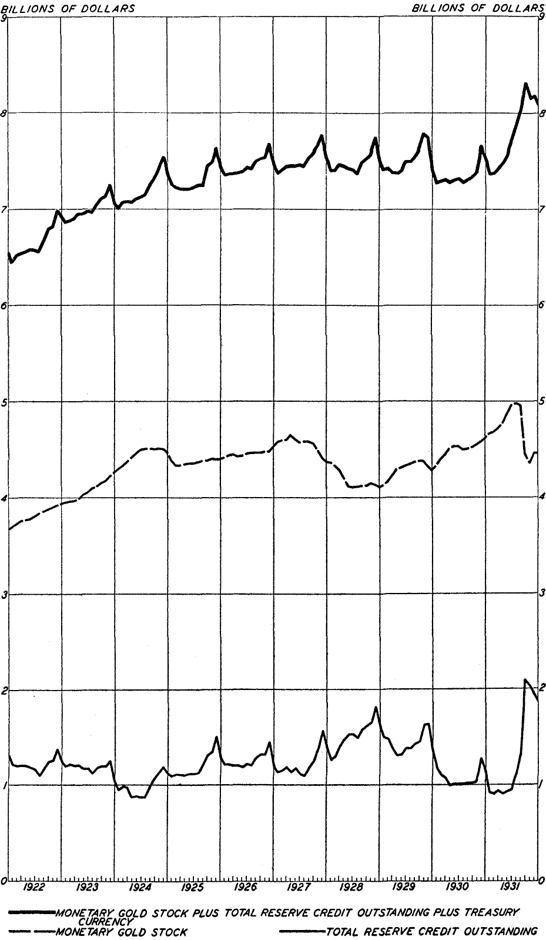
The accompanying chart shows the changes in the monetary gold stock of the country together with coincident changes in total Federal Reserve credit outstanding (government securities plus acceptances plus rediscounts), and the combined total of gold stock, Federal Reserve credit, and Treasury circulation. This combination makes up the supply of credit resources.
As the chart shows, there were, in the years from 1921 through 1931, three great waves of accumulation and disbursement of the monetary gold stock of the United States. The first increase shown, terminating in the middle of 1924, was the continuation of a movement which began in the middle of 1920 and was already past its most rapid stage at the time our story begins. This inflow, as we have pointed out elsewhere, was possible only because of the abandonment of the gold standard by most of the civilized nations of the world. Gold was not bought freely at the mints or central banks at its market value in the depressed currencies; hence the product of the mines and the gold which was released from hoards flowed to the countries where its market was the best. Except for shipment to America or to the Orient, gold was a frozen asset. This movement was wholly different in character from anything that has taken place since.
At first the gold imports raised no question of policy, partly because Reserve Bank ratios were very low, and partly because member banks were so heavily in debt to the Reserve Banks and the demand of the public for bank loans was so light that the banks preferred to pay their debts rather than to try to expand credit. But with the termination of the acute stage of depression the member banks ceased to reduce their indebtedness and began to use the inflowing gold to increase their reserves.
Support for Member Bank Credit, 1922-31
This movement raised the question whether the Reserve system was to bring the gold into full use; that is, whether the Reserve Banks were to consider themselves free to expand their earning assets so long as they had themselves a safe margin above the legal requirement of a 40 per cent reserve against notes and a 35 per cent reserve against deposits. American tradition would have sanctioned such a policy. The reserves of the Federal Reserve system were now adequate to support a credit structure nearly twice as great as that which had collapsed in 1920. It might even have been possible to maintain such an expanded credit structure in the face of European stabilization, if the stabilization programs were carried through on the basis of the depreciated value of the currency units with gold reserves appropriate to the devalued currencies. However, in 1922 no Western European country had abandoned the idea of stabilizing on a gold basis, and many of these countries still contemplated stabilization at the old par values of their currencies. It was anticipated that whenever stabilization was effected, or seriously attempted, a large proportion of the gold which was coming to America would return to Europe.3
For this reason and also because there was no disposition to face the probable domestic consequences of a fresh inflation, it was decided without hesitation and without controversy not to attempt to make the new gold the basis of a pyramid of Reserve credit. Therefore, either the required ratio had to be increased or the reserve ratio had to be abandoned as a guide. The solution of the problem was the policy of maintaining a “sound credit condition,” which was discussed in Chapter V.
This policy did not mean, however, that the gold was sterilized. It meant only that there was no “secondary” expansion, that is, no expansion of Reserve Bank deposits and note issues on the basis of the use of the new gold as a 35-40 per cent reserve. How far the gold served as a basis of primary expansion, that is, pyramiding of member bank deposits, depended on the extent to which imports of gold were offset by contraction of Reserve credit. It is of importance, therefore, that we get a clear picture of the relationship between changes in the gold stock and changes in the sum of the gold stock and the outstanding volume of Federal Reserve credit.
In 1922, when business conditions were so bad that there was no apparent danger of inflation, member bank reserves were allowed to increase by nearly as much as the gold inflow, Federal Reserve credit showing little change.4 In 1923, on the other hand, when business was expanding with great rapidity, of the 300 million dollars of gold added to the national monetary stock, 140 million was offset by reduction of Federal Reserve credit, the balance being absorbed in the monetary circulation.5 In 1924, most of which was very unprosperous, reserves expanded by the full amount of the gold inflow. In 1925 a considerable loss of gold in the first half-year was offset by a more than seasonal shrinkage in monetary circulation and a reduction in member bank reserves. Federal Reserve credit did not expand to make up the loss. It did, however, expand more than seasonally in the last half of the year. For the whole period from the end of 1921 to the end of 1925, the volume of Reserve credit remained practically stationary except for (a) seasonal changes due to fluctuations in the currency requirements of the country which have no significance as indicators of over- or under-expansion of credit, and (b) a sharp decline and an equally sharp recovery in connection with the depression and revival of 1924. The net change for the four years was only 36 million dollars, or 2 1/2 per cent. Changes in the volume of member bank reserves and in the currency circulation corresponded with surprising accuracy to changes in the gold supply.
In the next four years the relationship between gold and credit was entirely different. From the end of 1925 through 1929, instead of Federal Reserve credit alone it was the total credit base, consisting of Federal Reserve credit plus monetary gold stock plus Treasury currency,6 which tended to remain constant. During the first half of each year the sum of the Federal Reserve credit outstanding and the gold stock varied only slightly from 5,700 million dollars. In the second half of the year there was regularly an expansion of Reserve credit of 250 to 300 million dollars to take care of the increased demand for hand-to-hand currency. Aside from this seasonal adjustment, changes in gold stock and changes in Federal Reserve credit offset one another, sometimes because Reserve credit was expanded or contracted following a gold movement, sometimes because the gold movement adjusted itself to the Reserve situation in this country. In short, whereas from 1922 through 1925 the contribution of the Federal Reserve system to the credit resources of the world was approximately stable, in 1925-29 it was the total amount of support for currency and bank credit in the United States that was stable.
Finally, in 1930-31 we have still a different situation. In this period, especially in 1931, there was a great shrinkage both in the amount of Reserve credit and in the total of all forms of credit base which was effectively available to support member bank operations. This situation, however, is masked in the actual figures for 1931 by a great expansion of sterile credit in the form of hoarded notes.
The shrinkage in 1931 was no part of any Federal Reserve scheme of control. The case was similar to 1921. The tide of deflation was so strong that the gold supply and the Federal Reserve credit policy both ceased for the time being to have any effect on the volume of borrowing. Through the first part of the year, bank credit was steadily liquidated under the influence of declining demand for customers’ loans and growing scarcity of investments which were deemed to offer adequate security. And toward the end of the year currency hoarding and runs on banks instilled into the minds of bankers such a passion for liquidity that excess reserves appeared in unprecedented volume. Naturally the volume of bank reserves showed no consistent relationship either to gold flow or to Reserve system credit policy.
II. GOLD STOCK AND CREDIT POLICY
When confronted by a gold inflow, as was the Reserve system during most of the period under consideration, a central bank can be guided by standards of policy so different that there is room for disagreement even as to what is the distinction between a positive policy and a do-nothing policy. We may approach the question by stating first the extreme limits of a central bank’s possible response to a gold inflow; then consider practical intermediate policies.
On the side of liberality the most extreme interpretation of central bank responsibility would demand that the bank expand its own operations, by security purchases and by encouraging borrowings, to the full amount which the new reserve would permit. On this basis the import of gold during the eight-year period which ended with the stock market crash of 1929 would have permitted an expansion of roughly 1,500 million dollars of Federal Reserve member bank reserves, instead of the 600 million dollar increase which actually occurred. This, of course, is merely a limiting figure, not a practical estimate, since it is based on the assumptions (a) that the pursuit of such an expansionist policy would not have reduced the amount of the gold inflow;7 (b) that the public could have been induced to carry 9 billion dollars of additional bank deposits without the necessity of the banks paying prohibitively high interest on these deposits; and (c) that the commercial banks could have increased their assets by some 9 billion dollars above the figures actually reached without running up the price of securities so high, and cutting their standards of safety of loans so low, that they would have preferred to carry excess reserves rather than to expand enough to use them. While no one, so far as I know, has explicitly argued for such a policy, its desirability seems to be the implicit assumption of those critics who accuse the Federal Reserve system of pursuing a radically deflationary policy.
The opposite extreme would be a policy of offsetting all gold imports by sales of securities and all exports by purchases, so that the credit element in the credit base would go down as fast as the gold element went up. The statement that it has been the Reserve system’s policy to sterilize gold imports implies that the Reserve system practice has been governed by this extreme principle. In fact, the policy actually followed was almost as far from this extreme as from the other. For if such a policy had been followed from 1921 on we should have had at the end of 1929 (still assuming that the gold movement would have been the same as it actually was) member bank reserves of about 1,750 million dollars, instead of 2,374 million dollars. In January 1930 Federal Reserve credit outstanding would have been only about 700 million dollars instead of 1,300. No expansion of member bank credit would have taken place, except that which resulted from the substitution of time for demand deposits and the shifting of deposits from banks with high reserve ratios to those with low reserve ratios.
With such a policy in force a successful injection of new bank credit into the circulation would have tended to start an outflow of gold, and if the Reserve Banks cut off any compensating expansion of their own credit, the expansion of bank credit would have been checked by a shortage of Reserve funds. Vice versa, any shortage of credit which attracted currency from abroad would have tended to effect its own cure. This policy would have resulted in a maximum fluidity of gold as between countries, whereas the first policy would have tended to immobilize the gold where it was.
Both these statements are abstractions, and neither corresponds closely to reality. For 1922-25 the first comes nearer to a description of actual practice than does the second; during more recent years the second comes nearer what was actually done than does the first. There was never a stated policy of offsetting all gold gains and losses by countervailing credit operations. But as it has worked out, the policies of supplying credit in accordance with the banks’ demands and stabilizing business conditions have in fact had much the same effect. If gold has come in at a time when the Reserve system was willing to have credit expanded, or gone out when the policy was to restrict credit, it has been allowed to have its normal effect. But if at any given time the business situation is considered satisfactory, since 1925 the practice has been to hold steady, not the Federal Reserve contribution to the credit supply, but the whole supply including the gold stock.
Sometimes the open market holdings have been expanded or contracted with a deliberate purpose of offsetting the gold movement.8 More often, what has happened has been that the banks have borrowed in order to get gold for export, or have paid off loans out of the proceeds of imports and the Reserve system has refrained from taking any steps to restore the former volume of Reserve credit. The general policy of adapting Reserve credit to the needs of the banks has meant that the changes in gold stock have been offset in large part by changes in Federal Reserve credit, whether such offset was purposely engineered or not.9 The result of these practices is that an expansion of Reserve credit prevents a gold outflow from tightening the money market, and a contraction prevents an inflow from easing it, and so it tends to run on till it is checked by the effect on foreign markets or by some extraneous circumstance. When a gold flow starts it sets in operation no forces which will quickly check it. In this respect the situation in the United States, though less extreme, is similar in character to that which maintained in Europe before the stabilization of the currencies. This policy of neutralizing gold flows, is, I believe, the basic reason why the movements of gold, both in and out, have been of such vast proportions.10
III. WHAT POLICY SHOULD HAVE BEEN FOLLOWED?
We must consider next the highly theoretical question, namely, what is the proper responsibility of a banking system to the inflow and outflow of gold, assuming that its reserves are large enough to give it freedom to shape its policy as it pleases. The question breaks into two parts, according to the origin of the increased gold supply.
Gold newly mined or transferred from industrial to monetary uses is an inflationary element in the world’s currency just as much as is new bank credit or paper money. If we are to avoid all monetary disturbing influences on the equilibrium of production, and on the relations of debtors and creditors, the influence of new gold must be neutralized in some way. However, so long as the cost of gold production is not suddenly reduced by gold discoveries or by advancing technique, or gradually increased by exhaustion of the mines, the new gold is largely an offset to the deflationary effect which the increase of population would have if the money supply were constant. It is the assumption of the defenders of the pure gold standard that gold production and the growth of the world’s need for gold can be expected roughly to compensate one another. The correctness of this assumption under present conditions we shall consider in connection with the contention that the gold of America should be transferred to countries which will make more active use of it.
International transfers of the gold which is already in monetary use present a problem of a different character. Gold shipments and earmarkings are the standard devices by which the existing volume of funds—regardless of whether it is too great or too small in the aggregate—is distributed to those parts of the world where funds are relatively scarce. Whether such movements should be neutralized or allowed to exercise their full effect on the money market of a given country depends on whether that country wishes to keep step with the rest of the world in the rate of credit expansion, or believes itself intelligent enough to discern, and strong enough to maintain, a more satisfactory rate. The latter policy means that the gold standard is in effect abandoned and replaced by a managed currency.
My judgment is that during the earlier part of the period which we have been studying, say till the stabilization of the British currency in the spring of 1925, there was a good case for endeavoring to keep outstanding the volume of currency which seemed most likely to maintain stability in the domestic situation, letting the incoming gold displace an equivalent amount of Reserve credit. From that time on through 1930 I believe it would have been better to go to the other extreme, letting gold exports and imports exert their maximum influence on the monetary situation.11 I do not suppose that this would have made any great difference in the amount of credit that would actually have been outstanding at the close of the period, or at most times; it would have meant simply that gold movements in either direction would have been checked much more quickly by the tightening or easing of the market which they would have stimulated. In 1929, however, such a policy would have meant an early abandonment of the Federal Reserve Board’s attempt to check the stock market by tightening the money market. I should regard this episode as one of the exceptional cases when a gold movement should be offset so far as possible by credit contraction, if I were otherwise in sympathy with the policies of 1929.12
The objection will at once suggest itself that the adoption of this policy would have tended to perpetuate the existing concentration of gold stocks in America. This is true. Gold will not move in large volume unless it is prevented from having its normal effect on the money markets of one or both of the countries concerned. There is no tendency toward an automatic restoration of the former proportionate holdings now that the banking structure of the world has been adjusted to the changed distribution which took place during the early post-war era of irredeemable currencies.
True, a large part of the United States gold stock is “free” so far as the Federal Reserve Banks are concerned; that is, it could go out of the Federal Reserve Banks without pulling their reserve ratios dangerously low. But the member bank reserves which were created by depositing gold when it came in are now an integral part of the credit structure of the country and cannot be liquidated without disaster. The only way the gold could get out of this country without an enormous deflation of bank credit would be for the Federal Reserve Banks to replace it with their own credit; and the only way it could be added to the reserves of another country without a corresponding inflation of their economic systems would be for the central bank of that country to contract its credit. A mutual operation of this sort could be engineered, without any effect on the banking structures of the two countries, except that the Federal Reserve Banks of the United States would earn more money and the central banks of the other countries concerned would earn less money.13 The benefit of this operation would be that the country which got the gold would have a more adequate reserve for emergencies.
Such a mutual expansion of earning assets in America and contraction elsewhere is not, of course, what is contemplated by advocates of a redistribution of the world’s gold supply. What is wanted is an expansion of the earning assets of the Federal Reserve Banks without any corresponding contraction elsewhere; probably a pyramid of further expansion in the credit structure of the rest of the world. This operation would be equivalent in its results to the sudden injection into the world’s monetary stock of say half a billion or a billion dollars of new gold. Such a complete departure from the usual practice of central banking would have to be justified by evidence that there has occurred throughout the world either a great increase of the need for, or a great contraction of the supply of, the means of payment.14 The mere existence of a different distribution of gold from that existing before the war and the mere fact of a highly unequal distribution of the gold between different countries of the world are no evidence whatever of the need for a larger total supply of credit, and in the absence of evidence that the total supply of credit is becoming progressively less adequate, there is a presumption that the existing distribution is the best distribution.15
Our problem involves, therefore, the question of the adequacy of the world’s gold supply. And on this question I am disposed to state an opinion the full justification of which would be the task for a volume in itself.
As a matter of theory it can hardly be denied that the central banks of the world could by concerted action so manipulate credit as to offset the effect of a chronic shortage or a chronic plethora of gold. But I see no evidence that during the past ten years there has been any such gold shortage or surplus as would constitute a basis for central bank action. Certainly central bankers have not accepted the idea that there is any necessity for such action. As to the future of the gold supply, very pessimistic forecasts have been issued by eminent authorities, but there are comparatively few who believe that the gold supply has actually been so inadequate as to restrict productive activity or exert a downward pressure on prices.
My own judgment is, first, that there is so much uncertainty as to what the long-time trend of prices is at any given time that central bank policy can be predicated on the need of correcting the trend only in the case of very conspicuous and unusual disturbances of the gold supply such as extraordinary discoveries of new gold fields, and revolutionary improvements in the technique of obtaining gold, or, in the opposite direction, a persistent tightening of bank credit manifesting itself in substantially all countries. Second, I do not believe that the case for an impending shortage was at all conclusive, even before the recent drastic price declines. Third, it is obvious that the fall in the costs of gold mining in the last two years necessitates a complete revision of all forecasts, and such revisions have not yet been published by any of those experts who have been pessimistic as to the outlook for sufficient gold to support the world’s credit structure.
Should such a gold shortage ever appear, it would be a proper matter for concerted international action, but I see no reason to anticipate a need for it. Current pessimism about the gold situation, in so far as it is not a part of the general current frantic search for a scapegoat, reflects the unwillingness of certain sections of the public to face the necessity of effective action directed to the maintenance of the balance of international payments. But neither the necessity of such a balance nor the difficulty of maintaining it would be in any way affected by an increase in the world’s gold supply or an international agreement to reduce the reserve ratios.16 The direction of the international movement of gold and the adequacy of the world’s supply of gold are independent questions.
Though in general the presumption is in favor of letting gold have its full effect on the reserves of the member banks, situations are sure to arise from time to time when it will be necessary for the Reserve system to offset a gold movement by credit operations. The automatic operation of gold movements on the money market is like disarmament—an ideal which no nation can maintain alone. Whenever the principle of neutrality in credit policy is abandoned by countries whose monetary demands constitute a considerable fraction of the gold market of the world, the whole setting of the problem is changed for every other country.
If there is a general trend toward expansion or deflation, the balance of payments of any one country will be disturbed by its deviation from this general trend rather than from a policy of strict neutrality. If artificially dear money draws gold into one country, only artificially dear money in other countries will check its flow; if cheap money drives gold out of one important country, another country cannot rely on the inflow as an evidence that its own credit policies are unduly restrictive. In 1921, for instance, had it not been for the accident of an enormous indebtedness of member banks at the Reserve Banks, reliance on the uncontrolled play of economic forces would have been as inconvenient for this country as would have been under normal circumstances a sudden quadrupling of the gold output of the world. Likewise the loss of gold by various European countries in 1929 was not the reflection of inflationary policies in those countries but of the sharp restriction of credit in America by the Federal Reserve system, and the maintenance of stability required credit expansion by their central banks, though from the standpoint of our Reserve authorities such a policy was very far from co-operative.
So long as the credit controllers of different countries have different ideas as to whether credit should be made more liberal there will be endless bickering and endless complaints about the failure of international co-operation. Two central banks can co-operate to make credit cheaper in both countries, or dearer in both; there is no technique by which they can co-operate to make it cheaper in one and dearer in the other. Nor is there any technique which will redistribute the gold of the world except on the condition that the effects of the movement are compensated by central bank action, both in the country into which the gold goes and in that from which it comes. Hence the only way to avoid this conflict is to have a common idea as to what should be done about the total supply of monetary units in the world—or whether anything should be done.
The explanation of the gold movement is, of course, much more complicated than the foregoing statement would imply. In the case of every one of our great gold movements there have been specific reasons, such as German accumulation after the adoption of the Dawes Plan; French accumulation in 1928; sales of American securities by foreigners during the stock market boom; gold hoarding in Europe in 1931; and so on. But the real problem is to explain not merely why this or that country took gold, but also why the movement was out of the United States rather than out of some other country, and in this explanation the policy of offset must have a prominent place. In at least one case; namely, in 1927, this policy was deliberately chosen in order to facilitate a redistribution of the gold.
- 1The distinction between “banking policy” and “credit policy” is taken from Annual Report of the Federal Reserve Board, 1928, pp. 9-10.
- 2Compare pp. 132-40.
- 3This is, of course, in substance the position of the Banking School in the British banking controversy of the early nineteenth century.
- 4“. . . When increased credit demands can be met only by recourse to the Federal Reserve Banks, the volume of Reserve Bank lending is a sensitive indicator of credit conditions. . . .” (Federal Reserve Bulletin, 1923, Vol. 9, p. 411).
- 5Annual Report of the Federal Reserve Board, 1923, p. 10 (quoted below, pp. 79-80); Federal Reserve Bulletin, 1928, Vol. 14, p. 6.
- 6The omission of reference to price changes in the text is intentional and without prejudice. I believe that there is need of a thorough reexamination of the orthodox statement of the influence of gold movements on price changes and the extent to which in pre-war days changes in price levels were caused by gold movements and operated to check the gold movements.
- 7For fuller discussion of these points, see Chap. IX; compare also B. H. Beckhart, The Discount Policy of the Federal Reserve System, Chap. II.
- 8The cash balance carried in the United States Treasury was occasionally drawn upon to meet seasonal or crisis demands, either through the depositing of funds in banks or through the purchase of bonds by the Treasury, but the device was very crude and there was no continuity of policy in its management.
- 9Compare chart, p. 35.
- 10The possibility of temporary nullification of a central bank’s control through the mobilization of fresh resources is illustrated by an action of the Midland Bank, which in 1927 bought securities so heavily as to lower its own reserve ratio by several per cent. The amount involved was small enough so that the Bank of England was able to offset it. The net result was simply to increase the earning assets of the Midland Bank and decrease those of the Bank of England; not to ease the market.
- 11Compare p. 231.
- 12Annual Report of the Federal Reserve Board, 1927, pp. 10, 16.
- 13See pp. 104-05.
- 14Annual Report of the Federal Reserve Board, 1927, p. 11.
- 15The 4 1/2 per cent rate was charged on all maturities of less than 90 days, such paper making up the great bulk of the transactions.
- 16As reported by the New York Stock Exchange.

