
Credit Policies of the Federal Reserve System
IV: Stabilization of The Money Market
CHAPTER IV
STABILIZATION OF THE MONEY MARKET
In Part I we have discussed the organization of the banking system which has grown up in the United States since the passage of the Federal Reserve Act in 1913, and have outlined the post-war history of the exercise by the Reserve Banks and the Reserve Board of the powers of credit control entrusted to them by that Act. In Parts II and III we shall consider topically the way in which various questions of policy have been handled in the years from 1922 through 1931. We shall consider first the more important issues, deferring to Part III the treatment of the less significant aspects of Reserve system policy.
The most important issues which have led to the adoption of credit policies by the Reserve system in the years since the end of the depression of 1921 are of four types; namely, disturbances in the money market itself, the fluctuations of business activity, the stabilization of the exchanges of certain European countries, and the activity of speculation in the domestic security markets. In this chapter we survey a number of quite distinct policies which have been developed in dealing with different types of irregularity in the workings of the short-term money market.
In the discussion of banking policy which preceded the creation of the Reserve system, considerable emphasis was laid on the need for an elastic currency. The need for elasticity was evidenced by the frequency with which money became very tight as the result of a seasonal or other sudden increase in the demand of the public for cash. It was hoped and intended that the new system would provide a way of bridging over these strains. The experience of central banks of other countries was often cited in this connection.
In more recent years, however, as we have noted, interest has shifted to other objectives, and comparatively little is now heard of the money market itself as an object of the central bankers’ solicitude. Indeed, it is generally assumed that the normal effect of an intelligent central bank policy will be to “unstabilize” short-term interest rates, since the central bank will be manipulating the money market upward and downward in order to stabilize other phases of business activity. This view has found some support in Reserve Bank circles, though very little has been said about it in official publications. In practice, as we shall see, there are several ways in which the Reserve system operations have actually steadied the money market, especially with reference to short-term disturbances. We shall examine first the theory of what a central bank can do in this direction.
I. THE TRADITION OF CENTRAL BANK POLICY
The treatment of the fluctuations of interest rates breaks into two distinct problems, according to the degree of permanence of the conditions which give rise to them. As was pointed out in Chapter I, the generally accepted theory of credit control does provide for a limited amount of stabilization of money markets; since it requires, or permits, a central banking system to minimize those fluctuations of interest rates which are known to be due to strictly temporary causes.
For example, it is generally agreed that it is sound policy to engage in credit operations which will tend to reduce the effect on interest rates of regular seasonal variations in the demand for money. Likewise those fluctuations in the supply of or the demand for funds which are due to Treasury operations, to window-dressing by banks and business corporations, or to stock exchange settlements (under the European term settlement system), can be compensated by transactions which put just enough credit into the market, or take enough out of the market, to offset the effect of the temporary disturbing influence.
Another case for such offsetting operations arises from special gold movements which are not due to commercial considerations but to political factors, or are incidents of stabilization programs. Finally, a Reserve agency or central bank can render invaluable service by temporarily drawing down its reserve to expand credit in times of crisis, thereby preventing the appearance of such extraordinary premiums on cash as characterized our pre-war panics.
It is not, however, a normal central bank policy to offset the effect of gold movements by buying securities when gold moves out of the country, and selling them when it comes in, unless the movements are believed to be only temporary in their character. If an outflow of gold is caused by an adverse balance of payments due to persisting causes (regardless of whether these causes are found in past credit policies, or elsewhere), the more it is compensated by expansion of Reserve or central bank credit, the bigger it will tend to become.
Official discussions of the theory of Federal Reserve system operations do not recognize clearly the distinction between temporary and persistent disturbances, but Reserve bank practice has conformed fairly well to the theory. The obviously temporary fluctuations in the demand for money and credit—those due to seasonal factors, quarter-day operations, window-dressing, and to emergencies—have been ironed out very consistently and very successfully. Changes in the money market which have been due to more persistent causes—gold movements and booms and depressions—have been handled less consistently. In the following section we shall examine the practice with reference to temporary fluctuations.
II. TEMPORARY DISTURBANCES
At the time when the Federal Reserve Act was under consideration, there was no disagreement as to the need for a system which would display more elasticity in the face of seasonal fluctuations in the demand for credit and currency, and also in times of crisis. A particularly disturbing feature of the United States money market was the periodic stringency which was occasioned by the autumn demand for currency and credit in the interior for “crop-moving,” a general term covering a great variety of business operations, including the Christmas trade, which were concentrated in the last four months of the year. The New York banks were never in position to take care of this demand without inconvenience, simply because they employed their resources as fully as possible in the other months of the year and had no reserve to be drawn upon when the tight season arrived. The cause of the difficulty was understood well enough, but there was no incentive for any individual bank to keep itself liquid in anticipation of the autumn strain, so long as others did not co-operate. Had all banks kept an excess of reserves in the slack period to be drawn upon in the fall, there would have been some compensation in the form of higher rates, but no individual bank operating alone could get such a compensation.
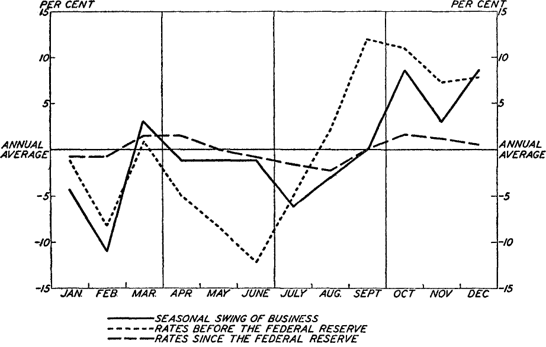
The seasonal fluctuations of interest rates have been reduced to less than half their pre-war magnitude. It was expected that the Reserve system, since it was organized on a limited profit basis, would keep part of its resources idle during most of the year, so that it could provide the extra credit for the autumn without contracting other credit correspondingly or procuring new credit from abroad. This expectation has been realized. There has been a virtual elimination of the seasonal movement of money rates in financial centers, and a considerable reduction in the irregular fluctuations. The diagram on page 68, taken from Governor Strong’s testimony at the hearings on the Strong bill,1 shows very clearly the increase in stability, and the accompanying table shows how the Federal Reserve Banks achieved this result by varying their outstanding credit from season to season.2
| Monthly Average (1922-31) | Millions of Dollars |
|---|---|
| January | 1,269 |
| February | 1.163 |
| March | 1,161 |
| April | 1,161 |
| May | 1,134 |
| June | 1,143 |
| July | 1,155 |
| August | 1,152 |
| September | 1,238 |
| October | 1,358 |
| November | 1,401 |
| December | 1,514 |
Seasonal Changes in Money Rates before and after the Establishment of the Federal Reserve System
The Reserve system has been very successful in ironing out disturbances which originate in Treasury operations. The income taxes are collected in four instalments, on the 15th day of March, June, September, and December, and the maturities of the short-time borrowings of the Treasury regularly fall on the same dates. The Treasury is not given immediate credit by the Federal Reserve Banks for these checks, and consequently it has to borrow from the Reserve Banks to pay off the maturing certificates of indebtedness. To bridge the gap the Reserve Banks make one-day loans to the Treasury, which are renewed from day to day for decreasing amounts. These loans vary widely in amount. The March issues, which are the largest, frequently exceed 200 million dollars for one or two days; in 1929 they amounted to 314 million.
This process by itself would result in putting a large amount of excess credit into the market. The checks which have been used in payment of the taxes are collected gradually over a period of two or three days, and of course do not impair the reserves of the banks on which they are drawn until they are presented for payment. Therefore, in order to absorb the effect of the new funds put into the market by the Treasury’s payments, the Reserve Banks sell government securities out of their portfolios, or sell participations in the one-day loans.3 Stabilizing operations of this sort have been so successful that the public is no longer conscious of the need of them.4
Window-dressing gives rise to another type of disturbance which has been remedied by Reserve Bank management. This type of temporary stabilizing operation has been described by Governor Strong as follows:
Then there is what is commonly described as the window-dressing of bank balances—something that can hardly be escaped, and which is the practice more or less in all countries. We calculate the reserves of our member banks on a weekly average in the big cities, and for the country banks a fortnightly average. It is impossible for a large bank in New York with a large swing of deposits and transactions to maintain its reserve accurately every day at the legal minimum. . . .
If any unusual transaction causes them to be over in the early part of the week, such as on a quarter day, when this big fund comes into the market, then they will run down the latter part of the week to make their average right. That occurs weekly in New York, and was quite a problem for a time, until we devised the plan of changing the periods throughout the Reserve districts somewhat, so that they are staggered. Chicago, Boston, Philadelphia, and other cities use a different period from New York, and it equalizes the necessity for the New York banks to borrow from us at times to adjust their own reserves in that way, and at times to meet demands of out-of-town banks which are adjusting their reserves. . . .
The other window-dressing period is just before the semiannual bank statements are made, and especially at the end of December. The banks do not like to show borrowed money, and there is a good deal of shifting of borrowings so as to avoid it. That is also done for window-dressing purposes, and sometimes it is a little difficult to manage. At the end of last year we saw that there was going to be a development of that sort, and bought $50,000,000 of government securities to relieve the situation a little bit; at times we have to do that.5
The Federal Reserve system has provided a supply of emergency credit. At the time when the Reserve system was being planned, there was no disagreement as to the need of some provision for greater elasticity in times of crisis. It was everywhere expected that Reserve Banks would keep unused reserves for emergencies, thus averting the necessity of drawing gold out of the United States Treasury, importing it from England, and economizing it by the issue of clearing house certificates. This expectation also has been realized. On three occasions—in 1920, 1929, and 1931—the Reserve system has shown itself a better emergency refuge than was available under the old national banking system. These cases are all excellent examples of the sort of service which a central banking system can render, for which it gets very little credit; for the potential disturbances which are prevented from occurring never come to the attention of the public.
III. CYCLICAL DISTURBANCES
For a number of years after 1921 it appeared that the cyclical fluctuations of money rates had shown a definite decrease in range as compared with the period before the establishment of the Federal Reserve system. In 1928 Wesley C. Mitchell made an elaborate analysis of the range of fluctuations of a large number of business series in pre-war and post-war business cycles, and found that out of 20 items tested, interest rates on commercial paper showed a greater degree of stabilization than any other items except two.6
On the other hand, in the severe business recession of 1929-31, interest rates were more unstable than were most measures of business activity, and more so than in pre-war collapses. From July 1929 to July 1931 wholesale prices dropped 28 per cent; industrial production 34 per cent;7 pig iron production 59 per cent; commercial paper rates 67 per cent. Then in the course of a few months rates advanced 100 per cent without any corresponding recovery in business conditions. By pre-war experience one would have expected interest rates to fall to about half the peak level.
It certainly is not safe to conclude, therefore, that the Federal Reserve system has had a stabilizing influence upon the money market so far as the cyclical fluctuations are concerned. This is not surprising, and does not mean that its program has miscarried. There is no evidence that the System has ever attempted a program of stabilizing interest rates against cyclical fluctuations. On the contrary, the policy at times has been to accentuate or hasten the fluctuations of money rates in the hope of stabilizing other factors in the business situation—notably in 1929 when money rates were tightened in a period of prosperity and in 1930 and the first half of 1931 when they were artificially lowered in a period of depression.
IV. GOLD MOVEMENTS
The Reserve system’s handling of the major problems which have arisen in connection with the inflow and outflow of gold is reserved for consideration in Chapter IX. Mention may be made here, however, of the service rendered in one instance in easing the shock of a sudden large increase in the world’s supply of monetary gold.
In May 1927 the Bank of France paid a debt to the Bank of England and thereby regained control of 90 million dollars of gold which had been pledged as collateral for the loan and had not been counted as part of the banking reserve of either country. Of the gold thus released 30 million dollars was sold for export to the United States, and 60 million was purchased by the Federal Reserve Banks and held in London under earmark. This gold was not counted by the Reserve Banks as a part of their reserves. Later in the month the Bank of France used a part of its dollar funds in New York for the purchase of gold. This loss of gold was offset by the Reserve Banks through the purchase of securities. Later in the summer the Reserve Banks sold the gold which was held abroad and then gradually sold out the foreign exchange which they had received for the gold.8
- 1The distinction between “banking policy” and “credit policy” is taken from Annual Report of the Federal Reserve Board, 1928, pp. 9-10.
- 2Compare pp. 132-40.
- 3This is, of course, in substance the position of the Banking School in the British banking controversy of the early nineteenth century.
- 4“. . . When increased credit demands can be met only by recourse to the Federal Reserve Banks, the volume of Reserve Bank lending is a sensitive indicator of credit conditions. . . .” (Federal Reserve Bulletin, 1923, Vol. 9, p. 411).
- 5Annual Report of the Federal Reserve Board, 1923, p. 10 (quoted below, pp. 79-80); Federal Reserve Bulletin, 1928, Vol. 14, p. 6.
- 6The omission of reference to price changes in the text is intentional and without prejudice. I believe that there is need of a thorough reexamination of the orthodox statement of the influence of gold movements on price changes and the extent to which in pre-war days changes in price levels were caused by gold movements and operated to check the gold movements.
- 7For fuller discussion of these points, see Chap. IX; compare also B. H. Beckhart, The Discount Policy of the Federal Reserve System, Chap. II.
- 8The cash balance carried in the United States Treasury was occasionally drawn upon to meet seasonal or crisis demands, either through the depositing of funds in banks or through the purchase of bonds by the Treasury, but the device was very crude and there was no continuity of policy in its management.

