
Credit Policies of the Federal Reserve System
III: Banking And Business, 1922-31
CHAPTER III
BANKING AND BUSINESS, 1922-31
In the year 1922 the Federal Reserve authorities for the first time found themselves faced with a definite problem of credit control and at the same time possessed of sufficient independence to make their decisions significant. The situation in which the System found itself may be summarized as follows:
First, gold was flowing into the country in large quantities from Europe and going out in much smaller quantities to South America and the Orient. Second, loan liquidation at member banks, which had been proceeding at a rapid rate through 1921, continued through the first half of 1922. Third, liquidation of member bank credit at the Reserve Banks also continued through the first half of 1922. The accompanying chart shows how the volume of Reserve credit went down as the gold stock went up.
The third of these developments was a consequence of the other two. The importation of gold furnished the member banks with a means of liquidating their indebtedness, while the low level of business activity relieved them of any pressure to increase their reserves by depositing the gold, and thereby to make possible a larger commercial credit structure.
It is perhaps necessary to point out that the large inflow of gold at this time was the result of a very unusual international credit situation. Practically all the European currency systems were based on irredeemable paper. During the months immediately preceding the collapse of the boom in 1920-21, the former warring countries had been very heavy buyers in the United States, their purchases being financed in part by the flotation of bonds, but chiefly by the extension of short-term credit by exporters who in turn were financed by short-time credits issued by American banks.
Principal Elements of the Credit Structure
1922-31
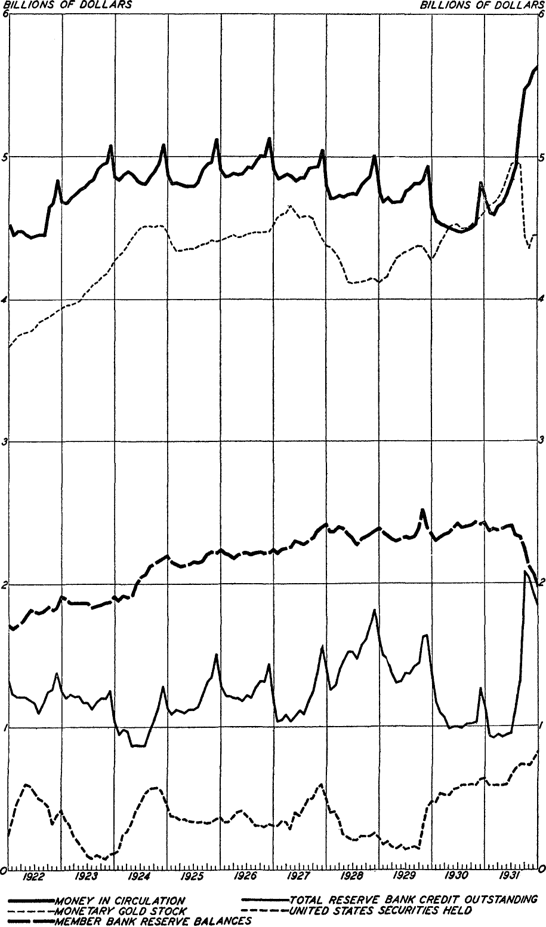
The developments of 1920-21 put an end to the easy extension of this type of credit. Heavy losses were incurred by exporters on account of the refusal of European buyers to accept delivery of goods which had been contracted for at high prices and on account of inability to make collections. Although these losses were in large part incidents of a world-wide price adjustment and did not necessarily reflect a permanent impairment of credit of European buyers, the immediate effect was to make American exporters unwilling to trade except on a cash basis—and because of the instability of the European currencies that meant a dollar basis.
A few years later it became possible to finance an excess of American exports over imports by the sale of long-term securities, but in 1922 and 1923 such securities were not salable in large volume on American investment markets. These years intervened between an era of easy short-time credit and an era of easy long-time credit—ease being tested, in each case, by the volume of financing, rather than by the rates charged. In this situation the alternatives open to the European public were (a) to curtail the excess of their buying in America over sales of goods here, (b) to return American securities, (c) to ship gold. All three lines of procedure were followed, but the first was peculiarly difficult because of the accumulated deficiencies, both of capital and of consumption goods carried from the war period, and the second was of limited value because American securities had already been so largely returned as an incident of war finance.
During this period neither the Federal Reserve Board nor the managements of the individual Reserve Banks had either historical knowledge or personal experience of similar situations which could be trusted as a guide. Moreover, the close connection between open market operations and credit control had not been recognized, so that for most of the year 1922 the open market operations were left to the judgment of the directors of the individual Reserve Banks, and were not utilized as an instrument of control at all. As the gold flowed into the member banks it was deposited by them with the Federal Reserve Banks, at first to reduce indebtedness, later to create reserves which were utilized by the member banks in large measure in the purchase of securities. As the Reserve Banks did not expand their own earning assets correspondingly, the ratio of gold to Federal Reserve obligations continued to rise, as it had been doing since the summer of 1920.
From the middle of 1922 on, the rise of the reserve ratio was checked because the Reserve system adopted the policy of paying out gold certificates in place of Federal Reserve notes. Between July 1922 and the end of 1925, gold certificates in circulation increased by 940 million dollars, while Federal Reserve notes decreased by 300 million dollars. This virtual use of gold for currency served to mask the increasing abundance of the gold supply and protected the Federal Reserve authorities from popular pressure in the direction of an easier credit supply.
Since the gold certificate requires a backing of 100 per cent in gold, and this gold is not counted as part of the reserves of the Federal Reserve system, the effect of substituting a gold certificate in circulation for a Federal Reserve note (which requires only a 40 per cent gold backing) is to cut down the reserve ratio. Gold thus put into circulation forms a secondary reserve which can be drawn upon in case of shortage by expanding the volume of Federal Reserve notes, provided that eligible commercial paper is available to furnish the 60 per cent backing for Federal Reserve notes. This use of gold in the form of certificates is the only important survival of a common feature of pre-war European monetary practice, namely the use of gold in circulation as a secondary reserve.
I. DECENTRALIZED CREDIT CONTROL, 1922-23
During the first half of 1922 rediscounts, which already had fallen in fourteen months from 2,800 million dollars to 1,146 million, continued to shrink, standing at 461 million at the end of the half-year. Rates remained comparatively stable during this period and clearly had little to do with the member banks’ policy of liquidating their indebtedness.
The Reserve Banks, however, were engaging in open market operations on a scale previously unapproached. The volume of United States securities held by the twelve Banks rose from an average of 236 million dollars in January to 604 million in May, from which the figure dropped to 326 million in November, recovering to 379 million in December. The average for the year was 454 million as compared with 264 million in 1921 and 323 million in 1920.
During the first half of the year these open market operations were carried out by the individual banks on their own initiative, chiefly for the sake of the earnings. Objection to the practice arose from advocates of centralized credit control,1 and also from the Treasury Department, which found that the unsystematized purchasing activities of the twelve Banks constituted a disturbing element in the money market, and interfered with the planning of Treasury operations. On the initiative of the Treasury, an open market committee was formed by the governors of the Reserve Banks to coordinate the purchasing activities of the System. This committee began to function in June 1922. The date almost coincided with the peak of open market holdings, but the coincidence may have been accidental, as the function of the committee at the outset was apparently to co-ordinate the operations rather than to control their volume.
II. MODERATE RESTRAINT, APRIL-DECEMBER 1923
In April 1923 the Federal Reserve Board passed a resolution to the effect that “the time, manner, character, and volume of open market investments purchased by Federal Reserve Banks be governed with primary regard to the accommodation of commerce and business, and to the effect of such purchases or payments on the general credit situation.” The governors’ committee on open market purchases was dissolved, and a new committee was appointed by the Federal Reserve Board to exercise control of the open market operations—the new committee, however, being identical in membership with the old one, and having the same chairman, Governor Benjamin Strong of the Federal Reserve Bank of New York.
The immediate occasion for the adoption of this resolution appears to have been the conclusion reached by the Federal Reserve Board, on the basis of the work of its Division of Analysis and Research, that the total earning assets of the Reserve Banks had not, during 1922, been affected materially by open market operations, since rediscounts fell off as open market purchases increased, and vice versa. This being the case, the conclusion was obvious that effective credit control required co-ordination of the open market policy and the discount rate policy. It was entirely logical, therefore, that the time, place, and manner of open market operations should be brought within the scope of the Reserve Board’s responsibility.2
The first test of the new method of credit control was afforded by the events of the spring of 1923. The revival of business activity which began toward the end of 1921 proceeded with such rapidity that by the spring of 1923 fears were aroused in many quarters that we might be running into a renewed period of inflation. From June 1922 to March 1923 the index of general business activity compiled by the American Telephone and Telegraph Company rose from -14 to +10 (as compared with the January 1920 peak of +13). Pig iron production of 3,524,000 tons in March 1923 broke all previous records. The wholesale price index of the Bureau of Labor Statistics rose from a low of 138 in January 1922 to 159 in March 1923.
Under ordinary circumstances the public would not have been alarmed by these advances, which were not extreme considering that they were measured from the bottom of a profound depression. But the inflation experience of Europe reinforced the lesson of the crash of 1920-21, which was too fresh in men’s minds to be ignored, and made it easy to obtain popular support for a program of caution. The first definite measures of credit control were in the direction of restraint. Open market holdings of United States government securities, which stood at 456 million dollars on January 3 and at 239 million dollars on April 4, were allowed by the newly constituted open market committee to run down to 95 million by July and to 73 million by November. In February and March discount rates at Boston, New York, and San Francisco were raised from 4 to 4 1/2 per cent, which made the latter rate uniform throughout the System. In spite of this gesture, however, rediscounting increased as rapidly as securities were sold, and remained far above the 1922 figure throughout the last half of the year.3 Thus the total of Federal Reserve credit remained about the same as in 1922. Gold imports, which had dropped to negligible figures in the spring, revived and ran at high figures throughout the last half of the year, but the increase in gold stock was absorbed by an increase in monetary circulation. The net result of these offsetting changes was that member bank reserves remained at almost exactly the level of 1922.
The peak of the mild business boom was reached in April. The downturn was very gradual and even at the end of the year activity in most lines was fully up to what was regarded as normal. This slackening of the pace of business was unquestionably in line with the hopes of Federal Reserve authorities; how far it is to be attributed to their efforts we consider at a later point.4
III. AN EASY MONEY POLICY, 1924
The events of 1924 make two quite distinct stories, one covering the completion of the business liquidation movement, running through July, the other the period of rapid recovery. During February and March 1924, the downswing of the business cycle was interrupted by a sharp but temporary recovery; then productive activity suffered one of the most acute setbacks in our history. By July, pig iron production was down to 1,780,000 tons for the month (as compared with 3,680,000 tons in July 1923); wholesale prices had dropped to 147 from a maximum of 159; and the American Telephone and Telegraph index had fallen from +18 to -16. However, the period of acute depression proved to be short; the restriction of basic production and the resulting unemployment were not reflected in greatly diminished consumptive expenditures. Trade and distribution consequently were not curtailed to an extent at all comparable with the decline of industrial activity, and the volume of commercial borrowing continued at a high level right through the depression.5
During the summer, business activity made only a small recovery. Then in the autumn came a combination of good crops here and bad crops abroad, a conjuncture which on several previous occasions had come to the rescue of American business in distress. Prices of farm crops rose rapidly. The election returns of November were viewed with as much enthusiasm in industrial circles as were the crop developments by agriculturalists. Under these influences, business activity mounted abruptly to a high prosperity level.
At about the beginning of 1924 the open market policy of the Banks was reversed. From a level of 133 million dollars at the beginning of the year, holdings of the United States government securities mounted steadily until they crossed the 600 million mark in October, after which they remained about steady, ending the year at 540 million. The acceptance buying rate, which had stood at 4 1/8 per cent all through the last half of 1923, fluctuated between that figure and 4 per cent until April, then plunged downward to 2 per cent. The New York rediscount rate also was lowered in successive steps of of 1 per cent on May 1, June 12, and August 8, ending the year at 3 per cent. Three other eastern Banks went to 3 1/2 per cent, while the other eight Banks ended the year at 4 per cent. From the end of 1923 to the autumn of 1924 the policy of the Federal Reserve system was directed toward monetary ease with more vigor than at any other period in the history of the System prior to 1930. This policy, which coincided during the first half of the year with large gold imports, resulted in an extreme depression of short-term money rates, which touched in late summer the lowest level attained since the war, and had recovered only slightly at the end of the year. Gold imports dropped to low levels after June, and in December there was a net export, the first since 1920.
IV. A PERIOD OF NEUTRALITY, 1925-26
In 1925 the Federal Reserve system played a less prominent role in the money markets of the country. During the first half of the year there was a slight recession in business activity and during the last six months a correspondingly slight upswing. The amazing rise in stock prices which had started in the middle of 1924 continued through the year without serious interruption. By the end of 1925 the popular stock price indexes had advanced to levels nearly 50 per cent above those of the middle of 1924.
In banking circles the most notable development of the year was the very rapid increase of investments in securities and of loans on securities. The gold export movement which had begun in December continued through the first part of the year, and was only partly offset by an unusually large return of currency from circulation. There was some decline in commercial loans but it was more than offset by an increase of lending on collateral; hence additional Federal Reserve credit was used in spite of the absence of pressure for short-term credit from trade sources. Fears began to be expressed that an excessive amount of credit might be going into the support of speculation.
The increase in Reserve credit took the form of rediscounts and acceptance holdings. Government security holdings of the Reserve Banks were decreased in the first two months by about 200 million dollars and after that date were maintained at a practically constant level.
In the fall of the year there was an increase in the open market rates for commercial paper. In view of this rise and of the growth of bank credit,6 a series of advances in discount rates was made in November, all the Banks which had 3 1/2 per cent rates bringing them up to 4 per cent. The New York rate was not raised until after the first of January; all the rest of the Banks ended the year with a 4 per cent rate.
The year 1925 marks the beginning of definite large-scale credit relations between the Federal Reserve system and European central banks. The gold standard was re-established in England in April. As part of a plan for protecting the exchange the Bank of England asked for, and obtained, a contract giving it the right to draw on the Federal Reserve Banks for gold, up to an amount of 200 million dollars over a period of two years, repayment being guaranteed by the British Treasury. No advances were actually made under this credit, but the assurance that gold could be obtained on demand in America was presumably of material assistance to British financial authorities in carrying through their stabilization program. Credits were also extended to Belgium and Poland.7
In 1926, as in 1925, the Federal Reserve system was called upon to take no drastic measures of credit control. The outstanding peculiarity of the year was a high rate of business activity combined with declining commodity prices and very moderate expansion of bank credit. As in 1925, there was a slight slackening of business activity in the spring but the recovery was very rapid. Annual data indicate that as measured by productive activity and by corporate profits, 1926 was more prosperous than had been any preceding year since 1916. Yet the increase in member bank loans and investments during the year was the smallest shown for any year between 1921 and 1929. Moreover, in contrast with the situation in 1925, what bank expansion there was in 1926 was in the field of commercial loans. Loans on securities declined slightly while security investments increased by about the same amount.
The stock market continued to be very active. The volume of sales was practically the same as in 1925, and nearly 50 per cent greater than in the most active preceding year. Stock prices suffered a short but very severe decline in the first part of the year, then advanced slowly. The loss was little more than made up by the end of the year.8
Rediscount rates at all the Reserve Banks stood at 4 per cent throughout the year except at New York, where the rate was reduced to 3 1/2 per cent on April 3 and restored to 4 per cent on August 13.9 The only important change in open market policy corresponded to the change in rediscount rates at New York, 65 million dollars of United States securities being purchased in the spring, and 75 million sold in the period immediately after the restoration of the 4 per cent rate in August.10
V. EASY MONEY AGAIN, 1927
Federal Reserve policy in 1927 was apparently dominated by two factors: the industrial situation and the international movement of gold. The year was one of moderate business recession, particularly during the last six months. This curtailment of business activity was due in part to the coal strike which began in April, and in part to the fact that production was suspended at the Ford plant during most of the year.
The stock market showed no effect of the curtailment of business activity, advancing rather steadily throughout the year.11 The low for the year was practically as high as the high for all preceding time, and the general average at the end of the year was 75 per cent above that of the middle of 1924. The expansion of security market operations, accompanied by declining activity in business, reflected itself in a 15 per cent expansion of security loans at member banks and a trifling contraction of “all other” loans, which are chiefly commercial. Bank investments in securities expanded by over 14 per cent.
During the first half of 1927 gold came into the country very rapidly. This inflow of gold, together with the usual seasonal return flow of currency, enabled member banks to liquidate their indebtedness, with the result that the volume of Reserve credit outstanding declined during the summer to the lowest level reached since the summer of 1924. During the first half of the year there were no significant open market operations and no changes in rediscount rates.
About the middle of the year the Federal Reserve Board adopted, for the second time since 1922, a definite policy of easing the money market. At various dates from July 29 to September 13, rediscount rates were lowered from 4 to 3 1/2 per cent at all the Federal Reserve Banks. Open market operations were renewed, about 80 million dollars of government securities being purchased in the course of the summer. This easy money policy was explained as due in part to a desire to aid in the recovery of business from depression and in part to a policy of aiding foreign nations to finance purchases of American crops and to protect their exchanges.12
The easy money policy led to an open break between the Federal Reserve Board and the Federal Reserve Bank of Chicago. The practice had always been for the Reserve Banks to initiate rate changes and the Federal Reserve Board either to ratify or to veto them. In this case, however, the Board ordered the Reserve Bank of Chicago to put into effect the 3 1/2 per cent rate, over the protest of the Bank.13
In November, open market purchases were discontinued, “largely because of the fact that in the absence of demand for additional credit from trade and industry there was a continued rapid growth in the volume of member bank credit used in investments and in loans on securities.”14 The net effect of the year’s operations, however, was an increase in member banks’ reserve balances of 180 million dollars as compared with no net increase in 1926.
VI. THE ATTEMPT TO CURTAIL SPECULATION, 1928-29
The year 1928 was one of active business, expanding speculation, continued growth in the volume of outstanding credit, and a rising level of money rates in the open market. Business recovered rapidly from the recession of 1927, and through the last three quarters was fully up to normal, though not extraordinarily active.
The Federal Reserve system abandoned its policy of keeping money rates low, and presently directed its energies to curbing the growth of speculative loans. In January and February, discount rates at all the Reserve Banks were raised from 3 1/2 to 4 per cent and advances were made in the buying rates for acceptances. Between April 20 and June 7 discount rates were advanced to 4 1/2 per cent, and in the three weeks beginning July 11 the rates at eight Banks were further raised to 5 per cent. Buying rates for acceptances by the end of July ranged from 4 1/2 to 5 per cent and remained at that level through the rest of the year.15 At the same time the security holdings of the Reserve Banks were rapidly liquidated, falling from over 600 million dollars in January to less than 250 million in June.
The pressure on the member banks thus exerted by the Reserve Banks was reinforced by pressure from abroad. Gold flowed out rapidly throughout the first half of the year, and returned during the second half only in small volume. The net result for the year was a decrease in monetary gold stock of 274 million dollars. To a slight extent this loss was offset by a decrease of 30 million dollars in money in circulation.
The member banks met the pressure on their reserves in part by increasing their borrowings at the Reserve Banks and in part by curtailment of their own activities. Rediscounts increased by 474 million dollars, and total Reserve credit by 192 million. Total loans and investments showed a decrease for the year of 32 million dollars and member bank reserves a decrease of 98 million. The decline in bank loans was more than accounted for by the decrease in security loans and investments, commercial loans showing a small increase.
Naturally with increasing business activity and declining bank reserves, money rates in the open market advanced rapidly. Commercial paper, which opened the year at 4 per cent, was quoted at 5 1/4 to 5 1/2 at the end of the year; call money went above 8 per cent in December, and time loans on securities were quoted at from 7 to 7 3/4 the end of the year. The spread between rates on security loans and on commercial loans was wider than at any previous time, or at least for 40 years. The difference was due partly to the great intensity of the demand for credit in the securities market and to the fact that security loans are not eligible for rediscount; partly to a common banking policy of favoring the commercial as against the speculative borrower.
In spite of official discouragement and the rising cost of money, the stock market continued to be buoyant, not to say flamboyant, throughout the year. Stock prices, as measured by the Standard Statistics Company’s index numbers, rose from 135 to 171; brokers’ loans16 rose from 4,400 million dollars in December 1927 to 6,440 million in December 1928. The increase in brokers’ loans was made possible, in spite of a curtailment of collateral lending by the banks, through a great increase in the volume of loans made by corporations, private individuals, foreign banks, and other agencies outside the “legitimate” banking fraternity. The discrimination on the part of banks against the stock market, coupled with the willingness of speculators to pay high rates and the unwillingness of banks to meet this competition by high rates on deposits, was leading to rapid elimination of the banks from the business of financing speculation, except as agents for the lenders.
With the coming of the new year, the tendencies which had shown themselves in 1928, both in the stock market and in the money market, became even more evident. The call loan market, to be sure, eased slightly in January, but time money and commercial paper rates remained firm, and by March all three markets were once more advancing. Stock prices continued to rise, and brokers’ loans to expand. Flotations of stock issues reached figures hitherto unheard of, while bond issues dwindled. Moreover, the high rates began to attract capital from all over the world, and gold imports rose rapidly.
The Reserve Board was reluctant to sanction further advances in rediscount rates, but the rates on acceptances were raised to levels above those charged for rediscounts. In addition there was instituted a new policy of “direct pressure,” that is, refusal to lend to banks which were making call loans on stock market security. In February a warning was issued by the Reserve Board against the excessive absorption of credits by the stock market, and banks were urged to co-operate in diverting funds to agriculture and business.17
During March and April indications were that the Board had been measurably successful in securing the co-operation of member banks in its efforts to cut down the proportion of credit which was being used for security speculation. At least in the next seven weeks after the warning of February 7, brokers’ loans reported by domestic bankers declined by nearly 300 million dollars. Against this decline, -however, there was an increase of 275 million dollars in the loans made by lenders “other than banks,” so that the total of brokers’ loans changed only slightly. The total of reporting member bank credit was also substantially unchanged over the next two months.
Nevertheless, Reserve Bank pressure on the market was increased. Rates at those Reserve Banks which had ended the year 1928 on a 4 1/2 per cent level had all been brought up to 5 per cent by May, and the acceptance buying rates were 5 1/2 to 5 3/4 per cent. The net inflow of gold in the first half of 1929 was 180 million dollars, the result being that foreign bank rates rose sharply, while rates in this country were not eased. Member bank borrowings continued around the billion-dollar level, while acceptance holdings fell to the lowest figure in post-war history.
The general stock market averages remained about steady through the first six months of the year 1929, but the volume of speculation was very large and there were wide swings in prices of individual securities. For example, the public utility index rose 62 points from the first week of January to the fourth week of June, while automobile stocks in the same period dropped 44 points. Copper stocks rose from 261 to 277 and steel stocks from 168 to 183, while fertilizers fell from 140 to 104 and leathers from 145 to 99.18 In the same period the total volume of brokers’ loans increased by 212 million dollars, though loans for the account of banks decreased by 576 million dollars.
During the late spring and early summer there began to be signs that business as well as the stock market was running at a rate above normal. Automobile production in particular set extraordinarily high records down to the late summer. Moreover, in July the stock market began to advance more rapidly than ever. The Standard Statistics Company’s general index which, as already noted, had made but little advance from January to June, advanced 10 points in July and 11 points in August, reaching its high point in the third week in September.
This development, combined with the evidences of over-capacity in the industrial field, placed the Federal Reserve authorities in an embarrassing situation. With the oncoming of the crop-moving season and the expansion of currency demand which always occurs in the autumn, traditional Federal Reserve policy called for an expansion of the purchases of acceptances, in order to enable the banks to furnish currency for domestic needs and also to facilitate the purchase of crops by foreign buyers. The Federal Reserve Board had definitely committed itself at the beginning of the year to a policy designed to reduce the flow of capital into the securities market without making it dear for other business. Moreover, the high money rates in New York were creating vigorous protest throughout the world. Gold continued to move into this country, the net import movement in July being 34 million dollars, and in August 18 million. The New York Reserve Bank, which had been responsible for the initiation of the easy money policy in 1924 and 1927, had been urging higher rates for several months.
Confronted by this dilemma, the Reserve authorities compromised. On the main point at issue, namely the release of Federal Reserve credit to ease the money situation, they surrendered to the demands of business interests at home and abroad; on the nominal cost they surrendered to the restrictionists. On August 9 the New York rediscount rate was raised from 5 to 6 per cent, and at the same time the buying rate on acceptances was lowered to 5 1/8 per cent. The increase of the rediscount rate served as a gesture of disapproval of the stock market situation, slightly more emphatic perhaps than the gesture of February 7, but quite as futile. The lowering of the acceptance rate effectively eased the money market.
Acceptances at once began to increase, running up from 75 million dollars in July to 355 million in the last week of October.19 Rediscounts declined in the same period by 250 million. The commercial paper rate stayed above 6 per cent up to the end of October, but call loans dropped to 6 per cent, the lowest level in more than a year. Total loans and investments of member banks, which had shown no increase since 1927, increased rapidly from 22,581 million dollars on August 7 to 24,431 million on October 30.
The next chapter is too well known to require detailed narration. The stock market boom which had defied the influence of tight money for nearly a year had run its course, and was unable to profit by easier money. From the middle of September to the middle of October prices sagged off gradually, and then there ensued the most precipitous drop in the history of American security markets.
Reserve policy in this panic, as in the lesser stock market collapse of 1926, was directed to assisting the banks to take care of the situation. As in previous stock market collapses, leading banking interests came to the rescue of the market with purchases intended to prevent demoralization and to make possible an orderly adjustment to the lower level. Trading and investment companies affiliated with the large city banks bought stocks and posted them with the banks as collateral for loans, and the banks replenished their reserves by selling their government securities to the Reserve Banks.
VII. THE BANKS AND THE DEPRESSION, 1930-31
As soon as it was clear that the stock market boom was over and that the immediate future held threat of business depression, the Federal Reserve system adopted a policy of monetary ease. This policy was expressed both through large purchases of United States government securities and through unprecedented reductions of Reserve Bank rediscount and acceptance rates. At the end of October 1929, the rediscount rate stood at 6 per cent in New York, and at 5 per cent in all other Banks. By January 1931, it stood at 2 per cent in New York, 2 1/2 per cent in Boston, 3 per cent in five Banks, and 3 1/2 per cent in the other five. Further reductions brought the rates down by June to a maximum of 3 per cent, with New York at the unprecedentedly low figure of 1 1/2 per cent. In spite of these reductions, the volume of rediscounts fell to the lowest level in the history of the Reserve system.
Rates on acceptances fell from 5 1/8 per cent in the autumn of 1929 to 1 7/8 per cent at the close of 1930, with acceptance holdings closing the year 1930 at about the same figure as that of 1929. Holdings of United States government securities, as tested by monthly averages, crossed the 600 million mark in October for the first time since May 1922, and in December stood at the unprecedented figure of 644 million dollars.
In spite of these enormous open market purchases, the total volume of Reserve Bank credit outstanding was lower than in any year since the Armistice except 1924, and the last three months of 1930 showed lower figures even than 1924. The same trend showed itself in the first half of 1931. The Reserve Banks continued to expand their holdings of United States government securities, the only type of credit extension which is under their direct and complete control. But the funds thus put into the market came back through reduction of rediscounts or were applied to the purchase of acceptances which would otherwise have been offered to the Reserve system. Thus throughout the spring the total figures for Reserve credit outstanding ran below all post-war records.
The primary cause of this deflation of credit was the widespread business depression. Confidence in the future was lacking to such an extent that only the very highest grade of short-term securities commanded a strong market. Speculative investors who in former years had carried securities on bank credit, sold them and liquidated their indebtedness. Commercial borrowings for carrying inventories and accounts receivable were at a minimum. Moreover, since business abroad suffered from even deeper stagnation than did business in the United States, low rates in this country did not produce their normal effect of an outflow of gold. On the contrary, in spite of its deeply depressed condition, the American market continued to be one of the most attractive markets in the world for floating funds, and gold flowed in throughout 1930 and the first half of 1931 at a rate approaching the record figures of the years from 1921 to 1924.
In the face of this combination of a demand restricted by business depression and speculative pessimism, and credit supply enhanced by the inflow of gold, there ceased to be an effective demand for Reserve credit. The Reserve Banks did the only thing they could do under the circumstances. They spread their wares on the bargain counter and waited for the reappearance of demand.
VIII. THE CRISIS OF 1931
For nearly two years following the stock market crash in the autumn of 1929 the policy of the Reserve system was very simple. Larger and larger open market purchases and lower and lower rediscount rates seemed to be the only program by which the Reserve system could hope to stem the tide of deflation. And even though these measures apparently were unavailing, there seemed to be no unfavorable results on the credit structure, and no danger that the Reserve system would be weakened by its liberal policy so long as neither business nor speculation afforded an outlet for the funds thus freely offered.
Events of the late summer and early autumn of 1931, however, completely changed the situation and brought about a sharp reversal of the rediscount policy. A succession of credit stringencies and bank embarrassments occurred in Central Europe and led directly to the suspension of gold payments by Great Britain, by the Scandinavian countries, and by a number of countries in other parts of the world. And, in a considerable number of countries which did not forsake gold parity, foreign exchange transactions were subjected to rigid governmental control.
These events, coupled with a continuous series of bank failures in America, administered a severe shock to what was left of public confidence both in America and abroad. There ensued in various European countries a revival of the hoarding of gold and of bank notes, and a flight of capital into the countries whose currencies seemed to be relatively strong. This fact together with losses incurred and anticipated on sterling precipitated a scramble on the part of central banks to turn their foreign assets into gold.
In America also there was a great increase in the holding of currency. During September and October money in circulation rose by half a billion dollars. By the end of the year there was a further increase of 200 million dollars to 5,648 million, the highest figure ever recorded. At the same time gold was going out of the country faster than ever before. During September the country lost 257 million dollars from its gold stock, and in October it lost 450 million more.
To meet this call for a great increase of circulation at the same time that gold was going out of the country, an enormous immediate expansion of the Reserve system earning assets was necessary. From August to December, holdings of United States securities went up 50 million dollars, acceptances 80 million, and rediscounts nearly 500 million, bringing the total of Reserve system credit above 2 billion for October and November, and just below that figure for December. The combined reserve ratio of the Federal Reserve Banks dropped from 78.8 per cent at end of August to 65.1 at the end of November.
In spite of the fact that the gold position of the Reserve Banks was tremendously strong, alarm was felt for the safety of the reserves, and rediscount rates were advanced with unprecedented rapidity, the New York rate going from 1 1/2 to 2 1/2 per cent on December 9 and 3 1/2 on October 16. By the middle of November all Banks had 3 1/2 per cent rates except Richmond and Dallas, which were on a 4 per cent basis. Up to April 1932 these rates remained unchanged except that the two 4 per cent Banks dropped to the prevailing level in January, and New York dropped to 3 per cent in February.
The winter of 1931-32 was a period of great public interest in banking questions, but no important changes either in legislation or in policy ensued. The Glass-Steagall Act, which was rushed through Congress to save the gold standard, provided that United States government securities might be used to back Federal Reserve notes, thereby making it possible to release a very large amount of gold for export or for hoarding. This measure was predicated on the assumption that there was a shortage of eligible commercial paper. In view of the fact that member banks held at the close of 1931 more than 7 billion dollars of eligible assets, of which only about 600 million had been used for borrowing purposes, the emergency which called for legislation was obviously remote. To be sure, the eligible paper which was not in the hands of the Federal Reserve Banks could not be used as a basis for the issue of notes, but experience has shown that the volume of rediscounting can readily be increased at any time by the simple expedient of selling out the open market holdings of securities. The real difficulty was the tradition against rediscounting. By encouraging the idea that a bank ought to regard the use of Reserve credit as an emergency device or a temporary expedient, the System has made it impossible to stimulate rediscounting by low rates at times when its own credit policies call for an increase in its holdings of eligible paper. It has changed the open market purchase of securities from a supplementary device intended to strengthen the influence of the rate into the principal method of controlling credit. Hence it has found it necessary to use the paper purchased through its open market operations for a purpose for which it was originally intended that nothing should be used except paper arising from loans to member banks or from the purchase of acceptances.
- 1The distinction between “banking policy” and “credit policy” is taken from Annual Report of the Federal Reserve Board, 1928, pp. 9-10.
- 2Compare pp. 132-40.
- 3This is, of course, in substance the position of the Banking School in the British banking controversy of the early nineteenth century.
- 4“. . . When increased credit demands can be met only by recourse to the Federal Reserve Banks, the volume of Reserve Bank lending is a sensitive indicator of credit conditions. . . .” (Federal Reserve Bulletin, 1923, Vol. 9, p. 411).
- 5Annual Report of the Federal Reserve Board, 1923, p. 10 (quoted below, pp. 79-80); Federal Reserve Bulletin, 1928, Vol. 14, p. 6.
- 6The omission of reference to price changes in the text is intentional and without prejudice. I believe that there is need of a thorough reexamination of the orthodox statement of the influence of gold movements on price changes and the extent to which in pre-war days changes in price levels were caused by gold movements and operated to check the gold movements.
- 7For fuller discussion of these points, see Chap. IX; compare also B. H. Beckhart, The Discount Policy of the Federal Reserve System, Chap. II.
- 8The cash balance carried in the United States Treasury was occasionally drawn upon to meet seasonal or crisis demands, either through the depositing of funds in banks or through the purchase of bonds by the Treasury, but the device was very crude and there was no continuity of policy in its management.
- 9Compare chart, p. 35.
- 10The possibility of temporary nullification of a central bank’s control through the mobilization of fresh resources is illustrated by an action of the Midland Bank, which in 1927 bought securities so heavily as to lower its own reserve ratio by several per cent. The amount involved was small enough so that the Bank of England was able to offset it. The net result was simply to increase the earning assets of the Midland Bank and decrease those of the Bank of England; not to ease the market.
- 11Compare p. 231.
- 12Annual Report of the Federal Reserve Board, 1927, pp. 10, 16.
- 13See pp. 104-05.
- 14Annual Report of the Federal Reserve Board, 1927, p. 11.
- 15The 4 1/2 per cent rate was charged on all maturities of less than 90 days, such paper making up the great bulk of the transactions.
- 16As reported by the New York Stock Exchange.
- 17At least such a policy was promulgated by the Board. It is difficult to say how far the Reserve Banks went in carrying it out. Apparently the New York Bank did not give much heed to it; alleging, truly, that New York banks were not loaning heavily in the stock market. Compare p. 133.
- 18Indexes of Standard Statistics Company.
- 19This increase is not altogether due to the rate change, as the supply of acceptances is always increased by autumn exports. The increase in 1929 was much more than seasonal, however.

