
Credit Policies of the Federal Reserve System
X: Stabilization of Prices
CHAPTER X
STABILIZATION OF PRICES
So far we have said very little about the relationship between bank credit and commodity prices. In passing lightly over this phase of credit policy, we have followed the example of the Federal Reserve authorities themselves. The standard of Federal Reserve policy described in Chapter V treats price indexes as only one, and not necessarily the most important, set of data to be used in determining whether the “accommodation of credit and business” requires that credit be made easier, or tightened, or let alone. Likewise the standards of 1928-29 are not stated in terms of prices. There is, however, a considerable body of opinion which attaches a unique significance to stability of prices, and would impose on the Federal Reserve system the obligation to make price stabilization the chief, if not the sole, test of policy. To this suggestion we must now give critical attention.
When England faced the question of currency stabilization in 1924 and 1925, a determined effort was made by a very influential group of economic thinkers to obtain for stability of internal prices precedence over stability of foreign exchanges, as the direct goal of public policy. A “managed currency,” that is, an irredeemable paper currency, was to be perpetuated, and it was to be the duty of its “managers” to stabilize the general price level by manipulating the bank rate and the quantity of currency. Mr. J. M. Keynes, who was a leader in this movement, has since worked out with great care the theoretical case for price stability as either the final goal or the immediate test of central banking policy.1 The late Professor R. A. Lehfeldt of the University of Johannesburg advocated control of the output of gold with stability of the price index as an objective. Other economists, led by Professor Gustav Cassel of Sweden, urged that the same objective be secured through central bank discount policy. Professor Cassel indeed contends that the maintenance of a stable price level is the sole duty of central banks.2
In this country Professor Irving Fisher has been for many years an untiring advocate of radical measures designed to stabilize the price level. The Stable Money Association, which was organized largely through his efforts, has for its objective the promotion of stability in general prices.3 It includes in its membership a considerable proportion of the professional economists in the country and a number of leading bankers and business men.
Adherents of the doctrine that the stabilization of commodity prices should be the sole or chief determinant of Federal Reserve policy have brought forward specific proposals in the form of the two Strong bills,4 on which hearings were held before the Banking and Currency Committee of the House of Representatives in 1926, 1927, and 1928. The first of these bills5 was brief and.pointed. It proposed to amend the Federal Reserve Act to provide that Federal Reserve Banks should:
Establish from time to time, subject to review and determination of the Federal Reserve Board, a rate of discount to be charged by such banks for each class of paper, which shall be made with a view to accommodating commerce and promoting a stable price level for commodities in general. All of the powers of the Federal Reserve system shall be used for promoting stability in the price level.6
Extended hearings were held on this bill in 1926 and 1927. Among the supporters of the bill were such well-known economists as Gustav Cassel, John R. Commons, Irving Fisher, James H. Rogers, Hudson B. Hastings, Willford I. King, Harry Gunnison Brown, Jeremiah W. Jenks, and Henry C. Taylor. The opponents were chiefly officials of the Federal Reserve system, and included Adolph C. Miller of the Federal Reserve Board, Governor Benjamin Strong of the Federal Reserve Bank of New York, W. W. Stewart, formerly head of the Division of Research and Statistics of the Federal Reserve Board, and E. A. Goldenweiser, the present head of that division. After the close of the hearings the bill was revised to take account of the criticisms which had been offered, and, as was vainly hoped, to make it acceptable to Federal Reserve authorities. In the task of revision, Congressman Strong had the assistance of Professor John R. Commons, who spent several months in obtaining the comments of leading authorities, and working out successive drafts of the bill to take account of these criticisms.
The new bill7 was much less precise than was its predecessor as to the specific nature of the responsibility to be laid upon the Federal Reserve authorities. This vagueness was probably the result of attempts to work the bill into such form as to make it acceptable to individuals with widely differing views. Its chief provisions may be summarized as follows:
(1) The Federal Reserve system (which is defined so as to include the Federal Reserve Board, the Federal Reserve Banks, “and all committees, commissions, agents, and others under their direction, supervision or control”) is to make stabilization of prices and of business conditions the primary objective of its credit policy.
(2) The decisions arrived at in carrying out this purpose, together with the reasons therefor, are to be published, at least annually.
(3) An extraordinarily extensive program of research is to be undertaken both by the Federal Reserve Board and by the twelve Federal Reserve Banks, the results to be communicated to Congress at least annually.
The controversy over the stabilization issue hinges chiefly upon differences of economic theory. It does not involve party traditions or conflicting sectional or class interests. For this reason the stabilization proposals have attracted little attention among the rank and file of business men, politicians, and publicists, and have been left to the consideration of a comparatively small number of thoughtful persons, in Congress, in the Federal Reserve system, and outside. At the hearings on the stabilization bills there was but little disagreement concerning the desirability of the objectives at which the bills aimed, and the discussion was conducted with the utmost recognition of good faith and public spirit on the part of both sides. The positions of the leading proponents of the bills may be summarized as follows:
Advocates of stabilization stress the social losses which result from long slow changes of price levels. Such changes were the decline from 1873 to 1897 and the rise from 1897 to 1919. Certain evils are universally acknowledged to accompany these swings. A rise in prices encourages the accumulation of stocks of goods for speculative purposes, and thereby misleads producers as to the extent of real demand and stimulates the development of excess productive capacity. Rising prices also work a serious injury to persons whose incomes are not readily adjusted to the falling value of money. Those whose savings have gone into bonds, bank deposits, life insurance, and mortgages find that the buying power of their dollars shrinks, and they suffer losses from a situation for which they are in no way responsible. These results manifest themselves most strikingly in great war-time inflationary movements like those which carried the ruble and the mark down to the billionth part of their former values, but the same injustices occurred in less degree in all countries in the period of rising prices which preceded the World War.
Falling price levels, on the other hand, are believed to check business activity. Hand-to-mouth buying is encouraged and producers under-estimate the strength of demand. All borrowers suffer under a growing burden as their incomes go down while their debts remain fixed. Whether prices are adjusted downward through an abrupt crash, such as that of 1921, or a long gradual decline like that of 1873-97, the losses are unavoidable.
Whether prices rise or fall the losses of individuals are, of course, largely the counterpart of the gains of others. But it is always the case when income and wealth are redistributed that the losses of the unfortunate are more keenly felt, and are more conspicuous to the others, than the gains of the fortunate.
It is hoped through price stabilization to flatten out the curve of the so-called business cycle. It is argued that if we could prevent or greatly curtail the price swings which characterize business cycles we would thereby prevent the recurring waves of unemployment, falling prices, bankruptcies, and slack business, and also prevent the speculation and extravagance of the booms which usually precede and are generally believed to cause these depressions. Interest in this problem has been very keen in this country both among economists and among business men, ever since the slump of 1921, and especially since the end of 1929.
A third source of interest in stabilization is the problem of farm relief. During the past decade the level of farm prices has nearly always been lower in proportion to industrial prices than was the case just before the war, and every legislative proposal which bears in any way on prices has to take account of this situation. A prominent group of agricultural economists attributes a large share of the farmer’s ills to a tendency for farm prices to fall faster than prices of other commodities in times when the general tendency of prices is downward. The price slump of 1920-21 and the slow decline which has been taking place in recent years have put the farmer at a disadvantage, and kept him there. Naturally stabilization proposals have a strong appeal to those friends of the farmer who accept these views.
The stabilization bills did not propose to confer any new powers upon the Federal Reserve Board to be used in carrying out the stabilization program. It was tacitly assumed that the present powers of the Board are ample for the purpose. Congressman Strong in introducing the second bill said: “Our Federal Reserve Board is controlling the gold level of the entire world.” And Professor Commons said in 1927:
A legislative rule directing the Reserve system to stabilize the general level of wholesale prices calls for no additional powers to be granted to the System—it already has all the power needed and its lenders have the ability needed. They lack only a rule of stabilization.
The officials of the Federal Reserve system, however, hold a different opinion. Throughout the earlier hearings they not only dissented from the extreme view of their powers, but expressed grave doubts as to whether any legislative act could enable them to control price movements. To overcome this objection the revised bill carried the phrase “so far as such purposes may be accomplished by monetary and credit policy.” In this form the bill is an expression of an ideal, but not of a specific obligation.
It was obvious, however, that the passage of the revised Strong bill would have carried with it an implication that the Reserve authorities can fairly be charged with serious responsibility for the movements of the price level. Officials of the Federal Reserve system who appeared before the Banking and Currency Committee were eager to controvert this assumption. Partly, of course, their attitude may be explained as the natural reluctance of any public official to assume more responsibility than he needs in order to carry out the purposes in which he is interested. The difference of opinion goes deeper than that, however.
The advocates of price stabilization rested their case in part on the quantity theory of money and in part on an interpretation of recent Federal Reserve practice. A theoretical argument to the effect that the Federal Reserve system has full control of the price situation, based on the quantity theory of money, was offered by several witnesses. Professor Cassel said: “The general level of prices is exclusively a monetary question,” and “the Federal Reserve system has no other function than to give the country a stable money.”8 A fuller analysis was offered by Mr. Norman Lombard, executive secretary of the Stable Money Association, and by Professor Cassel. Mr. Lombard said:
There are four factors in the equation of exchange: The money in circulation (M), its velocity (V), the volume of trade (T), and the price level (P). MV/T equals P. If you want to stabilize the price level (P) you must stabilize the other side of the equation MV/T. Obviously the velocity of circulation is something not under government control. The volume of trade is something we do not want to control. In order to keep the price level constant, therefore, we must manipulate M; and by manipulating M one way or the other you can keep a constant price level.
The Chairman: By manipulating the money in circulation?
Mr. Lombard: By manipulating the money in circulation, or the substitutes for money.
In addition to this theoretical argument, the advocates of the bill laid great stress on events which they interpret as constituting the successful application of the principles which they advocate. As Professor Fisher put it:
The Federal Reserve Board has been doing, without any specific authority beyond the phrase in the Federal Reserve Act, ‘accommodate commerce and business,’ practically what is being proposed in this bill.
This idea was developed at length by Professor Commons, who held that the events of the first part of 1923 afforded an example of successful stabilization, and those of the rest of 1923 and of 1924 a case of unskillful management which resulted in unnecessary price fluctuations. Professor Commons did not deny the effect of non-monetary conditions on price averages, but held that by timely action these changes can and should be compensated.9
The opponents of the stabilization bills rejected both the economic theory and the interpretation of recent history set forth by its advocates. Their arguments may be summarized as follows:
First, they urged the danger that the bill would be regarded as a mandate to fix the prices of individual commodities, especially farm products. This risk was stressed especially by Governor Strong.
Second, they questioned the quantity theory of the relation of money and prices, and argued that it is impossible by credit manipulation to control either individual prices or the average of all prices.
Third, they claimed that a specific instruction to make stability of prices the objective of credit policy would rule out other tests of great importance. Stock prices, inventories, general business activity, and the condition of the money market itself were cited.
Fourth, they denied that the Federal Reserve system had actually stabilized the price level from 1922 to 1926 or 1927. They showed that during these years prices were stable only by comparison with the violent fluctuations of the war period from 1916 to 1921. “There is no period during the last quarter century, except the war period,” said Mr. Stewart, “when prices have fluctuated over so wide a range as from 1922 to 1926 ”10
The Strong bills did not specify what sort of price index is to be used as a basis for stabilization. It has been generally assumed by American advocates of price stabilization that the choice of the index is a technical question which can be settled more or less indifferently in any one of several ways; or, at least that stabilization in terms of any one of the currently popular indexes would be better than no stabilization at all. Congressman Strong stated:
Personally I prefer the index number of the Bureau of Labor, because it has 404 commodities in general, which I believe is best for the country. But I was urged to suggest an index number, and after hearing various advocates of the different index numbers, realizing that it was a disputed proposition, I thought it best to only direct the Federal Reserve Board to use its powers for stabilization of the purchasing power of money, and leave to their investigation and study and judgment what was the best index number to use. . . .11
The point is of considerable importance, for two reasons. In the first place, if the Federal Reserve system accepts a mandate to stabilize prices, the frequency of the occasions when it will have to take action of a positive character will depend to a large extent on the sensitiveness of the index which is chosen as a guide. As Mr. Hamlin said:
. . . There is great difference. For example, in the period from 1925 to 1927 the Bureau of Labor wholesale indexes show a price decline of about 12 per cent; but if you take the curve of the cost of living, the decline was barely 2 per cent. If you take a composite index like Mr. Snyder’s, there was hardly any decline at all.12
Wholesale prices always fluctuate more than retail prices and frequently make their turning points earlier. The degree of inflationary or deflationary activity needed to reverse a movement in the cost of living index might easily be an unstabilizing factor in the more sensitive wholesale field, and, vice versa, actions intended to check a movement in the wholesale field might easily be indicated at a time when the cost of living or the so-called general price level index was showing no change.
Moreover, it is quite often the case that for months at a time different types of index are moving in different directions. The chart on page 210 shows three of the most popular American indexes and brings out clearly the difficulty of determining what sort of action is called for by a movement of “the” price level. From December 1923 to December 1924, for instance, the cost of living showed a decline while the wholesale index and the general price level advanced. The same thing is true of the period from December 1921 to December 1922. From December 1922 to December 1923 the wholesale index fell by 2.6 points while the cost of living index rose by 3.7 points. From December 1927 to December 1928 the cost of living and wholesale prices moved in different directions.
A Comparison of Three Price Indexes, 1922-31
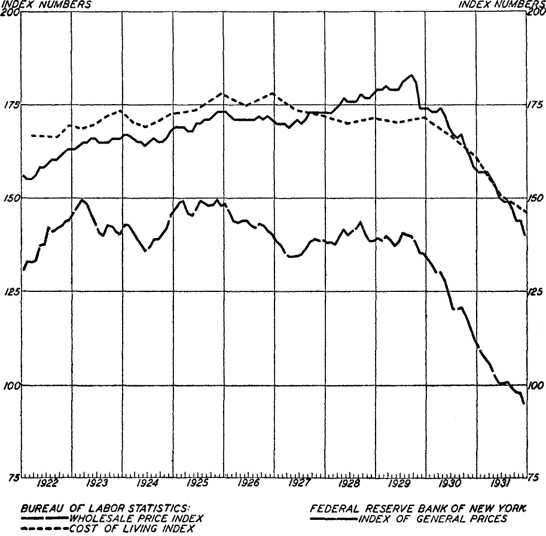
The choice of an Index number involves a choice between the different possible objectives. The various indexes are not different measures of the same thing; they are measures of different things, and the consequences of stabilizing them would not be identical. Let us examine first the so-called index of the general price level. This is a composite index which is designed to measure the price element in the total volume of monetary transactions—consequently it includes stock prices, wholesale and retail commodity prices, wages, and rents.13
The general price level, by the logic of its construction, is a device for portraying the movement of the equation of the exchange; a theoretical point of some interest to economists but one which has nothing to do with any of the suggested objectives of stabilization. The elements which are combined in this index are subject to such diverse influences that it is unlikely that they will all move together except in cases like 1921 and 1931 where all other influences are swamped by panic fears, or in cases like the German prices of 1923 where the situation is completely dominated by currency inflation.14 With component elements moving in different directions the movement of the index is merely a question of weighting. The only logical basis of weighting such an index is the relative volume of money payments involved in paying rents, buying stocks, financing retail trade, and so on. Such a weighting is defensible if one is merely interested in eliminating the price element from a series of miscellaneous monetary data, such as bank deposits, but no one can seriously argue that the importance of stock prices as compared with the cost of living, for the purpose of adjusting the equities between debtors and creditors, has any relationship to the relative volume of money turned over in the stock exchange and in the retail markets. Nor is it clear that the movement of such an index would have any predictable relationship to the stability of business conditions. That this is not a mere theoretical quibble is evident from a comparison of the movements of the general price level and the wholesale price level in the years between 1925 and 1929.
As between other indexes of the price level, the choice depends on two considerations: first, the objectives which we wish to accomplish, and second, the relative difficulties of compilation and interpretation of the various indexes. As has been noted, there are two chief objectives in the minds of the advocates of price stabilization—the stabilization of employment and business activity, and the maintenance of justice between debtor and creditor.
Justice between debtor and creditor, in so far as it is to be secured by price stabilization, necessitates a further choice between two ideals; namely, stabilization of the value of the debt to the lender, and stabilization of the effort required on the part of the borrower to discharge the debt. In a progressive society it is clear that these must diverge. To produce the same quantity of goods and services requires less and less human effort. If our aim is to insure that the lender shall get back the purchasing power with which he parted, we arrive at the cost of living index as the measure of the value of money.15 But stabilization of the sacrifice of paying a debt would call for stabilization in terms of an index of the factors of production. The first of these solutions aims to give all the gains of progress to the debtor,16 the second permits the creditor to share in them. The first aims to give back to the creditor the real income which he gave up, the second aims to give him back the same proportionate share of the total income of the community. The first would be accomplished by a stabilization of the purchasing power of money against all forces which tend to change the price level, the second would be approximated by a procedure which stabilized against changes which are due to monetary inflation and deflation, including the effects of changes in the gold supply, but not against changes in prices which result from changes in the productivity of human effort.17
Looking at the matter from the standpoint of the debtor-creditor relationship, the choice of the majority, I think, would be the cost of living index, even if the compilation of an index of the productivity of human effort were feasible. But there are also very grave difficulties in the way of the computation of a cost of living index, especially for just those comparisons over long periods of time which are of chief importance in connection with the debtor-creditor relationship. The technical difficulties in the collection of comparable prices of consumption goods are enormous. Published quotations are obscured by differences of quality, even in current quotations, and historical comparisons of prices of most consumption goods are meaningless. Technological progress in the production of consumers’ goods consists largely in improvement of the quality of things which keep the same name, and frequently keep the same price.
Moreover, the content of the standard of living changes radically from one generation to the next. Of what significance today would be an index of the cost of the commodities which made up the standard of living of a typical American family in 1890 or 1860? Equally grave are the difficulties which confront us when we compare the standard of living of families of different income groups. The cost of living indexes which we have are chiefly based on working-class budgets. They are of interest in measuring real wages, but they do not correspond to the consumptive expenditures of those who are chiefly concerned in the equitable adjustment of long-time contracts and fixed salaries.
A wholesale index presents fewer difficulties of compilation and of interpretation of quotations. Most such indexes consist chiefly of raw materials which are standardized in quality and are quoted in open markets with tolerable frequency and accuracy. It is therefore a great temptation to use them as measures of the purchasing power of money. But the fact that they can be compiled readily must not blind us to their defects. The compilation of every index involves a bias in the direction of choosing commodities on which price quotations are easy to secure, and this bias is more influential in making up a wholesale index because the compiler has more freedom of choice. But those quotations which are easiest to get in satisfactory form are those which are made in highly competitive markets. In highly competitive markets prices fluctuate a great deal. The radical changes which take place in these wholesale markets, especially those for basic raw materials, do not reflect changes in the power of money to command the necessities and luxuries of life. It would be a bitter blow to the holder of a fixed income to have it reduced at a time when rent and milk and bread have not fallen in price at all, simply because the command of money over pig iron and hay and raw cotton has increased.
Of greater importance than the question of justice between debtor and creditor is the stabilization of employment. It is often assumed that from this standpoint it is more important to stabilize the wholesale index than the retail index. But the only basis for this conclusion is the fact that the wholesale index fluctuates more in the course of a cycle than does the retail index. This does not mean that the stabilization of the wholesale index would of itself have a more wholesome influence on business than the stabilization of anything else that fluctuates in the course of a cycle—wages, for instance, or the volume of advertising.
Moreover, if our purpose is to stabilize business conditions, there is no basis, either theoretical or practical, for selecting any set of prices as the chief criterion of stability. Here the weight of the argument is all in favor of the position taken by the Federal Reserve Board and the Federal Reserve Banks, and outlined above in Chapter V. If the stability of business is our goal, and if we believe credit manipulation is a promising means of effecting it, why not be guided by employment, by profits, by interest rates, by any and all of the indexes of business activity rather than merely by a price index?
We can go a step further than this, however. Little as we know about the causes of the semi-rhythmical movement of business activity, we can say without hesitation that the injection of new purchasing power into the markets of the world by inflation and deflation of currency and credit is an unstabilizing factor. At least this is true when the inflation is more than an offset to changes in the seasonal, technical, or psychological need for currency and for credit balances. Price changes which are stimulated by fiscal or currency policy (and most of the illustrations used by the advocates of stabilization are drawn from periods of extreme currency inflation or deflation such as occur in connection with war) undoubtedly do disturb business equilibrium. If all price changes were of this character, price stabilization might well prove wholly practicable and wholly beneficial. But there are also price changes of a different character; price declines which are due to the progress of technique, invention, and the improvement of management; price advances which are due to the exhaustion of natural resources and the decay of economic power. To prevent these changes by credit policy—assuming it to be practicable—would require the continuous injection of new purchasing power into the markets, or its continuous withdrawal. Would such activity be a stabilizing or a disturbing factor in the business situation? Should we stabilize against all price changes or only against those of monetary origin?18
This brings us back to the same question, in a different form, which we considered above (page 212) in connection with the problem of determining justice between debtors and creditors; that is, would it be desirable to stabilize the value of the products of human effort or the valuation put on the effort itself? For the chief non-monetary cause of price level changes is the increasing productivity of human labor and capital.
The Strong bills did not discriminate between changes due to monetary and those due to non-monetary causes. Opponents of the stabilization program made much of this distinction and contended that it is undesirable to stabilize against those price changes which are due to non-monetary conditions. Thus Mr. Hamlin said:
I put myself this question as a test: Suppose that gold, over a certain period, is perfectly stable; there is neither appreciation nor depreciation; but suppose there has been a decline in the wholesale index numbers caused by some very great improvements in productive processes, inventions, savings in costs, and so forth, which bring down the wholesale level of prices, and that those same inventions and improved processes have taken place in Europe as well as in the United States. Under the bill as I have suggested changing it, would it be my duty to regard that reduction as an evil and to stabilize prices at a higher level, knowing that at that higher level, with no change in Europe, with no stabilization in Europe, it would mean serious injury to our export trade and would mean such a flood of imports that we would have to have a mountainous tariff to shut them out?
That was the question that I put to myself as a test; and I reached the conclusion that under the bill, with the suggestions I have made, I would not be obliged to try to keep that price level up; in other words, that a lower base of wholesale prices brought about by improvements in productive processes would be perfectly consistent with a stable condition of agriculture, industry, and commerce.19
And Mr. Miller said:
. . . It is a wholesome thing when the price level goes down because of improved industrial productivity and business management; in fact, I should say that the factor of “management” in industry is entitled to have its place in the scheme of price movements just as you would have the factor of “management” in central or reserve banks.20
This is a point of great theoretical importance. According to the tradition of the American school of quantity theorists, the costs of production of individual commodities, as affected by changing technique, cannot influence the general average of prices (except as they may increase the total amount of business to be done with a given quantity of money).21 But a number of European scholars who would be classified in America as monetary theorists recognize the distinction as valid, and conclude that the correct object of stabilization is not the commodity price level but a price level of the factors of production—in other words, the price level corrected for the effects of technological change.22
The experience of the years from 1922 to 1929 seems to indicate that this point is not merely a fine-spun logical play of the arm-chair economist, but a fatal objection to the use of a commodity price index as an index of the presence of inflation or deflation. Prices, both wholesale and retail, declined, and the stabilization advocates would have had the Reserve system resort to inflation to stop the movement—though even then they were somewhat restrained by the buoyancy of the stock market. Looking back now it appears probable that those years were years of mild credit inflation which was offset by the downward pressure on prices exerted by technological change.
The preceding discussion has no doubt made it clear that my own conclusions as to the merits of stabilization are unfavorable. My reasons may be summarized as follows:
1. The price level is not readily controlled by credit manipulation. If we are doubtful about the efficacy of the control of central bank activity, and I have indicated in Chapter V that there is room for doubt, the choice of a price index as the immediate object of stabilization does nothing to remove those doubts. If we cannot stabilize business activity by adjusting credit to business conditions as observed directly, we can scarcely hope to stabilize it indirectly by action taken on the basis of a price index which may or may not reflect the course of business.
The effect of a change in the cost of credit on the price level is much less definitely predictable than is generally assumed by advocates of the stabilization doctrine. The quantity of bank credit outstanding is a factor, but only one factor, in the determination of the price level. Equally important is the willingness of the community to hold a larger or smaller part of its available resources in the comparatively unproductive form of cash and bank balances. The greater the demand for till and pocket money and bank balances as a form of saving, the larger the amount of credit that must be outstanding to support a given price level. These demands are affected by changes in population, by the growth of the use of checks, by the multiplication or consolidation of individual business units, by changes in the banks’ requirements as to average balances, and above all (so far as short period changes are concerned) by anticipated changes in the level of prices. When prices are moving up or are expected to move up, depositors prefer to carry small balances and keep their funds invested; when falling prices are anticipated bank balances are deemed better investments than commodities or securities.
Of course, given time enough and a disregard for all other considerations, all these changes can presumably be offset and a downward trend reversed by a sufficiently vigorous open market policy. But this would not mean stability, it would mean a different set of fluctuations, perhaps as great as those we have now. The experience of 1930-32 indicates that a price change can run very far in the face of determined efforts to reverse it by credit policy.
2. The volume of credit outstanding is not susceptible of direct control. The Reserve system can make money rates low—that is open market rates, on high-grade short-term instruments. It can also influence the yields of those high-grade seasoned securities on which the risk is little affected by fluctuations in profits and in public confidence in the future. Customers’ rates which govern over 80 per cent of bank lending are much less responsive to discount policy. Still less responsive are the yields of stocks and speculative bonds.23
But the demand for short-term funds is inelastic and highly variable. In times when credit is being liquidated, the lowering of the rediscount rates has very little significance. The purchase of securities by the Reserve Banks has somewhat more effect on the volume of credit than have changes in the rediscount rate, but its primary incidence is on the rates charged in the open market. It does not produce corresponding changes in the amount of credit taken by business men. Reference has been made to the situation in 1924.24 In the twelve months from October 31, 1923 to October 31, 1924 the Reserve Banks increased their open market holdings from 296 million dollars to 784 million, yet during that time the total of Reserve Bank credit outstanding decreased by 130 million dollars.25
In times of tight money, changes in the credit policy of the Reserve system are somewhat more effective, but rate policy is restricted by international competition, and even if Reserve credit is arbitrarily restricted the banks still have a choice between curtailing the credit extended to their customers and securing additional credit from abroad. The pool of credit is international in extent; it is impossible for the banking system of any one country to expand or curtail credit unless it can carry the rest of the world along also.26 This suggests a third difficulty.
3. The policy of price stabilization is incompatible with the maintenance of the gold standard.27 Under the plan of stabilizing prices through credit control, any change in domestic prices which might result from the stabilizers’ efforts would create a divergence between the purchasing power of gold at home and abroad. This would stimulate a gold movement, outward when prices were raised by credit expansion and inward when they were lowered by credit contraction, which would work directly against the stabilizers’ plans. No country could hope to hold its own price stable in the face of a world-wide change in the value of gold, and at the same time keep its currency freely interchangeable with gold in the world’s markets at a fixed ratio.28
4. A serious, though perhaps not fatal, objection lies in the lack of a satisfactory index number. This point has been elucidated above (pages 210-17). Advocates of stabilization are disposed to wave the difficulty aside, alleging that all index numbers give such similar results that mistakes in the choice of the components would make little difference. It is true that almost any index number shows prices lower in 1921 than in 1920, and lower in 1930 than in 1929. But a stabilization program requires more than a rough measure. The stabilization plan would have to define the amount which was to be considered significant and the interval after a turning point in prices when action would be called for. Hence even minor differences would be important.
5. The proposal to make stability of commodity prices the sole test of Reserve policy is too restrictive. It would force Reserve authorities either to ignore conditions which may be of fundamental importance, such as speculative activity, international considerations, the accumulation of inventories, the state of employment—unless indeed there should arise a strained system of interpretation which would bring any and every important consideration under the rubric of price stabilization through the supposed influence of anything and everything on long-run stability of prices.
6. The stabilization of prices against the consequences of technological progress may involve creation of instability of productive activity. The grounds for this apprehension have been noted above (pages 216-17). No one would argue that it would be possible, without great risk, to stabilize the prices of those commodities whose costs are falling most rapidly; what better reason is there to think that we can safely tamper with the currency so as to offset the normal price effects of the falling real costs of a great number of commodities?
For these reasons I believe that the program of the stabilizers should be rejected. We have taken great risks in entrusting to the Federal Reserve Board and the Federal Reserve Banks the power to manipulate the money markets according to their judgment of what is good for industry, agriculture, and trade; a mandate to use the stability of the price level as their sole guide would reduce the probability of benefit from the existence of the System, without materially lessening the risks.
Addendum:
After this chapter was ready for the press the stabilization question was reopened by the campaign for the Goldsborough bill which as originally introduced combined the principal features of the Strong bills and the pre-war suggestion of Irving Fisher for the establishment of a tabular standard, or flexible dollar. The bill as it was introduced read as follows:
Be it enacted, etc., That the Federal Reserve Act is amended by adding at the end thereof a new section to read as follows:
“Sec. 31. The Federal Reserve Board and the Federal Reserve Banks are hereby authorized and directed to take all available steps to raise the present deflated wholesale commodity level of prices as speedily as possible to the level existing before the present deflation, and afterwards to use all available means to maintain such wholesale commodity level of prices.”
Sec. 2. If, in carrying out the purposes of the preceding section, the Federal Reserve Board and/or the Federal Reserve Banks, in selling securities, should exhaust the supply, the Federal Reserve Board is authorized and directed to issue new debentures.
Sec. 3. If, in carrying out the purposes of Section 1, the gold reserve is deemed by the Federal Reserve Board to be too near to the prescribed minimum, the Board is authorized to raise the official price of gold if the other methods already authorized appear inadequate; if, on the other hand, the gold reserve ratio is deemed to be too high the Federal Reserve Board is authorized to lower the official price of gold if the other methods already authorized appear inadequate.29
Public hearings were held on the bill in March and April 1932. It was reported out in modified form and was passed by the House on May 2 by a vote of 289 to 60. The revised bill read as follows:
Be it enacted, etc., That the Federal Reserve Act is amended by adding at the end thereof a new section to read as follows:
“Sec. 31. It is hereby declared to be the policy of the United States that the average purchasing power of the dollar as ascertained by the Department of Labor in the wholesale commodity markets for the period covering the years 1921 to 1929, inclusive, shall be restored and maintained by the control of the volume of credit and currency.”
Sec. 2. The Federal Reserve Board, the Federal Reserve Banks, and the Secretary of the Treasury are hereby charged with the duty of making effective this policy.
Sec. 3. Acts and parts of Acts inconsistent with the terms of this Act are hereby repealed.30
It will be noted that in the bill as passed the provision for changing the official price of gold has been stricken out. This leaves the bill substantially identical with the Strong bills except that (a) it specifies an index of the wholesale price level as the standard of stabilization, and (b) it provides that before the price average is stabilized it is to be raised to the level of 1921-29. In other words, it establishes for the immediate future a price-raising policy; and for the long run a price stabilization policy.31
“I noticed a statement by one professor a short time ago . . . to the effect that the decline in prices of 1926 and the first part of 1927, when business was very active, was the prime cause of the subsequent recession in business in the latter part of 1927. Now, I am not prepared to accept that for a moment. In my judgment, in that period of 1926 and the first half of 1927, of very active business, had the Federal Reserve Banks, because prices were declining somewhat, injected more credit into the situation, it would have developed at many points unsound conditions in business which would have been followed by a more serious amount of recession in the latter part of 1927, or possibly at the present time. . . (Hearings on H.R. 11806, p. 135. Compare also F. A. Hayek, “Das Schicksal der Goldwahrung,” Der Deutsche Volkswirt, Feb. 12, 1932, pp. 642-45.)
- 1The distinction between “banking policy” and “credit policy” is taken from Annual Report of the Federal Reserve Board, 1928, pp. 9-10.
- 2Compare pp. 132-40.
- 3This is, of course, in substance the position of the Banking School in the British banking controversy of the early nineteenth century.
- 4“. . . When increased credit demands can be met only by recourse to the Federal Reserve Banks, the volume of Reserve Bank lending is a sensitive indicator of credit conditions. . . .” (Federal Reserve Bulletin, 1923, Vol. 9, p. 411).
- 5Annual Report of the Federal Reserve Board, 1923, p. 10 (quoted below, pp. 79-80); Federal Reserve Bulletin, 1928, Vol. 14, p. 6.
- 6The omission of reference to price changes in the text is intentional and without prejudice. I believe that there is need of a thorough reexamination of the orthodox statement of the influence of gold movements on price changes and the extent to which in pre-war days changes in price levels were caused by gold movements and operated to check the gold movements.
- 7For fuller discussion of these points, see Chap. IX; compare also B. H. Beckhart, The Discount Policy of the Federal Reserve System, Chap. II.
- 8The cash balance carried in the United States Treasury was occasionally drawn upon to meet seasonal or crisis demands, either through the depositing of funds in banks or through the purchase of bonds by the Treasury, but the device was very crude and there was no continuity of policy in its management.
- 9Compare chart, p. 35.
- 10The possibility of temporary nullification of a central bank’s control through the mobilization of fresh resources is illustrated by an action of the Midland Bank, which in 1927 bought securities so heavily as to lower its own reserve ratio by several per cent. The amount involved was small enough so that the Bank of England was able to offset it. The net result was simply to increase the earning assets of the Midland Bank and decrease those of the Bank of England; not to ease the market.
- 11Compare p. 231.
- 12Annual Report of the Federal Reserve Board, 1927, pp. 10, 16.
- 13See pp. 104-05.
- 14Annual Report of the Federal Reserve Board, 1927, p. 11.
- 15The 4 1/2 per cent rate was charged on all maturities of less than 90 days, such paper making up the great bulk of the transactions.
- 16As reported by the New York Stock Exchange.
- 17At least such a policy was promulgated by the Board. It is difficult to say how far the Reserve Banks went in carrying it out. Apparently the New York Bank did not give much heed to it; alleging, truly, that New York banks were not loaning heavily in the stock market. Compare p. 133.
- 18Indexes of Standard Statistics Company.
- 19This increase is not altogether due to the rate change, as the supply of acceptances is always increased by autumn exports. The increase in 1929 was much more than seasonal, however.
- 20See 70 Cong. 1 sess., Brokers’ Loans, Hearings on S. res. 113 before Committee on Banking and Currency.
- 21See testimony of Cassel, Fisher, and Foster in Hearings on H.R. 78955 William T. Foster and Waddill Catchings, “Is the Reserve Board Keeping Faith?,” Atlantic Monthly, July 1929, Vol. 144, pp. 93-102.
- 22From July 31 to December 31 the increase in acceptances held was 327 million dollars. In no other years except 1924 and 1929 has the increase exceeded 235 million dollars, and usually it has been below 200 million (in 1924, 363 million dollars; in 1929, 329 million). Computed from data published in annual reports of the Federal Reserve Board.
- 23From the beginning of 1922 to the end of 1927 member bank reserve balances had shown an increase in every year, the average gain being 120 million dollars, or about 6 per cent.
- 24Monthly averages, December 1927 compared with December 1928.
- 25Hearings on S. res. 71, Part 6, pp. 753-63.
- 26Federal Reserve Bulletin, 1929, Vol. 15, p. 94.
- 27“The Chairman. . . . It is the business of the Federal Reserve Bank to know what the borrower is doing and for what purpose he is doing it. If that is not the meaning of this Act why should they feel—your board of directors ever feel, in any sense or degree—warranted in admonishing member banks in New York to reduce their loans to brokers?
- 28Hearings on S. res. 71, Part 6, pp. 724-25.
- 29The production index of the Standard Trade and Securities Service for the first half of 1929 averaged 131 as compared with 120, 120, and 119 for 1926, 1927, and 1928 respectively.
- 30Hearing’s on S. res. 71, Part 1, pp. 56-57. It should be added that Governor Harrison explained the failure of discount rate advances to check the speculative movement in 1928 as a result of the loans on account of “others.”
- 31Ibid., p. 172.

