
Credit Policies of the Federal Reserve System
XV: Regional Uniformity of Rates
CHAPTER XV
REGIONAL UNIFORMITY OF RATES
In this chapter we consider the policy of the Reserve system with regard to uniformity of rediscount rates between Federal Reserve Districts and the effects of Reserve policy on the regional structure of bank loan rates.
Throughout our history, interest rates, both those paid on mortgage loans and those charged by banks over the counter, have generally been higher in the West of the United States than in the East, and higher in the South than in the North. This difference results in part from the fact that the older sections of the country are better supplied with capital. The West borrows from the East, and naturally rates are higher in the borrowing section. In part also the difference is probably due, so far as rates on bank loans are concerned, to the fact that in the agricultural regions banks find it more difficult to get adequate diversification of risk. They are, therefore, under more temptation to make doubtful loans and their loss ratios run higher. Moreover, banks in the West and South are smaller than in the Northeast and therefore have somewhat higher operating ratios.
The sectional difference in interest rates, coupled with the fact that certain large regions have been borrowers from other regions, has been one of the major sources of sectionalism in American thinking, and has frequently given rise to bitter political controversy. The fight on the Second United States Bank, the Greenbacker movement, and the Free Silver controversy are among the conspicuous expressions of the conflict of interests between the capital-rich and the capital-poor sections. Naturally there was some expectation that a thoroughgoing reform of our banking system, carried out under Democratic auspices, would be of some aid in this direction. It would not have been surprising if the newer sections of the country had attempted to obtain in the Federal Reserve Act a provision for uniformity of rediscount rates, such as characterized the Federal Farm Loan and Federal Intermediate Credit Acts. No serious effort of this sort was made, however.
The plan on which the Reserve system was organized created a presumption against uniformity of rates. The Aldrich plan had provided for uniform rediscount rates throughout the country. In contrast to this, the regional system of control set up in the Federal Reserve Act clearly implied that rates would vary from district to district. The power of the Federal Reserve Board to “review and determine” rates certainly did not contemplate the establishment of a single rate throughout the System.
It may seem curious that the earlier plan, which in general represented the views of large banking interests, should have provided for uniform rates, while a bill drawn under the influence of the West and South left the door open for the charging of higher rates in the poorer sections. There are two explanations. In the first place the political elements which framed the Reserve Act were deeply interested in maintaining the independence of the individual Reserve Banks. Uniformity could obviously only be attained through centralization of the rate-making power; the avoidance of such centralization was the cardinal feature which distinguished the Glass bill from the Aldrich plan. Second, there seems to have been general acceptance of the idea that some divergence of rates between districts was desirable, perhaps necessary. Economists generally held that the difference in rates reflected such large differences in the supply of savings in the older and newer sections that it was impracticable to overcome them. It was agreed that a policy of uniform rediscount rates would infallibly lead to inflation in the newer sections, if rates were fixed at a low enough level to make the rediscount provision of any value in the East.1
In the early years of the Reserve system there was apparently no attempt at uniformity of rates. The original schedule of discount rates, established on November 16, 1914, provided for 5 1/2 per cent on paper of less than 30 days’ maturity at New York and Philadelphia, and 6 per cent at the other Banks. Rates for longer maturities were fixed at 6 per cent at some Banks and 6 1/2 at others. During the next few months the rates were rapidly lowered, all Banks getting down, before May 1, 1915, to 4 per cent or less for paper maturing within 60 days. Rates in general remained as low as this till after the war.
As a rule during these early years, two rates were in effect in the System for each of the more important types of paper, some of the Reserve Banks charging one-half per cent more than the rest. The lack of uniformity from district to district, however, appears to have reflected variations in the judgment of Reserve officials rather than actual geographic differences in money markets. For example, on January 1, 1916, the New York and San Francisco Reserve Banks had identical rates on paper maturing in less than 10 days and also in from 31 to 60 days, while New York was one-half per cent higher than San Francisco on 11-30 day paper and one-half per cent lower on 61-90 day paper. Such variations as these can hardly be explained on the basis of differences in the economic needs of the various districts.
From the beginning, lack of uniformity in rediscount rates was apparently regarded by the Federal Reserve Board as an evil. In its report for 1915 the Board said: “It may not be practicable to maintain uniform rates through the twelve districts, but they should unquestionably bear a consistent relation one to another, while a very much greater adherence to uniformity than before the enactment of the Federal Reserve Act will undoubtedly be secured.”2
War finance did much to unify the money markets of the country, and discount policy reflected this development. During the war the bulk of bank borrowing was done on the security of United States obligations, and uniform rates were generally maintained for such loans.3 The changes which were made from time to time reflected national conditions, chiefly changes in the rate paid on successive issues of Liberty Loans, rather than local conditions in the several districts.
During recent years there has been a strong tendency toward uniformity of rediscount rates. The rate was uniformly 4 1/4 per cent at all Banks from March 6, 1923 to May 1, 1924. Then for a year and a half there was considerable diversity. During this interval, one Bank went to 3 per cent, and four others to 3 1/2 per cent, while seven did not go below 4. By January 8, 1926, however, all rates were once more uniform at 4 per cent, and from that time till 1931 there were no independent local movements at any Reserve Bank except New York.
In 1926 New York rates were lowered in April and raised in August, independently of other Banks, and in 1929 they were raised in August and lowered in November. In 1930 New York rates kept dropping ahead of the other Banks and ended the year at 2 per cent, with two others at 3 per cent, and the rest at 3 1/2. In 1931 there was less uniformity of movement. The last of the series of reductions was made in May, at which time the range was as follows: per cent, one Bank; 2 per cent, one Bank; 2 1/2 per cent, four Banks; 3 per cent, five Banks; 3 1/2 per cent, one Bank. There were no further changes until October 9 when there began a series of advances which quickly wiped out most of the differences.4 From January 28 to June 24, 1932 all Banks except New York had the same rate, 3 1/2 per cent.
In summary, aside from New York rediscount rates, there were no differences in the five years 1926-30, except those due to lags in the process of changing the System from one level to another. A shift of rates was never made simultaneously at all Banks, and frequently the successive changes were spread over several months. The order in which the Banks changed their rates displayed no uniformity and was generally not to be explained on discernible economic grounds.5
The theory that regional rates reflect the independent judgment of local boards of directors is dead. This fact became dramatically clear in the Chicago case of 1927,6 but even without that incident would be obvious from the general uniformity of rates and the way in which the rate changes in one district follow those in another. Since the open market policy is even more obviously centralized,7 we cannot properly speak of the credit policy of an individual Reserve Bank—unless indeed that Bank is strong enough to impose its policy on the System.
It is clear also that those who control the System’s policies attach but little importance to inter-district differences in money market conditions. There has never been any formal declaration of an intention to maintain a uniform rate structure; indeed there have been statements that such is not the purpose.8 But in practice it is obvious that changes are made in accordance with a unified plan and that any local conditions which might make differences in rates desirable are subordinated to the supposed needs of the country as a whole.
Early opposition to uniformity of rate policy was in part due to exaggeration of the independence of the money markets of the country. In the discussions of the Reserve plan too much emphasis was placed on the rates at which banks lend, which do differ widely from region to region; and not enough attention was paid to the cost to the banks of securing funds otherwise than through rediscounting, which shows much less divergence. From the standpoint of rediscount policy the important question is not the rate at which a bank lends over the counter to customers who have no convenient alternative source of capital, but the cost at which it can meet its temporary needs elsewhere as an alternative to rediscounting. Before the Federal Reserve system came in, the usual method was to borrow from a correspondent bank in a financial center. Such borrowing was always common, though often more or less concealed.9 To a much greater extent than was anticipated, the system of interbank credit relationships survived the establishment of the Federal Reserve system, and became an obstacle to the maintenance of high rediscount rates in regions where customers’ rates were high. From the beginning, indeed, though city banks rediscounted at the Reserve Banks, country banks continued to do a considerable proportion of their borrowing through their correspondents.10 Since the rates on interbank loans are not controlled by the location of the borrowing bank, interbank lending makes it difficult to maintain differences in Reserve rediscount rates.
Those lending rates which vary most from region to region are the least important in determining the proper level of rediscount rates. An exaggerated importance has always been attached to the relationship between the rediscount rate and the rate which the borrowing bank gets on its high-rate non-liquid loans. There are large regional differences in rates charged customers over the counter, but the rate earned in these transactions does not determine how much a bank will seek to borrow at a given rediscount rate. From the standpoint of a bank, the limiting factors in the granting of local high-rate loans are risk and liquidity, rather than cost of borrowed capital. If the banks believed they could safely make more high-yield loans they would do so, whether they could rediscount or not. For, even without borrowing or rediscounting, a solvent bank can almost always obtain some additional funds at a cost lower than the rates it charges to local borrowers. All that is necessary is to reduce the secondary reserves. There is practically always a margin of funds invested in open market commercial or cattle loan paper, loaned on call, or deposited at low rates with correspondents.11 This reserve of low-yield liquid loans and investments varies in size as the local supply of safe loans goes up and down, and as the bank’s lending policies are changed.
What is important is that rediscount rates shall not offer to banks an opportunity to shave out a profit by borrowing to make or maintain open market loans. That would be inflationary in tendency, for such transactions are not kept down adequately by the factor of risk, and do not seriously impair liquidity. But it is a matter of relatively small consequence that rediscount rates are always lower than rates on the slow-moving customers’ loans, in the East as well as the West.
The maintenance of uniform rediscount rates has been made easier by the appearance of greater unity in the open money markets of the country. The accompanying chart shows the trend toward equalization of open market money rates in the larger financial centers. In part this tendency may be the result of Federal Reserve policy, but there have been other forces working in the same direction. The most important of these is probably the creation of a great mass of short-term government paper, mostly held by banks, which sells throughout the country at a uniform rate and is shifted about with the greatest ease in response to changes in the money market.
A second, and less important, factor is the development of the acceptance market as an outlet for Reserve funds, the yield of the acceptances being the same no matter which Reserve Bank buys them. A third is the great increase in the public buying of stocks and bonds, which of course are sold at uniform prices throughout the country. Finally, the spread of large-scale business organizations, especially chain systems, has increased the proportion of the business of outlying centers which is financed in the central money markets, or is able to resort to them if satisfactory rates are not offered in the local community.
Customers’ Rates in Leading Cities before and after the Establishment of the Federal Reserve System12
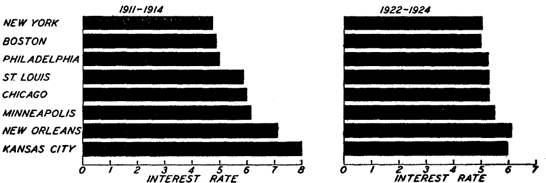
It is uncertain whether the operation of the Federal Reserve system has tended to equalize rates charged over the counters of banks. It is generally believed that there has been some equalization of rates. However, the table on page 302, computed and condensed from a table of rates by months prepared by the Division of Research and Statistics of the Federal Reserve Board, shows no evidence of such a tendency so far as the period since 1918 is concerned. What it does show is that the rates charged in the cities in all sections of the country are much more uniform in periods of tight money than in periods of easy money. Banking conditions in the financial centers of the East are much more competitive than in the West and South. When money is abundant rates in New York especially tend to drop much faster than elsewhere; when money becomes tight they go up correspondingly faster. In July of 1924 the differential between New York and the reporting Banks in the South and West widened to 1.75 per cent.13
Differentials in Customers’ Rates14 (Excess, in hundredths of 1 per cent)
| Year | Eight Northern and Eastern Cities over New York | Twenty-Seven Southern and Western Cities over the Northern and Eastern Cities | Southern and Western Cities over New York |
|---|---|---|---|
| 1919, January | 25 | 32 | 57 |
| 1920, “ | 6 | 17 | 23 |
| 1921, “ | 28 | 11 | 39 |
| 1922, “ | 58 | 48 | 106 |
| 1923, “ | 52 | 56 | 108 |
| 1924, “ | 32 | 49 | 81 |
| 1925, “ | 64 | 77 | 141 |
| 1926, “ | 50 | 42 | 92 |
| 1927, “ | 33 | 73 | 106 |
| 1928, “ | 17 | 80 | 97 |
| 1929, “ | 13 | 7 | 20 |
| 1930, “ | 24 | 24 | 48 |
| 1930, December | 52 | 74 | 126 |
If there has been any equalization of rates charged by country banks, the responsibility of the Reserve system is even more doubtful than in the case of rates in the larger cities. The Federal Farm Loan system and the Federal Intermediate Credit system have been working toward equalization of rates charged farmers in different sections of the country much more directly than has the Federal Reserve system. Certainly in 1920 the Reserve system made it easier for the South and West to shift part of the strain to the Northeast, but there is little in the record of Federal Reserve operations since 1922 to suggest further influence in this direction.
The Federal Reserve system has not done away with the practice of interbank depositing and lending. It has centralized the legal reserves, but left untouched the practice of carrying deposits with banks of larger cities as secondary reserves. This has been a disappointment to many more people than are interested in the reform of over-the-counter lending practice.
One of the prime purposes in the minds of the founders of the Federal Reserve system was the prevention of the flow of bank funds from the interior to New York, and this objective still bulks large in the thought of the American public. It is grounded in the regional conflict of interest which has always colored our financial thinking. It also reflects a failure on the part of the public to understand fully the reasons which lead country banks to carry balances with New York banks and to lend their funds in the New York money market. Since the West has always been capital poor and has been a heavy borrower from the East on long-time account, it appears anomalous that western banks should be lenders in New York on short-time account, especially since the return from balances carried with city correspondents is always considerably less than the rates charged borrowers in the bank’s own community.
The fundamental reason for the practice, of course, is found in the country bank’s needs for more diversification in its investments than the local community furnishes and, more important, in the necessity of keeping a considerable proportion of its assets liquid.15 For the same reason that part of a bank’s resources must be carried as cash in the vault without any return, another much larger part must be kept in highly liquid form, even though the return is very small. From the standpoint of the banker an interest-bearing balance with another bank is a way to eat his cake and have it too—it is at the same time an earning asset and a reserve against calls from depositors.
As a practical matter the only way in which country banks can put their reserves into a form to earn them something and at the same time have them immediately available is to lend them out in financial centers or deposit them there. Except for seasonal peaks, there are few opportunities for making very short-time loans to farmers or manufacturers or wholesale and retail distributors. Nowhere is there any considerable demand for loans repayable on demand except in connection with the purchase and sale of securities and of commodities which can be turned over on very short notice. In practice that means operations in speculative security and commodity markets, for immediate marketability and speculative trading go together.
From the standpoint of a country bank, a New York balance or a call loan is practically as good a reserve as cash in the vault.16 The fundamental reason which leads to interbank depositing is the same as the reason the banking systems of the less commercialized nations carry reserves in the form of balances in the banks of foreign financial centers and in foreign bills of exchange—namely the desire to keep some funds in a form as nearly equivalent to cash as possible, and still to have them bring in some return. In both cases the reserves, if they are to be really available and at the same time are to earn a return, must be placed in important investment and speculative centers. The dependence of our country bankers on such balances in lieu of cash reserves is simply the use of the gold exchange standard in domestic finance.
Deposits with city correspondents and over-the-counter loans are usually non-competing uses of funds. So long as the rate paid to country banks on balances in New York is below the rate which these banks charge their customers for loans over the counter, or earn by investing in local securities and paper of intermediate length, there is no real danger that local enterprises will be starved by the competition of the central money markets. The fact that a bank has funds which it can place elsewhere in a demand deposit or invest in securities which have an immediate market is no proof that it has funds that it can safely tie up in commercial or investment operations, any more than cash in the vaults is a proof of ability to make additional loans of equivalent amounts over the counter. The uses are non-competitive (except when call loan rates are running at exceptionally high levels). A bank has the same interest as its local customers in keeping as much of its money at work in financing their operations as is consistent with safety. When country banks send money to New York to earn 2 per cent at a time when their customers are willing to borrow at 8 per cent, it is a safe assumption that but little of the money could safely be made available for the local 8 per cent loans, even if the 2 per cent were not to be had.
Low rediscount rates at an individual Reserve Bank do not make funds scarce in its district. The idea is widely held that high rediscount rates at interior Reserve Banks benefit the business interests of the interior by attracting capital to them. This doctrine, which found expression particularly often at the time of the controversy between the Chicago Bank and the Federal Reserve Board in 1927, is entirely fallacious. It is true of course that, other things being equal, the payment of high rates will attract money from outside, which is better for the business interests of the interior than it would be to do without the funds. If the payment of higher rates to outsiders were estopped, say by a usury law, the result might be a shortage of credit—for instance, for crop-moving.
But if low rates prevail in a district simply because the Reserve Bank—or any one else—stands ready to supply the funds at less than the rate needed to attract funds from outsiders, the low rates cannot possibly cause a shortage of funds. The banks and business interests of the West are still free to bid as high for capital in New York as they wish; the action of an interior Reserve Bank in lowering its rates interferes with the movement of private capital into the district only to the extent that it makes it superfluous.
Of course, a Reserve Bank may get itself over-ex-tended if it makes borrowing too easy. This happened in 1919-20. But so long as the Reserve Banks have ample reserves—and that has been the situation continuously for the last ten years—the only reason for objecting to low rates is their inflationary tendency; the idea that they keep capital out of the districts in which they prevail is absurd.
In summary, my judgment is that the drift of policy in the direction of uniformity of rates is a good thing. Mistakes will be made from time to time no matter whether the decisions are centralized or are made locally by the Reserve authorities in the various districts. But on the whole we have a unified open money market, and a unified discount policy is only a reasonable recognition of the facts. The fear entertained 15 years ago that rates high enough to prevent inflation in the West would be deflationary in the East has proved itself to be groundless.
“Senator Glass. Does not that come about because the directors have been taught to believe that the Federal Reserve Board here at Washington has established the policy of uniform rediscount rates throughout the United States?
“Mr. Young. Well, I would be very sorry, Senator, if they did have that feeling. I can see why they possibly might have felt that way, but I think that at the present time the directors of the Federal Reserve Banks do not have that feeling.” 70 Cong. 1 sess., Brokers’ Loans, Hearings on S. res. 113 before Committee on Banking and Currency, pp. 71-72.
- 1The distinction between “banking policy” and “credit policy” is taken from Annual Report of the Federal Reserve Board, 1928, pp. 9-10.
- 2Compare pp. 132-40.
- 3This is, of course, in substance the position of the Banking School in the British banking controversy of the early nineteenth century.
- 4“. . . When increased credit demands can be met only by recourse to the Federal Reserve Banks, the volume of Reserve Bank lending is a sensitive indicator of credit conditions. . . .” (Federal Reserve Bulletin, 1923, Vol. 9, p. 411).
- 5Annual Report of the Federal Reserve Board, 1923, p. 10 (quoted below, pp. 79-80); Federal Reserve Bulletin, 1928, Vol. 14, p. 6.
- 6The omission of reference to price changes in the text is intentional and without prejudice. I believe that there is need of a thorough reexamination of the orthodox statement of the influence of gold movements on price changes and the extent to which in pre-war days changes in price levels were caused by gold movements and operated to check the gold movements.
- 7For fuller discussion of these points, see Chap. IX; compare also B. H. Beckhart, The Discount Policy of the Federal Reserve System, Chap. II.
- 8The cash balance carried in the United States Treasury was occasionally drawn upon to meet seasonal or crisis demands, either through the depositing of funds in banks or through the purchase of bonds by the Treasury, but the device was very crude and there was no continuity of policy in its management.
- 9Compare chart, p. 35.
- 10The possibility of temporary nullification of a central bank’s control through the mobilization of fresh resources is illustrated by an action of the Midland Bank, which in 1927 bought securities so heavily as to lower its own reserve ratio by several per cent. The amount involved was small enough so that the Bank of England was able to offset it. The net result was simply to increase the earning assets of the Midland Bank and decrease those of the Bank of England; not to ease the market.
- 11Compare p. 231.
- 12a Compiled from Annual Reports of the Federal Reserve Board and from Federal Reserve Bulletins, Vol. 18, pp. 186, 352, 358, 400.
- 13Annual Report of the Federal Reserve Board, 1927, pp. 10, 16.
- 14a Facts and Figures Relating to the American Money Market, p. 61; Federal Reserve Bulletin, 1932, Vol. 18, p. 105.
- 15See pp. 104-05.
- 16Annual Report of the Federal Reserve Board, 1927, p. 11.

