
Credit Policies of the Federal Reserve System
XI: Efficacy of the Reserve System’s Technique
CHAPTER XI
EFFICACY OF THE RESERVE SYSTEM’S TECHNIQUE
An appraisal of the results which have been obtained from the attempts of the Reserve system to improve on the working of free competition in the money markets in the past ten years involves two kinds of issues; namely, the efficacy of the instruments of control which are at the disposal of the Reserve system, and the merits of the objectives at which the System has aimed. Final judgment on questions of the latter type can best be postponed until after we have considered in Part III a number of less conspicuous issues which have to do chiefly with the allocation of credit to different applicants and its issuance through the medium of different credit instruments. But the operations which were summarized in Chapter III and described more fully in Chapters IV to IX inclusive will suffice as a basis for judging the efficacy of the instruments of control which the Reserve system uses. How far does the actual growth of credit during the decade from 1922 through 1931 correspond to that which the Reserve system was aiming at?
Experience can never demonstrate in thoroughly satisfactory fashion the efficacy or futility of any economic technique. It is rarely possible to isolate the effects of a given policy from those of other conditions. Moreover when a policy fails there is always the possibility that the tools of control were not used with sufficient skill, vigor, or promptness to afford a test of their effectiveness. Nevertheless the experience of the past ten years is sufficient to throw a considerable amount of light on the effectiveness of the technique by which the Federal Reserve system, in common with other central banking systems, attempts to control the volume of credit and thereby the functioning of the money markets and the pace of business activity.
This is an issue of much greater importance than is the question whether at each successive critical point the Reserve system authorities have used the best of judgment. If the pace of business activity and the allocation of national income between consumption and investment are as completely subject to the control of credit authorities as is assumed in much current discussion, the way is open for a wiser use of the weapons of credit control to bring about stability and enduring prosperity in years to come. If, on the other hand, the real powers of the Reserve authorities are so limited that the best they can do is to facilitate adjustments of a relatively minor character, the sooner that fact is recognized, the better. Administration of the matters which fall within the genuine competence of the Reserve system will be greatly improved by relinquishment of any ambition to achieve the impossible.
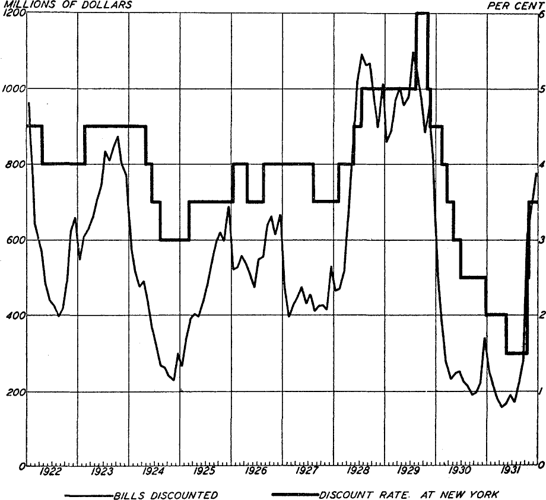
As between the two chief tools for credit manipulation, the primary importance under present American conditions must be ascribed to the open market operations. The rediscount rate is not an effective instrument for controlling the volume of Federal Reserve Credit in use because member bank borrowing does not respond to rate changes. As is shown by the accompanying chart, rediscounts are usually low in times of low rates and high when rates are high. On the other hand there is a positive correlation between open market operations and the size of member bank reserves, as is shown by the table on page 234.
Rediscount Rate and Volume of Rediscounting, 1922-31
Rediscount Rate at New York Compared with Call Loan Rate, 1922-31
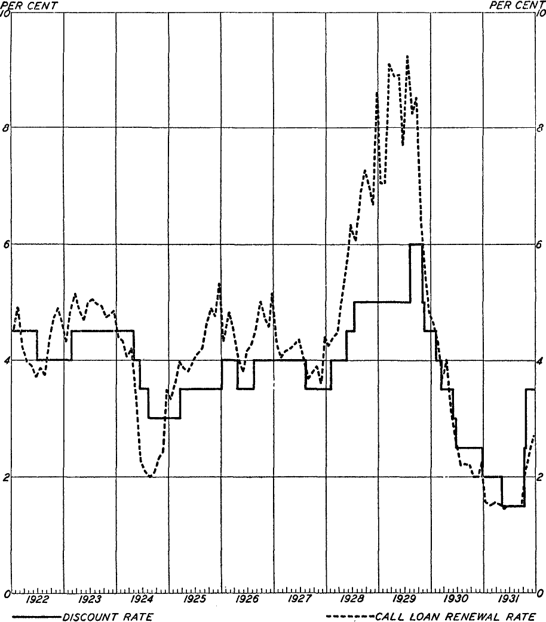
The principal reasons for the absence of any inverse correspondence between the level of rates and the volume of borrowing are to be found in the open market operations and in the tradition against interbank borrowing to which reference was made in Chapter II. When it is desired to ease the market, securities are bought and the discount rate is lowered. The lowering of rediscount rates by itself would give some incentive to banks to make added use of their rediscount facilities. But the fresh money which comes into the reserves of member banks on account of the open market purchases makes it their immediate problem to find uses for new money rather than to increase their balances by rediscounting. Under such circumstances the practical alternatives are either to buy securities, to increase open market loans, or to pay off rediscounts. The chart on page 229 shows that there is usually a profit in rediscounting so as to maintain call loans. This is also true of time collateral loans and of the purchase of commercial paper, though not of government securities and acceptances. But it is a well established principle that a bank ought not to borrow merely in order to relend at a profit. The Reserve Board says:
. . . in general it is not necessary to maintain a discount rate above the prevailing level of call loan rates in order to prevent member banks from borrowing at the Reserve Banks for the purpose of increasing their loans on securities. Member banks generally recognize that the proper occasion for borrowing at the Reserve Bank is for the purpose of meeting temporary and seasonal needs of their customers in excess of funds available out of the member banks’ own resources; borrowing from the Reserve Bank for the purpose of enlarging their own operations is not considered a proper use of Reserve Bank credit either by the member banks or by the officers of the Federal Reserve Banks.1
This tradition is in part an outgrowth of deliberate Reserve system policy; in part the survival of a prewar tradition which made any sort of borrowing by a bank a confession of weakness; and in part an expression of a broader traditional principle that any sort of permanent capital investment—industrial, commercial, or agricultural—ought to be financed by long-time capital instruments rather than by short-term borrowing.2
The existence of this tradition leads the banks to apply the fresh reserve money first to paying off their borrowings, without much regard to the rate level. In the converse case, when sales of United States securities are made in large volume the banks lose reserves. They cannot sell securities except to one another, nor can they quickly collect any substantial amount of their outstanding loans. Consequently they borrow, at least temporarily, to replenish their reserves, and the higher rates which are exacted at such time have no apparent restrictive effect.3
So long as reliance is placed on quantitative rather than qualitative control of member bank credit, as it usually has been in the past,4 it makes little difference whether the rediscount rate is effective or not. Open market operations serve the same purpose. But if progress is ever to be made along the lines blocked out in 1929, by withdrawal of rediscount privilege from banks which do not support the Reserve Board’s or the Reserve Banks’ policies, it will be essential that much less use shall be made of open market operations and that rate control be substituted for a traditional ban on continuous borrowing as a means of keeping borrowing within limits.5 In that case it will be necessary to destroy the tradition against rediscounting. If the member banks were encouraged to borrow freely whenever they found it profitable to do so, a very high discount rate would be an effective check on excessive borrowing, and a low rate a stimulus to greater borrowing when the situation seemed to call for liberality. If this were to be done it might be necessary to vary rediscount rates over a wider range than is now customary, and perhaps to have a larger degree of geographical diversity of rates. Probably there would still be a great deal of difficulty in stimulating borrowing in times when public confidence is low. But within the range in which open market operations are now effective, the rediscount rate could be made effective, and open market operations dispensed with.
Aside from the question of relative effectiveness of the two standard methods of controlling credit, there is the more important question of the extent to which either one can be deemed adequate for the responsibilities which public opinion has imposed on the Reserve Board and the directors of the Reserve Banks.
In most cases the volume of outstanding credit shows considerable responsiveness to changes in Reserve system open market policy, though gold movements and repayment of borrowings may make it necessary to buy two or three dollars worth of bonds to put one dollar into the bank reserves. A comparison of recent changes in open market policy and changes in other money market items may be illuminating. During the period covered by our study the Reserve system made four distinct efforts to increase the volume of credit outstanding by buying securities, and two direct attempts to contract credit by selling them. The table on page 234 shows the time relationship between these movements and a number of related items.
It will be noted that there is a high degree of correspondence between the policy of the System as expressed in the purchases of securities and the direction of change of member bank reserve balances. Repayment of indebtedness works against the changes in open market holdings, and often gold movements do so, but these offsets are not sufficient to cancel the effect of open market operations.
The effect on the loans and on the investments of reporting member banks presents an interesting contrast. Bank investments in every case show a pronounced change in the same direction as Federal Reserve holdings of United States securities, while loans display no responsiveness whatever. This difference is to be explained partly by the fact that the public demand for loans cannot be quickly stimulated by the cheapening of money, and partly by the circumstance that cheap money periods are also periods when banks feel it necessary to be unusually cautious in their credit analysis.
Open Market Operations and the Money Market6
(Net change of monthly average; in millions of dollars except as otherwise noted)
| Item | March 1923 to November 1923 | November 1923 to October 1924 | May 1927 to December 1927 | December 1927 to July 1929 | October 1929 to December 1930 | February 1932 to May 1932 |
|---|---|---|---|---|---|---|
| ALL FEDERAL RESERVE BANKS: | ||||||
| United States securities | -233 | + 502 | +315 | - 459 | + 490 | + 670 |
| Rediscounts | +171 | - 559 | + 56 | + 567 | - 547 | - 362 |
| Member bank reserve balances. | + 2 | + 266 | +137 | - 65 | + 29 | + 231 |
| REPORTING MEMBER BANKS: | ||||||
| Loans | +179 | + 980 | +730 | +1,554 | -1,374 | - 1,009 |
| Investments | -260 | + 950 | +324 | - 403 | +1,366 | + 346 |
| Net demand deposits | -114 | +1,767 | +693 | - 627 | + 206 | + 49 |
| Net demand plus time deposits. | + 16 | +2,461 | +999 | - 373 | + 588 | + 24 |
| MONETARY GOLD STOCK: | +216 | + 324 | -235 | - 81 | + 202 | - 111 |
| WHOLESALE PRICES7: | -5.5 | -0.2 | +3.1 | +1.2 | -15.9 | - 1.9 |
In three of the six cases the movement of gold did not conform to that which theory would lead us to expect. In 1923-24 and in 1929-30 there was an increase in the gold stock in spite of an easy money policy and in 1927-29 there was a net loss in the period when security holdings were being drastically reduced. In the two cases first mentioned the explanation is obvious. In 1920-24, as was noted previously,8 so large a part of the world was off the gold standard that gold drifted steadily into the gold standard countries quite irrespective of their credit policies. The import of gold in the face of easy money from October 1929 to December 1930 is also accounted for by the fact that easy money policies here were matched or outdone by easy money policies everywhere else. The net loss of gold between December 1927 and July 1929 is more difficult to reconcile with what theory would lead us to anticipate. However, it is to be noted, first, that the net loss of gold was more than accounted for by the takings of France, all other countries showing a net loss to us during the period; and second, that the whole net loss and much more occurred in the first six months of the period and was the continuation of a movement which had started during the easy money period of 1927. For the last half of the period we gained gold with increasing rapidity.
Tentatively the situation may be summed up as follows:
1. The chain of causal relationships which it is desired to set up would run from open market policy to the reserves of member banks; thence to loans and investments on the one hand and deposits on the other; and finally to the buying policy of the public and the price level.
2. The first effect of reversal of open market policy is to stimulate a partial offsetting change in rediscounts (which is apparently not influenced significantly by rediscount rates).
3. A second probable effect (less certain to occur) is to divert the demand for funds for reserve purposes from the Reserve Banks to the foreign market, or vice versa, causing gold to flow in or out.
4. These offsets are not complete, however. Reserves of member banks do show some response to changes in open market policy.
5. Member banks’ investment policy responds readily to an open market policy which is designed to further either expansion or contraction.
6. Loans at member banks do not show a tendency to expand and contract as Federal Reserve policy grows more and less liberal.
7. The price data, which represent the last stage in the chain of effects which is hoped for, show no evidence of any responsiveness to Reserve system policy. Any relationship which may exist here is obviously of a long-run character. It does not show itself in experiments which run only over periods of a year or two.
The two major factors which limit the control of the Reserve system over the volume of funds in use are the gold movement and the state of business sentiment. The nature of the relationship between credit expansion and gold movement has been indicated in Chapter II. Credit is highly fluid. If any central bank substantially increases the amount of purchasing power at the disposal of its own nationals some part of the new funds is certain to be expended or loaned abroad.9 Such a change will depress the foreign exchanges below the level at which they would otherwise stand, and presently, if both nations concerned are on the gold standard, will cause a gold flow—unless both nations are keeping step in the expansion. If the gold standard is not in effect the central bank’s credit operations can reflect themselves in fluctuations in the exchange rates without causing any gold flow. If it is in effect in some countries and not in others, the new gold of the world is likely to move into the gold standard countries without much regard to credit policy, as was the case with the United States in 1921-24.10
Though in the absence of an effective gold standard the central bank is not restrained by the gold situation, the fluidity of capital none the less sets limits to credit control. If the central bank is charged with the obligation of keeping the value of the currency from fluctuating outside of prescribed limits, this obligation operates just as does the gold standard to deprive the central bank of full freedom of action in its efforts to stimulate business by credit expansion and check it by contraction. An expansion of the credit of the central bank is bound to have an adverse effect on the balance of payments. This will cause the currency to depreciate in terms of other currencies, and unless the depreciation is to be allowed to continue indefinitely, it will have to be countered by measures of restriction.
The largest degree of liberty of action is found in the case in which a country has abandoned all efforts to maintain the stability of its currency. Under such circumstances, for a brief period, the currency issuing authority is free to manipulate the volume of money without regard to the effect on exchange rates or gold reserves—though in practice such cases most often arise when fiscal necessities so completely dominate the situation as to make all other tests of credit policy irrelevant. The next largest degree of independence is that of a country which, having the gold standard, has a supply of gold so far in excess of its requirements that it can pursue the policies which seem most conducive to domestic or international prosperity without regard to their effect on the exchanges and on the gold stock.
Theoretically, the United States is in this latter position. In practice, however, public opinion still regards gold movements as so important a symptom of soundness of the policies pursued, that the Reserve system can only temporarily ignore them. The events of the winter of 1931-32 showed clearly that long before the gold flow becomes technically a necessary factor in the credit policy it becomes a psychological factor.
Of no less importance is our second limiting factor. The state of business sentiment affects the problem of credit control by determining the volume of currency which will be readily kept in circulation, the proportion of cash to bank deposits held by the public, and the relative extent to which funds put into the banks by Reserve system operations will be used by the banks to support increased deposit liabilities or sent back to the Reserve Banks in repayment of borrowings. As is shown more fully in Chapter V the Reserve system apparently has a considerable power to hold down the amount of credit extended to the public by the banks in times of boom but very little power to bring about an increase in time of depression.
In summary, the Reserve system’s control of rediscount rates and its open market operations constitute a crude and circuitous technique for controlling the state of the money markets, and through them the pace of business activity. It would be unjustifiable to impute to the Reserve system primary responsibility either for the prosperity which the country enjoyed during the major portion of the period under review, or for the disasters with which the decade closed. Nor does the recent experience of other countries point the way to a material strengthening of that technique. Nevertheless, the success of the Reserve system in dealing with minor disturbances and with seasonal fluctuations and the limited success which has attended its efforts to cope with major difficulties, do justify further effort along this line. Credit control is not a panacea; it is an experiment.
- 1The distinction between “banking policy” and “credit policy” is taken from Annual Report of the Federal Reserve Board, 1928, pp. 9-10.
- 2Compare pp. 132-40.
- 3This is, of course, in substance the position of the Banking School in the British banking controversy of the early nineteenth century.
- 4“. . . When increased credit demands can be met only by recourse to the Federal Reserve Banks, the volume of Reserve Bank lending is a sensitive indicator of credit conditions. . . .” (Federal Reserve Bulletin, 1923, Vol. 9, p. 411).
- 5Annual Report of the Federal Reserve Board, 1923, p. 10 (quoted below, pp. 79-80); Federal Reserve Bulletin, 1928, Vol. 14, p. 6.
- 6a Compiled from Annual Reports of the Federal Reserve Board and from Federal Reserve Bulletins, Vol. 18, pp. 186, 352, 358, 400.
- 7b Bureau of Labor Statistics index; in points (average for 1926=100).
- 8The omission of reference to price changes in the text is intentional and without prejudice. I believe that there is need of a thorough reexamination of the orthodox statement of the influence of gold movements on price changes and the extent to which in pre-war days changes in price levels were caused by gold movements and operated to check the gold movements.
- 9For fuller discussion of these points, see Chap. IX; compare also B. H. Beckhart, The Discount Policy of the Federal Reserve System, Chap. II.
- 10The cash balance carried in the United States Treasury was occasionally drawn upon to meet seasonal or crisis demands, either through the depositing of funds in banks or through the purchase of bonds by the Treasury, but the device was very crude and there was no continuity of policy in its management.

