

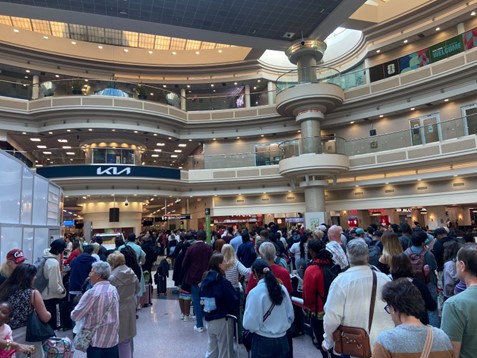
After leaving the 2026 Austrian Economics Research Conference—having presented a forthcoming paper on the concept of interventionist non-intervention with Connor O’Keeffe—I experienced some lesser degree of it at the Atlanta airport (with Jeffrey Degner who I coincidentally joined in line). Due to a partial government shutdown affecting the TSA, in which TSA workers are not being paid, many workers are no longer showing up, making wait times to get through security hours long. (In our case, we got through the line in 5+ hours—from about 7:50 a.m. to 1:12 p.m.). While there are plenty of pictures and videos of this phenomenon, especially from Atlanta, they cannot do the situation justice.
Figure #1—Atlanta Line
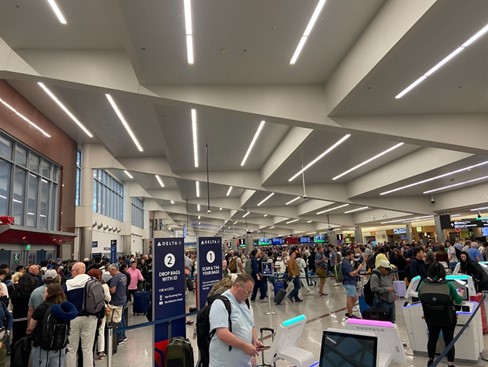
Figure #2—Atlanta Line
The Situation
First off, let it be stated for the record, that this article is not a complaint, either about the situation itself or about the specific TSA workers who were there on the scene or who even stayed home. Rather, the point is to describe as an eyewitness and participant and to attempt to explain it through the framework of Austrian economics and Rothbardian political philosophy.
While I and others spent more than five hours in line (the line got much longer as the day progressed), missed a flight and had to reschedule in line, was exhausted by the situation, and disappointed not to arrive home earlier, I will say that I was pleasantly impressed with how civilly people behaved toward one another. Lines were respected, and people were very patient and understanding toward each other, and the TSA workers who showed up were generally professional, helpful, and patient.
Over time, there was a strange kind of comradery that developed with people around us and others throughout the day who had all experienced this unique situation. People had to start talking to make sure they were in the right line, commiserating about the situation, worrying about missing their flights, changing travel plans, etc. People all sort of celebrated as they finally got through security and said goodbye to people they’d probably never see again.
According to outlets like WSB-TV and The Atlanta Journal-Constitution, the primary cause is a sharp drop in available screeners tied to a federal funding disruption and partial government shutdown. Many Transportation Security Administration (TSA) officers have been working without pay, leading to elevated call-outs and attrition. Additional strain from flight delays and uneven checkpoint staffing has compounded the problem, creating bottlenecks where large passenger surges hit reduced screening capacity at once. It is estimated that 30-37 percent of TSA agents are calling out on some days due to lack of pay and some 300 of them have quit since the shutdown. Airport and TSA guidance recommends arrival about three hours before departure, but—as my experience shows—it can be much longer.
Why Atlanta?
We should take the time to note that—while the issues described above are affecting the local TSA’s and airports all over the country—the problem is more acute and concentrated in Atlanta. What explains this?
For one thing, Hartsfield-Jackson Atlanta International Airport is consistently ranked as the busiest airport in the world by passenger volume. Therefore, even under normal conditions, the system runs very close to capacity. This is another aspect of the calculational chaos caused by government interventions.
Atlanta is also the primary hub for Delta Air Lines (my airline on this trip), as well as a central node in the broader US air travel network. That concentration means massive surges of passengers hit security at the same time, especially during peak times (e.g., early morning departures, Sunday returns, etc.). Under normal conditions this is manageable, but with reduced staffing at the TSA and little margin for disruption, delays compound quickly. While connecting passengers typically bypass TSA, flight delays, cancellations, and ground stops elsewhere still compress departure schedules and concentrate origin passengers into tighter screening windows, overwhelming specific checkpoints at specific times. In other words, extreme volume, synchronized passenger surges, reduced staffing, and tight operational margins combine to produce the acute delays.
What explains this?
Interventionist Non-Intervention
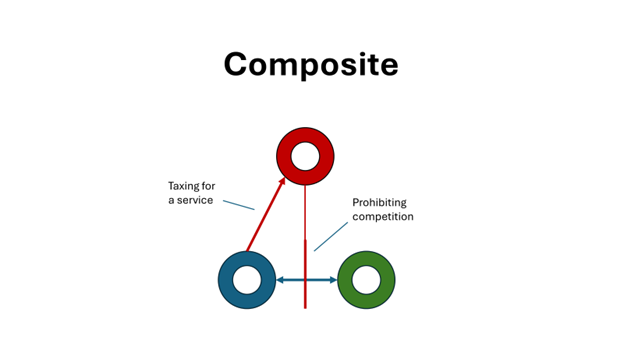
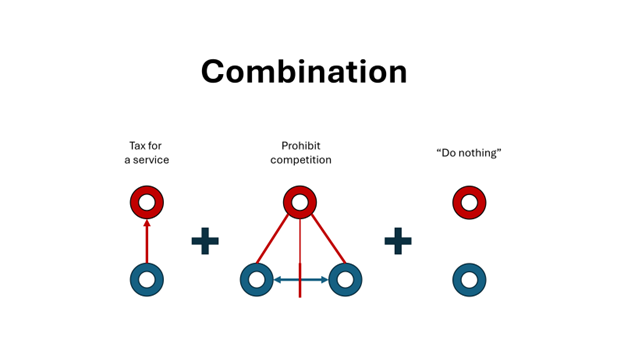
Restated, the concept of interventionist non-intervention argues that the state—following coercive taxation and monopolization or competition suppression—can intervene through doing “nothing,” that is, paid non-delivery of promised and monopolized service.
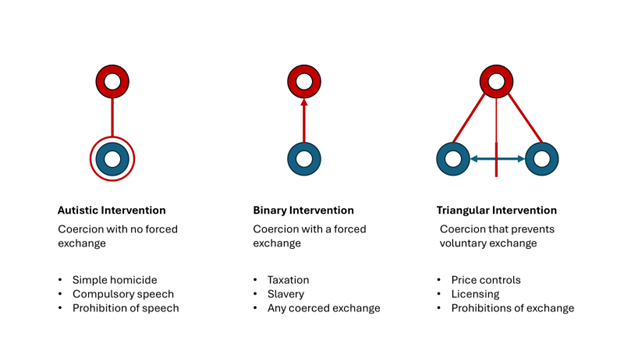
The core elements of interventionist non-intervention are: 1) the binary intervention of coercive taxation where citizens are forced to pay for a service regardless of whether or not they receive it; 2) the triangular interventions of monopolization or competition suppression where the state claims exclusive domain over the service provision; and, 3) non-delivery wherein the state then fails or refuses to provide the monopolized service for which it has extracted payment, in part or in whole. These three are the minimum requirements for interventionist non-intervention.
Additionally, intensifying elements may be added, which include prohibition of self-help alternatives, the maintenance of the coercive framework, and legal immunity from consequences of non-delivery. In short, it is not anarcho-tyranny, but rather tyranny in different forms—tyranny in extraction, tyranny in prohibition, and tyranny in abandonment.
Figure #3—Rothbard’s Interventionist Typology
Figures #4 & #5—Interventionist Non-Intervention: Binary Intervention + Triangular Intervention + Non-Delivery
The TSA as a Test Case
Absent the role of the state, it is highly improbable that a situation like the one described above could emerge on the free market. There are once-in-a-lifetime or rare, unexpected events that can disrupt markets, but the nature of free markets and private firms is fundamentally different from that of bureaucratic service provision. Due to profit and loss, the possibility of economic calculation, and the voluntary nature of private enterprise, delivery of service is paramount. Bureaucratic services lack these essential features of free markets, therefore, non-delivery of service is incentivized, becomes the accidental result, or both.
It is true that Disneyland has long lines, however, the situation with the TSA shows the effects of coercive revenue extraction plus monopolization and competition suppression, followed by partial non-delivery. Imagine if Disneyland received revenue from coercive taxation, could monopolize or nearly-monopolize services, and then fail or refuse to deliver paid-for services.
Binary Intervention: Coerced Revenue Extraction
A state cannot survive without coercively extracting revenue from the private, productive sector. By this method of revenue extraction—contrasted against voluntary payment and contractual receipt of service—the nature of the enterprise is fundamentally altered. The key to understanding this is that, simply, there is a bifurcation between revenue extracted and service provided. When a government service—like TSA—is disconnected from voluntary payment or non-payment, the market mechanisms of prices, opportunity costs, economic calculation, supply meeting demand, and profits are all removed.
Interestingly, in addition to a federal budget, the TSA also receives “congressionally mandated security fees [$4,535,253,000 in 2025] to help finance the increased cost of securing the nation’s aviation transportation system. The revenue generated from these security fees is utilized to help ensure the safe and efficient flow of people and commerce.” The “September 11 Security Fee” is collected by air carriers from passengers at the time air transportation is purchased, then remitted to the TSA.
In Bureaucracy, Mises wrote, “In public administration there is no market price for achievements. This makes it indispensable to operate public offices according to principles entirely different from those applied under the profit motive.” The converse of Mises’s point is also true: in public administration, there are no losses, but there are often shortages, inefficiencies, rationing, and long wait times. Rothbard writes,
On the free market, in short, the consumer is king, and any business firm that wants to make profits and avoid losses tries its best to serve the consumer as efficiently and at as low a cost as possible. In a government operation, in contrast, everything changes. Inherent in all government operation is a grave and fatal split between service and payment, between the providing of a service and the payment for receiving it. The government bureau does not get its income as does the private firm, from serving the consumer well or from consumer purchases of its products exceeding its costs of operation. No, the government bureau acquires its income from mulcting the long-suffering taxpayer. Its operations therefore become inefficient, and costs zoom, since government bureaus need not worry about losses or bankruptcy; they can make up their losses by additional extractions from the public till. (emphasis in original)
Needless to say, while I was treated respectfully by the TSA employees who showed up, I did not feel like the “king of the airport.” In fact, due to this incentive structure, the taxpayer is routinely viewed as an annoyance for expecting and using the services the state monopolizes and taxes him to provide. Rothbard identifies this tendency and contrasts it with the tendency of private enterprise which tries to entice the consumer to use a service more,
. . .the consumer, instead of being courted and wooed for his favor, becomes a mere annoyance to the government, someone who is “wasting” the government’s scarce resources. In government operations, the consumer is treated like an unwelcome intruder, an interference in the quiet enjoyment by the bureaucrat of his steady income. (emphasis in original)
Again, Rothbard writes,
In all areas of private enterprise, firms try to coax and persuade consumers to buy more of their product. Where government owns and operates, on the other hand, there are invariably calls on consumers for patience and sacrifice, and problems of shortages and deficiencies continually abound. (emphasis added)
Airline customers, especially at Atlanta, were reminded to “pack your patience.” Along these lines, Rothbard even provides some examples that illustrate this point, though the TSA did not exist in his time,
Many grave consequences follow from the split [of revenue and service] and from the “free” service as well. As in all cases where price is below the free-market price, an enormous and excessive demand is stimulated for the good, far beyond the supply of service available. Consequently, there will always be “shortages” of the free good, constant complaints of insufficiency, overcrowding, etc. An illustration is the perpetual complaints about police insufficiency, particularly in crime-ridden districts, about teacher and school shortages in the public school system, about traffic jams on government-owned streets and highways, etc. In no area of the free market are there such chronic complaints about shortages, insufficiencies, and low quality service.
Insulated not only from profits, but also from losses, such a paradigm encourages interventionist non-intervention—monopolization, continued revenue extraction, and paid non-delivery, partial delivery, or delivery after a long wait. In fact, total paid non-delivery or partial paid non-delivery (e.g., shortages, inefficiencies) might even be used as evidence of “underfunding.” In the present case, airline customers are double-taxed—taxed for the service itself in money, and taxed again in their time as they wait for service to be completed.
Triangular Intervention: TSA Monopolization & Competition Suppression
While states cannot survive without revenue extraction, the state itself is a monopoly and creates monopolies. The TSA is a monopoly that customers must go through if they want to fly (with few exceptions). Rothbard reminds us that “government service is always a monopoly or semimonopoly.” He continues,
Often. . .it is a compulsory monopoly—all or nearly all private competition is outlawed. The monopoly means that government service will be far more costly, higher priced, and poorer in quality than would be the case in the free market. Private enterprise gains a profit by cutting costs as much as it can. Government, which cannot go bankrupt or suffer losses in any case, need not cut costs; protected from competition as well as losses, it need only cut its service or simply raise prices. (emphasis added)
Private airlines may compete on a hampered market (e.g., TSA, FAA are government entities), and airlines may even enjoy crony privileges by being government-approved and compliant airports and airlines, but the TSA is a monopoly with no positive pressure from competition. In fact, when it comes to the more intense versions of interventionist non-intervention, competition is suppressed and self-help alternatives are rejected, hampered, or even outlawed. Speaking of which, Elon Musk’s offer to pay TSA personnel during this impasse was rejected due to other legal regulations, but “Gifts to the U.S. Government” always remains available!
Partial Non-Delivery
Now, it is debatable whether non-delivery is the most appropriate term for the situation of the TSA. In literal terms, the service was ultimately delivered for many, if slowly and after long wait times. (I eventually got through TSA security and got on a flight, though a different flight). Non-delivery would entail that the service is absent or functionally inaccessible, this phenomenon described involves degraded delivery wherein the service exists but imposes high time costs, shortages, frustration, or inefficiencies.
Does the TSA deliver its promised service? In terms of safety (which is also a marginal good, not a total good), they can hardly claim much credit—besides possibly some deterrence—for airline safety since it has been reported, again and again, that they fail most tests, even at a rate of up to 95 percent. Following this, the results of internal testing by the Department of Homeland Security were classified. In another disturbing recent event, this time involving the FAA, a plane crash occurred due to a likely error of a lone air traffic controller. Some argue that such services are so vital that they cannot be left to the free market and must be orchestrated by the government, however, we should turn this around—these services are too important to allow the government to monopolize and manage.
In terms of getting people through security so that they can get to their flights, it is debatable whether the non-delivery is partial or full. While many people did get through eventually, many missed flights or had to change them, often at their own expense, so non-delivery is appropriate. Per Bylund writes concerning the TSA situation, “A private business that fails to deliver loses customers, and therefore both revenue and market share. Its failure is its own problem, which is a strong incentive to fix it” (emphasis added). But this is not the case with the TSA. At least Delta attempted to put some pressure on Congress by revoking certain special privileges they received when flying.
Conclusion
The point of this article is to analyze, not complain, and to trace out the effects when binary and triangular interventions are combined. The argument for interventionist non-intervention is not that everything would be fine if the government simply supplied the service, but rather that non-delivery becomes a tempting possible option when government monopolizes and taxes. The issue is the fundamental disconnect between revenue and service, one that is insoluble for all government services.
The satirical Babylon Bee offered a possible solution as a joke, but one which unironically would be an improvement: “Airport Wait Times Eliminated After TSA Checkpoints Taken Over By Chick-Fil-A.” In fact, Chick-fil-A did assist with lines during covid. But the TSA case illustrates the nature of government “services,” as summarized by Bylund: “government agencies have little or no incentive to serve the users of their service.” Hence, interventionist non-intervention.

