


The national debt is approaching $40 trillion. The size of the national debt raises several pertinent questions. At what point will growth in the national debt cause a financial crisis and national bankruptcy? How can such a crisis be averted? Can we rely on politicians to act soon enough to avert this crisis?
The RAND Corporation recently published a report on this topic on the National Debt, which stated a few obvious facts. The national debt is, as a percentage of GDP, at a near historic level. The US did in fact dig itself out of a huge financial hole after World War Two. We did it before, We can do it again. We just need to avoid inflation- adjusted increases in the Federal spending, and simplify the tax code (see https://www.rand.org/pubs/research_reports/RRA2614-4.html).
This analysis of the RAND Corporation is technically correct, but otherwise naive. Specialized economists often focus on technical analysis, which omits historical events and context and political realities. Historians and Political Scientists generally lack an understanding of technical economics, and their lack of technical expertise leads them to engage in idle speculation. It is, however, not too difficult to bring all the necessary elements together in understanding our current fiscal predicament.
The next graph depicts net federal saving relative to total disposable income- negative numbers indicating borrowing. The financial position of the United States between World War Two and 1981 deteriorated. During the 1950s, President Eisenhower ran a few small surpluses, and no large deficits. Eisenhower was a true fiscal Conservative, who had deficit increases only during the recessions of 1954 and 1958, unavoidably. President Kennedy also avoided large additions to the national debt. Kennedy was under the sway of responsible Demand side Economists, who pushed for small deficits to stimulate the economy only during recessions. Consequently, the relative burden of WW2 debt fell as a percentage of gross domestic product during the Truman-Kennedy years.
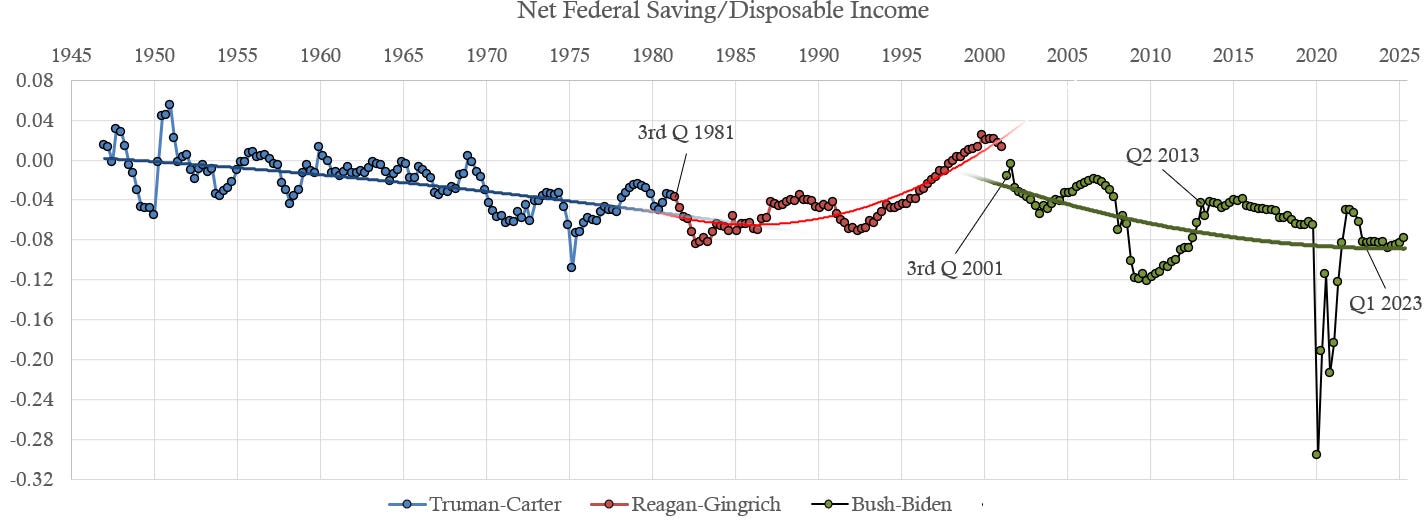
Larger chronic deficits emerged in the 1960s, partly due to President Johnson’s wars: The War on Poverty and the War in Vietnam. In addition to the two aforesaid wars, special interest groups obtained a plethora of subsidies and income tax exemptions.
Economist Mancur Olson explained how political lobbying is biased in favor of narrow special interest groups. Olson’s theory predicts concentrated benefits and dispersed costs in the public sector, which is exactly what we all observe in reality. The accumulation of special interest subsidies and tax breaks added more to the national debt.
Presidents Johnson and Nixon were skilled politicians, who knew how to bargain with both Congress and special interest groups- at taxpayer expense. Current Politicians impose financial costs of deficits on future generations of taxpayers with relative ease. Future generations of taxpayers can neither vote nor lobby in the present.
Of course, the general taxpaying public is not helpless. During the 1970s, voters began to rethink the role of government in our society. Naive notions of wise politicians governing in the public interest gave way to more skeptical views of government. People began to object to the imposition of heavy and unfair taxes and regulations1. This backlash against Federal waste and abuse led to the election of Ronald Reagan. The recovery of 1983 initiated an improvement in Federal finances. Net Federal borrowing declined from 1982 into the 1990s, as seen on the above graph. The Federal government actually went into surplus during the late 1990s. The main departure from this trend was during the early 1990s, while Bill Clinton was starting his first term. The election of a Republican Congress in 1994 Set US government back on the path towards fiscal responsibility, thanks to Newt Gingrich and John Kasich.
What caused this shift in American politics during the 80s and the 90s? As previously mentioned, the wasteful and corrupt nature of Federal spending and regulation was apparent. Dissatisfaction with Johnson’s War on Poverty also fueled the conservative-libertarian shift in politics at that time. The collapse of the Soviet Union made defense cuts possible, and likely also served to discredit left-wing economic beliefs. Congress was therefore able to cut welfare, military spending, and regulatory costs.
President George W. Bush set the Federal government back on a path to fiscal waste and irresponsibility. President Bushes war on Terror was, of course, costly. However, President Bush pushed for more Federal spending before the War on Terror began. I distinctly remember Conservative columnist Fred Barnes remarking, in the Spring of 2001, that “Bush is a Republican who likes spending money on conservative things”. I also remember Democrat commentator Eleanor Clift remarking that President Bush “is a President that we can work with”. President Bush also believed in fiscal stimulus; he signed a fiscal stimulus bill at the end of 2007 in an effort to avoid the looming 2008 recession.
President Obama’s record made the fiscal imbalances and regulatory expansions of Johnson, Nixon, and Bush seem small. Why did Bush and Obama undo the Reagan Revolution? Special interest groups will nudge us towards fiscal imbalance, so long as democratic governance exists. Yet this is only part of the problem. Since the 1990s Socialist, and even Marxist, ideas have have regained some popularity. How did socialism regain popularity? By focusing on fairness and on justice, rather than on efficiency. Those who engage in calm and thoughtful discussion of the efficiency of private and public sector institutions will inevitably realize that private enterprises and markets work better than do government bureaucracies. Those who create the impression wealthy people in capitalist societies got rich by exploiting domestic workers or foreigners can ignite outrage against capitalism.
President Trump entered his first term in office on the basis of economic nationalism, mercantilism. Trump did implement some deregulation, and an unnecessary tax-cut. But he lost control of the fiscal situation as a result of the Covid crisis. President Biden entered office after the Covid reopening of the US economy, when the economy had nearly returned to full employment. Yet, he somehow perceived a need for massive Federal fiscal stimulus. That is, Biden implemented a type of policy with a poor track record, one that failed spectacularly while he was Obama’s Vice President- and did so at a time when there was no need for any such policy.
President Trump started his second Presidential term by instituting an unofficial Department of Governmental Efficiency (DOGE)2. This DOGE project obviously fell short of both its own objectives for spending cuts, and also the spending cuts needed for fiscal balance in the United States. Trump’s efforts to cut spending and deregulate are laudable. However, we should remember that Eisenhower achieved fiscal balance by perusing spending control first, tax cuts later. And we should also recognize that special interest groups can block or limit the size of spending cuts. Olson’s theory of special interest bias is correct. We likely can’t achieve fiscal balance through normal political bargaining, given the current mindset in the US.
Americans need to relearn the lesson that unlimited government is inherently unjust and inefficient. How can this be done? This morning the Congressional majority held a hearing on fraudulent uses of Federal funds, especially in Minnesota. The full extent of fraudulent spending during the Biden years is still unknown, but may be shocking. Of course, the per-person cost of this fraud may not turn out to be that large. However, this is not just a matter of waste, this fraud scandal changes the image of government.
The existence of billions of dollars of fraud challenges the belief that the welfare state is a vehicle for social justice, and supports the correct belief that government welfare programs tend to be used by narrow interest to steal money from taxpayers. To put it simply, the moral bankruptcy of typical politicians combined with the intellectual bankruptcy of the Left begets national bankruptcy- but legitimate moral outrage in most of the electorate can prevent this outcome.
Cutting welfare rolls and reducing government employment in welfare and regulatory bureaucracies alone wont balance the Federal budget. However, credible commitment to fiscal sanity will lower interest payments on the national debt- Treasury bill rates have fallen relative to corporate bond rates, since Biden left office. Congress and Trump will also need to root-out fraud and waste in the Pentagon, and in Medicare and Medicaid. Can this really be done? Congress has enacted rational spending restrictions and cuts before- in the 1950’s and 1980’s, and more recently in the 1990’s. This can happen again in 2026.

