

The Wall Street Journal recently ran a commentary by Justin Lahart, according to which the debate among economists regarding minimum wages is still unsettled- after 30 years. Lahart mentions the debate on employment effects of minimum wages that started with the widely cited, but narrowly focused and flawed, New Jersey minimum wage study.
Economists recognize, first that increases in labor costs can lead to many outcomes. Employers may in some instances pass increased labor costs onto their consumers. Employers can invest less in workplace comfort and safety- and this has increased labor injury rates. Or, and employers can invest more in labor-replacing automation. Employers may also benefit from lower worker turnover/quitting at a higher minimum wage, which implies that employers may pay higher wages voluntarily.
Lahart goes completely off the rails when in his discussion of monopsony hiring.
“In economics there is a theory called “monopsony.” Monopoly’s opposite, it describes markets where buyers hold bargaining power. In the labor market, those buyers are employers… employers could more easily work together to keep wages low than workers could organize to raise them… Any market where switching jobs is costly and workers’ options are limited can give employers more power in setting wages” J. Lahart WSJ, emphasis added
The idea that employers simultaneously entice employees to stay with higher wages, and also force wages down with monopsony power is incoherent. In reality, teen workers can select from many different employers, especially in urban centers with mass transit. And high rates of teen worker turnover implies that switching jobs is not too costly.
Of course, we also need to distinguish between switching costs to employers- finding and training new employees, and costs to employees of finding and switching to new jobs. The former increases the bargaining leverage of employees. The latter increases the bargaining leverage of employers. Either of these two costs could be larger in any specific case.
While it is important to recognize that there are many possible responses to minimum wage increases, and that some pairs of such responses cannot occur simultaneously, a critical issue in debating the has been left out of the past three decades of debate. The NJ minimum wage study shifted our attention from unemployment to employment.
Small changes in statewide or citywide minimum wage rates do have small ambiguous effects on employment. Studies of small increases in minimum wage rates naturally have lower signal to noise ratios, and are affected by multiple factors which may not easily controlled in statistical studies.
The effects of real minimum wage rates on overall teen unemployment are quite clear. Teen unemployment rates have been stuck in double digits for decades. Those who desire minimum wage rate increases can’t explain why teen unemployment rates have remained so high for so long. Hence, they have shifted to debating an issue where their odds of success are higher- the ambiguous employment effects of minimum wage increases.
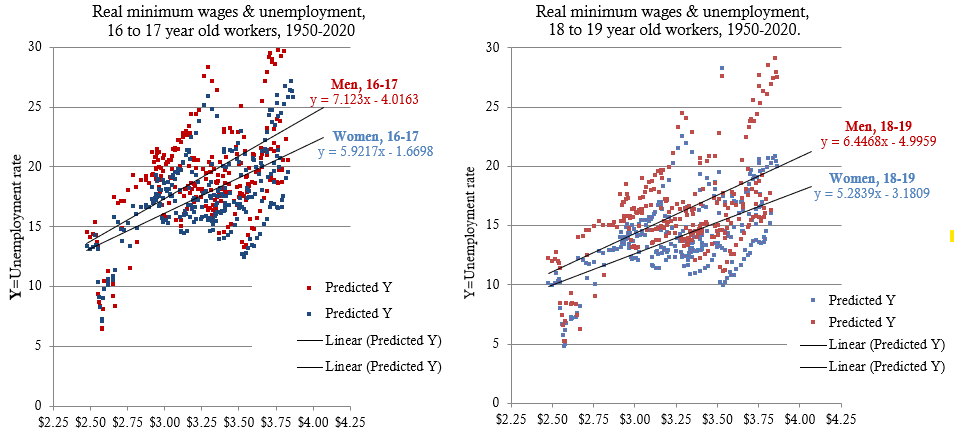
Minimum wage laws have had serious consequences on unemployment rates in the United States. Inflation has eroded the value of the Federal minimum wage, and also many state minimum wage rates. The debate that started with the employment effects of a New Jersey minimum wage increase has given intellectual cover to bad policies in other states. Those who defend restrictive state minimum wage rates should either address the unemployment issue or concede defeat.

