
Abundance, Generosity, and the State
9. Interventionism
9
INTERVENTIONISM
Economic goods are scarce. In order to increase the quantity or quality of economic goods that are provided and received gratuitously, someone has to bear the production costs. This is what economists mean when they insist that there is no such thing as a free lunch.
Dreamers and quacks think otherwise. Public policy is their preferred hunting ground, charlatanism their method. To the gullible public they promise something for nothing, thanks to the powers of the state. Often their schemes are alluring because they trade visible present benefits against as-yet-invisible future costs. Pay-as-you-go pension schemes are a case in point, monetary interventionism another. Some of these plans are complex, and some training is then required to see through their fallacies. But ultimately, they are all based on the spurious notion that the state is some sort of Santa Claus, not bound by the laws of cause and effect: The state has the miraculous ability to create economic goods out of nothing and for free. It should therefore be entrusted with solving all kinds of problems, from poverty to air pollution. We just need to give it a mandate. Bastiat ([1848] 1995, p. 144) summarized the Santa Claus theory of the state in a famous aphorism: “The State is the great fiction by which everybody seeks to live at the expense of everybody else.”
The refutation of such fictions is the daily bread of the economist. This is true in the field of gratuitous goods as well. In order to distinguish genuine gratuitous goods from fictitious ones, it is first of all necessary to highlight the various means by which economic goods are obtained without payment. This is what we have done in the preceding chapters. We have seen that innumerable economic goods are produced and obtained—day in, day out—without payment, not only through donations, but also through ordinary market exchanges. A free economy can be understood as one giant organism that constantly churns out gratuitous benefits for all market participants. Neglecting this aspect of a market order can entail serious policy errors, and it certainly puts a cap on the joys of living under capitalism.
The next step is to study the impact of government interventions. So far, we have studied gratuitous goods under the assumption that all social relations are based on the respect for private-property rights. We have relaxed this hypothesis only to examine the influence of occasional violations of property rights through the actions of muggers, conmen, and similar people. Now it is time to focus on institutionalized violations of property rights, as exemplified by the interventionism of the modern state.
Max Weber famously defined modern governments as communities of agents who successfully claim the monopoly of legitimate physical violence.They may do things that would be considered criminal if done by a private citizen. This appears in the very language that is commonly used to refer to government activities. We speak of conscription rather than of temporary enslavement, of taxation rather than of robbery, of regulation rather than of coercion, and so on. Modern governments are not bound by the common law, the “law of equal freedom” (Spencer [1851] 1995, chap. 4), the rules that apply to everybody else. Their acts are regulated by a special kind of law—public law. Unsurprisingly, therefore, their activities entail consequences very dissimilar to those that we observe in the private sector. It is these special features that we now need to study, as far as the production of gratuitous goods is concerned.
How does the government, when it taxes and regulates the rest of society, when it issues commands and prohibitions, influence the gratuitous providing and receiving of economic goods? This is the overall topic of part three. The present chapter will serve as an introduction.
We will start off discussing what the phrase a “monopolist of legitimate violence” implies in practice. Modern governments do not only apply and enforce the laws. They may also suspend these laws and create new ones that are at odds with them. In the economic literature, such activities are called government interventions. Below we will consider them in some more detail and highlight the importance of permissive interventions, which are particularly important today and have a great impact on gratuitous goods.
PRIVATE GOVERNMENT VERSUS THE MODERN STATE
It is often assumed that in liberal democracies the agents of the state are subject to the same rules as all other members of society. They are part and parcel of the social order and play by the same rule book as everyone else. They just have the particular mission of enforcing the laws of the land and of preserving peace and order.
This is not fully wrong, but neither is it fully right. In order to understand the characteristic feature of the modern state, it is helpful to contrast it with other forms. Many eminent writers have done this in historical perspective, comparing modern government with medieval feudal governments and with the governments of antiquity. For our present purposes, however, it is not necessary to give a full-blown historical account, and any such attempt would also embroil us in discussing questions of detail that are irrelevant for our present purposes. We will therefore facilitate our task by comparing the modern state to a hypothetical extreme form of government which is diametrically opposed to the modern state with respect to the practice of suspending and creating laws—private government.
The characteristic feature of a private government is that it operates within a purely private-law social order. In such a setting, there would be no special law that would only apply to the government. There would be no such thing as public law. Private law and legal customs would be the only law. They would literally be the “common law” that applies to everybody whether rich or poor. Within such a framework, each owner of landed property may be interpreted as a governor of his own estate. Private government would essentially be the management of landed property.
A large landowner may rent chunks of his estate to people who pay him annually in exchange for the benefit of establishing their residence or their business on his land. He might not only lease the land to his tenants, but also provide various connected services; for example, road management, security, and arbitration services between the tenants. He might choose to provide these services on his own or to commission specialized firms and associations.
Insofar as he did not sell his land, but lease it, he would remain the residual owner of all goods related to the land that were not explicitly leased to the tenants and commissioners. He would be the ultimate arbiter of all the exceptional problems that were not anticipated in drawing up the contracts. But he would not strictly speaking make the law. He would not decide what the law is, but himself be subject to the principles of private law as well as to legal customs. The law and the customs would apply to himself and to everyone else (common law).
Such a landowner-governor might choose to provide some of his services without compensation, either as a commercial device (grant) or out of sheer love for his tenants (gift). He would be able to make genuine gifts insofar as he is the true owner of the land and of the land-related revenue. This is what sets him apart from governments of a modern state.
The modern state arose in Europe in the sixteenth and seventeenth centuries out of princely opposition to the Catholic Church. Before that time, the leaders of the church—bishops, abbots, and others—very much operated like private governors, side by side with the secular rulers. They based their claims to rule on the common law and on the related theory of natural law.The Protestant princes then set out to reform the church. But since they did not own much church property and could therefore do little, they proceeded to expropriate the church by taking exception to the common law. These deeds led to the legal, social, and political quagmire known as the religious wars. To get out of this debacle, the legal fictions of sovereign power and of the social contract turned out to be most helpful, for both doctrines have one crucial idea in common: the sovereign state (the sovereign political community) makes the law.It is not just an ultimate arbiter between different interpretations of the common law in concrete cases. Rather, it is the very fount of right and wrong, of what is legal and what is illegal. The state makes the common law, and it may make it to its own liking. In this conception, the state itself is under the law only in the formal sense that its own decisions also apply to itself. However, materially, the modern state is above the law to the extent that its legal definitions are not bound by any principles higher than the sheer will of its own representatives.
In the field of economics, these political distinctions can be illustrated with the difference between mixed and interventionist economies. When governments purchase and sell goods and services, they more often than not behave in exactly the same way as all other persons and organizations. They are then part and parcel of the larger society and economy. They play by the same rule book as all others. Economists call this a mixed economy. Things are different when a government acts in the characteristic manner of a modern government, that is, when it takes exception to the common law. In such cases it is intervening in the economy. The modern state claims the authority to override any and all established laws and claims. It is an interventionist state.
REPRESSIVE AND PERMISSIVE INTERVENTIONS
A government intervention is a partial violation of private-property rights. In the famous words of Mises, it is “a limited order by a social authority forcing the owners of the means of production and entrepreneurs to employ their means in a different manner than they otherwise would” (Mises [1929] 2011, p. 4). When the government is conscripting soldiers, it violates the right that the latter ordinarily have in their own persons. When it taxes the citizens, it violates the right that the taxpayers have to use their money as they see fit. These are partial violations. Conscription usually is temporary and taxation rarely amounts to complete expropriation. But in all cases, the ordinary property rights of the people are to some extent violated.
All government interventions have both repressive and permissive effects (see Hülsmann 2016, 2017, 2018). They are repressive in that they curb the citizens’ exercise of their ordinary property rights. They are permissive in that they create beneficiaries who are able to overstep the natural boundaries of their own private property and do things that they could not otherwise do. The very meaning of an intervention is to transgress the ordinary or common-law limits of private property. The rights of the victims of such transgressions are curtailed. Their liberty is repressed, whereas the liberties of the perpetrator, of his allies, and of some bystanders are enhanced.
The repressive effects curb initiative. The permissive effects facilitate and encourage irresponsibility and outright frivolous behavior. These problems then typically serve as a pretext for further and more far-reaching interventions.
Spirals of permissive interventions are different from repressive spirals. In the latter, the citizens are driven to evasion, and this creates supply-side shortages that prompt the government to intervene ever more to prop up supply. By contrast, in permissive spirals, the citizens do not evade the interventions, but rush to benefit from them as much as possible. The demand for the ostensibly gratuitous benefits increases and thereby tends to create demand-side shortages. The state is therefore driven to step up its interventions in order to curb demand. Let us look at these effects in some more detail.
The Dynamics of Repressive Interventions
The government applies violence, or threatens to apply it, in order to induce its subjects to behave differently than they otherwise would. They have to pay taxes and respect various regulations. They have to spend their money in a certain way; for example, on what the government believes to be solid buildings and healthy food, on health insurance, on car insurance, and so on.
Insofar as they are repressive, government interventions create unwanted co-ownership. The very principle according to which the government has the authority to ordain this and that use of private property turns the government—or other designated beneficiaries— into co-owners of the property of other people. But this is not voluntary co-ownership as in a business partnership or a condominium apartment building. It is coercive co-ownership at the point of a gun. And such coercive co-ownership cannot fail to entail a race to the bottom, as in a forced marriage between two egocentrics. When benefits are private and rivalrous while ownership is coercively collectivized, then each of the two unwilling partners tries to secure the greatest benefits for himself, while minimizing his own contribution to the common good. Each one seeks to obtain as large a payoff as possible and as quickly as possible, while neglecting to make any efforts for the long-run preservation of resources. Short-run services are extracted at the expense of longer-run serviceability. Repressive interventions therefore lead to capital consumption and long-run impoverishment.
There is a similar race to the bottom in that repressive interventions tend to spill over. They create problems in other fields where the government had not intervened, and thereby lead the government to also intervene there. For example, when the government prohibits certain farmers from producing certain crops on their land in order to bolster the prices of these crops, these farmers are likely to shift to other crops, thereby inducing their prices to drop, with adverse effects for farmer revenues, leading to calls for more government help. The government may then mandate that no crops at all be planted on a certain percentage of the land. The farmers will then choose to leave their poorest soils idle and to till the better land all the more intensively, thus perpetuating the problem of oversupply. The government may then increase the percentage of the land that must not be tilled, and so on.
The race to the bottom between the citizens and the repressive state is an interventionist spiral. In order to preserve its control of the available resources, the government is tempted to issue ever more orders. It seeks to restrain one sort of behavior and to ordain another one. The citizens, in their turn, react by anticipating the next waves of interventions, which prompts them to accelerate the exploitation of the available resources as long as they still have any liberty to use them.
The Dynamics of Permissive Interventions
The permissive effects of interventionism are particularly important in present-day societies and deserve careful attention. They are characteristic of democratic societies, in which government power is obtained, preserved, and extended through general elections. Political parties compete, inter alia, by championing permissive policies that apparently increase the liberties of voters and pressure groups.
Government interventions are always permissive in regard to the government itself. Taxing and regulating other people conveys resources and power to the state. The creation of legal loopholes has the same effect. Today, US Senators are not subject to insider-trading regulations; the employees of international organizations such as the Organization for Economic Cooperation and Development (OECD) and the European Commission do not pay national income taxes; and the employees of most central banks, of the Bank for International Settlement (BIS), and of too-big-to-fail commercial banks are immune from arrest or imprisonment and not subject to national jurisdiction “for acts carried out in discharge of their duties” (BIS 2013, sec. 12). Most recently, during the 2021–22 political campaign for mandatory covid treatments, legal exemptions were granted to all US Congress members and their staff, as well as to the employees of the White House, of the Centers for Disease Control and Prevention (CDC), of the Food and Drug Administration (FDA), and of the major drug companies producing the mRNA treatments (Pfizer, Moderna, and Johnson & Johnson).
While special privileges for the political establishment are legendary, for electoral and similar reasons the government also seeks to increase the liberties of other people beyond their natural limits. This happens in particular when the government pays subsidies—when it bails out failed firms or hands out welfare checks—or when it allows certain people to break contracts and the law. For example, governments have often authorized labor unions to break the law by coercing managers and strike breakers. They have authorized industrial companies to pollute rivers and the air, overriding the preexisting rights of neighbors. They have authorized banks to renege on their contractual obligations and to suspend their payments. They have again and again relieved pharmaceutical companies of common-law producer liability.
The dynamics of permissive interventions revolve around the fact that their beneficiaries receive certain goods gratuitously or, more precisely, at the expense of other people. Permissive interventions therefore attract willing beneficiaries, whereas repressive interventions provoke attempts at evasion.
Government subsidies are an obvious case in point. When single parents are subsidized, the single-parent lifestyle will attract more people. When juvenile delinquents receive either mild or no punishment at all, more and more children and youths will seek to enrich themselves (or the elders who command them) through violent attacks on their fellow human beings. When firms are subsidized, their owners will be less interested in serving customers. When firms are bailed out, their owners will be less interested in self-preservation, and bailouts will therefore become more frequent. When the unemployed are supported by the dole, the incentive to remain unemployed increases whenever market wage rates are close to the level of the dole. Government pension schemes undermine the incentives to marry and start a family. Tax-funded education systems increase the incentives to study for longer and for personal enjoyment rather than in preparation for a professional career. And so on.
In the long run, all such policies are self-defeating. They undermine the very foundations of life in society. They pitch self-interest against the common good. In economics, such problems are called rationality traps or prisoner’s dilemmas.Permissive interventions encourage people to behave in a way that carries material advantages from the individual’s short-run point of view, whereas from any other point of view it is destructive. They discourage people from making the sacrifices that they ordinarily would make. They seduce people into irresponsible behavior. Individual people are behaving rationally for the short run, but society as a whole is going downhill.
Monetary Interventions
Monetary interventions are permissive interventions on stilts. Today all central banks create fiat money out of nothing. There is no technical or commercial limitation to the production of banknotes and accounting money. The remaining legal limitations are few in number and these legal barriers are constantly tested before the courts.
More so than in the case of any other type of government intervention, the creation of money has time and again nourished the most fanciful ideas about the costless creation of wealth for all. What Melchior Palyi wrote in 1962 (p. 62) is still valid today:
The object of inflationist wishful thinking is the centuries-old dream of perpetual prosperity at no social cost. Money-printing does the trick. . . . The underlying assumptions were two: that labor will not ask for higher wages even if prices rose (the unions are not interested in the cost of living, Keynes asserted), and that the inflationary process can be thrown in reverse gear whenever the money managers decide to do so (as if they were not only immaculately wise, but also omnipotent).
From time immemorial, governments have meddled with money. The reason is that increases in the money supply boost the real revenues of the first owners of the new money units at the expense of those who come to own these new units last. Indeed, following an expansion of the money stock, individual prices do not increase at the same time and in the same proportion, but at different points in time and in different proportions. These consequences of an increase in the money stock are called Cantillon effects, after Richard Cantillon (1997), who described them at the beginning of the eighteenth century. The uneven impact of money production on individual prices creates winners and losers. Winners are those who sell at prices that increase faster or more sharply than the prices at which they buy and losers those who suffer the reverse. But this works out especially to the benefit of the first owners of the new units produced. Indeed, these can exchange the new units while the price level is still at its initial level, while those who use the new units last have to pay higher purchase prices before they can increase their spending.
Governments therefore have a material incentive to gain monopoly control of the production of money, to impose on the market such types of money as can be multiplied at will, and to make sure that they are among the first users of the new money units.
The types of fiat money have changed in the course of history, but the basic principles and motivations have remained the same in all times and places. The Greek and Roman governments replaced silver and gold coins with token coins, the Mongol rulers replaced precious metals with paper notes, and modern governments have also replaced them with scriptural or accounting money. With fiat money, the government always wins at the expense of the great bulk of the population. Our modern systems excel—if this is the word— in that they allow for especially large and fast redistributions of monetary income and wealth. Those who control the printing press, and their connections, are able to exert almost unlimited control over all the resources that are traded on markets—labor, raw materials, capital goods, and consumer goods.
FIGURE 6: CONSUMER PRICES IN THE UNITED KINGDOM, 1800—2021
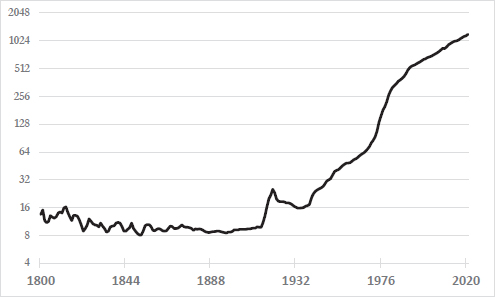
Sources: ONS, dataset MM23, Long-term indicator of prices of consumer goods and services; Jan. 1974 = 100.
The most visible effect of monetary interventionism in our day is perennial price inflation. Since the Genoa Conference of 1922, national central banks have officially coordinated in order to facilitate expansionary monetary policies. Since World War II, these policies have produced near-uninterrupted price inflation (see Figure 6 for the case of the UK). The consequence has been the financialization of the economy, meaning that households and nonfinancial firms increasingly behave like financial agents. Indeed, when the level of money prices rises permanently and predictably, all agents have strong incentives to leverage their investments and hold a large part of their wealth in the form of liquid financial assets.
The distinct disadvantage of leveraging is that it goes hand in hand with a greater risk of bankruptcy. Business owners who wish to stay in business therefore prefer to use primarily their own money and to use loans only with much moderation.
However, leverage becomes widespread when over many years the interest rate is lower than the expected price-inflation rate. It becomes irresistible if the leveraged investor can also expect to be bailed out. Both conditions for widespread leverage have been fulfilled in the economies of the Western Hemisphere most of the time since World War II. Central banks have driven this process, not only by relentlessly providing cheap loans from the printing press, but also by bailing out systemically important commercial banks.
We will examine the macroeconomic consequences of this development and its impact on gratuitous goods in chapters 11 and 12. To conclude this introductory chapter, we would like to lay out some basic considerations on the general relationship between interventionism and gratuitous goods.
INTERVENTIONISM AND GRATUITOUS GOODS
We have repeatedly pointed out that crimes against persons and property represent the logical opposite of gratuitous goods. Crimes are gratuitous evils. They take away goods from their rightful owners without justification. The criminal arrogates to himself a power over others to which he is not entitled and which those others do not owe him. Crime is therefore a black hole of gratuitousness. It involves a gratuitous gain for the criminal and a corresponding loss for the victim.
The criminal obtains various goods—power over the lives and actions of others, the enjoyment of stolen material goods, and so on—in excess of what he may legitimately claim and in excess of what others truly owe him. Crime often pays, at least in the short run.
The victim of a crime loses various economic goods, such as material property, health, and time. And with his property he loses all the gratuitous benefits that spring from it. As we have argued, the very point of property rights is to preserve the gratuitous services of nature for the owner. For example, the owner of a house enjoys protection from wind, storm, sun, and rain. He may pay for a new wall with the sweat of his brow or with money from his purse. But he does not have to pay the wall to remain solid and protect him. The wall serves him for free. The property rights of the owner are not legal ties between him and the wall, but between him and other humans. Property rights convey to him a claim on these others—the claim to be left alone in his tranquil possession of the wall—along with a corresponding obligation on the part of these others.
This seems to have straightforward implications for government interventions. After all, governments make claims on the lives and possessions of others in very much the same ways as ordinary criminals. This is obviously so in the case of totalitarian regimes. It is no less obvious in the case of rogue states and of states built on slavery. To some extent it even holds true for the present-day liberal democracies of the West. Expressions such as confiscation, seizure, asset forfeiture, socialization, and nationalization befog the plain fact that the agents of interventionist “liberal” states take lives and property from other persons; that they thereby come to control these resources; and that they bring about a redistribution of gratuitous goods very much as in the case of ordinary crime. Liberal democracies also lead wars of aggression. They also conscript their citizens and torture their enemies. They also incarcerate people for saying and publishing the wrong things. They also condone the massive slaughter of innocents (think of the abortion industry). They also tend to enslave their populations with skyrocketing taxes and forced contributions to state-sponsored social security organizations, as well as with a monetary system that lures all people into debt and dependency.
The Legitimacy of the Interventionist State
Our proposition that interventionism destroys gratuitous goods, basically in the same way as gratuitous goods are destroyed through criminal activities, is liable to the objection that the activities of the state are legitimate.
The residents of a country are obliged to pay taxes. The government is entitled to receive these sums. It does not matter that the corresponding claims and obligations have no contractual basis, nor any foundation in custom and precedent. It is true that they are rooted in government fiat. They are conjured up out of thin air. But the claims and obligations created by the interventionist state are legitimate. When the state regulates property, it does not arrogate to itself any powers. When it taxes the population, it does not gratuitously obtain monetary income. It receives what it can rightfully claim. The taxpayers pay what they rightfully owe.
This objection seems to coincide with Max Weber’s definition of the modern state as a community that successfully claims the monopoly of legitimate violence. However, notice that this is a definition, not a demonstration. Anyone can make claims. Anyone can claim that his own actions are legitimate. But his actions are not really legitimate unless these claims are true. Weber did not address the question whether any monopoly of violence is in fact legitimate.It is patent that modern states have successfully claimed their monopolies. But this does not prove much with respect to the truth of their claims. Their monopolies could merely be the result of juridical error. Or they could merely show that the claimants are powerful enough to crush all resistance. Might does not make right. Power is not the same thing as legitimacy.
Government agents are typically convinced of the legitimacy of interventionism. Again, this can hardly count as a demonstration. Even criminals occasionally attempt to justify themselves when caught in the act. Insolent muggers and looters say that they “need” other people’s money, or that they were reestablishing a more proper distribution of wealth. Governments possess incomparably greater resources than muggers and looters. They are able to hire armies of very bright people who help them to come up with much smarter justifications than one could expect from ordinary criminals. They may also use their power to censor any fundamental critique of interventionism and to broadcast their own point of view through state schools, state universities, and state-licensed media, day in, day out.
The most basic argument in favor of the legitimacy of the interventionist state is that no social life and no social institution of any kind could flourish without it. If there were no Leviathan state, so the argument goes, then all men would be at each other’s throats more or less all of the time. In such a brutish state of universal and total war, there might very well be no law and no rights at all. At the very least, all personal and property rights would be precarious. Markets could not develop to any significant degree. Civilization could not thrive.
All arguments to the effect that the state violates private-property rights, or that it robs the taxpayers, therefore appear to be self-defeating. While it is true that government is an apparatus of compulsion and coercion, the point is that this coercion is legitimate. It is not opposed to but fundamental for property rights of any sort. The interventionist state is best suited to protect the population, its belongings, its welfare, and the common good.
Notice that this argument is entirely based on considerations of expediency, rather than on considerations of justice.Indeed, for a government to be just, it must fulfill certain prerequisites. Most notably, it has to fall under the common law. A private government of the sort that we have discussed above could therefore be a just government. It could rule by virtue of its ownership of the land, and it could come to possess the land under the common law by home-steading it or by purchasing it from others, for example. A land-owner has the legitimate right under the common law to protect his property and to enforce the contractual stipulations that bind him to others who use his land. His rule can be a just rule.
By contrast, an interventionist state cannot be a just state by the standards of the common law. To intervene means to violate the common law. It means to violate property rights, and such violations cannot be licit as such. Violence exercised by the government in the name of preserving society is wrong inasmuch it is violent; that is, to the extent that it breaks the common law. Even the advocates of the modern state concede this point. They argue that violence, though wrong per se, is legitimate if it serves a vital purpose and is exercised on behalf of the whole body politic. But this argument concedes the point under contention. Violence is wrong per se. It is intrinsically wrong and legitimized only for extrinsic reasons.
This is why Saint Augustine famously said: “Justice being taken away, then, what are kingdoms but great robberies? For what are robberies themselves, but little kingdoms?”In our day, Frank van Dun and Hans-Hermann Hoppe have demonstrated in their brilliant works on argumentation ethics that it is outright impossible to justify violations of property rights, as such, by any argument what-soever. Any attempt of this sort invariably runs into self-contradictions.
Violence can be justified only by extrinsic reasons; that is, in light of its beneficial effects. If such effects do not exist, the justification evaporates. This is where economists come into play. The core business of economic analysis is to understand causal relations in complex social systems: the causes and consequences of market exchange, social organization, and government activities. Classical economists and economists of the Austrian School have refuted, one by one, all the utilitarian arguments purporting to demonstrate the expediency of the interventionist state. They have shown that individual initiatives and free associations between individual persons tend to produce superior results without intervention. This holds true for all areas of life, even for the production of security. Protection against criminals and foreign aggressors, as well as arbitration and other judicial services, is best left to private initiative.The coercive powers of the interventionist state do not improve protection and arbitration, but undermine them quite significantly as far as the general population is concerned. The only entity that is better protected through interventionism, at least in the short run, is the Leviathan state itself.
If the economic critique of interventionism is pertinent, as the present author believes it is, then it follows that the modern state has no legitimacy to create claims and obligations out of thin air. And this implies that it may not legitimately tax and regulate the population. Clearly, the state has power on its side. It can make lives miserable and it can ruin the material existence of its subjects. This is why it can issue commands and expect to be obeyed. This is why most people pay taxes. They do not pay them out of genuine obligation, but out of fear and for the sake of peace and public order.
Social Contract or Forced Donations?
The foregoing considerations suggest that all government interventions involve gratuitous transfers of economic goods. Indeed, if taxes cannot be legitimized, then it follows that they are by their very nature paid and received in excess of any legitimate claims and obligations. But then they are essentially gratuitous payments, though of a special kind. They are forced donations from taxpayers to the government. Similarly, the gratuitous money transfers made by the welfare state are gratuitous, but in the same way as loot sharing is gratuitous. The government robs the taxpayer and then shares the loot. Again, this analogy was already drawn by Saint Augustine. Right after his analogy between states and robber bands, he makes the following statement: “The [robber] band itself is made up of men; it is ruled by the authority of a prince, it is knit together by the pact of the confederacy; the booty is divided by the law agreed on.”
How do these contentions stand up to criticism? Does the welfare state—which seems to be the most obvious case in point—actually provide its services gratuitously? Clearly, its services are typically provided without payment or below market prices. But arguably, these services are not gratuitous in the strict sense of the word.
Standard theory portrays the relationships between the state, the taxpayers, and the beneficiaries of state services as being connected through a grand social contract, a system of tit for tat involving all citizens. Each citizen gives up his individual right to protect himself and his loved ones in exchange for better protection under the large wings of the Leviathan state. All residents fund the welfare state with their taxes, and in exchange the state protects the paymasters and all others against economic hardship.
Social-contract theory is obviously a fictitious construct. No social contract has ever been concluded in the past. And even if such a pact had been made between the members of a previous generation, it could not bind the current one.These considerations alone fully explode the theory. They refute the contention that taxpayers and tax receivers are involved in a legitimate tit for tat. Tax receivers do not have legitimate claims to receive taxes. Taxpayers are not morally obliged to pay taxes. Paying and receiving taxes are gratuitous acts.
However, one could argue that social-contract theory does not have to be true in order to be relevant for the economics of gratuitous goods. The sheer fact that it is today the standard theory makes it relevant, for this fact implies that virtually all state agents and all beneficiaries of the welfare state, as well as most people who have to fund the welfare state, profess to be involved in a grand social tit for tat. But in this case the services of the state cannot be perceived as gifts. The letter of the law is actually crystal clear about this point. Citizens have the right to be protected. Legal residents (and sometimes even illegal ones) have the right to benefit from state medical services, state schooling, state housing, etc. They therefore do not receive these services gratuitously. At least, this is what the theory seems to imply.
However, the social-contract interpretation seems to be at odds with other relevant facts. Welfare beneficiaries do not directly pay for the services received, and the beneficiaries are led to believe that they obtain these services without paying the full market price; that is, that they obtain certain goods gratuitously. This is, after all, the very point of the welfare state, the very reason for its popularity.
Tax law, too, seems to imply that taxes are being paid gratuitously. Indeed, the payment of taxes does not involve any obligation on the part of the receiving government. From a legal point of view, taxes are not payments for distinct services, unlike the tolls paid by the users of public bridges and unlike administrative fees and various other specific payments made to the state. Even the payments that go to state-sponsored social security systems typically go hand in hand with corresponding obligations of the social-security administration. But taxes are different. The government is completely free to use them as it sees fit. Taxes therefore need to be classified as forced donations. The government is the donee of forced donations, rather than one of the parties of a social tit for tat.
We therefore maintain our contention that all mandatory payments to the welfare state—whether taxes or contributions to social security systems—are forced donations from the taxpayers to the state. They are by their very nature paid and received in excess of any truly legitimate claims and obligations.
Property Rights Perverted
Through state interventions, the agents of the state obtain material goods, as well as power over other people, in excess of what they may legitimately claim and in excess of what others truly owe them. And the subjects of the interventionist state lose various economic goods, and thereby they also lose the gratuitous benefits that spring from private property.
When interventions become pervasive, all goods need to be defended all the time, in parliament and before the courts, against the onslaughts of others. Judge Gideon Tucker (1870, p. 249), in an 1866 verdict on an inheritance case, scolded the defendant to have “forgotten the saying that ‘no man’s life, liberty, or property are safe while the Legislature is in session.’” This is an important point. Under interventionism, possession becomes less tranquil and more precarious than it otherwise would have been. The destruction of gratuitous goods through government interventionism is therefore not accidental, but enshrined into the very nature of the modern state. The latter attacks natural liberty and the gratuitous enjoyment of property—Smith’s “tranquillity”—at its very root.
One might object that property is always costly. It always needs to be defended. This is true. But notice that under the common law, such defense costs would diminish with the progress of civilization and the pacification of social relations. In fine, as Bastiat and Herbert Spencer have argued, they are likely to drop to zero, so that the enjoyment of property would become almost completely gratuitous. By contrast, with interventionist policies, the costs of ownership cannot be expected to diminish because invasions of private property are the core business of political agents. The costs of ownership therefore tend to increase. Property needs to be defended relentlessly against political onslaughts. And once any piece of property becomes the victim of a successful invasion—once it becomes subject to regulation and taxation—this invasion is likely to increase in the course of time. Forms need to be filled out and filed and taxes need to be paid every single year.
We see here that interventionism fundamentally changes the scope and meaning of property rights. In a hypothetical private-law society, all claims and obligations would be defined by the persons who are immediately concerned. Contracts would specify the claims and obligations involved in human cooperation. Land boundaries and building rights would be settled between neighbors. Landed property rights would be the products of such private legal arrangements. To be mutually beneficial, they would tend to be just and permanent, thereby reducing the costs of ownership for all neighbors.
By contrast, under interventionism, property rights are no longer embedded in the interactions between the people who are directly concerned. They are now rooted in the hierarchical relationship between each owner and a central political authority. In such a setting, property rights are privileges that need to be renewed periodically. The owner of a house or of a piece of land, so to say, needs to renew his ownership license by paying property taxes. Property rights no longer serve to reduce the costs of ownership, ideally to zero. They now serve to provide the agents of the state with permanent revenue and permanent control.
Side-Effect Goods of Interventionism
We have just seen that interventionism by its very nature destroys gratuitous goods in various direct and indirect ways. To complete this part of our investigation, we now need to consider the possibility that it brings about gratuitous goods in the form of side-effect benefits.
This could be the case to the extent that interventions produce economic goods, such as protection against criminals and external foes, a sound legal order, sound money, or the pacification of social relations through the welfare state. These goods are not themselves gratuitous, but they certainly do entail gratuitous side effects, just as all other goods entail side-effect goods. Most notably, they go hand in hand with greater concentration, predictability, and security, all of which entail greater economies of scale. To wit, legal monopolies prevent all other people from entering the monopolized field of activity. The production of the monopolized good is concentrated. As a consequence, all other people will devote their energies to other tasks. For example, the greater security which becomes possible thanks to a Leviathan state puts all other people in the happy position of having to devote fewer resources to defend and protect themselves. The time and capital that they save can now be devoted to other activities. The same thing could also be said about the greater stabilization of the legal and economic environment which becomes possible due to government interventions. For this reason, too, all other people can make important savings of time and capital, which will become available for other projects. From an aggregate point of view, therefore, the monopoly leads to economies of scale, and these economies are usually presented as positive side effects by the political authorities.
However, these benefits are questionable if not outright illusory. On the one hand, the goods produced by government interventions must not be seen in isolation but in the overall economic context, and the latter deteriorates when the government intervenes. On the other hand, interventions produce such goods only in the short run, while they fail to deliver them in the long run
The economies of scale that result from legal monopolies are economic goods, ceteris paribus. The problem is that the monopoly not only entails economies of scale, but also deteriorates other goods. For example, it goes hand in hand with dependence on the monopolist producer. It also goes hand in hand with the risk that this monopolist will not be faithful to his mission and obligations. Since the entire country now depends on a single source for a vital service, any default on the monopolist’s part entails the collapse of all dependents at once. The social fabric becomes fragile. There is therefore a trade-off between different goods, such as economies of scale, independence, and robustness. Legal monopolies tilt the balance in favor of one good, while neglecting the others. Political propaganda then focuses unilaterally on the benefits and downplays the costs. But the problem of balancing the different objectives remains, and it is usually not the case that one size fits all. Usually, different people need different combinations of cost savings, independence, and robustness (to name just these three). What the government does is to impose one combination for all.
Moreover, legal monopolies tend to deteriorate the quality of the product. The monopolist is removed from competitive pressure. Therefore, he will be able to charge higher prices than he could have obtained under competition, and he can afford to reduce (or to not improve) the quality of his product. In the long run, this implies that the monopolized good will tend to be underproduced in quality and quantity.
THE NEGLECT OF INTERVENTIONISM
Because of their characteristic and far-reaching consequences, interventionist policies deserve the special attention of all people who wish to understand modern political and economic problems. Unfortunately, despite the efforts of Eugen von Böhm-Bawerk, Ludwig von Mises, Hans Sennholz, Murray Rothbard, Hans-Hermann Hoppe, Robert Higgs, Thomas DiLorenzo, Pascal Salin, Jesús Huerta de Soto, Jacques and Pierre Garello, Stefan Blankertz, Randall Holcombe, Gunther Schnabl, Thorsten Polleit, Philipp Bagus, and a host of other good economists, this fact still has to make it into the perception of the general public.
The confusion around interventionism springs most notably from its permissive effects. Government interventions are typically associated with the repressive effects that they entail, with the countless prohibitions and commands issued by the state. By contrast, their licentious or permissive effects are held to be additions to individual liberty, especially when they are funded by the printing press.
It is true that ex nihilo loans from the printing press make it possible for households to spend more money on houses, apartments, and motor vehicles, and that the printing press makes it possible for firms to spend more money on labor, equipment, and raw materials. In a way, therefore, the liberties of the market participants are increased, and it is only too tempting to consider such effects to be part and parcel of the free economy.
However, a genuinely free economy is premised on respect for private-property rights, whereas interventions by their very nature are violations of private property. The license that is nurtured by the printing press is deep down no different from the license fed by a state-sponsored employment relief program or from the license of a slave owner. In all such cases, the liberties of the beneficiaries are bought at the expense of unwilling victims. There are people who are forced to adhere to the state-sponsored unemployment relief programs and many others who are forced to subsidize them. Slaves are robbed of their own liberty to increase the liberties of the slave owners. And most owners of money suffer when the central bank, or a commercial bank, creates money out of thin air.
License is not equal liberty for all under the common law. It is “mammonism,” in the words of Franz Keller (1912). It is more liberty for some at the expense of less liberty for others, brought about by special privileges. An interventionist regime is not a free economy, but an economy distorted by violations of property rights.
As we shall see below, government interventions have dramatically adverse consequences for gratuitous goods. They reduce the ability and willingness of private households to make gifts. They make people indifferent and cold-hearted toward each other. These problems are well known, but most observers believe that they are the natural consequence of a free economy, of capitalism and unfettered markets, rather than of government interventions. Such misinterpretations typically motivate public policies that are likely to reinforce rather than solve the problems.
The solution to institutionalized indifference is not to subsidize civil society or nonprofit organizations and other elements of the so-called independent sector with taxpayer money. Taking inspiration from Tocqueville’s vivid portrayal of nineteenth-century American society, Richard Cornuelle emphasized that human society is not a two-pronged universe of markets and states.There is also a distinct nonprofit sector, which is not a mix of markets and states. It includes families, clubs, and associations, and provides various goods of the greatest importance. Today, many scholars and social leaders accept this distinction and believe it to be a key to social progress in our time. They see in the development of civil society a potential solution for any problem that might affect states and markets. It is only too tempting to hope that nongovernmental organizations (NGOs) of various sorts might turn out to be a better social repair shop than the bloodless welfare state. Unfortunately, however, such hopes are ill founded. Government interventions do not just alter the workings of a market economy. They are likely to shape any and all social relations, not least of all the activities within civil society.
_______________________________
See Weber (1919, p. 4). See also Weber (1922, pt. 1, chap. 1, sec. 17, pp. 29–30) and Oppenheimer ([1907] 1990, pp. 19–20 and passim).
An early theoretical discussion of private-law social orders is in Haller (1820, vol. 2). More recently, and from different perspectives, see Brunner (1942), Voegelin ([1938] 1996, [1952] 1959), Rothbard (1973, 1982), Hoppe (1989, 2001, 2021), and Bassani (2021).
On the close affinities between natural law and the common law, see O’Sullivan (1950), Wu (1954), Ibbetson (2001), and McWilliams (2010).
Another characteristic feature is its corporate form (see Creveld 1999), but this is less relevant for our concerns.
A similar case is limited liability. To some extent, such limitations may result from the free and responsible choices of the market participants. Peter may agree to lend one hundred dollars to Paul, who runs a limited liability business. If the business goes bankrupt, Peter might not see his money again, because Paul is liable only for as much as he owns in his company. But things are very different in noncontractual social relations; if Paul causes an accident with a company vehicle on a business trip, and supposing his conduct is not negligent, then it seems that not only might his company have to compensate the victims to the full extent of its equity capital, but Paul himself (as the owner of the firm) might have to compensate them out of his private wealth if the equity capital is insufficient to cover the damage. Indeed, the victims did not consent to any limitations on Paul’s liability. In such cases, Paul’s liability can only be limited by government decree. This limited liability is then an instance of permissive interventionism. The firm can take on more risks and cause more damage than it could in a free society.
The mainstream theory of prisoner’s dilemmas is flawed to the extent that it compares real-world choices to an unattainable optimum or Nirvana world. A similar problem afflicts the mainstream theory of moral hazard. See Hülsmann (2006).
Weber ([1922] 1947, p. 19) listed the typical psychological motivations that prompt acting persons to ascribe legitimacy to a political order—the reasons why they believe the order to be legitimate (Legitimitätsglaube). But, again, such beliefs are irrelevant to the question of whether the order is in fact legitimate.
See Bernays (1928) and Hoppe (2021, chap. 1). A potent justification consists in portraying the state as the logical opposite of and political remedy for the self-interested activities of the market. The state presents itself as the great and central agency that performs the necessary sacrifices on behalf of the political community. However, Moshe Halbertal (2012, p. 105) points out that this reverses the true state of affairs. The state is not the agency that does the sacrificing, but the agent that demands and absorbs sacrifices on a grand scale. “The modern state’s hunger for human sacrifice is insatiable.” Halbertal concludes that in “positing itself as a sacrificial stage and the genuine realm of noninstrumental action, the state threatens to exhaust and monopolize the realm of the transcendent. It thus becomes a false god, providing the loyal citizen a misdirected sense of redemption from his selfish cage” (p. 116).
This argument goes back to Hobbes ([1651] 1904). Mises (1962) has also adopted it in his political philosophy. Other theoreticians, such as Hans Kelsen ([1960] 1967, chap. 6) and the anthropologist David Graeber (2018) have argued, even more radically, that without the Leviathan state there could be no property rights at all. This argument seems to boil down to a semantic quibble. Kelsen would not use the word “property right” for any claim that is not backed by the power of a state. But the fact is that human communities and markets are much older than the state. Since long before the advent of the state, human beings have been able to peacefully use material goods, to share, give, and exchange them. They have been able to stake their claims against each other and come to terms.
As Eric Voegelin (1999, pp. 119–20) and others have pointed out, it is also premised on a peculiar anthropological conception of man which leaves room for no love but self-love.
Saint Augustine (1993, bk. 4, sec. 4, p. 112).
See Dun ([1983] 2008) and Hoppe (1987; 1993; 2021, chaps. 2 and 8).
An overview of the abundant literature can be found in Hoppe (2003) and Benson ([1990] 2011).
He goes on: “If, by the admittance of abandoned men, this evil increases to such a degree that it holds places, fixes abodes, takes possession of cities, and subdues peoples, it assumes the more plainly the name of a kingdom, because the reality is now manifestly conferred on it, not by the removal of covetousness, but by the addition of impunity. Indeed, that was an apt and true reply which was given to Alexander the Great by a pirate who had been seized. For when that king had asked the man what he meant by keeping hostile possession of the sea, he answered with bold pride, ‘What thou meanest by seizing the whole earth; but because I do it with a petty ship, I am called a robber, whilst thou who dost it with a great fleet art styled emperor’” (Augustine 1993, bk. 4, sec. 4, pp. 112–13.).
See Hume ([1777] 1987, pt. 2, chap. 12), Haller ([1820] 1964, vol. 1), and Spooner (1867, 1870).
It is therefore contradictory when Rousseau ([1762] 1948, p. 129) claims that under the social contract, the life of each “is no longer merely a gift of nature, but a conditional gift of the State.” Could one argue that the state owns its citizens? But this seems to be contradictory, too. Indeed, how is it possible to make a gift to a being that one owns? The author is indebted to Professor Xavier Martin for bringing this neglected phrase from Rousseau’s Social Contract to his attention.
Another important factor that accounts for the widespread confusion between free societies and interventionist regimes is short memory and a lack of education. Many people simply do not remember what the government did ten, five, and even two years ago. As a consequence, when government interventions produce adverse social and economic effects, they are more often than not held to be the outgrowth of the normal way the economy operates. Rather than cutting back the previous interventions, there are calls for new interventions to rectify the effects of the previous ones.
See Cornuelle (1965) and also Hayek (1979, chap. 14, pp. 389ff.).

