
Abundance, Generosity, and the State
3. Motivations of Donations
3
MOTIVATIONS OF DONATIONS
Donations have final, formal, efficient, and material causes. Economics is mainly concerned with the efficient ones. It looks at the human choices that bring donations about. But we have seen that the final cause—the general purpose or objective—of donations is the central pivot toward which all other causes are geared. Before we turn to the economics of donations, it is therefore advisable to study how human choices are motivated by this purpose.
The immediate cause of a donation is always and everywhere to be seen in the choices of the donor. The donor prefers to donate some of his time or material resources rather than using them for other purposes. This inescapable fact is the starting point of the economics of donations, a subject that we shall deal with in chapter 5. But why does a man harbor the preferences that turn him into a donor? Why does he prefer to give rather than keep for himself?
Economics can shed some light on these questions to the extent that human preferences are determined by the context of economic development and prevailing market prices. Economic growth is an important boon for material donations. Rising wage rates on the labor market may lead to reduced donations of time. However, here we are concerned not with the question of why donors give more or less, but with the question of why they give at all and with the related question of why some refuse to give anything. To these questions, economics has no answer. In order to understand the ultimate purpose of donations, as well as their consequences, we must look elsewhere.
LOVE
We have stated that a donor is motivated by love of the cause or person to whom he dedicates his time and resources or to whom he transfers property. This may warrant a few remarks. As a starter, why do we not use a less emphatic word, such as generosity, to designate the cause of donations? Clearly, the word generosity would be perfectly appropriate and fine in this context—after all, a donor is generous. But it would also entrap us in a tautology. To be generous means to make donations. But our question here is why donations are being made. And the right answer to this question is that donations are motivated by a mental disposition that is commonly called love. The lover wishes the loved person or thing to exist and to thrive, and this desire prompts him to be generous.
Philosophy distinguishes between a variety of types of love, each of which might motivate, in one way or another, donations of time and material resources. In what follows, we will highlight three particularly well-known forms of love, as well as the crucial role of the family as a school of love.
Eros, Philia, Caritas
Acts of devotion to a person or to a scientific, artistic, or moral cause are typical expressions of eros, the love of beauty. Erotic love is awakened and stimulated through the senses, through human touch, eyes, ears, smell, and taste. However, as Plato argued in his Symposium, the affection for the impressions of the sense organs is only a first step in an erotic love affair. Eros is a longing for something that the lover does not possess. It drives him and guides him. It eventually leads him to the discovery and appreciation of inner beauty—to the ideal that the loved activity or object or person instantiates. And from there, his love affair drives him to God. Indeed, it leads him from loving the singular to loving the universal, from loving the part to loving the whole, from loving the fleeting moment to loving what remains eternally, and from loving the creature to loving the creator.
Similarly, when discussing friendship (philia) in his Nicomachean Ethics, Aristotle (1893, chaps. 8 and 9) distinguishes a noble form of friendship based on shared ideals from profane friendships based on pleasure and on utility. Friendship may be based on shared pleasures of a carnal sort, the pleasures of drink, food, song, dance, sex, hunting, sports, and similar things.
Utilitarian friendship is based on mutual material dependence for the attainment of material ends. Friedrich von Hayek (1976, p. 108) points out that the Greek verb katallatein means “to exchange” but also “to turn a foe into a friend.” The catallactic order, the exchange economy, is indeed one of the most powerful engines of social integration. The friendship that results from market exchange is utilitarian friendship. An entrepreneur makes business friends, an employed worker befriends his colleagues. These friendships quite naturally lead to the creation and development of business associations and labor unions.
The friendship between spouses may be utilitarian, too, to the extent that they love each other as means for the attainment of common objectives (raising children, acquiring property) and of personal ends (enjoying sexual intercourse, a well-managed home, a greater income, etc.).
By contrast, idealistic friendship is based on the common devotion to a transcendent good such as justice, beauty, or the worship of God. It is the first step to the Christian notion of love. Agape, or caritas, is the divine, selfless affirmation and promotion of the other for the other’s sake.Caritas is embodied most notably in the command to “love one another as I have loved you” ( Jn 13:34).
Love of this sort may seem to be paradoxical as far as the gratuitousness of love is concerned. Indeed, by loving others, the Christian is working toward his own sanctification and salvation. But then his love seems to be selfish. It therefore cannot be a genuine gift, which requires genuine devotion to others. However, he who in the same act loves himself and others still provides a gift to these others, though not a perfect one. Moreover, he may love others without intending his own salvation. The latter would then result from his action, yet without being his design. In this case, his love of others would be a perfect gift.
Similarly, the commandment to love others may seem to annihilate the gratuitousness of such love. If Peter is obliged to love Paul, then loving Paul does have a “good reason” of the sort that we discussed in chapter 1. Again, this seems to be no genuine love at all because genuine love must be gratuitous. However, Jesus addresses His commandment only to those who wish to be His followers. He does not impose ex nihilo claims and obligations on all of humanity by virtue of His sovereign power. Rather, He invites a response. And He indicates the sort of response that He expects. If Peter wishes to be a disciple of Christ, then Peter needs to love his neighbor Paul, as well as all of his other neighbors. As a Christian, therefore, Peter’s decision to love Paul comes in fulfillment of his obligation toward Jesus Christ. But his decision to be a Christian is not an obligation. It may very well be a gratuitous act, prompted by his love for Jesus.
Christian theology affirms that, ultimately, all love is oriented to God. When we love our spouse, our love is already oriented to God to the extent that we truly love our spouse. Similarly, any love for sciences and the arts is ultimately oriented to Him (see Aquinas [1259–65] 2009, bk. 3, chaps. 17–37).
A School of Love
It is clear that pleasure-based and utilitarian friendships cannot be the origin of genuine donations, though they can be the origin of grants. Only idealistic friendship motivates genuine donations. Friendship typically comes in the forms of relational donations in the form of time spent together, of material gifts intended as relational gifts (expressions of friendship), and of material gifts intended to improve the material condition of the beneficiary.
In the Christian conception, caritas is the ideal toward which all social relations should be oriented, beginning with the family. The ideal of marriage based on love—rather than on pleasure or utility—is a distinctly Christian ideal, even though it came into full swing only in the eighteenth and nineteenth centuries, when Christianity had started to lose its grip on public policy. But it is not only the relationships within the family that should be based on love. The central function of the family is to cultivate love as a habit. It is supposed to be a school of virtuous life—a “school of devotion and abnegation” (Durkheim [1893] 2013, p. XVIII)—starting with the virtues of love and friendship. The prime vehicles of this moral education are good words and, especially, good examples. Children naturally imitate the behavior of their parents. Eventually they come to imitate their thinking.
Non-Christian families tend to play this crucial role, too. They cannot fail to play it. They are driven toward it by the logic of family life. Even if the spouses do not deliberately strive to love each other and their children, even if they are brought together not out of their own desire, but in order to honor ancient customs or out of respect for the decisions of their elders, they will tend to learn to love each other. To be sure, this tendency is no mechanical or failsafe way to love. Families, too, are subject to opposing influences. Family life, too, may involve abusive relations and the horrors of violence. The point is that it is impossible to reap the material benefits that spring from the division of labor within the family without a minimum of trust and mutual appreciation. This does not only hold true for the carnal pleasures of the spouses. It is impossible to even share a meal or carry on a conversation without respecting the needs of others. Lubomir Mlčoch argues that sharing meals “constitutes a powerful emotional and even theological experience. Its image is so powerful that it has inspired great artists and found its way into many Biblical stories.” He goes on:
When Jesus Christ wanted to show us a glimpse of the unimaginable eternal Kingdom he repeatedly used parables of banquet and wedding receptions. [H]is stories also linked together the unity which comes through eating together with that which comes through the shared preparation of a meal. Little else brings family together as much as the joint preparation of food and sharing a meal. (Mlčoch 2017, p. 23)
The family is therefore a fertile soil where love grows even when it is not deliberately planted.Family life educates all its members in the cultivation of the virtues. It is the breeding ground of prudence, justice, strength, moderation, wisdom, understanding, counsel, and piety. It most notably fosters the virtues of chastity and virginity. It nourishes in family members the habit of withholding great goods from the ordinary course of human interaction, to keep them holy in defiance of all material and emotional incentives to secularize them. The virtues of chastity and virginity are therefore fundamental for culture and donations.
CUSTOMARY GIFTS
Speaking of families as schools of love does not seem to have much to do with ordinary life. It seems to be idealistic speculation. And in a way, this is true. Philosophers and theologians would readily admit that the erotic ascension from earthly pleasures and utilitarian friendships to the towering heights of caritas is next to impossible in practice. No human walks this steep path out of his own strength. Ordinary love is rooted in earthly matters and rarely strays far away from them. It only faintly responds to inner beauty and the divine. It revolves around what is pleasant, helpful, and customary.
Many expressive gifts are customary gifts. They are made on occasions on which one usually makes a gift; for example, on birthdays, at baptisms, on engagement, at weddings, on Mother’s Day, on Father’s Day, on religious feast days such as Christmas and Valentine’s Day, and on various other special occasions.
Customs grow slowly but steadily. In developed civilizations, customary gifts tend to be pervasive. This circumstance has clouded the judgment of many students of gifts and of the gift economy. They have come to conclude that the effective cause of gifts is not to be found in individual choices, but in the social obligations into which one is born. Marcel Mauss and a host of others have even come to consider customary gifts no gifts at all, but elements of a generation-overlapping tit for tat. They are part and parcel of an eternal social circuit in which transfers of economic goods are ordained by obligations toward others and give rise to ever more claims on others.
The fallacy of this point of view is not difficult to see. All it takes is to examine the nature of gifts and to trace their causes back to individual choices, as we have done on the preceding pages. It then becomes manifest that the social context within which a gift is made has no bearing at all on its gift character. The only relevant consideration is whether the donor freely intends to give without expecting any return, out of his love for the donee.
Clearly, customary gifts cease to be genuine gifts if they are made only to honor the custom. Then the recipient of the gift is merely the lucky winner of a custom lottery, whereas the donor truly appreciates not the person, but the custom. And he may not even appreciate the custom, but may just want to stay out of the trouble into which he would get himself were he to disrespect it. It is true that customs constrain the time and place of certain expressions of love. Some customs even ordain the exact form of this expression (ceremonial kisses, birthday cakes). But all of this is secondary. Customary gifts may be genuine gifts. It is likely that most of them are genuine gifts.
MORAL HAZARD
Gifts entail two sorts of costs. On the one hand, like all human action, gift giving goes hand in hand with opportunity costs. The goods that are given away could have been used otherwise. The advantages enjoyed by the donee could have been enjoyed by somebody else. On the other hand, we find a type of cost more specifically related to gift giving; namely, a moral corruption that in today’s economic jargon is known as moral hazard. This most notably concerns gifts that improve the material situation of the donee and which the latter expects to receive, such as alimony payments or charitable donations.
It is well known that such assistance can be abused, and the risk of such abuse is precisely the above-mentioned moral hazard. There is a risk for the donor that the donee, expecting to benefit from the donor’s continued support, will relax his efforts to stand on his own feet. Similarly, there is a risk for the donee that the donor will abuse his position of power and start to exact conditions. These risks depend on the character of the donor, on the character of the donee, on the scope of the expected donations, and on various other factors.
Often such moral hazard turns from risk to reality and becomes an entrenched dependence. Kenneth Boulding called this the “dependency trap” of one-way transfers (Boulding 1973, p. 99).A classical case is the subsidization of “infant industries” that never grow up but turn into dependent industries. Another important example concerns welfare programs, such as the US Aid to Families with Dependent Children program. Boulding (1973, p. 100) pointed out that welfare programs “may easily produce a ‘welfare subculture’ permanently dependent on welfare grants and incapable of making possible adaptations toward genuine independence. We see the same phenomenon in the United States in the Indian reservations, which are perhaps one of the most disastrous examples of an acute dependence trap.” A few decades later, the field studies of Charles Murray (2012) and others confirmed these apprehensions.
Gifts are not riskless. Neither are loving, trusting, investing, and crossing the street. In a free society, these risks are freely accepted. Freedom of action makes donors and donees responsible, thereby limiting the aforesaid risks. When a donor has the option to cut back on or walk away from his charitable engagements, there are strong incentives for the donee not to abuse the support he receives. When donees truly depend on their sponsors, the latter have a strong incentive to engage with those who cannot help themselves; to engage with them not only by handing over a check, but also with empathy and friendship.
ALTRUISM
We have repeatedly emphasized the crucial role of love as a cause of donations. This includes most notably the altruistic love of others. The altruist is concerned with the welfare of others for their own sake. The benevolent altruist wishes them to be in good spiritual, intellectual, emotional, and physical condition, for his beneficiaries’ own sake. Because this is his ultimate end, the altruist is willing to use his own resources—especially time and money—to promote it, even if no further good may come of it for himself. He is giving time or money in excess of what he is obliged to give. He provides gratuitous goods to his loved ones.
Altruism is occasionally portrayed as the antidote to all ills that may befall mankind and society. It is affirmed that economic crises, greediness, and inequality—to name just these few—are ultimately rooted in selfishness and the profit motive. The way out is to tame our selfish impulses, to cut back on haggling and trading, and to start caring for others, which will lead us to interact more through gifts and less through market exchange.
At first glance, this argument sounds plausible. But it turns out to be problematic if we look in more detail at the issues involved. In what follows, we shall highlight two basic problems of any altruistic strategy for social reform.On the one hand, altruism must not be confused with benevolence. Torturers and slanderers are altruists, too. They are “concerned with the happiness of others,” though in a perverse way. They are malevolent altruists. On the other hand, although benevolent altruism is easy to define in general, it is difficult to put into practice. Let us discuss these issues in turn, starting with a taxonomy of social attitudes.
A Taxonomy of Social Attitudes
For a self-centered person, the improvement of others’ conditions is not an end in itself. He may very well care for others, but only as a means to improve his own welfare, not as an ultimate objective. Self-centeredness might even take the form of self-absorption or solipsism, as in the case of autism. Such persons barely pay any attention to others. Their thoughts and acts are nonsocial or asocial.
FIGURE 4: TAXONOMY OF SOCIAL ATTITUDES
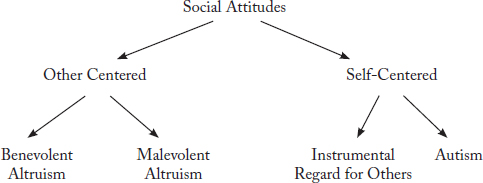
By contrast, when a person is motivated by other-centered concerns, the improvement of others’ conditions, as he perceives them, are for him an end in themselves. This is most notably the case in benevolent altruism, in which the acting person wishes to improve others’ conditions. However, it is also the case when the acting person wishes to deteriorate others’ conditions. Benevolent and malevolent altruists have one thing in common: the realization of their objectives depends on the satisfaction of others’ preferences. In the case of benevolent altruism, this dependence is positive. In the case of malevolent altruism, it is negative. Let us look at these forms of altruism in a bit more detail.
Malevolent Altruism
Malice is a plain fact of everyday experience. It has been known in all ages and civilizations. In the early eighteenth century, Bishop Joseph Butler discussed it under the name of “disinterested cruelty” or “disinterested malevolence.” He contended that “disinterestedness is so far from being in itself commendable, that the utmost possible depravity, which we can in imagination conceive, is that of disinterested cruelty” (Butler [1726] 1841, p. xii).
The malevolent altruist wishes other people to fare ill. In his eyes, it is good that these others do not do well, that they are poor, feel pain, or are lonely. Because such suffering is for him an ultimate end, he is willing to invest resources to make sure that others’ condition deteriorates, even if no further good may result therefrom for himself or anybody else. In this case, where gratuitous harm is intentionally inflicted on others, it is appropriate to speak of gratuitous evil.
In his disquisition on the foundations of morality, Arthur Schopenhauer ([1840] 2010, p. 204) identified ill will or spitefulness (Übelwollen) as a major anti-moral driving force (antimoralische Triebfeder) of human behavior: this force is “very abundant, indeed, almost commonplace in its lower degrees, and it easily approaches the higher.” He considered it to be “very fortunate for us that prudence and politeness throw their mantle over these and do not allow us to see how universal is mutual ill-will and how ‘the war of all against all’ is carried on, at least in thoughts” (pp. 204–5). He noticed that ill will often resulted from envy, but even more so from a profound glee over the misfortune of others, a pleasure in seeing other people suffer, which in the English language is today often expressed by the German word Schadenfreude. Schopenhauer (1840, p. 205) explains:
In a certain respect, the opposite of envy is Schadenfreude. Yet to feel envy is human; to enjoy Schadenfreude is devilish. There is no more unfailing sign of a thoroughly bad heart and profound moral baseness than an inclination to pure, heartfelt Schadenfreude.
In practice, it is not always easy to detect malevolent forces at work. The deception works so well because sins are deviations from a virtuous middle ground. Despair and thoughtlessness are deviations from the virtue of hope. Ruthlessness, permissiveness, and envy are deviations from justice. Hatred toward other men is a deviation from justified hatred of evil deeds. Unsurprisingly, therefore, those who are prone to envy and hate tend to hide their motivations under the mantle of justice.
Problems of Benevolent Altruism
Malevolent altruism has no monopoly on evil consequences: benevolent altruism is not without problems, either.
As we saw when discussing the Hobbes fallacy, there is no human action that is not driven by the acting person’s own objectives. There is no benevolent altruism without the motivation of an individual self. What makes altruism selfless rather than selfish is that the intention to care for the welfare of others is the ultimate end.
Benevolent altruism is difficult to translate into action because it is unavoidable that the identification of what benefits the other will be colored by our own notions of the latter’s needs. There is a danger of the altruist’s seeking to foster not the other, but his own abstractions of how the other—or the environment, the world, or the universe—should be. Clearly, in this case, he would ultimately seek to foster himself. The presumptive beneficiary would just be an instrument for the altruist’s self-aggrandizement. This does not mean that the action of our false altruist would be without merit, but it does mean that it would be driven by narcissism rather than altruism. Genuine altruism requires love for and openness toward the other. It requires a thorough knowledge of the other and of one’s self.
Moreover, the genuine altruist uses his own resources. By contrast, there are myriads of people who profess to be driven by the welfare of others or by the public interest and who act as paid employees of public administrations and private charitable organizations. God knows their hearts, but for a human observer, it is difficult to tell their true motivations. It is plausible to suppose unselfishness on the part of those who fund nongovernmental organizations (NGOs) and other organizations of the so-called third sector (but even this assumption should be made cautiously). The same presupposition may often be made in regard to all those who labor without pay in families, parishes, associations, and clubs of all sorts. But the salaried employees of public and private welfare organizations may not claim this presupposition in their favor. They are prima facie engaged in ordinary commercial activity. They don’t give their time for free. Like all other employees, like all people who work for profit, they “have had their reward” (Mt 6:2).
And then of course there is, in the civil service as elsewhere, the propensity to mask and disguise quite ordinary material interests under the cloak of presumably noble aspirations. Schopenhauer ([1851] 1905–10, 5:226) had a keen eye for this fact: “Our civilised world is but a grand masquerade. Here we encounter knights, pastors, soldiers, doctors, lawyers, priests, philosophers, and whatnot! But they are not what they represent: these are mere masks, under which, as a rule, are moneymakers.”
Benevolent altruism is the essential motivation of gift giving. But it is important to be aware of its limitations. We have already quoted Smith’s ([1776] 1994, p. 485) famous quip: “I have never known much good done by those who affected to trade for the public good.” Benevolent altruism might very well lead to a deterioration of the conditions of others, and in practice it often does (see Oakley, Knafo, Madhavan, and Wilson 2012). This is so for three basic reasons.
First and foremost, benevolent altruism is a matter of motivations, or intentions. It does not concern action nor the effective results of action. From the fact that someone harbors benevolent feelings, attitudes, or objectives in regard to others it does not follow that he sets out to act in the material world to improve their conditions. Second, even those altruists who are driven to “do something” do not necessarily make the world a better place. They do not necessarily employ suitable means to achieve their benevolent ends. A well-intentioned person might be wrong about the relevant causal relations and therefore choose means that either have no desired effect or produce the opposite of what is desired. A classic example from public policy is the case of minimum-wage laws. The imposition of above-market wage rates by law seems to be a convenient shortcut to improve the material conditions of the working poor. But in practice such laws prevent low-productivity persons from obtaining jobs. Unemployment statistics illustrate this fact. Among the unemployed, there is a great preponderance of the young, the inexperienced, the old, and the handicapped.
A third reason why benevolent altruism is neither necessary nor sufficient to improve the conditions of others is that its protagonists might go astray when they proceed to conceptualize the concrete meaning of their objective (see Rhonheimer 2001, pp. 204ff.). All people of good will agree to strive for “the common good.” But what does this mean concretely? Altruists may seek to improve “the conditions” of other people. But what they consider to be an improvement does not always coincide with what the putative beneficiaries think. And even if these altruists and their presumptive beneficiaries agree on this point, they might both be wrong about what would really be an improvement.
These remarks are not meant to denigrate benevolent altruism but to serve as a reminder that it is difficult to translate altruism into good deeds. There is a difference between wishing well and doing good. There is no easy route, no intellectual and material shortcut, to any sort of improvement. Benevolent altruism must be based on truth no less than on charity. It requires caritas in veritate.
THE REJECTION OF GIFTS
Donations, and gifts in particular, are not always welcome. There are people who seek to avoid gift giving and gift receiving altogether. What are the motivations behind this rejection?
Gifts can be embarrassing for the beneficiary. This may result from a particular characteristic of the gift: that it comes from the wrong person, that it is too expensive, too beautiful, too something. But what shines through in these instances is, very often, an embarrassment about the principle of the gift in question. For what does it mean that a gift is too expensive? Too expensive as compared to what? And why would this matter if the gift were a true gift? The expensive gift would be a problem only if it were not a true gift, but the initiation of a tit for tat. Then it might be too expensive to reciprocate. Similarly, who would be a person from whom we could, would, or should rightfully accept a gift? A person to whom we would not mind being indebted? But then, again, the gift in question would not be a true gift, but part and parcel of a tit for tat.
The rejection of gifts, then, may be inspired by very different reasons. In what follows, we will discuss three of them in more detail. The rejection of gifts may result from the donee’s doubts about the motivations of the donor, from pride, or from a rejection of the very principle of private property.
Misunderstanding Gifts
It is not always easy to understand the true character of a gift because this character depends on the unobservable motivations of the donor. Rich gives a bottle of champagne to Poor on the occasion of the latter’s birthday. Poor might just be merry without any afterthought. But he might also ask himself whether this was truly a free gift. Did Rich just initiate a tit for tat? Does he wish to indebt Poor, to set him up for some unspecified future service? By their very nature, these questions can never be answered with full certainty. It is impossible for us to look into another man’s heart. And the difficulty increases when we receive gifts from strangers or under unusual circumstances. This is why under civil law, gifts are contracts in which the donor and the donee formally agree on the gratuitous nature of the transfer. Clearly, such attempts to make the donor’s and donee’s motivations explicit remain superficial. They do not penetrate to the heart of the matter: the intentions of the donor and the donee. This is one reason for the reluctance to accept gifts.
The Revolt of the Proud
The rejection of gifts may also reflect a deep-seated human desire to return each favor to “get even” with one’s benefactor, to pay one’s debts, even if those debts are indefinite, even if they are moral rather than monetary, and even if they are purely imaginary. In other words, it may be rooted in human pride, in the warped ambition to be the exclusive master of one’s own fate.
Josef Pieper argued that the mindset of the proud was at the root of the rejection of leisure—which implies, we might add, the rejection of gratuitous activities. Correspondingly, this frame of mind entailed the one-sided veneration of effort, or labor, as a source of human well-being and happiness. In Pieper’s words:
The innermost meaning of this over-emphasis on effort appears to be this: that man mistrusts everything that is without effort; that in good conscience he can own only what he himself has reached through painful effort; that he refuses to let himself be given anything. (Pieper [1948] 1998, p. 39)
Mises expressed the mindset of the proud very well in his discussion of the welfare state, or, as he called it, the charity system. He contended: “To be an almsman is shameful and humiliating. It is an unbearable condition for a self-respecting man.” And he declared that this humiliation was a consequence of private property and contractual exchange: “It is only the mentality of a capitalistic environment that makes people feel the indignity of giving and receiving alms” (Mises [1949] 1998, p. 834).
However, these claims stand on shaky grounds. Mises himself had pointed out, in other passages of his magnum opus, that all our human endeavors depend on conditions that we do not control and that the present-day residents of developed countries are, as it were, “the lucky heirs of our fathers and forefathers” (p. 489; see also p. 481). It is true that this does not turn everybody into an almsman, yet this is not true in the sense that we do not depend on others, but only in that we do not have to beg these benefactors for their assistance. Lucky heirs are tempted to be proud and to behave like spoiled brats. They might feel lucky, not only because they inherit the savings of their ancestors, but also because these ancestors have shown them the kindness of taking an early and permanent leave of absence. The horrible personal dependence of the heirs is not ever present to their minds. They may praise their good luck and their fortune. They do not have to feel grateful.
Moreover, why should “a self-respecting man” feel shame and humiliation if he is forced to be an almsman by the circumstances of his life? Mises assumes this, but it concerns a psychological or anthropological question, not an economic necessity. He would have been right, by definition, if he had referred to “a proud man.” But in all other cases human dignity and self-respect do not seem to depend on one’s material condition.
Finally, the feeling of “the indignity of giving and receiving alms” does not only result from the way of thinking that prevails in capitalism. As Mauss has taken great pains to demonstrate, and successfully so, such feelings are not limited to capitalistic environments or to alms. One of the very purposes of gifts in primitive societies is to humiliate the beneficiary.
The Rejection of Private Property
Let us now turn from the psychological to the intellectual reasons for the rejection of gifts. Here, we should consider in particular that the revolt against gifts can be motivated by the rejection of the very principle of private property. We have seen that the existence of gratuitous goods presupposes a limitation of claims and obligations. There can be no gratuitous good if there is no private sphere of personal autonomy. Communities that do not know private property do not know gifts either. Those who reject private property willy-nilly reject the notion of gratuitousness as well.
Private-property orders are the fruit of a long and winding process. The principle of private property is rooted in the nature of man, most notably in his inalienable will, but it takes some effort and time to understand how this principle translates into claims, obligations, landed property, contracts, and so on. In the early stages of civilization, property rights were not well defined and there was no clear-cut distinction between payments and gifts. However, then as now, the benefits of the division of labor drove people together. Then as now, specialized producers needed to exchange their products. In the absence of clear-cut private property, this exchange took the form of a tit for tat. It took the form of a gift exchange that Malinowski and Mauss (1922) still found in some primitive Pacific tribes at the beginning of the twentieth century.
In the minds of the people who live under such circumstances, the “exchange of gifts” is the very foundation of society, not because gift giving entails social bonds rooted in friendship and charity, but because without it there would be no division of labor at all. We find an enunciation of this idea in Aristotle’s Nicomachean Ethics. He considered the desire to get even with one’s benefactors to be the foundation of social life: “If men have received good, they seek to repay it: for otherwise there is no exchange of services; but it is by this exchange that we are bound together in society” (Aristotle 1893, bk. 5, chap. 5, sec. 6).
Although this interpretation of gifts as the foundation of the division of labor is somewhat justified in the case of early civilizations such as ancient Greece, it becomes an anachronism if presented as an ideal for modern times. Whatever the deficiencies of private-property orders may be, one of their advantages is that they greatly facilitate the division of labor by defining and protecting private property. Long-term planning and commitments are put on a much more reliable basis than they could be in a vague and ambiguous tit-for-tat economy. And the gift economy, too, flourishes in this order, as we have already argued.
The Rejection of Inherited Wealth
Gifts are often rejected by outsiders with great vigor when they come in the form of wealth handed down from one generation to the next. The undeserving heir comes to own a sizable estate by sheer luck of birth and privileged social relations. Inheritance seems to create an appallingly unjust inequality of wealth. Scrooge McDuck became rich as a result of an entire life of hard labor and cunning investments. He earned his wealth. But why should his heirs, who did not labor as he did, and who might be clueless investors, come to own all of this? Would it not be equitable to share this wealth more widely? Would it not be just for the state to tax the heirs and distribute the proceeds to other people?
The premise of this sort of reasoning is that only work, and maybe also the investment of one’s savings, should count as legitimate sources of wealth. But why? Consider that most forms of inheritance are not financial. Boulding (1973, p. 34) points out that a mother language, too, is an inheritance and that it can be quite valuable, as in the case of the English language in our contemporary world. He goes on: “Similarly, I may inherit a religion, a nationality, and a culture, which may be of more or less value to me, and the differential inheritance of these things may easily lead toward increasing or decreasing inequality, depending on the nature of the process itself ” (p. 34).
Furthermore, some of the most important activities in human life are performed outside of the market nexus. A woman who runs the family household, a full-time mother, earns no wage and no return on capital. Does this mean that she should not inherit her husband’s wealth, all of it?
But what if the heir is not a loving wife of many years? What if the heir is not even a relative? What if he is a lazy and arrogant lad? Would it be unjust if he received all of the wealth of the deceased, by the good graces or the delusions of the latter? Rivers of ink have flown to disparage the legitimacy of such inheritance, but Pascal Salin begs to differ. He points out: “If the heir does not have ‘the right’ to inherit, nobody can receive this right, especially not statesmen or those to which they transfer the resources obtained by inheritance taxation” (Salin 2020, p. 67). He then goes on to emphasize that the entire case against the heirs is wrongheaded because the real issue lies with the person who makes the bequest. The proper point of view from which one should judge the moral legitimacy of an inheritance is not the point of view of the heir but the point of view of the deceased. After all, it is his wealth that he bequeaths. If he may spend it on his own consumption, why should he not also be free to turn it into a gift for others? Moreover, Salin argues that (2020, pp. 73–74):
The life cycle and the cycle of generations are not separable from the cycle of patrimonies, of their birth, their development, their transformation, and their annihilation. The transmission of goods—by free transaction or by inheritance—is one of the essential means by which the unpredictable evolution of human history occurs . . . . The transmission of inheritance of a property, whether a home or a family business, is one of the means by which people establish a link between the past and the future. By confiscating an important part of the property, the state amputates not only a legacy, but the personality of the person who has created it. Inheritance taxes should be removed, without exception.
The run-of-the-mill critique of inheritance also neglects to take account of its positive repercussions for other people. The sums of money that are saved before death in preparation for a future bequest cannot fail to promote, right now, one way or another, the productive activities of others. The building and preserving of capital, which will eventually also benefit the heirs, is an immediate benefit to all kinds of other people. Inversely, the taxation of inheritance, and all laws that similarly reduce the incentives to save, do not only hurt the prospective heirs, but other people as well. We will study these issues in more detail in chapters 5 and 11. In the next chapter, we will deal in more detail with an important variant of the rejection of gifts out of a rejection of private property; namely, with the social philosophy of tit for tat.
_______________________________
On caritas, see Lewis (1960); Wojtyla ([1960] 1981); and Benedict XVI (2005). Studies of different forms of love by contemporary Thomists are in Fritz Case (2012) and Mattison (2012). Plotinus (1962), in his third Ennead (tractate V), points out that eros moves from the inferior to the superior, whereas agape moves from the superior to the inferior, to lift it up.
Aquinas ([1259–65] 2009, bk. 1, chap. 91, sec. 4) in his metaphysical speculations on the causes of love argued that love was motivated by kinship or connaturality. In his words: “Since each thing in its own way wills and seeks its proper good, if it is the nature of love that the lover will and seek the good of the one he loves, it follows that the lover is to the loved as to that which in some way is one with him. From this the proper nature of love is seen to consist in this, that the affection of the one tends to the other as to someone who is somehow one with him. Therefore, the more that through which the lover is one with the one he loves is greater, the more is the love intense. For we love those whom the origin of birth joins to us, or the way of life, or something of the sort, more than those whom the community of human nature alone joins to us” (see also bk. 4, chap. 42; idem 1948, I/II, q. 27, art. 4). Starting from love motivated by kinship, Durkheim ([1893] 2013, pp. 17ff.) points out that love is also motivated by complementarity.
Boulding also highlighted two other traps: a Maussian “sacrifice trap” (grants are perpetuated out of a commitment to the ideals considered to be foundational for a society) and an “ignorance trap” (grants are perpetuated because there is no reliable information about their real impact). On sacrifice traps, see also Halbertal (2012, pp. 98–104).
In chapter 10, we shall argue that when freedom gives way to coercion, when free gifts are turned into enforceable claims to sustenance, and when the welfare state replaces private charity, responsibility vanishes and the risks of abuse and dependence increase.
See, for example, Elster (2010) and Cohen (2012), as well as his critique in Wolfelsperger (2010). The word altruism was coined by Auguste Comte (1851, pp. 614 ff., 691ff.), a staunch opponent of Christian faith and morals.
See also our discussion of a utopian pure gift economy on pp. 168ff.
Notice that, for the same reason, it is not certain that malevolent altruists will achieve their goals. Their intentions are evil, but their actions do not necessarily entail evil consequences, especially from a long-run perspective. (This has been duly emphasized by authors since the times of Mandeville and de Sade. The latter got carried away in concluding that good intentions are therefore irrelevant.) Moreover, let us notice that in a free society, the extent of malevolent altruism is limited by the private resources that it consumes.
“The unreciprocated gift still makes the person who has accepted it inferior, particularly when it has been accepted with no thought of returning it. . . . Charity is still wounding for him who has accepted it, and the whole tendency of our morality is to strive to do away with the unconscious and injurious patronage of the rich almsgiver” (Mauss [1925] 2002, p. 83). “Through such gifts a hierarchy is established. To give is to show one’s superiority, to be more, to be higher in rank, magister. To accept without giving in return, or without giving more back, is to become client and servant, to become small, to fall lower (minister)” (p. 95). Bourdieu ([1997] 2000, chap. 5, case study 1) develops this idea in more detail.
He adds the following remark: “This is the reason why we set up a temple of the graces [charities,  in sight of all men, to remind them to repay that which they receive; for this is the special characteristic of charity or grace. We ought to return the good offices of those who have been gracious to us, and then again to take the lead in good offices towards them” (Aristotle 1893, bk. 5, chap. 5, sec. 7). Laum (1924) and Gerloff (1932) have argued that modern market exchange developed out of religious sacrifice. Tit for tat was first organized around temples.
Writing toward the end of the nineteenth century, Herbert Spencer ([1879] 1978, chap. 14) argued essentially along the same lines: “The right of gift implies the right of bequest; for a bequest is a postponed gift. If a man may legitimately transfer what he possesses to another, he may legitimately fix the time at which it shall be transferred. When he does this by a will, he partially makes the transfer, but provides that the transfer shall take effect only when his own power of possession ceases. And his right to make a gift subject to this condition, is included in his right of ownership; since, otherwise, his ownership is incomplete.” Spencer went on to observe that “the growth of industrialism, with its freer forms of social relations, has brought increased freedom in the disposition of property; and it has brought this in the greatest degree where industrialism has most subordinated militancy, namely, among ourselves and the Americans.”

