
Abundance, Generosity, and the State
2. The Nature of Donations
2
THE NATURE OF DONATIONS
Donations are the best-known gratuitous goods. Most everybody receives and makes them on a regular basis. Children receive the love and care of their parents, grand-parents, and other relatives. The handicapped, the elderly, and the hapless stranger receive gratuitous assistance. Almost everyone receives birthday presents. And almost everyone has wished other people a good day or a good night.
Statisticians have come up with different ways to measure donations. The most widespread metrics are “donations of money,” “volunteering,” and “helping a stranger.” Donations of money can be measured in absolute amounts and compared to gross domestic product (GDP) and various measures of overall monetary wealth. By contrast, it is much more difficult to measure the time spent volunteering and helping strangers. Therefore, more often than not, statisticians measure participation in each of these activities. They ask a representative sample of the population of a country whether in the previous year they have donated money at all; that is, irrespective of the amount. The percentage of positive responses indicates how much that country participated in the activity of “donating money.” The same method is applied to measure participation in the other two activities.
Following this participation methodology, the US-based Charities Aid Foundation publishes the World Giving Index, which is based on data from Gallup’s World Poll and covers, in the 2020 edition, 114 countries and 90 percent of the world population. The annual index ranks these countries in each of the three categories of charitable activities and also provides an overall ranking, calculated as the average of the three participation rates. In 2020, the most generous country by that measure was Indonesia, with an average participation rate of 69 percent, followed by Kenya (58 percent) and Nigeria (52 percent). Further down the list were the United States (rank 19, 43 percent) and the United Kingdom (rank 22, 41 percent). Even further down were Austria (rank 62, 34 percent), Germany (rank 85, 30 percent), France (rank 106, 25 percent), and Italy (rank 111, 22 percent).
The distinct advantage of the participation methodology is that it allows the comparison of different countries despite their enormous differences in income and wealth. It would not make much sense to rank countries by the absolute dollar amounts that their populations donate. Poorer countries are by definition unable to match the richer ones.
However, the participation methodology also carries a considerable disadvantage: the data quality is extremely weak. Whether people volunteer for one hour, one day, one week, or one month does not show up in the participation rate. The one-hour volunteer counts as much as the one-month volunteer. And the same thing holds true for the other categories. A one-dollar donation in the US counts as much as a ten-dollar donation in Zimbabwe (and in the US, for that matter).
This is why it is often advisable to measure donations of money in absolute dollar amounts. To be sure, this precludes meaningful comparisons between different countries. On the other hand, it becomes possible to quantitatively compare the different purposes of donations. And it also becomes possible to accurately measure the evolution of generosity over time. For example, Figure 2 shows the evolution of monetary donations in Germany as a percentage of disposable personal income, household net wealth, and GDP.
FIGURE 2: MONETARY GIVING IN GERMANY, 2009—20
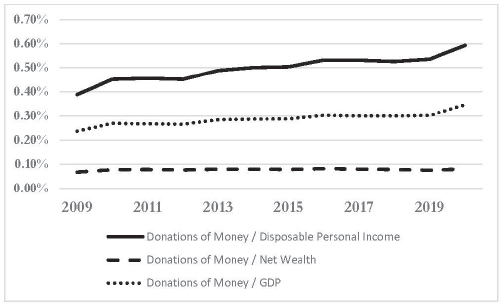
Sources: DZI Spenden-Almanach 2021; Statistisches Bundesamt; Bundesbank; calculations by the author.
Now, although the statistical assessment of donations is a most valuable source of information, it is no substitute for rigorous theoretical analysis. Statistics cost money. They therefore tend to focus on things that are easy to measure. But as we have seen, the measures are not always significant or of good quality. Nor are they necessarily helpful for grasping the relevant causal relationships. Our purpose in this book is to come to an understanding of the causes and consequences of gratuitous goods. Accordingly, in what follows, we shall take a long and hard look at the theory of donations and then discuss some of the statistical material in later parts of the book.
Donations have been covered in countless monographs, hand-books, dictionaries, and stand-alone articles.We shall not tackle all the themes in the literature nor its merits and deficiencies. Our paramount objective is to understand the relation between donations and the market economy, which we shall discuss in chapter 5. In the present chapter, we will study the nature of donations. We will argue that donations have four characteristic features: (1) they are devoted to some cause or person different from the donor himself; (2) they come with no strings attached; (3) they result from free choices within the limits of private-property rights; and (4) they sacrifice personal time or savings.Let us now discuss these features in more detail.
DEVOTION
Genuine donations are made out of devotion to a purpose that transcends the donor’s own gratification. They are selfless. They are not made for the donor’s sake, but for something or someone else. Devotion prompts the donor to dedicate (a part of ) his resources to something or someone else. He dedicates (a part of ) his life to piety, to a science, to an art, to the pursuit of beauty or justice, etc. Devotion may also drive him to be attentive to a person or a group of persons, to cater to their needs and well-being with various gifts of time and money.
The proper motivation of devotion—its only motivation, as it were—is the donor’s love of something or someone other than himself. This does not mean that the donor does not love himself, too. It means that he also loves something or someone else, in the sense of asserting the goodness of the loved one (Pieper [1972] 1992, pp. 38–39).
Devotion can be disorderly because its driving force—love—can be disorderly. “For since there is only one true kind of devotion, while there are many false and vain, if you do not know which is the true, you may deceive yourself, and waste your time in following some kind of devotion which is useless and superstitious” (Sales ([1609] 1891, p. 1). The greater and purer the love, the more thorough and productive is the devotion, which “is nothing else but a certain spiritual lightness and vivacity, by means of which charity operates in us, or we by it, with alacrity and affection” (ibid., p. 2).
Proportionality
Here we are not concerned with the limitations and pitfalls of devotion. We do not praise it nor belittle it, nor compare it to the pros and cons of selfishness. But we need to highlight two things about devotion which are relevant for the economics of gratuitous goods. The first is that genuine devotion exists, even though in its pure form it may be only rare and fleeting. The second is that to the extent that human actions are motivated by devotion, they entail different consequences than human actions driven by selfish motives.
Devotion justifies “unreasonable” costs. Devotion alone justifies genuine sacrifice.When human beings act in the pursuit of any other objective, the means are always proportioned to their specific end. Firms spend only as much money as they can hope to make through an expenditure. The time and effort needed to train for a job must be worthwhile in terms of the expected revenue. Even in activities that are pursued for their own sake yet without any transcendental objective—the pleasure of dance, food, drink, sexual intercourse, games, and so on—the means are always proportioned to the result.
By contrast, when devotion comes into play, the result is secondary. The means are sacrificed. They are not compared to the result, not proportioned to it. More often than not, it is outright impossible, and sometimes absurd, to even attempt to proportion the means to their end. Indeed, what could it mean to use proportionate means in the pursuit of truth, justice, and beauty? Could any means ever be proportional to the love of a loved one? How could any human means ever be proportional to the glory of God?
This is not to say that human beings make sacrifices without consideration of their own economic circumstances. Donations definitely do have such an economic dimension, and we shall argue that they are therefore subject to economic law. But economic analysis must also be mindful of the particularities of its subject matter. If economists wish to explain the causes and consequences of human action, they have to acknowledge that some human ends require genuine sacrifice and that human beings are able to make such sacrifices.
The primordial theoretical significance of this fact will become clearer as we move on. Its practical importance does not need to be demonstrated. From the mist of ancient times to the present day, genuine devotion has always been held in great esteem, especially lifelong and complete devotion by specialists. Except in periods of decline, humanity has always protected priesthood, purity, and marriage. It has always prized single-minded warriors, artists, and scholars. Lifelong and complete devotion has been the quintessential res extra commercium. Language carries this heritage to the present day; for example, when we say that someone “consecrates” his time to an art or to a science.
Leisure
Time and material wealth may be committed to creating temples, churches, holy vessels, and holy habits. Time may be consecrated to contemplation, study, artistic creation, and religious worship. Such time is not “used” as a means. It is not meant to “serve” the acting person. This is most obvious in the case in which the activity is an end in itself and the agent enters the picture as a performer—as in the enactment of music, dance, song, and holy rituals.
Philosophers use the word “leisure” when referring to time thus devoted (Pieper [1948] 1995; Samaras 2017). One reason why donations of time are so poorly dealt with in the economic literature is that economists have defined the very word “leisure” in a way that brushes over this distinctive finality. Rather than sticking with the definition the philosophers use, the economic concept of leisure designates all activities that are not labor; that is, which do not aim at earning revenue.This conception of leisure has deep etymological roots: leisure (otium) is the binary opposite of commerce or business (negotium). This meaning is also broad enough to include the leisure of the philosophers while also including a variety of other activities. When economists talk about people enjoying leisure, they mean that people are enjoying a consumers’ good (see, for example, Mises [1949] 1998, pp. 131–32; Rothbard [1962] 1993, chap. 1, sec. 8). The leisure of economics connotes a state of idleness, involving inertia, distraction, and laziness.
By contrast, leisure in the philosophical sense, although definitely not labor, is the very opposite of idleness. And it is also the opposite of consumption for self-gratification. Leisure is time used selflessly; that is, without the expectation of any personal benefit or revenue.Leisure activities in this sense are donations of time to a good cause. They are not gifts. Their intended beneficiaries are not other human beings. It is true that humans might benefit from such acts, and this is in fact likely. A beautiful cathedral will probably be an enjoyment for passersby and for the attendants of the religious ceremonies held inside. But such human joys are not the ultimate end when erecting the cathedral. The sole intended beneficiary is God. Similarly, many people might benefit from scientific discovery, and they might relish beautiful literature, music, opera, sculptures, and paintings. Yet the truly passionate researcher, writer, composer, sculptor, or painter gives no thought to these pleasures of others nor to his own. He might be an intellectual as defined by Julien Benda. He might be a creative genius as described by Ludwig von Mises. In any case, he is in love with a holy cause that transcends his own person and to which he dedicates large parts of his life, in some cases his entire life.
It is true that such activities are an important source of gratuitous economic goods both for the person who undertakes them and for other people, within and outside of markets. But such benefits are obtained as an unintended consequence of acts of devotion. We shall study this crucial issue in more detail in chapter 6.
Gifts
Gifts differ from leisure in that they are oriented to other persons. Material gifts also involve a transfer of property, in which respect they are somewhat similar to market exchanges. John may devote his life to making Anna happy without ever making a gift to her. Inversely, he may present her with a lot of gifts without being any further devoted to her happiness. John Mueller claims: “The difference between a gift and an exchange is that in exchange, the persons who are the ultimate ends or purposes of those involved in the exchange do not coincide, but the means they have chosen to pursue their respective ends do” (Mueller 2010, p. 144). But this is not true. The ultimate ends of the persons involved in a gift relationship do not necessarily coincide.
From the legal point of view, a gift is a voluntary and unilateral transfer of an economic good from one person to another in which both parties agree on the gratuitous nature of the transfer. In the case of a service, the donor agrees to provide the service (or to have the service provided) to the beneficiary and the latter agrees to receive it. Neither receives any compensation. In the case of a tangible good, the donor agrees to abandon his property rights in favor of the beneficiary and the latter agrees to receive them as a gift, both without compensation.
It is useful to distinguish three forms of gifts: (1) relational donations in the form of time spent with other persons; (2) material gifts intended as relational gifts; and (3) material gifts to improve the material condition of the beneficiary.Let us present them in a bit more detail.
Some needs are relational in such a way that they can only be satisfied through personal gifts. A child needs the love of his parents, not only to survive, but also to nourish in him love, hope, and self-confidence, as well as many other mental dispositions and values on which he can build his life. The parents therefore have to give him much of their time and efforts. They must also try to be models that the child can emulate. Affluent families can purchase various educational services. They can hire babysitters and governesses, send their children to boarding schools, and pay for their university tuition. But they cannot purchase love, and they cannot purchase time. They must give their own time in order to nourish the child. Nothing can replace the gift of this personal relation and effort in the development of the young person.
These things do not change much when children become adults. To be happy and to keep growing in mind and body, all human beings need the love of friends and family. No money, no tool, and no machine can replace the time spent among friends. Jim cannot hire someone else to spend time with Joe in the hope that this will nourish the friendship between Jim and Joe. Similarly, nobody can pray in Jim’s place. To become a friend of God, and to remain in this friendship, it is necessary that Jim spend his own time praying to the Almighty.
Other relational needs can be satisfied to some extent with the help of material gifts. Wedding rings, Christmas presents, and birthday presents are material goods, but more often than not, they do not respond to any material need; at any rate, they do not only respond to material needs. They are relational gifts meant to be a tangible expression of the donor’s love for the donee. As we have seen, Laum (1960) argues that meals have always had such a social function and were usually provided by a host (see our discussion on pp. 19–20).
Still other needs are not relational and therefore do not entail the gift of personal time. Material economic goods often fall into this category: food, clean water, clean air, clean clothes, means of transport, and many other things. These goods can be obtained both through exchange and as gifts. Material gifts can be useful remedies for two sorts of problems: (1) the prospective beneficiary cannot afford the good in question and (2) he does not understand that he needs the good.
The Hobbes Fallacy
All human actions are driven by intentions, and these are always someone’s intentions or motivations. A donor’s actions are driven by his own intentions. According to a widespread misunderstanding, this precludes the possibility of his gift’s being a true free gift.
Whatever the donor does, the argument goes, he pursues his own intentions. Whatever he does, he does it ultimately for himself, even if others might also benefit from his action. This is not a matter of psychological attitude, but of praxeological necessity. The donor acts. He is driven by his own intentions. All of his actions are therefore selfish. In fact, fundamentally, it makes no sense to distinguish between selfish and unselfish actions, because all of them are driven by the same self. Accordingly, a person is compensated whenever he succeeds in doing what he set out to do. If he gives money to a beggar, or a smile to a stranger, he does not act without reward, but always in pursuit of his own personal goals. It therefore seems to follow that his action cannot be gratuitous, at least not completely so, even though he might wish or imagine it to be otherwise. After all there is always a “good reason” why he acted in this way rather than another.
Thomas Hobbes seems to have been the first modern author to state this idea, and he did so with admirable succinctness and clarity: “For no man giveth, but with intention of Good to himself ” (Hobbes [1651] 1904, chap. 15, p. 103). In his honor, we will therefore call this proposition the Hobbes fallacy.
Indeed, a fallacy it is, for it confuses the driving force of human action with its objectives or finality. From the fact that my actions are driven by my intentions and that my actions demonstrate my preferences (efficient cause) it does not follow that my intentions aim at myself (final cause). Wishing my action to succeed is not the same thing as seeking a reward for myself. When Peter donates money gratuitously to Paul, he wishes to increase the cash balance of the latter. His intention concerns Paul, not himself. Peter’s own person comes into play only because he realizes that Paul would not have much money unless he, Peter, gave him some. If another person made a donation beforehand, Peter might not act at all.
The line separating gifts from non-gifts runs along intentions, not along observable behavior. Donating money and smiling at strangers is not per se selfish, nor is it per se gratuitous. It all depends on the underlying intentions. The characteristic feature of donations is the focus on the other rather than on oneself. This focus is absent when people donate money and smile at strangers only for selfish reasons. Such donors want to feel better about themselves, increase their standing in the eyes of bystanders, or be admitted into the country club, or into heaven, among various motives. Their actions might still be meritorious and gratuitous, but they are not genuine gifts.
The Fallacy of Autistic Exchange
The distinction between the efficient and final causes of human action has yet to make it into economic literature. Without it, there is little hope that economists will come to grips with the nature, causes, and consequences of donations. Unfortunately, even the great Mises failed to make this distinction, and his understanding of donations therefore has a surprisingly Maussian bent. Indeed, Mises argued that, in the act of gift giving, the donor performs an exchange with himself, an “autistic exchange.” In his words:
Making one-sided presents without the aim of being rewarded by any conduct on the part of the receiver or of third persons is autistic exchange. The donor acquires the satisfaction which the better condition of the receiver gives to him. The receiver gets the present as a God-sent gift. (Mises [1949] 1998, p. 196)
This interpretation of gifts is idiosyncratic and manifestly inaccurate.It is wrong to state that the donor “acquires” something as a consequence of his donation. The truth is that as a consequence of his donation, there prevails a different state of affairs and that the donor prefers this state of affairs to the one that would have prevailed without his donation. Using the word “acquires” insinuates that the donor himself, as a consequence of his donation, receives something that becomes his property. But this is clearly not the case. And Mises also insinuates that a donor always and everywhere gives in order to acquire some benefit for himself, which is also not true.
Mises clearly grapples with the fact that the donation expresses the preferences of the donor. But as we have argued, this does not mean that a donation always and everywhere aims at satisfying the donor himself. The difficulty disappears with the distinction between efficient and final causes. While all human actions result from individual choices and preferences, or efficient causes, the actions may pursue entirely different objectives, or finalities.
GRATUITOUSNESS
Donations are characterized by their selfless objective, or finality. They may serve a noble cause or a donee, but not the donor himself. This is why a truly liberal donation is one that comes not only without any reciprocity or payment of any sort, but also without any preconditions.
Conditionality
In the case of gifts, it may be nevertheless necessary to specify conditions under which the beneficiary may obtain or use the gift. This is most notably the case when the beneficiary does not have full legal accountability, as in the case of minors, senile persons, or the mentally ill. Conditionality may be especially advisable when the immediate beneficiary is a fiduciary; that is, a person distinct from the ultimate beneficiary. In such cases the donor might legitimately try to temporarily restrict the beneficiary’s freedom of action, to make sure that the gifts serve their objective.In doing this, the donor does not exact a payment or some other form of reciprocity. The conditionality aims to ensure that the gift truly serves the beneficiary.
Giving under conditions is very important in the case of large donations and also in the case of inheritances. Such are genuine if the donor receives nothing in return. Whenever a donor wishes to control how his donation is used or if the conditions placed on a gift have the effect of providing reciprocal services to the donor, then such donations are either grants or payments, not gratuitous goods.
Preparedness
Conditionality may also come in a more subtle form. Very often it is necessary that the donee make various efforts and preparations in order to really receive what he has been given. Reading a love letter is not possible without understanding language and meaning. Love letters require an effort of courtesy and tact on the part of the addressee to grasp subtleties of meaning (see Steiner 1989, pp. 147–50). More generally speaking, all forms of gratuitous social interaction—participating in a conversation, sharing a meal—presuppose some preparation in order to properly receive the gratuitous elements. Much of human education aims at preparing children to receive all those goods that come free. In order to learn from the wisdom of authors, it is necessary to master their language and to read them attentively. For fellowship and friendship to be strengthened by the sharing of a meal, it is necessary to respect mealtimes, cater to the needs of the others, and follow the conversation.
Consent and Gifts
In the case of gifts, it is important that the donee accept the gift in order to preclude the possibility that it is not a gift at all but a nuisance. The donee needs to do something. At the very least, he must somehow express his agreement. “May it be done to me according to your word” (Lk 1:38).
There are no foolproof ways to ascertain the consent of the donee. Indeed, even if the beneficiary declares that he accepts the gift, it cannot be concluded with certainty that he truly cherishes the gift as such. He might, for example, accept it only in order not to offend the donor. By the same token, if a donee is incapable of declaring his acceptance of a gift, it is not certain that he does not accept it. Szpindor Watson (2015, p. 188) gives the example of a husband in a coma. He needs his wife to make life-and-death decisions on his behalf. Even though the husband cannot personally accept any gifts—for example, gratuitous medical care—she can accept them as his legal representative. Similar considerations apply when parents act on behalf of infants, toddlers, and older children.We are here not concerned with the rather juridical question of what “counts as” a genuine acceptance. Our point is merely that a gift, to be a gift at all, must be accepted by the donee or his legal representative.
This seems to be unproblematic. However, it is important not to fall into a materialistic trap when interpreting the gift. The beneficiary does not benefit because someone else is willing to gratuitously provide something to him. He benefits because he considers this thing to be an economic good, such that he prefers to receive rather than forgo it. It is well known that gifts can be rejected, and that some gifts should be rejected. The Trojans were not somehow impelled or obliged to accept the Greeks’ wooden horse. The Trojans took it because they believed they would be better off owning the horse—erroneously, as it turned out.
In other words, what makes something a gift is not its objective suitability as such nor its uses (its “use value”), nor the fact that other people find it desirable (its “exchange value” or market price), but the fact that the prospective beneficiary himself finds it desirable and therefore agrees to receive it. He gratuitously receives the object proposed to be given to him, be it a service or be it the property rights to a commodity. But what makes him a true beneficiary, and what makes the object a gift, is the personal value of the gift. By agreeing to accept it, the beneficiary demonstrates his preference for accepting the gift, rather than forgoing it. He demonstrates that he thinks himself to be better off, thanks to the gift, than he would otherwise have been.
As we have seen, the donor may benefit as well; for example, by enjoying a feeling of satisfaction. However, any such benefits would have to result indirectly and unintentionally from his deed. As we have seen, a true donor does not make a gift in order to benefit from it himself. But this does not preclude his benefitting from it indirectly. Quite to the contrary, this is exactly what we should expect in such cases. If Peter gives a five-dollar bill to Paul, a beggar, Peter thereby demonstrates that he prefers that the beggar own the banknote. If this wish materializes, then it may very well be the case, and it is even likely to be the case, that Peter will feel happy because the world is now a better place according to his criteria. But as long as Peter does not deliberately act in pursuit of such feelings of personal happiness, his gift is pure and uninterested.
Grants
In pure acts of devotion, the love of the transcending cause is the only motivation that prompts the use of time and material resources. Such acts are fully gratuitous. The agent does not expect anything in return. But perfect and relentless devotion is rare. In most cases, the agent also aims at benefits for himself. In some cases, he is only concerned with himself, even though he pretends to be devoted to something else. Following Kenneth Boulding (1973), we shall use the word “grant” to refer to self-interested donations.
Think of a researcher who only studies and publishes in order to attain full professorship or membership in the National Academy of Sciences. Think of an author who deliberately writes in such a way as to maximize his book sales. Think of comedians who just want to spend a fun time with cool friends. Think of an atheistic church architect or of a lukewarm prelate setting out for a church career. The world is full of people who are professionals in religion, arts, and sciences—that is, who see these activities as sources of revenue and personal gratification rather than as vocations that are to be cultivated for their own sake. Such people seek a return for themselves rather than the advancement of religion, art, or science as such.
These remarks are not intended as a moral criticism of self-interested activities. There is nothing morally wrong about pursuing one’s own interests, provided that the means employed are legitimate. Indeed, “other things being equal, each thing loves itself more than another, and a sign of this is that the nearer a thing is to one-self the more it is naturally loved” (Aquinas [1259–65] 2009, bk. 1, chap. 102). Self-interest is not only natural and legitimate, but a most powerful driving force of improvements of all kinds. He who cares for his own business first and foremost is not necessarily at odds with the welfare of other people. As Smith famously stated: “By pursuing his own interest he frequently promotes that of the society more effectually than when he really intends to promote it.” And he adds: “I have never known much good done by those who affected to trade for the public good” (Smith [1776] 1994, p. 485).
We will have the opportunity to study the beneficial side effects of self-interested behavior in some detail in chapter 6. In chapter 3, we will also duly underscore the damage that can be wrought by donors who wish to do good but who do so without the proper motivation, instruction, and circumspection. But here our purpose is different. Here we need to highlight the difference between donations and grants.
In the case of a pure donation, the object of devotion is the only concern of the donor. In the case of a pure grant, there is no consideration of devotion at all. And then there are mixed forms— imperfect donations, imperfect grants—in which the donor intends to benefit both the object of his devotion and himself. The perfect donation is a pure sacrifice, whereas imperfect donations also serve the personal ends of the donor. They represent to some extent acts of consumption or of investment.
For example, when I spend an evening with my wife watching a romantic movie that I thoroughly dislike only to be a good companion, this is close to a perfect gift. By contrast, when I buy my wife a ticket for a soccer match that I would like her to watch with me, the gift is imperfect in that even if she likes soccer, her happiness is not the only end of my action.
Let us spin the example further. Suppose I knew my wife dislikes soccer and I bought her a ticket nevertheless, thinking she would come with me anyway because she likes to spend time with me even under unpleasant circumstances. That purchase would not be a gift to her but consumer spending for my own pleasure only. It is true that she would receive the ticket gratuitously, but it would be a pure grant, rather than an imperfect gift.
Similarly, suppose Jim does not like to have his drinks alone. He invites Tom and pays for his drinks. Tom then receives drinks gratuitously but not as a gift. From Jim’s point of view, the drinks are a payment for companionship. It might very well be the case that Tom likes hanging out in the bar anyway and thoroughly appreciates both the drinks and talking to Jim. But that is not fundamentally different from all other cases in which an employee likes his job.
Or suppose I am taking part in a writers’ contest and running against a very talented rival. I know that he has a computer game addiction. If I anonymously send him his favorite game in the mail in the hope that he will spend his time playing rather than writing, then, clearly, I have not made a genuine gift to him. His happiness would in this case not count at all. It would be merely a means for the attainment of my personal ends.
Other examples come readily to mind. Weapons are often given to the enemies of one’s enemies. People might make donations toward the beautification of the city where they live in the hope that their business will benefit from the improvements. Childless uncles and aunts might subsidize their nephews’ education not out of love, but in the hope that the nephews will gratefully remember them when they reach retirement age.
In short, whenever a donation is self-interested to the point that it ultimately serves only the objectives of the donor and the beneficiary is merely a means for the attainment of the ends of the donor, then this donation is not a gift at all, but a pure grant. It is the would-be donor’s personal consumer or investment expenditure.
Let us briefly compare investments and grants in order to highlight this point. Both have the objective of providing benefits to the person who makes them. The main difference is that grants provide gratuitous goods to some immediate beneficiaries, whereas investments typically do not. A grant may be made without stipulating any tit for tat (for example, supplying weapons to the enemies of one’s enemies), whereas an investment is a purchase of goods that serves the investor’s immediate (not ultimate) purposes. A market economy is an “outlay economy” insofar as investors renounce immediate gratification when they pursue long-run goals. Such outlays fulfill a crucial social function. They provide present revenue to suppliers and employees and relieve them of a significant part of the investment risks. But such outlays are not gifts, and usually they are not even grants.
In the real world, the relative importance of grants as compared to gifts depends most notably on the legal, monetary, and fiscal framework. In the long run, this framework is likely to produce distinct national cultures of giving. Some twenty years ago, Karen Wright (2001) highlighted that grants were the predominant form of giving in the US, whereas gifts were the predominant form in the UK. Wright proposed that scholars think of this difference as reflecting the difference between generosity and altruism. In the US, people were generous (and are still so today), but their donations were intended to be completely selfless less frequently than in the UK.
JUSTICE
We have already seen that private-property rights and donations are intimately related. To be gratuitous, a donation must be made outside of any context of claims and obligations. When Mark becomes the owner of an orange because he bought it from Ralph, he has a good reason to receive this orange from Ralph. He therefore does not receive it gratuitously, and Ralph does not gratuitously hand it over to Mark. By contrast, if there is no such contract between them and Ralph nevertheless hands the orange over to Mark, Ralph makes a gift. Mark receives the orange gratuitously precisely because he had no right to receive it. And Ralph provides the orange gratuitously precisely because he had the right to keep it. Mark has an obligation to respect this right. He receives the orange “without a good reason” through Ralph’s good graces.
It is this latter circumstance that we now need to appreciate for its full value. Donations must be made within the boundaries of legitimate property rights, lest they be no donations at all. Donations must be just. To choose means to change a state of affairs that we can control. To choose within the boundaries of legitimate property rights means to change the state of affairs that we legitimately control.
Suppose John takes the orange that belongs to Ralph and donates it to Mark without Ralph’s authorization. Is John making a gift? Apparently not. He fleeces Ralph, the true owner. John has the obligation to respect Ralph’s ownership of the orange. If he takes it without Ralph’s consent, John acts in violation of his own obligation and of Ralph’s claim.
But could we not argue that John obtains the orange “without a good reason” and therefore receives it gratuitously? And does not Ralph likewise “provide” the orange “without a good reason”? We have already answered these questions in discussing the nature of gratuitous evil. In a limited sense, it is true that the robber obtains goods gratuitously. But his gain is mirrored by the victim’s gratuitous loss. The robber’s deed therefore drains the very bedrock of gratuitous goods; namely, property rights. The robber does not obtain a good gratuitously. He takes loot.
In our example, John is a robber who hands out loot. But he might just as well be an imposter who sells goods that he does not own. He might be an embezzler who abuses the goods that other people have entrusted to him in good faith. Whatever the concrete crime may be, it is clear that all “donations” made from expropriations are false donations. They are forms of loot sharing. Likewise, all economic goods transferred out of fear, even when they are given without any conditionality, and even when they have the outward appearance of gifts, are no gifts at all, but forced grants that serve as investments in the donor’s future security.
There might be extenuating circumstances, such as when a robber robs another robber in order to return the property to the legitimate owners, as in the legend of Robin Hood. But this does not alter the fact that whatever donations result from crimes are not genuine gifts. When Robin Hood returns taxpayer money to a taxpayer, he does not make a gift but a restitution.
When a donation is not freely made but occurs under coercion or the threat of violence against the person or property of the donor, then whatever unilateral transfer he makes is not a gift, but a tribute, ransom, tax, or other forced payment. The immediate beneficiary of such transfers is usually the person or organization that coerces or threatens the unwilling donor. Sometimes this beneficiary seeks to cloud the real nature of the act in euphemistic language, avoiding expressions such as “threat,” “violence,” and “coercion” and replacing them with seemingly innocuous terms such as “contribution,” “duty,” or “charge,” which are borrowed from ordinary contractual relations.It is not necessary for us to dwell on the rhetoric deployed to obfuscate the reality of the matter. A forced transfer is a crime, not a donation.
SACRIFICE
A donation is not just the deliberate choice to do something good without expecting a return. It also has a material dimension. He who makes a donation commits economic goods to some other person for that person’s own sake or to some cause for its own sake. The donor forgoes the scarce services of these goods. He sacrifices them.
Earmarked Personal Savings
The economic goods that are devoted to some cause or given to another person come out of the donor’s savings. To save an economic good means to not use it for one’s own current gratification. It literally means to save it from one’s current personal consumption.
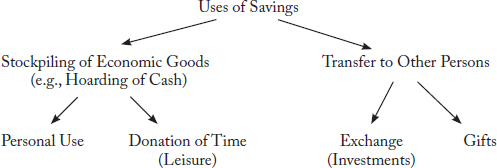
Wealth is the common name for all economic goods that have been saved from consumption and preserved into the present. When we speak of savings, we therefore mean additions to overall wealth. The latter can be allocated to four basic purposes: personal projects, funding time donations to a selfless cause, investments, and gifts (see Figure 3).
FIGURE 3: USES OF SAVINGS
Savings that are earmarked for donations may be called sacrificial goods. Their characteristic feature is that the donor does not intend to use them for his own gratification but consciously and deliberately dedicates them to, or earmarks them for, a transcendent cause or another person. The earmarking may only exist in the mind of the decision-maker, as when a family decides to reserve some sum of money for poor relief. But often the earmarking itself is visible and public, especially in the case of holy spaces and religious holidays, which are distinguished from profane places and ordinary times (see Eliade [1957] 1990). There are holy places whose boundaries stretch across space, such as churches, temples, and mosques. There are holy activities whose boundaries span across time, such as the liturgy of Mass, holy games, Gregorian chant, and holy music.
An analogy to the concept of sacrifice is the Mengerian concept of capital, which denotes the monetary equivalent of all the economic goods that a person intends to use in order to earn revenue (Menger 1888).Capital goods, too, are often visible and public. Cases in point are factory buildings and trucks. But just as in the case of sacrificial goods, the only thing that counts in identifying capital goods is the entrepreneurial intention. No good belongs to someone’s capital because of its physical characteristics. It belongs to that person’s capital because he deliberately earmarks it to serve the pursuit of future revenue.
The more frugal a person’s lifestyle, the greater the sacrifices he can make. The physiological facts of human life do set certain objective boundaries to human will. Even ascetics such as fakirs need to indulge in a minimum of personal gratification in order to make it to the next day. It is not physically possible to survive while being entirely devoted to noble causes and to other persons. Some personal resources need to be used to satisfy one’s own needs. Indeed, the Bible commands the faithful to love his neighbor as himself, not more than himself.
But these physiological limits are wide. Today, a frugal person, whatever his wealth in absolute dollar terms might be, can create, enjoy, and share an abundance of goods. And indeed, there are many poor people who donate great shares of their time and material goods to noble causes and to other people. On the other hand, there are also people who, despite their wealth, do not know abundance. They are always short of time and money. When they speak, it is to provide information, give orders, and network. But they do not discuss questions of truth, beauty, and justice. They do not speak without expecting a return. They are stingy despite being rich. Indeed, if the stomach grows faster than wealth, there can be no abundance. This is the grain of truth in Sahlins’s Stone Age Economics and in the wisdom of all tribes and all ages.
Nobody has expressed the relationship between savings and generosity more aptly than Jean-Baptiste Say. In the context of his theory of consumption, Say made the case for “economical consumption” as a virtuous middle ground between the opposite vices of prodigality and avarice. He argued that only the economical man is able to make truly free gifts because the prodigal spender will be forced to backtrack. The latter might make large donations but is likely to regret them soon after. Then he will turn to his donees to ask them for a quid pro quo. In Say’s words:
Without [the virtue of frugality] there can be no liberality, none at least of a permanent and wholesome kind; for, when it degenerates into prodigality, it is an indiscriminate largess, alike to deserving and undeserving; stinting those who have claims in favour of those who have none. It is common to see the spendthrift reduced to beg a favour from people that he has loaded with his bounty; for what he gives now, one expects a return will some day be called for; whereas, the gifts of the economical man are purely gratuitous; for he never gives except from his superfluities. The latter is rich with a moderate fortune; but the miser and the prodigal are poor, though in possession of the largest resources. (Say [1803] 1861, p. 449)
Sacrifices are made effortlessly in periods of growing wealth. Many families who become rich, thanks to successful businesses, often preserve their old consumption patterns for one or two generations. For a while, they have abundant time and material resources. But in the typical sequence of events, the stomachs of the succeeding generations grow and the abundance disappears. Similarly, periods of declining wealth (such as war and natural calamities) often entail dwindling abundance, as the stomach does not shrink quite as fast as the portions on the dinner table.
Sacrificial Abundance
The phenomenon of abundance to which we have just alluded merits some further thoughts. In a wider sense, abundance means overflow. But over what? In economics, the word abundance is commonly used in opposition to scarcity. It denotes a good that is available in such profusion that all human projects that depend on it can be realized. It is typically a free or noneconomic good, such as atmospheric oxygen. The abundance of such a good is so great that no person or group of persons, not even humanity as a whole, can use all units of that good. It overflows the human capacity to use it. It saturates all projects that depend on it.
Economic goods typically cannot be abundant in this sense. By definition, their quantities are not sufficient to satisfy all people. At least some projects that depend on them cannot be realized. But why is this only typically the case? Are there any exceptions? Surprisingly, yes. And even more surprisingly, the exception concerns the central good of a market economy, its general medium of exchange. Money can render abundant services to the economy as a whole because the latter do not depend on its quantity, but on its purchasing power. In monetary economics, this is known as one of the anomalies of money. The services of nonmonetary goods such as apples, chairs, and computer screens do not depend on their prices. But the services provided by money depend on the price of money, that is, on its purchasing power. And money’s purchasing power increases whenever the demand for money increases. If the demand for apples increases at a given stock, then apples become increasingly scarce. But if the quantity of money remained constant while the demand for money increased, money would provide ever more exchange services because its purchasing power would rise. Ludwig von Mises stated this remarkable fact in the following words:
The services which money renders can be neither improved nor impaired by changing the supply of money. There may appear an excess or a deficiency of money in an individual’s cash holding. But such a condition can be remedied by increasing or decreasing consumption or investment. (Of course, one must not fall prey to the popular confusion between the demand for money for cash holding and the appetite for more wealth.) The quantity of money available in the whole economy is always sufficient to secure for everybody all that money does and can do. (Mises [1949] 1998, p. 418)
The abundance of the services of money is rooted in the logic of indirect exchange. It is not planned or deliberately brought about by any human being. It is a beneficial but unintentional consequence of human action.
The sacrificial abundance of donations is different. Donated goods are designated as abundant. As we have argued, they are earmarked for donations, for purposes different from the self-gratification of the donor. Their abundance is of the sort that we find alluded to in Josef Pieper’s monograph Leisure, the Basis of Culture, even though the great philosopher did not provide a proper definition. And indeed, it is difficult to precisely define abundance without any reference to private property and human choice.
Sacrificial abundance does not necessarily overflow the human capacity to absorb the good. But it always exceeds self-imposed limitations. It is a chosen abundance of economic goods that could very well be used for self-gratification. The donor deliberately limits the personal use of his resources. For example, he sets aside some time to visit with friends who may enjoy his company or with people who might need his counsel. This time thereby becomes abundant relative to the time earmarked for himself—it is an extra hour that he does not use for his own projects. And in the same sense, it becomes abundant for those other people, too. It exceeds the resources that they could command on their own through production and exchange.
In the case of donations of time, this overflow is often so great that it saturates all capacities of absorption. One hour sacrificed in keeping a lonely person company is as abundant as an hour possibly can be. It is full. In the same way, an hour spent in prayer is abundant in that it completely fills this time. It could not possibly fall short of its purpose. And church buildings are likewise abundant. The buildings cannot fall short of their purpose. The very fact that they exist fulfills their essential function.
Josef Pieper writes about the abundance inherent in the celebration of Holy Mass. He argued that “it is in the nature of religious celebration to make a space of abundance and wealth, even in the midst of external poverty in material things. This is because sacrifice is at the center of the celebration.” He went on:
What is sacrifice? It is voluntary, a gift that is offered, and certainly not usefulness, but the very opposite of usefulness. Thus in the very midstream of worship, and only from there, comes a supply that cannot be consumed by the world of work, a space of uncountable giving, untouched by the ever-turning wheel of buying and selling, an overflow released from all purpose, and an authentic wealth: it is [celebration]-time. (Pieper [1948] 1998, p. 72)
In less lofty cases, donations are abundant, too. Gifts occasionally do overflow the donees’ capacity of absorption. Following Bernhard Laum (1960, sec. 5 and passim), we may think here most notably of copious meals. One of the great joys of mothers and grandmothers is to saturate the appetites of their little ones. And they are not alone. All meals provide the opportunity to create and share abundance. Saturating the hunger and thirst of one’s guests is a time-honored custom. It is also a beautiful way of expressing friendship and providing joy. It is simple, profoundly human, and universal.
In most cases, it is true, sacrifices do not saturate the absorption capacity of the beneficiaries. Very often, sacrifices are appallingly insufficient to have any significant impact. In the presence of hunger and war, even large donations may turn out to be as drops of water on a hot stove. However, in all cases, donations create a state of relative abundance, as we have pointed out before. They create extra hours and extra money beyond what the beneficiaries could have obtained through their own efforts.
FALSE GIFTS
To conclude this chapter, it is appropriate to consider a few instances of things that are presented as gifts when in fact they are more or less well disguised payments. Their typical purpose is to compensate the recipient for favors, goods, and services received, expected, or hoped for.
We have seen that a genuine donation has four essential characteristics: the donor intends to benefit some cause or person other than himself, he does not seek any compensation, he freely consents to the transfer, and his donation consists of personal savings. If one of these conditions is not met, whereas it is presumed or alleged to exist, the purported donation is in fact a false donation or pseudodonation.
Accordingly, we may distinguish four basic types of pseudo-gifts. (1) If the donor is not truly devoted to the beneficiary, he is making a grant rather than a gift. (2) If he does not intend to make a gift, but rather expects the beneficiary to compensate the action with a reciprocal service, then the good in question is an ordinary payment that is merely disguised. It is a “price under the mantle of a gift,” or a hidden price. (3) If the donor does not agree to donate, then he is fleeced. (4) If he is not the legitimate owner of the donated good (if he does not sacrifice any of his own goods), then the ostensible gift is in fact loot. We will deal with false donations at various points throughout the remainder of this book. In what follows, we will highlight the most important techniques that serve to disguise nongifts as gifts. Most notably, false gifts are a standard technique in sales and marketing, where they serve to obfuscate genuine market prices. But the mantle of gifts may also cloak more primitive forms of exchange that usually go by the name of tit for tat. Let us briefly discuss these cases in turn.
Prices under the Mantle of Gifts
Hidden prices are fairly widespread in commerce. Price reductions are a common example. The seller tells his prospective client that a commodity is from now on priced x percent below the regular price. A variant of this is the “sale” price after Christmas. The seller gives the impression that he is reducing the price in order to make a particularly good offer, whereas his goal might just be to sell the good at the highest realizable price under the new market conditions (out of Christmas season). Still another variant is the “extra” merchandise given on top of what has been bought: an extra oyster at the market or an extra handkerchief at the clothes store. Here too the purpose might not be to make a gift, but to entice or reward customer fidelity.
Other variations of the same technique are well known. Firms trying to increase their market share may sell their goods for particularly low prices for some time. Similarly, young or unemployed people often work for free or for very low wages to get a foot into an industry.Other firms might give certain products away for free in order to earn money by selling complementary goods in the future. In the 1950s, Gillette applied this method on a large scale, giving away razors in order to sell the corresponding razor blades. Still other firms provide gratuitous services to one group of people while selling advertisement opportunities to others, as with television shows (see, for example, Farchy, Méadel, and Sire 2016, pp. 29–32). In the internet-based economy, these forms of cross-subsidization are often complex, but they ultimately have the same effect. In virtually all such cases, the purported “gift” is part and parcel of ordinary competitive market behavior. It constitutes competitive pricing, designed to increase the entrepreneur’s bottom line.
While this is so in virtually all cases, there may be exceptions. The difference between a genuine gift and a hidden price is rooted in the donor’s intentions, but his thoughts are not subject to the scrutiny of outside observers.
One might argue that hidden prices play on the credulity of customers and possibly abuse this credulity. But the customers are not easily fooled. Some people, it is true, mistake commercial offers for genuine gifts. But the astute buyer is fully aware that the seller is not engaged in gift giving. He is likely to see through the posted intentions to the true intentions, which concern the seller’s bottom line. In short, both sellers and buyers incorporate the commercial offers into their calculus and neither side perceives them as gifts. Therefore, such offers are no gifts, because genuine gifts presuppose the donor’s intention of not receiving anything in return.
Now, this does not mean that in such commercial offers there is no gratuitous component at all. As we will see in more detail, the competitive market process invariably generates gratuitous benefits. The customer benefitting from a price reduction is not just benefitting in his imagination. He may be credulous in thinking that the seller wishes to hand out gifts. But he is not hallucinating: the price reduction is a real benefit, not just a figment of his imagination. As we have explained, it is for him a gratuitous benefit, even though it is not a gift. In chapter 6, we will argue that price rebates may be interpreted as side effects of the competitive market economy, and of a growing economy in particular.
Analogous observations can be made about involuntary payments under the mantle of gifts. The most important cases are organized crime and government. In discussing the importance of free choice as the effective cause of donations, we have already mentioned that governments, at all times and places, have sought to cloud the coercive nature of taxation by giving it various names that suggest that the payment is a voluntary contribution rather than a sum extorted at the point of a gun. But governments have also sought the mantle of gifts when compensating their employees. For example, land grants to hereditary nobility were usually presented as gifts, yet these were false gifts because the grant was as a rule revocable (see Weber 1922 passim).
Tit for Tat under the Mantle of Gifts
False gifts may also come in the form of a tit for tat. What distinguishes tit for tat from an ordinary market exchange is that the terms of the exchange are not definite.To wit, consider the difference between buying bread and attending a dinner party. Buying bread in a bakery is a straightforward affair. The baker displays the prices he asks for his breads, the customer hands over the money, and the baker hands over the bread. Things are different when an invitation to a dinner party is bargained against another or when birthday gifts are traded, for example. Here the terms of the exchange are not definite. They are often ruled by customs within more or less broad margins.
Tit for tat is widespread in a great variety of social settings. Birthday and Christmas gifts are often not true gifts but tit for tat for previous “gifts” or attempts to oblige the beneficiary to give a “gift” in the future. It is unclear why people prefer to “truck and barter”—to use Smith’s famous expression—in the form of tit for tat rather than through outright monetary exchange. It may be a consequence of various legal restrictions placed on market exchange (we will examine this hypothesis in the last part of our book). It may also have something to do with the odium that sticks to money payments or with the deep-seated human desire to fool oneself. Whatever the explanations may be, the fact is that everybody recognizes these customs for what they are. As a rule, they are perfectly innocent and very human. In the next chapter, when studying the causes and consequences of donations, we will have the opportunity to deal with such customary gifts in a bit more detail.
_______________________________
See the overview in Andreoni and Payne (2013) and Kolm and Ythier (2006).
These four conditions correspond to Aristotle’s (1995) final, formal, efficient, and material causes. See Physics, bk. 2, chap. 3, and Metaphysics, bk. 5, chap. 2.
Halbertal (2012, pp. 1–2) points out that the term “sacrifice” has three related meanings: an offering of property from humans to God, the victim of a crime, and giving up a vital interest for a higher cause. In the present book, we will be mainly concerned with the third one and occasionally comment on its connection to the first. Our main purpose is to understand the significance of sacrifice from the point of view of the theory of subjective value. Notable studies of sacrifice are de Maistre ([1810] 2010); Hubert and Mauss ([1899] 1964); Girard (2004); and Halbertal (2012). Other philosophical approaches are presented in Keenan (2005).
For general overviews of the economic conception of leisure, see Veal (2006); Osberg (2018); and Weiss (2009). Becker (1965) has argued that the distinction between labor and leisure is of secondary importance within the economics of allocating time.
Moreover, there is a venerable strand in the economic literature that denigrates leisure in this sense and compares it unfavorably with labor. See especially Thorstein Veblen ([1899] 1934, pp. 43–53). In Veblen’s eyes, the “nonproductive consumption of time” is motivated by “a sense of the unworthiness of productive work” and the desire to furnish “an evidence of pecuniary ability to afford a life of idleness” (p. 43).
Notice that time not used for labor can be used for immediate gratification (pleasure), but it can also be dedicated to a transcendent cause or to another person.
Benda ([1927] 2003) argued that a true intellectual pursues a universal cause such as truth, justice, or democracy. He denounced the tendency of the intellectual renegades (the “betrayers”) to value work or effort higher than contemplation.
See, for example, the German civil law code (Bürgerliches Gesetzbuch), sec. 516. See Burckhard (1899) for a fuller juridical discussion. See also Jhering (1893, pp. 100ff., 121) and the very comprehensive analysis in Dupeyroux (1955). For a concise presentation of the system of contracts within civil law, see Scalise (2016). The legal definition of gifts is somewhat unsatisfactory in that it does not account for the difference between gifts that are intended to exclusively benefit the donee, and those through which the donor also intends to benefit himself. We will discuss this issue when dealing with grants, see pp. 78ff.
For discussions on relational goods in present-day economics, see Uhlaner (1989); Gui (2000); Prouteau and Wolff (2008).
It is also prominent in the philosophy of Immanuel Kant, who had arguably an even greater impact on subsequent generations. See most notably Kant ([1788] 1991, p. 128 and passim).
Similarly, Alain Caillé (1994) distinguishes between a self-centered “interest in” and an altruistic “interest for.” John Mueller (2010), Damien de Callataÿ (2011) and Catherine Gbedolo (2015), too, understand that intentionality is no obstacle to free gifts.
Herbert Spencer apparently argued in an analogous manner (see Durkheim [1893] 2013, p. 94). McCaffrey (2015) and Szpindor Watson (2015), too, have recently endorsed Misesian autistic exchange in their debate with Mueller (2015). Andreoni (1989, 2018) makes the case that charitable giving is motivated by “warm glow” feelings. And Gary Becker’s (1974) concept of “social income” ultimately boils down to the same idea; namely, that altruistic action is driven by the agent’s bottom line, even if it is a “social” bottom line.
In a very similar argument, Rudolf von Jhering (1893) famously stressed that there is no such thing as human action without personal ends (Zwecke). Just as there is no physical thing without a cause, there is no act of the will (no human action) without an objective that the action seeks to accomplish (p. 5). Whereas altruistic activities seem to contradict this fundamental contention, in Jhering’s judgment this contradiction is apparent only. However, his solution to this riddle is not convincing. Distinguishing between egoistic and self-denying motivations, Jhering wrote the following about a person driven by self-denying motivations: “[He] does not seek inner satisfaction about his own deed . . . but a satisfaction completely unrelated to any thought about himself, namely, satisfaction about the success that the deed produces in the person of the other; it is the joy of seeing the other happy” (p. 54). This solution is problematic in that it stresses the satisfaction of the protagonist. While self-denying action à la Jhering is unrelated to any thought about oneself, it still pursues the acting person’s satisfaction and joy. But this seems to be a selfish objective after all. The proper objective of a self-denying act is the happiness of the other, period. The protagonist himself may harbor feelings of satisfaction and joy, as long as these are not intended outcomes.
Also notice the reference to the psychological concept of the “satisfaction” that the autistic exchange “gives to” the acting person. This does not rhyme well with Mises’s praxeological approach.
Conditional gifts require particular vigilance on the part of the beneficiary. For a discussion of their practical issues in the light of concrete cases, see Lalani (1997).
More complicated cases are imaginable. In private correspondence (2018), David Gordon pointed out the possibility of a passerby giving cardiopulmonary resuscitation to an unconscious stranger, which seems to be a gift, even though the recipient has not accepted it and is in fact incapable of doing so.
Schopenhauer ([1851] 1905–10, 4:171ff.) memorialized the professional philosophers. On the difference between economics as a vocation and economics as a profession, see Salerno (2019b).
It is therefore not quite appropriate to call the market economy a “giving economy,” as Gilder (1981, chap. 3) and Rhonheimer (2015) do.
For a discussion of the historical and etymological continuum between voluntary and forced payments to the government, see Bernhard Laum (1960, chap. 16, pp. 242ff.) Similarly, Köpping (2002) points out that the Latin noun munus stands for exchange, gift, homage, and tribute.
Menger’s medieval precursor is Olivi ([1295] 2021, III, sec. 63). Eduard Braun (2015, 2017, 2020) has highlighted some of the theoretical and practical implications of Menger’s conception.
NB: The English edition of Pieper’s text oddly translates the word Feier (celebration) as “festival.” In the present context, which concerns the celebration of Mass, this is especially inappropriate because the corresponding English phrase is “to celebrate Mass.”We have therefore taken the liberty of rectifying this shortcoming.
For a critical assessment of such ostensibly gratuitous services clothed in euphemistic and misleading vocabulary (“volunteering”), see Simonet (2018).
Akerlof (1982) interpreted labor contracts as “partial gift exchanges.” He argued that firms which paid wages above the market-clearing level could expect workers to supply greater effort, and he therefore called these higher wages (larger gifts) “efficiency wages.” However, for the reasons stated above, such wages are not gifts at all.
According to Mises ([1949] 1998, p. 197), the exchange of definite quantities is a characteristic feature of a free society, where social relations are based on contractual bonds, as opposed to hegemonic regimes: “In the frame of a contractual society the individual members exchange definite quantities of goods and services of a definite quality. In choosing subjection in a hegemonic body a man neither gives nor receives anything that is definite. He integrates himself into a system in which he has to render indefinite services and will receive what the director is willing to assign to him. He is at the mercy of the director. The director alone is free to choose.”

