
Abundance, Generosity, and the State
1. Gratuitous Goods
1
GRATUITOUS GOODS
It is appropriate to begin with a formal definition of our subject. So far, we have loosely referred to “gratuitous goods” as gifts and similar goods that are received without payment. This corresponds to the meaning of the adjective gratuitous that we find in standard dictionaries. A gratuitous good is not compensation. It is not received in exchange for something that the beneficiary is or has done. It is not a payment, a prize, a reward, or a tribute. It comes without any apparent good reason. It comes for free. It is gratis.
But the dictionaries also highlight a more general meaning of the word gratuitous. In the wider sense, it means “uncalled for.” It denotes something that somebody does, or obtains, or otherwise experiences “without any good reason.”
This second meaning includes the first one as a special case. To wit, if I obtain a potato from a seller at a price, then I do not obtain it gratuitously but for the “good reason” that I exchange it for money. By contrast, if I obtain a potato without payment, then I seem to obtain it gratuitously, for there seems to be no good reason why I should receive it at all. In other words, goods that are obtained without payment are prima facie obtained without a good reason. They are gratuitous in both the narrower and the wider sense.
Now, the payment of a market price is not the only possible reason why my potato might not be gratuitous. If I had to dig it out of the ground, then it would not quite be gratuitous, either, because I would then have to “invest” my time and “spend” my labor on it. On the other hand, even if the potato was costly for me, it could very well be gratuitous for others. For example, I could give it away or others could gratuitously enjoy its smell if I cooked it. It therefore seems to be helpful to go beyond the dictionary definition and study the nature of gratuitous goods in some more detail.
We shall start with a few terminological clarifications and then examine the circumstances under which goods are provided and received “without any good reason.” This will lead us to develop a general definition of gratuitous goods and to discuss their principal origins. We will conclude the chapter with a few remarks on gratuitous evil. After all, envy, lies, robbery, and various other bad things are gratuitous, too, in the sense that they also affect us without any good reason.
PROVIDING AND RECEIVING
We have again and again referred to gratuitous goods. But strictly speaking, there is no such thing. Gratuitousness is not a quality of things. It is a quality of the process by which the goods that we call gratuitous goods affect their beneficiaries. When I make a gift of flowers to my wife, then, it is not the flowers that are gratuitous, but rather my provision and her reception of them. Or, in the earlier example, the potato itself is not gratuitous, and neither is cooking, but the flavor of a cooked potato may be smelled gratuitously.
In what follows, we will continue to speak of “gratuitous goods” as a convenient shorthand. But it is important to keep in mind that this expression refers to the ways of providing and receiving goods gratuitously, not to the goods themselves.
The ways of providing and receiving goods gratuitously are different from the ways of doing so non-gratuitously, from the ways of paying for goods.In later chapters, we will see in more detail that these ways of providing and receiving goods are often mixed up. What is more, they grow and perish together. But this does not alter the fact that the difference between them is a binary opposition, as in right-left, up-down, more-less. Just as the direction “right” can only be understood in opposition to the direction “left,” gratuitousness in the way of providing or receiving a good can only be appreciated in contrast to the fact that goods may also be provided and received at a price.
Indeed, if it were not possible to pay for any good whatsoever, it would be meaningless to speak of gratuitousness. For example, it would make no sense to assert that rocks benefit from gratuitous sunshine. Rocks cannot receive light in any other manner. They are unable to choose. Only beings who have the ability to choose are able to pay and receive a price. Only in reference to such beings would it make sense to point out that some goods are provided and received gratuitously.
We see here that the gratuitous ways of providing and receiving necessarily have a personal or subjective dimension. Only acting persons can, properly speaking, provide or receive anything. It also follows that all gratuitous things are either good or bad. There are gratuitous goods and there are gratuitous evils, but there is no gratuitous middle ground that nobody cares for or has to be concerned about.
Prices to Pay
A gratuitous thing, action, or experience comes without any good reason. However, the absence of a good reason does not mean that there is absolutely no reason at all. Fine weather and friendly greetings from complete strangers are gratuitous goods, but they do not come without reason. They do have various causes. They do relate to other things, and they are the result of circumstances that bring them about. All things and all living creatures have causes. All choices and all human actions have causes. There is nothing in heaven and on earth without a cause. Carl Menger said as much in the famous opening sentence of his Principles of Economics. God may suspend the laws of nature, but man cannot. God may create abundance by a sheer act of His will, but humans cannot. No benefit of any kind just pops up by miracle or by decree. Nothing is or could be gratuitous in the sense that it is without cause.
This brings proper emphasis to our definition. To be gratuitous means to have no good reason. As we have seen, this means, in general, to not pay a price. If someone pays a price for a good, then that good is not gratuitous for him, whereas it would be gratuitous for those who benefit from it without having paid, or at least without having paid full price.
Now, paying a price must be understood in a larger sense. It covers both market payments and opportunity costs. Both arise in a context of scarcity. Human beings have the wondrous ability of imagination. They can fathom a future different from the present, and this creates a tension between what they would like to do and what they can do. Economists call this tension scarcity. What people can do is limited by the means that they control. But the available stock of some goods is insufficient to do all the things that people would like to do with them. These goods are scarce. They are economic goods.
Typically, human energy is scarce; money is scarce; drinking water, food, and arable land are scarce. And so are the man-made instruments of labor. Whether a good is scarce or not depends on whether its quantity is sufficient to do all the things that a given person would like to do with that good, as well as on the context. Dinner would no longer be a good if it were served during sleeping hours. It might also cease to be an economic good at the end of an eight-hour banquet.
Whenever goods are scarce for someone, this someone has to choose how best to use them. And whatever his choice may be, and whatever he achieves, the choice always involves some sort of renunciation. There is always some good that he has to forgo. The time spent on work cannot be spent in family meetings and vice versa. Water used for cleaning becomes undrinkable. The personal value of these forgone goods is the decision-maker’s opportunity cost of choice.
Opportunity costs are “good reasons” of the sort that we mentioned before. Goods that come with opportunity costs are therefore not gratuitous. They are costly for those who have to bear these opportunity costs. They have to be obtained at a price, even though the beneficiary does not pay this price by giving up something tangible that he previously owned but by renouncing some good that he could have enjoyed if he had acted differently.
Below we shall see how economic goods may be gratuitously provided and received. Here we need to stress that all economic goods have opportunity costs when they are used. Likewise, they entail opportunity costs (and often monetary costs as well) when they are produced.
Production means to bring a good into existence. This occurs most notably through the transformation of physical matter with the objective of creating a new shape that has more value than the previous shape. For example, flour, milk, and eggs may be transformed into a cake; steel and rubber may be transformed into a wheel. But production is not limited to the physical transformation of factors of production into consumer goods. Selling, buying, threatening, stealing, caring, etc., are acts of production, too. In a wider sense, all human actions are acts of production. They all seek to attain ends that would be unattainable without the action. They alter reality in such a way as to render it more valuable to the acting person.
Because all human actions involve opportunity costs, goods can be received gratuitously only to the extent that the beneficiary himself does not act to receive them. But all the production and use of all economic goods comes with opportunity costs. This is the meaning of the proverb “There is no such thing as a free lunch.” Fine weather is a gratuitous good because it comes at no price. Minerals in the ground and oxygen in the air are gratuitous goods for everybody, whereas steel bars and bottled oxygen are not gratuitous for the people who have produced them. True love and true friendship are gratuitous goods by definition; indeed, if we could do something to produce them, they would no longer be true love and true friendship.
Free Lunches
Whereas all lunches are paid for by someone, not all lunches are received by people who pay for them. If James pays Mike to paint James’s house, then the renovated house might be enjoyed by all passers-by. Their joy would not be bought at any monetary cost, since they have not made any contribution toward the cost of the paint job. Neither is any opportunity cost involved, either, because they are just “passing by.” The sight of the beautiful house comes as a fringe benefit. They did not walk to the house in order to have a look at it. That would have involved an opportunity cost.
The same thing would also hold true if James had painted his house all by himself. Even if he had not spent any money (making the brushes, the paint, and the ladder all by himself ) nor made any barter exchange, James would still have paid a price for the paint job in the larger sense of having spent his own time on it. While painting his house, he could not be with family or friends, in worship, nor in the market earning money. He has to forgo these other benefits. By contrast, all other people who happen to walk by the house and enjoy seeing it in its renovated glory would benefit gratuitously. Their joy would not come at a personal expense, even in the basic form of an opportunity cost. It would come in the form of a side effect of James’s renovation activities.
A more straightforward way of providing gratuitous goods to others is in the form of gifts. Dinner served at the family table is gratuitous for the children, not for the parents. James could have painted the house of his parents or of some friends without asking them for any payment. He would have incurred the monetary and opportunity costs, but the beneficiaries would have obtained a gratuitous economic good.
Economic goods such as dinners and paint jobs are especially interesting for the theory of gratuitous goods, because only such economic goods can be gratuitously transferred by one person to another. Indeed, as we have seen, only economic goods are known, under human control, and scarce. If a good were not known to us, we obviously could not provide it to anybody else. If we did not control it, we could neither use it nor provide it to any other person. If it were not scarce, there would be no point in doing anything whatsoever to benefit from that good.
While economic goods can be gratuitously provided to others, nobody can provide gratuitous goods to himself. As we have seen, any such provision to oneself would be an act of production, and production comes at an opportunity cost. As soon as a person employs any means to bring a desired good into existence, it is no longer a gratuitous good for him. Similarly, while only economic goods can be gratuitously provided through deliberate choice and action, all goods can be gratuitously received. The love of God is not an economic good, but all mankind receives it gratuitously. Sunshine and the oxygen in our atmosphere are not economic goods, yet we all receive them gratuitously.
GRATUITOUSNESS AND JUSTICE
Let us now consider more closely the consequences of social relations for gratuitous goods. All social relations exist within a normative context.
Wherever two persons interact, they do so on the basis of claims and obligations that frame their relations. This concerns even those persons who do not wish to be involved in any social setting at all. Such persons, too, have a claim on others; namely, the claim to be left alone, and there is a corresponding obligation for these others to leave them alone (see Bolick 2004, chap. 7). But the normative context especially concerns all situations of conviviality inside and outside of the division of labor, where traffic rules, house rules, statutes (of condominiums, clubs, and companies), customs, and legislation come into play.
Norms concern human action. They concern persons, not things. Colloquially we say that Mr. Jones has a “claim on his house.” But upon closer inspection, this phrase turns out to be a shorthand expression for the more convoluted “he has a claim on other persons to act in such a way as to respect his tangible property, including his house.” Indeed, the pleading or presenting of claims can take place only between rational beings who have the capacity to choose. A claim needs to be addressed to other persons, to rely on the moral relations between the claimant and the addressee, and to demand action in one way or another. A claim is always a claim on the actions of other persons.
As the owner of a house, Mr. Jones has a claim on all other persons to respect his property. By contrast, there can be no effective claim on any inanimate object, such as the house, since the latter is incapable of deliberate choice and action.
Claims and obligations can be just when they are grounded in intelligible fact, so that dialogue and legal arguments may help each person to his due. This is the case, for example, when claims and obligations have been agreed upon in the contract between a buyer and a seller. They are unjust when they are arbitrary; that is, when they are not grounded in any intelligible fact. The state of affairs that prevails when just norms are respected is called justice (see Kinsella 2023, pp. 300, 359).
Wherever human action in a social context is concerned, there is a good reason to do or to receive something when it is just; that is, when we are obliged to do or receive this something. Similarly, there is a good reason to do or to receive something whenever we are entitled to this effect. Accordingly, a gratuitous good deed is an action that is carried out without obligation or entitlement; a gratuitous benefit is one that we receive without entitlement and without obligation to the benefactor.
These considerations lead us to a general definition of gratuitousness: Gratuitous is what is provided or received beyond the demands of justice. This definition can be applied beyond the social context. It is precisely because we have no claims on anyone to provide us with the things that we find in a state of nature (minerals in the ground, oxygen in the air, virgin land, etc.) that we gratuitously receive all these things. We receive them gratuitously to the extent that they are in their state of nature, whereas we obtain them for a good reason (by incurring a cost) to the extent that we have “mixed our labor” with them, as in the production of steel bars, bottled drinks, and arable land. Similarly, since we have no obligation toward anyone to preserve things that we find in their state of nature, we may transform all such things without infringing on the claims of any other person.
To sum up, gratuitous are all those things and deeds that we do, experience, and receive beyond the demands of justice. Gratuitousness in this sense is not removed from the inexorable causal nexus. All things and all acts have causes; but they do not always have “good reasons” and in this sense may be gratuitous. Above we have stated that fine weather is a gratuitous good because we do not produce it ourselves. Not only do we not produce the weather, but we also have no other reasons to claim good weather from anybody. Therefore, fine weather is a gratuitous good, just like minerals in the ground and the oxygen in the air. A birthday present from a distant acquaintance is a gratuitous economic good, since the receiver is not entitled to it and the giver is not obliged to give it. The victim of a mugger is subject to gratuitous violence, since he is not obliged to suffer this violence nor is the perpetrator entitled to inflict it. True love and true friendship are gratuitous goods, because they cannot be claimed from anybody and cannot be owed.
PRIVATE PROPERTY AND GRATUITOUS GOODS
How does our definition of gratuitousness accord with the preceding discussion of market prices and opportunity costs? We observed that economic goods can be gratuitously provided or received to the extent that their production and use do not involve market payments and opportunity costs. Then, we argued that economic goods can be gratuitously provided or received to the extent that such transfers are not made in fulfillment of any moral claims or obligations. Are these two different criteria for distinguishing gratuitous goods? If not, how do they relate to one another?
Causes of Claims and Obligations
The connection is that acts of production are particular causes of claims and obligations. Above we used John Locke’s phrase “mixing one’s labor” to express this fact. By mixing our labor with things in a state of nature, we create property rights in these things.In other words, acts of production do not merely physically transform the factors of production into products. They also create a relation between the producer and his product, a property relation, along with claims and obligations that are grounded in this relationship.
When Smith fabricates a felt hat, he thereby creates a claim against all other persons to respect his property relation with the hat, by virtue of the very fact that he has transformed felt and other materials into the hat. And for the same reason, all others have the obligation to respect his claim. They did nothing to produce the hat and therefore do not have any claim on Smith to share the hat. When the latter keeps the hat, unhampered by others, he therefore does not keep it gratuitously but for a good reason. In fact, all producers enjoy their products for the perfectly good reason that without their own activity, the products would not have come to exist in the first place. Smith therefore has a claim on all others to leave him alone. And these others do not gratuitously leave him alone and let him keep the hat but rather do so because they have the obligation to do so.
Although acts of production are especially important sources of claims and obligations, they are not the only ones. Economic analysis heavily focuses on market exchange, based on contracts, and the very point of such contracts is to create claims and obligations for buyers and sellers. Thus, when Smith sells his hat to Brown for ten dollars, new claims and obligations spring into existence. Through his contract with Smith, Brown acquires a claim on others to respect his new property relation toward the hat and he becomes obliged toward Smith for the payment of ten dollars. Smith acquires a claim on Brown’s payment and becomes obliged to hand over the hat. When Smith hands the hat over to Brown, he therefore does not act gratuitously, but in fulfillment of his obligation and of Brown’s claim. And neither are the ten dollars which Smith receives from Brown a gratuitous good but rather a payment obtained in fulfillment of Brown’s obligation and of Smith’s claim.
Contracts and statutory law (legislated law) are the most important sources of man-made norms. Whereas they will hold center stage in the present book, we should note that not all claims and obligations are man made. Some are independent of human will. Some go back to religious faith or custom, while still others are hardwired into the logic of action. Let us walk through a few illustrations.
Not All Claims and Obligations Are Man Made
We have seen that when Smith produces a hat, his hat-related claims on others do not result from any contract or convention with these others. They spring from his act of production. For the same reason, third parties are obliged to respect Smith’s property relation to the hat, even though they might not have any contractual engagement with him. One might argue that these claims and obligations are man made in the sense that they are rooted in Smith’s act of production. One might even argue that Smith produced the hat because he knew this would bring about corresponding claims and obligations. But this does not alter the fact that these claims and obligations do not spring from contracts between Smith and others but from Smith’s act of production. In this sense, they are not man made.
Another important example is the principle of priority, or the principle of homesteading, according to which the first person to transform a previously unowned good thereby acquires a stronger property relation to this good than anybody else (see Hoppe [1987] 2005, pp. 99ff.; Kinsella 2003, pp. 228f.).The principle of homesteading applies in particular to one’s own mind and body. Each human being owns his mind and his body. He owns them in the visceral sense that he alone is able to move his muscles and use his mind. He also owns them in the sense that he has a priority moral claim on others to respect this control and not hamper it. These claims and obligations are not man made. They spring from human nature (naturalistic explanation) or from the divine act of creation (theological explanation). Next consider claims and obligations resulting from dependence relations (see Aquinas [1259–65] 2009, bk. 2, chap. 28). If God not only is the creator of heaven and earth, but also incessantly keeps them in existence, then all humans should be thankful and honor Him, even if they cannot bring themselves to love Him. For analogous reasons, each human should also honor the dignity and liberty of all other humans, because all have been created—and all are sustained in existence at each moment—by the Almighty. And for analogous reasons, too, each child is obliged to honor his parents, without whom he would not exist. In other words, he does not honor his parents gratuitously, but out of obligation.
Other claims and obligations are rooted in the logic of language and argumentation. The obligation to speak truthfully is not a matter of convention or contract but enshrined in the very nature of what it means to speak to others. Speaking is not the same thing as making noises or jokes. Nobody has a claim on hearing the truth from a jester, for example. But those who promise to be frank do have the obligation to be truthful. And those who are asked to speak the truth have the obligation to speak up or shut up, unless the question itself is uttered under threat. None of this is a matter of convention. It is rooted in the logic of language (see Grice 1989; Hieber 2017).
For similar reasons, the moral claim on personal liberty, or self-determination, cannot only be justified by the religious conviction that man has been created by God in His image. It is also vindicated by the principle of self-ownershipand upheld by the logic of argumentation. Indeed, whoever makes truth claims of any sort engages in argumentation with other human beings, and such argumentation presupposes that the property rights of these others are respected (see Dun [1983] 2008; Hoppe [1987] 2008, [1993] 2006). Persons engaged in an argument may or may not agree on what they are discussing. But each of them has to acknowledge that the other is a legitimate self-owner—an owner of his mind, his vocal cords, his body. Without such a preliminary acknowledgment, which can be explicit or implicit, neither could possibly agree or disagree with the other on anything. Notice the implications. Any sort of argumentation involves a mutual recognition of self-ownership and, therefore, of the principle of private-property rights. It is therefore impossible to argue against the legitimacy of private-property rights, or to refute the self-ownership of each person and the claims and obligations that spring from it, without falling into self-contradiction. The right to own oneself therefore exists independently of any human convention. It is not man made.
Contracts, Private-Property Rights, and Gratuitous Goods
Historically, the importance of man-made claims and obligations has constantly increased, both in the form of contractual claims and obligations as well as in the form of statutory laws (the latter especially after the French Revolution). The rise of contracts was based on the simultaneous emergence and growth of private-property rights. Indeed, contracts presuppose such private-property rights. If it is not clear what I own, and do not own, then it is impossible to transfer ownership.
The principal driving force of this movement has been the realization that the distinction between mine and thine is a powerful way to pacify social relations. Where property rights are absent or ambiguous, conflicts are inevitable.The very purpose of private property is to enable different people to pursue different goals simultaneously and peacefully. This especially concerns conflicting goals—seeking the same appointment, the same client order, the same award.
Private property defines the limits within which each individual can pursue his own personal projects independently, and also compete with others if he so wishes, and within which he can freely share economic goods with others. Property owners can team up with others for charitable purposes, for games and fun, or for business.
But private-property rights are not only the indispensable precondition for market competition. They are also, and equally crucially, the indispensable precondition for gratuitous goods.
As we have seen, gratuitous are all those things and deeds that we do, experience, and receive outside of the demands of justice. In other words, gratuitous are only those things and deeds that we receive in excess of what we may legitimately claim. The only context in which gratuitous goods can exist, therefore, is a context of limited moral claims and obligations. I can give gratuitously only if I am able to give something beyond what I have to give, which in turn presupposes the existence of a “beyond.” If a person had unlimited moral claims on all the goods in the world, then this person could never receive any gratuitous benefit whatsoever. Everything that he could ever receive would be his from the outset. Similarly, if a person had unlimited moral obligations to provide goods to other people, then these others could never receive anything gratuitous from him. Everything that they would ever obtain would be theirs from the very beginning.
Now, the very point of private-property rights is to establish the limits of claims and obligations. The word “private” indicates that the owner of a material good has the right to withhold it from others, at least to some extent.While the good itself may very well exist gratuitously and while it might gratuitously provide various services, property rights make the enjoyment of these gratuitous benefits contingent on the decisions of the good’s owner. He may decide to deny others control of the good or deprive them of its benefits, at least to some extent. The claims of these others are then limited, and the property owner’s obligations toward them are limited, too.
Private-property rights must therefore not be thought of as being in opposition to gratuitous goods. Quite to the contrary, these rights deliver the existential context within which a good may be provided or received gratuitously. Gratuitous goods are rooted in private-property rights. If there are no boundaries to moral claims and obligations, then there can be no such thing as a gratuitous good. The growth of private-property rights has therefore gone hand in hand with the growth of gratuitous goods. The blossoming of contractual relations has made possible gratuitousness in all its forms.
This fundamental fact has not escaped the attention of those who have studied the nature of gifts. Aquinas (1948, I, q. 38, art. 1) wrote: “The word ‘gift’ imports an aptitude for being given. And what is given has an aptitude or relation both to the giver and to that to which it is given. For it would not be given by anyone, unless it was his to give; and it is given to someone to be his.”Similarly, Bernhard Laum (1960, p. 21) opened his discussion of liberality by stating: “Giving implies transferring property. Only he who owns property is able to give.” And Marcel Mauss, the famous modern theoretician of gifts, observed that the rise of property rights and market exchange went hand in hand with the rise of gifts (see Mauss [1925] 2002, p. 61).
However, we shall see that private-property rights not only are fundamental to gifts but are fundamental to all forms of gratuitous goods, most notably the beneficial side effects of human action that we shall discuss in chapter 6.
Antagonism between Private Property and Gratuitous Goods
Our contention that private-property rights provide an existential context for gratuitous goods may be astonishing. A counterargument is readily available: Private property means that one man deprives another man of things that, ultimately, neither of them has brought into existence. Without the institution of private property, both would have access to all the gratuitous resources of the world. Private property reserves this access to gratuitous resources to one group of people, the owners, at the expense of the nonowners. Therefore, the owners alone are the beneficiaries of this state of affairs. Property rights provide them with the tranquil possession and enjoyment of gratuitous goods, while the others are deprived of them.It is true that in a private-property social order, gifts and other gratuitous goods become possible. But all in all, this hardly seems to be an advantage. Is it not rather cynical to argue that private property makes it possible for the haves to “donate” some crumbs to the have-nots? Private property makes this kind of gratuitousness possible, to be sure, but at the price of destroying the fundamental gratuitousness of nature.
This objection warrants several rejoinders that will be presented throughout the present book. Let us start off by highlighting the tragedy of the commons, as well as the difference between the gratuitous existence and the gratuitous availability of natural resources.
The privatization of goods must be seen in the context of the so-called tragedy of the commons. Scarce resources that are freely accessible to everybody tend to be underproduced and overused. The overuse is most obvious in the case of depletable resources, such as minerals. In the absence of private property, each user would find himself in a race to the bottom against all other users. Each would try to secure as much as possible of the limited resource for himself, thus accelerating its depletion and destroying the gratuitous availability of this good in record time. A similar problem arises in the case of common-pool resources, such as pastures, lakes, streams, and forests, especially in the context of a growing economy. It makes a great difference whether a pond is used by five, fifty, or five hundred users or whether there are five, fifty, or five hundred cows on a ten-acre meadow.
One reason why common-pool resources have been privatized in the past is that their gratuitous services were rapidly dwindling and even disappearing.When ten farmers jointly use the pastures around their village, none of them has a material incentive to invest any time and money in the maintenance of the grassland or to manage the size of his herd. But as the meadow turns into mud and soiled grass, and more and more new farmers arrive who also wish to use it, the farmers are likely to consider privatizing the land. For example, they might start to restrict its use by outsiders and set house rules for themselves. They might divide the land among themselves or sell it to one person. In each and every one of these cases, the farmers would be privatizing the land, not necessarily in any formal legal sense, but in the economic sense of withholding it from nonowners. The latter would thereby be denied the services of the common-pool resource, to be sure, but the point is precisely that these services would otherwise dwindle by the day in terms of quantity and quality. With private property come responsibility and incentives to explore, find, transform, and preserve natural resources (see Block 2019).
This brings us to a second consideration. It is true that natural resources are gratuitous insofar as they exist quite independently of any human endeavor. But hardly any of them are gratuitous in the sense of being spontaneously available to just about any human being. To obtain minerals that are buried deep in the ground or under the sea it is necessary to make considerable investments of time and savings, none of which is likely to occur without the incentives that spring from private property.
It is therefore wrong to construe an inherent antagonism between private property and gratuitous goods. As we have seen, private-property rights provide an existential context within which gratuitous goods may emerge. The apparent contradiction between private property and gratuitous goods is resolved once it is appreciated that the macroeconomic effects of private property (resources become available) are different from the microeconomic ones (resources are withheld).
Private property is not only the indispensable foundation of a large-scale and complex division of labor.The free development of for-profit production, within the strict boundaries of private-property rights, is also an important condition for the progress of gratuitous goods in all their forms. The mechanisms of this development are the core subject of the present book and will be analyzed in the following chapters.
Private-Property Rights Are Historically Contingent
The prevalence of social orders based on private-property rights is not a brute fact of nature such as gravity or bad weather. It is very much the result of deliberate human action.It is true that such an order is in conformity with human reason and that in this sense it might be called a natural social order. But this does not alter the fact that its existence is historically contingent. No law of nature has brought about private-property orders. Private property is a fragile cultural achievement (Mises [1949] 1998, pt. 8).It can be realized if human beings act with the moral resolve to respect private property even though nonrespect might benefit them materially, especially in the short run. And a private-property order can only be maintained if this moral commitment is constantly renewed, which in the long run is only possible if that order is understood and loved.
THE ORIGINS OF GRATUITOUS ECONOMIC GOODS
We have just seen that gratuitous goods depend on the presence of limited claims and obligations—on the existence of private-property rights. Let us now examine the material conditions under which they can come into being a bit more closely. Based on our discussion so far, and in the light of our definition of gratuitous goods, it appears that the latter can have two broad types of material origins; namely, nature and human action.
Oxygen, sunshine, and many other features of man’s natural environment do not depend on human action, and fortunately so. They immediately serve some of the most important human needs, without necessitating any conscious effort to bring them into or keep them in existence. They are “free goods” (Marshall [1890] 1920) or “general conditions of human welfare” (Mises [1949] 1998).
To serve human needs, other goods require human effort. Minerals in the ground have to be mined, the salts of the seas must be harvested, fish have to be caught, wild animals must be hunted down. But all these goods exist gratuitously. They are freely available to be enjoyed, to be taken, to be preserved, to be consumed, and also to be loved and admired.
Human action, too, is a source of gratuitous goods. It is this source that will hold center stage in the present book. Human action brings about gratuitous goods through a whole variety of mechanisms, not all of which are well understood, even by many professional economists. In short, gratuitous goods result from human action both intentionally and unintentionally. The intentional gratuitous goods, most notably gifts, are the best known and best understood. But unintentional gratuitous goods are just as important, and possibly even more so.
In the remainder of this chapter, we will briefly review the immediate origins of gratuitous goods. In subsequent chapters they will be discussed in more detail.
Nature
The most abundant source of gratuitous economic goods is man’s natural environment. Our natural environment is not man made. In many areas of the world, the tiny uppermost crust of the planet has been transformed by human labor, but it was not man who created it. It was there for him to transform. It was there gratuitously. Man had no claim to possess and transform the material world, and the material world itself could not have any obligation toward man.
Human beings acquire claims on parts of their natural environment in various ways, most notably through homesteading, production, gifts, and exchange.As we have seen, such claims (and the corresponding obligations) are not claims against Mother Nature herself, or against her divine creator, but claims against other human beings. By homesteading a previously ownerless piece of land, for example, a man does not strictly speaking come to acquire a claim on that land, even though this is how we express his claim in colloquial language and even though lawyers often speak and think in those terms. Rather, a man acquires a claim against other human beings based on his priority in transforming this part of nature.
All such claims are limited. They are valid only to some extent. The farmer transforms land, which gives him a claim to the fruits of that land inasmuch as his labor has brought those fruits about. He has not himself created the land nor the forces of nature that bring forth the fruit, and therefore the fruit is to some extent a gratuitous good. However, this gratuitous part may be inextricably mixed up with the part that he owns, and therefore nobody else can claim that land nor its fruit. The owner of the land may therefore effectively have a claim to all its fruits, even though he contributed to them only partially.Private-property rights are desirable for the owner precisely because they convey to him these gratuitous goods.
The gratuitous services flowing from nature do not only benefit agriculture, but all culture. In particular, they also benefit manufacturing and other industrial activities. Ricardo rightly criticized Smith for limiting the benefits of nature to agriculture. Here is what he wrote as a rejoinder:
Does nature nothing for man in manufactures? Are the powers of wind and water, which move our machinery, and assist navigation, nothing? The pressure of the atmosphere and the elasticity of steam, which enable us to work the most stupendous engines—are they not the gifts of nature? to say nothing of the effects of the matter of heat in softening and melting metals, of the decomposition of the atmosphere in the process of dyeing and fermentation. There is not a manufacture which can be mentioned, in which nature does not give her assistance to man, and give it too, generously and gratuitously. (Ricardo [1817] 2004, p. 76)
Similar considerations pertain to innate personal talents and abilities (see Marshall [1890] 1920, pp. 577–79, 664). The abilities with which we are born—both the ordinary abilities of walking, digesting food, talking, seeing, hearing, learning, etc., and the extraordinary abilities of great artists, athletes, leaders, scholars, and so on—are gifts of nature. In the words of Ludwig von Mises:
The quantity and the quality of labor which an individual is fitted to deliver is determined by his innate and acquired characteristics. The innate abilities cannot be altered by any purposeful conduct. They are the individual’s heritage with which his ancestors have endowed him on the day of his birth. He can bestow care upon these gifts and cultivate his talents, he can keep them from prematurely withering away; but he can never cross the boundaries which nature has drawn to his forces and abilities. (Mises [1949] 1998, p. 619)
We do not have a claim against anyone to possess our talents and abilities, nor has anyone else the obligation to provide his own abilities to us. Therefore, inasmuch as whatever we do or achieve results from the exercise of our will (from our labor) and from our innate talents, the part that is imputable to the latter is a free gift of nature. And we come to own this gratuitous part because it is inextricably mixed up with the part that we control through our will.
Finally, the laws of nature themselves are gratuitous goods. Man is utterly dependent on the existence of constant relationships between cause and effect. All exercise of human reason is based on this premise (see Mises 1962, chaps. 1, 4, pp. 19–21). Without it, there could be no logic and no experience. If eating wheat were to nourish us on one day yet poison us on another, if walking moved us toward our destination today but away from it tomorrow, if the same word meant one thing now and the opposite in the next sentence, if objects randomly jumped rather than continually moved through space, then we could not successfully choose and act at all. Man has no claim against anyone to bring about any constant relationship between cause and effect or to keep it in existence. And yet, fortunately, such relationships exist in great abundance, ready for us to discover, contemplate, understand, love, admire, and use to our benefit.
Human Action
Our paramount objective is to come to understand the extent to which, in Benedict XVI’s words, the “principle of gratuitousness” is present in “normal economic activity.” How and to what extent can the actions of households, associations, firms, and governments provide gratuitous economic goods to other persons? What immediate and more remote causes come into play?
Most fundamentally, the faculty to act is itself gratuitously available to each person. A person’s ability to act results only partially from his own past choices and deeds. He is self-made, but only to an extent. Much of his personality, his talents, abilities, interests, and aspirations, are the natural endowment that he receives at birth for free. It does not matter for our present purposes whether he ultimately receives his natural endowment from God (theological explanation) or from Mother Nature alone (naturalistic explanation). In any case, he receives it for free.
Moreover, consider that human action is stretched out in time. None of this time—no year, no day, no second—is of our own making. Time is a general condition of welfare, a free good of such fundamental importance that all other goods depend on it, but it is not an economic good and not even a good in the Mengerian sense. Rather, human action is an economic good with a temporal dimension. Time cannot be owned or held in reserve.Time must be seized and filled, one way or another. It can be filled with leisure and contemplation, with holy rituals, with games and pastimes. It can be used to provide services to others, to produce material goods. Every second of time is like a gratuitous increment of revenue that we are free to use as we wish but which we cannot keep for ourselves. If time were a gift—as it would be if God exists—then it would be a truly divine gift.
Furthermore, all the information received through the senses comes free. Information is an important good. Learning through observation, contemplation, and communication with others is the most powerful way to receive this good. Observing the behavior of other human beings and of animals often provides crucial clues for the solution of practical problems. Even if the observer does not grasp the relevant causal mechanisms, observation reveals to him that such and such is the case or can be the case. The study of anthills and termite hills inspired the conception of natural ventilation systems for human buildings. Spider webs inspired roof designs for stadiums and other large buildings. Birds inspired airplanes. To be sure, learning involves opportunity costs. But the information and insights derived from observation are gratuitous to the extent that they come from outside of the observer.
Accordingly, the most basic education focuses on observation and communication skills—watching, listening, talking, reading, writing—without which these gratuitous goods could not be received. They enable man to learn from the experiences and thoughts of others, by and large for free.
Some activities are pursued for their own sake, while others serve a different purpose. The former are activities to which we devote ourselves; they form the realm of leisure. The latter activities are commonly called labor.An analogous distinction can be made in regard to material economic goods. They, too, may be consumed for their own sake, or they may be used in the pursuit of other goals. For example, a football may be used in a game among friends (an end in itself ) or in a professional tournament, where it might just be a means to earn money.
Economic goods can be gratuitously provided to other persons (gifts), through deliberate or intentional acts (gift giving). This intentional form of gratuitousness has been practiced from time immemorial, all over the world, in all ethnic groups, regardless of age, sex, income, and wealth. Gift giving is one of the most distinctive features of human existence.
The extent of gift giving depends most notably on the ability to make gifts; that is, on donor income and donor wealth. In the past two hundred years, income and wealth have reached unheard-of levels all over the world, but especially in the Western world. Accordingly, gift giving has grown. But it has been transformed as well. Present-day gift giving is still to a very large extent a personal affair, bonding individual donors and beneficiaries. But there is also organized gift giving, and the charitable organizations that facilitate it have grown to an unprecedented size. We shall deal with these issues in more detail below.
Moreover, economic goods may also be gratuitously received from others even though nobody had intended to provide them or to provide them gratuitously. The distinction between intentional and unintentional effects of human action is of fundamental importance in economic analysis. Without it, it is impossible to understand the working of a market economy and the impact of government interventions. It is our contention that the same distinction is also necessary to understand the origin of certain types of gratuitous goods. The latter can be “the result of human action, but not of human design” in Adam Ferguson’s felicitous phrase (quoted in Hayek 1973, p. 20). This form of gratuitousness may be called spontaneous gratuitousness. As far as we can see, it has been neglected in the economic literature and merits the special attention of today’s economists.
A MOTIVE OF HUMAN ACTION
Human action does not only generate gratuitous goods in the form of gifts and beneficial side effects. It is also very much motivated by the desire to obtain and to provide economic goods gratuitously. But here we face an asymmetry. Although the desire to donate one’s own wealth to others is rare and requires the virtue of liberality, the desire to receive goods without payment is virtually unlimited. The wish to “get free stuff ” pervades all times and places, all economic sectors, all ages, and all social backgrounds. The very selfishness for which the market economy is often chided is, at bottom, a universal quest to obtain goods for free.
Ludwig von Mises ([1949] 1998, p. 13) characterized the essential driving motive of human action as the eagerness “to substitute a more satisfactory state of affairs for a less satisfactory.” Clearly, this is the case for all those who wish to get something for nothing. But who is really able to pay nothing? Beggars and welfare beneficiaries come to mind. Criminals, too: the robber, the mugger, the thief, the quack, the spy, and so many others at least try to get something for nothing, even though their calculus is often wrong. Similar motivations also prompt human beings to seek gratuitous goods by dissociating desirable activities from some of their unwelcome natural effects. Heavy drinkers imbibe pills to get rid of headaches, couples use contraceptives, pharmaceutical companies reject liability for some of their products.
But the desire to obtain something for nothing does not just concern particular cases of human action. In a way, it is present in any and all human activities, even when it is not possible to obtain something for free. For who would not rather have it for free, if he had the choice? Who would not rather eat his cake and have it, too? The fact is that next to all human activities are driven by the desire to obtain something more for something less—and ideally something for nothing. This quest has sometimes been called the economic principle.
It is manifest in the privatization of natural resources. We have already stressed the aggregate advantages of a private-property order. However, privatization is typically not at all motivated by such overall advantages. The privatizers typically just think of themselves. They want to control, now and forever, all the gratuitous services that spring from resources.
Technological progress is another typical example. The whole point of technology is to get more output out of a given input of human time and natural resources. The utopia of technology is the perpetuum mobile, the engine that gives something for nothing, all the time.
And the same motive, in one form or another, drives all human activities, inside and outside of market economies. The entire division of labor can be interpreted as a systematic effort to extract a greater output from a given input. The wish to obtain something for nothing is an extreme—radical, utopian—form of this pervasive desire.
This wish is not quite as utopian as it seems. The purpose of the present book is to explore its boundaries.
OBSERVATIONS ON GRATUITOUS EVIL
Most writings on gratuitousness are exclusively concerned with the gratuitousness of goods: with noneconomic spiritual goods such as truth and love and with economic goods such as cars, houses, and cell phones inasmuch they are provided or obtained without payment. However, it is important to keep in mind the wider meaning of gratuitousness. There are not only gratuitous goods, but also various gratuitous evils—evil acts or evil experiences, such as gratuitous violence, gratuitous insults, or gratuitous suffering. A complete analysis cannot neglect gratuitous evils, especially when it comes to practical matters and public policy. Therefore, even though we shall mostly focus on gratuitous goods, we shall here and there digress and also discuss the dark side of gratuitousness.
To be evil means to be harmful or at least to tend to cause harm. Similarly, evil acts and evil personal character traits are harmful to other persons. If such acts are committed intentionally and habitually, the person who commits them is evil in the strongest sense of the word. He is then profoundly immoral and wicked.
To some extent the meaning of evil overlaps with the meaning of bad. A bad man is just as morally reprehensible as an evil man, and an evil smell is quite as unpleasant as bad news. The difference between the two is that the word “bad” is also used to connote a state of imperfection, as in bad movie, bad manuscript, bad grammar, bad health, or bad husband. By contrast, the word “evil” is more narrowly used to denote things or persons or acts that are active agents of harm, even though they might not be imperfect as such. For example, a cancer cell is an evil, even though the cell as such might be a perfect and fully developed specimen of all that a cancer cell can be. And a demon can be a nearly perfect spiritual being. What makes him evil is the corruption of his will.
Since we are especially interested in knowing the causes of gratuitous goods and gratuitous evils, it is most convenient to focus on evil things, evil deeds, and evil persons—in the sense of agents of harm—and to deal with badness—in the sense of imperfection— only incidentally. Moreover, the grammatical advantage of the word “evil,” in the English language, at any rate, is that it connotes both a quality and a substance.
Only Actions Can Be Gratuitously Evil
A thing is evil from the point of view of a person if it produces a deterioration in the present state of affairs or if it hampers the improvement of that state of affairs.
It would seem that bad things cannot be gratuitously evil. Bad weather occurs all over the world, but any weather is what it is for perfectly good reasons which are commonly called the laws of nature. In the case of weather, these laws are rather complex and difficult to understand, but this does not alter the fact that they exist. However, no human being has any moral claims on the weather, and the weather, being inanimate, has no moral obligations toward any man. The weather can therefore be bad, but not evil.
Things would be different only if we assumed that the weather is the result of the deliberate choice of a moral being. In that case it could be that the being in question is morally obliged to produce good weather but fails to comply for no good reason. Only then could the weather be gratuitously bad, just as any other job can be done in a gratuitously bad way. By contrast, if all meteorological conditions were determined only and exclusively by inexorable laws of nature, then there could not be anything that one could qualify as gratuitously bad weather, which is why, in the English language, the word “evil” is altogether avoided in this and similar contexts.
The word “evil” more narrowly describes an agent, something that brings about a deterioration of the current state of affairs, such as a virus, a cancer cell, a demon, or a robber. However, viruses and cancer cells do not make choices. They do not intend anything. They do not act in the narrow sense of the word. Their activity is entirely determined by laws of nature. Only moral agents (persons) endowed with free will—God, angels, demons, human beings—act. Only their actions, and the results of their actions, can therefore be gratuitous evils.
An action is gratuitously evil if it occurs without any good reason. And the good reasons are given, most notably, in the claims and obligations of the persons involved. Person A inflicts gratuitous evil on person B, therefore, if A does X despite being obliged not to do it, or, in other words, because A does X even though B had a claim on A not to do X. Robbery is a case in point. The robber inflicts gratuitous evil on his victim. He is obliged not to invade the property of the victim, and the victim has a claim on the robber to respect the victim’s property.
Asymmetry between Gratuitous Goods and Gratuitous Evils
We see here that gratuitous evils can be defined in analogy to gratuitous goods. Gratuitous evils exist only within a context of claims and obligations. But we should also notice the asymmetry between the two cases: Gratuitous evils are suffered when these claims and obligations are violated without any good reason. They are violations of the demands of justice. By contrast, gratuitous goods are obtained only while scrupulously respecting the claims and obligations of all parties involved.
All goods that a person receives without having any claim to receive them are gratuitous goods for that person. However, if someone receives goods in violation of existing claims and obligations, then his gratuitous gain is mirrored by a gratuitous loss on the part of others. The victim of a robbery suffers gratuitous evil. He had the right to keep his property, but it was taken from him without any good reason. What is more, the robbery saps the very foundation of gratuitous goods; namely, property rights. The robber’s gain is therefore categorically different from gratuitous goods such as donations or fine weather. It is not a gratuitous good but loot.
FIGURE I: ASYMMETRY BETWEEN GRATUITOUS GOODS AND GRATUITOUS EVILS
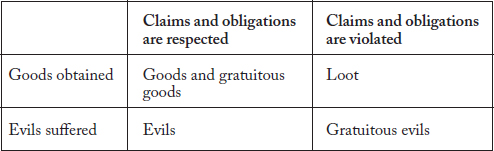
By contrast, the evils that we suffer while all claims and obligations are respected are evils, but not gratuitous evils (see Figure 1). This is most notably the case of things that are entirely subject to the laws of nature. Things that are in no way influenced by the deliberate choices of moral agents can be gratuitous goods, but they cannot be gratuitous evils. Nobody has a moral claim to enjoy fine weather. Therefore, fine weather is always a gratuitous good. But by the same token, bad weather is not a gratuitous evil. It is an evil, but not a gratuitous one.
_______________________________
Standard dictionaries (Merriam-Webster’s Collegiate Dictionary, The Oxford English Dictionary) explain the two meanings in juxtaposition to one another. They explain that the etymological roots of the word go back to the Latin adjectives gratuitus (done without pay, spontaneous, voluntary) and gratus (pleasing, agreeable), as well as to the Latin noun gratia (favor). See also Aquinas ([1259–65] 2009, bk. 3, chap. 150). According to etymonline.com, as of the 1650s, gratuitous was used in the sense of “freely bestowed” and the sense of “uncalled for, done without good reason” was first recorded in the 1690s.
In German, the opposite of gratuitous is entgeltlich. In French, it is onéreux. But in the English language, there does not seem to be any good antonym for the word gratuitous. Some dictionaries propose the word onerous—signifying something that is burdensome or arduous or trying—but this is not what we are looking for. After all, even a gratuitous good may very well be onerous. For example, Aunt Nancy may invite you to spend an evening with her at the theater. You do not want to see the play and would prefer to stay home, but you accept the invitation because you do not want to hurt her feelings. In this case, the play is gratuitous and burdensome for you at the same time. Now, Kinsella (2023, p. 221) mentions that section 1909–10 of the Louisiana Civil Code distinguishes between gratuitous and onerous contracts. This is indeed the difference that we have in mind, but this connotation of the word “onerous” seems to be a historical peculiarity of Louisiana law. Therefore, we will simply refer to non-gratuitous goods, which is not elegant but has the advantage of clarity.
Carl Menger ([1871] 1976, p. 52) defined goods as known and controllable (ownable) causes of the satisfaction of human needs. Economic goods have the additional characteristic of being scarce (see pp. 100ff.). In the present work, we will use Menger’s conception of economic goods, but define goods as causes of the satisfaction of human needs, even if these causes are not known or controllable.
Notice that this is a wider definition of norms than the standard legal one, which focuses on enforceable claims and obligations. Moral obligations most notably include legal obligations; and moral rights or entitlements include legal rights. See Reinach ([1913] 1984, pp. 12–13).
See Locke ([1689] 1993, p. 128); Rothbard ([1982] 1998, pp. 34 ff.); Hoppe ([1987] 2005, chap. 4; [1993] 2006); Kinsella (2023, pp. 224–28). For a doctrinal overview, see Brocker (1992, especially chap. 4). See also Reinach (1913); Hülsmann (2004); Massin (2016). According to Horvath (1929), quoted in Pieper ([1931] 2004), Aquinas also argued that property could be acquired only through labor.
A systematic exposition of the different types of norms and the distinction between them can be found in Hayek (1973, chaps. 5 and 6, as well as pp. 81ff. and 493ff.). See also Leoni (1962), van Dun (2013), and Benson ([1990] 2011, chap. 2). Norms need to be seen in the more general context of justice; see Pieper ([1972] 1992).
On the principle of self-ownership see Locke ([1689] 1993, p. 128); Wojtyla ([1960] 1981, pp. 24, 97); Rothbard ([1982] 1998, pp. 31–32).
The following two paragraphs have been adapted from Hülsmann (2021).
See Frank van Dun’s (2017) masterful study of the four archetypal causes of conflict and the corresponding archetypal solutions. The four causes of conflict are (1) the presence of more than one agent, (2) scarce economic goods, (3) disagreement over the use of economic goods, and (4) unrestricted access to economic goods. These causes of conflict are individually necessary and jointly sufficient. The corresponding archetypal solutions are to be found in social organizations (conflict 1), value-based communities (conflict 3), and private property (conflict 4). Only for the second cause of conflict (scarcity) is there no archetypal solution, apart from the wishful thinking that we find in social utopias.
The exact extent to which a material good is privately owned depends most notably on the limits of the appropriation of unowned nature through human action. See our discussion on pp. 51ff.
Aquinas made this statement while discussing the question of whether the word gift is a personal name of the Holy Spirit, which he affirms.
Adam Smith ([1759] 1853, chap. 3) famously stressed the central importance of the “usual and natural tranquillity” that comes with ownership. “Happiness consists in tranquillity and enjoyment.”
We are aware that other motivations have played a role in privatization as well. For example, land grabbing has a venerable tradition (see, for example, Sumner 1913, pp. 31–65; Higgs 2005) and thrives today, most notably under the umbrella of asset-forfeiture laws and the doctrine of eminent domain (overviews in Knepper, McDonald, Sanchez, and Pohl 2020; Kim, Lee, and Somin 2017). Our point is not to vindicate any and all forms of privatization, but to highlight the fact that privatization can be—and more often than not is—just and useful for all parties involved.
This is equally crucial to the moral assessment of private property (see Rhonheimer 2018, 2021). Pope Francis has recently emphasized the traditional Catholic principle of the preeminence of the “common destination of all goods” over the principle of private property (see his encyclical Tutti fratelli, 2020). As we have just seen, private property is the most important human institution to make all goods available to mankind. See the discussion in Naudet (2020, epilogue).
Or, in the words of Carl Menger ([1871] 1976, p. 97): “Property, therefore, like human economy, is not an arbitrary invention but rather the only practically possible solution of the problem that is, in the nature of things, imposed upon us by the disparity between the requirements for, and available quantities of, all economic goods.”
Animals, too, defend their territories. Ardrey (1967) therefore argues that private-property orders have evolved out of brute nature. However, the crucial aspect of private-property orders is not the will to control (which humans share with animals), but the acceptance of rules governing the acquisition of new property.
Acemoglu and Robinson (2019) have argued similarly, though largely on the basis of anecdotal considerations.
From a Christian perspective, all natural phenomena ultimately result from divine providence. Ultimately, it is God who makes oxygen, minerals, hurricanes, and good weather. Ultimately, it is He who keeps them in existence. Ultimately, therefore, all manifestations of gratuitousness are rooted in the actions of some person, be the person divine, angelic, or human. In our present study we are focusing on human actions.
For a detailed analysis, see Rothbard ([1982] 1998) and Hoppe (1993). Man also comes to control goods by violence, but he cannot acquire legitimate claims on goods by violence. The reason is that any attempt to justify violence (and claims based on violence) involves a self-contradiction. See pp. 42ff.
Marshall ([1890] 1920, p. 55) defines the free gifts of nature as follows: “Those goods are free, which are not appropriated and are afforded by Nature without requiring the effort of man. The land in its original state was a free gift of nature.” And he says that privately owned natural resources such as oyster beds are “still free gifts from the point of view of the nation” (p. 56).
This is one of the reasons why the idea of an “allocation of time” à la Gary Becker (1965) is problematic.
Josef Pieper (1998, p. 32; 1992, pp. 25–26) highlights that all human understanding relies on two distinct powers, the active ratio and the receptive intellectus. The latter enables human beings to learn gratuitously. In Pieper’s words: “The medievals distinguished between the intellect as ratio and the intellect as intellectus. Ratio is the power of discursive thought, of searching and researching, abstracting, refining, and concluding [cf. Latin dis-currere, to run to and fro], whereas intellectus refers to the ability of “simply looking” (simplex intuitus), to which the truth presents itself as a landscape presents itself to the eye. The spiritual knowing power of the human mind, as the ancients understood it, is really two things in one: ratio and intellectus, all knowing involves both. The path of discursive reasoning is accompanied and penetrated by the intellectus’ untiring vision, which is not active but passive, or better, receptive—a receptively operating power of the intellect.”
The distinction between leisure and labor is a fundamental distinction in economic analysis (see Mises [1949] 1998; Rothbard [1962] 1993). It is not an empirical distinction, though the ratio of leisure to labor is contingent. See the more detailed discussion on pp. 148ff.
The concept of spontaneous gratuitousness mirrors the concept of a spontaneous social order (Hayek 1973, p. 2). According to Hayek, the distinction between spontaneous orders (cosmos) and deliberately designed social orders, or organizations (taxis), is fundamental in modern social philosophy (chap. 2). It goes back to the sixteenth-century Salamanca school and was more fully developed in the eighteenth and nineteenth centuries by Mandeville, Hume, Smith, Ferguson, Burke, Savigny, Wilhelm von Humboldt, and Carl Menger (p. 22).

