
Abundance, Generosity, and the State
5. The Economics of Donations
5
THE ECONOMICS OF DONATIONS
Donations have causes and consequences that spring from their purpose. But they also have causes and effects that spring from the fact that they are human actions. Leisure activities and gifts exist because there are people who effectively choose to donate their time and material resources. These choices, their causes and consequences, are the subject of the present chapter.
We will start off discussing to what extent donations are different from all other choices. Thereafter we will study how donations relate to market activities—how they compete, but also nurture and complement each other.
At the same time, however, we will pursue a second objective. Real-world economies are not free-market economies. They are not the product of unhampered buying, selling, and donating. They are also influenced by the legal, regulatory, and administrative interventions of the state, and increasingly so. What is the impact of these interventions? As we shall see, this question is central for the economics of gratuitous goods.
To provide an answer, we need to apply the traditional method of political economy. It involves two steps.
It is first necessary to consider donations and markets in a hypothetical setting in which all social relations are based on the full respect for private-property rights. This is what we shall do in part two, which deals with gratuitous goods in a free society; that is, in a hypothetical society unhampered by violations of property rights. Then, we can bring into play those human actions that are based on violations of private-property rights or on threats of such violence. This is what we will do in part three.
This two-step procedure is inconvenient and fraught with various dangers. It forces us to think and talk about a hypothetical free economy and a hypothetical free market that do not have much to do with the real world. In our world, as in all human worlds that have ever existed, property rights are imperfectly defined and protected. Alas, for the human mind, the only way to understand the workings of our world is to follow the method that we just outlined. The only way to understand how gratuitous goods are influenced by violations of property rights is to compare a hypothetical world without such violations to a world in which they are present.
DONATING AS A CATEGORY OF HUMAN ACTION
Modern economics is a theory of action, rather than a theory of goods. Its basic categories are not the qualities, quantities, and prices of commodities, but categories of action, such as choice; subjective value; time; means and ends; and errors and successes. Ludwig von Mises therefore called the general theory of action praxeology—the logic of action. He reserved the name of economics for the particular branch of praxeology that deals with human action based on economic calculation.
Donating is a general category of human action. It has particular causes and consequences that set it apart from other types of action. The most straightforward way to appreciate these particularities is by focusing on the way donations are evaluated.
To evaluate an economic good means to compare it in various ways to other economic goods. Three types of comparison hold center stage in economic analysis: (1) the comparison between a good and the ends that it serves; (2) the comparison of some units of the good with other units of the same type of good; and (3) the comparison of the good with other goods that serve other ends. All three types usually come into play at the same time. We will look at the details in the next section. Here we need to elaborate on the salient issue which we pointed out in chapter 2.
Donations stand out from all other forms of human action, both within and outside of market economies, in that they deliberately neglect the first type of comparison. A donation is evaluated according to comparisons (2) and (3), which is why donations are subject to economic law and we are able to perform an economic analysis of them. But donations are not evaluated according to comparison (1). They are not compared to their ends. More precisely, they are not proportioned to their ends.
This does not mean that donations have no ends. All economic goods have purposes. All human actions pursue objectives. Neither does it mean that the donor ignores the causal relationship between the donation and its ends. Of course he knows why he makes this donation rather than another one or rather than none at all. Of course his choice is motivated by the purpose of the donation. What we mean is that donations do not serve the donor. They are not useful to him in the sense of being intended to convey to him any advantages or profit.
The reason is that donations involve sacrifice. Where there is no sacrifice, the means are proportioned to the end. They are from the outset chosen in such a way that they have a lower value than their end. In this sense, they are chosen to be subservient to the decision-maker. The acting person seeks to create a (subjective) profit by deploying means that for him have a lower (subjective) value than the (subjective) value of the anticipated end result of his action. Likewise, in a market economy, an entrepreneur hires factors of production to fabricate products that he will sell to his customers. The factors of production are supposed to serve him. He will consent to hire them only at such prices that will allow for a monetary profit (see Hülsmann 2002).
The same thing holds true for all activities which are pursued for pleasure, such as play, sport, dance, sex, and gastronomy. That they are pursued for pleasure, after all, means that they are not pursued out of genuine devotion, for their own sakes. There is a difference between painting for the market, painting for pleasure, and painting out of devotion. Only in the last case does the category of sacrifice come into play. Only in this case are the means not proportioned to the end. There is no weighing of the hours committed, the pains taken, and the money spent against the painting. By contrast, if the purpose is to serve the market, then the hours, the pains taken, and the monetary outlays are brought into a reasonable—profitable— relationship with the monetary result. Otherwise, the painter would not even get going. And even if the painter’s aim is only personal pleasure, he will take care to bring the means into a reasonable relationship with the pleasure that he hopes for.
Where there is sacrifice, the means do not serve the donating person. Where there are genuine donations, made out of genuine devotion, the value proportion between the means and the end does not count. We already pointed out in chapter 2 that the very question of a proportion between means and ends quite often makes no sense at all. An artist devoted to beauty will not assess the value of the means in relation to the result. He could not do this, even if he tried. How can beauty be measured? How can finite means ever be in a reasonable relationship with an infinite end?
For these reasons, acts of donation stand out from all other actions. As we shall see, they also stand out with respect to the consequences that they entail for the market economy and for civilization more generally. Civilization crucially depends on the ability and willingness of at least some of its members to make genuine sacrifices, at least some of the time. Fortunately, there have always been men and women who are ready to make them. But this disposition is not written in stone. It depends on a variety of factors that we will discuss in the remainder of the book.
Donations stand out from all other actions. They also do not fit into any of the three conventional classes of economic activity: production, consumption, and exchange. If this scheme covered all economic activity, then donations would have to be classified as acts of consumption, as acts of production, or as acts of exchange. Let us therefore see how donations fit into this classification scheme.
By definition, donating cannot be classified as an exchange. We have discussed this in some detail and do not need to dwell on this point. It makes much more sense to classify donations as acts of consumption, especially if donations are interpreted in light of the Misesian theory of autistic exchange or in light of the Beckerian concept of social income.
Nevertheless, as we have seen, this classification is problematic in that the donor appears to necessarily be one of the donation’s ultimate beneficiaries because donation becomes a consumers’ good for him. But this would directly contradict what we have found to be the distinguishing characteristic of a donation; namely, that the intended beneficiary of a genuine donation is always something else or someone else. A genuine donation necessarily transcends the donor. It is intended to transcend his own planning, his own needs, his own desires, his own satisfaction.
Moreover, whenever donations are made in the form of gifts, the donation involves two persons and therefore two points of view. Interpreting a gift as a consumers’ good for the donor is plausible from a Misesian or Beckerian perspective. But what about the donee? The donee might take great pleasure in receiving an expression of friendship in the form of a gift. He might eventually consume the gift or transfer it to his family members. But he may also use it in his business. The act of receiving is therefore not necessarily an act of consumption for the donee.
If donations are not forms of exchange nor of consumption it would appear that they have to be classified as acts of production. And indeed, this makes much sense if we recall that donations involve saving, the renunciation of current consumption. Classifying donations as production also makes sense in that donations are means for the attainment of (transcendent) ends that are different from the means—in distinct contrast to acts of consumption such as dance and play, which usually are ends in themselves.
However, as we have seen, there is a categorical difference between donations and ordinary acts of production. The latter always seek to make sure that the value of the means is less than the value of the ends, whereas in the case of donations there is no such calculus, which at any rate would be absurd. It therefore appears to be necessary to regard donations as a distinct economic category of its own.
THE SUBJECTIVE VALUE OF DONATIONS
Donations are made and received because they are valuable. In economic analysis, the word “value” has two meanings. It can refer to the personal or subjective significance of an economic good, and it may refer to its market price. In the case of donations, there can be no market prices by definition; we shall therefore be preoccupied with the first meaning only.
Subjective value is the relative importance of an economic good for an acting person who has to decide whether he wishes to own or enjoy more or less of that good, rather than other goods that he could own or enjoy alternatively, including his own time. Such decisions are obviously made in light of the advantages and inconveniences of the good compared to the pros and cons of other goods that could be chosen instead.
Economists stress that all decisions are personal or subjective because they are not completely determined by the pros and cons of the alternative choices. All decisions are made in light of the pros and cons of the alternatives, but not only because of them. If two persons are confronted with exactly the same alternatives, each of them might choose differently. If the same person is confronted with the same alternatives at different moments in his life, he might make a different choice each time. There is always a singular personal element that is effective in choosing, an element that cannot be reduced to the material or objective context in which the choice takes place. This element is called subjective value.
Subjective value is the foundation of the economic analysis of human action and of the market economy in particular. The expression refers to the element of personal freedom, even arbitrariness, that is inherent in human choice. But this freedom is subject to economic laws. Most notably, we may distinguish four universal laws of subjective value: (1) the first law of value, according to which larger quantities of homogeneous goods have a higher subjective value than smaller quantities of the same good; (2) the law of diminishing marginal value, according to which each unit in a stock of homogeneous goods has a lower subjective value than each unit of the same good in a smaller stock—in other words, the marginal value sinks as the stock grows; (3) the means-ends law of subjective value, according to which means have a lower value than the ends they serve; and (4) the law of equilibrium, or law of diversification, according to which agents seek to own the (subjectively) right balance of all the different goods that they own.
The laws (1), (2), and (4) are universal laws of human action. They hold true for all economic goods, irrespective of the social and political context and irrespective of the concrete uses of these goods.They also hold true when such goods are donated rather than exchanged.
According to the law of diminishing marginal value, if the stock of a homogeneous good increases, then the value of each unit of the (now) larger stock is lower than the value of each unit of the (previously) smaller stock. The reason is that the additional units allow us to do more things. But these things are necessarily less important to us than the things that we would have done had we only had the help of the units of the smaller stock.
If I have ten hens and hand over two as a gift to my neighbor, then to me, the value of each of the remaining eight is now higher than the value of each of the ten that I had before. The inverse holds true for my neighbor, the beneficiary of my largess. To him, each hen now has a lower relative value than it would have had if he had not received my gift.
Our hypothetical gift has direct implications for all other activities, most notably the market activities of donors and beneficiaries. The fewer hens I have, the higher the price that I would ask in exchange for any of them tends to be and the more time or money I’ll need to spend on other food. The inverse holds true for my neighbor. He will not be ready to pay quite the same price for additional hens that he would have paid otherwise. And because he now has more hens, he’ll need to spend less time or money on food, or at least on hens, and accordingly can devote more of his resources to other things.
It follows that the first two laws of subjective value do apply in the case of donations. As long as money has any value at all, a larger sum of money will always be more valuable to the donor than a smaller sum; and to a donee, the larger sum will also be more valuable than the smaller sum, though not necessarily to the same extent as for the donor.
As we have seen, things are different with respect to the third law. Donations are not proportioned to their ends. It is this fact that separates them from all other types of human action. Instead, donations are brought into a reasonable proportion with all the other objectives that could also be pursued with the help of the means that will be sacrificed in the donation (law of equilibrium). Virtually all economic goods that are gratuitously committed to a transcending cause could be employed in other ways. The time committed to contemplation, study, artistic creation, and religious worship could also be devoted to commercial activity, hiking trips, or lazy idleness. Acts of devotion therefore compete with all the mundane activities that would necessitate the same resources. God does not compete with human beings nor with their profane undertakings. But on human timetables, worshipping God does compete with lunches, labor, visits to the movie theater, and sports. Donations are therefore not removed from economic law.
DONATIONS AND THE MARKET ECONOMY
Very often, donations and market exchanges feed directly into each other. Donors purchase gifts and donees use money gifts to make purchases. In order to be able to make a gift, one needs some wealth; and in order to acquire wealth, one typically needs first to provide goods and services to clients. Donations therefore tend to grow along with the market economy. When real incomes and real wealth increase, market participants are able to make larger and more frequent donations.
We see here that markets and donations are prima facie positively related. As we go on, it will become increasingly clear that this is an organic relationship. It springs from the nature of markets and of donations, which play complementary roles within the human economy, nurturing each another, thriving and perishing together. Donations cannot be replaced when it comes to things that need to be done for their own sakes. Market exchanges cannot be replaced as a framework for evaluating means and ends, for bringing them into a reasonable proportion under changing conditions of time and place.
This is why it makes no sense to conceive of donations and market exchanges as alternative options for human cooperation. Neither could possibly substitute for the other and serve as the model for all economic relations. We will not dwell much on this topic, since it is obvious that infants, the destitute and frail elderly, and the severely handicapped, to name just a few cases, could not provide for themselves via market exchanges. It is a little less obvious that donations are no possible substitute for the market economy. We will leave this issue aside for the moment and return to it later.
Antagonisms between market exchanges and donations may occur here and there, but they do not spring from the nature of donations, nor from the nature of markets. They may either result from short-run conflicts pertaining to the allocation of resources (Should this or that sum of money be invested or given to the poor?); or they may result from government interventions, which alter the relationship between market exchanges and donations and create conflicts that would not spontaneously occur.
Donations and market exchanges therefore tend to reinforce each other at all times and places. But which are the concrete mechanisms that come into play? In what follows, we shall see how the pricing processes of the market economy coordinate donations and for-profit activities.
Donations in a Growing Market Economy: A Baseline Scenario
In a growing economy, material goods become more and more abundant. The overall level of production increases, and the overall level of real incomes increases as well. On the side of the donees, this reduces the need for material gifts, though not for relational gifts. On the side of the donors, economic growth increases the ability to make both material and relational gifts.
Furthermore, economic growth does not only affect the amount of donations, but also their composition. It tends to make purely material gifts increasingly superfluous, while stimulating donations of time, and relational gifts in particular. For prospective donors, there would be ever less need, and ever fewer incentives, to spend their time on the production of material goods, while prospective donees would have fewer material needs, though an undiminished need for relational gifts.
Moreover, and most importantly, economic growth does not only enhance the ability of market participants to make donations, but also their motivation to do so. Let us see how this works.
The increase of real incomes tends to entail an increase of real savings (though not necessarily an increase of the savings rate). Some of these savings will be held in cash (hoarded), but another part will be invested in firms, real estate, and financial markets. Economists call this greater investment an increase in the supply of monetary capital. Its natural consequence is that the return on capital (ROC) tends to fall. Indeed, what does it mean to invest more money in a firm? It means that this firm hires more factors of production and eventually sells more products to its customers. But the increased demand for factors is likely to increase their prices, and the increased supply of products is likely to reduce their prices. The profit margin of our firm therefore tends to fall (see the full discussion in Roth-bard [1962] 1993, pp. 398–407). And the same result obtains when greater savings are available for investments in real estate and financial assets. In all cases, the increase in savings tends to bring about a diminished ROC.
This decline in the ROC means that the use of wealth as capital (that is, with the intention to obtain future revenue through investments) becomes ever less rewarding. As a corollary, the opportunity costs of donations fall. More donations will therefore be made. But this does not mean that donations will increase in a linear or proportional manner (as could be expected if economic growth entailed a rise in incomes but no change in the ROC). Rather, growth has a disproportionate impact on donations. When real incomes increase, donations tend to increase as a percentage of income. And inversely, when real incomes shrink, donations tend to drop as a percentage of income.
In other words, in a free-market setting, the nonprofit sector tends to grow (and shrink) faster than the for-profit sector. Increased capital accumulation tends to diminish the ROC. This discourages for-profit uses of savings and makes more income and savings available for donations. In the case of a shrinking market economy, gifts and other donations shrink even more than for-profit activities. Reduced savings are likely to diminish the supply of capital. The price of capital, and with it the opportunity costs of donations, therefore increase. Fewer donations are made.
The mechanism that we see here at work is well known and has been described in other contexts. Murray Rothbard ([1962] 1993, pp. 184–85) highlighted it in a comparison between the values of exchangeable and of nonexchangeable goods:
Suppose that a man owns a piece of land containing an historic monument, which he prizes on aesthetic grounds. Suppose also that he has an offer for sale of the property for a certain sum of money, knowing that the purchaser intends to destroy the monument and use it for other purposes. But it is evident that a greater abundance of consumers’ goods already at his disposal will tend to raise the value of the (unexchangeable) aesthetic good to him as compared with the given sum of money A destitute person is far less likely to prefer the nonexchangeable to the exchangeable than one whose “standard of living” in terms of the latter is high.
Capital accumulation brings about a state of affairs in which ever more resources remain outside of the market, to be held in reserve.Although this state of affairs might seem to be regrettable from a narrow economic point of view, and to call for some sort of remedy, these reserves of material things and of time actually play a fundamental role in human life. As we have seen, they are the material foundation of donations. Without any surplus stocks held in reserve, it is impossible to make donations of any kind. Without any time withheld from commercial activity, it is impossible to cultivate friendship, tend to the sick and lonely, or pursue a scientific or artistic endeavor.
Countervailing Forces
We have just studied a baseline scenario that shows how economic growth tends to have a disproportionate impact on the level of donations, as well as on the kinds of donations that are made.
Are there any countervailing forces that may supersede this basic relationship? We have seen that the positive impact of economic growth on the level of donations may result from two factors, either separately or in combination: increased incomes and the reduction of the ROC. Let us therefore look at them more closely.
The increase of real incomes is a characteristic feature of all economic growth. The two are synonymous. Economic growth means that real incomes increase overall. Donations therefore tend to increase whenever and wherever there is economic growth. But notice that this holds true only at the aggregate level. If only a few incomes increase, while most other incomes stagnate or diminish, there might still be economic growth in the aggregate; this would tend to have a positive impact on the level of donations, even though in practice it would affect only a happy few.
How about the ROC? We have seen that it tends to diminish in a growing economy and that donations then tend to grow faster than for-profit activities. But this drop in the ROC is not inevitable under economic growth. The reason is that economic growth may be propelled by factors that have a countervailing impact on the ROC.
Economic growth generally results from three causes; namely, increased monetary savings, increased material and human resources, and improvements in the way the available resources are used (most notably under the impact of inventions, discoveries, entrepreneurship, and engineering). In all three cases, economic growth will tend to stimulate savings, as in our baseline scenario, and therefore entail a tendency for the ROC to fall. But only the first cause of economic growth (increased monetary savings) reinforces this tendency, while the other two causes exercise an opposite effect. If more resources become available (for example, due to migrations or to the discovery of minerals that can be accessed at low costs), then factor prices will tend to fall. As a consequence, firms will likely become more profitable. Their ROC will increase. Organizational or technological improvements would have the same effect. If savings increase and more resources became available, there would be two opposite forces at work, one that would lead to a drop in the ROC and one that would entail its increase. Sometimes the former would be stronger than the latter, and sometimes it would be the other way around.
We therefore have to nuance the basic finding from our baseline scenario. We now understand that to the extent that economic growth is driven by savings, donations tend to grow (and shrink) faster than the for-profit sector. When larger savings entail greater capital accumulation, the opportunity costs of donations drop. For-profit uses of savings are then discouraged. A higher percentage of wealth becomes available for donations. By contrast, to the extent that economic growth is driven by an increased availability of resources, or by improvements in the way the available resources are used, there is no systematic impact on the percentage of wealth that will be allocated to donations. The latter rise and fall with wealth, but their relative share in wealth does not systematically increase nor decrease.
There is a further consideration that should come into play when dealing with the impact of the ROC. Above we argued that a reduction of the ROC is tantamount to a reduction of the opportunity costs of donations. Yet again, this is true only in the absence of countervailing forces. It is true if the drop in the ROC results from an increase in savings. It may not be true if the ROC drops for other reasons. Two cases merit our attention.
In the first one, the ROC falls because of a drop in the demand for capital. This may most notably be the case in an economic slowdown or slump, or when ill-advised policies paralyze the country. In all such cases, the drop in the ROC would reduce the opportunity costs of donations, but this would be offset, totally or in part, by the simultaneous drop in incomes. Reduced incomes are tantamount to lower material donations, and they would also entail the necessity of working longer hours, thereby increasing the opportunity costs of time donations. Hence, there would again be two opposing tendencies at work. Sometimes the drop of the ROC would overcompensate for the drop in incomes, and sometimes it would be the other way around. But, this case may not be very relevant for our present concerns. After all, we wish to understand how donations fare under the impact of economic growth, not under the impact of slowdown or paralysis. Let us therefore turn to the second case.
In the second case, the ROC falls under the impact of financial leverage. Consider the following numerical example.
An entrepreneur pursues a line of business from which he has come to expect a 10 percent annual return on his capital of $1 million. That is, he expects to make an annual net revenue of $100,000. But thanks to an inexpensive bank loan, he is able to increase the volume of his operations tenfold. He no longer invests $1 million but $10 million. It is true that his ROC is likely to drop. After all, he will henceforth wish to sell a greater volume of products, and this can only be done at lower unit prices. He will also need to hire more factors of production, and this is likely to increase their prices and diminish his bottom line. Let us therefore assume that his ROC diminishes from 10 to 5 percent. And let us also assume that he needs to pay 3 percent annually on the $9 million in credit that he received from the banks. If his business runs as planned, then he will earn an annual net revenue of $230,000. This sum is equal to the difference between $500,000 (corresponding to a 5 percent return on capital of $10 million) and the $270,000 which he needs to service his debt (3 percent of $9 million).
Now, notice that the return on his own capital, his equity capital, has increased from 10 percent to 23 percent. Even though the ROC has dropped, the total amount of money that our entrepreneur can earn by staying fully invested in his business has increased and he has multiplied the return on his equity capital. From his point of view, therefore, the opportunity costs of donations have not diminished but grown. He is therefore likely to reduce his donations—maybe not the absolute amount of time and money that he donates, but the percentage of his time and money dedicated to donations.
What we see here is of utmost importance to the economics of donations. We see that financial leverage has the power to invert the baseline relationship between savings-driven growth and donations.
What, then, are the causes of financial leverage? We have discussed this question in some detail in another book (Hülsmann 2013, chap. 8). In what follows, we will therefore highlight only the two most important factors: the price-deflationary tendencies of economic growth and the monetary policy of central banks.
Price Deflation and Monetary Policy
As the economy grows, more and more economic goods become available. But this does not mean that there will be more units of each type of good. To be sure, some goods will be produced in greater quantity. But more often than not, economic growth goes hand in hand with increased diversification. It is not necessary to produce more haircuts and more bread because the demand for such goods is quickly saturated. If more savings become available to fund additional investment projects, these funds therefore tend to be used to produce different goods. These could turn out to be better haircuts and better bread, but often they are completely new types of goods.
Now, money is one of those goods that will tend to be improved in quality rather than quantity. The reason is that money serves, among other things, as a store of wealth. All market participants therefore prefer to use monies that preserve their purchasing power as well as possible. Ideally, they would like to use a type of money with an increasing purchasing power (see Salin 1990, chap. 2, sec. 2, and chap. 6, sec. 1). The purchasing power of each money unit (PPM) most notably increases when the money stock does not increase as fast as the stock of goods it can buy. It then becomes scarcer in comparison to these other goods. Its market price—its PPM—tends to increase.
Suppose the economy grows at an annual rate of 3 percent. All goods are traded both against paper notes and against silver coins. The paper notes are issued by a bank. The silver coins are produced by a mining company. Furthermore, suppose that these are two distinct types of money. The notes are not used as promises to pay silver, and the coins are not used as promises to pay banknotes. Each year, the bank increases the quantity of notes in circulation by 10 percent, whereas the annual production of silver corresponds to 2 percent of the existing stock. The banknotes would therefore tend to become ever more abundant relative to other goods (silver and all nonmonetary goods), whereas silver would become ever scarcer relative to other goods. Accordingly, the market participants would have a material incentive to use silver rather than banknotes.
In a free-market economy, the choices of the market participants would not be impeded by government interventions. A free market in money would therefore lead to the selection of the scarcest types of money. This implies that in a growing free-market economy, money would tend to be produced less than all other goods. Nonmonetary goods would become increasingly abundant in comparison to money; and money would become increasingly scarce in comparison to nonmonetary goods. The PPM would increase and the general level of all money prices would fall. Each year, bananas, cars, and rentals would cost a little less money than in the previous year. In other words, economic growth under free markets would tend to be price-deflationary growth.
Price deflation has two momentous consequences for gratuitous goods. The first one is that price deflation encourages the hoarding of money, which increases the real cash balances of all market participants. We will discuss this in more detail in chapter 6.
The second one is that price deflation discourages financial leveraging. This is easy to understand in the case of households. Under price-deflationary growth, household monetary incomes are likely to stagnate, and they may even decrease, whereas their real incomes will tend to rise. But loans are money loans. They therefore have to be repaid in money, and this is typically not a good deal under price deflation. Suppose Jim obtains a $1,000 loan now and has to pay it back in two years, when the price level will be 10 percent lower than now. In two years, he will be making a payment that has a 10 percent higher purchasing power than the sum he initially received. Moreover, his own money income may have fallen, in which case the burden of paying $1,000 would be higher than it is now. The case of firms is a bit more complicated and will be discussed in chapter 9. But the general tendency is the same: price-deflation discourages financial leveraging.
From these considerations it follows that we may reassert our initial conclusions. In an unimpeded market economy, in which economic growth is driven by savings, donations tend to grow (and shrink) faster than the for-profit sector. In other words, when the price-deflationary tendencies of the market are not offset or overcompensated for by monetary policy, the use of wealth as capital becomes ever less rewarding. As a consequence, the opportunity costs of donations tend to diminish. More donations will therefore be made not only in absolute terms, but also as a relative share of income and wealth.
In part three, we will discuss in more detail how central bank policies affect gratuitous goods. Under inflationary monetary policies, donations may stagnate or shrink even when incomes are rising. The reason is that monetary interventions create various incentives to devote all available resources to for-profit activities at the expense of nonprofit activities, including charity. Therefore, the tendency for donations to grow (and shrink) faster than the for-profit sector does not hold in the presence of monetary interventions designed to inflate the money supply.
Bequests and Inheritance
So far, we have examined the qualitative relationship between economic development and the level of donations, as well as the different forms of donations. It would be tempting to follow up with a quantitative assessment, but we need to postpone this until we have a better grasp of all relevant causal factors. At this stage of our analysis, we shall make one exception, which concerns the quantitatively most important form of giving; namely, the bequest of wealth to one’s heirs.
Although monetary gifts are often made in small installments on a pay-as-you-go basis, large donations are usually made as lump sums at the end of a person’s life. These sums are saved over a lifetime. Typically, such savings do not lie dormant in a bank account but are invested. This implies that donations motivate much of the capital accumulation on which a developed market economy must rely.
Following Boulding (1973, pp. 32–33), we can illustrate the quantitative dimension of financial inheritance with a back-of-the-envelope calculation based on 2019 figures for the US. At the end of that year, US GDP stood at $20.984 trillion; the aggregate net wealth of US households and nonprofits was $118.577 trillion, and the average life expectancy was about seventy-nine years. If these figures were constant, and if wealth were equally distributed across all age groups, then one-seventy-ninth of the aggregate net wealth, or $1.501 trillion, corresponding to 7.18 percent of GDP, would be bequeathed each year. In other words, 7.18 percent of aggregate revenue in any given year would result from inheritance.
Now, wealth is not equally distributed across all age groups. The oldest households, which are especially relevant for our question, typically have higher-than-average savings. In the year 2019, the net worth of the oldest US households was some 1.31 times higher than the average. Accordingly, total inheritances would be equal to some 9.41 percent of GDP, rather than to the 7.18 percent given above.In the case of Germany, the same sort of calculation based on 2020 figures implies that a value corresponding to 5.16 percent of GDP is bequeathed every year. In the case of France, this figure would be 8.15 percent of GDP, based on 2018 figures.
This rough assessment gives us an approximate idea of the enormous significance of inheritance. From a quantitative point of view, it is certainly the most important form of material gift in modern society. It therefore cannot fail to have the most profound impact on the for-profit activities in the economy. However, moving beyond Boulding, we should underline that inheritance also has a qualitative dimension that is at least as important as its quantitative one. This concerns especially the transmission of capital. Inheritance has very different economic and social consequences depending on who the heirs are, in particular how they relate to the deceased and how they relate to his capital. Let us point out in some more detail how these two factors determine the supply of capital and its productivity.
The productivity of human action crucially depends on the capital employed. The more capital is available, the more time is available to prepare final production, and the greater is therefore the abundance of final products in terms of quantity and quality. This is called the law of roundabout production.
Now, death puts a natural limit to self-centered time horizons. If it were not possible to transfer capital from the deceased to living persons who are able to run the business in which the capital is currently employed, the business could not survive the death of its founder. Inheritances make some continuity possible. The current owner, who loves and knows his business, is likely to leave it to people who love and know it, too. Indeed, the possibility of leaving it to such people is one of the strongest motivations to develop a business and keep it going.
Very much the same thing can probably be said about other forms of material inheritance, including land, residential real estate, and durable consumers’ goods. In each case, one may ask why the deceased did not consume all of his wealth before death. And in each case, part of the answer will be that he was saving it for his loved ones among the living. In other words, one of the most powerful motivations for building and preserving material wealth is to become and remain able to make gifts.Few decisions to make substantial gifts are made at a moment’s notice, as when we encounter a beggar at a street corner and give him change. Large gifts are planned in advance, often far in advance. Many a man has worked hard for a lifetime in order to be able to give substantial material gifts on his passing.
The level of wealth and capital existing at any point in time does not simply drop out of the blue sky. Nor does it simply result from the productivity of the real economy, which would then appear the ultimate cause of wealth, rendering the distribution of wealth through exchange and gifts a peripheral issue, unconnected to the production of wealth. It is precisely the other way around. The rules that govern the distribution of wealth inform and motivate the persons who produce wealth. The overall amount of wealth therefore depends on the legal framework and on the implied distribution mechanism.It depends on the will and the ability of acting men to build up and preserve wealth and capital for other people.
Wealth, the production of wealth, and its various uses are not unconnected spheres of human life. They are part and parcel of one decision-making process.The supply of capital in a market economy crucially depends on the motivation of current asset owners to bequeath their wealth to people (or causes) they love. It depends on what Schumpeter ([1942] 2003, p. 160) once called “the family motive”—the desire to work and save for spouse and children.
It follows that anything that impairs this motivation, or which prejudices the ability of the current owners to donate their assets to those who in their eyes should eventually own them, is likely to reduce the supply of capital. A free and unimpeded gift economy therefore makes for an abundant capital supply, whereas the taxation and regulation of gifts—especially of inheritances—slows down capital accumulation. And as we have seen above, this is likely to entail a negative feedback loop. Lower capital accumulation means lower growth rates, and higher returns on capital. As a consequence, the ability and willingness to make donations is curtailed.
Virtues
So far, we have discussed the beneficial impact of economic growth on the ability and readiness of people to make donations. We have also seen that the desire to make donations is a powerful motivation for capital accumulation and capital preservation. And we have argued that donations are complementary to markets in that they provide goods that cannot be purchased, either out of poverty or because of their relational nature.
Now we need to consider an even more fundamental complementarity between donations and markets. Indeed, the most fundamental goods on which an extended market economy is built cannot themselves be produced through for-profit activities. We are talking here about basic attitudes and personal values, such as the will to do good and to be good; the love of truth for its own sake; the respect for and love of others for their own sake; the trust in others; the readiness to make personal sacrifices for others without expecting a return; the love of justice; and courage in the face of adversity, to name just the most important ones.
Such goods are known as virtues. They can be produced through processes commonly known as education and socialization. But they need to be produced for their own sake or for the sake of a supreme moral objective, most notably pleasing God.In any case, they cannot serve as means to attain some other end, like monetary revenue or the power of the state. Indeed, if the love of truth depended on the revenue associated with being truthful or on state approval then it would not be a love of truth, but of money or of the state. This sort of truth loving might be good enough as a foundation for occasional spot exchanges of limited value, but it cannot provide the foundation for human cooperation within production processes that involve thousands of people who barely know each other and that span many years and generations. It could not create the trust needed for this level of cooperation.
Virtues involve sacrifice. The virtuous person must be ready to forego, without compensation, any advantages that are in opposition to the virtue. There are no material incentives to behave virtuously. There can be no such incentives. Virtuous behavior therefore cannot be “produced” by the motivations and mechanisms that drive the market. Such behavior must come as a donation. It must be cherished for its own sake or for the sake of God. The sacrifice involved in virtuous behavior must be accepted and, ideally, loved. And the only way to educate others to come to this love is by example; that is, by sacrifice. This is the most noble mission of parents and other educators.
Without virtue, the market economy is condemned to be crippled. To be sure, the same thing holds true for all other human institutions and most notably for the state. This fact brings to mind the memorable words of Ernst-Wolfgang Böckenförde (1976, p. 60): “The liberal and secular state lives on premises that it cannot itself control.”Indeed, the modern state grew out of a culture that revolved around sacrifice. Without this foundation, the state, too, is condemned to wither away. No thriving human association is possible unless some of its members, at least some of them, are willing to make the necessary sacrifices.
In short, the foundation of human flourishing is not to be found in the powers of coercion, nor in greed or fear. The true foundation is the willingness to make sacrifices. Neither sticks nor carrots, neither pleasure nor pain, can replace them.
And the preeminent form of sacrifice is religious ceremony— the festive dedication of time and material resources to publicly honor God and give Him thanks. For this sacrifice is removed from the concerns of the ordinary business day. It cannot be a tit for tat. It cannot be a hidden price or a bribe. Against a background free of such ambiguities, the true character of the sacrifice appears in stark relief. Josef Pieper therefore called the ritual of public sacrifice “the primary source of man’s freedom, independence and immunity within society. Suppress that last sphere of freedom, and freedom itself, and all our liberties, will in the end vanish into thin air” (Pieper [1948] 1998, pp. 17–18).
We now see more clearly than before the practical difference between donations and grants. The development of market exchanges, and the building of long and intricate supply chains, requires the availability of goods that need to be appreciated for their own sake, and not as means for the attainment of other ends. At some point, there must be people who provide such goods for their own sake. They must stand ready to provide them even if they do not thereby obtain any personal benefit. At a most fundamental level, the development of the market economy requires devotion and sacrifice. Grants will not do.
This salient difference between donations and grants also shows up in the fact that there is no market for donations. To be more precise, as a matter of logical necessity, there cannot be a market for donations. A “donation” that could be obtained via exchange would in fact not be a donation at all, but a price or a return on investment. And for the same reason, there cannot be a market for acts of devotion or for the virtues that result from them.
Things are different in regard to grants. Kenneth Boulding has pointed out that competitive grant making is possible, resembling competition in for-profit activities:
There is something like a “market” in grants. Where there are a large number of grantors facing a large number of potential recipients, at least an analog of the competitive market in the exchange sector begins to appear. Something like this market exists, at least in the more developed countries, in the field of research. Research is widely recognized as a highly suitable activity for grant support. Scientific knowledge is a public good in that once the discovery has been made, it is available to anyone who can understand it. That does not apply, of course, to trade secrets, classified research, and patented processes. (Boulding 1973, p. 24)
Again, this holds true for grants, but not for donations. If a donor were to “compete” with other donors, the objective of his action would change and his gifts could no longer be considered pure donations. A new objective comes into play that vitiates the gratuitous nature of his actions. He now wishes—at least also wishes—to obtain an advantage over other competitors. He wishes to gain the honor of funding this or that research project (and thus not only the honor but a reputation that will prove useful to attract further funding). That is, he does not seek to do good without expecting anything in return. He may still wish to do good, but he also expects a benefit for himself. The products of scientific research might be “public” in the sense that nobody owns them exclusively. But the product for those who fund scientific research may very well include monetary revenue for themselves. This seems to be the case, most notably, as Boulding rightly observed, with respect to the large foundations which are involved in such funding activities.
DONATIONS AND ECONOMIC ORGANIZATION
There is today an entire industry of charitable organizations, or philanthropic organizations, as they are sometimes called. By employee head count, these entities surpass even the largest for-profit companies.
Germany is a case in point. The country features six large private welfare organizations: Caritas (Catholic Church), Diakonie (Lutheran Church), the German Red Cross, Arbeiterwohlfahrt (labor unions), Paritätischer Gesamtverband (an association of corporations and labor unions), and Zentralwohlfahrtsstelle ( Jewish run). All of these organizations are co-funded by private donations and massive subsidies from the federal, regional, and local governments. The governments typically commission these organizations to implement various public welfare programs. The two largest private welfare organizations, of approximately equal size, are Caritas and Diakonie. Together they have employed approximately 1.2 million persons, along with hundreds of thousands of volunteers, in the last twenty years. To put this figure in perspective, consider the corresponding figures for the three largest German industrial firms (in terms of employees). In 2021, Siemens employed roughly 303,000 people worldwide and 86,000 in Germany. In the same year, the Mercedes-Benz Group employed about 172,000 people worldwide, and the largest German corporation, Volkswagen, employed approximately 668,000 worldwide, 294,000 of them in Germany.
The large philanthropic organizations of our time are typically managed with the same tools as any for-profit company. They use double-entry bookkeeping and balance sheets, and employ professionals to manage their operations. They even have sales departments, though the latter typically have different names, such as “donor relations” or “development.” Philanthropic organizations are also somewhat coy about using the words “profit” and “loss” in their income statements.
This warrants two comments, one on the classification of organizations and the other on the fundamental role of monetary calculation.
The Classification of Organizations
Many scholars today seek to establish sharp lines distinguishing for-profit firms from other institutions, such as nonprofit organizations and philanthropic enterprises.But no such lines exist, and it is vain to look for them.In particular, such lines cannot be drawn based on the legal or administrative setup of an organization. An investment trust listed on the London Stock Exchange can be run like a charity; and some trusts seem to be run that way. A nonprofit organization can be run for the personal monetary profit of its management and founders, benefitting from the fiscal and regulatory privileges that come with the nonprofit status; and some nonprofits seem to be run that way. A family can be run for profit like a firm, benefitting from the fiscal and regulatory status of private house-holds; and some families seem to be run that way. We say that they “seem to be run that way” because what truly drives CEOs or mothers is hidden in their hearts, and it is liable to change.
The truth of the matter seems to be that there is a great variety of human motivations; that the motivations of one person change from time to time; and that man, if left free, would devise the organizational forms most suitable to his purposes but that he cannot always choose his preferred option because of various legal constraints, in which case he has to work, as best as he can, with the options that the state imposes on him.
Economic Calculation
The more relevant dividing line can be found elsewhere. It divides human action that can rely on monetary calculation from human action that cannot. In a monetary economy, all individuals and all organizations, whatever their legal or administrative status, and whatever their motivations might be, can rely on monetary calculations. They can add up costs and revenues. They can compare costs to revenue. They can compare the profitability of past activities, and they can estimate the profitability of future courses of action.
This holds true in the case of donations no less than in the case of for-profit activities in commerce and industrial production. The market entrepreneur seeking monetary profits relies on an investment calculus when he compares expected costs to expected revenues for each venture and when he compares the expected returns of different ventures. Similarly, private households compare the prices of different goods. In a monetary economy, all types of expenditures— from food, housing, and transport to vacations and gifts—can be compared to each other in money terms. Households may rely on such comparisons for all choices related to consumption, saving, and investment. A household may choose to compare its costs (such as expenditures on consumers’ goods, rent, and insurance) to the revenue obtained on the market or through government handouts. It may even establish an income statement and a balance sheet. It is true that few households seek to maximize the monetary return on their household spending, and fortunately so for the mental health of its members. But this does not alter the fact that they can rely on the price system to inform their choices and pursue their plans.
In a monetary economy, therefore, the tool of economic calculation can be used not only in the for-profit sector, but also in households, and in fact in all organizations, whatever their objectives might be. It is wrong to assign the applicability of this tool to the for-profit sector only. The present author may be excused for emphasizing this error since he himself has occasionally lapsed into it. Even if we define nonprofits as organizations that do not sell their products, but provide them gratuitously to other people, it does not follow that such organizations have no revenue that could be compared to cost. Indeed, where does their money come from? A nonprofit enterprise obviously does have revenue. It therefore does have customers. To be sure, its customers are not the people to whom it provides unpaid services, but the people from whom it gets funding.
Hence, we uphold our contention that in a monetary economy all market participants, whatever their legal or administrative status, and whatever their motivations might be, can rely on monetary calculation. In other words, whereas all human choices rely on subjective values, these choices may also rely on economic calculation, wherever monetary exchange is present. Choices that rely on economic calculation may aim at maximizing monetary revenue, or not. Wherever markets are absent, only subjective values remain, and they become the sole guide of human action.
This sheds some light on the large private welfare organizations of our day. They operate in a monetary economy. They are able to base their decision-making on economic calculation. This is why they can reach their considerable size and operate with a modicum of efficiency. But it also explains, as we have pointed out above, why the legal form of an organization is of quite secondary importance. It explains why so many organizations that are ostensibly nonprofits behave very much like for-profit organizations or pursue the distinct social or political agenda of their founders and of the people who fund them and run them. To wit, a few years ago, George McCully, the founder of the Massachusetts Catalogue for Philanthropy, found that “very few” of the organizations listed in the IRS database of nonprofit institutions in Massachusetts had “anything to do with ‘philanthropy.’” He explains:
In Massachusetts the Catalogue for Philanthropy . . . found that 75 percent of tax-exempt entities are primarily self-serving (supported by, and providing benefits for, their own members), only about 10 percent are indisputably “private initiatives, for public good, focusing on quality of life, and engaged in public fund-raising (the philanthropic marketplace),” and the remaining 15 percent are “paraphilanthropic”—between the two. (McCully 2012, p. 185)
Nonprofit organizations play an important role both in relation to the gift economy and to the market economy. However, in the present chapter we cannot conclusively assess this role. We first need to consider the influence of government interventionism and therefore postpone our final remarks on this topic until chapter 11.
A Pure Gift Economy
If charitable organizations can reach the dimension of large-scale industrial enterprises, the question of whether it would be possible to gear all production processes toward gift giving comes to mind. In such a scenario, no one would sell his products anymore but give them away. And everyone would in turn benefit from the gifts made by other people. Could the entire economy be a pure gift economy of this sort?As we know from analyses of communism, this could be attempted, but it would come at a heavy price.
A pure gift economy would by definition be an economy without exchange, and thus without market prices. Yet market prices provide orientation marks for all market participants. They greatly facilitate the decisions of families, charities, and firms to produce one type of good rather than another; and not to use certain goods because they cost too much to buy. In a pure gift economy, this orientation would no longer exist. It would have to be replaced by a great sense of judgement and great discipline on the part of all members of society. Clearly, such qualities are exceedingly rare and, what is more, they would not be rewarded in a pure gift economy and would therefore not be cultivated in such a setting. It is out of the question to organize an extended division of labor on the little judgement and on the little discipline that could be mounted by just a few virtuous people.
Moreover, even if these people were not few but many, a pure gift economy would still suffer from a formidable impediment. As Mises ([1922] 1981; [1949] 1998) showed, without exchange and market prices it would be impossible to organize the division of labor within lengthy and complex roundabout-production processes. Good judgment might be sufficient to devise an overall plan for cooperation between a few shoemakers and butchers without the interposition of prices and exchange, but good judgment is at a complete loss to evaluate the relative (and often changing) importance of computer programs, drilling equipment, operations research, and other goods that are removed from our immediate experience.
A static economy serving a few people with very short supply chains might be organized as a gift economy if the producers are inspired by brotherly love and mutual trust. As soon as any one of these conditions is absent; as soon as love and trust are lacking; as soon the economy involves thousands, millions, and billions of people; as soon as supply chains grow long and complex; as soon as technological and other conditions change fast and frequently, a pure gift economy is out of the question. The productivity of labor in such an economy would be exceedingly small as compared to what we know it to be in a developed market economy. Both for-profit production and donations would plummet.
Hence, we see again the complementarity of markets and donations. Monetary exchange makes a unique and irreplaceable contribution to the division of labor and to social life more generally. Money prices, not any specific motivations such as the profit motive, provide a framework that allows human cooperation to be extended among millions and billions of persons, over many years and generations, and that allows man to cope with rapid technological change. These benefits are gratuitous side effects of a monetary economy. We will deal with this important subject in more detail in the next chapter.
THE SHARING ECONOMY
The above considerations of the problems of a pure gift economy can be usefully extended to discuss the case of the so-called sharing economy, which in the second decade of the twenty-first century has attracted a lot of attention.
The internet-based sharing economy revolves around firms such as Airbnb and Uber. In their public relations, Airbnb and Uber stress the benefits that the owners of private apartments and private vehicles may derive from putting them to work through the company. Thanks to Airbnb and Uber, such goods may not only become a source of revenue, but also be shared gratuitously. In any case, the new technology allows a resource to be made available to a larger set of people than just the owners and their rather narrow circle of friends and relatives.
Sharing is a form of social integration. In a general sense, it is the form of social integration. The very meaning of sharing is to have something in common with other persons and thus to be bonded to them. All communities are based on shared experiences, shared problems, shared convictions, and shared aspirations. It is therefore natural to suppose that “the sharing economy” might provide valuable lessons for the social role of gratuitous goods. Some analysts have heralded the sharing economy as the dawn of a new civilization involving the “end of ownership” (Nanos 2013).
However, sharing is not new. Neither are the practices of the sharing economy fundamentally new. The expression “sharing economy” is very much a buzzword that was invented by interested parties for marketing purposes and which then came to lead an existence of its own (Eckhardt and Bardhi 2015; McCann 2015).
An increase in sharing is not tantamount to increased social integration. Increased sharing always goes hand in hand with advantages for some people and disadvantages for others. It can be a symptom of social disintegration, and it can even be the cause of social disintegration. Consider property held in joint ownership, as is often the case with goods received as an inheritance. The heirs who share an estate do not necessarily grow closer. As many families know, such situations might entail exactly the opposite. The heirs are likely to disagree on the best use of the property and to quarrel about usus, fructus, and abusus. In such cases, sharing is the cause of strife, rather than of friendship and cooperation.
It is therefore necessary to analyze more carefully the nature, forms, causes, and consequences of sharing. In what follows, we shall outline the main considerations that come into play.
Nature and Forms of Sharing
Sharing means to have something in common with other persons. That what is shared is necessarily a good; that is, something that stands in a positive causal relation to human welfare. One would not speak of “sharing” an illness or a death threat. But one can share love, faith, hope, language, thoughts, a culture, loot, or an apartment. The sharing economy by its very nature revolves around economic goods.
As we have seen, economic goods are scarce, are known, and can be controlled. The latter aspect is particularly relevant for our question. Indeed, an economic good is always controlled by someone. There is always an owner. The ownership may be legitimized according to various legal standards or it may not be, but there is always a person or a group of persons who controls the access to and use of any given economic good.
Economic goods may be shared intentionally or unintentionally (spontaneously). Intentional sharing takes one of the following three forms. (1) Ownership itself may be shared (collective ownership). (2) The owners of a resource may allow other people to use it gratuitously. (3) The owners of a resource may allow others to use it in return for compensation.
FIGURE 5: SHARING ECONOMIC GOODS
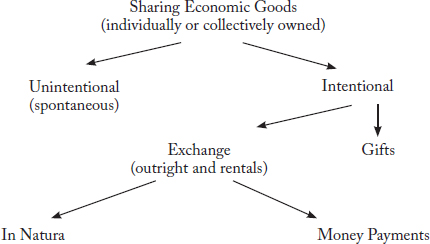
But economic goods may also be shared unintentionally, or spontaneously. This form most notably concerns fixed capital goods. Suppose Mr. Smith, a textile manufacturer, owns an industrial sewing machine. Smith is free to use or not to use the machine. But clearly the only way for him to use it is in mass production of textiles. This is of course why Smith bought (or built) the machine. He wants to produce trousers, skirts, suits, and costumes in great quantities. However, irrespective of how much money Smith might earn, his machine itself essentially serves the needs of other people. He is the owner, but the only way to use his property is by sharing its products with other people.
Mises was the first economist to point out this particularity of fixed capital goods. He concluded his analysis as follows:
In the society which divides labour no one is exclusive owner of the means of production, either of the material things or of the personal element, capacity to work. All means of production render services to everyone who buys or sells on the market. Hence if we are disinclined here to speak of ownership as shared between consumers and owners of the means of production, we should have to regard consumers as the true owners in the natural sense and describe those who are considered as the owners in the legal sense as administrators of other people’s property. (Mises [1922] 1981, p. 31)
In the same vein, George Reisman (1996, pp. 300–301) pointed out that capitalists, despite controlling next to all of the tools needed for production, earn a mere 10 percent or so of aggregate net income. The other ninety percent is earned by labor and bureaucrats. Martin Rhonheimer (2021) restated these thoughts in even more general terms. Private property has an inherent social orientation. It does not need to be limited to make way for the needs of others. It is the very means by which the needs of others are catered to.
Common-Pool Resource Ownership Is Private
The collective ownership of common-pool resources is supposed to be categorically different from private-property ownership. Private-property owners may join forces to create partnerships, joint-stock corporations, and condominiums. But in such cases, the argument goes, the property that is held in common is still private property. It can be withheld from others. By contrast, certain resources cannot be owned because their physical characteristics do not allow the exclusion of others. They therefore have a special collective or public nature. Such common-pool resources include municipal land, lakes, seas, waterways, and atmospheric air.
This conception is flawed on two counts. (1) Common-pool resources usually are privately owned, and they can be preserved and developed only if they are privately held. (2) Whether it is possible to privatize parts of a common-pool resource does not depend on the physical characteristics of that resource but on the economic context. Let us explain these points in a little bit more detail.
As a matter of fact, common-pool resources are usually privately owned (often by the state). Very often, this ownership does not come in the usual legal form of property titles. Instead, it comes in the economic form of private use and private disposition. Only certain people may use the good. Some are admitted to the restrictive circle of beneficiaries. Others are excluded.
The reason for this state of affairs is straightforward. If access to a common-pool resource were not restricted, then the good would be quickly depleted. Few people have given more thought to the nature of common-pool resources and their efficient management than the Nobel laureate Elinor Ostrom (1990, 2010). Ostrom emphasized the need to clearly define both the common-pool resource and the entitled parties. She also stressed the crucial importance of effective exclusion mechanisms against unentitled parties (see Ostrom 1990, chap. 3).
In short, common-pool resources either are privately owned or do not last. But why does this private ownership concern only the good as a whole and not also its parts? Here two economic considerations come into play. The first one concerns the value of using the common-pool resource as a whole rather than using parts of it. The second one concerns the costs of dividing it into suitable parts.
A resource tends to remain in shared ownership whenever the cost of dividing the resource is too high relative to the expected benefit. In such cases, holding the resource as a whole is the only way to own it efficiently. The reason why a lake is not usually parceled into tranches is that with current technology it would be exceedingly expensive to demarcate borders and monitor trespassing on aquatic property.
But conditions may change. Technology will change. Although subdividing a lake into privately owned tracts might be nearly impossible today, and exceedingly expensive, anyway, it may very well become feasible at a reasonable cost tomorrow. In other words, there is no such thing as a common-pool resource per se. There are only economic goods that under current conditions cannot be efficiently divided and must therefore be owned in their entirety.
Moreover, notice that these considerations only pertain to common-pool resources. A pool is a stock of homogeneous economic goods. The different parts of the stock can be separated without affecting each unit’s serviceableness. Therefore, they can also be owned separately. But there are also goods that are better owned as a whole because their parts are complementary. These parts lose their serviceableness if they are separated. It would be inadvisable, for example, to divide a lake used for fishing, if the good health of the fish requires them to be able to roam through the entire lake.
Sharing under the Impact of Capital Accumulation and Capital Consumption
The foregoing considerations can be extended by more systematically studying the impact of capital accumulation—and of capital consumption—on the sharing of economic goods. Earlier we highlighted the fact that increased capital accumulation tends to reduce the return on capital investments and thus the opportunity costs of donations, which implies that sharing in the form of gift giving is likely to be stimulated.
Under capital accumulation, the population becomes wealthier (increasing real incomes), whereas the incentives to invest diminish (declining return on capital). Therefore, alternative uses of wealth become more important, including various forms of gratuitous wealth sharing. People will tend to increase their sponsorship of sports, sciences, and the arts, as well as their support of charitable institutions.
At the same time, the process of capital accumulation is likely to have a negative impact on the extent of the commons. As more savings (and potentially more capital) become available, and as the return on capital tends to shrink, it becomes worthwhile to finance projects that demand comparatively high investments at comparatively low returns. This is likely to influence the cost-benefit analysis of dividing common-pool resources.
For similar reasons, the process of capital accumulation is likely to have a negative impact on commercial rentals. Many durable goods are rented rather than purchased outright. This is true of consumers’ goods such as vehicles, apartments, houses, and gardening equipment, and also of capital goods such as tractors, drilling equipment, and scaffolds. Individuals and firms rent these goods due to the limitations of their budget and the opportunity cost of an outright investment. The owners of durable goods rent them out because this provides income. Under capital accumulation, the budget constraints of the renters are relieved, the return on capital diminishes, and the necessity of earning extra income declines. Therefore, outright purchases will tend to grow relative to rentals.
The bottom line is that in a free-market setting, capital accumulation tends to encourage the different forms of gratuitous wealth sharing, which, as we have seen, is likely to reinforce social integration; while reducing the more conflict-laden forms of sharing, such as common-pool resources and rentals.
Exactly the inverse tendencies result from a process of capital consumption. As savings diminish, capital becomes scarcer and the return on capital tends to increase. At the same time, labor productivity diminishes, with a concomitant impact on output and real revenues. Gratuitous wealth sharing is therefore likely to diminish, whereas rentals and common-pool resources will tend to become more prominent. Social relations as a whole become more conflictual.
Technological Progress and Sharing
Let us now examine how sharing is affected by technological progress. We should stress from the outset that there can be no technological progress without capital. Capital is the foundation of technological development. It is always needed to finance research and development and to finance the application of R and D in industrial production and elsewhere. However, even if the capital endowment of an economy remains constant, technology can improve. Such progress makes it possible to earn higher profits with a given capital. In other words, the return on capital tends to increase with technological advancement. At the same time, technological improvements tend to increase output and thus aggregate real incomes.
The effects of technological development are likely to have a mixed effect on common-pool resources. The increasing return on capital means increased opportunity costs for investments, including those designed to divide common-pool resources into separate parts. Hence, unless the technological breakthrough in question specifically concerns such investments, it is likely to slow down the division of the commons.
Technological progress also has a mixed impact on rental services. The increased return on capital invested in rentals makes it more profitable for investors to specialize in renting out various durable goods, and it also increases the opportunity costs of owning such goods without using them regularly. Now, a breakthrough might specifically benefit rental services, as in the case of the property management software created by Airbnb and similar firms. But it might also benefit outright purchases of durable goods, if it substantially reduces the prices paid by the final users. Thus unless technological advancement specifically facilitates outright purchases of goods that would otherwise be rented, it is likely to benefit the rental market.
As far as gifts are concerned, the impact of technological progress is not uniform either. On the one hand, the wealth effect is likely to increase such forms of sharing. On the other hand, the increased return on capital signifies higher opportunity costs for noncapital uses of wealth. Therefore, unless the technological breakthrough in question specifically facilitates the gratuitous sharing of wealth, it is not likely to be particularly beneficial in this regard.
We conclude, then, that technological progress per se is not conducive to sharing. This fact needs to be stressed in regard to the often-exaggerated claims made on behalf of the internet-based “sharing economy.” Although it is true that the services provided by online firms facilitate the renting of durable goods, this is not per se likely to increase social cohesion (Slee 2015) and donations of time and money.
_______________________________
We are fully aware that the last two sentences may sound like gibberish to the ears of economists. Indeed, without the distinction between efficient and final causes (see above, pp. 66, 72–75), it makes no sense to assert that donations do not serve the donor and are not useful to him. But in the light of this distinction, these words convey the meaning they have for most noneconomists. For a discussion of the verbs “to use” and “to love” see Wojtla ([1960] 1981, pp. 25–36).
By contrast, the category of consumption seems to fit all those cases of leisure (in the economic sense) which cannot be properly counted as leisure in the philosophical sense; that is, which cannot be counted as donations. Time spent playing sports, relaxing at bars, or watching television shows are consumptive activities. The time needed to enjoy food, drink, and other consumers’ goods can itself be interpreted as a consumers’ good. See Fegley and Israel (2020).
There are also context-dependent laws of subjective value. Most notably, in the context of a market economy, the value of any good depends on whether that good can be traded and at what price. Accordingly, today’s standard microeconomic theory distinguishes between the substitution effects and the income effects of a price variation (Böhm and Haller 2018; Helm 2018). The existence of income effects has been contested by Salin (1996). On the same topic, see also the debate between Salerno (2018, 2019a) and Israel (2018, 2020, 2021).
For a Mengerian analysis of the subjective marginal value of gifts, see Gbedolo (2015, pp. 156–62).
This is related to but not quite the same thing as the “reserve fund” discussed by Mises ([1949] 1998, chap. 36, sec. 2). The latter is the excess income or excess wealth that, in the eyes of interventionists, can be taxed or expropriated without adverse consequences for the economy as a whole.
Notice that all schools of economic thought acknowledge the existence of this tendency. The contentious issue is whether price deflation is desirable. Classical and Austrian economists typically think it is (see Hülsmann 2008a, chap. 4; 2013, chaps. 2 and 4; Salerno 2010; Bagus 2015). By contrast, the champions of monetary interventionism typically argue that an unhampered, price-deflationary economy would be suboptimal from an aggregate point of view. To reach its full growth potential, they hold, an economy needs to be stimulated with expansionary monetary policy (Keynesian variant) or with monetary interventions that stabilize the PPM (monetarist variant). Keynesians and monetarists therefore recommend that the government force all market participants to use fiat money, which should be produced by central banks or other monetary authorities. Fiat money comes in the form of notes and tokens and accounting money, all of which can be produced without any significant cost. The authorities can therefore easily offset, or overcompensate for, the price-deflationary tendencies of the market. All that is required is fiat money.
These figures are taken from the Federal Reserve’s Financial Accounts of the United States (second quarter, 2020) and the Survey of Consumer Finances (2019) data.
The median net worth of US households whose heads of household were seventy-five and older was $254,800, while the mean net worth was $977,600. In the same year, the median for all “families with holdings” was $121,700 and the mean was $748,800. From an aggregate point of view, the mean, or average, figures are more relevant. The net worth of the average seventy-five-plus US household was 1.31 times as large as the net worth of the average US household.
We will discuss this law in more detail on pp. 211ff.
Empirical studies of the main motivations for saving usually distinguish factors such as acquisition and maintenance of real estate and other important assets; preparation for emergencies and retirement; and bequests. When asked about their “principal” motivation to save, households name bequests in about 10–15 percent of all cases (see, for example, Deutsche Bundesbank 2019; Le cercle de l’épargne 2022). However, this does not mean that 10–15 percent of all wealth is earmarked for bequests. If this motivation dominates among the richest households, then the real figure is probably much higher. Businesses are indeed the richest households’ characteristic form of wealth (see, for example, Campbell 2006; Dao 2020), and as we pointed out, bequests of businesses invariably involve the issue of finding the right successor.
See Mises ([1922] 1981; [1949] 1998).
See Rothbard ([1962] 1993, pp. 183–200) for a detailed discussion.
All goods, including moral virtues are ordered toward God. Acting virtuously therefore cannot be a meaningful ultimate end (see Aquinas [1259–65] 2009, bk. 3, 34). With Saint Augustine (1993) we might say that all goods have to be loved in the right way; namely, more or less than other goods. The concept of the right ordering of love is developed in his De civitate Dei, bk. 14, especially sections 7ff.
“Der freiheitliche, säkularisierte Staat lebt von Voraussetzungen, die er selbst nicht garantieren kann.” The very idea of a secular state is a religious idea with Christian roots. See Taylor (2007) and Rhonheimer (2014). For an original interpretation of the nature of Christian sacrifice, see Girard ([1982] 1986, 2004, 2005).
To be sure, grants and other forms of reciprocity do have various beneficial side effects in terms of establishing personal networks and trust and signaling a commitment to shared values and norms. This point has been duly emphasized in the literature on reciprocity (see, for example, Zamagni 2010; Gill and Thomas 2022).
For a discussion of governance and control issues in nonprofit organizations, see Doncaster and Hughes (1996).
See, for example, Boettke and Prychitko (2004, esp. pp. 21–26).
Pascal Salin (2020, pp. 83–84, 120) contends that the distinction between firms and households is an artificial one, introduced by the logic of taxation.
Human motivations are strongly influenced by the economic and political context. An important case in point is monetary interventionism. The artificial expansion of money and credit is likely to reinforce the quest for material gain at the expense of other human objectives (see Hülsmann 2008, 2013, 2016). This tendency manifests itself, for example, in the tendency toward financialization, that is, the adoption of the characteristic strategies of financial firms (leveraged investments and a preference for liquid assets) by non-financial firms and by households. We will discuss this issue in more detail in part three.
The primacy of intentionality over legal form has been neglected in the literature on the “third sector” (the nonprofit sector or civil society, the other sectors being “the market” and the state). This holds true both for the pioneering work of Richard Cornuelle (1965) and for present-day authors such as Luigi Bruni and Stefano Zamagni ([2004] 2007). For a critique of the “philanthropy myth” see Zunz (2014).
The question is a very old one. In the Middle Ages, it arose in the context of the creation of mendicant orders—in particular of the Franciscan order. Saint Francis and his disciples, such as Saint Bonaventure and Bertrand de la Tour, sought to imitate Christ by living a life without private property. They claimed this was possible with the “simple factual use” of economic goods (simplex usus facti). See Frank (2008); Nold (2003).
See in particular Mises ([1922] 1981); Rothbard (1970); Hoppe (1989).
This section is adapted from Hülsmann (2018).
This holds true even for primitive societies. See Bassi (2021) and the sources referenced there.

