

According to the March employment report, released last week by the federal Bureau of Labor Statistics, the jobs economy in the United States continues to stagnate as economic growth slows and the US-Israeli war on Iran pushes up energy prices.
According to the report, the establishment survey showed an increase of 178,000 jobs, month to month, but the household survey showed a decrease of 64,000 workers over the same period. March’s household survey marks the third month in a row of negative job growth. Over the past year, total household employment has fallen by 661,000 with an average monthly drop of 55,000.
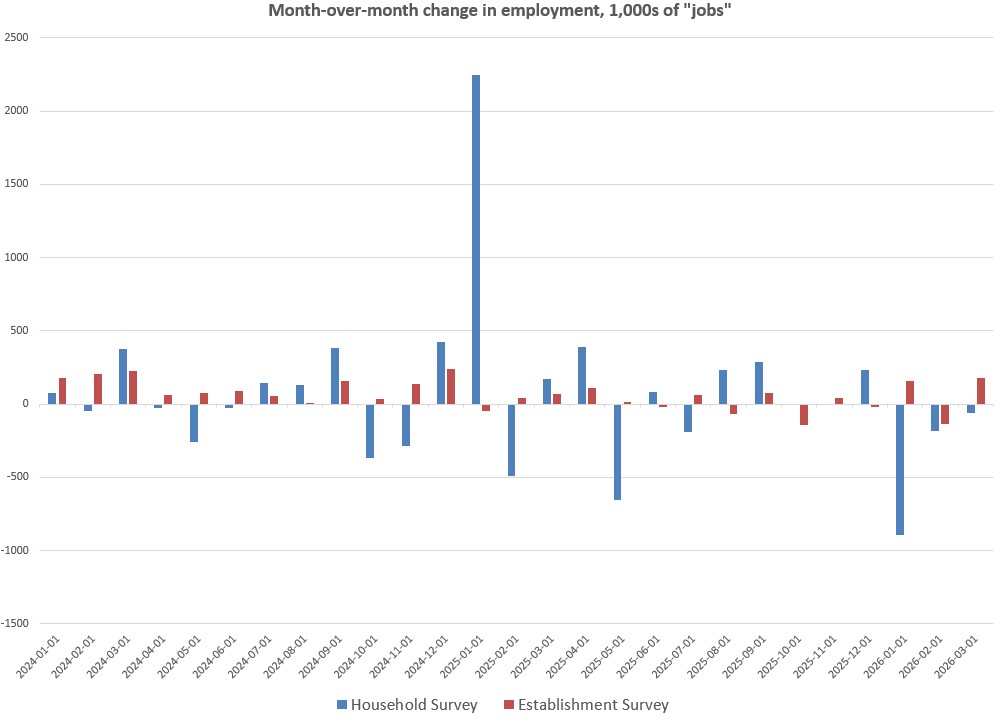
Employment measured by the establishment survey was less dire, but showed very anemic growth. If employment numbers over the past year are any indication, March’s job growth number of 178,000 is likely to be revised downward by tens of thousands. In any case, the current numbers show that, even with March’s current optimistic jobs-growth total, employment rose by an average of only 21,000 jobs per month since March of last year.
This numbers likely reflect the data behind the Federal Reserve’s most recent report on economic projections, which suggest that US job growth has essentially fallen to zero overall. In March’s FOMC press conference, Fed Chairman Jerome Powell noted the lack of job growth, as described by Yahoo Finance:
“Effectively, there’s zero net job creation in the private sector,” after accounting for revisions over the past six months, Powell said. “But actually, that looks like that’s about what the economy needs, in terms of dealing with very, very low — nonexistent, really — growth in the labor force, which of course we’ve never had in our history.”
Notably, this lack of job growth, combined with a declining labor force, helps explain why the unemployment rate has generally remained flat in recent months. In spite of so little job creation, the unemployment rate for March actually fell slightly to 4.3 percent, down from February’s rate of 4.4 percent. At the same time, the labor force participation rate fell to 61.9 percent, the lowest since November 2021, and this helps push the down the pool of workers who would compete for jobs in a declining market.
New hires, meanwhile, show little promise of resurgence, and in February, hires hit the lowest level since April 2014 (excluding the covid period). This number, however, is not mirrored by a large number of layoffs. Layoffs remains at unremarkable levels. Stagnant job growth combined with low fires suggests we remains in what has been termed the “no hire-no fire” economy in which jobs are hard to find, but we’re also not witnessing large numbers of workers losing their jobs.
The Fed’s overall projection for 2026 shows continued stagnation going into the year. In an April 2 report from the Fed reflected Powell’s words at the March FOMC press conference:
Labor force growth has been slowing and could be near-zero starting this year, driven by weak population growth reflecting low net immigration and by declining labor force participation reflecting population aging. Such weak growth in the labor force is unprecedented in the United States’ recent history. In this note we highlight two significant implications of near-zero labor force growth: First, near-zero labor force growth implies that breakeven employment growth (i.e. the pace needed to maintain a steady unemployment rate) would also be near-zero—making negative job growth almost as likely as positive job growth in any given month. Second, it implies that any growth in potential GDP will need to come entirely from productivity growth. These features would represent a significant shift in U.S. labor market dynamics and the composition of economic growth.
Note that this description of the economy suggests a certain underlying view of the job market. The assumption here is that there is no reservoir of available workers in the United States, and any significant increase in total employment will require population growth, presumably from immigration. Yet, according to the Census Bureau, there are currently 16.4 million non-disabled men, age 16 to 64, who are not in the labor force. Moreover, as of March, there are 2.7 million men not in the labor force who report wanting a job. This level is well above what was experienced during most of the 2000s, before the Great Recession. We might also note that the employment-population ratio is at the lowest level reported since November 2021. In other words, it is unclear that the current lack of job growth must be characterized as largely a function of insufficient population growth.
Even if these discouraged and out-of-market workers can be enticed back into employment, it will be difficult for employers to turn workers into productive imputs as prices rise for producers thanks, in part, to rising energy prices caused by the US-Israeli war on Iran. The most recent price-inflation data shows producer prices hitting a three year high. Employers will also face a slowing economy overall. The most recent revision to GDP growth downgraded the fourth-quarter 2025 growth to 0.5 percent. Perhaps it’s no wonder that the latest consumer sentiment index reading has fallen to the lowest level ever recorded.

