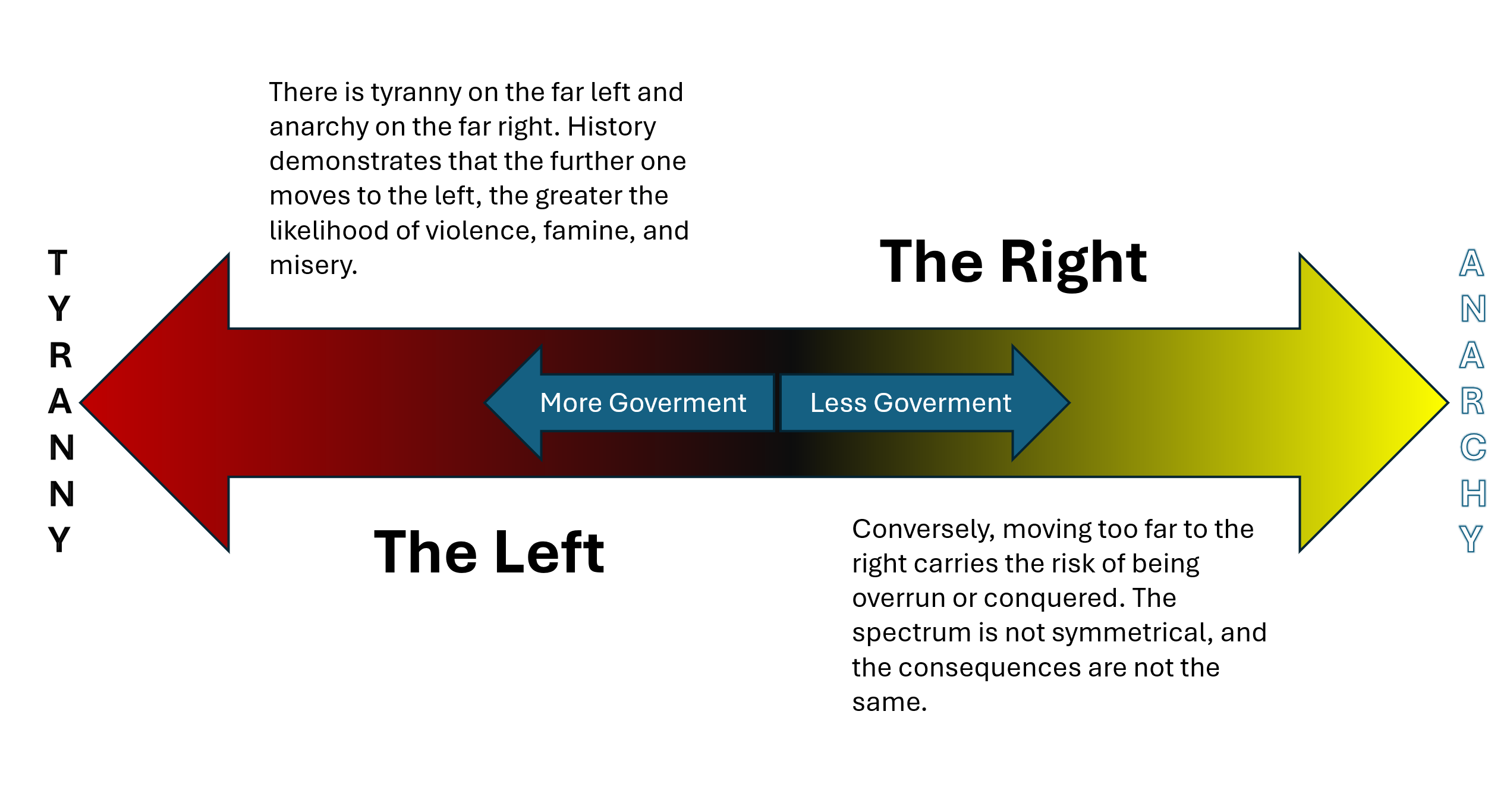
Libertarian and pro-freedom movements have always drawn disproportionate support from the extremes of the IQ bell curve. The modern Left—pointing to the intellectual shortcomings of some of liberty’s most colorful supporters on the lower end—clumsily attempts to wield this fact as an argument against the Right. Meanwhile, the enlightened Right scratches its head, puzzled by this strange and exotic coalition rallying behind the cause of freedom.
Perhaps it forgets a basic historical truth: humanity has overcome staggering odds with armies of illiterate peasants. Civilizations were not built exclusively by philosophers and mathematicians. They were raised by ordinary people, armed not with theory but with intuition, grit, and an instinctive understanding of exchange and fairness.
So why does such a strong love of freedom appear both among towering intellects and among those of far more modest cognitive means? The answer may be uncomfortable for central planners: the free market is not an abstract construct—it is deeply intuitive, woven into human nature itself.
Money—as proof of useful work performed—allowed human communities to scale beyond the natural limit of roughly 500 individuals. It restrained parasitic behavior so long as its supply was kept in check. People who would today be dismissed as “simple” built a technical civilization through sheer labor and cooperation. Goods accumulated where they were most useful and were reinvested into future generations.
Where—if not in a free market—does a compassionate, hardworking, ordinary person have a genuine chance to build a small fortune?
The Socialist Illusion of a World Without Hierarchy
Socialism repeatedly seduces with the promise of abolishing hierarchy. What it never explains is how decisions are supposed to be made in its absence. A general assembly to vote on the color of toilet brushes in the women’s restroom on the third floor?
Anyone who has ever participated in real decision-making knows this fantasy collapses on contact with reality. Hierarchy has no viable substitute. Every historical implementation of socialism—despite its rhetoric—embedded hierarchy deep into its foundations.
An honest Left-wing proposal would sound something like this: We will replace the hierarchy discovered through the competitive process of the free market with a hierarchy imposed by arbitrary bureaucratic decision.
Beyond the well-known economic calculation problem and the problem of dispersed, specialized knowledge, socialism crumbles at a more fundamental level: it lacks any independent mechanism for verifying competence. The market continuously tests, rewards, and punishes. Bureaucracy merely appoints.
The Mirage of Technocratic Salvation
The Left still fails to grasp a sobering fact: even if more than a century of searching were to culminate in a genuine solution to the economic calculation problem, their troubles would not end. Yet faith persists. The search continues.
The latest desperate attempt is the relocation of resources and investment capital through total surveillance and massive data processing by AI systems. Even if this experiment on the living organism of an economy were to succeed to some degree, one question remains unavoidable: Why would we trade a precise, universally-accessible, and essentially free mechanism for determining investment profitability for a clumsy, energy-hungry, and exorbitantly expensive monopoly of an all-powerful state?
And let us assume—charitably—that this blind shot hits its target. That total surveillance and staggering energy consumption somehow approximate rational allocation. One question still looms: What guarantee do we have that replacing the thrilling, dynamic game of the market with enforced equality of outcomes will not suffocate us with boredom?
Freedom is not merely efficient, it is alive. And life, unlike bureaucracy, does not thrive in cages—even gilded ones.