

Over the past weekend, from February 12 until February 15, Polymarket—in conjunction with the Food Bank For NYC—organized a pop-up grocery store in NYC that offered groceries entirely free of charge. Although the event was a short-term promotional stunt by Polymarket, it drew public praise from Mayor Zohran Mamdani, who has pitched similar interventionist ideas for grocery stores before. More importantly, this event serves as a recent and practical example of how such interventions disrupt the natural dynamics of supply and demand in a free market. The goods are not truly “free”; the cost is simply shifted away from clear and voluntary prices into less transparent and more restrictive forms.
In a free market, every individual has their own subjective value, and are able to decide what they are willing to trade for each and every additional unit of a good. When these individual decisions are aggregated together across thousands or millions of buyers and sellers, they form the familiar supply and demand curves that are constantly adjusting toward a price equilibrium.
We can illustrate this with an example, using groceries on the horizontal axis and price in dollars on the vertical axis. For simplification, “groceries” represent a general basket of food items rather than any single product.
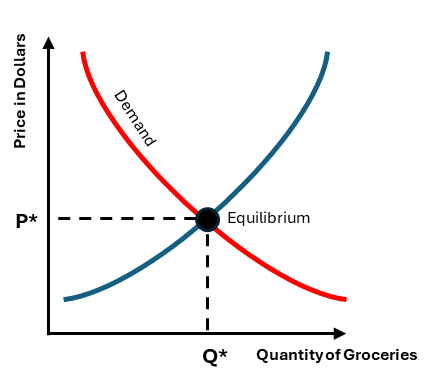
This represents the natural state of a free market: a widely-distributed interaction between consumers and producers, where prices continually adjust toward a level that equalizes supply and demand.
The free grocery store—along with countless historical examples—shows what happens when this process is disrupted. In terms of the supply and demand curve, two things occur:
- The price of groceries is artificially set to $0. Since the cost of producing groceries exceeds $0, no rational supplier would provide goods at this price, as doing so would guarantee a loss. In this case, the store was supported through Polymarket, meaning those losses were absorbed by them. This leads to the second effect.
- A gap emerges between demand and readily-available supply. At a cost of $0, demand is no longer constrained by price and surges toward infinity. With no price signal to moderate demand, the resulting gap must be resolved through other means, which we will explore shortly.
These two effects lead to a broken supply-demand curve that looks something like the following. There is excess demand with price set to $0 and the supply that is provided is provided at a loss, covered by Polymarket.
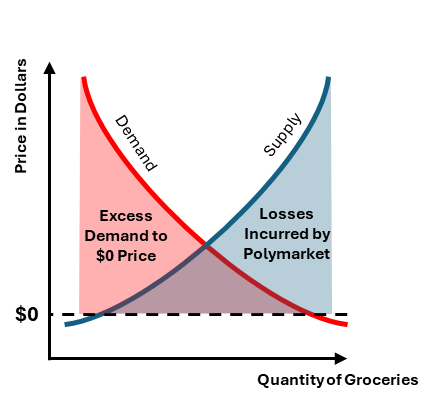
Price helps coordinate and modulate the relationship between supply and demand. Because groceries carry a monetary cost, consumers do not visit the store endlessly or purchase unlimited quantities. Prices provide structure to the market; they create a dampener for unchecked demand.
The instinctive response is to assume that, without price, consumers could simply obtain as much as they need, especially for essential goods like food. But lowering the price of groceries, or any good, to free does not remove cost; it merely shifts it elsewhere. When price is eliminated, new barriers emerge.
In the case of the free grocery store, two new costs became apparent:
- Wait times expanded dramatically. With demand no longer constrained by price, far more people showed up than could be efficiently served. Even Polymarket, which was heavily incentivized to produce a successful event, saw multi-hour lines despite hiring security and enforcing a strict ticketing system.
- Choice and quantity were restricted. Shoppers quickly learned that this abundance was illusory. Each shopper was limited to what could fit in a provided tote bag and was chaperoned around the store. Higher-demand items such as meat, eggs, and milk were rationed and limited.
In effect, consumers were required to sacrifice productive time to stand in line, only to face reduced selection and externally-imposed rations. The cost did not disappear; it changed form. In a free market, individuals can apply their labor to earn money and exchange it for the goods they value most. Instead, time and free choice were sacrificed for an inferior return.
While the idea of a free grocery store may appear compassionate, especially for those who are struggling, the underlying cost is merely obscured, not eliminated. It is also not sustainable; the cost of groceries cannot be absorbed indefinitely. This is evident in the fact that the promotional event lasted only a few days.
This lesson applies to more than promotional grocery stores. Markets that face intervention simply find that the costs are simply shifted elsewhere. Free roads suffer heavy traffic and deterioration; free beaches, rivers, and lakes become overused and polluted. The lesson here is that there is absolutely nothing more expensive than “free.”

