

We have long normalized the idea that economics is the use of scarce resources. The problem is that, if resources are scarce, the only option left is to decide how to allocate them, leading to a real struggle—sometimes violent—between the parties to see who gets what little there is.
At one time, we were told that when coal ran out, civilization would disappear. But then oil appeared, which—thanks to technological development—became a far superior energy source. And the world progressed incredibly. Henry Ford announced that he would manufacture cars for the middle class; they thought he was crazy.
Fifty years ago, a few “experts” said that crude oil reserves would only last for another thirty years. Today, thanks to new technology, it is abundant, except when states complicate and even destroy production and transportation, as happened in Venezuela due to Chavista state policies.
“Man, through the tenacious application of his intelligence and his work, gradually wrests its secrets from nature, and makes better use of its riches,” Paul VI affirmed. And “...what the economic system produces is not material things, but immaterial knowledge,” said Frank Tipler.
It’s not about fighting over what little there is, but about serving and cooperating voluntarily to create abundance, which is what characterizes the free market.
Creation is infinite; it has no limits as long as the order of the cosmos—the order of nature that predates humankind—is respected.
In contrast, rationalism, state constructivism, and attempts to impose an “order” that—not arising spontaneously from society—must be coercively imposed using the monopoly on violence that states claim for this purpose clashes with social nature and enters into a conflict that only destroys.
For example, let us examine the issues today stemming from the war in Iran and the Strait of Hormuz. As the following graph shows, oil consumption per unit of GDP has been falling since the late 1970s, thanks to the technology used to utilize and extract crude oil much more efficiently. For example, fracking has made the US a net exporter of energy since 2019.
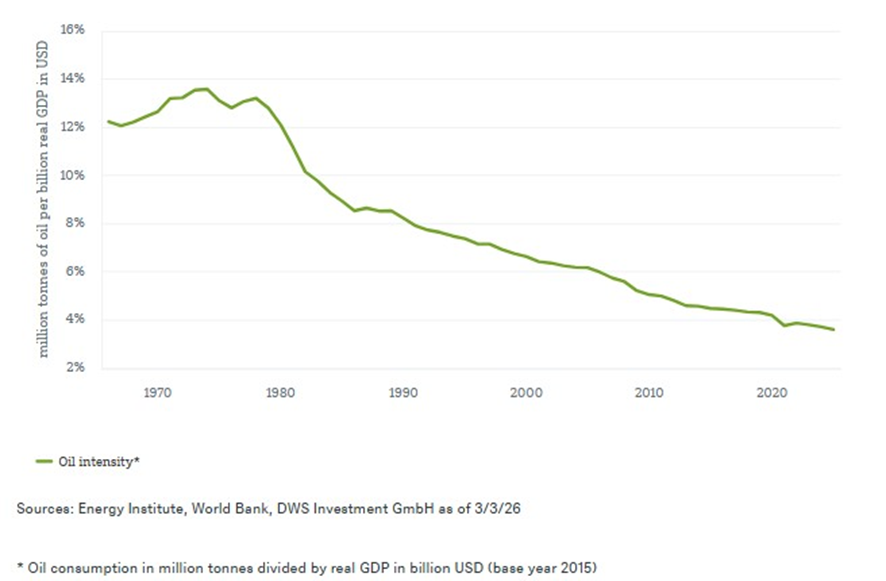
Based on the above, the need for crude oil would no longer be so critical were it not for the counterproductive intervention of states which, as is to be expected, complicate matters, causing the current oil crisis.
Besides the obvious destruction and disruption caused by wars, Western sanctions against Russia and the price cap mechanism implemented by the G7 have complicated Western supplies, forcing Moscow to sell its oil and gas at significant discounts in Asian markets.
In another case, the president of the European Commission had to acknowledge that “reducing the nuclear energy quota was a mistake.” The German state closed its last nuclear power plants in 2023 and now considers it a “serious strategic error” that has led to greater dependence on oil and gas. Reactivating the old plants is no longer possible, so attention is now focused on new construction and small modular reactors (SMRs).
France, on the other hand, generates around 65 percent of its electricity from nuclear power and exports its surplus, while the US is the world’s largest producer, generating nearly 30 percent of global nuclear electricity and covering almost 20 percent of its own domestic demand. This is its main source of clean energy, with 94 reactors belonging to private companies, which are now seeking to expand with new technologies, such as advanced reactors (SMRs).
Incidentally, a serious misconception, stemming from the abrupt increase in the price of oil as a consequence of state interventions—starting with wars and blockades—is the belief that the eventual pass-through of this increase to prices in general constitutes inflation.
Inflation is actually the opposite: artificial expansion of money and credit. Therefore, the rise in the cost of crude oil, even if it affects all prices, is not inflation but simply a relative readjustment aimed at reconfiguring the market in response to this new situation.
In other words, faced with a decrease in the supply of crude oil—due to state intervention—the price increases to discourage consumption while simultaneously promoting increased production and/or logistics.
For example, a price increase could incentivize other transportation alternatives, such as projects linked to the Pakistani port of Gwadar and potential extensions of the Iran-Pakistan gas pipeline. Or the Power of Siberia pipeline, which already transports Russian gas to northeastern China, while the Power of Siberia 2 project (still in the negotiation phase) could significantly increase the volumes exported to the Chinese market in the next decade.

