
Taxpayers in Revolt: Tax Resistance During the Great Depression
5. Selling the State: The National Pay Your Taxes Campaign

Bankers and Reformers
Shanks moved quickly to put teeth into this proclamation. In less than a month, he convinced the National Municipal League (NML) to form a national campaign to promote taxpaying at the local level. NML placed the endeavor under its Committee on Citizens’ Councils for Constructive Economy (CCCE). Adopting the slogan of Chicago’s teachers, the new group called itself the National Pay Your Taxes Campaign (NPYTC). Joined by Shanks—who became secretary of the new organization—Thomas H. Reed, the head of CCCE, took over the chairmanship of NPYTC.
Reed’s campaign against those who sought cuts in taxes and spending caught the eyes of NML’s leaders, who asked him to chair their new Committee on Constructive Economy. He came still further into the limelight at the President’s Conference on the Crisis in Education, in January 1933. When delegates at that conference formed the Citizens’ Councils for Constructive Economy (CCCE), they asked NML’s Committee on Constructive Economy—and hence Reed—to take over the helm.
Destructive versus Constructive Economy
Newark: The Sale of the City
Of all the taxpaying campaigns launched in the early 1930s, the “sale of the city” drive in Newark, New Jersey, won the most national attention. For good reason, the 1935 editions of the Publicity Handbook and the Campaign Manual highlighted it as a model for other cities.
After 1931, the city government, ever on the verge of default, stumbled from one fiscal crisis to another. Relief rolls mounted. Bankers and other investors grew reluctant to keep lending the city money and demanded substantial economies. Public employees, in turn, resisted attempts to impose layoffs and cut salaries. Yet something had to be done to stave off receivership. Finally, in July 1932, city employees agreed to salary reductions ranging from 1 to 15 percent. This belated concession was not enough. Sidestepping further economies or new levies as too politically risky, they chose the path of least resistance—an advertising campaign to collect back taxes. The campaign owed both its inception and its organization to Newark’s director of public safety. Dubbed a “sale of the city” drive by its organizers. Public Management described the effort as “like the war bond drives” in that “the appeal was to community patriotism, a request to recognize community obligations, plus a reminder that payment of taxes is not voluntary with the taxpayer.” Even the advertising trade journal Printer’s Ink made mention of the campaign. The drive’s pay-your-taxes sales pitch had—as this quote from Public Management reveals—an almost Orwellian pervasiveness:
Although organizers claimed that the campaign increased tax payments by one-third, in the end it turned out to be at best a holding action. Newark’s tax delinquency in 1932 increased overall. Moreover, although the drive may have been at least partly responsible for persuading local businessmen to advance loans in late 1932, the threat of default still loomed.
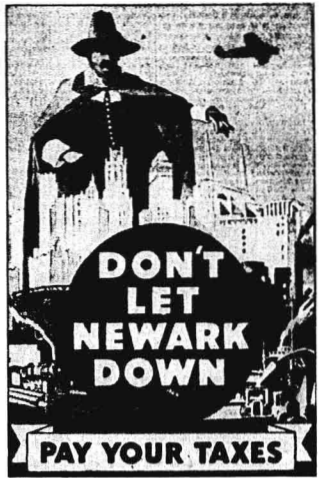
Poster used in Newark’s Pay Your Taxes Campaign in 1933 (Newark Evening News, 28 September 1933; courtesy Newark Public Library)
Strategies of Persuasion, Coercion, and Reward
More than one prominent foe of tax resistance wondered why taxpayers, often so meticulous about meeting private bills, balked when the tax collector came to call. A writer in the October 1934 issue of Tax Policy asked in frustration: “Is it too much to expect of citizens of a great democracy that they shall recognize their governmental obligations and pay their tax bills in as upright and self-respecting fashion as they pay for automobiles and chewing gum?” One of America’s leading intellectuals, H. L. Mencken, the editor of the American Mercury and a friend of tax revolts, exemplified the perspective which Tax Policy criticized. According to Mencken, the average taxpayer did not view government as
The gist of this argument was that government gave cheaper service because it used cooperative purchasing. Pay-your-taxers never really grappled with the question of why individuals needed the force of government to purchase services cooperatively—especially if the benefits were so manifest. Of course, tax resisters rarely addressed these questions either. As shall soon become clear, resisters could more than match pay-your-taxers in skirting the uncomfortable implications of an ideology.
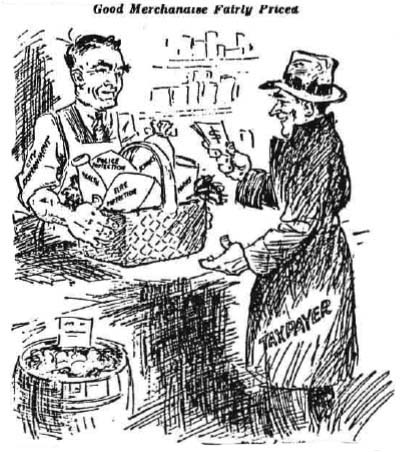
Poster used in 1934 for the Memphis Pay Your Taxes Campaign (United States Municipal News, 1 October 1935)
Robber Barons, Anarchists, and Slackers
During the first three years of the depression, good-government reformers were caught off guard by a wave of tax resistance and “destructive economy.” Since the late nineteenth century, they had grown accustomed to regarding the urban political machine as their major nemesis. Now, an unprecedented taxpayers’ revolt necessitated a temporary change in emphasis. New strategies and alliances had to be forged to deal with the threat that tax resistance posed to the municipal-reform and rationalization edifice that they had taken so long to build. By the end of 1933, municipal reformers had largely agreed on what these strategies should be. Along with other critics of the tax revolt, they put into place a plan of counterattack. Resisters could tap existing anti-big-government attitudes in American society and often, but not always, had the advantage of popular support. Against these advantages civic reformers matched three decades of professional expertise and commitment to a strong (and legally unrestrained) taxing system. As we shall see, these could be powerful weapons when deployed in the fight against tax resistance.

