
Taxpayers in Revolt: Tax Resistance During the Great Depression
1. Tax Resistance: Origins and Development

Origins and Development
If the real estate tax failed to meet even the rather dubious criteria of justice and equity as set down in the public finance tomes of the period, such as ability to pay, what accounts for its remarkable staying power as an extractive source? For one thing, it involved a low administrative overhead. Since real property could not be effectively hidden from their purview, the assessor and collector did not have to engage in costly and unpopular detective work. For all intents and purposes, taxpayers could not conceal their taxable real estate from the authorities. When real estate taxpayers, either by choice or necessity, lapsed into arrears, their delinquency became apparent for all to see.
By the end of the 1920s, local governments hit on the “tax-anticipation warrant” (a bond payable in future taxes) to evade the debt limit. For many vote-conscious politicians in the 1920s, the tax-anticipation warrant proved an irresistible temptation. Since it did not meet the legal definition of a municipal bond, it fell outside the restrictions of most debt limits. More importantly, politicians had every reason to gamble that continued prosperity would ensure the safe retirement of the warrants or at least put off the final day of reckoning. In short, the tax-anticipation warrant seemed a foolproof method of financing the expansion of local government and at the same time circumventing tax resistance.
Figure 1-1
Median Year-End Tax Delinquency for All Cities over 50,000 Population, 1930-1936 (percent of collections)
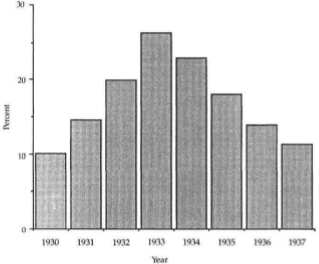
By 1931, the political side to the tax system’s collapse made its presence felt. For the first time in decades, local and state officials had to confront organized and far-ranging tax revolts. In 1932, journalist Anne O’Hare McCormick observed:
Wherever you go you run into mass meetings called to protest against taxes. That is nothing new, of course, but opposition has seldom been so spontaneous, so universal, so determined. The nearest thing to a political revolution in the country is the tax revolt. For the first time in a generation taxpayers are wrought up to the point of willingness to give up public services. “We’ll do without county agents,” they say, “We’ll give up the public health service. We can no longer pay the cost of government.”
The Rural Dimension
The Urban Dimension
The property owners’ divisions did not sit by at the beck and call of either the NAREB or the individual local boards. To be sure, most of the divisions started out as mere appendages to the local boards, but as time went by, they embarked on separate and occasionally conflicting courses. Tax reduction being their raison d’être, they usually lodged much more strident critiques of high taxes than the parent boards. In contrast to their real estate operator patrons, division members did not have the luxury of shifting any of their taxes onto tenants or homeowners. This predisposed them to consider desperate and sometimes illegal measures, like the tax strike, that local boards could not countenance.
The Taxpayers’ League
Taxpayers versus Tax Spenders
Wherever proposed, tax-reduction and tax-limitation initiatives ran into opposition from state employees, municipal reformers, and others who depended directly or indirectly on tax money. In Michigan, for example, the Michigan Education Association and the Michigan Municipal League led the fight against the 15 mill tax-limitation initiative. State education and teachers’ associations, with the help of the National Education Association, formed the core of unsuccessful campaigns against limitation proposals in Ohio, Indiana, and Washington. In addition, national municipal-reform and rationalization organizations, like the American Municipal Association, the National Municipal League, and the Municipal Finance Officers’ Association, gave ideological and logistical succor to these campaigns.
The local taxpayers’ league became a common fixture throughout the country. No state, and few localities, escaped protests of one kind or another. Because it touched the lives of so many powerful constituencies, the urban tax revolt generated most of the publicity. Civic reformers, real estate business groups, municipal bond holders, and organized government professionals drew their sustenance from America’s larger cities. In the following pages of this chapter, I focus on Milwaukee, Detroit, and New York City. Many other cities could have been selected as case studies, but these three received especially close attention from leading journalists, politicians, civic reformers, real estate interests, and municipal bond investors.
Milwaukee
Detroit
New York City
Parallels between all these cases abound. In every city, taxpayers made opposition to high real estate taxes the centerpiece of their activism. Although frequently serving to unify taxpayers, the National Association of Real Estate Boards, its local chapters, and affiliated organizations pursued variegated and occasionally conflicting strategies. In New York City and Atlanta, local boards worked closely with the authorities and sought to restrain strike-prone elements while in Milwaukee and Detroit they chose to confront, through the initiative process, rather than conciliate.
What motivated these long-quiescent taxpayers to rebel? Or still more specifically, were those who chose the route of resistance ideologically motivated or merely hard-pressed Americans who sought economic relief via tax relief? Obviously, economic motivations played a central role in bringing taxpayers to the point of rebellion, but it would be both facile and misleading to conclude that tax resistance was automatically caused by economic self-interest. A more rewarding line of analysis would treat the onset of economic decline as a catalyst to action by taxpayers. It was not so much that taxpayers like Hal Steed cynically adopted an anti-big-government pose when the depression cut into their incomes. Rather, as Steed himself put it, the depression forced taxpayers to think for the first time about the burden and perforce the purposes of high taxes. To use a popular term of the period, the depression motivated taxpayers to become “tax conscious,” to look more critically at how a bureaucracy they could once afford to ignore spent their tax dollar.

