
Taxpayers in Revolt: Tax Resistance During the Great Depression
4. Breaking the Chicago Tax Strike

Despite this high representation of proprietors, ARET as a whole did not fit the petit bourgeois label. Skilled blue-collar workers constituted the biggest single group of members. Indeed, skilled workers joined ARET in numbers disproportionate to their percentage in the general population. Like the proprietors, they worked in a wide spectrum of pursuits. Of the fifty-four skilled workers in the sample, carpenters, painters, and tailors totalled six each. Next were plumbers at five and machinists at four. The balance came from an array of occupations and included electricians, station engineers, and mechanics.
Table 4-1
Occupational Distribution for the Population of Chicago and for the Membership of the Association of Real Estate Taxpayers
| Percent of Group | ||
| Occupational Group | Chicago, 1930 | ARET, 1928-29 |
| Proprietary | 5.4 | 17.2 |
| Professional and managerial | 9.7 | 15.5 |
| Clerical and sales | 27.9 | 21.6 |
| Skilled | 27.0 | 30.0 |
| Semiskilled and service | 16.5 | 10.5 |
| Unskilled | 12.3 | 5.0 |
The assessment records bore out the relatively modest backgrounds of ARET’s members. Unfortunately, the Office of Assessor organized these records by address and not by the name of the taxpayer. This made it almost impossible to tell either the total value or the number of real estate parcels each member owned. According to the press, one suit brought by 30,000 members listed 56,000 parcels. If these aggregate figures accurately reflect their real estate holdings (and we have no reason to believe they did not) each member owned on average a modest 1.86 parcels. Averages, however, can be misleading. I found the assessed value of residences the best available barometer of wealth. Using addresses culled from the City Directory, I used the assessment records to tally only those residences both owned and occupied by individual ARET members.
Map 4-1
Residential Location of Members of the Association of Real Estate Taxpayers in Chicago
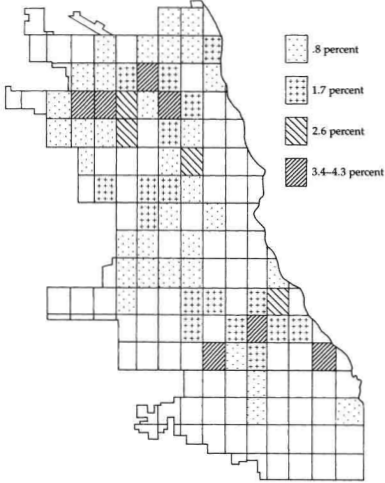
Note: The map is divided into the grid format used by Olcott’s Land Values Blue Book of Chicago1932. Each square in the grid shows the percentage of ARET’s members residing there. Only those members with owner-occupied residences were included in this sample.
ARET did not recruit its membership from any one particular area (Map 4-1). Pratt’s radio campaign, fortified by a financial war chest and extensive organizational network, had done well in attracting taxpayers throughout Chicago. Considering the frequent appearances of German, Slavic, Italian, and Greek names in the membership roll, ARET’s recruitment success in ethnic neighborhoods is scarcely cause for surprise. Foreign-born Americans had the same chance as natives to own their homes. Members of some nationalities, among them Poles, northern Italians, and Bohemians, owned homes in greater percentages than native-born Americans.
The content of Pratt’s radio talks had surefire appeal for these middle-class taxpayers. They could empathize with Pratt’s salvos against tax spenders and banks earning 6 percent interest on tax-anticipation warrants. His recurrent theme that the banks evaded personal property taxes on intangibles while owners of real estate paid the cost of local government must have galvanized them still further. Taxpayers in distress did not have to strain too hard to accept Pratt’s opinion as to the culprits.
Pratt’s populist rhetoric should not be mistaken as a mere propaganda ploy to reach the small taxpayer. The prosperous real estate operators who led ARET could also relate to his message. People like Bistor believed themselves equally threatened by banker, bureaucrat, and politician. Several members of ARET’s executive committee, after all, had once been on the same middle-class level. The community of interest existed on yet another level. Though misleadingly posed by Cermak and others, the characterization of ARET’s membership as speculators had some merit. The term might, for example, fit a plumber who had acquired a small apartment building or an extra parcel of land during the 1920s.
Give Me the Biggest Wrench You Have
As ARET’s power grew, its opponents stepped up their campaign to break the strike. An almost insurmountable task awaits the historian trying to paint a coherent picture of these efforts. Much of the time (throughout 1931 and early 1932, for example), antistrike activity generated more smoke than substance. As usual, threats were never in short supply. Cermak made clear his readiness to go to almost any lengths to destroy ARET. When the time came for concrete action he and the rest of the city administration betrayed their befuddlement. At least within memory, Chicago had never faced a puzzle like this. City leaders had institutions, or at least precedents, to cope with a host of other social problems ranging from natural disasters to labor strife. In this crisis, they had to be innovators.
There Will Be Bloodshed
Mopping Up
The Tax Strike in Perspective
A simple division of the delinquency rolls into taxpayers able and unable to pay obscures critical subtleties. It entirely omits taxpayers caught somewhere between the two extremes. Many individuals, though hard pressed, could pay at least part of their taxes but instead put priority on other bills. The disintegration of the tax sale system in Chicago, and most other parts of the country, could hardly fail to make an impression. With money so tight, taxpayers had every reason to ask why they should not take care of first things first. Viewed from this perspective, support of government seemed far less relevant than more immediate needs like meeting mortgage payments or putting the children through school.
The demise of the strike seems to have had a profound short-term impact on this middle group. The hyperbole from the media and politicians over the Skarda and Graham acts evoked renewed fears of coercive government power. Many people regarded the tax sale as a paper tiger, but it was hard to be quite so sure about the untried Skarda Act and its imposing receiverships. Bistor and Kesner, among other members of ARET, saw their properties fall into receiverships under its provisions.
When evaluating the strike’s impact, the limitations of poring over the nuances of the tax-delinquency roll become apparent. Those in power feared the strike not so much because it was attractive to some of the delinquent taxpayers but because it represented an organized movement. In other parts of the country, willful delinquents usually stood alone. Politicians could brand them as antisocial slackers and make the charge good. In Chicago, delinquents could join a mass organization that gave their behavior a sense of moral legitimacy, ARET broke the government’s monopoly on tax information. It gave taxpayers a rare source of alternative options.
Nevertheless, tax resisters were disorganized when compared to their adversaries. The organization nearest to ARET in sympathy was the CREB. The CREB may have backed ARET’s political, and even legal, program but it could not stomach the illegality of organized nonpayment. Chicago’s other wealthy business interests generally kept aloof, but often opposed the strike. The Chicago Association of Commerce (CAC), the leading representative of the wealthier business interests, stayed conspicuously silent during the controversy.
Strategies
Even at this late date, Pratt clung doggedly to the legal strategy-He pointed out that the courts had invariably ruled on technicalities and had never addressed the merits of ARET’s case. Although his point was well taken, Pratt never really asked the key question: How could the strike’s defeat in the courts have been otherwise? ARET particularly erred in not formulating a fallback strategy. Consequently, when litigation failed, it had no other recourse than to go to court again.
ARET, and the massive taxpayers’ revolt it led, embodied a distrust of big government and centralized institutions. Like so many other organizations evoking this sentiment in the 1930s, ARET lacked a well-articulated program. It called for reducing government’s size but avoided concrete proposals. ARET’s broadsides for economy usually, but not always, consisted of vague attacks on government extravagance and corruption. Considering the far-reaching ramifications of its tax-reduction program, such a strategy had obvious shortcomings. Had ARET been more forthright, it might have stood a better chance of winning more support from elements of the business community and the press who were friendly to tax reduction.
ARET’s biggest blind spot was its inability to frame a convincing defense of nonpayment. For a while, its leaders could take refuge in trumpeting the questionable legal basis of tax levies. When the courts ruled against this premise, strikers were left without an alternative defense of nonpayment. Adverse rulings left them at a still greater loss to answer the allegation that the logic of the tax strike led to anarchy. Nevertheless, for the greater part of its existence, ARET had remarkable success. Pratt and Bistor, and the organization they built, managed to hold off the tax collector for nearly two years. They presided over what may have been the biggest concerted tax strike since the aftermath of the Revolutionary War.

