
Taxpayers in Revolt: Tax Resistance During the Great Depression
2. Chicago: Portrait of a “Tax Racket”

In Chicago’s tax strike from 1930 to 1933, the tax revolt of the 1930s found its most dramatic expression. If degree of tax controversy is a criterion, Chicago provides a poor choice for a typical case study. Chicago’s importance to the historian lies in the explosive example it served as for the rest of the country. Its plight stood out as a reminder to other localities of just how bad the tax revolt could potentially get. When compared to other American cities, Chicago’s fiscal situation was a portrait of extremes. The corruption of the local taxation and assessment process had long been pervasive. When taxpayers struck back against this system, they did it in a big way. Chicago’s organized tax-resistance movement was unrivaled for its time in both breadth of support and extremity of tactics.
In the kinds of tax problems it faced, however, Chicago was quite typical. By the early depression years, tax corruption, heavy reliance on the real estate tax, tax delinquency, and the resistance had moved to center stage in many large and small American cities. These tax afflictions, although especially acute in Chicago, were not specific to it. For these reasons, uncovering the story of its tax strike can also yield profitable insights into the general character and potential of tax resistance during the depression.
Busting the Tax Racket
Fairweather and the leadership of the Building Managers’ Association knew what few others, including the CTF, even suspected. Relative to other classes of property in the city, Loop property had been overassessed by the Board of Assessors. At first, the JCREV campaign for assessment reform duplicated the failures of the teachers. The Board of Assessors, Board of Review, and the new Republican administration of Mayor William Hale “Big Bill” Thompson spurned the commission’s requests for access to the records of the just-completed 1927 assessment.
The “Reform” Reassessment
The Taxpayers Have a Holiday
The Onset of the Revolt
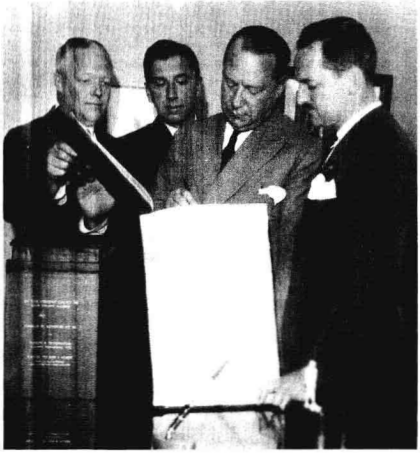
Association of Real Estate Taxpayers officials and attorneys pose in 1932 with books listing the 26,000 colitigants in Reinecke v. McDonough. Left to right: James E. Bistor, president of ARET; Perry Ten Hoor, ARET attorney; George W. Reinecke, member of ARET’s board of directors; and Ferre C. Watkins, ARET attorney. (International News Photos)
While Bistor described himself as a Republican, he had taken little interest in politics until the formation of ARET. Like other ARET leaders, he used the association as the launching pad for a long career of involvement in political causes. Bistor’s political outlook must be viewed as inseparable from the depression-era context from which it arose.
The Program of Revolt
Obey or Revise
“Obey” Becomes “Revise”: Challenging the Assessment
ARET spent no time mourning the defeat. Frustrated by the electoral process, it went after the jugular of the Strawn program: the recently completed 1930 assessment. ARET’s leaders reasoned that without a legal assessment the planned 1929 and 1930 tax increases would never come off. They did not base their complaint, as had the opponents of the 1927 assessment, on an allegation of discrimination between different classes of real estate. Instead, ARET challenged the assessment because it failed to correct the imbalance between the assessments for real and personal property. Ironically, the underassessment of personal property had been an issue of little consequence during the earlier imbroglio over tax corruption.
Intrigued with ARET’s case, William Malone, the chairman of the commission, quickly scheduled a hearing for 17 December. During his testimony, Pratt displayed a list of general classes of non-assessed or underassessed personal property culled from census and income tax records. These included over $4 billion in trust departments of local banks, $550 million of inventories in retail and wholesale establishments, and $400 million in automobiles. If one took the word of the assessor at face value, much of this personal property did not even exist.
Lastly, the Civic Federation’s reputation rested on its track record as a sober and responsible advocate of municipal rationalization. A new reassessment could have thrown the governments of Cook County into an irreversible tailspin. To support another reassessment would have run completely counter to the cautious mind-set of the Civic Federation’s leadership. The Civic Federation had, to be sure, supported—indeed helped to usher through—the voiding of the 1927 assessment. Conditions had changed radically in the interim. Not only did the city now face a depression, but its credit had almost dried up. In 1927, the leaders of the Civic Federation had believed—naively, as time proved—that the reassessment would take only a few months. They had not imagined in their wildest dreams that it would drag on for two years. They were not in a mood to endure that headache again.

