
Money, Bank Credit, and Economic Cycles
CHAPTER 9: A PROPOSAL FOR BANKING REFORM: THE THEORY OF A 100-PERCENT RESERVE REQUIREMENT
9
A PROPOSAL FOR BANKING REFORM: THE THEORY OF A 100-PERCENT RESERVE REQUIREMENT

In this last chapter, following a brief review of twentieth-century proposals for the establishment of a 100-percent reserve requirement in banking, we will present our recommendation for reforming the banking system, a proposal based on free-banking practices subject to the traditional legal principles which govern the monetary bank-deposit contract (a 100-percent reserve requirement). We will then compare the advantages of the proposed system with those of other possible systems, specifically the current banking and financial system and a fractional-reserve free-banking system. At that point we will review and answer the different objections made to proposals for a 100-percent reserve requirement. Then, after presenting a program of transitional stages which makes it feasible to move from the current banking and financial system to the model proposed, we will finish the chapter with a series of comments on the possible application of our recommendations to the specific cases of the European Monetary Union and the monetary and financial reconstruction under way in countries of the former Eastern bloc. The book ends with a summary of the most significant conclusions reached.
1
A HISTORY OF MODERN THEORIES IN SUPPORT OF A 100-PERCENT RESERVE REQUIREMENT
We know that distrust of fractional-reserve banking dates back at least as far as the Salamancan theorists of the sixteenth and seventeenth centuries, David Hume in the eighteenth century, theorists of the school of Jefferson and Jackson in the decades following the founding of the United States, and the important group of theorists from nineteenth-century continental Europe (Modeste and Cernuschi in France; Michaelis, Hübner, Geyer, and Tellkampf in Germany). Moreover, certain highly distinguished economists of the twentieth century, such as Ludwig von Mises and at least four recipients of the Nobel Prize for Economics (Friedrich A. Hayek, Milton Friedman, James Tobin, and Maurice Allais) have at some point defended the establishment of a 100-percent reserve requirement on demand deposits placed at banks.
THE PROPOSAL OF LUDWIG VON MISES
Ludwig von Mises was the first twentieth-century economist to propose the establishment of a banking system with a 100-percent reserve requirement on demand deposits. Mises made his recommendation in the first edition of his book, The Theory of Money and Credit, published in 1912. At the end of this first edition, in a section literally reproduced in the second, which was printed in 1924, Mises draws the following conclusion:
Fiduciary media are scarcely different in nature from money; a supply of them affects the market in the same way as a supply of money proper; variations in their quantity influence the objective exchange value of money in just the same way as do variations in the quantity of money proper. Hence, they should logically be subjected to the same principles that have been established with regard to money proper; the same attempts should be made in their case as well to eliminate as far as possible human influence on the exchange ratio between money and other economic goods. The possibility of causing temporary fluctuations in the exchange ratios between goods of higher and of lower orders by the issue of fiduciary media, and the pernicious consequences connected with a divergence between the natural and money rates of interest, are circumstances leading to the same conclusion. Now it is obvious that the only way of eliminating human influence on the credit system is to suppress all further issue of fiduciary media. The basic conception of Peel’s Act ought to be restated and more completely implemented than it was in the England of his time by including the issue of credit in the form of bank balances within the legislative prohibition.
Mises adds:
It would be a mistake to assume that the modern organization of exchange is bound to continue to exist. It carries within itself the germ of its own destruction; the development of the fiduciary medium must necessarily lead to its breakdown.
Mises again considers the model for an ideal banking system in his 1928 book, Geldwertstabilisierung und Konjunkturpolitik (Monetary stabilization and cyclical policy). There we read:
The most important prerequisite of any cyclical policy, no matter how modest its goal may be, is to renounce every attempt to reduce the interest rate, by means of banking policy, below the rate which develops on the market. That means a return to the theory of the Currency School, which sought to suppress all future expansion of circulation credit and thus all further creation of fiduciary media. However, this does not mean a return to the old Currency School program, the application of which was limited to banknotes. Rather it means the introduction of a new program based on the old Currency School theory, but expanded in the light of the present state of knowledge to include fiduciary media issued in the form of bank deposits. The banks would be obliged at all times to maintain metallic backing for all notes— except for the sum of those outstanding which are not now covered by metal—equal to the total sum of the notes issued and bank deposits opened. That would mean a complete reorganization of central bank legislation. . . . By this act alone, cyclical policy would be directed in earnest toward the elimination of crises.
Two years later, on October 10, 1930, before the Financial Committee of the League of Nations in Geneva, Mises delivered a memorandum on “The Suitability of Methods of Ascertaining Changes in the Purchasing Power for the Guidance of International Currency and Banking Policy.” There, before the monetary and banking experts of his day, Mises expressed his ideas as follows:
It is characteristic of the gold standard that the banks are not allowed to increase the amount of notes and bank balances without a gold backing, beyond the total which was in circulation at the time the system was introduced. Peel’s Bank Act of 1844, and the various banking laws which are more or less based on it, represent attempts to create a pure gold standard of this kind. The attempt was incomplete because its restrictions on circulation included only banknotes, leaving out of account bank balances on which cheques could be drawn. The founders of the Currency School failed to recognize the essential similarity between payments by cheque and payments by banknote. As a result of this oversight, those responsible for this legislation never accomplished their aim.
Mises would later explain that a banking system based on the gold standard and a 100-percent reserve requirement would tend to push prices down slightly, which would benefit most citizens, since it would raise their real income, not through a nominal increase in earnings but through a continual reduction in the prices of consumer goods and services and relative constancy in nominal income. Mises deems such a monetary and banking system far superior to the current system, which is beset with chronic inflation and recurrent cycles of expansion and recession. In reference to the economic depression then afflicting the world, Mises concludes:
The root cause of the evil is not in the restrictions, but in the expansion which preceded them. The policy of the banks does not deserve criticism for having at last called a halt to the expansion of credit, but, rather, for ever having allowed it to begin.
Ten years after delivering this memo before the League of Nations, Mises once more defended a 100-percent reserve requirement, this time in the first German edition of his all-embracing economic treatise, published as Nationalökonomie: Theorie des Handelns und Wirtschaftens (Economics: Theory of Action and Exchange). Here Mises again presents his thesis that the ideas essential to the Currency School require the application of a 100-percent reserve requirement to all fiduciary media; that is, not only to banknotes, but also to bank deposits. Moreover, in this book Mises advocates the abolition of the central bank and indicates that while this institution continues to exist, even if the issuance of new fiduciary media (bills and deposits) is strictly prohibited, there will always be a danger that “emergency” budget difficulties will be cited as political justification for issuing new fiduciary media to help finance the needs of the state. Mises implicitly responds thus to theorists of the Chicago School who in the 1930s proposed that a 100-percent reserve requirement be set for banking, but that the monetary base remain fiduciary, and that the responsibility for issuing and controlling the stock of money continue to fall to the central bank. Mises does not consider this the best solution. In this case, even with a 100-percent reserve requirement, money would still ultimately depend on a central bank and would therefore be subject to all sorts of pressures and influences, particularly the danger that in a financial emergency the state would exercise its power to issue currency in order to finance itself. According to Mises, the ideal solution would thus be to establish a system of free banking (i.e., without a central bank) subject to traditional legal principles (and hence, a 100-percent reserve requirement).In this book Mises accompanies his defense of a 100-percent reserve requirement with his objection not only to the central bank, but also to a fractional-reserve free-banking system: although such a system would greatly limit the issuance of fiduciary media, it would be inadequate to completely eliminate credit expansion nor the recurrent booms and economic recessions which inevitably come with it.
In 1949 Yale University Press published the first English edition of Ludwig von Mises’s economic treatise, entitled Human Action: A Treatise on Economics. In this English edition Mises repeats the arguments from the German edition, but he expressly refers to Irving Fisher ’s plan for establishing a 100-percent reserve requirement for banking. Mises disapproves of Fisher ’s plan, not because it includes a proposal for a 100-percent reserve requirement, which Mises fully supports, but because Fisher seeks to combine this measure with the conservation of the central bank and the adoption of an indexed monetary unit. In fact, according to Mises, the suggestion to reestablish a 100-percent reserve requirement, yet preserve the central bank, is insufficient:
[I]t would not entirely remove the drawbacks inherent in every kind of government interference with banking. What is needed to prevent any further credit expansion is to place the banking business under the general rules of commercial and civil laws compelling every individual and firm to fulfill all obligations in full compliance with the terms of the contract.
Mises again expresses his ideas on a 100-percent reserve requirement in an appendix (on “Monetary reconstruction”) to the 1953 English reissue of The Theory of Money and Credit, where he explicitly states:
The main thing is that the government should no longer be in a position to increase the quantity of money in circulation and the amount of checkbook money not fully—that is, 100 percent—covered by deposits paid in by the public.
Furthermore, in this appendix Mises also proposes a process of transition to the ideal system, with the following goal:
No bank must be permitted to expand the total amount of its deposits subject to check or the balance of such deposits of any individual customer, be he a private citizen or the U.S. Treasury, otherwise than by receiving cash deposits in legal-tender banknotes from the public or by receiving a check payable by another domestic bank subject to the same limitations. This means a rigid 100 percent reserve for all future deposits; that is, all deposits not already in existence on the first day of the reform.
Though further on we will again deal with the process of transition to the ideal banking system, we observe here that Mises, in keeping with his 1928 writings, proposes the same system of transition as the one applied to banknotes with Peel’s Act (which required that only newly-created bills be backed 100 percent by specie).
FRIEDRICH A. HAYEK AND THE PROPOSAL OF A 100-PERCENT RESERVE REQUIREMENT
Friedrich A. Hayek, undoubtedly Mises’s most brilliant disciple, first wrote about a 100-percent reserve requirement when, at the age of twenty-five, he published the article, “The Monetary Policy of the United States after the Recovery from the 1920 Crisis,” following his return from a study tour of the United States. Indeed, in this article, Hayek strongly criticizes the monetary policy the Federal Reserve had put into operation at the time. The Fed’s policy was designed to maintain the stability of the dollar ’s purchasing power in a context of rapidly growing productivity, and it had already begun to generate the substantial credit expansion which would ultimately cause the Great Depression. For the first time in his life, Hayek refers to the 100-percent reserve requirement in a footnote of this seminal article. He states:
As we have already emphasized, the older English theoreticians of the currency school had a firmer grasp of this than the majority of economists who came after them. The currency school hoped also to prevent cyclical fluctuations by the regulation of the note issue they proposed. But since they took only the effects of the note issue into account and neglected those of deposit money, and the restrictions imposed upon bank credit could always be got round by an expansion of transfers through bank deposits, Peel’s Bank Act and the central bank statute modelled upon it could not achieve this aim. The problem of the prevention of crises would have received a radical solution if the basic concept of Peel’s Act had been consistently developed into the prescription of 100 percent gold cover for bank deposits as well as notes.
In his remarkable work, Monetary Nationalism and International Stability, published twelve years later in 1937, F.A. Hayek again speaks of establishing a banking system based on a 100-percent reserve requirement. At that time, theorists of the Chicago School had already made a similar proposal, which they attempted to base on the central bank’s paper currency. In contrast Hayek asserts that the ideal solution would be to combine a 100-percent reserve requirement for banking with a return to a pure gold standard. In this way, all bank-notes and deposits would be backed by gold 100 percent, and a worldwide, sound monetary system effective at preventing government manipulation and “monetary nationalism” would emerge. Hayek concludes:
The undeniable attractiveness of this proposal lies exactly in the feature which makes it appear somewhat impracticable, in the fact that in effect it amounts . . . to an abolition of deposit banking as we know it.
Nearly forty years later, F.A. Hayek again took up the subject of money and banking in his famous work, Denationalization of Money. Although modern fractional-reserve free-banking theorists have used this book to justify their model, there is no doubt that Hayek proposes a system of free banking and private issuance of monetary units and that ultimately he wishes to see the banking model with a 100-percent reserve requirement prevail. In fact in the section he devotes to the change of policy in commercial banking, Hayek concludes that the vast majority of banks
clearly would have to be content to do their business in other currencies. They would thus have to practise a kind of “100 percent banking,” and keep a full reserve against all their obligations payable on demand.
Hayek adds a harsh criticism of the current banking system:
An institution which has proved as harmful as fractional reserve banking without the responsibility of the individual bank for the money (i.e., cheque deposits) it created cannot complain if support by a government monopoly that has made its existence possible is withdrawn.
MURRAY N. ROTHBARD AND THE PROPOSAL OF A PURE GOLD STANDARD WITH A 100-PERCENT RESERVE REQUIREMENT
In 1962 Professor Murray N. Rothbard’s now classic article, “The Case for a 100-Percent Gold Dollar,” appeared in the book, In Search of a Monetary Constitution(which was edited by Leland B. Yeager and also contains articles by James M. Buchanan, Milton Friedman, Arthur Kemp, and others). In this article, Rothbard first develops his proposal for a pure gold standard based on a free-banking system with a 100-percent reserve requirement. In this paper, Rothbard criticizes all who support a return to the spurious gold standard rooted in a fractional-reserve banking system controlled by a central bank. Instead he suggests what he views as the only coherent, stable long-term solution: a free-banking system with a 100-percent reserve requirement, the abolition of the central bank, and the establishment of a pure gold standard. According to Rothbard, the result would be the prevention not only of the recurrent cycles of boom and recession caused by fractional-reserve banking, but also of the possibility, even with a 100-percent reserve requirement as defended by Chicago School theorists in the 1930s, that the conservation of the central bank should leave the entire system vulnerable to the political and financial needs of each moment.
Nevertheless we deem Rothbard’s main contribution to be the strong legal foundation on which he builds his proposal. In fact he accompanies his economic analysis with an essentially legal, though multidisciplinary, study aimed entirely at showing that banking with a 100 percent reserve is simply the logical result of applying traditional legal principles to the banking field. Hence, on this particular point, in the present book we merely try to develop and extend Rothbard’s original thesis. Specifically, Rothbard compares the banker who operates with a fractional reserve with the criminal who commits the crime of misappropriation:
[H]e takes money out of the company till to invest in some ventures of his own. Like the banker, he sees an opportunity to earn a profit on someone else’s assets. The embezzler knows, let us say, that the auditor will come on June 1 to inspect the accounts; and he fully intends to repay the “loan” before then. Let us assume that he does; is it really true that no one has been the loser and everyone has gained? I dispute this; a theft has occurred, and that theft should be prosecuted and not condoned. Let us note that the banking advocate assumes that something has gone wrong only if everyone should decide to redeem his property, only to find that it isn’t there. But I maintain that the wrong—the theft— occurs at the time the embezzler takes the money, not at the later time when his “borrowing” happens to be discovered.
Although Rothbard has correctly presented the legal aspects of the issue, he has followed the Anglo-Saxon legal tradition without realizing that even stronger legal support for his thesis lies in the continental European legal tradition, based on Roman law, as we explained in the initial chapters.
MAURICE ALLAIS AND THE EUROPEAN DEFENSE OF A 100-PERCENT RESERVE REQUIREMENT
In Europe, the Frenchman Maurice Allais, who received the Nobel Prize for Economics in 1988, has championed the proposal of a banking system subject to a 100-percent reserve requirement. As Allais has stated:
The credit mechanism as it currently operates, based on the fractional coverage of deposits, the ex nihilo creation of money, and the long-term lending of short-term-loan funds, substantially aggravates the disruptions mentioned. Indeed, all major crises in the nineteenth and twentieth centuries stemmed from an excessive expansion of credit, from promissory notes and their monetization, and from the speculation this expansion fueled and made possible.
Though Maurice Allais often quotes Ludwig von Mises and Murray N. Rothbard, and though Allais’s economic analysis of the effects of fractional-reserve banking and its role in provoking economic crises is impeccable and heavily influenced by the Austrian theory of the economic cycle, in the end Allais does suggest the conservation of the central bank as the organization ultimately responsible for controlling the monetary base and overseeing its growth (at a fixed rate of 2 percent per year).For Allais believes the state alone, and not bankers, should take advantage of the expropriation which comes with the possibility of creating money. Thus his proposal of a 100-percent reserve requirement is not the logical result of applying traditional legal principles to banking, as in the case of Murray N. Rothbard. Instead, it represents an attempt to assist governments in administering a stable monetary policy by preventing the elastic, distorting credit expansion which all fractional-reserve banking systems generate from nothing. In this sense, Maurice Allais simply follows the old tradition established by some members of the Chicago School, who proposed a 100-percent reserve requirement to make government monetary policy more effective and predictable.
THE OLD CHICAGO-SCHOOL TRADITION OF SUPPORT FOR A 100-PERCENT RESERVE REQUIREMENT
The Chicago School prescription of a 100-percent reserve requirement dates back to March 16, 1933, when Henry C. Simons, Lloyd W. Mints, Aaron Director, Frank H. Knight, Henry Schultz, Paul H. Douglas, Albert G. Hart and others circulated an anonymous six-page document called “Banking and Currency Reform.”Albert G. Hart later expanded on this program in his article, “The ‘Chicago Plan’ of Banking Reform,” published in 1935. Here Hart expressly recognizes Professor Ludwig von Mises as the ultimate father of the proposal.Later, in November of 1935, James W. Angell published a comprehensive article in which he defends this position and analyzes its different aspects. His article is entitled “The 100-Percent Reserve Plan,”and was followed by a paper by Henry C. Simons, “Rules versus Authorities in Monetary Policy,” which appeared in 1936.
Of the Chicago theorists, Henry C. Simons comes closest to the thesis that a 100-percent reserve requirement is not a mere economic-policy proposal, but an imperative of the institutional framework of rules which is vital for the correct functioning of a market economy. Indeed Simons asserts:
A democratic, free-enterprise system implies, and requires for its effective functioning and survival, a stable framework of definite rules, laid down in legislation and subject to change only gradually and with careful regard for the vested interests of participants in the economic game.
Nevertheless Henry C. Simons defends a 100-percent reserve requirement with the basic purpose of restoring complete government control over the quantity of money in circulation and its value. He had announced his proposal one year earlier, in a pamphlet entitled “A Positive Program for Laissez-Faire: Some Proposals for a Liberal Economic Policy,” published in 1934. As indicated in this pamphlet, at that time Simons already believed that deposit banks which maintained
100 per cent reserves, simply could not fail, so far as depositors were concerned, and could not create or destroy effective money. These institutions would accept deposits just as warehouses accept goods. Their income would be derived exclusively from service charges—perhaps merely from moderate charges for the transfer of funds by check or draft. . . . These banking proposals define means for eliminating the perverse elasticity of credit which obtains under a system of private, commercial banking and for restoring to the central government complete control over the quantity of effective money and its value.
Simons’s contributionswere followed by those Fritz Lehmann made in his article, “100 Percent Money”and by the article Frank D. Graham published in September of 1936 with the title, “Partial Reserve Money and the 100 Percent Proposal.”
Irving Fisher compiled these proposals in book form in 100 Percent Money. Following World War II, they were taken up again by Henry C. Simons in his 1948 book, Economic Policy for a Free Society, and by Lloyd W. Mints in Monetary Policy for a Competitive Society. This trend culminated in the publication of Milton Friedman’s A Program for Monetary Stability in 1959. Milton Friedman, like his predecessors, recommends the current system be replaced with one which includes a 100-percent reserve requirement. The only difference is that Friedman suggests the payment of interest on such reserves, and in an interesting footnote he mentions the complete free-banking system, defended by Gary Becker, as one way to approach this objective.
Henry C. Simons comes closest to recognizing the juridical-institutional demands for a 100-percent reserve requirement.However, in general, Chicago theorists have defended a 100 percent-reserve banking system for exclusively practical reasons, believing this requirement would make government monetary policy easier and more predictable. Therefore the theorists of the Chicago School have been guilty of naiveté in ascribing to governments the desire and ability to administer a stable monetary policy under all circumstances.This naiveté parallels that shown by modern neo-banking defenders of fractional-reserve free banking when they rely on spontaneous interbank liquidation and clearing mechanisms to halt under all circumstances planned, simultaneous expansion by most banks. These theorists fail to see that although a fractional-reserve free-banking system would have more limitations than the current system, it would not prevent the creation of fiduciary media, nor, logically, would it immunize the market against economic crises. Hence we must conclude that the only effective way to rid society of special privileges and economic cycles is to establish a free-banking system governed by legal principles; that is, a 100-percent reserve requirement.
2
OUR PROPOSAL FOR BANKING REFORM
Logical deduction based on this book’s analysis points to a particular program of banking reform: on the one hand, the institutions related to the financial market should be made contingent on traditional legal principles; and on the other, the government agencies which until now have controlled and directed the financial system should be eliminated. We believe that in order to establish a truly stable financial and monetary system for the twenty-first century, a system which protects our economies as far as possible from crises and recessions, the following will be necessary: (1) complete freedom of choice in currency; (2) a system of free banking and the abolition of the central bank; and most importantly, (3) obligatory observance of traditional legal rules and principles by all agents involved in the free-banking system, particularly the important principle according to which no one may enjoy the privilege of loaning something entrusted to him on demand deposit. In short, it is necessary to maintain at all times a banking system which includes a 100-percent reserve requirement. We will now discuss in greater detail each component of our proposal.
TOTAL FREEDOM OF CHOICE IN CURRENCY
We recommend the privatization of currency and an end to state and central-bank intervention with respect to its issuance and control over its value. This goal requires the elimination of legal tender regulations which oblige all citizens, even against their will, to accept the state-issued monetary unit as a liberatory means of payment in all cases. The revocation of legal tender laws is therefore an essential part of any process of deregulation of the financial market. This “denationalization of money,” in Hayek’s words, would allow economic agents, who possess far more accurate, first-hand information on their specific circumstances of time and place, to decide in each case what type of monetary unit it would most benefit them to use in their contracts.
It is not possible to theorize a priori about the future evolution of money. Our theoretical analysis must be limited to the observation that money is an institution which emerges spontaneously, like law, language, and other legal and economic institutions which involve an enormous volume of information and appear in an evolutionary manner throughout a very prolonged period of time in which many generations of human beings participate. Moreover, as with language, certain institutions which in the social process of trial and error best fulfill their function tend to predominate. Trial alone, throughout the spontaneous, evolutionary market process, can lead to the predominance of those institutions most conducive to social cooperation, without the possession by any one person or group of the intelligence and information necessary to create these types of institutions ex novo.
These reflections are fully applicable to the emergence and evolution of money,and hence in this field we must be particularly suspicious of proposals to create an artificial currency, no matter how many advantages such a plan may at first appear to have.
Therefore our proposal of free choice in currency is clear. In the transition process which we will examine further on, money in its current form is to be privatized via its replacement by that form of money which, in an evolutionary manner, generation after generation, has prevailed throughout history: gold.In fact it is pointless to attempt to abruptly introduce a new, widespread monetary unit in the market while ignoring thousands of years of evolution in which gold has spontaneously predominated as money. According to the monetary regression theorem, such a feat is impossible, since no form of money can be used in society as a generally accepted medium of exchange if it does not rest on a very prolonged historical process which begins with the original industrial or commercial use of the commodity in question (as with gold and silver). Thus our proposal is based on privatizing money in its current form by replacing it with its metallic equivalent in gold and allowing the market to resume its free development from the time of the transition, either by confirming gold as the generally accepted form of money, or by permitting the spontaneous and gradual entrance of other monetary standards.
A SYSTEM OF COMPLETE BANKING FREEDOM
This second element of our proposal refers to the necessity of revoking banking legislation and eliminating central banks and in general any government agency devoted to controlling and intervening in the financial or banking market. It should be possible to set up any number of private banks with complete freedom, both in terms of corporate purpose and legal form. As the distinguished Laureano Figuerola y Ballester stated in 1869, it is necessary to leave “the choice of banking forms to each individual, who will know how to choose the best ones, according to particular circumstances of time and place.”Nevertheless the defense of free banking does not imply permission for banks to operate with a fractional reserve. At this point it should be perfectly clear that banking should be subject to traditional legal principles and that these demand the maintenance at all times of a 100 percent reserve with respect to demand deposits at banks. Hence free banking must not be viewed as a license to infringe this rule, since its infringement not only constitutes a violation of a traditional legal principle, but it also triggers a chain of consequences which are highly damaging to the economy. The legal and economic aspects of such affairs are intimately related, and it is impossible to violate legal and moral principles without causing grave, harmful consequences for the spontaneous process of social cooperation. Thus free banking should have no other limit than that established by the framework of general legal principles. This brings us to the third essential element in our proposal; let us now consider it.
THE OBLIGATION OF ALL AGENTS IN A FREE-BANKING SYSTEM TO OBSERVE TRADITIONAL LEGAL RULES AND PRINCIPLES, PARTICULARLY A 100-PERCENT RESERVE REQUIREMENT ON DEMAND DEPOSITS
There remains little for us to add here on the recommendation of a 100-percent reserve requirement for banking. We have devoted this book’s entire analysis to justifying this third element in our proposal, a point logically and intimately linked to the other two. Indeed the only way to eradicate the state central-planning agency related to money and the financial system (i.e., the central bank) is to permit society to resume the use of that form of private money which in an evolutionary manner has emerged throughout history (gold, and to a lesser extent, silver). Moreover a free market economy can only operate based on the framework provided by the rules of substantive law. When applied to banking, these rules demand the establishment of a completely free banking system, but one in which bankers consistently observe the principle of maintaining a 100 percent reserve on demand-deposit contracts.
Combined, the three above elements comprise the core of a proposal to definitively reform and privatize the modern banking and monetary system, to free it from the obstacles which now disrupt it, especially central-bank intervention and state-granted privileges enjoyed by the most important agents in the financial sector. This reform would permit the development of banking institutions truly appropriate to a market economy, institutions which would facilitate sustainable economic development and the accumulation of wisely invested capital, while preventing the maladjustments and crises which the current, rigorously controlled and centralized financial system causes.
WHAT WOULD THE FINANCIAL AND BANKING SYSTEM OF A TOTALLY FREE SOCIETY BE LIKE?
We agree with Israel M. Kirzner that it is impossible to know today what information and institutions entrepreneurs who participate in the financial and banking system of the future will freely and spontaneously create tomorrow, assuming they suffer no institutional state coercion and are subject merely to the legal framework of substantive rules required by the operation of any market. As we know, the most important of all such rules in banking is the principle of a 100 percent reserve.
Despite the above, we can conjecture with F.A. Hayekthat under these circumstances a variety of mutual funds would spontaneously emerge,in which people would invest a portion of current “deposits.” These mutual funds would be highly liquid, due to the existence of widespread secondary financial markets. However, as is logical, they would not guarantee their participants the recovery at any time of the nominal value of their investments. As with the value of any other security in the secondary market, this would be subject to changes in the market value of the corresponding shares. Thus a sudden change (albeit improbable) in the social rate of time preference would cause generalized fluctuations in the value of shares. Such oscillations in value would only affect the holders of the corresponding shares and not, as now occurs, all citizens, who, year after year, see a significant drop in the purchasing power of the state-issued monetary units they are obliged to use.
Quite possibly, this widespread system of mutual funds would be accompanied by an entire network of institutions devoted to providing their customers with such services as payments, transfers, bookkeeping, and cashier services in general. These companies would operate in an environment of free competition and would charge the corresponding market prices for their services.
Also conceivable is the appearance of a number of private firms with no connection whatsoever to credit, companies dedicated to the extraction, design, and supply of the different forms of private money. Such firms would also receive a profit (most likely a modest one) for their services. We say “extraction” because we have no doubt that in an environment of complete freedom, the predominant form of money will always be a metallic one with at least those essential characteristics that until now gold alone has offered: immutability, great homogeneity, and above all, scarcity. For the scarcer money is, and the more unlikely significant increases or decreases in its volume within relatively short periods of time are, the better money fulfills its function.
3
AN ANALYSIS OF THE ADVANTAGES OF THE PROPOSED SYSTEM
In this section we will consider the main advantages a free-banking system which adheres to legal principles, a 100-percent reserve requirement and a completely private form of money (gold) offers as opposed to the system of financial central planning (central bank) which currently controls the financial and banking spheres of all countries.
1. The Proposed System Prevents Bank Crises. Even the most prominent defenders of fractional-reserve free banking have recognized that the establishment of a 100-percent reserve requirement would put an end to bank crises.Indeed bank crises stem from the inherent lack of liquidity of these institutions, which use in the form of loans most of the money deposited with them on demand. If, in keeping with traditional legal principles in the irregular deposit, anyone who receives money on deposit is required to keep on hand at all times a tantundem equal to 100 percent of the money received, it is obvious that depositors will be able to withdraw the amount deposited at any time without placing any financial strain on the corresponding banks.
Of course banks, in the exercise of activities other than deposit banking, in their role as loan intermediaries for example, may certainly encounter economic problems as a result of entrepreneurial errors or poor management. However in these cases the simple application of the principles of bankruptcy lawwould be sufficient to liquidate this type of bank operation in an orderly fashion without affecting in any way the guaranteed return of demand deposits. From a legal and economic point of view, this second type of bank “crisis” is completely unrelated, both qualitatively and quantitatively, with the traditional crises which have plagued banks since they began to operate with a fractional reserve. The only way to avoid these traditional crises is precisely to do away with fractional-reserve banking.
2. The Proposed System Prevents Cyclical Economic Crises. As we have seen based on both theory and history, successive cycles of artificial boom and economic recession have afflicted market economies since banks began to function with a fractional reserve. In addition, the damaging effects of these cycles became even stronger when governments granted banks the privilege of legally operating in this manner. The damage became most acute with the creation of the central bank as a lender of last resort designed to supply the system with the necessary liquidity in times of trouble. For while the central bank has reduced the frequency of bank crises, it has not been capable of ending financial crises and economic recessions, which, in contrast, have in many cases become deeper and more severe.
A banking system in tune with traditional property-law principles (i.e., a 100 percent reserve) would immunize our societies against recurrent economic crises. In fact, under these circumstances, the volume of loans could not increase without a prior, parallel increase in society’s real, voluntary saving. Under such conditions, it would be impossible to imagine that the productive structure could be distorted as a result of discoordination in the behavior of those economic agents who invest and those who save. The best guarantee against intertemporal maladjustments in the productive structure is observance of the traditional legal principles present in the innermost logic behind the legal institutions related to the irregular-deposit contract and property law.
Contrary to the belief of the Chicago theorists (those who advocated a 100-percent reserve requirement for banking), the eradication of economic crises and recessions also clearly depends upon the total privatization of money (pure gold standard). For if the central bank continues to be responsible for the issuance of purely fiduciary money, there will never be any guarantee that this institution, via open-market operations on the stock exchange, could not temporarily and artificially reduce interest rates and inject capital markets with artificial liquidity which, in the end, would exert exactly the same discoordinating effects on the productive structure as credit expansion initiated by private banks without the backing of real savings.The key Chicago defenders of a 100-percent reserve requirement (Simons, Mints, Fisher, Hart, and Friedman) primarily sought to facilitate monetary policy and prevent bank crises (point one above), but their macroeconomic-monetarist analytical tools kept them from seeing that even more harmful than bank crises are cyclical economic crises unleashed on the real productive structure by the fractional-reserve banking system. Only the complete abolition of legal-tender regulations and the total privatization of the state-issued money now in existence will prevent government institutions from triggering economic cycles even once a 100-percent reserve requirement is established for private banking.
Finally, we must recognize that the recommended system would not avoid all economic crises and recessions. It would only avert the recurrent cycles of boom and recession which we now suffer (and which constitute the vast majority and the most serious). It would not prevent those isolated crises provoked by wars, natural disasters, or similar phenomena which, due to their sudden attack on the confidence and time preference of economic agents, might cause shocks to the productive structure and thus demand considerable, painful readjustments. Nonetheless we must not be deceived, as a number of theorists are (mainly those adherents of “new classical economics”), by the notion that all economic crises stem from external shocks. These theorists fail to realize that most crises have an endogenous origin and are fueled by the very credit expansion which the banking sector brings about and central banks orchestrate. In the absence of this disruptive influence on credit, the number of shocks would fall to a minimum, not only because the prime cause of instability in our economies would disappear, but also, as we will explain later, because governments would adopt much more disciplined fiscal programs. With this increased restraint, the proposed system would act in time to abort many policies that would foster financial irresponsibility and even violence, conflicts, and wars, which without a doubt, are also ultimately responsible for the isolated appearance of external shocks which prove highly damaging to the economy.
3. The Proposed System Is the Most in Tune with Private Property. The establishment of a 100-percent reserve requirement for demand-deposit bank contracts would stamp out the legal corruption which has plagued the institution of banking from its very beginning. As we saw in our historical study of the evolution of banking, governments first overlooked the fraudulent nature of fractional-reserve banking. Then, when the effects of the system became more evident, instead of adequately defining and defending the traditional principles of property law, they became accomplices and later the driving force behind the corresponding expansionary processes, always with the goal of obtaining an easier source of financing for their political projects. The evolution of banking on the fringe of legal principles has produced solely negative results: it has encouraged all sorts of fraudulent, irresponsible behaviors; it has triggered artificial credit expansion and highly damaging, recurrent economic recessions and social crises; and it has ultimately determined the inevitable appearance of the central bank and an entire web of administrative regulations on financial and banking activities, regulations which have not achieved the objectives set for them and which, surprisingly today, firmly on the twenty-first century, continue to destabilize the world’s economies.
4. The Proposed Model Promotes Stable, Sustainable Economic Growth, and Thus Drastically Reduces Market Transaction Costs and Specifically the Strains of Labor Negotiations. Over one hundred years of chronic worldwide inflation and continuous, and during many periods completely uncontrolled, credit expansion have corrupted the behavioral habits of economic agents, and hence today, most believe inflation and credit expansion are necessary to stimulate economic development. Furthermore the misconception that any economy not in an economic boom is therefore “stagnant” has become generalized. People fail to see that rapid, exaggerated economic expansion is always likely to have an artificial cause and must reverse in the form of a recession. In short, we have become accustomed to living in manic-depressive economies and have adjusted our behavior to an unstable, disturbing pattern of economic development.
However, following the proposed reform, this “manic-depressive” model of economic development would be replaced by another much more stable and sustained one. In fact, not only would artificial expansion be prevented, along with the stress it involves at all levels (economic, environmental, social, and personal), but the recessions which inevitably follow each period of expansion would be prevented as well. In the proposed model, the monetary system would be rigid and inelastic with respect to the money supply, both in terms of growth in the quantity of money in circulation and, especially, possible decreases or contractions in it. Indeed a 100-percent reserve requirement would preclude an expansionary increase in the money supply in the form of loans, and the quantity of money in circulation would simply grow naturally and would be tied to the annual rise in the worldwide stock of gold. The worldwide stock of gold has grown at an average of between 1 and 3 percent per year over the last 100 years. Therefore, with a monetary system comprised of a pure gold standard and a 100-percent reserve requirement for banking, if we assume productivity mounts at an average rate of 3 percent per year, this model of economic growth would give rise to a gradual, constant drop in the prices of consumer goods and services. Not only is this drop perfectly compatible with sustainable economic development from a theoretical and practical standpoint, but it would also guarantee that the benefits of such growth would profit all citizens through a constant increase in the purchasing power of their monetary units.
This model of rising productivity, economic development and a money supply which grows slowly (at a rate of around 1 percent) would generate, via a decrease in prices, an increase in the real income of the factors of production, especially labor, which in turn would result in an enormous fall in the negotiation costs currently associated with collective bargaining. (Assuming the demand for money is stable, productivity rises at a rate of 3 percent and the money supply grows at a rate of 1 percent, prices would tend to fall by approximately 2 percent per year.) In this model, the real income of all factors of production, especially labor, would be updated automatically, and hence collective bargaining, which presently creates so much tension and conflict in western economies, could be eliminated. Indeed this process would be relegated to those isolated cases in which, for example, a greater increase in productivity or in the market price of specific types of labor made it necessary to negotiate even greater rises than those automatically reflected each year in real income with the decline in the general price level. Moreover in these cases even the intervention of unions would be unnecessary (though the possibility is not excluded), since market forces themselves, guided by the entrepreneurial profit motive, would spontaneously provoke those income rises justified in relative terms. Therefore, in practice, collective bargaining would be limited to those isolated cases in which productivity rose less than average, making certain reductions in nominal wages necessary (in any case, these would generally be smaller than the drop in the general price level).
Finally, we should point out that the chief virtue in the rigidity of the proposed monetary system is that it would completely prevent sudden contractions or decreases in the money supply such as inevitably occur now in the recession stage which in the economic cycle follows every expansion. Thus perhaps the greatest advantage of the reform we suggest is that it would totally eliminate the credit squeeze which succeeds every boom and is one of the clearest signs of the economic crises that repetitively grip our economies. The worldwide stock of gold is unchanging and has accumulated over the history of civilization. Hence it is inconceivable that its volume will suddenly plunge at some future point. One of the most salient features of gold, and possibly the most influential in gold’s evolutionary predominance as money par excellence, is its homogeneity and immutability throughout the centuries. Thus the main advantage of the proposed model is that it would preclude the sudden reductions in the volume of credit and, hence, in the quantity of money in circulation, which until now have been repetitive in the “elastic” monetary and credit systems which prevail in the world. In short, a pure gold standard with a 100-percent reserve requirement would prevent deflation, understood as any drop in the quantity of money or credit in circulation.
5. The Proposed System Would Put an End to Feverish Financial Speculation and its Damaging Effects. We could liken banks’ creation of money through credit expansion to the opening of Pandora’s box. To close it again, we must eliminate the incentives that tempt individuals to indulge in all kinds of unscrupulous, fraudulent behaviors. Such incentives are extremely harmful, since they corrupt the established habit of saving and working conscientiously; that is, the habit of making a constant, honest, responsible, and long-term economic effort.Furthermore wild stock-market speculation would also be thwarted, and take-over bids, which are harmless in themselves, would only be made in the presence of true, objective, economic reasons for them. They would not be a mere result of great ease in obtaining external financing due to ex nihilo credit expansion in the banking sector. In other words, as Maurice Allais indicates:
Take-over bids are essentially useful, but the legislation governing them should be revised. It should not be possible to finance them using means of payment created ex nihilo by the banking system or newly-issued junk bonds, as occurs in the United States.
In the market, the expansionary supply of loans unbacked by saving creates its own demand, which is often embodied in unscrupulous economic agents whose only intention is to obtain a short-term benefit from the enormous advantages which, to the detriment of all other citizens, they derive from using newly-created means of payment before anyone else.
6. The Proposed System Reduces the Economic Functions of the State to a Minimum and, in Particular, Permits the Eradication of the Central Bank. The system we recommend would eliminate the need for the Federal Reserve, the European Central Bank, the Bank of England, the Bank of Japan, and in general any authority, central bank or official, public or government body with a monopoly on the issuance of money and, as a central monetary-planning agency, on the control and management of the banking and financial system of any country. Even certain distinguished politicians, such as the nineteenth-century American President Andrew Jackson, understood this idea perfectly and, motivated by it, fiercely opposed the establishment of any central bank. Unfortunately their influence was not strong enough to prevent the creation of the current central-planning system in the sector of banking and finance, nor any of this system’s harmful effects, past or present, on our economies.
Moreover, as the Public Choice School indicates, privileged special interest groups and politicians will tend to exploit any fiduciary monetary system based on a state monopoly on the issuance of money. In fact, politicians face the irresistible temptation to try to buy votes with funds created from nothing, an enticement analyzed by theorists of the “political cycle,” among others.Furthermore the possibility of expanding money and credit allows politicians to finance their expenditures without resorting to taxes, which are always unpopular and painful. At the same time, with this course of action, the decrease in the purchasing power of money works in politicians’ favor, since income taxes are generally progressive. For these reasons it is especially important that we find a monetary system which, like the one proposed here, permits the discontinuation of state intervention in the field of money and finance. Mises sums up this argument quite well:
The reason for using a commodity money is precisely to prevent political influence from affecting directly the value of the monetary unit. Gold is the standard money . . . primarily because an increase or decrease in the available quantity is independent of the orders issued by political authorities. The distinctive feature of the gold standard is that it makes changes in the quantity of money dependent on the profitability of gold production.
Therefore we see that the institution of a pure gold standard with a 100-percent reserve requirement has emerged from the choices made by millions and millions of economic agents in the market throughout a prolonged evolutionary process, and it provides the vital opportunity to check the tendency of all governments to meddle in and manipulate the monetary and credit system.
7. The Proposed System Is the Most Compatible with Democracy. One of the key principles of democracy is that the financing of public activities must be the object of discussion and explicit decision-making on the part of political representatives. The current monopoly on the issuance of money, which is held by a public agency and a banking industry that operates with a fractional reserve, permits the ex nihilo creation of purchasing power which benefits the state and certain individuals and companies, to the detriment of the rest of society. This possibility is exploited mainly by the government, which uses it as a mechanism for financing its expenditures without having to resort to the most obvious and politically costly route, an increase in taxes. Although governments try to conceal this financing mechanism by rhetorically demanding that budgets be financed in an “orthodox” manner, and that the deficit not be directly funded through the issuance of currency and credit, in practice the result is quite similar when a significant number of the treasury bonds governments issue to finance their deficit are later purchased by central and private banks with new money of their own creation (indirect process of monetization of the national debt). Furthermore we should emphasize that the hidden expropriation of citizens’ wealth, an action permitted by the process of fiduciary inflation, profits not only governments, but also bankers themselves. Indeed, because bankers operate with a fractional reserve and governments do not oblige them to devote all credit expansion to financing the public sector (through the purchase of treasury bonds), banks also carry out a gradual, diffuse expropriation of a major portion of the purchasing power of citizens’ monetary units, while banks’ balance sheets reflect the amassment of considerable assets which are the cumulative result of this historical process of expropriation. In this sense, bankers’ protests against the suggestion that they be required to devote such a large percentage of their assets to financing the public deficit must be understood as one side of an argument between the two “accomplices” in the socially detrimental credit-expansion process, accomplices who “negotiate” between themselves which share of the “profits” each will take.
In contrast to the above system, a pure gold standard with a 100-percent reserve requirement would oblige states to fully specify their expenditures and the sources of their income, which would prevent them from resorting to the covert financing available in inflation and credit expansion. Moreover, such a system would also preclude private bankers from profiting from a large portion of this “inflationary tax.” Maurice Allais has given an abundantly clear assessment of this point. He states:
Given that any creation of money exerts the same effects as would a true tax imposed on all whose income is diminished by the rise in prices which inevitably follows the issuance of new money, the profit derived from it, which is actually considerable, should return to the state and thus permit it to reduce the overall amount of its taxes.
Nonetheless, we suggest a much more favorable option: that the state should relinquish its power to issue money and thus accept an obligation to rely on taxes in order to finance all of its expenditures, which it would be required to do with complete transparency. As a result of the above, citizens would directly perceive the entire cost involved and would hence be sufficiently motivated to subject all public agencies to the necessary monitoring.
8. The Proposed System Fosters Peaceful, Harmonious Cooperation among Nations. An analysis of the history of military conflicts over the last two centuries plainly reveals that many of the wars which have ravaged humanity could have been completely prevented or would have been much less virulent if it had not been for states’ mounting influence in monetary matters and, ultimately, their acquired control over credit expansion and the creation of money. Indeed, governments have concealed the true cost of military conflicts from their citizens by largely financing these costs using inflationary procedures which, under the pretext of each particular military emergency, states have employed with absolute impunity. Therefore we can confidently assert that inflation has fueled wars: if in each case the citizens of the nations engaged in battle had been aware of the true cost involved, either hostilities would have been averted in time by the corresponding democratic mechanisms, or citizens would have required governments to negotiate a solution long before the destruction and damage to humanity reached the immense degrees which, sadly, they have reached in history. Thus we conclude with Ludwig von Mises:
One can say without exaggeration that inflation is an indispensable intellectual means of militarism. Without it, the repercussions of war on welfare would become obvious much more quickly and penetratingly; war-weariness would set in much earlier.
At the same time, the establishment of a pure gold standard with a 100-percent reserve requirement would amount to a de facto adoption of a single, worldwide monetary standard. There would be no need for an international central bank, and thus no risk that such a bank would manipulate the worldwide supply of money and credit. In this way, we would enjoy all the advantages of a single, international monetary standard, yet suffer none of the disadvantages of intergovernmental agencies related to money. Furthermore this system would not provoke suspicion concerning a loss of sovereignty to the corresponding states, while all nations and social groups would benefit from the existence of a sole monetary unit which no one would govern nor manipulate. Therefore a pure gold standard and a 100-percent reserve requirement would promote international economic integration within a harmonious juridical framework of mutual satisfaction, a framework which would minimize social conflicts, thus encouraging peace and voluntary trade between all nations.
4
REPLIES TO POSSIBLE OBJECTIONS TO OUR PROPOSAL FOR MONETARY REFORM
Although no integrated, coherent, systematic critique of our plan to reform the banking system has yet been produced,there have been certain isolated, unsystematic objections to the proposal to establish a banking system with a 100-percent reserve requirement. We will now present and analyze these challenges one by one.
1. “Banks would disappear, because they would lose their raison d’être and main source of income.” Such criticism is unfounded. All that banks would lose by adopting a 100-percent reserve requirement is the possibility of creating loans ex nihilo; i.e., loans unbacked by a rise in voluntary saving. The suggested reform would make it impossible for the banking system as a whole to expand credit artificially, and with it the money supply, and thereby trigger recurrent cycles of boom and recession.
A significant number of totally legitimate activities would remain to sustain the banking business, and bankers could continue to pursue these activities, thus fulfilling the needs of consumers. One such activity would be true credit intermediation, which consists of loaning, with a differential, funds previously lent banks by their customers (not demand deposits). In addition, as deposit banks (with a 100-percent reserve requirement), institutions could provide custody and safekeeping, while charging the corresponding market price for this service and even combining it with other peripheral ones (the making of payments, transfers, records of customers’ operations, etc.). If to this we add the custody and management of securities, the rental of safe deposit boxes, etc., we get a reasonably good idea of the extensive range of legitimate functions banks could continue to perform.
Therefore the belief that the reestablishment of a 100-percent reserve requirement would mean the death of private banks is unjustified. There would simply be a modification, itself largely evolutionary and non-traumatic, to their structure and operations. We have already mentioned the strong probability of the spontaneous development of a banking system comprised of a network of mutual funds, deposit institutions that maintain a 100-percent reserve ratio, and companies that specialize in providing accounting and cashier services to their customers. Hence we conclude with Ludwig von Mises:
It is clear that prohibition of fiduciary media would by no means imply a death sentence for the banking system, as is sometimes asserted. The banks would still retain the business of negotiating credit, of borrowing for the purpose of lending.
In short, banks could continue to engage in a large number of activities, thus satisfying the needs of consumers and obtaining a legitimate profit in return.
2. “The proposed system would largely decrease the amount of available credit, thereby pushing up the interest rate and hindering economic development.” This is the popular criticism most often expressed, and it mainly comes from those economic agents (businessmen, politicians, journalists, etc.) who allow themselves to be influenced chiefly by the external and most visible characteristics of the economic system. According to this objection, if we prevent banks from creating loans ex nihilo, many companies will meet significantly greater difficulties in obtaining financing, and hence, ceteris paribus, the interest rate will rise and obstacles to economic development will appear. This objection stems from the fact that presently, due to credit expansion, businessmen face little difficulty in securing financing for almost any investment project, no matter how outlandish, assuming the economy is in a phase in which bankers are not afraid to expand their loans. Credit expansion has altered the traditional habits associated with the “entrepreneurial culture,” habits which rested on much more prudent, responsible, and careful consideration prior to a decision on whether or not to launch a particular investment project.
At any rate, it is a grave error to suppose credit would disappear in a banking system governed by a 100-percent reserve requirement. Quite the opposite is true. Banks would still loan funds, but only those funds previously and voluntarily saved by economic agents. In short, the proposed system would guarantee that only that which has been saved would be lent. The new arrangement would thus ensure coordination between the supply and demand of present and future goods in the market and, consequently, prevent the profound maladjustments which the current banking system produces and which ultimately generate economic crises and recessions.
Moreover the notion that the loan funds devoted to investment in the current system can ultimately exceed society’s voluntary saving is a fallacy. As we know, ex post, saving is always equal to investment, and if, ex ante, banks grant loans (through a process of credit expansion) at a faster pace than that of voluntary saving, entrepreneurs will simply tend to err en masse and allot the scarce, real resources saved by society to disproportionate investment projects which they will never be able to successfully complete.
Therefore this second objection is unfounded: with a 100-percent reserve requirement, banks would continue to loan what is saved, yet entrepreneurs would tend to invest saved funds in a much more prudent, realistic manner. If, from the start, businessmen were to encounter greater obstacles to financing certain entrepreneurial projects, such difficulties would be the logical manifestation of the healthy functioning of the only market mechanism capable of halting the initiation of unprofitable investment projects in time, and thus avoiding their unwise and discoordinated execution, which the current system promotes during credit booms.
As to the interest rate, there is no indication that in the long term it would be higher in the proposed system than in the current one. Indeed the interest rate ultimately depends on economic agents’ subjective valuations of time preference. In our model, economic agents would not be affected by the massive squandering of capital goods which accompanies recurrent economic recessions. Furthermore it is clear that, other things being equal, in a system like the one we recommend, the interest rate would tend to be quite low in nominal terms, since the corresponding premium for the expected evolution of the purchasing power of money would in most cases be negative. Also, the component of risk would depend on the precariousness of each specific investment project undertaken and, following a period without economic recessions, would tend to fall as well. Hence we conclude that there is absolutely no theoretical basis for the assumption that the interest rate would be higher in the proposed system than it is now. Quite the reverse would be true. There are very powerful reasons to believe that in both real and nominal terms, the market rates of interest would be lower than those we are presently accustomed to.
Therefore a system composed of a pure gold standard and a 100-percent reserve requirement would not weaken economic development. In fact, such a system would give rise to a model of stable, continuous development, free from the manic-depressive reactions which we have, with difficulty, become used to and which, unfortunately, involve the regular malinvestment of a huge quantity of society’s scarce resources, to the serious detriment of sustainable economic growth and harmony in society.
3. “The proposed model would penalize those who profit from the current banking and financial system.” It has at times been argued that the recommended system would unjustly penalize all those who profit from the present financial and banking system. Among its chief beneficiaries we must first list the government, which, as we know, manages to finance its expenditures (directly and indirectly) via credit expansion, without having to resort to the politically painful measure of raising taxes. Next we could mention bankers themselves (who line their pockets by the same procedures as the government, yet directly and privately), and also depositors, if they receive interest on their deposits and “do not pay” for the set of peripheral services banks perform.
Nevertheless those who voice this objection do not take into account that many of the supposed “profits” individuals obtain from the banking system are not truly profits. Indeed it is inaccurate to argue that depositors currently enjoy substantial benefits (in the form of cashier, payment and bookkeeping services) without paying for them, since depositors themselves actually bear the full cost (explicitly or implicitly) of these benefits.
As to the explicit interest often available on deposits, such payments are usually compensated for by the continual decline in the purchasing power of depositors’ monetary units. In the proposed system, which includes a 100-percent reserve requirement, the purchasing power of deposited monetary units would not only not decline, but, as we have seen, would grow gradually and constantly. This enormous benefit to all citizens would be remarkably superior to the supposed “advantage” of receiving explicit interest which hardly compensates for the devaluation of money. Hence today in most cases the real interest rate on deposits (after deducting the drop in the purchasing power of money) is almost null or even negative.
In a society with a pure gold standard and a 100-percent reserve requirement, all citizens would gain from the gradual, continuous increase in the purchasing power of their monetary units. They would receive interest on effective savings and be openly and explicitly obliged to pay the market price for those legitimate banking services they chose to use. The proposed system would thus be much more coherent and almost certainly more advantageous to the people in general than the present financial and banking system.
As to the argument that governments and bankers would be unable to continue profiting from the current system, more than a defect and motive for criticizing our proposal, this would be a positive result which would offer prima facie justification for it. Indeed, above we emphasized the great importance of preventing governments from using inflation and credit expansion to finance their expenditures in a concealed manner. Moreover we need not reiterate the details of the obscure legal basis and harmful effects of private banks’ power to issue loans and deposits.
4. “A 100-percent reserve requirement is an example of state intervention and jeopardizes the contractual freedom of the parties.” Modern neo-banking advocates of fractional-reserve free banking often argue that it is “inadmissible” from a “libertarian” standpoint to limit the contractual freedom of the parties, specifically, the ability of depositors to freely enter into pacts with their bankers by which the former agree to open demand-deposit accounts on which only a fractional reserve is to be maintained. In the first three chapters we saw that a 100-percent reserve requirement on demand deposits would not at all constitute intolerable government interference (“legislation through commands,” in Hayekian terminology). Instead, it would merely represent the natural application of traditional property-law principles to the monetary irregular-deposit contract (“substantive or material law,” in Hayekian terminology).Furthermore a voluntary decision by two parties to enter into a contract and full coindence and agreement on its cause (which, incidentally, is not usually the case in the present financial and banking system) are necessary conditions for the legitimacy of an operation, but they alone are in no way sufficient to grant this legitimacy in keeping with traditional legal principles. In fact if third parties suffer harm as a result of such a contract, the contract is illegitimate, null, and void, because it disrupts the public order.According to the analysis we present in this book, it is precisely this lack of legitimacy which pertains to fractional-reserve banking. This practice not only gives rise to the creation of additional means of payment to the detriment of all citizens, who watch as their monetary units decline in purchasing power;it also deceives entrepreneurs on a broad scale, leading them to invest where and when they should not, and triggering recurrent cycles of boom and recession with a very heavy cost in human, economic and social terms.
Finally, we must counter the oft-heard argumentwhich centers around the claim that economic agents are unwilling to voluntarily establish a banking system based on a 100-percent reserve requirement and that their unwillingness is evidenced by the fact that nowadays they could freely agree to a similar arrangement (but do not) by using the safe deposit boxes banks rent out in the market. In contrast to this argument, we must point out that safe-deposit-box services are in no way associated with the contract governing the irregular-deposit of a fungible good such as money (rather, they are connected with a typical regular-deposit contract concerning specific goods). In addition, the safe-deposit-box business (which entails a cost to customers, and in their subjective view, does not provide the same services as a monetary bank-deposit contract) could never really compete on equal terms with the current fractional-reserve deposit system. In fact banks commonly pay interest on deposits nowadays (which suggests improper use is made of them). Also, banks offer valuable services at no explicit cost, which makes it impossible for voluntary deposit contracts that include a 100 percent reserve to compete and prosper, especially in an inflation-ridden environment in which the purchasing power of money declines continuously. A very similar counter-argument is called for concerning the public goods the state provides at no apparent direct cost to the consumer. It is notoriously difficult in a free-market environment for any private company with plans to offer the same services at market prices to thrive, due to this unfair, privileged competition from government agencies. These agencies supply “free” benefits to citizens and generate heavy losses which we all ultimately cover with our taxes via the national budget (inflationary tax).
5. “Financial ‘innovations’ will inevitably trigger the resurgence of fractional-reserve banking.” According to this argument, any legal precautions taken to prohibit fractional-reserve banking and, thus, to establish a 100-percent reserve requirement on demand deposits will be insufficient; such measures will always, ultimately be circumvented via new forms of business and financial “innovations” which, in evasion of the law or not, in one way or another, will tend to achieve the same end as fractional-reserve banking. Hence as early as 1937 even Hayek affirmed:
It has been well remarked by the most critical among the originators of the scheme that banking is a pervasive phenomenon and the question is whether, when we prevent it from appearing in its traditional form, we will not just drive it into other and less easily controllable forms.
Hayek cited Peel’s Act of 1844 as the most notable precedent. Because those who introduced this act neglected to impose a 100-percent reserve requirement on deposits, from that point on, monetary expansion mainly took the form of deposits, rather than banknotes.
To begin with, even if this objection were justified, it would not constitute even a hint of an argument against the attempt to reach the ideal goal: a proper definition and defense of traditional private-property-law principles in connection with demand deposits. In fact in many other contexts, for example that of criminal activities, we see that, although from a technical standpoint it is often very difficult to correctly apply and defend the corresponding traditional legal principles, an all-out effort should still be made to appropriately define and defend the legal framework.
Furthermore, contrary to the view of some, fractional-reserve banking is not so “omnipresent” that it is impossible to fight in practice. It is true that throughout this book we have considered different legal forms of business which, in evasion of the law, have been devised in an attempt to disguise monetary, irregular bank deposits as other contracts. We have touched on operations with an agreement of repurchase at their nominal value; different transactions with “American” put options; so-called time “deposits,” which in practice act as true demand deposits; and demand deposits carried out through the completely unrelated institution of life insurance. The specific combinations of these legal forms of business, and any other similar form or combination which might be developed in the future, are easily identifiable and classifiable under civil and criminal law, just as we proposed in the second section (footnote 40) of this chapter. For it is relatively easy for any impartial judge or observer to ascertain whether the essence of an operation permits the withdrawal at any time of the funds initially deposited and whether, from a subjective viewpoint, human behavior shows that people regard certain claims as money, i.e., a generally accepted medium of exchange which is perfectly available (i.e., liquid) at all times.
Moreover the creation of new businesses and “contracts” in an effort to circumvent the basic legal principles which should govern banking has taken place in an environment in which economic agents have been unable to identify the extent to which such “novelties” are illegitimate and cause great harm to the economy and society. If from now on judicial and public authorities clearly identify the issues we analyze in this book, it will be much easier to combat the deviant behaviors which may arise in the financial sector. It is unsurprising that Peel’s Act of 1844 was followed by a disproportionate expansion of bank deposits, since at that time economic theorists had not yet established the absolute equivalence between bank deposits and banknotes, in terms of their nature and effects. Peel’s Act did not fall short of its objective due to the “omnipresent” nature of fractional-reserve banking, but precisely to humans’ failure to realize that banknotes and deposits have the same nature and produce the same economic effects. In contrast, today economic theory has provided judges with analytical tools of incalculable value to guide them toward the correct identification of criminal behaviors and the pronouncement of fair, studied jurisprudential rulings with respect to all “doubtful” cases which may arise in practice.
Finally, we must make a few important clarifications regarding the concept of “innovation” in the financial market and the essential difference between so-called “financial innovations” and the technological and entrepreneurial innovations introduced in the sectors of industry and commerce. While any technological and entrepreneurial innovation adopted successfully in commerce and industry should be welcome from the beginning, since such changes tend to increase productivity and better satisfy the desires of consumers, in the financial sector, where activities should always take place within an unchanging framework of stable, predictable legal principles, “innovations” should initially be viewed with suspicion. Indeed, in the sphere of banking and finance, innovations may be considered positive when, for example, they consist of new computer equipment and software, channels of distribution, etc. However when “innovations” directly influence the role essential legal principles must play in providing the inviolable framework for the functioning of the entire market, these changes will tend to inflict serious harm on society, which should reject and crack down on them. Hence it is a bad joke to term a “financial innovation” that which is ultimately designed to hide frauds and to circumvent general legal principles vital for the healthy functioning and maintenance of a market economy.
Financial products conform to the different contract types which have traditionally developed within the law, and the fundamental structure of these types cannot be modified without distorting and violating the most basic legal principles. Therefore the only conceivable way to introduce “new” financial products is to make different combinations of legitimate, existing legal contracts, though innovation possibilities in this field are quite limited. We must also remember that on many occasions “innovations” are forced into existence by the fiscal voracity of governments and the welter of fiscal legislation they introduce in all historical periods. In many cases, such “innovations” are aimed at diminishing as far as possible the payment of taxes, and they lead to the strangest and most forced, complicated and juridically unnatural forms of business. At this point the direct violation of traditional legal principles is only one step away,and experience shows that the temptation to cash in on the large profits fractional-reserve banking generates prompts many to take this step without hesitation. Therefore it is essential in this field to maintain an attitude of constant, rigorous vigilance and prevention with respect to the infringement of traditional legal principles.
6. “The proposed system would not allow the money supply to grow at the same rate as economic development.” Economic agents have become accustomed to the current inflationary environment and believe economic development is impossible without a certain amount of credit expansion and inflation. Moreover various schools of economic thought have praised increases in effective demand and tend to reinforce ever popular inflationary appeals. Nevertheless, just as economic agents have adapted to an inflationary environment, they would adjust to one in which the purchasing power of the monetary unit rose gradually and continuously.
Here again it is important to distinguish between two different meanings of the term “deflation” (and “inflation”) which are often confused in theoretical discussion and analysis. Deflation refers to either an absolute decrease or contraction in the money supply or to the result such a contraction generally (but not always) tends to produce, i.e., a rise in the purchasing power of the monetary unit, or in other words, a fall in the general price “level.” The proposed system of a pure gold standard and a 100-percent reserve requirement would obviously be completely inelastic with respect to contractions, and therefore would prevent any deflation understood as a decrease in the money supply, something the present “flexible monetary system” cannot guarantee, as economic crises repeatedly remind us.
If by “deflation” we understand a drop in the general price level or a rise in the purchasing power of the monetary unit, it is clear that to the extent that general economic productivity increased faster than the money supply, such “deflation” would be present in the monetary system we recommend. We described this model of economic development above, and it offers the great advantage of not only preventing economic crises and recessions, but also spreading the benefits of economic development to all citizens by stimulating gradual, continuous growth in the purchasing power of each person’s monetary units and a parallel decrease in each person’s demand for money.
We must recognize that the proposed system would not guarantee a monetary unit of unchanging purchasing power. This is an unattainable goal, and even if it were achieved, it would present no other advantage than to eliminate the premium which is included in the interest rate depending on the expected future evolution of the purchasing power of money. However in this respect it is only important that in practice economic agents be able to easily predict the evolution of the purchasing power of money and to take it into account when making decisions. This would be sufficient to avert the sudden, unjustified redistribution of income between creditors and debtors which in the past has always accompanied the expansionary credit or monetary shocks economic agents have failed to foresee in time.
It has been argued that if the supply of specie grows less rapidly than economic productivity, the consequent rise in the purchasing power of the monetary unit (or decrease in the general price level) may, under certain circumstances, even exceed the social rate of time preference incorporated in the market rate of interest.Although the social rate of time preference depends on humans’ subjective valuations, and thus its evolution cannot be theoretically ascertained in advance, we must recognize that if it drops to very low levels, due to a substantial rise in society’s tendency to save, the above effect could actually appear on occasion. However market rates of interest would under no circumstances reach zero, much less a negative number. To begin with, the well-known Pigou effect would become evident: the increase in the purchasing power of the monetary unit would boost the value of the real cash balances held by economic agents, whose wealth would grow in real terms and who would increase their consumption, thus pushing the social rate of time preference back up.In addition, entrepreneurs would always find financing, via a positive interest rate, for all investment projects which generated the expected accounting profits in excess of the rate prevailing in the market at any given moment, no matter how low. We should keep in mind that gradual reductions in the market rate of interest tend to drive up the present value of capital goods and investment projects: a decrease from 1 to 0.5 percent will almost double the present value of very durable and long-term capital goods, and this value will double again if rates fall from 0.5 to 0.25 percent. Therefore it is inconceivable that nominal interest rates should reach zero: as they approach that limit, growth in the present value of capital goods will give rise to fantastic opportunities to earn considerable entrepreneurial profits, which will always guarantee an inexhaustible flow of entrepreneurial profits and investment opportunities.
Consequently one aspect we can foresee is that in the proposed model, nominal interest rates would reach historically low levels. Indeed, if on average we can predict an increase in productivity of around 3 percent and growth in the world’s gold reserves of 1 percent each year, there would be slight annual “deflation” of approximately 2 percent. If we consider a reasonable real interest rate, including the risk component, to be between 3 and 4 percent, then we could expect the market rate of interest to be between 1 and 2 percent per year and to oscillate within a very narrow margin of around one-eighth of a point. Economic agents who have only lived in environments of inflation based on monetary and credit expansion may feel we have just described a panorama from outer space, but it would be a highly favorable situation, and economic agents would become accustomed to it with no major problem.
Even various members of the Neo-Banking School of fractional-reserve free banking have exaggerated the supposed dangers of “deflation.” For example, Stephen Horwitz questions the gradual, continuous decline in prices in our model and states that just as sudden changes affect growth in prices today, abrupt decreases in prices would be inevitable in the system we propose (!). Horwitz fails to see that a monetary standard inflexible to contractions would render such abrupt decreases practically impossible, except under the extraordinary circumstances of natural disasters, wars and other similar phenomena. Under normal conditions, there would be no reason for the demand for money to ever increase traumatically; in fact it would gradually decrease as the rise in the purchasing power of the monetary unit made it unnecessary for economic agents to hold such high real cash balances.
The model of slight, gradual, and continuous “deflation” which would appear in a system that rests on a pure gold standard and a 100-percent reserve requirement would not only not prevent sustained, harmonious economic development, but would actively foster it. Furthermore this has taken place in the past on various occasions. For example, we have already mentioned the case of the United States during the period from 1867, following the Civil War, until 1879. Even Milton Friedman and Anna J. Schwartz have had to admit that this period
was a vigorous stage in the continued economic expansion that was destined to raise the United States to a first rank among the nations of the world. And their coincidence casts serious doubts on the validity of the now widely held view that secular price deflation and rapid economic growth are incompatible.
7. “The maintenance of a pure gold standard and a 100-percent reserve requirement would be very costly in terms of economic resources and would therefore inhibit economic development.” The argument that a pure gold standard would be quite expensive in terms of economic resources was raised by John Maynard Keynes, who viewed such a standard as no more than a “barbarous relic” of the past. This argument then found its way into the most commonly used textbooks. For instance, Paul A. Samuelson indicates: “(It) is absurd to waste resources digging gold out of the bowels of the earth, only to inter it back again in the vaults of Fort Knox.”It is obvious that a pure gold standard, with slight “deflation,” i.e., a constant, gradual increase in the purchasing power of the monetary unit, would offer a continuous incentive to find and mine larger quantities of gold, thus employing valuable, scarce economic resources in the search for, extraction and distribution of the yellow metal. Although there is no unanimous estimate of the economic cost of this monetary standard, for the sake of argument we might even admit, as Leland B. Yeager does, that it would be equal to about 1 percent of the gross domestic product of each nation.It is obviously much “cheaper ” to issue paper money than to mine the earth for gold at a cost of around 1 percent of the gross domestic product of all countries throughout the world.
Nevertheless to reject this monetary system based on the supposed cost of the gold standard, as Keynes and Samuelson do, is to be deceived. It is not correct to merely compare the costs of gold production with those of issuing paper money; instead, it is necessary to compare the overall (direct and indirect) costs involved in both monetary systems. In doing so, we must weigh not only the serious harm cyclical economic recessions inflict on the economy and society, but also the range of costs associated with a monetary standard that is elastic, entirely fiduciary, and controlled by the state. Required reading on this topic includes Roger W. Garrison’s “The Costs of a Gold Standard.”In this article, Professor Garrison estimates the opportunity costs of a purely fiduciary monetary standard and compares them with those of a pure gold standard and a 100-percent reserve requirement. Garrison states:
The true costs of the paper standard would have to take into account (1) the costs imposed on society by different political factions in their attempts to gain control of the printing press, (2) the costs imposed by special-interest groups in their attempts to persuade the controller of the printing press to misuse its authority (print more money) for the benefit of special interests, (3) the costs in the form of inflation-induced misallocation of resources that occur throughout the economy as a result of the monetary authority succumbing to the political pressures of the special interests, and (4) the costs incurred by businesses in their attempts to predict what the monetary authority will do in the future and to hedge against likely, but uncertain, consequences of monetary irresponsibility. With these considerations in mind, it is not difficult to believe that a gold standard costs less than a paper standard.
In addition, we would add the high cost of maintaining the entire worldwide network of central banks and their well-paid employees, and the substantial economic resources used in gathering statistics and financing “research” projects, international conferences and meetings (the International Monetary Fund, World Bank, etc.). We should also bear in mind the significant cost involved in the excessive provision of banking services; specifically, the exaggerated proliferation of new branches and the sheer squandering of human and economic resources it entails.Therefore it comes as no surprise that even Milton Friedman, who for many years agreed with the majority that the cost of a pure gold standard was too high, changed his mind and finally admitted that economically speaking, a pure gold standard poses no problem of opportunity cost.
In short, we conclude that a monetary and banking system based on a pure gold standard and a 100-percent reserve requirement for banking is a “social institution” essential to the correct functioning of any market economy. A social institution can be defined as any set of behavior patterns which has spontaneously evolved over a very prolonged period of time, as a result of the contributions multiple generations of people have made to social processes through their participation in them. Thus such institutions, like the pure gold standard, private-property law, and the family, carry with them an enormous volume of information and have been successfully proven in the most varied historical contexts and circumstances of time and place. That is why we cannot innocuously dispense with these institutions, nor can we sacrifice moral principles without incurring inordinate social costs. For behavior patterns, traditions, and moral principles, far from being “repressive or inhibitory social traditions” (as authors like Rousseau and, in general, “scientistic” theorists have irresponsibly called them), have made the development of civilization possible. When human beings deify reason and come to believe they can modify and “improve” social institutions or even reconstruct them ex novo (Keynesians and monetarists have most fostered this attitude among economic theorists), they lose sight of vital guidelines and points of reference and invariably rationalize their most atavistic and primitive passions, thus jeopardizing society’s spontaneous processes of cooperation and coordination. The gold standard and the principle of a 100-percent reserve ratio constitute an integral part of those vital social institutions which must act as an autopilot or guide for practical human behavior in the processes of social cooperation. The irresponsible elimination of these institutions generates excessive, unpredictable costs in the form of social tensions and maladjustments which endanger the peaceful, harmonious progress of civilization and humanity.
8. “The establishment of a system like the one proposed would leave the world too dependent on countries which, like South Africa and the former Soviet Union, have always been the largest producers of gold.” The danger that a pure gold standard might come to rely too heavily on the gold production of South Africa and the nations which today make up the former Soviet Union has been highly exaggerated. Furthermore such warnings are based on a mistaken disregard for the fact that though these countries mine a substantial proportion of the new gold extracted each year (South Africa with 34 percent and the former Soviet Union with 18 percent of the annual production of new gold),the relative importance of the volumes they produce, in comparison with the existing stock of gold in the world (which has accumulated throughout the history of civilization because gold is immutable and indestructible), is practically insignificant (no more than 0.5 percent per year). In fact most of the worldwide stock of gold is spread among the countries of the European Union, America, and Southern Asia. Moreover now that the Cold War has ended, it is unclear how nations like South Africa and the former Soviet Union, whose annual gold production amounts to only a tiny fraction of the world’s total stock, could play a disruptive role, especially when they would be the first nations to suffer from the effects of any policy aimed at artificially reducing the production of gold.
In any case we must recognize, as we will see in the next section, that the transition toward a monetary system such as the one we recommend would inevitably raise by several times (maybe more than twenty) the market value of gold today in terms of current monetary units. This increase in value would initially and inevitably lead to a significant, one-time capital gain for the current holders of gold and in particular, companies which mine and distribute it. However the desire to prevent certain third parties from profiting (perhaps) undeservedly from the reestablishment of a monetary system with so many benefits for society as the one proposed constitutes no prima facie argument whatsoever against such a system.
9. “The supposed failure of a 100-percent reserve requirement in Argentina during the regime of General Perón.” The twentieth century provides one historic attempt, at least in a rhetorical sense, to establish a 100-percent reserve requirement for banking. However in this case, the reform was not accompanied by an overall privatization of the monetary system and the elimination of the central bank. Instead, credit was completely nationalized, a step which drove inflation to a high level and caused profound credit distortions which devastated the Argentinian economy. Therefore this example does not illustrate any disadvantage of the reform we have proposed. On the contrary, it offers a historical confirmation of the harmful effects public-sector intervention exerts on the financial, monetary and credit sector. Let us analyze the history of the Argentinian “experiment” in greater detail.
The reform was introduced shortly after General Perón took office in Argentina in 1946; it was implemented via decree-law number 11554, which was ratified by law 12962. These legal provisions nationalized bank deposits, as they contained the official declaration that the nation of Argentina would guarantee all deposits from that point on. The explanatory statement of these texts included, among other considerations, the following:
Indeed, now that all deposits remain in the banks at the expense of the central bank, which defrays the financial and administrative expenses, and now that recipient banks can no longer use deposits in the absence of an agreement with the central bank, those deposits have ceased to “weigh on” banks, so to speak, and they have stopped impelling banks to expand loans beyond useful limits. This is the road to healthy credit, credit geared more to long-term economic goals than to banks’ accomplishment of purely financial purposes.
Nevertheless despite this apparently sound rhetoric, Perón’s banking reform was condemned to failure from the start. In fact, the reform was based on a complete nationalization of the monetary and banking sector, such that the responsibility for granting new loans fell on the central bank, and central bank officials depended directly on the government. In other words, not only did the state not completely privatize financial and monetary institutions and permit credit to spontaneously coincide with the country’s rate of saving; but the central bank actually embarked on a reckless campaign of expansionary loans to privileged recipients. These loans reached the economic system through open-market operations on the stock exchange, and especially through the discount rate offered those banks most in tune with the administration.
The reform gave the central bank the power to carry out open-market operations each year for an amount of up to 15 percent of the total money supply. It also entirely divested the Argentinian currency of its gold backing and abolished the preexisting relationship between this currency and gold. In 1949, law 13571 modified the constitution of the central bank’s council of directors and designated the finance minister himself president of this council, thus converting the institution into a mere appendage of the government. Finally, the reform established that from that point on, credit would be granted by the central bank in the form of a discount to the different banks, with no limit on volume or expansionary capacity. Hence this enormous power would be used to favor those institutions most sympathetic to the current political regime. Consequently, and despite its initial rhetoric, Perón’s reform fostered unprecedented growth in the volume of credit, a tremendous expansion of means of payment, and severe inflation which grossly distorted the country’s productive structure and gave rise to a profound economic recession from which Argentina has taken many years to recover. For example, during the nine years of Perón’s first period in office (from 1946 to 1955), the money supply increased by more than 970 percent, and the gold and foreign exchange backing of bills issued fell from 137 percent in 1946 to slightly over 3.5 percent in 1955.
The reform was abolished by the revolutionaries who ousted General Perón in 1955 and again privatized deposits. Nonetheless this measure was inadequate to end financial chaos, and private banks resumed their expansionary policies with new enthusiasm, thus following the example set by the central bank under Perón. As a result, Argentinian hyperinflation became chronic and infamous all over the world.
We may conclude that the designers of the Argentinian experiment sought merely to reserve the advantages of credit expansion for the government, and hence to prevent private banks from profiting from a substantial portion of this expansion, as had been the norm until then. In any case, the intention was never to privatize the monetary system and do away with the central bank. The Peronist reform confirms a fact we have acknowledged here, i.e., that a 100-percent reserve ratio combined with a central-bank monopoly on the issuance of currency and loans can distort the economy just as seriously if monetary authorities decide for political reasons to embark on a policy of credit expansion (either by directly creating and granting loans or by making open-market purchases on the stock exchange). Therefore the failure of Argentina’s experiment under General Perón does not constitute any historical illustration of the disadvantages of a 100-percent reserve ratio. Rather, it confirms the need to consistently couple such a reform with a complete privatization of money and the elimination of the central bank.
In short, Perón’s system was aimed at precluding the expansionary creation of loans by private banks. However, it replaced this activity with an even greater expansion of unbacked loans at the hands of central bankers and the government itself, and thus it ultimately harmed the country’s monetary, financial, and economic system even more seriously. Therefore nothing is gained by eliminating one process of credit expansion (that of private fractional-reserve banking) if the very state applies another directly and on an even larger scale.
10. “The proposed reform could not be accomplished by any single country, but would require a difficult and costly international agreement.” Although the most advantageous course of action would be to establish a pure gold standard and 100-percent reserve requirement on an international level, and though an agreement to do so would tremendously facilitate a transition to the new system, there is no reason the different states should not work separately toward the ideal monetary system until such an international agreement is possible. This is precisely what Maurice Allais recommended for France (before that country decided to be included in the European Monetary Union).Allais indicates that the establishment of a 100-percent reserve requirement and the maintenance of a highly rigorous monetary policy on the part of the central bank (a policy which would permit the monetary base to grow by no more than 2 percent per year) would be an initial step in the right direction, and the United States, the European Union, Japan, Russia, or any other country could take it alone. Moreover we must keep this idea in mind when evaluating the different programs for monetary unification which have been established in certain prominent economic areas, specifically the European Monetary Union. We will consider again this matter in the following section.
Furthermore the establishment of fixed, yet revisable exchange rates between the different countries might oblige the nations of an economic area to follow the leadership of those states which most clearly and steadily advance in the ideal direction. Thus an irresistible trend toward the achievement of the proposed goal may arise.
5
AN ECONOMIC ANALYSIS OF THE PROCESS OF REFORM AND TRANSITION TOWARD THE PROPOSED MONETARY AND BANKING SYSTEM
To begin this section, we will briefly consider the major issues involved in any political strategy for bringing about economic reform in any area, including that of finance, credit, and money.
A FEW BASIC STRATEGIC PRINCIPLES
The most serious danger to all reform strategies looms in the political pragmatism of daily affairs, which often causes the tendency to abandon the ultimate goals on the grounds that they are politically “impossible” to reach in the short term. This is a grave danger which in the past has sabotaged different programs for reform. Indeed, pragmatism has systematically prompted politicians to reach joint, ad hoc decisions in order to acquire or retain political power, and these decisions have often been fundamentally incoherent and counter-productive with respect to the most desirable long-term objectives. Furthermore, as discussion has centered exclusively on what is politically feasible in the immediate short term, and final goals have been postponed or forgotten entirely, politicians have not completed the necessary, detailed study of these goals nor the process of spreading them to the people. As a result, the possibility of creating a coalition of interests in support of the reform is continually undermined, since other programs and objectives considered more urgent in the short term weaken and overshadow such an effort.
The most appropriate strategy for the reform we propose must therefore rest on a dual principle. The first part consists of constantly studying and educating the public about the substantial benefits they would derive from the achievement of the final medium-and long-term objectives. The second part involves the adoption of a short-term policy of gradual progress toward these objectives, a policy which must always be coherent with them. This strategy alone will make politically possible in the medium-and long-term what today may seem particularly difficult to accomplish.
Let us now return to our topic: banking reform in market economies. In the following sections, we will suggest a process for reforming the current system. In formulating our recommendation, we have taken into account the above strategy and the essential principles theoretically analyzed in this book.
STAGES IN THE REFORM OF THE FINANCIAL AND BANKING SYSTEM
Chart IX-1 reflects the five basic stages in a reform process involving the financial and banking system. In our outline the stages progress naturally from right to left; that is, from the most controlled systems (those with central planning in the banking and financial sector) to the least controlled ones (those in which the central bank has been abolished and complete freedom prevails, yet the banking industry is subject to legal principles—including a 100-percent reserve requirement).
The first stage corresponds to “central planning” for financial and banking matters; in other words, a system strictly controlled and regulated by the central bank. This type of arrangement has predominated in most western countries up to the present time. The central bank holds a monopoly on the issuance of currency and at any given time determines the total amount of the monetary base and the rediscount rates which apply to private banks. Private banks operate with a fractional reserve and expand credit without the backing of real saving. They do so based on a bank multiplier which regulates growth in fiduciary media and is established by the central bank. Thus the central bank orchestrates credit expansion and increases the money supply via open-market purchases (which go toward the partial or complete monetization of the national debt). In addition it instructs banks as to the strictness of the credit terms they should offer. This stage is characterized by the independence of the different countries with respect to monetary policy (monetary nationalism), in a more or less chaotic international environment of flexible exchange rates which are often used as a powerful competitive weapon in international trade. This system gives rise to great, inflationary credit expansion which distorts the productive structure and repeatedly provokes stock-market booms and unsustainable economic growth, followed by severe economic crises and recessions that tend to spread to the rest of the world.
In the second stage the reform process advances a bit in the right direction. The central bank is legally made “independent” of the government, and an attempt is made to come up with a monetary rule (generally an intermediate one) to reflect the monetary-policy goal of the central bank. This goal is usually expressed in terms of a rate of monetary growth exceeding the rise in productivity (between 4 and 6 percent). This model was developed by the Bundesbank of the Federal Republic of Germany and has influenced the rule followed by the European Central Bank and other central banks throughout the world. This system fosters an increase in international cooperation among different central banks and promotes, even in large geographical areas, where economic and trading uniformity is greater, the establishment of a system of fixed (but in some cases revisable) exchange rates to end the competitive anarchy typical of the chaotic environment of flexible exchange rates. As a result, credit expansion becomes more moderate, though it does not completely disappear, and hence stock-market crises and economic recessions continue to hit, though they are less serious than in the first stage.
In the third stage, the central bank would remain independent, and a radical step would be taken in the reform: a 100-percent reserve requirement would be established for private banks. As we pointed out at the beginning of this chapter, this step would necessitate certain legislative modifications to the commercial and penal codes. These changes would allow us to eradicate most of the current administrative legislation issued by central bankers to control deposit and credit institutions. The sole, remaining function of the central bank would be to guarantee that the monetary supply grows at a rate equal to or slightly lower than the increase in productivity in the economic system. (As we know, Maurice Allais proposes a growth rate of around 2 percent per year.)
THE IMPORTANCE OF THE THIRD AND SUBSEQUENT STAGES IN THE REFORM: THE POSSIBILITY THEY OFFER OF PAYING OFF THE NATIONAL DEBT OR SOCIAL SECURITY PENSION LIABILITIES
In the banking industry, reform would revolve around the concept of converting today’s private bankers into mere managers of mutual funds. Specifically, once authorities have announced and explained the reform to citizens, they should give the holders of current demand deposits (or their equivalent) the opportunity to manifest their desire, within a prudent time period, to replace these deposits with mutual-fund shares. (People would receive the warning that if they should accept this option, they would no longer be guaranteed the nominal value of their deposits, and a need for liquidity would oblige them to sell their shares on the stock market and take the current price for them at the moment they sell them).Each depositor to select this option would receive a number of shares strictly proportional to the sum of his deposits with respect to the total deposits at each bank. Each bank would transfer its assets to a mutual fund which would encompass all of the bank’s wealth and claims (except for, basically, the portion corresponding to its net worth).
After the period during which deposit holders may express a wish to continue as such or instead to acquire shares in the mutual funds to be constituted following the reform, the central bank, as Frank H. Knight recommends,should print legal bills for an overall amount equal to the aggregate of all demand deposits and equivalents recorded on the balance sheets of all the banks under its control (excluding the sum represented by the above exchange option). Clearly the central bank’s issuance of these legal bills would not be inflationary in any way, since the sole purpose of this action would be to back the total amount of demand deposits (and equivalents), and each and every bank would receive banknotes for a sum identical to its corresponding deposits. In this way a 100-percent reserve requirement could be established immediately, and banks should be prohibited from granting further loans against demand deposits. In any case, such deposits would always have to remain perfectly balanced with a reserve (in the form of bills held by banks) absolutely equal to the total of demand deposits or equivalents.
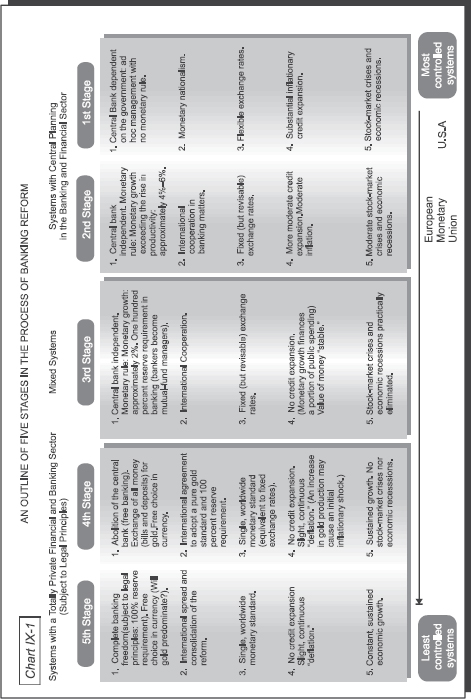
We must point out that Hart suggests the new paper money the central bank prints to back deposits be handed over to banks as a gift. If this occurs, it is obvious that banks’ balance sheets will reflect an enormous surplus, one precisely equal to the sum of demand deposits backed 100 percent by a reserve.
We might ask ourselves who should own the total of banks’ accounting assets which exceed their net worth. For the operation we have just described reveals that by functioning with a fractional reserve, private banks have historically created means of payment in the form of loans produced ex nihilo, and these loans have permitted banks to gradually expropriate wealth from the whole of the rest of society. Once we take into account the difference between banks’ income and expenditures each year, the aggregate wealth the banking system has expropriated in this way (by a process that produces the effects of a tax, just as inflation does for the government) is precisely equal to the assets banks possess in the form of real estate, branch offices, equipment and especially, the sum of their investments in loans to industry and trade, in securities acquired on the stock market and elsewhere, and in treasury bonds issued by the government.
Hart’s proposal that the basis of the reform consist of simply giving banks the sum of the bills they need to reach a 100-percent reserve ratio is a bitter pill to swallow. This method would make the total of private banks’ current assets unnecessary in the account books as backing for deposits, and hence, from an accounting viewpoint, they would automatically come to be considered the property of banks’ stockholders. Murray N. Rothbard has also advocated this solution, which does not seem equitable. For if any group of economic agents has historically taken advantage of the privilege of granting expansionary loans unbacked by real saving, it has precisely been the stockholders of banks (to the extent that the government has not at the same time partially expropriated the profits of this extremely lucrative activity, thus obliging banks to devote a portion of their created monetary stock to financing the very state).
The sum of private banks’ assets can and should be transferred to a series of security mutual funds, the management of which would become the main activity of private banking institutions following the reform. Who should be the holders of the shares in these mutual funds, which at the time of their conversion would have a value equal to the total value of all of the banking system’s assets (except those corresponding to the equity of its stockholders)? We propose that these shares in the new mutual funds to be created with the assets of the banking system be exchanged for the outstanding treasury bonds issued in all countries overwhelmed by a sizeable national debt. The idea is simple enough: the holders of treasury bonds would, in exchange for them, receive the corresponding shares in the mutual funds to be established with the assets of the banking system.This move would eliminate a large number (or even all) of the bonds issued by the government, which would benefit all citizens, since from that point on they would no longer have to pay taxes to finance the interest payments on the debt. Furthermore the current holders of treasury bonds would not be adversely affected, since their fixed-income securities would be replaced by mutual-fund shares which, from the time of the reform, would have a recognized market value and a rate of return.Moreover there are other government liabilities (for example, in the area of state social-security pensions) which could be converted into bonds and might also be exchanged for shares in the new mutual funds, either instead of or in addition to treasury bonds, and with highly beneficial economic effects.
Chart IX-2 shows a breakdown of the different accounting assets and liabilities which would appear on the consolidated balance sheet for the banking system once all bank deposits had been backed by a 100 percent reserve and mutual funds had been created with the system’s assets. From that point on, banks’ activities would simply consist of managing the mutual funds created with their assets, and bankers could obtain new loans (in the form of new shares in these funds) and invest them, while charging a small percentage as a fee for the management of this type of operation. Bankers could also continue to engage in the other (legitimate) activities they had always pursued in the past (the performance of payment, cashier and bookkeeping services, transfers, etc.), and they could charge the corresponding market prices for these services.
In any case, international cooperation (and fixed, but revisable exchange rates) would continue in this third stage, and once deposits were backed with a 100 percent reserve, credit expansion would completely disappear. As we have indicated, the central bank would be limited to increasing the size of the money supply by a small percentage and using this increase to finance a portion of state expenditures, as Maurice Allais proposes.In no case would this new money be used to make open-market purchases or directly expand credit, activities rampant in Argentina’s failed attempt at banking reform under General Perón. The reforms described above would lead to the almost complete elimination of stock-market crises and economic recessions. Beginning at that point, the behavior of savers and investors in the market would be very closely coordinated.
The establishment of a 100-percent reserve requirement is a necessary condition for the definitive abolition of the central bank, which would occur in the fourth stage. Indeed, once private banking is made subordinate to legal principles, complete banking freedom should be demanded, and remaining central-bank legislation could be eliminated, as could the central bank itself. This would require the replacement of today’s fiduciary money, which the central bank alone has the power to issue, with a form of private money. It is impossible to take a leap in the dark and establish an artificial monetary standard which has not emerged through an evolutionary process. Hence the new form of money should consist of the substance humanity has historically considered money par excellence: gold.
Murray N. Rothbard has devoted considerable thought to the process of exchanging for gold all bills already issued by the Federal Reserve, a step which would follow the establishment of a 100-percent reserve requirement on all bank deposits. Based on data from 1981, Rothbard reaches the conclusion that this exchange would be contingent on a gold price of $1,696 per ounce. Over the past fifteen years the price of the exchange has risen noticeably. Therefore, if we take into account that the current [1997] price of gold is around $350 an ounce, it is clear that in a country with an economy as large as that of the United States, the complete privatization of fiduciary money and its replacement with gold would require a nearly twenty-fold increase in the present market value of gold.This sharp rise in the price of gold would initially drive up its supply and perhaps cause an inflationary shock which we could hardly quantify, but which would be felt only once and would not exert any acute distorting effects on the real productive structure.
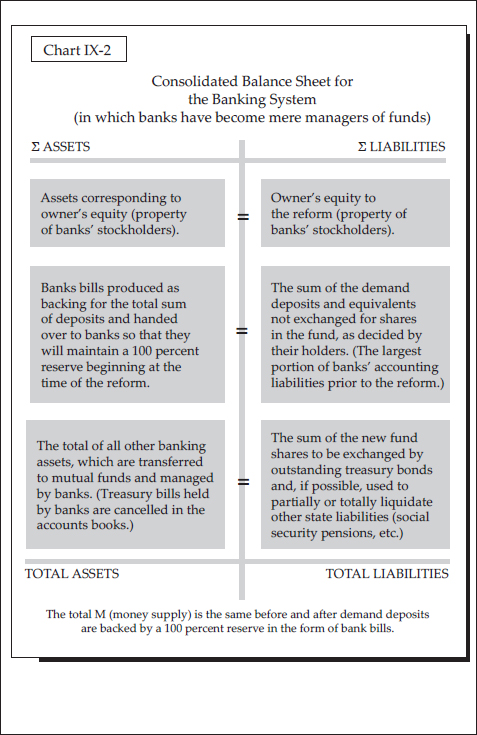
The fifth and last stage in the privatization of the financial and banking system would begin when the conditions of gold production and distribution had stabilized. This last stage would be characterized by absolute freedom in banking (though the system would be subject to legal principles, and hence, a 100-percent reserve requirement on demand deposits) and the existence of a single, worldwide pure gold standard with a 100-percent reserve ratio in an environment of slight, gradual “deflation” and sustained economic growth. At any rate, the evolutionary process of experimentation in the field of money and finance would continue, and it is impossible to predict whether gold would continue to be the currency chosen by the market as a medium of exchange, or whether future changes in social conditions would spontaneously, through a process of evolution, give rise to the emergence of an alternative standard.
In this fifth and last stage, in which a single gold standard would spread throughout the world, it would be advisable for the different countries to arrive at an international agreement designed to prevent the transition from having any unnecessary, real effects (apart from the initial, inflationary shock which would be unavoidable, since the jump in the value of gold would trigger an increased influx of the metal into the market). Such an agreement would stipulate the prior creation of a structure of fixed exchange rates between all currencies. This would make it possible to uniformly assess the entire world supply of fiduciary media and to redistribute among the economic agents and private banks of the different countries the stocks of gold held by the world’s central banks. This redistribution would be carried out in exact proportion to the sum of deposits and bills in each.
Thus would be the end of the final stage in the privatization of the banking and financial sector, and economic agents would reinitiate the spontaneous market process of experimentation in the field of money and finance, a process which was historically interrupted by the nationalization of money and the creation and fortification of central banks.
THE APPLICATION OF THE THEORY OF BANKING AND FINANCIAL REFORM TO THE EUROPEAN MONETARY UNION AND THE BUILDING OF THE FINANCIAL SECTOR IN ECONOMIES OF THE FORMER EASTERN BLOC
The above remarks on the reform of the western banking and financial system might be helpful in the design and management of the European Monetary Union, a topic that is currently sparking great interest among specialists in the field.
These considerations provide at least an indication of the direction European monetary reform should take at all times and of the dangers to avoid. It is evident we should steer clear of a system of monopolistic national currencies which compete with each other in a chaotic environment of flexible exchange rates. Moreover we should avoid maintaining a European central bank which prevents competition between currencies in a broad economic area, fails to meet the challenges of banking reform (100-percent reserve requirement), fails to guarantee a level of monetary stability at least as high as that of the most stable national currency at any given point in history and, in short, represents an insurmountable obstacle to subsequent reforms, i.e., the elimination of the central financial planning agency (the central bank). Therefore perhaps the most workable and appropriate model in the short and medium term would consist of the introduction throughout Europe of complete freedom of choice in currencies, both public and private and from both inside and outside the Union. The national currencies still in use due to tradition would be placed in a system of fixed exchange rateswhich would adjust the monetary policy of each country to the most solvent and stable policy among all the countries at any point in time. Thus the door would at least remain open to the possibility that nation-states in the European Union might in the future advance in the three fundamental areas of monetary and banking reform (freedom of choice in currency, free banking, and a 100-percent reserve requirement on demand deposits). In doing so, states would oblige the other Union members to follow their strong monetary leadership, as Maurice Allais maintains.
Once the European Central Bank was created on June 1, 1998, it became important that criticism of it and the single European currency center around the distance between this system and the ideal of a pure gold standard and 100-percent reserve requirement. Many libertarian theorists (mainly those of the Chicago School) mistakenly focus their criticism on the fact that the new arrangement does away with the former system of monetary nationalism and flexible exchange rates.
However, a single European monetary standard which is as rigid as possible would represent a healthy step toward a pure gold standard. Furthermore it would complete the institutional framework of the European free-trade system, since it would preclude monetary interference and manipulation on the part of each member country and oblige those countries with more rigid economic structures (Germany and France, for example) to introduce the flexibility they need to compete in an environment in which resorting to inflationary national monetary policies to compensate for structural rigidities is no longer an option.
Some very similar thoughts could be applied to the necessary establishment of a financial and banking system in the economies of the former Eastern bloc. While we must recognize that these economies start from a highly unfavorable position after decades of central planning, the present transition toward a market economy offers a unique and crucially important opportunity to avoid the major errors committed in the West up to now and to advance directly to at least the third or fourth stage in our reform plan. At the same time, a jump straight to the fourth stage would be quite feasible in the former Soviet Union, where abundant gold reserves would permit the establishment of a pure gold standard, a measure which would benefit the nation a great deal. At any rate, if these countries fail to learn from the experience of others and attempt, in awkward imitation of the West, to set up a fractional-reserve banking system directed by a central bank, the financial pressures of each moment will lead to policies of rampant credit expansion and enormous harm to the productive structure. Such policies will foster feverish speculation and create a climate of social unrest which might even endanger the overall transition of these societies to a full-fledged market economy.
6
CONCLUSION: THE BANKING SYSTEM OF A FREE SOCIETY
The theory of money, bank credit, and financial markets represents the greatest theoretical challenge confronting economists in the twenty-first century. In fact it is no stretch to claim that once the theoretical gap embodied by the analysis of socialism was filled, perhaps the most important, yet least-understood field was that of money. For, as we have attempted to reveal in detail throughout this book, this area is fraught with methodological errors, theoretical confusion and, as a result, systematic government coercion. The social relationships in which money is involved are by far the most abstract and obscure, and the knowledge generated through them is the most vast, complex, and difficult to grasp. Consequently the systematic coercion of governments and central banks in this field is by far the most damaging. In any case the intellectual delay in the theory of money and banking has severely affected the development of the world economy, as we see from the acute, recurrent cycles of boom and recession which continue to grip market economies since the dawn of the new millennium.
Nevertheless economic thought on banking issues is quite long-standing, and as we have seen, can be traced back even to the scholars of the School of Salamanca. Closer to our time, we find the controversy between the Banking and Currency Schools, a debate which laid the foundation for the development of subsequent doctrine. We have made an effort to demonstrate the absence of complete agreement between the Free-Banking School and the Banking School, on the one hand, and between the Central-Banking School and the Currency School, on the other. Many free-banking advocates did base their position on the fallacious, unsound inflationary arguments of the Banking School, and most Currency School theorists did plan to reach their objectives of financial solvency and economic stability via the inception of a central bank to curb abuses. However, from the very beginning, certain able Currency School theorists found it impossible and utopian to believe the central bank would do anything but further aggravate the problems that had emerged. These scholars were aware that the best way to limit the creation of fiduciary media and to achieve monetary stability was through a free-banking system governed, like all other economic agents, by the traditional principles of civil and commercial law (i.e., a 100-percent reserve requirement on demand deposits). Paradoxically, nearly all Banking School defenders ended up cheerfully accepting the establishment of a central bank which, as lender of last resort, would guarantee and perpetuate the expansionary privileges of the private banking system. Mean-while private bankers sought with increasing determination to participate in the lucrative “business” of generating fiduciary media by credit expansion without having to give too much thought to problems of liquidity, due to the support offered at all times by the central bank, the lender of last resort.
Furthermore, although Currency School theorists were correct in almost all of their theoretical contributions, they were unable to see that every one of the drawbacks they rightly perceived in the freedom of private banks to issue fiduciary media in the form of banknotes were also inherent in the “business” of granting expansionary loans against demand deposits at banks, though in this case the drawbacks were more concealed and surreptitious, and hence much more dangerous. These theorists also committed an error when they claimed the most appropriate policy would be to introduce legislation to abolish merely the freedom to issue banknotes unbacked by gold and to set up a central bank to defend the most fundamental monetary principles. Only Ludwig von Mises, who followed the tradition of Modeste, Cernuschi, Hübner, and Michaelis, was capable of realizing that the Currency School’s prescription of a central bank was a mistake, and that the best and only way to uphold the school’s sound monetary principles was through a free-banking system subject without privileges to private law (i.e., with a 100-percent reserve requirement).
The failure of most Currency School theorists was fatal. These theorists were responsible for the fact that Peel’s Act of 1844, despite the honorable intentions behind it, failed to eliminate the creation of fiduciary deposits, though it prohibited the issuance of unbacked banknotes. Moreover members of the Currency School also defended the institution of a central-banking system which, mainly due to the negative influence of Banking School theorists, would eventually be used to justify and promote policies of monetary recklessness and financial excess, policies much more foolish than those theorists originally sought to remedy.
Therefore the central bank, understood as a central planning agency in the field of money and banking, cannot be considered a natural product of the evolution of the free market. On the contrary, it has been dictatorially imposed from the outside as a result of governments’ attempts to profit from the highly lucrative possibilities of fractional-reserve banking. In fact governments have deviated from their essential role, as they have ceased to adequately define and defend the property rights of bank depositors, and they have taken advantage of the practically unlimited possibilities of money and credit creation which the establishment of a fractional-reserve ratio (on bills and deposits) has opened up for them. Thus in the violation of the private-property-law principles which apply to demand deposits, governments have largely found their longed-for philosopher’s stone, which has provided them with unlimited financing without requiring them to resort to taxes.
The construction of a true free-banking system must coincide with the reestablishment of a 100-percent reserve requirement on amounts received as demand deposits. The original neglect of this obligation led to all the banking and monetary issues which have given rise to the current financial system, with its high level of government intervention.
The idea is ultimately to apply a seminal idea of Hayek’s to the field of money and banking. According to this idea, whenever a traditional rule of conduct is broken, either through institutional government coercion or the granting of special privileges by the state to certain people or organizations, sooner or later grave, undesirable consequences always ensue and cause serious damage to the spontaneous process of social cooperation.
As we saw in the first three chapters, the traditional rule of conduct transgressed in the banking business is the legal principle that the safekeeping obligation, an essential element in a non-fungible deposit, manifests itself, in the contract governing the deposit of a fungible good (for example money), in the requirement that a reserve of 100 percent of the fungible good (money) received on deposit be maintained constantly. Hence any use of such money, specifically the granting of loans against it, implies a violation of this principle and thus, an illegitimate act of misappropriation.
At each stage in history, bankers have promptly become tempted to breach this traditional rule of conduct and make self-interested use of their depositors’ money. At first they did so secretively and with a sense of shame, since they were still aware of the dishonest nature of their behavior. Only later did bankers manage to make the violation of the traditional legal principle an open and legal practice, when they obtained from the government the privilege of using their depositors’ money, almost always in the form of loans, which initially were often granted to the government itself. Thus arose the relationship of complicity and the coalition of interests which have become customary between governments and banks and explain the current “understanding” and “cooperation” between these two types of institutions. Such a climate of collaboration is evident, with only subtle differences, in all western countries under almost all circumstances. For bankers soon realized that the violation of the above traditional legal principle led to a financial activity which earned them fat profits, but which in any case required the existence of a lender of last resort, the central bank, to provide the necessary liquidity in the moments of crisis which experience taught would always reappear sooner or later. The central bank would also be responsible for orchestrating increases in joint, coordinated credit expansion and for imposing on all citizens the legal tender regulations of its own monopolistic currency.
Nevertheless the unfortunate social consequences of this privilege granted to bankers (yet to no other institution or individual) were not entirely understood until Mises and Hayek developed the Austrian theory of economic cycles, which they based on the theory of money and capital and we analyzed in chapters 5 through 7. In short, Austrian theorists have demonstrated that the pursuit of the theoretically impossible (from a legal-contractual and technical-economic standpoint) goal of offering a contract comprised of fundamentally incompatible elements, a contract which combines ingredients typical of mutual funds (particularly the possibility of earning interest on “deposits”) with those typical of a traditional deposit contract (which by definition must permit the withdrawal of the nominal value at any time) will always, sooner or later, trigger certain spontaneous readjustments. Initially these readjustments take the form of the uncontrolled expansion of the money supply, inflation, and generalized poor allocation of productive resources on a microeconomic level. Eventually they manifest themselves in financial crisis, an economic recession, the elimination of the errors exerted on the productive structure by credit expansion, and massive unemployment.
It is important to understand that the privilege which allows banks to operate with a fractional reserve represents an obvious attack by government authorities on the correct definition and defense of depositors’ private-property rights, when respect for these rights is essential to the proper functioning of any market economy. As a result, a typical “tragedy of the commons” effect invariably appears, as it does whenever property rights are not adequately defined and defended. This effect consists of an increased inclination on the part of bankers to try to get ahead of their competitors by expanding their own credit base sooner and more than their rivals. Consequently the fractional-reserve banking system always tends toward more or less rampant expansion, even when it is “monitored” by central bankers who, contrary to what has normally occurred in the past, seriously (and not just rhetorically) concern themselves with setting limits.
In short, the essential goal of monetary policy should be to subject banks to the traditional principles of civil and commercial law, according to which each individual and company must fulfill certain obligations (100-percent reserve requirement) in strict keeping with the terms agreed to in each contract.
At the same time, we should be strongly critical of most of the literature which, following the publication in the late seventies of Hayek’s book, Denationalization of Money, has defended a model of fractional-reserve free banking. The most important conclusion to draw from all of this literature is that its authors too often fail to realize that they frequently commit the old errors of the Banking School. As we explained in chapter 8, this is true of the works of White, Selgin, and Dowd. There is nothing wrong with their attention to the advantages of an interbank clearing system in terms of self-control in credit expansion, and in this sense their system would produce better results than the current central-banking system, as Ludwig von Mises originally pointed out. However fractional-reserve free banking is still a second best which would not keep a wave of excessive optimism in loan concession from triggering the joint action of different banks. At any rate, these authors fail to see that as long as the fractional-reserve privilege remains, it will be impossible in practice to dispense with the central bank. In brief, as we have argued in this book, the only way to eliminate the central planning agency in the field of banking and credit (the central bank) is to do away with the fractional-reserve privilege private bankers currently enjoy. This is a necessary measure, though it is not sufficient: the central bank must still be completely abolished and the fiduciary money it has created up to now must be privatized.
In conclusion, if we wish to build a truly stable financial and monetary system for the twenty-first century, a system which will protect our economies as far as humanly possible from crises and recessions, we will have to: (1) ensure complete freedom of choice in currency, based on a metallic standard (gold) which would replace all fiduciary media issued in the past; (2) establish a free-banking system; and, most importantly, (3) insist that all agents involved in the free-banking system be subject to and comply with traditional legal rules and principles, especially the principle that no one, not even a banker, can enjoy the privilege of loaning something entrusted to him on demand deposit (i.e., a free-banking system with a 100-percent reserve requirement).
Until specialists and society in general fully grasp the essential theoretical and legal principles associated with money, bank credit, and economic cycles, we may realistically expect further suffering in the world due to damaging financial crises and economic recessions which will inevitably and perpetually reappear until central banks lose their power to issue paper money with legal tender and bankers lose their government-granted privilege of operating with a fractional reserve. We now wrap up the book as we began it, with this opinion: Now that we have seen the historic fall of socialism, both in theory and in practice, the main challenge to face both professional economists and lovers of freedom in this century will be to use all of their intellectual might to oppose the institution of the central bank and the privilege private bankers now enjoy.
_____________
Mises, The Theory of Money and Credit, pp. 446–48; italics added. This is the best and most recent English edition of Mises’s book. The above excerpt, in Mises’s exact words, follows:
Es leuchtet ein, dass menschlicher Einfluss aus dem Umlaufsmittelwesen nicht anders ausgeschaltet werden kann als durch die Unterdrückung der weiteren Ausgabe von Umlaufsmitteln. Der Grundgedanke der Peelschen Akte müsste wieder aufgenommen und durch Miteinbeziehung der in Form von Kassenführungsguthaben ausgegebenen Umlaufsmittel in das gesetzliche Verbot der Neuausgabe in vollkommenerer Weise durchgeführt werden als dies seinerzeit in England geschah. . . . Es wäre ein Irrtum, wollte man annehmen, dass der Bestand der modernen Organisation des Tauschverkehres für die Zukunft gesichert sei. Sie trägt in ihrem Innern bereits den Keim der Zerstörung. Die Entwicklung des Umlaufsmittels muss notwendigerweise zu ihrem Zusammenbruch führen. (Mises, Theorie des Geldes und der Umlaufsmittel, pp. 418–19)
Mises, Geldwertstabilisierung und Konjunkturpolitik, p. 81; English translation On the Manipulation of Money and Credit, pp. 57–173. The above excerpt appears on pp. 167–68 and the italics have been added. The exception Mises includes between dashes indicates that he, in keeping with the spirit of Peel’s Act, merely calls for a 100 percent reserve in relation to newly-issued fiduciary media (deposits and banknotes) which would mean that the stock of these already issued at the time the reform is launched would remain unbacked by specie. The implementation of Mises’s proposal would represent a large step forward and in practice could be achieved quite easily without initially producing substantial changes in the market value of gold. However the proposal is imperfect. It would leave banks without backing on those bills and deposits issued in the past, and banks would thus be particularly vulnerable to possible crises of confidence. Therefore in this chapter we propose a more radical program consisting of a 100-percent reserve requirement on all fiduciary media (whether already issued or not). Bettina Bien Greaves has developed Mises’s proposal in detail in “How to Return to the Gold Standard,” The Freeman: Ideas on Liberty (November 1995): 703–07.
This memorandum had been forgotten and was rediscovered in the League of Nations archives when Richard M. Ebeling was preparing materials for the book, Money, Method, and the Market Process, pp. 78–95. The above excerpt appears on p. 90; italics added.
Ibid., p. 91; italics added.
Mises’s exact words follow:
Wenn heute, dem Grundgedanken der Currency-Lehre entsprechend, auch für das Kassenführungsguthaben volle— hundertprozentige—Deckung verlangt wird, damit die Erweiterung der Umlaufsmittelausgabe auch in dieser Gestalt unterbunden werde, dann ist das folgerichtiger Ausbau der Ideen, die jenem alten englischen Gesetz zugrundelagen. . . . Auch das schärfste Verbot der Erweiterung der Umlaufsmittelausgabe versagt gegenüber einer Notstandsgesetzgebung. (Mises, Nationalökonomie, 2nd ed. [Munich: Philosophia Verlag, 1980, p. 403)
In this sense, Mises’s footnote on p. 402 of Nationalökonomie is particularly illustrative. It reads:
Für die Katallaktik ist der Begriff “normale Kreditausweitung” sinnlos. Jede Kreditausweitung wirkt auf die Gestaltung der Preise, Löhne und Zinssätze und löst den Prozess aus, den zu beschreiben die Aufgabe der Konjunkturtheorie ist.
This footnote was later translated into English on p. 442 of the 3rd rev. ed. of Human Action:
The notion of “normal” credit expansion is absurd. Issuance of additional fiduciary media, no matter what its quantity may be, always sets in motion those changes in the price structure the description of which is the task of the theory of the trade cycle. Of course, if the additional amount issued is not large, neither are the inevitable effects of the expansion.
This statement from Mises has generated substantial confusion among those members of the Austrian School who defend a fractional-reserve free-banking system (White, Selgin, Horwitz, etc.). The assertion reveals Mises’s belief that such a system would not escape the phases of expansion and recession characteristic of the economic cycle (though they would be less severe than those which affect current banking systems backed by a central bank). Remember also what we said in footnote 120 of chapter 8.
Mises, Human Action, 3rd ed., p. 443. Here, for the first time, Mises indicates that the problems related to the banking system stem from the fact that its participants are not subject to traditional legal principles. This is the fundamental idea Murray N. Rothbard would later develop and which lies at the heart of our thesis.
Mises, The Theory of Money and Credit, pp. 481 and 491; italics added.
Despite Mises’s crystal clear statements in favor of a 100-percent reserve requirement, his defense of free banking as an indirect step toward the ideal of a 100 percent reserve (and thus toward a banking system subject to traditional legal principles) has prompted some Austrian theorists of the modern Neo-Banking School to make a self-interested interpretation of Mises’s position. Thus these theorists view Mises as a defender of fractional-reserve free banking first, and of banking with a 100 percent reserve second. For instance, see White, “Mises on Free Banking and Fractional Reserves,” pp. 517–33. In an interesting article, Joseph T. Salerno recently showed White’s position to be untenable:
because he overlooks important passages in the very works of Mises that he cites, and because he ignores significant developments in Mises’s theory of money that occurred between the publication of the first German edition of The Theory of Money and Credit in 1912 and the publication of Nationalökonomie in 1940. (Salerno, “Mises and Hayek Dehomogenized,” pp. 137–46)
Hayek, “The Monetary Policy of the United States after the Recovery from the 1920 Crisis,” chapter 1 of Money, Capital and Fluctuations: Early Essays, p. 29; italics added. This article is the English translation of the theoretical portion of the original, which was published in German with the title, “Die Währungspolitik der Vereinigten Staaten seit der Überwindung der Krise von 1920,” Zeitschrift für Volkswirtschaft und Sozialpolitik, vols. 1–3, no. 5 (1925): 25–63 and vols. 4–6, pp. 254–317.
Hayek, Monetary Nationalism and International Stability, pp. 81–84, esp. p. 82; italics added. Hayek especially praises the proposal for a 100-percent reserve requirement “because it goes to the heart of the problem” (p. 81). Hayek sees only one disadvantage in this plan, apart from its being “somewhat impracticable”: it seems unlikely that unbacked bank deposits would not appear in some other legal form, given that “banking is a pervasive phenomenon” (p. 82). Later we will deal with this objection.
Hayek, Denationalization of Money, pp. 94–95 and p. 55. The above excerpts appear on p. 119 of the 2nd rev. expanded ed. (London: Institute of Economic Affairs, 1978). Hayek also calls for the drawing of a definite distinction between simple deposit banking (to which a 100-percent reserve requirement would apply) and investment banking, which would be limited to the lending of those funds customers first lend their banks. Hayek concludes:
I expect that it will soon be discovered that the business of creating money does not go along well with the control of large investment portfolios or even control of large parts of industry. (pp. 119–20, 2nd ed.)
Sharp, yet just criticism of Hayek’s other proposals related to the denationalization of money and the establishment of a currency based on a commodities index (which are only indirectly related to our object of study) appears in Murray N. Rothbard, “The Case for a Genuine Gold Dollar,” in The Gold Standard, Llewellyn H. Rockwell, Jr., ed. (Lexington, Mass.: Lexington Books), 1985, pp. 2–7.
In Search of a Monetary Constitution, Leland B. Yeager, ed. (Cambridge, Mass.: Harvard University Press, 1962).
Murray N. Rothbard, The Case for a 100 Percent Gold Dollar (Auburn, Ala.: Ludwig von Mises Institute, 1991), pp. 44–46.
In September 1993, for the first time, we personally shared with Murray N. Rothbard the results of our research on the legal-Roman foundation of the bank deposit and the position of Salamancan theorists on the issue, and Rothbard was enthusiastic. He later encouraged us to publish a brief summary of our conclusions in an article for Review of Austrian Economics. Unfortunately he was unable to see the article published, as he passed away unexpectedly on January 7, 1995. Other important works in which Rothbard deals with the topic include: What Has Government Done to Our Money?, 4th ed. (Auburn, Ala.: Ludwig von Mises Institute, 1990); The Mystery of Banking; Man, Economy, and State, pp. 703–09; and the articles, “The Myth of Free Banking in Scotland,” pp. 229–45, and “Aurophobia: or Free Banking on What Standard?”pp. 99–108. Besides Murray Rothbard, in the United States current advocates of a 100-percent reserve requirement for banking include: Hans-Hermann Hoppe, The Economics and Ethics of Private Property (Dortrecht, Holland: Kluwer Academic Publishers, 1993), pp. 61–93, and “How is Fiat Money Possible?—or The Devolution of Money and Credit,” pp. 49–74; Joseph T. Salerno, “Gold Standards: True and False,” Cato Journal: An Interdisciplinary Journal of Public Policy Analysis 3, no. 1 (Spring, 1983): 239–67, and also “Mises and Hayek Dehomogenized,” pp. 137–46; Walter Block, “Fractional Reserve Banking: An Interdisciplinary Perspective,” pp. 24–32; and Skousen, The Economics of a Pure Gold Standard. This last work is a doctoral thesis on a 100-percent reserve requirement for banking, and it contains an especially valuable, exhaustive review of all related sources to date. Like Rothbard, the above theorists belong to the long line of American thinkers (beginning with Jefferson and Jackson) who assert that banking should be rigorously governed by legal principles and a 100-percent reserve requirement. The most important nine-teenth-century theorist of this movement was Amasa Walker, The Science of Wealth, pp. 138–68 and 184–232.
Maurice Allais, “Les conditions monétaires d’une économie de marchés: des enseignements du passé aux réformes de demain,” Revue d’économie politique 3 (May–July 1993): 319–67. The above excerpt appears on p. 326, and the original text reads:
Le mécanisme du crédit tel qu’il fonctionne actuellement et qui est fondé sur la couverture fractionnaire des dépôts, sur la création de monnaie ex nihilo, et sur le prêt à long terme de fonds empruntés à court terme, a pour effet une amplification considérable des désordres constatés. En fait, toutes les grandes crises des dix-neuvième et vingtième siècles ont résulté du développement excessif du crédit, des promesses de payer et de leur monétisation, et de la spéculation que ce développement a suscitée et rendue possible. (Italics added)
Maurice Allais introduced his theses to the general public in his well-known article, “Les faux monnayeurs,” published in Le Monde, October 29, 1974. Allais also presents them in chapters 6–9 of the book, L’impôt sur le capital et la réforme monétaire (Paris: Hermann Éditeurs, 1989), pp. 155–257. In 1994 our critical evaluation of fractional-reserve banking was also published in France in Huerta de Soto, “Banque centrale ou banque libre,” pp. 379–91.
For example, see the quotations from Murray N. Rothbard’s work on pp. 316, 317 and 320 of Allais’s book, L’impôt sur le capital et la réforme monétaire. See also references to Amasa Walker on p. 317, and especially to Ludwig von Mises, whose book, The Theory of Money and Credit, Allais is perfectly familiar with and quotes on various occasions, among others, on pp. 355, 307 and 317. Moreover Maurice Allais pays warm tribute to Ludwig von Mises:
Si une société libérale a pu être maintenue jusqu’ à présent dans le monde occidental, c’est pour une grande part grâce à la courageuse action d’hommes comme Ludwig von Mises (1881–1973) qui toute leur vie ont constamment défendu des idées impopulaires à l’encontre des courants de pensée dominants de leur temps. Mises était un homme d’une intelligence exceptionelle dont les contributions à la science économique ont été de tout premier ordre. Constamment en butte à de puissantes oppositions, il a passé ses dernières années dans la gêne, et sans l’aide de quelques amis, il n’aurait guère pu disposer d’une vie décente. Une société qui n’est pas capable d’assurer à ses élites, et en fait à ses meilleurs défenseurs, des conditions de vie acceptables, est une société condamnée. (p. 307)
Although in practice Maurice Allais fully agrees with the analysis and prescriptions of the Austrian School on matters of money and cycles, he embraces the mathematical development of the general equilibrium model and thereby separates radically from the Austrians, as certain fundamental errors in his analysis attest (Huerta de Soto, Socialism, Economic Calculation and Entrepreneurship, pp. 153–54). Pascal Salin has therefore concluded that rather than a liberal economist of the same type as Hayek, Maurice Allais is a “social engineer ” with strong personal laissez-faire leanings, a theorist whose mathematical analysis often leads him to a pragmatic utilitarianism which Hayek and Austrian scholars in general would clearly label “constructivist” or “scientistic.” See Pascal Salin, “Maurice Allais: Un économiste liberal?” manuscript pending publication, p. 12. Salin has also published a paper in which he analyzes the Austrian theory of economic cycles and the banking-policy prescriptions that derive from it. See Pascal Salin, “Macro-Stabilization Policies and the Market Process,” Economic Policy and the Market Process: Austrian and Mainstream Economics, K. Groenveld, J.A.H. Maks, and J. Muysken, eds. (Amsterdam: North-Holland, 1990), pp. 201–21. In footnote 98 of chapter 8, we explain why we cannot agree with Salin’s stance in favor of fractional-reserve free-banking.
See Ronnie J. Phillips, The Chicago Plan and New Deal Banking Reform (Armonk, N.Y.: M.E. Sharpe, 1995), pp. 191–98. See also Jeromir Benes and Michael Kumhof, “The Chicago Plan Revisited,” IMF Working Paper, February 12, 2013.
Albert G. Hart, “The ‘Chicago Plan’ of Banking Reform,” Review of Economic Studies 2 (1935): 104–16. The reference to professors Mises and Hayek appears at the foot of p. 104. Another interesting precedent for the Chicago Plan is found in a book by Frederick Soddy, a recipient of the Nobel Prize for Chemistry: Wealth, Virtual Wealth and Debt (New York: E.P. Dutton, 1926). Knight wrote a favorable review of Soddy’s book that same year: “Review of Frederick Soddy’s Wealth, Virtual Wealth and Debt,” Saturday Review of Literature (April 16, 1927): 732.
James W. Angell, “The 100 Percent Reserve Plan,” The Quarterly Journal of Economics 50, no. 1 (November 1935): 1–35.
Henry C. Simons, “Rules versus Authorities in Monetary Policy,” Journal of Political Economy 44, no. 1 (February 1936): 1–30.
Simons, “Rules versus Authorities in Monetary Policy,” p. 181; reprinted as chapter 7, Economic Policy for a Free Society (Chicago: University of Chicago Press, 1948), pp. 181. It is highly significant that Simons makes this legal-institutional analysis in precisely the article in which he offers his proposal for banking reform based on a 100-percent reserve requirement.
Henry C. Simons, “A Positive Program for Laissez-Faire: Some Proposals for a Liberal Economic Policy,” originally published as “Public Policy Pamphlet,” no. 15, Harry D. Gideonse, ed. (Chicago: University of Chicago Press, 1934). It was reprinted as chapter 2 of Economic Policy for a Free Society, pp. 64–65. On Henry Simons see Walter Block, “Henry Simons is Not a Supporter of Free Enterprise,” Journal of Libertarian Studies 16, no. 4 (Fall, 2002): 3–36.
Henry C. Simons, in footnote 7 on p. 320 of his Economic Policy for a Free Society, adds:
There is likely to be extreme economic instability under any financial system where the same funds are made to serve at once as investment funds for industry and trade and as the liquid cash reserves of individuals. Our financial structure has been built largely on the illusion that funds can at the same time be both available and invested—and this observation applies to our savings banks (and in lesser degree to many other financial institutions) as well as commercial, demand-deposit banking.
Fritz Lehmann, “100 Percent Money,” Social Research 3, no. 1: 37–56.
Frank D. Graham, “Partial Reserve Money and the 100 Percent Proposal,” American Economic Review 26 (1936): 428–40.
Irving Fisher, 100 Percent Money (New York: Adelphi Company, 1935).
Lloyd W. Mints, Monetary Policy for a Competitive Society (New York, 1950), pp. 186–87.
Milton Friedman, A Program for Monetary Stability (New York: Fordham University Press, 1959). Friedman first published his ideas on a 100-percent reserve requirement in 1948 in his article, “A Monetary and Fiscal Framework for Economic Stability,” American Economic Review 38, no. 3 (1948): 245–64. Rothbard’s criticism of Friedman is in his article, “Milton Friedman Unraveled,” Journal of Libertarian Studies 16, no. 4 (Fall, 2002): 37–54.
Friedman, A Program for Monetary Stability.
Friedman does not mention Mises, who, nearly fifty years earlier in German and twenty-five years earlier in English, had already put forward a detailed version of the same theory. Milton Friedman, A Program for Monetary Stability, footnote 10. Gary Becker ’s proposal was many years later published: Gary S. Becker, “A Proposal for Free Banking,” Free Banking, vol. 3: Modern Theory and Policy, White, ed., chap. 2, pp. 20–25. Though Gary Becker could easily be classified with modern neo-banking advocates of fractional-reserve free banking, he recognizes that, in any case, a system which includes a 100-percent reserve requirement would be a considerable improvement on the current financial and banking system (p. 24).
Irving Fisher also dealt with the legal aspects of a 100-percent reserve requirement. He indicated that in this system
demand deposits would literally be deposits, consisting of cash held in trust for the depositor . . . the check deposit department of the bank would become a mere storage ware-house for bearer money belonging to its depositors. (Irving Fisher, 100 Percent Money, p. 10)
Unfortunately Fisher ’s underlying economic theory was monetarist, and hence he never understood how the credit expansion which results from fractional-reserve banking affects society’s structure of productive stages. Moreover Fisher recommended an indexed standard be established and the government retain control over monetary policy, to which Ludwig von Mises responded with sharp criticism (Human Action, pp. 442–43). Specifically, Fisher ’s use of the monetarist equation of exchange led to important errors in his theoretical analysis and economic forecasting. Fisher failed to see that aside from the macroeconomic effects accounted for by his formula, growth in the money supply distorts the productive structure and inexorably feeds crises and recessions. Thus in the late 1920s Fisher thought economic expansion would continue “indefinitely” and did not realize that it rested on an artificial foundation which was condemned to failure. Indeed, the Great Depression of 1929 took him completely by surprise and nearly ruined him. On the intriguing personality of this American economist, see Irving N. Fisher’s book, My Father Irving Fisher (New York: A Reflection Book, 1956), and the biography by Robert Loring Allen, Irving Fisher: A Biography.
As Pascal Salin states in his article on Maurice Allais, “Toute l’histoire monétaire montre que l’État a refusé de respecter les règles monétaires et que la source ultime de l’inflation provient de ce défaut institutionnel.” Pascal Salin, “Maurice Allais: un économiste liberal?” p. 11. Thus we cannot trust that a central bank, which will always be influenced to some extent by the current political scene, will be able to maintain a monetary policy which immunizes society against the evils of economic cycles, even if the desire is present and a 100-percent reserve requirement is established for private banking. This is so because nothing bars the central bank from directly financing state expenditures or, via open-market operations, acquiring massive numbers of treasury bonds and other securities, and thus injecting liquidity into the system through the capital market and temporarily distorting the interest rate and society’s structure of productive stages. This would set in motion the inexorable mechanisms of economic cycles, which would trigger a severe depression. This is the prima facie argument against the conservation of the central bank, and it shows the necessity of combining the re-establishment of legal principles in private banking with the complete deregulation of the sector and the abolition of the central bank. On the traditional strong leaning toward interventionism of the Chicago School, see “Symposium: Chicago versus the Free Market,” Journal of Libertarian Studies 16, no. 4 (Fall, 2002).
On the Keynesian side, James Tobin, who received the Nobel Prize for Economics in 1981, has proposed a “deposit currency” system which incorporates many aspects of the Chicago Plan for a 100-percent reserve requirement. See his “Financial Innovation and Deregulation in Perspective,” Bank of Japan Monetary and Economic Studies 3 (1985): 19–29. See also the comments Charles Goodhart makes on Tobin’s proposal of a 100-percent reserve requirement in his The Evolution of Central Banks, pp. 87ff. Tobin seems to follow the tradition of Lauchlin Currie, The Supply and Control of Money in the United States (1934; New York: Russell & Russell, 1968). More recently Alex Hocker Pollock has again defended a similar banking system in his article, “Collateralized Money: An Idea Whose Time Has Come Again?” Durrell Journal of Money and Banking 5, no. 1 (March 1993): 34–38. The main disadvantage of Pollock’s proposal is that it indicates reserves should be held not in money, but in assets with a market value that makes them easy to liquidate.
On the theory of the emergence of institutions, specifically money, see Menger, Untersuchungen über die Methode der Socialwissenschaften und der Politischen Ökonomie insbesondere and “On the Origin of Money,” pp. 239–55. We should also remember Mises’s monetary regression theorem, according to which the price or purchasing power of money is determined by its supply and demand, which is in turn determined not by its purchasing power today, but by the knowledge the actor formed on its purchasing power yesterday. At the same time, the purchasing power of money yesterday was determined by the demand for money which developed based on the knowledge of its purchasing power the day before yesterday. We could trace this pattern back to the moment when, for the first time in history, people began to demand a certain good as a medium of exchange. Therefore this theorem reflects Menger ’s theory on the spontaneous emergence and evolution of money, but in this case there is a retroactive effect. Mises’s monetary regression theorem is of capital importance in any project for reforming the monetary system, and it explains why in this field there can be no “leaps in the dark,” attempts to introduce ex novo monetary systems which are not the result of evolution and which, as in the case of Esperanto with respect to language, would inevitably be condemned to failure. On the monetary regression theorem, see Mises, Human Action, pp. 409–10, 425 and 610. The introduction in the market of new payment technologies (first paper, then plastic cards, and now electronic “money”) does not affect at all the conclusion of our analysis. It is not possible nor convenient to try to introduce a constellation of private fiat electronic moneys competing among themselves in a chaotic world of flexible exchange rates, especially when we already know the final result of the secular and free monetary evolution of humankind: a single worldwide commodity (gold) that cannot be manipulated either by private individuals or public servants. For these reasons we cannot accept the proposal of Jean Pierre Centi, “Hayekian Perspectives on the Monetary System: Toward Fiat Private and Competitive Moneys,” in Austrian Economics Today I, The International Library of Austrian Economics, Kurt R. Leube, ed. (Frankfurt: FAZ Buch, 2003), pp. 89–104. See also footnote 104.
The best-known plan for the denationalization of money appears in Hayek’s 1976 book, Denationalisation of Money. Nevertheless Hayek’s follies in support of artificial monetary standards began thirty years earlier: “A Commodity Reserve Currency,” Economic Journal 53, no. 210 (June– September 1943): 176–84 (included as chapter 10 of Individualism and Economic Order, pp. 209–19). While we consider Hayek’s Mengerian analysis of the evolution of institutions to be correct, and we agree that it would be highly beneficial to permit in the monetary field as well the private experimentation characteristic of markets, we find it regrettable that Hayek ultimately proposed a completely artificial standard (comprised of a basket of various commodities) as a new monetary unit. Although one can interpret Hayek’s proposal as a procedure for returning to traditional money (a pure gold standard and a 100-percent reserve requirement), Hayek clearly earned the criticism certain Austrian economists leveled against him. These economists judged his proposals quite severely and called them “scientistic” and “constructivist.” Among the critics were Murray N. Rothbard, Hans-Hermann Hoppe and Joseph T. Salerno, “Mises and Hayek Dehomogenized.” The same objections can be made to the very similar proposal of Leland B. Yeager, “The Perils of Base Money,” p. 262.
Silver could also be considered a secondary, parallel metallic standard which, if economic agents should wish, could coexist with gold at the fluctuating exchange rate determined by the market between the two at all times. Furthermore we must recognize that the decline in the use of silver as money was accelerated when nineteenth-century governments established fixed exchange rates between gold and silver which artificially undervalued the latter. See Rothbard, Man, Economy, and State, pp. 724–26.
The pure gold standard we propose does not remotely resemble the spurious gold standard used until the 1930s, a standard based on the existence of central banks and a fractional-reserve banking system. As Milton Friedman indicates:
A real honest-to-God gold standard . . . would be one in which gold was literally money and money literally gold, under which transactions would literally be made in terms either of the yellow metal itself, or of pieces of paper that were 100-percent warehouse certificates for gold. (Milton Friedman, “Has Gold Lost its Monetary Role?” in Milton Friedman in South Africa, Meyer Feldberg, Kate Jowel, and Stephen Mulholland, eds. )
On the economic theory of gold see chapter 8 (“The Theory of Commodity Money: Economics of a Pure Gold Standard”) of Mark Skousen’s book, The Structure of Production, pp. 265–81.
Laureano Figuerola, Escritos económicos, preliminary study by Francisco Cabrillo Rodríguez, ed. (Madrid: Instituto de Estudios Fiscales, 1991), p. 268. This assertion, which even Mises and Hayek themselves could not have worded more accurately, appears in the report Laureano Figuerola delivered to the Spanish Constituent Assembly on February 22, 1869.
In short, we recommend replacing the current web of administrative legislation which regulates banks with a few simple articles to be established in the Penal and Commercial Codes. For instance, in Spain, the entire body of banking legislation could be eliminated and simply replaced with new Articles 180 and 182 of the Commercial Code. The text of these new articles might resemble the following (excerpts which differ from the current phrasing are shown in italics):
Article 180: Banks will hold in their vaults an amount of cash equal to the total value of deposits, checking accounts and bills in circulation.
Article 182: The sum of the bills in circulation, together with the amount corresponding to deposits and checking accounts, will in no case exceed the total of the cash reserves held by each bank at any given moment.
In our articles for the Commercial Code we need not make reference to operations carried out in evasion of the law in order to mask a true deposit contract (transactions with a repurchase agreement, or American put options, etc.), since the legal technique of the doctrine of law evasion would render such operations null and void. However, to avoid the possibility that a financial “innovation” might be converted into money prior to its legal annulment, it would be wise to add the following to Article 180: “The same obligation must be fulfilled by all individuals and corporations which, in evasion of the law, conduct legal transactions which mask a true monetary-deposit contract.”
As to the Penal Code, in Spain the necessary reforms would be very few. Nevertheless in order to clarify even further the content of Article 252 of the Penal Code and make it compatible with the phrasing we suggest for Articles 180 and 182 of the Commercial Code, it should be worded as follows:
Article 252: The penalties specified will be applied to anyone who, to the detriment of another, appropriates or embezzles money, goods or any other movable property or patrimonial asset which he has received on deposit, irregular deposit or monetary bank deposit, on consignment or in trust, or by way of any other similar claim carrying the obligation to deliver or return the property, or who denies having received it. . . . These penalties will be increased by 50 percent in the case of a necessary deposit, an irregular or monetary bank deposit, or any other operation which, in evasion of the law, masks a monetary irregular deposit.
These simple modifications to the Commercial and Penal Codes would make it possible to abolish all current banking laws in Spain. It would then fall to ordinary law courts to evaluate the behavior of individuals who might be suspected of breaking any of the prohibitions mentioned. (This process would logically include all the guarantees characteristic of a constitutional state, guarantees conspicuously absent today in many administrative actions of the central bank.)
We are not able to chart the future of capitalism in any specificity. Our reason for this incapability is precisely that which assures us . . . the economic future of capitalism will be one of progress and advance. The circumstance that precludes our viewing the future of capitalism as a determinate one is the very circumstance in which, with entrepreneurship at work, we are no longer confined by any scarcity framework. It is therefore the very absence of this element of determinacy and predictability that, paradoxically, permits us to feel confidence in the long-run vitality and progress of the economy under capitalism. (Israel M. Kirzner, Discovery and the Capitalist Process [Chicago and London: University of Chicago Press, 1985], p. 168)
Hayek, Denationalisation of Money, pp. 119–20.
On the development of this network of mutual funds, see the article by Joseph T. Salerno, “Gold Standards: True and False,” pp. 257–58. The perception that shares in these mutual funds would eventually become money is incorrect, since such shares are merely titles to real investments and would not guarantee the recovery of the nominal value of such investments, which would always be subject to trends in the market prices of the corresponding capital goods, stocks and/or bonds. In other words, despite the high degree of liquidity these investments might reach, this liquidity would neither be immediate nor would it correspond to the nominal value attached to monetary units by definition. In fact any person with a need for liquidity would be obliged to find someone in the market willing to provide that liquidity by paying in gold the market value of the corresponding mutual-fund shares. Hence mutual funds can guarantee neither the value of the capital invested at the time the share is acquired, nor the interest rate of the investment. Any “guarantee” of liquidity simply refers to the relative ease with which the fund’s shares can be sold on the market (though there is no legal guarantee that the sale will be possible under all circumstances nor much less at a set price). See also Laurence J. Kotlikoff, Jimmy Stewart is Dead: Ending the World’s Ongoing Financial Plague with Limited Purpose Banking (New York: Wiley & Sons, 2010).
Therefore it is through no caprice of history that in a context of freedom gold has prevailed as generally accepted money, since it has the essential characteristics which, from the standpoint of general legal principles and economic theory, a widely accepted medium of exchange must have. In this area, as in many others (the family, property rights, etc.), economic theory has backed the spontaneous results of the process of social evolution.
Among others, George A. Selgin, who confirms that “a 100-percent reserve banking crisis is an impossibility.” Selgin, “Are Banking Crises a Free-Market Phenomenon?” p. 2.
See Cabrillo, Quiebra y liquidación de empresas: un análisis económico del derecho español.
An accurate definition of property rights with respect to the monetary bank-deposit contract (100 percent reserve) and a strong, effective defense of these rights is therefore the only prerequisite for a “stable monetary system,” a goal Pope John Paul II views as one of the state’s (few) key responsibilities in the economy. See John Paul II, Centesimus Annus: Encyclical Letter on the Hundredth Anniversary of Rerum Novarum, 1991, no. 48 (London: Catholic Truth Society, 1991), pp. 35–36. Here John Paul II states: “Economic activity, especially the activity of a market economy, cannot be conducted in an institutional, juridical or political vacuum.” This assertion harmonizes perfectly with our support for the application of legal principles to the concrete case of the monetary bankdeposit contract.
As we know, the government may also cause horizontal (intratemporal) discoordination in the productive structure by issuing new money to finance a portion of its expenditures.
See Skousen, “The Theory of Commodity Money: Economics of a Pure Gold Standard,” in The Structure of Production, pp. 269–71. Skousen also explains that, given the unchanging nature of gold, the worldwide stock of it accumulated throughout history only rises and does not decline. Therefore, other things being equal, if the volume of gold produced worldwide remains constant, the money supply will increase by less and less, in terms of percentage. However this circumstance is compensated for by technological improvements and innovations in the mining sector, which have determined that, on average, the worldwide stock of gold has risen from 1 to 3 percent per year since 1910. Mises, for his part, indicates that the annual increase in the worldwide stock of gold tends to match the gradual, enduring rise which population growth causes in the demand for money. Hence if demand mounts from 1 to 3 percent (a rate similar to that of the increase in gold), prices will drop by around 3 percent per year and nominal interest rates will fluctuate between 0.25 and 1 percent (assuming general economic productivity increases by 3 percent, on average). See Human Action, pp. 414–15. Mises does not mention that healthy, long-lasting deflation caused by growth in productivity tends, ceteris paribus, to reduce the demand for money, allowing nominal reductions in the rates of interest to be less pronounced.
George A. Selgin recently argued that the best monetary-policy rule is to allow the general price level to fall in accordance with growth in productivity. See his book, Less Than Zero: The Case for a Falling Price Level in a Growing Economy. We find this suggestion fundamentally sound. Nevertheless, for the reasons stated in chapter 8, we do not entirely support Selgin’s theses. We particularly disagree with his view that the institutional measure most conducive to his suggestion would be to establish a fractional-reserve free-banking system.
Mises, in the memorandum which he prepared for the League of Nations, and which we mentioned earlier in this chapter, expresses the above ideas brilliantly and concisely:
[I]f all expansion of credit by the banks had been effectively precluded, the world would have had a monetary system in which—even apart from the discoveries of gold in California, Australia, and South Africa—prices would have shown a general tendency to fall. The majority of our contemporaries will find a sufficient ground for regarding such a monetary system as bad in itself, since they are wedded to the belief that good business and high prices are one and the same thing. But that is prejudice. If we had had slowly falling prices for eighty years or more, we would have become accustomed to look for improvements in the standard of living and increases in real income through falling prices with stable or falling money income, rather than through increases in money income. At any rate, a solution to the difficult problem of reforming our monetary and credit system must not be rejected offhand merely for the reason that it involves a continuous fall in the price level. Above all, we must not allow ourselves to be influenced by the evil consequences of the recent rapid fall in prices. A slow and steady decline of prices cannot in any sense be compared with what is happening under the present system: namely, sudden and big rises in the price level, followed by equally sudden and sharp falls. (Mises, Money, Method, and the Market Process, pp. 90–91; italics added)
We must remember that during the Great Depression of 1929, the money supply contracted by around 30 percent. A contraction of this sort would be impossible with a pure gold standard and a 100-percent reserve requirement, given that the monetary system we propose is inelastic with respect to contractions. Hence in our model, the monetary contraction which many mistakenly identify as the main cause of the Great Depression would not have occurred in any case. At the same time, it is highly improbable that the combination of a pure gold standard and a 100-percent reserve requirement has ever resulted in an inflationary rise in prices. See Mark Skousen, Economics on Trial: Lies, Myths and Realities (Homewood, Ill.: Business One Irwin, 1991), pp. 133–38. In fact, in no year from 1492 to the present has the total supply of gold increased by more than 5 percent, and the average increase, as we have already indicated, has been between 1 and 3 percent per year.
In the exact words of Maurice Allais, “spéculation, frénétique et fébrile, est permise, alimentée et amplifiée par le crédit tel qui fonctionne actuellement.” Maurice Allais, “Les conditions monétaires d’une économie de marchés,” p. 326. Perhaps there is no more concise and elegant way to refer to what the Spanish have in recent years popularly come to call “la cultura del pelotazo” [the culture of easy money], a trend which has undoubtedly been made possible and fed by the uncontrolled credit expansion brought about by the financial system. Alan Greenspan has popularized the expression “irrational exuberance” in reference to the typical behavior of investors in the recent financial bubble.
Allais, “Les conditions monétaires d’une économie de marchés,” p. 347. The original text reads:
Les offres publiques d’achat sont fondamentalement utiles, mais la législation les concernant doit être réformée. Il n’est pas souhaitable qu’elles puissent être financées par des moyens de paiement créés ex nihilo par le système bancaire, ou par l’émission des junk bonds, comme c’est le cas aux États-Unis.
Thus we should be especially critical of those authors who, such as Alan Reynolds, Arthur B. Laffer, Marc A. Miles and others, attempt to establish a pseudo-gold-standard in which the central bank continues to play the leading role in monetary and credit policy, but with a reference to gold. Friedman has appropriately characterized this pseudo-gold-standard as “a system in which, instead of gold being money, gold was a commodity whose price was fixed by governments.” (See Friedman, “Has Gold Lost its Monetary Role?” p. 36). The proposals of Laffer and Miles appear in their book, International Economics in an Integrated World (Oakland, N.J.: Scott and Foresman, 1982). A brief, brilliant critique of these proposals can be found in Salerno, “Gold Standards: True and False,” pp. 258–61.
See, for example, chapter 5 (“Ciclo Político-Económico”) of Juan Francisco Corona Ramón’s book, Una introducción a la teoría de la decisión pública (Public Choice) (Alcalá de Henares; Madrid: Instituto Nacional de Administración Pública, 1987), pp. 116–42, and the bibliography provided therein. Remember also the references of footnote 57 of chapter 6.
Mises, On the Manipulation of Money and Credit, p. 22; italics added.
Mises, The Theory of Money and Credit, p. 455. There we read:
Thus the sound-money principle has two aspects. It is affirmative in approving the market’s choice of a commonly used medium of exchange. It is negative in obstructing the government’s propensity to meddle with the currency system.
Hence we consider our proposal vastly superior to that of the School of Monetary Constitutionalism, the adherents of which attempt to solve current issues via the establishment of constitutional rules on monetary growth and banking and financial markets. Monetary constitutionalism is not necessary in the context of a pure gold standard and a 100-percent reserve requirement, nor would it curb politicians’ temptation to manipulate credit and money.
Comme toute création monétaire équivaut par ses effets à un véritable impôt prélevé sur tous ceux dont les revenus se voient diminués par la hausse des prix qu’elle engendre inévitablement, le profit qui en résulte, considérable à vrai dire, devrait revenir à l’État en lui permettant ainsi de réduire d’autant le montant global de ses impôts. (Allais, “Les conditions monétaires d’une économie de marchés,” p. 331)
In the same place, Allais identifies the following as one of the most striking paradoxes of our time: though the public has become more aware of the serious dangers involved in government use of the money press, citizens remain completely ignorant of the identical dangers which the system of credit expansion unbacked by real saving poses in the form of fractional-reserve banking. The Spaniard Juan Antonio Gimeno Ullastres has studied the tax effect of inflation, though unfortunately he fails to mention the consequences of the credit expansion fractional-reserve banking entails. See his article, “Un impuesto llamado inflación,” published in Homenaje a Lucas Beltrán (Madrid: Editorial Moneda y Crédito, 1982), pp. 803–23.
Ludwig von Mises, Nation, State and Economy: Contributions to the Politics and History of Our Time (New York and London: New York University Press, 1983), p. 163; and also Human Action, p. 442. The former is Leland B. Yeager’s translation of Mises’s Nation, Staat, und Wirtschaft, which was originally published in 1919, in German (Vienna and Leipzig: Manzsche Verlags Buchhandlung, 1919). On this important topic, see also Joseph T. Salerno, “War and the Money Machine: Concealing the Costs of War Beneath the Veil of Inflation,” chapter 17 of The Costs of War: America’s Pyrrhic Victories, John V. Denson, ed. (New Brunswick and London: Transaction Publishers, 1997), pp. 367–87. Nevertheless the first to point out the close connection between militarism and inflation was, again, Father Juan de Mariana, in his book, De Monetae Mutatione, published in 1609. See Tratado y discurso sobre la moneda de vellón, p. 35 (English edition, A Treatise on the Alteration of Money).
“Exhaustive research, however, fails to uncover any published critiques in this regard.” Walter Block, “Fractional Reserve Banking,” p. 31. Leland Yeager ’s brief critical comments on our proposal have already been answered in this section. See “The Perils of Base Money,” pp. 256–57.
Mises, The Theory of Money and Credit, p. 361.
For example, let us suppose the economy grows at an average rate of around 3 percent per year, and the money supply (the world stock of gold) rises by 1.5 percent. Under these circumstances, we will see very slight deflation of 1.5 percent per year. If the real market rate of interest is 4 percent (a natural rate of 3 percent and a risk component of 1 percent), the nominal market interest rate will be approximately 2.5 percent per year. In footnote 49 we supposed nominal interest rates would be even lower, due to population growth and a consequent, perennial low increase in the demand for money.
Under competitive conditions the benefits are partly enjoyed by the holders of fractionally-backed bank liabilities themselves, whose gain takes the form of explicit interest payments or lowered bank service charges or a combination of these. (Selgin, “Are Banking Crises a Free-Market Phenomenon?” p. 3).
Il n’y a pas lieu de rendre gratuitement des services qui en tout état de cause ont un coût qu’il faut bien supporter. Si un déposant est affranchi des frais relatifs à la tenue de son compte, la banque doit les supporter. Dans la situation actuelle elle peut le faire, car elle bénéficie des profits correspondants à la création de monnaie par le mécanisme du crédit. Qui en supporte réellement le coût?: l’ensemble des consommateurs pénalisés par la hausse des prix entraînée par l’accroissement de la masse monétaire. (Allais, “Les conditions monétaires d’une économie de marchés,” p. 351)
[T]he free market does not mean freedom to commit fraud or any other form of theft. Quite the contrary. The criticism may be obviated by imposing a 100% reserve requirement, not as an arbitrary administrative fiat of the government, but as a part of the general legal defense of property against fraud. (Rothbard, Man, Economy, and State, p. 709)
As Jevons stated:
“It used to be held as a general rule of law, that any present grant or assignment of goods not in existence is without operation,” and this general rule need only be revived and enforced to outlaw fictitious money-substitutes. Then banking could be left perfectly free and yet be without departure from 100% reserves. (Jevons, Money and the Mechanism of Exchange, pp. 211–12)
By the same token, a free, voluntary “contract” by which two parties agree that one will pay the other to murder a third party would be invalid, since it would disturb the public order and be detrimental to third parties. The contract would be null and void even in the absence of deception or fraud, and even if both parties entered into it willfully and with full knowledge of its nature.
We are not referring to a drop in purchasing power in absolute terms, but in relative terms, with respect to the growth which could be expected in the purchasing power of money in a banking system with a 100-percent reserve ratio. In addition, the economic consequences of current banking practices are, in this respect, identical to those of counterfeiting, an activity everyone agrees should be punished as a breach of public order, even if it is impossible to individually identify its victims.
Juan José Toribio Dávila offers this critical argument, among others, in his paper, “Problemas Éticos en los Mercados Financieros,” which he presented at the Encuentros sobre la dimensión ética de las instituciones y mercados financieros, which took place in Madrid under the auspices of the Fundación BBV in June 1994. Moreover Toribio Dávila argues that a stable monetary policy could be achieved with any reserve ratio, while he fails to consider the factors behind the theoretical impossibility of central planning in general, and of its application to the financial sector in particular. These factors account for central bankers’ lack of ability and desire to adequately calculate the demand for money and to control the supply which, supposedly, should match the demand. Furthermore Toribio Dávila overlooks the profound discoordinating effects which any growth in the money supply in the form of credit expansion (i.e., that unbacked by real saving) exerts on the productive structure. Finally, there is a clear connection between a 100-percent reserve requirement and ethics in the operations of financial institutions. In fact the link is evident not only in the host of ethically irresponsible behaviors characteristic of the feverish speculation credit expansion provokes, but also in the unquestionable fact that economic crises and recessions stem from the violation of an ethical principle which demands the maintenance of a 100 percent reserve on monetary demand-deposit contracts.
Furthermore, Hülsmann has explained that
[T]he confusion between monetary titles and fractional-reserve IOUs brings into operation what is commonly known as Gresham’s Law. Imagine a potential bank customer who is offered two types of deposits with a bank. He believes that both deposits deliver exactly the same services. The only difference is that he has to pay for the first type of deposit, whereas he does not have to pay—or even receives payment—for the second type of deposit. Clearly he will choose not to be charitable to his banker and will subscribe to a deposit of the second type. When genuine money titles and fractional-reserve IOUs are confused, therefore, the latter will drive the former out of the market. (Hülsmann, “Has Fractional-Reserve Banking Really Passed the Market Test?” pp. 399–422; quotation is from pp. 408–09)
Hayek, Monetary Nationalism and International Stability, p. 82. On the same topic, see Simons, “Rules versus Authority in Monetary Policy,” p. 17.
However, we can imagine how different the economic history of the last 175 years would have been had Peel’s Act not neglected to impose a 100-percent reserve requirement on deposits as well! Incidentally, Hayek has argued that it is impossible to radically separate the different instruments which could represent money as a generally accepted medium of exchange, and thus there would only be a “continuum” of different degrees of liquidity, which would further complicate the challenge of determining when the traditional legal principles we defend here are upheld and when they are not. We do not find this a solid argument. As Menger maintains, it is always possible in practice to adequately distinguish between money and all other highly liquid instruments which, nevertheless, do not constitute immediate, generally accepted mediums of exchange. The distinction between these two types of goods lies in the fact that money is not only a highly liquid instrument; it is the only perfectly liquid good. Therefore people are willing to demand it even if they receive no interest for keeping it, while the holders of other, borderline instruments which lack perfect liquidity demand interest for possessing them. The essential difference between money and other peripheral “mediums” hinges on the existence of perfect liquidity (i.e., a loss of perfect, immediate availability). Gerald P. O’Driscoll elaborates on this point in his article, “Money: Menger ’s Evolutionary Theory,” pp. 601–16.
For example, it is certainly possible to commit murder using increasingly sophisticated poisons which leave no trace and seriously hinder the collection of evidence concerning the true source and nature of the homicide. However no one has any doubt that murder is a violation of fundamental legal principles, and that all efforts necessary to prevent and punish this sort of conduct should be made.
There are also financial innovations which, like takeover bids, fulfill a legitimate function in the market and do not in themselves violate any traditional legal principle, but which become corrupted in the presence of fractional-reserve banking and credit expansion unbacked by real saving. A concise, yet exhaustive analysis of the financial “innovations” which have emerged as a result of the poorly named process of “financial deregulation” (which has largely consisted of reducing the compliance of the financial sector with traditional legal principles) appears in Luis Barrallat’s book, La banca española en el año 2000: un sector en transición (Madrid: Ediciones de las Ciencias Sociales, 1992), pp. 172–205. We should point out that many of these financial “innovations” arise within the fertile environment of feverish speculation (“irrational exuberance”), a consequence of the credit expansion fractional-reserve banking fuels.
Hence this is another example which perfectly illustrates the acute corruptive effects which the fiscal and economic interventionism of the state exerts on the concept of substantive or material law, related social habits, and the sense of justice. We have dealt with this topic extensively in Huerta de Soto, Socialism, Economic Calculation and Entrepreneurship, pp. 71–76.
After the stock market crash of October 1987, a credit squeeze was kept at bay only momentarily by the massive doses of liquidity all central banks injected into the system. Even so, in the economic recession that followed (1990–1991), central bankers were helpless to convince economic agents to borrow new money, even when interest rates were set at historically low levels (2–3 percent in the United States). More recently (2001), Japanese monetary authorities lowered the interest rate in that country to 0.15 percent, without provoking the expansionary effects predicted. Later, history repeated itself again after the stock market crash of 2001–2002 and the fixing of the rate of interest at 1 percent by the Federal Reserve. And again it was fixed at the historical low level of 0–0.25 percent at the end of 2008 as a desperate reaction to the worldwide financial crisis.
This is the argument C. Maling presents in his article, “The Austrian Business Cycle Theory and its Implications for Economic Stability under Laissez-Faire,” chapter 48 of J.C. Wood and R.N. Woods, Friedrich A. Hayek: Critical Assessments (London: Routledge, 1991), vol. 2, p. 267.
On the Pigou effect, see Don Patinkin’s article, “Real Balances,” The New Palgrave: A Dictionary of Economics, vol. 4, pp. 98–101.
In a world of a rising purchasing power of the monetary unit everybody’s mode of thinking would have adjusted itself to this state of affairs, just as in our actual world it has adjusted itself to a falling purchasing power of the monetary unit. Today everybody is prepared to consider a rise in his nominal or monetary income as an improvement to his material wellbeing. People’s attention is directed more toward the rise in nominal wage rates and the money equivalent of wealth than to the increase in the supply of commodities. In a world of rising purchasing power for the monetary unit they would concern themselves more with the fall in living costs. This would bring into clearer relief the fact that economic progress consists primarily in making the amenities of life more easily accessible. (Mises, Human Action, p. 469)
Horwitz, “Keynes’ Special Theory,” footnote 18 on pp. 431–32. Moreover Horwitz asserts that the Austrians who defend a 100-percent reserve requirement have been unable to explain why a drop in the demand for money would necessarily be different, in terms of favoring the appearance of economic crises, than a rise in the supply of money. Horwitz overlooks the fact that it is the granting of fiduciary media unbacked by real saving, i.e., credit expansion, rather than a generalized decrease in the demand for money, which distorts the productive structure and causes crises. Other things being equal, a fall in the demand for money could only cause a decline in the purchasing power of the monetary unit and would not necessarily influence the creation of loans unbacked by real saving and thus, society’s productive structure. Hence we must reject Horwitz’s conclusion that “100-percent reserve banking is insufficiently flexible to maintain monetary equilibrium,” since this notion is based on a misleading theoretical analysis which fails to adequately deal with the mechanisms of discoordination set in motion in the economic cycle.
Friedman and Schwartz, A Monetary History of the United States, 1867–1960, p. 15; italics added. Mises expresses an identical conclusion in Money, Method, and the Market Process, pp. 90–91, and he conveyed the same idea in the previously cited 1930 memorandum to the specialists of the financial committee of the League of Nations. See also the detailed economic study of the period from 1873 to 1896 which Selgin includes in his book, Less Than Zero, pp. 49–53.
Samuelson, Economics, 8th ed. (New York: Macmillan, 1970).
Leland B. Yeager, “Introduction,” The Gold Standard: An Austrian Perspective, p. x.
Roger W. Garrison, “The Costs of a Gold Standard,” chapter 4 of the book, The Gold Standard: An Austrian Perspective, pp. 61–79.
Ibid., p. 68.
Furthermore, Roger W. Garrison reminds us that the cost in terms of real resources allocated for the production and distribution of gold is to a great extent inevitable, since people continue to devote a considerable volume of economic resources to the extraction, refining, distribution and storage of the yellow metal, regardless of whether it forms the basis of the monetary standard. Ibid., p. 70.
See Friedman and Schwartz, “Has Government any Role in Money?” pp. 37–62. Therefore it is clear that a pure gold standard and a 100-percent reserve requirement should strongly appeal to monetarists, since this arrangement would mean the equivalent of a relatively stable monetary rule, and given the indestructible nature of the gold stock, it would preclude sudden contractions in the money supply while at the same time totally eliminating the government’s discretionary use of authority in the monetary field. From this standpoint, for reasons of strict coherence, it is unsurprising that monetarists like Friedman have increasingly been leaning toward a pure gold standard, a system they had always categorically disregarded in the past.
Skousen, Economics on Trial, p. 142.
Rothbard states:
Depending on how we define the money supply—and I would define it very broadly as all claims to dollars at fixed par value—a rise in gold price sufficient to bring the gold stock to 100 per cent of total dollars would require a ten-to twenty-fold increase. This of course would bring an enormous windfall gain to the gold miners, but this does not concern us. I do not believe that we should refuse an offer of a mass entry into Heaven simply because the manufacturers of harps and angels’ wings would enjoy a windfall gain. (Rothbard, “The Case for a 100-Percent Gold Dollar,” p. 68; italics added)
At any rate, we must admit, as Rothbard does, that such growth in the value of gold would, mainly during the first years following the transition, give an enormous push to the industry of gold mining and distribution, and consequently would somewhat modify the present structure of international trade, migratory flows and capital. Murray Rothbard later changed his mind, and in order to prevent banks from profiting illegitimately, he suggested that bank bills form the sole basis for gold conversion. This measure would force a deflation of the monetary stock corresponding to deposits. Despite this change in Rothbard’s position, we find our proposal (to be presented further on) quite superior, since it would avoid the unnecessary deflation which would result from his. See Murray N. Rothbard, “The Solution,” The Freeman: Ideas on Liberty (November 1995): 697–702.
A brief, clear description of the banking system General Perón established appears in José Heriberto Martínez’s article, “El sistema monetario y bancario argentino,” in Homenaje a Lucas Beltrán (Madrid: Editorial Moneda y Crédito, 1982), pp. 435–60. We find the above excerpt on pp. 447–48.
Curiously, bank deposits were again brought under government control during the new, brief Peronist period which began in 1973. This decision to nationalize deposits was reversed when a military junta overthrew the regime and seized power on March 24, 1976. What happened next has gone down in economic history and revealed that the system of banking “freedom” and irresponsibility which followed was almost as disruptive as the system previously instituted by Perón. Again, in December 2001, Argentina had the dubious honor of illustrating economic theory. In this case, its fractional-reserve currency board failed upon an evaporation of public confidence and a subsequent, corresponding run to withdraw dollars from bank deposits. This led Minister Cavallo to limit the amount people could withdraw weekly from banks to 250 dollars (limit popularly known as the “corralito”) and clearly demonstrates one of the essential theoretical principles highlighted in this book: that a fractional-reserve banking system without a lender of last resort is an impossibility.
Perón’s experiment revealed the failure not of a 100-percent reserve ratio, but of the nationalization of credit, and it produced all the adverse effects Ludwig von Mises had predicted in his 1929 article on the topic: Die Verstaatlichung des Kredits: Mutalisierung des Kredits (Bern, Munich, and Leipzig: Travers-Borgstroem Foundation, 1929). This paper was later translated into English with the title, “The Nationalization of Credit?” It appeared in A Critique of Interventionism: Inquiries into the Economic Policy and the Economic Ideology of the Present (New York: Arlington House, 1977), pp. 153–64.
See Allais, “Une objection générale: la construction européenne,” pp. 359–60 of his article, “Les conditions monétaires d’une économie de marchés.”
At any rate, if strong economies, like the United States and the European Union, were to establish a gold standard and 100-percent reserve requirement, they would be setting an immensely powerful example in the monetary field, an example other countries would be compelled to heed.
See William H. Hutt’s now classic work, Politically Impossible...? (London: Institute of Economic Affairs, 1971). A very similar analysis to that presented in the text, but in relation to the reform of the Spanish social security system, appears in Huerta de Soto, “The Crisis and Reform of Social Security: An Economic Analysis from the Austrian Perspective,” Journal des Économistes et des Études Humaines 5, no. 1 (March 1994): 127–55. Finally, we have updated, developed and presented our ideas on the best political steps to take to deregulate the economy in Jesús Huerta de Soto, “El economista liberal y la política,” Manuel Fraga: homenaje académico (Madrid: Fundación Cánovas del Castillo, 1997), vol. 1, pp. 763–88. English version entitled, “A Hayekian Strategy to Implement Free Market Reforms,” included in Economic Policy in an Orderly Framework: Liber Amicorum for Gerrit Meijer, J.G. Backhaus, W. Heijmann, A. Nentjes, and J. van Ophem, eds. (Münster: LIT Verlag, 2003), pp. 231–54.
José Antonio de Aguirre, in his appendix to the Spanish edition of Vera C. Smith’s book, The Rationale of Central Banking and the Free Banking Alternative (Indianapolis, Ind.: Liberty Press, 1990), explains why a broad consensus has arisen in favor of the independence of monetary authorities.
A depositor at a bank is a holder of “money” inasmuch as he would be willing to keep his deposits at the bank even if they bore no interest. The fact that in fractional-reserve banking systems deposits have been confused with loans makes it advisable, in our view, to give depositors the chance to exchange deposits, within a reasonable time period, for shares in the mutual funds to be constituted with the bank’s assets. In this way it would become clear which deposits are subjectively regarded as money and which are seen as true loans to banks (involving a temporary loss of availability). Also, massive, disturbing and unnecessary transfers from deposits to mutual fund shares once the reform is complete would be prevented. As Ludwig von Mises points out,
The deposits subject to cheques have a different purpose [than the credits loaned to banks]. They are the business man’s cash like coins and bank notes. The depositor intends to dispose of them day by day. He does not demand interest, or at least he would entrust the money to the bank even without interest. (Mises, Money, Method and the Market Process, p. 108; italics added)
The necessary reserve funds will be created by printing paper money (or electronically creating the accounts in the central bank corresponding to the demand deposits of each private bank) and putting it in the hands of the banks which need reserves by simple gift. Even so, of course, the printing of this paper would be non-inflationary, since it would be immobilized by the increased reserve requirements. (Hart, “‘The Chicago Plan’ of Banking Reform,” pp. 105–06, and footnote 1 on p. 106, where Hart attributes this proposal to Frank H. Knight)
Mises first pointed out that banknotes and deposits created from nothing through the fractional-reserve banking system generate wealth that could be considered the profit of banks themselves, and we explained this idea in chapter 4, when we indicated that such deposits provide an indefinite source of financing. The fact that in account books, loans created ex nihilo square with deposits also created ex nihilo conceals a fundamental economic reality from the general public: deposits are ultimately money which is never withdrawn from the bank, and banks’ assets constitute a body of great wealth expropriated from all of the rest of society, from which banking institutions and their stockholders exclusively profit. Curiously, bankers themselves have come to recognize this fact implicitly or explicitly, as Karl Marx states:
So far as the Bank issues notes, which are not covered by the metal reserve in its vaults, it creates symbols of value, that form not only currency, but also additional, even if fictitious, capital for it to the nominal amount of these unprotected notes. And this additional capital yields an additional profit for it.—In B.A. 1857, Wilson asks Newmarch, No. 1563: “The circulation of a bank’s own notes, that is, on an average the amount remaining in the hands of the public, forms an addition to the effective capital of that bank, does it not?”—“Assuredly.”—1564. “All profits, then, which the bank derives from this circulation, is a profit arising from credit, not from a capital actually owned by it?”—“Assuredly.” (p. 637; italics added)
Thus Marx concludes:
[B]anks create credit and capital, 1) by the issue of their own notes, 2) by writing out drafts on London running as long as 21 days but paid to them in cash immediately on being written, and 3) by paying out discounted bills of exchange, which are endowed with credit primarily and essentially by endorsement through the bank, at least for the local district. (Karl Marx, Capital: A Critique of Political Economy, vol. 3, p. 638; italics added)
On the transition to a 100-percent reserve requirement, see Rothbard, The Mystery of Banking, pp. 249–69. In general we agree with the transition program formulated by Rothbard. However we object to the gift he plans for banks, a contribution which would allow them to keep the assets they have historically expropriated from society. In our opinion, it would be perfectly justifiable to use these assets toward the other ends we discuss in the text. Rothbard himself recognizes this weak point in his reasoning when he states:
The most cogent criticism of this plan is simply this: Why should the banks receive a gift, even a gift in the process of privatizing the nationalized hoard of gold? The banks, as fractional reserve institutions are and have been responsible for inflation and unsound banking. (p. 268)
Rothbard appears to lean toward the solution from his book because he wishes to ensure that both bills and deposits receive 100 percent backing, and not merely bills, which would obviously be deflationary. Nevertheless he does not seem to have thought of the idea we suggest in the text. Moreover we should remember that, as we indicated at the end of footnote 89, just before his death, Rothbard changed his mind and proposed that only bills in circulation be exchanged for gold (leaving out bank deposits).
Ideally, the exchange would take place at the respective market prices of both the treasury bonds and the shares in the corresponding mutual funds. This goal would require that these funds be created and placed on the market some time before the exchange occurs (especially considering the number of depositors who may first opt to become shareholders and cease to be depositors). Therefore, our proposal is much better and robust than the one proposed by Irving Fisher in 100% Money (op. cit., pp. 128–30) and “100% Money and the Public Debt,” Economic Forum (April-June 1936): 406–20.
For example, in Spain, in 1997, demand deposits and equivalents totaled sixty trillion pesetas (around 60 percent of GNP), and outstanding treasury bonds in the hands of individuals added up to approximately forty trillion. Therefore the exchange we propose could be carried out with no major trauma, and it would permit the repayment of all treasury bonds at one time without placing the holders of them at a disadvantage nor producing unnecessary inflationary tensions. At the same time, we must remember that banks hold a large percentage of all live treasury bonds, and hence in their case, instead of an exchange, a simple cancellation would be made in the account books. The difference between the sixty trillion pesetas in demand deposits and equivalents which would be backed by a 100 percent reserve and the forty trillion pesetas in treasury bonds could be used for a similar, partial exchange involving other financial, government liabilities (in the area of state social-security pensions, for example). In any case, the sum available for this type of exchange would be that remaining after subtracting the amounts corresponding to those deposit-holders who had freely decided to convert their deposits into shares of equal value in the above mutual funds.
Maurice Allais demands not only that monetary growth be used to finance the current expenditures of the state (which would reduce direct taxes; specifically, income taxes), but also that deposit banking (with a 100-percent reserve ratio) be radically separated from investment banking, which involves loaning to third parties money the bank has first been loaned by its customers. See Allais, “Les conditions monétaires d’une économie de marchés.” A detailed examination of the transition measures Maurice Allais suggests appears on pp. 319–20 of the book, L’Impôt sur le capital et la réforme monétaire. The separation between deposit banking and investment banking is also defended by Hayek in his work, Denationalisation of Money.
The impossibility of replacing today’s fiduciary money with artificial, private monetary standards follows from the monetary regression theorem, explained in footnote 35. This is why Murray N. Rothbard is especially critical of authors who, like Hayek, Greenfield, and Yeager, have at times recommended the creation of an artificial monetary system based on a basket of commodities. Rothbard states:
It is precisely because economic history is path-dependent that we don’t want to foist upon the future a system that will not work, and that will not work largely because such indices and media cannot emerge “organically” from individual actions on the market. Surely, the idea in dismantling the government and returning (or advancing) to a free market is to be as consonant with the market as possible, and to eliminate government intervention with the greatest possible dispatch. Foisting upon the public a bizarre scheme at variance with the nature and functions of money and of the market, is precisely the kind of technocratic social engineering from which the world has suffered far too much in the twentieth century. (Rothbard, “Aurophobia: or Free Banking on What Standard?” p. 107, footnote 14)
Rothbard chose this curious title for his article in order to call attention to the obstinate efforts of many theorists to dispense with gold (historically the quintessential form of money) in their mental lucubrations on the ideal form of private money. On Richard H. Timberlake’s critique of the monetary regression theorem (“A Critique of Monetarist and Austrian Doctrines on the Utility and Value of Money,” Review of Austrian Economics 1 [1987]: 81–96), see Murray N. Rothbard’s article, “Timberlake on the Austrian Theory of Money: A Comment,” printed in Review of Austrian Economics 2 (1988): 179–87. As Rothbard discerningly points out, Timberlake resolutely claims that money has a direct, subjective utility, just like any other good, yet he fails to realize that money only generates utility as a medium of exchange, unlike consumer and intermediate goods, and thus the absolute volume of it is irrelevant with respect to the fulfillment of its function. Therefore one must turn to the “monetary regression theorem” (which is simply a retrospective version of Menger ’s theory on the evolutionary emergence of money) to explain how economic agents estimate money’s purchasing power today based on that which it had in the past. This is the key to avoiding the vices of circular reasoning in this matter.
Rothbard, “The Case for a Genuine Gold Dollar,” chapter 1 of The Gold Standard: An Austrian Perspective, p. 14; see also “The Solution,” p. 700.
Thus it would be unnecessary and damaging to implement the proposal F.A. Hayek made in 1937, when, in reference to the establishment of a 100-percent reserve requirement for banking in a context of a pure gold standard, he concluded:
[I]t would clearly require as an essential complement an international control of the production of gold, since the increase in the value of gold would otherwise bring about an enormous increase in the supply of gold. But this would only provide a safety valve probably necessary in any case to prevent the system from becoming all too rigid. (Hayek, Monetary Nationalism and International Stability, p. 82)
In any case, the initial inflationary shock could be reduced if, during the years prior to the transition to the fifth stage, central banks were to inject their 2 percent increase in the money supply in the form of open-market purchases of gold.
For example, see the book, España y la unificación monetaria europea: una reflexión crítica, Ramón Febrero, ed. (Madrid: Editorial Abacus, 1994). Other relevant works on this debate include: Pascal Salin, L’unité monétaire européenne: au profit de qui? (Paris: Economica, 1980); and Robin Leigh Pemberton, The Future of Monetary Arrangements in Europe (London: Institute of Economic Affairs, 1989). On the different ideas of Europe and the role of its nations, see Jesús Huerta de Soto, “A Theory of Liberal Nationalism,” Il Politico LX, no. 4 (1995): 583–98.
The prescription of fixed exchange rates is traditional among Austrian theorists who consider it second best in the pursuit of the ideal monetary system, which would consist of a pure gold standard and in which economic flows would be free of unnecessary monetary disturbances. The most exhaustive Austrian analysis of fixed exchange rates appears in Hayek’s book, Monetary Nationalism and International Stability. Mises also defends fixed exchange rates (see his book, Omnipotent Government: The Rise of the Total State and Total War [New York: Arlington House, 1969], p. 252, and also Human Action, pp. 750–91). A valuable analysis, from an Austrian point of view, of the economic theory behind fixed exchange rates can be found in José Antonio de Aguirre’s book, La moneda única europea (Madrid: Unión Editorial, 1990), pp. 35ff.
J. Huerta de Soto, “An Austrian Defense of the Euro and the Current Antideflationist Paranoia,” Atlantic Economic Journal 43, no. 1 (2015): 5–20.
In chapter 6 (footnote 110), we referred to the severe banking crises which have already erupted in Russia, the Czech Republic, Romania, Albania, Latvia, and Lithuania due to the disregard shown by these countries for recommendations like the ones we make in the text. See Richard Layard and Andrea Richter, “Who Gains and Who Loses from Russian Credit Expansion?” Communist Economies and Economic Transformation 6, no. 4 (1994): 459–72. On the different issues which interfere with plans for monetary reform in ex-communist countries, see, among other sources, The Cato Journal 12, no. 3 (Winter, 1993). See also the work by Stephen H. Hanke, Lars Jonung, and Kurt Schuler, Russian Currency and Finance (London: Routledge, 1993). The authors of this book propose the establishment of a currency-board system as the ideal model for monetary transition in the former Soviet Union. For reasons given in footnote 91, we deem this reform plan much less adequate than our proposal to institute a pure gold standard and 100-percent reserve requirement using Russia’s substantial gold reserves.

