
Money, Bank Credit, and Economic Cycles
CHAPTER 5: BANK CREDIT EXPANSION AND ITS EFFECTS ON THE ECONOMIC SYSTEM
5
BANK CREDIT EXPANSION AND ITS EFFECTS ON THE ECONOMIC SYSTEM

In the previous chapter we explained how the monetary bank-deposit contract with a fractional reserve leads to the creation of new money (deposits) and its infusion into the economic system in the form of new loans unbacked by a natural increase in voluntary saving (credit expansion). In this chapter we will focus on the effects of credit expansion on the economic system. We will analyze the distortions the expansion process causes: investment errors, credit squeezes, bank crises and eventually, unemployment and economic recessions. First, however, we must examine in detail both the theory of capital and the productive structure of a real economy, since a clear grasp of both is essential to understanding the processes triggered in the market by banks’ concession of loans not derived from a previous increase in voluntary saving. Our analysis will reveal that the legal concept which concerns us (the monetary bank-deposit contract with a fractional reserve) does great harm to many economic agents (and to society in general) inasmuch as it is the principal root of recurring economic recessions. Moreover we will show that because credit expansion precipitates economic and bank crises, it renders the “law of large numbers” inapplicable in banking and therefore makes it technically impossible to ensure the completion of banks’ fractional-reserve operations. This fact acquires great significance in light of the inevitable emergence of the central bank as a lender of last resort, which we will explore in depth in a later chapter. We will begin by explaining the processes spontaneously set in motion in an economic system when new loans originate from a voluntary increase in society’s real saving; then in contrast and by comparison it will be easier to understand what happens when banks create loans ex nihilo through a process of credit expansion.
1
THE FOUNDATIONS OF CAPITAL THEORY
In this section we will examine the basic tenets of capital theory which are essential to understanding the effects credit expansion exerts on the economic system.We will begin by considering the subjectivist conception of human action as a series of productive stages intended to achieve an end.
HUMAN ACTION AS A SERIES OF SUBJECTIVE STAGES
We may begin by defining human action as any deliberate behavior or conduct.A person acts to attain certain goals he/she feels are important. Value refers to the degree of subjective appreciation the actor assigns his goal, and the means is anything the actor subjectively considers adequate to accomplish it. Utility represents the subjective appraisal the actor makes of the means, in terms of the value of the goal he believes it will help him to achieve. Means must be scarce by definition: if the actor did not regard them as such in light of his objectives, he would not even take them into account before acting. Ends and means are not “given” (i.e., data) but instead result from the fundamental entrepreneurial activity of human beings, an activity which consists of creating, discovering or simply realizing which ends and means are relevant for the actor in each set of specific circumstances of time and place he encounters. Once the actor believes he has discovered which ends are worth accomplishing, he forms an idea of the means available to assist him. He then incorporates them, almost always tacitly, into a plan of action which he embarks upon through an act of will.
Consequently the plan is a mental picture, conjured up by the actor, of the different future stages, elements and circumstances his action may involve. The plan is the actor ’s personal evaluation of the practical information he possesses and gradually discovers within the context of each action. Moreover each action implies a continuous process of individual or personal planning through which the actor continually conceives, revises and modifies his plans, as he discovers and creates new subjective information on the goals he sets himself and the means he believes are available to assist him in reaching these goals.
All human action is directed toward the attainment of an end, or consumer good, which can be defined as a good that directly and subjectively satisfies the needs of the human actor. The term first-order economic goods has traditionally referred to those consumer goods which, in the specific, subjective context of each action, constitute the goal pursued by the actor in performing the action.The achievement of these goals, consumer goods, or first-order economic goods, is necessarily preceded by a series of intermediate stages represented by “higher-order economic goods” (second, third, fourth, etc.). The higher the order of each stage, the further the good is from the final consumer good.
Furthermore all human action takes place in time, and we are not referring here to the deterministic or Newtonian sense of the word (i.e., merely physical or analogical), but to the subjective sense; that is, the actor ’s subjective perception of time within the context of his action. According to this subjectivist conception, the actor experiences the passage of time as he acts; in other words, as he realizes new ends and means, designs plans of action and completes the different stages which compose each action.
When human beings act, they inevitably synthesize memories of the past into new expectations and mental images for the future, regarding the different stages in the action process they will follow. This future is never predetermined, but instead the actor imagines, creates and builds it step by step. Therefore the future is always uncertain, since it has yet to be done or built, and the only part of it the actor possesses consists of specific ideas, mental images or expectations he hopes to realize through the completion of the stages he imagines will make up his personal action process. Furthermore the future is open to man’s every creative possibility, and at any point the actor may modify his objectives or vary, rearrange and revise the stages of the action processes in which he is involved.
Hence in economics time is inseparable from human action. It is impossible to conceive of an action which does not take place in time, one that does not take time. Moreover the actor perceives the passage of time as he acts and goes through the different stages in his action process. Human action, which is always directed toward the attainment of a goal or the alleviation of a discomfort, invariably takes time, in the sense that it requires the realization and completion of a series of successive stages. Therefore what separates the actor from the achievement of his goal is the period of time required by the series of successive stages that compose his action process.
The following tendency always exists with respect to the actor ’s subjective view of the future: as the time period required by an action increases (i.e., as the number and complexity of the successive stages which constitute the action increase), the result or aim of the action becomes more valuable. An action can acquire a greater subjective value—as the number, duration, and complexity of stages involved in it increases—in two ways: by enabling the actor to achieve results he subjectively values more and could not achieve via shorter human actions; or by facilitating the attainment of more results than would be possible through shorter action processes.It is easy to understand the economic principle that human action processes tend to achieve aims of greater value the longer the processes last. Indeed if this were not the case, i.e., if the actor did not attach greater value to the results of longer actions, he would never undertake them and would opt for shorter actions instead. In other words, an actor is separated from his goal precisely by a certain length of time (i.e., by the time necessary to complete the set of stages in his action process). Thus, other things being equal, it is evident that human beings will always try to accomplish their goals as soon as possible, and they will only be willing to postpone the attainment of their ends when they subjectively believe that by doing so they will achieve more valuable objectives.
We are now ready to discuss the logical notion of time preference, which establishes that, other things being equal, the actor prefers to satisfy his needs or reach his objectives as soon as possible. In other words, when the actor is faced with two goals of equal subjective value to him, he will always prefer the one he can attain in less time. Or to put it even more briefly, other things being equal, “present goods” are always preferable to “future goods.” The law of time preference is just another way of expressing the following essential principle: any actor, in the course of his action, tries to achieve the results of the action as soon as possible, and he is separated from his ends by a series of intermediate stages involving a certain time period. Hence time preference is not a psychological or physiological concept, but necessarily follows from the logical structure of action present in the mind of all human beings. In short, human action is directed toward certain ends and the actor chooses the means to accomplish them. The goal is the actor ’s purpose in performing any action, and in any action, time is what separates the actor from the goal. Therefore the closer the actor is in time to his goal, the closer he is to achieving the objectives he values. The tendency described above and the time preference we have just explained are simply two different ways of expressing the same reality. According to the former, actors undertake time-consuming actions because they expect to thus achieve more valuable ends; according to the latter, other things being equal, actors always prefer the goods closer to them in time.
Hence it is impossible to imagine a human action to which the principle of time preference does not apply. A world without time preference is inconceivable and would be absurd: it would mean people always preferred the future to the present, and objectives would be postponed, one after the other, just before they were reached, and therefore no end would ever be achieved and human action would be senseless.
CAPITAL AND CAPITAL GOODS
We may use the term capital goods to designate the intermediate stages of each action process, subjectively regarded as such by the actor. Or to put it another way, each of the intermediate stages in an actor ’s production process is a capital good. Hence this definition of capital goods fits in perfectly with the subjectivist conception of economics presented above. The economic nature of a capital good does not depend on its physical properties, but on the opinion of an actor, who believes the good will enable him to reach or complete a stage in his action process. Therefore capital goods, as we have defined them, are simply the intermediate stages the actor believes he needs to go through before achieving the purpose of his action. Capital goods should always be placed in a teleological context, in which the essential defining elements are the aim pursued and the actor ’s subjective view on the stages necessary to fulfill it.
Hence capital goods are “higher-order economic goods,” or factors of production which subjectively materialize at each intermediate stage in a particular action process. Moreover capital goods arise from the union of three essential elements: natural resources, labor and time, all of which are combined in entrepreneurial action conceived and processed by human beings.
The sine qua non for producing capital goods is saving, or the relinquishment or postponement of immediate consumption. Indeed in an action process the actor will only be able to reach successive and increasingly time-consuming intermediate stages if he has first sacrificed the chance to undertake actions which would produce a more immediate result. In other words, he must give up the achievement of immediate ends which would satisfy current human needs (consumption). To illustrate this important concept, we will use the example given by Böhm-Bawerk to explain the process of saving and investment in capital goods carried out by an individual actor in an isolated situation, such as Robinson Crusoe on his island.
Let us suppose that Robinson Crusoe has just arrived on his island and spends his time picking berries by hand, his only means of subsistence. Each day he devotes all of his efforts to gathering berries, and he picks enough to survive and can even eat a few extra daily. After several weeks on this diet, Robinson Crusoe makes the entrepreneurial discovery that with a wooden stick several meters long, he could reach higher and further, strike the bushes with force and gather the necessary berries much quicker. The only problem is that he estimates it could take him five whole days to find a suitable tree from which to take the stick and then to prepare it by pulling off its branches, leaves, and imperfections. During this time he will be compelled to interrupt his berry picking. If he wants to produce the stick, he will have to reduce his consumption of berries for a time and store the remainder in a basket until he has enough to survive for five days, the predicted duration of the production process of the wooden stick. After planning his action, Robinson Crusoe decides to undertake it, and therefore he must first save a portion of the berries he picks by hand each day, reducing his consumption by that amount. This clearly means he must make an inevitable sacrifice, which he nevertheless deems well worth his effort in relation to the goal he longs to achieve. So he decides to reduce his consumption (in other words, to save) for several weeks while storing his leftover berries in a basket until he has accumulated an amount he believes will be sufficient to sustain him while he produces the stick.
This example shows that each process of investment in capital goods requires prior saving; that is, a decrease in consumption, which must fall below its potential level.Once Robinson Crusoe has saved enough berries, he spends five days searching for a branch from which to make his wooden stick, separating it from the tree and perfecting it. What does he eat during the five days it takes him to prepare the stick, a production process which forces him to interrupt his daily harvest of berries? He simply consumes the berries he accumulated in the basket over the preceding several-week period during which he saved the necessary portion from his handpicked berries and experienced some hunger. In this way, if Robinson Crusoe’s calculations were correct, at the end of five days he will have the stick (a capital good), which represents an intermediate stage removed in time (by five days of saving) from the immediate processes of the berry production (by hand) which up to that point had occupied him. With the finished stick Robinson Crusoe can reach places inaccessible to him by hand and strike the bushes with force, multiplying his production of berries by ten. As a result, from that point on his stick enables him to gather in one-tenth of a day the berries he needs to survive, and he can spend the rest of his time resting or pursuing subsequent goals that are much more important to him (like building a hut or hunting animals to vary his diet and make clothes).
Robinson Crusoe’s production process, like any other, clearly arises from an act of entrepreneurial creativity, the actor’s realization that he stands to benefit, i.e., he can accomplish ends more valuable to him, by employing action processes which require a longer period of time (because they include more stages). Thus action or production processes yield capital goods, which are simply intermediate economic goods in an action process whose aim has not yet been reached. The actor is only willing to sacrifice his immediate consumption (i.e., to save) if he thinks that by doing so he will achieve goals he values more (in this case, the production of ten times more berries than he could gather by hand). Furthermore Robinson Crusoe must attempt to coordinate as well as possible his present behavior with his foreseeable future behavior. More specifically, he must avoid initiating action processes that are excessively long in relation to his savings: it would be tragic for him to run out of berries (that is, to consume all he has saved) halfway through the process of producing a capital good and without reaching his goal. He must also refrain from saving too much with respect to his future investment needs, since by doing so he would only unnecessarily sacrifice his immediate consumption. Robinson Crusoe’s subjective assessment of his time preference is precisely what enables him to adequately coordinate or adjust his present behavior in relation to his future needs and behavior. On the one hand, the fact that his time preference is not absolute makes it possible for him to forfeit some of his present consumption over a period of several weeks with the hope of thus being able to produce the stick. On the other hand, the fact that he does have a time preference explains why he only devotes his efforts to creating a capital good he can produce in a limited period of time and which requires sacrificing and saving for a limited number of days. If Robinson Crusoe had no time preference, nothing would stop him from dedicating all of his efforts to building a hut right away (which, for example, might take him a month minimum), a plan he would not be able to carry out without first having saved a large quantity of berries. Therefore he would either starve to death or the project, out of all proportion to his potential saving, would soon be interrupted and abandoned. At any rate, it is important to understand that the real saved resources (the berries in the basket) are precisely the ones which enable Robinson Crusoe to survive during the time period he spends producing the capital good and during which he ceases to gather berries directly. Even though Robinson Crusoe is undoubtedly much more productive harvesting berries with his wooden stick than he is with his bare hands, there is also no doubt that the process of berry production using the stick is a more lengthy one in terms of time (it includes more stages) than the production process of berry picking by hand. Production processes tend to increase in length and duration (i.e., to become more complex and include more stages) as a result of the saving and entrepreneurial activity of humans; and the longer and more time-consuming these processes become, the more productive they tend to be.
In a modern economy, in which many economic agents simultaneously perform different functions, we will use the term capitalist to denote that economic agent whose function is precisely to save; in other words, to consume less than he creates or produces and to make available to workers the resources they need to live for the duration of the production process in which they participate. (Robinson Crusoe also behaved like a capitalist when he saved berries that later enabled him to survive while he produced his wooden stick.) Thus when the capitalist saves, he frees up resources (consumer goods) which can be used to sustain workers who direct their energies to productive stages further removed from final consumption, i.e., the production of capital goods.
Unlike in the example of Robinson Crusoe, production processes in a modern economy are extremely complex, and in terms of time, very lengthy. They incorporate a multitude of stages, all of which are interrelated and divide into numerous secondary processes that humans employ in the innumerable action projects they constantly launch.
For instance the process of producing a car consists of hundreds or even thousands of productive stages requiring a very prolonged period of time (even several years) from the moment the car company begins to design the vehicle (the stage furthest from final consumption), orders the corresponding materials from its suppliers, runs these materials through the different assembly lines, orders the different parts for the motor and all accessories, etc., until it arrives at the stages closest to consumption, such as transport and distribution to dealers, the development of advertising campaigns and the presentation and sale of the car to the public. So although when we visit the factory we see a finished vehicle emerge every minute, we must not deceive ourselves by thinking the production process of each car lasts one minute. Instead we should be aware that each car calls for a process of production lasting several years, a process comprised of numerous stages, beginning when the model is conceived and designed and ending when the car is presented to its proud owner as a consumer good. In addition, in modern societies humans have a tendency to specialize in different stages of the production process. An increasing division of labor (or to be more precise, of knowledge), both horizontal and vertical, causes the stages in the production process to be continuously broken down into other stages as the division of knowledge spreads and deepens. Specific companies and economic agents tend to specialize in each one of these stages. Apart from a stage-by-stage analysis, we can also examine the process by considering the many phases which occur at once. At all times each of the stages coexists with the others and therefore some people spend their time designing vehicles (the cars which will be available to the public in ten years), while others simultaneously order materials from suppliers, others work on assembly lines, and others devote their efforts to the commercial field (very close to final consumption), promoting the sale of vehicles that have already been produced.
Therefore it is clear that, just as the difference between the “rich” Robinson Crusoe with the stick and the “poor” Robinson Crusoe without it lay in the capital good the former had obtained through prior saving, the essential difference between rich societies and poor societies does not stem from any greater effort the former devote to work, nor even from any greater technological knowledge the former hold. Instead it arises mainly from the fact that rich nations possess a more extensive network of capital goods wisely invested from an entrepreneurial standpoint. These goods consist of machines, tools, computers, buildings, semi-manufactured goods, software, etc., and they exist due to prior savings of the nation’s citizens. In other words, comparatively rich societies possess more wealth because they have more time accumulated in the form of capital goods, which places them closer in time to the achievement of much more valuable goals. There is no doubt that an American worker earns a much higher wage than an Indian worker, but this is chiefly because the former has at his disposal and uses many more capital goods (tractors, computers, machines, etc.) than the Indian worker, and the goods he uses are of much higher quality. To put it another way, the longer the production process, the more productive it tends to be, as we have seen. The modern tractor plows the earth much more productively than the Roman plow. Nevertheless the tractor is a capital good whose production requires a set of stages much more numerous, complex and lengthy than those necessary to produce a Roman plow.
Capital goods in the extremely complex network which composes the real productive structure of a modern economy are not perpetual, but are always temporary in the sense that they are physically used up or consumed during the production process, or they become obsolete. In other words, wear on capital equipment is not only physical, but technological and economic as well (obsolescence). Hence capital goods must be preserved and maintained (in Robinson Crusoe’s case, he must take care of his stick and protect it from wear). This means entrepreneurs must repair existing capital goods; and, even more importantly, they must constantly produce new capital goods to replace the old ones they are in the process of consuming. Depreciation refers to the wear capital goods undergo during the production process. A certain minimum level of saving is essential in order to compensate for depreciation by producing the capital goods necessary to replace ones that have worn out or depreciated. This is the only way for the actor to maintain his productive capacity intact. Moreover if he wishes to further increase the number of stages, lengthen the processes and make them more productive, he will have to accumulate even more than the minimum savings required to counteract the strict amortization rate, the accounting term for the depreciation of capital goods. To save, the actor must reduce consumption in relation to production. If his output is constant, he must curtail his actual consumption; however if his output is growing, he will be able to save (to accumulate capital goods) by keeping his volume of consumption relatively constant. Nevertheless even in this last case saving requires the sacrifice (as always) of the increasing volumes of potential consumption which a growing output would permit.
In every production process (i.e., series of successive stages or capital goods) it is possible to distinguish the stages which are relatively closer in time to the final consumer good from those which are relatively further from it. As a general rule capital goods are difficult to convert, and the closer they are to the final stage of consumption, the more difficult is their convertibility. Nonetheless the fact that capital goods are difficult to adapt does not mean the actor, in his action process, is not often forced to modify the objectives of his action, and consequently, to review and convert the stages he has already completed (i.e., to convert his capital goods as far as is practicable). In any case, when circumstances change or the actor changes his mind and modifies the aim of his action, the capital goods he has produced up to that point may become utterly useless or they may be useful only after a costly conversion. The actor could also find a way to use the goods, yet still feel that had he known in advance they would eventually be needed in a different production process, he would have made them in quite a different way. Finally, it is very rare for a capital good to be so removed from consumption, or for the circumstances to be such, that the good is perfectly useful in any alternative project.
Thus we see the influence of the past on actions carried out today. Action, as we have defined it, is always prospective, never retrospective; and an actor considers a good a capital good based on a planned future action, not on the good’s material properties nor on former action projects.Nevertheless the past undoubtedly influences future action, to the extent that it determines the current starting point. Humans commit countless entrepreneurial errors when conceiving, undertaking, and completing their actions; and consequently, they embark on subsequent actions from a present position they would have attempted to make different had they known about it in advance. However once events have unfolded in a certain way, humans always strive to make the best of their present circumstances with a view to accomplishing their goals for the future. While capital goods are difficult to convert, investors manage to provide them with considerable “mobility” through the juridical institutions of property and contract law, which regulate the different forms of transferring such goods. Thus the (extremely complex and prolonged) productive structure permits the constant mobility of investors, through the exchange and sale of capital goods in the market.
We are now ready to consider the concept of capital, which from an economic viewpoint differs from the concept of “capital goods.” In fact we will define “capital” as the market value of capital goods, a value estimated by the individual actors who buy and sell capital goods in a free market.Thus we see that capital is simply an abstract concept or instrument of economic calculation; in other words, a subjective valuation of or judgment on the market value entrepreneurs attribute to capital goods and on the basis of which they continually buy and sell them, attempting to make a pure entrepreneurial profit with each transaction. Therefore in a socialist economy in which neither free markets nor market prices exist, it is perhaps feasible to speak of capital goods, but not of capital: the latter always requires a market and prices which are freely determined by the economic agents who participate in it. If it were not for market prices and the subjective estimation of the capital value of goods that compose the intermediate stages in production processes, in a modern society it would be impossible to estimate or calculate whether or not the final value of the goods to be produced using capital goods offsets the cost involved in the production processes, neither would it be possible to direct in a coordinated way the efforts of people who contribute to the different action processes.
We have attempted elsewhere to demonstrate that all systematic coercion which impedes the free exercise of entrepreneurship prevents humans from discovering the information they need to carry out their actions.It also keeps them from spontaneously transmitting this information and coordinating their behavior with respect to the needs of others. This means that the coercive intervention which is characteristic of socialism, of state interventionism in the economy, and of the granting of privileges to certain groups against traditional legal principles, prevents to a greater or lesser extent the exercise of entrepreneurship, and hence the coordinated action of human beings; it also tends to generate systematic maladjustments in the framework of society. Systematic discoordination can be intratemporal; or, as in the case of human actions related to different stages of production processes or capital goods, intertemporal, such that human beings who cannot act freely tend to adjust their present behavior poorly to their future behavior and needs.
As we saw from Robinson Crusoe’s isolated production process, intertemporal coordination is fundamental to all human action which takes time and especially to those actions related to capital goods; thus the great importance of permitting the free exercise of entrepreneurship in this area. In this way entrepreneurs constantly discover profit opportunities in the market, believing they see new possible combinations of capital goods, and considering these combinations to be undervalued with respect to the market price they estimate they will be able to obtain in the future for the consumer goods they produce. In short we are referring to a process of continual buying and selling, “recombination” and production of new kinds of capital goods, a process which generates a dynamic and very complex productive structure which always tends to expand horizontally and vertically.Without free entrepreneurship, nor free markets for capital goods and money, it is impossible to make the necessary economic calculation regarding the horizontal and vertical extension of the different stages in the production process, resulting in widespread discoordinated behavior that throws society off balance and prevents its harmonious development. In entrepreneurial processes of intertemporal coordination, a leading role is played by an important market price: the price of present goods in relation to future goods, more commonly known as the interest rate, which regulates the relationship between consumption, saving and investment in modern societies, and which we will study in detail in the next section.
THE INTEREST RATE
As we have seen, other things being equal, humans always place present goods higher than future goods on their scale of value. However the relative intensity of this difference in subjective valuation varies substantially from one person to another; and it can even vary greatly throughout the life of one person based on changes in his circumstances. Some people have a high time preference and value the present greatly in relation to the future; thus they are only willing to sacrifice the immediate achievement of their ends if they expect or believe they will accomplish in the future goals they subjectively value very highly. Other people have a more limited time preference, and although they also value present goods more than future goods, they are more predisposed to relinquish the immediate achievement of their aims in exchange for objectives which they value only a little more and which will be reached tomorrow. This difference in the psychic intensity of the subjective valuation of present goods in relation to future goods, a difference reflected on each human actor ’s scale of value, means that in a market comprising many economic agents, each of which has his own distinct and variable time preference, multiple opportunities arise for mutually beneficial exchanges.
Hence people with a low time preference will be willing to give up present goods in exchange for future goods valued only a bit higher, and they will perform exchanges in which they will hand over their present goods to people with a higher time preference, i.e., people who value the present more intensely than they do. The creativity and alertness inherent in entrepreneurship give rise to a market process that tends to establish a market price for present goods with respect to future goods. We will use the term “interest rate” to denote the market price of present goods in relation to future goods. Given that in the market many actions are carried out using money as a generally-accepted medium of exchange, the interest rate is the price one must pay to obtain a certain number of m.u. immediately; this price reflects the number of units one must return in exchange at the end of the set term or time period. Generally, for reasons of custom, the price is expressed as a certain yearly percentage. For instance, an interest rate of 9 percent indicates that market transactions are conducted in such a way that it is possible to obtain 100 m.u. immediately (present good) in exchange for a promise to turn over 109 m.u. at the end of one year (future good).
Therefore the interest rate is the price established in a market in which the suppliers or sellers of present goods are precisely the savers; that is, all those relatively more willing to relinquish immediate consumption in exchange for goods of greater value in the future. The buyers of present goods are all those who consume immediate goods and services (be they workers, owners of natural resources or capital goods, or any combination of these). Indeed the market of present and future goods, in which the interest rate is determined, consists of society’s entire structure of productive stages, in which savers or capitalists give up immediate consumption and offer present goods to owners of the primary or original factors of production (workers and owners of natural resources) and to owners of capital goods, in exchange for the full ownership of consumer (and capital) goods of a supposedly higher value once the production of these goods has been completed in the future. If we eliminate the positive (or negative) effect of pure entrepreneurial profits (or losses), this difference in value tends to coincide with the interest rate.
From a legal standpoint, exchanges of present goods for future goods can take many forms. For instance, in a cooperative the workers themselves simultaneously act as capitalists, waiting until the end of the entire production process to acquire the ownership of the final good and its full value. Nevertheless in most cases workers are not willing to wait until the production process ends nor to take on the risks and uncertainties it entails. Thus instead of forming cooperatives, they prefer to sell the services of their productive effort in exchange for immediate present goods. They agree on a labor contract (an employment contract for another ’s account) according to which the person who advances them the present goods (the capitalist, saver or supplier of present goods) receives the full ownership of the final good once it has been produced. Combinations of these two different types of contract are also possible. This is not the proper place to analyze the different legal forms which the exchange of present goods for future goods takes in a modern society. Furthermore these forms do not affect the fundamental argument we advance in this book, though they are undoubtedly of great interest from a theoretical and practical standpoint.
It is worth noting that the “loan market,” in which one may obtain a loan by agreeing to pay the corresponding interest rate, constitutes a relatively small part of the general market, in which present goods are exchanged for future goods and which encompasses the entire productive structure of society. Here owners of the original means of production (labor and natural resources) and capital goods act as demanders of present goods, and savers act as suppliers of them. Therefore the short-, medium-, and long-term loan market is simply a subset of that much broader market in which present goods are exchanged for future goods and with respect to which it plays a mere secondary and dependent role, despite the fact that the loan market is the most visible and obvious to the general public.In fact it is entirely possible to conceive of a society in which no loan market exists, and all economic agents invest their savings in production directly (via internal financing and retained earnings through partnerships, corporations, and cooperatives). Although in this case no interest rate would be established in a (nonexistent) loan market, an interest rate would still be determined by the ratio at which present goods are exchanged for future goods in the different intermediate stages in production processes. Under these circumstances the interest rate would be determined by the “rate of profit” which would tend to equal the net income at each stage in the production process, per unit of value and time period. Although this interest rate is not directly observable in the market, and even though in each company and in each specific production process it incorporates important external factors (such as the components of pure entrepreneurial profits or losses, and the risk premium), the profit generated in each stage of the entire economic system would tend to correspond to the interest rate, due to the typical entrepreneurial process of equalizing accounting profits over the different stages of the productive structure, assuming no further changes occur and all creative possibilities and opportunities for entrepreneurial profit have already been discovered and exploited.
In the outside world, the only directly-observable figures are what we could call the gross interest rate or market rate of interest (which coincides with the interest rate in the credit market) and the gross accounting profits generated by each production activity (i.e., net income). The first consists of the interest rate as we have defined it (also sometimes called the originary or natural rate of interest), plus the risk premium corresponding to the operation in question, plus or minus a premium for expected inflation or deflation; that is, for the expected decrease or increase in the purchasing power of the monetary unit used in exchanges of present goods for future goods and in calculations regarding such transactions.
The second figure, which is also directly observable in the market, represents gross accounting profits (i.e., net income) derived from the specific productive activity carried out at each stage of the production process. These profits tend to match the gross interest rate (or market rate of interest) as we have defined it in the preceding paragraph, plus or minus pure entrepreneurial profits or losses.As in all markets entrepreneurial profits and losses tend to disappear as a result of competition between entrepreneurs, the accounting profits of each productive activity by time period tend to match the gross market interest rate. Indeed the accounting profits reported by each company for a financial year could be considered to include an implicit interest-rate component, with respect to the resources saved and invested by the capitalists who own the company. This implicit component, together with the risk factor and entrepreneurial profits or losses which result from the purely entrepreneurial activity of the business, give rise to accounting profits. From this perspective it is possible for a company to report accounting profits (i.e., net income) when it has actually suffered entrepreneurial losses, if accounting profits fail to reach the amount necessary to exceed the implicit gross-market-interest-rate component that applies to resources capitalists invest in their businesses throughout the financial year.
In any case, regardless of the external form interest takes, the key is to remember that as a market price or social rate of time preference, interest plays a vital role in the coordination of the behavior of consumers, savers, investors, and producers in a modern society. Just as it was crucial for Robinson Crusoe to coordinate his actions and refrain from dedicating to future goals an effort disproportionate to his stock of saved present goods, the same issue, intertemporal coordination, arises constantly in society.
In a modern economy, present and future behaviors are reconciled through entrepreneurial activity in the market where present goods are exchanged for future goods and the interest rate, the market price of one type of goods in terms of the other, is established. Thus the more plentiful the savings, i.e., the greater the quantity of present goods sold or offered for sale, other things being equal, the lower their price in terms of future goods; and consequently, the lower the market rate of interest. This indicates to entrepreneurs that more present goods are available, which enables them to increase the length and complexity of the stages in their production processes, making these stages more productive. In contrast, the fewer the savings, i.e., other things being equal, the less economic agents are willing to give up immediate consumption of present goods, the higher the market rate of interest. Thus a high market rate of interest shows that savings are relatively scarce, an unmistakable sign entrepreneurs should heed to avoid unduly lengthening the different stages in the production process and generating as a result discoordination or maladjustments which pose a great danger to the sustained, healthy and harmonious development of society.In short the interest rate conveys to entrepreneurs which new productive stages or investment projects they can and should embark on and which they should not, in order to keep coordinated, as much as humanly possible, the behavior of savers, consumers, and investors, and to prevent the different productive stages from remaining unnecessarily short or becoming too long.
Finally we must point out that the market rate of interest tends to be the same throughout the entire time market or productive structure in society, not only intratemporally, i.e., in different areas of the market, but also intertemporally, i.e., in some productive stages relatively close to consumption as in other productive stages further from it. Indeed if the interest rate one can obtain by advancing present goods in some stages (for example, those closest to consumption) is higher than that one can obtain in other stages (for example, those furthest from consumption), then the entrepreneurial force itself, driven by a desire for profit, will lead people to disinvest in stages in which the interest rate or “rate of profit” is lower, relatively speaking, and to invest in stages in which the expected interest rate or “rate of profit” is higher.
THE STRUCTURE OF PRODUCTION
Although it is nearly impossible to illustrate with charts the extremely complex structure of productive stages that make up a modern economy, Chart V-1 represents a simplified version of this structure, and we include it with the purpose of clarifying the theoretical arguments we will later develop.
Moreover although this chart is not strictly necessary for explaining the essential theoretical arguments, and in fact, authors of the stature of Ludwig von Mises never used it in their presentation of the theory of capital and of business cycles,traditionally many theorists have considered it helpful to use simplified charts of the stages in real production processes (like Chart V-1) in order to clarify their arguments.
The stages of the productive structure reflected in Chart V-1 do not represent the production of capital goods and consumer goods in physical terms, but rather their value in monetary units (m.u.). To the left of the chart we assume that the productive structure is composed of five stages whose “order number,” in keeping with Menger ’s classic contribution, increases with the distance from the final stage of consumption. Thus the first stage comprises “first-order economic goods” or consumer goods which, in our chart, are exchanged for the value of one hundred m.u. The second stage is composed of “second-order economic goods,” or the capital goods closest to consumption. The third, fourth, and fifth stages continue this pattern, and the fifth stage is the furthest from consumption. In order to simplify the explanation, we have supposed that each stage requires the time period of one year, and therefore the production process in Chart V-1 would last five years from its beginning in the fifth stage (the furthest from consumption) to the final consumer goods in the first stage. There are two ways to consider the stages in our outline: we can regard them as consecutive, as the set of productive stages which must be gone through before arriving at the final consumer good after five years (the diachronic point of view); or we can view them as simultaneous, as a “photograph” of the stages taking place at one time in the same financial year (the synchronic point of view). As Böhm-Bawerk indicates, this second interpretation of the chart (as a representation of the production process in the form of a set of synchronized stages) bears a strong resemblance to the age pyramids formulated with data from the census. These pyramids represent cross-sections of the real population, which is classified by ages. In them we can also see the change in the number of people of each age who remain alive (mortality table); this second interpretation means viewing the stages as consecutive.
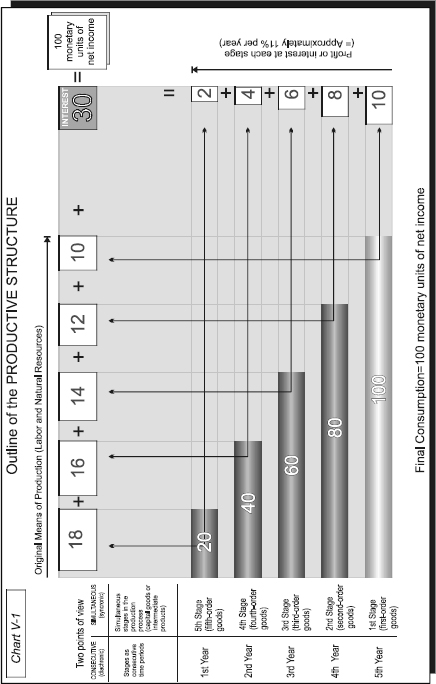
The arrows in our diagram represent the flows of monetary income which at each stage in the production process reach the owners of the original means of production (labor and natural resources) in the form of wages and rents, and the owners of capital goods (capitalists or savers) in the form of interest (or accounting profit). Indeed if we begin at the first stage in our example, consumers spend 100 m.u. on consumer goods, and this money becomes the property of the capitalists who own the consumer goods industries. One year earlier, these capitalists had advanced from their savings 80 m.u. corresponding to the services of fixed capital goods and to circulating capital goods produced by other capitalists in the second stage of the production process. The first capitalists also pay 10 m.u. to the owners of the original means of production (labor and natural resources) which they hire directly in the last stage, corresponding to the production of consumer goods (this payment to the owners of the original means of production is represented on our chart by the vertical arrow that begins to the right of the last step [100 m.u.] and extends to the upper right-hand box containing 10 m.u.). Since the capitalists of the consumer goods stage advanced eighty m.u. to the owners of the capital goods of the second stage, and ten m.u. to workers and owners of natural resources (a total of 90 m.u.), at the end of one year when these capitalists sell the consumer goods for 100 units, they obtain an accounting profit or interest derived from having advanced 90 m.u. from savings a year earlier. This difference between the total amount they advanced, 90 m.u. (which they could have consumed, yet they saved and invested it), and the amount they receive at the end of a year, 100 m.u., is equal to an interest rate of approximately 11 percent per year (10:90 = 0.11). From an accounting standpoint, this sum appears as profit on the income statement drawn up to reflect the entrepreneurial activity of capitalists of the consumer goods stage (represented by the box at the lower right-hand corner of Chart V-1).
We can follow the same reasoning with respect to the rest of the stages. Hence for example, the capitalists who own the intermediate goods of the third stage advanced at the beginning of the period 40 m.u. in payment for capital goods produced in the fourth stage, as well as 14 m.u. to owners of the original means of production (labor and natural resources). In exchange for the 54 m.u. they have advanced, the capitalists become owners of the product which, once it is finished, they sell to capitalists of the second stage for 60 m.u., earning a differential of six m.u., which is their accounting profit or interest; it is also close to 11 percent. This pattern repeats itself in each stage.
The upper portion of the chart shows the amounts which the capitalists advance at each stage to the original means of production (workers and owners of natural resources) and which add up to a total of 70 m.u. (18+16+14+12+10=70 m.u.). In a column on the right-hand side, we indicate the monetary sums obtained as accounting profits at each stage. These profits reflect the accounting difference between the m.u. advanced by the capitalists of each stage and those they receive for the sale of their product in the following stage. As we know, this accounting profit tends to coincide with the interest derived from the amount the capitalists of each stage save and advance to capitalists of earlier stages and to the owners of the original means of production. The total of the accounting differences between income and expenses at each stage adds up to 30 m.u., which when added to the 70 m.u. received by the original means of production, equals 100 m.u. of net income, which coincides exactly with the amount spent on final consumer goods during the period.
SOME ADDITIONAL CONSIDERATIONS
We must now discuss some important additional considerations regarding our outline of the stages in the production process:
1. The arbitrary selection of the time period of each stage.
First we must state that the decision to make each stage last one year was purely arbitrary, and any other time period could have been chosen. We decided on one year because that is the business and accounting period most commonly used, and therefore it makes the proposed illustrative outline of productive stages easier to understand.
2. The avoidance of the erroneous concept of “average period of production.”
Second, we should indicate that the five-year duration of the production process in our example is also purely arbitrary. Modern production processes are highly complex, as we know, and they vary greatly from one sector or business to another, with respect to the number and duration of stages. At any rate, it is unnecessary and pointless to refer to an “average period of production,” since a priori estimates of the length of any particular production process depend on the specific process itself. We know that capital goods are actually the intermediate stages in a production process initiated by an entrepreneur. From a subjective point of view, a production process always has a beginning, the specific moment at which the actor first perceives that a particular goal is worthwhile to him, and a certain set of intermediate stages which he conceives in advance and later attempts to carry out as he acts. Hence our analysis is not based on the idea of an “average period of production” and is therefore immune to criticism of that concept.In fact all production periods have a specific origin and cannot be traced back indefinitely in time; instead each stops at the very moment a certain entrepreneur took up the pursuit of an aim which constituted the imagined final stage in his process.Thus the first stage of production begins precisely at the moment the entrepreneur conceives of the final stage in the process (a consumer good or a capital good). In identifying the beginning of the first stage, it is totally irrelevant whether or not the production process in question involves the use of capital goods or factors of production completed in advance, yet which no one had ever imagined would eventually be used in such a process. Moreover it is unnecessary to trace back indefinitely in time the conception of a set of stages in a production process because any capital good produced in advance which nevertheless remains unused for a specific purpose for any length of time, ultimately becomes another “original” resource, so to speak, similar in this respect to all other natural resources that generate income, yet are viewed by the actor as just another initial factor in his course of action.In short all production processes are invariably prospective, they have an identifiable beginning and a foreseeable end, and their duration varies according to the process in question yet is never infinite nor undetermined. Therefore the retrospective calculation of supposed, phantasmagoric average periods of production is meaningless.
3. Fixed and circulating capital goods.
A third pertinent observation about our portrayal of productive stages is that it includes not only fixed capital goods, but also circulating capital goods and durable consumer goods. From a human actor ’s prospective point of view, the distinction between fixed and circulating capital goods is irrelevant, since it is largely based on the physical characteristics of the goods in question and depends especially upon whether or not these goods are considered to have been “completed.” Indeed when fixed capital goods are incorporated into a production process, they are considered “completed,” while circulating capital goods are thought to be semi-manufactured or in an “intermediate” process of production. However according to the subjectivist view on production processes aimed at consumption, both fixed and circulating capital goods constitute intermediate stages in an action process which only concludes when the final consumer good satisfies the desires of consumers; therefore, economically speaking, it is senseless to distinguish between the two.
The same can be said for “inventories” or stocks of intermediate goods held on hand at each of the productive stages. These stocks, which are considered a part of circulating capital, constitute one of the most significant components of the value of each stage in a process of production. Furthermore it has been demonstrated that as the economy evolves and prospers, these stocks become more important because they enable different businesses to minimize the ever-latent risk of unexpected shortages or “bottlenecks” which prolong delivery periods. In this way, inventories make it possible for clients at all levels (not only at the level of consumption, but also at the level of intermediate goods) to have at their disposal a growing variety of products to choose from and acquire immediately. Hence one manifestation of the lengthening of production processes is precisely a continual increase in inventories or stocks of intermediate goods.
4. The role of durable consumer goods.
Fourth, durable consumer goods satisfy human needs over a very prolonged period of time. Therefore they simultaneously form a part of several stages at once: the final stage of consumption and various preceding stages, according to their duration. In any case, for our purposes it is irrelevant whether the consumer himself must wait a certain number of years or stages before taking advantage of the latest services his durable consumer good can perform. Only when these services are directly received do we reach the last stage of Chart V-1, the stage of consumption. The years the owner spends caring for and maintaining his durable consumer good so that it will continue to perform consumer services for him in the future correspond to the stages which appear above and are increasingly distant from consumption: stage two, three, four, etc.Thus one of the manifestations of the lengthening of production processes and of the increase in their number of stages consists precisely of the production of a larger number of durable consumer goods of increasing quality and durability.
5. The trend toward the equalization of the rate of accounting profit or interest at each stage.
The fifth fundamental point we must emphasize is the following: In the market there exists a trend (driven by the force of entrepreneurship) toward the equalization of the “rate of profit” in all economic activities. This occurs not only horizontally, within each production stage, but also vertically, between stages. Indeed when there are disparities in profits, businessmen will devote their effort, creative capacity and investment to those activities which generate relatively higher profits, and they will stop devoting these things to activities which yield lower profits. Significantly, in the example from Chart V-1, the rate of accounting profit, or relative difference between income and expenses, is the same at each stage, i.e., approximately 11 percent per year. If the situation were otherwise; that is, if in one of the stages the rate of accounting profit or interest were higher, then disinvestment would take place, and productive resources would be withdrawn from the stages with a lower rate of profit and directed to those with a higher rate of accounting profit. This redirection of resources takes place until the greater demand for capital goods and original means of production in the receiving stage results in an increase in spending on these components in that stage; and the greater influx of its final goods tends to reduce their prices, until the differential between income and expenses decreases, giving rise to a rate of profit equal to that of other productive stages. This microeconomic reasoning is key to understanding modifications made to the number and length of productive stages; we will later examine these changes.
6. Gross and net investment and saving.
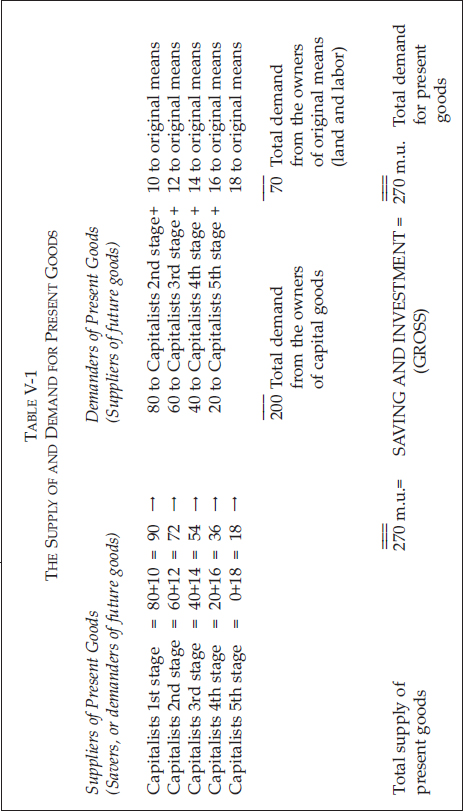
Sixth, although in the example from Chart V-1 the total net income received by owners of the original means of production and by capitalists in the form of profit or interest (100 m.u.) coincides exactly with the sum spent over the period in consumer goods (and thus net saving is equal to zero), there is a significant volume of gross saving and investment. In fact gross saving and investment are reflected in Table V-1, which indicates for each stage, at the left-hand side of the table, the supply of present goods offered by savers in exchange for future goods. At the right-hand side, we find the corresponding demand for present goods experienced by the providers of future goods, mainly owners of the original means of production (labor and natural resources) and the capitalists of earlier stages. We can observe from the table that gross saving, or the total supply of present goods, equals 270 m.u.: overall gross saving which takes place in the economic system and is 2.7 times greater than the amount spent during the year on final consumer goods. This gross saving is identical to the gross investment of the financial year in the form of spending by the capitalists on natural resources, labor, and capital goods from prior stages in the production process.
7. Gross and net income for the year.
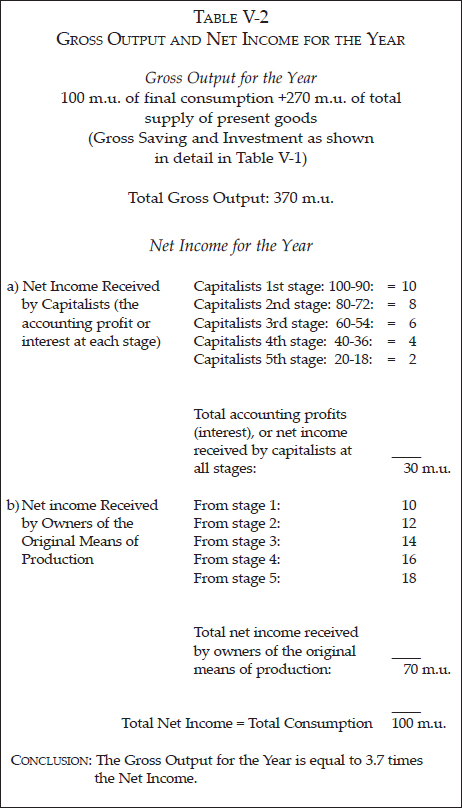
Seventh, we could view Chart V-1, our outline of the different stages in the production process, as an illustration of the flow of both capital goods and money. Indeed capital goods “flow downward,” i.e., from the stages furthest from consumption to the stages closest to it, and money “flows” in the opposite direction. In other words, m.u. are first used to pay for final consumer goods, and from that point they gradually move up the scale of productive stages until they reach those stages furthest from consumption. Therefore to obtain the gross monetary income for the period, we total, from bottom to top, all of the transactions (in terms of m.u.) conducted during the period. Details appear in Table V-2.
We see from this table that the gross income for the period is equal to 370 m.u. Of this amount, 100 m.u. correspond to net income, which is spent entirely on final consumer goods; and 270 m.u. correspond to the total supply of present goods or gross saving, which coincides with the total gross demand for present goods during the period. The following relationship exists between gross income and net income for the period, according to the calculation made in Table V-2: gross income is equal to 3.7 times the net income for the period. That is, a relationship exists between the number of m.u. spent on consumer goods and the much larger number spent on capital goods. This proportion is represented in Chart V-1 by the unshaded area corresponding to the final stage, that of consumer goods, versus the shaded areas pertaining to the other stages (including the net monetary income of the factors of production, shown at the top). Hence it is an unquestionable fact that the amount of money spent on intermediate goods during any time period is much larger by far than the amount spent during the same period on consumer goods and services. It is interesting to note that even minds as brilliant as Adam Smith committed unfortunate errors when it came to recognizing this fundamental economic fact. Indeed, according to Adam Smith,
the value of the goods circulated between the different dealers, never can exceed the value of those circulated between the dealers and the consumers; whatever is bought by the dealers, being ultimately destined to be sold to the consumers.
CRITICISM OF THE MEASURES USED IN NATIONAL INCOME ACCOUNTING
The sum of gross income, as we have defined and calculated it, along with its distribution over the different stages in the production process, is crucial for a correct understanding of the economic process which takes place in society. In fact the structure of the stages of capital goods and their value in m.u. are not measures which, once obtained, can be automatically and indefinitely maintained regardless of human decisions made by entrepreneurs who must deliberately and continually choose whether to increase, hold steady or reduce the productive stages undertaken in the past. In other words, whether a certain structure of productive stages remains the same or changes, becoming narrower or broader, depends solely upon whether the entrepreneurs of each stage subjectively decide it is worthwhile to reinvest the same percentage of the monetary income they have received, or instead, they believe it is more beneficial to them to modify this proportion by increasing or decreasing it. In the words of Hayek:
The money stream which the entrepreneur representing any stage of production receives at any given moment is always composed of net income which he may use for consumption without disturbing the existing method of production, and of parts which he must continuously re-invest. But it depends entirely upon him whether he re-distributes his total money receipts in the same proportions as before. And the main factor influencing his decisions will be the magnitude of the profits he hopes to derive from the production of his particular intermediate product.
Therefore no natural law forces entrepreneurs to reinvest their income in the same proportion in which they have invested in capital goods in the past. Instead, this proportion depends on the specific circumstances present at each moment, and in particular on the entrepreneurs’ expectations regarding the profit they hope to obtain at each stage of the production process. This means that, from an analytical standpoint, it is very important to focus on the evolution of the amounts of gross income as reflected in our diagram, and to avoid concentrating exclusively on net values, as is the custom. So we see that even when net saving equals zero, a productive structure is maintained by considerable gross saving and investment, the sum of which is several times larger than even the amount spent on consumer goods and services during each productive period. Therefore the key is to study gross saving and investment, i.e., the aggregated value, in monetary terms, spent in the stages of intermediate goods prior to final consumption, an amount which remains hidden if we focus exclusively on the evolution of accounting figures in net terms.
This is precisely why we should be especially critical of traditional national income accounting measures. For example, the traditional definition of “gross national product” (GNP) contains the word “gross,” yet in no way reflects the true gross income spent during the year on the entire productive structure. On the one hand, GNP figures hide the existence of different stages in the production process. On the other hand, what is even more serious and consequential is that the gross national product, despite the “gross” in its name, does not reflect the total gross monetary spending which takes place in all productive stages and sectors of the economy. This is because it is based solely on the production of goods and services delivered to final users. In fact it rests on a narrow accounting criterion of added value which is foreign to the fundamental truths of the economy; it only adds the value of consumer goods and services and of the final capital goods completed during the year. It does not incorporate the other intermediate products which make up the stages in the production process and which pass from one stage to another during the financial year.Hence gross national product figures only include a small percentage of the total production of capital goods. Indeed GNP incorporates the value of the sales of fixed or durable capital goods, such as real estate, industrial vehicles, machinery, tools, computers, etc., which are finished and sold to their final users during the year, and thus are considered final goods. However it in no way includes the value of circulating capital goods, intermediate non-durable products, nor of capital goods which are not yet finished or if so, pass from one stage to another during the process of production. These intermediate goods are obviously different from the similar ones included in final goods (for instance, in each time period the carburator produced as an intermediate product is not the same carburator included in the car sold as a final product). In contrast, our gross output figure from Table V-2 incorporates the gross production of all capital goods, whether completed or not, fixed, durable or circulating, as well as all consumer goods and services produced during the financial year.
In short the Gross National Product is an aggregate figure representing added values, and it excludes intermediate goods. The only reason national accounting theorists offer for using this figure is that with this criterion they avoid the problem of “double counting.” Yet from the standpoint of macroeconomic theory, this argument rests on a narrow accounting concept applicable to individual companies and is very dangerous, as it excludes from the computation the enormous volume of entrepreneurial effort which each year is dedicated to the production of intermediate capital goods, the bulk of economic activity but not at all worth evaluating, according to GNP figures. To get an idea of the amounts involved, it suffices to consider that the gross output (calculated according to our criterion) of an advanced country like the United States is equal to more than twice the country’s official GNP.
Therefore traditional national income accounting figures tend to eliminate at a stroke the central role intermediate stages play in the process of production; specifically, these measures ignore the undeniable fact that the continuance of intermediate stages is not guaranteed, but results from a constant, uncertain series of concrete entrepreneurial decisions which depend on expected accounting profits and on the social rate of time preference or interest rate. The use of GNP in national income accounting almost inevitably implies that production is instantaneous and requires no time, i.e., that there are no intermediate stages in the production process and that time preference is irrelevant with respect to determining the interest rate. In short the standard measures of national income completely do away with the largest, most significant part of the production process, and moreover they do so in a disguised manner, since, paradoxically and despite the label “gross,” they cause non-experts (and even most experts) in the field to overlook the most significant part of each country’s productive structure.
If national income accounting measures were modified and made truly “gross,” they would include all intermediate products, and it would be possible to follow the proportion of the amount spent each year on consumer goods and services to the amount spent at all intermediate stages. This ratio is ultimately determined by the social rate of time preference, which establishes the proportion of gross saving and investment to consumption. Clearly the weaker the time preference, and therefore the more savings generated in society, the larger the proportion of gross saving and investment to final consumption. At the same time, a strong time preference means interest rates will be high, and the ratio of gross saving and investment to consumption will decrease. Adequate intertemporal coordination of the decisions of economic agents in a modern society requires that the productive structure adapt to different social rates of time preference quickly and efficiently, something the entrepreneurial spirit itself, driven by the search for profit, tends to guarantee, as entrepreneurs try to equalize profit over all stages. If we wish to find a statistical measure which, instead of concealing, sheds as much light as possible on this important intertemporal coordination process, we must replace the current gross national product estimate with another such as gross national output, as defined here.
2
THE EFFECT ON THE PRODUCTIVE STRUCTURE OF AN INCREASE IN CREDIT FINANCED UNDER A PRIOR INCREASE IN VOLUNTARY SAVING
THE THREE DIFFERENT MANIFESTATIONS OF THE PROCESS OF VOLUNTARY SAVING
In this section we will examine what happens within the structure of production when, for whatever reason, economic agents reduce their rate of time preference; that is, when they decide to increase their saving or supply of present goods to others. This can take place in any of the following ways:
First, capitalists of the different stages in the productive structure may decide, beginning at a certain point, to modify the proportion in which they had been reinvesting the gross income derived from their productive activity. In other words, nothing guarantees the continuity, from one period to the next, of the ratio in which the capitalists of one productive stage spend the income they receive from that stage on the purchase of capital goods from earlier stages and on labor and natural resources. Capitalists may very possibly decide to increase their supply of present goods to others. That is, they may decide to reinvest a greater percentage of the income they receive per period, acquiring capital goods and services as well as original means of production (labor and natural resources). In that case, in the short run, their accounting profit margin will decrease, which is equivalent to a downward trend in the market interest rate. The profit margin falls as a result of an increase in monetary costs in relation to income. The capitalists are willing to temporarily accept this drop in accounting profits, since they expect to generate in this way, in a more or less distant future, total profits larger than those they would have earned had they not modified their behavior.Given that the market in which present goods are exchanged for future goods encompasses society’s entire structure of productive stages, such increases in saving and their manifestation in new investments are often the most important in society.
Second, owners of the original means of production (workers and owners of natural resources) may decide not to consume, as in the past, the entire sum of their social net income (which in Chart V-1 was 70 m.u.). They may instead decide to reduce their consumption beginning at a certain point and to invest the m.u. they no longer spend on final consumer goods and services, in the productive stages they decide to launch directly as capitalists (a category which includes members of cooperatives). Though this procedure takes place in the market, the resulting savings are not normally very substantial in real life.
Third, it could occur that both the owners of the original means of production (workers and the owners of natural resources) as well as capitalists (to the extent they receive net income in the form of accounting profits or market interest) decide beginning at a certain point not to consume their entire net income, but to loan a portion of it to capitalists of the different stages in the production process, enabling them to broaden their activities by purchasing more capital goods from prior stages and more natural resources, and by hiring more labor. This third procedure is carried out through the credit market, which, despite being the most visible and conspicuous in real economic life, is of secondary importance and plays a subsidiary role in relation to the more general market in which present goods are exchanged for future goods through self-financing or capitalists’ direct reinvestment of present goods in their productive stages (the first and second procedures of saving-investment mentioned above). Though this system of saving is important, it is usually secondary to the first two procedures for increasing saving we described above. Nevertheless a very strong connection exists between the flows of saving and investment of both procedures, and in fact both sectors of the “time market”—the general sector of the productive structure and the particular sector of the credit market—behave as if they were communicating vessels.
ACCOUNT RECORDS OF SAVINGS CHANNELLED INTO LOANS
From an economic standpoint, all three of these procedures for increasing saving invariably entail the following: an increase in the supply of present goods by savers, who transfer these present goods to the owners of original resources and material means of production (capital goods) from previous productive stages. For instance, if we follow the accounting example from chapter 4, which involves the third procedure described above, the following journal entries result:
The saver who loans his resources in the form of present goods records this entry in his journal:

This entry is clearly the accounting record of the fact that the saver offers 1,000,000 m.u. of present goods, which he relinquishes. In doing so he loses the complete availability of the goods and transfers it to a third person; for instance, the entrepreneur of a certain productive stage. The entrepreneur receives the m.u. as a loan, which he records in his journal via the following entry:

The entrepreneur who receives these present goods uses them to acquire: (1) capital goods from prior productive stages; (2) labor services; (3) natural resources. Through this third procedure, savers who do not wish to involve themselves directly in the activity of any of the productive stages can save and invest through the credit market by entering into a loan contract. Although this method is indirect, it ultimately produces a result identical to that of the first two procedures for voluntarily increasing saving.
THE ISSUE OF CONSUMER LOANS
It could be argued that sometimes loans are not granted to entrepreneurs of productive stages, to enable them to lengthen their production processes through investment, but are instead granted to consumers who purchase final goods. First, we must note that the very nature of the initial two saving procedures described above precludes the use of the saved resources for consumption. It is only possible to conceive of a consumer loan in the credit market, which as we know plays a subsidiary role and is secondary to the total market where present goods are offered and purchased in exchange for future goods. Second, in most cases consumer loans are granted to finance the purchase of durable consumer goods, which as we saw in previous sections,are ultimately comparable to capital goods maintained over a number of consecutive stages of production, while the durable consumer good’s capacity to provide services to its owner lasts. Under these circumstances, by far the most common, the economic effects of consumer loans, with respect to encouraging investment and lengthening productive stages, are identical to and indistinguishable from the effects of any increase in savings directly invested in the capital goods of any stage in the productive structure. Therefore only a hypothetical consumer loan allocated for financing a household’s current expenditure on non-durable consumer goods would have the effect of immediately and directly increasing final current consumption. Nonetheless despite the fact that relatively little credit is allotted to final current consumption, the existence of such consumer loans in the market indicates a certain latent consumer demand for them. Given the connection between all sectors of the market of present and future goods, once this residual demand for loans for current consumption is satisfied, most real resources saved are freed to be invested in the productive stages furthest from consumption.
THE EFFECTS OF VOLUNTARY SAVING ON THE PRODUCTIVE STRUCTURE
We will now explain how the price system and the coordinating role of entrepreneurs in a free market spontaneously channel decreases in the social rate of time preference and the resulting increases in saving into modifications of society’s structure of productive stages, making this structure more complex and lasting, and in the long run, appreciably more productive. In short we will explain one of the most significant coordinating processes which exist in all economies. Unfortunately, as a result of monetarist and Keynesian economic theories (which we will examine critically in chapter 7), for at least two generations of economists the majority of economics textbooks and study programs have almost completely ignored this process. Consequently most of today’s economists are unfamiliar with the functioning of one of the most important processes of coordination present in all market economies.
For analytical purposes we will begin by considering an extreme situation which nevertheless will be of great assistance in graphically illustrating and better understanding the processes involved. We will suppose that economic agents suddenly decide to save 25 percent of their net income. Our starting point will be the clear, numerical example of the last section, in which we assumed net income was equal to 100 m.u., which corresponded to the original means of production and the interest capitalists received, and which was spent entirely on consumer goods. We will now suppose that, as a result of a fall in time preference, economic agents decide to relinquish 25 percent (i.e., one-fourth) of their consumption and to save the corresponding resources, offering this excess of present goods to potential demanders of them. Three effects simultaneously follow from this increase in voluntary saving. Given their great importance, we will now consider them separately.
FIRST: THE EFFECT PRODUCED BY THE NEW DISPARITY IN PROFITS BETWEEN THE DIFFERENT PRODUCTIVE STAGES
If there is an increase in social saving of one-fourth of net income, clearly the total monetary demand for consumer goods will decrease by the same proportion. Chart V-2 illustrates the effect this has on the final stage, that of consumption, and on the accounting profits of companies devoted to that stage.
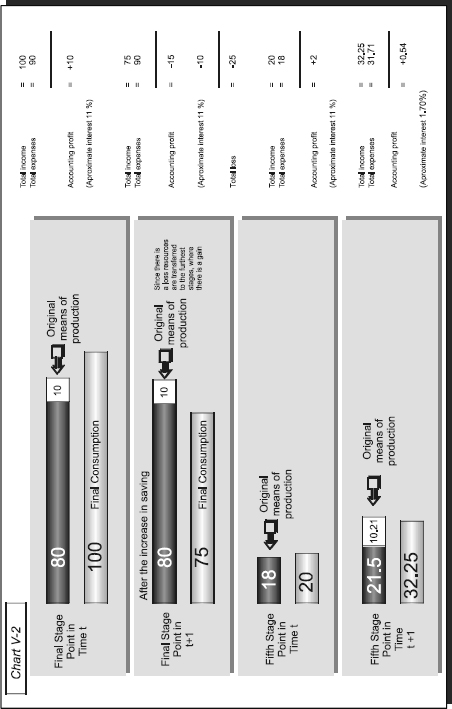
Chart V-2 shows that before the increase in saving, 100 m.u. of net income were spent on final consumer goods produced by companies which first incurred expenses totaling 90 m.u. Of this amount, 80 m.u. corresponded to the purchase of capital goods from the stage immediately preceding, and 10 m.u. were paid for original means of production hired or purchased in the last stage (labor and natural resources). This determined an accounting profit of 10 m.u., roughly equal to an interest rate of 11 percent, which as we saw in the last section, was the market rate of interest which accounting profits of all productive stages, both those closest to and those furthest from final consumption, tended to match.
If we suppose there is an increase in saving equal to 25 percent of net income, the situation in the final stage (consumption) is reflected in Chart V-2 at period of time t+1. Immediately following the rise in saving, we see that the monetary demand for final consumer goods decreases from 100 to 75 m.u. in each time period. Nevertheless a reduction in expenditures does not immediately accompany this fall in cash income which businesses devoted to the final stage of production experience. On the contrary, in their account books these companies record unchanged expenditures of 90 m.u. Just as in the previous case, 80 m.u. of this amount is spent on capital goods from the preceding stage (machinery, suppliers, intermediate products, etc.) and 10 m.u. are paid to the owners of the original means of production (workers and the owners of natural resources). As a result of this increase in saving, companies devoted to the final stage (consumption) suffer an accounting loss of 15 m.u. This sum becomes 25 m.u. when we consider the opportunity cost derived from the fact that the entrepreneurs not only experience the above accounting loss, but also fail to earn the 10 m.u. which capital invested in other productive stages generates as interest. Therefore we could conclude that all increases in saving cause considerable relative losses to or decreases in the accounting profits of the companies which operate closest to final consumption.
However let us now remember that the sector of consumption constitutes only a relatively small part of society’s total productive structure and that the sum of the m.u. spent on final consumption makes up only a fraction of the value of the gross national output, which encompasses all stages of the production process. Therefore the fact that accounting losses occur in the final stage does not immediately affect the stages prior to consumption, in which a positive difference continues to exist between income and expenditures, a difference similar to the one which preceded the increase in saving. Only after a prolonged period of time will the depressive effect which the rise in saving exerts upon the final stage (that of consumer goods) begin to be felt in the stages closest to it, and this negative influence will increasingly weaken as we “climb” to productive stages relatively more distant from final consumption. At any rate the accounting profits of the stages furthest from consumption will tend to remain constant, as shown in Chart V-2, stage five, period of time t. Here we observe that activity in this stage continues to yield an accounting profit of 11 percent, the result of a total income of 20 m.u. and total expenses of 18 m.u. Hence the increase in saving clearly gives rise to a great disparity between the accounting profits received by companies devoted to the first stage, that of consumer goods, and those earned by companies operating in the stages furthest from final consumption (in our example, the fifth stage in the productive structure). In the consumer goods sector an accounting loss follows from the upsurge in saving, while the industries of the fifth stage, which are further from consumption (now are helping to produce consumer goods that only will be available five years from now), continue to enjoy profits roughly equal to 11 percent of the capital invested (the current decrease in consumption does not affect consumption five years from now).
This disparity in profits acts as a warning sign and an incentive for entrepreneurs to restrict their investments in the stages close to consumption and to channel these resources into other stages which still offer relatively higher profits and which are, given the circumstances, the stages furthest from final consumption. Therefore entrepreneurs will tend to transfer a portion of their demand for productive resources, in the form of capital goods and primary factors of production, from the final stage (consumption) and those closest to it, to the stages furthest from consumption, where they discover they can still obtain comparatively much higher profits. The increased investment or demand for more productive resources in the stages furthest from consumption produces the effect shown in Chart V-2 for stage five, period of time t+1. Indeed entrepreneurs from the fifth stage increase their investment in original factors and productive resources from 18 m.u. to 31.71 m.u., a figure nearly double their initial outlay (of this amount 21.5 m.u. are spent on the productive services of capital goods and 10.21 m.u. are spent on labor services and natural resources).This leads to a rise in the production of goods in the fifth stage, which in monetary terms, increases from 20 m.u. to 32.35 m.u., resulting in an accounting profit of 0.54 m.u. Although in terms of percentage this amount is lower than former profits (1.70 percent as opposed to the 11 percent earned previously), it is comparatively a much higher profit than that which the industries producing final consumer goods obtain (industries which, as we saw, are sustaining absolute losses of 15 m.u.).
Consequently growth in saving gives rise to a disparity between the “rates of profit” in the different stages of the productive structure. This leads entrepreneurs to reduce immediate production of consumer goods and to increase production in the stages furthest from consumption. A lengthening of production processes tends to ensue, lasting until the new social rate of time preference or interest rate, in the form of differentials between accounting income and expenditures in each stage, now appreciably lower as a result of the substantial increase in saving, spreads uniformly, throughout the entire productive structure.
The entrepreneurs of the fifth stage have been able to increase their supply of present goods to others from 18 m.u. during period t to 31.71 m.u. in period t+1. This has been possible due to greater social saving, or a greater supply of present goods in society. The entrepreneurs finance this larger investment in part through the increase in their own saving, i.e., by investing a portion of the money which in the past they earned as interest and spent on consumption, and in part through new saving they receive from the credit market in the form of loans fully backed by a prior rise in voluntary saving. In other words, the increase in investment in the fifth stage materializes by any of the three procedures described in the last section.
Moreover the increase one might expect to observe in the prices of the factors of production (capital goods, labor and natural resources) as a result of the greater demand for them in the fifth stage does not necessarily occur (with the possible exception of very specific means of production). In fact each increase in the demand for productive resources in the stages furthest from consumption is mostly or even completely neutralized or offset by a parallel increase in the supply of these inputs which takes place as they are gradually freed from the stages closest to consumption, where entrepreneurs are incurring considerable accounting losses and are consequently obliged to restrict their investment expenditure on these factors. Thus for entrepreneurial coordination to exist between the stages in the productive structure of a society which is immersed in a process of increased saving and economic growth, it is particularly important that the corresponding factor markets, especially the markets for original means of production (labor and natural resources), be very flexible and permit at a minimum economic and social cost the gradual transfer of these factors from certain stages of production to others.
Finally the drop in investment in the consumer goods sector, which tends to stem from accounting losses generated by the increase in voluntary saving, normally accounts for a certain slowdown in the arrival of new consumer goods to the market (regardless of the increase in the stock of them). This slowdown lasts until the rise in the complexity and number of stages in the production process unquestionably improves productivity, which in turn brings a significantly larger quantity of consumer goods to the market. One might expect the temporary reduction in the supply of consumer goods to push up their price, other things being equal. However this rise in prices does not materialize, precisely because from the outset the decrease in supply is more than compensated for by the parallel fall in the demand for consumer goods, a result of the prior increase in voluntary saving.
To sum up, the increase in voluntary saving is invested in the productive structure, either through direct investments or through loans granted to the entrepreneurs of the productive stages relatively distant from consumption. These loans are backed by real voluntary saving and lead to an increase in the monetary demand for original means of production and capital goods used in such stages. As we saw at the beginning of this chapter, production processes tend to be more productive the more stages distant from consumption they contain, and the more complex these stages are. Therefore this more capitalintensive structure will eventually bring about a considerable increase in the final production of consumer goods, once the newly-initiated processes come to an end. Hence growth in saving and the free exercise of entrepreneurship are the necessary conditions for and the motor which drives all processes of economic growth and development.
SECOND: THE EFFECT OF THE DECREASE IN THE INTEREST RATE ON THE MARKET PRICE OF CAPITAL GOODS
The increase in voluntary saving, i.e., in the supply of present goods, gives rise, other things being equal, to a decrease in the market rate of interest. As we know, this interest rate tends to manifest itself as the accounting difference between income and expenses in the different productive stages and is also visible in the interest rate at which loans are granted in the credit market. It is important to note that the fall in the interest rate caused by all rises in voluntary saving greatly affects the value of capital goods, especially all of those used in the stages furthest from final consumption, goods which, relatively speaking, have a long life and make a large contribution to the production process.
Let us consider a capital good with a long life, such as a building owned by a company, an industrial plant, a ship or airplane used for transport, a blast furnace, a computer or high-tech communications device, etc., which has been produced and performs its services in different stages of the productive structure, all of which are relatively distant from consumption. The market value of this capital good tends to equal the value of its expected future flow of rents, discounted by the interest rate. An inverse relationship exists between the present (discounted) value and the interest rate. By way of illustration, a decrease in the interest rate from 11 to 5 percent, brought about by an increase in saving, causes the present value of a capital good with a very long life to more than double (the present value of a perpetual unitary rent at 11 percent interest is equal to 1/0.11 = 9.09; and the present value of a perpetual rent at 5 percent interest is equal to 1/0.05 = 20). If the capital good lasts, for example, twenty years, a drop in the interest rate from 11 to 5 percent produces an increase of 56 percent in the market or capitalized value of the good.
Therefore if people begin to value present goods less in relative terms, then the market price of capital goods and durable consumer goods will tend to increase. Moreover it will tend to increase in proportion to the duration of a good; i.e., to the number of productive stages in which it is used and to the distance of these stages from consumption. Capital goods already in use will undergo a significant rise in price as a result of the drop in the interest rate and will be produced in greater quantities, bringing about a horizontal widening of the capital goods structure (that is, an increase in the production of pre-existing capital goods). At the same time, the fall in the interest rate will reveal that many production processes or capital goods which until then were not considered profitable begin to be so, and consequently entrepreneurs will start to introduce them. In fact in the past entrepreneurs refrained from adopting many technological innovations and new projects because they expected the cost involved to be higher than the resulting market value (which tends to equal the value of the estimated future rent of each capital good, discounted by the interest rate). However when the interest rate falls, the market value of projects for lengthening the productive structure through new, more modern stages further from consumption begins to rise and may even come to exceed the cost of production, rendering these projects worthwhile. Hence the second effect of a decrease in the interest rate caused by an increase in voluntary saving is the deepening of the investment goods structure, in the form of a vertical lengthening involving new stages of capital goods increasingly distant from consumption.
Both the widening and deepening of the capital goods structure follow from the role of entrepreneurs and their collective capacity for creativity and coordination. They are able to recognize an opportunity and a potential profit margin when a difference arises between the market price of capital goods (determined by the present value of their expected future rent, which increases appreciably when the interest rate falls) and the cost necessary to produce them (a cost which remains constant or may even decrease, given the greater market supply of original means of production coming from the stage of final consumption, which initially shrank when saving increased).
Thus this second effect also entails a lengthening of the capital goods structure, just as we saw with the first effect.
Fluctuations in the value of capital goods, which arise from variations in saving and the interest rate, also tend to spread to the securities which represent these goods, and thus to the stock markets where they are traded. Hence an increase in voluntary saving, which leads to a drop in the interest rate, will further boost the price of stocks of companies which operate in the capital goods stages furthest from consumption, and in general, the price of all securities representing capital goods. Only securities which represent the property of the companies closest to consumption will undergo a temporary, relative decline in price, as a result of the immediate, negative impact of the decrease in the demand for consumer goods that is generated by the upsurge in saving. Therefore it is clear that, contrary to popular opinion, and in the absence of other monetary distortions we have not yet touched on, the stock market does not necessarily reflect mainly companies’ profits. In fact, in relative terms with the capital invested, the accounting profits earned by the companies of the different stages tend to match the interest rate. Thus an environment of high saving and low relative profits (i.e., with a low interest rate) constitutes the setting for the greatest growth in the market value of securities representing capital goods. Moreover the further the capital goods are from final consumption, the higher the market price of the corresponding securities.In contrast, growth in relative accounting profits throughout the productive structure, and thus in the market rate of interest, other things being equal, will manifest itself in a drop in the value of securities and a consequent fall in their market value. This theoretical explanation sheds light on many general stock-market reactions which ordinary people and many “experts” in finance and economics fail to understand, since they simply apply the naive theory that the stock market must merely reflect, automatically and faithfully, the level of accounting profits earned by all companies participating in the production process, without considering the stages in which the profits are earned nor the evolution of the social time preference (interest rates).
THIRD: THE RICARDO EFFECT
All increases in voluntary saving exert a particularly important, immediate effect on the level of real wages. Chart V-2 shows how the monetary demand for consumer goods falls by one-fourth (from 100 m.u. to 75 m.u.), due to the rise in saving. Hence it is easy to understand why increases in saving are generally followed by decreases in the prices of final consumer goods.If, as generally occurs, the wages or rents of the original factor labor are initially held constant in nominal terms, a decline in the prices of final consumer goods will be followed by a rise in the real wages of workers employed in all stages of the productive structure. With the same money income in nominal terms, workers will be able to acquire a greater quantity and quality of final consumer goods and services at consumer goods’ new, more reduced prices.
This increase in real wages, which arises from the growth in voluntary saving, means that, relatively speaking, it is in the interest of entrepreneurs of all stages in the production process to replace labor with capital goods. To put it another way, via an increase in real wages, the rise in voluntary saving sets a trend throughout the economic system toward longer and more capital-intensive productive stages. In other words, entrepreneurs now find it more attractive to use, relatively speaking, more capital goods than labor. This constitutes a third powerful, additional effect tending toward the lengthening of the stages in the productive structure. It adds to and overlaps the other two effects mentioned previously.
The first to explicitly refer to this third effect was David Ricardo. He did so in his book, On the Principles of Political Economy and Taxation, the first edition of which was published in 1817. Here Ricardo concludes that
[e]very rise of wages, therefore, or, which is the same thing, every fall of profits, would lower the relative value of those commodities which were produced with a capital of a durable nature, and would proportionally elevate those which were produced with capital more perishable. A fall of wages would have precisely the contrary effect.
In the well-known appendix “On Machinery,” which was added in the third edition, published in 1821, Ricardo concludes that “[m]achinery and labour are in constant competition, and the former can frequently not be employed until labour rises.”
The same idea was later recovered by F.A. Hayek, who, beginning in 1939, applied it extensively in his writings on business cycles. Here we will for the first time use it, integrated with the prior two effects, to explain the consequences an upsurge in voluntary saving has on the productive structure and to detract from theories on the so-called “paradox of thrift” and the supposedly negative influence of saving on effective demand. Hayek offers a very concise explanation of the “Ricardo Effect” when he states that
[w]ith high real wages and a low rate of profit investment will take highly capitalistic forms: entrepreneurs will try to meet the high costs of labour by introducing very laboursaving machinery—the kind of machinery which it will be profitable to use only at a very low rate of profit and interest.
Hence the “Ricardo Effect” is a third microeconomic explanation for the behavior of entrepreneurs, who react to an upsurge in voluntary saving by boosting their demand for capital goods and by investing in new stages further from final consumption.
It is important to remember that all increases in voluntary saving and investment initially bring about a decline in the production of new consumer goods and services with respect to the short-term maximum which could be achieved if inputs were not diverted from the stages closest to final consumption. This decline performs the function of freeing productive factors necessary to lengthen the stages of capital goods furthest from consumption.Furthermore the consumer goods and services left unsold as a result of the rise in voluntary saving play a role remarkably similar to that of the accumulated berries in our Robinson Crusoe example. The berries permitted Crusoe to sustain himself for the number of days required to produce his capital equipment (the wooden stick); during this time period he was not able to devote himself to picking berries “by hand.” In a modern economy, consumer goods and services which remain unsold when saving increases fulfill the important function of making it possible for the different economic agents (workers, owners of natural resources and capitalists) to sustain themselves during the time periods that follow. During these periods the recently-initiated lengthening of the productive structure causes an inevitable slowdown in the arrival of new consumer goods and services to the market. This “slowdown” lasts until the completion of all of the new, more capital-intensive processes that have been started. If it were not for the consumer goods and services that remain unsold due to saving, the temporary drop in the supply of new consumer goods would trigger a substantial rise in the relative price of these goods and considerable difficulties in the provision of them.
CONCLUSION: THE EMERGENCE OF A NEW, MORE CAPITAL-INTENSIVE PRODUCTIVE STRUCTURE
The three effects we have just examined are provoked by the entrepreneurial process of seeking profit, and the combination of the three tends to result in a new, narrower and more elongated structure of capital goods stages. Moreover the differential between income and costs at each stage, i.e., the accounting profit or interest rate, tends to even out at a lower level over all stages of the new productive structure (as naturally corresponds to a larger volume of saving and a lower social rate of time preference). Therefore the shape of the productive structure comes to closely resemble that reflected in Chart V-3.
Chart V-3 reveals that final consumption has fallen to 75 m.u. This reduction has also affected the value of the product of the second stage (the previous stage closest to consumption), which has dropped from 80 m.u. in Chart V-1 to 64.25 m.u. in Chart V-3. A similar decrease occurs in the third stage (from 60 m.u. to 53.5 m.u.), though this time the reduction is proportionally smaller. However beginning in the fourth stage (and upward, each stage further from consumption than the one before it), the demand in monetary terms grows. The increase is gradual at first. In the fourth stage, the figures rise from 40 m.u. to 42.75 m.u. It then becomes proportionally much more substantial in the fifth stage, where the value of the product grows from 20 m.u. to 32.25 m.u., as we saw in Chart V-2. Furthermore two new stages, stages six and seven, appear in the area furthest from consumption. These stages did not exist before.
After all necessary adjustments have been made, the rate of profit for the different stages tends to even out at a significantly lower level than that reflected in Chart V-1. This phenomenon derives from the fact that the upsurge in voluntary saving generates a much lower market rate of interest, and the rate of accounting profit for each stage (in our example, approximately 1.70 percent annually) approaches this figure. The net income received by the owners of the original means of production (workers and owners of natural resources) and by the capitalists of each stage, according to the net interest rate or differential, amounts to 75 m.u., which coincides with the monetary income spent on consumer goods and services. It is important to point out that even if only 75 m.u. are spent on consumer goods and services, i.e., 25 units less than in Chart V-1, once all new production processes are completed, the production of new final consumer goods and services will increase substantially in real terms. This is because production processes tend to become more productive as they become more roundabout and capital-intensive. Moreover a larger quantity, in real terms, of produced consumer goods and services can only be sold for a lower total number of m.u. (in our example, 75). Therefore there is a dramatic decline in the unit price of new consumer goods and services reaching the market, and correspondingly the income received by owners of the original means of production (specifically, workers’ wages and hence, their living standard) undergoes a sharp increase in real terms.
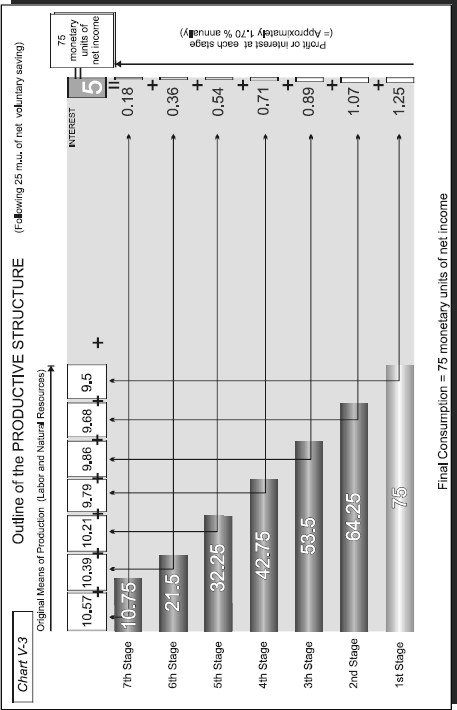
Tables V-3 and V-4 reflect both the supply of and the demand for present goods, as well as the composition of the gross national output for the year, after all adjustments provoked by the increase in voluntary saving. We see that the supply of and demand for present goods rests at 295 m.u., i.e., 25 m.u. more than in Table V-1. This is because gross saving and investment have grown by precisely the 25 m.u. of additional net saving voluntarily carried out. However as Table V-4 shows, the gross national output for the year remains unaltered at 370 m.u., of which 75 m.u. correspond to the demand for final consumer goods, and 295 m.u. to the total supply of present goods. In other words, even though the gross national output is identical in monetary terms to its value in the last example, it is now distributed in a radically different manner: over a narrower and more elongated productive structure (that is, a more capital-intensive one with more stages).
The distinct distribution of the same gross national output (in monetary terms) in each of the two productive structures is more apparent in Chart V-4.
Chart V-4 is simply the result of superimposing Chart V-1 (line) on Chart V-3 (bar), and it shows the impact on the productive structure of the 25 m.u. growth in voluntary net saving. Hence we see that the voluntary increase in saving provokes the following effects:
- First: a deepening of the capital goods structure. This outcome manifests itself as a vertical “lengthening” of the productive structure via the addition of new stages (in our example, stages six and seven, which did not exist before).
- Second: a widening of the capital goods structure, embodied in a broadening of the existing stages (as in stages four and five).
- Third: a relative narrowing of the capital goods stages closest to consumption.
- Fourth: In the final stage, the stage of consumer goods and services, the jump in voluntary saving invariably generates an initial drop in consumption (in monetary terms). However the lengthening of the productive structure is followed by a substantial real increase (in terms of quantity and quality) in the production of consumer goods and services. Given that the monetary demand for these goods is invariably reduced, and given that these two effects (the drop in consumption and the upsurge in the production of consumer goods) exert similar influences, the increase in production gives rise to a sharp drop in the market prices of consumer goods. Ultimately this drop in prices makes it possible for a significant real rise in wages to occur, along with a general increase in all real income received by owners of the original means of production.
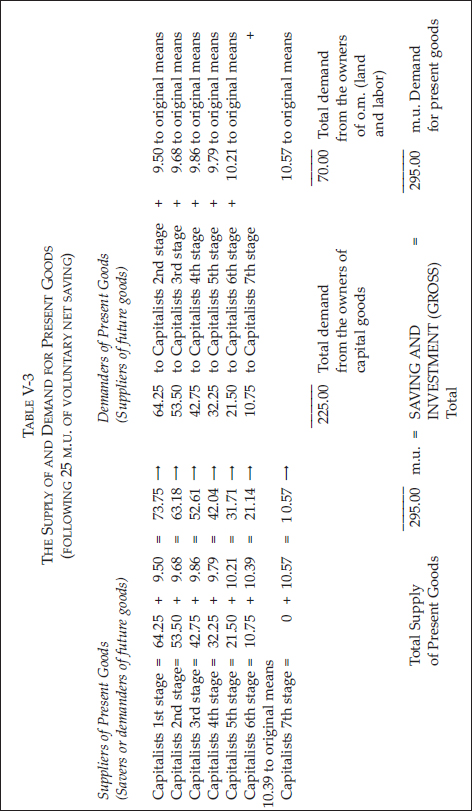
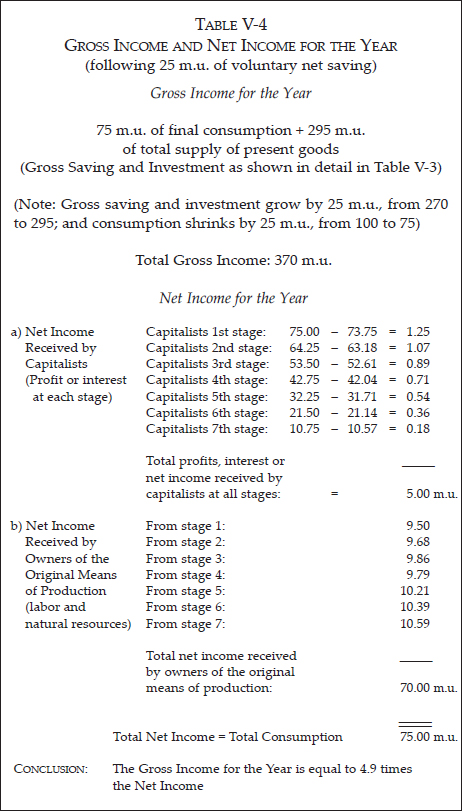
In short, in our example there has been no drop in the money supply (and therefore no external deflation, strictlyspeaking), nor has the demand for money risen. So if we assume both of these factors remain constant, then the general fall in the price of consumer goods and services arises exclusively from the upsurge in saving and the increase in productivity, itself a consequence of the more capital-intensive productive structure. Moreover this brings about marked growth in wages (in real terms), which, though their nominal value remains the same or even diminishes somewhat, permit the earner to acquire an increasing quantity of consumer goods and services of higher and higher quality: the decline in the price of these goods is proportionally much sharper than the possible decline in wages. In brief this is the healthiest, most sustained process of economic growth and development imaginable. In other words, it involves the fewest economic and social maladjustments, tensions, and conflicts and historically has taken place on various occasions, as the most reliable studies have shown.
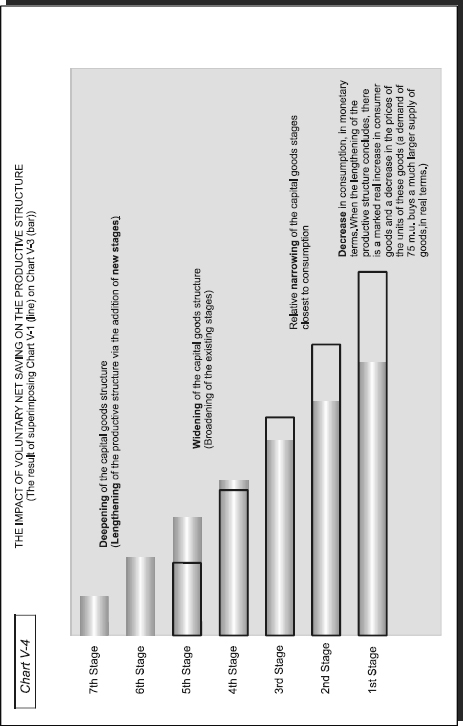
THE THEORETICAL SOLUTION TO THE “PARADOX OF THRIFT”
Our analysis also allows us to solve the problems posed by the supposed dilemma of the paradox of thrift or saving. This “paradox” rests on the concept that, though saving by individuals is positive in the sense that it allows them to augment their income, socially speaking, when the aggregate demand for consumer goods diminishes, the decrease eventually exerts a negative effect on investment and production. In contrast we have presented the theoretical arguments which demonstrate that this interpretation, based on the old myth of underconsumption, is faulty. Indeed, even assuming that gross national output in monetary terms remains constant, we have shown how society grows and develops through an increase in real wages, even when the monetary demand for consumer goods declines. We have also demonstrated how, in the absence of state intervention and increases in the money supply, an immensely powerful market force, driven by entrepreneurs’ search for profit, leads to the lengthening of and growing complexity in the productive structure. In short, despite the initial relative decrease in the demand for consumer goods which stems from growth in saving, the productivity of the economic system is boosted, as is the final production of consumer goods and services, and real wages.
THE CASE OF AN ECONOMY IN REGRESSION
Our reasoning up to this point can be reversed, with appropriate changes, to explain the effects of a hypothetical decrease in society’s voluntary saving. Let us begin by supposing that the productive structure closely resembles that reflected in Chart V-3. If society as a whole decides to save less, the result will be an increase, of for instance 25 m.u., in the monetary demand for consumer goods and services. Therefore the monetary demand will rise from 75 m.u. to 100 m.u., and the industries and companies of the stages closest to consumption will tend to grow dramatically, which will drive up their accounting profits. Though these events may appear to provoke the effects of a consumer boom, in the long run they will lead to a “flattening” of the productive structure, since productive resources will be withdrawn from the stages furthest from consumption and transferred to those closest to it. In fact the increased accounting profits of the stages close to final consumption will, relatively speaking, discourage production in the most distant stages, which will tend to bring about a reduction in investment in these stages. Moreover the drop in saving will push up the market rate of interest and diminish the corresponding present value of durable capital goods, deterring investment in them. Finally a reverse “Ricardo Effect” will exert its influence: growth in the prices of consumer goods and services will be accompanied by an immediate decline in real wages and in the rents of the other original factors, which will encourage capitalists to replace capital equipment with labor, now relatively cheaper.
The combined result of all these influences is a flattening of the productive structure, which comes to resemble that described in Chart V-1, which, although it reflects a greater demand for consumer goods and services in monetary terms, shows there has been a generalized impoverishment of society in real terms. In fact the less capital-intensive productive structure will result in the arrival of fewer consumer goods and services to the final stage, which nevertheless undergoes a considerable rise in monetary demand. Hence there is a decrease in the production of consumer goods and services, along with a substantial increase in their price, a consequence of the two previous effects combined. The result is the generalized impoverishment of society, especially of workers, whose wages shrink in real terms, since, while in monetary terms they may remain constant or even increase, such a rise never reaches the level of growth undergone by monetary prices of consumer goods and services.
According to John Hicks, Giovanni Boccaccio, in an interesting passage in the Introduction to Decameron, written around the year 1360, was the first to describe, in rather precise terms, a process very similar to the one we have just analyzed when he related the impact the Great Plague of the fourteenth century had on the people of Florence. In fact the epidemic caused people to anticipate a drastic reduction in life expectancy, and thus entrepreneurs and workers, instead of saving and “lengthening” the stages in their production process by working their lands and tending their livestock, devoted themselves to increasing their present consumption.After Boccaccio, the first economist to seriously consider the effects of a decline in saving and the resulting economic setback was Böhm-Bawerk in his book, Capital and Interest,where he explains in detail that a general decision by individuals to consume more and save less triggers a phenomenon of capital consumption, which ultimately lowers productive capacity and the production of consumer goods and services, giving rise to the generalized impoverishment of society.
3
THE EFFECTS OF BANK CREDIT EXPANSION UNBACKED BY AN INCREASE IN SAVING: THE AUSTRIAN THEORY OR CIRCULATION CREDIT THEORY OF THE BUSINESS CYCLE
In this section we will examine the effects banks exert on the productive structure when they create loans unbacked by a prior increase in voluntary saving. These circumstances differ radically from those we studied in the last section, where loans were fully backed by a corresponding rise in voluntary saving. In accordance with the credit expansion process triggered by fractional-reserve banking (a process we examined in detail in chapter 4), a bank’s creation of credit would result in an accounting entry which, in its simplest form, would resemble this one:
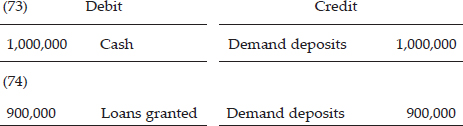
These book entries, which are identical to numbers (17) and (18) in chapter 4, record in a simplified and concise fashion the unquestionable fact that the bank is able to generate from nothing new m.u. in the form of deposits or fiduciary media which are granted to the public as loans or credit even when the public has not first decided to increase saving.We will now consider the effects this important event has on social processes of coordination and economic interaction.
THE EFFECTS OF CREDIT EXPANSION ON THE PRODUCTIVE STRUCTURE
The creation of money by the banking system in the form of loans has some real effects on the economy’s productive structure, and it is necessary to clearly distinguish between these effects and those we studied in the last section with respect to loans backed by saving. More specifically, the generation of loans ex nihilo (i.e., in the absence of an increase in saving) raises the supply of credit to the economy, especially to the different capital goods stages in the productive structure. From this standpoint, the increased supply of loans which results from bank credit expansion will initially exert an effect very similar to that produced by the flow of new loans from saving which we analyzed in detail in the last section: it will tend to cause a widening and lengthening of the stages in the productive structure.
The “widening” of the different stages is easy to understand, since basically the loans are granted for the production processes which constitute each of the stages. Credit extended to finance durable consumer goods also leads to a widening and lengthening of the productive structure, because (as we have seen) durable consumer goods are economically comparable to capital goods throughout the period during which they are fit to render their services. Therefore even in the case of consumer loans (to finance durable consumer goods), the greater influx of loans will tend to increase both the quantity and quality of such goods.
The “lengthening” of the productive structure derives from the fact that the only way banks can introduce into the economy the new money they create from nothing and grant as loans is by temporarily and artificially reducing the interest rate in the credit market and by easing the rest of the economic and contractual conditions they insist on when granting loans to their customers. This lowering of the interest rate in the credit market does not necessarily manifest itself as a decrease in absolute terms. Instead a decrease in relative terms, i.e., in relation to the interest rate which would have predominated in the market in the absence of credit expansion, is sufficient.Hence the reduction is even compatible with an increase in the interest rate in nominal terms, if the rate climbs less than it would have in an environment without credit expansion (for instance, if credit expansion coincides with a generalized drop in the purchasing power of money). Likewise such a reduction is compatible with a decline in the interest rate, if the rate falls even more than it would have had there been no credit expansion (for example, in a process in which, in contrast, the purchasing power of money is growing). Therefore this lowering of the interest rate is a fact accounted for by theory, and one it will be necessary to interpret historically while considering the circumstances particular to each case.
The relative reduction credit expansion causes in the interest rate boosts the present value of capital goods, since the flow of rents they are expected to produce increases in value when discounted using a lower market rate of interest. In addition, the lowering of the interest rate gives the appearance of profitability to investment projects which until that point were not profitable, giving rise to new stages further from consumption. The process through which these stages come into existence closely resembles the one involved when society’s voluntary saving actually increases. Nevertheless we must emphasize that although the initial effects may be very similar to those which, as we saw, follow an upsurge in voluntary saving, in this case the productive stages are lengthened and widenedonly as a consequence of the easier credit terms banks offer at relatively lower interest rates yet without any previous growth in voluntary saving. As we know, a sustainable lengthening of the productive structure is only possible if the necessary prior saving has taken place in the form of a drop in the final demand for consumer goods. This drop permits the different productive agents to sustain themselves using the unsold consumer goods and services while the new processes introduced reach completion and their more productive result begins to reach the market in the form of consumer goods.
In short, entrepreneurs decide to launch new investment projects, widening and lengthening the capital goods stages in the productive structure; that is, they act as if society’s saving had increased, when in fact such an event has not occurred. In the case of an upsurge in voluntary saving, which we examined in the last section, the individual behavior of the different economic agents tended to become compatible, and thus the real resources that were saved and not consumed made the preservation and lengthening of the productive structure possible. Now the fact that entrepreneurs respond to credit expansion by behaving as if saving had increased triggers a process of maladjustment or discoordination in the behavior of the different economic agents. Indeed entrepreneurs rush to invest and to widen and lengthen the real productive structure even though economic agents have not decided to augment their saving by the volume necessary to finance the new investments. In a nutshell, this is a typical example of an inducement to mass entrepreneurial error in economic calculation or estimation regarding the outcome of the different courses of action entrepreneurs adopt. This error in economic calculation stems from the fact that one of the basic indicators entrepreneurs refer to before acting, the interest rate (along with the attractiveness of terms offered in the credit market), is temporarily manipulated and artificially lowered by banks through a process of credit expansion.In the words of Ludwig von Mises,
But now the drop in interest falsifies the businessman’s calculation. Although the amount of capital goods available did not increase, the calculation employs figures which would be utilizable only if such an increase had taken place. The result of such calculations is therefore misleading. They make some projects appear profitable and realizable which a correct calculation, based on an interest rate not manipulated by credit expansion, would have shown as unrealizable. Entrepreneurs embark upon the execution of such projects. Business activities are stimulated. A boom begins.
At first the discoordination expresses itself in the emergence of a period of exaggerated and disproportionate optimism, which stems from the fact that economic agents feel able to expand the productive structure without at the same time having to make the sacrifice of reducing their consumption to generate savings. In the last section the lengthening of the productive structure was shown to be made possible precisely by the prior sacrifice required by all increases in saving. Now we see that entrepreneurs hasten to widen and lengthen the stages in production processes when no such prior saving has taken place. The discoordination could not be more obvious nor the initial excess of optimism more justified, since it seems possible to introduce longer production processes without any sacrifice or previous accumulation of capital. In short a mass error is committed by entrepreneurs, who adopt production processes they consider profitable, but which are not. This error feeds a generalized optimism founded on the belief that it is possible to widen and lengthen the stages in production processes without anyone’s having to save. Intertemporal discoordination increasingly mounts: entrepreneurs invest as if social saving were constantly growing; consumers continue to consume at a steady (or even increased) pace and do not worry about stepping up their saving.
To illustrate the initial effect credit expansion exerts on the real productive structure, we will follow the system used in the last section to present several graphs and tables which reflect the impact of credit expansion on the productive structure. A word of caution is necessary, however: it is practically impossible to represent in this way the complex effects produced in the market when credit expansion triggers the generalized process of discoordination we are describing. Therefore it is important to exercise great care in interpreting the following tables and charts, which should only be valued insofar as they illustrate and facilitate understanding of the fundamental economic argument. It is nearly impossible to reflect with charts anything other than strictly static situations, since charts invariably conceal the dynamic processes which take place between situations. Nonetheless the tables and graphs we propose to represent the stages in the productive structure may well help illustrate the essential theoretical argument and greatly facilitate an understanding of it.
Chart V-5 provides a simplified illustration of the effect exerted on the structure of productive stages by credit expansion brought about by the banking system without the necessary increase in social saving. When we compare it with Chart V-1 of this chapter, we see that final consumption remains unchanged at 100 m.u., in keeping with our supposition that no growth in net saving has taken place. However new money is created (deposits or fiduciary media) and enters the system through credit expansion and the relative reduction in the interest rate (along with the typical easing of the contractual conditions and the requirements for obtaining a loan) necessary to persuade economic agents to take out the newly-created loans. Therefore the rate of profit in the different productive stages, which as we know tends to coincide with the interest rate obtained at each stage by advancing present goods in exchange for future goods, in our example now drops from the 11 percent shown in Chart V-1 to slightly over 4 percent yearly. Moreover the new loans allow the entrepreneurs of each productive stage to pay more for the corresponding original means of production, as well as for the capital goods from earlier stages which they obtain for their own productive processes.
Table V-5 reflects the supply of and demand for present goods following bank credit expansion unbacked by saving. We see that the supply of present goods increases from the 270 m.u. shown in Table V-1 to slightly over 380 m.u., which are in turn composed of the 270 m.u. from the example in the last section (m.u. originating from real saved resources) plus slightly over 113 m.u. which banks have created through credit expansion without the backing of any saving. Thus credit expansion has the effect of artificially raising the supply of present goods, which are demanded at lower interest rates by owners of the original means of production and by capitalists of the earlier stages further from consumption. Furthermore Table V-5 reveals that the gross income for the year is over 483 m.u., 113 units more than the gross income for the year prior to credit expansion. (See Table V-2.)
Chart V-6 offers a simplified representation of the effect of credit expansion (i.e., unbacked by a prior rise in voluntary saving) on the productive structure. In our example, this effect expresses itself in the lengthening of the productive structure via the appearance of two new stages, six and seven. Prior to the expansion of credit these stages did not exist, and they are the furthest from final consumption. In addition the preexisting productive stages (two through five) are widened. The sum of the m.u. which represent the monetary demand embodied in each new widening or lengthening of productive stages, and which on the chart is reflected by the shaded areas, amounts to 113.75 m.u., the exact rise in gross monetary income for the year, an increase which stems exclusively from the creation of new money through credit expansion brought about by banks.
Let us not be deceived by Chart V-5: the new structure of productive stages it illustrates rests on generalized intertemporal discoordination, in turn the result of the mass entrepreneurial error provoked by the introduction of a large volume of new loans which are granted at artificially reduced interest rates, without the backing of real prior saving. This anomalous state of discoordination cannot be maintained, and the next section will include a detailed explanation of the reaction credit expansion inevitably sets off in the market. In other words, from the standpoint of pure microeconomic theory, we will examine the factors that will cause the reversal of the “macroeconomic” discoordination we have revealed.
Hence we will study the reasons the intertemporal discoordination process, initially set in motion by credit expansion, will completely reverse. Any attack on the social process, be it intervention, systematic coercion, manipulation of essential indicators (such as the price of present goods in terms of future goods, or the market rate of interest), or the granting of privileges against traditional legal principles, spontaneously triggers certain processes of social interaction which, as they are driven precisely by entrepreneurship and its capacity to create and coordinate, tend to halt and rectify errors and discoordination. Great credit goes to Ludwig von Mises for being the first to reveal, in 1912, that credit expansion gives rise to booms and optimism which sooner or later invariably subside. In his own words:
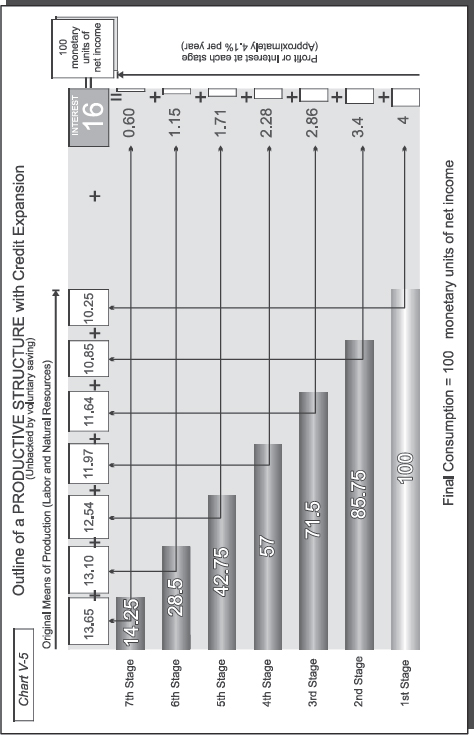
The increased productive activity that sets in when the banks start the policy of granting loans at less than the natural rate of interest at first causes the prices of production goods to rise while the prices of consumption goods, although they rise also, do so only in a moderate degree, namely, only insofar as they are raised by the rise in wages. Thus the tendency toward a fall in the rate of interest on loans that originates in the policy of the banks is at first strengthened. But soon a countermovement sets in: the prices of consumption goods rise, those of production goods fall. That is, the rate of interest on loans rises again, it again approaches the natural rate.
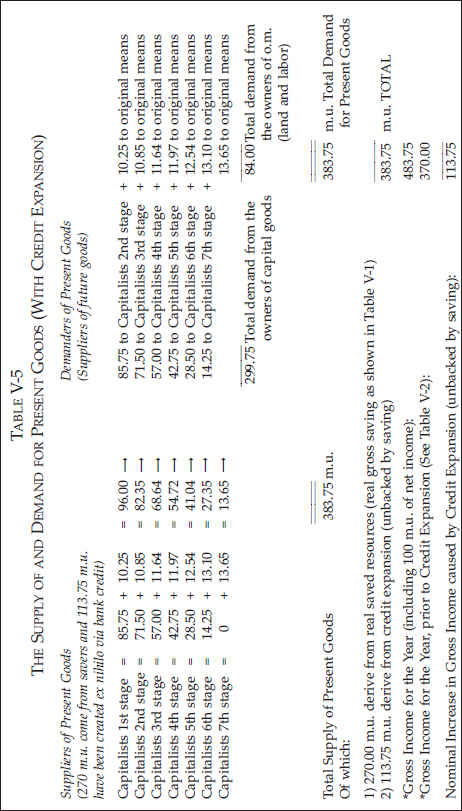
As we will have the opportunity to study later, prior to Mises various scholars of the School of Salamanca (Saravia de la Calle for instance) and others of the nineteenth century, mainly intellectuals of the Currency School (Henry Thornton, Condy Raguet, Geyer, etc.), sensed that booms provoked by credit expansion ultimately and spontaneously reversed, causing economic crises. Nonetheless Mises was the first to correctly formulate and explain, from the standpoint of economic theory, the reasons this is necessarily so. Despite Mises’s momentous initial contribution, a completely formulated analysis of the different economic effects which comprise the market’s reaction to credit expansion first became available with the writings of Mises’s most brilliant disciple, F.A. Hayek.In the next section we will examine these effects in detail.
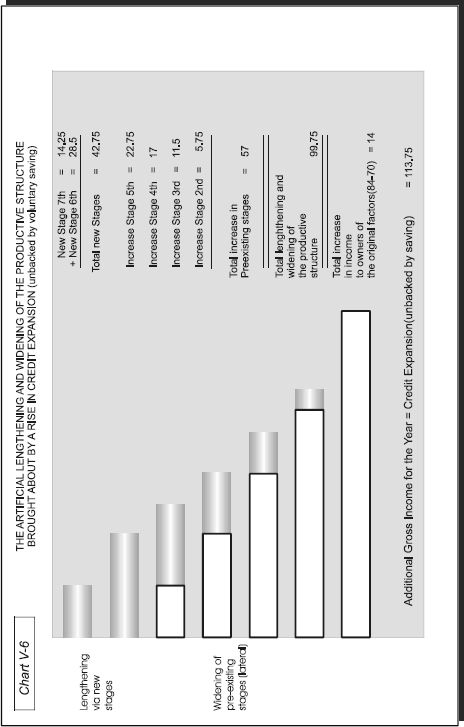
THE MARKET’S SPONTANEOUS REACTION TO CREDIT EXPANSION
We will now consider the microeconomic factors which will halt the process of exaggerated optimism and unsustainable economic expansion that follows the granting of bank loans unbacked by a previous increase in voluntary saving. In this way we will be fully able to take typically macroeconomic phenomena (financial crises, economic recessions, and unemployment) back to their fundamental microeconomic roots. We will now study, one by one, the six microeconomic causes of the reversal of the boom that credit expansion invariably triggers:
1. The rise in the price of the original means of production.
The first temporary effect of credit expansion is an increase in the relative price of the original means of production (labor and natural resources). This rise in price stems from two separate causes which reinforce each other. On the one hand, capitalists from the different stages in the production process show a greater monetary demand for original resources, and this growth in demand is made possible by the new loans the banking system grants. On the other hand, with respect to supply, we must keep in mind that when credit expansion takes place without the backing of a prior increase in saving, no original means of production are freed from the stages closest to consumption, as occurred in the process we studied earlier, which was initiated by a real upsurge in voluntary saving. Therefore the rise in the demand for original means of production in the stages furthest from consumption and the absence of an accompanying boost in supply inevitably result in a gradual increase in the market price of the factors of production. Ultimately this increase tends to accelerate due to competition among the entrepreneurs of the different stages in the production process. The desire of these entrepreneurs to attract original resources to their projects makes them willing to pay higher and higher prices for these resources, prices they are able to offer because they have just received new liquidity from the banks in the form of loans the banks have created from nothing. This rise in the relative price of the original factors of production begins to push the cost of the newly launched investment projects above the amount originally budgeted. Nevertheless this effect alone is still not sufficient to end the wave of optimism, and entrepreneurs, who continue to feel safe and supported by the banks, usually go ahead with their investment projects without a second thought.
2. The subsequent rise in the price of consumer goods.
Sooner or later the price of consumer goods begins to gradually climb, while the price of services offered by the original factors of production starts to mount at a slower pace (in other words, it begins to fall in relative terms). The combination of the following three factors accounts for this phenomenon:
(a) First, growth in the monetary income of the owners of the original factors of production. Indeed if, as we are supposing, economic agents’ rate of time preference remains stable, and therefore they continue to save the same proportion of their income, the monetary demand for consumer goods increases as a result of the increase in monetary income received by the owners of the original factors of production. Nonetheless this effect would only explain a similar rise in the price of consumer goods if it were not for the fact that it combines with effects (b) and (c).
(b) Second, a slowdown in the production of new consumer goods and services in the short-and medium-term, a consequence of the lengthening of production processes and the greater demand for original means of production in the stages furthest from final consumption. This temporary decline in the speed at which new consumer goods arrive at the final stage in the production process derives from the fact that original factors of production are withdrawn from the stages closest to consumption, causing a relative shortage of these factors in those stages. This shortage affects the immediate production and delivery of final consumer goods and services. Furthermore as the capital theory outlined at the beginning of the chapter explains, the generalized lengthening of production processes and the incorporation into them of a greater number of stages further from consumption invariably leads to a short-term decrease in the rate at which new consumer goods are produced. This slowdown lasts the length of time necessary for newly initiated investment processes to reach completion. It is clear that the longer production processes are, i.e., the more stages they contain, the more productive they tend to be. However it is also clear that until new investment processes conclude, they will not allow a larger quantity of consumer goods to reach the final stage. Hence the growth in income experienced by the owners of the original factors of production, and thus the increase in monetary demand for consumer goods, combined with the short-term slowdown in the arrival of new consumer goods to the market, accounts for the fact that the price of consumer goods and services eventually climbs more than proportionally; that is, faster than the increase in monetary income experienced by the owners of the original means of production.
(c) Third, the rise in monetary demand for consumer goods which is triggered by artificial entrepreneurial profits that result from the credit expansion process. Banks’ creation of loans ultimately entails an increase in the money supply and a rise in the price of the factors of production and of consumer goods. These increases eventually distort entrepreneurs’ estimates of their profits and losses. In fact entrepreneurs tend to calculate their costs in terms of the historical cost and purchasing power of m.u. prior to the inflationary process. However they compute their earnings based on income comprised of m.u. with less purchasing power. All of this leads to considerable and purely fictitious profits, the appearance of which creates an illusion of entrepreneurial prosperity and explains why businessmen begin to spend profits that have not actually been produced, which further increases the pressure of the monetary demand for final consumer goods.
It is important to underline the effect of the more-than-proportional rise in the price of consumer goods (or in the turnover or gross income of consumer goods industries if their productivity increases) with respect to the rise in the price of original factors of production. Theoretically this is the phenomenon which has most escaped the notice of many scholars. As they have not fully comprehended capital theory, the analyses of these theorists have not accounted for the fact that when more productive resources are devoted to processes further from consumption, processes which begin to yield results only after a prolonged period of time, there is a reduction in the speed at which new consumer goods arrive at the last stage in the production process. Moreover this is one of the most significant distinguishing features of the case we are now considering (in which the lengthening of production processes is financed with loans the banks create ex nihilo) with respect to the process initiated by an upsurge in voluntary saving (which by definition produced an increase in the stock of consumer goods that remained unsold and which sustained the owners of the original factors of production while new processes of production could be completed). When there is no prior growth in saving, and therefore consumer goods and services are not freed to support society during the lengthening of the productive stages and the transfer of original factors from the stages closest to consumption to those furthest from it, the relative price of consumer goods inevitably tends to rise.
3. The substantial relative increase in the accounting profits of the companies from the stages closest to final consumption.
The price of consumer goods escalates faster than the price of original factors of production, and this results in relative growth in the accounting profits of the companies from the stages closest to consumption with respect to the accounting profits of companies who operate in the stages furthest from consumption. Indeed the relative price of the goods and services sold in the stages closest to consumption increases very rapidly, while costs, though they also rise, do not rise as fast. Consequently accounting profits, or the differential between income and costs, mount in the final stages. In contrast, in the stages furthest from consumption the price of the intermediate goods produced at each stage does not show a major change, while the cost of the original factors of production employed at each stage climbs continuously, due to the greater monetary demand for these factors, which in turn originates directly from credit expansion. Hence companies operating in the stages furthest from consumption tend to bring in less profit, an accounting result of a rise in costs more rapid than the corresponding increase in income. These two factors produce the following combined effect: it gradually becomes evident throughout the productive structure that the accounting profits generated in the stages closest to consumption are higher in relative terms than the accounting profits earned in the stages furthest from it. This prompts entrepreneurs to rethink their investments and even to doubt their soundness. It compels them to again consider the need to reverse their initial investment of resources by withdrawing them from more capital-intensive projects which have barely gotten off the ground and returning them to the stages closest to consumption.
4. The “Ricardo Effect.”
In addition, the more-than-proportional rise in the price of consumer goods with respect to the increase in original-factor income begins to drive down (in relative terms) the real income of these factors, particularly wages. This real reduction in wages provokes the “Ricardo Effect,” which we have covered in detail, but which now exerts an impact contrary to the one it exerted in our last example, where real growth took place in voluntary saving. In the case of voluntary saving, the temporary decrease in the demand for consumer goods brought about a real increase in wages, which tended to give rise to the substitution of machines for labor and therefore to lengthen the productive stages, distancing them from consumption and making them more capital-intensive. However now the effect is just the opposite: the more-than-proportional growth in the price of consumer goods with respect to the rise in factor income drives this income, particularly wages, down in real terms, providing entrepreneurs with a powerful financial incentive to substitute labor for machinery or capital equipment, in keeping with the “Ricardo Effect.” This results in a relative drop in the demand for the capital goods and intermediate products of the stages furthest from consumption, which in turn further aggravates the underlying problem of the fall in accounting profits (even losses) which begins to be perceived in the stages furthest from consumption.
In short, here the “Ricardo Effect” exerts an impact contrary to the one it exerted when there was an upsurge in voluntary saving.Then we saw that an increase in saving brought about a short-term decrease in the demand for consumer goods and in their price, and thus a boost in real wages which encouraged the substitution of machinery for workers, growth in the demand for capital goods and a lengthening of productive stages. Now we see that the relative rise in the price of consumer goods causes a drop in real wages, motivating entrepreneurs to substitute labor for machinery, which lessens the demand for capital goods and further reduces the profits of companies operating in the stages furthest from consumption.
5. The increase in the loan rate of interest. Rates even exceed precredit-expansion levels.
The last temporary effect consists of an escalation in interest rates in the credit market. This rise occurs sooner or later, when the pace of credit expansion unbacked by real saving stops accelerating. When this happens the interest rate will tend to return to the relatively higher levels which prevailed prior to the beginning of credit expansion. In fact if, for instance, the interest rate is around 10 percent before credit expansion begins and the new loans the banking system creates ex nihilo are placed in the productive sectors via a reduction in the interest rate (for example, to 4 percent) and an easing of the rest of the “peripheral” requirements for the granting of loans (contractual guarantees, etc.), it is clear that when credit expansion comes to a halt, if, as we are supposing, no increase in voluntary saving takes place, interest rates will climb to their previous level (in our example, they will rise from 4 to 10 percent). They will even exceed their pre-credit-expansion level (i.e., they will rise above the originary rate of 10 percent) as a result of the combined effect of the following two phenomena:
(a) Other things being equal, credit expansion and the increase in the money supply which it involves will tend to drive up the price of consumer goods, i.e., to reduce the purchasing power of the monetary unit. Consequently if lenders wish to charge the same interest rates in real terms, they will have to add (to the interest rate which prevails prior to the beginning of the credit expansion process) a component for “inflation,” or in other words, for the expected drop in the purchasing power of the monetary unit (as well as the increased risk premium mentioned on page 380).
(b) There is another powerful reason interest rates climb to and even exceed their prior level: entrepreneurs who have embarked upon the lengthening of production processes despite the rise in interest rates will, to the extent that they have already committed substantial resources to new investment projects, be willing to pay very high interest rates, provided they are supplied with the funds necessary to complete the projects they have mistakenly launched. This is an important aspect which went completely unnoticed until Hayek studied it in detail in 1937.Hayek demonstrated that the process of investment in capital goods generates an autonomous demand for subsequent capital goods, precisely ones which are complementary to those already produced. Furthermore this phenomenon will last as long as the belief that the production processes can be completed. Thus entrepreneurs will rush to demand new loans regardless of their cost, before being forced to admit their failure and altogether abandon investment projects in which they have allocated very important resources and with respect to which they have jeopardized their prestige. As a result, the growth in the interest rate which takes place in the credit market at the end of the boom is not only due to monetary phenomena, as Hayek had previously thought, but also to real factors that affect the demand for new loans.In short, entrepreneurs, determined to complete the new capital goods stages they have begun and which they begin to see threatened, turn to banks and demand additional loans, offering a higher and higher interest rate for them. Thus they start a “fight to the death” to obtain additional financing.
6. The appearance of accounting losses in companies operating in the stages relatively more distant from consumption: the inevitable advent of the crisis.
The above five factors provoke the following combined effect: sooner or later companies which operate in the stages relatively more distant from consumption begin to incur heavy accounting losses. These accounting losses, when compared with the relative profits generated in the stages closest to consumption, finally reveal beyond all doubt the serious entrepreneurial errors committed and the urgent need to correct them by paralyzing and then liquidating the investment projects mistakenly launched, withdrawing productive resources from the stages furthest from consumption and transferring them back to those closest to it.
In a nutshell, entrepreneurs begin to realize a massive readjustment in the productive structure is necessary. Through this “restructuring” in which they withdraw from the projects they began in the stages of capital goods industries and which they were unable to successfully complete, they transfer what is left of their resources to the industries closest to consumption. It has now become obvious that certain investment projects are unprofitable, and entrepreneurs must liquidate these and make a massive transfer of the corresponding productive resources, particularly labor, to the stages closest to consumption. Crisis and economic recession have hit, essentially due to a lack of real saved resources with which to complete investment projects which, as has become apparent, were too ambitious. The crisis is brought to a head by excessive investment (“overinvestment”) in the stages furthest from consumption, i.e., in capital goods industries (computer software and hardware, high-tech communications devices, blast furnaces, shipyards, construction, etc.), and in all other stages with a widened capital goods structure. It also erupts due to a parallel relative shortage in investment in the industries closest to consumption. The combined effect of the two errors is generalized malinvestment of productive resources; that is, investment of a style, quality, quantity, and geographic and entrepreneurial distribution typical of a situation in which much more voluntary saving has taken place. In short, entrepreneurs have invested an inappropriate amount in an inadequate manner in the wrong places in the productive structure because they were under the impression, deceived as they were by bank credit expansion, that social saving would be much greater. Economic agents have devoted themselves to lengthening the most capitalintensive stages in the hope that once the new investment processes have, with time, reached completion, the final flow of consumer goods and services will increase significantly. However the process by which the productive structure is lengthened requires a very prolonged period of time. Until this time has passed, society cannot profit from the corresponding rise in the production of consumer goods and services. Yet economic agents are not willing to wait until the end of that more prolonged period of time. Instead they express their preferences through their actions and demand the consumer goods and services now, i.e., much sooner than would be possible were the lengthening of the productive structure to be completed.
Society’s savings can be either wisely or foolishly invested. Credit expansion brought about by the banking system ex nihilo encourages entrepreneurs to act as if social saving had increased substantially, precisely by the amount the bank has created in the form of new loans or fiduciary media. The microeconomic processes examined above invariably and spontaneously bring to light the error committed. This error derives from the fact that for a prolonged period of time economic agents believed available savings to be much more considerable than they actually were. This situation is very similar to the one in which our Robinson Crusoe from section 1 would find himself if, having saved a basket of berries large enough to permit him to spend a maximum of five days producing a capital good without having to devote himself to the collection of more berries, through an error in calculationhe were to believe that this amount of savings would allow him to undertake the construction of his cabin. After five days spent just digging the foundations and gathering materials, he would have consumed all of his berries and would therefore be unable to complete his illusory investment project. Mises likens the general error committed to the one a builder would make if he were to misjudge the amount of materials available to him and use them all up laying the foundations of a building, which he would then be forced to leave unfinished.As Hayek puts it, we are thus dealing with a crisis of overconsumption, or in other words, insufficient saving. It has become obvious that saving is inadequate to permit the completion of the more capital-intensive investments made by mistake. The situation would resemble that of the imaginary inhabitants of an island who, having undertaken the construction of an enormous machine capable of completely satisfying their needs, had exhausted all of their savings and capital before finishing it and had been left with no other choice but to temporarily abandon the project and return all of their energy to the daily search for food at a mere subsistence level, i.e., without the assistance of any capital equipment.In our society such a shortage of savings leads to the following: many factories are closed, particularly in the stages furthest from consumption, numerous investment projects launched in error are paralyzed, and many workers are laid off. Furthermore pessimism spreads throughout society, and the notion that an inexplicable economic crisis has erupted, shortly after people had begun to believe that the boom and optimism, far from reaching their peak, would last indefinitely, demoralizes even the most persistently high-spirited.
Chart V-7 reflects the state of the productive structure once the crisis and economic recession provoked by credit expansion (i.e., unbacked by a prior increase in voluntary saving) have become evident and the necessary readjustments have been made. As the chart makes clear, the new productive structure is flatter and contains only five stages, since the two stages furthest from consumption have disappeared. As Charts V-5 and V-6 show, initially credit expansion, in error, permitted entrepreneurs to embark on these stages. Furthermore Table V-6 shows that although the gross income for the year is identical to that reflected in Table V-5 (483.7 m.u.), the distribution of the portion allocated to the direct demand for final consumer goods and services and to the demand for intermediate goods has varied in favor of the former. In fact now there are 132 m.u. of monetary demand for consumer goods, an amount one-third larger than the 100 units of monetary demand which appeared in the example shown in Chart V-5 and Table V-5. Meanwhile the overall monetary demand for intermediate goods has diminished from 383 to 351 units. In short there is a “flatter ” structure which is less capitalintensive and therefore leads to the production of fewer consumer goods and services, yet these goods and services are the object of greater monetary demand, all of which gives rise to a strong jump in the price of consumer goods and services and the generalized impoverishment of society. This is revealed in the fall, in real terms, in the price of the different original factors of production. Though the nominal value of the monetary income received by their owners has mounted substantially, the even more rapid increase in the price of consumer goods places the owners of these factors at a considerable disadvantage in real terms. Moreover the interest rate, or rate of accounting profit approached at each stage, has risen above 13.5 percent, i.e., to a level which even exceeds that of the interest in the credit market prior to credit expansion (11 percent per year). This higher rate reflects a premium to compensate for the drop in the purchasing power of money; the keener competition among the different entrepreneurs, who desperately wish to obtain new loans; and the increase in the components of risk and entrepreneurial uncertainty which influences the interest rate whenever pessimism and economic distrust are rampant.
We must emphasize that the productive structure which remains following the necessary readjustment, and which Chart V-7 illustrates, cannot continue to match the structure that existed prior to credit expansion. This is due to the fact that circumstances have changed significantly. Heavy inevitable losses of specific capital goods have been incurred to the extent that society’s scarce resources have been channeled into investments that cannot be restructured and therefore are devoid of economic value. This gives rise to general impoverishment of society, a state which manifests itself as a decline in capital equipment per capita, resulting in a decrease in the productivity of labor, and consequently, a further reduction in real wages. Furthermore there has been a shift in the distribution of income among the different factors of production, as well as a realignment of all the investment processes which, though initiated in error, are still of some use and economic value. All of these new circumstances make the productive structure qualitatively very different from and quantitatively much flatter and poorer than the one that existed before banks brought about credit expansion.
In summary, we have described the microeconomic basis for the spontaneous market reaction which consistently tends to follow credit expansion. This reaction gives rise to the consecutive cycles of boom and recession which have regularly affected western economies for nearly two centuries (and even much longer, as we saw in chapter 2). We have also demonstrated that there is no theoretical possibility that banks’ increase in loans, if not backed by a corresponding prior rise in voluntary saving, will permit society to reduce the necessary sacrifices all processes of economic growth require, and foster and accelerate sustainable growth in the absence of a voluntary decision made by citizens to sacrifice and save.Given that these are highly significant conclusions, in the next section we will analyze their implications for the banking sector, particularly, the manner in which they explain that this sector cannot operate independently (i.e., without a central bank) while maintaining a fractional reserve. Thus we will conclude the theoretical analysis we set out to produce in chapter 3: to demonstrate on the basis of economic theory that it is impossible for the banking system to insure itself against suspensions of payments and bankruptcy via a fractional-reserve requirement, since the supposed insurance (the fractional-reserve requirement) is precisely what triggers a process of credit expansion, boom, crisis and economic recession which invariably has a detrimental effect on banks’ solvency and ability to pay.
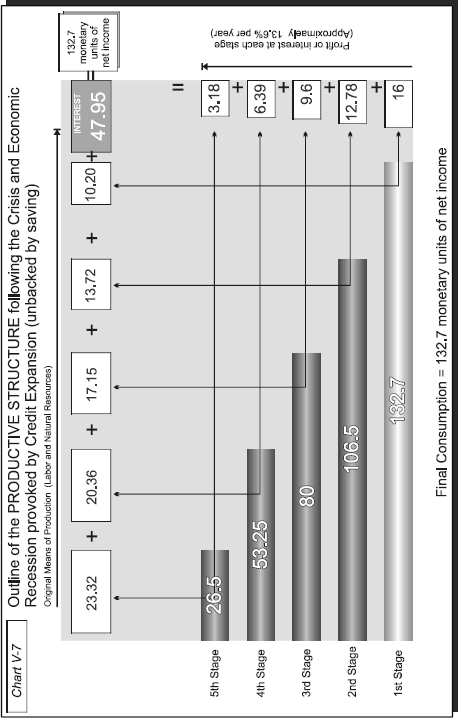
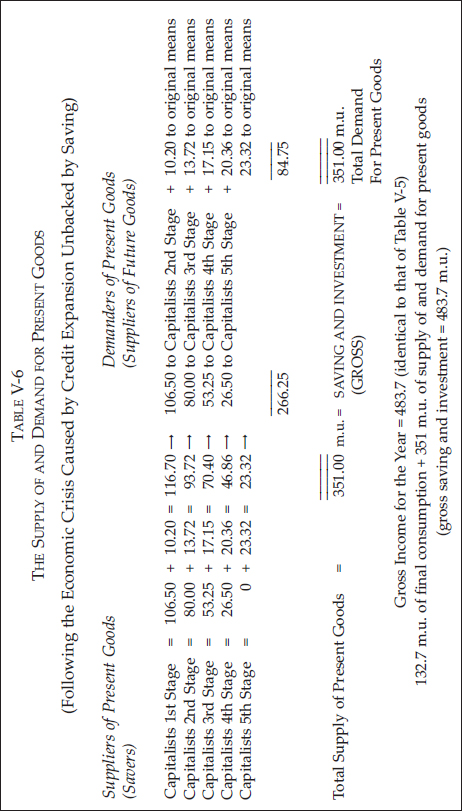
4
BANKING, FRACTIONAL-RESERVE RATIOS, AND THE LAW OF LARGE NUMBERS
Our analysis up to this point permits us to comment on whether it is possible, as certain scholars maintain, to insure through the application of the law of large numbers the practice of fractional-reserve banking. Essentially we will respond to the argument that banks, in order to fulfill their customers’ normal requests for liquidity, and in accordance with the law of large numbers, only need to keep on hand, in the form of a cash reserve, a fraction of the money deposited with them in cash. This argument lies at the heart of legal doctrines aimed at justifying the monetary irregular bank-deposit contract with a fractional reserve. We critically examined this contract in chapter 3.
The reference in this area to the law of large numbers is equivalent to an attempt to apply the principles of insurance techniques to guard against the risk of deposit withdrawals, a risk assumed in advance to be quantifiable and thus technically insurable. However, this belief is mistaken, and as we will see, it is based on a misconceived idea of the nature of the phenomena before us. Indeed, far from the type of events which correspond to the natural world and represent an insurable risk, banking related phenomena fall within the realm of human action and are therefore immersed in uncertainty (not risk), which by its very nature is not technically insurable.
For in the field of human action the future is always uncertain, in the sense that it has yet to be built and the only part of it possessed by the actors which will be its protagonists are certain ideas, mental images, and expectations they hope to realize through their personal action and interaction with other actors. Moreover the future is open to man’s every creative possibility; hence each actor faces it with a permanent, ineradicable uncertainty which can be reduced through the patterned behaviors of the actor and others (institutions) and the alert exercise of entrepreneurship. Nevertheless the actor will not be able to totally eliminate this uncertainty.The open, permanent and ineradicable nature of the uncertainty we are referring to makes both traditional notions of objective and subjective probability, and the Bayesian conception of the latter inapplicable to the field of human interaction. In fact Bayes’s theorem requires a stable, underlying stochastic structure incompatible with the human capacity for entrepreneurial creativity.This is so for two reasons: first, it is not even possible to know all of the potential alternatives or cases; and second, the actor only possesses certain subjective beliefs or convictions—termed by Mises case probabilities (of unique events)—which as they are modified or broadened tend to change by surprise, i.e., in a radical, divergent manner, the actor ’s entire map of beliefs and knowledge. Thus the actor continually discovers completely new situations of which previously he had not even been able to conceive.
This concept of uncertainty, which corresponds to single events in the field of human action and hence of economics, differs radically from the notion of risk applicable within the sphere of physics and natural science. Table V-7 provides a summary.
Clearly the events related to customers’ more or less massive and unexpected withdrawal of deposits from a bank correspond to the sphere of human action and are immersed in uncertainty, which by its very nature is not technically insurable. The technical-economic reason it is impossible to insure uncertainty stems basically from the fact that human action itself brings about or creates the events which an attempt is made to insure. In other words, withdrawals of deposits are invariably influenced by the very existence of the insurance, and therefore the necessary stochastic independence between the existence of the “insurance” (a fractional-reserve requirement supposedly established according to the law of large numbers and bankers’ experience) and the occurrence of the phenomenon (bank crises and runs which provoke the massive withdrawal of deposits), precisely what is meant to be insured against, does not exist.A detailed demonstration of the close connection between the attempt to apply the law of large numbers in the form of a fractional-reserve requirement and the fact that this “insurance” inevitably triggers massive withdrawals of deposits is simple. The development of the Austrian theory, or circulation credit theory of the business cycle (covered in this chapter), makes it possible. Indeed fractional-reserve banking permits the large-scale granting of loans unbacked by a prior increase in saving (credit expansion) and initially provokes artificial widening and lengthening of the productive structure (illustrated by the shaded areas in Chart V-6). Nevertheless sooner or later the microeconomic factors explained in detail in the previous section set in motion social processes which tend to reverse the entrepreneurial errors committed, and consequently the productive structure comes to resemble that illustrated in Chart V-7. There we see that the new stages by which an attempt was made to lengthen the productive structure (stages six and seven of Chart V-6) disappear altogether. Furthermore the “widenings” of stages two through five are liquidated, bringing about the general impoverishment of society, a result of the unwise investment of its scarce real saved resources. Accordingly a highly significant number of the recipients of loans derived from credit expansion are ultimately unable to repay them and become defaulters, initiating a process in which both suspensions of payments and bankruptcies multiply. Hence default comes to affect a very large percentage of bank loans. In fact once the crisis hits and it becomes evident that the investment projects launched in error should not have been undertaken, the market value of these projects is reduced to a fraction of their initial value, when it does not disappear completely.
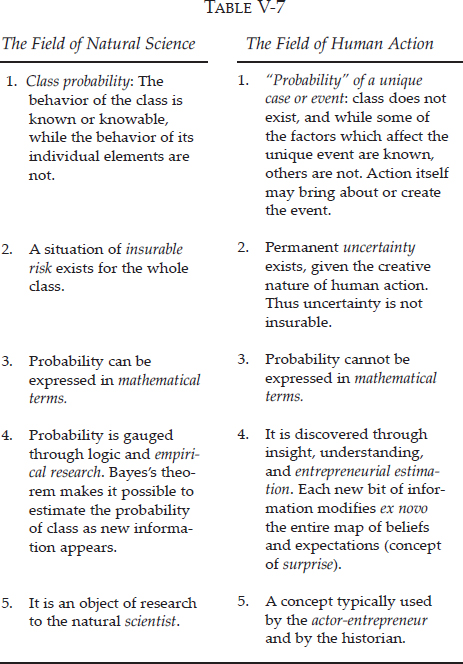
The extent to which this generalized decrease in the value of many capital goods is carried over to banks’ assets is graphically illustrated precisely by the loan amounts which correspond to the shaded areas in Chart V-6. This chart reflects, in monetary terms, the erroneous lengthening and widening of the productive structure: changes attempted in the expansive phases of the economic cycle, due to the cheap, easy financing of bank loans (unbacked by a prior increase in voluntary real saving). Inasmuch as the errors committed are revealed and the “lengthenings” and “widenings” of the productive structure are abandoned, liquidated, or realigned, the value of the assets of the entire banking system diminishes dramatically. Moreover this decline in value is gradually accompanied by the credit tightening process we analyzed in accounting terms at the end of chapter 4 and which tends to aggravate even further the negative effects the recession exerts on the assets of the banking system. In fact those entrepreneurs who fortunately manage to save their companies from a suspension of payments and bankruptcy restructure the investment processes they initiated. They paralyze them, liquidate them and accumulate the liquidity necessary to return the loans they obtained from the bank. Furthermore the pessimism and demoralization of economic agentsmeans that new loan requests and their approval cannot compensate for the speed at which loans are repaid. A serious credit squeeze results.
Therefore one must draw the conclusion that the economic recession caused by credit expansion results in a generalized decline in the value of the accounting assets of the banking system, just when depositors’ optimism and confidence are lowest. In other words, recession and default drive down the value of banks’ loans and other assets, while banks’ corresponding liabilities, the deposits now in the hands of third parties, remain unchanged. With respect to accounting, the financial situation of many banks becomes particularly problematic and difficult, and they begin to announce suspensions of payments and failures. As is logical, from a theoretical standpoint it is impossible to determine in advance which specific banks will be relatively more affected. However we can safely predict that those banks which are marginally less solvent will face a serious liquidity squeeze, a suspension of payments and even bankruptcy. Such a situation can very easily precipitate a generalized crisis of confidence in the entire banking system, prompting individuals to withdraw their deposits en masse, not only from the banks which, relatively speaking, experience the greatest difficulties, but by contagion, from all the rest as well. Indeed all banks which operate with a fractional reserve are inherently insolvent, and their differences are relatively minor and merely a matter of degree, making a significant financial and credit squeeze inevitable. Events of this sort (such as the economic crisis Florentine banks provoked in the fourteenth century) have repeatedly occurred since the dawn of fractional-reserve banking. At any rate it has been demonstrated that the fractional-reserve system endogenously triggers processes which make it impossible to insure banking via the application of the law of large numbers. These processes cause systematic crises in the banking system, which sooner or later plague it with insuperable difficulties. This invalidates one of the stalest arguments to technically justify the existence of a contract which, like that of the monetary bank deposit with a fractional reserve, is of an inadmissible legal nature (as we saw in chapter 3), given that it originates solely from a privilege granted by public authorities to private banks.
One might mistakenly believe that the high incidence of default and the generalized loss of value on the asset side of bank balance sheets, both products of the economic crisis, could from an accounting standpoint be offset with no problem by eliminating the corresponding deposits which balance these loans on the liability side. Not in vain did chapter 4 show that the credit expansion process entails banks’ creation of such deposits. Nonetheless economically speaking this argument is invalid. While banks’ creation of money in the form of deposits initially coincides with their creation of loans, and both are granted to the same actors, loan recipients immediately part with the m.u. received as deposits, using them to pay their suppliers and owners of the original means of production. Hence the direct recipients continue to owe the loan amounts to the bank, yet the deposits change hands at once. This precisely is the root of banks’ inherent insolvency which endangers their survival in the stages of severe economic recession. In fact the businessmen who receive loans commit en masse entrepreneurial errors which the crisis reveals. They mistakenly instigate processes of investment in capital goods, in which the loans materialize, loans whose value falls dramatically or is completely lost. Substantial default results, and the value of a large portion of banks’ assets plummets. However at the same time, the deposit holders, now third parties, maintain their claims intact against the banks that brought about credit expansion, and therefore banks are unable to eliminate their liabilities at the same rate the value of their assets drops. An accounting maladjustment ensues, leading to suspensions of payments and to the bankruptcy of marginally less solvent banks. If pessimism and the lack of confidence spread, all banks may become insolvent, ending in the disastrous failure of the banking system and of the monetary system based on fractional-reserve banking. This instability intrinsic to the fractional-reserve banking system is what makes the existence of a central bank as lender of last resort inevitable, just as the correct functioning of a system of complete banking freedom requires a return to traditional legal principles and thus a 100-percent reserve requirement.
If a monetary bank-deposit contract which allows bankers to neglect their obligation to maintain a 100-percent reserve ratio may eventually even lead to the downfall of the banking system (and of many of its customers), how is it possible that historically bankers have insisted upon acting in this manner? In the first three chapters we studied the historical factors and circumstances which gave rise to the bank-deposit contract with a fractional reserve. There we saw that this contract originated from a privilege governments granted bankers, allowing them to use in their own interest the money of their depositors, most often in the form of loans given to the very granter of the privilege, i.e., the government or state, continually overwhelmed by financial pressures. If governments had fulfilled their essential purpose and had adequately defined and defended the property rights of depositors, such an anomalous institution would never have emerged.
Let us now ponder some additional considerations with respect to the emergence of the monetary bank-deposit contract with a fractional reserve. One relevant issue is the great theoretical difficulty which, given the complex, abstract nature of social processes related to credit and money, renders a great many people, even those most involved in these processes, unable to analyze and comprehend the effects which credit expansion ultimately provokes. In fact throughout history most people have generally considered the effects of credit expansion on the economy positive and have merely focused on its most visible, short-term results (waves of optimism, economic booms). However what can be said of the bankers themselves, who throughout history have experienced numerous bank runs and crises that have repetitively and seriously endangered their business or even ended it? Given that bankers have suffered first-hand the consequences of operating with a fractional-reserve ratio, one might think it is in their own best interest to modify their practices and adapt them to traditional legal principles (that is, a 100-percent cash reserve). Even Ludwig von Mises held this idea at first,yet historical experience, which shows that again and again banks have relapsed into holding a fractional reserve (in spite of the huge risks it entails), does not justify it, nor does the theoretical analysis. Indeed even when bankers are aware that fractional-reserve banking is condemned to failure in the long run, the ex nihilo creation of money, an ability all credit expansion involves, generates such large profits that bankers eventually succumb to the temptation to revert to a fractional reserve. In addition no particular banker can be absolutely certain his bank will be one of those that eventually suspend payments or fail, since he can always hope to be able to withdraw from the process before the crisis hits, demand the repayment of loans, and avoid defaulters. Thus a typical tragedy of the commons, a process known to be triggered whenever the property rights of third parties are inadequately defined or defended (as in the case which concerns us), is set in motion. We will study the process in greater depth in chapter 8. In light of the above it is unsurprising banks face an irresistible temptation to expand their credit before other banks and hence to take full advantage of the profits of the expansion while leaving the rest of the banks, and the entire economic system in general, to jointly bear the extremely harmful consequences which ultimately follow.
To conclude, the technical impossibility of insuring against the risk of deposit withdrawal via a fractional-reserve ratio also explains, as we will see in chapter 8, that bankers themselves have been the chief defenders of the existence of a central bank which, as lender of last resort, could guarantee their survival during panic stages.From this point of view, the historical emergence of the central bank as an institution was an inevitable result of the very privilege which allows banks to loan most of the money they receive on deposit, through the maintenance of a fractional-reserve ratio. Furthermore it is evident that until traditional legal principles, and thus a 100-percent reserve requirement, are reestablished, it will be impossible to manage without the central bank and to introduce a true free-banking system which is subject to the law and does not adversely affect the course of the economy by regularly provoking destabilizing phases of artificial expansion and economic recession.
_____________
The capital theory we will expound is the key to understanding how bank credit expansion distorts the economy’s real productive structure. In fact the usual error of the critics of the Austrian theory of the business cycle (also called the circulation credit theory), which we present here, is that they fail to take capital theory into account. This is the case, for example, with Hans-Michael Trautwein and his two papers: “Money, Equilibrium, and the Business Cycle: Hayek’s Wicksellian Dichotomy,” History of Political Economy 28, no. 1 (Spring, 1996): 27–55, and “Hayek’s Double Failure in Business Cycle Theory: A Note,” chapter 4 of Money and Business Cycles: The Economics of F.A. Hayek, M. Colonna and H. Hagemann, eds. (Aldershot, U.K.: Edward Elgar, 1994), vol. 1, pp. 74–81.
On the concepts of human action, plans of action, the subjective conception of time, and action understood as a set of successive stages, see Huerta de Soto, Socialism, Economic Calculation and Entrepreneurship, pp. 16ff.
The development of economics as a science which is always based on human beings, the creative actors and protagonists in all social processes and events (the subjectivist conception), is undoubtedly the most significant and characteristic contribution made by the Austrian School of economics, founded by Carl Menger. In fact Menger felt it vital to abandon the sterile objectivism of the classical (Anglo-Saxon) school whose members were obsessed with the supposed existence of external objective entities (social classes, aggregates, material factors of production, etc.). Menger held that economists should instead always adopt the subjectivist view of human beings who act, and that this perspective should invariably exert a decisive influence on the way all economic theories are formulated, in terms of their scientific content and their practical conclusions and results. On this topic see Huerta de Soto, “Génesis, esencia y evolución de la Escuela Austriaca de Economía,” in Estudios de economía política, chap. 1, pp. 17–55.
This classification and terminology were conceived by Carl Menger, whose theory on economic goods of different order is one of the most important logical consequences of his subjectivist conception of economics. Carl Menger, Grundsätze der Volkswirthschaftslehre (Vienna: Wilhelm Braumüller, 1871). Menger uses the expression “Güter der ersten Ordnung” (p. 8) to refer to consumer goods or first-order goods. English translation by J. Dingwall and B. Hoselitz, Principles of Economics (New York: New York University Press, 1981).
On the subjective, experimental and dynamic conception of time as the only conception applicable to human action in economics, see chapter 4 of the book by Gerald P. O’Driscoll and Mario J. Rizzo, The Economics of Time and Ignorance (Oxford: Basil Blackwell, 1985), pp. 52–70.
As Ludwig M. Lachmann has correctly stated, economic development entails not only an increase in the number of productive stages, but also an increase in their complexity, and therefore a change in their composition. Ludwig M. Lachmann, Capital and its Structure (Kansas City: Sheed Andrews and McMeel, 1978), p. 83. See also Peter Lewin, “Capital in Disequilibrium: A Reexamination of the Capital Theory of Ludwig M. Lachmann,” History of Political Economy 29, no. 3 (Fall, 1997): 523–48; and Roger W. Garrison, Time and Money: The Macroeconomics of Capital Structure (London and New York: Routledge, 2001), pp. 25–26.
José Castañeda eloquently states:
As more auxiliary means are introduced into the production process, the process becomes more lengthy, and in general, more productive. Of course more indirect processes may exist; that is, ones that are longer or more drawn-out, yet no more productive. Nevertheless these are not taken into account since they are not applied, and a longer process is only introduced when it improves productivity.
José Castañeda Chornet, Lecciones de teoría económica (Madrid: Editorial Aguilar, 1972), p. 385.
The law of time preference may even date back to Saint Thomas Aquinas, and it was expressly stated in 1285 by one of his most brilliant disciples, Giles Lessines, who maintained that
res futurae per tempora non sunt tantae existimationis, sicut eadem collectae in instanti nec tantam utilitatem inferunt possidentibus, propter quod oportet quod sint minoris existimationis secundum iustitiam.
In other words,
future goods are not valued as highly as goods available immediately, nor are they as useful to their owners, and therefore justice dictates they should be considered less valuable.
Aegidius Lessines, De usuris in communi et de usurarum contractibus, opuscule 66, 1285, p. 426; quoted by Dempsey, Interest and Usury, note 31 on p. 214. This idea was later presented by Saint Bernardine of Siena, Conrad Summenhart, and Martín Azpilcueta in 1431, 1499, and 1556 respectively (see Rothbard, Economic Thought Before Adam Smith, pp. 85, 92, 106–07 and 399–400). The implications this concept has for economic theory were later worked out by Turgot, Rae, Böhm-Bawerk, Jevons, Wicksell, Fisher, and especially Frank Albert Fetter and Ludwig von Mises.
In a world without time preference people would consume nothing and save everything, and eventually humans would die of starvation and civilization would disappear. “Exceptions” to the law of time preference are merely apparent and invariably result from a disregard for the ceteris paribus condition inherent in the law. Thus a careful examination of any supposed “counter-example” suffices to reveal that refutations of time preference do not involve identical circumstances. This is the case with goods that cannot be simultaneously enjoyed, or those which, although they appear physically equivalent, are not identical from the actor ’s subjective viewpoint (for instance, ice cream, which we prefer in summer, even when winter is closer). On the theory of time preference, see Mises, Human Action, pp. 483–90 (pp. 480–87 of the Scholar ’s Edition).
The principal point to be emphasized is that capital goods, thus defined, are distinguished in that they fall neatly into place in a teleological framework. They are the interim goals aimed at in earlier plans; they are the means toward the attainment of still further ends envisaged by the earlier plans. It is here maintained that the perception of this aspect of tangible things now available provides the key to the unravelling of the problems generally attempted to be elucidated by capital theory.
Israel M. Kirzner, An Essay on Capital (New York: Augustus M. Kelley, 1966), p. 38; reproduced in Israel M. Kirzner ’s book, Essays on Capital and Interest: An Austrian Perspective (Aldershot, U.K.: Edward Elgar, 1996), pp. 13–122.
This explains the traditional notion of three factors of production: land or natural resources, labor, and capital goods or higher-order economic goods. In each process of action or production, the actor, using his entrepreneurial sense, generates and combines these factors or resources. The processes culminate in the market in four different types of income: pure entrepreneurial profit, stemming from the actor’s alertness and creativity; rent from land or natural resources, in terms of their productive capacity; labor income or wages; and rent derived from the use of capital goods. Even though all capital goods ultimately consist of combinations of natural resources and labor, they also incorporate (apart from the entrepreneurial alertness and creativity necessary to conceive and generate them), the time required to produce them. Furthermore from an economic standpoint capital goods cannot be differentiated from natural resources solely in terms of their distinct physical form. Only purely economic criteria, such as the unaltered permanence of a good with respect to the achievement of goals and the fact that no further action is required of the actor, enable us from an economic standpoint to clearly distinguish between land (or a natural resource), which is always permanent, and capital goods, which strictly speaking, are not permanent and are spent or “consumed” during the production process, making it necessary to take their depreciation into account. This is why Hayek has affirmed that, despite appearances, “Permanent improvements in land is land.” F.A. Hayek, The Pure Theory of Capital (London: Routledge and Kegan Paul, [1941] 1976), p. 57; reedited by Lawrence H. White, as vol. XII of The Collected Works of F.A. Hayek (Chicago: University of Chicago Press, 2007). See also p. 298 and footnote 31.
This is the classic example given by Eugen von Böhm-Bawerk, Kapital und Kapitalzins: Positive Theorie des Kapitales (Innsbruck: Verlag der Wagner ’schen Universitäts-Buchhandlung, 1889), pp. 107–35. This work has been translated into English by Hans F. Sennholz, Capital and Interest, vol. 2: Positive Theory of Capital (South Holland, Ill.: Libertarian Press, 1959), pp. 102–18.
Saving always results in capital goods, even when initially these merely consist of the consumer goods (in our example the “berries”) which remain unsold (or are not consumed). Then gradually some capital goods (the berries) are replaced by others (the wooden stick), as the workers (Robinson Crusoe) combine their labor with natural resources through a process which takes time and which humans are able to go through due to their reliance on the unsold consumer goods (the saved berries). Hence saving produces capital goods first (the unsold consumer goods that remain in stock) which are gradually used up and replaced by another capital good (the wooden stick). On this important point, see Richard von Strigl, Capital and Production, edited with an introduction by Jörg Guido Hülsmann (Auburn, Ala.: Mises Institute, 2000), pp. 27 and 62.
Mark Skousen, in his book The Structure of Production (London and New York: New York University Press, 1990), reproduces a simplified outline of the stages in the production process used in the textile and oil industries in the United States (pp. 168–69). He illustrates in detail the complexity of both processes as well as the significant number of stages they comprise and the very prolonged time period they require. This type of flow chart can be used to provide a simplified description of the activity in any other sector or industry. Skousen takes the diagrams of the above-mentioned industries from the book by E.B. Alderfer and H.E. Michel, Economics of American Industry, 3rd ed. (New York: McGrawHill, 1957).
For this reason Hayek is especially critical of the traditional definition of a capital good as an intermediate good produced by humans, a definition he considers
a remnant of the cost of production theories of value, of the old views which sought the explanation of the economic attributes of a thing in the forces embodied in it. . . . Bygones are bygones in the theory of capital no less than elsewhere in economics. And the use of concepts which see the significance of a good in past expenditure on it can only be misleading.
Hayek, The Pure Theory of Capital, p. 89. Hayek concludes that
For the problems connected with the demand for capital, the possibility of producing new equipment is fundamental. And all the time concepts used in the theory of capital, particularly those of the various investment periods, refer to prospective periods, and are always “forward-looking” and never “backward-looking.” (Ibid., p. 90)
A demoralized entrepreneur who wishes to abandon his business and settle elsewhere can find sure, constant mobility in the market: legal contracts permit him to put his business up for sale, liquidate it and use his new liquidity to acquire another company. In this way he achieves real, effective mobility that is much greater than the mere physical or technical mobility of the capital good (which, as we have seen, is usually rather limited).
Nonetheless on various occasions we will be forced to use the term capital less strictly, to refer to the set of capital goods which make up the productive structure. This loose sense of “capital” is the one intended by, among others, Hayek in The Pure Theory of Capital, p. 54; it is also the meaning intended by Lachmann in Capital and its Structure, where on page 11 “capital” is defined as “the heterogeneous stock of material resources.”
This is precisely the fundamental argument Mises raises concerning the impossibility of economic calculation in a socialist economy. See Huerta de Soto, Socialism, Economic Calculation and Entrepreneurship, chaps. 3–7.
Ibid., chaps. 2 and 3, pp. 41–155.
This is the terminology used, for example, by Knut Wicksell in Lectures on Political Economy (London: Routledge and Kegan Paul, 1951), vol. 1, p. 164, where Wicksell expressly mentions a “horizontal-dimension” and a “vertical-dimension” to the structure of capital goods.
The interest rate can actually be interpreted in two different ways. It can be seen as a ratio of today’s prices (of which one corresponds to the good available today and the other corresponds to the same good available tomorrow); or it can be considered the price of present goods in terms of future goods. Both ideas yield the same result. The former is the one advocated by Ludwig von Mises, for whom the interest rate “is a ratio of commodity prices, not a price in itself” (Human Action, p. 526). We prefer to favor the latter here, following Murray N. Rothbard. A detailed analysis of how the interest rate is determined as the market price of present goods in terms of future goods, along with other studies, can be found in Murray N. Rothbard’s book, Man, Economy, and State: A Treatise on Economic Principles, 3rd ed. (Auburn, Ala.: Ludwig von Mises Institute, 1993), chaps. 5–6, pp. 273–387. In any case the interest rate is determined in the same way as any other market price. The only difference lies in the fact that, rather than reflect an established price for each good or service in terms of m.u., the interest rate is based on the sale of present goods in exchange for future goods, each in the form of m.u. Although we defend the idea that the interest rate is determined exclusively by time preference (i.e., by the subjective valuations of utility which time preference entails), the acceptance of another theory (for example, that to a greater or lesser degree the interest rate is set by the marginal productivity of capital) does not affect this book’s essential argument concerning the disruptive effects which banks’ expansive creation of loans has on the productive structure. In this regard, Charles E. Wainhouse states:
Hayek establishes that his monetary theory of economic fluctuations is consistent with any of the “modern interest theories” and need not be based on any particular one. The key is the monetary causes of deviations of the current from the equilibrium rate of interest.
“Empirical Evidence for Hayek’s Theory of Economic Fluctuations,” chapter 2 in Money in Crisis: The Federal Reserve, the Economy and Monetary Reform, Barry N. Siegel, ed. (San Francisco: Pacific Institute for Public Policy Research, 1984), p. 40.
What we colloquially refer to as the “money market” is actually just a short-term loan market. The true money market encompasses the entire market in which goods and services are exchanged for monetary units and in which the price or purchasing power of money, and the monetary price of each good and service are simultaneously determined. This is why the following affirmation, made by Marshall, is wholly misleading: “The ‘money market’ is the market for command over money: ‘the value of money’ in it at any time is the rate of discount, or of interest for short period loans charged in it.” Alfred Marshall, Money Credit and Commerce (London: Macmillan, 1924), p. 14. Mises, in Human Action, p. 403, completely clears up Marshall’s confusion of terms.
However, strictly speaking, the concept of a “rate of profit” makes no sense in real life, and we have only introduced it by way of illustration and to aid the reader in understanding the theory of the cycle. As Mises states:
[I]t becomes evident that it is absurd to speak of a “rate of profit” or a “normal rate of profit” or an “average rate of profit.” . . . There is nothing “normal” in profits and there can never be an “equilibrium” with regard to them. (Mises, Human Action, p. 297)
In fact the interest rate at which loans are negotiated in the credit market also includes an entrepreneurial component we have not mentioned in the text:
The granting of credit is necessarily always an entrepreneurial speculation which can possibly result in failure and the loss of a part of the total amount lent. Every interest stipulated and paid in loans includes not only originary interest but also entrepreneurial profit. (Mises, Human Action, p. 536)
This same idea is focal in Roger Garrison’s latest book, which we read after the first edition of our book had been published in Spanish. Garrison states:
[T]he intertemporal allocation may be internally consistent and hence sustainable, or it may involve some systematic internal inconsistency, in which case its sustainability is threatened. The distinction between sustainable and unsustainable patterns of resource allocation is, or should be, a major focus of macroeconomic theorizing. (Garrison, Time and Money, pp. 33–34)
Mises, The Theory of Money and Credit and also Human Action.
The first theorist to propose an illustration basically identical to that of Chart V-1 was William Stanley Jevons in his book The Theory of Political Economy, the 1st edition of which was published in 1871. We have used a reprint of the 5th edition (Kelley and Millman, eds.), published in 1957 in New York; page 230 includes a diagram where, according to Jevons, “line ox indicates the duration of investment and the height attained at any point, i, is the amount of capital invested.” Later, in 1889, Eugen von Böhm-Bawerk gave more in-depth consideration to the theoretical issue of the structure of successive stages of capital goods and to using charts to illustrate this structure. He proposed to represent it by successive annual concentric circles (the expression Böhm-Bawerk uses is konzentrische Jahresringe), each of which depicts a productive stage; the circles overlap other larger ones. This type of chart appears, along with Böhm-Bawerk’s explanation of it, on pp. 114–15 of his book, Kapital und Kapitalzins, vol. 2: Positive Theorie des Kapitales; the corresponding pages of the English edition, Capital and Interest, are pp. 106–07, vol. 2. The chief problem with Böhm-Bawerk’s chart is that it depicts the passage of time in a very clumsy way and therefore reveals the need for a second dimension (vertical). Böhm-Bawerk could easily have gotten around this difficulty by replacing his “concentric rings” with a number of cylinders placed one on top of the other, so that each cylinder has a base smaller than the one below it (like a circular wedding cake whose layers are smaller in diameter the higher their position). Hayek later overcame this difficulty, in 1931, in the first edition of his now classic book, Prices and Production, foreword by Lionel Robbins (London: Routledge, 1931; 2nd rev. ed., in 1935); p. 36 of the first edition and p. 39 of the second. From this point on, unless we indicate otherwise, all quotations taken from this book will come from the 2nd edition. The book contains a chart very similar to Chart V-1. Hayek used this type of illustration again in 1941 (but this time in continuous terms) in his book, The Pure Theory of Capital (see, for example, p. 109). Moreover in 1941 Hayek also developed a prospective three-dimensional chart of the different stages in the production process. What this chart gains in accuracy, precision, and elegance, it loses in comprehensibility (p. 117 of the 1941 English edition). In 1962 Murray Rothbard (Man, Economy, and State, chaps. 6–7) proposed a depiction similar and in many aspects even superior to Hayek’s. Mark Skousen follows Rothbard’s illustration very closely in his book, The Structure of Production. In Spanish we first introduced the chart of the stages in the productive structure over forty years ago in the article, “La teoría austriaca del ciclo económico,” originally published in Moneda y crédito, no. 152 (March 1980): 37–55 (republished in our book, Estudios de economía política, chap. 13, pp. 160–76). Although the triangular charts Knut Wicksell proposes in Lectures on Political Economy (vol. 1, p. 159) could also be interpreted as an illustration of the productive structure, we have deliberately left them out of this brief outline of the history of charts depicting the stages in the production process. See also Alonso Neira, M.A., “Hayek’s Triangle,” An Eponymeus Dictionary of Economics: A Guide to Laws and Theorems Named after Economists, Julio Segura and Carlos Rodriquez Braun, eds. (Cheltenham, U.K.: Edward Elgar, 2004). Finally a critical analysis of Hayekian triangles from the Austrian point of view can be seen in Walter Block and William Barnett, “Hayekian Triangles,” Procesos de Mercado 3, no. 2 (2006).
The inventory of capital constitutes, so to speak, a cross section of the many processes of production which are of varying length and which began at different times. It therefore cuts across them at very widely differing stages of development. We might compare it to the census which is a cross section through the paths of human life and which encounters and which arrests the individual members of society at widely varying ages and stages. (Böhm-Bawerk, Capital and Interest, vol. 2: Positive Theory of Capital, p. 106)
In the original edition, this quotation appears on p. 115.
John B. Clark, “The Genesis of Capital,” Yale Review 2 (November 1893): 302–15; and “Concerning the Nature of Capital: A Reply,” Quarterly Journal of Economics (May 1907). Frank H. Knight, “Capitalist Production, Time and the Rate of Return,” in Economic Essays in Honour of Gustav Cassel (London: George Allen and Unwin, 1933).
Ludwig von Mises very clearly states that
The length of time expended in the past for the production of capital goods available today does not count at all. These capital goods are valued only with regard to their usefulness for future satisfaction. The “average period of production” is an empty concept. (Mises, Human Action, p. 489)
Rothbard expresses a similar opinion in his book, Man, Economy, and State, pp. 412–13.
Furthermore Rothbard points out that
[l]and that has been irrigated by canals or altered through the chopping down of forests has become a present, permanent given. Because it is a present given, not worn out in the process of production, and not needing to be replaced, it becomes a land factor under our definition. (Italics in original)
Rothbard concludes that once
the permanent are separated from the nonpermanent alterations, we see that the structure of production no longer stretches back infinitely in time, but comes to a close within a relatively brief span of time. (Man, Economy, and State, p. 414; italics added)
As F.A. Hayek has explained,
The different installments of future services which such goods are expected to render will in that case have to be imagined to belong to different “stages” of production corresponding to the time interval which will elapse before these services mature.
Prices and Production, p. 40; footnote on p. 2. In this respect the equivalence between durable consumer goods and capital goods had already been revealed by Eugen von Böhm-Bawerk, according to whom, “The value of the remoter installments of the renditions of service is subject to the same fate as is the value of future goods.” Capital and Interest, vol. 2: Positive Theory of Capital, pp. 325–37, esp. p. 337. In the German edition see the chapter dedicated to “Der Zins aus ausdauernden Gütern,” on pp. 361–82 of the 1889 edition already cited. Böhm-Bawerk expresses this principle in German in the following way: “In Folge davon verfällt der Werth der entlegeneren Nutzleistungsraten demselben Schicksale, wie der Werth künftiger Güter.” See Kapital und Kapitalzins, vol. 2: Positive Theorie des Kapitales, p. 365. In Spain José Castañeda Chornet reveals that perhaps he has been the one who has best understood this essential idea when he affirms that
Durable consumer goods, which generate a flow of consumer services over time, may be included in an economy’s fixed capital. In a strict sense they constitute fixed consumer capital, not productive capital. So capital, in a broad sense, comprises productive or true capital as well as consumer capital, or capital for use. (Castañeda, Lecciones de teoría económica, p. 686)
Roger W. Garrison has put forward the additional argument that all consumer goods for which a secondhand market exists should be classified, from an economic standpoint, as investment goods. In fact consumer goods classified as “durable” simultaneously form a part of consecutive stages in the production process, although they legally belong to “consumers,” since consumers take care of, protect and maintain them in their productive capacity so they will render direct consumer services over a period of many years. Roger Garrison, “The Austrian-Neoclassical Relation: A Study in Monetary Dynamics,” doctoral thesis presented at the University of Virginia, 1981, p. 45. On the possibility and convenience of representing consumer durables in our chart, see Garrison, Time and Money, pp. 47–48.
Tables such as Table V-1 have been constructed for the same purpose by Böhm-Bawerk (Capital and Interest, vol. 2, pp. 108–09, where in 1889 he first recorded for each stage of production the value in “years of labor ” of the products of the corresponding stage). Later, in 1929, F.A. Hayek performed the same task with greater precision in his article “Gibt es einen ‘Widersinn des Sparens’?” (Zeitschrift Für Nationalökonomie, Bd. 1, Heft 3, 1929), which was translated with the title “The ‘Paradox’ of Saving” and published in English in Economica (May 1931) and later included as an appendix to the book, “Profits, Interest and Investment” and Other Essays on the Theory of Industrial Fluctuations, 1st ed. (London: George Routledge and Sons, 1939 and Clifton, N.J.: Augustus M. Kelley, Clifton 1975), pp. 199–263, esp. pp. 229–31. As Hayek himself admits, it was precisely the desire to simplify the awkward presentation of these tables that led him to introduce the chart of production stages we have displayed in Chart V-1 (see Prices and Production, p. 38, note 1).
Adam Smith, The Wealth of Nations, book 2, chap. 2, p. 390 of vol. 1 of the original 1776 edition cited earlier, p. 306 of the E. Cannan edition (New York: Modern Library, 1937 and 1965); and p. 322 of vol. 1 of the Glasgow edition, (Oxford: Oxford University Press, 1976). As Hayek points out (Prices and Production, p. 47), it is important to note that Adam Smith’s authority on this subject has misled many authors. For example, Thomas Tooke, in his book, An Inquiry into the Currency Principle (London 1844, p. 71), and others have used Smith’s argument to justify the erroneous doctrines of the Banking School.
Hayek, Prices and Production, p. 49. This is precisely why the conception of capital as a homogeneous fund that reproduces by itself is meaningless. This view of capital is defended by J.B. Clark and F.H. Knight and is the theoretical basis (along with the concept of general equilibrium) for the extremely stale model of the “circular flow of income” that appears in almost all economics textbooks, despite the fact that it is misleading, as it does not reflect the temporal structure by stages in the production process, as in Chart V-1 (see also notes 39, 58 and pp. 515–16).
For instance as Ramón Tamames indicates, the gross national product at market prices
can be defined as the sum of the value of all the final goods and services produced in a nation in one year. I speak of final goods and services because intermediate ones are excluded to avoid the double computation of any value.
Fundamentos de estructura económica, 10th revised ed. (Madrid: Alianza Universidad, 1992), p. 304. Also see the book by Enrique Viaña Remis, Lecciones de contabilidad nacional (Madrid: Editorial Cívitas, 1993), in which he states that
the distinction between intermediate inputs and depreciation has given rise to the convention of excluding the former and including the latter in the value added. Therefore we distinguish between gross value added, which includes depreciation, and net value added, which excludes it. Consequently both product and income can be gross or net, depending upon whether they include or exclude depreciation. (p. 39)
As we see, the label “gross” is used to describe a figure that continues to be net, given that it excludes the entire value of intermediate inputs. National income accounting textbooks have not always ignored the fundamental importance of intermediate products. The classic work, The Social Framework of the American Economy: An Introduction to Economics, by J.R. Hicks and Albert G. Hart (New York: Oxford University Press, 1945), includes an explicit reference to the great importance of the time span in any process of production of consumer goods (the concrete example used is that of the production of a loaf of bread). The authors give a detailed explanation of the different stages of intermediate products necessary to arrive at the final consumer good. Hicks and Hart conclude (pp. 33–34):
The products which result from these early stages are useful products, but not products which are directly useful for satisfying the wants of consumers. Their use is to be found in their employment in the further stages, at the end of which a product which is directly wanted by consumers will emerge. . . . A producers’ good may be technically finished, in the sense that the particular operation needed to produce it is completed. . . . Or it may not be technically finished, but still in process, even so far as its own stage is concerned. In either case it is a producers’ good, because further stages are needed before the result of the whole process can pass into the consumers’ hands. The consumers’ good is the end of the whole process; producers’ goods are stages on the road toward it. (Italics added)
Skousen, in his book, The Structure of Production, pp. 191–92, proposes the introduction of “gross national output,” a new measure in national income accounting. With respect to the possible gross national output of the United States, Skousen concludes the following:
First, Gross National Output (GNO) was nearly double [Gross National Product] (GNP), thus indicating the degree to which GNP underestimates total spending in the economy. Second, consumption represents only 34 percent of total national output, far less than what GNP figures suggest (66 percent). Third, business outlays, including intermediate inputs and gross private investment, is the largest sector of the economy, 56 percent larger than the consumer-goods industry. GNP figures suggest that the capital-goods industry represents a minuscule 14 percent of the economy.
All of these figures refer to 1982 national income accounting data for the United States. As we will later see when we focus on business cycles, traditional gross national product figures have the glaring theoretical defect of hiding the important oscillations which take place in the intermediate stages of the production process throughout the cycle. Gross national output, however, would reflect all of these fluctuations. See also the data for 1986, found at the end of footnote 20, chapter 6.
As Murray Rothbard indicates, the net quality of GNP invariably leads one to identify capital with a perpetual fund that reproduces by itself without the need for any particular decision-making on the part of entrepreneurs. This is the “mythological” doctrine defended by J.B. Clark and Frank H. Knight, and it constitutes the conceptual basis for the current national income accounting system. Thus this system is simply the statistical, accounting manifestation of the mistaken understanding of capital theory promoted by these two authors. Rothbard concludes: “To maintain this doctrine it is necessary to deny the stage analysis of production and, indeed, to deny the very influence of time in production” (Rothbard, Man, Economy, and State, p. 343). Furthermore the current method of calculating GNP also strongly reflects Keynes’s influence, enormously exaggerating the importance of consumption in the economy and conveying the false impression that the most significant portion of the national product exists in the form of consumer goods and services, instead of investment goods. In addition this explains why most agents involved (economists, businessmen, investors, politicians, journalists, and civil servants) have a distorted idea of the way the economy functions. Since they believe the sector of final consumption to be the largest in the economy, they very easily conclude that the best way to foster the economic development of a country is to stimulate consumption and not investment. On this point see Hayek, Prices and Production, pp. 47–49, esp. note 2 on p. 48, Skousen, The Structure of Production, p. 190, and also George Reisman, “The Value of ‘Final Products’ Counts Only Itself,” American Journal of Economics and Sociology 63, no. 3 (July 2004): 609– 25, and Capitalism (Ottawa, Ill.: Jameson Book, 1996), pp. 674ff. See also next footnote 55.
Input-output tables partially escape the inadequacies of traditional national income accounting by permitting the calculation of the amount corresponding to all intermediate products. However even though input-output analysis is a step in the right direction, it also has very serious limitations. In particular, it reflects only two dimensions: it relates the different industrial sectors with the factors of production used directly in them, but not with the factors of production which are used but correspond to more distant stages. In other words, input-output analysis does not reflect the set of consecutive intermediate stages leading up to any intermediate stage or capital good or to the final consumer good. Instead it only relates each sector with its direct provider. Further-more due to the great cost and complexity of input-output tables, they are only compiled every certain number of years (in the United States, every five years), and therefore the statistics they contain are of very slight value with respect to calculating the gross national output for each year. See Skousen, The Structure of Production, pp. 4–5.
The expected increase in profit is considered in absolute, not relative, terms. Indeed profits representing, for example, 10 percent of 100 m.u. (10 m.u.) are smaller than profits representing 8 percent of 150 m.u. (12 m.u.). Even though the interest rate or rate of accounting profit decreases as the result of the weaker time preference which causes an increase in saving and investment, in absolute terms the accounting profits rise by 20 percent, i.e., from 10 to 12 m.u. This is what generally occurs in the stages furthest from consumption during the process we are considering. Regarding the stages closest to consumption, it is important to remember that, as we will indicate in the main text, the comparison is not drawn with past profits, but with an estimate of those which would have been produced had the entrepreneurial investment strategy not been modified.
See pages 300–01 and footnotes 32 and 33.
While studying economics in the late seventies, we noticed that in no Economic Theory course did the instructor explain how an increase in saving affects the productive structure; professors described only the Keynesian model of the “paradox of thrift,” which as is widely known, outright condemns increases in social saving, because they reduce effective demand. Although Keynes did not expressly refer to the “paradox of thrift,” this concept follows when Keynes’s economic principles are carried to their “logical” conclusion:
If governments should increase their spending during recessions, why should not households? If there were no principles of “sound finance” for public finance, from where would such principles come for family finance? Eat, drink and be merry, for in the long-run all are dead. (Clifford F. Thies, “The Paradox of Thrift: RIP,” Cato Journal 16, no. 1 [Spring–Summer, 1996]: 125)
See also our comments in footnote 58 on the treatment this subject receives in different editions of Samuelson’s textbook.
Following Turgot, Eugen von Böhm-Bawerk was the first to confront and resolve this issue. His analysis was rudimentary, yet contained all the essential elements of a definitive explanation. It is found in volume 2 of his magnum opus, Capital and Interest, published in 1889 (Kapital und Kapitalzins: Positive Theorie des Kapitales, pp. 124–25). Due to its significance, we include here the passage from Capital and Interest in which Böhm-Bawerk poses the question of growth in voluntary saving in a market economy and the forces involved which lead to a lengthening of the productive structure: let us suppose, says Böhm-Bawerk, that
each individual consumes, on the average, only three-quarters of his income and saves the other quarter, then obviously there will be a falling off in the desire to buy consumption goods and in the demand for them. Only three-quarters as great a quantity of consumption goods as in the preceding case will become the subject of demand and of sale. If the entrepreneurs were nevertheless to continue for a time to follow the previous disposition of production and go on bringing consumption goods to the market at a rate of a full 10 million labor-years annually, the oversupply would soon depress the prices of those goods, render them unprofitable and hence induce the entrepreneurs to adjust their production to the changed demand. They will see to it that in one year only the product of 7.5 million labor-years is converted into consumption goods, be it through maturation of the first annual ring or be it through additional present production. The remaining 2.5 million labor-years left over from the current annual allotment can be used for increasing capital. And it will be so used. . . . In this way it is added to the nation’s productive credit, increases the producer ’s purchasing power for productive purposes, and so becomes the cause of an increase in the demand for production goods, which is to say intermediate products. And that demand is, in the last analysis, what induces the managers of business enterprises to invest available productive forces in desired intermediate product. . . . [I]f individuals do save, then the change in demand, once more through the agency of price, forces the entrepreneurs into a changed disposition of productive forces. In that case fewer productive powers are enlisted during the course of the year for the service of the present as consumption goods, and there is a correspondingly greater quantity of productive forces tied up in the transitional stage of intermediate products. In other words, there is an increase in capital, which redounds to the benefit of an enhanced enjoyment of consumption goods in the future. (Böhm-Bawerk, Capital and Interest, vol. 2: Positive Theory of Capital, pp. 112–13; italics added)
These amounts correspond to the numerical example in Chart V–3.
The formula is 
which in terms of compound capitalization at interest i, corresponds to the present value of a temporary annuity, payable in arrears, of n periods, where the capitalization period coincides with the rent period. It is clear that as period n becomes longer and approaches infinity, the value of the rent will approach 1/i, which as a mnemonic rule, is applicable in practice to all capital goods with a very long life (and to land, due to its permanence). See Lorenzo Gil Peláez, Tablas financieras, estadísticas y actuariales, 6th revised updated ed. (Madrid: Editorial Dossat, 1977), pp. 205–37.
It should be noted that technological innovations which boost productivity (in the form of a greater quantity and/or quality of goods and services) by reducing the length of production processes will be introduced in any case, whether or not society’s net saving increases. However such an increase makes possible the application of new technologies which, due to a marginal lack of resources, cannot be adopted prior to the rise in saving.
The ceiling price will be reached when the effect of the reduction in the interest rate subsides and is counteracted by the larger number and volume of securities issued in the primary stock and bond market, which will tend to cause the market price per security to stabilize at a lower level. In the next chapter we will see that all prolonged market buoyancy and in general, all sustained, constant rises in stock-market indexes, far from indicating a very healthy underlying economic situation, stem from an inflationary process of credit expansion which sooner or later will provoke a stock-market crisis and an economic recession.
As Hayek indicates, these reductions in prices may take some time, depending upon the rigidity of each market, and at any rate, they will be less than proportional to the fall in demand that accompanies saving. If this were not the case, saving would not entail any actual sacrifice and the stock of consumer goods necessary to sustain economic agents while more capital-intensive processes are completed would not be left unsold. See F.A. Hayek, “Reflections on the Pure Theory of Money of Mr. J.M. Keynes (continued),” Economica 12, no. 35 (February 1932): 22–44, republished in The Collected Works of F.A. Hayek, vol. 9: Contra Keynes and Cambridge: Essays, Correspondence, Bruce Caldwell, ed. (London: Routledge, 1995), pp. 179–80.
See David Ricardo, The Works and Correspondence of David Ricardo, vol. 1: On the Principles of Political Economy and Taxation, Piero Sraffa and M.H. Dobb, eds. (Cambridge: Cambridge University Press, 1982), pp. 39–40.
Ibid., p. 395.
See Hayek, “Profits, Interest and Investment” and Other Essays on the Theory of Industrial Fluctuations, p. 39. Shortly afterward, in 1941, F.A. Hayek briefly touched on this effect in relation to the impact an increase in voluntary saving exerts on the productive structure, though he did not expressly quote Ricardo. This is the only instance we know of in which the “Ricardo Effect” is directly applied to an analysis of the consequences of a rise in voluntary saving, and not to the role the effect plays in the different phases of the business cycle, theorists’ predominant concern up until now. The excerpt in question is found on p. 293 of The Pure Theory of Capital (London: Macmillan, 1941), and successively reprinted thereafter (we quote from the 1976 Routledge reprint). It reads as follows: “The fall in the rate of interest may . . . drive up the price of labour to such an extent as to enforce an extensive substitution of machinery for labour.” Hayek later returned to the topic in his article, “The Ricardo Effect,” published in Economica 34, no. 9 (May 1942): 127–52, and republished as chapter 11 of Individualism and Economic Order (Chicago: University of Chicago Press, 1948), pp. 220–54. Thirty years later he dealt with it again in his article, “Three Elucidations of the Ricardo Effect,” published in the Journal of Political Economy 77, no. 2 (1979), and reprinted as chapter 11 of the book New Studies in Philosophy, Politics, Economics and the History of Ideas (London: Routledge and Kegan Paul, 1978), pp. 165–78. Mark Blaug recently admitted that his criticism of the “Ricardo Effect” in his book, Economic Theory in Retrospect (Cambridge: Cambridge University Press, 1978), pp. 571–77, was based on an error in interpretation regarding the supposedly static nature of Hayek’s analysis. See Mark Blaug’s article entitled “Hayek Revisited,” published in Critical Review 7, no. 1 (Winter, 1993): 51–60, and esp. note 5 on pp. 59–60. Blaug acknowledges that he discovered his error thanks to an article by Laurence S. Moss and Karen I. Vaughn, “Hayek’s Ricardo Effect: A Second Look,” History of Political Economy 18, no. 4 (Winter, 1986): 545–65. For his part, Mises (Human Action, pp. 773–77) has criticized the emphasis placed on the Ricardo Effect in order to justify a forced increase in wages through union or government channels with the purpose of raising investment in capital goods. He concludes that such a policy only gives rise to unemployment and a poor allocation of resources in the productive structure, since the policy does not stem from an increase in society’s voluntary saving, but rather from the simple coercive imposition of artificially high wages. Rothbard expresses a similar view in Man, Economy, and State (pp. 631–32). Hayek does so as well in The Pure Theory of Capital (p. 347), where he concludes that dictatorially-imposed growth in wages produces not only a rise in unemployment and a fall in saving, but also generalized consumption of capital combined with an artificial lengthening and narrowing of the stages in the productive structure.
See Hayek, The Pure Theory of Capital, p. 256.
In the words of Hayek himself:
All that happens is that at the earlier date the savers consume less than they obtain from current production, and at the later date (when current production of consumers’ goods has decreased and additional capital goods are turned out . . .) they are able to consume more consumers’ goods than they get from current production. (Hayek, The Pure Theory of Capital, p. 275. See also footnote 13 above)
The above considerations reveal once again the extent to which traditional national income statistics and the measures of growth in national income are theoretically inadequate. We have already pointed out that the indicators of national income do not measure the gross national output and tend to exaggerate the importance of consumption, while overlooking the intermediate stages in the production process. It is also true that the statistical measures of economic growth and of the evolution of the price index are both distorted because they focus mainly on the final stage, consumption. Therefore it is easy to see how, in the initial phases of the process triggered when voluntary saving rises, a statistical decrease in economic growth is registered. In fact there is often an initial decline in final consumer and investment goods, while national accounting statistics fail to reflect the parallel increase in investment in the stages furthest from consumption, the creation of new stages, not to mention the growth in investment in non-final intermediate products, stocks and inventories of circulating capital. Moreover the consumer price index falls, since it merely reflects the effect the reduced monetary demand has on consumer goods stages, yet no index adequately records the growth in prices in the stages furthest from consumption. Consequently different agents (politicians, journalists, union leaders, and employers’ representatives) often make an erroneous popular interpretation of these economic events, based on these statistical national accounting measures. Hayek, toward the end of his article on “The Ricardo Effect” (Individualism and Economic Order, pp. 251–54), offers a detailed description of the great statistical difficulties which exist with respect to using national accounting methods to record the effects on the productive structure of an increase in voluntary saving; or in this case, the influence of the “Ricardo Effect.” More recently, in his Nobel Prize acceptance speech, F.A. Hayek warned against the particularly widespread custom of regarding unsound theories as valid simply because there appears to be empirical support for them. Hayek cautioned against rejecting or even ignoring true theoretical explanations merely because it is quite difficult, from a technical standpoint, to collect the statistical information necessary to confirm them. These are precisely the errors committed in the application of national income accounting to the process by which the productive stages furthest from consumption grow wider and deeper, a process always due to a rise in voluntary saving. See “The Pretence of Knowledge,” Nobel Memorial Lecture, delivered December 11, 1974 and reprinted in The American Economic Review (December 1989): 3–7.
Milton Friedman and Anna J. Schwartz, in reference to the period from 1865 to 1879 in the United States, during which practically no increase in the money supply occurred, conclude that,
[T]he price level fell to half its initial level in the course of less than fifteen years and, at the same time, economic growth proceeded at a rapid rate. . . . [T]heir coincidence casts serious doubts on the validity of the now widely held view that secular price deflation and rapid economic growth are incompatible. (Milton Friedman and Anna J. Schwartz, A Monetary History of the United States 1867–1960 [Princeton, N.J.: Princeton University Press, 1971], p. 15, and also the important statistical table on p. 30)
In addition Alfred Marshall, in reference to the period 1875–1885 in England, stated that
It is doubtful whether the last ten years, which are regarded as years of depression, but in which there have been few violent movements of prices, have not, on the whole, conduced more to solid progress and true happiness than the alternations of feverish activity and painful retrogression which have characterised every preceding decade of this century. In fact, I regard violent fluctuations of prices as a much greater evil than a gradual fall of prices. (Alfred Marshall, Official Papers, p. 9; italics added)
Finally, see also George A. Selgin, Less Than Zero: The Case for a Falling Price Level in a Growing Economy, Hobart Paper 132 (London: Institute of Economic Affairs, 1997).
The essential argument against the thesis that saving adversely affects economic development and that it is necessary to stimulate consumption to foster growth was very brilliantly and concisely expressed by Hayek in 1932 when he demonstrated that it is a logical contradiction to believe that an increase in consumption manifests itself as an increase in investment, since investment can only rise due to a rise in saving, which must always go against consumption. In his own words:
Money spent today on consumption goods does not immediately increase the purchasing power of those who produce for the future; in fact, it actually competes with their demand and their purchasing power is determined not by current but by past prices of consumer goods. This is so because the alternative always exists of investing the available productive resources for a longer or a shorter period of time. All those who tacitly assume that the demand for capital goods changes in proportion to the demand for consumer goods ignore the fact that it is impossible to consume more and yet simultaneously to defer consumption with the aim of increasing the stock of intermediate products. (F.A. Hayek, “Capital Consumption,” an English translation of the article previously published under the German title “Kapitalaufzehrung,” in Weltwirt-schaftliches Archiv 36, no. 2 (1932): 86–108; italics added)
The English edition appears as chapter 6 of Money, Capital and Fluctuations: Early Essays (Chicago: University of Chicago Press, 1984), pp. 141–42. Hayek himself reminds us that this fundamental principle was put forward by John Stuart Mill, who in his fourth proposition on capital established that: “demand for commodities is not demand for labour.” Nevertheless Hayek indicates that John Stuart Mill failed to adequately justify this principle, which only became fully accepted by theorists upon the development of the theory of capital by Böhm-Bawerk and the theory of the cycle by Mises and Hayek himself (see John Stuart Mill, Principles of Political Economy (Fairfield, N.J.: Augustus M. Kelley, 1976), book 1, chap. 5, no. 9, pp. 79–88). According to Hayek, the understanding of this basic idea is the true test of any economist: “More than ever it seems to me to be true that the complete apprehension of the doctrine that ‘demand for commodities is not demand for labor ’ . . . is ‘the best test of an economist.’” Hayek, The Pure Theory of Capital (1976 ed.), p. 439. In short it means understanding that it is perfectly feasible for an entrepreneur of consumer goods to earn money even when his sales do not increase and even decrease, if the entrepreneur reduces his costs by substituting capital equipment for labor. (The increased investment in capital equipment creates jobs in other stages and makes society’s productive structure more capital-intensive.) See also J. Huerta de Soto, “Hayek’s Best Test of a Good Economist,” Procesos de Mercado 5, no. 2 (Autumn 2004): 121–24.
To F.A. Hayek goes the credit for being the first to have theoretically demolished the supposed “paradox of thrift” in 1929, in his article, “Gibt es einen ‘Widersinn des Sparens’?” (“The ‘Paradox’ of Saving,” Economica 2, no. 2 [May 1931], and reprinted in Profits, Interest and Investment, pp. 199–263). In Italy Augusto Graziani defended a position very similar to Hayek’s in his article, “Sofismi sul risparmio,” originally published in Rivista Bancaria (December 1932), and later reprinted in his book, Studi di Critica Economica (Milan: Società Anonima Editrice Dante Alighieri, 1935), pp. 253–63. It is interesting to note that an author as distinguished as Samuelson has continued to defend the old myths of the theory of under-consumption which constitute the basis for the paradox of thrift. He does so in various editions of his popular textbook, and as one might expect, relies on the fallacies of Keynesian theory, which we will comment on in chapter 7. It is not until the thirteenth edition that the doctrine of the “paradox of thrift” becomes optional material and the corresponding diagram justifying it disappears (Paul A. Samuelson and William N. Nordhaus, Economics, 13th ed. [New York: McGraw-Hill, 1989], pp. 183–85). Later, in the 14th edition (New York: McGraw-Hill, 1992), all references to the topic are silently and prudently eliminated. Unfortunately, however, they reappear in the 15th edition (New York: McGraw-Hill, 1995, pp. 455–57). See also Mark Skousen “The Perseverance of Paul Samuelson’s Economics,” Journal of Economic Perspectives 2, no. 2 (Spring, 1997): 137–52. The main error in the theory of the paradox of thrift consists of the fact that it ignores the basic principles of capital theory and does not treat the productive structure as a series of consecutive stages. Instead it contains the implicit assumption that only two stages exist, one of final aggregate consumer demand and another made up of a single set of intermediate investment stages. Thus in the simplified model of the “circular flow of income,” it is assumed that the negative effect on consumption of an upsurge in saving immediately and automatically spreads to all investment. On this topic see Skousen, The Structure of Production, pp. 244–59.
Rothbard (Man, Economy, and State, pp. 467–79) has revealed that, as a result of the lengthening of the productive structure (a phenomenon we have examined and one which follows from an increase in voluntary saving), it is impossible to determine in advance whether or not the income capitalists receive in the form of interest will rise. In our detailed example this does not occur in monetary terms and perhaps not in real terms either. This is due to the fact that, even when saving and gross investment grow, we cannot establish, simply on the basis of economic theory, whether or not the value of income derived from interest will fall, rise or remain constant, since each of these alternatives is feasible. It is also impossible to ascertain what will happen to the monetary income received by owners of the original means of production. In our example it stays the same, which results in a dramatic increase in the owners’ real income once the prices of consumer goods decline. Nonetheless a drop in the income (in monetary terms) received by the owners of the original means of production is possible, although such a drop will always be less marked than the reduction in the prices of consumer goods and services. Nowadays it is clearly a challenge for us to conceive of an economy in rapid development, yet where the monetary income received by owners of the factors of production (especially labor) diminishes, however this scenario is perfectly feasible if the prices of final consumer goods and services fall even faster.
In the words of John Hicks himself:
Boccaccio is describing the impact on people’s minds of the Great Plague at Florence, the expectation that they had not long to live. “Instead of furthering the future products of their cattle and their land and their own past labour, they devoted all their attention to the consumption of present goods.” [John Hicks asks:] “Why does Boccaccio write like Böhm-Bawerk? The reason is surely that he was trained as a merchant.” (Hicks, Capital and Time: A Neo-Austrian Theory, pp. 12–13)
Böhm-Bawerk, Capital and Interest, vol. 2: The Positive Theory of Capital, pp. 113–14. At the end of this analysis, Böhm-Bawerk concludes that saving is the necessary prior condition for the formation of capital. In the words of Böhm-Bawerk himself: “Ersparung [ist] eine unentbehrliche Bedingung der Kapitalbildung” (Böhm-Bawerk, German edition, p. 134).
Fritz Machlup clearly exposed the error committed by the theorists of the paradox of thrift when he made reference to the concrete historical case of the Austrian economy after World War I. At that time everything possible was done to foster consumption, however the country became extremely impoverished. Machlup ironically states:
Austria had most impressive records in five lines: she increased public expenditures, she increased wages, she increased social benefits, she increased bank credits, she increased consumption. After all these achievements she was on the verge of ruin. (Fritz Machlup, “The Consumption of Capital in Austria,” Review of Economic Statistics 17, no. 1 [1935]: 13–19)
Other examples of this kind of generalized impoverishments were the Argentina of General Perón and Portugal after the 1973 Revolution.
“So far as deposits are created by the banks, money means are created, and the command of capital is supplied, without cost or sacrifice on the part of the saver.” F.W. Taussig, Principles of Economics, 3rd ed. (New York: Macmillan, 1939), vol. 1, p. 357. Remember also note 23 in chapter 4, p. 205.
It does not matter whether this drop in the gross market rate expresses itself in an arithmetical drop in the percentage stipulated in the loan contracts. It could happen that the nominal interest rates remain unchanged and that the expansion manifests itself in the fact that at these rates loans are negotiated which would not have been made before on account of the height of the entrepreneurial component to be included. Such an outcome too amounts to a drop in gross market rates and brings about the same consequences. (Mises, Human Action, p. 552)
When under the conditions of credit expansion the whole amount of the additional money substitutes is lent to business, production is expanded. The entrepreneurs embark either upon lateral expansion of production (viz., the expansion of production without lengthening the period of production in the individual industry) or upon longitudinal expansion (viz., the lengthening of the period of production). In either case, the additional plants require the investment of additional factors of production. But the amount of capital goods available for investment has not increased. Neither does credit expansion bring about a tendency toward a restriction of consumption. (Ibid., p. 556)
A lengthening of the period of production is only practicable, however, either when the means of subsistence have increased sufficiently to support the laborers and entrepreneurs during the longer period or when the wants of producers have decreased sufficiently to enable them to make the same means of subsistence do for the longer period. (Mises, The Theory of Money and Credit, p. 400)
Elsewhere we have explained why systematic coercion and manipulation of market indicators, the result of government intervention or the granting of privileges by the government to pressure groups (unions, banks, etc.), prevent people from producing and discovering the information necessary to coordinate society, and serious maladjustments and social discoordination systematically follow. See Huerta de Soto, Socialismo, cálculo económico y función empresarial, chaps. 2 and 3.
Mises, Human Action, p. 553 (p. 550 of the Scholar ’s Edition). As all saving takes the form of capital goods, even when initially these goods are merely the consumer goods which remain unsold when saving rises, Mises’s explanation is completely valid. See footnotes 13 and 54. Lionel Robbins, in his book, The Great Depression (New York: Macmillan, 1934), lists the following ten characteristics typical of any boom: first, the interest rate falls in relative terms; second, short-term interest rates begin to decline; third, long-term interest rates also drop; fourth, the current market value of bonds rises; fifth, the velocity of the circulation of money increases; sixth, stock prices climb; seventh, real estate prices begin to soar; eighth, an industrial boom takes place and a large number of securities are issued in the primary market; ninth, the price of natural resources and intermediate goods rises; and last, tenth, the stock exchange undergoes explosive growth based on the expectation of an uninterrupted increase in entrepreneurial profits (pp. 39–42).
Roger Garrison interprets this phenomenon as an unsustainable departure from the production possibilities frontier (PPF). See his book, Time and Money, pp. 67–76.
Our intention is to warn readers of the error which threatens anyone who might attempt to make a strictly theoretical interpretation of the charts we present. Nicholas Kaldor committed such an error in his critical analysis of Hayek’s theory, as was revealed by Laurence S. Moss and Karen I. Vaughn, for whom
the problem is not to learn about adjustments by comparing states of equilibrium but rather to ask if the conditions remaining at T1 make the transition to T2 at all possible. Kaldor ’s approach indeed assumed away the very problem that Hayek’s theory was designed to analyze, the problem of the transition an economy undergoes in moving from one coordinated capital structure to another.
See their article, “Hayek’s Ricardo Effect: A Second Look,” p. 564. The articles in which Kaldor criticizes Hayek are “Capital Intensity and the Trade Cycle,” Economica (February 1939): 40–66; and “Professor Hayek and the Concertina Effect,” Economica (November 1942): 359–82. Curiously, Kaldor had translated from German to English Hayek’s book, Monetary Theory and the Trade Cycle, first published in 1933 (London: Routledge). Rudy van Zijp has pointed out that the criticism Kaldor and others have leveled against Hayek’s “Ricardo Effect” has derived from the assumption of a hypothetical state of general equilibrium which does not permit a dynamic analysis of the intertemporal discoordination credit expansion inevitably provokes in the market. See Rudy van Zijp, Austrian and New Classical Business Cycle Theory (Aldershot, U.K.: Edward Elgar, 1994), pp. 51–53.
Mises, The Theory of Money and Credit, p. 401; italics added. The last two sentences are so important that it is worthwhile to consider Ludwig von Mises’s expression of the essential idea in his original German edition:
Aber bald setzt eine rückläufige Bewegung ein: Die Preise der Konsumgüter steigen, die der Produktivgüter sinken, das heißt der Darlehenszinsfuß steigt wieder, er nähert sich wieder dem Satze des natürlichen Kapitalzinses. (Ludwig von Mises, Theorie des Geldes und der Umlaufsmittel, 2nd German ed. [Munich and Leipzig: Duncker and Humblot, 1924], p. 372)
Mises, who was strongly influenced by Wicksell’s doctrine of “natural interest,” bases his theory on the disparities which emerge throughout the cycle between “natural interest” and “gross interest in the credit (or ‘monetary’) market.” Banks temporarily reduce the latter in their process of credit expansion. Though we view Mises’s analysis as impeccable, we prefer to base our presentation of the theory of the cycle directly on the effects credit expansion exerts on the productive structure, and to somewhat minimize the importance of Mises’s analysis of the disparities between “natural interest” and “monetary interest.” Knut Wicksell’s main work in this area is Geldzins und Güterpreise: Eine Studie über die den Tauschwert des Geldes bestimmenden Ursachen (Jena: Verlag von Gustav Fischer, 1898), translated into English by R.F. Kahn with the title Interest and Prices: A Study of the Causes Regulating the Value of Money (London: Macmillan, 1936 and New York: Augustus M. Kelley, 1965). Nevertheless Wicksell’s analysis is much inferior to Mises’s, particularly because it rests almost exclusively on changes in the general price level, rather than on variations in relative prices in the capital goods structure, which is the essence of our theory. Mises summarized and completed the exposition of his own theory in Geldwertstabilisierung und Konjunkturpolitik (Jena: Gustav Fischer, 1928); English translation by Bettina Bien Greaves, “Monetary Stabilization and Cyclical Policy,” included in On the Manipulation of Money and Credit (New York: Free Market Books, 1978).
Hayek’s most important works are: Geldtheorie und Konjunkturtheorie, (Beitrage zur Konjunkturforschung, herausgegeben vom Österreichisches Institut für Konjunkturforschung, no. 1 [Vienna 1929]), translated into English by Nicolas Kaldor and published as Monetary Theory and the Trade Cycle (London: Routledge, 1933, and New Jersey: Augustus M. Kelley, 1975); Prices and Production, the first edition of which appeared in 1931 and the second, revised, updated edition of which appeared in 1935 and was later reprinted more than ten times in England and the United States; Profits, Interest, and Investment (1939, 1969, 1975); the series of essays published in Money, Capital and Fluctuations: Early Essays, Roy McCloughry, ed. (Chicago: University of Chicago Press, 1984); and last, The Pure Theory of Capital (1941; four later editions, and vol. XII of Hayek’s Collected Works). Hayek himself, in an “Appendix” to Prices and Production (pp. 101–04), lists the main forerunners of the Austrian theory or circulation credit theory of the business cycle, which can be traced back to Ricardo himself (the first to describe the effect Hayek christened the “Ricardo Effect”), Condy Raguet, James Wilson, and Bonamy Price in England and the United States; J.G. Courcelle-Seneuil, V. Bonnet, and Yves Guyot in France; and curiously, in German, ideas very similar to those of the theorists of the Austrian School can be found in the writings of Karl Marx and especially in those of Mijail Tugan-Baranovsky (see his work, Industrial Crises in England, St. Petersburg, 1894), and of course in those of Böhm-Bawerk (Capital and Interest, vol. 2: Positive Theory of Capital, pp. 316ff.). Later these contemporaries of Hayek worked along the same lines: Richard von Strigl, in Kapital und Produktion (Munich and Vienna: Philosophia Verlag, 1934, 1982; English translation, Auburn, Ala.: Ludwig von Mises Institute, 2000); Bresciani-Turroni in Italy, The Economics of Inflation: A Study of Currency Depreciation of Post-War Germany (1931, 1937; London and New York: Augustus M. Kelley 1968); Gottfried Haberler, “Money and the Business Cycle,” published in 1932 and reprinted in The Austrian Theory of the Trade Cycle and Other Essays (Washington, D.C: Ludwig von Mises Institute, 1978), pp. 7–20; Fritz Machlup, The Stock Market, Credit and Capital Formation, originally published in German in 1931 and reprinted in English (London: William Hodge, 1940). Notable writings in the English-speaking world include: Davenport, The Economics of Enterprise (New York: Augustus M. Kelley, [1913] 1978), chap. 13; Frederick Benham, British Monetary Policy (London: P.S. King and Shaw, 1932); H.F. Fraser, Great Britain and the Gold Standard (London: Macmillan, 1933); Theodore E. Gregory, Gold, Unemployment and Capitalism (London: P.S. King and Shaw, 1933); E.F.M. Durbin, Purchasing Power and Trade Depression: A Critique of Under-Consumption Theories (London and Toronto: Johnathan Cape, 1933), and The Problem of Credit Policy (London: Chapman and Hall, 1935); M.A. Abrams, Money in a Changing Civilisation (London: John Lain, 1934); and C.A. Phillips, T.F. McManus and R.W. Nelson, Banking and the Business Cycle, (New York: Arno Press, 1937). And also in the United States, the work of Frank Albert Fetter, esp. his article, “Interest Theory and Price Movements,” American Economic Review 17, no. 1 (1926): 72ff. (included in F.A. Fetter, Capital, Interest, and Rent, Murray N. Rothbard, ed. [Kansas City: Sheed Andrews and McMeel, 1977]).
It is important to remember that in 1974 the Swedish Academy awarded F.A. Hayek the Nobel Prize in Economics precisely for his “pioneering work in the theory of money and economic fluctuations.” See William J. Zahka, The Nobel Prize Economics Lectures (Aldershot, U.K.: Avebury, 1992), pp. 19 and 25–28. Writings in Spanish on the Austrian theory of the business cycle are few but can be traced back to the article by Mises published in the Revista de Occidente in 1932 (“La causa de las crisis económicas,” Revista de Occidente, February 1932) and to Luis Olariaga’s translation of Monetary Theory and the Trade Cycle, by F.A. Hayek (La teoría monetaria y el ciclo económico [Espasa-Calpe, 1936]). Olariaga’s edition of this book contains, as an appendix, a translation into Spanish (entitled “Previsiones de Precios, Perturbaciones Monetarias e Inversiones Fracasadas”) of “Price Expectations, Monetary Disturbances and Malinvestments” from the original English version. This article appears as chapter 4 of Profits, Interest and Investment and undoubtedly holds one of Hayek’s clearest presentations of his theory of the business cycle (fortunately it is included in the Spanish translation of Prices and Production published in 1996 [Precios y producción], Unión Editorial, Madrid). The fateful first year of the Spanish Civil War also coincided with the publication of the first Spanish translation (by Antonio Riaño) of The Theory of Money and Credit, by Ludwig von Mises (Teoría del dinero y del crédito ). It is not surprising that the war reduced the impact of these writings in Spain to a minimum. A notable achievement from the period following the civil war is Richard von Strigl’s outline of the Austrian theory of the cycle in his book, Curso medio de economía, M. Sánchez Sarto, Spanish trans. (Mexico: Fondo de Cultura Económica, 1941). The year 1947 saw the publication of Teoría de los ciclos económicos (Madrid: CSIC, 1947), by Emilio de Figueroa. In volume 2 of this work Figueroa compares Hayek’s and Keynes’s theories of the cycle (pp. 44–63). The Fondo de Cultura Económica also published the translation of J.A. Estey’s book, Business Cycles (Tratado sobre los ciclos económicos ), chapter 13 of which contains a detailed explanation of the Austrian theory. The only other works on this subject to be translated into Spanish are Gottfried Haberler ’s book, Prosperity and Depression (Prosperidad y depresión: análisis teórico de los movimientos cíclicos, translated by Gabriel Franco and Javier Márquez and published by the Fondo de Cultura Económica in 1942; chapter 3 of this book is devoted to the Austrian School’s theory of circulation credit); F.A. Hayek’s book, The Pure Theory of Capital (La teoría pura del capital, published by Aguilar in 1946); and Ludwig von Mises’s work, Human Action (La acción humana: tratado de economía, the first edition of which was published in 1960 by the Fundación Ignacio Villalonga). Apart from these books, the only other work in Spanish on the topic is our article, “La teoría austriaca del ciclo económico,” which was published over forty years ago in Moneda y Crédito 152 (March 1980), and which includes a comprehensive bibliography on the subject; and the series of essays by F.A. Hayek published as ¿Inflación o Pleno Empleo? (Madrid: Unión Editorial, 1976). Last, in 1996 Carlos Rodríguez Braun’s translation of Hayek’s Prices and Production (Precios y producción) appeared, published by Ediciones Aosta and Unión Editorial in Madrid.
In section 11 of chapter 6 (p. 440) we will see that our analysis does not change substantially even when a large volume of unused factors of production exists prior to credit expansion.
The additional demand on the part of the expanding entrepreneurs tends to raise the prices of producers’ goods and wage rates. With the rise in wage rates, the prices of consumers’ goods rise too. Besides, the entrepreneurs are contributing a share to the rise in the prices of consumers’ goods as they too, deluded by the illusory gains which their business accounts show, are ready to consume more. The general upswing in prices spreads optimism. If only the prices of producers’ goods had risen and those of consumers’ goods had not been affected, the entrepreneurs would have become embarrassed. They would have had doubts concerning the soundness of their plans, as the rise in costs of production would have upset their calculations. But they are reassured by the fact that the demand for consumers’ goods is intensified and makes it possible to expand sales in spite of rising prices. Thus they are confident that production will pay, notwithstanding the higher costs it involves. They are resolved to go on. (Mises, Human Action, p. 553)
Furthermore, assuming the existence of a (constant) supply curve of savings, the decrease in interest rates will reduce savings and increase consumption. See Garrison, Time and Money, p. 70.
Hayek expresses the concept in this concise manner:
[F]or a time, consumption may even go on at an unchanged rate after the more roundabout processes have actually started, because the goods which have already advanced to the lower stages of production, being of a highly specific character, will continue to come forward for some little time. But this cannot go on. When the reduced output from the stages of production, from which producers’ goods have been withdrawn for use in higher stages, has matured into consumers’ goods, a scarcity of consumers’ goods will make itself felt, and the prices of those goods will rise. (Hayek, Prices and Production, p. 88)
Sooner or later, then, the increase in the demand for consumers’ goods will lead to an increase of their prices and of the profits made on the production of consumers’ goods. But once prices begin to rise, the additional demand for funds will no longer be confined to the purposes of new additional investment intended to satisfy the new demand. At first—and this is a point of importance which is often overlooked—only the prices of consumers’ goods, and of such other goods as can rapidly be turned into consumers’ goods, will rise, and consequently profits also will increase only in the late stages of production. . . . [T]he prices of consumers’ goods would always keep a step ahead of the prices of factors. That is, so long as any part of the additional income thus created is spent on consumers’ goods (i.e., unless all of it is saved), the prices of consumers’ goods must rise permanently in relation to those of the various kinds of input. And this, as will by now be evident, cannot be lastingly without effect on the relative prices of the various kinds of input and on the methods of production that will appear profitable. (Hayek, The Pure Theory of Capital, pp. 377–78; italics added)
In an environment of increasing productivity (such as the one experienced during the period from 1995 to 2005), the (unit) prices of consumer goods will not rise significantly, yet the (monetary) amount companies closest to consumption bring in in sales and total profits will soar.
As is logical, the fact that, due to coercion and union action, wages may rise at a rate similar to that of the increase in the price of consumer goods, in no way detracts from our argument, since the other five factors we have mentioned in the text will continue to exert their influence. The “Ricardo Effect” may do so as well, given that, at least in relative terms, the price of the factors of production employed in the stages closest to consumption will always be lower than that of the resources used in the stages furthest from it, and therefore the “Ricardo Effect,” which is based on a comparison of relative costs, will continue to operate (entrepreneurs of the stages closest to consumption will begin to use, in relative terms, more labor than capital equipment). When coercion is used to improve the income of owners of the original factors, ultimately the only possible outcome is an important rise in involuntary unemployment among members of this group. This effect is especially acute in the stages furthest from consumption.
The first time Hayek expressly mentioned the “Ricardo Effect” to explain the process by which the initial effects of credit expansion reverse was in his essay, “Profits, Interest and Investment,” included in pp. 3–71 of the book of the same title. Hayek offers a very concise description of the “Ricardo Effect” on pp. 13–14 of this essay, where he states:
It is here that the “Ricardo Effect” comes into action and becomes of decisive importance. The rise in the prices of consumers’ goods and the consequent fall in real wages means a rise in the rate of profit in the consumers’ goods industries, but, as we have seen, a very different rise in the time rates of profit that can now be earned on more direct labour and on the investment of additional capital in machinery. A much higher rate of profit will now be obtainable on money spent on labour than on money invested in machinery. The effect of this rise in the rate of profit in the consumers’ goods industries will be twofold. On the one hand it will cause a tendency to use more labour with the existing machinery, by working overtime and double shifts, by using outworn and obsolete machinery, etc., etc. On the other hand, in so far as new machinery is being installed, either by way of replacement or in order to increase capacity, this, so long as real wages remain low compared with the marginal productivity of labour, will be of a less expensive, less labour-saving or less durable type.
Hayek also deals with the action of the “Ricardo Effect” in the most expansive phases of the boom in the following papers: “The Ricardo Effect” (1942, pp. 127–52), and the previously-cited “Three Elucidations of the Ricardo Effect” (1969). Other interesting writings on this topic include the article by Laurence S. Moss and Karen I. Vaughn, “Hayek’s Ricardo Effect: A Second Look” (1986, pp. 545–65) and the one by G.P. O’Driscoll, “The Specialization Gap and the Ricardo Effect: Comment on Ferguson,” published in History of Political Economy 7 (Summer, 1975): 261–69. See also Jesús Huerta de Soto, “Ricardo Effect,” Eponymous Dictionary of Economics: A Guide to Laws and Theorems Named after Economists, Julio Segura and Carlos Rodriquez Braun, eds. (Cheltenham, U.K.: Edward Elgar, 2004).
Or as Mises explains:
[W]ith further progress of the expansionist movement the rise in the prices of consumers’ goods will outstrip the rise in the prices of producers’ goods. The rise in wages and salaries and the additional gains of the capitalists, entrepreneurs, and farmers, although a great part of them is merely apparent, intensify the demand for consumers’ goods. . . . At any rate, it is certain that the intensified demand for consumers’ goods affects the market at a time when the additional investments are not yet in a position to turn out their products. The gulf between the prices of present goods and those of future goods widens again. A tendency toward a rise in the rate of originary interest is substituted for the tendency toward the opposite which may have come into operation at the earlier stages of the expansion. (Mises, Human Action, p. 558)
As Ludwig von Mises wrote in 1928:
The banks can no longer make additional loans at the same interest rates. As a result, they must raise the loan rate once more for two reasons. In the first place, the appearance of the positive price premium forces them to pay higher interest for outside funds which they borrow. Then also they must discriminate among the many applicants for credit. Not all enterprises can afford this increased interest rate. Those which cannot run into difficulties. (See On the Manipulation of Money and Credit, p. 127)
This is Bettina Bien Greaves’s translation into English of the book published in 1928 by Ludwig von Mises with the title, Geldwertstabilisierung und Konjunkturpolitik. The above passage is found on pp. 51–52 of this German edition, which contains a detailed explanation of all of Mises’s theory on business cycles. It was published before Prices and Production and the German edition of Monetary Theory and the Trade Cycle by Hayek (1929). It is odd that Hayek almost never cites this important work, in which Mises formulates and develops the theory of the cycle, which he only had the opportunity to outline in his book, The Theory of Money and Credit, published sixteen years earlier. Perhaps this oversight was deliberate and arose from a desire to convey to the scientific community the impression that the first attempt to develop Mises’s theory was made by Hayek in his writings on Monetary Theory and the Trade Cycle and Prices and Production, when Mises had already covered the topic very thoroughly in 1928.
See F.A. Hayek, “Investment that Raises the Demand for Capital,” published in Review of Economics and Statistics 19, no. 4 (November 1937) and reprinted in Profits, Interest and Investment, pp. 73–82.
Hayek himself, in reference to the rise in interest rates in the final stage of the boom, indicates that:
[T]he most important cause practically of such false expectations probably is a temporary increase in the supply of such funds through credit expansion at a rate which cannot be maintained. In this case, the increased quantity of current investment will induce people to expect investment to continue at a similar rate for some time, and in consequence to invest now in a form which requires for its successful completion further investment at a similar rate. . . . And the greater the amount of investment which has already been made compared with that which is still required to utilise the equipment already in existence, the greater will be the rate of interest which can advantageously be borne in raising capital for these investments completing the chain. (Hayek, “Investment that Raises the Demand for Capital,” pp. 76 and 80)
Mises points out the boom ends precisely when the entrepreneurs begin to experience difficulties in obtaining the increasing amount of financing they need for their investment projects:
The entrepreneurs cannot procure the funds they need for the further conduct of their ventures. The gross market rate of interest rises because the increased demand for loans is not counterpoised by a corresponding increase in the quantity of money available for lending. (Mises, Human Action, p. 554)
Entrepreneurs determined to complete their endangered long-term capital projects turn to the banks for more bank credit, and a tug-of-war begins. Producers seek new bank loans, the banking system accommodates the new loan demand by creating new money, product prices rise ahead of wage costs. In each market period the process repeats itself, with product prices always rising ahead of wages. (Moss and Vaughn, “Hayek’s Ricardo Effect: A Second Look,” p. 554)
In Human Action Mises explains the process in this way:
This tendency toward a rise in the rate of originary interest and the emergence of a positive price premium explain some characteristics of the boom. The banks are faced with an increased demand for loans and advances on the part of business. The entrepreneurs are prepared to borrow money at higher gross rates of interest. They go on borrowing in spite of the fact that banks charge more interest. Arithmetically, the gross rates of interest are rising above their height on the eve of the expansion. Nonetheless, they lag catalactically behind the height at which they would cover originary interest plus entrepreneurial component and price premium. The banks believe that they have done all that is needed to stop “unsound” speculation when they lend on more onerous terms. They think that those critics who blame them for fanning the flames of the boom-frenzy of the market are wrong. They fail to see that in injecting more and more fiduciary media into the market they are in fact kindling the boom. It is the continuous increase in the supply of the fiduciary media that produces, feeds, and accelerates the boom. The state of the gross market rates of interest is only an outgrowth of this increase. If one wants to know whether or not there is credit expansion, one must look at the state of the supply of fiduciary media, not at the arithmetical state of the interest rates. (Mises, Human Action, pp. 558–59)
In the words of F.A. Hayek:
The crux of the whole capital problem is that while it is almost always possible to postpone the use of things now ready or almost ready for consumption, it is in many cases impossible to anticipate returns which were intended to become available at a later date. The consequence is that, while a relative deficiency in the demand for consumers’ goods compared with supply will cause only comparatively minor losses, a relative excess of this demand is apt to have much more serious effects. It will make it altogether impossible to use some resources which are destined to give a consumable return only in the more distant future but will do so only in collaboration with other resources which are now more profitably used to provide consumables for the more immediate future. (Hayek, The Pure Theory of Capital, pp. 345–46)
Precisely for this reason we have argued elsewhere that business cycles are a practical example of the errors in economic calculation which result from state interventionism in the economy (in this case in the monetary and credit field). See Huerta de Soto, Socialism, Economic Calculation and Entrepreneurship, pp. 62ff. In other words, we could consider the entire content of this book as simply the application of the theorem of the impossibility of socialist economic calculation to the particular case of the credit and financial sector.
The whole entrepreneurial class is, as it were, in the position of a master-builder whose task it is to erect a building out of a limited supply of building materials. If this man overestimates the quantity of the available supply, he drafts a plan for the execution of which the means at his disposal are not sufficient. He oversizes the groundwork and the foundations and only discovers later in the progress of the construction that he lacks the material needed for the completion of the structure. It is obvious that our master-builder ’s fault was not overinvestment, but an inappropriate employment of the means at his disposal. (Mises, Human Action, p. 560)
See also the curious Biblical reference in Luke 14, 28–30.
See Huerta de Soto, “La teoría austriaca del ciclo económico,” in Estudios de Economía Politica, chap. 13, p. 175. In Hayek’s own words:
The situation would be similar to that of a people of an isolated island, if, after having partially constructed an enormous machine which was to provide them with all necessities, they found out that they had exhausted all their savings and available free capital before the new machine could turn out its product. They would then have no choice but to abandon temporarily the work on the new process and to devote all their labour to producing their daily food without any capital. (Hayek, Prices and Production, p. 94)
The entrepreneurs must restrict their activities because they lack the funds for their continuation on the exaggerated scale. Prices drop suddenly because these distressed firms try to obtain cash by throwing inventories on the market dirt cheap. Factories are closed, the continuation of construction projects in progress is halted, workers are discharged. As on the one hand many firms badly need money in order to avoid bankruptcy, and on the other hand no firm any longer enjoys confidence, the entrepreneurial component in the gross market rate of interest jumps to an excessive height. (Mises, Human Action, p. 562)
Mark Skousen indicates that in the recession phase the price of goods from the different stages undergoes the following changes: first, the most serious decreases in price and employment normally affect the companies operating furthest from consumption; second, the prices of products from the intermediate stages fall as well, though not as dramatically; third, wholesale prices drop, yet less sharply in comparison; and fourth and last, the prices of consumer goods also tend to decline, though much less noticeably than the rest of the above goods. Moreover if stagflation occurs the price of consumer goods may even rise instead of declining. See Skousen, The Structure of Production, p. 304.
Fritz Machlup has closely studied the factors which provoke the flattening of the productive structure and has examined the reasons it is different and poorer after the readjustment than before credit expansion:
(1) Many capital goods are specific, i.e., not capable of being used for other purposes than those they were originally planned for; major losses follow then from the change in production structure. (2) Capital values in general—i.e., anticipated values of the future income—are reduced by higher rates of capitalization; the owners of capital goods and property rights experience, therefore, serious losses. (3) The specific capital goods serviceable as “complementary” equipment for those lines of production which would correspond to the consumers’ demand are probably not ready; employment in these lines is, therefore, smaller than it could be otherwise. (4) Marginal-value productivity of labour in shortened investment periods is lower, wage rates are, therefore, depressed. (5) Under inflexible wage rates unemployment ensues from the decreased demand prices for labour. (See Fritz Machlup, “Professor Knight and the ‘Period of Production,’” Journal of Political Economy 43, no. 5 [October 1935]: 623)
The comments of Ludwig von Mises regarding the possibility that the new productive structure will resemble the one which existed prior to credit expansion are perhaps even more specific:
These data, however, are no longer identical with those that prevailed on the eve of the expansionist process. A good many things have changed. Forced saving and, to an even greater extent, regular voluntary saving may have provided new capital goods which were not totally squandered through malinvestment and overconsumption as induced by the boom. Changes in the wealth and income of various individuals and groups of individuals have been brought about by the unevenness inherent in every inflationary movement. Apart from any causal relation to the credit expansion, population may have changed with regard to figures and the characteristics of the individuals comprising them; technological knowledge may have advanced, demand for certain goods may have been altered. The final state to the establishment of which the market tends is no longer the same toward which it tended before the disturbances created by the credit expansion. (Mises, Human Action, p. 563)
In the eloquent words of Moss and Vaughn:
Any real growth in the capital stock takes time and requires voluntary net savings. There is no way for an expansion of the money supply in the form of bank credit to short-circuit the process of economic growth. (“Hayek’s Ricardo Effect: A Second Look,” p. 555; italics added)
Perhaps the article in which Hayek most concisely and clearly explains this entire process is “Price Expectations, Monetary Disturbances and Malinvestment,” published in 1933 and included in his book, Profits, Interest and Investment, pp. 135–56. Along these lines we should also mention the work of Roger W. Garrison, who vividly illustrated the Austrian theory of capital and of the cycle and compared it with the most common diagrams used in macroeconomics textbooks to present the classical and Keynesian models, especially, “Austrian Macroeconomics: A Diagrammatical Exposition,” originally published on pp. 167–201 of the book, New Directions in Austrian Economics, Louis M. Spadaro, ed. (Kansas City: Sheed Andrews and McMeel, 1978; The Institute for Humane Studies, 1978, as an independent monograph), and the article by Ludwig M. Lachmann, “A Reconsideration of the Austrian Theory of Industrial Fluctuations,” originally published in Economica 7 (May 1940), and included on pp. 267–84 of Lachmann’s book, Capital, Expectations and the Market Process: Essays on the Theory of the Market Economy (Kansas City: Sheed Andrews and McMeel, 1977). Finally, see Garrison’s book, Time and Money.
On this topic see Huerta de Soto, Socialism, Economic Calculation and Entrepreneurship, pp. 17 and 38.
“The Bayesian approach rules out the possibility of surprise.” J.D. Hey, Economics in Disequilibrium (New York: New York University Press, 1981), p. 99. Along the same lines, Emiel F.M. Wubben, in his article, “Austrian Economics and Uncertainty,” a manuscript presented at the First European Conference on Austrian Economics (Maastricht, April 1992, p. 13), states:
the conclusion to be drawn is the impossibility of talking about subjective probabilities that tend to objective probabilities. The dimensions are not on the same footing but cover different levels of knowledge.
Mises, Human Action, pp. 110–18.
In short we are referring to the phenomenon of moral hazard, which M.V. Pauly has already theoretically analyzed. According to Pauly, the optimality of complete insurance is no longer valid when the method of insurance influences the demand for the services provided by the insurance policy [“The Economics of Moral Hazard,” American Economic Review 58 (1968): 531–37]. Another relevant article is Kenneth J. Arrow’s “The Economics of Moral Hazard: Further Comments,” originally published in American Economic Review 58 (1968): 537–53. Here Arrow continues the research he started on this phenomenon in his 1963 article, “Uncertainty in the Welfare Economics of Medical Care,” American Economic Review 53 (1963): 941–73. Arrow holds the view that moral hazard is involved whenever “the insurance policy might itself change incentives and therefore the probabilities upon which the insurance company has relied.” These two articles by Arrow appear in his book, Essays in the Theory of Risk-Bearing (Amsterdam, London and New York: North Holland Publishing Company, 1974), pp. 177–222; see esp. pp. 202–04. Finally two further sources which warrant consideration are: chapter 7 (devoted to uninsurable risks) of Karl H. Borch’s important book, Economics of Insurance (Amsterdam and New York: North Holland, 1990), esp. pp. 317 and 325–30; as well as Joseph E. Stiglitz’s article, “Risk, Incentives and Insurance: The Pure Theory of Moral Hazard,” published in The Geneva Papers on Risk and Insurance 26 (1983): 4–33.
The boom produces impoverishment. But still more disastrous are its moral ravages. It makes people despondent and dispirited. The more optimistic they were under the illusory prosperity of the boom, the greater is their despair and their feeling of frustration. (Mises, Human Action, p. 576)
Remember also what we said in chapter 4, sec. 8, pp. 254–63.
In 1928 Ludwig von Mises admitted:
I could not understand why the banks didn’t learn from experience. I thought they would certainly persist in a policy of caution and restraint, if they were not led by outside circumstances to abandon it. Only later did I become convinced that it was useless to look to an outside stimulus for the change in the conduct of the banks. Only later did I also become convinced that fluctuations in general business conditions were completely dependent on the relationship of the quantity of fiduciary media in circulation to demand. . . . We can readily understand that the banks issuing fiduciary media, in order to improve their chances for profit, may be ready to expand the volume of credit granted and the number of notes issued. What calls for a special explanation is why attempts are made again and again to improve general economic conditions by the expansion of circulation credit in spite of the spectacular failure of such efforts in the past. The answer must run as follows: According to the prevailing ideology of businessman and economist-politician, the reduction of the interest rate is considered an essential goal of economic policy. Moreover, the expansion of circulation credit is assumed to be the appropriate means to achieve this goal. (“Monetary Stabilization and Cyclical Policy,” included in the book, On the Manipulation of Money and Credit, pp. 135–36)
This work is the English translation of the important book Mises published in 1928 with the title, Geldwertstabilisierung und Konjunkturpolitik.
We first had the opportunity to defend the thesis that the theory of the “tragedy of the commons” should be applied to fractional-reserve banking at the Regional Meeting of the Mont-Pèlerin Society which took place in Rio de Janeiro, September 5–8, 1993. There we pointed out that the typical “tragedy of the commons” clearly applies to banking, given that the entire expansive process derives from a privilege against property rights, since each bank entirely internalizes the benefits of expanding its credit while letting the other banks and the whole economic system share the corresponding costs. Moreover as we will see in chapter 8, an interbank clearing mechanism within a free banking system may thwart individual, isolated attempts at expansion, but it is useless if all banks, moved by the desire for profit in a typical “tragedy of the commons” process, are more or less carried away by “optimism” in the granting of loans. On this topic see our “Introducción Crítica a la Edición Española” to Vera C. Smith’s book, Fundamentos de la banca central y de la libertad bancaria [The Rationale of Central Banking and the Free Banking Alternative] (Madrid: Unión Editorial/Ediciones Aosta, 1993), footnote 16 on p. 38.
The standard analysis of the “public-choice school” could also be mentioned here to explain how banks, as a powerful pressure group, have mobilized to protect their privilege, establish a legal foundation for it and obtain government support whenever necessary. Thus it is not surprising authors such as Rothbard conclude that “bankers are inherently inclined toward statism.” Murray N. Rothbard, Wall Street, Banks, and American Foreign Policy (Burlingame, Calif.: Center for Libertarian Studies, 1995), p. 1. See also the literature on the economic effects of demand deposits in current monetary systems based on central banks (among others Douglas W. Diamond and Phillip H. Dybvig, “Bank Runs, Deposit Insurance, and Liquidity,” Journal of Political Economy 91 [1983]: 401–19; and Itay Goldstein and Ady Pauzner, “Demand-Deposit Contracts and the Probability of Bank Runs,” Journal of Finance 60, no. 3 [June 2005]: 1293–1327).
Therefore the central bank constitutes the most concrete historical proof of the practical and theoretical failure of the attempt to insure against deposit withdrawal via a fractional reserve. The fact that a lender of last resort, to create and provide the liquidity required in times of panic, is considered necessary shows that such insurance is impossible and that the only way to avoid the inevitable, damaging consequences that the institution of fractional-reserve banking produces for banks is by creating and preserving an institution with absolute control over the monetary system and the ability to create the necessary liquidity at any time. In other words, the fractional-reserve privilege is also ultimately responsible for the central bank’s strong, frequent intervention in the financial system, which is thus excluded from the processes of the free market subject to traditional legal principles. This book began with the assertion that the main practical and theoretical challenge facing the economy at the start of this new century is precisely to put an end to the intervention and systematic coercion of the state and to privileges within the financial system, by subjecting it to the same traditional legal principles which are invariably demanded of all other economic agents operating in a free market. This assertion is now perfectly understandable.

