
Money, Bank Credit, and Economic Cycles
CHAPTER 8: CENTRAL AND FREE BANKING THEORY
8
CENTRAL AND FREE BANKING THEORY

This chapter contains a theoretical analysis of the arguments raised for and against both central and free banking throughout the history of economic thought. To begin we will review the theoretical debate between those in favor of a privileged banking system, i.e., one not subject to traditional legal principles and therefore capable of expanding credit (the Banking School), and those theorists who have always contended that banks should follow universal rules and principles (the Currency School).The analysis and evaluation of the theoretical contributions of both schools will also provide us with a chance to study the controversy between supporters of the central bank and defenders of a free banking system. We will see that at first members of the Currency School by and large defended the central bank, and Banking School theorists favored a free banking system, yet in the end the inflationist doctrines of the Banking School prevailed, ironically under the auspices of the central bank. Indeed one of the most important conclusions of our analysis is that the central bank, far from being a result of the spontaneous process of social cooperation, emerged as the inevitable consequence of a fractional-reserve private banking system. In a fractional-reserve context it is private bankers themselves who eventually demand a lender of last resort to help them weather the cyclical economic crises and recessions such a system provokes. We will wrap up the chapter with a look at the theorem of the impossibility of socialist economic calculation. When applied to central bank operations, this theorem explains the problems of administrative banking laws as we know them. Finally we will argue that current free-banking advocates usually make the mistake of accepting and justifying fractional-reserve practices and fail to see that such a concession would not only inevitably lead to the resurgence of central banks, but would also trigger cyclical crises harmful to the economy and society.
1
A CRITICAL ANALYSIS OF THE BANKING SCHOOL
In this section we will examine the theoretical arguments advocates of fractional-reserve banking have constructed to justify such a system. Although these arguments have traditionally been considered a product of the Banking and Currency School controversy which arose in England during the first half of the nineteenth century, the earliest arguments on fractional-reserve banking and the two opposing sides (the banking view versus the currency view) can actually be traced back to contributions made by the theorists of the School of Salamanca in the sixteenth and seventeenth centuries.
THE BANKING AND CURRENCY VIEWS AND THE SCHOOL OF SALAMANCA
The theorists of the School of Salamanca made important contributions in the monetary field which have been studied in detail.
The first Spanish scholastic to produce a treatise on money was Diego de Covarrubias y Leyva, who published Veterum collatio numismatum (“Compilation on old moneys”) in 1550. In this work the famous Segovian bishop examines the history of the devaluation of the Castilian maravedi and compiles a large quantity of statistics on the evolution of prices. Although the essential elements of the quantity theory of money are already implicit in Covarrubias’s treatise, he still lacks an explicit monetary theory.It was not until 1556, several years later, that Martín de Azpilcueta unequivocally declared the increase in prices, or decrease in the purchasing power of money, to be the result of a rise in the money supply, an increase triggered in Castile by the massive influx of precious metals from America.
Indeed Martín de Azpilcueta’s description of the relationship between the quantity of money and prices is faultless:
In the lands where there is a serious shortage of money, all other saleable items and even the labor of men are given for less money than where money is abundant; for example, experience shows that in France, where there is less money than in Spain, bread, wine, cloth and labor cost much less; and even when there was less money in Spain, saleable items and the labor of men were given for much less than after the Indies were discovered and covered Spain with gold and silver. The reason is that money is worth more when and where it is scarce, than when and where it is abundant.
In comparison with the profound and detailed studies which have been conducted on the monetary theory of the School of Salamanca, up to this point very little effort has been made to analyze and evaluate the position of the scholastics on banking.Nevertheless the theorists of the School of Salamanca carried out a penetrating analysis of banking practices, and by and large, they were forerunners of the different theoretical positions which more than two centuries later reappeared in the debate between members of the “Banking School” and those of the “Currency School.”
As a matter of fact, in chapter 2 we mentioned the severe criticism of fractional-reserve banking voiced by Doctor Saravia de la Calle in the final chapters of his book, Instrucción de mercaderes. In a similar vein, though not as strongly critical as Saravia de la Calle, Martín de Azpilcueta and Tomás de Mercado undertake a rigorous analysis of banking which includes a catalog of the requirements for a fair and lawful monetary bank deposit. These early authors could be viewed as members of an incipient “Currency School,” which had long been developing at the very heart of the School of Salamanca. These scholars typically adopt a consistent, firm stance on the legal requirements for bank-deposit contracts, as well as a generally critical, wary attitude toward banking.
A distinct second group of theorists is led by Luis de Molina and includes Juan de Lugo and Leonardo de Lesio and, to a lesser extent, Domingo de Soto. As stated in chapter 2, these authors follow Molina’s example and, like him, they demand only a weak legal basis for the monetary bankdeposit contract and accept fractional-reserve practices, arguing that such a contract is more a “precarious” loan or mutuum than a deposit. We will not repeat here all arguments against Molina’s position on the bank-deposit contract. Suffice it to say that underlying his position is a widespread misconception which dates back to the medieval glossators and their comments on the institution of the depositum confessatum. What concerns us now is the fact that this second group of scholastics was much more lenient in their criticism of bankers and went as far as to justify fractional-reserve banking. It is not, then, altogether far-fetched to consider this group an early “Banking School” within the School of Salamanca. As their English and Continental heirs would do several centuries later, members of this school of thought not only justified fractional-reserve banking, in clear violation of traditional legal principles, but also believed it exerted a highly beneficial effect on the economy.
Though Luis de Molina’s arguments concerning the bank contract rest on a very shaky theoretical foundation and in a sense constitute a regression with respect to other attitudes held by members of the School of Salamanca, it should be noted that Molina was the first in the “Banking School” tradition to realize that checks and other documents which authorize the payment, on demand, of certain quantities against deposits fulfill exactly the same function as cash. Therefore it is not true, though it is widely believed, that the nineteenth-century theorists of the English Banking School were the first to discover that demand deposits in banks form part of the money supply in their entirety, and thus affect the economy in the same way as bank bills. Luis de Molina had already clearly illustrated this fact over two centuries earlier in Disputation 409 of his work, Tratado sobre los cambios [“Treatise on exchanges”]. In fact, Molina states:
People pay bankers in two ways: both in cash, by giving them the coins; and with bills of exchange or any other type of draft, by virtue of which the one who must pay the draft becomes the bank’s debtor for the amount which the draft indicates will be paid into the account of the person who deposits the draft in the bank.
Specifically, Molina is referring to certain documents which he calls chirographis pecuniarum (“written money”), and which were used as payment in many market transactions. Thus:
Though many transactions are conducted in cash, most are carried out using documents which attest either that the bank owes money to someone or that someone agrees to pay, and the money stays in the bank.
Moreover Molina indicates that these checks are considered “on demand”: “The term ‘demand’ is generally used to describe these payments, because the money must be paid the moment the draft is presented and read.”
Most importantly, long before Thornton in 1797 and Pennington in 1826, Molina expressed the essential idea that the total volume of monetary transactions conducted at a market could not be carried out with the amount of cash which changes hands at the market, were it not for the money banks create with their deposit entries, and depositors’ issuance of checks against these deposits. Hence banks’ financial activities result in the ex nihilo creation of a new sum of money (in the form of deposits) which is used in transactions. Indeed Molina expressly tells us:
Most of the transactions made in advance [are concluded] using signed documents, since there is not enough money to permit the huge number of goods for sale at the market to be paid for in cash, if they must be paid for in cash, or to make so many business deals possible.
Finally, Molina distinguishes sharply between those operations which do involve the granting of a loan, since the payment of a debt is temporarily postponed, from those carried out in cash via check or bank deposit. He concludes:
We must warn that an item cannot be considered purchased on credit if the price is withdrawn from a bank account, even if an immediate cash payment is not made; for the banker will pay the amount owed in cash when the market is over, if not sooner.
Juan de Lugo, for his part, strictly adheres to Molina’s doctrine and views the monetary bank deposit as a “precarious” loan or mutuum which the banker may use in his private business dealings as long as the depositor does not claim it.
Molina and Lugo are so confused as to the legal basis of the bank deposit contract that they actually claim it can have a distinct legal nature for each of the parties involved (i.e., that it can simultaneously be a deposit to the depositor and a loan to the banker). These two theorists apparently see no contradiction in this position, and with respect to bankers’ activities, content themselves with cautioning bankers to act “prudently,” so that, in keeping with the law of large numbers, their liquidity will always be sufficient to allow them to satisfy “customary” requests for deposit returns. They fail to realize that their standard of prudence is not an objective criterion adequate to direct the actions of bankers. It certainly does not coincide with bankers’ ability to return all deposits in their keeping at any time, and Molina and Lugo themselves are careful to point out that bankers commit “mortal sin” when they use their depositors’ funds speculatively and imprudently, even if such actions end well and they are able to return their depositors’ money in time.Moreover the standard of prudence is not a sufficient condition: a banker may be very prudent yet not very perceptive, or he may even have bad luck in business, so that when the time comes to pay he lacks ample liquidity and cannot return deposits.What, then, is an acceptable standard of prudence? This question clearly has no objective answer capable of serving as a guide in banking. Furthermore as we saw in earlier chapters, the law of large numbers is inapplicable to fractional-reserve banking, since the credit expansion involved in such banking practices leads to recurrent cycles of boom and recession which invariably cause difficulties for bankers. Indeed the banking business itself creates the liquidity crises and thus, the widespread insolvency of banks. At any rate, when the crisis hits it is highly likely that the bank will be unable to pay, i.e., that it will suspend payments, and even if in the end all its creditors are lucky enough to receive their money, in the best of circumstances this only happens after a long liquidation process in which the depositors’ role is altered. They lose immediate availability of their money and become forced lenders with no choice but to postpone withdrawal of their deposits until the liquidation is over.
Tomás de Mercado was undoubtedly motivated by the above considerations when he emphasized that Molina and Lugo’s principles of prudence were an objective no bank fulfilled in practice. It seems as if Tomás de Mercado was aware that such principles do not constitute a practical guide to guaranteeing the solvency of banks. Moreover if these principles are ineffectual in consistently achieving the goal of solvency and liquidity, the fractional-reserve banking system will not be capable of honoring its commitments in all situations.
Two Jesuit economists recently examined the doctrine of the scholastics on banking; one did so from the perspective of the Banking School, and the other from that of the Currency School. The first is the Spanish Jesuit Francisco Belda, the author of an interesting paper entitled, “Ética de la creación de créditos según la doctrina de Molina, Lesio y Lugo” [“The ethics of the creation of loans, according to the doctrine of Molina, Lesio and Lugo”].Indeed Father Belda considers it obvious that:
It can be gathered from Molina’s description that in the case of bankers there is a true creation of loans. The intervention of banks has lead to the creation of new purchasing power previously nonexistent. The same money is simultaneously used twice; the bank uses it in its business dealings, and the depositor uses it as well. The overall result is that the media of exchange in circulation are several times greater in quantity than the real amount of cash at their origin, and the bank benefits from all these operations.
Furthermore according to Belda, Molina believes
banks can reasonably do business with the deposits of their clients, as long as they do so prudently and do not risk being unable to honor their own obligations on time.
In addition, Belda states that Juan de Lugo offers
a thorough description of the practices of money changers and bankers. Here we do find explicit approval of credit creation, though not with the formal appearance of created credit. Banks do business with the deposits of their clients, who at the same time do not give up the use of their own money. Banks expand the means of payment through loans, trade-bill discounting and other economic activities they carry out with the money of third parties. The final result is that the purchasing power in the market is pushed far beyond that represented by the cash deposits at its origin.
Belda obviously concludes correctly that of all the scholastics’ doctrines, those of Molina and Lugo are the most favorable to banking. Nevertheless we must criticize Father Belda for not explaining the positions of the other members of the School of Salamanca, for example Tomás de Mercado, and especially Martín de Azpilcueta and Saravia de la Calle, who as we know, are much harsher and more critical judges of the institution of banking. Furthermore Belda bases his analysis of the contributions of Molina and Lugo on a Keynesian view of economics, a perspective which not only ignores all the damaging effects credit expansion exerts on the productive structure, but also presents such practices as highly beneficial because they increase “effective demand” and national income. Therefore Belda adopts the Keynesian and Banking-School view and only analyzes the contributions of those members of the School of Salamanca who are the least strict concerning the legal justification for the monetary bank deposit and, thus, the most inclined to defend fractional-reserve banking.
Nonetheless another prominent Jesuit, Father Bernard W. Dempsey, is the author of an economic treatise, entitled Interest and Usury,in which he also examines the position of the members of the School of Salamanca on the banking business. Father Dempsey’s theoretical knowledge of money, capital and cycles serves as the foundation of his study and represents a much sounder basis than the one Father Belda builds upon.
Interestingly, Dempsey does not develop his thesis with an analysis of the views of those members most against banking (Saravia de la Calle, Martín de Azpilcueta, and Tomás de Mercado), but instead focuses on the writings of those most favorable to the banking business (Luis de Molina, Juan de Lugo and Lesio). Dempsey carries out an exegesis on the works of these authors and concludes that fractional-reserve banking would not be legitimate even from the standpoint of their own doctrines. These Salamancan authors defend certain traditional principles concerning usury, and Dempsey supports his conclusion by applying such principles to banking and its economic consequences, which, though unknown in the age of these scholastics, had been revealed in the theories of Mises and Hayek before Dempsey produced his treatise. Indeed though we must acknowledge Molina and Lugo’s more favorable treatment of banking, Dempsey expressly states that the loans banks generate ex nihilo in the course of their operation with a fractional-reserve entail the creation of buying power backed by no prior voluntary saving or sacrifice. As a result, considerable harm is done to a vast number of third parties, who see the purchasing power of their monetary units fall owing to the inflationary expansion of banks.According to Dempsey, this ex nihilo generation of buying power, which implies no previous loss of purchasing power to other people, violates the essential legal principles Molina and Lugo themselves lay down and in this sense is reprehensible. Specifically, Dempsey asserts:
We may conclude from this that a Scholastic of the seventeenth century viewing the modern monetary problems would readily favor a 100-percent reserve plan, or a time limit on the validity of money. A fixed money supply, or a supply altered only in accord with objective and calculated criteria, is a necessary condition to a meaningful just price of money.
Dempsey insists that bank credit expansion drives down the purchasing power of money, and that therefore banks tend to return deposits in monetary units of increasingly reduced purchasing power. This leads him to conclude that if members of the School of Salamanca had possessed a detailed, theoretical understanding of the functioning and implications of the economic process which fractional-reserve banking triggers, then even Molina, Lesio, and Lugo would have condemned it as a vast, harmful, and illegitimate process of institutional usury.
Now that we have analyzed the main postures members of the School of Salamanca adopted on banking, we will see how their ideas were collected and developed in later centuries by both continental European and Anglo-Saxon thinkers.
THE RESPONSE OF THE ENGLISH-SPEAKING WORLD TO THESE IDEAS ON BANK MONEY
Although a comprehensive analysis of the evolution of monetary thought from the scholastics to the English Classical School would exceed the scope of this book,it is fitting that we should comment briefly on the evolution of ideas concerning fractional-reserve banking up to the time the controversy between the Banking and Currency Schools officially arose, in nineteenth-century Britain.
The seminal monetary ideas conceived by members of the School of Salamanca later won the support of Italians Bernardo Davanzatiand Geminiano Montanari, whose book, La moneta, was published in 1683.In their treatises these theorists take the contributions of the School of Salamanca as a starting point and go on to develop the quantity theory of money as presented by Azpilcueta and other scholastics. Although the influence of this intellectual monetary trend soon spread to England, basically through the works of Sir William Petty (1623–1687),John Locke (1632–1704),and others, it was not until John Law, Richard Cantillon, and David Hume had made their contributions that we find express reference to the problems posed by fractional-reserve banking with respect to both monetary issues and the real economic framework.
We have already referred to John Law (1671–1729) elsewhere in this book: in chapter 2 we pointed out his unusual personality, as well as his utopian, inflationist monetary proposals. Although he made some valuable original contributions, such as his opposition to Locke’s nominalist, conventional theory on the origin of money,John Law also made the first attempt to give a veneer of theoretical respectability to the fallacious and popular idea that growth in the quantity of money in circulation always stimulates economic activity. In fact, from the correct initial premise that money as a widely-accepted medium of exchange boosts commerce and encourages the division of labor, Law arrives at the erroneous conclusion that the greater the amount of money in circulation, the larger the number of transactions and the higher the level of economic activity. What follows would constitute another fatal error in his doctrine, namely the belief that the money supply must at all times match the “demand” for it, specifically the number of inhabitants and the level of economic activity. This implies that unless the amount of money in circulation keeps pace with economic activity, the latter will decline and unemployment will rise.This theory of Law’s, later discredited by Hume and Austrian School monetary theorists, has in one form or another survived up to the present, not only through the work of nineteenth-century Banking-School theorists, but also through many modern-day monetarists and Keynesians. In short, Law attributes Scotland’s poor level of economic activity in his time to the “reduced” money supply and thus carries the ideas of the Mercantilist School to their logical conclusion. For this reason, Law claims the primary objective of any economic policy must be to increase the amount of money in circulation, an aim he attempted to accomplish in 1705 by introducing paper money backed by what then was the most important real asset: land.Law later changed his mind and centered all his economic-policy efforts on the establishment of a fractional-reserve banking system which, through the issuance of paper money redeemable in specie, was expected to increase the money supply as needed in any given situation to sustain and foster economic activity. We will not dwell here on the details of the inflationary boom Law’s proposals generated in eighteenth-century France, nor on the collapse of his entire system, which brought great social and economic harm to that nation.
A contemporary of John Law was fellow banker Richard Cantillon (c. 1680–1734), whose life and adventures we have already covered. Cantillon, also a speculator and banker, was endowed with great insight for theoretical analysis. He produced a highly significant study of the influence an increase in the quantity of money in circulation exerts on prices, an influence which first becomes evident in the prices of certain goods and services and gradually spreads throughout the entire economic system. Therefore Cantillon argued, as Hume later would, that variations in the quantity of money mainly affect the relative price structure, rather than the general price level. Cantillon, a banker first and foremost, justified fractional-reserve banking and his self-interested use of any money or securities his customers entrusted to him as an irregular deposit of fungible goods indistinguishable from one another. In fact chapter 6 (“Des Banques, et de leur credit”) of part 3 of his notable work, Essai sur la nature du commerce en général, contains the first theoretical analysis of fractional-reserve banking, in which Cantillon not only justifies the institution but also draws the conclusion that banks, under normal conditions, can smoothly conduct business with a 10-percent cash reserve. Cantillon states:
If an individual has to pay a thousand ounces to another, he will pay him with a banker ’s note for that sum. Possibly this other person will not claim the money from the banker, but will keep the note and, when the occasion requires it, hand it over to a third person as payment. Thus the note in question may be exchanged many times to make large payments, without anyone’s thinking of demanding the money from the banker for a long time. There will hardly be anyone who, due to a lack of complete trust or to a need to make small payments, will demand the sum. In this first case, a banker’s cash does not represent as much as 10 percent of his business. (Italics added)
After Cantillon, and aside from some interesting monetary analysis by Turgot, Montesquieu, and Galiani,no important references to banking appear until Hume makes his essential contributions.
David Hume’s (1711–1776) treatment of monetary matters is contained in three brief but comprehensive and illuminating essays entitled “Of Money,” “Of Interest” and “Of the Balance of Trade.”Hume deserves special recognition for having successfully refuted John Law’s mercantilist fallacies by proving that the quantity of money in circulation is irrelevant to economic activity. Indeed Hume argues that the volume of money in circulation is unimportant and ultimately influences only the trend in nominal prices, as stated by the quantity theory of money. To quote Hume: “The greater or less plenty of money is of no consequence; since the prices of commodities are always proportioned to the plenty of money.”Nevertheless Hume’s unqualified acknowledgment that the volume of money is inconsequential does not prevent him from correctly recognizing that rises and falls in the amount of money in circulation do have a profound effect on real economic activity, since these changes always influence primarily the structure of relative prices, rather than the “general” price level. Indeed certain businessmen are always the first to receive the new money (or to experience a slump in their sales as a result of a decrease in the money supply), and thus begins an artificial process of boom (or recession) with far-reaching consequences for economic activity. Hume maintains:
In my opinion, it is only in this interval or intermediate situation, between the acquisition of money and rise of prices, that the encreasing quantity of gold and silver is favourable to industry.
Although Hume lacks a theory of capital to show him how artificial rises in the quantity of money damage the productive structure and trigger a recession, the inevitable reversal of the initial expansionary effects of such rises, he correctly intuits the process and doubts that increases in credit expansion and in the issuance of paper money offer any long-term economic advantage: “This has made me entertain a doubt concerning the benefit of banks and paper-credit, which are so generally esteemed advantageous to every nation.”For this reason Hume condemns credit expansion in general and fractional-reserve banking in particular and advocates a strict 100-percent reserve requirement in banking, as we saw in chapter 2. Hume concludes:
[T]o endeavour artificially to encrease such a credit, can never be the interest of any trading nation; but must lay them under disadvantages, by encreasing money beyond its natural proportion to labour and commodities, and thereby heightening their price to the merchant and manufacturer. And in this view, it must be allowed, that no bank could be more advantageous, than such a one as locked up all the money it received [this is the case with the Bank of AMSTERDAM], and never augmented the circulating coin, as is usual, by returning part of its treasure into commerce.
Equally valuable is Hume’s essay, “Of Interest,” devoted entirely to criticizing the mercantilist (now Keynesian) notion that a connection exists between the quantity of money and the interest rate. Hume’s reasoning follows:
For suppose, that, by miracle, every man in GREAT BRITAIN should have five pounds slipt into his pocket in one night; this would much more than double the whole money that is at present in the kingdom; yet there would not next day, not for some time, be any more lenders, nor any variation in the interest.
According to Hume, the influence of money on the interest rate is only temporary (i.e., short-term) when money is increased through credit expansion and a process is initiated which, once completed, causes interest to revert to the previous rate:
The encrease of lenders above the borrowers sinks the interest; and so much the faster, if those, who have acquired those large sums, find no industry or commerce in the state, and no method of employing their money but by lending it at interest. But after this new mass of gold and silver has been digested, and has circulated through the whole state, affairs will soon return to their former situation; while the landlords and new money-holders, living idly, squander above their income; and the former daily contract debt, and the latter encroach on their stock till its final extinction. The whole money may still be in the state, and make itself felt by the encrease of prices: But not being now collected into any large masses or stocks, the disproportion between the borrowers and lenders is the same as formerly, and consequently the high interest returns.
Hume’s two brief essays constitute as concise and correct an economic analysis as can be found. We may wonder how different economic theory and social reality would have been if Keynes and other such writers had read and understood from the start these important contributions of Hume’s, and had thus become immune to the outdated mercantilist ideas which, time and again, reappear and gain new acceptance.
Compared to Hume’s, Adam Smith’s contributions must largely be considered an obvious step backward. Not only does Smith express a much more positive opinion of paper money and bank credit, but he also openly supports fractional-reserve banking. In fact Smith claims:
What a bank can with propriety advance to a merchant or undertaker of any kind, is not, either the whole capital with which he trades, or even any considerable part of that capital; but that part of it only, which he would otherwise be obliged to keep by him unemployed, and in ready money for answering occasional demands.
The only restriction Smith places on the granting of loans against demand deposits is that banks must use deposits “prudently,” for if they abandon caution, they lose the confidence of their customers and fail. As was the case with those Salamancan scholastics (Molina and Lugo) whose views were closest to those of the Banking School, nowhere does Smith define his criterion of “prudence,” nor does he ever comprehend the devastating effects temporary credit expansion (beyond the level of voluntary saving) exerts on the productive structure.
After Adam Smith, the most important thinkers on banking activities are Henry Thornton and David Ricardo. In 1802 Thornton, a banker, published a noteworthy book on monetary theory entitled An Inquiry into the Nature and Effects of the Paper Credit of Great Britain.Thornton produced a highly precise analysis of the effects credit expansion exerts on prices in the different stages of the productive structure. He even guesses that whenever banks’ interest rate is lower than the “average rate” of profit companies derive, an undue increase in the issuance of bills results, triggering inflation and, in the long run, recession. Thornton’s intuitions foreshadowed not only Wicksell’s theory on the natural rate of interest, but also much of the Austrian theory of the economic cycle.
After Thornton’s, the most notable work was produced by David Ricardo, whose distrust of banks parallels Hume’s. Ricardo may be regarded as the official father of the English Currency School. In fact Ricardo strongly disapproved of the abuses committed by bankers in his day and particularly resented the harm done to the lower and middle classes when banks were unable to honor their commitments. He deemed such phenomena the result of banking offenses, and while he did not anticipate the precise development of the Austrian, or circulation credit theory of the business cycle, he at least understood that artificial processes of expansion and depression stem from certain banking practices, namely the unchecked issuance of paper money unbacked by cash and the injection of this money into the economy via credit expansion.In the following section we will examine in detail the key principles of the Currency School, started by Ricardo, as well as the main postulates of the Banking School.
THE CONTROVERSY BETWEEN THE CURRENCY SCHOOL AND THE BANKING SCHOOL
The popular arguments raised by defenders of fractional-reserve banking from the days of the School of Salamanca became more widespread and systematic in England during the first half of the nineteenth century, owing to the efforts of the so-called Banking School.During that period a sizeable group of theorists (Parnell, Wilson, MacLeod, Tooke, Fullarton, etc.) formed, bringing together and systematizing the three main tenets of the Banking School, namely: (a) that fractional-reserve banking is juridically and doctrinally justified and highly beneficial to the economy; (b) that the ideal monetary system is one which permits the expansion of the money supply as required by the “needs of trade,” and particularly to adjust to population and economic growth (this is the idea John Law initially developed); and (c) that the fractional-reserve banking system, through credit expansion and the issuance of paper bills unbacked by commodity-money, permits increases in the money supply to meet the “needs of trade” without producing inflationary effects or distortions in the productive structure.
John Fullarton (c. 1780–1849) was undoubtedly the most prominent of Banking School representatives. He was among the school’s most persuasive authors and in 1844 published a widely-read book entitled On the Regulation of Currencies. Here Fullarton puts forward what would become a famous doctrine, Fullarton’s law of reflux of banknotes and credit. According to Fullarton, credit expansion in the form of bills issued by a fractional-reserve banking system poses no danger of inflation because the bills banks issue are injected into the economic system as loans, rather than direct payment for goods and services. Thus, Fullarton reasons, when the economy “needs” more means of payment it demands more loans, and when it needs less, loans are repaid and flow back to banks, and therefore credit expansion has no negative effects whatsoever on the economy. This doctrine became quite popular, yet it was a clear step backward with respect to advances Hume and other authors had already made in monetary theory. Nevertheless it surprisingly gained the unexpected support of even John Stuart Mill, who eventually, by and large, endorsed Fullarton’s theories on the issue.
We have already explained at length why the essential principles of the Banking School are fundamentally unsound. Only ignorance of the simplest basics of monetary and capital theory might make the inflationist fallacies of this school appear somewhat credible. The main error in Fullarton’s law of reflux lies in its failure to account for the nature of fiduciary loans. We know that when a bank discounts a bill or grants a loan, it exchanges a present good for a future good. Since banks which expand loans create present goods ex nihilo, a natural limit to the volume of fiduciary media the banking system could create would only be conceivable under one condition: if the quantity of future goods offered in the market in exchange for bank loans were somehow limited. However, as Mises has eloquently pointed out, this is never the case.In fact banks may expand credit without limit simply by reducing the interest rate they apply to the corresponding loans. Moreover, given that loan recipients pledge to return a greater amount of monetary units at the end of a certain time period, there is no limit to credit expansion. Indeed borrowers can repay their loans with new monetary units the banking system itself creates ex nihilo in the future. As Mises puts it, “Fullarton overlooks the possibility that the debtor may procure the necessary quantity of fiduciary media for the repayment by taking up a new loan.”
Although the monetary theories of the Banking School were invalid, in one particular respect they were accurate. Banking School theorists were the first to recover a monetary doctrine of the “banking” sector of the School of Salamanca, namely that bank deposit balances fulfil exactly the same economic function as banknotes. As we will later see, throughout the debate between the Banking and Currency Schools, in which the latter focused solely on the damaging effects of unbacked paper bills, Banking School defenders correctly argued that if the recommendations of the Currency School were sensible (and they were), they should also be applied to all bank deposits, since, as bank money, deposits play a role identical to that of unbacked banknotes. Even though this doctrine (i.e., that bank deposits are part of the monetary supply) had already been espoused by the Salamancan group most favorable to banking (Luis de Molina, Juan de Lugo, etc.), in nineteenth-century England it had been practically forgotten when Banking School theorists rediscovered it. Perhaps the first to refer to this point was Henry Thornton himself, who, on November 17, 1797, before the Committee on the Restriction of Payments in Cash by the Bank, testified: “The balances in the bank are to be considered in very much the same light with the paper circulation.”Nonetheless, in 1826 James Pennington made the clearest assertion on this matter:
The book credits of a London banker, and the promissory notes of a country banker are essentially the same thing, that they are different forms of the same kind of credit; and that they are employed to perform the same function . . . both the one and the other are substitutes for a metallic currency and are susceptible of a considerable increase or diminution, without the corresponding enlargement or contraction of the basis on which they rest. (Italics added)
In the United States, in 1831, Albert Gallatin revealed the economic equivalence of bank bills and deposits and did so more explicitly than even Condy Raguet. Specifically, Gallatin wrote:
The credits in current accounts or deposits of our banks are also in their origin and effect perfectly assimilated to bank-notes, and we cannot therefore but consider the aggregate amount of credits payable on demand standing on the books of the several banks as being part of the currency of the United States.
Nevertheless despite this valuable contribution from the Banking School, i.e., the rediscovery that bank deposits and paper money perform exactly the same economic function as specie and cause the same problems, the rest of the Banking School doctrines were, as Mises asserted, seriously faulty. Banking School theorists were unable to coherently defend their contradictory ideas; they tried in vain to refute the quantity theory of money; and they failed in their attempt to develop an articulate interest rate theory.
These Banking School doctrines met with fierce opposition from defenders of the Currency School, who carried on a time-honored tradition which dates back not only to the Salamancan scholastics who were most uncompromising in their views on banking (Saravia de la Calle, Martín Azpilcueta and, to a lesser extent, Tomás de Mercado), but also, as we have seen, to Hume and Ricardo. The leading theorists of the nineteenth-century Currency School were Robert Torrens, S.J. Lloyd (later Lord Overstone), J.R. McCulloch, and George W. Norman. Currency School theorists provided a valid explanation of the recurring phases of boom and recession which plagued the British economy in the 1830s and 1840s: the booms had their roots in credit expansion which the Bank of England initiated and the other British banks continued. Gold systematically flowed out of the United Kingdom whenever her trading partners either did not engage in credit expansion or did so at a slower pace than Britain, where the fractional-reserve banking system was comparatively more developed. Each of the arguments Banking School theorists devised in their attempt to refute the Currency School’s central idea (i.e., that the outflow of gold and cash from Great Britain was the inevitable consequence of domestic credit expansion) failed miserably. However defenders of the Currency School position made three serious mistakes which in the long run proved fatal. First, they failed to realize that bank deposits play exactly the same role as banknotes unbacked by specie. Second, they were unable to combine their sound monetary theory with a complete explanation of the trade cycle. They merely scratched the surface of the problem, and, lacking an adequate theory of capital, were unable to perceive that bank credit expansion exerts a negative influence on the different capital-goods stages in a nation’s productive structure. They did not analyze in detail the existing relationship between variations in the money supply and the market rate of interest, and thus they implicitly relied on the naive, mistaken assumption that money could be neutral, an idea today’s monetarists have supported. Therefore it was not until 1912, when Ludwig von Mises reformulated Currency School teachings, that monetary theory was finally fully integrated with capital theory, within a general theory of the economic cycle. The third fatal error of the Currency School lay in the notion that, in keeping with Ricardo’s suggestions, the best way to curtail the Banking School’s inflationary excesses was to grant an official central bank a monopoly on the issuance of banknotes.Currency School theorists failed to realize that in the long run such an institution was bound to be used by Banking School members themselves to speed up credit expansion in the form of banknotes and deposits in circulation.
These three mistakes of the Currency School proved fatal: they were the reason Sir Robert Peel’s famous Bank Charter Act (passed on July 19, 1844), despite the highly honorable intentions of its drafters, failed to ban the creation of fiduciary media (deposits unbacked by metallic money) though it did ban the issuance of unbacked bills. As a result, even though Peel’s Act marked the beginning of a central bank monopoly on the issuance of paper currency, and although the central bank theoretically issued only banknotes fully backed by specie (100 percent reserve), private banks were free to expand money by granting new loans and creating the corresponding deposits ex nihilo. Hence expansionary booms and the subsequent stages of crisis and depression continued, and during these periods the Bank of England was obliged time and again to suspend the provisions of the Peel Act and to issue the paper currency necessary to satisfy private banks’ demand for liquidity, thus, when possible, saving them from bankruptcy. Therefore it is ironic that the Currency School supported the creation of a central bank which, gradually and due mainly to political pressures and the negative influence of predominant Banking School theorists, was eventually used to justify and encourage policies of monetary recklessness and financial excesses much worse than those it was originally designed to prevent.
Consequently, even though in terms of theory the Banking School was utterly defeated, in practice it ultimately triumphed. Indeed Peel’s Bank Charter Act failed because it did not prohibit the issuance of new loans and deposits in the absence of a 100 percent reserve. As a result, recurrent cycles of boom and recession continued, and the proposals and theories of the Currency School understandably lost a tremendous amount of prestige. Therefore popular demands for inflationary policies which facilitate credit expansion, demands backed by the ever handy mercantilist theories of the Banking School, found a breeding ground in the central-bank-based system, which ultimately became an essential instrument of an interventionist, planned credit and monetary policy invariably aimed at virtually unchecked monetary and credit expansion.
Only Modeste, Cernuschi, Hübner, and Michaelis, followed by Ludwig von Mises and his much more profound analysis, saw that the Currency School’s recommendation of central banking was mistaken and that the best, indeed the only, way to uphold the school’s principles of sound money was to adopt a free banking system subject to private law (i.e., to a 100-percent reserve requirement) and unbenefited by privileges. However we will study this point in greater detail in the next section, in which we will examine the debate between supporters of free banking and those of central banking.
2
THE DEBATE BETWEEN DEFENDERS OF THE CENTRAL BANK AND ADVOCATES OF FREE BANKING
An analysis of the nineteenth-century debate between defenders of the central bank and advocates of free banking must begin with an acknowledgment of the indisputable, close connection which initially existed between the Banking School and the Free-Banking School, on the one hand, and between the Currency School and the Central-Banking School, on the other.Indeed it is easy to understand why supporters of fractional-reserve banking, on the whole, initially championed a banking system free from any kind of interference: they wished to continue to do business based on a fractional reserve. Likewise it was only natural for Currency School theorists, ever distrustful of bankers, to naively embrace government regulation in the form of a central bank intended to avoid the abuses the Banking School attempted to justify.
PARNELL’S PRO-FREE-BANKING ARGUMENT AND THE RESPONSES OF MCCULLOCH AND LONGFIELD
We will not embark here on a comprehensive account of the controversy between the Free-Banking and Central-Banking Schools: Vera C. Smith and others have already come up with excellent studies on this topic. Nonetheless a few additional points merit discussion. One thought we must keep in mind is that most advocates of free banking based their doctrine on the spurious, inflationist Banking School arguments covered in the last section. Therefore, regardless of the effects a free-banking system might actually exert on the economy, the theoretical foundation on which most free-banking advocates built their arguments was either entirely fallacious or, at best, highly questionable. Consequently, during this period the Free-Banking School made few contributions of any doctrinal value. One such contribution was the correct acknowledgment that, economically speaking, deposits and unbacked bills play the same role. Another, one of particular analytical interest, was made by Sir Henry Parnell as early as 1827. According to Parnell, a free-banking system would place natural limits on the issuance of banknotes, due to the influence of the corresponding interbank clearing house, which, on the model of the Scottish banking system, Parnell believed would develop wherever banks freely competed in the issuance of banknotes. Parnell argued that banks in a totally free banking system would be unable to endlessly expand their paper-money base without prompting their competitors to demand payment of the bills, in specie, through a clearing house. Thus banks, for fear of being unable to weather the corresponding outflow of gold, would, in their own interest, adopt strict limitations on the issuance of fiduciary media.Parnell’s analysis has considerable merit and lies at the heart of the arguments invoked to date in favor of free banking. His analysis was used and developed even by certain authors of the Currency School (like Ludwig von Mises) who were nonetheless highly skeptical of the central-bank system.
A FALSE START FOR THE CONTROVERSY BETWEEN CENTRAL BANKING AND FREE BANKING
Two distinguished theorists of the Currency School, J.R. McCulloch and S.M. Longfield, challenged Parnell’s claim. McCulloch argued that the mechanism Parnell described would not curb inflation if all banks in a free-banking system should collectively yield to a wave of expansion in the issuance of banknotes.Samuel Mountifort Longfield carried McCulloch’s objection even further and contended that even if a single bank expanded its paper-money base, in a free-banking system the rest would inevitably be forced to follow suit lest their financial-market share or their profits drop.Long-field’s argument contains an important kernel of truth, since the liquidation of excess banknotes through a clearing house takes time, and there is always a (perhaps irresistible) temptation to overissue on the assumption that all other banks will sooner or later do the same. In this way the first bank to launch an expansionary policy derives the most profit and eventually establishes a position of advantage over its competitors.
Regardless of the theoretical basis for the arguments of Parnell, or for those of McCulloch and Longfield, one thing seems certain: their debate sparked off a false controversy between central-bank and free-banking supporters. We use the term “false” because the theoretical discussion between these two sides misses the heart of the whole problem. Indeed Parnell is correct when he states that in a free-banking context, the clearinghouse system tends to act as a buffer against isolated cases of expansion in the issuance of banknotes. At the same time, McCulloch, and Longfield as well, are right in pointing out that Parnell’s argument fails if all banks simultaneously embark on a policy of expansion. Nevertheless Currency School theorists felt their arguments against Parnell’s views lent prima facie support to the establishment of a central bank, which they believed would offer the most effective protection against the abuses of fractional-reserve banking. Parnell, for his part, contented himself with defending free banking, though with the limits the interbank clearinghouse system would set as a safeguard against banks’ reckless expansion of their paper-money base. Nonetheless he failed to realize that, regardless of the arguments of McCulloch and Longfield, a return to traditional legal principles and a 100-percent reserve requirement would be much simpler and more effective than any clearinghouse system. Having over-looked this option, at least with regard to bank deposits, is the most crucial error committed by McCulloch and Longfield’s branch of the Currency School as well. By endorsing the creation of a central bank, this faction inadvertently paved the way for the future strengthening of the very inflationary policies its adversaries favored.
THE CASE FOR A CENTRAL BANK
Thus began a prolonged controversy between free-banking champions and central-bank promoters. The latter offered the following arguments to support their case against the position of the Banking and Free-Banking School:
First, a free-banking system, by its very nature, even under optimal conditions, would be prone to occasional, isolated bank crises which would harm customers and holders of ban-knotes and deposits. Therefore, under such circumstances, there is a need for an official central bank with the power to step in to protect noteholders and depositors in the event of a crisis. This argument is clearly paternalistic and aimed at justifying the existence of a central bank. It ignores the fact that when support is provided to those hit by a crisis, in the long run such support merely tends to further hamper the smooth running of the banking system, which requires constant and active supervision and confidence on the part of the public. Supervision is relaxed and confidence bolstered when the general public takes for granted the intervention of the central bank to avoid any damage in the case of a bank failure. Moreover bankers actually tend to exercise less responsibility when they too are sure of the central bank’s support should they need it. Hence it is quite credible that the existence of a central bank tends to aggravate bank crises, as has been revealed even recently in several cases. The “deposit insurance” system in many countries has played a major role in fostering perverse behavior among bankers and in facilitating and aggravating bank crises. Nevertheless, from a political standpoint the above paternalistic argument can become extremely influential, even nearly irresistible, in a democratic environment. At any rate, this first argument marks the beginning of the false start in the free-banking/central-banking debate, in the sense that the argument would be meaningless if traditional legal principles were respected and a 100-percent reserve requirement were reestablished for banking. Under these conditions, no harm would be done to holders of banknotes and deposits, who would always be able to withdraw their money, regardless of the fate of their bank. Therefore the paternalistic argument that a central bank is necessary to protect the interests of injured parties makes no sense. If we follow the logic of a fractional-reserve banking system, this first argument in favor of a central bank is at least very doubtful, while in the context of a free-banking system based on traditional legal principles and a 100-percent reserve requirement, it is completely irrelevant.
The second argument expressed in favor of central banks rests on the notion that a banking system controlled by a central bank provokes fewer economic crises than a free-banking system. This argument, like the first one, represents an inappropriate approach to the debate. We already know that the fractional-reserve free-banking system may stimulate growth in the money supply in the form of loans, and that this growth invariably distorts the productive structure of capital goods and endogenously and repetitively triggers a reversion process that manifests itself as an economic recession that hits banks particularly hard. In fact it was the very desire to protect banks from the effects of the repetitive crises created by fractional-reserve banking which prompted bankers themselves to demand the establishment of a central bank to loan them money as a last resort. Experience has shown that far from defusing economic crises, the advent of the central bank has exacerbated them. In a fractional-reserve free-banking system (with no central bank), even though the expansionary processes which provoke crises cannot be avoided, the reversion mechanisms which lead to the necessary readjustment and correction of economic errors operate much sooner and more quickly than in the central-bank-based system. Indeed the loss of public confidence is not the only factor to endanger the most expansionist banks, the reserves of which rapidly diminish as the holders of their bills withdraw their countervalue in specie. Interbank clearing mechanisms related to deposits also jeopardize those banks which expand their credit base faster than the rest. Even if most banks expand their deposits and bills simultaneously, the spontaneous processes identified by the theory of economic cycles soon gather momentum and tend to reverse the initial expansionary effects and bankrupt marginally less solvent banks. In contrast, the existence of a central bank, a lender of last resort, may prolong the process of credit and monetary expansion much further in relation to the independent process which would be set in motion in a free-banking system. It is impossible to ignore the contradiction inherent in the institution of the central bank, which was theoretically created to curb monetary expansion, maintain economic stability and prevent crises, but which in practice is devoted to providing new liquidity on a massive scale when banks face crises and panics. If we also consider political influences and the inflationary desires of the public, we will understand why inflationary processes and their distortion of the productive structure have been aggravated and the historical result has been much more severe and profound economic crises and recessions than those which would have arisen in a free-banking system. Therefore we can conclude that this second argument in favor of the central bank is groundless, since the very existence of the central bank tends to exacerbate economic crises and recessions. Nevertheless we must also acknowledge that crises would erupt even in a fractional-reserve free-banking system, though they would not cause as many repercussions as in a monetary system directed by a central bank. We have made this point in previous chapters and will demonstrate it further on. In any case, we do not have to resign ourselves to living with recurrent economic crises and recessions, since the mere re-establishment of general legal principles (100-percent reserve requirement) would prevent a free-banking system from exerting any negative effects on economic processes, and in this way the most common pretext for creating a central bank would disappear.
The third argument in favor of a central bank is that in supplying the liquidity necessary, it provides the best way to deal with crises once they have hit. Again it is evident that the failure to clearly identify the essential root of the economic problems of banking leads theorists to err substantially in their approach to the debate between central-banking and free-banking supporters. Although interbank clearing mechanisms and continuous public supervision would tend to limit credit expansion in a fractional-reserve free-banking system, they would be unable to prevent it completely, and bank crises and economic recessions would inevitably arise. There is no doubt that crises and recessions provide politicians and technocrats with an ideal opportunity to orchestrate central-bank intervention. Therefore it is obvious that the very existence of a fractional-reserve banking system invariably leads to the emergence of a central bank as a lender of last resort. Until traditional legal principles are reestablished, along with a 100-percent reserve requirement in banking, it will be practically inconceivable for the central bank to disappear (in other words, it will inevitably arise and endure).
At the same time, the establishment of a central bank to meet crises tends to worsen economic recessions. The existence of a lender of last resort aggravates expansionary processes and makes them much more rapid and lengthy than they would be in a fractional-reserve free-banking system (i.e., with no central bank). Therefore it is paradoxical to claim that the correct treatment of economic and bank crises depends on the existence of a central bank, when the central bank is ultimately the main culprit in dragging out and exacerbating crises. Nevertheless let us remember that even if the introduction of a fractional-reserve free-banking system were to tame crises somewhat, it could not completely eliminate them, and the different economic agents involved (mainly the bankers and citizens potentially harmed in each crisis) would inevitably urge the establishment of a central bank. The only way to end this vicious circle is to recognize that the origin of the entire problem lies in fractional-reserve banking. In fact the reestablishment of a 100-percent reserve requirement would not only avoid bank crises and recurrent economic recessions, but it would also invalidate this third argument, one of the stalest invoked to justify the existence of the central bank.
Finally, two additional, subsidiary arguments in favor of the central bank have been expressed. The first refers to the supposed “need” for a “rational” monetary policy imposed from above through the central bank. The second argument is related to the first and centers around the need to establish an adequate policy of monetary cooperation among different countries. Supposedly this goal also requires the existence of different, coordinated central banks. We will examine the theoretical impossibility of implementing a monetary and banking policy in a centralized, coercive manner through a central bank in a forthcoming section, where we will apply the theory of the impossibility of socialism to the banking and financial sector. Therefore we will refrain from analyzing these last two arguments in depth here.
THE POSITION OF THE CURRENCY SCHOOL THEORISTS WHO DEFENDED A FREE-BANKING SYSTEM
Unfortunately, due to their inability to equate the economic effects of deposits with those of banknotes, and to their naiveté in proposing the creation of a central bank to check the abuses of fractional-reserve banking, Currency School theorists were unable to foresee that the remedy they prescribed would necessarily prove much worse than the sickness they had correctly diagnosed. Only a handful of Currency School theorists understood that their goals of monetary stability and solvency would be at much greater risk if a central bank were created, and as a lesser evil and in order to prevent abuses as far as possible, these theorists recommended the maintenance or establishment of a free-banking system with no central bank. Nonetheless most Currency School writers who defended free banking were not deceived as to the expansionary possibilities of such a system, and they always maintained that the final solution to the problems posed would only be achieved with the prohibition of the issuance of new fiduciary media (i.e., with the prohibition of credit expansion unbacked by an increase in real voluntary saving). In proposing a system in which banks could freely issue bills and deposits, they basically hoped that interbank clearing mechanisms, customer supervision and control through the market, and the immediate failure of banks which lost public confidence would serve to more effectively limit the issuance of unbacked banknotes and deposits.By this indirect route, they planned an effective move toward the objective of a 100-percent reserve requirement (for both bills and deposits), an aim to be pursued by all legal means available in each historical context.
This idea was first defended in France by Victor Modeste.With the same goal in mind, Henri Cernuschi, on October 24, 1865, before a commission appointed to investigate banking activities, stated:
I believe that what is called freedom of banking would result in a total suppression of banknotes in France. I want to give everybody the right to issue banknotes so that nobody should take any banknotes any longer.
Cernuschi’s doctrine had only two flaws: it referred merely to banknotes and ignored bank deposits. And furthermore, it was not so radical as Modeste’s who considered fractional-reserve free banking a fraudulent business that should not be allowed at all.
While the French Currency School was establishing this position in favor of free banking and a 100-percent reserve ratio, a number of German economists, among them Hübner and Michaelis, were carrying out a more in-depth theoretical analysis which led to the same conclusions. In the United States, the panic of 1819 had sparked the formulation of a doctrine against both fractional-reserve banking and the establishment of a central bank, and this doctrine strongly influenced the above school of German-speakers. As we already know, in the U.S., Condy Raguet and others (William M. Gouge, John Taylor, John Randolph, Thomas Hart Benton, Martin Van Buren, etc.) developed a body of monetary doctrine highly critical of banking.These men correctly identified fractional-reserve banking as the ultimate cause of crises and concluded that a return to a 100-percent reserve ratio was the only way to eradicate them.Tellkampf, who had visited the U.S. as a young man, witnessed the abuses and highly damaging effects of fractional-reserve banking there and was imbued with the rigorous monetary doctrine being developed in America at the time. When he returned to Germany and was appointed professor of economics at Breslau, he wrote several papers in which he called for a ban on banks’ issuance of fiduciary media.Otto Hübner also shared some of the views of Tellkampf and the American school. Hübner observed that the less regulated banks were, the less frequent their solvency problems tended to be. He felt the choice was between a system of privileged banks protected by a central bank and apt to encourage irresponsible practices, and a free-banking system with no central bank to confer any privileges or protection. In this second system, each bank would necessarily be responsible for its own policies, and consequently bankers would act in a more prudent way. According to Hübner, the final objective should be an end to the issuance of banknotes not backed 100 percent by specie. Nevertheless, in light of the current situation, he believed the fastest and most effective way to move toward the ideal system was through free banking, in which each bank would be required to fulfill its obligations entirely.
As early as 1867, the notable theorist Philip Joseph Geyer formulated a theory to explain economic cycles (a precursor to the theory proposed in this book) which Mises and Hayek would later carry to its logical conclusion. In fact Geyer impeccably summarises the defects of the fractional-reserve banking system and describes how it provokes economic crises. According to Geyer, the banking system produces “artificial capital” (künstliches Kapital), which refers precisely to fiduciary media generated by banks and unbacked by real wealth from voluntary saving. Geyer explains why a boom follows and must inevitably reverse in the form of a bank crisis and an economic recession.Finally, like Hübner, Otto Michaelis defended a free-banking system as a means to curb abuses and move toward the ideal of a 100-percent reserve requirement.
The tradition of Modeste, Cernuschi, Hübner, and Michaelis was continued by Ludwig von Mises, who in 1912 conclusively upheld the tenets of the Currency School. He not only asserted that both banknotes and deposits were fiduciary media, but he also grounded monetary theory on that of marginal utility and Böhm-Bawerk’s theory of capital. The result was, for the first time, a complete, coherent and integrated theory of economic cycles. Thus Mises realized that English Currency School theorists were mistaken in recommending a central bank and that the best, in fact the only, way to achieve the school’s goals of monetary solvency was through the establishment of a free-banking system subject, without privileges, to private law (i.e., to a 100-percent reserve requirement). Furthermore Mises recognized that in the end most advocates of Banking School principles cheerfully accepted the establishment of a central bank which, as lender of last resort, would guarantee and perpetuate the expansionary privileges of private bankers. These individuals made an increasing effort to shirk their commitments and devote themselves to the lucrative “business” of creating fiduciary money via credit expansion, and central-bank support allowed them to do so without having to worry too much about liquidity problems. Not surprisingly, Mises is especially critical of the fact that Peel’s Bank Charter Act of 1844, despite the excellent intentions with which it was drafted, failed to ban the expansionary creation of fiduciary deposits as it did with banknotes. Mises also condemns the use of the law to constitute and reinforce a central-bank system which, as we know, was eventually used to justify and promote policies of monetary chaos and financial excess much more damaging than the ones it was designed to prevent.
Mises’s essential contribution to the study of money and economic cycles appears in his work, The Theory of Money and Credit, first published in 1912.It was not until eight years later, in 1920, that he expounded his famous theorem of the impossibility of socialist economic calculation, initiating the important debate that would surround this topic in the following decades. No explicit evidence suggests Mises was aware that the fundamental arguments he raised in 1920 on the impossibility of socialism were also directly applicable to fractional-reserve banking, and especially to the establishment and operation of a central bank. However in the next section we will defend the thesis that our analysis on fractional-reserve banking and the central bank is simply a specific case which arises when the general theorem of the theoretical impossibility of socialism is applied to the financial sphere.
3
THE “THEOREM OF THE IMPOSSIBILITY OF SOCIALISM” AND ITS APPLICATION TO THE CENTRAL BANK
In chapter 2 we saw that throughout history central banks have emerged not as a result of the spontaneous, evolutionary free-market process, but as a consequence of deliberate government intervention in the banking sector. In fact the institution of the central bank is rooted in the failure of public authorities to adequately define and defend depositors’ property rights; in other words, to put an end to bankers’ misuse of the money their customers entrust to them on deposit. This failure gave rise to the development of fractional-reserve banking, a practice which, as we know, permits bankers to create new monetary instruments ex nihilo, and thus to generate large profits. We are already familiar with the harmful effects such banking activity exerts on the economic structure in the form of malinvestment, severe crises, and recessions which should, in principle, justify particularly diligent care on the part of governments to guarantee the fulfillment of traditional legal principles (a 100-percent reserve requirement on demand deposits). Nevertheless throughout history, far from increasing their zeal to ensure compliance with the law in banking, governments have been the first to take advantage of the banking business, granting bankers many privileges. In order to cope with the perpetual fiscal difficulties created by their financial carelessness, governments have not only legalized fractional-reserve banking via the corresponding privilege, but they have continually attempted to take advantage of this set-up, either by requiring that a large number of the loans created ex nihilo by the fractional-reserve banking system be given to the government itself, or by reserving all or part of the highly lucrative fractional-reserve banking business for themselves.
For their part, private bankers themselves did not fail to notice that their industry underwent recurrent panics and liquidity crises which regularly endangered the continuity of bankers’ lucrative business. Hence private bankers have been the first to request the establishment of a central bank which, as lender of last resort, would guarantee their survival in times of trouble. In this way the interests of private bankers came to coincide with those of the state and its central bank, and a symbiosis formed between the two. The state obtains easy financing in the form of loans and inflation, the cost of which goes unnoticed by the citizens, who do not initially experience a heavier tax burden. Private bankers gladly accept the central bank’s existence and the rules it imposes, since bankers realize the entire framework of their business would ultimately collapse without the support of an official institution to provide the necessary liquidity once the “inevitable” bank crises and economic recessions hit.
Therefore we can conclude with Vera Smith that the central bank is not a spontaneous result of the market process. Instead the state has coercively imposed it in order to achieve certain objectives (particularly easy financing and the orchestration of inflationary policies, which are always very popular), all with the acquiescence or support of private banks, which in this area have almost always acted as the government’s accomplices in the past.
The above explains the historical appearance of the central bank, which is founded on the complicity and community of interests which have traditionally united governments and bankers and which fully account for the intimate “understanding” and “cooperation” between these two types of institutions. Nowadays this relationship, with only slight variations, is evident in all western countries and in almost all situations. The survival of private banks is guaranteed by the central bank, and thus this institution, and ultimately the government itself, exercises close supervision and political and economic control over banks. Moreover the central bank is intended to direct the monetary and credit policy of every country, with the aim of achieving certain economic policy goals. In the next section we will see why it is theoretically impossible for a central bank to sustain a monetary and credit system which produces no severe economic maladjustments and disturbances.
THE THEORY OF THE IMPOSSIBILITY OF COORDINATING SOCIETY BASED ON INSTITUTIONAL COERCION OR THE VIOLATION OF TRADITIONAL LEGAL PRINCIPLES
Elsewhere we have defended the thesis that socialism should be redefined as any system of institutional aggression on the free exercise of entrepreneurship.This aggression may take the form of direct physical violence (or the threat of it) perpetrated by government authorities or of privileges granted to certain social groups (unions, bankers, etc.) so that they may violate traditional legal principles with state support. To attempt to coordinate society via institutional coercion is an intellectual error, because it is theoretically impossible for an agency in charge of committing this type of aggression (a central planning board) to obtain the information it would need to establish social coordination with its decrees.The above is true for the following four reasons: first, it is impossible for the agency to constantly assimilate the enormous volume of practical information stored in the minds of different human beings; second, the subjective, practical, tacit, and nonverbal nature of most of the necessary information precludes its transmission to the central organ; third, information which actors have not yet discovered or created and which simply arises from the free market process, itself a product of entrepreneurship subject to the law, cannot be transmitted; and fourth, coercion keeps entrepreneurs from discovering or creating the information necessary to coordinate society.
This is precisely the essence of the argument Mises originally raised in 1920 on the impossibility of socialism and, in general, of state intervention in the economy. The argument theoretically explains the failure of economies of the former Eastern bloc, as well as the growing tensions, maladjustments and inefficiency which stem from the interventionist welfare state characteristic of western economies.
Likewise, the granting of privileges which conflict with traditional legal principles prevents coordinated cooperation among the different agents in society. Indeed traditional legal principles are essential to the coordinated, peaceful exercise of entrepreneurship. Their systematic violation hinders the free creativity of entrepreneurs, as well as the creation and transmission of the information necessary to coordinate society. When these principles are disregarded, social maladjustments remain hidden and tend to worsen systematically.
The inevitable outcome of states’ systematic coercion of society and of the concession of privileges against traditional legal principles is widespread social disorder and lack of adjustment in all areas and at all levels of society which are affected by such coercion and privileges. In fact both coercion and privileges encourage inaccurate information and irresponsible acts, and both lead to the corruption of individual behavioral habits subject to the rule of law, favor the development of the underground economy and, in short, cause and sustain all sorts of social maladjustments and conflicts.
THE APPLICATION OF THE THEOREM OF THE IMPOSSIBILITY OF SOCIALISM TO THE CENTRAL BANK AND THE FRACTIONAL-RESERVE BANKING SYSTEM
One of the central theses of this book is that the theorem of the impossibility of socialism, and the Austrian analysis of the social discoordination which inevitably follows institutional coercion and the granting of privileges at variance with the law, are directly applicable to the financial and banking system which has evolved in our economies. This system is based on private fractional-reserve banking and is controlled by an official institution (the central bank) which has become the architect of monetary policy.
Indeed the modern financial and banking system of market economies is entirely based on systematic coercion against the free exercise of entrepreneurship in the financial sector and on the concession to private banks of privileges which conflict with traditional legal principles and allow banks to operate with a fractional reserve.
We need not dwell on the juridical nature of the “odious” privilege involved in fractional-reserve banking, since we studied this aspect in detail in the first three chapters. As to the systematic exercise of coercion in the field of banking and finance, it is easy to understand that such manipulation is carried out via the legal tender regulations which compel the acceptance, as a liberatory medium of exchange, of the monetary unit issued by the monopolistic central bank.The institutional coercion the central bank applies also manifests itself in an entire network of administrative banking legislation designed to rigorously control the operations of banks and, on a macroeconomic level, to define and implement the monetary policy of each country.
In short we can hardly avoid concluding that “the organization of the banking system is much closer to a socialist economy than to a market economy.”Therefore in banking and credit matters, our situation matches that which prevailed in the socialist countries of the former Eastern bloc, which attempted to coordinate their economic decisions and processes through a system of central planning. In other words “central planning” has become commonplace in the banking and credit sector of market economies, so it is natural that in this area we should see the same discoordination and inefficiency which plagues socialism. Let us now examine three separate instances of interventionism and/or privileges in the organization of banking. The theorem of the impossibility of socialism applies in each, namely: (a) the most widespread case of a central bank which oversees a fractional-reserve banking system; (b) the case of a central bank which manages a banking system that operates with a 100-percent reserve ratio; and finally, (c) the case of a free-banking system (with no regulation and no central bank) which nevertheless exercises the privilege of maintaining only a fractional reserve.
(a) A system based on a central bank which controls and oversees a network of private banks that operate with a fractional reserve
The system made up of a central bank and private banking with a fractional reserve is the most disruptive example of “central planning” in the financial sphere.Indeed this system is founded upon a privilege which private bankers enjoy (the use of a fractional-reserve ratio) and which naturally causes distortions in the form of credit expansion, malinvestment and recurrent cycles of boom and recession. Moreover the entire system is orchestrated, managed, and supported by a central bank which acts as lender of last resort and exercises systematic, institutional coercion in the field of banking, finance and money.
In providing banks with the necessary liquidity in times of crisis, the central bank tends to counteract the mechanisms which work in a free market to spontaneously reverse the expansionary effects of banking. (Such mechanisms consist precisely of the rapid failure of the most expansionary and least solvent banks.) Consequently the process of deposit creation and credit expansion (i.e., without the backing of real, voluntary savings) may be prolonged indefinitely, thus aggravating its distortion of the productive structure and exacerbating the inevitable economic crises and recessions it creates.
The system of financial planning which rests on the central bank cannot possibly eliminate recurring economic cycles. The most it can do is to delay their appearance by creating new liquidity (and providing support to endangered banks in times of crisis), at the cost of aggravating the inevitable economic recessions. Sooner or later, the market always tends to spontaneously react and to reverse the effects of monetary aggression unleashed on it, and therefore deliberate attempts to prevent such effects via coercion (or the granting of privileges) are condemned to failure. The most these attempts can achieve is the postponement, and consequent worsening, of the necessary reversion and recovery, or economic crisis. They cannot prevent it. In a fractional-reserve free-banking system (with no central bank), the reversion tends to occur much earlier, due to spontaneous interbank clearing processes (though the productive structure is still somewhat distorted). The creation of a central bank to act as lender of last resort and supply the liquidity necessary in times of crisis tends to neutralize the market’s spontaneous reversion and recovery processes, and as a result expansionary policies can become much more lasting and damaging.
The central bank, as the “financial central-planning board,” embodies an intrinsic contradiction. Indeed, as F.A. Hayek has revealed, all central banks face a fundamental dilemma, since they invariably wield great discretionary power in the administration of their policies, yet they do not have all the information they need to reach their objectives. The central bank exercises its power over private banks mainly by threatening to not provide them with the liquidity they need. And at the same time it is believed that the chief duty and purpose of the central bank consists precisely of not refusing to supply the liquidity necessary when bank crises hit.
The above accounts for the great difficulty central bankers face in eliminating economic crises, despite their effort and dedication. It also explains the tight control the central bank maintains over private banking, through administrative legislation and direct coercion.
Moreoever, like Gosplan, the most important economic-planning agency of the now extinct Soviet Union, the central bank is obliged to make an unceasing effort to collect an extremely vast quantity of statistical information on the banking business, the different components of the money supply, and the demand for money. This statistical information does not include the qualitative data the central bank would need to harmlessly intervene in banking affairs. For such information is not only extraordinarily profuse; but what is more important, it is also subjective, dynamic, constantly changing, and particularly difficult to obtain in the financial sector. Hence it is painfully obvious that the central bank cannot possibly acquire all the information it would need to act in a coordinated manner, and its inability to do so is one more illustration of the theorem of the impossibility of socialism, in this case applied to the financial realm.
Knowledge of the different components of the supply of and demand for money is never available for objective accumulation. On the contrary, it is of a practical, subjective, diffuse nature and is difficult to articulate. Such knowledge arises from economic agents’ subjective desires, which change constantly and depend largely on the evolution of the money supply itself. We already know that any quantity of money is optimal. Once any changes in the money supply have exerted their effects on the relative-price structure, economic agents can take full advantage of the purchasing power of their money, regardless of its absolute volume. It is when the quantity and distribution of money changes, via the expansion of loans (unbacked by saving) or the direct spending of new monetary units in certain sectors of the economy, that a serious disturbance occurs and widespread maladjustments and discoordination appear in the behavior of the different economic agents.
Therefore it is unsurprising that the current central-bank system is marked by having triggered the most severe intertemporal discoordination in history. We have seen that the monetary policies adopted by central banks, especially that of England and the Federal Reserve of the United States, with the purpose of “stabilizing” the purchasing power of the monetary unit, encouraged a process of great credit and monetary expansion throughout the “roaring” twenties, a process which led to the most acute economic depression of the last century. Following World War II, economic cycles have been recurrent, and some have approached even the Great Depression in severity: for example, the recession of the late seventies and, to a lesser extent, that of the early nineties. These events have occurred despite many political declarations concerning the need for governments and central banks to conduct a stable monetary policy, and despite the massive efforts made, in terms of human, statistical, and material resources, to realize this objective. Nevertheless the failure of such efforts could not be more obvious.
It is impossible for the central bank, as a financial central-planning agency, to somehow carry out the exact function private money would fulfill in a free market subject to legal principles. The central bank not only lacks the necessary information, but its mere existence tends to amplify the distorting, expansionary effects of fractional-reserve banking, giving rise in the market to severe intertemporal discoordination which, in most cases, not even the central bank is able to detect until it is too late. Even central-bank defenders, like Charles Goodhart, have been obliged to admit that, contrary to the implications of their equilibrium models, and despite all efforts made, in practice it is almost impossible for central-bank officials to adequately coordinate the supply of and demand for money, given the highly changeable, unpredictable, seasonal behavior of the multiple variables they work with. For it is exceedingly difficult, if not impossible, to manipulate the so-called “monetary base” and other aggregates and guides, such as the price index and rates of interest and exchange, without instigating erratic and destabilizing monetary policies. Furthermore Goodhart acknowledges that central banks are subject to the same pressures and forces that influence all other bureaucratic agencies, forces which have been studied by the Public Choice School. Indeed central-bank officials are human and are affected by the same incentives and restrictions as all other public officials. Therefore they may be somewhat swayed in their decision-making by groups with a vested interest in influencing the central bank’s monetary policy. These include politicians eager to secure votes, private banks themselves, stock-market investors and numerous other special interest groups. Goodhart concludes:
There is a temptation to err on the side of financial laxity. Raising interest rates is (politically) unpopular, and lowering them is popular. Even without political subservience, there will usually be a case for deferring interest rate increases until more information on current developments becomes available. Politicians do not generally see themselves as springing surprise inflation on the electorate. Instead, they suggest that an electorally inconvenient interest rate increase should be deferred, or a cut ‘safely’ accelerated. But it amounts to the same thing in the end. This political manipulation of interest rates, and hence of the monetary aggregates, leads to a loss of credibility and cynicism about whether the politicians’ contra-inflation rhetoric should be believed.
Acknowledgment of the harmful behavior (analyzed by the Public Choice School) of central-bank officials and of the “perverse” influence politicians and interest groups exert on them has led to the consensus that central banks should be as “independent” as possible of the political decisions of the moment and that this independence should even be incorporated into legislation.This constitutes a small step forward in the reformation of the financial system. However, even if rhetoric for the independence of central banks finds its way into legislation or the constitution itself, and even if it is effective in practice (which is more than doubtful in most cases), many public-choice arguments regarding the behavior of central-bank officials would remain unrefuted. Moreover, and more importantly, the central bank would continue to generate massive, systematic intertemporal maladjustments even when appearing to pursue a more “stable” monetary policy.
Oddly enough, the controversy over the independence of central banks has provided the context for the discussion on which structure of incentives would best motivate central-bank officials to develop the correct monetary policy. Thus, in connection with the “financial central-planning agency,” the sterile debate about incentives has revived, a debate which in the 1960s and 1970s prompted theorists from the economies of the former Eastern bloc to expend a veritable river of ink. In fact the proposal of making the salary of central-bank officials conditional upon their performance with respect to set goals of price stability is strongly reminiscent of the incentive mechanisms which were introduced in socialist countries in an unsuccessful attempt to motivate the managers of state companies to act more “efficiently.” Such proposals for reforming the incentive system failed, just as the latest, similar, well-intentioned propositions regarding the central bank are bound to fail. They will be unsuccessful because from the start they ignore the essential fact that the officials responsible for government agencies, whether state-owned companies or central banks, cannot in their daily lives escape from the bureaucratic environment in which they work, nor can they overcome the inherent ignorance of their situation. János Kornai makes the following appropriate, critical comments concerning attempts to develop an artificial incentive system to make the behavior of functionaries more efficient:
An artificial incentive scheme, supported by rewards and penalties, can be superimposed. A scheme may support some of the unavowed motives just mentioned. But if it gets into conflict with them, vacillation and ambiguity may follow. The organization’s leaders will try to influence those who impose the incentive scheme or will try to evade the rules. . . . What emerges from this procedure is not a successfully simulated market, but the usual conflict between the regulator and the firms regulated by the bureaucracy. . . . Political bureaucracies have inner conflicts reflecting the divisions of society and the diverse pressures of various social groups. They pursue their own individual and group interests, including the interests of the particular specialized agency to which they belong. Power creates an irresistible temptation to make use of it. A bureaucrat must be interventionist because that is his role in society; it is dictated by his situation.
(b) A banking system which operates with a 100-percent reserve ratio and is controlled by a central bank
In this system the distortion and discoordination which arise from the central bank’s systematic intervention on the financial market would be lessened, since private banks would no longer enjoy the privilege of functioning with a fractional reserve. In this sense bank loans would necessarily reflect economic agents’ true desires with regard to saving, and the distortion caused by credit expansion (i.e., unbacked by a prior increase in real, voluntary saving) would be checked. Nevertheless we cannot conclude that all discoordination generated by the central bank would disappear, since the mere existence of the central bank and its reliance on systematic coercion (the imposition of legal-tender regulations and a set monetary policy) would still have a damaging effect on the processes of social coordination.
In this example the most critical discoordination would be intratemporal, rather than intertemporal,because new money created by the central bank and placed in the economic system would tend to affect the relative-price structure “horizontally.” In other words it would tend to engender a productive structure which, horizontally speaking, would not necessarily coincide with the one consumers wish to sustain. A poor allocation of resources would ensue, along with a need to reverse the effects new injections of money would exert on the economic system.
Furthermore, although we cannot refer to any true instance in which a central bank has overseen a system of private banks which have operated with a 100 percent reserve, such a system would also be subject to the political influences and lobby pressures studied by the Public Choice School. It would be naive to believe that central bankers with the power to issue money would desire and be able to develop a stable, undistorted monetary policy, even if they supervised a private banking system which functioned with a 100-percent reserve requirement. The authority to issue money poses such an overwhelming temptation that governments and special interest groups would be unable to resist taking advantage of it. Therefore, even if the central bank did not compound its errors through a fractional-reserve banking system, it would still face the constant risk of succumbing to pressure from politicians and lobbyists eager to take advantage of the central bank’s power in order to accomplish the political goals deemed most appropriate at any particular moment.
In short we must acknowledge that because the privilege of fractional-reserve banking is absent in the model covered in this section, most of the intertemporal discoordination behind economic cycles is absent there as well. Nevertheless multiple possibilities of intratemporal discoordination remain, owing to the injection into the economic system of new monetary units created by the central bank, and regardless of the specific method used to inject this new money into society (financing public spending, etc.). In addition, the effects examined by the Public Choice School would play a key role in these intratemporal maladjustments. Indeed it is almost inevitable that the central bank’s power to issue money should be politically exploited by different social, economic, and political groups, with the resulting distortion of the productive structure. Though monetary policy would certainly be more predictable and less distorting if private banks maintained a 100 percent reserve, theorists who defend the conservation of the central bank under these circumstances are naive in that they consider that the government and different social groups would desire and be able to develop a stable, and (as far as possible) “neutral,” monetary policy. Even if banks kept a 100 percent reserve, the very existence of the central bank, with its tremendous power to issue money, would attract all sorts of perverse political influences like a powerful magnet.
(c) A fractional-reserve free-banking system
The third and last system we will analyze in light of the theory of the impossibility of socialism is a privileged free-banking system, i.e., one with no central bank, but with permission to operate with a fractional reserve. The theory of the impossibility of socialism also explains that the concession of privileges which allow certain social groups to violate traditional legal principles produces the same widespread discoordination as socialism, understood as any system of regular, institutional aggression toward the free exercise of entrepreneurship. We have devoted a significant portion of this book (chapters 4–7) to examining how the infringement of traditional legal principles in connection with the monetary bank-deposit contract offers banks the possibility of expanding their credit base even when society’s voluntary saving has not increased. We have also seen that as a consequence, discoordination arises between savers and investors and must reverse in the form of a bank crisis and economic recession.
The main clarification to be made concerning a fractional-reserve free-banking system is that the spontaneous market processes which reverse the distorting effects of credit expansion tend to begin sooner in this system than in the presence of a central bank, and therefore abuses and distortions cannot become as severe as they often do when a lender of last resort exists and orchestrates the entire expansionary process.
Thus it is conceivable that in a free-banking system, isolated attempts to expand bank credit would be curbed relatively quickly and spontaneously by customers’ vigilance toward banks’ operations and solvency, the constant reassessment of the trust placed in banks, and, more than anything, the effect of interbank clearing houses. In fact any isolated bank expanding its credit faster than the sector average or issuing notes more rapidly than most would see the volume of its reserves drop quickly, due to interbank clearing mechanisms, and the banker would be forced to halt expansion to avoid a suspension of payments, and eventually, failure.
Nonetheless, even though this definite market reaction tends to check the abuses and isolated expansionary schemes of certain banks, there is no doubt that the process only works a posteriori and cannot prevent the issuance of new fiduciary media. As we saw in chapter 2, the emergence of fractional-reserve banking (which in its early days was unaccompanied by a central bank) marked the beginning of substantial, sustained growth in fiduciary media, first in deposits and loans unbacked by saving, and later, also in banknotes unbacked by reserves of specie. This process has continually distorted the productive structure and generated cycles of boom and recession which have been historically recorded and studied in many situations in which private banks have functioned with a fractional reserve and without the existence and supervision of a central bank. Some of the earliest of such studies can be traced back to the economic and bank crises which hit fourteenth-century Florence. Just as the theory of free banking indicates, the great majority of these expansionary banks did eventually failed, but only after issuing fiduciary media for a varying length of time, an activity which never failed to exert crippling effects on the real economy by provoking bank crises and economic recessions.
Not only is fractional-reserve free-banking incapable of avoiding credit expansion and the appearance of cycles, but it actually tempts bankers in general to expand their loans, and the result is a policy in which all bankers, to one extent or another, are carried away by optimism in the granting of loans and in the creation of deposits.It is a well-known fact that whenever property rights are not adequately defined—and this is the case with fractional-reserve banking, which by definition involves the violation of depositors’ traditional property rights—the “tragedy of the commons” effect tends to appear.Thus a banker who expands his loans brings in a handsome, and larger, profit (if his bank does not fail), while the cost of his irresponsible act is shared by all other economic agents. It is for this reason that bankers face the almost irresistible temptation to be the first to initiate a policy of expansion, particularly if they expect all other banks to follow suit to one degree or another, which often occurs.
The above example differs only slightly from Hardin’s classic illustration of the “tragedy of the commons,” in which he points to the effects an inadequate recognition of property rights may exert on the environment. Unlike in Hardin’s example, in fractional-reserve free banking a spontaneous mechanism (interbank clearing houses) tends to limit the possibility that isolated expansionary schemes will reach a successful conclusion. Table VIII-2 outlines the dilemma banks encounter in such a system.
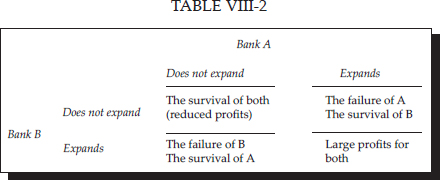
This table reflects the existence of two banks, Bank A and Bank B, both of which have two options: either to refrain from expanding credit or to adopt a policy of credit expansion. If both banks simultaneously initiate credit expansion (assuming there are no other banks in the industry), the ability to issue new monetary units and fiduciary media will yield the same large profits to both. If either expands credit alone, its viability and solvency will be endangered by interbank clearing mechanisms, which will rapidly shift its reserves to the other bank if the first fails to suspend its credit expansion policy in time. Finally it is also possible that neither of the banks may expand and both may maintain a prudent policy of loan concession. In this case the survival of both is guaranteed, though their profits will be quite modest. It is clear that given the choices above, the two banks will face a strong temptation to arrive at an agreement and, to avoid the adverse consequences of acting independently, initiate a joint policy of credit expansion which will protect both from insolvency and guarantee handsome profits.
The above analysis extends to a large group of banks which operate in a free-banking system and maintain a fractional reserve. The analysis shows that under such circumstances, even if interbank clearing mechanisms limit isolated expansionary schemes, these spontaneous mechanisms actually encourage implicit or explicit agreements between the majority of banks to jointly initiate the process of expansion. Thus in a fractional-reserve free-banking system, banks tend to merge, bankers tend to arrive at implicit and explicit agreements among themselves, and ultimately, a central bank tends to emerge. Central banks generally appear as a result of requests from private bankers themselves, who wish to institutionalize joint credit expansion via a government agency designed to orchestrate and organize it. In this way, the “uncooperative” behavior of a significant number of relatively more prudent bankers is prevented from endangering the solvency of the rest (those who are more “cheerful” in granting loans).
Therefore our analysis enables us to conclude the following: (1) that the interbank clearing mechanism does not serve to limit credit expansion in a fractional-reserve free-banking system if most banks decide to simultaneously expand their loans in the absence of a prior rise in voluntary saving; (2) that the fractional-reserve banking system itself prompts bankers to initiate their expansionary policies in a combined, coordinated manner; and (3) that bankers in the system have a powerful incentive to demand and obtain the establishment of a central bank to institutionalize and orchestrate credit expansion for all banks, and to guarantee the creation of the necessary liquidity in the “troublesome” periods which, as bankers know from experience, inevitably reappear.
The privilege which allows banks to use a significant portion of the money placed with them on demand deposit, i.e., to operate with a fractional reserve, cyclically can result in a dramatic discoordination of the economy. A similar effect appears when privileges are granted to other social groups in other areas (unions in the labor market, for example). Fractional-reserve banking distorts the productive structure and provokes widespread, intertemporal discoordination in the economy, a situation bound to spontaneously reverse in the form of an economic crisis and recession. Although in a fractional-reserve free-banking system independent reversion processes tend to curb abuses sooner than in a system controlled and directed by a central bank, the most harmful effect of fractional-reserve free banking is that it provides banks with an immensely powerful incentive to expand loans jointly and, particularly, to urge authorities to create a central bank aimed at offering support in times of economic trouble and organizing and orchestrating widespread, collective credit expansion.
CONCLUSION: THE FAILURE OF BANKING LEGISLATION
Society’s market process is made possible by a set of customary rules of which it is also the source. These rules constitute the behavioral patterns embodied in criminal law and private contract law. No one has deliberately formulated them. Instead such rules are evolutionary institutions which emerge from practical information contributed by a huge number of actors over a very prolonged period of time. Substantive or material law, in this sense, comprises a series of general, abstract rules or laws. They are general because they apply equally to all people, and they are abstract because they establish only a broad scope of action for individuals and do not point to any concrete result of the social process. In contrast to this substantive conception of law, we find legislation, understood as a set of coercive, statutory, and ad hoc orders or commands which are the materialization of the illegitimate privileges and the systematic, institutional aggression with which the government attempts to dominate the processes of human interaction.This concept of legislation implies the abandonment of the traditional notion of the law (explained above), and the replacement of it with “spurious law” composed of a conglomeration of administrative orders, regulations and commands which dictate exactly how the supervised economic agent should behave. Thus to the extent that privileges and institutional coercion spread and develop, traditional laws cease to act as standards of behavior for individuals, and the role of these laws is taken over by the coercive orders and commands of the regulatory agency, in our case, the central bank. In this way the law gradually loses its scope of implementation, and as economic agents are robbed of the criteria of substantive law, they begin to unconsciously alter their personalities and even lose the custom of adapting to general, abstract rules. Under these conditions, to “elude” commands is in many cases simply a matter of survival, and in others it reflects the success of corrupt or perverse entrepreneurship. Hence, from a general standpoint, people come to see deviation from the rules as an admirable expression of human ingenuity, rather than a violation of a regulatory system which seriously jeopardizes life in society.
The above considerations are fully applicable to banking legislation. Indeed the fractional-reserve banking system, which has spread to all countries with a market economy, primarily entails (as we saw in the first three chapters) the violation of an essential legal principle in relation to the monetary bank-deposit contract and the granting of an ius privilegium to certain economic agents: private banks. This privilege allows banks to disregard legal principles and make self-interested use of most of the money citizens have entrusted to them via demand deposits. Banking legislation mainly constitutes the abandonment of traditional legal principles in connection with the monetary demand-deposit contract, the heart of modern banking.
Furthermore banking legislation takes the form of a tangled web of administrative orders and commands which emanate from the central bank and are intended to strictly control the specific activities of private bankers. This welter of injunctions has not only been incapable of preventing the cyclical appearance of bank crises, but (and this is much more significant) it has also fostered and aggravated recurrent stages of great artificial boom and profound economic recession. Such stages have regularly seized western economies and entailed a great economic and human cost. Thus:
Each time a new crisis hits, a complete set of new laws or amendments to prior ones is swiftly enacted under the naive assumption that the former laws were insufficient and that the new, more detailed and all-encompassing ones will better avoid future crises. This is how the government and the central bank excuse their unfortunate inability to avert crises, which nevertheless arise again and again, and the new regulations last only until the next bank crisis and economic recession.
Therefore we can conclude that banking legislation is condemned to failure and will continue to be so unless the present form is thoroughly abolished and replaced by a few simple articles to be included in the commercial and penal codes. These articles would establish the regulation of the monetary bank-deposit contract according to traditional legal principles (a 100-percent reserve requirement) and would prohibit all contracts which mask fractional-reserve banking. In short, in keeping with Mises’s view, the above proposal entails the substitution of several clear, simple articles, to appear in the commercial and penal codes, for the current web of administrative banking legislation, which has not achieved the objectives set for it.
It is interesting to note that modern defenders of fractional-reserve free banking wrongly believe, due in part to their lack of legal preparation, that a 100-percent reserve requirement would amount to an unfair administrative restriction of individual freedom. Nevertheless, as the analysis of the first three chapters shows, nothing could be further from the truth. For these theorists do not realize that such a rule, far from being an example of systematic, administrative government coercion, merely constitutes the recognition of traditional property rights in the banking sector. In other words, theorists who endorse a fractional-reserve free-banking system, which would infringe traditional legal principles, fail to see that “free trade in banking is synonymous with free trade in swindling,” a famous phrase attributed to an anonymous American and reiterated by Tooke.Moreover if a free-banking system must ultimately be defended as a “lesser evil” in comparison with central banking, the motive should not be to permit the exploitation of the lucrative possibilities which always arise from credit expansion. Instead free banking should be seen as an indirect route to the ideal free-banking system, one subject to legal principles, i.e., a 100-percent reserve requirement. All legal means available in a constitutional state should be applied at all times in the direct pursuit of this goal.
4
A CRITICAL LOOK AT THE MODERN FRACTIONAL-RESERVE FREE-BANKING SCHOOL
The last thirty years have seen a certain resurgence of the old economic Banking School doctrines. Defenders of these views claim that a fractional-reserve free-banking system would not only give rise to fewer distortions and economic crises than central banking, but would actually tend to eliminate such problems. Given that these theorists base their reasoning on different variations of the Old Banking School arguments, some more sophisticated than others, we will group the theorists under the heading, “Neo-Banking School,” or “modern pro-Fractional-Reserve Free-Banking School.” This school is composed of a curious alliance of scholars,among whom we could mention certain members of the Austrian School who, in our opinion, have missed some of Mises’s and Hayek’s teachings on monetary matters and the theory of capital and economic cycles, members like White,Selginand, more recently, Horwitz;members of the English Subjectivist School, like Dowd;and finally, theorists with a monetarist background, like Glasner,Yeagerand Timberlake.Even Milton Friedman,though he cannot be considered a member of this new school, has been gradually leaning toward it, especially following his failure to convince central bankers that they should put his famous monetary rule into practice.
Modern fractional-reserve free-banking theorists have developed an economic theory of “monetary equilibrium.” They base their theory on certain typical elements of the monetarist and Keynesian analysisand intend it to demonstrate that a fractional-reserve free-banking system would simply adjust the volume of fiduciary media created (banknotes and deposits) to public demand for them. In this way they argue that fractional-reserve free banking would not only preserve “monetary equilibrium” better than other, alternative systems but would also most effectively adjust the supply of money to the demand for it.
In a nutshell, this argument centers around the hypothetical results of an increase in economic agents’ demand for fiduciary media, assuming reserves of specie in the banking system remain constant. In that event, theorists reason, the pace at which fiduciary media are exchanged for bank reserves would slacken. Reserves would increase and bankers, aware of this rise and eager to obtain larger profits, would expand credit and issue more banknotes and deposits, and the growth in fiduciary media would tend to match the prior increase in demand. The opposite would occur should the demand for fiduciary media decrease: Economic agents would withdraw greater quantities of reserves in order to rid themselves of fiduciary media. Banks would then see their solvency endangered and be obliged to tighten credit and issue fewer banknotes and deposits. In this way a decrease in the supply of fiduciary media would follow the prior decrease in the demand for them.
The theory of “monetary equilibrium” obviously echoes Fullarton’s law of reflux and, especially, the Old Banking School arguments concerning the “needs of trade.” According to these arguments, private banks’ creation of fiduciary media is not detrimental if it corresponds to an increase in the “needs” of businessmen. These arguments are repeated and crystallized in the “new” theory of “monetary equilibrium,” which states that private banks’ creation of fiduciary media in the form of notes and deposits does not generate economic cycles if it follows a rise in public demand for such instruments. Although Lawrence H. White does develop an embryonic version of this reformed “needs of trade” doctrine in his book on free banking in Scotland,credit for theoretically formulating the idea goes to one of White’s most noted students, George A. Selgin. Let us now critically examine Selgin’s theory of “monetary equilibrium,” or in other words, his revised version of some of the Old Banking School doctrines.
THE ERRONEOUS BASIS OF THE ANALYSIS: THE DEMAND FOR FIDUCIARY MEDIA, REGARDED AS AN EXOGENOUS VARIABLE
Selgin’s analysis rests on the notion that the demand for money in the form of fiduciary media is a variable exogenous to the system, that this variable changes with the desires of economic agents, and that the main purpose of the free-banking system is to reconcile the issuance of deposits and banknotes with shifts in the demand for them.Nevertheless such demand is not exogenous to the system, but endogenously determined by it.
It is no coincidence that theorists of the Fractional-Reserve Free-Banking School begin their analysis by focusing on certain more or less mysterious variations in the demand for fiduciary media, and that they neglect to explain the origin or etiology of these variations.It is as if these theorists realized that, on the side of the money supply, the Austrians have demonstrated that credit expansion seriously distorts the economy, a fact which in any case seems to warrant a rigid monetary systemcapable of preventing the monetary expansions and contractions typical of any fractional-reserve banking system. Therefore on the side of supply, theoretical arguments appear to support the establishment of a relatively inelastic monetary system, such as a pure gold standard with a 100-percent reserve requirement for banknotes and deposits.Hence if defenders of the Neo-Banking School wish to justify a fractional-reserve free-banking system in which there may be substantial increases and decreases in the money supply in the form of fiduciary media, they must independently look to the side of demand in the hope of being able to demonstrate that such modifications in the supply of fiduciary media (which are inevitable in a fractional-reserve system) correspond to prior variations in demand which are satisfied by the reestablishment of a hypothetical, preexistent state of “monetary equilibrium.”
Growth in the money supply in the form of credit expansion distorts the productive structure and gives rise to an economic boom and subsequent recession, stages during which significant variations in the demand for money and fiduciary media take place. Hence the process is not triggered, as theorists of the modern Free-Banking School suppose, by independent, catalytic changes in the demand for fiduciary media, but by the manipulation of the supply of them. All fractional-reserve banking systems carry out such manipulation to one degree or another by expanding credit.
It is true that in a system composed of a multiplicity of free banks unsupported by a central bank, credit expansion would stop much sooner than in a system in which the central bank orchestrates widespread expansion and uses its liquidity to aid those banks in jeopardy. This is the pro-free-banking argument Parnell originally developed and Mises later identified as second-best.However it is one thing to assert that in a completely free banking system credit expansion would be curbed sooner than in the current system, and it is quite another to claim that credit expansion brought about in a fractional-reserve free-banking system would never distort the productive structure, since a state of supposed “monetary equilibrium” would always tend to return. In fact Mises himself very clearly indicates that all credit expansion distorts the productive system. Hence Mises rejects the essence of the modern theory of monetary equilibrium. Indeed Mises affirms:
The notion of “normal” credit expansion is absurd. Issuance of additional fiduciary media, no matter what its quantity may be, always sets in motion those changes in the price structure the description of which is the task of the theory of the trade cycle.
The chief failing of Selgin’s theory of “monetary equilibrium” is that it ignores the fact that the supply of fiduciary media largely creates its own demand. In other words, modern free-banking theory contains the Old Banking School’s fundamental error, which, as Mises adeptly revealed, lies in a failure to reflect that public demand for credit depends precisely on banks’ inclination to lend. Thus those bankers who, in the beginning, are not overly concerned about their future solvency are in a position to expand credit and place new fiduciary media in the market simply by reducing the interest rate they ask for the new money they create and easing their normal credit terms.Therefore, in contrast with the assumptions of Selgin and the other theorists of his school, bankers can initiate credit expansion in a free-banking system if for some reason they disregard their own solvency, whether or not a prior variation in the demand for fiduciary media has occurred.
Another factor explains why, during a prolonged period, the increase in the quantity of deposits (from credit expansion) actually tends to stimulate demand for fiduciary media. In fact all economic agents who are unaware that an inflationary process of expansion has begun, and that this process will ultimately cause a relative decrease in the purchasing power of money and a subsequent recession, will notice that certain goods and services begin to rise in price faster than others and will wait in vain for such prices to return to their “normal” level. Meanwhile they will most likely decide to increase their demand for fiduciary media. To again cite Mises:
This first stage of the inflationary process may last for many years. While it lasts, the prices of many goods and services are not yet adjusted to the altered money relation. There are still people in the country who have not yet become aware of the fact that they are confronted with a price revolution which will finally result in a considerable rise of all prices, although the extent of this rise will not be the same in the various commodities and services. These people still believe that prices one day will drop. Waiting for this day, they restrict their purchases and concomitantly increase their cash holdings.
Not only are banks in a fractional-reserve free-banking system able to unilaterally instigate credit expansion, but during a prolonged period the resulting increase in the supply of fiduciary media (which can always be placed in the market through an opportune reduction in the interest rate) tends to create further demand. This increase in demand will last until the public loses some of its unrealistic optimism, begins to distrust the economic “bonanza,” and foresees a widespread rise in prices, followed by a crisis and profound economic recession.
We have argued that the origin of monetary changes lies on the side of supply, that banks in a free-banking system are able to manipulate the money supply, and that the corresponding issuance of fiduciary media creates its own demand in the short and medium term. If the above assertions are true, then Selgin is utterly mistaken in claiming that the supply of fiduciary media merely adjusts to the demand for them. Indeed the demand for fiduciary media, at least during a considerable period of time, adjusts to the increased supply which banks create in the form of loans.
THE POSSIBILITY THAT A FRACTIONAL-RESERVE FREE-BANKING SYSTEM MAY UNILATERALLY INITIATE CREDIT EXPANSION
Various circumstances make it possible for a fractional-reserve free-banking system to initiate credit expansion in the absence of a corresponding, prior increase in the demand for fiduciary media.
First, we must point out that the monetary equilibrium analysis of modern free-banking theorists contains many of the same limitations as the traditional neoclassical analysis, which, both in a micro-and macroeconomic context, merely deals with the final state of social processes (monetary equilibrium), a state to which the rational, maximizing behavior of economic agents (private bankers) supposedly leads. In contrast, the economic analysis of the Austrian School centers on dynamic entrepreneurial processes, rather than on equilibrium. Each entrepreneurial act coordinates and establishes a tendency toward equilibrium, which, nevertheless, is never reached, because during the process itself circumstances change and entrepreneurs create new information. Thus, from this dynamic point of view, we cannot accept a static model which, like that of monetary equilibrium, presupposes that immediate, perfect adjustments between the demand for and the supply of fiduciary media take place.
In real life, each banker, according to his insight and entre-preneurial creativity, subjectively interprets the information he receives from the outside world, both in terms of his level of optimism in evaluating the course of economic events, and in terms of the volume of reserves he considers “prudent” with a view to maintaining his solvency. Hence each banker, in an environment of uncertainty, decides each day what volume of fiduciary media he will issue. In the above entrepreneurial process, bankers will clearly commit many errors which will manifest themselves in the unilateral issuance of fiduciary media and will distort the productive structure. Granted, the process itself will tend to reveal and eliminate the errors committed, but only following a period of varying length, and damage to the real productive structure will not be avoided. If we add that, as we saw in the last section, the supply of fiduciary media tends to create its own demand, we see it is highly unlikely that a fractional-reserve free-banking system (or any other market) could reach the “monetary equilibrium” that its theorists so desire. For in the best of cases, private bankers will attempt through a process of trial and error to adjust their supply of fiduciary media to the demand for them, which is unknown to bankers and tends to vary as a consequence of the very issuance of fiduciary media. Hence scholars may debate whether or not the entrepreneurial coordination process will bring the coveted state of “monetary equilibrium” within bankers’ reach, but scholars cannot deny that throughout this process innumerable entrepreneurial errors will be committed in the form of the unjustified issuance of fiduciary media, and that these errors will inevitably tend to affect the productive structure by provoking economic crises and recessions, just as the Austrian theory of economic cycles explains.
Second, a large or small group of bankers could also collectively orchestrate the expansion of fiduciary media or decide to merge in order to share and better “manage” their reserves, thus increasing their capacity to expand credit and improve profits.Unless fractional-reserve free-banking theorists wish to prohibit this type of entrepreneurial strategy (which we doubt), it will obviously result in credit expansion and consequent economic recessions. It can be argued that in-concert expansion will tend to correct itself, since, as Selgin maintains, the total increase in interbank clearings will raise the variance in the clearing of debits and credits.However, aside from Selgin’s assumption that the total volume of metallic reserves in the banking system remains constant, and despite the doubts of many authors regarding the effectiveness of Selgin’s mechanism,even if we allow for the sake of argument that Selgin is correct, it can still be argued that the adjustment will never be perfect nor immediate, and therefore in-concert expansion and mergers may provoke significant increases in the supply of fiduciary media, thus triggering the processes which set economic cycles in motion.
Third and last, with every increase in the overall stock of specie (gold) banks keep as a “prudent” reserve, a fractional-reserve free-banking system would stimulate growth in the issuance of fiduciary media which does not correspond to prior rises in demand. If we remember that the world stock of gold has been mounting at an annual rate of 1 to 5 percentdue to the increased world production of gold, it is clear that this factor alone will permit private bankers to issue fiduciary media at a rate of 1 to 5 percent per year, regardless of the demand for them. (Such creation of money will produce an expansion followed by a recession.)
In conclusion, significant (fiduciary) inflationary processesand severe economic recessionsmay occur in any fractional-reserve free-banking system.
THE THEORY OF “MONETARY EQUILIBRIUM” IN FREE BANKING RESTS ON AN EXCLUSIVELY MACROECONOMIC ANALYSIS
We must point out that the analysis of modern free-banking theorists ignores the microeconomic effects which arise from increases and decreases in the supply of and demand for fiduciary media instigated by the banking industry. In other words, even if we admit for the sake of argument that the origin of all evil lies, as these theorists suppose, in unexpected changes in economic agents’ demand for fiduciary media, it is clear that the supply of fiduciary media which the banking system supposedly generates to adjust to changes in the demand for them does not instantaneously reach precisely those economic agents whose valuation of the possession of new fiduciary media has altered. Instead this supply flows into the market at certain specific points and in a particular manner: in the form of loans granted via a reduction in the interest rate and initially received by individual businessmen and investors who tend to use them to initiate new, more capital-intensive investment projects which distort the productive structure.
Therefore it is unsurprising that modern free-banking theorists overlook the Austrian theory of business cycles, since this theory does not fit in with their analysis of the issuance of fiduciary media in a fractional-reserve free-banking system. These theorists thus take refuge in an exclusively macroeconomic analysis (monetarist or Keynesian, depending on the case) and, at most, use instruments which, like the equation of exchange or the “general price level,” actually tend to conceal the truly relevant microeconomic phenomena (variations in relative prices and intertemporal discoordination in the behavior of economic agents) which occur in an economy upon the expansion of credit and growth in the quantity of fiduciary media.
In normal market processes, the supply of consumer goods and services tends to vary along with the demand for them, and new goods generally reach precisely those consumers whose subjective valuation of them has improved. However where newly-created fiduciary media are concerned, the situation is radically different: an increased supply of fiduciary media never immediately and directly reaches the pockets of those economic agents whose demand for them may have risen. Instead, the money goes through a lengthy, cumbersome temporal process, or transition phase, during which it first passes through the hands of many other economic agents and distorts the entire productive structure.
When bankers create new fiduciary media, they do not deliver them directly to those economic agents who may desire more. On the contrary, bankers grant loans to entrepreneurs who receive the new money and invest the entire amount without a thought to the proportion in which the final holders of fiduciary media will wish to consume and save or invest. Hence it is certainly possible that a portion of the new fiduciary media (supposedly issued in response to increased demand) may ultimately be spent on consumer goods, and thereby push up their relative price. We know (chap. 7, p. 552) that according to Hayek:
[S]o long as any part of the additional income thus created is spent on consumer ’s goods (i.e., unless all of it is saved), the prices of consumer ’s goods must rise permanently in relation to those of various kinds of input. And this, as will by now be evident, cannot be lastingly without effect on the relative prices of the various kinds of input and on the methods of production that will appear profitable.
Hayek clarifies his position even further:
All that is required to make our analysis applicable is that, when incomes are increased by investment, the share of the additional income spent on consumer ’s goods during any period of time should be larger than the proportion by which the new investment adds to the output of consumer ’s goods during the same period of time. And there is of course no reason to expect that more than a fraction of the new income [created by credit expansion], and certainly not as much as has been newly invested, will be saved, because this would mean that practically all the income earned from the new investment would have to be saved.
As a graphic illustration of our argument, let us suppose that the demand for fiduciary media increases, while the proportion in which economic agents wish to consume and invest remains unchanged.Under these conditions, economic agents must reduce their monetary demand for consumer goods, sell bonds and other financial assets and, especially, reinvest less money in the different stages of the productive process until they can accumulate the greater volume of bank deposits they wish to hold. Therefore if we suppose that the social rate of time preference has not altered, and we use a simplified version of the triangular diagrams from chapter 5 to represent society’s real productive structure, we see that in Chart VIII-1 the increase in the demand for fiduciary media shifts the hypotenuse of the triangle toward the left. This movement reflects a drop in the monetary demand for consumer and investment goods, since the proportion of one to the other (or time preference) has not varied. In this chart, surface “A” represents economic agents’ new demand for (or “hoarding” of) fiduciary media (see Chart VIII-1).
The fundamental conclusion of the theory of monetary equilibrium in a fractional-reserve free-banking system is that banks would respond to this rise in the demand for fiduciary media by expanding their issuance by a volume equal to that of the new demand (represented by surface “A”), and the productive structure, as shown in Chart VIII-2, would remain intact (see Chart VIII-2).
Nonetheless we must remember that banks do not directly transfer the new fiduciary media they create to their final users (the economic agents whose demand for fiduciary media has increased by the volume represented by surface “A” in Chart VIII-1). Instead, the deposits are lent to entrepreneurs, who spend it on investment goods and thereby initially create a more capital-intensive structure, which we represent in Chart VIII-3.
Nevertheless this more capital-intensive productive structure cannot be maintained in the long term. For once the new fiduciary media reach their final recipients (who in the very beginning accumulated the bank money they needed, as surface “A” in Chart VIII-1 indicates), they will spend them, according to our postulate of unchanging time preference, on consumer and investment goods in a proportion equal to that shown in Charts VIII-1 and VIII-2. If we superimpose Chart VIII-3 on Chart VIII-2 (see Chart VIII-4), the distortion of the productive structure becomes clear. Shaded area “B” represents the investment projects entrepreneurs have launched in error, since all of the fiduciary media banks have issued to adjust to the increase in the demand for them have been channeled into investment loans.Shaded area “C” (with a surface identical to “B”) reflects the portion of the new fiduciary media which the final holders spend on the goods closest to consumption. The productive structure regains the proportions shown in Chart VIII-1, but only following the inevitable, painful readjustments which the Austrian theory of economic cycles explains and which a free-banking system, as we have just seen, would be incapable of preventing. Therefore we must conclude, in contrast to what Selgin and White suggest,that even if the expansion of fiduciary media fully matches a prior increase in the demand for them, it will provoke the typical cyclical effects predicted by the theory of circulation credit.
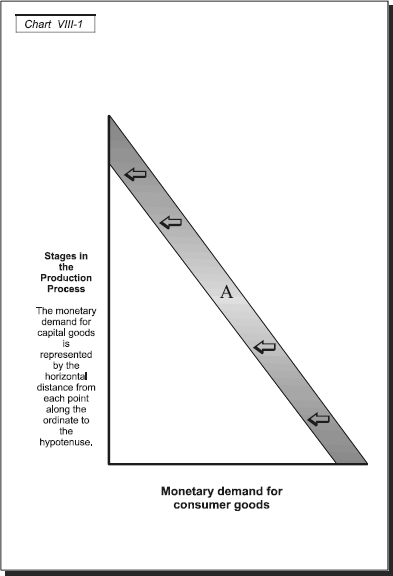
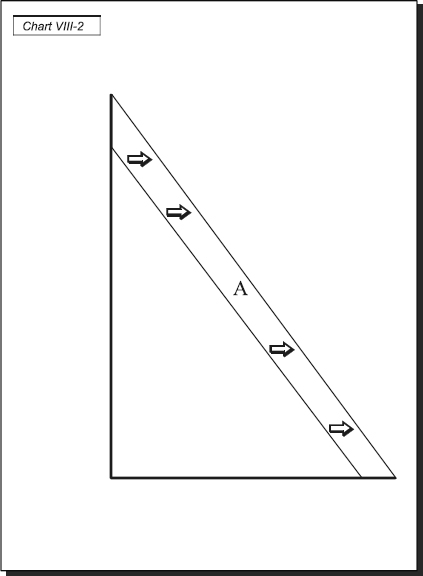
THE CONFUSION BETWEEN THE CONCEPT OF SAVING AND THAT OF THE DEMAND FOR MONEY
The attempt to recover at least the essence of the old “needs of trade” doctrine and to show that a fractional-reserve free-banking system would not trigger economic cycles has led George A. Selgin to defend a thesis similar to the one John Maynard Keynes presents in connection with bank deposits. Indeed let us remember that, according to Keynes, anyone who holds additional money from a loan is “saving”:
Moreover, the savings which result from this decision are just as genuine as any other savings. No one can be compelled to own the additional money corresponding to the new bank-credit, unless he deliberately prefers to hold more money rather than some other form of wealth.
George Selgin’s position resembles Keynes’s. Selgin believes public demand for cash balances in the form of bank-notes and deposit accounts reflects the desire to offer shortterm loans for the same amount through the banking system. Indeed, Selgin states:
To hold inside money is to engage in voluntary saving. . . . Whenever a bank expands its liabilities in the process of making new loans and investments, it is the holders of the liabilities who are the ultimate lenders of credit, and what they lend are the real resources they could acquire if, instead of holding money, they spent it. When the expansion or contraction of bank liabilities proceeds in such a way as to be at all times in agreement with changing demands for inside money, the quantity of real capital funds supplied to borrowers by the banks is equal to the quantity voluntarily offered to the banks by the public. Under these conditions, banks are simply intermediaries of loanable funds.
Nonetheless it is entirely possible that the public may simultaneously increase their balances of fiduciary media and their demand for consumer goods and services, if they decide to cut back on their investments. For economic agents can employ their money balances in any of the following three ways: they can spend them on consumer goods and services; they can spend them on investments; or they can hold them as cash balances or fiduciary media. There are no other options. The decision on the proportion to spend on consumption or investment is distinct and independent from the decision on the amount of fiduciary media and cash to hold. Thus we cannot conclude, as Selgin does, that any money balance is equal to “savings,” since a rise in the balance of fiduciary media may very well depend on a drop in investment spending (via the sale of securities on the stock market, for instance) which makes it possible to increase final monetary expenditure on consumer goods and services. Under these circumstances an individual’s savings would drop, while his balance of fiduciary media would rise. Therefore it is incorrect to qualify as savings all increases in fiduciary media.
To maintain, as Selgin does, that “every holder of demand liabilities issued by a free bank grants that bank a loan for the value of his holdings”is the same as asserting that any creation of money, in the form of deposits or notes, by a bank in a fractional-reserve free-banking system ultimately amounts to an a posteriori concession of a loan to the bank for the amount created. However the bank generates loans from nothing and offers additional purchasing power to entrepreneurs, who receive the loans without a thought to the true desires of all other economic agents regarding consumption and investment, when these other individuals will ultimately become the final holders of the fiduciary media the bank creates. Hence it is entirely possible, if the social time preference on consumption and investment remains unchanged, that the new fiduciary media the bank creates may be used to step up spending on consumer goods, thus pushing up the relative prices of this type of good.
Fractional-reserve free-banking theorists generally consider any note or deposit a bank issues to be a “financial asset” which corresponds to a loan. From a legal standpoint, this notion involves serious problems, which we examined in the first three chapters. Economically speaking, the error of these theorists lies in their belief that money is a “financial asset” which represents the voluntary saving of an economic agent who “loans” present goods in exchange for future goods.Nevertheless money is itself a present good,and the possession of cash balances (or deposits) says nothing about the proportions in which the economic agent wishes to consume and invest. Thus increases and decreases in his money balances are perfectly compatible with different combinations of simultaneous increases and decreases in the proportions in which he consumes or invests. In fact his balances of fiduciary media may rise simultaneously with his spending on consumer goods and services, if he only disinvests some of the resources saved and invested in the past. As Hans-Hermann Hoppe points out, the supply of and demand for money determine its price or purchasing power, while the supply of and demand for “present goods” in exchange for “future goods” determine the interest rate or social rate of time preference and the overall volume of saving and investment.
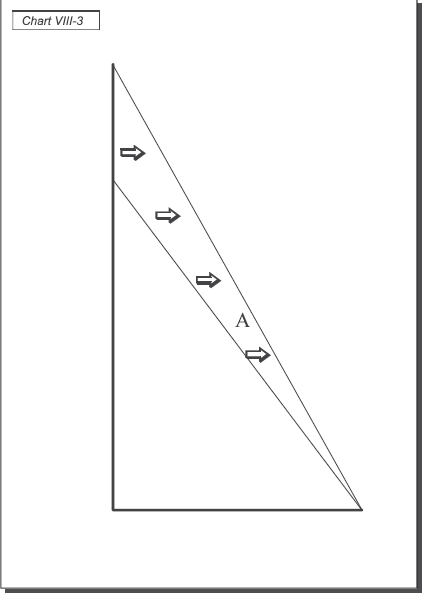
Saving always requires that an economic agent reduce his consumption (i.e., sacrifice), thus freeing real goods. Saving does not arise from a simple increase in monetary units. That is, the mere fact that the new money is not immediately spent on consumer goods does not mean it is saved. Selgin defends this position when he criticizes Machlup’s viewthat the expansionary granting of loans creates purchasing power which no one has first withdrawn from consumption (i.e., saved). For credit to leave the productive structure undistorted, it logically must originate from prior saving, which provides present goods an investor has truly saved. If such a sacrifice in consumption has not taken place, and investment is financed by created credit, then the productive structure is invariably distorted, even if the newly-created fiduciary media correspond to a previous rise in the demand for them. Hence Selgin is obliged to redefine the concepts of saving and credit creation. He claims saving occurs ipso facto the moment new fiduciary media are created, provided their initial holder could spend them on consumer goods and does not. Selgin also maintains that credit expansion does not generate cycles if it tends to match a prior increase in the demand for fiduciary media. In short these arguments resemble those Keynes expresses in his General Theory, arguments refuted long ago, as we saw in chapter 7.
The creation of fiduciary media also entails an increase in the money supply and a consequent decrease in the purchasing power of money. In this way banks collectively and almost imperceptibly “expropriate” the value of citizens’ monetary units. It certainly smacks of a bad joke to declare that the economic agents who suffer such expropriation are actually (voluntarily?) “saving.” It is not surprising that these doctrines have been defended by authors like Keynes, Tobin, Pointdexter and, in general, all who have justified inflationism, credit expansion and the “euthanasia of the rentier ” for the sake of aggressive economic policies geared to insure an “adequate” level of “aggregate demand.” What is surprising, however, is that authors like Selgin and Horwitz, who belong (or at least belonged) to the Austrian School and thus should be more aware of the dangers involved, have had no alternative but to resort to this sort of argument in order to justify their “fractional-reserve free-banking” system.
THE PROBLEM WITH HISTORICAL ILLUSTRATIONS OF FREE-BANKING SYSTEMS
Neo-banking authors devote strong efforts to historical studies which they intend to support the thesis that a free-banking system would protect economies from cycles of boom and depression, owing to the “monetary equilibrium” mechanism. Nevertheless the empirical studies produced thus far have not focused on whether free-banking systems have prevented credit expansion, artificial booms and economic recessions. Instead they have centered on whether bank crises and runs have been more or less frequent and severe in this type of system than in a central-banking system (which is obviously quite a different issue).
In fact George A. Selgin looks at the occurrence of bank runs in different historical free-banking systems versus certain systems controlled by a central bank and reaches the conclusion that bank crises were more numerous and acute in the second case.Moreover the main thesis of the main neo-banking book on free banking in Scotland consists entirely of the argument that the Scottish banking system, which was “freer ” than the English one, was more “stable” and subject to fewer financial disturbances.
However, as Murray N. Rothbard has indicated, the fact that, in relative terms, fewer banks failed in the Scottish free-banking system than in the English system does not necessarily mean the former was superior.Indeed bank failures have been practically eliminated from current central-banking systems, and this does not make such systems better than a free-banking system subject to legal principles. It actually makes them worse. For bank failures in no way indicate that a system functions poorly, but rather that a healthy, spontaneous reversion process has begun to operate in response to fractional-reserve banking, which is a legal privilege and an attack on the market. Therefore whenever a fractional-reserve free-banking system is not regularly accompanied by bank failures and suspensions of payments, we must suspect the existence of institutional factors which shield banks from the normal consequences of fractional-reserve banking and fulfill a role similar to the one the central bank currently fulfills as lender of last resort. In the case of Scotland, banks had so encouraged the use of their notes in economic transactions that practically no one demanded payment of them in gold, and those who occasionally requested specie at the window of their banks met with general disapproval and enormous pressure from their bankers, who accused them of “disloyalty” and threatened to make it difficult for them to obtain loans in the future. Furthermore, as Professor Sidney G. Checkland has shown,the Scottish fractional-reserve free-banking system still went through frequent, successive stages of credit expansion and contraction, which gave rise to economic cycles of boom and recession in 1770, 1772, 1778, 1793, 1797, 1802–1803, 1809–1810, 1810–1811, 1818–1819, 1825–1826, 1836–1837, 1839, and 1845–1847. In other words, even though in relative terms fewer bank runs occurred in Scotland than in England, the successive stages of boom and depression were equally severe, and despite its highly praised free-banking system, Scotland was not free from credit expansion, artificial booms and the subsequent stages of serious economic recession.
The nineteenth-century Chilean financial system provides another historical illustration of the inadequacy of fractional-reserve free-banking systems to prevent artificial expansion and economic recessions. In fact during the first half of the nineteenth century, Chile had no central bank and implemented a 100-percent reserve requirement in banking. For several decades its citizens firmly resisted attempts to introduce a fractional-reserve banking system, and during those years they enjoyed great economic and financial stability. The situation began to change in 1853, when the Chilean government hired Jean-Gustav Courcelle-Seneuil (1813–1892), one of the most prominent French fractional-reserve free-banking theorists, as professor of economics at the University of Santiago de Chile. Courcelle-Seneuil’s influence in Chile during the ten years he taught there was so great that in 1860 a law permitting the establishment of fractional-reserve free banking (with no central bank) was enacted. At this point the traditional financial stability of the Chilean system gave way to stages of artificial expansion (based on the concession of new loans), followed by bank failures and economic crises. The convertibility of the paper currency was suspended on several occasions (1865, 1867, and 1879), and a period of inflation and serious economic, financial and social maladjustment began. This period resides in the collective memory of Chileans and explains why they continue to mistakenly associate financial disturbances with the doctrinal economic liberalism of Courcelle-Seneuil.
Moreover the fact that various historical studies appear to indicate that fewer bank runs and crises arose in free-banking systems than in central-banking systems does not mean the former were completely free of such episodes. Selgin himself mentions at least three instances in which acute bank crises devastated free-banking systems: Scotland in 1797, Canada in 1837, and Australia in 1893.If Rothbard is correct, and in the rest of the cases institutional restrictions played the role of central bank to at least some extent, then the number of bank crises might have been much larger in the absence of these restrictions.At any rate we must not consider the elimination of bank crises to be the definitive criterion for determining which banking system is the best. If this were the case, even the most radical fractional-reserve free-banking theorists would be obliged to admit that the best banking system is that which requires the maintenance of a 100 percent reserve, since by definition this is the only system which in all circumstances prevents bank crises and runs.
In short, historical experience does not appear to support the thesis of modern fractional-reserve free-banking theorists. Bank credit expansion gave rise to cycles of boom and depression in even the least controlled free-banking systems, which were not free from bank runs and failures. The recognition of this fact has led certain neo-banking authors, such as Stephen Horwitz, to insist that though historical evidence against their views is of some significance, it does not serve to refute the theory that fractional-reserve free banking produces only benign effects, since strictly theoretical procedures must be used to refute this theory.
IGNORANCE OF LEGAL ARGUMENTS
Theorists of fractional-reserve banking tend to exclude legal considerations from their analysis. They fail to see that the study of banking issues must be chiefly multidisciplinary, and they overlook the close theoretical and practical connection between the legal and economic aspects of all social processes.
Thus free-banking theorists lose sight of the fact that fractional-reserve banking involves a logical impossibility from a legal standpoint. Indeed at the beginning of this book we explained that any bank loan granted against demand-deposit funds results in the dual availability of the same quantity of money: the same money is accessible to the original depositor and to the borrower who receives the loan. Obviously the same thing cannot be available to two people simultaneously, and to grant the availability of something to a second person while it remains available to the first is to act fraudulently. Such an act clearly constitutes misappropriation and fraud, offenses committed during at least the early stages in the development of the modern banking system, as we saw in chapter 2.
Once bankers obtained from governments the privilege of operating with a fractional reserve, from the standpoint of positive law this banking method ceased to be a crime, and when citizens act in a system backed in this way by law, we must rule out the possibility of criminal fraud. Nevertheless, as we saw in chapters 1 through 3, this privilege in no way provides the monetary bank-deposit contract with an appropriate legal nature. Quite the opposite is true. In most cases this contract is null and void, due to a discrepancy concerning its cause: depositors view the transaction as a deposit, while bankers view it as a loan. According to general legal principles, whenever the parties involved in an exchange hold conflicting beliefs as to the nature of the contract entered into, the contract is null and void.
Moreover even if depositors and bankers agreed that their transaction amounts to a loan, the legal nature of the monetary bank-deposit contract would be no more appropriate. From an economic perspective, we have seen that it is theoretically impossible for banks to return, under all circumstances, the deposits entrusted to them beyond the amount of reserves they hold. Furthermore this impossibility is aggravated to the extent that fractional-reserve banking itself tends to provoke economic crises and recessions which repetitively endanger banks’ solvency. According to general legal principles, contracts which are impossible to put into practice are also null and void. Only a 100-percent reserve requirement, which would guarantee the return of all deposits at any moment, or the support of a central bank, which would supply all necessary liquidity in times of difficulty, could make such “loan” contracts (with an agreement for the return of the face value at any time) possible and therefore valid.
The argument that monetary bank-deposit contracts are impossible to honor only periodically and under extreme circumstances cannot redeem the legal nature of the contract either, since fractional-reserve banking constitutes a breach of public order and harms third parties. In fact, because fractional-reserve banking expands loans without the support of real saving, it distorts the productive structure and therefore leads loan recipients, entrepreneurs deceived by the increased flexibility of credit terms, to make ultimately unprofitable investments. With the eruption of the inevitable economic crisis, businessmen are forced to halt and liquidate these investment projects. As a result, a high economic, social, and personal cost must be borne by not only the entrepreneurs “guilty” of the errors, but also all other economic agents involved in the production process (workers, suppliers, etc.).
Hence we may not argue, as White, Selgin, and others do, that in a free society bankers and their customers should be free to make whatever contractual agreements they deem most appropriate.For even an agreement found satisfactory by both parties is invalid if it represents a misuse of law or harms third parties and therefore disrupts the public order. This applies to monetary bank deposits which are held with a fractional reserve and in which, contrary to the norm, both parties are fully aware of the true legal nature and implications of the agreement.
Hans-Hermann Hoppeexplains that this type of contract is detrimental to third parties in at least three different ways. First, credit expansion increases the money supply and thereby diminishes the purchasing power of the monetary units held by all others with cash balances, individuals whose monetary units thus drop in buying power in relation to the value they would have had in the absence of credit expansion. Second, depositors in general are harmed, since the credit expansion process reduces the probability that, in the absence of a central bank, they will be able to recover all of the monetary units originally deposited; if a central bank exists, depositors are wronged in that, even if they are “guaranteed” the repayment of their deposits at any time, no one can guarantee they will be repaid in monetary units of undiminished purchasing power. Third, all other borrowers and economic agents are harmed, since the creation of fiduciary credit and its injection into the economic system jeopardizes the entire credit system and distorts the productive structure, thus increasing the risk that entrepreneurs will launch projects which will fail in the process of their completion and cause untold human suffering when credit expansion ushers in the stage of economic recession.
In a free-banking system, when the purchasing power of money declines in relation to the value money would have were credit not expanded in a fractional-reserve environment, participants (depositors and, especially, bankers) act to the detriment of third parties. The very definition of money reveals that any manipulation of it, society’s universal medium of exchange, will exert harmful effects on almost all thirdparty participants throughout the economic system. Therefore it does not matter whether or not depositors, bankers, and borrowers voluntarily reach specific agreements if, through fractional-reserve banking, such agreements influence money and harm the public in general (third parties). Such damage renders the contract null and void, due to its disruption of the public order.Economically speaking, the qualitative effects of credit expansion are identical to those of the criminal act of counterfeiting banknotes and coins, an offense covered, for instance, by articles 386–389 of the Spanish Penal Code.Both acts entail the creation of money, the redistribution of income in favor of a few citizens and to the detriment of all others, and the distortion of the productive structure. Nonetheless, from a quantitative standpoint, only credit expansion can increase the money supply at a fast enough pace and on a large enough scale to feed an artificial boom and provoke a recession. In comparison with the credit expansion of fractional-reserve banking and the manipulation of money by governments and central banks, the criminal act of counterfeiting currency is child’s play with practically imperceptible social consequences.
The above legal considerations have not failed to influence White, Selgin, and other modern fractional reserve free-banking theorists, who have proposed, as a last line of defense to guarantee the stability of their system, that “free” banks establish a “safeguard” clause on their notes and deposits, a clause to inform customers that the bank may decide at any moment to suspend or postpone the return of deposits or the payment of notes in specie.Clearly the introduction of this clause would mean eliminating from the corresponding instruments an important characteristic of money: perfect, i.e., immediate, complete, and never conditional, liquidity. Thus not only would depositors become forced lenders at the will of the banker, but a deposit would become a type of aleatory contract or lottery, in which the possibility of withdrawing the cash deposited would depend on the particular circumstances of each moment. There can be no objection to the voluntary decision of certain parties to enter into such an atypical aleatory contract as that mentioned above. However, even if a “safeguard” clause were introduced and participants (bankers and their customers) were fully aware of it, to the extent that these individuals and all other economic agents subjectively considered demand deposits and notes to be perfect money substitutes, the clause referred to would only be capable of preventing the immediate suspension of payments or failure of banks in the event of a bank run. It would not prevent all of the recurrent processes of expansion, crisis and recession which are typical of fractional-reserve banking, seriously harm third parties and disrupt the public order. (It does not matter which “option clauses” are included in contracts, if the general public considers the above instruments to be perfect money substitutes.) Hence, at most, option clauses can protect banks, but not society nor the economic system, from successive stages of credit expansion, boom and recession. Therefore White and Selgin’s last line of defense in no way abolishes the fact that fractional-reserve banking inflicts severe, systematic damage on third parties and disrupts the public order.
5
CONCLUSION: THE FALSE DEBATE BETWEEN SUPPORTERS OF CENTRAL BANKING AND DEFENDERS OF FRACTIONAL-RESERVE FREE BANKING
The traditional approach to the debate between advocates of central banking and those of fractional-reserve free banking is essentially flawed. First, this approach ignores the fact that the fractional-reserve free-banking system almost inevitably releases forces which lead to the emergence, development, and consolidation of a central bank. Fractional-reserve banking gives rise to credit expansion, which triggers reversion processes in the form of financial crises and economic recessions, which in turn inevitably prompt citizens to demand government intervention and state regulation of banking. Second, the very bankers involved in the system soon discover that they can reduce the risk of insolvency if they make agreements between themselves, merge or even demand the establishment of a lender of last resort to provide them with the liquidity necessary in times of difficulty and to institutionalize and officially direct the growth of credit expansion.
We can conclude that fractional-reserve banking has been the main historical cause of the appearance and development of the central bank. Hence we must not approach the theoretical and practical debate in traditional terms, but in terms of two radically different systems: a free-banking system subject to traditional legal principles (a 100-percent reserve requirement) and in which all fractional-reserve operations, whether voluntarily agreed upon or not, are cracked down on as illegal and a breach of public order; and a system which permits fractional-reserve banking and from which a central bank (lender of last resort) will inevitably emerge and control the entire financial system.
These are the only two theoretically and practically viable alternatives. Up to this point we have examined the economic effects of fractional-reserve banking, both orchestrated by a central bank and in a free-banking system. In the next and last chapter we will carefully analyze a free-banking system subject to traditional legal principles, i.e., a 100-percent reserve requirement.
_____________
The definitions of “Banking School” and “Currency School” offered in the text basically coincide with those Anna J. Schwartz proposes. According to Schwartz, theorists of the Currency School believe monetary policy should be disciplined and subject to general legal rules and principles, while members of the Banking School generally advocate granting bankers (and eventually the central bank) complete discretionary freedom to act and even to disregard traditional legal principles. In fact Anna J. Schwartz notes that the whole controversy centers on whether
policy should be governed by rules (espoused by adherents of the Currency School), or whether the authorities should allow discretion (espoused by adherents of the Banking School). (Anna J. Schwartz’s article, “Banking School, Currency School, Free Banking School,” which appeared in volume 1 of The New Palgrave: Dictionary of Money and Finance , pp. 148–51)
See especially the research Marjorie Grice-Hutchinson published under the direction of F.A. Hayek, The School of Salamanca: Readings in Spanish Monetary Theory, 1544–1605; Rothbard, “New Light on the Prehistory of the Austrian School,” pp. 52–74; Alejandro A. Chafuen, Christians for Freedom: Late-Scholastic Economics (San Francisco: Ignatius Press, 1986), pp. 74–86. On Marjorie Grice-Hutchinson see the laudatory comments Fabián Estapé makes in his introduction to the third Spanish edition of Schumpeter ’s book, The History of Economic Analysis (Historia del análisis económico , pp. xvi–xvii).
We have used the Omnia opera edition, published in Venice in 1604. Volume 1 includes Diego de Covarrubias’s treatise on money under the complete title, Veterum collatio numismatum, cum his, quae modo expenduntur, publica, et regia authoritate perpensa, pp. 669–710. Davanzati often quotes this piece of writing, and Ferdinando Galiani does so at least once in chapter 2 of his famous work, Della moneta, p. 26. Carl Menger also refers to the treatise of Covarrubias in his book, Principles of Economics (New York and London: New York University Press, 1981), p. 317; p. 257 in the original version, Grundsätze der Volkswirthschaftslehre.
Azpilcueta, Comentario resolutorio de cambios, pp. 74–75; italics added. However Nicholas Copernicus preceded Martín de Azpilcueta by almost thirty years, since he formulated a (more embryonic) version of the quantity theory of money in his book, De monetae cudendae ratio (1526). See Rothbard, Economic Thought Before Adam Smith, p. 165.
See, for instance, the comments Francisco Gómez Camacho makes in his introduction to Luis de Molina’s work, La teoría del justo precio (Madrid: Editora Nacional, 1981), pp. 33–34; the remarks Sierra Bravo makes in El pensamiento social y económico de la escolástica desde sus orígenes al comienzo del catolicismo social, vol. 1, pp. 214–37; the article by Francisco Belda which we cover in detail on the following pages; and the more recent article by Jesús Huerta de Soto, “New Light on the Prehistory of the Theory of Banking and the School of Salamanca.”
Molina, Tratado sobre los cambios, p. 145.
Ibid., p. 146.
Ibid., p. 147; italics added.
Ibid., p. 149.
Quare magis videntur pecuniam precario mutuo accipere, reddituri quotiscumque exigetur a deponente. Communiter tamen, pecunia illa interim negotiantur, et lucrantur, sine ad cambium dando, sine aliud negotiationis genus exercendo.
This is a direct quotation taken from p. 406, section 5, no. 60, “De Cambiis,” by Lugo Hispalensis, Disputationum de iustitia et iure.
Perhaps it is Juan de Lugo who most clearly and concisely expresses this principle, as we saw in footnote 102 of chapter 2.
In other words a banker may commit pure or genuine entrepreneurial errors (ones not insurable by the law of large numbers) which result in serious entrepreneurial losses, regardless of the degree of prudence he has shown. On the concept of “genuine error,” see Israel Kirzner, “Economics and Error,” in Perception, Opportunity and Profit (Chicago: University of Chicago Press, 1979), chap. 8, pp. 120–36.
Published in Pensamiento, a quarterly journal of philosophical research and information, published by the Facultades de Filosofía de la Compañía de Jesús en España 73, no. 19 (January–March 1963): 53–89.
Belda, pp. 63 and 69.
Ibid., p. 87. Belda refers to Juan de Lugo, Disputationum de iustitia et iure, vol. 2, provision 28, section 5, nos. 60–62.
Dempsey, Interest and Usury. We must note that Father Belda actually intended his article to be a Keynesian criticism of the ideas Father Dempsey presents in this book. Our thanks to Professor James Sadowsky, of Fordham University, for supplying a copy of Dempsey’s book, which we were unable to find in Spain.
In his introduction to Father Dempsey’s book, Schumpeter strongly emphasizes Dempsey’s deep theoretical knowledge of and complete familiarity with the economic doctrines of Ludwig von Mises, Friedrich A. Hayek, Wicksell, Keynes and others. Moreover, in his monumental work, The History of Economic Analysis, Schumpeter makes laudatory mention of Dempsey.
The credit expansion results in the depreciation of whatever circulating medium the bank deals in. Prices rise; the asset appreciates. The bank absolves its debt by paying out on the deposit a currency of lesser value. . . . No single person would be convicted by a Scholastic author of the sin of usury. But the process has operated usuriously; again we meet systematic or institutional usury. . . . The modern situation to which theorists have applied the concepts of diversion of natural and money interest, diversion of saving and investment, diversion of income disposition from tenable patterns by involuntary displacements, all these have a sufficient common ground with late medieval analysis to warrant the expression, “institutional usury,” for the movements heretofore described in the above expressions. (Dempsey, Interest and Usury, pp. 225 and 227–28; italics added)
In short, Dempsey simply applies to banking the thesis Juan de Mariana presents in his work, Tratado y discurso sobre la moneda de vellón.
Dempsey, Interest and Usury, p. 210.
A brilliant, concise summary of this monetary history appears with the title, “English Monetary Policy and the Bullion Debate,” in chapters 9–14 (part 3) of volume 3 of F.A. Hayek’s The Collected Works. See also D.P. O’Brien, The Classical Economists (Oxford: Oxford University Press, 1975), chap. 6; and Rothbard, Classical Economics, chaps. 5 and 6.
An English translation of Davanzati’s book, entitled A Discourse upon Coins, was published in 1696 (London: J. D. and J. Churchill, 1696).
Montanari’s book was originally entitled La zecca in consulta di stato and was reprinted as La moneta in Scrittori classici italiani di economía política (Milan: G. Destefanis, 1804), vol. 3.
See Sir William Petty’s Quantulumcumque Concerning Money, 1682, included in The Economic Writings of Sir William Petty (New York: Augustus M. Kelley, 1964), vol. 1, pp. 437–48.
Locke’s writings on monetary theory include “Some Considerations of the Consequences of the Lowering of Interest, and Raising the Value of Money” (London: Awnsham and John Churchill, 1692) and his “Further Considerations Concerning Raising the Value of Money” (London: Awnsham and John Churchill, 1695). Both of these pieces were reprinted in The Works of John Locke, 12th ed. (London: C. and J. Rivington, 1824), vol. 4; and also in Several Papers Relating to Money, Interest, and Trade, Etcetera (New York: Augustus M. Kelley, 1968). Locke was the first in England to introduce the idea that the value of the monetary unit is ultimately determined by the amount of money in circulation.
We must remember that, according to Carl Menger, Law was the first to correctly formulate the evolutionist theory on the origin of money.
See John Law, Money and Trade Considered: With a Proposal for Supplying the Nation with Money (Edinburgh: A. Anderson, 1705; New York: Augustus M. Kelley, 1966). In Law’s own words:
The quantity of money in a state must be adjusted to the number of its inhabitants, . . . One million can create employment for only a limited number of persons . . . a larger amount of money can create employment for more people than a smaller amount, and each reduction in the money supply lowers the employment level to the same extent. (Quoted by Hayek in “First Paper Money in Eighteenth-century France,” chapter 10 of The Trend of Economic Thinking, p. 158)
See John Law’s Essay on a Land Bank, Antoin E. Murphy, ed. (Dublin: Aeon Publishing, 1994).
Si un particulier a mille onces à païer à un autre, il lui donnera en paiement le billet du Banquier pour cette somme: cet autre n’ira pas peut-être demander l’argent au Banquier; il gardera le billet et le donnera dans l’occasion à un troisième en paiement, et ce billet pourra passer dans plusieurs mains dans les gros paiements, sans qu’on en aille de long-temps demander l’argent au banquier: il n’y aura que quelqu’un qui n’y a pas une parfaite confiance, ou quelqu’un qui a plusieurs petites sommes à païer qui en demandera le montant. Dans ce premier exemple la caisse d’un Banquier ne fait que la dixième partie de son commerce. (Cantillon, Essai sur la nature du commerce en général, pp. 399–400)
Cantillon obviously makes the same observation the theorists of the School of Salamanca had almost two centuries earlier with respect to bankers in Seville and other cities. Because these bankers enjoyed the public’s trust, they could consistently conduct their business while maintaining only a small fraction in cash to cover current payments. And, most importantly, that loans extended against deposits increase the money supply and create “disorders“ (pp. 408–13).
Ferdinando Galiani follows in Davanzati and Montanari’s footsteps, and his writings, included in Della moneta, rival even the works of Cantillon and Hume.
These essays have been reprinted in splendid editions by Liberty Classics. See Hume, Essays: Moral, Political and Literary, pp. 281–327.
See “Of Money,” ibid., p. 281. Even today this essential observation of Hume’s escapes some highly distinguished economists, as is clear from the following assertion Luis Ángel Rojo makes:
From a social standpoint, the real money balances held by the public should be at a level where the social marginal productivity of the money is equal to the social marginal cost of producing it—a cost which is very low in a modern economy. From a private perspective, the overall possession of real money balances will reach a level where their private marginal productivity—which, for the sake of simplicity, we may assume to be equal to their social marginal productivity—is equal to the private opportunity cost of holding riches in money form. As the public will decide, based on personal standards, the volume of real money balances they wish to maintain, the amount actually held will tend to be lower than that which would be ideal from a social viewpoint. (Luis Ángel Rojo, Renta, precios y balanza de pagos , pp. 421–22)
In this excerpt Luis Ángel Rojo not only views money as if it were a sort of factor of production, but he also fails to take into account that money fulfills both its individual and social functions perfectly, regardless of its volume. As Hume established, any amount of money is optimal.
Hume, Essays, p. 286.
Ibid., p. 284; italics added.
Ibid., pp. 284–85.
Hume, “Of Interest,” Essays, p. 299.
Ibid., pp. 305–06; italics added.
Hayek has pointed out the surprising gaps in Keynes’s knowledge of the history of economic thought concerning monetary matters in eighteenth-and nineteenth-century England and has indicated that, had Keynes’s knowledge been deeper, we would have been spared much of the clear regression Keynesian doctrines have represented. See F.A. Hayek, “The Campaign against Keynesian Inflation,” in New Studies in Philosophy, Politics, Economics and the History of Ideas, p. 231.
Adam Smith, An Inquiry into the Nature and Causes of the Wealth of Nations, vol. 1, p. 304; italics added. On the evolution of Adam Smith’s ideas on banking, see James A. Gherity, “The Evolution of Adam Smith’s Theory of Banking,” History of Political Economy 26, no. 3 (Autumn, 1994): 423–41.
Edwin G. West has noted that Perlman believes Smith was aware of the problems of expanding credit beyond voluntary saving, even though Smith was unable to resolve the contradiction between his favorable treatment of fractional-reserve banking and his sound thesis that only investment financed by voluntary saving is beneficial for the economy. See Edwin G. West, Adam Smith and Modern Economics: From Market Behaviour to Public Choice (Aldershot, U.K.: Edward Elgar, 1990), pp. 67–69. Pedro Schwartz mentions that “Adam Smith did not express his thoughts on credit and monetary matters as clearly as Hume did” and that, in fact, “he misled several of his followers . . . by not always identifying his institutional assumptions.” Pedro Schwartz also indicates that Adam Smith knew much less about banking and paper money than James Steuart and even states: “Some of the criteria in Smith’s presentation may have come from reading Steuart’s book, Political Economy.” See the article by Pedro Schwartz, “El monopolio del banco central en la historia del pensamiento económico: un siglo de miopía en Inglaterra,” printed in Homenaje a Lucas Beltrán (Madrid: Editorial Moneda y Crédito, 1982), p. 696.
See F.A. Hayek’s edition of this book and the introduction (New York: Augustus M. Kelley, 1978).
Hayek, The Trend of Economic Thinking, pp. 194–95.
Schwartz, “El monopolio del banco central en la historia del pensamiento económico: un siglo de miopía en Inglaterra,” p. 712.
Ricardo’s chief banking contributions appear in his well-known book, Proposals for an Economical and Secure Currency (1816), which has been reprinted in The Works and Correspondence of David Ricardo, Piero Sraffa, ed. (Cambridge: Cambridge University Press, 1951–1973), vol. 4, pp. 34–106. Ricardo’s criticism of banks is present in, among other documents, a letter he wrote to Malthus on September 10, 1815. This letter is included in volume 4 of The Works, edited by Sraffa, p. 177. Again, we must remember that Ricardo would never have advised a government to restore the parity of its devalued currency to predepreciation levels, as he clearly implies in his letter to John Wheatley of September 18, 1821 (contained in volume 9 of The Works, pp. 71–74). Hayek himself wrote in 1975:
I ask myself often how different the economic history of the world might have been if in the discussion of the years preceding 1925 one English economist had remembered and pointed out this long-before published passage in one of Ricardo’s letters. (Hayek, New Studies in Philosophy, Politics, Economics and the History of Ideas, p. 199)
In fact the fatal mistake manifest in the British post-war attempt to return to the gold standard abandoned during the First World War and to restore the pound to its previous value, lowered by wartime inflation, had already been revealed in a remarkably similar situation (following the Napoleonic wars) by David Ricardo a hundred years earlier. Ricardo stated at that time that he
never should advise a government to restore a currency which had been depreciated 30 percent to par; I should recommend, as you propose, but not in the same manner, that the currency should be fixed at the depreciated value by lowering the standard, and that no farther deviations should take place. (David Ricardo, in the above-mentioned letter to John Wheatley dated September 18, 1821, included in The Works and Correspondence of David Ricardo, Sraffa, ed., vol. 9, p. 73; see also chap. 6, footnote 46)
Actually, the main doctrines of the Banking School had already been put forward, at least in embryonic form, by theorists of the Anti-Bullionist School in eighteenth-century England. See chapter 5 (“The Early Bullionist Controversy”) from Rothbard’s book, Classical Economics (Aldershot, U.K.: Edward Elgar 1995), pp. 159–274; and Hayek, The Trend of Economic Thinking, vol. 3, chaps. 9–14.
John Fullarton, On the Regulation of Currencies, being an examination of the principles on which it is proposed to restrict, within certain fixed limits, the future issues on credit of the Bank of England and of the other banking establishments throughout the country (London: John Murray, 1844; 2nd rev. ed., 1845). Fullarton’s law of reflux appears on p. 64 of the book. In continental Europe, Adolph Wagner (1835–1917) popularized Fullarton’s version of the Banking School inflationist creed. John Fullarton was a surgeon, publisher, tireless traveler, and also a banker. On the influence Fullarton exerted on such diverse authors as Marx, Keynes, and Rudolph Hilferding, see Roy Green’s essay published in The New Palgrave: A Dictionary of Economics, vol. 2, pp. 433–34.
Mises, The Theory of Money and Credit, pp. 340–41.
Ibid., p. 342. For more on Mises’s criticism of the Banking School, see On the Manipulation of Money and Credit, pp. 118–19 and Human Action, pp. 429–40.
Reprinted in the Records from Committees of the House of Commons, Miscellaneous Subjects, 1782, 1799, 1805, pp. 119–31.
James Pennington’s contribution is dated February 13, 1826 and entitled “On Private Banking Establishments of the Metropolis.” It appeared as an appendix to Thomas Tooke’s book, A Letter to Lord Grenville; On the Effects Ascribed to the Resumption of Cash Payments on the Value of the Currency (London: John Murray, 1826); it was also included in Tooke’s work, History of Prices and of the State of the Circulation from 1793–1837, vol. 2, pp. 369 and 374. Murray N. Rothbard points out that before Pennington, Pennsylvania Senator Condy Raguet, an American theorist of the Currency School and defender of a 100-percent reserve requirement, had already shown (in 1820) that paper money is equivalent to deposits created by banks which operate with a fractional reserve. On this topic see Rothbard, The Panic of 1819, p. 149 and footnote 52 on pp. 231–32, as well as p. 3 of Rothbard’s book, The Mystery of Banking.
Albert Gallatin, Considerations on the Currency and Banking System of the United States (Philadelphia: Carey and Lea, 1831), p. 31.
It was the only merit of the Banking School that it recognized that what is called deposit currency is a money-substitute no less than banknotes. But except for this point, all the doctrines of the Banking School were spurious. It was guided by contradictory ideas concerning money’s neutrality; it tried to refute the quantity theory of money by referring to a deus ex machina, the much talked about hoards, and it misconstrued entirely the problems of the rate of interest. (Mises, Human Action, p. 440)
The most valuable contributions from these authors are covered in Hayek’s summary of the controversy between the Banking and Currency Schools. See chapter 12 of The Trend of Economic Thinking. In particular we must cite the following: Samuel Jones Lloyd (Lord Overstone), Reflections Suggested by a Perusal of Mr. J. Horseley Palmer’s Pamphlet on the Causes and Consequences of the Pressure on the Money Market (London: P. Richardson 1837); later reprinted by J.R. McCulloch in his Tracts and Other Publications on Metallic and Paper Currency, by the Right Hon. Lord Overstone (London: Harrison and Sons 1857). Also George Warde Norman, Remarks upon some Prevalent Errors with respect to Currency and Banking, and Suggestions to the Legislature and the Public as to the Improvement in the Monetary System (London: P. Richardson 1838); and especially Robert Torrens (perhaps the finest Currency School theorist), A Letter to the Right Hon. Lord Viscount Melbourne, on the Causes of the Recent Derangement in the Money Market, and on Bank Reform (London: Longman, Rees, Orme, Brown and Green, 1837).
Nevertheless Ricardo foresaw the importance of making the central bank independent of the government. See José Antonio de Aguirre, El poder de emitir dinero: de J. Law a J.M. Keynes (Madrid: Unión Editorial, 1985), pp. 52–62 and footnote 16.
We agree entirely with Pedro Schwartz when he classifies Keynes (and to a lesser extent, Marshall) as “Banking School” theorists who nonetheless defended the central bank system (precisely to gain the maximum “flexibility” to expand the money supply). See Schwartz’s article, “El monopolio del banco central en la historia del pensamiento económico: un siglo de miopía en Inglaterra,” pp. 685–729, esp. p. 729.
See Vera C. Smith, The Rationale of Central Banking and the Free Banking Alternative. Leland B. Yeager has written the preface to this magnificent edition. This work is a doctoral thesis written by the future Vera Lutz under the direction of F.A. Hayek. In fact Hayek had already devoted some time to a projected book on money and banking when, following his famous lecture series at the London School of Economics which yielded his book Prices and Production, he was appointed Tooke Professor of Economic Science and Statistics at that prestigious institution and was forced to interrupt his research. Hayek had completed four chapters: the history of monetary theory in England, money in eighteenth-century France, the evolution of paper currency in England, and the controversy between the Banking and Currency Schools. It was at this point he decided to hand over the work he had completed thus far, as well as the notes for a fifth and final chapter, to one of his most brilliant students, Vera C. Smith (later Vera Lutz), who, as a doctoral thesis, expanded on them and produced the above-mentioned book. Fortunately Hayek’s original manuscript was recovered by Alfred Bosch and Reinhold Weit, and an English translation by Grete Heinz has been published as chapters 9, 10, 11, and 12 of volume 3 of The Collected Works of F.A. Hayek. See F.A. Hayek, The Trend of Economic Thinking. On pp. 112–13 (2nd English ed.) of her book, Vera C. Smith mentions the initial general agreement between the Banking and Free-Banking Schools, and between the Currency and Central-Banking Schools. On this matter see also Rothbard, Classical Economics, vol. 2, chap 7.
Henry Parnell, Observations on Paper Money, Banking and Other Trading, including those parts of the evidence taken before the Committee of the House of Commons which explained the Scotch system of banking (London: James Ridgway, 1827), esp. pp. 86–88.
See, for example, Mises, “The Limitation of the Issuance of Fiduciary Media,” section 12 of chapter 17 of Human Action, pp. 434–48; see esp. “Observations on the Discussions Concerning Free Banking,” p. 444.
J.R. McCulloch, Historical Sketch of the Bank of England with an Examination of the Question as to the Prolongation of the Exclusive Privileges of that Establishment (London: Longman, Rees, Orme, Brown and Green, 1831). See also his A Treatise on Metallic and Paper Money and Banks (Edinburgh: A. and C. Black, 1858).
Longfield’s contributions appeared in a series of four articles on “Banking and Currency” published by the Dublin University Magazine in 1840. Vera C. Smith concludes:
The point raised by the Longfield argument is by far the most important controversial point in the theory of free banking. No attempt was made in subsequent literature to reply to it. (Smith, The Rationale of Central Banking and the Free Banking Alternative, p. 88)
See also our analysis supporting the initial Longfield insight on pp. 664–71.
A debate parallel to this one took place in Belgium and France between proponents of Free-Banking and the Banking School (Courcelle-Seneuil, Coquelin, Chevalier, and others) and Currency School theorists in favor of a central bank (such as Lavergne, D’Eichtal, and Wolowsky). In Germany the quarreling factions were led by Adolph Wagner and Lasker, on the side of free banking, and Tellkampf, Geyer, Knies, and Neisser, on the side of the pro-central-bank Currency School. On this matter, see chapters 8 and 9 of Smith, The Rationale of Central Banking, pp. 92–132.
The future development of payment and clearing systems through the Internet and other forms of computer-based communications will make the “emptying” of those banks which operate with a fractional reserve almost immediate upon the emergence of the slightest doubt concerning their solvency. In this respect the technological revolution in the field of computer communications will tend to promote private banking with a reserve requirement close to 100 percent (assuming the current system were to be completely privatized and the central bank were to disappear). See the paper by our pupil, Jesper N. Katz, “An Austrian Perspective on the History and Future of Money and Banking,” Erasmus Programme in Law and Economics, Summer 1997. See also The Future of Money in the Information Age, James A. Dorn, ed. (Washington, D.C.: Cato Institute, 1997). As for credit cards, or “plastic” or “electronic” money, as they are commonly known, we should note that they are not money, but mere instruments which, like paper checks, provide the ability to pay by charging to real money (or perfect money substitutes, such as bank deposits).
Victor Modeste, “Le billet des banques d’émission et la fausse monnaie,” Le Journal des Économistes n.s. 3 (August 15, 1866).
Je crois que ce qu’on appelle liberté bancaire aurait pour résultat la disparition complète des billets de banque en France. Je souhaite donner à tout le monde le droit d’émettre des billets, de sorte que plus personne désormais n’en accepterait. (Henri Cernuschi, Contre le billet de banque , p. 55)
See also Cernuschi’s interesting work, Mécanique de l’échange (Paris: A. Lacroix, 1865). Ludwig von Mises fully accepts Modeste’s and Cernuschi’s views as expressed above and includes the excerpt in Human Action, with the following comment: “[F]reedom in the issuance of bank-notes would have narrowed down the use of banknotes considerably if it had not entirely suppressed it.” Mises, Human Action, p. 446. Banking School theorists in favor of free banking opposed Cernuschi. In France this school was led by Jean-Gustav Courcelle-Seneuil. See especially his book, La banque libre: exposé des fonctions du commerce de banque et de son application à l’agriculture suivi de divers écrits de controverse sur la liberté des banques (Paris: Guillaumin, 1867). The best account of Modeste’s and Cernuschi’s doctrines (including an analysis of their differences) is that of Oskari Juurikkala’s “The 1866 False Money Debate, in the Journal des Économistes: Déjà Vu for Austrians?” Quarterly Journal of Austrian Economics 5, no. 4 (Winter, 2002): 43–55.
Another voice in support of a banking system subject to a 100-percent reserve requirement was that of the famous Davy Crockett, the frontier hero-turned-senator, for whom fractional-reserve banking systems were “species of swindling on a large scale” (Skousen, The Economics of a Pure Gold Standard, p. 32). Similar views were held by Andrew Jackson, the above-cited Martin Van Buren, Henry Harrison, and James K. Polk, all of whom would later become U.S. presidents.
An outline of the evolution of this school in the United States during the first half of the nineteenth century appears in James E. Philbin’s article, “An Austrian Perspective on Some Leading Jacksonian Monetary Theorists,” The Journal of Libertarian Studies: An Interdisciplinary Review 10, no. 1 (Autumn 1991): 83–95. A book which covers the different Banking and Monetary Schools which emerged in the first half of the nineteenth century in the United States is Harry E. Miller’s Banking Theory in the United States Before 1860 (1927; New York: Augustus M. Kelley, 1972).
Johann Ludwig Tellkampf, Essays on Law Reform, Commercial Policies, Banks, Penitentiaries, etc., in Great Britain and the United States of America (London: Williams and Norgate, 1859). See also his Die Prinzipien des Geldund Bankwesens (Berlin: Puttkammer and Mühlbrecht, 1867). As early as 1912 Mises made reference to Tellkampf’s (and Geyer ’s) proposals in the following rather puzzling passage:
The issue of fiduciary media has made it possible to avoid the convulsions that would be involved in an increase in the objective exchange value of money, and reduced the cost of the monetary apparatus. (Mises, The Theory of Money and Credit, p. 359)
This does not seem to square with other comments made by Mises, who at the end of the book proposes a return to a 100-percent reserve ratio and a ban on the creation of new fiduciary media, just as Tellkampf and Geyer (among the defenders of a central bank), and Hübner and Michaelis (among the defenders of free banking) do. As we observed in chapter 7, a parallel contradiction exists between the Hayek of Monetary Theory and The Trade Cycle (1929) and that of Prices and Production (1931). The only explanation lies in the process of intellectual development followed by the two authors, who were at first reluctant to vigorously defend the implications of their own analysis. Moreover we must keep in mind that, as we will see in the next chapter, Mises defends the establishment of a 100-percent reserve requirement, but only on newly-created ban-knotes and deposits, in the same vein as Peel’s Bank Charter Act. Therefore it is somewhat comprehensible that he should mention the “advantages” of the past issuance of fiduciary media, though it is surprising that he neglects to explain why the system he considers most suitable for the future would not also have been best in the past. We believe the advantages of the issuance of fiduciary media in the past were few compared with the severe damage it caused in the form of economic crises and recessions, and especially with the gross inadequacies of our current financial system, which is a result of those past errors.
See Otto Hübner, Die Banken, published by the author in Leipzig in 1853 and 1854.
Philip Geyer, Theorie und Praxis des Zettelbankwesens nebst einer Charakteristik der Englischen, Französischen und Preussischen Bank (Munich: Fleischmann’s Buchhandlung, 1867). See also Geyer ’s book, Banken und Krisen (Leipzig: T.O. Weigel, 1865). Vera C. Smith criticizes Geyer and Tellkampf’s proposal to abolish the issuance of fiduciary media and establish a 100-percent reserve requirement. Smith claims such an action would involve a deflationary process, but she fails to take into account that, as we will see in the next chapter when we consider the process of transition toward a 100 percent-based system, it is not necessary to re-establish the relationship which existed between ban-knotes and specie prior to the issuance of fiduciary media. On the contrary, any healthy transition process demands the avoidance of deflation and the redefinition of the relationship between fiduciary media and specie in light of the total quantity of banknotes and deposits already issued by the banking system. Therefore the point is not to trigger a monetary contraction, but to prevent any subsequent credit expansion.
Otto Michaelis, Volkswirthschaftliche Schriften (Berlin: Herbig, 1873), vols. 1 and 2.
Mises, Theorie des Geldes und der Umlaufsmittel. H.E. Batson translated the work into English, and Jonathan Cape published the first English edition (in London) in 1934. Thus it may have influenced Vera Smith’s doctoral thesis, which was published two years later. It is interesting to note that Smith includes Mises, along with Hübner, Michaelis, and Cernuschi, in the double-entry table on pp. 144–45 of her book. She lists them in the section corresponding to the strictest Currency School theorists, who nevertheless defend a free-banking system as the best route to a 100-percent reserve ratio, given the circumstances. Perhaps one of the most valuable aspects of Smith’s book is that it reveals that the Banking School and Free-Banking School do not exactly and automatically coincide, nor do the Currency School and Central-Banking School. Instead theorists fall into four distinct groups which can be outlined in a double-entry table. Because Vera Smith’s table is relevant and illuminating, we include a revised version here.
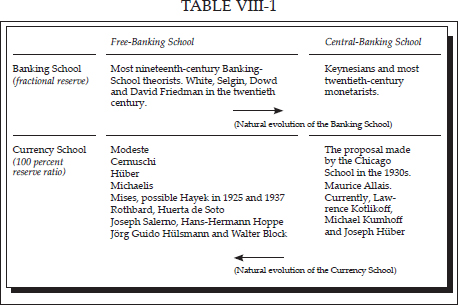
The classification of theorists into four schools (Fractional-Reserve Free Banking, Fractional-Reserve Central Banking, Free Banking with a 100 percent reserve, and Central Banking with a 100 percent reserve) is much clearer and more accurate than the method chosen by (among others) Anna J. Schwartz and Lawrence H. White, who identify only three schools, the Currency School, the Banking School, and the Free-Banking School. (See Anna J. Schwartz, “Banking School, Currency School, Free Banking School,” pp. 148–52.)
On the development in Spain of the doctrine in favor of the central bank and on this doctrine’s influence on the establishment of the Spanish bank of issue, see Luis Coronel de Palma, La evolución de un banco central (Madrid: Real Academia de Jurisprudencia y Legislación, 1976), and the references cited therein. See also the writings of Rafael Anes, “El Banco de España, 1874–1914: un banco nacional,” and Pedro Tedde de Lorca, “La banca privada española durante la Restauración, 1874–1914.” Both appear in volume 1 of La banca española en la Restauración (Madrid: Servicio de Estudios del Banco de España, 1974). Despite the valuable references included in these works, a history of Spanish economic thought on the debate between central-and free-banking supporters has yet to be written. The most important (fractional-reserve) free banking theorist in Spain was Luis María Pastor (1804–1872). See his book Libertad de Bancos y Cola del de España (Madrid: B. Carranza, 1865).
A central bank is not a natural product of banking development. It is imposed from outside or comes into being as the result of Government favours. This factor is responsible for marked effects on the whole currency and credit structure which brings it into sharp contrast with what would happen under a system of free banking from which Government protection was absent. (Smith, The Rationale of Central Banking and the Free Banking Alternative, p. 169)
Thus we accept the hypothesis of Professor Charles Goodhart (see footnote 73), who believes the emergence of the central bank to be a necessary consequence of the shift from a system of commodity money to a system of fiduciary money. We accept this hypothesis as long as acknowledgment is made to the effect that such a shift is not a spontaneous result of the market, but on the contrary, an inevitable outcome of the violation of traditional legal principles (100-percent reserve ratio on demand deposits), which are essential to the correct functioning of any free market. The only serious flaw we see in Vera Smith’s book lies in the author ’s failure to fully recognize that the central-bank system is simply the logical and unavoidable consequence of private bankers’ gradual and surreptitious introduction (in historical complicity with governments) of the fractional-reserve banking system. It is unfortunate that Smith neglects to devote some attention to the proposals for a 100-percent reserve requirement which were already circulating at the time she wrote the book. If she had examined these proposals, she would have realized that a true system of free-banking requires the re-establishment of a 100-percent reserve ratio on demand deposits. As we will see, many present-day theorists who defend the free-banking system commit the same error.
The classic work on the evolution of central banks is Charles Good-hart’s The Evolution of Central Banks, 2nd ed. (Cambridge, Mass.: MIT Press, 1990), esp. pp. 85–103. A brief, helpful outline of the emergence and development of central banks appears on pp. 9ff. of Tedde de Lorca’s book, El Banco de San Carlos, 1782–1822. Ramón Santillana provides a good illustration of the formation of the central bank in nineteenth-century Spain to cope with the financial difficulties of the state, which was continually forced to take advantage of the privileges of money creation (banknotes and deposits) enjoyed by the fractional-reserve banking industry. See Santillana’s book, Memoria histórica sobre los bancos Nacional de San Carlos, Español de San Fernando, Isabel II, Nuevo de San Fernando, y de España (reprinted by the Banco de España [Madrid, 1982]), esp. pp. 1, 3, 132, 236 and 237.
Huerta de Soto, Socialism, Economic Calculation and Entrepreneurship, p. 49. See also Jesús Huerta de Soto, “The Economic Analysis of Socialism,” in Gerrit Meijer, ed., New Perspectives on Austrian Economics (London and New York: Routledge, 1995), chap. 14.
Huerta de Soto, Socialism, Economic Calculation and Entrepreneurship, pp. 52–62.
A detailed analysis of all the theoretical conclusions outlined above appears in the first three chapters of Huerta de Soto, Socialism, Economic Calculation and Entrepreneurship, pp. 1–98, mainly chapter 3.
For example, see article 15 of autonomy statute 13/1994 of the Bank of Spain, July 1. The statute reads:
The Bank of Spain shall have exclusive authority to issue bills in pesetas, which, notwithstanding the status applied to coinage, shall be the only legal tender with full, unlimited liberatory power in Spanish territory. (Spain’s Official Gazette, July 2, 1994, p. 15404; italics added)
Logically, with Spain’s entrance into the European Monetary Union as of January 1, 2002, the euro and the European Central Bank have replaced the peseta and the Bank of Spain, respectively.
See, for example, the general list of central-bank duties included in article 7 of the above autonomy statute of the Bank of Spain.
See the paper written by our student Elena Sousmatzian Ventura, “¿Puede la intervención gubernamental evitar las crisis bancarias?” Revista de la Superintendencia de bancos y otras instituciones financieras 1 (April–June 1994): 66–87. In this paper Elena Sousmatzian adds that though the notion that the current banking system shares the characteristics of a socialist or controlled economy may initially surprise many, it is easy to understand when we remember that: (a) the entire system rests on the government monopoly on currency; (b) the system is based on the privilege which permits banks to create loans ex nihilo by holding only a fractional reserve on deposits; (c) the management of the whole system is performed by the central bank, as an independent monetary authority which acts as a true planning agency with respect to the financial system; (d) from a legal standpoint, the principle which applies to the government, i.e., that it may act only within its jurisdiction, also applies to banks, in contrast to the rule for other private entities, who may always do anything that is not prohibited; (e) banks are commonly excluded from the general bankruptcy proceedings stipulated in mercantile law and are instead subject to administrative law procedures such as intervention and the replacement of management; (f) bank failures are prevented by externalizing the effects of banks’ liquidity crises, the costs of which are met by the citizenry through loans from the central bank at prime rates or non-recoverable contributions from a deposit guarantee fund; (g) a vast, inordinately complicated set of regulations applies to banking and closely resembles that which controls government; and (h) there is little or no supervision of government intervention in bank crises. In many cases such intervention is determined ad hoc, and principles of rationality, efficiency, and effectiveness are disregarded.
We obviously exclude completely nationalized banking systems (China, Cuba, etc.), which at any rate are of little significance nowadays.
Furthermore the central bank cannot guarantee all customers of private banks the recovery of their deposits in monetary units of unaltered purchasing power. The belief that central banks “guarantee” all citizens the return of their deposits, regardless of the actions of the private banks involved, is pure fiction, since the most central banks can do is to create new liquidity ex nihilo to meet all deposit demands private banks are confronted with. Nevertheless, by doing so they trigger an inflationary process which often significantly lowers the purchasing power of the monetary units withdrawn from the corresponding deposits.
There is one basic dilemma, which all central banks face, which makes it inevitable that their policy must involve much discretion. A central bank can exercise only an indirect and therefore limited control over all the circulating media. Its power is based chiefly on the threat of not supplying cash when it is needed. Yet at the same time it is considered to be its duty never to refuse to supply this cash at a price when needed. It is this problem, rather than the general effects of policy on prices or the value of money, that necessarily preoccupies the central banker in his day-to-day actions. It is a task which makes it necessary for the central bank constantly to forestall or counteract developments in the realm of credit, for which no simple rules can provide sufficient guidance. (Hayek, The Constitution of Liberty, p. 336)
The various systems and agencies designed to “insure” created deposits in many western countries tend to produce an effect which is the exact opposite of that intended when they were established. These “deposit guarantee funds” encourage less prudent and responsible policies in private banking, since they give citizens the false assurance that their deposits are “guaranteed” and thus that they need not take the effort to study and question the trust they place in each institution. These funds also convince bankers that ultimately their behavior cannot harm their direct customers very seriously. The leading role deposit guarantee or “insurance” systems played in the eruption of the American bank crisis of the 1990s is covered in, among other sources, The Crisis in American Banking, Lawrence H. White, ed. (New York: New York University Press, 1993). It is therefore disheartening that the process of harmonizing European banking law has included the approval of Directive 94/19 C. E. of May 30, 1994, with respect to deposit guarantee systems. This directive establishes that each member state must officially recognize a deposit guarantee system and requires each European credit institution to affiliate itself to one of the agencies created for this purpose in each country. The directive also establishes that guarantee systems will insure coverage of up to 24,000 ecus (currently 100,000 euros, since 2010) on all deposits made by any one depositor, and that the European Commission will revise this figure every five years.
Thus the monetary-policy error which most contributed to the appearance of the Great Depression was that committed by European central banks and the American Federal Reserve during the 1920s. It was not, as Stephen Horwitz indicates and Milton Friedman and Anna Schwartz did before him, that the central bank, following the stock-market crash of 1929, failed to properly respond to a 30 percent decrease in the quantity of money in circulation. As we know, the crisis erupted because prior credit and monetary expansion caused distortions in the productive structure, not because the corresponding reversion process invariably brought deflation with it. Horwitz’s error in interpretation, along with his defense of the arguments invoked by members of the modern Fractional-Reserve Free-Banking School, appear in his article, “Keynes’ Special Theory,” in Critical Review: A Journal of Books and Ideas 3, nos. 3 and 4 (Summer–Autumn, 1989): 411–34, esp. p. 425.
Charles A.E. Goodhart has written an accurate summary of the insurmountable theoretical and practical difficulties the central bank encounters in implementing its monetary policy. See his article, “What Should Central Banks Do? What Should be their Macroeconomic Objectives and Operations?” published in Economic Journal 104 (November 1994): 1424–36. The above excerpt appears on pp. 1426–27. Other interesting works by Goodhart include: The Business of Banking 1891–1914 (London: Weidenfeld and Nicholson, 1972), and The Evolution of Central Banks. Thomas Mayer also referred to the inevitable political influences exerted on the decisions of central banks, even those banks most independent of the executive branch from a legal standpoint. See Mayer ’s book, Monetarism and Macroeconomic Policy (Aldershot, U.K.: Edward Elgar, 1990), pp. 108–09.
A helpful overview of the different positions on this point and of the related literature has been prepared by Antonio Erias Rey and José Manuel Sánchez Santos in “Independencia de los bancos centrales y política monetaria; una síntesis,” Hacienda Pública Española 132 (1995): 63–79.
On the positive effect which the independence of the central bank has on the financial system, see Geoffrey A. Wood et al., Central Bank Independence: What is it and What Will it Do for Us? (London: Institute for Economic Affairs, 1993). See also Otmar Issing’s book, Central Bank Independence and Monetary Stability (London: Institute of Economic Affairs, 1993).
János Kornai, “The Hungarian Reform Process,” Journal of Economic Literature 24, no. 4 (December 1986): 1726–27.
Nonetheless we cannot completely rule out the possibility of intertemporal distortions in this case. Even if banks are required to maintain a 100 percent reserve, intertemporal distortions will inevitably occur if the central bank injects new money into the economic system via massive open-market purchases which directly affect securities markets, rates of return, and hence, indirectly, the interest rate in the credit market.
F.A. Hayek has explained that unemployment often stems from the existence of intratemporal discrepancies between the distribution of the demand for different consumer goods and services and the allocation of labor and the other productive resources necessary to produce these goods. The creation and injection of new money by the central bank at different points in the economic system tends to produce and aggravate such qualitative discoordination. This argument, which is illustrated and reinforced by fractional-reserve banking to the extent that it combines intratemporal distortion with far more acute intertemporal discoordination, would still carry weight even if the central bank were to direct a banking system which operated with a 100-percent reserve ratio. In this case any increase in the money supply brought about by the central bank to achieve its monetary-policy goals would always horizontally or intratemporally distort the productive structure, unless (and this is inconceivable in real life) the new money were proportionally (in relation with the individual preexisting money balances) equally distributed among all economic agents. In this case the rise in the quantity of money in circulation would exert no effect, except to lend to proportionally boost the prices of all goods, services and factors of production. All real conditions which could initially be cited as justification for an increase in the money supply would remain unaltered.
The principal defenders of a private banking system based on a 100-percent reserve requirement and managed by a central bank include the members of the Chicago School in the 1930s and, currently, Maurice Allais, a recipient of the Nobel Prize in Economics. In the next chapter we will analyze their proposals in detail.
It is precisely this process that Parnell originally described in 1826 and Ludwig von Mises later developed further in chapter 12 of Human Action: “The Limitation on the Issuance of Fiduciary Media,” pp. 434–48.
Charles A.E. Goodhart states: “There were plenty of banking crises and panics prior to the formation of central banks” and cites O.B.W. Sprague’s book, History of Crises and the National Banking System, first published in 1910 and reprinted in New Jersey by Augustus M. Kelley in 1977. See Charles A.E. Goodhart, “What Should Central Banks Do? What Should be their Macroeconomic Objectives and Operations?” p. 1435. See also the article by the same author, “The Free Banking Challenge to Central Banks,” published in Critical Review 8, no. 3 (Summer 1994): 411–25. A collection of the most important writings of Charles A.E. Goodhart has been published as The Central Bank and the Financial System (Cambridge, Mass.: MIT Press, 1995).
On banks’ optimism and the “passive inflationism” which arises from bankers’ fear of aborting artificial expansion in time, see Mises, Human Action, pp. 572–73. Moreover Mises argues that benefits derived from privileges tend to run out (in the realm of banking this is due to an increase in branches, expenses, etc.), thus sparking demands for further doses of inflation (ibid., p. 749).
The expression “tragedy of the commons” came into use following Garret Hardin’s article, “The Tragedy of the Commons,” Science (1968); reprinted on pp. 16–30 of Managing the Commons, Garret Hardin and John Baden, eds. (San Francisco: Freeman, 1970). However the process had already been fully described twenty-eight years earlier by Ludwig von Mises in his “Die Grenzen des Sondereigentums und das Problem der external costs und external economies,” section 6 of chapter 10 of part 4 of Nationalökonomie: Theorie des Handelns und Wirtschaftens (Geneva: Editions Union, 1940; Munich: Philosophia Verlag, 1980), pp. 599–605.
Selgin and White have criticized our application of the “tragedy of the commons” theory to fractional-reserve free banking. They claim that what occurs in this sector is a pecuniary externality (i.e., one derived from the price system), which has nothing to do with the technological externality on which the “tragedy of the commons” rests. See George A. Selgin and Lawrence H. White “In Defense of Fiduciary Media, or We are Not (Devo)lutionists, We are Misesians!” Review of Austrian Economics 9, no. 2 (1996): 92–93, footnote 12. Nevertheless Selgin and White do not seem to fully grasp that the issuance of fiduciary media stems from the violation of traditional property rights in connection with the monetary bank-deposit contract, and that hence fiduciary media are not a spontaneous phenomenon of a legally based free-market process. Hoppe, Hülsmann, and Block, for their part, have come to our defense with the following assertion:
In lumping money and money substitutes together under the joint title of “money” as if they were somehow the same thing, Selgin and White fail to grasp that the issue of fiduciary media—an increase of property titles—is not the same thing as a larger supply of property and that relative price changes effected through the issue of fiduciary media are an entirely different “externality” matter than price changes effected through an increase in the supply of property. With this the fundamental distinction between property and a property title in mind, Huerta de Soto’s analogy between fractional reserve banking and the tragedy of the commons makes perfect sense. (Hans-Hermann Hoppe, Jörg Guido Hülsmann and Walter Block, “Against Fiduciary Media,” The Quarterly Journal of Austrian Economics 1, no. 1 (1998): 23, footnote 6)
Furthermore Mises emphasizes that the chief economic effect of negative external costs is to complicate economic calculation and discoordinate society, phenomena which clearly take place in the case of credit expansion in fractional-reserve banking. See Mises, Human Action, pp. 655ff.; and Philipp Bagus, “La tragedia de los bienes comunales y la escuela austriaca: Hardin, Hoppe, Huerta de Soto, y Mises,” Procesos de Mercado 1, no. 2 (2004): 125–29.
Table VIII-2 does not include any “weights” or values and is typically used to illustrate both cooperative games and “prisoner ’s dilemmas” (as when a prudent and honest bank refuses to cooperate, or an irresponsible one wants to be the first one to expand). The reasoning behind our application of the “tragedy of the commons” to the fractional-reserve free-banking system parallels the argument originally offered by Long-field, though he attempts, without much justification, to apply his case even to isolated instances of expansion by a few banks, while in our analysis such instances are limited by the interbank clearing mechanism, a factor Longfield fails to consider. The tragedy of the commons also accounts for the forces which motivate banks in a fractional-reserve free-banking system to merge and to request the creation of a central bank, with the aim of establishing general, common policies of credit expansion. The first time we explained this typical “tragedy of the commons” process in this context was at the regional meeting of the Mont Pèlerin Society which took place in Rio de Janeiro September 5–8, 1993. At this meeting, Anna J. Schwartz also pointed out that modern fractional-reserve free-banking theorists cannot seem to grasp that the inter-bank clearing mechanism they refer to does not curb credit expansion if all banks decide to simultaneously expand their credit to one degree or another. See her article, “The Theory of Free Banking,” presented at the above meeting, esp. p. 5. At any rate, the process of expansion obviously stems from a privilege which conflicts with property rights, and each bank clearly reserves for itself all the benefits of its credit expansion and allows the costs to be shared by the entire system. Moreover if most bankers implicitly or explicitly agree to “optimistically” join in the creation and granting of loans, the interbank clearing mechanism does not effectively curtail abuses. See also footnote 130.
Precisely for the reasons given I cannot agree with my friend Pascal Salin, who concludes that “the problem is [central bank] monetary monopoly, not fractional reserve.” See Pascal Salin, “In Defense of Fractional Monetary Reserves.” Even the most prominent defenders of fractional-reserve free banking have recognized that the interbank clearing system which would emerge in a free-banking environment would be incapable of checking a widespread expansion of loans. For example, see George Selgin’s article, “Free Banking and Monetary Control,” printed in Economic Journal 104, no. 427 (November 1994): 1449–59, esp. p. 1455. Selgin overlooks the fact that the fractional-reserve banking system he supports would create an irresistible trend not only toward mergers, associations and agreements, but also (and even more importantly) toward the establishment of a central bank designed to orchestrate joint credit expansion without compromising the solvency of individual banks, and to guarantee necessary liquidity as a lender of last resort with the power to assist any bank in times of financial difficulties.
Hayek, The Constitution of Liberty and Law, Legislation and Liberty. See also Huerta de Soto, Socialism, Economic Calculation and Entrepreneurship, chap. 3.
See p. 2 of our student Elena Sousmatzian Ventura’s article, “¿Puede la intervención gubernamental evitar las crisis bancarias?” Ms. Sousmatzian quotes the following description (offered by Tomás-Ramón Fernández) of the crisis-legislation cycle:
Banking legislation has always developed in response to crises. When crises have hit, existing legislation has always been found inadequate and devoid of the necessary answers and solutions. Thus it has always been necessary to come up with hasty emergency solutions which, despite the context of their “invention,” at the end of each crisis have been incorporated into a new general legal framework, which has lasted only until the following shock, when a similar cycle has begun. (Tomás-Ramón Fernández, Comentarios a la ley de disciplina de intervención de las entidades de crédito , p. 9)
Elena Sousmatzian expresses the problem in this way: if bank crises are preventable, government intervention has proven unequal to the task of preventing them; and if crises are inevitable, government intervention in this area is superfluous. Both positions have truth to them, since fractional-reserve banking makes crises inescapable, regardless of the banking legislation which governments insist on drafting and which often does more to further aggravate cyclical problems than it does to lessen them.
Mises, Human Action, p. 443.
To be specific, Tooke remarked:
As to the free trade in banking in the sense which it is sometimes contended for, I agree with a writer in one of the American papers, who observes that free trade in banking is synonymous with free trade in swindling. Such claims do not rest in any manner on grounds analogous to the claims of freedom of competition in production. It is a matter of regulation by the State and comes within the province of police. (Thomas Tooke, A History of Prices, 3 vols. , vol. 3, p. 206)
We agree with Tooke in that if free banking implies freedom to operate with a fractional reserve, then essential legal principles are violated and the state, if it is to have any function at all, should diligently attempt to prevent such violations and punish them when they occur. This appears to be precisely what Ludwig von Mises had in mind when, in Human Action (p. 666), he quoted this excerpt of Tooke’s.
As David Laidler accurately points out, recent interest in free banking and the development of the Neo-Banking School originated with Friedrich A. Hayek’s book on the denationalization of money (F.A. Hayek, Denationalization of Money: The Argument Refined, 2nd ed. ). Prior to Hayek, Benjamin Klein offered a similar proposal in his article, “The Competitive Supply of Money,” published in the Journal of Money, Credit and Banking 6 (November 1974): 423–53. Laidler ’s reference to the above two authors appears in his brief but stimulating article on banking theory, “Free Banking Theory,” found in The New Palgrave: A Dictionary of Money and Finance (London and New York: Macmillan Press, 1992), vol. 2, pp. 196–97. According to Oskari Juurikkala, the current debate among free-banking theorists (pro-100-percent reserve requirement versus pro-fractional reserve) is strictly parallel to the nineteenth century French debate between Victor Modeste (and Henry Cernuschi) and J. Gustave Courcelle-Seneuil. See his article, “The 1866 False-Money Debate in the Journal des Economistes: Déjà Vu for Austrians?”
Lawrence H. White, Free Banking in Britain: Theory, Experience and Debate, 1800–1845 (London and New York: Cambridge University Press, 1984); Competition and Currency: Essays on Free Banking and Money (New York: New York University Press, 1989); and also the articles written jointly with George A. Selgin: “How Would the Invisible Hand Handle Money?” Journal of Economic Literature 32, no. 4 (December 1994): 1718–49, and more recently, “In Defense of Fiduciary Media—or, We are Not Devo(lutionists), We are Misesians!” Review of Austrian Economics 9, no. 2 (1996): 83–107. Finally, Lawrence H. White has compiled the most important writings from a Neo-Banking School standpoint in the following work: Free Banking, vol. 1: 19th Century Thought; vol. 2: History; vol. 3: Modern Theory and Policy (Aldershot, U.K.: Edward Elgar, 1993).
George A. Selgin, “The Stability and Efficiency of Money Supply under Free Banking,” printed in the Journal of Institutional and Theoretical Economics 143 (1987): 435–56, and republished in Free Banking, vol. 3: Modern Theory and Policy, Lawrence H. White, ed., pp. 45–66; The Theory of Free Banking: Money Supply under Competitive Note Issue (Totowa, N.J.: Rowman and Littlefield, 1988); the articles written jointly with Lawrence H. White and cited in the preceding footnote; and “Free Banking and Monetary Control,” Economic Journal 104, no. 427 (November 1994): 1449–59. I am not very sure if Selgin does still consider himself a member of the Austrian School.
Stephen Horwitz, “Keynes’ Special Theory,” pp. 411–34; “Misreading the ’Myth’: Rothbard on the Theory and History of Free Banking,” published as chapter 16 of The Market Process: Essays in Contemporary Austrian Economics, Peter J. Boettke and David L. Prychitko, eds. (Aldershot, U.K.: Edward Elgar, 1994), pp. 166–76; and also his books, Monetary Evolution, Free Banking and Economic Order and Microfoundations and Macroeconomics (London: Routledge, 2000).
Kevin Dowd, The State and the Monetary System (New York: Saint Martin’s Press, 1989); The Experience of Free Banking (London: Routledge, 1992); and Laissez-Faire Banking (London and New York, Routledge, 1993).
David Glasner, Free Banking and Monetary Reform (Cambridge: Cambridge University Press, 1989); “The Real-Bills Doctrine in the Light of the Law of Reflux,” History of Political Economy 24, no. 4 (Winter, 1992): 867–94.
Leland B. Yeager and Robert Greenfield, “A Laissez-Faire Approach to Monetary Stability,” Journal of Money, Credit and Banking 15, no. 3 (August 1983): 302–15, reprinted as chapter 11 of volume 3 of Free Banking, Lawrence H. White, ed., pp. 180–95; Leland B. Yeager and Robert Greenfield, “Competitive Payments Systems: Comment,” American Economic Review 76, no. 4 (September 1986): 848–49. And finally Yeager’s book, The Fluttering Veil: Essays on Monetary Disequilibrium, G. Selgin, ed. (Indianapolis, Ind.: Liberty Fund, 1997).
Richard Timberlake, “The Central Banking Role of Clearinghouse Associations,” Journal of Money, Credit and Banking 16 (February 1984): 1–15; “Private Production of Scrip-Money in the Isolated Community,” Journal of Money, Credit and Banking 19, no. 4 (October 1987): 437–47; “The Government’s Licence to Create Money,” The Cato Journal: An Inter-disciplinary Journal of Public Policy Analysis 9, no. 2 (Fall, 1989): 302–21.
Milton Friedman and Anna J. Schwartz, “Has Government Any Role in Money?” Journal of Monetary Economics 17 (1986): 37–72, reprinted as chapter 26 of the book, The Essence of Friedman, Kurt R. Leube, ed. (Stanford University, Calif.: Hoover Institution Press, 1986), pp. 499–525.
Thus Selgin himself states:
Despite . . . important differences between Keynesian analysis and the views of other monetary-equilibrium theorists, many Keynesians might accept the prescription for monetary equilibrium. ( Selgin, The Theory of Free Banking, p. 56; see also p. 59)
The detailed analysis appears, among other places, in Selgin’s book, The Theory of Free Banking, chaps. 4, 5 and 6, esp. p. 34 and pp. 64–69.
Stephen Horwitz maintains that Lawrence White
explicitly rejects the real-bills doctrine and endorses a different version of the “needs of trade” idea. For him the “needs of trade” means the demand to hold bank notes. On this interpretation, the doctrine states that the supply of bank notes should vary in accordance with the demand to hold notes. As I shall argue, this is just as acceptable as the view that the supply of shoes should vary to meet the demand for them. (Horwitz, “Misreading the ‘Myth’,” p. 169)
To be specific, White appears to defend the new version of the Old Banking School’s “needs of trade” doctrine on pp. 123–24 of his book, Free Banking in Britain. In contrast to the thesis of Horwitz, Amasa Walker indicates, in connection with fiduciary media:
The supply does not satisfy the demand: it excites it. Like an unnatural stimulus taken into the human system, it creates an increasing desire for more; and the more it is gratified, the more insatiable are its cravings. (Amasa Walker, The Science of Wealth: A Manual of Political Economy, 5th ed. , p. 156)
“Free banking thus works against short-run monetary disequilibrium and its business cycle consequences.” Selgin and White, “In Defense of Fiduciary Media—or, We are Not Devo(lutionists), We are Misesians!” pp. 101–02.
Joseph T. Salerno points out that for Mises, increases in the demand for money do not pose any coordination problem whatsoever, as long as the banking system does not attempt to adjust to them by creating new loans. Even a rise in saving (that is, a fall in consumption) expressed solely in increased cash balances (hoarding), and not in loans linked to spending on investment goods, would lead to the effective saving of consumer goods and services in the community and to a process by which the productive structure would become longer and more capitalintensive. In this case the rise in cash balances would simply boost the purchasing power of money by pushing down the nominal prices of the consumer goods and services of the different factors of production. Nonetheless, in relative terms, the price disparities characteristic of a period of rising saving and increasing capital intensity in the productive structure would arise among the different stages of factors of production. See Joseph T. Salerno, “Mises and Hayek Dehomogenized,” printed in Review of Austrian Economics 6, no. 2 (1993): 113–46, esp. pp. 144ff. See also Mises, Human Action, pp. 520–21. In the same article, Salerno strongly criticizes White for maintaining that Mises was the forerunner of the modern free-banking theorists and for not realizing that Mises always challenged the essential premises of the Banking School and only defended free banking as a way to reach the final goal of a banking system with a 100-percent reserve requirement. See pp. 137ff. in the above article. See also upcoming footnote 119.
Let us remember that Hayek’s objective in Prices and Production was precisely
to demonstrate that the cry for an “elastic” currency which expands or contracts with every fluctuation of “demand” is based on a serious error of reasoning. (See p. xiii of Hayek’s preface to the first edition of Prices and Production)
Mark Skousen states that a system based on a pure gold standard with a 100-percent reserve requirement in banking would be more elastic than the system Hayek proposes and would not have the defect of conforming to the “needs of trade”: decreases in prices would stimulate the production of gold, thereby generating a moderate expansion of the money supply without producing cyclical effects. Skousen concludes:
Based on historical evidence, the money supply (the stock of gold) under a pure gold standard would expand [annually] between 1 to 5 percent. And, most importantly, there would be virtually no chance of a monetary deflation under 100 percent gold backing of the currency. (Skousen, The Structure of Production, p. 359)
Selgin himself recognizes that
Mises’s support for free banking is based in part on his agreement with Cernuschi, who (along with Modeste) believed that freedom of note issue would automatically lead to 100 percent reserve banking;
and also that Mises “believed that free banking will somehow lead to the suppression of fractionally-based inside monies.” See Selgin, The Theory of Free Banking, pp. 62 and 164. Lawrence H. White attempts to place a different interpretation on Mises’s position and presents Mises as the forerunner of modern fractional-reserve free banking defenders. See Lawrence H. White, “Mises on Free Banking and Fractional Reserves,” in A Man of Principle: Essays in Honor of Hans F. Sennholz, John W. Robbins and Mark Spangler, eds. (Grove City, Penn.: Grove City College Press, 1992), pp. 517–33. Salerno, in agreement with Selgin, makes the following response to White:
To the extent that Mises advocated the freedom of banks to issue fiduciary media, he did so only because his analysis led him to the conclusion that this policy would result in a money supply strictly regulated according to the Currency principle. Mises’s desideratum was . . . to completely eliminate the distortive influences of fiduciary media on monetary calculation and the dynamic market process. (Salerno, “Mises and Hayek Dehomogenized,” pp. 137ff. and p. 145)
Mises, Human Action, p. 442, footnote 17; italics added. Mises adds: “Free banking . . . would . . . not hinder a slow credit expansion” (Human Action, p. 443). Here Mises conveys an excessively optimistic impression of fractional-reserve free banking, particularly in light of this earlier passage from Theory of Money and Credit (1924): “[I]t is clear that banking freedom per se cannot be said to make a return to gross inflationary policy impossible.” Mises, Theory of Money and Credit, p. 436 (p. 408 in the German edition).
The Banking School failed entirely in dealing with these problems. It was confused by a spurious idea according to which the requirements of business rigidly limit the maximum amount of convertible banknotes that a bank can issue. They did not see that the demand of the public for credit is a magnitude dependent on the banks’ readiness to lend, and that banks which do not bother about their own solvency are in a position to expand circulation credit by lowering the rate of interest below the market rate. (Mises, Human Action, pp. 439–40)
Moreover let us remember that the process spreads and feeds upon itself as debtors borrow more newly-created deposits to repay earlier loans.
Mises, Human Action, pp. 427–28; italics added.
Curiously, like Keynesians and monetarists, modern free-banking theorists are obsessed with supposed, sudden, unilateral changes in the demand for money. They fail to see that such changes tend to be endogenous and to occur throughout an economic cycle which is first triggered by shifts in the supply of new money the banking system creates in the form of loans. The only other situations capable of producing a sudden rise in the demand for money are exceptional, like wars and natural disasters. Seasonal variations are comparatively less important and a free-banking system with a 100-percent reserve requirement could counteract them with a seasonal transfer of gold and slight price modifications.
See Jörg Guido Hülsmann, “Free Banking and Free Bankers,” Review of Austrian Economics 9, no. 1 (1996): 3–53, esp. pp. 40–41.
Remember our analysis contained in pages 664–71. See Laidler, “Free Banking Theory,” p. 197.
Selgin, The Theory of Free Banking, p. 82.
See, for example, Schwartz, “The Theory of Free Banking,” p. 3; and specially Philipp Bagus and David Howden “Fractional Reserve Free Banking: Some Quibbles,” Quarterly Journal of Austrian Economics 13, no. 4 (2010): 29–55; and “Unanswered Quibbles: George Selgin Gets it Wrong with Fractional Reserve Free Banking,” Procesos de Mercado 8, no. 2 (2011): 83–111.
Skousen, The Structure of Production, chap. 8, pp. 269 and 359.
We cannot rule out even greater credit expansion in the event of shocks in the supply of gold, though Selgin tends to play down the importance of this possibility. Selgin, The Theory of Free Banking, pp. 129–33.
Let us remember that for Mises (see footnote 120 above): “Banking freedom per se cannot be said to make a return to gross inflationary policy impossible,” especially if an inflationary ideology prevails among economic agents:
Many authors believe that the instigation of the banks’ behavior comes from outside, that certain events induce them to pump more fiduciary media into circulation and that they would behave differently if these circumstances failed to appear. I was also inclined to this view in the first edition of my book on monetary theory. I could not understand why the banks didn’t learn from experience. I thought they would certainly persist in a policy of caution and restraint, if they were not led by outside circumstances to abandon it. Only later did I become convinced that it was useless to look to an outside stimulus for the change in the conduct of the banks. . . . We can readily understand that the banks issuing fiduciary media, in order to improve their chances for profit, may be ready to expand the volume of credit granted and the number of notes issued. What calls for special explanation is why attempts are made again and again to improve general economic conditions by the expansion of circulation credit in spite of the spectacular failure of such efforts in the past. The answer must run as follows: According to the prevailing ideology of businessman and economist-politician, the reduction of the interest rate is considered an essential goal of economic policy. Moreover, the expansion of circulation credit is assumed to be the appropriate means to achieve this goal. (Mises, On the Manipulation of Money and Credit, pp. 135–36)
For the above reasons I do not consider entirely correct the position of Ludwig van den Hauwe, “Credit Expansion, the Prisoner ’s Dilemma and Free Banking as Mechanism Design,” Procesos de Mercado 5, no. 2 (Autumn 2008): 133–74.
“Crises have reappeared every few years since banks . . . began to play an important role in the economic life of people.” Ibid., p. 134.
Hayek, The Pure Theory of Capital, p. 378.
Ibid., p. 394. This appears to be the extreme case of an increase in saving which manifests itself entirely as a rise in balances of fiduciary media, the case Selgin and White use to illustrate their theory. See Selgin and White, “In Defense of Fiduciary Media—or, We are Not Devo(lutionists), We are Misesians!” pp. 104–05.
Such a situation is definitely possible, as Selgin and White themselves recognize when they affirm: “An increase in savings is neither necessary nor sufficient to warrant an increase in fiduciary media.” Selgin and White, “In Defense of Fiduciary Media—or, We are Not Devo(lutionists), We are Misesians!” p. 104.
Selgin and White implicitly acknowledge this point when they assert: Benefits accrue . . . to bank borrowers who enjoy a more ample supply of intermediated credit, and to everyone who works with the economy’s consequently larger stock of capital equipment. (Selgin and White, “In Defense of Fiduciary Media—or, We are Not Devo(lutionists), We are Misesians!” p. 94)
We deny that an increase in fiduciary media matched by an increased demand to hold fiduciary media is disequilibrating or sets in motion the Austrian business cycle. (Ibid., pp. 102–03)
Keynes, The General Theory of Employment, Interest and Money, p. 83. This thesis, which we covered in chapter 7, stems from the tautology of equating saving with investment, an error which underlies all of Keynes’s work and which, according to Benjamin Anderson, is tantamount to equating inflation with saving.
Selgin, The Theory of Free Banking, pp. 54–55.
Selgin, “The Stability and Efficiency of Money Supply under Free Banking,” p. 440.
How is it conceivable that banknotes and deposits, which are money in themselves, are also “financial assets” that signify that the bearer has turned over money to a third party today in exchange for a certain amount of money in the future? The idea that notes and deposits are “financial assets” exposes the fact that banks in a fractional-reserve banking system duplicate means of payment ex nihilo: there is the money lent to and enjoyed by a third party, and there is the financial asset which represents the operation and is also considered money. To put it another way, financial assets are titles or certificates which signify that someone has given up present money on handing it over to another in exchange for a larger quantity of future money. If, at the same time, financial assets are considered money (by the bearer), then an obvious, inflationary duplication of means of payment takes place in the market which originates in the granting of a new loan without anyone’s having to save the same amount first.
Money is a perfectly liquid present good. With respect to the banking system as a whole, fiduciary media are not “financial assets,” since they are never withdrawn from the system, but circulate indefinitely and, hence, are money (or to be more precise, perfect money substitutes). In contrast, a financial asset represents the handing over of present goods (generally money) in exchange for future goods (also generally monetary units) on a specified date, and its creation corresponds to a rise in an economic agent’s real saving. See Gerald P. O’Driscoll, “Money: Menger ’s Evolutionary Theory,” History of Political Economy 4, no. 18 (1986): 601–16.
First off, it is plainly false to say that the holding of money, i.e., the act of not spending it, is equivalent to saving. . . . In fact, saving is not-consuming, and the demand for money has nothing to do with saving or not-saving. The demand for money is the unwillingness to buy or rent non-money goods—and these include consumer goods (present goods) and capital goods (future goods). Not-spending money is to purchase neither consumer goods nor investment goods. Contrary to Selgin, then, matters are as follows: Individuals may employ their monetary assets in one of three ways. They can spend them on consumer goods; they can spend them on investment; or they can keep them in the form of cash. There are no other alternatives. . . . [U]nless time preference is assumed to have changed at the same time, real consumption and real investment will remain the same as before: the additional money demand is satisfied by reducing nominal consumption and investment spending in accordance with the same pre-existing consumption/investment proportion, driving the money prices of both consumer as well as producer goods down and leaving real consumption and investment at precisely their old levels. (Hans-Hermann Hoppe, “How is Fiat Money Possible?—or The Devolution of Money and Credit,” in Review of Austrian Economics 7, no. 2 (1994): 72–73).
See also the notable article by Ludwig van den Hauwe, “The Uneasy Case for Fractional-Reserve Free Banking,” Procesos de Mercado 3, no. 2 (Autumn 2006): 143–96.
Selgin’s unjustified criticism of Machlup appears in footnote 20 on p. 184 of his book, The Theory of Free Banking. Selgin would consider the entire volume of credit shown by surface “A” in our Chart VIII-2 “transfer credit,” because it is “credit granted by banks in recognition of people’s desire to abstain from spending by holding balances of inside money” (ibid., p. 60). In contrast, for Machlup (and for us), at least surface “B” of Chart VIII-4 would represent “created credit” or credit expansion, since economic agents do not restrict their consumption by the volume shown by surface “C”.
As an additional advantage of the system he proposes, Selgin mentions that economic agents who maintain cash balances in the form of fiduciary media created in a free-banking system can obtain a financial yield on their money and use a series of banking facilities (payment, bookkeeping, cashier, etc.) “free of charge.” However Selgin fails to mention certain costs of fractional-reserve free banking, such as artificial booms, malinvestment of resources, and economic crises. He also fails to touch on what we definitely consider the highest cost: the harmful effects of the violation of legal principles in a free-banking system give rise to a tendency toward the establishment of a central bank as a lender of last resort designed to support bankers and create the liquidity necessary to insure citizens the recovery of their deposits at any time. As for the supposed “advantage” of receiving interest on deposits and “free” cashier and bookkeeping services, there is no telling whether, in net terms, the interest economic agents would earn on funds truly saved and lent in a system with a 100-percent reserve requirement, less the cost of the corresponding deposit, cashier and bookkeeping services, would be equal to, higher than or lower than the real interest they currently receive on their demand checking accounts (minus the decline which chronically affects the purchasing power of money in the current banking system).
To date, theorists have carefully examined around sixty free-banking systems from the past. The conclusion they have generally drawn follows:
Bank failure rates were lower in systems free of restrictions on capital, branching and diversification (e.g., Scotland and Canada) than in systems restricted in these respects (England and the United States).
However this matter is irrelevant from the standpoint of our thesis, since the above studies do not specify whether cycles of expansion and economic recession were set in motion. See The Experience of Free Banking, Kevin Dowd, ed., pp. 39–46. See also Kurt Schuler and Lawrence H. White, “Free Banking History,” The New Palgrave Dictionary of Money and Finance, Peter Newman, Murray Milgate and John Eatwell, eds. (London: Macmillan, 1992), vol. 2, pp. 198–200. The above excerpt appears on p. 108 of this last article.
George A. Selgin, “Are Banking Crises a Free-Market Phenomenon?” a manuscript presented at the regional meeting of the Mont Pèlerin Society, Rio de Janeiro, September 5–8, 1993, pp. 26–27.
White, Free Banking in Britain.
Rothbard, “The Myth of Free Banking in Scotland,” Review of Austrian Economics 2 (1988): 229–45, esp. p. 232.
Sidney G. Checkland, Scottish Banking: A History, 1695–1973 (Glasgow: Collins, 1975). White himself recognizes in his book that Checkland’s is the definitive work on the history of the Scottish banking system. See also footnote 162.
Though much work remains to be done, historical studies on fractional-reserve free-banking systems with very few (if any) legal restrictions and no central bank appear to confirm that these systems were capable of triggering significant credit expansion and provoking economic recessions. This is what took place, for instance, in Italian and Spanish financial markets in the fourteenth and sixteenth centuries (see chapter 2, section 3), as Carlo M. Cipolla and others have revealed, as well as in Scotland and Chile, as we indicate in the text.
Albert O. Hirschman, in his article, “Courcelle-Seneuil, Jean-Gustav,” The New Palgrave: A Dictionary of Economics, John Eatwell, Murray Milgate, and Peter Newman (London: Macmillan, 1992), vol. 1, pp. 706–07, states that Chileans have even come to demonize Courcelle-Seneuil and to blame him for all the economic and financial evils which befell Chile in the nineteenth century. Murray N. Rothbard believes this demonization is unjust and stems from the fact that the poor functioning of the free-banking system Courcelle-Seneuil introduced in Chile also discredited the deregulating initiatives he launched in other areas (such as mining), when these efforts had a positive effect. See Murray N. Rothbard, “The Other Side of the Coin: Free Banking in Chile,” Austrian Economics Newsletter (Winter, 1989): 1–4. George Selgin responds to Rothbard’s article on free banking in Chile in his paper, “Short-Changed in Chile: The Truth about the Free-Banking Episode,” Austrian Economics Newsletter (Spring–Winter, 1990): 5ff. Selgin himself acknowledges that the period of free banking in Chile from 1866 to 1874 was an “era of remarkable growth and progress,” during which “Chile’s railroad and telegraph systems were developed, the port of Valparaiso was enlarged and improved, and fiscal reserves increased by one-quarter.” According to the Austrian theory, all of these phenomena are actually symptoms of the substantial credit expansion which took place during those years and was ultimately bound to reverse in the form of a recession (as, in fact, occurred). However Selgin attributes the subsequent bank crises (but not the recessions) to the Chilean government’s maintenance of an artificial parity between gold and silver. When gold rose in value, this parity resulted in the massive outflow of gold reserves from the country (see Selgin, “Short-Changed in Chile,” pp. 5, 6 and footnote 3 on p. 7).
Selgin, “Are Banking Crises a Free-Market Phenomenon?” Table 1(b), p. 27.
Raymond Bogaert appears to confirm Rothbard’s thesis. According to Bogaert, we have documented proof that of 163 banks created in Venice starting at the end of the Middle Ages, at least 93 failed. Raymond Bogaert, Banques et banquiers dans les cités grecques, p. 392 footnote 513.
Thus Selgin himself recognizes: “A 100-percent reserve banking crisis is an impossibility.” See George A. Selgin, “Are Banking Crises a Free-Market Phenomenon?” p. 2.
With respect to methodology, we fully concur with Horwitz’s position (see his “Misreading the ‘Myth’, p. 167). However it is curious that an entire school which emerged with the analysis of the supposedly beneficial results of the Scottish free-banking system has been forced to stop relying on historical studies of the free-banking system. Stephen Horwitz, commenting on Rothbard’s review of free-banking history, concludes:
If Rothbard is correct about them, we should look more sceptically at Scotland as an example. But noting the existence of government interference cannot by itself defeat the theoretical argument. The Scottish banks were neither perfectly free nor a conclusive test case. The theory of free banking still stands, and its opponents need to tackle it on both the historical and the theoretical level to refute it. (p. 168)
This is precisely what we have attempted in this book.
Hoppe, “How is Fiat Money Possible?—or, The Devolution of Money and Credit,” p. 67.
See, for example, White, Competition and Currency (New York: New York University Press, 1989), pp. 55–56, and Selgin, “Short-Changed in Chile,” p. 5.
Hoppe, “How is Fiat Money Possible?—or, The Devolution of Money and Credit,” pp. 70–71.
The multidisciplinary nature inherent in the critical analysis of the fractional-reserve banking system and the resulting importance of both legal and economic considerations in this analysis not only comprise the focal point of this book; Walter Block also highlights them in his article, “Fractional Reserve Banking: An Interdisciplinary Perspective,” published as chapter 3 of Man, Economy, and Liberty: Essays in Honor of Murray N. Rothbard, Walter Block and Llewellyn H. Rockwell, Jr., eds. (Auburn, Ala.: Ludwig von Mises Institute, 1988), pp. 24–32. Block points out the curious fact that no theorist from the modern, Fractional-Reserve Free-Banking School has built a critical, systematic case against the proposal of a banking system with a 100-percent reserve requirement. In fact, except for a few comments from Horwitz, neo-banking theorists have yet to even attempt to show that a banking system with a 100-percent reserve requirement would fail to guarantee “monetary equilibrium” and an absence of economic cycles. See Horwitz, “Keynes’ Special Theory,” pp. 431–32, footnote 18.
Our position on this point is even more radical than the one Alberto Benegas Lynch takes in his book, Poder y razón razonable (Buenos Aires and Barcelona: Librería “El Ateneo” Editorial, 1992), pp. 313–14.
The following shall be punishable by a prison term of eight to twelve years and a fine of up to ten times the face value of the currency: 1. The creation of counterfeit currency. (Article 386 of the Spanish Penal Code)
It is important to note that credit expansion, like the counterfeiting of money, inflicts particularly diffuse damage on society, and therefore it would be exceedingly difficult, if not impossible, to fight this crime based on each injured party’s demonstration of harm suffered. The crime of producing counterfeit currency is defined in terms of a perpetrator ’s act and not in terms of the specific personal damage caused by the act.
Such “option clauses” were in force in Scottish banks from 1730 to 1765 and reserved the right to temporarily suspend payment in specie of the notes banks had issued. Thus, in reference to bank runs, Selgin states:
Banks in a free banking system might however avoid such a fate by issuing liabilities contractually subject to a ‘restriction’ of base money payments. By restricting payments banks can insulate the money stock and other nominal magnitudes from panic-related effects. (Selgin, “Free Banking and Monetary Control,” p. 1455)
The fact that Selgin considers resorting to such clauses to avoid bank runs is as significant in terms of the “solvency” of his own theory as it is surprising from a legal perspective that the attempt is made to base a system on the expropriation, albeit partial and temporary, of the property rights of depositors and note holders, who, in a crisis, would be transformed into forced lenders and would no longer be considered true depositors and holders of monetary units, or more specifically, perfect money substitutes. Let us remember a comment from Adam Smith himself:
The directors of some of those [Scottish] banks sometimes took advantage of this optional clause, and sometimes threatened those who demanded gold and silver in exchange for a considerable number of their notes, that they would take advantage of it, unless such demanders would content themselves with a part of what they demanded. (Smith, An Inquiry into the Nature and Causes of the Wealth of Nations, Book II, chap. 2, pp. 394–95)
On option clauses, see Parth J. Shah, “The Option Clause in Free Banking Theory and History: A Reappraisal,” a manuscript presented at the 2nd Austrian Scholars Conference (Auburn, Ala.: Ludwig von Mises Institute, April 4–5, 1997), later printed in the Review of Austrian Economics 10, no. 2 (1997): 1–25.
It is interesting to note that many free-banking theorists fail to see that fractional-reserve banking is illegitimate from the standpoint of general legal principles, and instead of proposing the eradication of fractional-reserve banking, they suggest the banking system be completely privatized and the central bank be eliminated. This measure would certainly tend to check the practically unlimited abuses authorities have committed in the financial field, but it would not prevent the possibility of abuses (on a smaller scale) in the private sphere. This situation resembles that which would arise if governments were allowed to systematically engage in murder, robbery, or any other crime. The harm to society would be tremendous, given the enormous power and the monopolistic nature of the state. The privatization of these criminal acts (an end to governments’ systematic perpetration of them) would undoubtedly tend to “improve” the situation considerably, since the great criminal power of the state would disappear and private economic agents would be permitted to spontaneously develop methods to prevent and defend themselves against such crimes. Nevertheless the privatization of criminal activity is no definitive solution to the problems crime poses. We can only completely solve these problems by fighting crime by all possible means, even when private agents are the perpetrators. Thus we conclude with Murray N. Rothbard that in an ideal free-market economic system:
[F]ractional-reserve bankers must be treated not as mere entrepreneurs who made unfortunate business decisions but as counterfeiters and embezzlers who should be cracked down on by the full majesty of the law. Forced repayment to all the victims plus substantial jail terms should serve as a deterrent as well as to meet punishment for this criminal activity. (Murray N. Rothbard, “The Present State of Austrian Economics,” Journal des Economistes et des Etudes Humaines 6, no. 1 [March 1995]: 80–81; reprinted in Rothbard, The Logic of Action I [Cheltenham, U.K.: Edward Elgar, 1997], p. 165)
Leland Yeager seems to have (at least tacitly) accepted my thesis on the unworkability of a fractional-reserve free-banking system, when he proposes a monetary system based only on bank money in which all bank reserve requirements are abolished and no outside or base money is used at all. Yeager ’s system would be prone, of course, to all the cyclical problems we have analyzed in detail in this book. See Yeager, “The Perils of Base Money.” See also footnote 104 of chapter 9.

