
Money, Bank Credit, and Economic Cycles
CHAPTER 6: ADDITIONAL CONSIDERATIONS ON THE THEORY OF THE BUSINESS CYCLE
6
ADDITIONAL CONSIDERATIONS ON THE THEORY OF THE BUSINESS CYCLE

This chapter presents some additional considerations to clarify various aspects of the circulation credit theory of the business cycle. These reflections are intended to further our analysis as much as possible and to shed light on different peripheral matters of great theoretical and practical interest. The final part of the chapter is devoted to a review of the empirical evidence which illustrates and supports the theory put forward in the previous chapters.
1
WHY NO CRISIS ERUPTS WHEN NEW INVESTMENT IS FINANCED BY REAL SAVING (AND NOT BY CREDIT EXPANSION)
No economic crisis and consequent recession hit when the lengthening of the stages in the productive structure, a process we studied in the last chapter, results from a prior increase in voluntary saving, rather than from credit expansion banks bring about without the backing of any growth in real saving. Indeed if a sustained rise in voluntary saving triggers the process, this saving prevents all of the six microeconomic phenomena which spontaneously arise in reaction to credit expansion and which reverse the artificial boom that credit expansion initially creates. In fact in such a case there is no increase in the price of the original means of production. On the contrary, if the loans originate from an upsurge in real saving, the relative decrease in immediate consumption which this saving invariably entails frees a large volume of productive resources in the market of original means of production. These resources become available for use in the stages furthest from consumption and there is no need to pay higher prices for them. In the case of credit expansion we saw that prices rose precisely because such expansion did not arise from a prior increase in saving, and therefore original productive resources were not freed in the stages close to consumption, and the only way entrepreneurs from the stages furthest from consumption could obtain such resources was by offering relatively higher prices for them.
In addition, if the lengthening of the productive structure derives from growth in voluntary saving, there is no increase in the price of consumer goods which is more than proportional to a corresponding increase in the price of the factors of production. Quite the opposite is true; at first there tends to be a sustained drop in the price of these goods. Indeed a rise in saving always involves a certain short-term drop in consumption. Hence there will be no relative increase in the accounting profits of the industries closest to consumption, nor a decrease in the profits, or even an accounting loss, in the stages furthest from consumption. Therefore the process will not reverse and there will be nothing to provoke a crisis. Moreover as we saw in chapter 5, the “Ricardo Effect” plays a role, as it becomes advantageous for entrepreneurs to substitute capital equipment for labor, due to the growth in real wages following the relative decrease in the price of consumer goods, which in turn tends to arise from an upsurge in saving. Market rates of interest do not mount; on the contrary, they tend to decline permanently, reflecting society’s new rate of time preference, now even lower, given the increased desire to save. Furthermore if a component is to be included in the market interest rate to compensate for a change in the purchasing power of money, when voluntary saving climbs, the component will be negative. This is because, as we have seen, the tendency is toward a fall in the price of consumer goods (in the short-and long-term), which tends to drive up the purchasing power of money, an event which will exert even further downward pressure on nominal interest rates. In addition economic growth based on voluntary saving is healthy and sustainable, and therefore entrepreneurial and risk components implicit in the interest rate will also tend to drop.
The above considerations confirm that the recession always originates from an absence of the voluntary saving necessary to sustain a productive structure which thus proves too capital-intensive. The recession is caused by the credit expansion the banking system undertakes without the corresponding support of economic agents, who in general do not wish to augment their voluntary saving. Perhaps Moss and Vaughn have most concisely expressed the conclusion of the entire theoretical analysis of this process:
Any real growth in the capital stock takes time and requires voluntary net savings. There is no way for the expansion of the money supply in the form of bank credit to short-circuit the process of economic growth.
2
THE POSSIBILITY OF POSTPONING THE ERUPTION OF THE CRISIS: THE THEORETICAL EXPLANATION OF THE PROCESS OF STAGFLATION
The arrival of the economic recession can be postponed if additional loans unbacked by real saving are granted at an ever-increasing rate, i.e., if credit expansion reaches a speed at which economic agents cannot completely anticipate it. The procedure consists of administering additional doses of bank credit to the companies which have launched new investment projects and have widened and lengthened the stages in the production process. This new credit may defer the six phenomena we explained in chapter 5, which always tend to spontaneously reverse the initial consequences of all credit expansion in the market. However, while this procedure may postpone the depression, and may even do so for relatively long periods of time,this strategy is condemned to inevitable failure and involves a huge additional cost: once the recession hits, it will be much deeper and much more painful and prolonged.
The success of this strategy of postponing the crisis through additional loans hinges on a continuously-growing rate of credit expansion. Hayek already revealed this principle in 1934 when he stated: “[I]n order to bring about constant additions to capital, [credit] would have to . . . increase at a constantly increasing rate.”The need for this ever-escalating increase in the rate of credit expansion rests on the fact that in each time period the rate must exceed the rise in the price of consumer goods, a rise which results from the greater monetary demand for these goods following the jump in the nominal income of the original factors of production. Therefore given that a large portion of the new income received by owners of the original means of production originates directly from credit expansion, this expansion must progressively intensify so that the price of the factors of production is always ahead of the price of consumer goods. The moment this ceases to be true, the six microeconomic processes which reverse the changes made to the productive structure, shortening and flattening it, are spontaneously set in motion and the crisis and economic recession irrevocably hit.
In any case credit expansion must accelerate at a rate which does not permit economic agents to adequately predict it, since if these agents begin to correctly anticipate rate increases, the six phenomena we are familiar with will be triggered. Indeed if expectations of inflation spread, the prices of consumer goods will soon begin to rise even faster than the prices of the factors of production. Moreover market interest rates will soar, even while credit expansion continues to intensify (given that the expectations of inflation and of growth in the interest rate will immediately be reflected in its market value).
Hence the strategy of increasing credit expansion in order to postpone the crisis cannot be indefinitely pursued, and sooner or later the crisis will be provoked by any of the following three factors, which will also give rise to the recession:
(a) The rate at which credit expansion accelerates either slows down or stops, due to the fear, experienced by bankers and economic authorities, that a crisis will erupt and that the subsequent depression may be even more acute if inflation continues to mount. The moment credit expansion ceases to increase at a growing rate, begins to increase at a steady rate, or is completely halted, the six microeconomic processes which lead to the crisis and the readjustment of the productive structure are set in motion.
(b) Credit expansion is maintained at a rate of growth which, nevertheless, does not accelerate fast enough to prevent the effects of reversion in each time period. In this case, despite continual increases in the money supply in the shape of loans, the six effects described will inevitably develop. Thus the crisis and economic recession will hit. There will be a sharp rise in the prices of consumer goods; simultaneous inflation and crisis; depression; and hence, high rates of unemployment. To the great surprise of Keynesian theorists, the western world has already experienced such circumstances and did so both in the inflationary depression of the late 1970s and, to a lesser extent, in the economic recession of the early 1990s. The descriptive term used to refer to them is stagflation. Hayek revealed that the increasing speed at which the rise in the monetary income of the factors of production pushes up the demand for consumer goods and services ultimately limits the chances that the inevitable eruption of the crisis can be deferred via the subsequent acceleration of credit expansion. Indeed sooner or later a point will be reached at which growth in the prices of consumer goods will actually start to outstrip the increase in the monetary income of the original factors, even though this may only be due to the emergence of a slowdown in the arrival of consumer goods and services to the market, as a result of the “bottlenecks” caused by the attempt to make society’s productive structure more capitalintensive. Beginning at that point, the income generated by the factors of production, specifically wages, will begin to decline in relative terms, and therefore entrepreneurs will find it advantageous to substitute labor (now relatively cheaper) for machinery, and the “Ricardo Effect” will enter into action, hindering the projects of investment in capital-intensive goods, and thus ensuring the outbreak of the recession.
(c) Finally let us suppose that the banking system at no time reduces the rate at which it accelerates credit expansion, and instead does just the opposite: it constantly and progressively intensifies it, with the purpose of quashing any symptom of an emerging depression. In this case, the moment economic agents begin to realize that the rate of inflation is certain to continue growing, a widespread flight toward real values will commence, along with an astronomical jump in the prices of goods and services, and finally, the collapse of the monetary system, an event which will ensue when the hyperinflation process destroys the purchasing power of the monetary unit and economic agents spontaneously start to use another type of money. At that point the six microeconomic reversion effects we are familiar with will appear in all of their intensity, as will an acute economic depression, which to the painful readjustment of a totally distorted productive system will add the tremendous cost and social harm involved in any general failure of the monetary system.
3
CONSUMER CREDIT AND THE THEORY OF THE CYCLE
We are now able to identify the modifications, if any, to be made to our analysis when, as in modern economies, a significant portion of the credit expansion banks bring about without the support of voluntary saving takes the form of consumer credit. This analysis is of great theoretical and practical importance, since it has at times been argued that, to the extent credit expansion initially falls on consumption and not on investment, the economic effects which trigger a recession would not necessarily appear. Nevertheless this opinion is erroneous for reasons this section will explain.
It is first necessary to point out that most consumer credit is extended by banks to households for the purchase of durable consumer goods. We have already established that durable consumer goods are actually true capital goods which permit the rendering of direct consumer services over a very prolonged period of time. Therefore from an economic standpoint, the granting of loans to finance durable consumer goods is indistinguishable from the direct granting of loans to the capital-intensive stages furthest from consumption. In fact an easing of credit terms and a decline in interest rates will provoke, among other effects, an increase in the quantity, quality and duration of so-called “durable consumer goods,” which will simultaneously require a widening and lengthening of the productive stages involved, especially those furthest from consumption.
Hence we have only to consider how to revise our theory of the business cycle if a significant portion of credit expansion is devoted (contrary to the usual practice) to financing not durable consumer goods, but the current consumption of each financial year (in the form of goods and services which directly satisfy human needs and are exhausted in the course of the period in question). Substantial modifications to our analysis are unnecessary in this case as well, since one of the following is true: either credit expansion satisfies a more or less constant demand for credit to finance existing direct consumption in the economic system, and given that credit markets are like “communicating vessels,” such expansion frees the capacity to grant loans in favor of the stages furthest from consumption, thus instigating the typical processes of expansion and recession we are familiar with; or the loans exert their impact on current consumption while no additional capacity is freed for granting loans to industries from the stages furthest from consumption.
Only in this second case, insignificant in practice, is there a direct effect on the monetary demand for consumer goods and services. Indeed the new money immediately pushes up the prices of consumer goods and diminishes, in relative terms, the prices of the factors of production. The “Ricardo Effect” is set in motion, and entrepreneurs begin to hire more workers, in relative terms, and substitute them for machinery. Thus a trend toward the flattening of the productive structure is established without a prior expansionary boom in the stages furthest from consumption. Therefore the only modification to be made to our analysis is the following: if consumption is directly encouraged through credit expansion, the existing productive structure furthest from consumption clearly ceases to be profitable in relative terms, creating a trend toward the liquidation of these stages and the general flattening of the productive structure. This constitutes an economic process of impoverishment which initially manifests itself in a bubble, not only due to the increased consumer demand, but also because many entrepreneurs try to complete the investment projects they have already committed to. This process is just the opposite of the one we examined at the beginning of chapter 5, where we studied the beneficial effects an increase in voluntary saving (or a decrease in the immediate consumption of goods and services) exerts on economic development.
At any rate credit expansion always gives rise to the same widespread malinvestment in the productive structure, whether by artificially lengthening the existing structure (when expansion directly affects the capital goods stages, financing durable consumer goods) or shortening it (when credit expansion directly finances non-durable consumer goods).
4
THE SELF-DESTRUCTIVE NATURE OF THE ARTIFICIAL BOOMS CAUSED BY CREDIT EXPANSION: THE THEORY OF “FORCED SAVING”
In the broad sense of the term, “forced saving” arises whenever there is an increase in the quantity of money in circulation or an expansion of bank credit (unbacked by voluntary saving) which is injected into the economic system at a specific point. If the money or credit were evenly distributed among all economic agents, no “expansionary” effect would appear, except the decrease in the purchasing power of the monetary unit in proportion to the rise in the quantity of money. However if the new money enters the market at certain specific points, as always occurs, then in reality a relatively small number of economic agents initially receive the new loans. Thus these economic agents temporarily enjoy greater purchasing power, given that they possess a larger number of monetary units with which to buy goods and services at market prices that still have not felt the full impact of the inflation and therefore have not yet risen. Hence the process gives rise to a redistribution of income in favor of those who first receive the new injections or doses of monetary units, to the detriment of the rest of society, who find that with the same monetary income, the prices of goods and services begin to go up. “Forced saving” affects this second group of economic agents (the majority), since their monetary income grows at a slower rate than prices, and they are therefore obliged to reduce their consumption, other things being equal.
Whether this phenomenon of forced saving, which is provoked by an injection of new money at certain points in the market, leads to a net increase or decrease in society’s overall, voluntary saving will depend on the circumstances specific to each historical case. In fact if those whose income rises (those who first receive the new money created) consume a proportion of it greater than that previously consumed by those whose real income falls, then overall saving will drop. It is also conceivable that those who benefit may have a strong inclination to save, in which case the final amount of saving might be increased. At any rate the inflationary process unleashes other forces which impede saving: inflation falsifies economic calculation by generating fictitious accounting profits which, to a greater or lesser extent, will be consumed. Therefore it is impossible to theoretically establish in advance whether the injection of new money into circulation at specific points in the economic system will result in a rise or a decline in society’s overall saving.
In a strict sense, “forced saving” denotes the lengthening (longitudinal) and widening (lateral) of the capital goods stages in the productive structure, changes which stem from credit expansion the banking system launches without the support of voluntary saving. As we know, this process initially generates an increase in the monetary income of the original means of production, and later, a more-than-proportional rise in the price of consumer goods (or in the gross income of consumer goods industries, if productivity increases). In fact, the circulation credit theory of the business cycle explains the theoretical microeconomic factors which determine that the attempt to force a more capital-intensive productive structure, without the corresponding backing of voluntary saving, is condemned to failure and will invariably reverse, provoking economic crises and recessions. This process is almost certain to entail an eventual redistribution of resources which in some way modifies the overall voluntary saving ratio that existed prior to the beginning of credit expansion. However unless the entire process is accompanied by a simultaneous, independent, and spontaneous increase in voluntary saving of an amount at least equal to the newly-created credit banks extend ex nihilo, it will be impossible to sustain and complete the new, more capital-intensive stages undertaken, and the typical reversion effects we have examined in detail will appear, along with a crisis and economic recession. Moreover the process involves the squandering of numerous capital goods and society’s scarce resources, making society poorer. As a result, by and large, society’s voluntary saving ultimately tends to shrink rather than grow. At any rate, barring dramatic, spontaneous, unforeseen increases in voluntary saving, which for argument’s sake we exclude at this point from the theoretical analysis (which furthermore always involves the assumption that other things remain equal), credit expansion will provoke a self-destructive boom, which sooner or later will revert in the form of an economic crisis and recession. This demonstrates the impossibility of forcing the economic development of society by artificially encouraging investment and initially financing it with credit expansion, if economic agents are unwilling to voluntarily back such a policy by saving more. Therefore society’s investment cannot possibly exceed its voluntary saving for long periods (this would constitute an alternative definition of “forced saving,” one more in line with the Keynesian analysis, as F.A. Hayek correctly indicates).Instead, regardless of the final amount of saving and investment in society (always identical ex post), all that is achieved by an attempt to force a level of investment which exceeds that of saving is the general malinvestment of the country’s saved resources and an economic crisis always destined to make it poorer.
5
THE SQUANDERING OF CAPITAL, IDLE CAPACITY, AND MALINVESTMENT OF PRODUCTIVE RESOURCES
The chief effect credit expansion exerts on the productive structure is ultimately that it discoordinates the behavior of the different economic agents. Indeed entrepreneurs rush to lengthen and widen the productive stages and make them more capital-intensive, while the remaining economic agents are unwilling to cooperate by sacrificing their consumption and raising their overall voluntary saving. This maladjustment or discoordination, which stems from a systematic attack on the process of social interaction (the privilege governments grant banks, allowing them to use a fractional reserve on demand deposits), invariably triggers a crisis process that eventually corrects the entrepreneurial mistakes committed. Nevertheless the process takes time, and inevitably, by its end, serious errors will have been made that will have become irreversible.
The errors consist of launching and attempting to complete a series of investment projects which entail a lengthening and widening of the capital goods structure, projects which nonetheless cannot come to fruition, due to a lack of real saved resources. Moreover once resources and original factors of production have been transformed into capital goods, these goods become non-convertible to a certain extent. In other words, many capital goods will lose all of their value once it becomes clear there is no demand for them, they were manufactured in error and they should never have been produced. It will be possible to continue using others, but only after spending a large amount of money redesigning them. The production of yet others may reach completion, but given that the capital goods structure requires that the goods be complementary, they may never be operated if the necessary complementary resources are not produced. Finally, it is conceivable that certain capital goods may be remodeled at a relatively low cost, though such goods are undoubtedly in the minority.Hence a widespread malinvestment of society’s scarce productive resources takes place, and a loss of many of its scarce capital goods follows. This loss derives from the distorted information which, during a certain period of time, entrepreneurs received in the form of easier credit terms and relatively lower interest rates.Many investment processes may also be left half-completed, as their promoters abandon them upon realizing they cannot continue to obtain the new financial resources necessary to complete them, or though they may be able to continue to secure loans, they recognize that the investment processes lack economic viability. In short the widespread malinvestment expresses itself in the following ways: many capital goods remain unused, many investment processes cannot be completed, and capital goods produced are used in a manner not originally foreseen. A large portion of society’s scarce resources has been squandered, and as a result, society becomes poorer in general and the standard of living drops, in relative terms.
Many economists have misunderstood the fact that a significant number of the errors committed manifest themselves as completed capital goods which, nonetheless, cannot be used, due to the absence of the complementary capital goods or working capital necessary. Indeed many see this phenomenon of “idle capacity” as clear proof of a necessity to boost overall consumption with the purpose of putting into operation an idle capacity which has been developed but is not yet used. They do not realize that, as Hayek indicates,the existence of “idle capacity” in many production processes (but especially in those furthest from consumption, such as high technology, construction, and capital goods industries in general) in no way constitutes proof of oversaving and insufficient consumption. Quite the opposite is true: it is a symptom of the fact that we cannot completely use fixed capital produced in error, because the immediate demand for consumer goods and services is so urgent that we cannot allow ourselves the luxury of producing the complementary capital goods nor the working capital necessary to take advantage of such idle capacity. In short the crisis is provoked by a relative excess of consumption, i.e., a relative shortage of saving, which does not permit the completion of the processes initiated, nor the production of the complementary capital goods or working capital necessary to maintain the ongoing investment processes and to employ the capital goods which, for whatever reason, entrepreneurs were able to finish during the expansion process.
6
CREDIT EXPANSION AS THE CAUSE OF MASSIVE UNEMPLOYMENT
The direct cause of massive unemployment is labor market inflexibility. In fact state intervention in the labor market and union coercion, made possible by the privileges the legal system confers on unions, result in a series of regulations (minimum wages, entry barriers to maintain wages artificially high, very strict, interventionist rules on hiring and dismissal, etc.) which make the labor market one of the most rigid. Furthermore due to the artificial costs labor legislation generates, the discounted value of a worker ’s real marginal productivity tends to fall short of the total labor costs the entrepreneur incurs (in the form of monetary costs, such as wages, and other costs, such as subjective inconveniences) in hiring the worker. This leads to markedly high unemployment, which will affect all workers whose expected marginal productivity yields a discounted value lower than the cost involved in employing them. Therefore they will either be dismissed or not hired at all.
Whereas the direct cause of unemployment is clearly that indicated above, the indirect cause is still inflation; more specifically, credit expansion initiated by the banking system without the backing of real saving. Credit expansion is ultimately what gives rise to massive unemployment, since it instigates the entire process of widespread discoordination and malinvestment described. It does so by extensively allocating original means of production to parts of the productive structure where they do not belong, considering that entrepreneurs attract them to lengthen and widen the capital goods structure, without realizing that in doing so they commit a serious, large-scale entrepreneurial error. When the crisis hits and the errors come to light, new massive transfers of original factors of production and labor from the stages furthest from consumption to those closest to it will be necessary and will require an especially flexible labor market, one free of any institutional or union restrictions or coercion. Therefore those societies with a more rigid labor market will experience higher and more sustained unemployment upon the inevitable exposure of the entrepreneurial errors provoked in the productive structure by credit expansion.
Thus the only way to fight unemployment is, in the short term, to make the labor market more flexible in every sense, and in the medium and long term, to prevent the initiation of any process of artificial expansion which arises from the banking system’s granting of loans in the absence of a prior increase in voluntary saving.
7
NATIONAL INCOME ACCOUNTING IS INADEQUATE TO REFLECT THE DIFFERENT STAGES IN THE BUSINESS CYCLE
The statistics of gross national product (GNP), and in general, the definitions and methodology of national income accounting do not provide a reliable indication of economic fluctuations. Indeed gross national product figures systematically conceal both the artificial expansionary effects of banks’ creation of loans and the tightening effects the crisis exerts on the stages furthest from consumption.This phenomenon can be explained in the following manner: contrary to the very implications of the term “gross,” which is added to the expression “National Product,” GNP is actually a net figure that excludes the value of all intermediate capital goods which during the measurement period become available as inputs for the next stages of the productive structure. Hence gross national product figures exaggerate the importance of consumption over national income, relegate to third place, after government expenditure, the production of final capital goods completed throughout the period (the only capital goods reflected in the GNP by definition) and absurdly exclude approximately half of all of society’s entrepreneurial, labor and productive effort, that devoted to the manufacture of intermediate products.
The gross domestic output (GDO) of a financial year would be a much more precise indicator of the influence business cycles exert on the market and society. This measure would be calculated as described in tables from chapter 5, i.e., in truly gross terms, including all monetary spending, not merely that related to final goods and services, but all intermediate products manufactured in all stages in the production process. A measure of this sort would reveal the true effects exerted on the productive structure by credit expansion and by the economic recession it inevitably causes.
8
ENTREPRENEURSHIP AND THE THEORY OF THE CYCLE
The conception of entrepreneurship developed by Ludwig von Mises, Friedrich A. Hayek, and Israel M. Kirzner lies at the very root of a theory of entrepreneurship which we have presented elsewhere.An entrepreneur is any human actor who performs each of his actions with shrewdness, remains alert to the opportunities for subjective profit which arise in his environment and tries to act so as to take advantage of them. Human beings’ innate entrepreneurial capacity not only leads them to constantly create new information concerning their ends and means, but also spontaneously triggers a process by which this information tends to spread throughout society, accompanied by the spontaneous coordination of disparate human behaviors. The coordinating capacity of entrepreneurship sparks the emergence, evolution and coordinated development of human society and civilization, as long as entrepreneurial action is not systematically coerced (interventionism and socialism) nor are entrepreneurs obliged to act in an environment in which traditional legal norms are not respected because the government has granted privileges to certain social groups. When entrepreneurship cannot be incorporated into a framework of general legal principles or is systematically coerced, not only does it cease to create and transmit a large volume of social information, but it also generates corrupt and distorted information and provokes discoordinated and irresponsible behaviors. From this point of view our theory of the cycle could be considered an application of the more general theory of entrepreneurship to the specific case of the intertemporal discoordination (i.e., between different time periods) which follows from banking activity not subject to general legal principles and therefore based on the privilege of granting loans unbacked by a prior rise in voluntary saving (the monetary bank-deposit contract with a fractional reserve). Hence our theory explains how the violation of legal principles, which invariably causes serious social discoordination, exerts the same effect in a field as complex and abstract as that of money and bank credit. Thus economic theory has made it possible to connect legal and economic phenomena (the granting of privileges in violation of legal principles; and crises and recessions) which until now were thought to be completely unrelated.
One might wonder how entrepreneurs can possibly fail to recognize that the theory of the cycle developed by economists and presented here pertains to them, and to modify their behavior by ceasing to accept the loans they receive from the banking sector and avoiding investment projects which, in many cases, will bankrupt them. However, entrepreneurs cannot refrain from participating in the widespread process of discoordination bank credit expansion sets in motion, even if they have a perfect theoretical understanding of how the cycle will develop. This is due to the fact that individual entrepreneurs do not know whether or not a loan offered them originates from growth in society’s voluntary saving. In addition though hypothetically they might suspect the loan to be created ex nihilo by the bank, they have no reason to refrain from requesting the loan and using it to expand their investment projects, if they believe they will be able to withdraw from them before the onset of the inevitable crisis. In other words the possibility of earning considerable entrepreneurial profit exists for those entrepreneurs who, though aware the entire process is based on an artificial boom, are shrewd enough to withdraw from it in time and to liquidate their projects and companies before the crisis hits. (This is, for instance, what Richard Cantillon did, as we saw in chapter 2.) Therefore the entrepreneurial spirit itself, and the profit motive on which it rests, destines entrepreneurs to participate in the cycle even when they are aware of the theory concerning it. Logically no one can predict precisely when and where the crisis will erupt, and a large number of entrepreneurs will undoubtedly be “surprised” by the event and will encounter serious difficulties. Nonetheless, in advance, from a theoretical standpoint, we can never describe as “irrational” those entrepreneurs who, though familiar with the theory of the cycle, get carried away by the new money they receive, funds which the banking system has created from nothing, and which from the start provide the entrepreneurs with a great additional ability to pay and the chance to make handsome profits.
Another connection links the theory of entrepreneurship to the theory of the business cycle, and it involves the stage of recession and readjustment in which the grave errors committed in earlier phases of the cycle are exposed. Indeed economic recessions are the periods in which historically the seeds of the greatest entrepreneurial fortunes have been sown. This phenomenon is due to the fact that the deepest stages of the recession are accompanied by an abundance of capital goods produced in error, goods with a market price reduced to a fraction of its original amount. Therefore the opportunity to make a large entrepreneurial profit presents itself to those entrepreneurs shrewd enough to arrive at this recession stage in the cycle with liquidity and to very selectively acquire those capital goods which have lost nearly all of their commercial value but which will again be considered very valuable once the economy recovers. Hence entrepreneurship is essential to salvaging whatever can be saved and to getting the best possible use, depending upon the circumstances, from those capital goods produced in error, by selecting and keeping them for the more or less distant future in which the economy will have recovered and they can again be useful to society.
9
THE POLICY OF GENERAL-PRICE-LEVEL STABILIZATION AND ITS DESTABILIZING EFFECTS ON THE ECONOMY
Theorists are particularly interested in the following question, which has carried practical significance in the past and appears to be acquiring it again: If the banking system brings about credit expansion unbacked by real saving, and as a result the money supply increases, but just enough to maintain the purchasing power of money (or the “general price level”), then does the recession we are analyzing in this chapter follow? This question applies to those economic periods in which productivity jumps due to the introduction of new technologies and entrepreneurial innovations, and to the accumulation of capital wisely invested by diligent, insightful entrepreneurs.As we have seen, when bank credit is not artificially expanded and the quantity of money in circulation remains more or less constant, growth in voluntary saving gives rise to a widening (lateral) and lengthening (longitudinal) of the capital goods stages in the productive structure. These stages can be completed with no problem, and once concluded, they yield a new rise in the quantity and quality of final consumer goods and services. This increased production of consumer goods and services must be sold to a decreased monetary demand (which has fallen by precisely the amount saving has risen), and consequently the unit prices of consumer goods and services tend to decline. This reduction is always more rapid than the possible drop in the nominal income of the owners of the original means of production, whose income therefore increases very significantly in real terms.
The issue we now raise is whether or not a policy aimed at increasing the money supply by credit expansion or another procedure, and at maintaining the price level of consumer goods and services constant, triggers the processes which lead to intertemporal discoordination among the different economic agents, and ultimately, to economic crisis and recession. The American economy faced such a situation throughout the 1920s, when dramatic growth in productivity was nevertheless not accompanied by the natural decline in the prices of consumer goods and services. These prices did not fall, due to the expansionary policy of the American banking system, a policy orchestrated by the Federal Reserve to stabilize the purchasing power of money (i.e., to prevent it from rising).
At this point it should be evident that a policy of credit expansion unbacked by real saving must inevitably set in motion all of the processes leading to the eruption of the economic crisis and recession, even when expansion coincides with an increase in the system’s productivity and nominal prices of consumer goods and services do not rise. Indeed the issue is not the absolute changes in the general price level of consumer goods, but how these changes evolve in relative terms with respect to the prices of the intermediate products from the stages furthest from consumption and of the original means of production. In fact in the 1929 crisis, the relative prices of consumer goods (which in nominal terms did not rise and even fell slightly) escalated in comparison with the prices of capital goods (which plummeted in nominal terms). In addition the overall income (and hence, profits) of the companies close to consumption soared throughout the final years of the expansion, as a result of the substantial increase in their productivity. Their goods were sold at constant nominal prices in an environment of great inflationary expansion. Therefore the factors which typically trigger the recession (relative growth in profits in consumption and a mounting interest rate), including the “Ricardo Effect,” are equally present in an environment of rising productivity, insofar as increased profits and sales in the consumer sector (more than the jump in nominal prices, which at that point did not take place) reveal the decline in the relative cost of labor in that sector.
The theoretical articles Hayek wrote on the occasion of his first scholarly trip to the United States in the 1920s were aimed at analyzing the effects of the policy of stabilizing the monetary unit. Fisher and other monetarists sponsored the policy, and at that time its effects were considered harmless and very beneficial to the economic system. Upon analyzing the situation in the United States, Hayek arrives at the opposite conclusion and presents it in his well-known article, “Intertemporal Price Equilibrium and Movements in the Value of Money,” published in 1928.There Hayek demonstrates that a policy of stabilizing the purchasing power of the monetary unit is incompatible with the necessary function of money with respect to coordinating the decisions and behaviors of economic agents at different points in time. Hayek explains that if the quantity of money in circulation remains constant, then in order to maintain intertemporal equilibrium among the actions of the different economic agents, widespread growth in the productivity of the economic system must give rise to a drop in the price of consumer goods and services, i.e., in the general price level. Thus a policy which prevents an upsurge in productivity from reducing the price of consumer goods and services inevitably generates expectations on the maintenance of the price level in the future. These expectations invariably lead to an artificial lengthening of the productive structure, a modification bound to reverse in the form of a recession. Although in 1928 Hayek had yet to make his polished contributions of the 1930s, writings which we have used in our analysis and which make this phenomenon much easier to understand, it is especially commendable that at that point he arrived at the following conclusion (in his own words):
[I]t must be assumed, in sharpest contradiction to the prevailing view, that it is not a deficiency in the stability of the purchasing power of money that constitutes one of the most important sources of disturbances of the economy from the side of money. On the contrary, it is the tendency peculiar to all commodity currencies to stabilize the purchasing power of money even when the general state of supply is changing, a tendency alien to all the fundamental determinants of economic activity.
Hence it is not surprising that F.A. Hayek and the other theorists of his school during the latter half of the 1920s, upon examining the expansionary monetary policy of the United States (which, nonetheless, given the increase in productivity, did not manifest itself as a rise in prices), were the only ones capable not only of correctly interpreting the largely artificial nature of the expansionary American boom and its accompanying impact in the form of what appeared to be unlimited growth in the New York stock market indexes, but also of predicting, against the tide and to the surprise of all, the arrival of the Great Depression of 1929.Therefore we can conclude with Fritz Machlup that
[t]he creation of new circulating media so as to keep constant a price level which would otherwise have fallen in response to technical progress, may have the same unstabilizing effect on the supply of money capital that has been described before, and thus be liable to lead to a crisis. In spite of their stabilizing effect on the price level, the emergence of the new circulating media in the form of money capital may cause roundabout processes of production to be undertaken which cannot in the long run be maintained.
Though in the past these considerations could be thought of little practical importance, given the chronic increase in the general price level in western economies, today they are again significant and demonstrate that even with a policy of monetary “stability” guaranteed by central banks, in an environment of soaring productivity economic crises will inevitably hit if all credit expansion is not prevented. Thus in the near future these considerations may very well regain their very important practical significance. At any rate, they are of great use in understanding many economic cycles of the past (the most consequential of which was the Great Depression of 1929), and as an application of the theoretical conclusions of our analysis.
10
HOW TO AVOID BUSINESS CYCLES: PREVENTION OF AND RECOVERY FROM THE ECONOMIC CRISIS
At this point we can easily deduce that once banks have initiated a policy of credit expansion, or the money supply has increased in the form of new loans granted without the support of new voluntary saving, processes which eventually provoke a crisis and recession are spontaneously triggered. Thus financial crises and economic recessions cannot be avoided when credit expansion has taken place. The only possible measure is to prevent the process from beginning, by precluding the adoption of policies of credit expansion or of growth in the money supply in the shape of new bank loans. The final chapter of this book contains an explanation of the institutional modifications necessary to immunize modern economies against the successive stages of boom and recession they regularly undergo. These institutional reforms essentially involve restoring banking to the traditional legal principles which regulate the contract of irregular deposit of fungible goods and which require the continuous maintenance of the tantundem; in other words, a 100-percent reserve requirement for demand deposits and equivalents. This is the only way to guarantee that the system will not independently initiate any credit expansion unbacked by real saving, and that the loans granted will always originate from a prior increase in society’s voluntary saving. Thus entrepreneurs will only undertake the lengthening of the productive structure when they are able to complete and maintain it. In this way, the absence of systematic discoordination between the entrepreneurial decisions of investors and those of the other economic agents with respect to the amount and proportion of their income they wish to consume and save will be guaranteed.
Assuming credit expansion has taken place in the past, we know the economic crisis will inevitably hit, regardless of any attempts to postpone its arrival through the injection of new doses of credit expansion at a progressively increasing rate. In any case the eruption of the crisis and recession ultimately constitutes the beginning of the recovery. In other words the economic recession is the start of the recovery stage, since it is the phase in which the errors committed are revealed, the investment projects launched in error are liquidated, and labor and the rest of the productive resources begin to be transferred toward those sectors and stages where consumers value them most. Just as a hangover is a sign of the body’s healthy reaction to the assault of alcohol, an economic recession marks the beginning of the recovery period, which is as healthy and necessary as it is painful. This period results in a productive structure more in tune with the true wishes of consumers.
The recession hits when credit expansion slows or stops and as a result, the investment projects launched in error are liquidated, the productive structure narrows and its number of stages declines, and workers and other original means of production employed in the stages furthest from consumption, where they are no longer profitable, are laid off or no longer demanded. Recovery is consolidated when economic agents, in general, and consumers, in particular, decide to reduce their consumption in relative terms and to increase their saving in order to repay their loans and face the new stage of economic uncertainty and recession. The boom and the beginning of the readjustment are naturally followed by a drop in the interest rate. This drop arises from the reduction and even the disappearance of the premium based on the expectation of a decrease in the purchasing power of money, and also from the increased relative saving the recession provokes. The slowing of the frantic pace at which goods and services from the final stage are consumed, together with the rise in saving and the reorganization of the productive structure at all levels, furthers the recovery. Its effects initially appear in stock markets, which are generally the first to undergo a certain improvement. Moreover the real growth in wages which takes place during the stage of recovery sets the “Ricardo Effect” in motion, thus reviving investment in the stages furthest from consumption, where labor and productive resources are again employed. In this spontaneous manner the recovery concludes. It can be strengthened and maintained indefinitely in the absence of a new stage of credit expansion unbacked by real saving, an event which is usually repeated, giving rise to new recurring crises.
Nevertheless now that we have established that economic crises cannot be avoided once the seeds of them are sown, and that the only alternative is to prevent them, what would be the most appropriate policy to apply once an inevitable crisis and recession have hit? The answer is simple if we remember the origin of the crisis and what the crisis implies: the need to readjust the productive structure and adapt it to consumers’ true desire with regard to saving, to liquidate the investment projects undertaken in error and to massively transfer factors of production toward the stages and companies closest to consumption, where consumers demand they be employed. Therefore the only possible and advisable policy in the case of a crisis consists of making the economy as flexible as possible, particularly the different factor markets, and especially the labor market, so the adjustment can take place as quickly and with as little pain as possible. Hence the more rigid and controlled an economy is, the more prolonged and socially painful its readjustment will be. The errors and recession could even persist indefinitely, if it is institutionally impossible for economic agents to liquidate their projects and regroup their capital goods and factors of production more advantageously. Thus rigidity is the chief enemy of recovery and any policy aimed at mitigating the crisis and initiating and consolidating recovery as soon as possible must center on the microeconomic goal of deregulating all factor markets, particularly the labor market, as much as possible, and on making them as flexible as possible.
This is the only measure advisable during the stage of economic crisis and recession, and it is particularly important to avoid any policies which, to a greater or lesser extent, actively hinder or prevent the necessary spontaneous process of readjustment.Also to be especially avoided are certain measures which always acquire great popularity and political support during crises, in view of the socially painful nature of such phenomena. The following are among the main steps which are normally proposed and should be averted:
(a) The granting of new loans to companies from the capital goods stages to keep them from going through a crisis, suspending payments and having to reorganize. The granting of new loans simply postpones the eruption of the crisis, while making the necessary subsequent readjustment much more severe and difficult. Furthermore, the systematic concession of new loans to repay the old ones delays the painful investment liquidations, postponing, even indefinitely, the arrival of the recovery. Therefore any policy of further credit expansion should be avoided.
(b) Also very harmful are the inappropriately-named policies of “full employment,” which are intended to guarantee jobs to all workers. As Hayek very clearly states,
[A]ll attempts to create full employment with the existing distribution of labour between industries will come up against the difficulty that with full employment people will want a larger share of the total output in the form of consumers’ goods than is being produced in that form.
Thus it is impossible for a government policy of spending and credit expansion to successfully protect all current jobs if workers spend their income, originating from credit expansion and artificial demand from the public sector, in a way that requires a different productive structure, i.e., one incapable of keeping them in their current jobs. Any policy of artificially preserving jobs which is financed with inflation or credit expansion is self-destructive, insofar as consumers spend the new money created, once it reaches their pockets, in a way that makes it impossible for those very jobs to be profitable. Hence the only labor policy possible is to facilitate the dismissal and rehiring of workers by making labor markets highly flexible.
(c) Likewise, any policy aimed at restoring the status quo with respect to macroeconomic aggregates should also be avoided. Crises and recessions are by nature microeconomic, not macroeconomic, and thus such a policy is condemned to failure, to the extent it makes it difficult or impossible for entrepreneurs to review their plans, regroup their capital goods, liquidate their investment projects and rehabilitate their companies. As Ludwig M. Lachmann articulately puts it,
[A]ny policy designed merely to restore the status quo in terms of “macro-economic” aggregate magnitudes, such as incomes and employment, is bound to fail. The state prior to the downturn was based on plans which have failed; hence a policy calculated to discourage entrepreneurs from revising their plans, but to make them “go ahead” with the same capital combinations as before, cannot succeed. Even if business men listen to such counsel they would simply repeat their former experience. What is needed is a policy which promotes the necessary readjustments.
Therefore monetary policies intended to maintain at all costs the economic boom in the face of the early symptoms of an impending crisis (generally, a downturn in the stock market and real estate market), will not prevent the recession, even when they are sufficient to postpone its arrival.
(d) In addition the price of present goods in terms of future goods, which is reflected by the social rate of time preference, or the interest rate, should not be manipulated. Indeed in the recovery phase the interest rate in the credit market will spontaneously tend to decline, given the drop in the price of consumer goods and the increase in saving brought about by the reorganization the recession entails. Nevertheless any manipulation of the market rate of interest is counterproductive and exerts a negative effect on the liquidation process or generates new entrepreneurial errors. In fact we can conclude with Hayek that any policy which tends to maintain interest rates at a fixed level will be highly detrimental to the stability of the economy, since interest rates must evolve spontaneously according to the real preferences of economic agents with respect to saving and consumption:
[T]he tendency to keep the rates of interest stable, and especially to keep them low as long as possible, must appear as the arch-enemy of stability, causing in the end much greater fluctuations, probably even of the rate of interest, than are really necessary. Perhaps it should be repeated that this applies especially to the doctrine, now so widely accepted, that interest rates should be kept low till “full employment” in general is reached.
(e) Finally any policy involving the creation of artificial jobs through public works or other investment projects financed by the government should be avoided. It is evident that if such projects are financed by taxes or via the issuance of public debt, they will simply draw resources away from those areas of the economy where consumers desire them and toward the public works financed by the government, thus creating a new layer of widespread malinvestment. Moreover if these works or “investments” are financed through the mere creation of new money, generalized malinvestment also takes place, in the sense that, if workers employed through this procedure dedicate most of their income to consumption, the price of consumer goods tends to rise in relative terms, causing the delicate situation of companies from the stages furthest from consumption to deteriorate even further. In any case, in their contracyclical policies of public spending, it is nearly impossible for governments to resist the influence of all kinds of political pressures which tend to render these policies even more inefficient and harmful, as indicated by the conclusions of publicchoice theory. Furthermore there is no guarantee that by the time governments diagnose the situation and decide to take the supposedly remedial measures, they will not err with respect to the timing or sequence of the different phenomena and tend with their measures to worsen rather than solve the maladjustments.
11
THE THEORY OF THE CYCLE AND IDLE RESOURCES: THEIR ROLE IN THE INITIAL STAGES OF THE BOOM
Critics of the Austrian theory of the business cycle often argue that the theory is based on the assumption of the full employment of resources, and that therefore the existence of idle resources means credit expansion would not necessarily give rise to their widespread malinvestment. However this criticism is completely unfounded. As Ludwig M. Lachmann has insightfully revealed, the Austrian theory of the business cycle does not start from the assumption of full employment. On the contrary, almost from the time Mises began formulating the theory of the cycle, in 1928, he started from the premise that at any time a very significant volume of resources could be idle.In fact Mises demonstrated from the beginning that the unemployment of resources was not only compatible with the theory he had developed, but was actually one of its essential elements. In market processes in which entrepreneurs undertake plans that involve the production of heterogeneous and complementary capital goods, errors are continually committed and due to “bottlenecks,” not all productive factors and resources are fully employed. Thus the necessity of a flexible market conducive to the exercise of entrepreneurship, which tends to reveal existing maladjustments and restore coordination in a never-ending process. Indeed the theory explains how bank credit expansion interrupts and complicates the coordinating process by which existing maladjustments are remedied.
The theory of the business cycle teaches precisely that credit expansion unbacked by an increase in real saving will encourage the malinvestment of productive resources even when there is a significant volume of idle resources, specifically, unemployed labor. In other words, contrary to opinions expressed by many critics of the theory, full employment is not a prerequisite of the microeconomic distortions of credit expansion. When credit expansion takes place, economic projects which are not actually profitable appear so, regardless of whether they are carried out with resources that were unemployed prior to their commencement. The only effect is that the nominal price of the original means of production may not rise as much as it would if full employment existed before-hand. Nevertheless the other factors which give rise to malinvestment and a spontaneous reversal, in the form of a crisis and recession, of the errors committed eventually appear, regardless of whether the errors have been committed with originally-unemployed resources.
An artificial boom based on bank credit expansion which reallocates previously-unemployed original means of production merely interrupts the process of readjustment of those factors, a process not yet complete. Consequently a new layer of widespread malinvestment of resources overlaps a previous layer which has yet to be completely liquidated and reabsorbed by the market.
Another possible effect of the use of previously-idle resources is the following: apart from the fact that their price does not increase as rapidly in absolute terms, they may make a short-term slowdown in the production of consumer goods and services unnecessary. Nonetheless a poor allocation of resources still takes place, since resources are invested in unprofitable projects, and the effects of the cycle eventually appear when the monetary income of the previously-unemployed original means of production begins to be spent on consumer goods and services. The relative prices of these goods and services rise more rapidly than the prices of products from the stages furthest from consumption, thus diminishing real relative wages and setting off the “Ricardo Effect” and the other effects which lead to crisis and recession. In any case credit expansion will always, from the outset, cause a more-than-proportional increase in the relative price of products from the stages furthest from consumption. This rise stems from the new monetary demand credit generates for these goods and from the artificial reduction in the interest rate, which makes such projects more attractive. This results in a lengthening of the productive structure, a change which cannot be maintained in the long run and which is completely independent of whether previously-idle resources have been used in some of such projects.
Therefore the common argument that the theory developed by Mises, Hayek, and the Austrian School rests on the existence of a full employment of resources is fallacious. Even if we suppose high unemployment exists, the credit expansion process invariably leads to a recession.
12
THE NECESSARY TIGHTENING OF CREDIT IN THE RECESSION STAGE: CRITICISM OF THE THEORY OF “SECONDARY DEPRESSION”
We will now consider three different types of deflation, defined as any decrease in the quantity of money “in circulation.”Deflation consists of a drop in the money supply or a rise in the demand for money, and other things being equal, it tends to cause an increase in the purchasing power of the monetary unit (i.e., a decline in the “general price level”). Nevertheless it is important to avoid confusing deflation with its most typical, pronounced effect (the fall in the general price level), given that in certain cases the prices of goods and services decrease in the absence of deflation. As we have seen, this is part of the healthy growth process of an economy whose productivity is improving due to the incorporation of new technologies and to capital accumulation which arises from the entrepreneurial spirit and from the natural increase in the voluntary saving of its agents. We studied this process in previous sections, and without any decrease in the quantity of money in circulation, it gives rise to a widespread increase in the production of consumer goods and services, which can only be sold at lower prices. Thus the process results in a real rise in wages and in the income of the other original means of production, because although the income of workers and of the other owners of original factors may remain fairly constant in nominal terms, the prices of the consumer goods and services workers acquire drop considerably. In this case the decline in the general price level is not monetary in origin, but real,and it derives from the generalized increase in the productivity of the economy. Hence this phenomenon is completely unrelated to deflation as we have defined it, and is simply a sign of the healthiest and most natural process of economic development.
Nonetheless we will now examine three distinct types of deflation (strictly defined as any decline in the supply of or increase in the demand for money) which have radically different causes and consequences. Let us analyze these types of deflation in detail:
(a) The first type consists of policies adopted by public authorities to deliberately reduce the quantity of money in circulation. Such policies have been implemented on various historical occasionsand trigger a process by which the purchasing power of the monetary unit tends to increase. Moreover this forced decrease in the quantity of money in circulation distorts the structure of society’s productive stages. Indeed the reduction in the quantity of money initially brings about a decline in loan concession and an artificial increase in the market interest rate, which in turn leads to a flattening of the productive structure, a modification forced by strictly monetary factors (and not by the true desires of consumers). Consequently many profitable capital goods stages in the productive structure erroneously appear unprofitable (especially those furthest from consumption and most capital-intensive). As a result the most specialized companies in capital-intensive sectors sustain widespread accounting losses. Furthermore in all sectors the reduced monetary demand is unaccompanied by a parallel, equally-rapid decline in costs, and thus accounting losses arise and pessimism becomes generalized. In addition the increase in the purchasing power of the monetary unit and the decrease in the products’ selling price cause a substantial rise in the real income of the owners of the original means of production, who, to the extent their prices are rigid and do not fall at the same rate as those of consumer goods, will tend to become unemployed. Therefore a prolonged, painful adjustment period begins and lasts until the entire productive structure and all original factors have adjusted to the new monetary conditions. This whole process of deliberate deflation contributes nothing and merely subjects the economic system to unnecessary pressure. Regrettably, politicians’ lack of theoretical knowledge has led them on various historical occasions to deliberately initiate such a process.
(b) The second type of deflation, which should be clearly distinguished from the first, occurs when economic agents decide to save, that is, to refrain from consuming a significant portion of their income and to devote all or part of the total saved to increasing their cash balances (i.e., to hoarding).In this case, the rise in the demand for money tends to push up the purchasing power of the monetary unit (in other words, it tends to push down the “general price level”). However this type of deflation differs radically from the former in the sense that it does make a contribution, since it originates from an increase in the saving of economic agents, who thus free resources in the form of unsold consumer goods and services. This provokes the effects we studied in chapter 5, where we considered a rise in voluntary saving. More specifically the “Ricardo Effect” appears, due to the drop in the relative prices of consumer goods, which in turn leads to an increase, other things being equal, in the real wages of workers and in the income of the other original means of production. Hence the processes which trigger a lengthening of the productive structure are set in motion. The productive structure becomes more capital-intensive, due to the new investment projects undertaken, projects entrepreneurs will be able to complete because productive resources have been freed in the stages closest to consumption. The only difference between this situation and that of an increase in voluntary saving which is immediately and directly invested in the productive structure or capital markets is as follows: when saving manifests itself as a rise in cash balances, there is a necessary decline in the price of consumer goods and services and in the price of products from the intermediate stages, as well as an inevitable reduction in the nominal income of the original means of production and in wages, all of which adapt to the increased purchasing power of the monetary unit. Nevertheless unlike the first type of deflation mentioned, this type does not entail a painful process which contributes nothing. Instead here it is based on effective saving which causes a rise in society’s productivity. The lengthening of the productive structure and the reallocation of the factors of production occur to the extent there is a change, as explained in chapter 5, in the relative prices of the products from the intermediate stages and from the final stage, consumption. Such a change is independent of whether, in absolute, nominal terms, all prices must drop (to a varying extent) as a consequence of the increased purchasing power of the monetary unit.
(c) The third type of deflation we will consider results from the tightening of credit which normally occurs in the crisis and recession stage that follows all credit expansion. This process was mentioned in chapters 4 and 5, where we analyzed the following: just as credit expansion increases the quantity of money in circulation, the massive repayment of loans and the loss of value on the assets side of banks’ balance sheets, both caused by the crisis, trigger an inevitable, cumulative process of credit tightening which reduces the quantity of money in circulation and thus generates deflation. This third type of deflation arises when, as the crisis is emerging, not only does credit expansion stop increasing, but there is actually a credit squeeze and thus, deflation, or a drop in the money supply, or quantity of money in circulation. Nevertheless this sort of deflation differs from that analyzed in (a) above and produces various positive effects which merit our attention. First, deflation caused by the tightening of credit does not give rise to the unnecessary maladjustments referred to in section (a); instead it facilitates and accelerates the liquidation of the investment projects launched in error during the expansionary phase. Therefore it is the natural market reaction necessary for a rapid liquidation of the investment projects undertaken in error during the expansionary stage. A second positive effect of credit deflation is that it in a sense reverses the redistribution of income which took place in the expansionary stage of the inflationary boom. In fact inflationary expansion tended to bring about a decrease in the purchasing power of money, which in turn reduced the real income of everyone on a fixed income (savers, widows, orphans, pensioners) in favor of those who first received the loans of the banking system and first experienced an increase in monetary income. Now, in the stage of credit tightening, this forced redistribution of income reverses in favor of those who in the expansionary stage were the first harmed, and thus people on a fixed income (widows, orphans, and pensioners) will gain an advantage over those who most exploited the situation in the earlier stage. Third, credit deflation generally makes business ventures appear less profitable, since historical costs are recorded in monetary units with less purchasing power, and later, accounting income is recorded in monetary units with more purchasing power. As a result entrepreneurial profits are artificially diminished in account books, prompting entrepreneurs to save more and distribute less in the form of dividends (exactly the opposite of what they did in the expansionary phase). This tendency to save is highly favorable to the commencement of economic recovery.The decline, provoked by the tightening of credit, in the quantity of money in circulation undoubtedly tends to drive up the purchasing power of the monetary unit. An inevitable drop in the wages and income of the original means of production follows, though at first this decrease will be more rapid than the reduction in the price of consumer goods and services, if such a reduction takes place. Consequently, in relative terms, the wages and income of the original means of production will decline, leading to an increased hiring of workers over machines and a massive transfer of workers toward the stages closest to consumption. In other words the credit squeeze reinforces and accelerates the necessary “flattening” of the productive structure, a process which accompanies the recession. It is essential that labor markets be flexible in every aspect, in order to facilitate the massive transfers of productive resources and labor. The sooner the readjustment is completed and the effect of loans granted for erroneous investment projects is eliminated, the sooner the foundations of the subsequent recovery will be laid. The recovery will be characterized by a restoration of the relative price of the original means of production, i.e., by a decrease in the price of consumer goods and services. This reduction in the price of consumer goods and services will be greater, in relative terms, than the drop in wages, due to an increase in society’s general saving, which will again stimulate growth in the capital goods stages. This growth will be achievable, given that it will originate from a rise in voluntary saving. As Wilhelm Röpke reasonably concludes, this third type of deflation (the result of the credit squeeze that follows the crisis)
is the unavoidable reaction to the inflation of the boom and must not be counteracted, otherwise a prolongation and aggravation of the crisis will ensue, as the experiences in the United States in 1930 have shown.
Under certain conditions, government and union intervention, along with the institutional rigidity of the markets, may prevent the necessary readjustments which precede any recovery of economic activity. If wages are inflexible, hiring conditions very rigid, union power great and governments succumb to the temptation of protectionism, then extremely high unemployment can actually be maintained indefinitely, without any adjustment to new economic conditions on the part of the original means of production. Under these circumstances a cumulative process of contraction may also be triggered. By such a process the massive growth of unemployment would give rise to a widespread decrease in demand, which in turn would provoke new doses of unemployment, etc. Some theorists have used the term secondary depression to refer to this process, which does not arise from spontaneous market forces, but from coercive government intervention in labor markets, products, and international trade. In some instances, “secondary depression” theorists have considered the mere possibility of such a situation a prima facie argument to justify government intervention, encouraging new credit expansion and public spending. However the only effective policy for avoiding a “secondary depression,” or for preventing the severity of one, is to broadly liberalize markets and resist the temptation of credit expansion policies. Any policy which tends to keep wages high and make markets rigid should be abandoned. These policies would only make the readjustment process longer and more painful, even to the point of making it politically unbearable.
What should be done if, under certain circumstances, it appears politically “impossible” to take the measures necessary to make labor markets flexible, abandon protectionism and promote the readjustment which is the prerequisite of any recovery? This is an extremely intriguing question of economic policy, and its answer must depend on a correct evaluation of the severity of each particular set of circumstances. Although theory suggests that any policy which consists of an artificial increase in consumption, in public spending and in credit expansion is counterproductive, no one denies that, in the short run, it is possible to absorb any volume of unemployment by simply raising public spending or credit expansion, albeit at the cost of interrupting the readjustment process and aggravating the eventual recession. Nonetheless Hayek himself admitted that, under certain circumstances, a situation might become so desperate that politically the only remaining option would be to intervene again, which is like giving a drink to a man with a hangover. In 1939 Hayek made the following related comments:
it has, of course, never been denied that employment can be rapidly increased, and a position of “full employment” achieved in the shortest possible time by means of monetary expansion. . . . All that has been contended is that the kind of full employment which can be created in this way is inherently unstable, and that to create employment by these means is to perpetuate fluctuations. There may be desperate situations in which it may indeed be necessary to increase employment at all costs, even if it be only for a short period—perhaps the situation in which Dr. Brüning found himself in Germany in 1932 was such a situation in which desperate means would have been justified. But the economist should not conceal the fact that to aim at the maximum of employment which can be achieved in the short run by means of monetary policy is essentially the policy of the desperado who has nothing to lose and everything to gain from a short breathing space.
Now let us suppose politicians ignore the economist’s recommendations and circumstances do not permit the liberalization of the economy, and therefore unemployment becomes widespread, the readjustment is never completed and the economy enters a phase of cumulative contraction. Furthermore let us suppose it is politically impossible to take any appropriate measure and the situation even threatens to end in a revolution. What type of monetary expansion would be the least disturbing from an economic standpoint? In this case the policy with the least damaging effects, though it would still exert some very harmful ones on the economic system, would be the adoption of a program of public works which would give work to the unemployed at relatively reduced wages, so workers could later move on quickly to other more profitable and comfortable activities once circumstances improved. At any rate it would be important to refrain from the direct granting of loans to companies from the productive stages furthest from consumption. Thus a policy of government aid to the unemployed, in exchange for the actual completion of works of social value at low pay (in order to avoid providing an incentive for workers to remain chronically unemployed) would be the least debilitating under the extreme conditions described above.
13
THE “MANIC-DEPRESSIVE” ECONOMY: THE DAMPENING OF THE ENTREPRENEURIAL SPIRIT AND OTHER NEGATIVE EFFECTS RECURRING BUSINESS CYCLES EXERT ON THE MARKET ECONOMY
The economic crises credit expansion repeatedly provokes lead to other consequences which are more subtle, yet no less damaging to the harmonious cooperation among people and to their economic and social development.Specifically it is necessary to highlight the way in which the current monetary system, based on credit expansion, has made it customary for booms and crises to disturb economic development. In other words, it appears as if “manic-depressive” behavior were required of a market economy.
Indeed businessmen, journalists, politicians, union members, and economic agents in general have come to consider the artificial expansionary phase characteristic of a boom to be the normal stage of prosperity, which should be sought and maintained in any way possible. By the same token, expansion’s inevitable consequences, i.e., crisis and recession, are considered a very negative stage which should be avoided at all costs.Economic agents do not recognize the recession as the inevitable result of artificial expansion, and they fail to realize it has the virtue of revealing the errors committed and facilitating the recovery and readjustment of the productive structure.
Furthermore credit expansion excessively and unjustifiably forces economic agents’ reflexes and the pace at which they work. While the expansion lasts, people’s capacity for work is pushed to the limit and their entrepreneurial spirit becomes corrupted. Psychological stress and wear follow and are of high human and personal cost. Moreover the new money created via the expansionary granting of loans is used to finance all sorts of speculative operations, takeover bids and financial and trade wars in which the culture of short-sighted speculation prevails. In other words the misconceived idea that it is possible and desirable to accumulate astronomical profits with astonishing ease and swiftness spreads. This discourages the traditional entrepreneurial spirit and a job well done, both of which are based on prudent business management with an attitude of constancy and commitment to the achievement of long-term goals. This is what we have in mind when we refer to the widespread demoralization caused by artificial credit expansion. This discouragement is especially devastating to society’s youngest, most dynamic generations.
The problem is made worse if, as theorists who have analyzed the cycle from a political standpoint have shown,politicians make their decisions entirely on a short-term basis and with the aim of attaining immediate support to guarantee them victory in the next election, and therefore they never hesitate to advocate and initiate those policies of monetary expansion which will most help them achieve electoral success in the short run. Furthermore as any deviation from artificial expansion and the excessive optimism it produces is viewed unfavorably, immediately attacked by the media and used as a political weapon to be hurled by the opposition, unions and business organizations, no one dares to condemn the evils of the credit policy. This creates an environment of monetary irresponsibility which tends to aggravate problems and makes it highly unlikely they will be resolved through a sensible readjustment and liquidation which lay the foundations for a sustained recovery that does not depend on credit expansion.
The recurrent economic crises credit expansion provokes exert another very destructive effect on market economies and the principles of freedom of enterprise. Indeed each expansion process is invariably followed by a painful stage of readjustment, which is the ideal breeding ground for justifications of subsequent state intervention in the economy and for popular arguments that it is precisely the economic recession which reveals the inadequacies of a market economy and “proves” the necessity for the state to intervene more in the economy at all levels to mitigate the consequences of the recession and prevent further crises. Thus the recession provides a favorable environment for the resurgence of proposals of trade protectionism, market intervention, increases in the government budget deficit, and regulation of the economy. As we know, these interventionist policies only serve to prolong and aggravate the recession, and to hamper the necessary recovery. Sadly, the timid beginnings of the recovery are accompanied by such public pressure in favor of new credit expansion that expansion begins again and the entire process is repeated. As Mises eloquently concludes: “But the worst is that people are incorrigible. After a few years they embark anew upon credit expansion, and the old story repeats itself.”
14
THE INFLUENCE EXERTED ON THE STOCK MARKET BY ECONOMIC FLUCTUATIONS
The stock market is an important part of the marketplace in which securities representing loans to companies are traded (also called the “capital market”). Securities are the legal embodiment of investments which savers, or capitalists, make in the following type of transaction: Capitalists concede present goods to demanders of present goods, who are willing to hand over a larger quantity of future goods to savers, or lenders, in the future in exchange for the ability to use the present goods in production processes. These securities may take on a wide variety of legal forms; they may be stocks, bonds, etc. In any case the stock market has the great virtue of facilitating the exchange of ownership of such securities, and hence of the corresponding capital goods of which the securities represent a share. Another main advantage of the stock market is that it allows the holders of securities to obtain rapid liquidity should they wish to part with them.In addition it permits economic agents to temporarily invest their excess cash on hand, which they can use to purchase securities, and though these securities may represent long-term investments, they can be held for shorter periods and sold at any time.
In an economy which shows healthy, sustained growth, voluntary savings flow into the productive structure by two routes: either through the self-financing of companies, or through the stock market. Nevertheless the arrival of savings via the stock market is slow and gradual and does not involve stock market booms or euphoria.
Only when the banking sector initiates a policy of credit expansion unbacked by a prior increase in voluntary saving do stock market indexes show dramatic and sustained overall growth. In fact newly-created money in the form of bank loans reaches the stock market at once, starting a purely speculative upward trend in market prices which generally affects most securities to some extent. Prices may continue to mount as long as credit expansion is maintained at an accelerated rate. Credit expansion not only causes a sharp, artificial relative drop in interest rates, along with the upward movement in market prices which inevitably follows. It also allows securities with continuously rising prices to be used as collateral for new loan requests in a vicious circle which feeds on continual, speculative stock market booms, and which does not come to an end as long as credit expansion lasts. As Fritz Machlup explains:
If it were not for the elasticity of bank credit, which has often been regarded as such a good thing, the boom in security values could not last for any length of time. In the absence of inflationary credit the funds available for lending to the public for security purchases would soon be exhausted.
Therefore (and this is perhaps one of the most important conclusions we can reach at this point) uninterrupted stock market growth never indicates favorable economic conditions. Quite the contrary: all such growth provides the most unmistakable sign of credit expansion unbacked by real savings, expansion which feeds an artificial boom that will invariably culminate in a severe stock market crisis.
By the same token, as Hayek has shown, the significant capital gains acquired on the stock market during the expansion stage, to the extent economic agents consider them an addition to their wealth and spend them on the purchase of consumer goods and services, imply substantial consumption of capital, an event which will ultimately make society poorer.
Even when, analytically speaking, it is perfectly easy to identify the processes which tend to reverse the investment projects undertaken in error as a result of credit expansion, it is impossible to determine in advance exactly when and under what specific circumstances the artificial nature of the expansion will become evident in the stock market, ultimately setting off a crisis. However the stock market will definitely offer the first sign that the expansion is artificial and has “feet of clay,” and then quite possibly, the slightest trigger will set off a stock market crash.The crash will take place as soon as economic agents begin to doubt the continuance of the expansionary process, observe a slowdown or halt in credit expansion and in short, become convinced that a crisis and recession will appear in the near future. At that point the fate of the stock market is sealed.
The first symptoms of a stock market crisis seriously frighten politicians, economic authorities and the public in general, and a widespread clamor in favor of enough further credit expansion to consolidate and maintain the high stock market indexes is usually heard. High security prices are mistakenly viewed as a sign of good economic “health,” and therefore it is wrongly believed that all possible measures should be taken to prevent the stock market from collapsing. Indeed neither the public nor the majority of specialists wish to accept that the stock market decline is the initial warning of the inevitable recession and that stock market indexes cannot remain unchanged in the absence of new doses of credit. Such credit would only postpone the crisis and make the eventual recession much more severe.
When the crisis erupts, the stock market also acts as an indicator of its development. Other things being equal, indexes corresponding to the securities of companies that operate in the stages furthest from consumption reflect a more dramatic fall in market prices than those which represent companies that produce consumer goods and services. This is the stock market’s confirmation of the fact that the greatest entrepreneurial errors have been committed in the capital goods stages and of the necessity to liquidate these errors, save what can be saved and transfer the corresponding resources and original means of production toward other companies closer to consumption.
Once the recession period has begun, market sluggishness will continue for the duration of the readjustment process, indicating not only that this process is still painfully in motion, but also that market interest rates have risen to their pre-credit-expansion level (or even to a higher level, if, as usually occurs, they incorporate an additional premium for risk and inflation).In any case, market sluggishness will last as long as the readjustment, and could last indefinitely if the readjustment never concludes because new loans prolong malinvestment, and labor and all other markets are highly controlled and rigid.
When the readjustment has ended the recovery can begin, assuming economic agents regain confidence and again increase their rate of voluntary saving. In this case the price of consumer goods and services will tend to decline, in relative terms, with respect to the wages and income of the original means of production. This will set off the “Ricardo Effect,” and entrepreneurs will again become interested in launching new investment projects to lengthen and widen the capital goods stages in the productive structure. This rise in saving will stimulate growth in the price of securities, which will indicate the recovery has begun and entrepreneurs are again embarking on new processes of investment in capital goods. Nonetheless the upturn in stock market indexes will not be spectacular as long as new credit expansion is not initiated.
Although many additional considerations regarding the evolution of the stock market during the business cycle could be presented, the most important idea is this: in general, no significant, continuous rise in the price of securities can be accounted for by an improvement in production conditions nor by an increase in voluntary saving; such a rise can only be indefinitely maintained as a result of inflationary growth in credit expansion. A sustained improvement in the economy and an increase in voluntary saving generate a greater monetary influx into the stock market, but this inflow is slower and more gradual and is rapidly absorbed by the new securities issued by companies with an aim to finance their new investment projects. Only continuous, disproportionate growth in the money supply in the form of credit expansion can feed the speculative mania (or “irrational exuberance”) which characterizes all stock market booms.
15
EFFECTS THE BUSINESS CYCLE EXERTS ON THE BANKING SECTOR
At this point in our analysis it should be easy to identify the effects and relationships which link the business cycle and the banking sector. To begin with, we must recognize that the business cycle stems from credit expansion the banking sector brings about as a result of its legal privilege of implementing monetary demand-deposit contracts with a fractional reserve ratio. Moreover in chapter 4 we saw that this privilege explains the trend toward mergers in the banking industry, since the larger a bank’s relative size is in the market, the greater are its possibilities for credit expansion unlimited by the corresponding bank clearing house. Furthermore bank consolidation makes it possible to better “manage” fractional cash reserves, allowing banks to satisfy normal withdrawals with lower central cash balances.
Nevertheless in chapter 5 we saw how the credit expansion process inevitably provokes a crisis and readjustment period, during which much of the book value of banks’ assets evaporates, and in addition a widespread increase occurs in the demand for money and in the withdrawal of deposits (at least in the marginally less solvent banks). Therefore this accounts for the fact that bankers have forced the creation of a public institution, called the “central bank,” designed to act basically as lender of last resort in the stages of economic recession which are so dangerous for banks. Also the difficulties and overwhelming worries which beset bankers as a consequence of default and the withdrawal of deposits during the stage of readjustment and economic recession reinforce even further the trend toward bank mergers. In fact in this way banks are able to treat defaulters more uniformly, achieve significant economies of scale in the management of payment arrears and avoid the marginally more insolvent situation in which they would find themselves if a higher percentage of their loans were non-performing or if the public had less confidence in them.
Hence we can conclude that an inherent trend in the privileged exercise of fractional-reserve banking leads to bank consolidation and encourages bankers to develop and maintain close relations with the central bank as the only institution capable of guaranteeing banks’ survival in moments of crisis, situations banks themselves create regularly. Furthermore the central bank directs, orchestrates, and organizes credit expansion, making sure that banks expand more or less in unison and that none stray far from the established pace.
16
MARX, HAYEK, AND THE VIEW THAT ECONOMIC CRISES ARE INTRINSIC TO MARKET ECONOMIES
It is interesting to note that Marx, in his analysis of the capitalist economic system, basically concentrates on the study of the imbalances and maladjustments which occur in the market. This accounts for the fact that Marxist theory is primarily a theory of market disequilibrium and that occasionally it even coincides remarkably with the dynamic analysis of market processes which was developed by economists of the Austrian School, and particularly by Mises and Hayek themselves. One of the more curious points on which a certain agreement exists relates precisely to the theory of the crises and recessions which systematically ravage the capitalist system. Thus it is interesting to observe that certain authors of the Marxist tradition, such as the Ukrainian Mikhail Ivanovich Tugan-Baranovsky (1865–1919), reached the conclusion that economic crises originate from a tendency toward a lack of proportion among the different branches of production, a lack Tugan-Baranovsky believed inherent in the capitalist system.According to Baranovsky, crises occur because
the distribution of production ceases to be proportional: the machines, tools, tiles and wood used in construction are requested less than before, given that new companies are less numerous. However the producers of the means of production cannot withdraw their capital from their companies, and in addition, the importance of the capital involved in the form of buildings, machines, etc., obliges producers to continue producing (if not, the idle capital would not bear interest). Thus there is excessive production of the means of production.
Clearly part of the underlying economic reasoning behind this analysis bears a strong resemblance to that behind the Austrian theory of the business cycle. In fact Hayek himself mentions Tugan-Baranovsky as one of the forerunners of the theory of the cycle he presents in Prices and Production.
Furthermore it is interesting to note that Hayek himself, for a time, came to believe, like Marx, that economic crises were inherent in the capitalist economic system, although Hayek considered them the necessary cost of maintaining an elastic monetary and credit system, the expansion of which, at all times, would “guarantee” economic development. Specifically, Hayek asserted that economic crises arose
from the very nature of the modern organization of credit. So long as we make use of bank credit as a means of furthering economic development we shall have to put up with the resulting trade cycles. They are, in a sense, the price we pay for a speed of development exceeding that which people would voluntarily make possible through their savings, and which therefore has to be extorted from them. And even if it is a mistake—as the recurrence of crises would demonstrate—to suppose that we can, in this way, overcome all obstacles standing in the way of progress, it is at least conceivable that the non-economic factors of progress, such as technical and commercial knowledge, are thereby benefited in a way which we should be reluctant to forgo.
This early thesis of Hayek’s, which partially coincides with that of Marx, would only be valid if the very Austrian theory of business cycles had not revealed that economic crises cause great damage to the productive structure and widespread consumption of accumulated capital. These effects seriously hinder the harmonious economic development of any society. Moreover (and this is even more important) the theoretical, legal, and economic analysis carried out here is aimed at demonstrating that economic crises are not an inevitable by-product of market economies, but on the contrary, result from a privilege governments have granted banks, allowing them, with respect to monetary demand deposits, to act outside the traditional legal principles of private property, principles vital to market economies. Thus credit expansion and economic cycles arise from an institutionally-forced violation of the property rights involved in the monetary bank-deposit contract. Therefore crises are in no way inherent in the capitalist system, nor do they inevitably emerge in a market economy subject to the general legal principles that constitute its essential legal framework, an economy in which no privileges are conferred.
A second link connects Marxism and the Austrian theory of business cycles. Indeed if any ideology has justified and fed the class struggle, strengthening the popular belief that it is necessary to strictly regulate and control labor markets to “protect” workers from entrepreneurs and their capacity for exploitation, it has precisely been Marxist ideology. Hence Marxism has played a key and perhaps unintentionalrole in justifying and fostering the rigidity of labor markets, and therefore in making the readjustment processes which inevitably follow any stage of bank credit expansion much more prolonged and painful. If labor markets were much more flexible (a situation which will only be politically possible once the general public realizes how damaging labor regulation is), the necessary readjustment processes which follow credit expansion would be much less lasting and painful.
There is a third possible connection between the Austrian theory of economic cycles and Marxism: the absence of economic crises in systems of “real socialism,” an absence many authors have highly praised in the past. Nevertheless there is no point in arguing that economic crises do not arise in systems in which the means of production are never privately owned and all economic processes are “coordinated” from above through a coercive plan which public authorities deliberately impose. We must remember that depression appears in a market economy precisely because credit expansion distorts the productive structure, so that it no longer matches the one consumers would voluntarily maintain. Thus wherever consumers lack the freedom to choose and the productive structure is imposed on them from above, it is not that successive stages of boom and recession cannot occur, but rather, with all theoretical justification we may consider that such economies are continually and permanently in a situation of crisis and recession. This is due to the fact that the productive structure is imposed from above and does not coincide with the desires of citizens and it is theoretically impossible for the system to correct its maladjustments and discoordination.Therefore to contend that an economy of real socialism offers the advantage of eliminating economic crises is tantamount to affirming that the advantage of being dead is immunity to disease.Indeed after the fall of the socialist regimes of Eastern Europe, when consumers were again given the opportunity to freely establish the productive structure most in line with their desires, it immediately became clear that the scale and magnitude of past investment errors would make the readjustment process much deeper and much more prolonged and painful than is common in the stages of recession which affect market economies. It has become evident that most of the capital goods structure which existed in socialist economies was completely useless with respect to the needs and objectives characteristic of a modern economy. In short socialism provokes a widespread, intense, and chronic malinvestment of society’s factors of production and capital goods, a malinvestment much more severe than that caused by credit expansion. Hence we may conclude that “real socialism” is immersed in a deep “chronic depression,” i.e., in a situation of constant malinvestment of productive resources, a phenomenon which has even been accompanied by cyclical adverse changes and which has been studied in certain detail by various theorists from the former Eastern economies.
The appalling economic difficulties presently confronting the economies of the former Eastern bloc stem from many decades of systematic economic errors. These errors have been much more serious (and have been committed at a much more rapid pace) than those which have regularly appeared in the West due to credit expansion by the banking system and to the monetary policy of public authorities.
17
TWO ADDITIONAL CONSIDERATIONS
On various historical occasions credit expansion has been used as an instrument to help finance the national budget deficit. This can occur in two ways: either banks may be instructed to acquire treasury bonds with part of their credit expansion, or the government may borrow money directly from banks. Though technically these are examples of credit expansion, here it does not directly influence the loan market, but rather acts as a perfect substitute for the creation of money. In fact in this case, credit expansion amounts to the simple creation of money to finance the public deficit and leads to the traditional effects of any inflationary process: an initial redistribution of income similar to that which follows any inflationary process; and a distortion of the productive structure, to the extent the government finances expenditures and public works which temporarily modify the productive structure and later cannot be permanently maintained via economic agents’ current spending on consumer goods and services. At any rate it is necessary to distinguish true credit expansion, which gives rise to an artificial boom and to the business cycle, from the mere creation of new money and the placing of it in the hands of the state, a procedure which exerts the effects typical of an inflationary tax.
Another final consideration relates to the international nature of business cycles. Economies as internationally integrated as modern ones usually are initiate credit expansion processes simultaneously, and the effects spread rapidly to all the world’s markets. While the gold standard prevailed, each country’s capacity for domestic credit expansion was automatically limited, and this limit was determined by the invariable outflow of gold from the relatively more inflationary economies. With the abandonment of the gold standard, the arrival of flexible exchange rates and the triumph of monetary nationalism, each country became able to freely adopt credit expansion policies, triggering an inflationary contest which pitted all countries against all others. Only a very large and integrated economic area comprising various nations which have renounced credit expansion and maintain among themselves fixed exchange rates will be able to free itself, relatively speaking (not completely), from the damaging effects of a general expansion of credit initiated outside its borders. Nevertheless the effects of inflation may be felt even inside this area if a flexible exchange rate is not established between it and the countries outside of it which suffer a process of monetary expansion. It is true that fixed exchange rates act as an (imperfect) substitute for the limits the gold standard set on each country’s ability to independently expand its money supply in the form of loans. However this is consistent with the fact that the negative effect external expansion has on nations with more prudent monetary policies can only be lessened by the establishment of flexible exchange rates.
In any case the definitive elimination of economic crises will require a worldwide reform of the monetary system. Such a reform is outlined in the ninth and final chapter of this book.
18
EMPIRICAL EVIDENCE FOR THE THEORY OF THE CYCLE
In this section we will study how the theory of the business cycle presented in former sections fits in with the history of economic events. In other words we will consider whether or not our theoretical analysis provides an outline suitable for use in interpreting the phenomena of boom and recession which have occurred in history and still continue to occur. Thus we will contemplate how historical events, both those in the distant past and those more recent, illustrate or fit in with the theory we have developed.
Nonetheless it is necessary to begin with a word of caution regarding the historical interpretation of business cycles. Contrary to the assumptions of the “positivist” school, we do not consider empirical evidence alone sufficient to confirm or refute a scientific theory in the field of economics. We deliberately stated that we aim to study how historical events “illustrate” or “fit in with” the theoretical conclusions reached in our analysis, not to carry out an empirical test allowing us to falsify, confirm or demonstrate the validity of our analysis. Indeed though this may not be an appropriate place to reproduce the entire critical analysis of the logical inadequacies of “positivist methodology,”it is clear that experience in the social realm is always “historical,” i.e., it consists of extremely complex events in which innumerable “variables” are involved. It is not possible to observe these variables directly; we can only interpret them in light of a prior theory. Furthermore both events (with their infinite complexity) and their specific structure vary from one situation to another, and hence, though the typical, underlying forces of greatest significance may be considered the same, their specific historical nature varies substantially from one particular case to another.
Each theory of the cycle will determine a different selection and interpretation of historical events, and this fact gives great significance to the prior establishment, by methodological procedures other than positivist ones, of valid theories which permit the adequate interpretation of reality. Hence no irrefutable historical evidence exists, much less evidence capable of confirming that a theory is valid or invalid. Therefore we should be very cautious and humble in our hopes of empirically corroborating a theory. At most we must be satisfied with developing a logically-coherent theory which is as free as possible of logical defects in its corresponding chain of analytical arguments and is based on the essential principles of human action (“subjectivism”). With this theory at our disposal, the next step is to check how well it fits in with historical events and allows us to interpret actual occurrences in a manner more general, balanced and suitable than other, alternative theories.
These considerations are particularly relevant to the theory of the business cycle. As F.A. Hayek has indicated, the “scientistic” attitude which has so far dominated economics has determined that only economic theories formulated in empirical terms and applicable to measurable magnitudes are heeded. In Hayek’s words:
It can hardly be denied that such a demand quite arbitrarily limits the facts which are to be admitted as possible causes of the events which occur in the real world. This view, which is often quite naively accepted as required by scientific procedure, has some rather paradoxical consequences. We know, of course, with regard to the market and similar social structures, a great many facts which we cannot measure and on which indeed we have only some very imprecise and general information. And because the effects of these facts in any particular instance cannot be confirmed by quantitative evidence, they are simply disregarded by those sworn to admit only what they regard as scientific evidence: they thereupon happily proceed on the fiction that the factors which they can measure are the only ones that are relevant. The correlation between aggregate demand and total employment, for instance, may only be approximate, but as it is the only one on which we have quantitative data, it is accepted as the only causal connection that counts. On this standard there may thus well exist better “scientific” evidence for a false theory, which will be accepted because it is more “scientific,” than for a valid explanation, which is rejected because there is no sufficient quantitative evidence for it.
While taking the above warnings and considerations into account, in this section we will see that the available historical data concerning past cycles of boom and recession fits in excellently with our theory of the cycle. In addition at the end of this section we will review the studies conducted to empirically test the Austrian theory of the business cycle.
BUSINESS CYCLES PRIOR TO THE INDUSTRIAL REVOLUTION
(a) It would be impossible to cover here (even in condensed form) all cycles of boom and recession which affected the world’s economies prior to the Industrial Revolution. Nevertheless we are fortunate enough to have available to us a growing number of works on economic history which greatly facilitate the application of the theory of the business cycle to specific economic events from the past. We could begin by mentioning Carlo M. Cipolla’s works on the crises which gripped the Florentine economy in the mid-fourteenth century and in the sixteenth century, crises we covered in chapter 2.Indeed we saw that Cipolla, following R.C. Mueller ’s studies,documented the substantial credit expansion Florentine banks brought about starting at the beginning of the fourteenth century.The result was a significant economic boom that made Florence the center of financial and trade activity in the Mediterranean. Nonetheless a series of events, such as the bankruptcy in England, the withdrawal of funds in Naples, and the crash of Florentine treasury bills triggered the beginning of the inevitable crisis, which manifested itself in widespread bank failure and a strong tightening of credit in the market (or as it was then known, mancamento della credenza). Cipolla points out that the crisis resulted in the destruction of a great stock of wealth, and real estate prices, which had skyrocketed, plummeted to half their former value, and even such a reduction in price was insufficient to attract enough buyers. According to Cipolla, it took thirty years (from 1349 to 1379) for a recovery to begin. In his opinion a major role in the recovery was played by the disastrous plague, which
broke the vicious spiral of deflation. Since the number of capita was suddenly and dramatically reduced, the average per capita amount of currency available rose. In addition, during the three years that followed the plague, the output of the mint remained high. Consequently, cash balances were unusually large, and they were not hoarded: the prevailing mood among the survivors was that of spending. Thus prices and wages increased.
In chapter 2 we critically analyzed Cipolla’s use of the monetarist theory which underlies his interpretation of Florentine monetary processes.
(b) The second economic crisis Cipolla has studied in depth can also be fully accounted for in terms of the Austrian theory of the business cycle. It involves credit expansion which took place during the second half of the sixteenth century in Florence. Specifically, Cipolla explains,
the managers of the Ricci bank used the public funds as a monetary base for a policy of credit expansion. The preeminence of the Ricci bank in the Florentine market must have lured the other banks into emulating its policy of credit expansion.
According to Cipolla, during the 1560s the Florentine economy was quite active and was boosted by credit euphoria. However at the beginning of the 1570s the situation culminated in a severe liquidity squeeze which affected the entire banking system. Bankers, as the chroniclers colorfully put it, “only paid in ink.” The crisis gradually grew worse and then violently exploded in the mid-1570s, when a “great shortage of money” (deflation) and a tightening of credit were felt in the city. Cipolla states,
The credit multiplier suddenly worked perversely, and the Florentine market was throttled by a liquidity crisis, induced by the credit squeeze, that was exceptionally serious both in intensity and length. In the chronicler ’s pages, in the merchants’ letters, and in the contemporary bans we find continual, concerned references to the monetary and credit “stringency,” to the banks that did not “count” (that is, did not pay out cash), and to the lack of cash to pay workers on Saturdays.
Therefore credit expansion and the boom were followed by a depression, due to which trade shrank rapidly and bankruptcies were frequent. At that point the Florentine economy fell into a long process of decline.
(c) In chapter 2 we also mentioned other credit expansion processes which inevitably gave rise to subsequent economic crises. For example we covered the case of the Medici Bank, which expanded credit and eventually failed in 1492. In addition we studied, following Ramón Carande, the processes of expansion and bank failure which affected all of Charles V’s bankers in the Seville square. Likewise we reflected on the major depression which stemmed from John Law’s speculative and financial expansion in France at the beginning of the eighteenth century, expansion which several authors, including Hayek himself, have analyzed in detail.
BUSINESS CYCLES FROM THE INDUSTRIAL REVOLUTION ONWARD
With the Napoleonic Wars, the start of the Industrial Revolution and the spread of the fractional-reserve banking system, business cycles began to reappear with great regularity and acquired the most significant typical features identified by the theory we have presented in this book. We will now briefly touch on the dates and features of the most substantial cycles since the beginning of the nineteenth century.
1. The Panic of 1819. This particularly affected the United States and has been studied chiefly by Murray N. Rothbard in a now classic book on the subject. The panic was preceded by an expansion of credit and of the money supply, both in the form of bank bills and of loans, neither of which were backed by real saving. The newly-created Bank of the United States played a leading role in this process. This produced great artificial economic expansion which was sharply interrupted in 1819, when the bank ceased to expand credit and demanded the payment of other banks’ bills it possessed. The typical tightening of credit followed, along with a deep, widespread economic depression which halted the investment projects initiated during the boom and pushed up unemployment.
2. The Crisis of 1825. This was essentially an English crisis. It was characterized by marked credit expansion, which was used to finance a lengthening of the productive structure, i.e., an addition to the stages furthest from consumption. Such financing consisted basically of investments in the first railroad lines and in the development of the textile industry. In 1825 the crisis erupted, triggering a depression which lasted until 1832.
3. The Crisis of 1836. Banks began again to expand credit, and this led to a boom in which banking companies and corporations multiplied. New loans financed railroads, the iron and steel industry and coal, and the steam engine was developed as a new source of power. At the beginning of 1836 prices began to shoot up. The crisis came to a halt when banks decided to stop increasing their loans in light of the fact that they were losing more and more gold reserves, which were leaving the country, headed mainly for the United States. Starting in 1836 prices plunged and banks failed or suspended payments. The result was a deep depression which lasted until 1840.
4. The Crisis of 1847. As of 1840 credit expansion resumed in the United Kingdom and spread throughout France and the United States. Thousands of miles of railroad track were built and the stock market entered upon a period of relentless growth which mostly favored railroad stock. Thus began a speculative movement which lasted until 1846, when economic crisis hit in Great Britain.
It is interesting to note that on July 19, 1844, under the auspices of Peel, England had adopted the Bank Charter Act, which represented the triumph of Ricardo’s Currency School and prohibited the issuance of bills not backed 100 percent by gold. Nevertheless this provision was not established in relation to deposits and loans, the volume of which increased five-fold in only two years, which explains the spread of speculation and the severity of the crisis which erupted in 1846. The depression spread to France and the price of railroad stock plummeted in the different stock exchanges. In general profits decreased, particularly in the capital goods industries. Unemployment grew, especially in the sector of railroad construction. It is in this historical context that we should view the (clearly working-class and socialist) revolution which broke out in France in 1848.
5. The Panic of 1857. Its structure resembled that of previous crises. The panic originated in a prior boom which lasted five years, from 1852 to 1857, and which rested on widespread credit expansion of worldwide consequences. Prices, profits and nominal wages rose, and a stock market boom took place. The boom especially favored mining companies and railroad construction companies (the most important capital goods industries of the period). Moreover speculation became generalized. The first signs of the end of the boom appeared with the start of the decline in mining and railroad profits (the stages furthest from consumption); and the increase in production costs weakened profits further. Subsequently the slowdown impacted the iron, steel and coal industries and the crisis hit. It spread quickly, triggering a worldwide depression. August 22, 1857 was a day of true panic in New York and many banks suspended their operations.
6. The Crisis of 1866. The expansionary stage began in 1861. The evolution of banking in England, and credit expansion initiated by the Credit Foncier in France played a key role. Expansion drove up the price of intermediate goods, construction and cotton-related industries and persisted at a rapid pace until panic broke out in 1866, due to a series of spectacular failures, the most famous of which was that of Overend Gurney in London. At this time, as occurred in 1847 and 1857, Peel’s Bank Charter Act was temporarily suspended with the purpose of injecting liquidity into the economy and defending the Bank of England’s gold reserves. France’s first investment bank, the Crédit Mobiliaire, failed. The above gave rise to a depression which, as always, affected principally the sector of railroad construction, and unemployment spread mostly to capital-goods industries. Between 1859 and 1864, Spain engaged in substantial credit expansion which fostered wide-spread malinvestment, particularly in railroads. Beginning in 1864 it suffered a recession which reached its peak in 1866. Gabriel Tortella Casares has analyzed this entire process, and although in light of our theory some of his interpretative conclusions should be modified, the events he presents in his writings fit in perfectly with it.
7. The Crisis of 1873. The pattern of this crisis also closely resembled that of prior crises. Expansion was initiated in the United States due to the high costs involved in the Civil War. The railroad network was dramatically enlarged and the iron and steel industries underwent intensive development. Expansion spread to the rest of the world and in Europe there was tremendous stock market speculation in which industrial sector securities soared. Crisis hit first on the Continent in May of 1873 and following the summer in the United States, when recession had become obvious and one of the great American banks, Jay Cook & Co., failed. Notably, France, having abstained from the prior credit expansion, escaped this panic and the serious depression which followed.
8. The Crisis of 1882. Credit expansion resumed in 1878 in the United States and France. In the latter the issuance of industrial shares soared and an ambitious public works program was introduced. Banks played a very active role in attracting family savings and in the massive granting of loans to industry. The crisis erupted in 1882 with the failure of the Union Générale. Also on the verge of failure, the Crédit Lyonnais faced a massive withdrawal of deposits (around half). In the United States over 400 banks (from a total of 3,271) failed, and unemployment and crisis spread mostly to the industries furthest from consumption.
9. The Crisis of 1890–1892. Credit expansion spread throughout the world in the form of loans directed mainly to South America. Shipbuilding and heavy industry developed rapidly. The crisis arose in 1890, and the depression lasted until 1896. The usual bankruptcies of railroad companies, collapse of the stock market, crisis in the iron and steel industries, and unemployment made a violent appearance, as is typical in all depression years following a crisis.
10. The Crisis of 1907. In 1896 credit expansion was again initiated and lasted until 1907. In this case the new loan funds (created ex nihilo) were invested in electric power, telephone, subways, and shipbuilding. Electricity took on the leading role previously played by the railroads. Moreover for the first time the chemical industry took advantage of bank loans and the first automobiles appeared. In 1907 the crisis hit. It was particularly severe in the United States and many banks failed.
Following the crisis of 1907 a new boom began, and in 1913 it culminated in a new crisis similar to previous ones. This new crisis was interrupted by the outbreak of World War I, which altered the productive structure of nearly all countries in the world.
THE ROARING TWENTIES AND THE GREAT DEPRESSION OF 1929
The years following the First World War were characterized by the great credit expansion initiated in the United States. The newly-established Federal Reserve (founded in 1913) orchestrated this bout of credit expansion, which revolved around programs to stabilize the value of the monetary unit. Theorists such as Irving Fisher and other monetarists supported these programs, which acquired great, enduring popularity at this point. Given that the decade of the 1920s saw a considerable increase in productivity, in which many new technologies were employed and a large quantity of capital was accumulated, in the absence of such an expansion of the money supply in the form of loans, there would have been a significant and healthy decrease in the price of consumer goods and services, and thus a substantial rise in real wages. However credit expansion kept the prices of consumer goods practically constant throughout the entire period.
Benjamin M. Anderson, in his notable financial and economic history of this period in the United States, gives a detailed account of the volume of credit expansion brought about by the American banking system. In little over five years, the amount of the loans created ex nihilo by the banking system grew from $33 billion to over $47 billion. Anderson expressly states that
Between the middle of 1922 and April 1928, without need, without justification, lightheartedly, irresponsibly, we expanded bank credit by more than twice as much, and in the years which followed we paid a terrible price for this.
Murray N. Rothbard calculates that the money supply in the United States grew from $37 billion in 1921 to over $55 billion in January 1929.These figures closely approximate the estimates of Milton Friedman and Anna J. Schwartz, according to whom the money supply increased from over $39 billion in January 1921 to $57 billion in October 1929.
F.A. Hayek himself was a qualified first-hand witness of the expansionary credit policy the Federal Reserve followed in the 1920s. Indeed between 1923 and 1924 he spent fifteen months studying in situ the monetary policy of the U.S. Federal Reserve. One outcome of that stay was his article on American monetary policy following the crisis of 1920.In this article Hayek critically analyzes the Federal Reserve’s objective, according to which
Any rise in the index by a definite percentage is immediately to be met with a rise in the discount rate or other restrictions on credit, and every fall in the general price level by a reduction of the discount rate.
Hayek indicates that the proposal to stabilize the general price level originated with Irving Fisher in the United States and J.M. Keynes and Ralph Hawtrey in England, and that various economists, headed by Benjamin M. Anderson, fiercely criticized it. Hayek’s essential theoretical objection to the stabilization project is that, when the general price level is declining, attempts at stabilization invariably take the form of credit expansion, which inevitably provokes a boom, a poor allocation of resources in the productive structure and subsequently, a deep depression. This is what actually happened.
Indeed the goal of stability in the general price level of consumer goods was very nearly achieved throughout the 1920s, at the cost of great credit expansion. This generated a boom which, in keeping with our theoretical predictions, affected mainly capital goods industries. Thus the price of securities increased four-fold in the stock market, and while the production of goods for current consumption grew by 60 percent throughout the period, the production of durable consumer goods, iron, steel, and other fixed capital goods increased by 160 percent.
Another fact which illustrates the Austrian theory of the cycle is the following: during the 1920s wages rose mainly in the capital goods industries. Over an eight-year period they increased in this sector by around 12 percent, in real terms, while they showed an average of 5 percent real growth in the consumer goods industries. In certain capital goods industries wages rose even more. For instance, they increased by 22 percent in the chemical industry and by 25 percent in the iron and steel industry.
Apart from John Maynard Keynes and Irving Fisher, Ralph Hawtrey, the British Treasury’s Director of Financial Studies, was another particularly influential economist in terms of justifying credit expansion with the supposedly beneficial goal of keeping the general price level constant. According to Hawtrey,
The American experiment in stabilization from 1922 to 1928 showed that early treatment could shake a tendency either to inflation or to depression in a few months, before any serious damage had been done. The American experiment was a great advance upon the practice of the 19th century.
The policy of credit expansion which was deliberately adopted to keep the general price level stable initially provoked a boom. This boom, along with a lack of the analytical tools necessary to comprehend that the plan would actually cause a deep depression, led authorities to go ahead with the policy, which as we know, was doomed to fail.
The eruption of the crisis surprised monetarists (Fisher, Hawtrey, etc.), who, imbued with a mechanistic concept of the quantity theory of money, believed that once the money supply had been increased, its impact on prices would become stable and irreversible. These theorists did not realize that the expansionary growth in loans exerted a highly unequal effect on the productive structure and relative prices. Professor Irving Fisher was perhaps the most famous American economist at the time, and his comments were among those which most stood out. Fisher obstinately defended the theory that the stock market had reached a level (a “high plateau”) below which it would never again fall. The 1929 crisis took him by surprise and nearly ruined him.
The New York Stock Exchange disaster occurred in stages. Between 1926 and 1929 the share index more than doubled, increasing from 100 to 216. The first warning appeared on Thursday, October 24, 1929, when a supply of thirteen million shares was met with an almost nonexistent demand, and prices collapsed. Banks intervened and were able to momentarily suspend the fall, and prices dropped between twelve and twenty-five points. Though the panic was expected to cease over the weekend, the morning of Monday, October 28 brought a new, unstoppable disaster. Over nine million shares were offered for sale, and the market plunged by forty-nine points. The most devastating day was Tuesday, October 29, when thirty-three million shares were offered and the market plummeted by another forty-nine points.
At that point the depression hit and had the typical characteristics. More than 5,000 banks (out of a total of 24,000) failed or suspended payments between 1929 and 1932. Furthermore a drastic credit squeeze took place, and gross private investment shrank from over $15 billion in 1929 to barely $1 billion in 1932. In addition unemployment reached its peak in 1933 at around 27 percent of the active population.
The duration and particular severity of the Great Depression, which lasted an entire decade, can only be understood in terms of the economic and monetary policy errors committed principally by the Hoover administration (President Hoover was elected in 1928), but also by Roosevelt, an interventionist democrat. Virtually all of the most counterproductive measures possible were taken to exacerbate the problems and hinder the arrival of recovery. Specifically a forced and artificial wage support policy drove up unemployment and prevented the transfer of productive resources and labor from one industry to another. Moreover a colossal increase in public spending in 1931 constituted another grave error in economic policy. That year public spending rose from 16.4 percent of the gross domestic product to 21.5 percent, and a deficit of over $2 billion ensued. Authorities mistakenly decided to balance the budget by raising taxes (instead of reducing expenses): income taxes increased from 1.5 percent–5 percent to 4 percent–8 percent, many deductions were eliminated and marginal tax rates for the highest income levels jumped. Likewise corporate taxes climbed from 12 to nearly 14 percent, and estate and gift taxes doubled, reaching a maximum rate of 33.3 percent.
Furthermore the public works considered necessary to mitigate the problems of unemployment were financed by the large-scale issuance of government securities, which ultimately absorbed the scarce supply of available capital, crippling the private sector.
Franklin D. Roosevelt, who succeeded Hoover in the 1932 election, continued these harmful policies and carried their disastrous results a step further.
THE ECONOMIC RECESSIONS OF THE LATE 1970S AND EARLY 1990S
The most characteristic feature of the business cycles which have followed World War II is that they have originated in deliberately inflationary policies directed and coordinated by central banks. During the post-war decades and well into the late sixties Keynesian theory led to the belief that an “expansive” fiscal and monetary policy could avert any crisis. Grim reality sank in with the arrival of severe recession in the 1970s, when stagflation undermined and discredited Keynesian assumptions. Moreover the 1970s and the emergence of stagflation actually marked the rebirth of interest in Austrian economics, and Hayek received the 1974 Nobel Prize in Economics precisely for his studies on the theory of the business cycle. As a matter of fact, the crisis and stagflation of the seventies were a “trial by fire” which Keynesians did not survive, and which earned great recognition for Austrian School theorists, who had been predicting it for some time. Their only error, as Hayek admits, lay in their initial misjudgment of the duration of the inflationary process, which, unrestricted by old gold-standard requirements, was prolonged by additional doses of credit expansion and spanned two decades. The result was an unprecedented phenomenon: an acute depression accompanied by high rates of inflation and unemployment.
The crisis of the late seventies belongs to recent economic history and we will not discuss it at length. Suffice it to say that the necessary worldwide adjustment was quite costly. Perhaps after this bitter experience, with the recovery under-way, western financial and economic authorities could have been required to take the precautionary measures necessary to avoid a future widespread expansion of credit and thus, a future recession. Unfortunately this was not the case, and despite all of the effort and costs involved in the realignment of western economies following the crisis of the late seventies, the second half of the eighties saw the beginnings of another significant credit expansion which started in the United States and spread throughout Japan, England, and the rest of the world. Despite the stock market’s “warnings,” particularly the collapse of the New York Stock Exchange on October 19, 1987, “Black Monday,” (when the New York Stock Exchange Index tumbled 22.6 percent), monetary authorities reacted by nervously injecting massive new doses of credit into the economy to bolster stock market indexes.
In an empirical study on the recession of the early nineties,W.N. Butos reveals that between 1983 and 1987 the average rate of annual growth in the reserves provided by the Federal Reserve to the American banking system increased by 14.5 percent per year (i.e., from $25 billion in 1985 to over $40 billion three years later). This led to great credit and monetary expansion, which in turn fed a considerable stock market boom and all sorts of speculative financial operations. Moreover the economy entered a phase of marked expansion which entailed a substantial lengthening of the capital goods stages and a spectacular increase in the production of durable consumer goods. This stage has come to be called the “Golden Age” of the Reagan-Thatcher years, and it rested mainly on the shaky foundation of credit expansion.An empirical study by Arthur Middleton Hughes also confirms these facts. Furthermore Hughes examines the impact of credit expansion and recession on different sectors belonging to various stages of the productive structure (some closer to and some further from consumption). His empirical time-series study confirms the most important conclusions of our theory of the cycle. Moreover this recession was accompanied by a severe bank crisis which in the United States became apparent due to the collapse of several important banks and especially to the failure of the savings and loan sector, the analysis of which has appeared in many publications.
This last recession has again surprised monetarists, who cannot understand how such a thing happened.However the expansion’s typical characteristics, the arrival of the crisis and the ensuing recession all correspond to the predictions of the Austrian theory of the cycle.
Perhaps one of the most interesting, distinguishing characteristics of the last cycle has been the key role the Japanese economy has played in it. Particularly in the four-year period between 1987 and 1991, the Japanese economy underwent enormous monetary and credit expansion which, as theory suggests, affected mainly the industries furthest from consumption. In fact although the prices of consumer goods rose only by around 0 to 3 percent each year during this period, the price of fixed assets, especially land, real estate, stocks, works of art and jewelry, escalated dramatically. Their value increased to many times its original amount and the respective markets entered a speculative boom. The crisis hit during the second quarter of 1991, and the subsequent recession has lasted more than ten years. A widespread malinvestment of productive resources has become evident, a problem unknown in Japan in the past, and has made it necessary for the Japanese economy to initiate a painful, comprehensive realignment process in which it continues to be involved at the time of this writing (2001).
Regarding the effect this worldwide economic crisis has exerted in Spain, it is necessary to note that it violently gripped the country in 1992 and the recession lasted almost five years. All of the typical characteristics of expansion, crisis and recession have again been present in Spain’s immediate economic environment, with the possible exception that the artificial expansion was even more exaggerated as a consequence of Spain’s entrance into the European Economic Community. Moreover the recession hit within a context of an overvalued peseta, which had to be devalued on three consecutive occasions over a period of twelve months. The stock market was seriously affected, and well-known financial and bank crises arose in an environment of speculation and get-rich-quick schemes. It has taken several years for Spain to recover entirely from these events. Even today, Spanish authorities have yet to adopt all necessary measures to increase the flexibility of the economy, specifically the labor market. Together with a prudent monetary policy and a decrease in public spending and the government deficit, such measures are essential to the speedy consolidation of a stable, sustained recovery process in Spain.Finally, following the great Asian economic crisis of 1997, the Federal Reserve orchestrated an expansion of credit in the United States (and throughout the world) which gave rise to an intense boom and stock-market bubble. At this time (late 2001), it appears this situation will very probably end in a stock-market crash (already evident for stocks in the so-called “New Economy” of electronic commerce, new technologies and communications) and a new, deep, worldwide economic recession.
SOME EMPIRICAL TESTING OF THE AUSTRIAN THEORY OF THE BUSINESS CYCLE
Several fascinating studies have lent strong empirical support to the Austrian theory of the business cycle. This has occurred despite the difficulties in testing a theory based on the impact of credit expansion on the productive structure and the irregular manner in which such expansion affects the relative prices of products of the different production stages. It is difficult to empirically test these economic processes, especially while an attempt is made to continue using national accounting statistics, which, as we know, exclude most of the gross value produced in the intermediate stages of the production process. Charles E. Wainhouse has carried out one of these outstanding empirical studies.Wainhouse lists nine propositions which he deduces from the Austrian theory of the cycle and empirically tests them one by one.These tests yield several main conclusions. Wainhouse first empirically tests the proposition that changes in the supply of voluntary savings are independent of changes in bank credit. He uses statistical series which date from January 1959 to June 1981 and finds that in all cases but one the empirical evidence confirms this first proposition. Wainhouse’s second proposition is that modifications in the supply of credit give rise to changes in the interest rate, and that the two are inversely related. Abundant empirical evidence also exists to support this second proposition. Wainhouse’s third proposition states that changes in the rate at which loans are granted cause an increase in the output of intermediate goods, an idea he believes is also corroborated by the evidence he analyzes. The last three propositions Wainhouse empirically tests are these: that the ratio of the price of intermediate goods to the price of consumer goods rises following the beginning of credit expansion; that in the expansion process the price of the goods closest to final consumption tends to decrease in relation to the price of intermediate goods; and lastly, that in the final stage of expansion the price of consumer goods increases more rapidly than that of intermediate goods, thus reversing the initial trend. Wainhouse also believes that in general these last three propositions agree with the empirical data, and he therefore concludes that the data supports the theoretical propositions of the Austrian School of economics. Wainhouse leaves three propositions untested, thus leaving open an important field of possible future study for econometricians.
Another empirical study pertinent to the Austrian theory of the cycle is one conducted by Valerie Ramey, of the University of California at San Diego.Ramey has developed an intertemporal model which breaks down into different stages the inventories which correspond to: consumer goods, wholesale goods, manufactured equipment goods, and intermediate manufactured products. Ramey draws the conclusion that the price of inventories oscillates more the further they are from the final stage of consumption. The inventories closest to consumption are the most stable and vary the least throughout the cycle.
Mark Skousen arrives at a similar conclusion in his analysis of trends in the prices of products from three different production stages: that of finished consumer goods, that of intermediate products, and that of material factors of production. Skousen indicates, as stated in footnote 21, that during the period from 1976 to 1992, the prices of products from the stages furthest from consumption varied from +30 percent to –10 percent, the prices of intermediate goods only oscillated between +14 percent and –1 percent, and the prices of final consumer goods varied from +10 to –2 percent.Moreover Mark Skousen himself estimates that in the crisis of the early nineties, the gross national output of the United States, a measure which includes all goods from intermediate stages, fell by between 10 and 15 percent, and not by the significantly lower percentage (between 1 and 2 percent) reflected by traditional national accounting figures, like gross national product, which exclude intermediate products, and therefore exaggerate the relative importance of final consumption with respect to the total national productive effort.
Hopefully the future will bring more frequent and abundant historical-empirical research on the Austrian theory of the business cycle. With luck this research will rest on data from input-output tables and permit the use of the Austrian theory to reform the methodology of the national accounts, thus permitting the gathering of statistical data on variations in relative prices, variations which constitute the microeconomic essence of the business cycle. Table VI-1 is designed to simplify and facilitate this type of empirical research in the future. It summarizes and compares the different phases in the market processes triggered by an increase in society’s voluntary saving and those triggered by an expansion of bank credit unbacked by a prior rise in voluntary saving.
CONCLUSION
In light of the theoretical analysis carried out and the historical experience accumulated, it is surprising that at the dawn of the twenty-first century doubts still exist with respect to the recessive nature of credit expansion. We have seen that stages of boom, crisis, and recession recur with great regularity, and we have examined the key role bank credit expansion plays in these stages. Despite these truths, a large number of theorists persist in denying that economic crises stem from an underlying theoretical cause. These theorists fail to realize that their own analysis (be it Keynesian, monetarist, or of any other tendency) relies on the implicit assumption that the monetary factors related to credit play a leading role. These factors are fundamental to understanding the expansion and initial boom, that excessive, continuous increase which invariably takes place in the stock market, and, with the arrival of the crisis, the inevitable credit squeeze and recession, which particularly affects capital-goods industries.
Furthermore it should be obvious that such cycles perpetually recur due to an institutional cause, one capable of accounting for this inherent behavior of (hampered) market economies. As we have been arguing from the beginning of chapter 1, the cause lies in the privilege granted to bankers, allowing them, in violation of traditional legal principles, to loan out the money placed with them on demand deposit, thus operating with a fractional reserve. Governments have also taken advantage of this privilege in order to obtain easy financing in moments of difficulty, and later, via central banks, to guarantee easy credit terms and inflationary liquidity, which until now have been considered necessary and favorable as a stimulus of economic development.
The “gag rule” which has generally been imposed on the Austrian theory of the business cycle is highly significant, as is the widespread public ignorance of the functioning of the financial system. It is as if the two corresponded to an unspoken strategy to avoid change, a strategy which may originate from the desire of many theorists to maintain a justification for government intervention in financial and banking markets, together with the fear and awe most people feel at the idea of confronting banks.Thus we conclude with Mises:
For the nonmonetary explanations of the trade cycle the experience that there are recurrent depressions is the primary thing. Their champions first do not see in their scheme of the sequence of economic events any clue which could suggest a satisfactory interpretation of these enigmatic disorders. They desperately search for a makeshift [explanation] in order to patch it onto their teachings as an alleged cycle theory. The case is different with the monetary or circulating credit theory. Modern monetary theory has finally cleared away all notions of an alleged neutrality of money. It has proved irrefutably that there are in the market economy factors operating about which a doctrine ignorant of the driving force of money has nothing to say. . . . It has been mentioned already that every nonmonetary explanation of the cycle is bound to admit that an increase in the quantity of money or fiduciary media is an indispensable condition of the emergence of a boom. . . . The fanaticism with which the supporters of all these nonmonetary doctrines refuse to acknowledge their errors is, of course, a display of political bias. . . . [T]he interventionists are . . . anxious to demonstrate that the market economy cannot avoid the return of depressions. They are the more eager to assail the monetary theory as currency and credit manipulation is today the main instrument by means of which the anticapitalist governments are intent upon establishing government omnipotence.
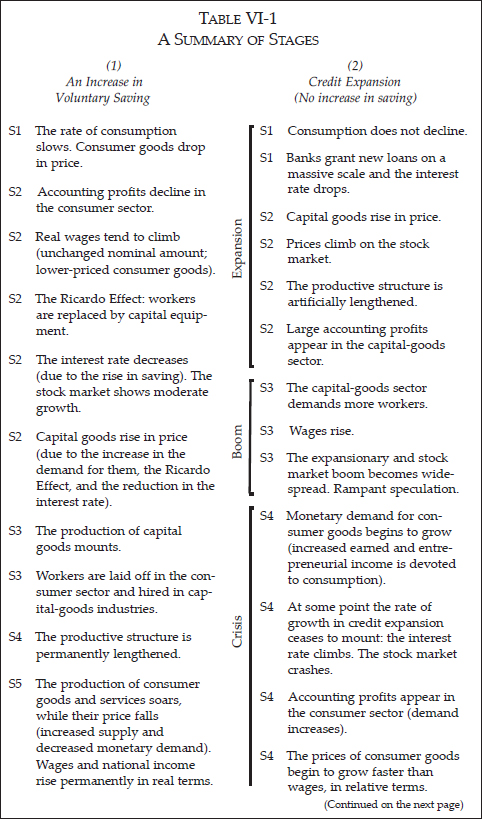
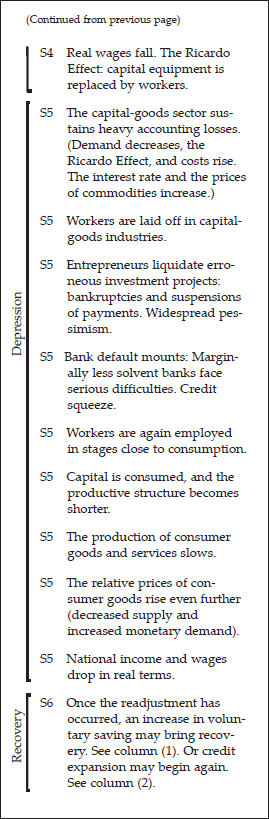
NOTES ON TABLE VI-1
1. All references to “increases” and “decreases” in prices refer to relative prices, not nominal prices or absolute magnitudes. Thus, for example, an “increase in the prices” of consumer goods indicates that such prices rise, in relative terms, with respect to those of intermediate goods.
2. It is simple to introduce the necessary modifications in the stages of the theoretical processes summarized in the table to include the historical peculiarities of each cycle. Hence if a rise in voluntary saving is accompanied by an increase in hoarding or the demand for money, the phases will remain the same, yet there will be a greater nominal decrease in the price of consumer goods, and a lesser increase in the nominal price of the factors of production. Nonetheless all relationships among relative prices remain just as depicted in the table. In the case of credit expansion, if “idle capacity” exists at its initiation, the nominal price of the factors of production and capital goods will not rise as significantly in the beginning, though the rest of the stages will follow as described, and foolish investments will also pile up.
3. Though the number which follows the letter “S” denotes the order of the stages, in certain cases this numbering is relatively arbitrary, depending upon each particular historical situation and whether or not the stages take place more or less simultaneously.
4. In real life the process could come to an indefinite halt during any of the phases, if government intervention makes markets highly rigid, and specifically if the prices of intermediate goods, wages or labor legislation are successfully manipulated. Furthermore a progressive increase in credit expansion may postpone the eruption of the crisis (and/or the liquidation of the malinvestments), but it will make it deeper and more painful when it inevitably hits.
_____________
Moss and Vaughn, “Hayek’s Ricardo Effect: A Second Look,” p. 555. See also footnote 91 on p. 382.
Hayek himself, while commenting on the eruption of the economic crisis at the end of the 1970s, admitted:
[m]y expectation was that the inflationary boom would last five or six years, as the historical ones had done, forgetting that then their termination was due to the gold standard. If you had no gold standard—if you could continue inflating for much longer—it was very difficult to predict how long it would last. Of course, it has lasted very much longer than I expected. The end result was the same.
Hayek is referring to the inflationary process which in the 1960s and 1970s spread throughout the world and was encouraged by historical circumstances which, like the Vietnam War and other events, fostered almost unlimited credit expansion worldwide, thus triggering a process that would later give rise to the severe stagflation and high unemployment of the late 1970s and early 1980s. See Hayek on Hayek: An Autobiographical Dialogue, Stephen Kresge and Leif Wenar, eds. (London: Routledge, 1994), p. 145.
Murray Rothbard assesses the possibility of deferring the arrival of the depression in the following terms:
Why do booms, historically, continue for several years? What delays the reversion process? The answer is that as the boom begins to peter out from an injection of credit expansion, the banks inject a further dose. In short, the only way to avert the onset of the depression-adjustment process is to continue inflating money and credit. For only continual doses of new money on the credit market will keep the boom going and the new stages profitable. Furthermore, only ever increasing doses can step up the boom, can lower interest rates further, and expand the production structure, for as the prices rise, more and more money will be needed to perform the same amount of work. . . . But it is clear that prolonging the boom by ever larger doses of credit expansion will have only one result: to make the inevitably ensuing depression longer and more grueling. (Rothbard, Man, Economy, and State, pp. 861–62)
Hayek, Prices and Production, p. 150.
Mark Skousen correctly indicates that, in relative terms, stagflation is a universal phenomenon, considering that in all recessions the price of consumer goods climbs more (or falls less) in relative terms than the price of the factors of production. Widespread growth in the nominal prices of consumer goods during a phase of recession first took place in the depression of the 1970s, and later in the recession of the 1990s. It sprang from the fact that the credit expansion which fed both processes was great enough in the different stages of the cycle to create and maintain expectations of inflation in the market of consumer goods and services even during the deepest stages of the depression (apart from the typical recent phenomena of relentless growth in public spending and in the deficit, and of massive social transfer payments which foster direct growth in the demand for, and therefore, in the prices of consumer goods and services). See Skousen, The Structure of Production, pp. 313–15.
Hayek draws the following analogy to explain this phenomenon:
The question is rather similar to that whether, by pouring a liquid fast enough into one side of a vessel, we can raise the level at that side above that of the rest to any extent we desire. How far we shall be able to raise the level of one part above that of the rest will clearly depend on how fluid or viscid the liquid is; we shall be able to raise it more if the liquid is syrup or glue than if it is water. But in no case shall we be at liberty to raise the surface in one part of the vessel above the rest to any extent we like. Just as the viscosity of the liquid determines the extent to which any part of its surface can be raised above the rest, so the speed at which an increase of incomes leads to an increase in the demand for consumers’ goods limits the extent to which, by spending more money on the factors of production, we can raise their prices relative to those of the products. (Hayek, “The Ricardo Effect,” pp. 127–52; Individualism and Economic Order, p. 241)
In 1969 Hayek again used this analogy in his article, “Three Elucidations of the Ricardo Effect,” in which he reiterates that the distorting effect of credit expansion on the productive structure must continue as long as banks create new money and this money enters the economic system at certain points at a progressively increasing rate. Hayek criticizes Hicks for assuming the inflationary shock will “uniformly” affect the entire productive structure, and he demonstrates that if credit expansion escalates at a rate exceeding the rise in prices, this process “can evidently go on indefinitely, at least as long as we neglect changes in the manner in which expectations concerning future prices are formed.” He concludes:
I find it useful to illustrate the general relationship by an analogy which seems worth stating here, though Sir John [Hicks] (in correspondence) did not find it helpful. The effect we are discussing is rather similar to that which appears when we pour a viscous liquid, such as honey, into a vessel. There will, of course, be a tendency for it to spread to an even surface. But if the stream hits the surface at one point, a little mound will form there from which the additional matter will slowly spread outward. Even after we have stopped pouring in more, it will take some time until the even surface will be fully restored. It will, of course, not reach the height which the top of the mound had reached when the inflow stopped. But as long as we pour at a constant rate, the mound will preserve its height relative to the surrounding pool—providing a very literal illustration of what I called before a fluid equilibrium. (Hayek, New Studies in Philosophy, Politics, Economics and the History of Ideas, pp. 171–73)
On the important role of expectations in this entire process, see especially Garrison, Time and Money, chaps. 1–4.
Ludwig von Mises examines this process in his analysis of the hyperinflation which assailed Germany from 1920 to 1923. Mises concludes:
Suppose the banks still did not want to give up the race? Suppose, in order to depress the loan rate, they wanted to satisfy the continuously expanding desire for credit by issuing still more circulation credit? Then they would only hasten the end, the collapse of the entire system of fiduciary media. The inflation can continue only so long as the conviction persists that it will one day cease. Once people are persuaded that the inflation will not stop, they turn from the use of this money. They flee then to “real values,” foreign money, the precious metals, and barter. (Mises, “Monetary Stabilization and Cyclical Policy,” p. 129)
Later, in Human Action, Mises states:
The boom can last only as long as the credit expansion progresses at an ever-accelerated pace. The boom comes to an end as soon as additional quantities of fiduciary media are no longer thrown upon the loan market. But it could not last forever even if inflation and credit expansion were to go on endlessly. It would then encounter the barriers which prevent the boundless expansion of circulation credit. It would lead to the crack-up boom and breakdown of the whole monetary system. (p. 555)
The classical treatment of Germany’s hyperinflation process is the one Bresciani-Turroni gives in The Economics of Inflation: A Study of Currency Depreciation in Post-War Germany. See also Richard M. Ebeling, “The Great Austrian Inflation,” The Freeman (April 2006): 2–3.
Perhaps Fritz Machlup has most clearly and concisely explained this phenomenon. He states:
The view that the expansion of credit for financing the production of consumers’ goods will not lead to disproportionalities of the kind associated with inflation can be disproved by the following argument. Either the consumers’ goods industries would have borrowed on the money market, or the capital market, in the absence of any expansion of bank credit, in which case the satisfaction of their demand for funds by means of the credit expansion obviously implies that there is so much less pressure on the credit market, and that some producers’ goods industry, which would not otherwise have obtained credit to finance an expansion, will be enabled to do so by this means. . . . Or the consumers’ goods industries would not have had any incentive to extend production in the absence of the credit expansion; in this case the fact that they now enter the market for producers’ goods with relatively increased buying power as against all other industries . . . may lead to a change in the distribution of productive factors involving a shift from the stages far from consumption to the stages near to consumption. (Machlup, The Stock Market, Credit and Capital Formation, pp. 192–93)
In Prices and Production (pp. 60–62 of the 1935 edition) Hayek uses his triangular diagrams to explain how the productive structure will inevitably become flatter and less capital-intensive, and therefore, less productive and poorer, if consumption is directly promoted through the granting of loans to finance non-durable consumer goods and services.
In the 1970s this phenomenon, along with the need to provide a simplified explanation of the process of malinvestment without relying on the complicated reasoning inherent in capital theory, led F.A. Hayek to slightly modify the popular presentation of his theory of the cycle. In his article, “Inflation, the Misdirection of Labor, and Unemployment,” written in 1975 (and included in the book, New Studies in Philosophy, Politics, Economics and the History of Ideas, pp. 197–209), he states:
[T]he explanation of extensive unemployment ascribes it to a discrepancy between the distribution of labour (and the other factors of production) between the different industries (and localities) and the distribution of demand among their products. This discrepancy is caused by a distortion of the system of relative prices and wages. (p. 200)
In the recent “biography” of Hayek, we see that in the last years of his life he believed modern cycles to be characterized by the very distinct forms of malinvestment involved, not only credit expansion in the stages furthest from consumption, but also artificial stimulation of consumption and, in general, all public spending which generates in the productive structure a change that cannot ultimately become permanent because the behavior of consumers does not support it. Hayek concludes:
[S]o much of the credit expansion has gone to where government directed it that the misdirection may no longer be of an overinvestment in industrial capital but may take any number of forms. You must really study it separately for each particular phase and situation. . . . But you get very similar phenomena with all kinds of modifications. (Hayek, Hayek on Hayek: An Autobiographical Dialogue, p. 146)
Consequently in its broadest sense, “forced saving” refers to the forced expropriation to which banks and monetary authorities subject most of society, producing a diffuse effect, when they decide to expand credit and money, diminishing the purchasing power of the monetary units individuals possess, in relation to the value these units would have in the absence of such credit and monetary expansion. The funds derived from this social plunder can either be completely squandered (if their recipients spend them on consumer goods and services or sink them into utterly mistaken investments), or they can become business or other assets, which either directly or indirectly come, de facto, under the control of banks or the state. The first Spaniard to correctly analyze this inflationary process of expropriation was the scholastic Father Juan de Mariana, in his work, De monetae mutatione, published in 1609. In it he writes:
If the prince is not a lord, but an administrator of the goods of individuals, neither in that capacity nor in any other will he be able to seize a part of their property, as occurs each time the currency is devalued, since they are given less in place of what is worth more; and if the prince cannot impose taxes against the will of his vassals nor create monopolies, he will not be able to do so in this capacity either, because it is all the same, and it is all depriving the people of their goods, no matter how well disguised by giving the coins a legal value greater than their actual worth, which are all deceptive, dazzling fabrications, and all lead to the same outcome. (Juan de Mariana, Tratado y discurso sobre la moneda de vellón que al presente se labra en Castilla y de algunos desórdenes y abusos [Treatise and Discourse on the Copper Currency which is now Minted in Castile and on Several Excesses and Abuses], with a preliminary study by Lucas Beltrán , p. 40; italics added)
A somewhat different translation from the original text in Latin has been more recently published in English. Juan de Mariana, S.J., A Treatise on the Alteration of Money, translation by Patrick T. Brannan, S.J. Introduction by Alejandro A. Chafuen, Journal of Markets and Morality 5, no. 2 (Fall, 2002): 523–93. The quotation is on page 544 (12 of the translation).
Joseph A. Schumpeter attributes the appropriate expression “forced saving” (in German, Erzwungenes Sparen or Zwangssparen) to Ludwig von Mises in his book, The Theory of Economic Development, first published in German in 1911 (The Theory of Economic Development [Cambridge, Mass.: Harvard University Press, 1968], p. 109). Mises acknowledges having described the phenomenon in 1912 in the first German edition of his book, The Theory of Money and Credit, though he indicates he does not believe he used the particular expression Schumpeter attributes to him. In any case Mises carefully analyzed the phenomenon of forced saving and theoretically demonstrated that it is impossible to predetermine whether or not net growth in voluntary saving will follow from an increase in the amount of money in circulation. On this topic see On the Manipulation of Money and Credit, pp. 120, 122 and 126–27. Also Human Action, pp. 148–50. Mises first dealt with the subject in The Theory of Money and Credit, p. 386. Though we will continue to attribute the term “forced saving” to Mises, a very similar expression, “forced frugality,” was used by Jeremy Bentham in 1804 (see Hayek’s article, “A Note on the Development of the Doctrine of ‘Forced Saving,’” published as chapter 7 of Profits, Interest and Investment, pp. 183–97). As Roger Garrison has aptly revealed, a certain disparity exists between Mises’s concept of forced saving (what we refer to as “the broad sense” of the term) and Hayek’s concept of it (which we will call “the strict sense”), and thus “what Mises termed malinvestment is what Hayek called forced savings.” See Garrison, “Austrian Microeconomics: A Diagrammatical Exposition,” p. 196.
See Hayek, “A Note on the Development of the Doctrine of ‘Forced Saving,’” p. 197. See also the comments on Cantillon and Hume’s contributions in chapter 8, pp. 615–20.
Fritz Machlup has compiled up to 34 different concepts of “forced saving” in his article, “Forced or Induced Saving: An Exploration into its Synonyms and Homonyms,” The Review of Economics and Statistics 25, no. 1 (February 1943); reprinted in Fritz Machlup, Economic Semantics (London: Transaction Publishers, 1991), pp. 213–40.
As a general rule, the closer a capital good is to the final consumer good, the more difficult it will be to convert. In fact all human actions are more irreversible the closer they are to their final objective: a house built in error is an almost irreversible loss, while it is somewhat easier to modify the use of the bricks if it becomes obvious during the course of the construction that using them to build a specific house is a mistake (see comments on pp. 280–82 previously).
Thus the theory of the cycle is simply the application, to the specific case of credit expansion’s impact on the productive structure, of the theory on the discoordinating effects of institutional coercion, a theory we present in Socialism, Economic Calculation and Entrepreneurship (esp. chap. 3, pp. 62–67). Lachmann arrives at the same conclusion when he states that malinvestment is “the waste of capital resources in plans prompted by misleading information,” adding that, though many capital goods reach completion, they
will lack complementary factors in the rest of the economy. Such lack of complementary factors may well express itself in lack of demand for its services, for instance where these factors would occupy “the later stages of production.” To the untrained observer it is therefore often indistinguishable from “lack of effective demand.” (Lachmann, Capital and its Structure, pp. 66 and 117–18)
In the words of F.A. Hayek himself:
The impression that the already existing capital structure would enable us to increase production almost indefinitely is a deception. Whatever engineers may tell us about the supposed immense unused capacity of the existing productive machinery, there is in fact no possibility of increasing production to such an extent. These engineers and also those economists who believe that we have more capital than we need, are deceived by the fact that many of the existing plant and machinery are adapted to a much greater output than is actually produced. What they overlook is that durable means of production do not represent all the capital that is needed for an increase of output and that in order that the existing durable plants could be used to their full capacity it would be necessary to invest a great amount of other means of production in lengthy processes which would bear fruit only in a comparatively distant future. The existence of unused capacity is, therefore, by no means a proof that there exists an excess of capital and that consumption is insufficient: on the contrary, it is a symptom that we are unable to use the fixed plant to the full extent because the current demand for consumers’ goods is too urgent to permit us to invest current productive services in the long processes for which (in consequence of “misdirections of capital”) the necessary durable equipment is available. (Hayek, Prices and Production, pp. 95–96)
After the boom period is over, what is to be done with the malinvestments? The answer depends on their profitability for further use, i.e., on the degree of error that was committed. Some malinvestments will have to be abandoned, since their earnings from consumer demand will not even cover the current costs of their operation. Others, though monuments of failure, will be able to yield a profit over current costs, although it will not pay to replace them as they wear out. Temporarily working them fulfills the economic principle of always making the best of even a bad bargain. Because of the malinvestments, however, the boom always leads to general impoverishment, i.e., reduces the standard of living below what it would have been in the absence of the boom. For the credit expansion has caused the squandering of scarce resources and scarce capital. Some resources have been completely wasted, and even those malinvestments that continue in use will satisfy consumers less than would have been the case without the credit expansion. (Rothbard, Man, Economy, and State, p. 863)
We are referring to involuntary (or institutional) unemployment, not to the so-called “natural rate of unemployment” (or voluntary and “catallactic” unemployment) which has grown so spectacularly in modern times as a result of generous unemployment compensation and other measures which act as a strong disincentive to the desire of workers to return to work.
See pp. 305–12 and 336 note 55. As Mark Skousen has pointed out: Gross Domestic Product systematically underestimates the expansionary phase as well as the contraction phase of the business cycle. For example, in the most recent recession, real GDP declined 1–2 percent in the United States, even though the recession was quite severe according to other measures (earnings, industrial production, employment). . . . A better indicator of total economic activity is Gross Domestic Output (GDO), a statistic I have developed to measure spending in all stages of production, including intermediate stages. According to my estimates, GDO declined at least 10–15 percent during most of the 1990–92 recession. (See “I Like Hayek: How I Use His Model as a Forecasting Tool,” presented at The Mont Pèlerin Society General Meeting, which took place in Cannes, France, September 25–30, 1994, manuscript awaiting publication, p. 12.)
Most conventional economists, along with political authorities and commentators on economic issues, tend to magnify the importance of the sector of consumer goods and services. This is primarily due to the fact that national income accounting measures tend to exaggerate the importance of consumption over total income, since they exclude most products manufactured in the intermediate stages of the production process, thus representing consumption as the most important sector of the economy. In modern economies this sector usually accounts for 60 to 70 percent of the entire national income, while it does not normally reach a third of the gross domestic output, if calculated in relation to the total spent in all stages of the productive structure. Moreover it is evident that Keynesian doctrines continue to strongly influence the methodology of the national income accounts as well as the statistical procedures used to collect the information necessary to prepare them. From a Keynesian standpoint, it is advantageous to magnify the role of consumption as an integral part of aggregate demand, thus centering national income accounting on this phenomenon, excluding from its calculations the portion of the gross domestic output which fails to fit well into Keynesian models and making no attempt to reflect the development of the different stages devoted to the production of intermediate capital goods, which is much more volatile and difficult to predict than consumption. On these interesting topics see Skousen, The Structure of Production, p. 306. According to a study carried out by the U.S. Department of Commerce, entitled, “The Interindustry Structure of the United States,” and published in 1986, 43.8 percent of the American gross domestic output (3,297,977 million dollars) comprised intermediate products which were not reflected by GDP figures (merely equal to 56.2 percent of the gross domestic output, i.e., 4,235,116 million dollars). See Arthur Middleton Hughes, “The Recession of 1990: An Austrian Explanation,” Review of Austrian Economics 10, no. 1 (1997): 108, note 4. Compare this data with that provided for 1982 in footnote 38 of chapter 5.
Hayek, on the last pages of his 1942 article on the Ricardo Effect (“The Ricardo Effect,” pp. 251–54), examines the ways in which traditional consumer price index statistics tend to obscure or prevent the empirical description of the evolution of the cycle, in general, and of the operation of the Ricardo Effect during the cycle, in particular. In fact the statistics in use do not reflect price changes in the products manufactured in the different stages of the production process, nor the relationship which exists in each stage between the price paid for the original factors of production involved and the price of the products made. Fortunately recent statistical studies have in all cases confirmed the Austrian analysis, revealing how the price of goods from the stages furthest from consumption is much more volatile than the price of consumer goods. Mark Skousen, in his (already cited) article presented before the general meeting of the Mont Pèlerin Society of September 25–30, 1994 in Cannes, showed that in the United States over the preceding fifteen years the price of the goods furthest from consumption had oscillated between a +30 percent increase and a –10 percent decrease, depending on the year and the stage of the cycle; while the price of products from the intermediate stages had fluctuated between +14 percent and –1 percent, depending on the particular stage in the cycle, and the price of consumer goods vacillated between +10 percent and –2 percent, depending on the particular stage. These results are also confirmed by V.A. Ramey’s important article, “Inventories as Factors of Production and Economic Fluctuations,” American Economic Review (June 1989): 338–54.
See Huerta de Soto, Socialism, Economic Calculation and Entrepreneurship, chaps. 2 and 3.
However Mises makes the following astute observation:
it may be that businessmen will in the future react to credit expansion in a manner other than they have in the past. It may be that they will avoid using for an expansion of their operations the easy money available because they will keep in mind the inevitable end of the boom. Some signs forebode such a change. But it is too early to make a definite statement. (Mises, Human Action, p. 797)
Nevertheless, for reasons supplied in the main text, this augural presentation Mises made in 1949 of the hypothesis of rational expectations is not entirely justified, considering that even when entrepreneurs have a perfect understanding of the theory of the cycle and wish to avoid being trapped by it, they will always continue to be tempted to participate in it by the excellent profits they can bring in if they are perceptive enough to withdraw in time from the corresponding investment projects. On this topic, see also the section entitled, “A Brief Note on the Theory of Rational Expectations” from chapter 7 in this volume, pp. 535–42.
This appears to be the case of the American economic boom since the late 1990s, when to a large extent the upsurge in productivity hid the negative, distorting effects of great monetary, credit and stock market expansion. The parallel with the development of economic events in the 1920s is striking, and quite possibly, the process will again be interrupted by a recession, which will again surprise all who merely concentrate their analysis on the evolution of the “general price level” and other macroeconomic measures that conceal the underlying microeconomic situation (disproportion in the real productive structure of the economy). At the time of this writing (the end of 1997), the first symptoms of a new recession have already manifested themselves, at least through the serious banking, stock market, and financial crises which have erupted in Asian markets. [The evolution of the world economy since 1998 has confirmed entirely the analysis of this book as already mentioned in its Preface to the 2nd English edition.]
See, for example, Murray N. Rothbard’s detailed analysis of this historical period in his notable book, America’s Great Depression, 5th ed. (Auburn, Ala.: Ludwig von Mises Institute, 2000). Mises (Human Action, p. 561) indicates that in the past, economic crises have generally hit during periods of continual improvement in productivity, due to the fact that
[t]he steady advance in the accumulation of new capital made technological improvement possible. Output per unit of input was increased and business filled the markets with increasing quantities of cheap goods.
Mises explains that this phenomenon tends to partially counteract the rise in prices which follows from an increase in credit expansion, and that in certain situations the price of consumer goods may even fall instead of rise. He concludes:
As a rule the resultant of the clash of opposite forces was a preponderance of those producing the rise in prices. But there were some exceptional instances too in which the upward movement of prices was only slight. The most remarkable example was provided by the American boom of 1926–29.
In any case Mises warns against policies of general price level stabilization, not only because they mask credit expansion during periods of increasing productivity, but also due to the theoretical error they contain:
It is a popular fallacy to believe that perfect money should be neutral and endowed with unchanging purchasing power, and that the goal of monetary policy should be to realize this perfect money. It is easy to understand this idea . . . against the still more popular postulates of the inflationists. But it is an excessive reaction, it is in itself confused and contradictory, and it has worked havoc because it was strengthened by an inveterate error inherent in the thought of many philosophers and economists. (Human Action, p. 418)
The article was first printed in German with the title, “Das intertemporale Gleichgewichtssystem der Preise und die Bewegungen des ‘Geldwertes,’” and published in Weltwirtschaftliches Archiv 2 (1928): 36–76. It was not translated nor published in English until 1984, when it was included in the book, Money, Capital and Fluctuations: Early Essays, pp. 71–118. A second English translation, by William Kirby, appeared in 1994. It is superior to the first and is entitled, “The System of Intertemporal Price Equilibrium and Movements in the ‘Value of Money,’” chapter 27 of Classics in Austrian Economics: A Sampling in the History of a Tradition, Israel M. Kirzner, ed., vol. 3: The Age of Mises and Hayek (London: William Pickering, 1994), pp. 161–98. Prior to this article, Hayek dealt with the same topic in “Die Währungspolitik der Vereinigten Staaten seit der Überwindung der Krise von 1920,” Zeitschrift für Volkswirtschaft und Sozialpolitik 5 (1925): vols. 1–3, pp. 25–63 and vols. 4–6, pp. 254–317. The theoretical portion of this article has appeared in English with the title, “The Monetary Policy of the United States after the Recovery from the 1920 Crisis,” in Money, Capital and Fluctuations: Early Essays, pp. 5–32. Here Hayek first criticizes the stabilization policies adopted in the United States.
F.A. Hayek, “Intertemporal Price Equilibrium and Movements in the Value of Money,” p. 97; italics removed. Even more specifically, Hayek concludes that
[t]here is no basis in economic theory for the view that the quantity of money must be adjusted to changes in the economy if economic equilibrium is to be maintained or—what signifies the same—if monetary disturbances to the economy are to be prevented. (p. 106)
See Mark Skousen, “Who Predicted the 1929 Crash?” included in The Meaning of Ludwig von Mises, Jeffrey M. Herbener, ed. (Amsterdam: Kluwer Academic Publishers, 1993), pp. 247–84. Lionel Robbins, in his “Foreword” to the first edition of Prices and Production (p. xii), also expressly refers to the prediction of Mises and Hayek of the arrival of the Great Depression. This prediction appeared in writing in an article by Hayek published in 1929 in Monatsberichte des Österreichischen Instituts für Konjunkturforschung. More recently, in 1975, Hayek was questioned on this subject and answered the following (Gold & Silver Newsletter [Newport Beach, Calif.: Monex International, June 1975]):
I was one of the only ones to predict what was going to happen. In early 1929, when I made this forecast, I was living in Europe which was then going through a period of depression. I said that there [would be] no hope of a recovery in Europe until interest rates fell, and interest rates would not fall until the American boom collapses, which I said was likely to happen within the next few months. What made me expect this, of course, is one of my main theoretical beliefs, that you cannot indefinitely maintain an inflationary boom. Such a boom creates all kinds of artificial jobs that might keep going for a fairly long time but sooner or later must collapse. Also, I was convinced after 1927, when the Federal Reserve made an attempt to stave off a collapse by credit expansion, the boom had become a typically inflationary one. So in early 1929 there was every sign that the boom was going to break down. I knew by then that the Americans could not prolong this sort of expansion indefinitely, and as soon as the Federal Reserve was no longer to feed it by more inflation, the thing would collapse. In addition, you must remember that at the time the Federal Reserve was not only unwilling but was unable to continue the expansion because the gold standard set a limit to the possible expansion. Under the gold standard, therefore, an inflationary boom could not last very long.
This entire process, which Austrian economists found so easy to understand and predict because they already had the necessary analytical tools, took place in an environment in which the general price level of consumer goods not only did not rise, but tended to fall slightly. In fact in the 1920s the general price level in the United States was very stable: the index went from 93.4 (100 in the base year, 1926) in June 1921, to 104.5 in November 1925, and fell again to 95.2 in June 1929. However during this seven-year period, the money supply grew from 45.3 to 73.2 trillion dollars, i.e., more than 61 percent. See Rothbard, America’s Great Depression, pp. 88 and 154. Rothbard, with his natural insight, concludes:
The ideal of a stable price level is relatively innocuous during a price rise when it can aid sound money advocates in trying to check the boom; but it is highly mischievous when prices are tending to sag, and the stabilizationists call for inflation. And yet, stabilization is always a more popular rallying cry when prices are falling. (p. 158)
Incidentally a great parallel exists between the situation Hayek described and that which is developing seventy years later, at the time of this writing (1997). Thus the American economic and stock-market boom may soon very possibly reverse in the form of a worldwide recession (which has already begun to manifest itself in Asian markets).
Machlup, The Stock Market, Credit and Capital Formation, p. 177.
Gottfried Haberler demonstrated that a fall in the general price level caused by improvements in all lines of production does not lead to the same adverse consequences as monetary deflation. See his monograph, Der Sinn der Indexzahlen: Eine Untersuchung über den Begriff des Preisniveaus und die Methoden seiner Messung (Tübingen: Verlag von J.C.B. Mohr [Paul Siebeck], 1927), pp. 112ff. See also his article, “Monetary Equilibrium and the Price Level in a Progressive Economy,” published in Economica (February 1935): 75–81 (this article has been reprinted in Gottfried Haberler, The Liberal Economic Order, vol. 2: Money and Cycles and Related Things, Anthony Y.C. Koo, ed. , pp. 118–25). Gottfried Haberler later qualified his position on the Austrian theory of the business cycle. This led some to believe, in our opinion unjustifiably, that Haberler had recanted his position entirely. The most substantial concession he made consisted of the statement that the theorists of the Austrian School had not rigorously shown that the stabilization of prices in an improving economy would necessarily always lead to an economic crisis (see Haberler, Prosperity and Depression, pp. 56–57). Furthermore Haberler did not base his change of opinion on any theoretical consideration, but merely on the possibility that during the evolution of the cycle, additional, unforeseen phenomena might occur (such as an increase in voluntary saving, etc.), which would tend to neutralize to an extent the forces indicated by the economic analysis. Therefore it is the responsibility of Haberler and his supporters to explain, in reference to each specific cycle, what particular circumstances may have neutralized the typical effects of credit expansion, effects, on the whole, predicted by the Austrians, whose formal theory Haberler and his followers have not been able to discredit at all (see also our comments on the similar thesis of D. Laidler, in chapter 7, pp. 528–30). Another author of relevant work is L. Albert Hahn, who, in his book, Common Sense Economics (New York: Abelard-Schumann, 1956, p. 128), asks whether or not a rise in productivity justifies a policy of inflationary credit expansion. He arrives at the conclusion that such a policy, which generates inflation without inflation and is generally considered totally harmless, can have very disturbing effects and cause a deep economic crisis. According to Hahn, theorists who consider such a policy innocuous err because they “overlook the fact that productivity increases mean profit increases for the entrepreneurs as long as costs— for labor as well as for capital—are not fully raised accordingly.” Hence Murray Rothbard concludes that the important factor is not so much the evolution of the general price level, but whether via a policy of credit expansion the interest rate is reduced to a level lower than the one which would prevail in a free market in the absence of such a policy (Man, Economy, and State, pp. 862–63).
One point should be stressed: the depression phase is actually the recovery phase; . . . it is the time when bad investments are liquidated and mistaken entrepreneurs leave the market—the time when “consumer sovereignty” and the free market reassert themselves and establish once again an economy that benefits every participant to the maximum degree. The depression period ends when the free-market equilibrium has been restored and expansionary distortion eliminated. (Rothbard, Man, Economy, and State, p. 860)
Therefore even though upcoming Table VI-1 (pp. 506–07) distinguishes between the phases of “depression” and “recovery,” strictly speaking, the stage of depression marks the beginning of the true recovery.
A detailed study of recovery and its different phases can be found on pp. 38–82 of Hayek’s book, Profits, Interest and Investment. See also pp. 315–17 of Skousen’s book, The Structure of Production, where Skousen refers to a statement of Hayek’s, according to which:
It is a well-known fact that in a slump the revival of final demand is generally an effect rather than a cause of the revival in the upper reaches of the stream of production— activities generated by savings seeking investment and by the necessity of making up for postponed renewals and replacements. (Skousen, The Structure of Production, p. 315)
Hayek made this astute observation in the journal, The Economist, in an article printed June 11, 1983 and entitled “The Keynes Centenary: The Austrian Critic,” no. 7293, p. 46.
As Ludwig M. Lachmann indicates,
[w]hat is needed is a policy which promotes the necessary readjustments. . . . Capital regrouping is thus the necessary corrective for the maladjustment engendered by a strong boom. (Capital and its Structure, pp. 123 and 125)
We agree with Murray N. Rothbard when he recommends that once the crisis erupts, the economy should be made as flexible as possible and the scope and influence of the state with respect to the economic system be reduced at all levels. In this way not only is entrepreneurship fostered in the sense that businessmen are encouraged to liquidate erroneous projects and appropriately redesign them, but a higher rate of social saving and investment is also promoted. According to Rothbard,
Reducing taxes that bear most heavily on savings and investment will further lower social time preferences. Furthermore, depression is a time of economic strain. Any reduction of taxes, or of any regulations interfering with the free-market, will stimulate healthy economic activity.
He concludes,
There is one thing the government can do positively, however: it can drastically lower its relative role in the economy, slashing its own expenditures and taxes, particularly taxes that interfere with saving and investment. Reducing its taxpending level will automatically shift the societal saving-investment-consumption ratio in favor of saving and investment, thus greatly lowering the time required for returning to a prosperous economy. (America’s Great Depression, p. 22)
Rothbard also provides us with a list of typical government measures which are highly counterproductive and which, in any case, tend to prolong the depression and make it more painful. The list is as follows:
(1) Prevent or delay liquidation. Lend money to shaky businesses, call on banks to lend further, etc. (2) Inflate further. Further inflation blocks the necessary fall in prices, thus delaying adjustment and prolonging depression. Further credit expansion creates more malinvestments, which, in their turn, will have to be liquidated in some later depression. A government “easy-money” policy prevents the market’s return to the necessary higher interest rates. (3) Keep wage rates up. Artificial maintenance of wage rates in a depression insures permanent mass unemployment. . . . (4) Keep prices up. Keeping prices above the free-market levels will create unsalable surpluses, and prevent a return to prosperity. (5) Stimulate consumption and discourage saving. . . . [M]ore saving and less consumption would speed recovery; more consumption and less saving aggravate the shortage of saved capital even further. . . . (6) Subsidize unemployment. Any subsidization of unemployment . . . will prolong unemployment indefinitely, and delay the shift of workers to the fields where jobs are available. (America’s Great Depression, p. 19)
Hayek, Profits, Interest and Investment, p. 60. Hayek also mentions that the rate of unemployment fails to reflect differences between the various stages in production processes. He points out that normally, in the deepest stage of the crisis, up to 25 or 30 percent of workers who dedicate their efforts to the stages furthest from consumption may be unemployed, while unemployment among workers from the stages closest to consumption is noticeably reduced, and may reach 5 or 10 percent. See also footnote 2 on pp. 59–60 of Hayek’s book.
Lachmann, Capital and its Structure, p. 123.
Hayek, Profits, Interest and Investment, p. 70.
On this topic see Ludwig von Mises, “The Chimera of Contracyclical Policies,” pp. 798–800 of Human Action. See also the pertinent observations of Mark Skousen on “The Hidden Drawbacks of Public Works Projects,” pp. 337–39 of his book, The Structure of Production.
[T]he Austrian theory does not, as is often suggested, assume “Full Employment.” It assumes that in general, at any moment, some factors are scarce, some abundant. It also assumes that, for certain reasons connected with the production and planned use of capital goods, some of these scarcities become more pronounced during the upswing. Those who criticize the theory on the ground mentioned merely display their inability to grasp the significance of a fundamental fact in the world in which we are living: the heterogeneity of all resources. Unemployment of some factors is not merely compatible with Austrian theory; unemployment of those factors whose complements cannot come forward in the conditions planned is an essential feature of it. (Lachmann, Capital and its Structure, pp. 113–14)
In 1928 Mises stated:
At times, even on the unhampered market, there are some unemployed workers, unsold consumers’ goods and quantities of unused factors of production, which would not exist under “static equilibrium.” With the revival of business and productive activity, these reserves are in demand right away. However, once they are gone, the increase of the supply of fiduciary media necessarily leads to disturbances of a special kind. (Mises, On the Manipulation of Money and Credit, p. 125)
This is the English translation of a passage found on p. 49 of the book Mises originally published in Jena in 1928. It is entitled, Geldwertstabilisierung und Konjunkturpolitik. Hayek, in his book, Profits, Interest and Investment, pp. 3–73, presents his theory of the business cycle, starting from the existence of idle resources. There he expressly reminds us that from the time Mises began developing the theory of the cycle in 1928, he assumed some labor and other resources would be unemployed (see also the footnote 1 on p. 42).
Thus it becomes obvious how vain it is to justify a new credit expansion by referring to unused capacity, unsold—or, as people say incorrectly, “unsalable”—stocks, and unemployed workers. The beginning of a new credit expansion runs across remainders of preceding malinvestment and malemployment, not yet obliterated in the course of the readjustment process, and seemingly remedies the faults involved. In fact, however, this is merely an interruption of the process of readjustment and of the return to sound conditions. The existence of unused capacity and unemployment is not a valid argument against the correctness of the circulation credit theory. (Mises, Human Action, p. 580)
Hayek arrives at a similar conclusion, though his reasoning differs slightly:
If the proportion as determined by the voluntary decisions of individuals is distorted by the creation of artificial demand, it must mean that part of the available resources is again led into a wrong direction and a definite and lasting adjustment is again postponed. And, even if the absorption of the unemployed resources were to be quickened in this way, it would only mean that the seed would already be sown for new disturbances and new crises. The only way permanently to “mobilise” all available resources is, therefore, not to use artificial stimulants—whether during the crisis or thereafter— but to leave it to time to effect a permanent cure by the slow process of adapting the structure of production to the means available for capital purposes. (Hayek, Prices and Production, pp. 98–99)
Mark Skousen also makes some very shrewd observations on this subject in his book, The Structure of Production, pp. 289–90.
This expression, though quite vivid, is not theoretically rigorous, since money is never “in circulation,” but always forms part of the cash balances of someone.
See the section entitled, “Cash-Induced and Goods-Induced Changes in Purchasing Power,” from chapter 17 of Mises, Human Action, 3rd ed., pp. 419ff.
In short we attempt to fill an important theoretical gap in the economic theory of deflation. In 1933 Ludwig von Mises revealed this gap when he stated,
Unfortunately, economic theory is weakest precisely where help is most needed—in analyzing the effects of declining prices. . . . Yet today, even more than ever before, the rigidity of wage rates and the costs of many other factors of production hamper an unbiased consideration of the problem. Therefore, it would certainly be timely now to investigate thoroughly the effects of declining money prices and to analyze the widely held idea that declining prices are incompatible with the increased production of goods and services and an improvement in general welfare. The investigation should include a discussion of whether it is true that only inflationistic steps permit the progressive accumulation of capital and productive facilities. So long as this naive inflationist theory of development is firmly held, proposals for using credit expansion to produce a boom will continue to be successful.
Ludwig von Mises, “Die Stellung und der nächste Zukunft der Kon-junkturforschung,” published in Festschrift in honor of Arthur Spiethoff (Munich: Duncker and Humblot, 1933), pp. 175–80, and translated into English as “The Current Status of Business Cycle Research and its Prospects for the Immediate Future,” published in On the Manipulation of Money and Credit, pp. 207–13 (the excerpt is taken from pp. 212–13). See also Philipp Bagus, In Defense of Deflation (Heidelberg: Springer, 2015).
For example on May 13, 1925, Winston Churchill, at that time Chancellor of the Exchequer of the United Kingdom, decided to restore the pre-World War I gold parity of the pound sterling. In other words, the parity which had existed since 1717, when Sir Isaac Newton fixed it at 1 pound per 4.86 dollars of gold.
The most typical examples of deflation deliberately initiated by governments are found in the United Kingdom: first, following the Napoleonic wars, and then, as mentioned above, under the auspices of Winston Churchill in 1925 when, despite the tremendous inflation which affected pound sterling notes in World War I, he decided to restore the currency’s prewar parity with gold. In short Churchill blatantly disregarded the advice Ricardo had given 100 years earlier in a very similar situation, following the Napoleonic wars: “I should never advise a government to restore a currency which had been depreciated 30 per cent to par.” Letter from David Ricardo to John Wheatley, dated September 18, 1821, The Works of David Ricardo, Piero Sraffa, ed. (Cambridge: Cambridge University Press, 1952), vol. 9, p. 73. Ludwig von Mises, in reference to these two historical cases, states:
The outstanding examples were provided by Great Britain’s return, both after the wartime inflation of the Napoleonic wars and after that of the first World War, to the prewar gold parity of the sterling. In each case Parliament and Cabinet adopted the deflationist policy without having weighed the pros and cons of the two methods open for a return to the gold standard. In the second decade of the nineteenth century they could be exonerated, as at that time monetary theory had not yet clarified the problems involved. More than a hundred years later it was simply a display of inexcusable ignorance of economics as well as of monetary history. (Mises, Human Action, pp. 567–68 and also p. 784)
F.A. Hayek points out the grave error of returning to the pre-World War I parity between gold and the pound and also mentions that this policy was implemented slowly and gradually, instead of in the form of a rapid shock, as took place in the United States between 1920 and 1921. Hayek concludes:
Though the clear determination of the government to restore the gold standard made it possible to do so as early as 1925, internal prices and wages were then still far from being adapted to the international level. To maintain this parity, a slow and highly painful process of deflation was initiated, bringing lasting and extensive unemployment, to be abandoned only when it became intolerable when intensified by the world crisis of 1931—but, I am still inclined to believe, just at the time when the aim of that painful struggle had been nearly achieved. (F.A. Hayek, 1980s Unemployment and the Unions: The Distortion of Relative Prices by Monopoly in the Labour Markets, 2nd ed. , p. 15. See also footnote 43 in chapter 8)
It is also possible, in theory and in practice, for economic agents to raise their cash balances (demand for money) without at all modifying their volume of monetary consumption. They can do this by disinvesting in productive resources and selling capital goods. This leads to a flattening of the productive structure and brings about the widespread impoverishment of society through a process which is the exact opposite of the one we analyzed in chapter 5 with respect to a lengthening (financed by growth in voluntary saving) of the productive structure.
Whenever an individual devotes a sum of money to saving instead of spending it for consumption, the process of saving agrees perfectly with the process of capital accumulation and investment. It does not matter whether the individual saver does or does not increase his cash holding. The act of saving always has its counterpart in a supply of goods produced and not consumed, of goods available for further production activities. A man’s savings are always embodied in concrete capital goods. . . . The effect of our saver ’s saving, i.e., the surplus of goods produced over goods consumed, does not disappear on account of his hoarding. The prices of capital goods do not rise to the height they would have attained in the absence of such hoarding. But the fact that more capital goods are available is not affected by the striving of a number of people to increase their cash holdings. . . . The two processes—increased cash holding of some people and increased capital accumulation—take place side by side. (Mises, Human Action, pp. 521–22)
An analysis of the positive effects of this third type of deflation (caused by the tightening of credit in the recession stage of the cycle) can be found in Rothbard, Man, Economy, and State, pp. 863–71. See also Mises, Human Action, pp. 566–70. Furthermore Mises indicates that despite its negative effects, the deflationary squeeze is never as damaging as credit expansion, because
contraction produces neither malinvestment nor overconsumption. The temporary restriction in business activities that it engenders may by and large be offset by the drop in consumption on the part of the discharged wage earners and the owners of the material factors of production the sales of which drop. No protracted scars are left. When the contraction comes to an end, the process of readjustment does not need to make good for losses caused by capital consumption. (Mises, Human Action, p. 567)
Wilhelm Röpke, Crises and Cycles (London: William Hodge, 1936), p. 120.
Wilhelm Röpke, the chief “secondary depression” theorist, in his hesitant and at times contradictory treatment of the topic, acknowledges that in any case, in the absence of outside intervention or rigidity, spontaneous market forces prevent a “secondary depression” from hitting and developing. Even when the rigidity of labor markets and the implementation of protectionist policies causes such a depression and it develops, the market ultimately, invariably and spontaneously establishes a “floor ” to the cumulative process of depression. See Röpke, Crises and Cycles, pp. 128–29.
Hayek, Profits, Interest and Investment, footnote 1 on pp. 63–64. Hayek later amplified his ideas on the subject, indicating that in the thirties he was opposed to Germany’s expansionary policy and even wrote an article that he never actually published. He sent the article to Professor Röpke with a personal note in which he stated the following:
Apart from political considerations I feel you ought not—not yet at least—to start expanding credit. But if the political situation is so serious that continuing unemployment would lead to a political revolution, please do not publish my article. That is a political consideration, however, the merits of which I cannot judge from outside Germany but which you will be able to judge.
Hayek concludes:
Röpke’s reaction was not to publish the article, because he was convinced that at that time the political danger of increasing unemployment was so great that he would risk the danger of causing further misdirections by more inflation in the hope of postponing the crisis; at that particular moment, this seemed to him politically necessary and I consequently withdrew my article. (F.A. Hayek, “The Campaign Against Keynesian Inflation,” chapter 13 of New Studies in Philosophy, Politics, Economics and the History of Ideas, p. 211)
At any rate desperate measures such as this can only procure a brief respite, while postponing the resolution of problems, which become much more serious over time. Indeed despite Röpke’s consequentialist decision, the situation in Germany continued to deteriorate and it was impossible to prevent Hitler ’s accession to power in 1933.
F.A. Hayek himself mentions that, under such circumstances, the least damaging policy would consist of offering
employment through public works at relatively low wages so that workers will wish to move as soon as they can to other and better paid occupations, and not by directly stimulating particular kinds of investment or similar kinds of public expenditure which will draw labour into jobs they will expect to be permanent but which must cease as the source of the expenditure dries up. (Hayek, “The Campaign against Keynesian Inflation,” p. 212)
However the risk of this type of concession is that, in current democratic systems, it is almost certain to be used by politicians in a less than rigorous manner to justify their measures of intervention in any economic recession. A possible solution might be to include as an article in the constitution the principle, supported by classical experts of public finance, of a balanced budget. As the agreement of all political forces would be required in order to modify the article, and this would only occur in the case of a unanimous belief in the “critical” nature of the situation, the risk of the unjustified implementation of artificial expansionary measures in times of crisis could be reduced.
The fact that new crises erupt every few years shows that they originate from the credit expansion process, which necessarily sets off the spontaneous readjustments we have studied. In the absence of credit expansion, economic crises would be specific, isolated events which would result only from unusual phenomena of a physical sort (poor crops, earthquakes, etc.) or of a social sort (wars, revolutions, etc.). They would not arise regularly, nor would they be as geographically widespread as they normally are.
The boom is called good business, prosperity, and upswing. Its unavoidable aftermath, the readjustment of conditions to the real data of the market, is called crisis, slump, bad business, depression. People rebel against the insight that the disturbing element is to be seen in the malinvestment and the overconsumption of the boom period and that such an artificially induced boom is doomed. (Mises, Human Action, p. 575)
Thus it is a grave error to believe real wealth is destroyed by the stock market crash which announces the crisis. On the contrary, the economic destruction takes place much earlier, in the form of generalized malinvestment during the previous stage, the credit boom. The fall in the stock market merely indicates economic agents have finally taken notice of this phenomenon. See also section 14.
The effect of credit expansion is more harmful the more accustomed economic agents are to an austere economy, the sustained growth of which depends solely on voluntary saving. It is under these circumstances that credit expansion is most damaging. Nevertheless under current conditions, in which artificial booms alternate with recessions, economic agents begin to learn from experience and the expansionary effects of the granting of loans are increasingly reduced or are achieved solely at the cost of injecting mounting volumes of credit at an escalating rate.
William D. Nordhaus, “The Political Business Cycle,” Review of Economic Studies 42, no. 130 (April 1975): 169–90. See also Edward R. Tufte, Political Control of the Economy (Princeton, N.J.: Princeton University Press, 1978); and C. Duncan MacRae, “A Political Model of the Business Cycle,” published in Journal of Political Economy 85 (1977): 239–63. See also footnote 56 of chapter 9.
Mises, Human Action, p. 578.
Another essential function of the stock market and the options and futures market has been revealed, in accordance with the most hallowed tradition of the Austrian School, by Ludwig M. Lachmann, who states:
[T]he Stock Exchange by facilitating the exchange of knowledge tends to make the expectations of large numbers of people consistent with each other, at least more consistent than they would have been otherwise; and that through the continual revaluation of yield streams it promotes consistent capital change and therefore economic progress. (Lachmann, Capital and its Structure, p. 71; italics added)
It is important to point out that the banking sector has largely usurped this important role of the stock market. Since the banking sector can expand credit, generate deposits and pay them out, it has become a popular tool for investing a temporary excess of cash. This is very harmful, as it permits an even greater increase in credit expansion, along with the negative effects we are familiar with. However if excess cash were placed in the stock market, it would lead to an effective rise in voluntary saving, which would permit the lengthening of investment processes, and no inevitable subsequent crisis would force entrepreneurs to suspend these processes (yet savers would never have the guarantee of receiving the same monetary sum for their securities, should they sell them, as they pay when they buy them). A common criticism against the stock market is that its small size and limited development make the issuance of bank deposits necessary for the financing of production projects. We are now in a position to grasp why this criticism is unjustified. The reality is actually quite the opposite: banks’ ability to finance investment projects via credit expansion unbacked by real saving is precisely what places banks in a position of prominence in many investment projects, to the detriment of the stock market, which loses importance in the process of investment and in many instances becomes a secondary market which, throughout the cycle, follows the guidelines set by the banking sector.
Only a sudden, improbable drop in society’s rate of time preference would allow stock-market indexes, in the absence of credit expansion, to jump to a new, consolidated level, from which point, at most, slow, gradual stock-market growth could take place. Thus continuously-prolonged stock-market booms and euphoria are invariably artificial and fed by credit expansion. Moreover such episodes of euphoria encourage the public to postpone consumption for the short term and invest cash balances in the stock market. Therefore while expectations of stock-market booms fed by credit expansion last, the crisis and recession can be temporarily postponed. This is what happened at the end of the 1990s, before the severe stock-market adjustment of 2000–2001. See Philipp Bagus, “Asset Prices: An Austrian Perspective,” Procesos de Mercado 4, no. 2 (Autumn, 2007): 57–93, and Edith Skriner, “Did Asset Prices Cause the Current Crisis?” in The First Great Recession of the 21st Century: Competing Explanations, Óscar Dejuán, Eladio Febrero, Maria Cristina Marcuzzo, eds. (Cheltenham, U.K. and Northampton, Mass., U.S.A.: Edward Elgar, 2011).
Machlup, The Stock Market, Credit and Capital Formation, p. 92. This book by Machlup is essential to understanding the cycle’s influence on the stock market.
Stock Exchange profits made during such periods of capital appreciation in terms of money, which do not correspond to any proportional increase of capital beyond the amount which is required to reproduce the equivalent of current income, are not income, and their use for consumption purposes must lead to a destruction of capital. (F.A. Hayek, “The Maintenance of Capital,” Economica 2 [August 1934])
This article appears as chapter 3 of Profits, Interest and Investment, pp. 83–134. The above excerpt is found on p. 133.
Regardless of its specific historical trigger, the stock market crisis will erupt after credit expansion decreases, since, as Fritz Machlup states,
The most probable result in this case is a quick recession of security prices. For higher stock prices will invite a new supply of securities, and the corporations, which want to take advantage of the higher prices in order to draw funds from the stock exchange and use them for real investment, will find that there are no additional funds to be had. (Machlup, The Stock Market, Credit and Capital Formation, p. 90)
We make no mention of the unquestionable fact that the interests of many speculative security holders are behind a large part of the “public clamor ” in favor of institutional support of the stock market. Likewise it is highly significant that when a stock market crisis erupts, the media almost unanimously convey “reassuring” messages which insist the phenomenon is transient and “unjustified” and advise the public not only to refrain from getting rid of their stocks, but also to take advantage of the situation to acquire more securities at a good price. The discordant voices of those who view the situation differently and believe it is wisest to sell (voices which, in crisis situations, represent precisely the majority of those who go to the market) are always discreetly and conveniently silenced.
Hence, for example, just prior to the stock market crash of October 24, 1929, Irving Fisher himself confidently stated, on October 17, 1929, “We are in a ‘higher plateau’ of stock exchange prices,” that a fully consolidated level had been reached and would never necessarily drop. See the remarks he made to the Commercial & Financial Chronicle, remarks which appeared on October 26, 1929, pp. 2618–19. Cited by Benjamin M. Anderson, Economics and the Public Welfare: A Financial and Economic History of the United States, 1914–1946 (Indianapolis, Ind.: Liberty Press, 1979), p. 210. Wesley C. Mitchell, R.G. Hawtrey and even John Maynard Keynes committed the same error as Fisher. See Skousen, “Who Predicted the 1929 Crash?” pp. 254–57 (see also footnote 100 below).
This is clearly seen on the Stock Exchange which discounts future yield streams on the basis of the present rate of interest. A sensitive and well-informed market witnessing the spectacle of a strong boom will of course in any case sooner or later have its misgivings about future yields and the cost of present projects. But we need not doubt that where this is not so, a rising rate of interest would strongly reinforce the discounting factor and thus damp excessive optimism. (Lachmann, Capital and Its Structure, pp. 124–25)
Lachmann explains the great importance of the stock market and futures market in spreading the dispersed knowledge and information of the different economic agents, thus enhancing the inter-and intratemporal coordination among them. Hence both the stock market and the futures market facilitate economic coordination and stability, as long as they are not distorted by the inflationary impact of credit expansion. At any rate futures markets will be the first to predict the successive phases of the business cycle. Even if this should not be the case, the events themselves (an increase in interest rates, accounting losses in capital-goods industries, etc.) will eventually put an end to the stock market boom and precipitate the economic crisis.
This is true of the current (2001) Japanese recession.
Therefore it should not surprise us that the recovery stage combines a relative drop in the price of consumer goods and services, and hence, in the price of the listed securities which correspond to the companies closest to the last stage in the productive structure, with an increase in the price of the securities which correspond to the companies which operate furthest from consumption. As Fritz Machlup indicates,
A shift of demand from consumers’ goods to securities is “saving.” It is usually assumed that a significant price shift takes place not only between consumers’ goods and securities but also between consumers’ goods and producers’ goods. It may seem strange that the price fall in consumers’ goods should correspond on the other side to price rises in two categories of things at the same time. But there is nothing complicated about this, for the rise in price of titles to capital goods may actually involve the rise in prices of the capital goods themselves. (Machlup, The Stock Market, Credit and Capital Formation, pp. 70–71)
A continual rise of stock prices cannot be explained by improved conditions of production or by increased voluntary savings, but only by an inflationary credit supply. A lasting boom can result only from inflationary credit supply. (Ibid., pp. 99 and 290)
Tugan-Baranovsky, Industrial Crises in Contemporary Britain. Spanish translation included in Lecturas de economía política, Francisco Cabrillo, ed. (Madrid: Minerva Ediciones, 1991), pp. 190–210. See also chapter 7, footnote 87.
Excerpt translated from Spanish edition. Ibid., p. 205; italics added.
In the German literature similar ideas were introduced mainly by the writings of Karl Marx. It is on Marx that M.v. Tougan-Baranovsky’s work is based which in turn provided the starting point for the later work of Professor Spiethoff and Professor Cassel. The extent to which the theory developed in these lectures corresponds with that of the two last-named authors, particularly with that of Professor Spiethoff, need hardly be emphasised. (Hayek, Prices and Production, p. 103)
See also Hayek, The Pure Theory of Capital, p. 426. On Tugan-Baranovsky and the content of his doctoral thesis, The Industrial Crises in England, see the biographical article on this author by Alec Nove, published in The New Palgrave: A Dictionary of Economics, John Eatwell, Murray Milgate, and Peter Newman, eds. (London: Macmillan, 1987), vol. 4, pp. 705–06. The error in all of these doctrines of a “lack of proportion” lies in the fact that they disregard the monetary and interventionist origin (in the form of the privileged operation of the banking system) of such a lack, they fail to recognize the entrepreneurial tendency to detect and correct maladjustments (in the absence of state intervention) and they naively assume that government economic authorities possess a deeper knowledge of these effects than the network of entrepreneurs which act freely in the market. See Mises, Human Action, pp. 582–83.
Hayek, Monetary Theory and the Trade Cycle, pp. 189–90. In 1929 the young Hayek added that, in his opinion, a rigid banking system would prevent crises, but “the stability of the economic system would be obtained at the price of curbing economic progress.” He concluded,
It is no exaggeration to say that not only would it be impossible to put such a scheme into practice in the present state of economic enlightenment of the public, but even its theoretical justification would be doubtful. (Ibid., p. 191)
Hayek himself recognized that his conclusion rested more on intuition and non-economic factors than on a rigorous theoretical analysis, and therefore it is not surprising that only a few years later, in Prices and Production and in Monetary Nationalism and International Stability, he changed his mind, proposed a constant money supply and advocated the demand for a 100-percent reserve requirement in banking. In “Hayek, Business Cycles and Fractional Reserve Banking: Continuing the De-Homogenization Process,” The Review of Austrian Economics 9, no. 1 (1996): 77–94, Walter Block and Kenneth M. Garschina level penetrating criticism against these statements the young Hayek made in 1929. However, on reflection, perhaps Hayek’s comments should be understood in a different light. As early as 1925 he proposed, as a radical solution to economic cycles, a return to the prescriptions of the Bank Charter Act of 1844 and the establishment of a 100-percent reserve requirement for demand deposits held by banks. Thus maybe it would be wiser to interpret the assertions Hayek made in 1929 (in Monetary Theory and the Trade Cycle) in the context of the lecture given before the Verein für Sozialpolitik which took place in Zurich in September 1928, instead of in the context of his other research studies. (This lecture formed the basis of his 1929 book.) Hayek’s speech was subject to a rigorous examination by professors who were little inclined to accept conclusions they viewed as too original or revolutionary. Hayek’s first endorsement of a 100-percent reserve requirement is found in note 12 of his article, “The Monetary Policy of the United States after the Recovery from the 1920 Crisis,” p. 29 (see also upcoming footnote 95). Hayek’s erroneous and short-lived concession regarding the supposedly beneficial effect of credit expansion on technological innovation echoes the naive inflationism implicit in Joseph Schumpeter ’s book, Theory of Economic Development. A brilliant critical evaluation of Schumpeter ’s unorthodox nature as viewed from the perspective of the Austrian theory of capital and business cycles is presented by José Antonio Aguirre in his “Introducción” to the Spanish edition of Böhm-Bawerk’s book, Capital and Interest, vol. 2: Positive Theory of Capital (Teoría positiva del capital) (Madrid: Ediciones Aosta/Unión Editorial, 1998), pp. 19–22.
In fact Marx himself considered the interventionist and syndicalist versions of socialism “utopian” and even stated that welfare and labor legislation aimed at benefiting workers would invariably be ineffective. In this sense he fully accepted the classical school’s arguments against state regulation of the market economy. Marx’s position on this issue in no way lessens the fact that Marxism, quite unintentionally, was the main ideological force behind the “reformist” movements that justified intervention in the labor market.
We have completely devoted the book, Socialism, Economic Calculation and Entrepreneurship, to demonstrating why it is impossible for a system of real socialism to exert a coordinating effect through its policies even under the most favorable conditions.
A dictator does not bother about whether or not the masses approve of his decision concerning how much to devote for current consumption and how much for additional investment. If the dictator invests more and thus curtails the means available for current consumption, the people must eat less and hold their tongues. No crisis emerges because the subjects have no opportunity to utter their dissatisfaction. Where there is no business at all, business can be neither good nor bad. There may be starvation or famine, but no depression in the sense in which this term is used in dealing with the problems of a market economy. Where the individuals are not free to choose, they cannot protest against the methods applied by those directing the course of production. (Mises, Human Action, pp. 565–66)
Among others, Tomask Stankiewicz in his article, “Investment under Socialism,” Communist Economies 1, no. 2 (1989): 123–30. See also Jan Winiecki’s book, The Distorted World of Soviet-Type Economies (London: Routledge, 1988 and 1991).
The massive increase in budget deficits was a common characteristic of the 1980s (especially in Spain), and it served to prolong expansionary periods and to postpone and aggravate subsequent recessions. The negative effects of these indirectly-monetized deficits have combined with the harmful effects of credit expansion, and the result has been even greater maladjustments in the allocation of resources and a delay in the beginning of the necessary readjustment.
A summary of the critical analysis of positivist methodology, along with a brief bibliography of the most important writings on the topic, appears in our article, “Método y crisis en la ciencia económica,” Hacienda pública española 74 (1982): 33–48, reprinted in Jesús Huerta de Soto, Estudios de economía política (Madrid: Unión Editorial, 1994), chap. 3, pp. 59–82. See also our article, “The Ongoing Methodenstreit of the Austrian School,” pp. 75–113. The methodological ideas of the Austrian School evolved in parallel with the debate on socialist economic calculation, and criticism of positivist methodology is one of the most interesting byproducts of this debate. The very factors which make socialism an intellectual error (the impossibility of obtaining the necessary practical information in a centralized way, for example) actually explain why it is not possible in economics to directly observe empirical events, nor to empirically test any theory, nor in short, to make specific predictions with respect to the time and place of future events. This is because the object of research in economics consists of the ideas and knowledge which human beings possess and create in connection with their actions, and this information changes constantly, is highly complex and cannot be measured, observed nor grasped by a scientist (nor by a central planning agency). If it were possible to measure social events and empirically test economic theories, socialism would be possible. The very factors which make socialism impossible demonstrate that positivist methodology is inapplicable. Thus “events” in the social realm, given their “spiritual” nature, can only be interpreted from a historical perspective, and this always requires a prior theory. For more on these controversial and thought-provoking issues, see the 33 bibliographical sources mentioned in our article, “Método y crisis en la ciencia económica,” and especially Mises’s book, Theory and History (New Haven, Conn.: Yale University Press, 1957), Hayek’s article, “The Facts of the Social Sciences,” in Individualism and Economic Order, pp. 57–76, and The Counter-Revolution of Science (Glencoe, Ill.: Free Press, 1952; Indianapolis, Ind.: Liberty Press, 1979). A favorable and unbiased explanation of the Austrian methodological paradigm appears in Bruce Caldwell, Beyond Positivism: Economic Methodology in the Twentieth Century (London: George Allen and Unwin, 1982; 2nd ed., London: Routledge, 1994), esp. pp. 117–38.
Hayek made these important observations regarding the difficulty of empirically testing economic theories, particularly the theory of the cycle, in the acceptance speech he made on receiving the Nobel Prize December 11, 1974. See his article, “The Pretence of Knowledge,” The American Economic Review (December 1989): 3. Hayek concludes in the same place:
[W]hat is probably the true cause of extensive unemployment has been disregarded by the scientistically minded majority of economists, because its operation could not be confirmed by directly observable relations between measurable magnitudes, and that an almost exclusive concentration on quantitatively measurable surface phenomena has produced a policy which has made matters worse. (p. 5)
Carlo M. Cipolla, The Monetary Policy of Fourteenth-Century Florence (Berkeley: University of California Press, 1982); and Money in Sixteenth-Century Florence (Berkeley: University of California Press, 1989).
R.C. Mueller, “The Role of Bank Money in Venice: 1300–1500,” pp. 47–96. And more recently, The Venetian Money Market: Bank, Panics, and the Public Debt, 1200–1500.
As Carlo Cipolla literally states: “The banks of that time had already developed to the point of creating money besides increasing its velocity of circulation.” Cipolla, The Monetary Policy of Fourteenth-Century Florence, p. 13.
Ibid., p. 48.
Cipolla, Money in Sixteenth-Century Florence, p. 106.
Ibid., p. 111.
See Hayek’s article, “First Paper Money in Eighteenth Century France,” printed as chapter 10 of the book, The Collected Works of F.A. Hayek, vol. 3: The Trend of Economic Thinking, pp. 155–76. See also Kindleberger, A Financial History of Western Europe, pp. 98ff.
See Rothbard, The Panic of 1819: Reactions and Policies. Rothbard made another important contribution with this book: in it he revealed that the crisis aroused a highly intellectual controversy regarding bank paper. Rothbard highlights the emergence of a large group of politicians, journalists and economists who were able to correctly diagnose the origins of the crisis and to propose appropriate measures to prevent it from recurring in the future. All of this occurred years before Torrens and others in England defined the essential principles of the Currency School. The following are among the most important figures who identified credit expansion as the origin of economic evils: Thomas Jefferson, Thomas Randolph, Daniel Raymond, Senator Condy Raguet, John Adams, and Peter Paul de Grand, who even defended the call for banks to follow the model of the Bank of Amsterdam and to constantly maintain a 100-percent reserve ratio (p. 151).
Tortella points out, quoting Vicens, that the Spanish crisis of 1866 “was at the origin of the Catalonian businessmen’s proverbial mistrust towards banks and large corporations.” See Gabriel Tortella-Casares, Banking, Railroads, and Industry in Spain 1829–1874 (New York: Arno Press, 1977), p. 585. For more information on the Spanish economy during this period, see Juan Sardá, La política monetaria y las fluctuaciones de la economía española en el siglo XIX (Barcelona: Ariel, 1970; first ed., Madrid: C.S.I.C., 1948), esp. pp. 131–51, and Manuel Martín Rodríguez, Análisis económico y revolución liberal en España (Madrid: Editorial Civitas, 2009).
For a more detailed historical outline of the crises and economic cycles from the dawn of the Industrial Revolution until World War I, see, for example, Maurice Niveau, Historia de los hechos económicos contemporáneos, Spanish trans. Antonio Bosch Doménech (Barcelona: Editorial Ariel, 1971), pp. 143–60.
Anderson, Economics and the Public Welfare, pp. 145–57. The above excerpt appears on p. 146.
Rothbard, America’s Great Depression, p. 88, column 4. Rothbard examines all peculiarities of the inflationary process, specifically their correspondence with a deliberate policy of the Federal Reserve, a policy endorsed by, among others, the Secretary of the Treasury, William G. McAdoo, according to whom,
The primary purpose of the Federal Reserve Act was to alter and strengthen our banking system that the enlarged credit resources demanded by the needs of business and agricultural enterprises will come almost automatically into existence and at rates of interest low enough to stimulate, protect and prosper all kinds of legitimate business. (p. 113)
Also see George A. Selgin, “The ‘Relative’ Inflation of the 1920’s,” in Less Than Zero, pp. 55–59.
Milton Friedman and Anna J. Schwartz, A Monetary History of the United States, 1867–1960 (Princeton, N.J.: Princeton University Press, 1963), pp. 710–12 (Table A-1, column 8). In the chapter they devote to the 1920s, Friedman and Schwartz indicate that one of the principal changes of the period was the decision, for the first time in history, to use
central-bank powers to promote internal economic stability as well as to preserve balance in international payments and to prevent and moderate strictly financial crises. In retrospect, we can see that this was a major step toward the assumption by government of explicit continuous responsibility for economic stability. (p. 240)
Although Friedman and Schwartz put their finger on the issue with this observation, the inadequacy of the monetary analysis with which they interpret their data leads them to consider the cause of the Great Depression of 1929 to be monetary policy errors committed by the Federal Reserve as of that date and not, as the theory of the Austrian School reveals, the credit expansion of the 1920s. Friedman and Schwartz completely overlook and fail to grasp the influence such expansion exerts on the productive structure.
F.A. Hayek, “The Monetary Policy of the United States after the Recovery from the 1920 Crisis,” chapter 1 of Money, Capital and Fluctuations, pp. 5–32. This article is an extract from a much more extensive German version which appeared in 1925 in Zeitschrift für Volkswirtschaft und Sozialpolitik (no. 5, 1925, vols. 1–3, pp. 25–63, and vols. 4–6, pp. 254–317). It is important to point out that it is in note 4 of this article (pp. 27–28) that Hayek first presents the fundamental argument which he later develops in detail in Prices and Production and which he bases on the work of Mises. Moreover note 12 of this article contains Hayek’s first explicit statement in favor of reestablishing a 100-percent reserve requirement for banking. Hayek concludes:
The problem of the prevention of crises would have received a radical solution if the basic concept of Peel’s Act had been consistently developed into the prescription of 100-percent gold cover for bank deposits as well as notes. (p. 29)
Hayek, Money, Capital and Fluctuations, p. 17.
In other words high “inflation” was definitely a factor during this period, but it manifested itself in the sector of financial assets and capital goods, not in the consumer goods sector (Rothbard, America’s Great Depression, p. 154). In his article, “The Federal Reserve as a Cartelization Device: The Early Years: 1913–1930,” chapter 4 in Money in Crisis, Barry N. Siegel, ed., pp. 89–136, Murray Rothbard offers us a fascinating account of the development of the Federal Reserve’s policy from 1913 to 1930, together with an analysis of the close, expansion-related cooperation between Strong, de facto governor of the Federal Reserve, and Montagu Norman, governor of the Bank of England. The large-scale open market operations of the 1920s followed. Their purpose was to inflate the American money supply in order to help the United Kingdom resolve its self-inflicted deflation problem.
Ralph G. Hawtrey, The Art of Central Banking (London: Longman, 1932), p. 300. Rothbard describes Hawtrey as “one of the evil geniuses of the 1920s.” Rothbard, America’s Great Depression, p. 159. The most serious error committed by Fisher, Hawtrey, and the rest of the “stabilizing” theorists is their failure to understand that the principal function of money is to serve as a vehicle for the creative exercise of entrepreneurship by leaving all creative possibilities for human action open with respect to the future. Therefore the demand for money and the purchasing power of money must never cease to vary. As Mises states,
With the real universe of action and unceasing change, with the economic system which cannot be rigid, neither neutrality of money nor stability of its purchasing power are compatible. A world of the kind which the necessary requirements of neutral and stable money presuppose would be a world without action. (Mises, Human Action, p. 419)
According to Phillips, McManus, and Nelson, “The end result of what was probably the greatest price-level stabilization experiment in history proved to be, simply, the greatest depression.” Phillips, McManus, and Nelson, Banking and the Business Cycle, p. 176.
On October 17, 1929, Fisher asserted: “Stocks have reached what looks like a permanently high plateau.” Anderson, Economics and the Public Welfare, p. 210. On the fortune Fisher made developing a calculator, and his inability to theoretically explain events he experienced and to predict the stock market crash in which he lost practically everything, see Robert Loring Allen’s enthralling biography, Irving Fisher: A Biography (Oxford: Blackwell, 1993). Fisher ’s major forecasting errors account for the damage to his academic and popular reputation and for the fact that his subsequent theory on the causes of the Great Depression was not taken very seriously. See Robert W. Dimand, “Irving Fisher and Modern Macroeconomics,” American Economic Review 87, no. 2 (May 1997): 444.
Elmus Wicker, The Banking Panics of the Great Depression (Cambridge: Cambridge University Press, [1996] 2000).
Murray N. Rothbard concludes his analysis of the Great Depression in this way:
Economic theory demonstrates that only governmental inflation can generate a boom-and-bust cycle, and that the depression will be prolonged and aggravated by inflationist and other interventionary measures. In contrast to the myth of laissez-faire, we have shown how government intervention generated the unsound boom of the 1920’s, and how Hoover ’s new departure aggravated the Great Depression by massive measures of interference. The guilt for the Great Depression must, at long last, be lifted from the shoulders of the free market economy, and placed where it properly belongs: at the doors of politicians, bureaucrats, and the mass of “enlightened” economists. And in any other depression, past or future, the story will be the same. (Rothbard, America’s Great Depression, p. 295)
We have not yet mentioned the European side of the Great Depression, an analysis of which appears in Lionel Robbins’s book, The Great Depression (1934). In a more recent work, The Credit-Anstalt Crisis of 1931 (Cambridge: Cambridge University Press, 1991), Aurel Schubert provides a clear account of the crisis of the Austrian banking system (though the underlying theory at times leaves much to be desired).
In an article in which he examines data from the crises between 1961 and 1987, Milton Friedman states that he sees no correlation between the amount of expansion and the subsequent contraction and concludes that these results “would cast grave doubt on those theories that see as the source of a deep depression the excesses of the prior expansion (the Mises cycle theory is a clear example).” See Milton Friedman, “The ‘Plucking Model’ of Business Fluctuations Revisited,” Economic Inquiry 31 (April 1993): 171–77 (the above excerpt appears on p. 172). Nevertheless Friedman’s interpretation of the facts and their relationship to the Austrian theory is incorrect for the following reasons: (a) As an indicator of the cycle’s evolution, Friedman uses GDP magnitudes, which as we know conceal nearly half of the total gross national output, which includes the value of intermediate products and is the measure which most varies throughout the cycle; (b) The Austrian theory of the cycle establishes a correlation between credit expansion, microeconomic malinvestment and recession, not between economic expansion and recession, both of which are measured by an aggregate (GDP) that conceals what is really happening; (c) Friedman considers a very brief time period (1961–1987), during which any sign of recession was met with energetic expansionary policies which made subsequent recessions short, except in the two cases mentioned in the text (the crisis of the late seventies and early nineties), in which the economy entered the trap of stagflation. Thanks to Mark Skousen for supplying his interesting private correspondence with Milton Friedman on this topic. See also the demonstration of the perfect compatibility between Friedman’s aggregate data and the Austrian theory of business cycles, in Garrison, Time and Money, pp. 222–35.
William N. Butos, “The Recession and Austrian Business Cycle Theory: An Empirical Perspective,” in Critical Review 7, nos. 2–3 (Spring and Summer, 1993). Butos concludes that the Austrian theory of the business cycle provides a valid analytical explanation for the expansion of the eighties and the subsequent crisis of the early nineties. Another interesting article which applies the Austrian theory to the most recent economic cycle is Roger W. Garrison’s “The Roaring Twenties and the Bullish Eighties: The Role of Government in Boom and Bust,” Critical Review 7, nos. 2–3 (Spring and Summer, 1993): 259–76. The money supply grew dramatically during the second half of the 1980s in Spain as well, where it increased from thirty trillion pesetas to nearly sixty trillion between 1986 and 1992, when a violent crisis erupted in Spain (“Banco de España,” Boletín estadístico [August 1994]: 17).
Margaret Thatcher herself eventually admitted, in her autobiography, that all of the economic problems of her administration emerged when money and credit were expanded too quickly and the prices of consumer goods rocketed. Thatcher, The Downing Street Years (pp. 565–66 of the Spanish edition of 1993).
Hughes, “The Recession of 1990: An Austrian Explanation,” pp. 107–23.
For example, Lawrence H. White, “What has been Breaking U.S. Banks?” pp. 321–34, and Catherine England, “The Savings and Loan Debacle,” in Critical Review 7, nos. 2–3 (Spring and Summer, 1993): 307–20. In Spain, the following work of Antonio Torrero Mañas stands out: La crisis del sistema bancario: lecciones de la experiencia de Estados Unidos (Madrid: Editorial Cívitas, 1993).
On this topic Robert E. Hall arrives at a most illustrative conclusion:
Established models are unhelpful in understanding this recession, and probably most of its predecessors. There was no outside force that concentrated its effects over the few months in the late summer and fall of 1990, nor was there a coincidence of forces concentrated during that period. Rather, there seems to have been a cascading of negative responses during that time, perhaps set off by Iraq’s invasion of Kuwait and the resulting oil-price spike in August 1990. (Hall, “Macrotheory and the Recession of 1990–1991,” American Economic Review (May 1993): 275–79; above excerpt appears on pp. 278–79)
It is discouraging to see such a prestigious author so confused about the emergence and evolution of the 1990s crisis. This situation says a lot about the pitiful current state of macroeconomic theory.
The Nikkei 225 index of the Tokyo Stock Exchange dropped from over 30,000 yen at the beginning of 1990 to less than 12,000 yen in 2001, following the failure of a number of banks and stock market firms (such as Hokkaido Takushoku, Sanyo and Yamaichi Securities and others). These bankruptcies have seriously harmed the credibility of the country’s financial system, which will take a long time to recover. Furthermore the Japanese bank and stock market crises have fully spread to the rest of the Asian markets (the failure of the Peregrine Bank of Hong Kong, of the Bangkok Bank of Commerce, and of the Bank Korea First come to mind, among others), and in 1997 they even threatened to spread to the rest of the world. On the application of the Austrian theory to the Japanese recession see the interesting article Yoshio Suzuki presented at the regional meeting of the Mont Pèlerin Society, September 25–30, 1994 in Cannes, France. See also the pertinent comments of Hiroyuki Okon in Austrian Economics Newsletter (Winter, 1997): 6–7.
We will not also go into the devastating effect of the economic and bank crisis in developing countries (for example, Venezuela), and on the economies of the former Eastern bloc (Russia, Albania, Latvia, Lithuania, the Czech Republic, Romania, etc.), which with great naivete and enthusiasm have raced down the path of unchecked credit expansion. As an example, in Lithuania at the end of 1995, following a period of euphoria, a bank crisis erupted and led to the closure of sixteen of the twenty-eight existing banks, the sudden tightening of credit, a drop in investment, and unemployment and popular malaise. The same can be said for the rest of the cases mentioned (in many of them the crisis has even been more severe).
As explained in the Preface, when the first English edition of this book was prepared (2002–2003), a worldwide economic recession was simultaneously affecting Japan, Germany, and (very probably) the United States. The deep financial crisis and economic recession which began in 2007–2008 is explained in the Preface to the second English edition.
Wainhouse, “Empirical Evidence for Hayek’s Theory of Economic Fluctuations,” pp. 37–71. See also his doctoral dissertation, “Hayek’s Theory of the Trade Cycle: The Evidence from the Time Series” (Ph.D. dissertation, New York University, 1982). Wainhouse methodology is also followed by P. Le Roux and M. Lewin, “The Capital Structure of the Business Cycle in South Africa,” Journal for Studies in Economics and Econometrics 22, no. 3 (1998): 91–109.
Wainhouse states:
Within the constellation of available tests of causality, Granger ’s notion of causality—to the extent that it requires neither the “true” model nor controllability—seems to offer the best prospects for practical implementation. (Wainhouse, “Empirical Evidence for Hayek’s Theory of Economic Fluctuations,” p. 55)
Wainhouse mentions the following articles by Granger and bases his empirical testing of the Austrian theory on them: Clive W.J. Granger, “Investigating Causal Relations by Econometric Models and Cross-Spectral Methods,” Econometrica 37, no. 3 (1969): 428 ff.; and “Testing for Causality: A Personal Viewpoint,” Journal of Economic Dynamics and Control 2, no. 4 (November 1980): 330 ff.
In his book, Prices in Recession and Recovery (New York: National Bureau of Economic Research, 1936), Frederick C. Mills presents another relevant empirical study which centers on the years of the Great Depression. Here Mills empirically confirms that the evolution of relative prices during the period of crisis, recession, and recovery which followed the crash of 1929 closely resembled that outlined by the Austrian theory of the business cycle. Specifically, Mills concludes that during the depression “Raw materials dropped precipitously; manufactured goods, customarily sluggish in their response to a downward pressure of values, lagged behind.” With respect to consumer goods, Mills states that they “fell less than did the average of all commodity prices.” Regarding the recovery of 1934–1936, Mills indicates that “the prices of industrial raw materials, together with relatively high prices of finished goods, put manufacturers in an advantageous position on the operating side” (pp. 25–26, see also pp. 96–97, 151, 157–58 and 222).
A helpful evaluation of Mills’s writings appears in Skousen’s book, The Structure of Production, pp. 58–60.
Valerie A. Ramey, “Inventories as Factors of Production and Economic Fluctuations,” American Economic Review (July 1989): 338–54.
Mark Skousen, “I Like Hayek: How I Use His Model as a Forecasting Tool,” presented at the general meeting of the Mont Pèlerin Society which took place September 25–30, 1994 in Cannes, France, pp. 10–11.
Other empirical studies have also revealed the non-neutral nature of monetary growth and the fact that it exerts a relatively greater impact on the industries in which the most durable goods are produced. See, for example, Peter E. Kretzmer, “The Cross-Industry Effects of Unanticipated Money in an Equilibrium Business Cycle Model,” Journal of Monetary Economics 23, no. 2 (March 1989): 275–396; and Willem Thorbecke, “The Distributional Effects of Disinflationary Monetary Policy,” Jerome Levy Economics Institute Working Paper No. 144 (Fairfax, Va.: George Mason University, 1995). Tyler Cowen, commenting on these and other studies, concludes:
[T]he literature on sectoral shifts presents some of the most promising evidence in favor of Austrian approaches to business cycles. The empirical case for monetary non-neutrality across sectors is relatively strong, and we even see evidence that monetary shocks have greater real effects on industries that produce highly durable goods. (Tyler Cowen, Risk and Business Cycles: New and Old Austrian Perspectives , chap. 5, p. 134)
Other articles on this matter are James P. Keeler, “Empirical Evidence of the Austrian Business Cycle Theory,” The Review of Austrian Economics 14, no. 4 (2001): 331–51; Robert Mulligan, “An Empirical Examination of Business Cycle Theory,” The Quarterly Journal of Austrian Economics 9, no. 2 (2006): 69–93; Paul Cwik, “Austrian Business Cycle Theory: A Corporate Finance Point of View,” The Quarterly Journal of Austrian Economics 11, no. 1 (2008): 60–68; Anthony M. Carilli and Gregory M. Dempster, “Is the Austrian Business Cycle Still Relevant?” The Review of Austrian Economics 21, no. 4 (December 2008): 271–81; and Francis Bismans and Christelle Mougeot, “Austrian Business Cycle Theory: Empirical Evidence,” The Review of Austrian Economics 22, no. 3 (September 2009): 241–47.
Fortunately, important mainstream economists have begun to recognize the unique relevance of the Austrian Business Cycle Theory to explain the 2008 Great Recession. See specially: C. Borio and P. Disyatat, “Global imbalances and the financial crisis: Link or no Link?”, BIS Working Papers (Basilea, 2011); R.J. Caballero, “Macroeconomics after the Crisis: Time to Deal with the Pretense of Knowledge Syndrome,” Journal of Economic Perspectives 24, no. 4 (2010): 85–102; D.W. Diamond and R.G. Rajan, “Illiquidity and Interest Rate Policy,” NBER Working Paper Series 15197 (Cambridge, 2009); A. Leijonhufvud, “Out of the corridor: Keynes and the crisis,” Cambridge Journal of Economics 33, no. 4 (2009): 741–57; L.E. Ohanian, “The Economic Crisis from a Neoclassical Perspective,” Journal of Economic Perspectives 24, no. 4 (2010): 45–66; O. Jorda, M. Schularick, and A.M. Taylor, “Financial Crises, Credit Booms, and External Imbalances: 140 Years of Lessons,” IMF Economic Review 59, no. 2 (2011): 340–78; G. Calvo, “Puzzling over the Anatomy of Crises: Liquidity and the Veil of Finance,” Mayekawa Lecture at the Institute for Monetary Economic Studies Conference, Bank of Japan, May 29–30, 2013, Tokyo; and N. Cachanosky and A.W. Salter, “The new Vienna: An Analysis of the renewed interest in the Mises-Hayek theory of the Business Cycle,” The Review of Austrian Economics 30, no. 2 (June 2017): 169–92.
Mises, “Fallacies of the Nonmonetary Explanations of the Trade Cycle,” in Human Action, pp. 580–82.

