
Money, Bank Credit, and Economic Cycles
CHAPTER 1: THE LEGAL NATURE OF THE MONETARY IRREGULAR-DEPOSIT CONTRACT
1
THE LEGAL NATURE OF THE MONETARY IRREGULAR-DEPOSIT CONTRACT

1
A PRELIMINARY CLARIFICATION OF TERMS: LOAN CONTRACTS (MUTUUM AND COMMODATUM) AND DEPOSIT CONTRACTS
According to the Shorter Oxford English Dictionary, a loan is “a thing lent; esp. a sum of money lent for a time, to be returned in money or money’s worth, and usually at interest.” Traditionally there have been two types of loans: the loan for use, in which case only the use of the lent item is transferred and the borrower is obliged to return it once it has been used; and the loan for consumption, where the property of the lent item is transferred. In the latter case, the article is handed over to be consumed, and the borrower is obliged to return something of the same quantity and quality as the thing initially received and consumed.
THE COMMODATUM CONTRACT
Commodatum (from Latin) refers to a real contract made in good faith, by which one person—the lender—entrusts to another—the borrower or commodatary—a specific item to be used for free for a certain period of time, at the end of which the item must be restored to its owner; that is, the very thing that was loaned must be returned.The contract is called “real” because the article must be given over. An example would be the loan of a car to a friend so he can take a trip. It is clear that in this case the lender continues to own the lent item, and the person receiving it is obliged to use it appropriately and return it (the car) at the end of the arranged period (when the trip is over). The obligations of the friend, the borrower, are to remain in possession of the article (the car or vehicle), to use it properly (following traffic rules and taking care of it as if it were his own), and to return it when the commodatum is finished (the trip is over).
THE MUTUUM CONTRACT
Though the commodatum contract is of some practical importance, of greater economic significance is the lending of fungibleand consumable goods, such as oil, wheat, and especially, money. Mutuum (also from Latin) refers to the contract by which one person—the lender—entrusts to another—the borrower or mutuary—a certain quantity of fungible goods, and the borrower is obliged, at the end of a specified term, to return an equal quantity of goods of the same type and quality (tantundem in Latin). A typical example of a mutuum contract is the monetary loan contract, money being the quintessential fungible good. By this contract, a certain quantity of monetary units are handed over today from one person to another and the ownership and availability of the money are transferred from the one granting the loan to the one receiving it. The person who receives the loan is authorized to use the money as his own, while promising to return, at the end of a set term, the same number of monetary units lent. The mutuum contract, since it constitutes a loan of fungible goods, entails an exchange of “present” goods for “future” goods. Hence, unlike the commodatum contract, in the case of the mutuum contract the establishment of an interest agreement is normal, since, by virtue of the time preference (according to which, under equal circumstances, present goods are always preferable to future goods), human beings are only willing to relinquish a set quantity of units of a fungible good in exchange for a greater number of units of a fungible good in the future (at the end of the term). Thus, the difference between the number of units initially delivered and the number received from the borrower at the end of the term is, precisely, the interest. To sum up, in the case of the mutuum contract, the lender assumes the obligation to hand over the predetermined units to the borrower or mutuary. The borrower or mutuary who receives the loan assumes the obligation to return the same number of units of the same sort and quality as those received (tantundem) at the end of the term set for the contract. Plus, he is obliged to pay interest, as long as an agreement has been made to that effect, as is usually the case. The essential obligation involved in a mutuum contract, or loan of a fungible good, is to return at the end of the specified term the same number of units of the same type and quality as those received, even if the good undergoes a change in price. This means that since the borrower only has to return the tantundem once the predetermined time period has ended, he receives the benefit of temporary ownership of the thing and therefore enjoys its complete availability. In addition, a fixed term is an essential element in the loan or mutuum contract, since it establishes the time period during which the availability and ownership of the good corresponds to the borrower, as well as the moment at which he is obliged to return the tantundem. Without the explicit or implicit establishment of a fixed term, the mutuum contract or loan cannot exist.
THE DEPOSIT CONTRACT
Whereas loan contracts (commodatum and mutuum) entail the transfer of the availability of the good, which shifts from the lender to the borrower for the duration of the term, another type of contract, the deposit contract, requires that the availability of the good not be transferred. Indeed, the contract of deposit (depositum in Latin) is a contract made in good faith by which one person—the depositor—entrusts to another—the depositary—a movable good for that person to guard, protect, and return at any moment the depositor should ask for it. Consequently, the deposit is always carried out in the interest of the depositor. Its fundamental purpose is the custody or safekeeping of the good and it implies, for the duration of the contract, that the complete availability of the good remains in favor of the depositor, who may request its return at any moment. The obligation of the depositor, apart from delivering the good, is to compensate the depositary for the costs of the deposit (if such compensation has been agreed upon; if not, the deposit is free of charge). The obligation of the depositary is to guard and protect the good with the extreme diligence typical of a good parent, and to return it immediately to the depositor as soon as he asks for it. It is clear that, while each loan has a term of duration during which the availability of the good is transferred, in the case of a deposit this is not so. Rather a deposit is always held and available to the depositor, and it terminates as soon as he demands the return of the good from the depositary.
THE DEPOSIT OF FUNGIBLE GOODS OR “IRREGULAR” DEPOSIT CONTRACT
Many times in life we wish to deposit not specific things (such as a painting, a piece of jewelry, or a sealed chest full of coins), but fungible goods (like barrels of oil, cubic meters of gas, bushels of wheat, or thousands of dollars). The deposit of fungible goods is definitely also a deposit, inasmuch as its main element is the complete availability of the deposited goods in favor of the depositor, as well as the obligation on the part of the depositary to conscientiously guard and protect the goods. The only difference between the deposit of fungible goods and the regular deposit, or deposit of specific goods, is that when the former takes place, the goods deposited become indiscernibly mixed with others of the same type and quality (as is the case, for example, in a warehouse holding grain or wheat, in an oil tank or oil refinery, or in the banker ’s safe). Due to this indistinguishable mixture of different deposited units of the same type and quality, one might consider that the “ownership” of the deposited good is transferred in the case of the deposit of fungible goods. Indeed, when the depositor goes to withdraw his deposit, he will have to settle, as is logical, for receiving the exact equivalent in terms of quantity and quality of what he originally deposited. In no case will he receive the same specific units he handed over, since the goods’ fungible nature makes them impossible to treat individually, because they have become indistinguishably mixed with the rest of the goods held by the depositary. The deposit of fungible goods, which possesses the fundamental ingredients of the deposit contract, is called an “irregular deposit,”as one of its characteristic elements is different. (In the case of the contract of regular deposit, or deposit of a specific good, ownership is not transferred, but rather the depositor continues to own the good, while in the case of the deposit of fungible goods, one might suppose that ownership is transferred to the depositary). Nevertheless, we must emphasize that the essence of the deposit remains unchanged and that the irregular deposit fully shares the same fundamental nature of all deposits: the custody and safekeeping obligation. Indeed, in the irregular deposit there is always an immediate availability in favor of the depositor, who at any moment can go to the grain warehouse, oil tank, or bank safe and withdraw the equivalent of the units he originally turned over. The goods withdrawn will be the exact equivalent, in terms of quantity and quality, of the ones handed over; or, as the Romans said, the tantundem eiusdem generis, qualitatis et bonetatis.
2
THE ECONOMIC AND SOCIAL FUNCTION OF IRREGULAR DEPOSITS
Deposits of fungible goods (like money), also called irregular deposits, perform an important social function which cannot be fulfilled by regular deposits, understood as deposits of specific goods. It would be senseless and very costly to deposit oil in separate, numbered containers (that is, as sealed deposits in which ownership is not transferred), or to place bills in an individually-numbered, sealed envelope. Though these extreme cases would constitute regular deposits in which ownership is not transferred, they would mean a loss of the extraordinary efficiency and cost reduction which result from treating individual deposits jointly and indistinctly from one anotherat no cost nor loss of availability to the depositor, who is just as happy if, when he requests it, he receives a tantundem equal in quantity and quality, but not identical in terms of specific content, to that which he originally handed over. The irregular deposit has other advantages as well. In the regular deposit, or deposit of specific goods, the depositary is not responsible for the loss of a good due to an inevitable accident or act of God, while in the irregular deposit, the depositary is responsible even in the case of an act of God. Therefore, in addition to the traditional advantages of immediate availability and safekeeping of the entire deposit, the irregular deposit acts as a type of insurance against the possibility of loss due to inevitable accidents.
THE FUNDAMENTAL ELEMENT IN THE MONETARY IRREGULAR DEPOSIT
In the irregular deposit, the obligation to guard and protect the goods deposited, which is the fundamental element in all deposits, takes the form of an obligation to always maintain complete availability of the tantundem in favor of the depositor. In other words, whereas in the regular deposit the specific good deposited must be continually guarded conscientiously and in individuo, in the deposit of fungible goods, what must be continually guarded, protected and kept available to the depositor is the tantundem; that is, the equivalent in quantity and quality to the goods originally handed over. This means that in the irregular deposit, custody consists of the obligation to always keep available to the depositor goods of the same quantity and quality as those received. This availability, though the goods be continually replaced by others, is the equivalent in the case of fungible goods of keeping the in individuo good in the case of non-fungibles. In other words, the owner of the grain warehouse or oil tank can use the specific oil or grain he receives, either for his own use or to return to another depositor, as long as he maintains available to the original depositor oil or grain of the same quantity and quality as those deposited. In the deposit of money the same rule applies. If a friend gives you a twenty-dollar bill in deposit, we may consider that he transfers to you the ownership of the specific bill, and that you may use it for your own expenses or for any other use, as long as you keep the equivalent amount (in the form of another bill or two ten-dollar bills), so that the moment he requests you repay him, you can do so immediately with no problem and no need for excuses.
To sum up, the logic behind the institution of irregular deposit is based on universal legal principles and suggests that the essential element of custody or safekeeping necessitates the continuous availability to the depositor of a tantundem equal to the original deposit. In the specific case of money, the quintessential fungible good, this means the safekeeping obligation requires the continuous availability to the depositor of a 100-percent cash reserve.
RESULTING EFFECTS OF THE FAILURE TO COMPLY WITH THE ESSENTIAL OBLIGATION IN THE IRREGULAR DEPOSIT
When there is a failure to comply with the obligation of safekeeping in a deposit, as is logical, it becomes necessary to indemnify the depositor, and if the depositary has acted fraudulently and has employed the deposited good for his own personal use, he has committed the offense of misappropriation. Therefore, in the regular deposit, if someone receives the deposit of a painting, for example, and sells it to earn money, he is committing the offense of misappropriation. The same offense is committed in the irregular deposit of fungible goods by the depositary who uses deposited goods for his own profit without maintaining the equivalent tantundem available to the depositor at all times. This would be the case of the oil depositary who does not keep in his tanks a quantity equal to the total deposited with him, or a depositary who receives money on deposit and uses it in any way for his own benefit (spending it himself or loaning it), but does not maintain a 100-percent cash reserve at all times.The criminal law expert Antonio Ferrer Sama has explained that if the deposit consists of an amount of money and the obligation to return the same amount (irregular deposit), and the depositary takes the money and uses it for his own profit, we will have to
determine which of the following situations is the correct one in order to determine his criminal liability: at the time he takes the money the depositary has sufficient financial stability to return at any moment the amount received in deposit; or, on the contrary, at the time he takes the money he does not have enough cash of his own with which to meet his obligation to return the depositor’s money at any moment he requests it. In the first case the offense of misappropriation has not been committed. However, if at the time the depositary takes the deposited amount he does not have enough cash in his power to fulfill his obligations to the depositor, he is guilty of misappropriation
from the very moment he takes the goods deposited for his own use and ceases to possess a tantundem equivalent to the original deposit.
COURT DECISIONS ACKNOWLEDGING THE FUNDAMENTAL LEGAL PRINCIPLES WHICH GOVERN THE MONETARY IRREGULAR-DEPOSIT CONTRACT (100-PERCENT RESERVE REQUIREMENT)
As late as the twentieth century, court decisions in Europe have upheld the demand for a 100-percent reserve requirement, the embodiment of the essential element of custody and safekeeping in the monetary irregular deposit. On June 12, 1927, the Court of Paris convicted a banker for the crime of misappropriation for having used, as was the common practice in banking, funds deposited with him by a client. On January 4, 1934, another ruling of the same court maintained the same position.In addition, when the Bank of Barcelona failed in Spain, Barcelona’s northern court of original jurisdiction, in response to protests of checking-account holders demanding recognition as depositors, pronounced a judgment acknowledging them as such and identifying their consequent preferential status as creditors of a bankruptcy claiming title to some of the assets. The decision was based on the fact that the right of banks to use cash from checking accounts is necessarily restricted by the obligation to maintain the uninterrupted availability of these account funds to the checking-account holder. As a result, this legal restriction on availability ruled out the possibility that the bank could consider itself exclusive owner of funds deposited in a checking account.Though the Spanish Supreme Court did not have the opportunity to rule on the failure of the Bank of Barcelona, a decision pronounced by it on June 21, 1928 led to a very similar conclusion:
According to the commercial practices and customs recognized by jurisprudence, the monetary deposit contract consists of the deposit of money with a person who, though he does not contract the obligation to retain for the depositor the same cash or assets handed over, must maintain possession of the amount deposited, with the purpose of returning it, partially or in its entirety, the moment the depositor should claim it; the depositary does not acquire the right to use the deposit for his own purposes, since, as he is obliged to return the deposit the moment it is requested of him, he must maintain constant possession of sufficient cash to do so.
3
THE ESSENTIAL DIFFERENCES BETWEEN THE IRREGULAR DEPOSIT CONTRACT AND THE MONETARY LOAN CONTRACT
It is now important to review and stress the fundamental differences between the irregular deposit contract and the loan contract, both with respect to money. As we will see later in different contexts, much of the confusion and many of the legal and economic errors surrounding our topic derive from a lack of understanding of the essential differences between these two contracts.
THE EXTENT TO WHICH PROPERTY RIGHTS ARE TRANSFERRED IN EACH CONTRACT
To begin with, it is necessary to point out that the inability to clearly distinguish between the irregular deposit and the loan arises from the excessive and undue importance given to the fact that, as we already know, in the irregular deposit of money or of any other fungible good we may consider that the ownership of the deposited good is transferred to the depositary, “just as” in the loan or mutuum contract. This is the only similarity between the two types of contract and it has led many scholars to confuse them without reason.
We have already seen that in the irregular deposit the transfer of “ownership” is a secondary requirement arising from the fact that the object of the deposit is a fungible good which cannot be handled individually. We also know there are many advantages to putting a deposit together with other sets of the same fungible good and treating the individual units indistinctly. Indeed, as one may not, in strictly legal terms, demand the return of the specific items deposited, since this is a physical impossibility, it may appear necessary to consider that a “transfer” of ownership occurs with regard to the individual, specific units deposited, as these are indistinguishable from one another. So the depositary becomes the “owner,” but only in the sense that, for as long as he continues to hold the tantundem, he is free to allocate the particular, indistinguishable units as he chooses. This is the full extent to which property rights are transferred in the irregular deposit, unlike the loan contract, where complete availability of the loaned good is transferred for the duration of the contract’s term. Therefore, even given the one feasible “similarity” between the irregular deposit and the monetary loan (the supposed “transfer ” of ownership), it is important to understand that this transfer of ownership has a very different economic and legal meaning in each contract. Perhaps, as we explained in footnote number five, it would even be wisest to hold that in the irregular deposit there is no transfer of ownership, but rather that the depositor at all times maintains ownership over the tantundem in an abstract sense.
FUNDAMENTAL ECONOMIC DIFFERENCES BETWEEN THE TWO CONTRACTS
This variation in legal content stems from the essential difference between the two contracts, which in turn derives from the distinct economic foundation on which each is based. Thus, Ludwig von Mises, with his habitual clarity, points out that if the loan
in the economic sense means the exchange of a present good or a present service against a future good or a future service, then it is hardly possible to include the transactions in question [irregular deposits] under the conception of credit. A depositor of a sum of money who acquires in exchange for it a claim convertible into money at any time which will perform exactly the same service for him as the sum it refers to, has exchanged no present good for a future good. The claim that he has acquired by his deposit is also a present good for him. The depositing of the money in no way means that he has renounced immediate disposal over the utility that it commands.
He concludes that the deposit “is not a credit transaction, because the essential element, the exchange of present goods for future goods, is absent.”
Therefore, in the monetary irregular deposit there is no relinquishment of present goods in favor of a larger quantity of future goods at the end of a time period, but rather simply a change in the manner of possessing present goods. This change occurs because under many circumstances the depositor finds it more advantageous from a subjective standpoint (that is, more conducive to his goals) to make a monetary irregular deposit in which the actual good deposited is mixed with others of the same sort and treated indistinguishably from them. Among other advantages, we have already mentioned an insurance against the risk of loss due to inevitable accident and the opportunity to use the cashier services provided by banks to customers with a checking account. In contrast, the essence of the loan contract is radically dissimilar. The aim of the loan contract is precisely to cede today the availability of present goods to the borrower for his use, in order to obtain in the future a generally larger quantity of goods in exchange at the end of the term set in the contract. We say “generally larger ” because, given the logical time preference inherent in all human actions, which indicates that, other things being equal, present goods are always preferable to future goods, it is necessary to add to the future goods a differential amount in the form of interest. Otherwise, it would be difficult to find anyone willing to give up the availability of present goods, which is a requirement of every loan.
Hence, from an economic viewpoint the difference between the two contracts is quite clear: the irregular deposit contract does not entail the exchange of present goods for future goods, while the loan contract does. As a result, in the irregular deposit the availability of the good is not transferred, but rather the good remains continuously available to the depositor (despite the fact that in a sense “ownership” has been shifted from a legal standpoint), while in the loan contract there is always a transfer of availability from the lender to the borrower. Furthermore, the loan contract usually includes an interest agreement, whereas in the monetary irregular-deposit contract, interest agreements are contra naturam and absurd. Coppa-Zuccari, with his customary insight, explains that the absolute impossibility of including an interest agreement in the irregular deposit contract is, from a legal viewpoint, a direct result of the right granted the depositor to withdraw the deposit at any time, and the depositary’s corresponding obligation to maintain the associated tantundem constantly available to the depositor.Ludwig von Mises also indicates that it is possible for the depositor to make deposits without demanding any type of interest precisely because
the claim obtained in exchange for the sum of money is equally valuable to him whether he converts it sooner or later, or even not at all; and because of this it is possible for him, without damaging his economic interests, to acquire such claims in return for the surrender of money without demanding compensation for any difference in value arising from the difference in time between payment and repayment, such, of course, as does not in fact exist.
Given the economic foundation of the monetary irregular-deposit contract, which does not imply the exchange of present goods for future goods, the uninterrupted availability in favor of the depositor and the incompatibility with an interest agreement arise logically and directly from the legal essence of the irregular deposit contract, which contrasts sharply with the legal essence of the loan contract.
FUNDAMENTAL LEGAL DIFFERENCES BETWEEN THE TWO CONTRACTS
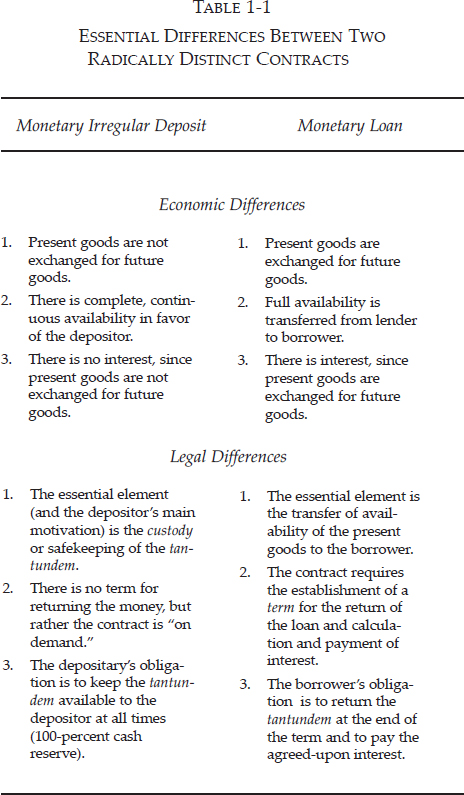
The essential legal element in the irregular deposit contract is the custody or safekeeping of the money deposited. To the parties deciding to make or receive an irregular deposit, this is the most important aim or purpose of the contract,and it varies greatly from the essential purpose of the loan contract, which is the transfer of the availability of the loaned good to the borrower so he can use it for a period of time. Two other important legal differences arise from this essential dissimilarity in purpose between the two types of contract. First, the irregular deposit contract lacks a term, the essential element identifying a loan contract. Indeed, while it is impossible to imagine a monetary loan contract without a fixed term (during which not only is ownership transferred, but availability is lost to the lender as well), at the end of which it is necessary to return the tantundem of money originally loaned plus interest, in the irregular deposit contract there is no term whatsoever, but rather there is continuous availability in favor of the depositor, who may withdraw his tantundem at any time.The second essential legal difference refers to the obligations of the two parties: in the irregular deposit contract the legal obligation implied by the nature of the contract consists, as we know, of the conscientious custody or safekeeping (as would be expected of a good parent) of the tantundem, which is kept continually available to the depositor.In the loan contract this obligation does not exist, and the borrower may use the loaned amount with total freedom. Indeed, when we speak of the legal “transfer of ownership” in the two contracts, we allude to two very dissimilar concepts. Whereas the “transfer ” of ownership in the irregular deposit contract (which could be considered a requirement of the fungible nature of the deposited goods) does not imply a simultaneous transfer of availability of the tantundem, in the loan contract there is a complete transfer of ownership and availability of the tantundem from lender to borrower.The differences covered in this section are outlined in Table 1-1.
4
THE DISCOVERY BY ROMAN LEGAL EXPERTS OF THE GENERAL LEGAL PRINCIPLES GOVERNING THE MONETARY IRREGULAR-DEPOSIT CONTRACT
THE EMERGENCE OF TRADITIONAL LEGAL PRINCIPLES ACCORDING TO MENGER, HAYEK, AND LEONI
The traditional, universal legal principles we dealt with in the last section in relation to the irregular deposit contract have not emerged in a vacuum, nor are they the result of a priori knowledge. The concept of law as a series of rules and institutions to which people constantly, perpetually and customarily adapt their behavior has been developed and refined through a repetitive, evolutionary process. Perhaps one of Carl Menger’s most important contributions was the development of a complete economic theory of social institutions. According to his theory, social institutions arise as the result of an evolutionary process in which innumerable human beings interact, each one equipped with his own small personal heritage of subjective knowledge, practical experiences, desires, concerns, goals, doubts, feelings, etc. By means of this spontaneous evolutionary process, a series of behavior patterns or institutions emerges in the realms of economics and language, as well as law, and these behaviors make life in society possible. Menger discovered that institutions appear through a social process composed of a multiplicity of human actions, which is always led by a relatively small group of individuals who, in their particular historical and geographical circumstances, are the first ones to discover that certain patterns of behavior help them attain their goals more efficiently. This discovery initiates a decentralized trial and error process encompassing many generations, in which the most effective behavior patterns gradually become more widespread as they successfully counter social maladjustments. Thus there is an unconscious social process of learning by imitation which explains how the pioneering behavior of these most successful and creative individuals catches on and eventually extends to the rest of society. Also, due to this evolutionary process, those societies which first adopt successful principles and institutions tend to spread and prevail over other social groups. Although Menger developed his theory in relation to the origin and evolution of money, he also mentions that the same essential theoretical framework can be easily applied to the study of the origins and development of language, as well as to our present topic, juridical institutions. Hence the paradoxical fact that the moral, juridical, economic and linguistic institutions which are most important and essential to man’s life in society are not of his own creation, because he lacks the necessary intellectual might to assimilate the vast body of random information that these institutions generate. On the contrary, these institutions inevitably and spontaneously emanate from the social processes of human interaction which Menger believes should be the main subject of research in economics.
Menger ’s ideas were later developed by F.A. Hayek in various works on the fundamentals of law and juridical institutions,and especially by the Italian professor of political science, Bruno Leoni, who was the first to incorporate the following in a synoptic theory on the philosophy of law: the economic theory of social processes developed by Menger and the Austrian School, the most time-honored Roman legal tradition, and the Anglo-Saxon tradition of rule of law. Indeed, Bruno Leoni’s great contribution is having shown that the Austrian theory on the emergence and evolution of social institutions is perfectly illustrated by the phenomenon of common law and that it was already known and had been formulated by the Roman classical school of law.Leoni, citing Cicero’s rendering of Cato’s words, specifically points out that Roman jurists knew Roman law was not the personal invention of one man, but rather the creation of many over generations and centuries, given that
there never was in the world a man so clever as to foresee everything and that even if we could concentrate all brains into the head of one man, it would be impossible for him to provide for everything at one time without having the experience that comes from practice through a long period of history.
In short, it was Leoni’s opinion that law emerges as the result of a continuous trial-and-error process, in which each individual takes into account his own circumstances and the behavior of others and the law is perfected through a selective evolutionary process.
ROMAN JURISPRUDENCE
The greatness of classical Roman jurisprudence stems precisely from the realization of this important truth on the part of legal experts and the continual efforts they dedicated to study, interpretation of legal customs, exegesis, logical analysis, the tightening of loopholes and the correction of flaws; all of which they carried out with the necessary standards of prudence and equanimity.The occupation of classical jurist was a true art, of which the constant aim was to identify and define the essence of the juridical institutions that have developed throughout society’s evolutionary process. Furthermore, classical jurists never entertained pretensions of being “original” or “clever,” but rather were “the servants of certain fundamental principles, and as Savigny pointed out, herein lies their greatness.”Their fundamental objective was to discover the universal principles of law, which are unchanging and inherent in the logic of human relationships. It is true, however, that social evolution itself often necessitates the application of these unchanging universal principles to new situations and problems arising continually from this evolutionary process.In addition, Roman jurists worked independently and were not civil servants. Despite multiple attempts by official legal experts in Roman times, they were never able to do away with the free practice of jurisprudence, nor did the latter lose its enormous prestige and independence.
Jurisprudence, or the science of law, became an independent profession in the third century B.C. The most important jurists prior to our era were Marcus Porcius Cato and his son Cato Licianus, the consul Mucius Scaevola, and the jurists Quintus Mucius Scaevola, Servius Surpicius Rufus, and Alfenus Varus. Later, in the second century A.D., the classical era began and the most important jurists during that time were Gaius, Pomponius, Africanus, and Marcellus. In the third century their example was followed by Papinian, Paul, Ulpian, and Modestinus, among other jurists. From this time onward, the solutions offered by these independent jurists received such great prestige that the force of law was attached to them; and to prevent the possibility of difficulties arising from differences of opinion in the jurists’ legal writings, the force of law was given to the works of Papinian, Paul, Ulpian, Gaius, and Modestinus, and to the doctrines of jurists cited by them, as long as these references could be confirmed upon comparison with original writings. If these authors were in disagreement, the judge was compelled to follow the doctrine defended by the majority; and in the case of a tie, the opinion of Papinian was to prevail. If he had not communicated his opinion on an issue, the judge was free to decide.
Roman classical jurists deserve the credit for first discovering, interpreting, and perfecting the most important juridical institutions that make life in society possible, and as we will see, they had already recognized the irregular deposit contract, understood the essential principles governing it, and outlined its content and essence as explained earlier in this chapter. The irregular deposit contract is not an intellectual, abstract creation. It is a logical outcome of human nature as expressed in multiple acts of social interaction and cooperation, and it manifests itself in a set of principles which cannot be violated without grave consequences to the network of human relationships. The great importance of law in this evolutionary sense, distilled and rid of its logical flaws through the science of legal experts, lies in the guidance it provides people in their daily lives; though in most cases, due to its abstract nature, people may not be able to identify or understand the complete specific function of each juridical institution. Only recently in the historical evolution of human thought has it been possible to understand the laws of social processes and gain a meager grasp on the role of the different juridical institutions in society, and the contributions of economics have been mostly responsible for these realizations. One of our most important objectives is to carry out an economic analysis of social consequences resulting from the violation of the universal legal principles regulating the monetary irregular-deposit contract. In chapter 4 we will begin this theoretical economic analysis of a juridical institution (the monetary bank-deposit contract).
The knowledge we have today of universal legal principles as they were discovered by Roman jurists comes to us through the work of the emperor Justinian, who in the years 528–533 A.D. made an enormous effort to compile the main contributions of classical Roman jurists and recorded them in three books (the Institutiones, the Digest, and the Codex Constitutionum, later completed by a fourth book, the Novellae), which, since the edition of Dionysius Gottfried,are known as the Corpus Juris Civilis. The Institutiones is an essential work directed at students and based on Gaius’s Institutiones. The Digest or Pandecta is a compilation of classical legal texts which includes over nine thousand excerpts from the works of different prestigious jurists. Passages taken from the works of Ulpian, which comprise a third of the Digest, together with excerpts from Paul, Papinian, and Julianus, fill more of the book than the writings of all of the rest of the jurists as a group. In all, contributions appear from thirty-nine specialists in Roman classical law. The Codex Constitutionum consists of a chronologically-ordered collection of imperial laws and constitutions (the equivalent of the present-day concept of legislation), and Novellae, the last work in the Corpus, contains the last imperial constitutions subsequent to the Codex Constitutionum.
Now let us follow up this brief introduction by turning to the Roman classical jurists and their treatment of the institution of monetary irregular deposit. It is clear they understood it, considered it a special type of deposit possessing the essential deposit characteristics and differentiated it from other contracts of a radically different nature and essence, such as the mutuum contract or loan.
THE IRREGULAR DEPOSIT CONTRACT UNDER ROMAN LAW
The deposit contract in general is covered in section 3 of book 16 of the Digest, entitled “On Depositing and Withdrawing” (Depositi vel contra). Ulpian begins with the following definition:
A deposit is something given another for safekeeping. It is so called because a good is posited [or placed]. The preposition de intensifies the meaning, which reflects that all obligations corresponding to the custody of the good belong to that person.
A deposit can be either regular, in the case of a specific good; or irregular, in the case of a fungible good. In fact, in number 31, title 2, book 19 of the Digest, Paul explains the difference between the loan contract or mutuum and the deposit contract of a fungible good, arriving at the conclusion that
if a person deposits a certain amount of loose money, which he counts and does not hand over sealed or enclosed in something, then the only duty of the person receiving it is to return the same amount.
In other words, Paul clearly indicates that in the monetary irregular deposit the depositary’s only obligation is to return the tantundem: the equivalent in quantity and quality of the original deposit. Moreover, whenever anyone made an irregular deposit of money, he received a written certificate or deposit slip. We know this because Papinian, in paragraph 24, title 3, book 16 of the Digest, says in reference to a monetary irregular deposit,
I write this letter by hand to inform you, so that you will know, that the one hundred coins you have entrusted to me today through Sticho, the slave and administrator, are in my possession and I will return them to you immediately, whenever and wherever you wish.
This passage reveals the immediate availability of the money to the depositor and the custom of giving him a deposit slip or receipt certifying a monetary irregular deposit, which not only established ownership, but also had to be presented upon withdrawal.
The essential obligation of depositaries is to maintain the tantundem constantly available to depositors. If for some reason the depositary goes bankrupt, the depositors have absolute privilege over any other claimants, as Ulpian skillfully explains (paragraph 2, number 7, title 3, book 16 of the Digest):
Whenever bankers are declared bankrupt, usually addressed first are the concerns of the depositors; that is, those with money on deposit, not those earning interest on money left with the bankers. So, once the goods have been sold, the depositors have priority over those with privileges, and those who received interest are not taken into account— it is as if they had relinquished the deposit.
Here Ulpian indicates as well that interest was considered incompatible with the monetary irregular deposit and that when bankers paid interest, it was in connection with a totally different contract (in this case, a mutuum contract or loan to a banker, which is better known today as a time “deposit” contract).
As for the depositary’s obligations, it is expressly stated in the Digest (book 47, title 2, number 78) that he who receives a good on deposit and uses it for a purpose other than that for which it was received is guilty of theft. Celsus also tells us in the same title (book 47, title 2, number 67) that taking a deposit with an intent to deceive constitutes theft. Paul defines theft as “the fraudulent appropriation of a good to gain a profit, either from the good itself or from its use or possession; this is forbidden by natural law.”As we see, what is today called the crime of misappropriation was included under the definition of theft in Roman law. Ulpian, in reference to Julianus, also concluded:
if someone receives money from me to pay a creditor of mine, and, himself owing the same amount to the creditor, pays him in his own name, he commits theft. (Digest, book 47, title 2, number 52, paragraph 16)
In number 3, title 34 (on “the act of deposit”), book 4 of the Codex Constitutionum of the Corpus Juris Civilis, which includes the constitution established under the consulship of Gordianus and Aviola in the year 239, the obligation to maintain the total availability of the tantundem is even clearer, as is the commission of theft when the tantundem is not kept available. In this constitution, the emperor Gordianus indicates to Austerus,
if you make a deposit, you will with reason ask to be paid interest, since the depositary should thank you for not holding him responsible for theft, because he who knowingly and willingly uses a deposited good for his own benefit, against the will of the owner, also commits the crime of theft.
Section 8 of the same source deals expressly with depositaries who loan money received on deposit, thus using it for their own benefit. It is emphasized that such an action violates the principle of safekeeping, obligates depositaries to pay interest, and makes them guilty of theft, as we have just seen in the constitution of Gordianus. In this section we read:
If a person who has received money from you on deposit loans it in his own name, or in the name of any other person, he and his successors are most certainly obliged to carry out the task accepted and to fulfill the trust placed in them.
It is recognized, in short, that those who receive money on deposit are often tempted to use it for themselves. This is explicitly acknowledged elsewhere in the Corpus Juris Civilis (Novellae, Constitution LXXXVIII, at the end of chapter 1), along with the importance of properly penalizing these actions, not only by charging the depositary with theft, but also by holding him responsible for payment of interest on arrears “so that, in fear of these penalties, men will cease to make evil, foolish and perverse use of deposits.”
Roman jurists established that when a depositary failed to comply with the obligation to immediately return the tantundem upon request, not only was he clearly guilty of the prior crime of theft, but he was also liable for payment of interest on arrears. Accordingly, Papinian states:
He who receives the deposit of an unsealed package of money and agrees to return the same amount, yet uses this money for his own profit, must pay interest for the delay in returning the deposit.
This perfectly just principle is behind the so-called depositum confessatum, which we will consider in greater detail in the next chapter and refers to the evasion of the canonical prohibition on interest by disguising actual loan or mutuum contracts as irregular deposits and then deliberately delaying repayment, thus authorizing the charging of interest. If these contracts had from the beginning been openly regarded as loan or mutuum contracts they would not have been permitted by canon law.
Finally, we find evidence in the following extracts (among others) that Roman jurists understood the essential difference between the loan or mutuum contract and the monetary irregular-deposit contract: number 26, title 3, book 16 (passage by Paul); number 9, point 9, title 1, book 12 of the Digest (excerpts by Ulpian); and number 10 of the same title and book. However, the clearest and most specific statements to this effect were made by Ulpian in section 2, number 24, title 5, book 42 of the Digest, in which he expressly concludes that “To loan is one thing and to deposit is another,” and establishes
that once a banker ’s goods have been sold and the concerns of the privileged attended to, preference should be given people who, according to attested documents, deposited money in the bank. Nevertheless, those who have received interest from the bankers on money deposited will not be dealt with separately from the rest of the creditors; and with good reason, since to loan is one thing and to deposit is another.
It is therefore clear from Ulpian’s writings in this section that bankers carried out two different types of operations. On one hand, they accepted deposits, which involved no right to interest and obliged the depositary to maintain the full, continuous availability of the tantundem in favor of the depositors, who had absolute privilege in the case of bankruptcy. And, on the other hand, they received loans (mutuum contracts), which did obligate the banker to pay interest to the lenders, who lacked all privileges in the case of bankrupcy. Ulpian could show no greater clarity in his distinction between the two contracts nor greater fairness in his solutions.
Roman classical jurists discovered and analyzed the universal legal principles governing the monetary irregular-deposit contract, and this analysis coincided naturally with the development of a significant business and trade economy, in which bankers had come to play a very important role. In addition, these principles later appeared in the medieval legal codes of various European countries, including Spain, despite the serious economic and business recession resulting from the fall of the Roman Empire and the advent of the Middle Ages. In Las Partidas (law 2, title 3, item 5) it is established that a person who agrees to hold the commodities of another takes part in an irregular deposit in which control over the goods is transferred to him. Nevertheless, he is obliged, depending upon agreements in the corresponding document, to return the goods or the value indicated in the contract for each good removed from the deposit, either because it is sold with the authorization of the original owner, or is removed for other, unexpected reasons.Moreover, in 1255 the Fuero Real (law 5, title 15, book 3) the distinction is made between the deposit “of some counted money or raw silver or gold,” received from “another, by weight,” in which case “the goods may be used and goods of the same quantity and quality as those received may be returned;” and the deposit “which is sealed and not counted or measured by weight,” in which case “it is not to be used, but if it is used, it must be paid back double.”These medieval codes contain a clear distinction between the regular deposit of a specific good and the irregular deposit of money, and they indicate that in the latter case ownership is transferred. However, the codes do not include the important clarifications made in the Corpus Juris Civilis to the effect that, though ownership is “transferred,” the safekeeping obligation remains, along with the responsibility to keep continually available to the depositor the equivalent in quantity and quality (tantundem) of the original deposit. Perhaps the reason for this omission lies in the increasing prevalence of the depositum confessatum.
In conclusion, Roman legal tradition correctly defined the institution of monetary irregular deposit and the principles governing it, along with the essential differences between this contract and other legal institutions or contracts, such as the loan or mutuum. In chapter 2 we will consider ways in which the essential principles regulating human interactions in the monetary irregular deposit (and more specifically, the rights of availability and ownership implied by the contract) were gradually corrupted over the centuries as a result of the combined actions of bankers and politicians. We will analyze the circumstances which made these events possible, as well as the reasons behind them. In chapter 3 we will study the different attempts made by the legal profession to justify contracts which, against traditional legal principles, gradually gained acceptance. Then in chapter 4 we will begin to consider the economic consequences of these events.
_____________
The Shorter Oxford English Dictionary, 3rd ed. (Oxford: Oxford University Press, 1973), vol. 1, p. 1227.
Manuel Albaladejo, Derecho civil II, Derecho de obligaciones, vol. 2: Los contratos en particular y las obligaciones no contractuales (Barcelona: Librería Bosch, 1975), p. 304.
Juan Iglesias, Derecho romano: Instituciones de derecho privado, 6th rev. updated ed. (Barcelona: Ediciones Ariel, 1972), pp. 408–09.
Fungible goods are those for which others of the same sort may be substituted. In other words, they are goods which are not treated separately, but rather in terms of quantity, weight, or measure. The Romans said that things quae in genere suo functionem in solutione recipiunt were fungible; that is, things quae pondere numero mensurave constant. Consumables are often fungible.
Our student César Martínez Meseguer argues convincingly that another adequate solution to our problem is to consider that in the irregular deposit there is no true transference of ownership, but rather that the concept of ownership refers abstractly to the tantundem or quantity of goods deposited and as such always remains in favor of the depositor and is not transferred. This solution is the one offered, for example, in the case of commixture covered in article 381 of the Spanish Civil Code, which admits that “each owner will acquire rights in proportion to the part corresponding to him.” Though the irregular deposit has traditionally been viewed differently (as involving the actual transfer of ownership of physical units), it appears more correct to define ownership in the more abstract terms of article 381 of the Spanish Civil Code, in which case we may consider there to be no transference of ownership in an irregular deposit. Moreover, this seems to be the view of Luis DíezPicazo and Antonio Gullón, Sistema de derecho civil, 6th ed. (Madrid: Editorial Tecnos, 1989), vol. 2, pp. 469–70.
In the specific case of the monetary irregular deposit, the occasional use of cashier services offered by banks is an additional advantage.
As Pasquale Coppa-Zuccari wisely points out,
a differenza del deposito regolare, l’irregolare gli garantisce la restituzione del tantundem nella stessa specie e qualità, sempre ed in ogni caso. . . . Il deponente irregolare è garantito contro il caso fortuito, contro il quale il depositario regolare non lo garantisce; trovasi anzi in una condizione economicamente ben più fortunata che se fosse assicurato. (See Pasquale Coppa-Zuccari, Il deposito irregolare , vol. 6, pp. 109–10)
Coppa-Zuccari may have expressed this essential principle of the irregular deposit better than anyone when he said that the depositary
risponde della diligenza di un buon padre di famiglia indipendentemente da quella che esplica nel giro ordinario della sua vita economica e giuridica. Il depositario invece, nella custodia delle cose ricevute in deposito, deve spiegare la diligenza, quam suis rebus adhibere solet. E questa diligenza diretta alla conservazione delle cose propie, il depositario esplica: in rapporto alle cose infungibili, con l’impedire che esse si perdano o si deteriorino; il rapporto alle fungibili, col curare di averne sempre a disposizione la medesima quantità e qualità. Questo tenere a disposizione una eguale quantità è qualità di cose determinate, si rinnovellino pur di continuo e si sostituiscano, equivale per le fungibili a ciò che per le infungibili è l’esistenza della cosa in individuo. (Coppa-Zuccari, Il deposito irregolare, p. 95)
Joaquín Garrigues states the same opinion in Contratos bancarios (Madrid, 1975), p. 365, and Juan Roca Juan also expresses it in his article on the deposit of money (Comentarios al Código Civil y Compilaciones Forales, under the direction of Manuel Albaladejo, tome 22, vol. 1, Editorial Revista del Derecho Privado EDERSA [Madrid, 1982], pp. 246–55), in which he arrives at the conclusion that in the irregular deposit the safekeeping obligation means precisely that the depositary
must keep the quantity deposited available to the depositor at all times, and therefore must keep the number of units of the sort deposited necessary to return the amount when it is requested of him. (p. 251)
In other words, in the case of the monetary irregular deposit, the safekeeping obligation means the demand for a continuous 100-percent cash reserve.
Other related offenses are committed when a depositary falsifies the number of deposit slips or vouchers. This would be the case of the oil depositary who issues false deposit vouchers to be traded by third parties, and in general, of any depositary of a fungible good (including money) who issues slips or vouchers for a larger amount than that actually deposited. It is clear that in this case we are dealing with the offenses of document forgery (the issue of the false voucher) and fraud (if in issuing the voucher there is an intention to deceive third parties and obtain a specific profit). Later on we will confirm that the historical development of banking was based on the perpetration of such criminal acts in relation to the “business” of issuing banknotes.
Antonio Ferrer Sama, El delito de apropiación indebida (Murcia: Publicaciones del Seminario de Derecho Penal de la Universidad de Murcia, Editorial Sucesores de Nogués, 1945), pp. 26–27. As we indicated in the text and Eugenio Cuello Calón also explains (Derecho penal, Barcelona: Editorial Bosch, 1972, tome 2, special section, 13th ed, vol. 2, pp. 952–53), the crime is committed the moment it is established that appropriation or embezzlement has occurred, and the offense actually derives from the intention of committing the appropriation. Due to their private nature, these intentions must be perceived by the result of external acts (like the alienation, consumption or lending of the good). These deeds generally take place long before the discovery is made by the depositor who, when he tries to withdraw his deposit, is surprised to find that the depositary is not able to immediately hand over to him the corresponding tantundem. Miguel Bajo Fernández, Mercedes Pérez Manzano, and Carlos Suárez González (Manual de derecho penal, special section, “Delitos patrimoniales y económicos” ) also conclude that the offense is committed the very moment the act of disposal takes place, no matter what the subsequent effects are, and continues to be a crime even when the object is recovered or the perpetrator fails to profit from the appropriation, regardless of whether the depositary is able to return the tantundem the moment it is required (p. 421). The same authors contend that there exists an unacceptable legal loophole in Spanish criminal law, compared to other legal systems containing
specific provisions for corporate crimes and breach of trust, under which it would be possible to include the unlawful behaviors of banks with respect to the irregular deposit of checking accounts. (p. 429)
In Spanish criminal law, the article governing misappropriation is article 252 (mentioned by Antonio Ferrer Sama) of the new 1996 Penal Code (article 528 of the former), which states:
The penalties specified in article 249 or 250 will be applied to anyone who, to the detriment of another, appropriates or embezzles money, goods, securities or any other movable property or patrimonial asset which he has received on deposit, on consignment or in trust, or by way of another claim carrying the obligation to deliver or return the property, or who denies having received it, when the amount appropriated exceeds 300 euros. These penalties will be increased by 50 percent in the case of a necessary deposit.
Finally, the most thorough work on the criminal aspects of the misappropriation of money, which covers in extenso the position of Professors Ferrer Sama, Bajo Fernández, and others, is by Norberto J. de la Mata Barranco, Tutela penal de la propiedad y delitos de apropiación: el dinero como objeto material de los delitos de hurto y apropiación indebida (Barcelona: Promociones y Publicaciones Universitarias [PPU, Inc.], 1994), esp. pp. 407–08 and 512.
These judicial rulings appear in Jean Escarra’s Principes de droit commercial, p. 256; Garrigues also refers to them in Contratos bancarios, pp. 367–68.
“Dictamen de Antonio Goicoechea,” in La Cuenta corriente de efectos o valores de un sector de la banca catalana y el mercado libre de valores de Barcelona (Madrid: Imprenta Delgado Sáez, 1936), pp. 233–89, esp. pp. 263–64. Garrigues also refers to this ruling in Contratos bancarios, p. 368.
José Luis García-Pita y Lastres cites this decision in his paper, “Los depósitos bancarios de dinero y su documentación,” which appeared in La revista de derecho bancario y bursátil (Centro de Documentación Bancaria y Bursátil, October–December 1993), pp. 919–1008, esp. p. 991. Garrigues also makes reference to this ruling in Contratos bancarios, p. 387.
Ludwig von Mises, The Theory of Money and Credit (Indianapolis, Ind.: Liberty Classics, 1980), pp. 300–01. This is the best English edition of H.E. Batson’s translation of the second German edition (published in 1924) of Theorie des Geldes und der Umlaufsmittel, published by Duncker and Humblot in Munich and Leipzig. The first edition was published in 1912. See also Philipp Bagus, David Howden, and Walter Block, “Deposits, Loans, and Banking: Clarifying the Debate,” American Journal of Economics and Sociology, 72, no. 3 (July 2013): 627–44.
Conseguenza immediata del diritto concesso al deponente di ritirare in ogni tempo il deposito e del correlativo obbligo del depositario di renderlo alla prima richiesta e di tenere sempre a disposizione del deponente il suo tantundem nel deposito irregolare, è l’impossibilità assoluta per il depositario di corrispondere interessi al deponente. (Coppa-Zuccari, Il deposito irregolare, p. 292)
Coppa-Zuccari also points out that this incompatibility between the irregular deposit and the payment of interest does not apply, as is logical, to the completely separate case where interest is awarded because the depositary fails to return the money upon request, thus becoming a defaulter. As a result, the concept of depositum confessatum was, as we shall see, systematically used throughout the Middle Ages as a legal ploy to bypass the canonical prohibition on the charging of interest on loans.
Mises, The Theory of Money and Credit, p. 301.
The fact that interest agreements are incompatible with the monetary irregular-deposit contract does not mean the latter should be free of charge. Indeed, in keeping with its very nature, the irregular deposit usually includes the stipulation of payment by the depositor to the depositary of a certain amount for the costs of guarding the deposit or maintaining the account. The payment of interest is a reasonable indication that the essential obligation of safekeeping in the irregular deposit contract is almost certainly being violated and that the depositary is using the money of his depositors for his own benefit, misappropriating part of the tantundem which he should keep available at all times to the depositors.
J. Dabin, La teoría de la causa: estudio histórico y jurisprudencial, translated by Francisco de Pelsmaeker and adapted by Francisco Bonet Ramón, 2nd ed. (Madrid: Editorial Revista de Derecho Privado, 1955), pp. 24 and on. That the purpose of the irregular deposit contract is custody or safekeeping and is different from the object of the loan contract is recognized even by authors who, like García-Pita or Ozcáriz-Marco, still do not accept that the unavoidable, logical consequence of its purpose of safekeeping is a 100-percent reserve requirement for bank demand deposits. See José Luis García-Pita y Lastres, “Depósitos bancarios y protección del depositante,” Contratos bancarios (Madrid: Colegios Notariales de España, 1996), pp. 119–266, and esp. 167–91; and Florencio Ozcáriz Marco, El contrato de depósito: estudio de la obligación de guarda (Barcelona: J.M. Bosch Editor, 1997), pp. 37 and 47.
Civil law experts unanimously agree that a term is essential to a loan contract, unlike an irregular deposit contract, which has no term. Manuel Albaladejo emphasizes that the mutuum contract concludes and the loan must be given back at the end of the term (for example, see article 1125 of the Spanish Civil Code). He even indicates that if a term has not been explicitly designated, then the intention to set one for the debtor must always be assumed, since a term is required by the essential nature of the loan contract. In this case a third party (the courts) must be allowed to stipulate the corresponding term (this is the solution adopted in article 1128 of the Spanish Civil Code). See Albaladejo, Derecho civil II, Derecho de obligaciones, vol. 2, p. 317.
Clearly, it is the tantundem which is kept continually available to the depositor, and not the same specific units deposited. In other words, even though ownership of the concrete physical units deposited is transferred and they may be used, the depositary does not gain any real availability, since what he gains with respect to the specific units received is exactly compensated by the necessary loss of the equivalent availability regarding other specific units already in his power, and this necessity stems from the obligation to keep the tantundem constantly available to the depositor. In the monetary deposit contract, this constant availability to the depositor is usually referred to by the expression “on demand,” which illustrates the essential, unmistakable purpose of the checking account or “demand” deposit contract: to keep the tantundem continually available to the depositor.
At this point it is important to draw attention to the “time deposit” contract, which possesses the economic and legal characteristics of a true loan, not those of a deposit. We must emphasize that this use of terminology is misleading and conceals a true loan contract, in which present goods are exchanged for future goods, the availability of money is transferred for the duration of a fixed term and the client has the right to receive the corresponding interest. This confusing terminology makes it even more complicated and difficult for citizens to distinguish between a true (demand) deposit and a loan contract (involving a term). Certain economic agents have repeatedly and selfishly employed these terms to take advantage of the existent confusion. The situation degenerates further when, as quite often occurs, banks offer time “deposits” (which should be true loans) that become de facto “demand” deposits, as the banks provide the possibility of withdrawing the funds at any time without penalty.
Carl Menger, Untersuchungen über die Methode der Socialwissenschaften und der Politischen Ökonomie insbesondere (Leipzig: Duncker and Humblot, 1883), esp. p. 182. (Investigations into the Method of the Social Sciences with Special Reference to Economics [New York: New York University Press, 1985]). Menger himself eloquently formulates this new question which his proposed scientific research program for economics is designed to answer:
How is it possible that the institutions which are most significant to and best serve the common good have emerged without the intervention of a deliberate common will to create them? (pp. 163–65)
The best and perhaps the most brilliant synopsis of Menger ’s theory on the evolutionary origin of money appears in his article, “On the Origin of Money,” Economic Journal (June 1892): 239–55. This article has been reprinted by Israel M. Kirzner in his Classics in Austrian Economics: A Sampling in the History of a Tradition (London: William Pickering, 1994), vol. 1, pp. 91–106.
F.A. Hayek, The Constitution of Liberty (London: Routledge, 1st edition [1960] 1990); Law, Legislation and Liberty (Chicago: University of Chicago Press, 1978); and The Fatal Conceit: The Errors of Socialism (Chicago: University of Chicago Press, 1989).
See Jesús Huerta de Soto, Estudios de economía política (Madrid: Unión Editorial, 1994), chap. 10, pp. 121–28, and Bruno Leoni, Freedom and the Law (Princeton, N.J.: D. Van Nostrand Company, 1961), essential reading for all jurists and economists.
Nostra autem res publica non unius esset ingenio, sed multorum, nec una hominis vita, sed aliquod constitutum saeculis et aetatibus, nam neque ullum ingenium tantum extitisse dicebat, ut, quem res nulla fugeret, quisquam aliquando fuisset, neque cuncta ingenia conlata in unum tantum posse uno tempore providere, ut omnia complecterentur sine rerum usu ac vetustate. (Marcus Tullius Cicero, De re publica, 2, 1–2 [Cambridge, Mass.: The Loeb Classical Library, 1961], pp. 111–12. See Leoni, Freedom and the Law, p. 89)
Leoni’s book is by all accounts exceptional. Not only does he reveal the parallelism between the market and common law on the one hand, and socialism and legislation on the other, but he is also the first jurist to recognize Ludwig von Mises’s argument on the impossibility of socialist economic calculation as an illustration of
a more general realization that no legislator would be able to establish by himself, without some kind of continuous collaboration on the part of all the people concerned, the rules governing the actual behavior of everybody in the endless relationships that each has with everybody else. (pp. 18–19)
For information on the work of Bruno Leoni, founder of the prestigious journal Il Politico in 1950, see Omaggio a Bruno Leoni, Pasquale Scaramozzino, ed. (Milan: Ed. A. Guiffrè, 1969), and the article “Bruno Leoni in Retrospect” by Peter H. Aranson, Harvard Journal of Law and Public Policy (Summer, 1988). Leoni was multifaceted and extremely active in the fields of university teaching, law, business, architecture, music, and linguistics. He was tragically murdered by one of his tenants while trying to collect the rent on the night of November 21, 1967. He was fifty-four years old.
In the words of Bruno Leoni, law is shaped by
una continua serie de tentativi, che gli individui compiono quando pretendono un comportamento altrui, e si affidano al propio potere di determinare quel comportamento, qualora esso non si determini in modo spontaneo. (Bruno Leoni, “Diritto e politica,” in his book Scritti di scienza politica e teoria del diritto , p. 240)
In fact, the interpreter of the ius was the prudens, that is, the legal expert or iuris prudens. It was his job to reveal the law. Jurists provided advice and assistance to individuals and instructed them in business practices and types of contracts, offered answers to their questions and informed judges and magistrates. See Juan Iglesias, Derecho romano: Instituciones de derecho privado, 6th rev. ed. (Barcelona: Ediciones Ariel, 1972), pp. 54–55.
Iglesias, Derecho romano: Instituciones de derecho privado, p. 56. And esp. Rudolf von Ihering, El espíritu del derecho romano, Clásicos del Pensamiento Jurídico (Madrid: Marcial Pons, 1997), esp. pp. 196–202 and 251–53.
The occupation of interpretatio was intimately related to the role of advisor to individuals, magistrates, and judges, and consisted of applying time-honored principles to new needs; this meant an expansion of the ius civile, even when no new institutions were formally created. (Francisco HernándezTejero Jorge, Lecciones de derecho romano , p. 30)
This force of law was first acquired in a constitution from the year 426, known as the Citation Law of Theodosius and Valentinianus III. See Hernández-Tejero Jorge, Lecciones de derecho romano, p. 3.
Corpus Juris Civilis (Geneva: Dionysius Gottfried, 1583).
Justinian stipulated that the necessary changes be made in the compiled materials so that the law would be appropriate to the historical circumstances and as close to perfect as possible. These modifications, corrections and omissions are called interpolations and also emblemata Triboniani, after Tribonian, who was in charge of the compilation. There is an entire discipline dedicated to the study of these interpolations, to determining their content through comparison, logical analysis, the study of anachronisms in language, etc., since it has been discovered that a substantial number of them were made after the Justinian era. See Hernández-Tejero Jorge, Lecciones de derecho romano, pp. 50–51.
Ulpian, a native of Tyre (Phoenicia), was advisor to another great jurist, Papinian, and together with Paul, he was an advising member of the concilium principis and praefectus praetorio under Alexander Severus. He was murdered in the year 228 by the Praetorians. He was a very prolific writer who was better known for his knowledge of juridical literature than for his creative work. He wrote clearly and was a good compiler and his writings are regarded with special favor in Justinian’s Digest, where they comprise the main part. On this topic see Iglesias, Derecho romano: Instituciones de derecho privado, p. 58. The passage cited in the text is as follows in Latin:
Depositum est, quod custodiendum alicui datum est, dictum ex eo, quod ponitur, praepositio enim de auget depositum, ut ostendat totum fidei eius commissum, quod ad custodiam rei pertinet. (See Ildefonso L. García del Corral, ed., Cuerpo de derecho civil romano, 6 vols. , vol. 1, p. 831)
However, as Pasquale Coppa-Zuccari astutely points out, the expression depositum irregolare did not appear until it was first used by Jason de Maino, a fifteenth century annotator of earlier works, whose writings were published in Venice in the year 1513. See Coppa-Zuccari, Il deposito irregolare, p. 41. Also, the entire first chapter of this important work deals with the treatment under Roman law of the irregular deposit, pp. 2–32. For an excellent, current treatment in Spanish of bibliographic sources on the irregular deposit in Rome, see Mercedes López-Amor y García’s article, “Observaciones sobre el depósito irregular romano,” in the Revista de la Facultad de Derecho de la Universidad Complutense 74 (1988–1989): 341–59; and also Alicia Valmaña Ochaita, El depósito irregular en la jurisprudencia romana (Madrid: Edisofer, 1996).
This is actually a summary by Paul of Alfenus Varus’s Digest. Alfenus Varus was consul in the year 39 A.D. and the author of forty books of the Digest. Paul, in turn, was a disciple of Scaevola and an advisor to Papinian during the time Papinian was a member of the imperial council under Severus and Caracalla. He was a very ingenious, learned figure and the author of numerous writings. The passage cited in the text is as follows in Latin:
Idem iuris esse in deposito; nam si quis pecuniam numeratam ita deposuisset ut neque clausam, neque obsignatam traderet, sed adnumeraret, nihil aliud eum debere, apud quem deposita esset, nisi tantundem pecuniae solvere. (See Ildefonso L. García del Corral, ed., Cuerpo de derecho civil romano, 6 vols. , vol. 1, p. 963)
Papinian, a native of Syria, was Praefectus Praetorio beginning in the year 203 A.D. and was sentenced to death by the emperor Caracalla in the year 212 for refusing to justify the murder of his brother, Geta. He shared with Julianus the reputation for being the most notable of Roman jurists, and according to Juan Iglesias, “His writings are remarkable for their astuteness and pragmatism, as well as for their sober style” (Derecho romano: Instituciones de derecho privado, p. 58). The passage cited in the text is as follows in Latin:
centum numos, quos hac die commendasti mihi annumerante servo Sticho actore, esse apud me, ut notum haberes, hac epitistola manu mea scripta tibi notum facio; quae quando volis, et ubi voles, confestim tibi numerabo. (García del Corral, ed., Cuerpo de derecho civil romano, vol. 1, p. 840)
Quoties foro cedunt numularii, solet primo loco ratio haberi depositariorum, hoc est eorum, qui depositas pecunias habuerunt, non quas foenore apud numularios, vel cum numulariis, vel per ipsos exercebant; et ante privilegia igitur, si bona venierint, depositariorum ratio habetur, dummodo eorum, qui vel postea usuras acceperunt, ratio non habeatur, quasi renuntiaverint deposito. (García del Corral, ed., Cuerpo de derecho civil romano, vol. 1, p. 837)
Furtum est contrectatio rei fraudulosa, lucri faciendi gratia, vel ipsius rei, vel etiam usus eius possessionisve; quod lege naturali prohibitum est admittere. (Ibid., vol. 3, p. 645)
Ibid., p. 663.
Si depositi experiaris, non immerito etiam usuras tibi restitui flagitabis, quum tibi debeat gratulari, quod furti eum actione non facias obnoxium, siquidem qui rem depositam invito domino sciens prudensque in usus suus converterit, etiam furti delicto succedit. (Ibid., vol. 4, p. 490)
Si is, qui depositam a te pecuniam accepit, eam suo nomine vel cuiuslibet alterius mutuo dedit, tam ipsum de implenda suscepta fide, quam eius successores teneri tibi, certissimum. est. (Ibid., p. 491)
“Ut hoc timore stultorum simul et perversorum maligne versandi cursum in depositionibus homines cessent.” As is clear and we will later expand upon, it had already been demonstrated that depositaries made perverse use of money entrusted to them by their depositors. See ibid., vol. 6, pp. 310–11.
Qui pecuniam apud se non obsignatam, ut tantundem redderet, depositam ad usus proprios convertit, post moram in usuras quoque iudicio depositi condemnandus est. (Ibid., vol. 1, p. 841)
In bonis mensularii vendundis post privilegia potiorem eorum causam esse placuit, qui pecunias apud mensam fidem publicam secuti deposuerunt. Set enim qui depositis numis usuras a mensulariis accepurunt, a ceteris creditoribus non separantur; et merito, aliud est enim credere, aliud deponere. (Ibid., vol. 3, p. 386)
Papinian, for his part, states that if a depositary fails to comply with his responsibilities, money to return deposits can be taken not only from deposited funds found among the banker ’s assets, but from all the defrauder ’s assets. The depositors’
privilege extends not only to deposited funds still among the banker ’s assets, but to all of the defrauder ’s assets; and this is for the public good, given that banking services are necessary. However, necessary expenses always come first, since the calculation of assets usually takes place after discounting them. (The principle reflected here of bankers’ unlimited liability appears in point 8, title 3, book 16 of the Digest.)
In Las Partidas (c. 1312) deposits are called condesijos [hidden deposits], and in law 2 of this work we read that
Control over the possession of goods given another for safekeeping is not transferred to the receiver of the goods, except when the deposit can be counted, weighed or measured when handed over; and if it is given the receiver in terms of quantity, weight or measure, then control is transferred to him. However, he must return the good or the same amount of another equal to that given him for safekeeping.
This topic is covered with the utmost eloquence and clarity in Las Partidas. See Las Siete Partidas, annotated by the university graduate Gregorio López; facsimile edition published by the Boletín Oficial del Estado [official gazette] (Madrid, 1985), vol. 3, 5th Partida, title 3, law 2, pp. 7–8.
See the reference made by Juan Roca Juan to the Fuero Real in his article on “El depósito de dinero,” in Comentarios al Código Civil y Compilaciones Forales, vol. 1, tome 22, p. 249.

