
Money, Bank Credit, and Economic Cycles
CHAPTER 3: ATTEMPTS TO LEGALLY JUSTIFY FRACTIONAL-RESERVE BANKING
3
ATTEMPTS TO LEGALLY JUSTIFY FRACTIONAL-RESERVE BANKING

This chapter contains a critical examination of the different theoretical attempts to legally justify fractionalreserve banking. We will consider the proposed arguments intended to legally support a monetary irregular deposit contract in which the depositary can make self-interested use of money on demand deposit. In light of the legal doctrine presented in chapter 1 and the economic analysis to be performed in the following chapters, we will critique two main lines of defense.
1
INTRODUCTION
The legal doctrines aimed at justifying fractional-reserve banking have been formulated ex post facto. They have not been based on preexisting legal principles that have given rise to certain legal acts. On the contrary, as we explained in the previous chapter, banking practices have long infringed upon basic, universal legal principles and have done so in response to specific circumstances which have conspired to make these violations possible (human avarice; inadequate regulation; governments’ financial needs; systematic intervention of the authorities and confusion arising from the depositum confessatum, a product of the canonical ban on interest). As is logical, the lack of a legal basis for such a widespread practice soon prompted bankers and theorists alike to search for a fitting legal justification. Moreover, this urge was reinforced by the fact that, on almost all occasions, the government or public authorities ended up being the main beneficiary of fraudulent banking practices. Therefore it is not surprising, given the traditional symbiosis between political authorities and the intelligentsia, that the latter was driven by the former to search for legal grounds to support the practices it permitted and encouraged.
Finding adequate legal grounds was essential to the survival of the whole network of vested interests which fractional-reserve banking generates. It was clear to any educated person that these practices should be based on something sounder than a mere de facto situation. It is not enough to realize and affirm, as Shepard B. Clough does, that
In fact, [goldsmiths] even lent money given them for safe-keeping on the theory and experience that they needed to have on hand only enough to meet the expected, current demand of depositors. This practice led them, at least by the seventeenth century, to the issuing of “promises to pay,” that is, “goldsmiths’ notes,” which, like modern banknotes, circulated from person to person. These “promises to pay,” which could be paid by using the deposits of customers, came actually to exceed the amount of money on deposit. When this happened credit had been actually created by issuing paper—a very major discovery.
Nevertheless, no matter how “major ” one considers the “discovery” that it is possible to make fraudulent use of depositors’ money or issue deposit receipts for a greater amount than is actually deposited, it is clear that these acts share the same characteristic present in all other criminal acts of misappropriation which have always been the object of doctrinal analysis by criminal law experts. The similarity between the two sets of actions is therefore so obvious that theorists could not remain impassive in the face of a legal irregularity such as this in the economy.
Hence it is not surprising that great efforts have been made to justify what appears completely unjustifiable: that it is legitimate, from the standpoint of general legal principles, to misappropriate funds deposited for safekeeping and to issue deposit receipts for more money than is actually deposited. However, the interested parties (bankers and governments, mostly) have found it so important to find an adequate theoretical justification beyond the easy solution of simply declaring legal a corrupt, criminal practice (which is what has ultimately happened, despite all the doctrinal façades and constructions), that many jurists are still at work trying to confer legal respectability on a procedure that is commonplace even now.
Doctrinal attempts to justify the use of a fractional reserve in the irregular deposit can be classified into two large groups. The first group of doctrines was intended to settle the issue by equating the irregular deposit contract with the loan contract. We will analyze this group of theories in detail and show that, from a legal point of view, it is impossible to equate these two contracts. Writers of the second and more recent set of doctrines start by acknowledging that there are fundamental differences between the loan and irregular deposit contract. These theorists have focused their efforts on the construction of a new legal concept of “availability” and hold that this notion should be taken “loosely,” meaning bankers should only be required to carry out their investments “prudently” and to comply with regulations and bank legislation at all times. A detailed study of this second set of theories will demonstrate that they ultimately entail a return to the failed attempt of the first group, i.e., to justify the use of a fractional reserve in the irregular deposit by equating the deposit contract with the loan contract. Thus, the doctrines of the second set fall into the same errors and legal contradictions we will see in those of the first. In addition, in the next chapter we will explain why the doctrinal essence of the new interpretation of availability (based on the “law of large numbers”) is inadmissible from the standpoint of economic theory.
We therefore conclude that past attempts to legally justify fractional-reserve banking with respect to demand deposits have failed. This explains the ambiguity constantly present in doctrines on this type of bank practice, the desperate efforts to avoid clarity and openness in its treatment, the generalized lack of accountability and ultimately (since fractional-reserve banking cannot possibly survive economically on its own), the fact that it has been provided with the support of a central bank which institutes the regulations and supplies the liquidity necessary at all times to prevent the whole set-up from collapsing. In chapter 8 we will discuss central banking and show, through a theoretical analysis, that the nationalization of money and the central bank’s regulation of the banking system and its laws governing it have been incapable of maintaining a stable financial system that avoids economic cycles and averts bank crises. Thus, we may conclude that the fractional-reserve banking system has failed as well, even though it is backed and protected by a central bank.
At the end of this chapter we will examine several new types of financial contracts, some of which closely resemble those bankers employ in connection with bank deposits. In particular, we will consider the different financial operations involving a “repurchase agreement.” We will show that these entail an evasion of the law; whenever payment of a previously-established price is guaranteed regardless of the secondary-market price at the time the agreement is implemented, such operations conceal a true deposit contract. Finally, we will take a look at the profound, essential differences between the financial operations related to banking and those connected with life insurance. The latter represents a perfected form of true saving, where present goods are exchanged for future goods. It is an exchange with especially appealing features, but they in no way involve appropriation of demand deposits, credit creation, nor issuance of receipts without backing. We will also discuss the corrupting influence exerted on the insurance business by the recent trend (most apparent in government legislation) toward clouding and obscuring the traditional legal and technical boundaries between the two types of institutions (life insurance and banking).
2
WHY IT IS IMPOSSIBLE TO EQUATE THE IRREGULAR DEPOSIT WITH THE LOAN OR MUTUUM CONTRACT
THE ROOTS OF THE CONFUSION
The attempts to legally equate the monetary irregular-deposit contract with the loan or mutuum contract are particularly attractive to those who most benefit from banking practices (bankers and authorities). Indeed, in chapter 1, which contained an explanation of the legal nature of both institutions, we indicated that a loan implies the transfer not only of ownership of the lent item, but of its full availability as well, and therefore the borrower can make full use of it, by investing it, spending it, etc. Considering that this is ultimately what a banker does when appropriating demand deposit funds, the ideal legal solution for him is clearly to equate the irregular deposit contract with the loan contract. Moreover, a worn-out legal pretext has persistently been used to reinforce the argument for equating the two. Lax and superficial, it is as follows: Since the irregular deposit contract consists of the deposit of fungible goods, the very essence of which implies the inevitable transfer of ownership of individual items deposited (because they are indistinguishable from one another), the deposit and the loan are naturally one and the same, as both institutions entail the transfer of ownership.
In chapter 1 we saw that this line of reasoning is fallacious, superficial, and abstruse. In fact, even if ownership is transferred in both cases, the two contracts still differ radically concerning the availability of the item (an essential feature of the contracts). Indeed, whereas in the loan contract full availability of the item is transferred along with ownership, the very essence of the irregular deposit contract demands that the purpose of safekeeping or custody predominate. Accordingly, although we might in theory consider that ownership is transferred, in practice such a transference is negligible, since the safekeeping or custody of the fungible good requires the constant availability of the tantundem to the depositor. Therefore, even if ownership were transferred in the same sense in both institutions, an essential legal difference would still exist between them: the contrast in availability.
It may come as a surprise that the jurists who have chosen to equate the deposit contract with the mutuum or loan contract have overlooked such an obvious difference. The association between the contracts is so forced and the arguments so weak that it is amazing that a certain group of theorists have tried to defend them. However, their attempt has a historical, theoretical explanation: the depositum confessatum, a legal artifice which arose in the Middle Ages from attempts to avoid the canonical ban on interest. Although we have already shown that the canonical prohibition on interest and the development of fractional-reserve banking shared very little direct connection, the depositum confessatum acted as a strong, indirect link between them. We already know that from the time of Roman law, if a depositary violated the essence of the deposit contract, based on safekeeping, and appropriated deposits and was not able to immediately return the funds when the depositor demanded them, then the depositary was obliged to pay interest. Then, irrespective of any other foreseeable civil or criminal actions (the actio depositi and the actio furti), as is logical, an additional suit was filed to obtain interest for late payment and the loss of availability to the depositor up to the point when the depositary returned his funds.Thus, it is easy to understand how convenient it was in the Middle Ages to disguise a loan as a deposit in order to make the payment of interest legal, legitimate and socially acceptable. For this reason, bankers started to systematically engage in operations in which the parties openly declared they were entering into a deposit contract and not a loan contract. However, as the Latin saying goes, excusatio non petita, accusatio manifesta (an unsolicited excuse is tantamount to a self-accusation). Indeed, with a true deposit it was not necessary to make any express declaration, and such a declaration, when made, only revealed an attempt to conceal a loan or mutuum contract. The purpose of disguising a loan as a deposit was to evade the strict canonical prohibitions on interest-bearing loans and to permit many true credit transactions highly necessary, both economically and socially.
The depositum confessatum clouded the decidedly clear legal boundaries between the irregular deposit contract and the loan or mutuum contract. Whatever a scholar ’s stance on the canonical prohibition of usury, the depositum confessatum almost inevitably led to the “natural” identification of deposit contracts with mutuum contracts. To a theorist who wished to discover and expose all violations of the canonical prohibition and each case of concealment of interest, anything that sounded like a “deposit” was sure to appear suspicious from the start, and the most obvious and efficient solution from this point of view was to automatically equate deposits with loans and condemn the payment of interest in all cases, regardless of the operation’s outer legal appearance. Paradoxically, the more “liberal” moralists did not stop at defending the legal existence of deposits and the consequent legitimacy of interest for late payment; they went on to indicate that such deposits were ultimately loans, and hence the banker could use or invest the money. These authors sought not only to justify the payment of interest, but also to legitimize an institution that permitted the same acts of investment, or exchange of present goods for future goods, that the loan contract had traditionally made possible. Furthermore, this type of exchange was quite necessary to industry and trade. Throughout the Middle Ages, most jurists who commented on law texts held this position. As we saw in the last chapter, it was also the opinion of several members of the School of Salamanca, such as Luis de Molina, who believed the monetary irregular-deposit contract to be a “precarious loan” in which ownership of the money is transferred to the banker (which we have seen is admissible in the case of a deposit of fungible money), as well as full availability (which we know is impossible and contrary to the very essence of the deposit).
Moreover, as we have already seen, the Irish banker and economist Richard Cantillon, in the civil and criminal suits brought against him for misappropriating securities deposited with him as fungible goods through an irregular deposit contract during the wave of speculation generated in France by John Law’s system, tried to defend himself using the only doctrinal justification that had at that point been developed in favor of his position: that because the contract was for an “irregular ” deposit (i.e., the securities were considered fungible goods), a complete transfer of both ownership and availability took place. Thus, he could legitimately appropriate the shares, sell them, and use them to speculate on the market without committing any crime nor harming his depositors.
The same legal line of argument used by Richard Cantillon’s defense had been developed by scholars with respect to the monetary irregular deposit (and not the irregular deposit of securities). Consequently, if it is considered legally appropriate and justified to equate the monetary deposit contract with the mutuum contract, the same would certainly be applicable, mutatis mutandis, to all other deposits of fungible goods; and in particular, to deposits of securities as goods indistinguishable from one another. Hence we must emphasize that any possible doctrinal analysis against the legality of a complete transfer of ownership and availability in an irregular deposit of securities also ultimately constitutes a powerful case against the use of a fractional reserve in the monetary irregular deposit. The great Spanish mercantilist Joaquín Garrigues has recognized this fact. He states:
The reasoning thus far leads us to the affirmation that when a customer entrusts his shares to the bank he intends to contract a bank deposit; however, immediately after making this assertion, we become aware of another contract with a similar financial purpose. This contract also involves the entrusting to the bank of a fungible good (money) and cashier services are provided by the bank. This—defenders of the checking account will say—is another unique contract which is not called a loan nor a deposit in bank documents and which has the same legal effects as the securities current account; namely, the transference of ownership to the bank and the bank’s return of the tantundem.
Despite Garrigues’s forced and unconvincing attempt to persuade us that these two deposits are different, it is obvious that both contracts of irregular deposits of fungible goods (of money and of securities) are essentially identical, and therefore if we accept the transfer of full availability of the good in one case (the deposit of money), we must also accept it in the other. Consequently, there is no denying the legality of one (the deposit of securities) without denying the legality of the other (the deposit of money).In conclusion, the legal arguments used by Cantillon in his defense were derived from theories regarding the monetary irregular-deposit contract, and if we consider them valid, then they also justify Cantillon’s obvious swindling of his customers and the host of irregular and fraudulent activities later performed in connection with irregular deposits of securities in the other countries, especially Spain. Catalonian bankers carried out such fraud well into the twentieth century, and Spanish scholars have correctly and unanimously recognized the dishonest, criminal nature of their behavior.
THE MISTAKEN DOCTRINE OF COMMON LAW
The doctrine equating the monetary irregular-deposit contract with the loan or mutuum contract has also prevailed in Anglo-Saxon common law, via the creation of law in the binding case system. At the end of the eighteenth century and throughout the first half of the nineteenth, various lawsuits were filed by which depositors, upon finding they could not secure the repayment of their deposits, sued their bankers for misappropriation and fraud in the exercise of their safekeeping obligations. Unfortunately, however, British case-law judgments fell prey to pressures exerted by bankers, banking customs, and even the government, and it was ruled that the monetary irregular-deposit contract was no different from the loan contract, and therefore that bankers making self-interested use of their depositors’ money did not commit misappropriation.Of all of these court rulings, it is worthwhile to consider Judge Lord Cottenham’s decision in Foley v. Hill and others in 1848. Here the judge arrives at the erroneous conclusion that
the money placed in the custody of a banker is, to all intents and purposes, the money of the banker, to do with it as he pleases. He is guilty of no breach of trust in employing it. He is not answerable to the principal if he puts it into jeopardy, if he engages in a haphazardous speculation; he is not bound to keep it or deal with it as the property of his principal, but he is, of course, answerable for the amount, because he has contracted, having received that money, to repay to the principal, when demanded, a sum equivalent to that paid into his hands.
Considering this type of ruling, it is not surprising that Richard Cantillon fled from France to England, where financial practices were much more lax, and as we have seen, court rulings ended up defending the same line of argument he used in his defense. In continental Europe, in contrast, the Roman legal tradition still exerted great influence. Roman jurists had impeccably formulated the nature of the monetary irregular deposit, basing it on the safekeeping obligation and the unlawfulness of banks’ appropriation of deposited funds. Hence Richard Cantillon’s fear is understandable. He fled continental Europe at a time when the Bank of Amsterdam was still operating with its full prestige and a 100-percent reserve ratio.Also, the concept of irregular deposit began to return to its classical legal roots (which outlawed fractional-reserve banking). It had already become clear that all banking systems which had been based on a fractional reserve had failed (i.e., the systematic failure of European banks of the late Middle Ages, of banks in Seville and Italy in the sixteenth and seventeenth centuries and the system of Law in eighteenth-century France), and judges had regularly pronounced rulings against bankers’ appropriation of funds on deposit (and as we know, such decisions have even been made well into the twentieth century in France and Spain).
We must emphasize that, at least with respect to the institution that concerns us (the irregular deposit), clearly the Anglo-Saxon common law system has less effectively guaranteed the defense of property rights and the correct regulation of social interaction than the legal system of continental Europe. We do not mean that the continental system in its latest version, Kelsenian and positivist, is superior to the common law system, only that the latter has often been inferior to Roman law. By “Roman law” we refer to the evolutionary, customary system based on the logical, exegetic, and doctrinal analysis of jurists of the Roman classical school. To put it another way, in the Anglo-Saxon common law system, past decisions are too binding, judges being often more influenced by the specific details of each case and by ostensible business activity than by the dispassionate, logical, and exegetic analysis which should be carried out based on essential legal principles. In short the Anglo-Saxon legal system depends excessively on precedents, while the continental system, based on Roman law, rests on precedents, sound doctrine, and juridical theory.
THE DOCTRINE OF SPANISH CIVIL AND COMMERCIAL CODES
A group of Spanish theorists has also tried to equate the monetary irregular-deposit contract and the loan contract. Citing several articles in the Spanish Civil and Commercial Codes, they claim the irregular deposit is not recognized as a separate concept in Spanish legislation and therefore is no more than a simple loan or mutuum contract. Nevertheless, not even Spanish positive law guarantees the association between the irregular deposit contract and the loan contract. On the contrary, such a connection is very doubtful and uncertain, and in fact, the majority of modern Spanish theorists have concluded, in keeping with the classical construction, that even from the standpoint of current Spanish positive law, the loan contract is one thing and the irregular deposit contract quite another.
To justify equating the two types of contracts, theorists have frequently referred to Article 1768 of the Spanish Civil Code. This article states that
when the depositary has permission to use the good deposited, the contract ceases to be a deposit and becomes a loan or commodatum. Permission is not assumed, but must be proven.
According to this article, if we were to understand use in its most general and lax sense, then as all irregular deposit contracts imply a transfer of ownership of the individual items deposited and hence of the indistinct “use” of the fungible good, the irregular deposit contract would always ipso facto become a loan or mutuum. Although later we will examine the different instances in which it could be considered that a “transfer of use” takes place, for now it is enough to remember that, as we saw in chapter 1, a general transfer of ownership and use is one thing, but in light of whether or not the tantundem is constantly kept fully available to the depositor, it is quite another. To the extent that Article 1768 is only intended to distinguish whether or not the tantundem is kept continuously available to the depositor, it would be perfectly possible under Spanish positive law to recognize the existence of an irregular deposit contract that is radically distinct from the loan contract. In fact Article 1770 of the very Civil Code seems to suggest this second interpretation. Indeed, this article stipulates that
the deposited good shall be returned along with all of its proceeds and accessions. Should the deposit consist of money, the same provisions established in Article 1724 regarding the representative apply to the depositary.
In other words, it seems the Civil Code itself allows for a type of monetary deposit which is not a loan. As José Luis Albácar and Jaime Santos Briz correctly point out,
When faced with such a discrepancy—we may even call it an antinomy—between conflicting statutory provisions [the “classical” and the “modern”], we should note that nowadays the more common idea seems to be that the mutuum and the irregular deposit are different, to the extent that some people believe that in these cases we are dealing with a type of deposit, an atypical and complex concept: the irregular deposit.
The treatment the monetary irregular deposit receives in the Spanish Commercial Code could also appear contradictory and lend itself to both interpretations. In fact Article 309 stipulates that
whenever the depositary, with the consent of the depositor, uses the goods deposited, either for himself or his business activities, or in operations ordered by the depositor, the rights and obligations of depositor and depositary shall cease, in favor of the rules and provisions applicable to the commercial loan, the commission or the contract carried out instead of the deposit.
It seems, therefore, that some parallels exist between Article 309 of the Spanish Commercial Code and Article 1768 of the Civil Code. However, Article 307 of the Commercial Code, which regulates cash deposits, states that
when cash deposits are made in unmarked currency or in an open, unsealed package, the depositary shall be responsible for their preservation and safety according to the terms established in paragraph 2 of Article 306.
And Article 306, paragraph 2 reads as follows:
in the safekeeping of deposits, the depositary shall be accountable for any damage to the deposited goods resulting from malice or negligence, as well as from the nature of the goods or defects in them, if in such cases he fails to take necessary measures to avoid or repair the damage, notifying the depositor as soon as the damage becomes obvious. (Italics added)
Thus, if we consider the last paragraph of Article 307 together with the second paragraph of Article 306, the Spanish Commercial Code itself fully allows for the concept of the monetary irregular deposit contract and imposes a very clear safekeeping obligation on the depositary in the depositor ’s favor, and even requires that, should any damage occur to the fungible money deposited, the depositary immediately notify the depositor. Nevertheless, Article 310 of the Commercial Code grants bankers a statutory privilege which legalizes the appropriation of funds deposited with them. This article specifies that
regardless of the provisions laid down in the preceding articles, deposits made in banks, public warehouses, credit associations or any other company shall be governed first by that company’s statutes, then by the prescriptions of this code and last by common law rules applicable to all deposits.
The nature of the “odious” privilege enjoyed by banks and other similar associations is obvious. Even from the standpoint of Spanish positive law, it could be argued that, according to Article 306 (cited above) of the Commercial Code, any person who is not a banker or similar professional and uses the money entrusted to him through an irregular deposit would violate the safekeeping obligation and therefore commit the crime of misappropriation. Bankers, however, are exempt from this possibility if their company’s statutes determine that they may use and appropriate depositors’ funds for their own business activities. Nevertheless bank statutes and contracts are not at all easy to understand. On the contrary, documents of this type are usually ambiguous and confusing,which explains court decisions stating that Spanish positive law requires bankers to maintain continuously available to depositors the entire amount of their deposits (tantundem); that is, to maintain a 100-percent reserve ratio. These judgments (such as the Spanish Supreme Court decision of June 21, 1928 and others cited in chapter 1) have been based on case-law interpretations of Spanish positive law and have been pronounced well into the twentieth century.
Finally we must mention Articles 7 and 8 of the Bank of Spain’s bylaws, which concern deposits. The first two paragraphs of Article 7 establish that “authorized offices may receive deposits of local currency or of notes from the bank itself.” Article 8 states that “the responsibility of the bank as a depositary is to return the same amount in local currency as is deposited in cash.” Article 10, which relates to checking accounts, has more or less the same content:
the bank may open and manage checking accounts of cash or securities for individuals or legal entities and duly represented corporations or organizations whose application is confidentially reviewed by the institution and accepted. The following may be deposited in ordinary cash accounts: legal banknotes and coins, checks and other documents related to other checking accounts . . . for each type of checking account the bank will provide the checkbooks needed by the account holder; and via the duly authorized checks, it will pay the sums and return the securities to the debit of the corresponding balances. Against cash checking accounts the following are also admissible: bearer, order, personal and crossed checks.
As we see, these articles of the Bank of Spain’s bylaws, and in general the statutes of all other banks, only regulate the operation of monetary irregular-deposit accounts and checking accounts from the standpoint of depositors, and they always maintain the confusion and ambiguity regarding whether such money is continuously safeguarded and kept available by the bank or whether the bank is expressly authorized by the depositor to appropriate funds and invest them in personal business deals. We must turn to Article 180 of the Commercial Code to see the true original meaning of Spanish commercial legislation on this point. Indeed, Article 180 specifies that “banks will keep cash in their vaults equivalent to at least one fourth the sum of deposits and checking accounts in cash and bills in circulation.” This ratio, which has traditionally been used by the Spanish central bank as an instrument of monetary policy and has been reduced to a current 1 percent (since January 2012), is the culmination of the statutory privilege enjoyed by the banking industry. Banking is the only institution expressly authorized by Spanish positive law to violate the safekeeping obligations of the monetary irregular-deposit contract, thus receiving permission to appropriate depositors’ money for bankers’ own use in investments and personal business activities. Although this reserve requirement alone keeps bankers from being criminals under the positive law in force in Spain, it does not in the least compensate for the lack of legal justification for the bank-deposit contract in its current form, nor, as is logical, for the damaging economic effects on society of the violation of traditional principles of property rights with respect to the monetary irregular deposit. In the following chapters we will examine these effects (the distortion of the productive structure; the generation of successive, recurrent stages of economic boom and recession; the promotion of widespread malinvestment; the creation of massive unemployment and the perpetuation of a privileged financial system incapable of guaranteeing smooth and sustainable economic development).
CRITICISM OF THE ATTEMPT TO EQUATE THE MONETARY IRREGULAR-DEPOSIT CONTRACT WITH THE LOAN OR MUTUUM CONTRACT
Even though the doctrinal association between irregular deposits and monetary loan or mutuum contracts is the perfect tool for justifying fractional-reserve banking, this association is so awkward that the most prestigious experts in commercial law have failed to accept it. Joaquín Garrigues, though he seems to want to unreservedly defend the doctrine of association, ultimately realizes that it is not justifiable, and he concludes that, despite the possible positive-law arguments (Article 1768 of the Spanish Civil Code and Article 309 of the Spanish Commercial Code, both cited earlier) that could be used to justify the association between the loan or mutuum contract and the irregular deposit contract,
there are still some factors which lead one to continue considering the contract a deposit and not a loan (for example, the free availability to the depositor, the fact that the depositor initiates the contract, the limited interest, etc.).
Curiously, Joaquín Garrigues does not expound on these factors, mentioning them only in passing. Instead he immediately tries to construct the theory based on the reinterpretation of the concept of availability, which we will study in the next section. Nevertheless, considering what we covered in chapter 1, it would have been very interesting to know what Garrigues could and should have said about the arguments against equating the two contracts, a matter we will now consider in greater depth.
THE DISTINCT CAUSE OR PURPOSE OF EACH CONTRACT
The most significant and definitive argument in favor of a distinction between the irregular deposit contract and the loan or mutuum contract lies in the essential difference between the cause or purpose of each. These terms refer to a fundamental, legal motive (related to the so-called causeof contracts) which is closely connected with the parties’ distinct subjective reasonfor deciding to enter into one contract or another. Therefore a perfect symbiosis exists between the subjectivist conception on which modern economic theory is basedand the legal point of view that mainly takes into account the different subjective goals of the parties in entering into one type of contract or another.
In chapter 1 we studied the essential, irreconcilable differences between the monetary irregular-deposit contract and the monetary loan or mutuum contract. All of those differences could ultimately be traced to the distinct cause or purpose of each contract. On one hand, the loan contract always implies an exchange of present goods, the availability of which is lost to the lender, for future goods, which the borrower must return along with an added amount in the form of interest, in payment for the inexorable loss of availability of the present goods when they are transferred from lender to borrower. On the other hand, in the monetary irregular deposit, the objective or cause of the contract is radically different. In this case there is no exchange of present goods for future goods, nor does the depositor have the faintest desire to lose the immediate availability of the good deposited. Hence the essential element in the irregular deposit contract is not, as in the loan contract, the transfer of availability, but rather the custody and safekeeping of the tantundem, which constitutes the legal cause or fundamental purpose motivating the depositor to enter into the contract. For this reason, there is no term, and the funds are deposited “on demand;” that is, they can be withdrawn at any time. If the depositor were informed that the contract he plans to sign is a loan contract by which he will grant a loan to the bank, and that therefore the money will no longer be available to him, he would certainly not go through with the contract as if it were a deposit, and he very well might decide to keep his money. Thus, there is absolutely no doubt that the cause or legal purpose of each contract is radically different from that of the other, and that attempting to mix them is like trying to mix oil and water, given the essential difference between them.
Theorists who attempt to equate the irregular deposit contract with the loan contract fail to realize that their doctrinal stance ignores the true cause or purpose motivating the contracting parties to enter into a contract. And no matter how many relatively empty statements they make about the equivalence of the two contracts, they inevitably come up against the same legal wall: the radical, essential difference between the legal cause behind each contract. Therefore, they can go no further than to state that each of the parties to the monetary bank-deposit contract thinks it is entering into a “different” contract. In other words, depositors hand over money as if making a deposit, and bankers receive it as if it were a loan. Yet, what kind of contract has two essentially distinct legal causes? Or to put it another way: How is it possible that both parties to the same contract simultaneously intend to retain the availability of the same sum?Indeed, depositors clearly turn over their money with the desire to retain full availability of the good turned over (monetary deposit “on demand”),while banks accept deposits not with the aim of keeping 100 percent of the tantundem in their possession at all times, but rather with the intention of using most of what they receive on deposit to make personal loans and investments. This “dual availability” could not possibly be ignored by Garrigues, who logically finds it very disquieting and confusing with respect to legality.As a matter of fact, for Garrigues the most outstanding feature of monetary bank deposits in their current version (which does not require a 100-percent reserve) is dual availability: the deposited goods are simultaneously available to both the bank and the customer. He adds that
this dual availability is precisely the reason it is difficult to formulate a legal description of the contract, because availability in favor of the depositor, a key feature of deposits, harmonizes poorly with availability in favor of the bank.
Rather than to say it is difficult to formulate a legal description of the contract, it would be more accurate to say such a description is legally impossible, given the radical difference between the cause or purpose of the two types of legal transactions. Therefore, it is not that one instance of availability “harmonizes poorly” with the other, but that the two instances are mutually exclusive on a fundamental level.Joaquín Garrigues’s uncertainty is even more obvious when in a footnotehe cites the rulings of the Court of Paris which we covered in chapter 1. These court decisions support a strict safekeeping obligation and a 100-percent reserve ratio for banks, which Garrigues calls “surprising assertions.” What is surprising is that Garrigues does not realize that his own analysis leads inevitably to the conclusion that the two contracts are different and that it is therefore impossible to equate in any way the irregular deposit contract with the loan contract. Upon reading Garrigues’s treatment of monetary bank-deposit contracts, one inevitably gets the impression that Garrigues himself suffers from a rather “guilty conscience” for carrying out such a forced legal analysis to try to justify the unjustifiable: the supposed existence of a monetary irregular-deposit contract which legally, and in accordance with legal principles and logic, permits the banker to freely use the goods deposited; in other words, fractional-reserve banking.
THE NOTION OF THE UNSPOKEN OR IMPLICIT AGREEMENT
Also inadmissible is the argument that Article 1768 of the Spanish Civil Code suggests that in irregular deposit contracts a type of “implicit or unspoken agreement” exists by which depositors authorize bankers to use money on deposit. This course of reasoning is unacceptable mainly because Article 1768 speaks of permission “to use the good deposited,” and we know that it is not the power to use the good that makes the monetary-deposit contract an irregular deposit contract. This authorization is inherent in all deposits of fungible goods, the very nature of which prevents them from being handled individually. In a sense, a transfer of ownership results, which in turn implies authorization for the depositary to use the goods. Nevertheless, we have already seen that this transfer of ownership and of power to use the deposited goods should be understood in a general sense. If it is not possible to track the individual units deposited, then we may certainly consider there to be a transfer of ownership and of power to use the specific items deposited. However, as is logical, this is perfectly compatible with a continuous 100-percent reserve requirement; that is, the custody and safekeeping of the tantundem and its availability to the depositor. This constitutes the banker ’s essential obligation and is the foundation of the deposit contract’s essential purpose. To put it another way, the characteristic, essential nature of the irregular deposit contract is not determined by the transfer of authority to use the goods, but by the fungible nature of the items deposited and by the contract’s purpose. A transfer of authority to use deposited goods may occur independently of an irregular deposit, and this is indeed what happens, for example, in the mutuum or loan contract. As we know, the legal cause or purpose of this contract is radically different (it entails not only the transfer of ownership and power to use the goods, but also the transfer of the availability of the goods, which is simultaneously lost to the lender). Therefore, and according to Coppa-Zuccari, the claim that supposed authorization (express or tacit) from the depositor converts the irregular deposit contract into a loan or mutuum is both unnecessary and inaccurate. It is unnecessary in the sense that all irregular deposit contracts, due to their very nature, involve the transfer of ownership and of the power to use the good (which is compatible, as is logical, with the fundamental obligation to maintain 100 percent of the tantundem in reserve). And it is inaccurate, since even though the power to use the deposited good is transferred, in no way does this alter the original purpose of the contract, which is none other than the custody and safekeeping of the tantundem.In fact, three logical possibilities exist with respect to the supposed authorization (express or tacit) to use the deposited good. Let us consider each one separately.
First, we may suppose that the vast majority of depositors are not aware that by depositing their money in a bank, they at the same time authorize the banker to use the money for his own profit in private business deals. It is certain that when the overwhelming majority of depositors make a demand deposit, they are under the honest impression that they are in fact doing just that: entering into an irregular deposit contract, the essential purpose of which is to transfer the custody or safekeeping of their money to the banker. In all cases, the banker simultaneously receives the money as if it were a loan or mutuum; that is, he considers that the full availability of the good is transferred to him and that he is therefore authorized to use it in his own business deals. It is obvious that the cause or purpose of each party’s participation in the contract does not coincide with the objective of the other party: one enters into the contract believing it to be a deposit and hands over the money based on that assumption, and the other receives the money as if it were a loan or mutuum and based on that idea invests it. Hence, this is a clear case of error in negotio, which is an error concerning the nature of the transaction and renders it completely void.To many this conclusion may appear extreme or disproportionate, but it is difficult to arrive at any other if we base our analysis on the legal arguments and principles inherent in the contracts we are studying.
Second, let us now assume that a certain group of bank customers (or for the sake of argument, all of them) enter into a deposit contract aware and fully accepting that banks will invest (or loan, etc.) a large portion of the money they deposit. Even so, this knowledge and hypothetical authorization does not in any way detract from the essential cause or purpose of the contract for these customers, whose intention is still to entrust their money to the banker for safekeeping; that is, to carry out a monetary irregular-deposit contract. In this case, the contract the depositors believe they have finalized is impossible from a technical and legal standpoint. If they allow the banker to use the money, then it can no longer be available to them, which is precisely the essential cause or purpose of the contract. Moreover, in chapter 5 we will see from the perspective of economic theory that in a fractional-reserve banking system the massive signing of contracts and the “law of large numbers” cannot possibly ensure the fulfillment of all depositor requests for full repayment of deposits. At this time, we will delay going into detail on our thesis, except to say that it rests on the acknowledgment that the current banking system generates loans without the backing of real savings. These loans in turn foster the foolish investment of resources and give rise to unwisely-invested business assets which are either worthless or of limited value and therefore incapable of balancing the corresponding deposit accounts on bank balance sheets. Consequently, bank insolvency tends to recur, banks being repeatedly unable to meet their obligations (without the external support of the central bank).
In addition, if for the sake of argument we assume that the law of large numbers is applicable to banking, then in the presence of a fractional reserve the deposit contract clearly becomes an aleatory contract.In such a contract, delivery of services by the bank is in any case an uncertain event which depends upon circumstances particular to each case. The contract’s uncertainty stems precisely from the possibility that depositors of a percentage of deposits exceeding the reserve ratio will attempt to withdraw their deposits and hence be unable to do so. The first to arrive would be able to retrieve their money, but those arriving after a certain point would not. Surely not even the depositors of this second hypothesis intend to enter into an aleatory contract subject to the uncertainty we have just described. Therefore, the most logical conclusion in this second case is either that the contract does not exist, since its purpose is impossible (without a 100-percent reserve ratio, it is impossible to insure that the banker will always be able to meet his obligations), or that the supposed authorization from the depositors lacks legal validity, because the essential objective is still the safekeeping of the good, and this inevitably and obligatorily requires the custody of 100 percent of the tantundem.
A natural incompatibility exists between the legitimate irregular deposit contract, the purpose of which is the custody or safekeeping of the deposited goods, and the authorization for depositaries to use for their own profit the money they receive. These depositaries (bankers) take in funds they agree to return as soon as requested by checking-account holders, but once the bankers have received the money, they make investments, grant loans and enter into business deals that tie it up and under various circumstances actually prevent its immediate return. The supposed authorization, either express or tacit, for bankers to use money on deposit is of little importance if the essential purpose of the contract, the deposit of money for safekeeping, continues intact. In this case the supposed authorization would be irrelevant, due to its incompatibility with the contract’s purpose, and it would thus be as legally null and void as any contract in which one of the parties authorizes the other to deceive him or accepts in writing self-deception to his own detriment. As the great Spanish expert in civil law, Felipe Clemente de Diego, so appropriately states, an irregular deposit contract in which the depositary is allowed to maintain a fractional-reserve ratio and hence can make self-interested use of a portion of deposited funds is a legal aberration, since at a fundamental level it conflicts with universal legal principles. For Felipe Clemente de Diego, there is no doubt that this contract
has the disadvantage of leading us to the discovery of a monster which, by its very nature, lacks legal viability, like humans with devastating malformations (monstrua prodigia), whom Roman law did not grant legal status. Article 30 of the Spanish Civil Code expresses a more moderate version of the same concept: “For civil purposes, only fetuses with a human figure will be reported as born. . . . “ For every being has its own nature, and when this is not found in the being itself, but is drawn from others more or less similar to it, the being’s true nature appears to flee and vanish and ceases to envelop it, reducing it to a monstrous hybrid bordering on a non-being.
It would be difficult to express more accurately and succinctly the fundamental incompatibility and the insoluble logical contradiction between the monetary irregular-deposit contract and the loan contract. Clemente de Diego concludes by criticizing
attempts to convert that radical opposition [between the irregular-deposit contract and the loan contract] into a single unit that would make up a new contract, which would neither be one nor the other, but instead would be both at the same time; this is impossible, as its terms are mutually exclusive.
Such a contract is simply ontologically impossible.
To conclude our comments on this second possibility, we must add that the contradiction is so obvious that bankers, in their contracts, general conditions, and forms, are always reluctant to specify the precise nature of the agreement and of the safekeeping obligation they acquire, and whether or not they have been authorized by the depositor to invest deposited funds for their own profit. Everything is expressed in a vague and confusing manner, and therefore it would not be rash to claim that depositors’ complete and perfect consent is missing, because the ambiguity, complexity and obscurity of the contract undoubtedly deceive customers, who in good faith believe they are entering into a true deposit contract. If the value and efficacy of surrendering a good depend on the procedure or document accompanying the action, then it is clearly important that the procedure or contract be welldefined and appropriately named, that its conditions be well-regulated and that both parties be aware of the legal consequences of these conditions. To fail to clarify or fully specify these details indicates a remarkable ambiguity on the part of bankers, and in the event that adverse legal consequences result, their weight should fall on the bankers’ shoulders and not on those of the contracting party, who with good faith enters into the contract believing its essential purpose or cause to be the simple custody or safekeeping of the money deposited.
Third and last, we may suppose that, if this is the depositors’ real desire, they could change their original plan to make an irregular deposit of money and instead enter into a mutuum or loan contract in which they agree to the loss of availability of the good and to its transfer to the banker for a set term in exchange for interest. This would constitute a true novation of the contract, which would change from an irregular deposit to a loan. The novation would be subject to general legal regulations regarding this type of contractual modification. This is a fully legitimate legal possibility which is little used in practice. Moreover, paradoxically, when novations take place in banking their purpose is usually the opposite. In other words, what undoubtedly begins as a mutuum or loan contract, although it is called a “time” deposit because it involves the real transfer of availability of the good to the banker for a set term or time period, on many occasions becomes an irregular deposit contract via the corresponding novation. This is what happens when bankers, in order to maintain their resources or attract more, either publicly or privately, and either verbally or in writing, offer the holder of a “time” deposit account the possibility of withdrawing his money at any time with very little or no financial penalty. To the extent that account holders make these “time” deposits (which are clearly loans) with the subjective and primary goal of depositing the money for safekeeping, then a monetary irregular deposit clearly takes place, regardless of its external appearance. Furthermore, insofar as the contract’s fundamental cause or purpose is the exchange of present goods for future goods plus interest, a true time “deposit” takes place. From a legal standpoint, this is unquestionably a mutuum or loan which can later be changed to or substituted for by a monetary irregular deposit through an express agreement between the parties.
In short, whichever way you look at it, the monetary irregular-deposit contract cannot be equated with the mutuum or loan contract. The two are essentially incompatible, and the existence of the demand deposit in fractional-reserve banking, despite its being a “monster” or “legal aberration,” can only be accounted for insofar as it was initially tolerated and later deliberately legalized by those exercising political power.Nevertheless, the fact that such a “monstrous” (according to Clemente de Diego) legal institution plays a role in the course of human interaction inevitably produces damaging economic and social consequences. In the following chapters we will explain why fractional-reserve banking is responsible for the crises and recessions that repetitively grip the economy, and this will constitute an additional argument against the legitimacy of the fractional-reserve bank-deposit contract, even when both parties are in perfect agreement. Furthermore, this explains the impossibility of at all times guaranteeing the repayment of these deposits without the creation of a whole government superstructure called the central bank. Once this organization has established a monopoly on the issue of paper money and declared it legal tender, it has the function of ensuring the creation of all the liquid assets necessary to satisfy any immediate need private banks may have for funds. In chapter 8 we will study the resulting emergence of a centralized monetary policy, which like all attempts to coordinate society through coercive measures (socialism and interventionism), and for the same reasons, is ultimately doomed to failure. Indeed, central banks and governmental monetary policy are the main culprits in the chronic inflation which in varying degrees affects western economies, as well as in the successive and recurrent stages of artificial boom and economic recession which cause so many social upheavals. But first, let us continue with our legal analysis.
3
AN INADEQUATE SOLUTION: THE REDEFINITION OF THE CONCEPT OF AVAILABILITY
The belief, held by the most qualified theorists, that it is impossible to reconcile two contracts as incompatible as the monetary irregular deposit and the loan contract, along with the fact that the majority of contracts sustaining present-day banking are demand deposits (monetary irregular-deposit contracts) have led scholars to try to formulate alternative juridical constructions to harmonize the irregular deposit contract with “traditional” banking, i.e., fractional-reserve banking. Some have tried to solve this contradiction by “redefining” availability. In fact, for subscribers to this line of thought, availability need not be understood in a strict sense (100-percent reserve ratio or keeping the tantundem available to the depositor at all times), but could be interpreted in a “lax” one: for example, the “general” solvency of the bank by which it meets its obligations; “prudent” investing; avoidance of high-risk speculation and the corresponding losses; maintenance of appropriate liquidity and investment ratios; and in short, compliance with an entire body of rigorous banking laws, which together with the hypothetical operation of the “law of large numbers” in the opening of deposit accounts and withdrawal of demand deposits, could ultimately guarantee the bank’s ability to return deposits whenever requested by a depositor.
Thus, to Garrigues the obligation to maintain deposits available to depositors “becomes a duty to work diligently, to make prudent and sensible use of deposits, so the bank is always capable of returning them on demand.”Following Lalumia’s example, Garrigues adds that the depositary is not “obliged to keep the tantundem, but only to invest it wisely and keep it liquid so he is always in a position to return it if necessary.”The bank would only have to keep in its vaults enough money to satisfy the “probable” demands of its clients. Garrigues therefore concludes that
in bank deposits, the element of custody is replaced by the technical element of calculating the probability of deposit withdrawals. In turn, this calculation depends on the fact that bank deposits are made on a large-scale.
Quite significantly, Garrigues himself acknowledges that all of this doctrine involves “the unavoidable replacement of the traditional concept of custody by an ad hoc concept, the plausibility of which is highly doubtful.”Garrigues is right in considering this reinterpretation by theorists of the concept of availability “forced” (even though he eventually accepts it). The theory that in the irregular deposit contract the safekeeping obligation merely consists of using resources “prudently” so the bank retains the solvency necessary to pay its debts is actually untenable. The prudent use of resources is advisable in all human actions; for instance, in all loan (not deposit) contracts which specify that certain resources are to be used and then returned following a set term. That is, it is advisable if there is a desire to comply with this obligation (the very meaning of solvency).However, as we know, the purpose of the irregular deposit contract is different from that of the loan contract and requires something markedly different: the custody or safekeeping of the good at all times. So if the depositors try to withdraw their deposits and the bank cannot pay them, regardless of whether it is solvent overall and can pay once it converts its investments into cash, the essential obligation in the deposit contract is clearly violated. This is due to the fact that some contracting parties (depositors) who have entered into the contract believing its fundamental purpose to be the custody and safekeeping of the good and its continuous availability are compelled to become something radically different: forced lenders. As such, they lose the immediate availability of their goods and are obliged to wait for a prolonged period of time until the bank has, in a more or less orderly fashion, converted its assets into cash and can pay.
Though the concepts of solvency and the prudent use of resources are not sufficient to comply with the essential meaning of availability in the irregular deposit contract, one might at least think the problem could be resolved by the calculation of probabilities and the “law of large numbers,” to which Garrigues refers. Nevertheless, as we argued above, even if it were statistically possible to calculate probabilities in this field (which is certainly not the case, as will be shown in the following chapters), the contract would at any rate cease to be a deposit and become an aleatory contract in which the possibility of obtaining the immediate repayment of the deposited good would depend on the greater or lesser probability that a certain number of depositors would not simultaneously go to the same bank to withdraw their deposits.
In any case, in chapter 5 we will argue that we cannot apply the objective calculation of probabilities to human acts in general, and in particular to those related to the irregular deposit. This is because the very institution of irregular deposit with no safekeeping obligation (i.e., with a fractional reserve), a legally paradoxical contract, triggers economic processes leading banks to make, on a large scale, unwise loans and investments with the deposits they appropriate or create. This is the case because these loans and investments are ultimately financed by credit expansion which has not been preceded by an increase in real savings. Economic crises inevitably result, along with a decrease in banks’ solvency and depositors’ confidence in them, which in turn sets off a massive withdrawal of deposits. Every actuary knows that if the consequences of an event are not completely independent of the existence of the insurance policy itself, these consequences are not technically insurable, due to moral hazard. In the following chapters we will show that the fractional-reserve banking system (i.e., a system based on the monetary irregular deposit in which 100 percent of the tantundem is not kept in reserve and available to depositors) endogenously, inevitably and repeatedly generates economic recessions, making it regularly necessary to liquidate investment projects, return loans and withdraw deposits on a massive scale. Therefore, the banking system based on the irregular deposit with a fractional reserve, the institution Clemente de Diego called an “aberration” or “legal monster,” invariably and ultimately (and this is one of the main contributions made by economic analysis to this field of law) leads bankers to become insolvent and unable to honor their commitment to return deposits on demand, even if they maintain a sufficiently elevated reserve ratio. This is precisely the reason the overwhelming majority of private banks that did not fully comply with the safekeeping obligation eventually failed. This state of affairs existed until bankers demanded the creation of a central bankand their demands were met. The central bank was to act as a lender of last resort, ready to grant bankers all the liquidity they needed during the recurrent stages of crisis caused by the instability of the fractional-reserve system itself.
Hence, the redefinition of the concept of availability is a leap into the void. First, banks continue to accept deposits as if they were loans and accordingly invest them in private business deals, and depositors still make deposits with the main intention of transferring the custody and safekeeping of their money while retaining its full availability. In other words, the forced attempt to redefine the concept of availability has not lessened the contradiction in legal logic. Second, from the strict viewpoint of private law and in keeping with the teachings of economic theory, the general guideline of a “prudent” use of resources and the application of the “calculation of probabilities” not only is not sufficient to guarantee that when a fractional reserve is used the bank will always be able to honor all repayment requests, but it also infallibly starts a process which, at least every certain number of years, results in the inevitable loss of confidence in banks and the massive unforeseen withdrawal of deposits. Conclusive proof of all of the above is offered by the fact that fractional-reserve banking (i.e., banking without a strict safekeeping obligation) has not been able to survive without a government-created central bank, which by imposing legal-tender regulations and compelling the acceptance of paper money, could produce out of nowhere the liquidity necessary in emergencies. Only an institution in conformity with general legal principles can survive in the marketplace without the need of privileges and government support, but solely by virtue of citizens’ voluntary use of its services within the framework of general and abstract civil-law rules.
Availability has also been defined as private banks’ compliance with the whole structure of government banking legislation in exchange for the backing of the central bank as lender of last resort. However, this requirement is also artificial and shifts the issue of the impossibility of legally defining the fractional-reserve bank deposit contract from the field of private law (where the two cannot be reconciled) to the field of public law; that is, administrative law and pure voluntarism by which the authorities can legalize any institution, no matter how legally monstrous it may seem. It is an odd paradox that the entire financial system is made to depend on the supervision of the state (which historically has been the first to benefit from profits obtained through the non-fulfillment of the safe-keeping obligation in the monetary-deposit contract), and, as F.A. Hayek wisely indicates,
The history of government management of money has . . . been one of incessant fraud and deception. In this respect, governments have proved far more immoral than any private agency supplying distinct kinds of money in competition possibly could have been.
Hayek means that today’s banking structure may appear sustainable despite its juridical inconsistency, due to the support it currently receives from the state and to an official central-banking institution which generates the liquidity necessary to bail out banks in trouble (in exchange for their compliance with a tangled web of administrative legislation comprising endless, cryptic and ad hoc directives and memoranda). Nevertheless, the violation of the traditional legal principles governing property rights inescapably results in negative social consequences. For instance, the return of deposits may be thus “guaranteed” at least theoretically (even using a fractional-reserve ratio, assuming the central bank lends its support). However, what cannot be guaranteed is that the purchasing power of the monetary units will not vary greatly with respect to the original deposit. In fact, ever since the creation of modern monetary systems, each year with slight differences in degree, we have been plagued by serious chronic inflation which has significantly decreased the purchasing power of the monetary units returned to depositors. We must also consider the effects of the intra-and inter-temporal social discoordination inflicted on modern economies by the current financial system, based on a fractional reserve for private banks and the conducting of monetary policy by the central bank. These effects consist of recurrent, successive phases of artificial boom and economic recession involving high unemployment rates, which do great harm to the harmonious, stable development of our societies.
As a result, in the banking and monetary fields we again observe the validity of Hayek’s seminal idea that whenever a traditional rule of conduct is broken, either through direct governmental coercion or the granting of special governmental privileges to certain people or organizations, or a combination of both (as occurs in the monetary irregular deposit with a fractional reserve), sooner or later damaging, undesired consequences follow, to the great detriment of the spontaneous social processes of cooperation. The traditional rule of conduct broken in banking, as we have studied in detail in these first three chapters, is the general legal principle that in the monetary irregular-deposit contract, custody and safekeeping (the essential element or purpose of all deposits) should always take the form of a continuous 100-percent reserve requirement. Consequently, any use of this money, particularly to make loans, entails a violation of this principle and an act of misappropriation. Throughout history, bankers have been quick to violate this traditional rule of conduct, making self-interested use of their depositors’ money, as demonstrated by various examples in chapter 2. At first the bankers did this guiltily and in secret, since they were still aware of the wrongful nature of their actions. Only later, when they obtained the government privilege of making personal use of their depositors’ money (generally in the form of loans, which at first were often granted to the government itself), did they gain permission to openly and legally violate the principle. The legal orchestration of the privilege is clumsy and usually takes the form of a simple administrative provision authorizing only bankers to maintain a reduced reserve ratio.
This marks the beginning of a now traditional relationship of complicity and symbiosis between governments and banks. This relationship explains the intimate “comprehension” and close “cooperation” which is still present today between the two types of institutions and has almost always existed, with slight variations, in all western countries. Bankers and authorities soon realized that by sacrificing traditional legal principles in the deposit they could take part in an extremely lucrative financial activity, though a lender of last resort, or central bank, was required to provide the necessary liquidity in times of difficulty, and experience showed that sooner or later these times always returned. However, the damaging social consequences of this privilege granted only to bankers were not fully understood until the theory of money and capital theory made sufficient progress in economics and were able to explain the recurrent emergence of economic cycles. The Austrian School in particular has taught us that the contradictory (from a legal-contractual as well as a technical-economic standpoint) objective of offering a contract comprising essentially incompatible elements and aimed at combining the advantages of loans (especially the possibility of earning interest on “deposits”) with those of the traditional monetary irregular deposit (which by definition must allow the depositor to withdraw his funds at any time) is sooner or later bound to cause inevitable spontaneous adjustments. At first these adjustments manifest themselves as expansions in the money supply (via the creation of loans which do not correspond to an actual increase in voluntary saving), inflation, a generalized poor allocation of society’s scarce productive resources at a microeconomic level, and ultimately, financial crisis, economic recession, the rectification of errors caused in the productive structure by credit expansion, and widespread unemployment. The next chapters will be devoted to examining all these issues from the standpoint of economic theory. Nevertheless, first we should wrap up our legal study with the analysis of some other juridical institutions related to bank deposits.
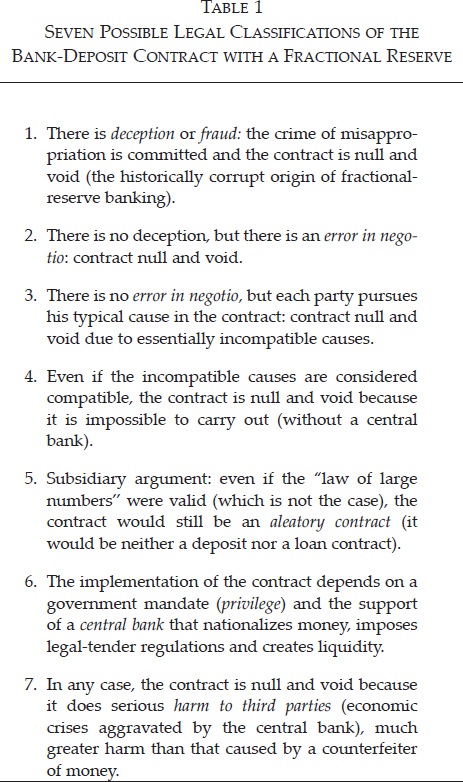
To conclude this section, the following table displays seven possible ways to legally classify the bank-deposit contract from the perspective of the logic inherent in the institution (and naturally, not from the viewpoint of positive law, which as we know, can give legal force to anything).
4
THE MONETARY IRREGULAR DEPOSIT, TRANSACTIONS WITH A REPURCHASE AGREEMENT AND LIFE INSURANCE CONTRACTS
In these first three chapters we have undertaken an analysis of the legal nature of the irregular deposit contract, and this analysis could serve, among other uses, as a reliable guide to identifying (from among the rich variety of legal contracts in the fast-changing real world) true loan contracts, irregular deposits in which the safekeeping obligation is met and contracts of a contradictory or even fraudulent nature. This is an important guide, as human ingenuity knows no bounds when it comes to attempting to fraudulently circumvent traditional legal principles for one’s own benefit and to the detriment of others.
Moreover, this danger is especially acute when legal principles are not adequately defined nor defended by public authorities, especially in a field, like that of finance, which is very abstract and difficult to understand for most citizens.
TRANSACTIONS WITH A REPURCHASE AGREEMENT
Whenever we observe, as in the monetary deposit, that the immediate availability of the good is offered to customers in order to attract their fundsand then invest their money or employ it in private transactions, etc., we should be on our guard, irrespective of the legal appearance of the transaction. For example, in certain contracts with a repurchase agreement, one of the parties commits to repurchase from the other, whenever requested by the second party, a security, right or financial asset at a prefixed price at least equal to that originally paid for the good. The intention in these cases, against legal principles, is to conceal a true monetary irregular-deposit contract, in which one of the contracting parties pursues the essential objective of guaranteeing the immediate availability of the good, and the other pursues the familiar, contradictory purpose or cause of gathering monetary resources to invest them in different business deals. In short, these are often even fraudulent transactions, in which the professional deposit “gatherer ” tries to convince his “customers” to turn over their available assets easily and without a heavy commitment, in exchange for the fundamental promise that their money will remain available to them and be returned to them whenever they desire (via the “repurchase agreement”).
We observe a similar case when, as often happens more or less explicitly in practice, an institution (for example, a bank) attempts to systematically maintain or “conserve” the market value of its stocks by carrying out a series of financial operations to indicate to the market that the sale of the stocks is “guaranteed” at a set price. If this is true, and to the extent that the general public believes it, we witness another transaction in which a monetary irregular-deposit contract is ultimately orchestrated via investment in securities, stocks or bonds whose liquidity on the market is implicitly “guaranteed” at all times by a trustworthy institution.Therefore, it is not surprising that many bank crises have arisen more from the massive sale of bank stocks than from a widespread withdrawal of deposits. These stocks were supposed to constitute a safe refuge for money while nearly guaranteeing its immediate availability. When the bank’s solvency comes into question, its securities are the first to be sold on a massive scale, rendering the bank unable to continue honoring its implicit commitment to maintain the market value of the stocks. At least in the past, these massive sales have resulted from the fact that the indiscriminate assistance supplied by central banks to private banks in times of need has not reached the point of continual preservation of shares’ current market price. The most recent bank crises in Spain and other countries have demonstrated that ultimately, the only “depositors” to lose out have been the stockholders themselves.
There are many other “borderline” cases. For example, some finance and holding companies, to encourage the subscription of their stocks, “commit” to repurchase them at the original price whenever requested by the shareholder. In general, we should be suspicious of any transaction with a repurchase agreement in which the price of the repurchase is fixed and is not the current price of the item on the corresponding secondary market.Hence, it falls to the jurist and the economist to employ their analytical judgment in the study of this economic-financial transaction and to decide exactly what type of operation it is, its true nature and its consequences, in light of the legal principles examined in these first three chapters and the economic implications we will now consider.Furthermore, this analysis would acquire vital importance if one day in the future the existent financial system based on the monopoly of a public central bank were ever completely privatized and a free-banking system subject to general legal principles were established. In this case, the current tangled web of administrative banking regulations would be replaced by a few clear, simple rules included in the Civil, Commercial and Penal Codes. The main purpose of these rules would be to guarantee adherence to the strict safekeeping principle (100-percent reserve requirement) regarding not only monetary demand-deposit contracts, but also any other economic-financial transaction in which the chief goal of the participants is to obtain custody and safekeeping for their deposits. In this (for now) hypothetical situation, the analysis we are proposing would greatly assist judges and jurists in making sense of the rich, extremely complex variety of contracts and transactions constantly emerging in the economic-financial world and would allow them to determine when to classify these transactions as null and void and/or criminal according to general civil and penal provisions.
At any rate, we should avoid a selfishly defeatist attitude common in the financial sector. It is based on the belief that human ingenuity will be capable of finding ever more sophisticated means of fraudulently evading universal legal principles and that therefore in practice they will never be obeyed and defended. We should avoid this defeatist posture, because the proliferation of ingenious ways to violate these principles stems precisely from the fact that public authorities have always defined and defended them in an extremely confusing, ambiguous and contradictory manner, and as a result there is no general awareness of the importance of respecting them. Quite the opposite is true. The prevailing values and ideas have over time become so corrupted that now people consider the irregular deposit contract with a fractional reserve to be legitimate. If general legal principles were again understood and respected, the number of irregular behaviors would decrease significantly (especially if public authorities really took care to preserve and defend the corresponding property rights). At the same time, the proven fact that human ingenuity continually searches for new ways to break the law and defraud others does not in the least detract from the fundamental importance of a set of clear principles to guide citizens and direct authorities in their duty to define and defend property rights.
THE CASE OF LIFE INSURANCE CONTRACTS
Life insurance is a typical time-honored legal institution, one that has been very well-formulated with respect to its essence and legal content and well-supported by actuarial, economic and financial practices. Nevertheless, lately some have tried to use it to conduct transactions which are very similar to the monetary irregular deposit with a fractional reserve. These attempts have been very detrimental to the development and traditional solvency of life insurance as an institution and have involved deceiving supposed “policyholders-depositors.”
Indeed, above all it is important to understand that the contract of life insurance bears no relation to the monetary irregular-deposit contract. Life insurance is an aleatory contract by which one of the parties, the contracting party or policyholder, commits to the payment of the premium or price of the operation, and in return the other party, the insurance company, agrees to pay certain benefits in the event that the policyholder dies or survives at the end of a term specified in the contract. Therefore, the premiums paid by the policyholder completely cease to be available to him, and availability is fully transferred to the insurer.Hence, all life insurance contracts involve an exchange of present, certain goods for future, uncertain goods (since their payment depends on an uncertain event, such as the death or survival of the policyholder). The life insurance contract is therefore equivalent to a savings transaction (in which the ownership and availability of present goods are relinquished in exchange for the ownership and availability of future goods), but it is a form of perfected savings, because it makes it possible to receive a considerable sum from the very moment the contract takes effect, given the anticipated, uncertain event takes place (for example, the policyholder dies). Any other traditional savings method (traditional mutuum or loan operation) would require a prolonged period of many years of saving to accumulate the capital paid by an insurance company in case of death. In other words, life insurance contracts, the calculation of probabilities based on mortality and survival tables, and the principle of mutualism or dividing loss among all policyholders sustaining an institution make it possible from the first moment to receive, should the anticipated event occur, a significant sum of money which, using other methods, could only be accumulated after a period of many years.
Moreover life insurance is a long-term contract which incorporates complex financial and actuarial components and requires the prudent investment of significant resources. The availability of these resources is transferred to the mutual or life insurance company, which must collect and invest the mathematically-calculated reserves necessary to make the future payments it will be obliged to make. These amounts are called “mathematical,” because they result from the calculation of probabilities of death and survival according to mortality tables, which are extremely reliable and highly constant for most western populations. It is possible to calculate, with as small a probability of ruin as is desired, the amount of money necessary to pay all guaranteed benefits. Later we will examine the radical differences which from an economic-financial standpoint exist between life insurance and the irregular deposit contract with a fractional reserve. As opposed to life insurance, the irregular deposit contract does not permit the calculation of probabilities, since the institution (fractional-reserve banking) does not exist completely independently of the recurrent massive withdrawal of deposits.
An added complexity emerges because some types of life insurance include the right of surrender. This means policyholders can cancel their contract and obtain in cash the mathematical liquidation value of their policy. Some theorists have defended the position that insurance policies which include this “surrender value” are very similar to monetary irregular-deposit contracts with fractional reserves.Against this view, it is important to point out that whether or not a covert irregular deposit exists depends ultimately on the true motive, purpose or subjective cause with which the contract is carried out. If, as is usual with traditional life insurance policies, the client intends to keep the policy until the end of its term and is not aware that he can redeem the funds at any time, then the transaction is clearly not an irregular deposit but a traditional life insurance contract. This type of insurance is sold with the idea that surrender is a “last resort,” a solution to be applied only in situations of pressing need when a family is completely unable to continue making payments on a policy which is so necessary for the peace of mind of all of its members.
However, we must acknowledge that (for the most part) recently banks and other financial institutions have exerted constant pressure to erase the fundamental, traditional distinctions and blur the boundaries between life insurance and bank-deposit contracts.
True monetary-deposit operations have begun to appear on the market disguised as life insurance policies. The main selling point presented to customers is that with these transactions they need not commit to a long-term savings operation involving regular payments, since the funds handed over to the insurance company may be recovered at any time with no penalty and no expense whatsoever (and may even include interest). One reason companies disguise these operations as life insurance policies is to take advantage of the customary tax incentives almost every government in the developed world grants insurance companies in recognition of their beneficial influence on society at all levels as promoters of voluntary saving and foresight, and hence on the sustained, noninflationary economic growth and development of the nation. Thus, bogus “life insurance” operations have been negotiated en masse and have really been nothing but camouflaged deposits made effortlessly by the public, who have held the idea that at any time their money could be recovered penalty-free if they needed it or simply wished to place it in another financial institution. This has generated a good deal of confusion. For instance, figures corresponding to bank deposits (operations completely unrelated to life insurance) have been included in the official statistics of life insurance premiums, and in the midst of the great confusion in the market, traditional life insurance policies have become discredited and their definition blurred.
Fortunately, normality is being restored, and both traditional private insurers and public authorities are beginning to realize that nothing hurts life insurance more than blurring the distinctions between it and bank deposits. This confusion has been detrimental to everyone: traditional life insurance, which has lost many of its tax incentives and faced increasing intervention and control by the central bank and monetary authorities; clients, who have taken out life insurance thinking they were making bank deposits and vice versa; banks, which on many occasions have attracted funds from true deposits (disguised as life insurance) and tried to make long-term investments with them, endangering their solvency; and finally, supervising public authorities, who have gradually lost control over the institution of life insurance, which has become blurred in its definition and to a great extent taken over by another institution (the central bank). Banks are a completely separate type of institution, whose financial and legal foundations leave much to be desired, as we are seeing.
_____________
See Bertrand de Jouvenel, “The European Intellectuals and Capitalism,” in Friedrich A. Hayek, ed., Capitalism and the Historians (Chicago: University of Chicago Press, 1954).
Shepard B. Clough, The Economic Development of Western Civilization (New York: McGraw-Hill, 1959), p. 109; italics added. See also chapter 4, n.7.
As we know, the fact that the monetary irregular deposit is a deposit contract means the actio depositi directa applies to it. Roman jurists developed this concept, which leaves it to the depositor to decide at any moment when his deposit is to be returned to him. This availability is so pronounced that the depositor ’s claim is considered equivalent to the ownership of the money deposited (since the tantundem of the deposit is fully and immediately available to him).
See Luis de Molina, Tratado sobre los cambios, edited and prefaced by Francisco Gómez Camacho, Disputation 408, 1022 d., p. 138. As we have seen, Juan de Lugo shares Molina’s viewpoint, and Domingo de Soto does also, though to a much lesser degree. All other members of the School of Salamanca, particularly Dr. Saravia de la Calle, being wise jurists true to Roman tradition, were against fractional-reserve banking despite the pressures they were subjected to and the practices they witnessed.
See F.A. Hayek, “Richard Cantillon (1680–1734),” in The Collected Works of F.A. Hayek, vol. 3: The Trend of Economic Thinking: Essays on Political Economists and Economic History, p. 159. See also the classic article by Henry Higgs, “Richard Cantillon,” in The Economic Journal 1 (June 1891): 276–84. Finally, A.E. Murphy, Richard Cantillon: Entrepreneur and Economist; and the report by Cantillon’s lawyer Henri Cochin, Memoire pour Richard Cantillon.
On this topic see pp. 194ff. in the “Dictamen de Joaquín Garrigues,” included in the book, La cuenta corriente de efectos o valores de un sector de la banca catalana y el mercado libre de valores de Barcelona, pp. 159–209. In this remarkable book, many of the arguments against the thesis that full availability is transferred in the irregular deposit of securities as fungible goods are therefore also directly applicable to criticism of the same theory with respect to the irregular deposit of money as a fungible good. We will incorporate these arguments into our study whenever appropriate.
The opposite would be an inadmissible logical contradiction; Florencio Oscáriz Marco, however, makes such an error. He maintains that deposits of bulk goods are not irregular deposits “because there is no power to use them and even less to take them at will, only power to mix them,” while in the case of deposits of another fungible good (money), he mysteriously does consider there to be a transfer of power over use and availability, a transfer converting deposits into “loans.” In addition to this conceptual error, Oscáriz makes an error in terminology: he cites the decision of the Spanish Supreme Court regarding a deposit of oil made by some olive dealers (Spanish Supreme Court decision of July 2, 1948) in an analysis of the “unique case” of deposits of bulk goods. In actuality the bulk goods deposit is the best model example imaginable of a deposit of fungible goods or irregular deposit. See Oscáriz Marco, El contrato de depósito: estudio de la obligación de guarda, pp. 110–12.
See La cuenta corriente de efectos o valores de un sector de la banca catalana y el mercado libre de valores de Barcelona.
This type of ruling contrasts with the trend of sound judgments established by the declaration that American grain depositaries acted fraudulently in the 1860s when they appropriated a portion of the grain deposits they were to safeguard and speculated with it on the Chicago market. In response to this disconcerting event, Rothbard wonders:
[W]hy did grain warehouse law, where the conditions—of depositing fungible goods—are exactly the same . . . develop in precisely the opposite direction? . . . Could it be that the bankers conducted a more effective lobbying operation than did the grain men?
See Murray N. Rothbard, The Case Against the Fed (Auburn, Ala.: Ludwig von Mises Institute, 1994), p. 43. The same valid legal doctrine has been evident in Spanish court decisions regarding bulk deposits of oil in olive oil mills. (See the Spanish Supreme Court decision of July 2, 1948.)
See the note on p. 73 of the book by E.T. Powell, Evolution of Money Markets (London: Cass, 1966), and Mark Skousen’s comments on this decision in his book, The Economics of a Pure Gold Standard (Auburn, Ala.: Ludwig von Mises Institute, 1977), pp. 22–24. Two precedents of Lord Cottenham’s decision were Sir William Grant’s ruling of 1811 in Carr v. Carr and the judgment delivered five years later in Devaynes v. Noble. See J. Milnes Holden, The Law and Practice of Banking, vol. 1: Banker and Customer (London: Pitman Publishing, 1970), pp. 31–32 and 52–55.
Incrediby, Cantillon does not mention in his Essai this then wellknown fact under the pretext that “he could not get the exact information about . . . cash kept in the vaults to pay all deposits” (p. 407). It must be assumed that the Essai was mainly written to facilitate Cantillon’s defense in his lawsuits against his claimants.
José Luis Albácar López and Jaime Santos Briz, Código Civil: doctrina y jurisprudencia (Madrid: Editorial Trivium, 1991), vol. 6, p. 1770. Navarra’s civil code, in law 554 at the end of title 12, also makes reference to the irregular deposit:
When in the deposit of a fungible good the depositary is either expressly or tacitly granted the power to use the good, the provisions established for the monetary loan in laws 532, 534 and 535 shall be applied.
As we see, the content of Article 1768 of the Spanish Civil Code is repeated here almost literally.
Curiously Spanish banks, when specifying the general conditions for their different checking account contracts, avoid using the word “deposit” for fear of the legal repercussions of such a contract (especially charges of misappropriation). They also avoid the words “loan” and “credit” because, although they would be legally covered if they called monetary irregular deposits “loans,” it is obvious that business-wise, it would be much harder to attract deposits from customers if they were generally aware that in opening a checking account they are actually loaning money to the bank rather than making a deposit. Consequently, bankers prefer to maintain the current ambiguity and confusion, since the existing contractual obscurity benefits them as long as they enjoy the privilege of using a fractional-reserve ratio and are backed by the central bank in the event of a liquidity crisis. However, bankers’ own legal classifications of their operations sometimes give them away. For example, the sixth general condition established by the Banco Bilbao-Vizcaya for draft discounting reads as follows:
Regardless of the different accounts and operations of the assignor, whether in cash, securities, collateral, guarantees or another type of document representing them, and notwith-standing the manner in which they are itemized . . . the bank is authorized to offset them by the loans it chooses to contract for any entitlement, including any type of deposit . . . this condition shall apply even to operations and loans which the assignor holds against the bank prior to the current transaction.
Moreover, whereas the Banco Bilbao-Vizcaya, in reference to the demand deposit represented by the so-called “savings passbook,” classified the latter as “the justificatory claim representing the right of the holder to request and obtain full or partial repayment of the balance in his favor,” the Banco Hispano-Americano went even further, establishing that the passbook “constitutes the nominative and non-negotiable document which is evidence of the holder ’s ownership.” As we see, in the latter case, the bank, without realizing it, attributes ownership status to the deposit contract; incidentally, this classification is much closer to the true legal nature of the institution (given the continuous availability in favor of the depositor) than that of a mere loan claim on the deposited sum. On this subject, see Garrigues, Contratos bancarios, pp. 368–79, footnotes 31 and 36. Garrigues notes that private bankers do not refer directly to monetary deposit contracts by name, but instead usually call demand deposits checking accounts, as revealed by an examination of deposit slips and general terms of accounts, as well as by bank statements, balance notices, etc. Moreover, this reluctance to speak of “monetary deposits” is evident even on bank balance sheets where there is never any mention of such a heading and where monetary irregular deposits are instead entered under “Checking Accounts” in the corresponding liabilities column under “Creditors.” Thus from a legal and contractual standpoint, with the consent of financial authorities, bankers purposefully contrive to conceal the true legal nature of their activities, especially from third parties and clients. The effects of the confusion created by banks are studied by Jörg Guido Hülsmann in his article, “Has Fractional-Reserve Banking Really Passed the Market Test?” The Independent Review 7, no. 3 (Winter, 2003): 399–422.
Garrigues, Contratos bancarios, p. 363; italics added.
Strangely, our top commercial law scholar rushes into an attempted justification of fractional-reserve banking while preserving the concept of the irregular deposit through the artifice of a redefinition of availability, without pausing first to examine the factors that make it impossible to equate the irregular deposit contract and the loan contract. It is as if Garrigues were ultimately aware that his redefinition implicitly entails equating deposits and loan contracts—at least from the banker ’s (the recipient’s) perspective. For this reason it does not behoove him to advance a detailed argument against equating deposits and loans, because such an argument would backfire on the doctrine he later defends. This attitude is quite understandable in a famed scholar whose chief customers were the country’s banks and bankers and who would therefore think twice before jeopardizing his prestige and academic standing by questioning the legitimacy of such an influential institution as fractional-reserve banking, which was rooted in practice and government-endorsed. In addition, during the years when Garrigues was developing his theories, he could only depend for support on an economic theory which, paralyzed by Keynesian doctrines (see footnote 21 in ibid.), justified any system of credit expansion, no matter how expedient, on the mistaken assumption that this would benefit “economic activity.” During those years of doctrinal poverty in economics, the only possible defense for the processes of social interaction against banking practices would have been strict observance of the basic principles governing the irregular deposit, which unfortunately received very weak support from mainstream theorists and were quickly abandoned. Despite all of these adverse circumstances, the writings of Garrigues and others who concentrate on the same topic, an unmistakable impression persists: that in order to justify the unjustifiable, theorists carry out the most forced legal reasoning and maneuverings to disguise as legal an activity that results from an unseemly, unlawful privilege granted by the government.
See, for example, the legal treatment Jean Dabin gives the cause of contracts in La teoría de la causa.
For Antonio Gullón,
the equating of the irregular deposit with the mutuum is still an artifice that conflicts with the true will of the parties. The depositor of money, for example, does not intend to grant a loan to the depositary. Just as in the regular deposit, he desires the safekeeping of the good and to always have it available. He happens to achieve these objectives more easily with the irregular deposit than with the regular deposit, since with the latter he risks the loss of his deposit in the event of an unavoidable accident, and he would bear the loss instead of the depositary. Meanwhile, in the irregular deposit, the depositary is the debtor of a type of good, which as such is never lost. (Italics added)
Cited by José Luis Lacruz Berdejo, Elementos de derecho civil, 3rd ed. (Barcelona: José María Bosch, 1995), vol. 2, p. 270.
This subjectivist conception is the basis of the logic of action on which all economic theory is constructed, according to the Austrian School of economics, founded by Carl Menger. On this topic, see our article, “Génesis, esencia y evolución de la Escuela Austriaca de Economía,” published in Huerta de Soto, Estudios de economía política, pp. 17–55.
Francisco Belda, following the example of Luis de Molina and Juan de Lugo, believes he resolves this contradiction with the facile, superficial assertion that “each of the two has the perfect right to view the operation from the angle which most behooves him.” However, Belda fails to realize that, as there is an essential difference and a contradiction between the causes motivating the parties to enter into the contract, the problem is quite another: it is not that each party views the contract as most behooves him, but rather that the fulfillment of the aim or cause of one party (the investment of funds by the banker) prevents the successful fulfillment of the aim or cause of the other (the custody, safekeeping and continual availability of the money). See Belda, S.J., “Ética de la creación de créditos según la doctrina de Molina, Lesio y Lugo,” pp. 64–87. See also Oscáriz Marco, El contrato de depósito: estudio de la obligación de guarda, footnote 83, p. 48.
The fact that depositors sometimes receive interest in no way detracts from the essential purpose of the deposit (the safekeeping of money). Since interest is attractive, the unsuspecting depositor will jump at the offer of it if he still trusts the banker. But in the case of a true deposit, the depositor would enter the contract even if he were not to receive any interest and had to pay a safekeeping fee. The essential nature of the contract is not altered by the unnatural payment of interest to depositors, and only indicates that bankers are making undue use of the money placed with them.
Significantly, the only theoretical reference cited by Garrigues in his book, Contratos bancarios, is Keynes’s Treatise on Money, which he expressly mentions at least twice in the main text (pp. 357 and 358) and twice in the footnotes (pp. 352 and 357, footnotes 1 and 11, respectively). With such a theoretical basis, the confusion evident in Garrigues’s entire discussion of the irregular deposit is hardly surprising. It seems as if his remarkable legal instinct were pointing him in the right direction, while the economic treatises he was reading on banking were leading him astray.
Garrigues, Contratos bancarios, p. 367; italics added. It is surprising that Garrigues has not realized that in economic terms, dual availability means “it becomes possible to create a fictitious supply of a commodity, that is, to make people believe that a supply exists which does not exist.” See William Stanley Jevons, Money and the Mechanism of Exchange (New York: D. Appleton, 1875 and London: Kegan Paul, 1905), p. 210. Convincing the public of the existence of a fictitious stock of fungible goods is definitive proof of the illegitimacy of all irregular deposits (of fungible goods) in which a fractional-reserve ratio (any ratio under 100 percent) is allowed.
Garrigues, demonstrating his characteristic gift of expression, concludes that in this contract “the banker counts on the money as if it were his, and the customer counts on the money even though it is not his.” The solution to this apparent paradox is very simple, because although the customer has ceased to own the money, he retains the right to demand the custody and safekeeping of the tantundem by the banker at all times; that is, a 100-percent reserve ratio, in keeping with the essential, ontological legal nature of the monetary irregular-deposit contract, which we covered in chapter 1. See Garrigues, Contratos bancarios, p. 368.
Ibid., footnote 31 on pp. 367–68.
Coppa-Zuccari, Il deposito irregolare, p. 132.
See Hernández-Tejero Jorge, Lecciones de derecho romano, pp. 107–08. Hernández-Tejero himself provides the following example, which is perfectly applicable to the case we are dealing with: “If one person entrusts to another a good on deposit, and the person receiving the good believes the transaction to be a mutuum or loan, then neither a deposit nor a mutuum exists.”
Furthermore, it is obvious that permission or authorization to use the good cannot be assumed but must be proven in each case. It seems unlikely that in most demand deposit contracts entered into by individuals such proof would be possible.
On aleatory contracts see Albaladejo, Derecho civil II, Derecho de obligaciones, vol. 1: La obligación y el contrato en general, pp. 350–52. It is important to emphasize that the fact that there is an aleatory nature to the monetary irregular-deposit contract with a fractional reserve in which the law of large numbers is fulfilled (in fact impossible) is only secondary to the other points we raise against such a contract.
The popular reaction of Argentinian citizens against the banking crisis of 2001 and the subsequent blockade of their demand deposits (known as corralito) is a perfect empirical illustration of the true safekeeping purpose of bank deposit contracts and of the impossibility of fractional-reserve banking (without a lender of last resort).
“Dictamen del señor de Diego (Felipe Clemente)” in La cuenta corriente de efectos o valores de un sector de la banca catalana y el mercado libre de valores de Barcelona, pp. 370–71. It is true that Felipe Clemente de Diego makes this comment in response to the argument of bankers who wished to defend the validity of the contract of irregular deposit of securities, with a fractional-reserve ratio, in which the depositary would be permitted to freely use the deposited goods, like in the monetary irregular-deposit contract. Yet as we have already mentioned, the arguments for and against either institution are identical, as both are contracts of the irregular deposit of fungible goods, whose legal nature, cause, purpose and circumstances are the same. Pasquale Coppa-Zuccari also highlights the contradictory nature of the monetary bank-deposit contract which, in the form in which it has been “legalized” by governments, is neither a deposit nor a loan, “La natura giuridica del deposito bancario,” Archivio giuridico “Filippo Serafini,” Modena n.s. 9 (1902): 441–72.
We do not support the doctrine that time “deposits” are not loan or mutuum contracts from the legal perspective, since both their economic and legal natures reflect all the fundamental requirements we studied in chapter 1 for a loan or mutuum. Among the scholars who attempt to justify the theory that time “deposits” are not loans, José Luis García-Pita y Lastres stands out with his paper, “Los depósitos bancarios de dinero y su documentación,” esp. pp. 991ff. The arguments García-Pita y Lastres offers here on this topic fail to convince us.
That is, fractional-reserve banking conflicts with traditional legal principles and only survives as a result of an act of coercive intervention found in a mandate or governmental statutory privilege, something that other economic agents cannot take advantage of and which expressly states that it is legal for bankers to maintain a fractional-reserve ratio (Article 180 of the Spanish Commercial Code).
Garrigues, Contratos bancarios, p. 375.
Ibid., p. 365.
Ibid., p. 367. García-Pita y Lastres defends the same theory in his paper “Los depósitos bancarios de dinero y su documentación,” where he concludes that
under the circumstances, instead of regarding “availability” as the simple right to claim immediate repayment, we should consider it a combination of behaviors and economic and financial activities aimed at making repayment possible. (p. 990)
He continues in the same vein in his paper “Depósitos bancarios y protección del depositante,” pp. 119–226. Also espousing this view, Eduardo María Valpuesta Gastaminza argues that
the bank is under no obligation to hold the deposited good, but rather custody becomes a responsibility to prudently manage both the customers’ and the bank’s resources, and to keep these available, which is also ensured by legitimate governmental regulations (which set the reserve requirement, limits to risk-taking, etc.). (pp. 122–23)
See “Depósitos bancarios de dinero: libretas de ahorro” in Contratos bancarios, Enrique de la Torre Saavedra, Rafael García Villaverde, and Rafael Bonardell Lenzano, eds. (Madrid: Editorial Civitas, 1992). The same doctrine has been endorsed in Italy by Angela Principe in her book La responsabilità della banca nei contratti di custodia (Milan: Editorial Giuffrè, 1983).
Garrigues, Contratos bancarios, p. 365.
Furthermore, the standard criterion of “prudence” is not applicable in this case: an imprudent bank may be successful in its speculations and preserve its solvency. By the same token, a very “prudent” banker may be seriously affected by the crises of confidence that inevitably follow artificial booms, which are generated by the fractional-reserve banking system itself. Hence, prudence is of little use when there is a violation of the only condition capable of guaranteeing the fulfillment of the bank’s commitments at all times (a 100-percent reserve ratio).
Rothbard, The Case Against the Fed, pp. 90–106. This is how Rothbard explains the leading role private bankers, especially J.P. Morgan, played in the creation of the American Federal Reserve:
J.P. Morgan’s fondness for a central bank was heightened by the memory of the fact that the bank of which his father Junius was junior partner—the London firm of George Peabody and Company—was saved from bankruptcy in the Panic of 1857 by an emergency credit from the Bank of England. The elder Morgan took over the firm upon Peabody’s retirement, and its name changed to J.S. Morgan and Company. (p. 93 footnote 22)
Hayek, The Fatal Conceit, pp. 103–04.
Many “irregular ” transactions are accompanied by the “guarantee” of continuous availability to persuade the customer that there is no need to relinquish it nor make the sacrifice required by lending. This practice makes attracting funds much easier, especially when the customer is naïve and can be tempted (as in any sham or swindle) with the possibility of obtaining high profits with no sacrifice nor risk.
If we carry this line of reasoning to extremes, the entire stock market could be viewed as an orchestrator of true deposits if the state were to at all times guarantee the creation of the liquidity necessary to maintain stock market indexes. For reasons of public image, governments and central banks have insisted on pursuing this objective and policy at least occasionally, during many stock market crises.
Another example of a simulated deposit is a temporary assignment with an agreement of repurchase on demand. This transaction is conducted as a loan from customer to bank: Collateral is offered in the form of securities, normally national bond certificates, in case of noncompliance by the depositary. The loan bears interest at an agreed-upon rate up until a specified date and is repayable at the simple request of the “lender ” prior to that date. If he exercises this option of early cancellation, the resulting amount to be paid him is calculated by compounding the interest on the original amount at the agreed-upon rate up until the date he exercises the option. For the client, this operation is identical to a loan backed by securities, combined with an American option. An option is an agreement conferring the right, not the obligation, to buy or sell a certain quantity of an asset on a particular date or up until a particular date. An option to purchase is a call option, and an option to sell, a put option. If the right granted lasts until a specified date, the option is called an “American” option; if it refers to a particular date, a “European” option. The acquirer of the right compensates the other party via the payment of a premium at the moment the contract is finalized. The client will exercise his option only if the interest rates paid on new time deposits maturing at the same time as his exceed the rate he originally negotiated. He will not exercise the option if interest rates fall, even if he needs the liquidity, because he will normally be able to take out a loan for the remainder of the term at a lower rate of interest and provide the bond certificates as collateral. Some institutions even offer these contracts accompanied by the cashier services typical of checking accounts, so the customer can issue checks and pay bills by direct debiting. Banks use this contract as a way to speculate with securities, since the public finances them and banks keep the profits. We are grateful to Professor Ruben Manso for providing us with some details of this type of operation.
Another interesting question is how to determine in practice when time “deposits” (loans) with a very short term become true deposits. Although the general rule is clear (the subjective intention of the parties must prevail, and upon maturity all loans become deposits requiring a 100-percent reserve until withdrawn), for practical purposes a temporary limit is often needed (a month? a week? a day?), under which loans granted to the bank should be regarded as actual deposits. As for the socalled secondary medium of exchange, which are not money but can be converted into cash very easily, meriting an additional premium for their purchase on the market, see Mises, Human Action, pp. 464–67.
In the model we propose (and which we will consider in greater detail in the last chapter), the control exerted in the financial sphere by the central bank and its officials would be replaced by that of judges, who would recover their full authority and central role in the application of general legal principles in the financial area as well.
As life insurance entails disciplined saving over a period of many years, it is much more difficult to sell than other financial products sold with the guarantee that the customer ’s money will remain continuously available to him (deposits). For this reason life insurance is sold through a costly network of salespeople, while the public goes willingly and without prompting to make bank deposits. Life insurance companies foster and encourage voluntary, long-term saving, whereas banks produce loans and deposits from nothing and require no one to make the prior sacrifice of saving.
Murray N. Rothbard, “Austrian Definitions of the Supply of Money,” in New Directions in Austrian Economics, Louis M. Spadaro, ed. (Kansas City: Sheed Andrews and McMeel, 1978), pp. 143–56, esp. pp. 150–51. Rothbard’s position is fully justified, however, with respect to all the new “life insurance” operations conceived to simulate deposit contracts.
Furthermore the surrender of the insurance policy traditionally entails a significant financial penalty for the policyholder. This penalty results from the company’s need to amortize the high acquisition costs it incurs during the first year of the contract. The tendency to reduce these penalties is a clear indication that the operation has ceased to be a traditional life insurance policy and has become a simulated bank deposit.
As we will see at the end of chapter 7, from 1921 to 1938, while chairman of the National Mutual Life Assurance Society, a leading British life insurance firm, John Maynard Keynes played a key role in the corruption of traditional principles governing life insurance. During his chairmanship, he not only promoted an “active” investment policy strongly oriented toward variable-yield securities (abandoning the tradition of investing in bonds), but he also defended unorthodox criteria for the valuation of assets (at market value) and even the distribution of profits to policyholders through bonuses financed by unrealized stock market “earnings.” All these typical Keynesian assaults on traditional insurance principles put his company in desperate straits when the stock market crashed in 1929 and the Great Depression hit. As a result, Keynes’s colleagues on the Board of Directors began to question his strategy and decisions. Disagreements arose between them and led to Keynes’s resignation in 1938, since, as he put it, he did not think “it lies in my power to cure the faults of the management and I am reluctant to continue to take responsibility for them.” See John Maynard Keynes, The Collected Writings (London: Macmillan, 1983), vol. 12, pp. 47 and 114–54. See also Nicholas Davenport, “Keynes in the City,” in Essays on John Maynard Keynes, Milo Keynes, ed. (Cambridge: Cambridge University Press, 1975), pp. 224–25. See also footnote 108 of chapter 7.
In short, the apparent boom in life insurance sales was an illusion, since the figures actually corresponded to radically different operations, i.e., fractional-reserve bank deposits. These figures completely lose their splendor if, instead of contrasting them with traditional life insurance sales (much more modest, since abnegation and a long-term commitment to saving and foresight are required), we compare them to the total of a country’s bank deposits, of which they make up only a small percentage. When only genuine life insurance sales are included in sector statistics, the situation is put back in perspective, and the mirage everyone (especially the government) strained to see vanishes.

